
Hyundai & FORD Just SHOCKED the Auto Industry | Episode 1047
About this episode
Ford and Hyundai are both making truck headlines, but for very different reasons. Ford expects uneven F-series inventory after a Q1 supplier fire, with F-series sales down 16% and lots of unsold 2025-or-older F-150s sitting for months. Hyundai, meanwhile, teased a rugged body-on-frame concept aimed at Bronco-style buyers, with production years away (2029). The hosts debate whether the market is cooling on full-size trucks and whether smaller/mid-size pickups are the real play. They also react to Dodge teasing a sub-$30k sports car (likely PR) and Subaru’s new EV push backed by heavy 0% financing.
caredge.com
"Today's show is brought to you by caredge.com. If me and my dad can help you out with anything car related, we'd love to. Back at caredge.com, we provide a car buying service that takes care of research, dealer outreach, and even negotiation."
CarEdge is a service that helps you buy a car. They do research, contact dealers, and help negotiate so you can get a better deal without the hassle.
CarEdge (caredge.com) is presented as a car buying service. The host says it handles research, dealer outreach, and negotiation so buyers can compare real offers and reduce stress.

Ford F150S
"Ford experienced significant sales downturns, including some sales slowdowns with their F-150s. Ford is saying that there's the potential... some of their shipments for new vehicles could be disrupted in inventory levels..."
The Ford F-150 is Ford’s most popular pickup truck. They’re saying supply issues could make it harder to have the right number of trucks available.
The Ford F-150 is Ford’s flagship full-size pickup. The segment highlights sales slowdowns and the risk that shipments could be disrupted, which can lead to uneven inventory.

Toyota Fj
"That looks like a Toyota FJ Cruiser on steroids. Oh, I think they're competing with the Bronco..."
The Toyota FJ Cruiser is a retro-styled off-road SUV known for its boxy design and off-road capability. The host uses it as a visual comparison for Hyundai’s new body-on-frame truck concept.
New York International Auto Show
"They revealed this at the New York International Auto Show. Dad, I think Hyundai's taken a shot here at Ford as well as potentially Toyota as well."
The New York International Auto Show is an event where automakers unveil new vehicles and concepts to generate media attention. The host notes Hyundai revealed the Boulder there, tying the announcement to the broader industry news cycle.

Hyundai Santa Cruz
"Yeah, isn't that interesting that Hyundai, whose only attempt so far in the small pickup truck category was the Santa Cruz, and the keyword there is was because it's being discontinued. That didn't go well,"
The Hyundai Santa Cruz is Hyundai’s small pickup that was positioned as a crossover-like truck. The segment notes it’s being discontinued, which frames Hyundai’s pivot toward competing in the “real truck” market.

Ford Bronco
"Bronco sales maybe not as high as Ford would like, but obviously, they're selling those vehicles."
The Ford Bronco is Ford’s rugged, off-road SUV. The hosts bring it up to show that vehicles aimed at off-roading can still be popular with buyers.
The Ford Bronco is Ford’s off-road-focused SUV, and the hosts reference Bronco sales as a sign that this kind of rugged vehicle can sell. Mentioning it sets the context for why Hyundai would want to compete in a similar “off-road credibility” space.
2029
"And if Hyundai does this, I mean, they're talking about, what, 2029? Yeah, 2029 is when you would anticipate seeing this."
They mention 2029 as the expected timeframe. That means this idea is more of a future plan than something you’d see right away.
The segment suggests a timeline of 2029 for when Hyundai would anticipate seeing this new truck concept in the market. This helps listeners understand it’s a longer-term product plan rather than an immediate model change.
imitation is the sincerest form of flattery
"And the first conclusion you come to is that imitation is the sincerest form of flattery. I mean, they are not bashful about who they steal their styling cues from."
It’s a saying that means copying someone can be a compliment. Here, it’s being used to talk about how car companies borrow design ideas from others.
This phrase is used to describe how copying or borrowing design ideas from competitors can be seen as a form of praise. In automotive terms, it points to how manufacturers may adopt popular styling cues to accelerate consumer acceptance.
truck market
"I think they are looking at some of the other automakers who have had success in the truck market because ultimately, that's what the bolder concept is."
The truck market is the business of selling pickups. The hosts are saying Hyundai is trying to break into that market because it’s where some automakers have been doing really well.
The truck market is a major U.S. vehicle segment where demand, pricing, and incentives can differ sharply from cars and crossovers. The speaker suggests Hyundai is entering this space with a strategy that mirrors how successful brands built momentum in pickups.
watermark here of how expensive these trucks can get
"So maybe we're finally finding the watermark here of how expensive these trucks can get."
They’re basically saying there’s a point where trucks get so expensive that people stop buying as much. It’s about how price affects demand.
“Watermark” here is being used as a threshold—an implied maximum price point where demand starts to fall. It’s a way of describing pricing sensitivity in the truck market, especially when inventory and production constraints also play a role.
111 days, 114 days, 260 days, 345 days
"You can see here, man, 111 days, 114 days, 260 days, 345 days, 267 days. These vehicles... are not moving fast at all."
This is basically how long trucks have been sitting at dealerships. The longer they sit, the harder it is for dealers to sell them at current prices.
Those numbers describe how long specific vehicles have been sitting on dealer lots (days of inventory). Longer days-to-sell typically means weaker demand, less favorable pricing, or both—especially for prior-year models.
General Motors
"Chevrolet sales, General Motors sales were down, what were they? They were down like 9%."
General Motors is the company that owns brands like Chevy and GMC. The point here is that GM’s overall sales are down, so the slowdown is affecting more than one truck line.
General Motors (GM) is the parent company behind Chevrolet and GMC. The host references GM sales being down (about 9%), using it as evidence that the truck market weakness is broader than just one automaker.
pickup trucks
"Two years ago when I was thinking about this. But my thoughts go to maybe people have satiated their appetite for pickup trucks. And let me just say this, with the advent of gas prices going up, that can factor into it as well."
They’re talking about what people want to buy in pickup trucks. The big idea is that demand can change when gas gets more expensive, and that affects what truck sizes automakers should sell.
The discussion is about how consumer demand for pickup trucks is shifting. It connects that shift to factors like fuel prices and how automakers decide which truck sizes to focus on.
selling out
"This is a fantastic point here. Dad, the smaller and mid-size truck segment is performing incredibly well. Ford is selling out of the Maverick."
“Selling out” means the dealership runs out of that model quickly. When that happens, dealers may charge more because buyers are still trying to get one.
“Selling out” means a model’s inventory is quickly depleted because demand exceeds supply. That situation often leads to higher pricing pressure, including dealer markups, since buyers compete for limited units.
smaller truck space
"Toyota has threatened and put out some marketing materials that suggest they're going to play in the smaller truck space. Again, the number of people that just want early 2000s, early 2010s Tacoma, people are out there that want those, much smaller pickup trucks."
They mean the market for smaller pickup trucks. The idea is that some buyers want a truck that’s easier to live with and more fuel-efficient than big full-size trucks.
“Smaller truck space” refers to the market for compact and mid-size pickups rather than full-size trucks. The speaker ties it to buyers who want the feel of early 2000s/early 2010s Tacoma-sized trucks.

Tacoma
"Again, the number of people that just want early 2000s, early 2010s Tacoma, people are out there that want those, much smaller pickup trucks."
They’re talking about the Toyota Tacoma as a popular smaller truck people remember fondly. The claim is that some buyers want trucks closer in size to those older Tacomas.
The Toyota Tacoma is used as an example of the kind of smaller pickup buyers are nostalgic for. The speaker suggests there’s a customer base that specifically wants the size and character of Tacoma-era trucks from the early 2000s and early 2010s.
fees
"...they were marked down to $43,000, and then, you know, with fees, you're back up close to $50,000..."
Car “fees” are extra charges added on top of the advertised price. The point here is that the final price can jump a lot once those extras are included.
In car pricing, “fees” can include dealer add-ons and government/administrative charges that raise the final transaction price beyond the advertised sticker. The segment uses this to explain why a seemingly good price can turn into a much higher out-the-door cost.
uptick in sales
"...that's why we're seeing the uptick in the Maverick sales and other mid-size and smaller pickups."
An “uptick in sales” means sales are increasing over a recent period. In this segment, it’s used to support the idea that consumers are moving toward smaller, more affordable trucks as full-size options become harder to justify.
sub-$30,000 sports car
"Dodge is teasing a sub-$30,000 sports car. It's going to come with style, attitude, and performance."
A “sub-$30,000” sports car implies a low entry price for a segment that’s usually more expensive. The speaker treats it as a potential strategy to regain attention, but questions whether it’s real or just a teaser.
plausible deniability
"well, we can't confirm or deny. What are we in the State Department or something? They want plausible deniability."
Plausible deniability means you can pretend you didn’t really commit to something because your wording is vague. The speaker is saying the company’s messaging might be intentionally unclear.
“Plausible deniability” is a political/PR concept meaning you can avoid being held accountable because your statements are vague or can be interpreted multiple ways. Here, it’s used to criticize how automakers might talk around whether a rumored car will actually be built.
0% financing for 75 months
"already, Dad, the manufacturer is offering 0% financing [1216.6s] for 75 months"
This is a financing promotion where the loan has no interest for a long time—75 months. It’s meant to make the monthly payment easier, often because the car isn’t selling as well as expected.
“0% financing for 75 months” is a promotional auto loan offer where the buyer pays no interest rate (or the effective rate is subsidized by the manufacturer). These deals are often used when a model isn’t moving quickly, because they reduce the monthly payment burden.
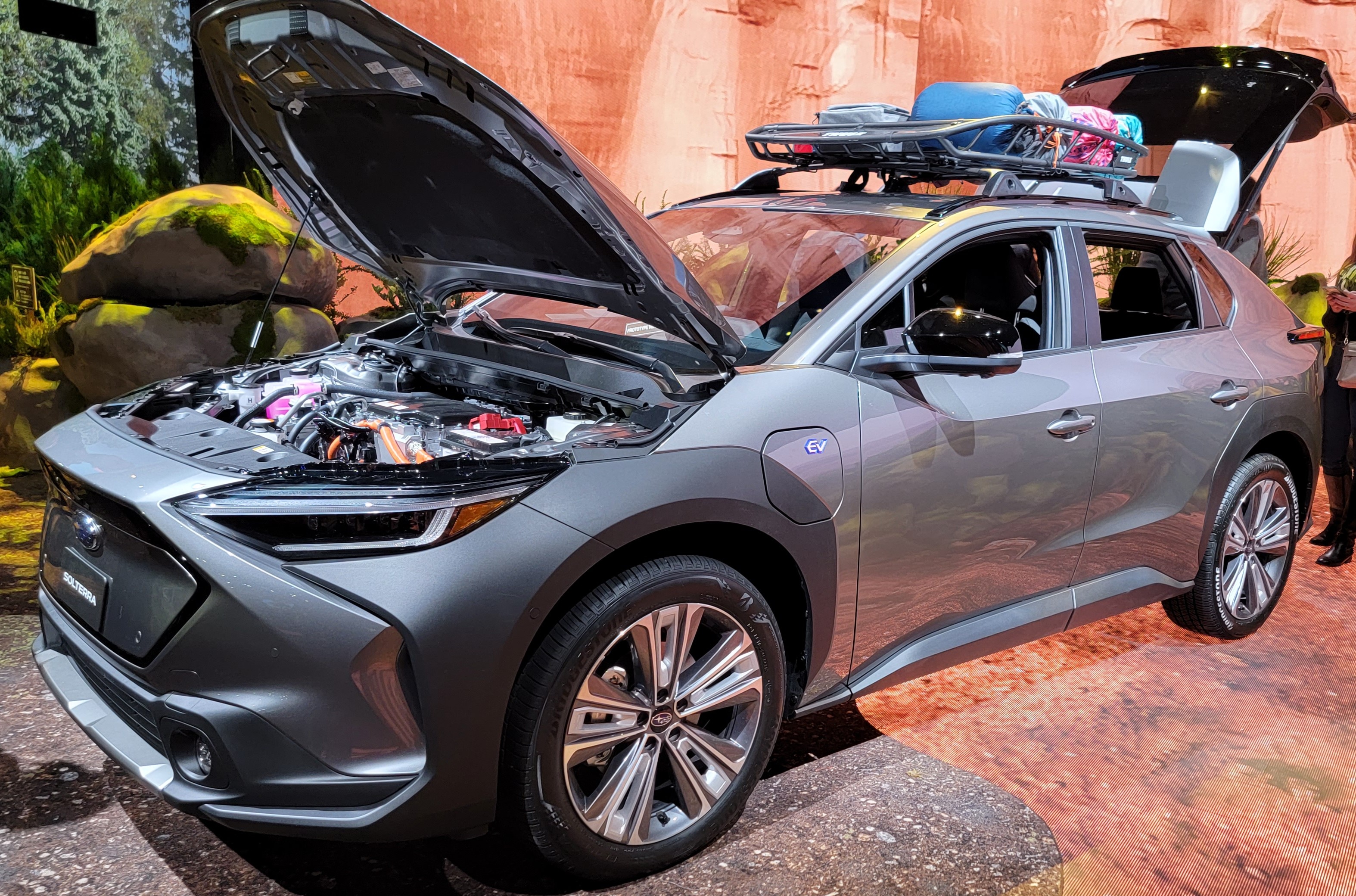
Subaru Solterra
"After the Soltera came out, [1224.3s] did not sell at all."
They mention the Subaru Solterra as an EV that didn’t sell well. It’s being used to show a pattern with Subaru’s electric lineup.
The Subaru Solterra is Subaru’s earlier electric vehicle that the speaker says “did not sell at all.” It’s used as a comparison point to argue that Subaru’s newer EVs are also struggling and may require incentives.
manufacturer incentives
"Uncharted [1248.1s] and Trailseeker here from Subaru, obviously not selling well, getting big manufacturer incentives."
Incentives are deals the car company offers to get people to buy. Here, the speaker thinks the big incentives show the EVs aren’t selling well.
Manufacturer incentives are discounts or promotional offers (like subsidized financing) used to encourage purchases. In this segment, the speaker treats incentives as evidence of weak demand for the newly launched EVs.
car payment calculator
"Plug that into the car calculator, the car payment calculator, and see how much, [1299.8s] and let's just use their price of $43.8"
A car payment calculator helps estimate what you’d pay each month. They’re using it to show how much interest rate changes the monthly cost.
A car payment calculator estimates monthly payments based on price, down payment, term length, and interest rate. The speaker uses it to compare how expensive the same vehicle would be under a typical interest rate versus a promotional 0% offer.
MSRP
"relative to the MSRP. MSRP is $43,44. $43, yeah. A third, you're underwriting a third of the MSRP just to sell this vehicle."
MSRP is the car’s official sticker price. Dealers may sell for less, but MSRP is the baseline number manufacturers publish.
MSRP (Manufacturer’s Suggested Retail Price) is the sticker price a manufacturer sets for a vehicle. The speaker compares the incentive amount to MSRP to argue that the discount is unusually large relative to the car’s list price.
Powertrain
"We're looking at new Subarus. I want more filters. I want Powertrain, and I want EV."
Powertrain is what makes the car move—like the engine or electric motor system. On a car listing site, it’s used to filter what kind of vehicle it is (EV vs gas).
Powertrain refers to the components that generate and deliver power—like the engine/motor, transmission, and drivetrain. In listing filters, “powertrain” is often used to separate EVs from gas or hybrid vehicles.
338 days
"That one's only been out there for 338 days. Why do you want to come out with two more?"
This is how long the car has been advertised for sale. If it takes a long time to sell, it can mean buyers aren’t rushing to buy it—so discounts may increase.
“Days on market” (how long a car has been listed for sale) is a practical indicator of inventory pressure. Longer listing times often correlate with weaker demand or less favorable pricing, which can lead to larger incentives over time.
boat anchor
"It makes no sense. You still have Solteras sitting out there. Not like you produced a lot of them, but we know they were boat anchors, as you like to say."
“Boat anchor” is a metaphor. The speaker means the car was a big problem—expensive to keep around and not selling well.
“Boat anchor” is a metaphor for something that’s heavy, costly, and not pulling its weight—here, referring to an EV that the speaker believes didn’t sell well. It’s used to criticize product strategy and the financial burden of slow-moving inventory.
dealer inventory
"You can see their inventory, how long their vehicles have been sitting on the lot right here, how many vehicles they recently added to inventory, how long their vehicles sit on average, which is really cool."
Dealer inventory just means the cars a dealership has for sale. They’re showing how you can look at what’s there and how long each car has been sitting.
Dealer inventory is the set of vehicles a specific dealership currently has listed or available for sale. In this segment, the focus is on using inventory data to understand availability and how long cars sit at that particular store.
aged inventory
"You literally can see now and just click through to aged inventory at a dealership, which is really fun."
Aged inventory means cars that have been sitting around for a while. If you look at those first, you may find deals because the dealer wants to sell them.
“Aged inventory” is inventory that has been sitting for an extended period, often longer than typical turnover. The segment implies you can click through to see these older listings at a dealership, which can be useful for spotting potential pricing leverage.
Request an Explanation
Heard something you'd like explained? We'll add it to this episode.
Sign in to request explanations for terms you heard.
Want to learn more?
Browse our glossary for plain-English explanations of automotive terms, jargon, and concepts.
Help improve this episode
See something that's not quite right? Our annotations are AI-generated and can sometimes miss the mark. Click the flag icon on any annotation to suggest a correction.