Porsche cars have internal code numbers that help identify exactly which car it is. Enthusiasts use those codes because they tell you more than just the model name.
The Porsche 917 is a famous older Porsche race car. In this segment, they use it as a comparison to explain how the Porsche 936 is related and how big it is.
The Porsche 914 is a smaller Porsche model they bring up to help you picture size. They’re basically saying the bigger race cars look huge compared to it.
A homologation car is a road car a company has to build in limited numbers so it can race a version of it. Racing rules require that the race entry is based on something that exists for customers.
The FIA is the organization that writes and enforces many of the rules for international auto racing. In this segment, Porsche is watching FIA rule direction so they can plan what to build.
A homologation platform is the “base” car that qualifies under the racing rules. After Porsche built enough of that base model, they were allowed to make race versions for competition.
A silhouette racer is a race car that has to keep the same basic outer shape as a street car. Teams could still build a very different race car underneath.
This was an FIA racing championship where the competition was organized around car manufacturers. The rules determined which types of race cars could enter.
Homologation is the process of getting a car officially approved for a racing class. Prototypes that don’t need homologation can be built with fewer restrictions.
Group 6 prototypes were race cars designed specifically for racing, not tied closely to production cars. The concern was that they might win the whole race instead of just their class.
Concept
9-34
These are Porsche’s internal project numbers. In this discussion, the speaker says they correspond to which racing class the car was meant to compete in.
Concept
9-35
This is another internal Porsche project number. Here, it’s being used to explain which racing class Porsche was originally planning to focus on.
This is Porsche’s internal project name for the car they built to compete in the Group 6 prototype rules. The “36” part is connected to which racing class they were targeting.
Concept
9-17 stroke 50
This is an odd early internal label Porsche used for the project. The speaker is basically saying it didn’t match what the car really was, so they changed the naming.
Concept
9-26
This is another internal project number Porsche tried before finalizing the naming logic. The point is that the designation changed as they refined how the program was categorized.
Can-Am was a famous racing series where teams built very fast sports cars. In this conversation, it’s mentioned because Porsche reused parts and ideas from cars built for that series.
The transmission is the set of gears that helps the engine’s power get to the wheels. Here, they’re saying Porsche reused a gearbox from another race car.
This is a type of race-car frame made from aluminum tubes. The tubes are arranged in a grid-like structure to make the car stiff and light.
Concept
plastic porches
“Plastic porches” is a nickname for Porsche race cars that used lightweight body panels made from plastic. The idea was to cut weight and make the cars easier to build and update.
The gearbox is where the gear ratios are selected. It’s part of how the car matches engine power to speed, and here it needed extra space to fit correctly.
A “six cylinder” engine has six cylinders that burn fuel to make power. More or fewer cylinders can change the engine’s size, which affects how everything fits in the race car.
This is an earlier Porsche race 911 with a turbo setup. The important takeaway is Porsche had already tested turbo technology in competition before building the later cars.
A turbocharger helps the engine make more power by pushing extra air into it. That can let a smaller engine feel much stronger, which is why it mattered for these race cars.
A flat-six is an engine design with six cylinders arranged in a flat, sideways layout. The hosts are pointing out that Porsche used a small 2.1-liter version of this engine with a turbo for racing.
Normally aspirated just means the engine doesn’t use a turbo or supercharger to push air in. The segment contrasts this with turbo engines that force more air into the cylinders.
ACO is the group that organizes the 24 Hours of Le Mans. They set up the race rules, and sometimes they disagree with the FIA about how racing should be governed.
In that era, race cars were sorted into different “groups” with different rulebooks. Porsche entered cars in several of those groups so they could race multiple classes at once.
Even though they call it a “sprint,” it’s still a long race—300 kilometers. It’s long enough that the car has to last and stay consistent, not just be fast for a few laps.
Qualifying is the session where cars set their best lap times to decide where they start the race. “Qualified second” means they earned the second-best starting spot.
Term
wet miserable day
They’re talking about a rainy day where the track is slippery. That kind of weather makes it easier to lose control in a turn.
The throttle cable connects the driver’s pedal to the engine’s throttle. If it gets stuck, the engine can keep pulling even when you want to slow down.
The ignition key is what starts and stops the engine. Here, the driver had to turn the engine off to slow down because the throttle wasn’t behaving normally.
Brand
Porsche's great customer
In racing, a “customer” team is one that isn’t the factory team but still races cars from that brand. They’re pointing out that a Porsche customer driver won.
Cylinder wall temperature is how hot the engine’s cylinder surfaces get while it’s running. If they get too hot, the engine can wear out faster or even fail, which is a bigger risk with turbo engines.
This phrase describes an engine that’s 2.0 liters total, has six cylinders in a V shape, and uses a turbo to boost power. The host is saying that Renault’s version struggled to keep temperatures under control.
The Saab 900 Turbo is an older Saab that used a turbo to make more power. The host is using it as an example of how turbo cars were popular, but people worried about reliability back then.
This means using race cars as a real-world test bench. The idea is that what teams learn while racing—like how to make turbo engines work better—can later show up in regular production cars.
The hosts are talking about how Porsche uses racing to test ideas, then brings what works to their regular street cars. They also say street cars can teach Porsche things that help racing development.
Car
Porsche 91710
The Porsche 91710 is mentioned as Porsche’s early turbo race car. The point is that Porsche learned turbocharging through racing before it became common in their road cars.
Car
Porsche 91730
The Porsche 91730 is another early turbo race Porsche. In this conversation, it’s used to show Porsche’s turbo development path from racing toward what later appeared in their street cars.
The Porsche 911 Turbo is a turbocharged version of the 911 that you can drive on the street. The episode is saying Porsche uses what it learns from race cars and also from street cars to improve turbo technology.
A “privateer” is a racing team that isn’t the factory team. They may buy or build cars based on manufacturer designs, but they’re not running the official works entry.
“Blueprints” are detailed plans for how to build something. The episode says the Kramer brothers used Porsche’s plans to build their own 936 cars.
Car
Porsche 934
The Porsche 934 is one of several Porsche race cars mentioned in passing. It’s included in a list to set up the idea that the Porsche 936 is the one people talk about less.
The Buick Century is a mid-size car made by Buick. It’s usually known as a regular road car, not a dedicated race car. The podcast mentions it while talking about big claims and how people describe racing accomplishments.
Car
Porsche 956
The Porsche 956 is another famous Porsche race car. Here it’s mentioned because it was very successful, so it tends to get more attention than the Porsche 936.
Car
Porsche 962
The Porsche 962 is another highly successful Porsche race car from the 1980s. The hosts mention it to explain why the Porsche 936 doesn’t get as much spotlight.
Le Mans is a famous long-distance race where cars run for 24 hours. It’s not just about going fast—it’s also about lasting the whole day without breaking.
Formula One is a different kind of racing series than Le Mans. It uses open-wheel race cars and a season-long points system, and the segment says Renault switched to that after sports car racing.
Sports car racing is racing with cars built for endurance events—often lasting many hours. The hosts are saying it was a new area for Schutts compared with other racing he’d seen.
The Porsche 935 is a different Porsche race car than the 936. In this story, it’s the one that actually wins Le Mans in 1979 after the other cars run into problems.
Sebring is another big endurance race, similar in spirit to Le Mans but held in the U.S. The hosts mention it because it was Schutts’ first race as Porsche’s CEO.
The Porsche 924 Turbo is a turbocharged Porsche model. In the story, it’s mentioned as part of Porsche’s development work before they focused on the 944.
The Porsche 944 is a Porsche sports car model. The hosts mention it because Porsche’s racing and development program was aimed at improving or supporting the 944 project.
Boost is extra pressure from a turbo that helps the engine burn more fuel and make more power. Racing organizations sometimes limit boost, so it can change how fast the car can be.
Methanol is a racing fuel. Here, the team had an engine built to run on methanol, but Le Mans rules and fuel setup pushed them to consider switching it to gasoline.
A chassis dyno is like a treadmill for a car, used to test how it performs without driving on a track. In this story, it’s described as the main place they checked the car before racing.
Term
never lifted the tail
“Lifted the tail” means the rear of the car starts to get loose or rotate when the driver changes throttle. Saying they never lifted the tail implies the driver kept the car stable and planted the whole time.
“Twin turbo” means there are two turbochargers working instead of one. The idea is often to make boost come on faster so the car responds better when you press the gas.
A “single turbo” means the engine uses one turbocharger to force more air into the cylinders. That affects how quickly the car feels like it’s building power.
“Spool up” is how quickly the turbocharger starts working hard enough to make boost. Faster spool-up means less delay between pressing the gas and getting power.
Cylinder heads are where the engine’s combustion happens. “Water cooled” means coolant runs through the head to keep temperatures under control, which helps the engine handle more heat.
Aerodynamics is how the car’s shape interacts with air. In racing, tweaks are usually done to help the car go faster on straights and stay stable in turns.
“Four valve” means each cylinder has more valves than the basic setup, usually two for intake and two for exhaust. More valve area can help the engine breathe better and make more power.
Term
intercooler that was brought in
They added a setup that helps cool the turbo-charged air more effectively. The hood scoop helps bring in the airflow needed to keep that cooling working during the race.
An air box is a shaped duct/box that routes air where the engine needs it. Here, it’s described as feeding air to the intercooler, the engine cooling fan, and the intake.
IMSA is a big sports-car racing series in North America. The speaker is saying they had to adjust the car’s setup to match what IMSA competitors and rules demanded.
A wind tunnel is like a big controlled airflow test chamber. Engineers use it to see how air moves around the car and then tweak shapes to improve cooling and reduce wind resistance.
Drag is the force that slows a car down because the car is pushing through air. Big shapes on the outside can increase drag, so designers try to reduce it.
They mean “archival material” as stuff you save so it can be looked at later, like records or recordings. The discussion is about how modern digital content can be harder to treat as “history” compared to old paper archives.
“Oral histories” are first-person accounts preserved through interviews or recorded conversations rather than written documents. Here, they’re noting that club racing history used to be hard to capture because people were focused on the next event, so spoken recollections could fill gaps.
They’re mentioning the Porsche 356, which is an early classic Porsche. The point is that older conversations could capture what people were talking about—like seeing one for sale—back then.
Oral history means interviewing people and recording what they remember. Instead of relying only on written records, you capture the real stories from the people who lived it.
They’re talking about an auction called Meekum at Indy and how the cars are grouped by what people can afford, with the biggest “star” cars saved for later.
This is a Porsche 959, a very rare and expensive supercar from the late 1980s. The “Comfort” edition is a more road-oriented variant compared with the “Sport” version, and the speaker is emphasizing that this one has very low miles and looks mostly untouched.
“Low mileage” is a collector-focused way of describing how little a car has been driven, which can help preserve wear items and maintain originality. In auction talk, low mileage often supports higher expectations because it suggests less use and potentially less deterioration.
This is a Ferrari 288 GTO, a rare Ferrari made for racing rules back in the Group B era. The speaker is comparing it to the Porsche 959 because both are highly collectible and have been selling for huge money.
Group B was a racing category that required manufacturers to make certain numbers of street-legal cars first. Those special “homologation” cars are rare, which is why collectors pay a lot for them.
“Tour de force” is a fancy way to say “really impressive.” Here, they mean the car’s technology was a standout achievement.
Concept
Wrensport
Wrensport is a car event where people show and talk about special cars. The speaker is saying that this rare Porsche 935 was first shown there.
Concept
series
In this context, “series” refers to a planned racing series or competition format for these cars. The hosts discuss expectations that people would buy the cars, but that they wouldn’t actually be used for racing in the intended series.
Pikes Peak refers to the Pikes Peak Hill Climb in Colorado, a famous motorsport event where cars race up a mountain road against the clock. The speaker mentions the Ingram family racing there, implying these cars are sometimes used for high-profile competition rather than just display.
“Street legal” means you can legally drive the car on normal public roads. If it wasn’t street legal at first, it’s harder to use casually or get to events without trailer transport.
The Porsche 911 Speedster is a special, limited 911 model that’s more about driving feel than everyday comfort. This one is described as very low-mileage, which is why it’s treated like a collector car.
A heritage package is a special option that makes a newer car look more like older Porsche designs. It usually changes things like colors, trim, and badges to match a classic style.
A “livery” is the graphics and paint design on a car. “Racing liveries” are the bold looks you see on race cars. This segment is about whether it’s cool to put that race-style look on a normal street car.
LIVE
Welcome to the Porsche Club Insider, your one stop for all things Porsche and PCA.
Here's your host, Vu Gwin, and the Insider crew.
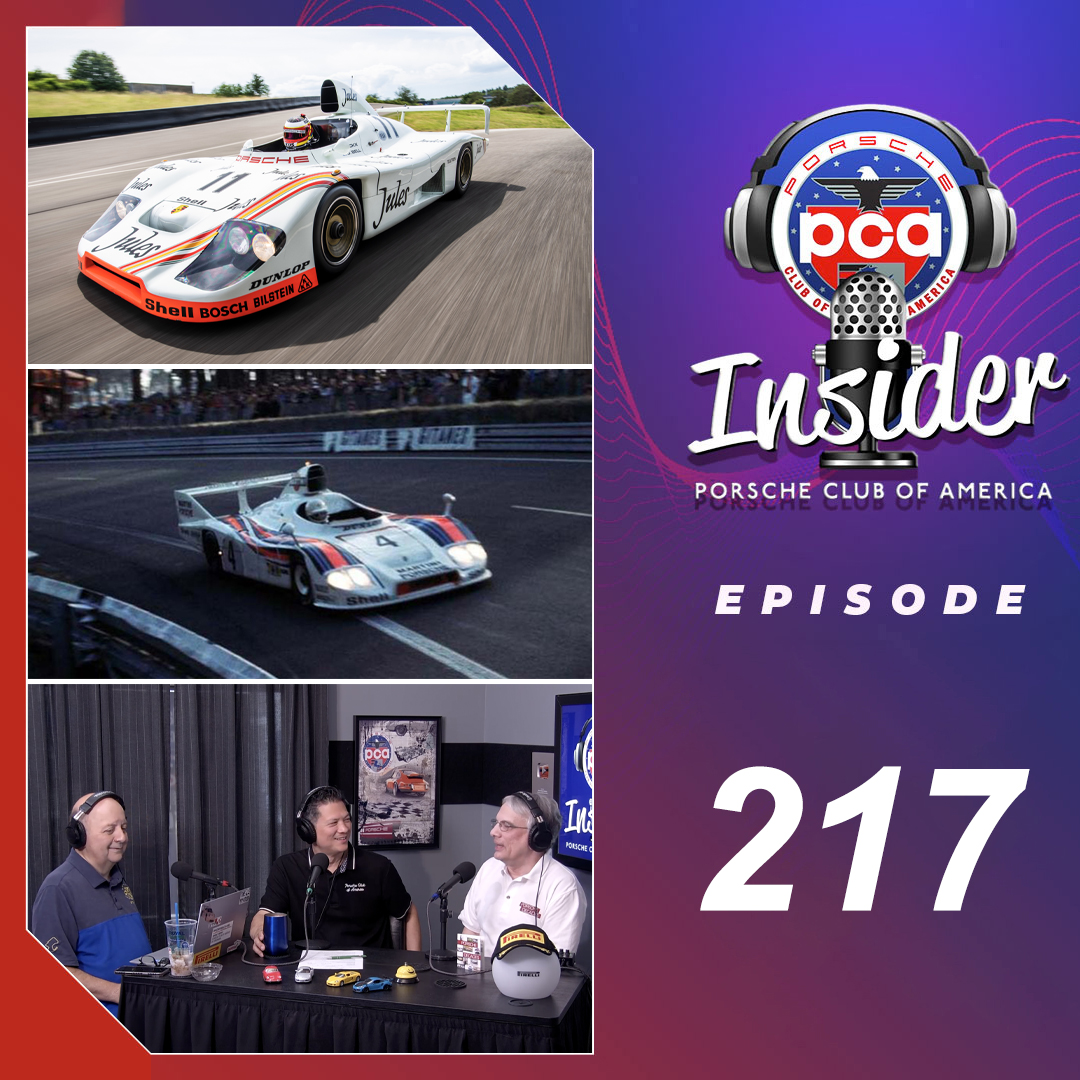
Welcome everyone to episode 217, today is going to be an education for me.
A lot of times people call into PCA and the newbies don't understand all the different
chassis numbers 9-11, 9-9-6, 9-9-1. Well, if you go back in time, there's a lot more to learn about.
For me, I think I know more about 9-17s, possibly 9-56s, but the one, I even know a lot about 9-35s,
or at least we've talked about them. You think you know a lot. I think I know a lot,
until I meet someone like our guest here. But today, of course, we're talking about the 9-36s.
And before I get into it, I want to thank our presenting sponsor, Pirelli. Pirelli tires have
to achieve the highest levels of performance, safety, noiselessness, and grip on the road surface.
Innovative tires that can satisfy even the most specific mobility needs of the end consumer.
I want to thank all of you for listening. If you aren't currently a PCA member and own a Porsche,
what are you waiting for? Be sure to have your VIN handy and sign up for PCA membership. For those
of you that don't currently own a Porsche, we have the Test Drive program. Just head over to
pca.org and get yourself set up. To my right, it's nice to have Manny Aubin at the table, of course.
Damon's manning the controls. And our special guest today, he's back. He's been with us before.
We know him as the author for Porsche Decades, Golf 917. He's also the PCA national historian.
And today, we're going to get into his latest model that he dives into, the 9-36.
Welcome. Do you remember the 9-36 we saw at Milly Allen maybe five, 10 years ago,
it's a Jules car. It struck me was it was so tiny that I remember staring at it going,
is this a 1-1 or is this like a smaller version? Because it was in the parking garage next to
two SUVs and it looked like a toy. It almost looks like a go-kart. I mean, how tiny. But the
fact that this very valuable car was squished between two rental SUVs, but that I thought,
here's a car that won Le Mans, but wow, it looks so fragile. That was 2019 when Jackie X was the
special guest at Amulet Island. And what I didn't understand is I believe a lot of it and you'll
share with us all the details. The car that preceded it was the 917, which is a pretty massive car.
I mean, we've seen them. They're not tiny like this. They look massive. Remember the ad was the 914
parked next to the 917. And the 914 looks like they had AI, they had a large car. But that's how
small the 917 really was. But the 936, you're right, the one that we saw at Amulet, it really
looked almost like a toy car. It's small. The wheelbase is virtually the same as the 917 on the
936. And the overall construction is very similar. So they're similar in size. I think they look a
little smaller, but they're actually similar in size to a 917 Spider. Okay, gotcha. So obviously,
the new book is 936. Yeah, yeah, I'm calling it The Secret Spider. It's the portion 936 story.
And I've been working on it for the past couple years. Makes sense, because everybody thinks of
me as the 917 guy. Yeah. And the 936 is a very close cousin or younger sibling of the 917. So
it made sense. And I've always thought they were really cool. I always thought the 936
was really cool. And when I was in junior high high school, I mean, this is the car that Porsche
actively was campaigning. So this was from 1976 to 1970. 76 to 81 really is the period of time
that we're dealing with. And of course, each year is a little different. But we can talk more
about that. All right, so let's just start. Why the 936? What caused that program to happen?
Yeah, it's it we have to back up a little bit and talk about what was going on.
Dr. Furman was was the CEO of Porsche. And I think most people know that when he came in,
he wanted to emphasize the 911 as Porsche's competition car. And that's how we get the
RS and RSR in that, you know, 72 73 period. The RS is a homologation car, you had to build so many,
you had to build 400 in order to then do a racing version, which was the RSR. So they were going
down a path of making the 911 the focus of their racing program. Then the 911 Turbo 930,
people don't often think of it as a homologation car, but in a way it was because they saw where
the rules were going with the FIA. And again, you had to build 400 cars in order to have it be
like a homologation platform to then go on and build cars in what then was called Group 4 and Group
5. So once they built 400 911 Turbos, they could then build a slightly modified car for Group 4.
That's the car that we know as the 934. And then you could build a highly modified version of that
same car for Group 5, which became the 935. And those were called silhouette racers because they
maintained the basic shape of the street car. But in Group 5, there was tremendous amount of
modification allowed. The problem for Dr. Furman came in 1975. The FIA had one series they were
going to run called the World Championship of MAKES. And this is where Group 4 and Group 5 cars
were eligible. But the FIA also decided to continue with another series, the World Sports Car Championship
for Group 6 prototypes. Prototypes you don't have to homologate at all. You can build one car
if you want and race it. And so Dr. Furman during the sort of middle of 75 is a little worried that
the FIA is going to schedule races where all these classes are going to be competing against each
other. So he's worried that Porsche will go out and win Group 5 as a class, but that a Group 6 prototype
will win whatever race it is overall. So Renault and Alfa Romeo primarily. And then if that happens,
nobody remembers who won the class. You only remember who won the race overall, right? So he
then basically confronts his team, his engineering team and says, what do you think about Group 6?
And they're all kind of shocked because, you know, Norbert Singer says in his book he hadn't even read
the rules for Group 6 because they had no thought that they were going to be doing this. They all
thought the focus was going to be on the 9-11, 9-34 and 9-35. So Dr. Furman really starts this
project as a precautionary measure because he says, hey, we have all the parts and pieces to
build a Group 6 car. We have it virtually all of it right on the shelf. So it shouldn't be that hard
to build a car that would be competitive for Group 6. And that's the car that eventually becomes the
9-36. There's the logic of the numbers because the numbers in a way refer to the class that the
cars were going to run in. So did 9, not to sound like capital obvious, 9-34, Group 4, 9-35, Group 5,
9-36, Group 6? Yes. Okay. They didn't give it 9-36 type number initially. They gave it a couple
unusual type numbers. First, they call it 9-17 stroke 50, which is very strange because I've
never heard that. Yeah. In no way was it a 9-17. So I said, well, that's no good. So then they gave
it the 9-26 number. But then eventually they said, well, wait a minute, let's align these numbers,
9-34, 9-35, 9-36. And they were using the three part because of the 9-30?
Theoretically, yeah. It's hard to know with Porsche type numbers. Sometimes it's hard to know
why they do what they do or what they did, what they did back in the day. But it makes sense now.
9-34 for Group 4, 9-35, Group 5, 9-36, Group 6. You mentioned a lot of the parts were on the shelf,
so to speak. So how much of it was 9-17 and how much of it was 9-35 and what was?
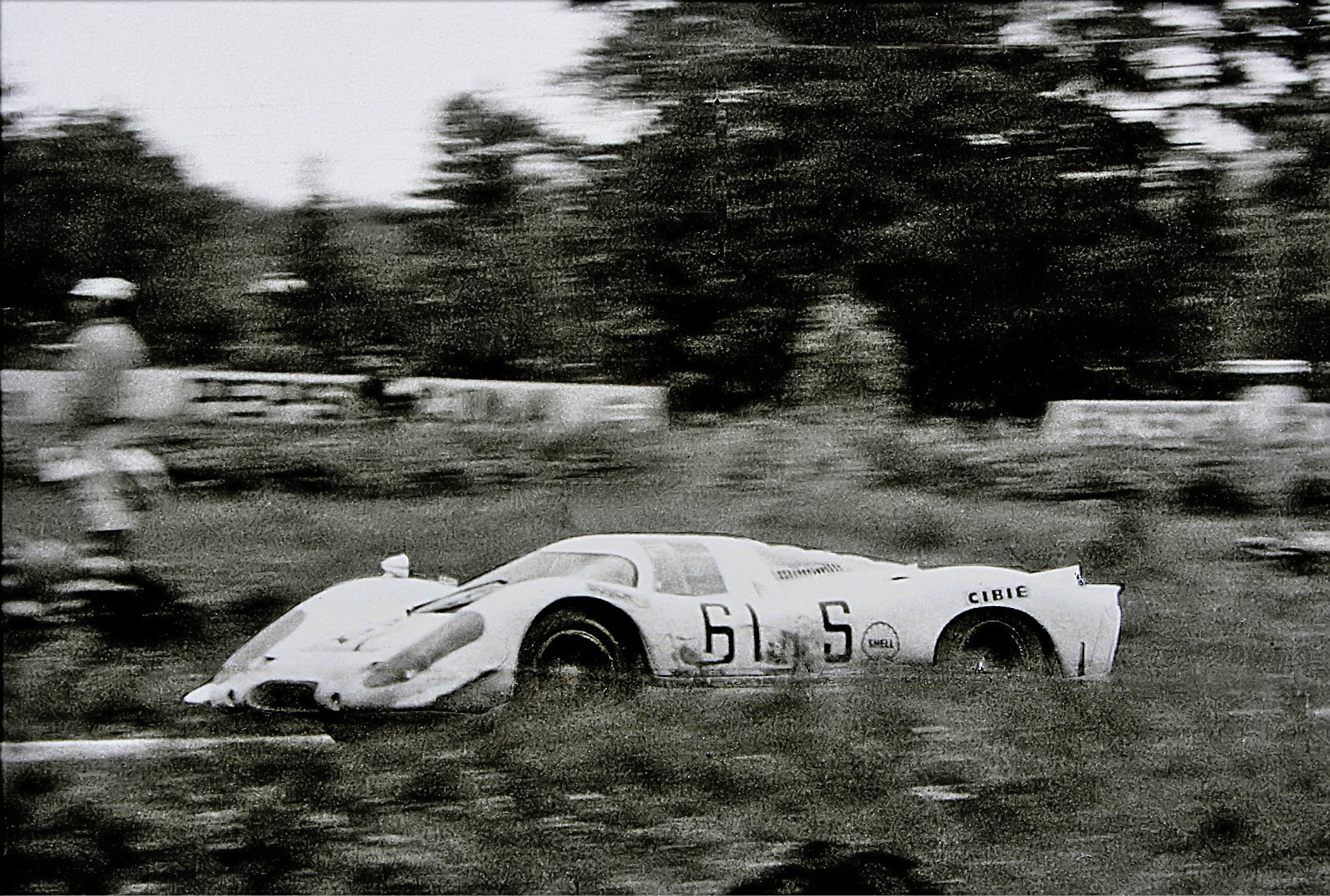
Almost nothing from the 9-35. So it's mostly the 9-17 Can-Am car. So it uses the transmission from
a 9-17 Can-Am car. Things like the suspension from the 9-17, although had to be modified a
little bit, but steering gear, all those little parts and piece components that they have right
on the shelf from their 9-17 Can-Am program, oh, wheel hubs, wheels, all that kind of stuff.
What about that two frame today? Use any of the 9-17 to create a whole new frame?
Well, it's a new frame technically, but it's very similar to a 9-17 Can-Am car,
tubular aluminum space frame, similar to a 9-083 also. And the bodywork, of course,
is new for the 9-36, but it's very similar to what they recently had been doing with their
9-17 Can-Am cars. And that's where Dr. Furman, again, he leaned on that with his guys. He said,
you guys know how to build these. They'd been building what I call the plastic porches, these
tube frame plastic body cars. They'd been building them now for almost 10 years. And so Dr. Furman
was like, you guys know how to do this. So was the 9-36 built to its class? They couldn't have
used an older car to run in that class? Theoretically, they could have. But they probably
wouldn't have felt competitive, maybe? Well, it wouldn't have been. It wouldn't have necessarily
the chassis itself wouldn't have necessarily been a perfect fit for all the components.
So you start fresh with the chassis, they could generally fit all the components. They did have
to create a spacer between the gearbox and the engine, because the engine's only six cylinder,
not 12 or eight cylinders. So that led to a little architecting. But I think they felt it
was best to start with fresh chassis designed specifically for Group 6. But again, they weren't
reinventing the wheel. I know money was always in a concern with Porsche, especially back then.
Were the other manufacturers just throwing money at their program, or were they also the same
voters portion? No, I mean Renault, who becomes the primary competition, Renault is a state-owned
country of France, owns Renault. I don't want to say they had unlimited resources,
but they had huge resources. And Renault at the time was going down two parallel paths. They were
still racing sports cars very actively, but they were heading into a Formula One program as well.
So Renault had huge resources, I think, compared to what Porsche had. But what Porsche had on their
side was experience. Now chassis and suspension is part of the equation, but the big part of the
equation is power plants. Yeah. Tell us about that. So that's another thing where I come back
to this theme of Porsche never throws anything away. And so when the engineers looked at Group
6, they said, ah, we've already run a car called the 911 RSR Turbo. So in 1974, they ran a turbo
charged 911, wasn't homologated, so they had to run it as a prototype, even though it was basically
a 911 with a little 2.1 liter flat six turbo. Yeah, one of my favorite cars. And they finished
second at Le Mans in 74 with this car. And also they had, they had sold a few of these engines
to their customers. And so a couple of their customers, primarily Reinhold Yoast, had installed
this little 2.1 liter turbo in his aging 9083 chassis and had done pretty well with it. So
Porsche already had a little proof of concept with their private owners running these small turbo
engines in the 9083s. That was during 1975 season. So they had the basically perfect engine. In Group
6, you could run three liter normally aspirated, or you could run 2.1 liter force induction turbo
charged engine. And so that Porsche, again, right off the shelf, essentially had a really good engine
that they thought would be competitive for Group 6. And where did they set their sights for the
debut for the 936? So the debut, we've just had a couple of weeks ago, we just had the 50 year
anniversary. Porsche decided to do the full season of WSC World Sports Car Championship
in 76 against Renault. And as it turned out, just to finish off the earlier story, the FIA in their
wisdom did not combine the two series. So that concern that Dr. Furman had kind of became mooted
because they had a separate schedule, mostly on different tracks for the World Sports Car Championship
versus Championship of MAKES. There was only one race weekend where on the Saturday at Dijon,
actually they ran the MAKES, and on the Sunday they ran the Sports Car Championship cars.
But Le Mans was outside of both championships. So there have been these periods in history
where the ACO, who runs 24 hours of Le Mans, don't see eye to eye with the FIA on the rules.
And this mid-70s is one of those periods where the organizers at Le Mans say,
we're running our own race to our own set of rules essentially, and so they're excluded from
both championships. So in that case, of course, Porsche is running Group 4, 5, and 6 all at the
same time on the same track against the same competition. But to answer your question, April
4th of 76, the first race is at the Nureberg ring. It's a 300 kilometer sprint at the ring,
and that's the first race for the 936. And how did it do?
Did pretty well, qualified second. So Renault, that season Renault always ran two cars,
and Porsche only ran one. So it was always two against one. In the first race Renault qualified
first and third. But at the second, second turn on the first lap, it was a wet miserable day,
as it always is seemingly at the ring. Second turn on the first lap, the two Renaults lost control
and hit each other and took themselves out of the ice. And the second turn, as David Hobbs would
say, that probably made for an interesting debrief in the old motor home. Yeah, supposedly the
team manager, who was Gerard LaRuse, who was an ex Porsche factory driver, apparently was
absolutely furious with his drivers. So Ralph Stallman was driving for, was driving the 936,
so he led much of the race, but then he had a problem with the throttle cable sticking,
and they tried to fix it, couldn't really fix it. He ended up having to drive the car on the
ignition key. What do you mean by that? Well, when he wanted to slow down, he had to turn the
engine off, basically, and then turn the engine back on. So what I did was turn the ignition off,
take the foot and pull the accelerator back, and click it, and I thought I was crazy.
That's crazy. Yeah, I can't even imagine doing that at the near bird ring. At least he was able
to keep the car running finished fifth, but Reinhold Yoast, Porsche's great customer, won the race
in his 9083 with the turbo engine. So after that, Porsche won all the rest of the races
in the series that year with the 936, Reinhold didn't win any races.
Who is driving? Do they have famous drivers? Well, they're famous now because they won,
but were they famous when they got in the car? Yeah, well, it's interesting because 76 is the
first season that Porsche signs Jackie X. So it's the beginning of the story with Jackie X as
basically Porsche's number one driver that coincides with the 936 being released. So it's
usually Jackie X and Jochen Moss or Ralph Stommel, and those were the usual drivers in the 936.
Do you think the drivers had a better kind of attitude? We read about the 917, how a lot of
drivers were intimidated by handling at the beginning, and the 936 different, were they
more confident with that? I think it was pretty good right out of the box, especially aerodynamically,
because again, they're basing it on the 91710, 91730 Can-Am cars. There were two slight problems
with the 936. First, it was slower than Porsche's own computer said it should be,
and they were having trouble with cylinder wall temperatures. So again, going back 50 years,
turbocharged racing engines were still kind of a new thing, especially for sports cars. Now at
Indianapolis, they'd had a fair amount of time with turbocharged cars, but for this form of racing,
turbocharged engines were still fairly new, and so managing the heat of a turbocharged
racing engine was still kind of a new thing, and Renault, as we may talk about later, that was really
Renault's downfall, was inability to manage the temperature in there, because they're running a
two-liter turbo, two-liter V6 turbo in their cars, and try as they might. Renault never quite,
they certainly didn't perfect the heat management, the internal heat management in their own engine.
Talking about two-liter turbos in today's world, it's fairly common, and I remember growing up
in the 80s when the like the Saab 900 turbo was, you know, some people loved them, but some people
were like, oh, I don't know about the reliability, and then we always hear about Porsche utilizing
motorsports as the active development racing laboratory. Do you think a lot of the turbo
findings from this 936 was eventually found its way into production cars?
I think it did, because Porsche always wants that relationship between what they're doing
in racing and what they're doing with their street cars. I mean, it starts with the 91710,
which is the first turbocharged Porsche racing car, but then it continues with the 91730,
and then the 936, oh, and the 911 turbo as we, the RSR turbo as we talked about it, it all is going
in a direction. Interesting that Porsche at the same time has a street car, you know, the 911
turbo on the street, so they're learning both from a street car and a competition car perspective
of what's going to work well with turbocharged engines, and this is, you know, this is now 50
years ago, and here we are today, we're, you know, I don't know what the exact percentage is, but
the vast majority of our Porsche street cars today have turbocharged.
936s, were they always factory effort? Was there a time where it eventually found their
ways into privateers? Yeah, we can, we can talk about that. The, so the factory only built three
chassis, it's another kind of fascinating thing about the 936, it's one of the rarest of all
Porsches, because the factory only built three chassis, start off in 76, they only had 76 and
77, they only had two chassis, 78, they built a third chassis, but in 1980, skipping ahead a bit,
1980, Reinhold Yoast wanted one, because Porsche had theoretically retired the 936s for the second
time, and Reinhold Yoast wanted one, and so what Porsche did was they built a fourth chassis
for Reinhold Yoast so that he could build his own 936 based on a factory chassis.
Condition was they couldn't call it, he couldn't call it a 936.
Oh, they made him call it a 908 slash 80.
Did you know that? I had no idea. Oh, it's a little crazy because when it got to Le Mans,
and it and everybody looked at it, it was totally obvious that it was a 936, and it kind of didn't
make sense that it was given this weird name and weird type number, because everybody knew it was
a 936, it looked exactly like a 936 in 1977, SPAC. Yeah. And then further down the road,
the Kramer brothers also built their own, based on the factory's blueprints, the Kramer brothers
built a fifth 936 chassis, and that was in 1982 to run the German national DRM championship.
Interesting. So why would you, like I, maybe it's just me, but I feel like you hear of so many other
famous motorsports chassies, the 936 seems to be kind of under the radar?
Until 1981. That's like the story of stories, me and motorsports, that what happened today,
people's minds would be blown. Well, before I tell the story on that one,
your impression is correct. And as part of why I wrote the book, and also for everybody's May
panorama, we're going to have a little nice article on the 936 as well, celebrate the 50th.
From my perspective, actually, the 936 is probably one of the last
Porsches that, you know, that won, you know, and was successful that I learned about or cared about.
It was 917, 956, 962, 934, 935, 911 turbo. It was all that stuff. And the 936 was like,
Porsche actually made that? That's exactly what I'm getting at. Yeah.
You know what it is? It's the middle child. Okay. So the 917 is this huge legendary, you know,
some people will say it's the greatest racing car of the 20th century, right? So you've got
that on one side. On the other side, you have the 956, 962, absolutely dominated in the 1980s.
And so the 936, since it was never officially sold to customers, and they only built,
Porsche only built three cars, it's way overshadowed by its older and younger siblings. And that's
why, as part of why I'm a little bit on a mission to just put this car in front of everybody on
the 50th anniversary, because, you know, winning Le Mans on three times is nothing to, there's nothing
to, especially how I can't win with the 963. So that really puts the emphasis on how difficult
it is to win Le Mans. Yeah. And then, and then what you're mentioning of, you know, it's not
state backed. This is a small company. It's just a small, still privately owned company doing this
on a, doing them, they do the 936 on a really small budget. But again, they've got all,
they've got all the parts and pieces there. So it makes sense. Huh. All right. So back to 1981.
So 1981 is really interesting. So briefly, I'll recap the history. 76, they win Le Mans.
It's the first turbocharged car to win the 24 hours of Le Mans. That's another distinction
that the 936 has. Oh, first turbo car to win Le Mans. 77, they win again. Jackie X, it's his
greatest drive. We can talk more about that if you're interested and if you want unbelievable
performance. 78, they bring three cars against Renault at four. And in 78, Renault finally wins
on their home ground. I mean, it was becoming potentially, you know, national embarrassment
of being beaten twice at Le Mans by Porsche. But in 78, Renault finally wins. They immediately
retire from sports car racing to focus, to focus on Formula One. Retire while we're on top. Yeah.
And so Porsche retires. The 936 is also, because they say, well, we have no competition.
79, Porsche gets sponsorship from this mysterious fellow David team Essex Petroleum.
That's a whole other story. He convinces Porsche to take the cars out of the warehouse and run them
at Le Mans in 79. Both cars have mechanical failures. And so it's the only time they don't
finish at Le Mans. But Kramer saves the day for Porsche and wins Le Mans with a 935 in 79.
1980, we talked about Yoast builds his own car based on a factory chassis.
He gets X out of retirement to drive with him in 1980. And they finish second, which is not bad.
Had some mechanical difficulties. So easily could have won the race, but they end up finishing second.
So then 1981, now the cars are retired, long retired back to the warehouse. But the key is 1981,
we have Peter Schutts becomes the CEO of Porsche. And he's knowledgeable about Indy because, you
know, being an American, he's been to Indy many times, but he's not as knowledgeable about sports
car racing. It's really this world of sports car racing is kind of new to Schutts as the CEO.
His first race he goes to is Sebring in March of 1981. And that car is won by the race is won by a
guy who used to be my neighbor, Bruce Levin, Bayside team driving with Hurley Haywood and Al
Holbert. They win Sebring. And so Peter Schutts gets very excited. He comes back to comes back to
Germany, goes to meet with his racing team at Bisonk and says, starts asking some kind of precision
questions similar to what he does famously with Dr. Bob about whether or not we should
continue building 911. It's kind of in parallel because this happens around the same time.
So he asks his racing team, what's the most important race of the year? Oh, it's 24 hours of
Le Mans, of course. At this point, that race is about 10 weeks away from that race, give or take.
So what do we have for Le Mans? And so the team tells him, well, we're racing these cars called
924 turbos as part of our development program for the 944. And so he says, well, do we have any
chance to win? And they're like, Oh, no, no, we have no chance to win the race overall, but we
might win our class. And so Peter Schutts, it's really interesting from an executive thinking
point of view, he pretty much makes a snap decision right on the spot to say, no. As long as I am in
charge of this company, we don't go to any race unless we have a chance to win overall. So you
guys go figure it out and then report back to me. Did he say like on a Friday and he said, come back
on a Monday? Yeah. And he said, he always wanted to do that because I listened to his tape. And he
said, I always wanted to make that kind of ultimatum like back to me on Monday with an answer. Not
thinking they would really come with an answer. Yeah. But once again, Porsche never throws anything
away. Let's dust it off. So the engineers run around quick and they think, well, we have our 936
is in the warehouse. And oh, you know, we have this engine that we built for the Indianapolis 500
in 1980, but we didn't get to run it because USAC didn't give us a favorable ruling on boost
for the Indy 500 in 1980, but we still have all the engines. And maybe we could convert them from
running on methanol to running on gasoline. So the Le Mans rules had changed. You could run a larger
capacity engine in 1981. So now we're like 2.65 liter flat six that they had built for the Indy
500. And all they have to do is convert it to run on petrol. And hey, maybe we could put that in the
936 and we might really have something. Well, that is what was done. They did almost no testing,
except on the chassis dyno was really the only they ran a Le Mans simulation, I guess on the
chassis dyno didn't really do any other testing, took it to Le Mans, and Jackie X and Derek Bell
had the perfect race, never lifted the tail, the whole 24 hours, all they did was add fuel and oil,
brake pads, tires, and X and Bell won by 14 laps. The little cassette tape I have of Peter Schultz,
he says that on that Monday, the engineers came back to him and they said, we think we have a
slight chance. Whereas the car inside the museum that we can pull out and they articulated what
Jay just said, and Schultz on the tape says, in the museum, he goes, but this car, we think
we changed a couple of things, like Jay said, may have a chance of winning overall.
Yeah, so it was, they ran two cars in 81 as X and Bell in the lead car won it. The second car
had some mechanical problems. Hurley Haywood was one of the co-drivers in the second car,
and to this day, if you ask Hurley, what's your favorite racing car of all the ones you've driven,
he'll say the 936 81 is his favorite, best car that he ever drove. So that tells you something
about Porsche and kind of the end of the 936 program at that point. It's important to note,
though, that 77-78, they continued also developing the car, even though it was only going to go to
the one race. It was only going to go to Le Mans, but in 77, they changed it from single turbo to
twin turbo, smaller turbos to spool up faster, better throttle response. They changed the aerodynamics
to try to make it faster down the straight. 78 for both the 935 and 936, they go to, wait for it,
water cooled cylinder heads. Oh my God. This did not bring about the end of the world when we
had a semi water cooled flat six in a Porsche because they had reached the limit of what you
can do with an air cooled engine. And they wanted to have a four valve, but you could not have a
four valve per cylinder head and still keep the engine air cooled. No way they could do it. Had
to be water cooled cylinder heads. So for 78, they developed that for the 935, but it might as well
also port that over to the 936 as well. So from that point forward, the 936s have these
water cooled four valve cylinder heads. Did they all use intercoolers or did they,
but then the hood scoop, the cooled intercooler that was brought in at the first year, I don't
think was it? Oh, well, yeah. Well, and that's one of the signatures of the 936 is this big
air box that sits behind the driver's head in 76. The first year sometimes they ran without the air
box. Sometimes with at Le Mans, they ran one car with one car without the big air box, but the air
box feeds, feeds air to the intercooler. It also feeds air to the cooling fan, which sits on top
of the engine, and it feeds air to the intake for the engine. So it's kind of doing three jobs.
You know, the air box. Renault and Alfa Romeo also had been using this kind of air box configuration.
They used it in Formula One at that same time until it was outlawed. So that mid 70s period,
you see a lot of these cars with these kind of interesting, you know, big air boxes sitting
behind the driver's head. I remember, I was bringer telling us when he had to adapt the
9.62 for IMSA to be competitive. And remember, he said he put the scoop to cool it. You think
about it, it goes back to the 936. Sure. In a way, yeah. He was bringing the air and he said he
realized it wasn't enough cool air getting in and they needed something to capture cool air
over top the intercooler. And so they went back to the 936 design. And Porsche did a tremendous
amount of wind tunnel testing on different shapes and sizes of air boxes to try to optimize
the both the intake as well as to reduce the, because it creates a lot of drag, you know,
having this big air box on top of the car does create a fair amount of drag. So Porsche did a
lot of experimenting and fiddling around with that to get to what they thought was the optimal shape
of the intake and the box itself. Well, this certainly has been an education for me.
Tell us a little bit. How many pages is the book? We don't know just yet because we're still working
on the layout. Okay. And so we don't have the layout quite finished. I'm hoping that the book
will be available about in June. Okay. You know, if we're lucky for Le Mans season. It's not a huge
book. I mean, it's smaller. It's going to be smaller than Porsche decades because we are,
we're talking about a book about basically three, four cars. So it's not going to be huge book in
terms of, in terms of size, I think it's going to be manageable. And I will say there are going to be
two, two books on the 936 this year. So hasn't officially, I don't think it's been officially
announced, but there's another group of friends of mine who are doing a translation of, Jürgen
Barth did a book on the 936 about 10 years ago, but it was only ever available in German. Okay.
And so we have another group who are doing a translation and update of that book,
which I believe is going to be a very lavish presentation. Mine is going to be a little bit
more basic. And in my book, I talked more about the competition, about what the competition was
doing at that time to race against Porsche. All right. Well, let us know when it's out. We'll
be sure to share with everyone. Yeah. Before we get into why you're here at PCA's national office,
I want to remind folks to head over to PCA.org and sign up for PCA's newsletters, performance news,
e-brake news, and Mark Fresh all free. So what you're doing here, Mr. National Historian?
Well, I'm here for training. Ms. Linda's here as well. Linda Goodman is here, very generous of her
to come down and spend a few days with me to kind of explain to me how things are supposed to work
with our archive as far as cataloging things, coming in, going out, and so forth. So we can
keep track of this rather large archive that we have of the club's history. So it's my job
now going forward to look after that. So that's the main thing that I'm doing here is to kind of get
myself further oriented to how the archive works, what do we have, and then we'll go forward from
there with managing the archive over time. That's probably the most important job that the historian
has. Yeah, and we get random things from members all the time, and there's a table that I park
stuff up there, and yeah, I let you sort it out because I don't know if it's truly valuable,
or if it's something that we say thank you, and then we donate or something. And then sometimes
I believe historians in the past have cruising eBay or whatever auctions and stuff. There are
pieces that are related to PCA's history that might be worthwhile for us to purchase and keep
in to our archives. If there's a gap in the collection that we can fill, absolutely, we would
look at that. Right now my impression is we don't have a lot of gaps. We have a few, but I don't
know that we have a lot of real obvious gaps, but yeah, absolutely. If there's an opportunity to
acquire something that is really valuable for the club, we certainly will look at that. And then I
have a few other projects in mind from the historian side of things that I'm hoping to,
that I've already started working on a little bit, but I'm hoping to do more with as time goes along.
A couple of them are just administrative projects, but we have to, one thing I think that the
Executive Council is interested in, and I'm also interested in, is preserving more of our oral
history by hopefully interviewing some of our most senior members and just collecting their
recollections and thoughts about the club in its early days and how things have changed over time.
So that's one thing we're figuring out and that I'm really going to look forward to working on.
And then we have another little thing to look at, which is how do we preserve our current history?
That's where I was going to go. I said I was going to go, but pre-2000s you had papers,
you had books, you had things that you could save, but today I've already talked to Damon.
Yeah, I was going to say, I was going to bring it up if you didn't.
Yeah, we do so much digital now.
It's hard to think of digital media as a history or the archival sort of level material,
but I've been here for almost coming up on 13 years now, and some of the stuff I've done is
archival material apparently. Yeah, it absolutely is. All the b-roll of our mistakes, right, Manny?
Yeah, but I mean, every time you guys do a podcast and you talk about, say,
Amelia Island, you're capturing our history kind of in real time. And so one of the things I think
we need to look at as a club is how do we actually preserve that and how do we know what we have?
I'm talking mainly things that have happened, let's say, in the last 10 years as Damon is saying.
How do we know what we have and how do we preserve what we have?
There's stuff like club racing alone. When I was really into club racing,
I would always push him saying, guys, we've been around for 20 years. There's nothing
that's documenting our history. We need to start having some kind of a place where we can put all
our results. I didn't even think about the oral histories back then, but how club racing used to
be because it's such a fast-paced world that you're going from one race to another, one event to
another, capturing that isn't on top of your mind. Yeah, they're focused on what's going on today and
thinking about. I would say it wouldn't have been cool if there was somehow these conversations
like we're about to get into meek and porches that are coming up for auction. Imagine if we could
listen to a conversation from the 60s or 70s where they were talking about, in period,
hey, did you go to the Porsche parade and do you see a 356 for sale? That would be really cool to
hear. So hopefully the conversations we're having recently in 20 years are going to be like those
guys were laughing at this car or they were saying that car was worth this, that, and the other.
Well, we have our Panorama classified. Yeah, I do that. I do that. I pull any car I buy. I go back
to that time period to see what it was like. What could you have bought it for? 20 years. Exactly.
But here we're going to have, we'll be on record and people will be hearing the little nuances and
the funny things that we say. I think once you figure out how to handle members submissions,
and I mean like a lot of our members are getting older, they're downsizing,
and I'll already go to events like Jeffrey Rosenberg gave me at the snowflake rally
for the club, for the archives, Groove Edge, and I thought, boy, that'd be great. We have an organized
way of something. I made a comment on the podcast about a book we didn't have enough books in our
library, and one of our members sent us a whole library. Well, no, he sent us one of the artifacts
books. Oh, okay, great. Yeah. And they sent us the five-line set of origanelli books. And I said,
well, it's not for me, it's for the club, I think. The club needs to have all of this in the archives.
Yeah. I mean, obviously, we're constrained with space a bit, so we have to be selective about...
We're going to take all the parade stuff and put it next door.
If you guys can do that, great. More room for me. But yeah, so we just have to balance,
figure out what makes sense going forward. And again, I mean, the oral history part is,
I think, something we need to focus on. Because I mean, just since I've become the historian,
we lost a member in our region who I really feel bad that we didn't get to for
oral history. And so this is something that every few months, every year, we lose some of our
elder members, and we lose an opportunity to get parts of our history from those folks who
were actually there. All right, so let's make some history. Let's talk about some cars. Let's
talk about the cars that are coming up at the Meekum auction at Indy. This auction will be May
8th to 16th. So when this... These cars are crossing Saturday, May 16th to last day. Oh, okay.
So by the time this... Meekum starts off with the cars that I can afford. And then he's like,
wait... We're not talking about those cars? Three of these later, it's the cars that cannot afford.
We're talking about the stars that are going to be on Saturday. It's like music. It has to build.
Yes. But where Manny and I shop, we shop when the store just opened.
They're still setting up as the cars are going to cross the auction.
Exactly. All right, first up, we have a 1987 959 Comfort edition. Now, they don't have one
on the website yet, the estimated... You know what? I think Meekum, the one that doesn't put
estimated price on it. There's no reserve that's going to sell. This is the Comfort version,
which for those that don't know, means they had the Sport, which they didn't make many of them.
Comfort was the, I guess, the normal one, if you want to call it normal.
This is in that very handsome gray. I don't think I see, to me, of the gray 959s.
No, I mean, this is beautiful. You don't see many 959s.
It only has 3,521 miles on it. It's beautiful. It's a beautiful car.
It'll be one of 292 3500 miles. And this looks like an untouched 959,
meaning Bruce Canepha hasn't given it that special touch. It looks very original.
Now, I don't play in this world, so is this a $1.5 million car, $2 million?
Where do you think this will land? I would think over $2 million.
Over $2 million? It's at low mileage. I'm not great for predicting values.
For those of you that are listening and you want to play along before the auction,
in the comments below, let us know how much you think this 959 is going to go for.
It's amazing. Supercars of this era, what they've been doing lately in terms of value,
is really pretty amazing. So one of the competitors to this, of course, is Ferrari 288 GTO,
which is one of my personal favorites. You look at what values have been doing,
because it's also a Group B homologation car. And you look at values of those cars of,
I mean, we had one recently, I think it sold for $10 million, which is...
Wow. It's interesting with the 959. To me, it's very German, very Porsche.
We drove it, you get inside of it. It feels like a 964. Very familiar.
Everything's there. You know where all the buttons are. It's a Porsche.
It's nothing that... Not like a 288 GTO, which I agree to is a beautiful car.
This was a... But from a technology point of view, it was a tour de force. It was so much superior.
All right. Next up, we have... This one is a very rare car, a 2019 935.
Yeah. This debuted at the Wrensport. And I really remember when they talked
about having a series, and you and I were like, right, no one's going to race one of these.
The people will buy them, but they're not going to be racing them.
That's exactly what happened with this car. I think it was just stuck into a...
40 kilometers, not miles. Stuck into a museum.
And it even has this transport, I don't know what they're called.
Tiedowns. Tiedowns. The wheels.
It's a museum piece. It was bought as an investment.
My question is, is anybody bringing these cars to track days or actually driving them?
The Ingrams. As they're meant to be.
The Ingram family. They race there to the Pikes Peak.
I think there's a gentleman, Carl, in the northeast. He's taken... He doesn't race them, but...
You're taking out the Monti car.
Oh, that's the Monti car. Yeah.
Similar. Yeah.
Same performance, but different car.
Okay. Similar performance.
But yeah, those cars, it's kind of a shame though, right?
That car, what it was meant to do, and it's...
Never a street legal car in the beginning.
It'd be tough to take to the track.
And again, I don't play in this world. I have no idea what that car's value is.
Neither do I. I don't have any of them sold. Have any of them sold publicly?
I think maybe one or two, yeah.
Yeah, I think one or two. I forget what they sold for.
But I'm going to say for the 959, since I didn't make a guess,
I'm going to say $3 million, maybe a little more.
Oh, $3 million.
Because that gray, that's not a super common color, I want to say, compared to...
What is it? White and...
They only made 77 of these.
Yeah.
Do we know what they roughly cost when they were new?
So that was in the $700,000 range, roughly.
I'm sure that could go up quite a lot.
In hindsight, that sounds like a bargain, because that car is easily going to go...
It's going to sell for more in the future, I think.
More than double than that, I would guess.
All right, the next car we're going to talk about at Meekum is more viable for the street,
but still very special.
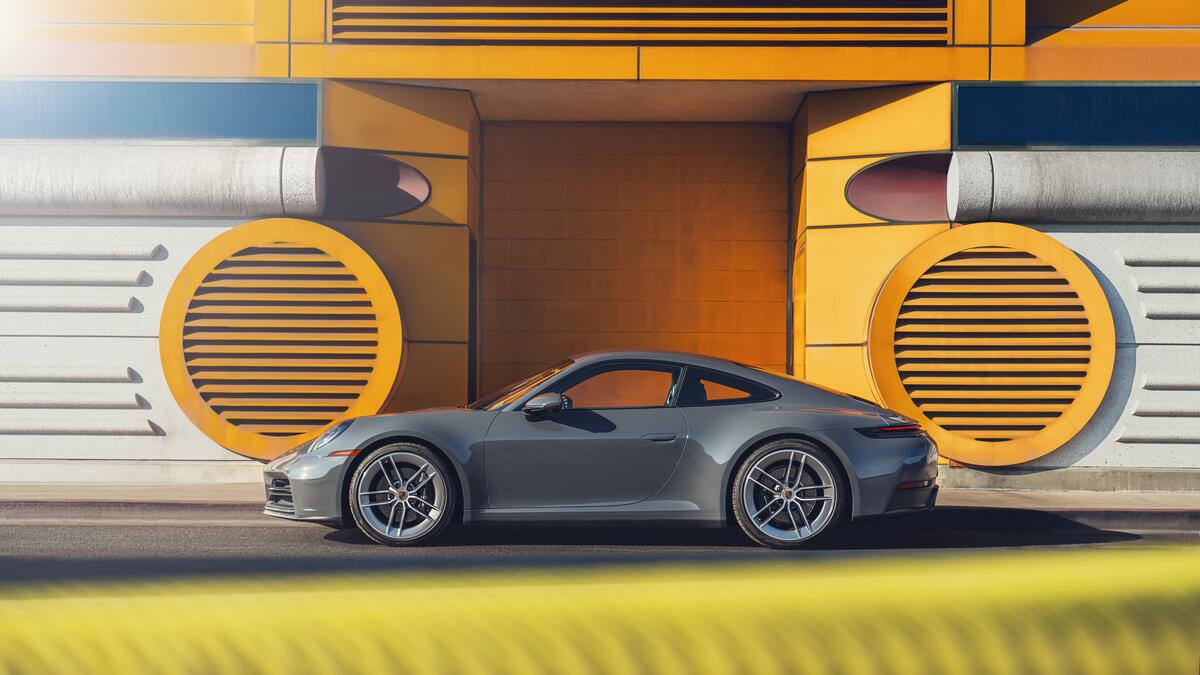
It's a 2019 911 Speedster in what looks to be the heritage package.
Man, that's a pretty loud car for the street.
I think they made 1,148 of them for celebrating the first year of Porsche producing their
26, only 127 miles of an odometer, so...
Another museum piece.
Another museum piece.
These are not rare cars, but this one's super low mileage, so...
I would drive the heck out of this one.
I would too.
Manual.
Can I ask you guys what you think about street cars with
quasi or racing liveries on them?
We kind of have in the past.
Have you had that debate?
Yeah, we have.
I'll let Damon start.
Damon, would you like this livery on your car?
Man, what do you do when that meatball gets old and you don't like it anymore?
That's what I think.
Don't get me started on Rubystar or Rubystone, because great colors, but man...
This is how you trigger Damon.
I didn't mean to do that.
This is how you trigger Damon.
What's interesting is everyone thought the car they came out with was going to be the
Speedster, but instead it was the Cabriolet, which I think was shocked a lot of people,
which of course leaves a question, is the Speedster coming down the road?
Because this is essentially as the GT3 Speedster, but they call it a Speedster, not GT3.
Yeah, even though I'm more of a racing historian, for cars on the street, I would
prefer not to have the race-inspired livery.
That would be my personal interest.
I think if I had the funds to buy a car like that, I'm going to go all out and get the...
Get the meatball on the side.
Get the meatball, get the color.
You better drive very responsibly, as we know.
Oh, yeah.
There was someone that was driving irresponsibly.
Rough roads, 9-11, and they customized your number, and he had a customized number while
blasting off the back roads.
He pissed off a bicycling group, and they posted all of what's on the media.
You found that person out so quickly.
It was like within 30 minutes, everyone knew who it was, because it had a unique number to it.
There were several of those cars, the cars in the area, but as soon as that
was zoomed in, that numbered, and they knew exactly who it was.
So, Vu, what about this?
Why not just buy that speedster, and theoretically buy the speedster,
and then make everybody think you got the package, and put a vinyl meatball on it with a number?
Because it's not of the factory.
Is it the meatball that triggers you, or is it the whole white front end?
It's not just that.
So, meatball's triggered me because it's a meatball without a number,
and I guess you can get a number, right?
Yes, you can put whatever number you'd like.
Like, you're stuck with that number and that meatball.
So, a livery, I can accept certain liveries a little more, and I have my preferences,
sort of thing, but even then...
We get it, Damon.
It's not my thing.
You know what triggers me is the Porsche script on the side, especially on a 9-11.
On a classic car, I don't mind it.
No, a 9-11 to me is the 9-11 and the Beetle are two shapes that, even if you're not a car person...
Are you saying just Porsche, or what about the Carrera script on an RS?
That's different.
I use my mother.
When my mother knows nothing about cars, she knows the 9-11 when she sees it,
and she knows the Beetle when she sees it.
So, to me, you don't have to put...
I wouldn't use you on that.
Like, I like Carrera script, but I don't necessarily need Porsche.
Made the story, Jay, that was the 908, where they put...
That's the first time they used that Porsche script, because somebody thought it was a
mantra, maybe?
Oh, I hadn't heard that.
I think it was...
They were like, we can't have people thinking this is French.
Right, right.
And so they put Porsche on there on that script, and that's the first instance of them using it.
Well, yeah, to me, racing cars is a completely different thing.
I mean, you guys know I love the Golf 917s, and I love the colors, but Golf Blue is one of the
last colors I would pick, believe it or not, for a street car.
I just...
I don't love it on the street.
I love it at the track.
I would pick Golf Blue as a color for the car.
I don't know...
Again, if I had the funds to buy a car that had a full Golf livery, I would rock it.
Now, I don't know if I would take my own personal, like my 996, and do a Golf livery on it.
Like, that's a bit much for me, but...
And my Beetle was kind of that light blue color, and that Beetle that I drove in college.
It was a 73, 72 in that light blue, and I liked it then, of course, for the connection.
But today, if I was ordering, if I was going to go paint a sample,
that color would be way down my list.
Really?
Yeah.
All right, well, since I'm triggering people, we talked about the
991 Speedster, but in the Porsche News recently, I don't know why this is triggering people,
because if the 911 Speedster didn't trigger you, why does the new 2027 911 GT3 SC trigger you?
Not triggering me, but I guess...
It doesn't trigger me?
I think it's in the last podcast.
20 years ago, I might have bulked at it.
Kind of like when the M3 came out of a convertible, I thought that was sacrilege.
But now I look at it and I go, they're out to make money, and that's what they're about to do.
They've got extra capacity on the line.
They know the market, they know they can sell these, and it helps them out.
I would say to you, being able to hear the GT3 exhaust note without a top being separating you
from the exhaust, that's got to be a pretty cool experience.
I hadn't thought about that, but yeah.
You get to hear it at 100% full tone, unfiltered, and imagine driving that thing on a back row
with trees and foliage around you.
That would be a great street car.
Yeah, I agree.
How many people love the Spyder and say the Spyder RS is the ultimate street car?
Guess what?
This kind of takes it up a notch.
I mean, I wish you would have put five-bolt wheels instead of center.
Okay, okay.
We're still triggering, we're still triggering center lock wheels.
If we're talking ultimate street car and we're talking GT3 SC versus the Spyder RS,
definitely 100%.
I don't know that I can say that without having driven the GT3 SE.
Because I've driven neither, so I'm all good on that.
The Spyder RS, and it is a fantastic car, not really at many crazy speeds,
but I got to imagine the GT3 SE's got to be a sweet ride.
But which one looks better?
Who's going to answer that?
And really have to look at them side by side.
I think the Spyder RS looks better.
You wrote the story about the new SC Cabriolet.
That one package where the center cap is like missing the crest, did they indicate why?
I blew through that story so quick because it was Tuesday, a newsletter day.
I was so rushed, I just don't remember.
I didn't realize it until I was watching a video.
And they said you can get these optional for what they called it.
But that had no, it reminded me of my McConn wheels where the crest had fallen off.
And I thought, that is really strange.
Why would they not put a crest or what's the meaning behind it?
I think Porsche is at a point in its history where it needs to make
every car it can to the spec that the buyers are willing to pay for.
And I'm not going to be, I mean, I'm long past the point of looking down my nose.
I mean, the Cayenne is, that's where I fall on my sword, because I think back to
some of the things I said when the Cayenne came out.
And just, I was in the room at Parade at Boudre,
French Schwab when he announced the Cayenne.
Right.
So now we own a McConn.
Yeah, Porsche, we need Porsche to stay healthy financially.
And Anna, exactly.
There is a market for the car.
We want them to be successful no matter what.
Yeah, yeah, build it.
Having said that though, can I respectfully
share my thoughts on the fender stripes on the GT3 SC?
Are you guys?
Corvette Grand Sport.
Oh, I saw that.
And you know, like that's the first thing that came out.
Exactly.
Like what was the inspiration for them to put not that stripe, not only on one fender, but they
did it on the race cars that could tell between the two cars.
But I don't know if Porsche has done that in the past on dirt cars.
I know, I know.
But I know Corvette did it.
That's the one thing I probably would have left out.
So is this another intrusion of the race car aesthetic onto the street car that is?
Bugging bugging you?
No, that's not why it's bugging me.
It's just that it gives off that Grand Sport and Challenger kind of vibe.
And again, I don't mean to be disrespectful.
No, but I love it when Porsche looks back at their history.
But hopefully it is.
I need to learn that.
So if you guys know why those stripes are on the fenders
for the GT3 SC educate me, please, because I'd like to appreciate them.
But right now they're just giving me the wrong vibes.
I wonder if.
So I think those those stripes even on the Grand Sport, you know, the Corvette,
they look good.
It's just that they remind me of a Corvette.
Sure.
Yeah, so maybe that's why.
They used it back in the day.
And I wonder if the Porsche designers or stylists,
I wonder if they were all from Germany this time around
and just don't have a lot of experience in the American market.
Well, I bet you I bet you they did it because it harkens back to something
that they know about that I don't and they associate it with that.
Whereas when I see it, I see something else and they didn't.
Yeah, good point.
No worries.
We know that the guys from Exclusive will come over, especially during parade
and they'll take pictures of people's cars and stickers they put on their decals.
Think they customize.
And I kind of worry that they think this is what everyone likes.
Yeah.
And they saw this in a car and said, this is what we should be doing.
Yeah.
So I've seen something recently in a bunch of social media posts
where this this like it's a G body car.
And I know it comes off of a race car in the past where they did like the front.
Like where the headlights and the fenders almost like somebody just drew a line
across the front when it's just yellow right across the front.
And I know why they did it.
And sometimes like something like that, like because I know the history,
I'm like, oh, that's kind of cool.
Yeah.
Right.
Because I know the connection.
But in this one, that's a direct throwback to the racing heritage where
Porsche would be racing potentially five different white cars.
So how do you tell them?
And how do you tell which cars coming in the pits?
Well, you paint the nose or the nose panel a different color on each one.
Or the mirrors, the different things.
Exactly.
All right.
Events, again, we've talked about Porsche period before.
Today as of the recording of the podcast, it's actually phase two of registration.
We have 2,600 people coming to Lake Placid.
The event is June 14th through 20th.
If you haven't already made your plans for it, it's probably a little too late.
But if you're seriously interested, look into it.
You can find all the information on PCA.org.
Works reunion Monterey.
It is August 14th.
Of course, it's part of Monterey Car Week.
Registration opens May 13th.
Treffenat C.
We have the 2026 Pacific Wine Country Cruise September 19th through 25th.
Rooms are still available.
It's an incredible bargain.
And as I did, did I make the announcement of who's coming?
No, I didn't.
I think I can do it for this one.
So we have invited and he's accepted.
We will also have Donald Osborne on the cruise.
So we'll have a seminar series with him, but you can just hang out with him and
as well as all the other fine guests that we are bringing.
You can ask him to dress down so we don't have to.
Oh, you know, that's not possible.
He's going to be in a bow tie no matter what.
So that's just his normal attire.
I think we're just going to recognize if you're wanting to race with the other
PCA members, PCASimRacing.com.
If you want some insider swag, head over to PCA's Web Store, PCAWebStore.org.
We have bottles, mugs, t-shirts.
If you'd like some decals, PCA Insider decals specifically, send us your
physical address information and email to podcast at PCA.org.
And we'll send you a set of decals.
Anything else before we wrap this up?
Jay, thank you for educating me.
I look forward to the book and it is really impressive how you come up with an idea and
you picked on the whole, you know, the 936 is sort of kind of lost amongst the fray.
And here you are on its anniversary, bringing a spotlight to us.
So thank you for...
Yeah, I hope everybody will enjoy their May Panorama at a minimum.
And then hopefully I'd love to have some people buy the book when it comes out and
learn a lot more about these great little cars they are.
And of course, thank you for volunteering as PCA's national historian.
It's my honor to do it.
Important part for PCA and for the future generations to know that they have
a resource that they can come back that's organized and find out what, you know,
cars were like back in the day and understand our history and where we came from.
So all good stuff.
Folks, thank you for listening.
Be sure to like, comment, and subscribe.
Consider sharing our show with fellow Porsche enthusiasts.
Until next time, stay safe and we'll catch you down the road.
About this episode
Jay Gillotti traces the Porsche 936 from its Group 6 origins and 917-based parts-bin engineering to its turbocharged Le Mans breakthrough. The conversation follows the car’s 1976 Nürburgring debut, its rare factory-built chassis, and the technical evolution that kept it competitive. It then jumps to the 1981 Le Mans revival, where a warehouse car with an Indy-derived engine won by 14 laps, before closing with PCA archive preservation, auction talk, and upcoming club events.
PCA National Historian and author Jay Gillotti is in the studio to talk all things Porsche 936. We dive into Jay’s upcoming book on this legendary racecar, exploring how its three Le Mans victories cemented Porsche’s legacy and how the "new" turbocharged 911 of the era helped shape its development. Jay also shares the incredible story of the 936 being pulled out of museum retirement for one final, triumphant run in 1981. If you’ve never heard the story, you’ve got to listen to the podcast. Plus, we discuss his new role as club historian and get the scoop on the new GT3 Cabriolet. It’s a jam-packed episode you won't want to miss!