
About this episode
Jay Gillotti traces a lifelong Porsche obsession from childhood memories of Le Mans on TV and family Volkswagen connections to years of collecting, writing, and ownership. He talks through his history book, the 917 longtail story, and the 936’s rapid development from existing parts. The conversation also reaches back to Ferdinand Porsche’s early electric and hybrid experiments, then turns candid about the Nazi-era realities that can’t be ignored.
Jay Gillotti has written very well know books such as Gulf 917 and Porsche Decades. This year a new book he is writing is coming out about the Porsche 936. He has also written articles for 000, Panorama, Forza, Vintage Motorsports, International Motor Racing Research Center, Collier AutoMedia and Wayne Carini's The Chase. He was also contributed to other automotive books like A French Kiss with Death, 1982 and Daring Drivers, Deadly Tracks. He has helped out at events like Pebble Beach Concours D'Elegance and moderated many Porsche Events people like Brian Redman, John Horsman, Vic Elford, Derek Bell, Hurley Haywood among others.
In this episode we talk about:
-How he got into Porsches.
-How Vasek Polak got is collection of parts and such.
-Books he has written.
-New book on 936 that is coming out.
-Ferdinand Porsche
Send questions and suggestions to [email protected]
https://www.circuitsixfour.com/
https://www.instagram.com/circuit6four/https://mail.google.com/mail/u/0/#inbox
Porsche Patter
"Welcome to Porsche Patter with Bracken Helms, the show where we hear Bracken and his distinguished guests from the Porsche community patter on about Porsches and all things automated."
“Porsche Patter” is the name of the podcast. It tells you the show is all about Porsche talk.
“Porsche Patter” is the podcast brand identity. It signals the show’s focus on Porsche culture and discussion.
Porsche community patter
"Welcome to Porsche Patter with Bracken Helms, the show where we hear Bracken and his distinguished guests from the Porsche community patter on about Porsches and all things automated."
They’re talking about what Porsche fans and people in the Porsche world are saying and sharing. It’s more about the community and stories than just car specs.
The hosts frame the show as casual conversation within the Porsche community. It’s essentially a segment about Porsche-related stories, people, and shared knowledge rather than a technical deep dive.
Circuits Explore
"Porsche Patter is sponsored by Circuits Explore. Circuits Explore creates authentic automotive apparel made for life-minded automotive enthusiasts."
Circuits Explore is the company sponsoring the podcast. They make car enthusiast clothing.
Circuits Explore is the sponsor and a company selling automotive-themed apparel. The mention is about sponsorship rather than a technical or car-related detail.
LA Lit Show
"I met Jay at this last LA Lit Show and as we were talking, we both kind of decided it would be a good idea to possibly have him on the podcast and for me to interview him."
They mention meeting Jay at an event in Los Angeles. It’s just background on where the interview started.
The “LA Lit Show” is referenced as the event where the host met Jay Gillotti. It’s a context marker for how the interview came together.
Volkswagen dealership
"You got introduced to Porsche because your dad worked at the Volkswagen dealership. Yes, that's partly correct. And then also you were watching..."
His dad worked at a Volkswagen dealership, meaning the family was around cars and the brand every day. That exposure helped lead him toward Porsche.
The guest’s dad worked at a Volkswagen dealership, which placed the family close to the brand’s sales and service network. That kind of environment often exposes people to the broader Porsche–Volkswagen ecosystem.
Le Mans movie
"And then also you were watching, I guess, normal TV, but Le Mans movie came on and there was the factuation with Steve McQueen. Yeah, well..."
They’re talking about a movie about the Le Mans race. Watching it as a kid stuck with him and helped shape his interest in racing and Porsche.
“Le Mans” refers to the famous endurance-racing event, and the movie the guest watched is a cultural touchstone for many racing fans. The film’s depiction of endurance racing helped spark his interest in Porsche and motorsport.
Steve McQueen
"...but Le Mans movie came on and there was the factuation with Steve McQueen. Yeah, well, I mean, first of all, for those of us who grew up in the 70s, Steve McQueen was on TV all the time."
They mention Steve McQueen because he’s the star of the “Le Mans” movie they watched. His racing-themed fame helped make the film memorable.
Steve McQueen is the actor associated with the “Le Mans” film mentioned in the episode. His on-screen racing persona is part of why the movie became so influential for future motorsport fans.

Beetle
"So basically took two cars, ended up with a light blue, kind of almost like a Gulf blue 72 slash 73 Beetle. And I drove that senior year in high school and then all through college."
They’re talking about an older Volkswagen Beetle from around 1972–1973. It’s the classic Beetle shape people recognize from older photos.
The speaker describes a light-blue “72/73 Beetle,” referencing the early-1970s Volkswagen Beetle. Those years are often associated with the classic, rounded Beetle body style and a simpler, air-cooled layout.
Gulf blue
"So basically took two cars, ended up with a light blue, kind of almost like a Gulf blue 72 slash 73 Beetle. And I drove that senior year in high school and then all through college."
“Gulf blue” is a specific shade of blue that people associate with racing cars sponsored by Gulf Oil. It’s basically a color reference, not a car model.
“Gulf blue” refers to a distinctive racing livery color associated with Gulf Oil’s famous motorsport branding. In car culture, it’s often used as shorthand for that recognizable blue tone.

Porsche Cayman
"We also have a 2008 Cayman S. So it's a 987.1. We've owned it now for about, oh, more than 15 years, I guess. And it's nice to have one foot in both worlds."
They’re talking about a 2008 Porsche Cayman S. It’s a mid-engine Porsche (engine sits closer to the middle of the car) and it’s from the first version of the Cayman’s second generation (987.1).
The speaker’s car is a 2008 Porsche Cayman S, identified as the 987.1 generation. The Cayman S is the sportier trim in the Cayman lineup, and the 987.1 is known for its more traditional, analog-feeling driving experience compared with later generations.
air cooled
"You know, I like the old school air cooled, but it's also nice to have a somewhat more modern car where the air conditioning works and the radio works. The Cayman S is a Macadamia, which is another interesting metallic color."
An air-cooled engine uses air flowing over the engine to keep it from overheating. The speaker likes the older air-cooled feel, but also wants modern conveniences like working air conditioning.
“Air-cooled” describes engines that rely on airflow (often via cooling fins and fan systems) instead of a liquid coolant to manage operating temperature. Porsche’s classic 911 and many other older Porsches used air-cooled designs, which many enthusiasts feel give a different character than modern liquid-cooled engines.
Macadamia
"The Cayman S is a Macadamia, which is another interesting metallic color. We kind of like the nostalgic colors. So yeah, those are our two Porsches."
“Macadamia” here is the name of the car’s paint color. It’s a metallic color, so it tends to look different depending on the light.
“Macadamia” is a specific paint color name for the Porsche Cayman S mentioned in the segment. It’s described as a metallic color, meaning it uses metallic flakes in the clear coat to create a particular sparkle and depth in different lighting.
mid-engine car
"I always wanted a mid-engine car. So what article did you write in triple zero?"
A mid-engine car has the engine in the middle of the car instead of the front. That can help the car feel more balanced and easier to steer.
A mid-engine car places the engine near the center of the vehicle, typically behind the driver but ahead of the rear axle. This layout can improve balance and handling because the weight sits closer to the car’s center.
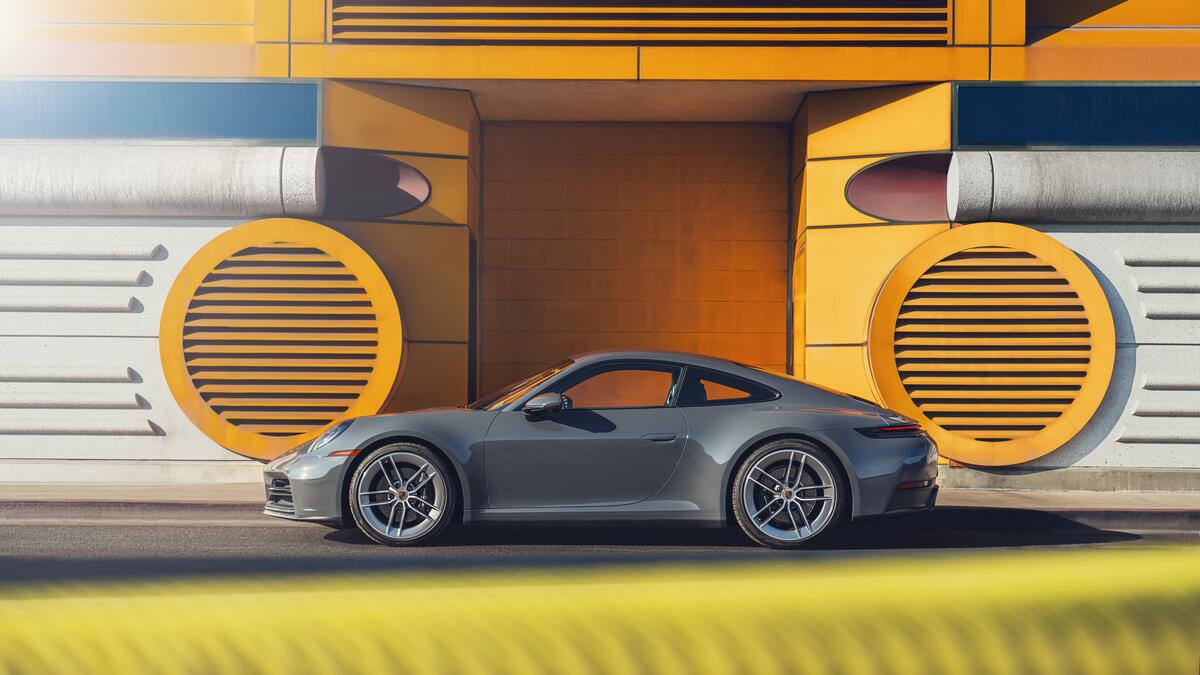
Longtail 917s
"Triple zero, I did an article on the Longtail 917s. Okay. Yeah, we did kind of an extensive article on the Longtail cars, which were for Le Mans only, and which Porsche got help from the French aerodynamicists at the SERA organization to do the body work on the Longtails."
The “Longtail 917” is a special Porsche race version built for endurance racing. The “longtail” shape helps the car stay stable at high speed, especially on tracks like Le Mans.
“Longtail 917” refers to Porsche’s 917 race cars configured with an extended rear body for improved high-speed stability. These cars are closely associated with Porsche’s Le Mans efforts in the early 1970s.
Le Mans only
"Yeah, we did kind of an extensive article on the Longtail cars, which were for Le Mans only, and which Porsche got help from the French aerodynamicists at the SERA organization to do the body work on the Longtails. Okay."
“Le Mans only” means the car was made mainly for the Le Mans endurance race. That kind of racing demands durability and stability for long hours, not just short sprints.
“Le Mans only” indicates the cars were developed specifically for the 24 Hours of Le Mans, rather than being broadly raced elsewhere. Endurance-focused rules, track characteristics, and reliability targets heavily shape how these cars are built.
SERA
"Yeah, we did kind of an extensive article on the Longtail cars, which were for Le Mans only, and which Porsche got help from the French aerodynamicists at the SERA organization to do the body work on the Longtails. ..."
SERA is mentioned as a French group that helped with aerodynamics. That means they worked on the car’s shape to help it cut through air better at racing speeds.
SERA is referenced here as a French organization that provided aerodynamic help for Porsche’s Longtail bodywork. In this context, it highlights how Porsche collaborated with specialized aero experts to refine race-car shapes.
Laguna Seca
"I never got to meet him in person until, would have been 2011 at Laguna Seca. Yeah, I haven't talked to him in a while."
Laguna Seca is a famous race track in California. The speaker mentions it as the place where they met someone in person.
Laguna Seca is a well-known road course in California where the speaker says they finally met Michael Kaiser in person. It’s a common venue for motorsport events and car enthusiast gatherings.
Frau Baer
"She was in charge of the customer parts department basically. So if you were a customer of Porsche and you were racing Porsche's, basically Frau Baer was one of the contacts in that department who you went to to get your parts."
Frau Baer is a person connected to Porsche’s customer racing era. The host says she was one of the main contacts people used to get Porsche racing parts.
Frau Baer is mentioned as a key contact in Porsche’s customer racing parts operation during the 1960s and 1970s. The speaker describes her role as effectively managing the customer parts department for racing customers.
assets on the balance sheet
"And there was always pressure from Porsche's accounting department, I think mainly to get rid of spare parts that were just sitting around because they had to be, you know, they were assets on the balance sheet, basically."
“Assets on the balance sheet” means the parts were recorded as company value in Porsche’s financial statements. Because those parts were treated as assets, Porsche’s accounting department pushed to write them off and remove them from inventory.
spare parts
"And there was always pressure from Porsche's accounting department, I think mainly to get rid of spare parts that were just sitting around because they had to be, you know, they were assets on the balance sheet, basically."
Spare parts are extra pieces a company keeps so repairs can be done quickly. Here, Porsche had lots of unused parts sitting around, and the accounting team wanted to get rid of them.
“Spare parts” are replacement components kept in inventory for repairs and maintenance. In this story, Porsche’s accounting team wanted to dispose of parts that were sitting unused because they were tied up as inventory assets.
write this stuff off
"And so the accounting department would want to write this stuff off and just get rid of it. And Voschik would be like, no, no, no, let me buy it."
“Write off” is an accounting action where a company reduces the recorded value of an asset because it’s no longer expected to be used or recovered. In the episode, Porsche wanted to write off the unused parts and dispose of them.
917 book
"And then the first book you wrote was the 917 book. And then after that, the Porsche..."
They mention writing a first book focused on the Porsche 917. It’s part of the story about the author’s work, not a how-to or technical deep dive.
The speaker says their first book was about the Porsche 917, indicating a dedicated publication segment within the conversation. This is more about the episode’s narrative/biography than a technical explanation.
different generations of the 911
"It can be as simple as just the different generations of the 911, for instance, or other generations of other cars. And we throw around those three-digit type numbers pretty fluently."
The 911 has been made for many years, and Porsche changed it in stages. If you know which “era” a 911 is from, you’ll understand what people are talking about when they compare cars.
The Porsche 911 has been produced in multiple generations over decades, and each generation has distinct engineering and styling details. In enthusiast circles, people often refer to these generations using shorthand codes, so knowing them helps you follow conversations.
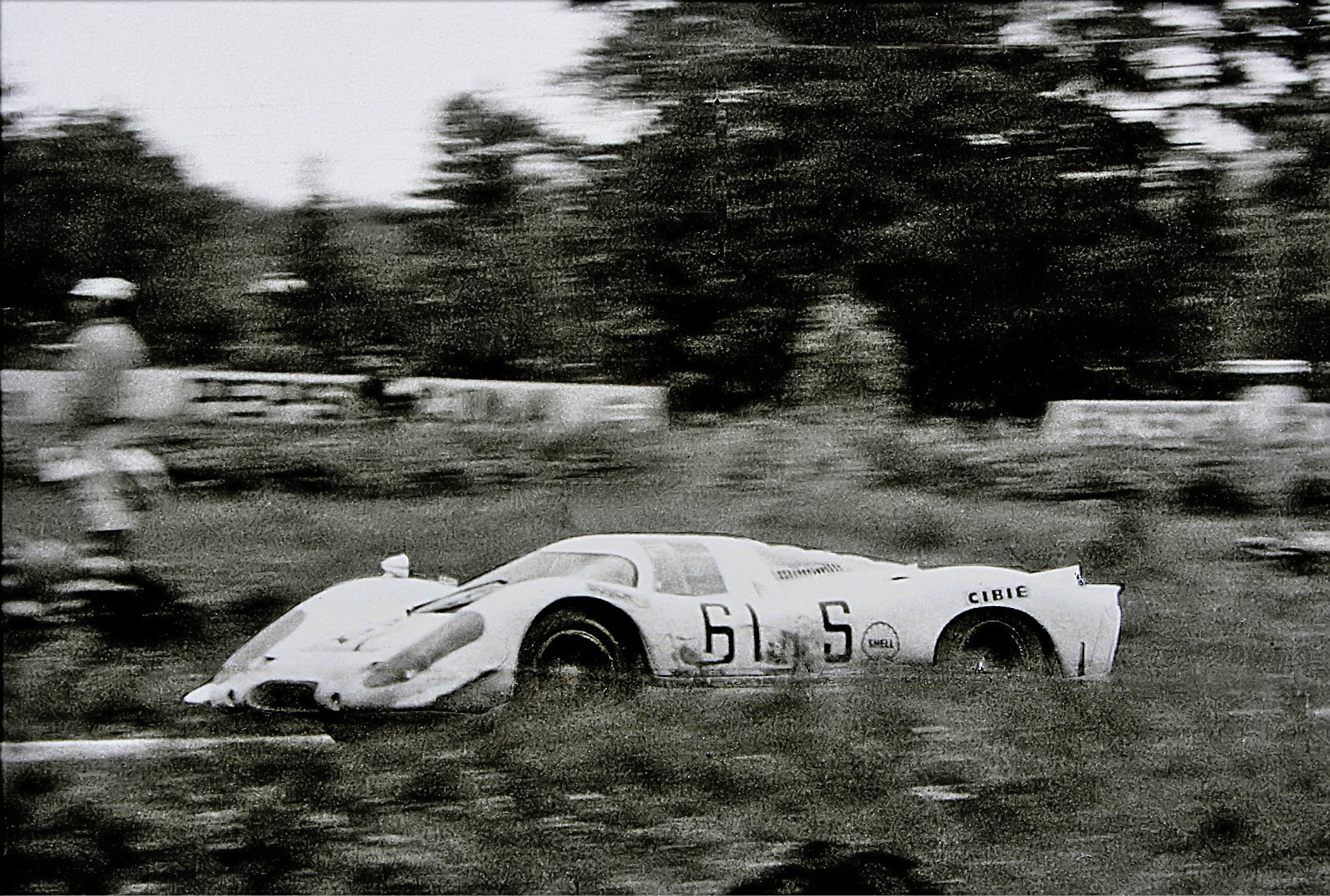
917
"And the 936 is a close cousin of the 917. When Porsche decided to build the 936, they had to build it in a hurry."
The Porsche 917 is a well-known Porsche race car from the endurance-racing era. The host is basically saying the 936 is closely related to it in how Porsche approached the project.
The Porsche 917 is another famous Porsche endurance race car, and the host calls the 936 a “close cousin” of it. That implies shared design thinking and component relationships between the two racing platforms.
transmissions
"So for the 936 ends up with the transmissions, basically suspension steering wheel hubs,"
A transmission is the gearbox that helps the engine deliver power efficiently. In racing, using an existing one can make the car easier and faster to build.
A transmission is the gearbox system that changes gear ratios to match engine speed to road or track conditions. In race-car development, using an existing transmission can be a practical way to speed up build time.
suspension
"So for the 936 ends up with the transmissions, basically suspension steering wheel hubs,"
Suspension is what connects the wheels to the car and helps the tires stay in contact with the road. In a race car, it’s tuned to help the car handle better.
Suspension is the system that connects the wheels to the car and controls ride and handling by managing how the tires move over bumps. Race cars often use suspension design choices to improve grip and stability.
steering wheel hubs
"So for the 936 ends up with the transmissions, basically suspension steering wheel hubs,"
The hub is the part that connects the steering wheel to the steering system. In race cars, it’s designed to fit the driver and be secure.
A hub is the mounting interface that connects a steering wheel to the steering column. In motorsport, steering wheel hubs are often part of a quick, modular setup for driver fitment and safety.

Porsche 936
"And then the chassis itself was newly designed, but it's very similar to a 917 Can-Am car or a 9083. So there's a lot of 917 in the 936."
The Porsche 936 is a Porsche race car from the 1970s. It’s the kind of car teams built for long-distance races, and in this episode they’re pointing out its big Le Mans success.
The Porsche 936 is a 1970s-era Porsche race car built for endurance racing. In this segment, it’s discussed as being closely related to earlier 917-era components and as a car that later achieved major success at Le Mans.
24 hours of Le Mans
"But this is a car that went on to win the 24 hours of Le Mans three times, which is a pretty significant achievement for a company like Porsche."
The 24 Hours of Le Mans is the world-famous endurance race in France, where cars compete to cover the most distance over a full day. The speaker highlights that the discussed Porsche won it three times, framing it as a major achievement for Porsche.
Group 5
"he was concerned because Porsche was putting all their effort into what then was called Group 5, Silhouette Racing. And they plan to compete very actively in Group 5 for 1976."
Group 5 is a set of racing rules that determines what kinds of cars can compete. Porsche was planning their racing program around those rules for the 1976 season.
“Group 5” refers to a FIA racing category with specific rules for the types of cars eligible to compete. The speaker explains Porsche was focusing effort on Group 5 “Silhouette Racing” for 1976, which influenced which cars they built and how they developed them.
Silhouette Racing
"he was concerned because Porsche was putting all their effort into what then was called Group 5, Silhouette Racing. And they plan to compete very actively in Group 5 for 1976."
Silhouette Racing means the cars have to look like a certain shape or style, even if the race engineering underneath is very different. The rules affected what Porsche built for that era.
Silhouette Racing is a style of racing where cars must resemble production-based “silhouette” shapes, even if the underlying engineering is heavily modified. In this segment, it’s tied to Group 5 rules and helps explain why Porsche’s development focus and car choices were shaped by the regulations.
Porsche 911 Turbo
"So the car is going to be the 935, right? So it's based on the Porsche 911 Turbo with a lot of modifications."
The Porsche 911 Turbo is a turbocharged 911 model. In this episode, they’re saying the race car they’re talking about was built using the 911 Turbo as a starting point.
The Porsche 911 Turbo is the turbocharged version of the 911, and it’s used here as the base platform for the 935. The speaker says the 935 is “based on the Porsche 911 Turbo,” highlighting how Porsche adapted a road-car-derived engine/drivetrain concept for racing.
World Sports Car Championship
"Then the FIA decided to continue with the World Sports Car Championship, which is for Group 6 prototypes."
The World Sports Car Championship was an international endurance racing series organized under FIA rules. Here, it’s mentioned as the series the FIA chose to continue, specifically for Group 6 prototypes, which directly impacted Porsche’s racing program.
Group 6 prototypes
"Then the FIA decided to continue with the World Sports Car Championship, which is for Group 6 prototypes."
Group 6 prototypes are a racing category for purpose-built race cars. The FIA switching to that category is described as a reason Porsche’s plans and car development priorities shifted.
“Group 6 prototypes” refers to another FIA prototype racing category, typically allowing purpose-built race cars rather than silhouette-style entries. The speaker says the FIA decided to continue with the World Sports Car Championship for Group 6 prototypes, which changed Porsche’s direction.
FIA
"Then the FIA decided to continue with the World Sports Car Championship, which is for Group 6 prototypes."
The FIA is the organization that makes the rules for a lot of international racing. Here, they’re the ones making the decision that affects what Porsche can race and how.
The FIA is the Fédération Internationale de l’Automobile, the governing body that sets many of the rules for international motorsport. In this segment, the FIA’s decision to keep the World Sports Car Championship going is described as a key factor in Porsche’s planning.

Porsche 935
"And the problem there is the 935 might win the Group 5 class, but if it doesn't win the race overall, you know, you're not going to get any publicity benefit because people only care about who wins the race overall."
The Porsche 935 was a purpose-built Porsche race car from the 1970s. The hosts are saying it could win its class, but the team also wanted to win the whole race for maximum attention.
The Porsche 935 is a famous 1970s Porsche race car built for Group 5 touring-car rules. In this segment, it’s discussed as a potential winner of the Group 5 class, which matters because overall race winners get the most publicity.
911 RSR Turbo
"The only thing, you know, major thing that came from elsewhere was the engine, which came from the 911 RSR Turbo that they had run at Le Mans as a prototype in 1974."
This is a Porsche 911 race version that ran at Le Mans. In the story, its engine was reused as the key “borrowed” part for the later race car they were building.
The “911 RSR Turbo” refers to a Porsche 911-based race car variant used in the 1974 Le Mans prototype program. Here, its engine is singled out as the major component that came from elsewhere and was used in the later Group 6/936 effort.

924 Turbos
"When he came in, you know, the racing team told him that the only plan they had for Le Mans was to run the 924 Turbos, which potentially could win the class."
The Porsche 924 Turbo is a Porsche model that can be turned into a race car. The hosts say Porsche’s plan for Le Mans was to run these, but the CEO wanted a car that could win the whole race, not just a class.
The Porsche 924 Turbo is a smaller Porsche race/production-based platform that the team initially planned to enter for Le Mans. The segment frames it as potentially class-winning, but not aligned with CEO Peter Schutz’s demand that Porsche only race if it can win overall.
Indianapolis 500
"...we have this engine that we were going to run in the Indianapolis 500 in 1980... So the Indy program was canceled..."
The Indianapolis 500 is a major race in the United States. In this story, Porsche couldn’t run its plan there because of rule issues, so they shifted focus to another race.
The Indianapolis 500 is a premier American open-wheel race, and it’s referenced here as the event Porsche planned to run the engine at. The segment focuses on how rule changes prevented that Indy program, pushing Porsche to redirect the project toward Le Mans instead.
USAC
"...it never ran at Indy because USAC changed the rules or didn't give Porsche the ruling that Porsche wanted..."
USAC was the organization that set the rules for major American racing events like Indianapolis. Here, their rule decisions impacted whether Porsche could run its engine the way it wanted.
USAC (United States Auto Club) was the sanctioning body that governed major American open-wheel racing, including IndyCar-era events. In this segment, USAC’s rule changes and rulings affected whether Porsche’s engine could run at the Indianapolis 500 as intended.
boost pressure
"...didn't give Porsche the ruling that Porsche wanted in terms of boost pressure at the 500."
Boost pressure is how much extra air a turbocharger pushes into the engine. Racing rules can cap it, so teams have to adjust their setup to stay within the rules and still make power.
Boost pressure is the extra air pressure a turbocharger (or supercharger) forces into the engine. In racing rules, limits on boost pressure can determine how much power an engine can make, so teams often redesign or re-interpret engines when regulations change.
methanol
"They said, hey, we have this engine... We can convert it from running on methanol to running on gasoline."
Methanol is a type of racing fuel. Switching an engine from methanol to gasoline isn’t just a refill—it changes how the engine needs to be tuned to run correctly.
Methanol is a fuel used in some racing series because it can be formulated to support high-performance combustion and cooling characteristics. This segment notes Porsche converted an engine from methanol to gasoline, which is a major change because fuel properties affect tuning, combustion, and engine hardware requirements.

Porsche 956
"And then that engine goes on to become the basis of the engine that the 956 runs on in 1982."
The Porsche 956 is another Porsche race prototype that came after the 936. The point here is that Porsche reused and evolved the engine concept from the earlier car for the 956.
The Porsche 956 is a later Porsche Group C prototype that became a cornerstone of Porsche’s early-1980s endurance dominance. The segment says the engine developed for the 936 became the basis for what the 956 used in 1982, showing how Porsche carried forward successful engineering.
Porsche 917/50
"they called it the 917 slash 50, but then they said, well, that's no good. It's not a 917."
Porsche had a race-car project that people initially called the “917/50.” The speaker says that name didn’t end up being correct, so Porsche changed the designation.
The Porsche 917/50 was an early naming attempt for a specific Porsche race car project. In this conversation, the hosts clarify that it ultimately wasn’t actually a “917,” so the name was changed as the project evolved.
Porsche 926
"So then they changed it to 926. It's not a 917. So then they had the type number 926 for a while."
“926” is the project number Porsche used for a while. It’s basically an internal label that changed as the team figured out the right way to name the car.
Porsche 926 is the internal project/type number the team used for a period. The discussion frames it as a placeholder designation before they aligned the naming with other Porsche race-car type numbers and classes.

Porsche 934
"But then they said, well, wait a minute, we've got the 934 for group 4, 935 for group 5."
The speaker mentions Porsche 934 as a reference point for how Porsche numbered cars for different racing groups. It’s used to explain why they wanted the new car’s number to “fit” the system.
Porsche 934 is referenced here as an existing Porsche race-car type number tied to “group 4.” The point of bringing it up is naming consistency—how Porsche’s type numbers map to racing classes.
group 4
"we've got the 934 for group 4, 935 for group 5. Maybe we should call this car the 936 so that they're kind of aligned with their type numbers"
“Group 4” is a racing category that sets rules for what kind of cars can race. Here, it’s mentioned to show how Porsche’s car numbers matched those categories.
“Group 4” refers to a specific FIA racing category/class used to regulate what cars could compete. In this segment, it’s used to explain how Porsche’s type numbers were associated with different racing groups.
electric car with the four hubs
"It was all the consultant stuff and the electric car with the four hubs. I remember learning when he was young, he put electricity in his house."
The phrase describes an early idea for an electric car where the drive system is built into the wheels (or near them). The point here is that the speaker is talking about early EV concepts tied to Porsche’s fascination with electricity.
This refers to an early concept of an electric vehicle layout where power is distributed to multiple “hubs” (typically meaning wheel-end motors or hub-mounted components). The speaker is describing a childhood book’s depiction of Ferdinand Porsche’s interest in electricity and early EV ideas.

Porsches Career
"including our great Porsche author, Carl Ludwigson's book called Genesis of Genius, is one of the best books that covers Ferdinand Porsche's career up until the point that he starts his own company."
The Porsche Carrera GT is a very high-performance Porsche supercar. It’s designed for fast driving and strong performance, not everyday commuting. It may be mentioned because it represents a major engineering achievement from Porsche.
The Porsche Carrera GT refers to Porsche’s high-performance supercar, built to deliver extreme acceleration and track-focused driving dynamics. It’s often discussed in the context of Porsche’s engineering and design achievements, and it can be a natural topic when a podcast is highlighting Porsche-related books and the company’s founder’s career. In this episode, it’s likely being mentioned as part of a broader look at Porsche’s “genius” and how that shows up in iconic cars.
electricity
"One thing is his fascination with electricity as a young kid, basically. First of all, nobody in his town where he was growing up had electricity."
They’re talking about Porsche being interested in electricity when he was young. It’s used as background for why he later became involved in engineering ideas related to power and vehicles.
In this segment, “electricity” is discussed as a formative fascination for Ferdinand Porsche—something he pursued even before his community had it. The hosts use it as a narrative thread connecting Porsche’s early interests to later engineering work.

Buick Century
"...ot even, you know, it's two years before the 20th century. And he invents and patents, as you mentioned, t..."
The Buick Century is a model of car made by Buick. It’s generally the kind of vehicle people used for everyday driving, like commuting and family trips. It may come up in history because it’s connected to the timeline of how cars and technology developed.
The Buick Century is an American car model line from Buick, typically associated with mid-size family-oriented driving rather than sports performance. It may be mentioned in a historical discussion because it ties into how early automobile patents, engineering ideas, and timelines connect to the development of the industry. In the podcast context, it sounds like it’s part of a broader “who invented what and when” narrative.
electric wheel hub motors
"And he invents and patents, as you mentioned, the electric wheel hub motors. So the motors actually built into the hub of the wheel."
Instead of having a motor in the engine bay, the motor is built into the wheel itself. That means the car can push the wheels directly from the wheel area.
Electric wheel hub motors are motors built into the wheel hub, so the drive happens at the wheels directly. That layout can simplify driveline components and changes how torque is delivered to the vehicle.
battery electric vehicles
"And that was his innovation for EVs, battery electric vehicles. He didn't stay with battery electric vehicles all that long because he ran into all the problems that we talk about today, right?"
A battery electric vehicle runs on electricity stored in a battery. The battery has to be heavy enough to carry the energy, which affects how far the car can go.
Battery electric vehicles (BEVs) use stored electrical energy in a battery pack to power electric motors. The key challenge is that early batteries had low energy density, which limited range and added significant weight.
range anxiety
"Batteries are too heavy. Where do I charge it? Range, range, anxiety, all that stuff he kind of ran into out of the gate in 1898, 1899."
Range anxiety is the feeling that you might run out of charge before you can find a place to recharge. It’s basically “what if I can’t make it?”
Range anxiety is the worry that a vehicle won’t have enough battery charge to reach the next charging point. It becomes more pronounced when battery range is limited or charging infrastructure is sparse.
lead acid batteries
"And remember, with those were lead acid batteries. So, you know, the batteries alone weighed thousands of pounds."
Lead-acid batteries are a very old type of rechargeable battery. They work, but they’re heavy, so they don’t store much energy compared to newer battery types.
Lead-acid batteries are an older battery chemistry that uses lead and sulfuric acid. They were common historically, but they’re heavy for the amount of energy they store, which severely limits EV practicality compared with modern chemistries.
hybrid
"So that's why he pretty quickly switched to what we would call a hybrid. So he used a combustion engine to drive a generator to provide the power to his wheel hub motors."
A hybrid uses two ways to get power. Here, an engine helps make electricity, which then powers the motors at the wheels.
A hybrid vehicle uses more than one energy source or power path—commonly combining an internal combustion engine with an electric generator/motor system. In this case, the combustion engine drives a generator to supply power to the wheel hub motors.
combustion engine
"So he used a combustion engine to drive a generator to provide the power to his wheel hub motors. And in the earliest part of the 20th century, you know, the first decade of the 20th century, that's kind of where the focus was."
A combustion engine is the classic engine that burns fuel to make power. In this setup, it’s used to generate electricity instead of directly driving the wheels.
A combustion engine produces power by burning fuel, converting chemical energy into mechanical energy. In early hybrid concepts, it can be used to run a generator rather than directly turning the wheels.
generator
"So he used a combustion engine to drive a generator to provide the power to his wheel hub motors."
A generator is a device that turns motion into electricity. Here, the engine spins it to make power for the electric motors.
A generator converts mechanical energy into electrical energy. In this hybrid approach, the combustion engine turns the generator, which then supplies electricity to the wheel hub motors.
pure EVs
"They still, they still built some pure EVs. [1390.8s] But mostly what they were doing was hybrid with a combustion engine, kind of like the Chevrolet Volt, you know,"
A pure EV is a fully electric car. It uses a battery to power the motor and doesn’t have a gas engine for driving.
“Pure EVs” refers to fully electric vehicles that run only on electricity stored in a battery. They don’t use a combustion engine for propulsion, unlike hybrids or plug-in hybrids.

Chevrolet Volt
"But mostly what they were doing was hybrid with a combustion engine, kind of like the Chevrolet Volt, you know, [1397.7s] a combustion engine that provides the electricity to the drivetrain."
The Chevrolet Volt is a car that can run on electricity, but it also has a gasoline engine as a backup. When the battery runs low, the gas engine helps make electricity so you can keep driving.
The Chevrolet Volt is a plug-in hybrid that uses both an electric motor and a combustion engine. In this setup, the combustion engine can generate electricity to keep the drivetrain powered when the battery is depleted.
Ferdinand Porsche
"But mostly what they were doing was hybrid with a combustion engine, kind of like the Chevrolet Volt, you know, [1397.7s] a combustion engine that provides the electricity to the drivetrain. [1403.6s] Um, so when you read about Ferdinand, a lot of times it says, you know, he was just focused on cars."
Ferdinand Porsche was a key person behind Porsche’s early history. In this episode, they’re talking about his involvement with the Nazi era, which is historical context.
Ferdinand Porsche is the founder/figure most associated with Porsche’s early engineering and development. The segment discusses his political affiliations during the Nazi era, which is a historical context point rather than a technical automotive detail.
Ferry Porsche
"But we have to acknowledge the fact that they were members of the Nazi party and Ferry Porsche was a member of the SS. [1464.5s] Again, my feeling is, is that was imposed on them."
Ferry Porsche was another major Porsche family figure. In this segment, they mention him because of what they say about his Nazi-era affiliations.
Ferry Porsche (Ferdinand “Ferry” Porsche) is discussed here in the context of Nazi-era membership. The episode uses this as part of a broader historical discussion about Porsche’s leadership during that time.
SS
"But we have to acknowledge the fact that they were members of the Nazi party and Ferry Porsche was a member of the SS. [1464.5s] Again, my feeling is, is that was imposed on them."
The SS was a Nazi organization. The hosts mention it because they’re discussing historical political involvement connected to Porsche family members.
The SS was a major Nazi organization responsible for security and enforcement. In the transcript, it’s mentioned to describe Ferry Porsche’s alleged membership, which is part of the historical/political discussion.
World War II
"So that's pretty good because that's coming from high level Nazi. [1509.0s] You know, Albert Speer was right up there."
World War II is the global war that happened in the 1930s and 1940s. Here it’s mentioned to explain the historical setting of the people they’re discussing.
World War II is referenced as the time period when Speer and Porsche “butted heads.” This is historical context for the discussion, not a technical automotive concept.
Mercedes
"[1567.8s] But from what I've read, his personality seems to just be like stubborn and super focused on what he wants, [1575.8s] because there was times like a Mercedes or Auto Union where they're like, no, let's do this. [1580.3s] And he's just kind of, fuck you, I quit."
They’re talking about Mercedes, a big German car company. In this story, it’s used to set up a conflict about decisions and direction.
The speaker mentions Mercedes in the context of a disagreement about what to do. Mercedes is a major German luxury-car brand, and in Porsche history discussions it often comes up as a peer automaker or employer/partner figure.
Auto Union
"[1567.8s] But from what I've read, his personality seems to just be like stubborn and super focused on what he wants, [1575.8s] because there was times like a Mercedes or Auto Union where they're like, no, let's do this. [1580.3s] And he's just kind of, fuck you, I quit."
Auto Union is referenced as another German automaker involved in a “let’s do this” versus “I quit” type of clash. Auto Union is historically important in German racing and car manufacturing, and it’s often mentioned in early 20th-century automotive history alongside brands like Mercedes and Porsche.
authoritarian environment
"[1596.4s] And sometimes he got had to go on the highway as a result of that. [1600.2s] But I think it's important to remember back to your original question, [1603.7s] I think it's important to remember that Ferdinand Porsche grew up in an authoritarian environment. [1608.9s] And he himself was an authoritarian."
An “authoritarian environment” describes a setting where authority is strict and decisions flow from the top down, with little room for debate. In this episode, it’s used to explain how Ferdinand Porsche was raised and how that shaped his own leadership style.
Request an Explanation
Heard something you'd like explained? We'll add it to this episode.
Sign in to request explanations for terms you heard.
Want to learn more?
Browse our glossary for plain-English explanations of automotive terms, jargon, and concepts.
Help improve this episode
See something that's not quite right? Our annotations are AI-generated and can sometimes miss the mark. Click the flag icon on any annotation to suggest a correction.