A sprint weekend is a special F1 race format with an extra, shorter race on Saturday. The results from that sprint help decide where cars start on Sunday, so teams have to plan carefully.
When F1 says “new regulations,” it means the rules for how cars can be built and raced have changed. That usually forces teams to rethink their car setup, so it can take a few races to figure out what’s best.
Concept
weather played sort of a factor
Weather affects how the track grips the tires and how the cars behave. If conditions change, it can be harder to tell whether a car improvement is the real reason for performance.
An upgrade package is when a team brings a set of improvements to the car, like new parts or tweaks. The team can’t always tell immediately how much faster it makes the car, so they learn as the weekend goes on.
Pole position means you start the race from the very front because you were fastest in qualifying. But you can still lose the lead at the start, which is what they’re pointing out.
The gearbox is what helps the car choose the right gear for speed and acceleration. When they say someone was “on his gearbox,” they mean they were right behind him and constantly pressuring him.
Track position just means who’s in front on the race track. Teams try to get and keep that advantage because it’s usually easier to manage the race when you’re ahead.
A strategy play is the team making a smart call during the race. It usually involves things like when to pit and which tires to use, and it can help a driver gain an advantage.
Mercedes is the F1 team involved in the race strategy. Their decisions—like when to pit and what tires to run—can strongly affect who ends up in front.
Paddles on the steering wheel are the buttons the driver uses to shift gears. They’re designed so the driver can change gears fast while staying fully in control.
Radio transmissions are the messages the driver sends to their team during the race. The tone and timing can reveal how stressed or focused the driver is.
They’re talking about how the driver is handling stress. If he can joke after a tough race, it usually means he’s not rattled and can focus on fixing things for the next session.
They mean how many positions the driver drops right at the beginning of the race. Early position is valuable in F1, and if you lose a few spots, it can be tough to get them back later.
A “bad start” means the car doesn’t get away well when the race begins. In F1 that’s a big deal because it can cost you positions right away.
Concept
Park Formet
This sounds like “Parc Fermé,” which is the area where F1 cars are kept after qualifying. Teams have limited ability to change things there, so it’s a controlled environment.
Toto Wolff is the top boss at Mercedes’ Formula 1 team. He helps decide how the team runs and how drivers are supported and coached.
Company
Total Wolf
This sounds like a mis-heard version of Toto Wolff, the Mercedes F1 team boss. The point is that he helped drive the plan for how the driver was handled.
It means they tried to shield him from too much pressure and attention. The idea is to help a driver settle in without everything feeling overwhelming.
In F1 coverage, “opposition” means the other teams and drivers competing against you. It’s used to frame performance as relative—who is faster and who is closing the gap.
“Bed in” refers to a driver spending an initial period adapting to a new car setup, team routines, and race rhythm. In F1, that early adjustment time can make a big difference once the season’s pace and expectations ramp up.
Concept
Formula 1 career
This just means how long someone has been racing in Formula 1. The hosts are talking about how fast a driver can learn and compete well.
A “buffer” is just a cushion of time or position. If you’re far enough ahead, you can make a small mistake without losing everything. If that cushion shrinks, you have to be more precise.
Motorsport just means racing competition. In Formula 1, it’s a reminder that even if a driver or team looks strong, things can still go differently during a race.
Concept
data point
A “data point” is one specific fact or result. They’re saying one past result is being used as a clue about how the driver will do this time.
“Media day” is when F1 drivers do interviews with reporters before the race weekend. It’s basically the press-and-promo portion of the event, before the cars hit the track.
“Mechanical reasons” means the car had a technical problem. If that happens, the driver can’t just “drive better” to fix it—something on the car needs to work properly.
A “pit” is when the car stops to change tires (and sometimes make other adjustments). “One lap later” means they came in slightly later than planned, which can change how the race plays out.
This phrase means the usual reasons someone might give for a tough race. The speaker is saying this time there isn’t an easy explanation that lets the driver “blame” something else.
If rain hits during the race, the track gets slippery and visibility can drop. Drivers have to change how they brake, turn, and accelerate, and sometimes they switch tires.
It means the tires aren’t gripping well at all, so the whole car starts to slide. Instead of the car “turning” normally, you have to drive ahead of what the car will do because it’s harder to control.
Corner balance is about how the car’s weight is set up for turning. If it’s not balanced right, the car will either push wide or slide the rear more than you want.
Undercut means pitting earlier than another car so you can drive faster on fresh tires. If it works, you can come out ahead after both cars have stopped.
A strategy misstep means the team’s plan during the race didn’t work out. In F1, that can happen if you pit at the wrong time or choose the wrong tire, and it can cost you the win.
The safety car is a pace car that comes out when the track isn’t safe. It slows everyone down, and that can be a good time to change tires or make a pit stop.
F1 has two main title races: one for the team (based on both cars’ points) and one for the driver (based on that driver’s points). Teams think about both when planning strategy.
The championship fight is the season-long race to win the overall title. Drivers earn points at every Grand Prix, so results that seem small can still matter a lot.
Points totals are just the running score for each driver across the season. Because points are awarded based on where you finish, the totals show who’s really close in the title race.
An intra-team battle means two drivers from the same Formula 1 team are racing each other for the best results. It can affect team decisions and who’s helping the car develop.
Lap time is the time it takes to do one full lap around the track. If someone has better lap times, it usually means they’re going faster, even if the race result looks different.
Outqualified means one driver got a worse qualifying result than another driver. Qualifying matters because it sets where you start the race, which can make it easier or harder to fight for position.
Reliability issues mean the car had problems that stopped it from running normally. If the car can’t complete laps in practice, the team has less time to learn what to fix.
When the rules are brand new, teams are still learning how to make the cars work best under them. So it’s harder to tell who is truly faster because people are still experimenting.
One-lap pace is how fast the car is for a single quick lap. Qualifying depends heavily on that, because you’re trying to set the best time before traffic and tire drop-off hurt you.
F1 teams have a spending limit. If they spend money on upgrades but don’t get the expected speed, it’s a problem because they can’t just overspend to fix it later.
Teams try new upgrades to make the car faster. If the parts “don’t work,” it means the upgrade didn’t improve the car the way they hoped, or it even hurt performance.
The “floor” is the bottom of the F1 car that helps it stick to the track using aerodynamics. If it gets damaged, the car can lose grip and feel less stable.
Barge boards are small fins on the sides of the car that help the airflow behave better. If they’re damaged, the car can lose downforce and feel slower or less planted.
Term
P3
“P3” just means third place. In F1 they use “P” for “position,” so P3 is position three.
It means engineers try to change just one thing so they know what caused the improvement or problem. If you change many things at once, it’s harder to tell what actually helped.
Teams use practice to try new parts and learn what works. With no testing and only one practice session, they have less time to figure out which changes are actually improving the car.
An F1 car is a whole system, not a set of separate parts. Changing one thing can affect other things, so it’s hard to predict results from a single change.
A “knock-on effect” is when one change causes other changes later on. In this case, delaying parts changes how much time engineers have to test and improve the car.
It means figuring out which car changes actually make it faster. Instead of mixing everything together, the team tries to test updates so they know what’s really helping.
Car
Ferrari
They’re talking about Hamilton’s Ferrari and how his results depend on how well the car is working at the start of the weekend. If the car isn’t right early, it can be harder to catch up later.
Downforce is the “push down” from the car’s shape and wings that makes the tires grip the road better. In corners, more downforce usually means the car can turn in faster and feel more stable.
Ground effects are a way race cars make downforce using the space under the car. Because it depends on how close the car is to the track, the car can behave differently if it rides higher or lower.
Term
Q3
Qualifying is how F1 decides the starting order. Q3 is the last and most important qualifying segment—if you make it there, you’re usually fighting for the best starting spots.
Red Bull Racing is the Formula 1 team and brand being discussed here. The hosts credit Red Bull’s development approach for turning an initially underperforming car into a competitive one with major upgrades.
The steering system is what connects the driver’s steering wheel to the front wheels. If a team changes it, the car can feel more responsive and easier to place into corners.
Race cars have to “tell” the driver what they’re doing. If the steering and controls don’t feel right, the driver can’t adjust quickly enough to go faster.
“Front end” means the part of the car that steers and turns—mostly the front tires and suspension. If it feels better, the driver can turn in more confidently and push harder.
The front suspension is what connects the front wheels to the car and controls how they move. Changing it can make the car feel more stable and easier to steer, especially when turning hard.
Franco Colapinto is the driver the hosts are talking about. They’re saying he showed strong speed and turned it into good results, which matters for his chances with the team.
LIVE
If you won the crown, you have to be the champion!
The test is passed and it's three Grand Prix victories in a row for Kimmy Antonelli!
Yes!
What a race!
What a race, man!
Oh my God!
What Kimmy's doing reminds me of Lewis in 2007, even Michael Schumacher in 1991.
I'm really impressed by Kimmy's mental strength.
Where he's starting to settle is as a very complete driver at a very young age.
What about the other side of the garage then?
He was convincingly defeated and that has got to hurt.
It's the first one that he can't sort of use the book of driver excuses as to why.
Lando, I felt very half full because he knows you should have won the race.
Franco Collopinto.
Quick handshake, quick hug from Lionel Messi and you can achieve anything, right?
After such a long break, we were desperate to get back to racing and the Miami Grand
Prix was well worth the wait.
Welcome everyone to F1 Nation.
I'm Tom Clarkson, inside the Miami Dolphins' incredible hard rock stadium, perhaps the
most unique paddock on the F1 calendar.
And joining me this evening on the show is F1 TV expert and IndyCar race winner James
Hinchcliffe and F1 correspondent Lauren Sporetto.
Very warm welcome to you both.
Welcome back F1.
What a race.
What a race indeed.
I mean, what a weekend, right?
To come off a five week break like that onto a sprint weekend, into a sprint weekend.
So much, I think, anticipation coming into this one.
First three races were kind of closely bunched together.
New regulations, lots to learn.
Five weeks off, teams have tons of upgrades coming, lots of question marks and uncertainties
coming into the race.
Who brings the most?
Who brings the best?
What works?
What doesn't?
Evidently, weather played sort of a factor in the whole thing from start to finish an
incredible weekend.
Very exciting.
And the field closed up, didn't it?
Yeah, I think that's the beauty of the first big upgrade packages of the season.
Obviously, the team had, what, four or five weeks to really refine these and put a bit
more budget in.
And I think because we only had 90 minutes of practice, it still wasn't really immediately
clear what kind of impact those upgrade packages had.
So we had to kind of feel our way through the race weekend.
And I'm not sure we've still got the answer yet because I don't think the teams know fully
whether or not they've got the most out of those packages just yet.
I think we need to now talk about the winner, don't we, Kimmy Antonelli.
Three on the bounce from three pole positions.
He now leads the championship by 20 points.
Talk us through how he did that, guys, with pressure from the reigning world champion,
you know, who was on his gearbox for lap after lap, his best win so far.
Would you agree?
Yeah, I would say so.
I think for sure the strongest kind of all-round performance and it's so interesting.
Three poles in a row still hasn't led lap one in any of them, but has come back to win
all three of those races and different circumstances kind of in each one.
But the most impressive part about this one was, yep, find a little bit of a strategy
play from Mercedes to get him that track position back.
But like you say, it wasn't a 14-second gap like he had in Suzuka, he didn't have the
pace advantage that he had at some of those other races.
This was incredible pressure from a world champion at a track that's very easy to make
a mistake.
That small mistake he made in China, that would have been a race-ending mistake in Miami.
So you look at how composed he was at one point complaining about something with the
paddles on the steering wheel.
Maybe the heart rate went up a little bit, certainly the tone of voice went up a little
bit, but he kept it calm.
Lando behind, meanwhile, his radio transmissions were dead cool.
I mean, that's a champion's transmission and you kind of hear what the young driver's
heart rate can do in those moments, but I think for sure that the most impressive one
so far.
I'm really impressed by Kimmy's mental strength, I think, after the sprint yesterday, after
he had that bad start.
I talked to him after qualifying.
I said, you know, if you thought about those starts, he was like, I'm not thinking about
that yet because he wanted to put that of his mind heading into today's Grand Prix.
And I think, you know, that start could have got in his head again, you know, when he had
that he balked down and I know he didn't drop back as far as he ended up doing.
But I think the way that he is kind of compartmentalising the things that Hint just mentioned about
the paddle and the issues there and whether or not Lando was kind of pushing him or putting
the pressure on, and he doesn't seem to be faced by any of it.
And I think you then compare that to his teammate, George Russell, who is the more experienced
of the two.
And I think if you were a new fan and you came in, I don't think you'd realised the
difference between, you know, their level of experience.
I think the job that Kimmy is doing is really impressive.
He was laughing at the pressure in the press conference after the race.
He was saying, only lost two places at the start in the Grand Prix.
That's progress.
But I mean, I feel to be able to make a joke about it means he's in a really good place
mentally.
Yes, 100 percent, but it also means that the team has a phenomenal car because we're going
to get to a point where you don't have that advantage and losing two or three places off
the start isn't OK.
You're not going to be able to bounce back from that every weekend for another, you
know, 19 weekends, whatever it is.
So I think it's working right now, but they're going to have to improve that at some point
because as these other teams get closer and they did get a lot closer this weekend, granted,
there's the caveat that Mercedes hasn't brought their first proper big upgrade package that's
coming down the road.
But if they continue to be this close, Kimmy's not going to be able to kind of rely on the
car pace advantage that they've got seemingly at the moment to make up for those bad starts.
Hence, just with the racing drivers head on, how have you seen Kimmy grow over the course
of this season?
Well, I kind of mentioned it in the in the pre-race show that, you know, down in Park
Formet when he got out of the car after qualifying, it wasn't fist pumping, cheering to the crowd.
He jumped off the car, very coolly walked by the crew through the hang loose symbol,
the swagger on the kid, the difference from that first pull and that elation of, oh my
god, I'm the fastest guy to form the one Grand Prix.
That's incredible.
Now he's just like, yep, still got it.
Now, you know, I'm here and you just see that growth.
That's that's very impressive.
How he's handling questions about the start thing, that's very impressive.
We kind of were relating it to Lando two years ago, seven pole positions without leading
lap one sort of thing, right?
Oh, Lando doesn't know how to start either, right?
He's dealing with a similar kind of situation and kind of in a similar way.
And at some point he's going to get it and then we're going to stop talking about it
because he'll probably never make that mistake again or never have issues off the start again.
But for a kid that young, it's already been a bit of a roller coaster his first kind of
year and a bit in Formula One.
And the where he's starting to settle is as a very complete driver at a very young age.
And he seems so assured behind the wheel now.
Yeah, I think that that really tough year that he had last year had a lot of ups and downs.
I remember around the Monza time, Toto Wolf, his boss was quite tough on him and basically
said he needs to sort sort himself out, kind of cut out the mistakes.
And I think the way that he's responded to those things each time is probably just giving
him the confidence that he can be that assured.
And remember, it feels like ages ago now, but George was dominant in Australia.
And I really remember leaving that weekend thinking, George has got this, you know,
Kimmy probably needs another year to kind of bed in.
And already it just doesn't feel like that Kimmy's turned this thing around.
And I think Mercedes have prepared him really well for the kind of pressure that he's going
to be facing here.
Do you remember, I remember when they first came in, they limited the media that he did.
They media trained him as best that they could.
They kind of protected him from the public eye to start with.
And I think that is helping him now because it's helping in the opposite way when everyone
is kind of getting very excited about what Kimmy might deliver.
He seems to be coping with that really well.
And I think a lot of that credit honestly goes to the architect of the whole thing in
Total Wolf because when he first came in, admittedly, I think we can all agree that
the plan was never originally to put him in the car last year, right?
It was a forced hand because of Lewis's switch over to Ferrari.
And Total made that call and they knew they sort of had to bubble wrap him a little bit.
And they did.
And when he made mistakes, Total was the first one to put an arm around him and say,
hey, rookies make mistakes.
This is what you're here for.
This, we know this.
It's good.
It's good.
When the mistakes were too many, too frequent, and too costly around Monza, he did step up
a little bit and he knew what Kimmy needed to hear when he needed to hear it.
When he needed the comforting arm around his shoulder, he was that guy.
When he needed to be the kind of stern parental figure of the team,
he spoke to him in a way that got his attention without breaking his spirit.
And, you know, now the result is he's kind of, again, he's been through
not the entire range of emotions, but certainly an awful lot for just a little over a year in
the series.
And in the background the whole time, Total has known what to say and when.
And I think that's been really, really key in his development.
And given the pace of the car this year relative to the opposition,
thank goodness they gave him that year to bed in last year.
Imagine if this was his first season.
It would be a huge ask on a 19-year-old.
Yeah.
I think it has helped him to have that early season under his belt.
He's then had another proper winter under his belt to kind of start this season on a
stronger footing.
But then having said that, he's such a fast learner, right?
He's only, what, 28 races into his Formula 1 career now?
And he's already looking like he's been around for a long time.
So I think you kind of always develop or you kind of work at the rate in which the package
and the machinery that you've got.
And I actually think he probably would have done a reasonably good job
had he had this advantage over the field.
Because like Hinch was saying earlier, when you've kind of got that kind of gap to the pack,
you can probably afford to make the odd mistake because you know it won't really cost you.
And that's probably helped Kimmy again, hasn't it, this year?
Because he's got that little buffer which obviously was much smaller here in Miami.
But I think that's what makes this win so much more impressive is that buffer had gone effectively.
And he didn't really seem to be phased by that at all.
And the really good ones are kind of ready.
I mean, yes, I said thank goodness they gave him last year and I'm sure it's helped.
But actually what Kimmy's doing reminds me of Lewis in 2007,
even Michael Schumacher in 1991.
Remember, he gets that one off opportunity, one race deal at Spa.
And he goes and lines up sevens on the grid in a Jordan.
They just, the really good ones are ready, aren't they, actually, when they first get behind the wheel.
This is a paid advertisement for better help.
Life can sometimes feel a bit full on.
Some days everything's great and other days you're stressed,
overwhelmed or just not quite feeling like yourself.
But when there's no actual crisis, it can be difficult to know where to turn.
You might not feel like your problems are big enough.
And while attitudes around seeking support have changed over the years,
there's still a lot of work to be done.
According to Better Help's 2026 State of Stigma report,
nearly 70% of grits say that societal attitudes discourage them from seeking help.
But Mental Health Awareness Week, which runs from May the 11th to the 17th,
is a good reminder that you don't actually have to go through things alone.
Sometimes just having someone to talk to,
someone who listens and helps you make sense of what's going on in life,
can make a real difference to how you're feeling.
Therapy isn't just for those in crisis.
It can be a steady presence in your everyday life.
Better Help is an online therapy platform
with over 30,000 qualified therapists worldwide.
They help match you with a therapist who suits your needs.
And if the match isn't quite right,
you can switch to another therapist at any time.
You don't have to be on this journey alone.
Find support and have someone with you in therapy.
Sign up to get 10% off at betterhelp.com slash F1 Nation.
That's better H-E-L-P dot com slash F1 Nation.
What about the other side of the garage then?
What is George Russell thinking after four races,
given the relative performance between the two of them,
particularly at the last two races in Suzuka and here in Miami?
So I think the important thing to remember is last year in Suzuka in Miami,
two tracks that Kimmy hadn't been to, he was quite quick.
And the pace was stronger than George here last year.
With a year of development,
I know the cars are completely different and all that sort of thing,
but in a year of experience now, why wouldn't he be quicker here?
We've talked about this on the show already.
I've always kind of said the first two wins had little asterisks beside them.
And still had to get it done.
I mean, not taking anything away from them.
This is motorsport.
These things happen.
But this one was a lot of much clearer of a victory, like we said.
But it's at a track that we know he likes based on one data point, fine.
But George has always said he doesn't like, right?
So three wins on the trot, that is concerning for a teammate, certainly.
But we know that Canada is a place that George has been very strong.
The team has been very strong.
George has been very strong.
Yes, Kimmy did a good job there last year,
but George had him covered very comfortably in the Grand Prix last year.
If we go to Canada in two weeks time, three weeks time, whatever it is,
and all of a sudden Kimmy's ahead again, that's, I think, when the 63 side of the garage needs to
start, maybe not panicking, but really coming up with a plan, maybe changing their approach
a little bit, trying to find what you have to do to not just slow him down, but speed yourself up.
So it's, again, I said it before the weekend, it's not panic mode yet for George Russell,
but if Canada goes Kimmy's way without any extenuating circumstances,
that's when you might need to start being concerned.
Is it a bit deftest when George was saying on Thursday during media day,
yeah, I don't like this track. This isn't my track.
Is that the right mindset?
I think that's a defense mechanism, to be honest.
I think he was probably laying the ground to what actually transpired,
which was that Kimmy was going to have the advantage.
I think to Hinge's point, this was a Kimmy circuit last year relative to George,
and I think he was probably having had those two difficult weekends in China and Japan.
He probably knew what was coming. I think he was realistic about it.
I think this weekend will have been tougher for George because in China,
it was mechanical reasons why he got pulled out of the fight.
In Japan, had he pitted one lap later, probably could have been fighting for the win.
So I think he can probably compartmentalize those ones and think,
all right, but this one, he was convincingly defeated.
And that has got to hurt Hinge, right? From a race and driver perspective,
you always want to beat your teammate, and he's been beating definitively this weekend.
But like you say, it's the first one that he can't use the book of driver excuses as to why.
So it's the first one. It's not a trend yet, yet.
But what Kimmy's doing now, and I was really hoping we had a race that was interrupted by
rain, if I'm totally honest, because dealing with those conditions and getting thrown that
curveball, that wrench in the plan, it would have been really interesting to see how a driver with
Kimmy's level of experience reacted and coped with that compared to how Max or Orlando or George
would have dealt with it. And I asked George about that, whether or not he was starting to get a bit
worried in the TV pen, whether he's starting to get worried about these running results.
And he immediately was going, I can't wait to get back to some more conventional tracks.
So I think he still fundamentally believes, when we get back to Europe and we get to your
Monaco's in New Spain, to New Austria's in Silverstones, I still think he believes that
he will be able to pull it back. And 20 points is actually not that much. Is it a difference?
And that can change within a couple of race weekends. So I don't think he is,
to Hinch's point, panicking yet. But I do think that this one is going to hurt a lot,
and he's got to win in Canada. That is a George track. So if he doesn't win there,
then maybe we can have this chat. He doesn't want four-wheel sliding, as he called it here,
right? Hinch, just what is four-wheel sliding? A four-wheel drift?
Yeah, essentially, when you come off a corner, and you're talking about corner balance or car
balance, rather, if you're understeering, the front's not quite turning, but the back's got
enough grip. If you're oversteering, the rear's sliding and trying to pass the front of the car,
a four-wheel slide is just that. Neither the front nor the back of the car are really gripped up.
So you're not fighting an imbalance. You're just fighting a lack of grip. It requires you to almost
anticipate what the car is going to do in the mid-fade, mid-corner phase, to the exit. It is
challenging, and certain drivers kind of like those lower grip conditions. We did this comparison
from Oscar and Lando a bunch in the last third of the season last year when we went to these
low-grip circuits. It really suits Lando. Oscar struggles a bit more. We got back to those higher
grip tracks like Katarly in the year, and Piastri had the advantage again. So George brings up a
good point. We know that Kimmy's good at Suzuki. We know he's good at Miami. We know George is good
in Montreal. So let's see what happens when we get to Canada. A lot rests. A lot rests. A lot
does, I think. As Laura was just saying, it's kind of a must-win. It's a must-beat Kimmy.
It's not a must-win. They've got a really good shot at winning, obviously, but if someone else
wins, as long as it's not Kimmy, he's got to beat his teammate. Now, talking about got-to-beats,
shall we talk about McLaren now? Lando, I felt very half full after that race. I think McLaren
should be celebrating what's been a huge turnaround, and yet Lando was very much, ah, that's the one
that got away. Because he knows he should have won the race, I think, and that's what's frustrating.
I think in the TV pen, he said, I can get over the P2s and the P3s when I couldn't have had the chance
to win. But I think had they not got undercut by Mercedes and Kimmy, he would have won this
Grand Prix and then he would have kind of left this weekend thinking, ah, hang on, maybe we really
are back in the fight, whether or not that truly is the case. Obviously, Mercedes is going to bring
their upgrade package to the next race in Canada. But I think that he really felt like he should
and could have won today's Grand Prix. So I think that's probably why he was glass
half empty. He actually said in the press conference, yeah, I think I had a faster car.
And what's so important about that is, to Lawrence's point, come Canada, they might not,
right? This was a huge opportunity for McLaren to try to collect as many points when they had
maybe a little bit, and it's a small advantage if it is won over Mercedes and they didn't execute.
And so I think that's what's tough. Racing racers, right? Whether you're a driver,
team manager, engineer, whatever. Memories are very short when it comes to successes, right?
So you look at where they were on Friday and Saturday and it was fist pumping,
hands in the air, look at how far we've come. 24 hours later, it's, well, we threw that one away,
didn't we? And they're already forgetting the victory on Saturday because the taste of defeat
is so much more bitter than how sweet the taste of victory is sometimes. These drivers hate losing
more than they like winning. And this was an example of a race lost. At the very least,
make Kimmy do it on the track, right? Let's not have it be a strategy, you know, misstep from
McLaren. But you say misstep, we were all thinking it was going to rain. Every, I mean, we had to
move the race up because we thought it was going to rain. We are now at the end of what the Grand
Prix should have been almost. And there was not a drop of rain out there. So you can forgive
McLaren first. I mean, how many radio transmissions did we see? Rain in five laps, rain in 10 laps,
rain in turns seven and eight. There was no rain. They were trying to just wait for the rain to come,
so they didn't hit and then have to pit three laps later for interns or full wets or whatever. So I
understand how it happened. But I think Max almost tipped the hand a little bit because he was so
quick when he did that early stop under the safety car and came back out. And yeah, it was,
it was a risk for Mercedes to pit him when he did in case if it did rain, they'd have been laughing,
they being McLaren. So it's a, it's not a straight up a blunder as say Qatar last year,
but it's still, you know, they're going to feel like they let one get away.
Tell us about the upgrade package, Lawrence, in terms of what they brought and how much
encouragement. I'm still trying to see this as a positive race from McLaren in terms of where
they were five weeks ago in Japan versus where they are now. They've got more coming in Montreal.
Oh, I think, you know, when they're in the debrief or first thing tomorrow morning,
they're going to be delighted with how this weekend went because you're right. They,
they've stepped it up from that first race in Australia, didn't even start with either car at
the next race in China in that Grand Prix to then come back in round four and be fighting a team that
we thought we're going to run away with this chairmanship is extraordinary. Now we shouldn't
be surprised because every package that McLaren have brought since 2023 has delivered big steps
of performance. It's delivered what they thought. And so I think that we shouldn't have been surprised
that they were able to do this. I think what's particularly encouraging for them is ahead of
this weekend, Andrea Stella said, we're going to give the drivers a completely new car.
Halfs come in here. So it was still a dramatic upgrade package changes all over from, you know,
from the body work to the front to the rear end. But the second half is coming in Canada and to the
point where you're going to get a beast bet car in Montreal. So I think actually McLaren are in a
very strong position. And I think while they might be wary of what Mercedes bring when they come to
Montreal, they felt like they should have won this race because they want to get on with it.
And they want to be defending both of their constructors and driver's championships because
I think this season is going to be quite topsy turvy. It's really going to depend on when you're
bringing up great package, how quickly you're able to get the most out of it. And so I think
it's going to be significantly closer for them than it was last year. So every result, every
point is going to count. And I imagine that's why in that moment it hurt. But actually what they've
delivered here put for me pulls them back into the championship fight and should probably worry
everyone else because there's going to be probably one, maybe two more big upgrade packages of this
quality this year. And if they keep doing that, then they are going to be the best team.
Championship fight, I'm just looking at my points totals. Norris is 51, Antonelli's on 100. So the
gap is decent already, isn't it? Already. But then we saw last year how quickly Max Verstappen
scored himself back into the title fight, how Lando Norris overhauled Oscar Piastri. I did a
Q&A with Zach ahead of the weekend and just before we went on stage, I just asked him,
we were just chatting. I was like, do you think you can fight for both championships? And he was
like, yeah, yeah, I definitely think we can. And Zach doesn't tend to do that. I don't think
when you're just having a chat with him, unless he genuinely believes that they can get in the fight.
And I think that belief echoes right through McLaren at the minute. And I think when you've
got that, it's an incredible strength of yours to be able to have to come to a track, because it's
going to scare everyone else. Because every time you tell them they're bringing a big upgrade package,
you really won slightly because everyone else is like, oh, so yeah, I think there is a gap,
of course it is. But I think we've really seen so far in McLaren's dominant period that they can
turn things around. And I think they can just once more.
Look, we discussed the intra-team battle at Mercedes between Antonelli and Russell. What
about what we've seen from Norris and Piastri here? I felt at the opening three races, Oscar had
the upper hand when he actually raced. But in terms of lap time, I felt he had the upper hand,
whereas here it was very much Norris, wasn't it? Again, a Norris track, never been outqualified
by a teammate in the Grand Prix here. So kind of status quo in a sense, obviously first win here,
sprint one last year. I think in the first few rounds, there were a few weekends where
Norris had more troubles, reliability issues in practice, so didn't get as many laps. And obviously,
with the rule set still being in its infancy, drivers still kind of figuring that stuff out.
I'm not sure we have enough true data points to have a really good sense on kind of if there's a
hierarchy between the two of them at McLaren right now. I think both have had strong weekends,
both have had weekends where they seemed a bit on the back foot. But again, we're still so early
in this season, so it's tough to know. What about Ferrari? They came here with more upgrades than
any other team. And I'm no body language expert, but I felt after the sprint that
Charles Leclerc was frustrated in that we've come here with more than anyone else. And there was
Max Verstappen doing great things in terms of pace. Where are we at in terms of the job
Ferrari's done here in Miami? Fred didn't annoy me. Fred didn't do his media session,
his traditional media session after the race, because travel plans changed, so we didn't
kind of get the chance to grill him. But I think that what was generally felt within the team this
weekend is they've added performance, but they've not added anywhere near as much performance as
I think they thought they would. Qualifying was a key area that they wanted to work on,
so you know, the one lap pace. And I think Charles probably realized very early on that
while the car did feel better, they just hadn't shot the gap in that metric. And I think that
will be a concern because it will almost certainly have been a big part of their cost cap development
budget that they would have spent on this package. So I think it is worrying. I think they'll be more
worried when they saw what Red Bull brought and how much of a step they were able to make,
obviously how much of a step like we talked about the McLaren have made. So I think they will be
concerning equally though. Ferrari have had a habit in the last couple of years of bringing
in parts and they don't work. So I think that they probably shouldn't be too hard on themselves
because Charles probably should have had a podium again today. That would have made him three out
of four podiums. So I guess it's all relative to like how well or how bad it's been. But I actually
still think Ferrari are in a good spot. It's just this upgrade package just hasn't delivered or
they just haven't found how to get the most out of it because they only have 90 minutes of practice.
And it might just be that they bought too much stuff and they then don't know because I was
talking to one technical director actually this ahead of the weekend and he was like,
what if we bring all these bits and it's one bit that doesn't work. It's going to take his
ages to work out like which bits of ramifications of that. Right. Exactly. So I think actually
let's just let it play out a little bit longer. Annoyingly Canada is a sprint weekend so they're
not going to get much more time to test it there than it's Monaco. So it might be that we're going
to have to wait till Barcelona and Austria to actually see the full kind of compliment of
performance that comes with those kind of packages. So I don't think they'll be panicking yet,
but I think they'll be disappointed obviously that they didn't make the kind of step of red bull
and you mentioned Monaco. Just do you think they've found enough over one lap for Charles to make
the difference in qualifying at Monaco? I don't think there's enough evidence yet to confirm
that, but then if you'd asked me right at the start of the season when is Lewis's or
Charles's best chance of winning a race, I would have said Monaco just because I think
the confidence that they had in that early phase of the season was quite strong in the
kind. Obviously you need confidence in Monaco, but I'm not sure I've seen enough yet to confirm
that yet. Hinch, what did you make of Charles spin at the end? Frustration I think more than
anything. Lately in a tire life, slightly offline and it's, I don't want to say it's easy to do,
but it's easier than you probably think to do. Just having that battle, trying to hang on to
that final podium spot. I think it was just a really small error in judgment, but it led to
pretty big consequences, tapping the wall, damaging the left front, and then falling down the order.
That's I think more than anything. You had the damage to Lewis's car early on in the race from,
I think it was contact with Colopinto because we actually, we did get, we caught Fred on
F1 TV after the, after the race and said that just essentially ended Lewis's race from a
performance standpoint. He just did so much damage to the floor and the barge boards.
And then yeah, there's a missed opportunity with Charles. So tough, tough weekend for them.
Some promise certainly, but tough result. You say missed opportunity. How much do you think
missed, missed from a P3 point of view? Or when you think of the electric amazing start he made
and was, you know, P1 at the exit of turn one, missed opportunity and that that was a race
they should have, could have, would have won? I just don't think they had the same, you know,
performance level of either McLaren or Mercedes. So yeah, I actually, I bet on Charles leading
at a turn one, I'm going to take, I'm going to take those small wins. It's not often our predictions
are right on TV Lars. We struggle with that. But no, I don't, I think they, I think they were
doing the best, I think they were actually maximizing their package, right? I think they
were maximizing what they had on the day. Whether they maximize the potential of the car over the
weekend, it's tough to know because you bring up a great point, man. This is like a, the number one
rule of engineering is make one change at a time. So you can isolate what's actually better and worse.
They don't have that freedom with, with no testing and a single practice session, you're bolting on
11, 12 different new components. And it really makes the job for the engineers difficult. It
really makes the job for the drivers difficult to isolate what's helping, what's hurting, what's
changing this, that or the other. And all of these things, they, they work together. It's
nothing's working in isolation on a Formula One car. So it's massively challenging to bring
such a large list of upgrades. So whether or not they, they maximize the potential of the car
over the weekend, maybe, maybe not, I think they were doing a great job of maximizing the car they
had for the race until the spin at the end. It's such an interesting point. I don't know
whether McLaren only bought half of their upgrade here from a, you know, production work flow
points of view, or did they bring only half because they wanted to see what was working
before they then bring the other half in Montreal? Maybe a different philosophy there.
It's one of those sneaky things that you could see, you know, masterminded by an Andrea Stella.
He's, he's one of those guys that would like, yeah, we could have had all this done. We could
delay these few parts, actually give ourselves another couple of days to develop them. And
every engineer will tell you every extra day that you can develop it before you create it,
for you produce it, could find a little bit more performance. And then the knock on effect is,
yeah, we can do a little bit better job of isolating what's really performing well.
It's interesting, isn't it? Look, what about Lewis Hamilton? I felt this was the weekend,
his quietest weekend. You know, he was so bullish after the opening three races. I,
you know, even Suzuki, which didn't go quite so well, but so bullish yet here. Okay, I know he
had the damage, but still least, least happy race for Lewis Hamilton. Why?
Yeah, I think at the start of the Japanese Grand Prix weekend, he said he kind of felt
like he had his mojo back. And then obviously that race weekend didn't quite pan out. And then I
feel like it's carried through into this race in that the deficit clearly to show was there
essentially throughout the whole weekend, which won't be easy to take. I think he hasn't clearly
felt comfortable with the car at any point this weekend. And we've seen a trend with Lewis at
Ferrari that when he doesn't start off the weekend strongly, he finds it quite hard to catch back
up. He said actually yesterday that they've moved to a place where it was close to what
Charles had at the beginning. And he wished he'd done that early doors. So I guess that's a little
bit of an admission that they just had a bit of a misstep at the start of the weekend. And on a
sprint weekend, it's really hard, not just Lewis, it's hard for any driver really to catch those
kind of missteps up, you know, over the course of the weekend. I still think it's way too early to,
to worry about Lewis. I still feel like the Lewis who's happy with this year's Ferrari
still exists. But I think again, it's race four where it hasn't quite gone to plan for him. And
I think he would have hoped that he would have made a bit more progress, been a bit more competitive
relative to Charles. Because so far we've talked about, you know, teammate versus teammate,
you know, this is probably what his greatest irritation is, is that he hasn't been able to
compete to push Charles effectively consistently throughout the race weekend.
You know how we were saying Montreal is a key weekend for George Russell, he just needs to come
home ahead of Kimmy. I feel Montreal for Lewis is a big one, right? He's owned that place
for the, well, for his entire career, actually. You know, if, if Charles is ahead again there,
then that's going to be a source of frustration for him.
Yeah, I think that's probably not a, not a terrible assessment. I mean, if he even looked
to last year through China, he was doing not bad, right? And it kind of started going south here,
to be honest. This wasn't a great race for him last year either. And I do believe that the way
these cars are being lighter and a little more nimble, even with less downforce, that's still
just fundamentally, I think suits, it's more towards his style than, than the ground effects cars were.
But yeah, is he comfortable enough to be challenging somebody as, as quick as Leclerc,
weekend and week out, you know, on a consistent basis. I'm with him, I don't think we know yet,
but the next couple of races will be interesting because he had a strong start last year too.
Even with, with all the, everything that was new, it's, it's going to be telling, I think,
the next few, next few rounds.
It's basically like having your own commerce expert at your fingertips with world-class expertise
in everything from managing inventory to international shipping to processing returns and beyond.
It's time to turn those what ifs into
with Shopify today. Sign up for your $1 per month trial at Shopify.com slash nation.
Go to Shopify.com slash nation. That's Shopify.com slash nation.
Couple more stories before we go guys. Can we start with Red Bull? We touched on them already,
you know, I think Max Verstappen couldn't even get into Q3 last time out at Suzuka.
I know this is a very different racetrack, but qualifies P2 for the Grand Prix. What a turner,
in fact, the biggest turnaround of all the teams this weekend. Were we surprised? Probably not
because they're Red Bull. Yeah, I don't think I was surprised, but I think I was impressed at the
level of the step that they were able to make around here. I know they tested at film and date,
the new upgrade package and almost immediately from the first lap that Max got in it, he realized
I'm not a passenger anymore. I'm back in control of this car. So he would have come here with a lot
of confidence, probably would have allowed him to maybe be a bit more aggressive in the way that he
started the weekend. And I think it's interesting that as he's made the progress through the weekend,
his teammate, Isaac Hajar, who's had a really strong season kind of went the other way for various
reasons that many of them went within his control because they were mechanical. But I think that
the way that Max has been able to have the confidence in the car again and be much happier
in the way that he's talking about things just shows the step that they made. And let's not
forget, they spent too much money last year keeping it a bit of the championship to fight until the
last race, knowing that would have an impact on this year. We are only in race four, obviously
would have been race six without the two races not happening. And they've still been able to bring
this massive package. So they've started this year with an underdeveloped car that wasn't quite
what they wanted, didn't really do what they wanted. And they've already brought a significant
package to the car that has not only put Max out of the midfield, Red Bull out of the midfield,
but actually it's hauled him specifically back into the fight for pole position again and for
race wins. And I think Max probably only just needs that little feeling of it's possible,
like anything is possible for him to go and make it impossible for anyone else to do that.
So I think it's a really encouraging step that they've made here. But I don't think we should
be surprised because Red Bull have done this all the time. Last time there was a big red change,
Ferrari started off the year well and Red Bull ended it and won that year. So yeah,
it's a great point. I mean, it's a team that really knows how to develop a race car. The point
for me that I thought was really interesting that Max touched on was, yeah, find a lot of
performance was added to the car. That's what the upgrades are traditionally for. But there was also
a change to the steering system. There was something in that car from, he said, the first
lap he did at Barcelona in the steering that was giving him the wrong feeling. And if a driver's
not connected to the car, it's not giving you the feedback that you need. You're never going to be
able to get the best out of yourself. And he said one of the big changes was less about pure
performance and more about giving him that feel that he needs through the front end,
through the steering, and then he can go attack the performance that they've added to the car.
And if you notice, by far the biggest gap he's had to Hadjar all weekend long. There was not one
competitive session where it really seemed like they were on the same page. You kind of noticed
that, in fact, throughout most of the top teams. Norris and Piazza were probably the closest,
but Charlotte Lewis a bit bigger than what we've seen. Antonelli over Russell a bit bigger than
we've seen. And then for stopping over Hadjar was pretty monumental, pretty seismic in terms of the
gap. And Hadjar was saying, don't know why. I didn't forget how to drive. I'm not sure where
this is coming from. Again, it's one race. There's no reason to panic if you're on the side of the
garage. But it is interesting that once you get Max comfortable in the car, he is going to find
every ounce of performance out of it. And do you think the changes to the steering were made
specifically to his car or do you think they had to be made to both cars?
I'm sure it was an option. It's like that the front suspension change that McLaren had two
years ago, right? Landon wanted it. There was something in the front end that he didn't like.
They've made an adjustment. Oscar tried it. He's like, I don't prefer it. I went back to the old
one. So they were on different specs, but it was a driver preference thing. So I'm sure that Hadjar
has been offered whatever it was to change. I don't know, again, if it was a performance thing,
or if he had the same complaints that Max did about feel. But it doesn't matter, right? He's
at the end of the day, it's Max is going out and getting the job done with the car. So,
yeah, Hadjar's just got to figure out what it is that Max is able to do.
What did you make of the spin on lap one? It's like classic Max, isn't it? He did that in
Hungary, I remember a few years ago and he caught it and he just seems to be able to control something
or catch something on the edge of disaster and just pull it back. And I'm not sure there's anyone
else in the field who could probably do that kind of thing. And he didn't even lose that many places,
did he? And was still able to make up so much progress even on those tires, which would have
been pretty worse for wear. Now, guys, Franco Colopinto, I think a lesson we've learnt this
weekend is that quick handshake, quick hug from Lionel Messi and you can achieve anything, right?
I mean, the guy's been on fire all weekend and a show run in front of 600,000 people last weekend
as well. He's a very emotional driver who just is loving the love, I feel right now and doing
a great job on trying. I think he's going to have to do a show run before every gore and
pre now go forward because... Is that part of the cost cap or how's that going to be real
expensive for Alpine? No more developments, but Colopinto is going to do 18 more show runs.
I think the interesting thing about Franco for me is that there have been flashes
across the whole time he's been at Alpine. If actually maybe there is some pace there,
he just hasn't been able to pull it together. Whereas obviously this weekend,
he's had the edge over Pierre and Pierre was saying that there's something wrong with the car,
that he doesn't feel quite comfortable in. But Franco has had the edge of him the whole weekend
and he's converted. So he's had a strong quality and he's converted it in the gore and pre and
continued that advantage over Pierre. So I think fair play to him. He really needed that because
I think Pierre's had an outstanding start to the season. I think it was important for Franco,
if he's got any hopes of staying at the team beyond the end of this year, starting to make a
bit of an in-road into that gap to him and Pierre and that he's not just a driver who's there because
he's got Argentinian backing or he's got this huge following back in Argentina that are supporting
him. So I think it was a massive weekend for him and now he's just got to carry it forward, right?
And what really helps him is that Alpine are the fifth fastest team at the minute. I remember in
pre-season, I'm pretty sure we all put Alpine around the best of the rest and then we went to
Australia and they were basically nowhere and they were struggling with understeer in the high
speed corners. But they've really, really upped their game. They've learnt quickly. It's really
paying them back that they switched all of their development money onto this year's car really
early doors last year into this year. And I think that both Pierre and Franco are able to get the
most out of it. I think Alpine are in a really strong spot now to be kind of P5 in the constructors
come the end of the year. It's almost the same story of Haas from last year where they had pivoted
early the year before, got to Australia, car was abysmal. I think they were locked out the last
row, made a couple of changes, points in China. It can turn that quickly. But no, they've done a
remarkable job. And when you look at how quick Pierre's been consistently over the start of the
season, for Franco to have a weekend where really every session on track, he was the car to beat.
It's a huge jump for him. We just need to see him doing it consistently and not once every
five races. He needs to be kind of pushing Pierre and having them go a little more a little more
often. I know you said Lawrence, there were moments of encouragement at Alpine. But I feel
this weekend is the first time we've seen Franco as he was at Williams. Do you remember
he did? There were some giant killing performances in that second half of 24. And this is the closest
I feel we've seen of him getting back to that level. Oh, you're right. It's miles better than
anything he's done as a weekend whole. Since he's come back to Alpine, I think he really had to fight
to keep his seat for this year. And if I'm honest, in the early phases this year, I was a bit worried
for him because the gap to Pierre was quite significant, even though I think talking to him
separately, he felt like he was doing a good job. It just wasn't coming to fruition. So I think
that he's been able to pull it together for this race. You're right, it's significant.
But even during his time at Williams, it was flashes, wasn't it? He had that strong weekend
in Baku. There was one slightly later on in the year, maybe it was Austin. But it wasn't consistent
through that period. So I think to Hinge's point, that's what he's got to do now consistently. And
he's fortunate in that the car is putting him in a position where he should be able to fight for
points regularly if he maxes it. Whereas obviously last year, the car was nowhere. So even if he had
a good weekend, it was much harder to show if he had a good weekend. Final discussion point,
who had double points finished for Williams on their bingo card? I mean, anyone who said they
did are lying because there is there. I'm pretty sure Williams definitely didn't think that they
were going to do it, right? Yeah, outstanding from them really. I think they've got a lot of low
hanging fruit in that they just need to shave weight off because the car was almost 20 kilos
overweight coming into this season for the various reasons we've talked about the production delays.
So I think for them to get both cars in was strong. I think they showed that last year operation
either were very strong. So actually in a race which offered opportunity like this one did,
they were there to capitalize on it again. I think Carlos and Alex clearly feel much more
comfortable with the machine that they've got. This is the irritation that they were expecting to
not just be P5 but taking the fight to the teams in front and they're obviously not doing that. So
this is actually still small fry for them in terms of what their preseason expectations were. But I
think it will probably be a massive relief to everyone within that team at the factory and
trackside that they have brought this upgrade package here and it has delivered the kind of step
that they had done. They have got more come in in Canada. They've also got more come in in
Monaco as well. I think kind of every race James Valls implied the other day, didn't he?
Yeah and I think that just means that they're probably what three or four months behind everyone
else. They're just slightly offset. So it might be that they will be coming back into this fight
for best of the rest and then maybe they'll be able to start making a gap in. But it was important
for them to have done that because the production delays really hurt them. It was embarrassing
for them and you could tell that Carlos and Alex were annoyed with the car that they had and
rightly so the team were annoyed with the way it's turned out. So I think for them to bounce
back again only in race four with this kind of upgrade package in a very competitive midfield
as well. We just talked about Alpine making a step, passive look strong for them to have this weekend
and get both cars in. It's quite difficult, isn't it, these days to get and for a midfield team to
get two cars in. So they're taking advantage of it really well. They have. They have certainly
was some attrition in this race in front of them from cars that they're racing against,
Hülkenberg, Lawson, Gasly, obviously. So I think for them when you look at their performance,
like the improvement from a pure performance standpoint, getting both cars into Q2,
that's the win. That's the on paper. That's the hard work back at the factory. That's doing a good
job upgrading the car. Getting both cars into the points in the race, that is capitalizing on an
opportunity, executing well in the race, drivers making smart decisions and all the rest of it.
But it's not like they're leaving here being like, we're the fifth fastest team. We're
ninth and 10th on merit. You're going to take the points. You have to capitalize on those
opportunities when they present themselves when you're racing in the midfield. But I think they'll
look back at what their pure pace was. It is a step forward. It's that little bit of progress.
They're going to need those little upgrades every single week to kind of keep chipping away at it.
And if we see a late season charge, as Lawrence was suggesting, the five points that they've
grabbed in these opening four races could be crucial. Exactly that. And I think that's probably
why they will be most satisfied that on a weekend where, like Hinch said, there was so much opportunity,
they've nailed it with both cars as well on a weekend where racing balls were off the pace,
has to have them delivered even though they knew the circuit wasn't going to be strong,
how we can get both cars into the top 10. So I think they'll take a lot of confidence from that
and the knowledge that more bits are coming and there's a lot of more cheap weights, a cheap lap
time that they can shave off the car. So I think for them, there's a lot of optimism, I think,
within the team going forward. But yeah, I still think they'll probably, what, eighth, ninth best
team probably on pure performance. So there's still a long way to go, but they weren't even racing
in the midfield really at the start of the year. So that is a step forward, isn't it?
All right. Well, guys, thank you both very much for your time. Driver of the day.
Got to give it to Kimmy, don't you? I mean, only last two places at the start,
avoided a turn two spin by Max, kept his head about him when he lost the lead on the racetrack,
did the out lap he needed, kept the gap close to the out lap he needed in the pit cycle to get
ahead of Lando and then put up with some pressure under some difficult circumstances. So yeah,
I think it's got to be him. I didn't want to agree because in case that we all end up saying Kimmy
because it was quite difficult. But I think at one point, I thought Charles was having a good
race and then obviously the spins pulled him out of that. And then Max, the way that he fought
back after that spin, I thought it was really strong. But I think to Hinch's point, I think the
quality of the drive that Kimmy delivered here under pressure from the Raining World Champion,
dealing with those potential technical issues that he had and knowing that actually a big result to
George was important, trying to gap him as much as he could on a track where he had an advantage
and still making sure that he came out on top was really impressive. So yeah, I'm going to give
it to him. It's going to be Kimmy, Kimmy, Kimmy from all through this because it was a huge moment
for him. Yeah, it's honorable mention to Max for sure. But 51 laps on the hardtie was incredible.
It was decent. It was a decent ship. It was getting, you know, to watch him side his way
through the field is just so much fun. It was just kind of like old school Max, you know. So
yeah, honorable mention there. But for sure, I think Kimmy takes it.
Now, we finish the show with the very sad news we received here in Miami that former F1 driver
and Paralympian Alex Zanardi has passed away at the age of 59. Alex raced for Jordan Minardi,
Lotus and Williams in the 90s, and he also won two IndyCar titles. In 2001, he suffered a major
crash at an IndyCar race at the Laosix ring in Germany. He had to have both legs amputated,
and that didn't stop him achieving more sporting greatness. He went on to win four gold medals
and two silvers for Italy in hand cycling at the Paralympic Games. He was an inspiration.
I just love to get memories and thoughts from each of you about the great Alex Zanardi.
I mean, for me, Alex's IndyCar career was one that was well timed for me as a young kid,
go karting and aspiring to be an IndyCar driver one day because his style was so flamboyant on
the race track. He was spectacular to watch, and that late 90s era, driving for Chip Ganassi,
racing in IndyCar where he got those two titles, some of the performances that he put on there were
spellbinding. Races we still talk about and still reference on broadcast today. On top of that,
outside of the car, he was just this energetic, charismatic, just loving life character.
And what was so impressive was after what happened to him in Germany, he didn't lose any of that.
The zest for life was there. The passion for competition was obviously still there, and
watching what he overcame to not only get back into a race car and be successful back in touring
cars, to then, of course, pivot to his career as a Paralympian was, I mean, it's a stuff of legend.
If you haven't read his book, I highly recommend it because it's a hell of a read
because he was a hell of a guy, incredible driver, incredible athlete and competitor,
but again, just an incredible, gracious, humble, just beautiful human being. And
yeah, my heart hurts for his family because we lost a good one.
And that second chapter is kind of when I got to know him a little bit more because
early in my career, I was covering touring cars, and then I covered the Paralympics, obviously,
and when he went on to achieve those incredible things, six Olympic medals, four of them gold.
For me, he was just an incredible human. I just think that every time you talk to him,
he was just happy to chat to you like he wanted to help you, wanted to offer you advice.
He was just living his best life and you had no idea, really,
the trauma that he had gone through. And I think that there are so few people I probably will
ever meet that will ever be able to match that kind of strength, bravery and charisma and passion
for life. So yeah, I'm sad I never got to see him race in Formula One and Indy, but very fortunate
to have seen what he was able to achieve. How about you? Do you see any good
Sonari stories from his years? I remember introducing him to my wife, Bella. And I said,
Alex, this is my wife, Bella. I know she's Bella. What's her name?
Like I said, charismatic. Charming guy. Charming guy. And it was wasn't it
sort of fun to see Brian Herter here because I just think of the move at the corkscrew.
It was at 1996 when Alex sort of wrestled his way past Brian. And to see Brian here supporting
Colton in Formula Two, you know, the weekend that Alex passes away. But I found him such an
inspirational figure. And it was a great sadness to me that I never saw him race in person in IndyCar.
I remember vividly him in the Williams in 99, which just never quite worked out because on
paper it should have done. The bond between him and Patrick Hedge should have worked because
Alex was so passionate about the technical side of the sport. But it was early days with the
groove tyres that are the narrow track cars and it just didn't work. So I'm sad that that
second phase of Formula One didn't work out for him, but just an inspirational man and much loved
by everyone he ever met. And it was a huge privilege for me to sit down and do a Beyond
the Grid podcast with him back in 2020. Just to be in his company and to hear him talk about such
a remarkable life was wonderful. And a link to that episode is in the description for this podcast,
or you can scroll back down the Beyond the Grid feed as well if you want to have a listen back.
But Alex Zanardi, what a legend and the thoughts of everyone in Formula One
and with Alex's family and friends right now. Thanks very much to Hinch and Lawrence.
I'll be back next Monday, so speak to you then. F1 Nation is produced by Formula One and AudioBoom Studios.
About this episode
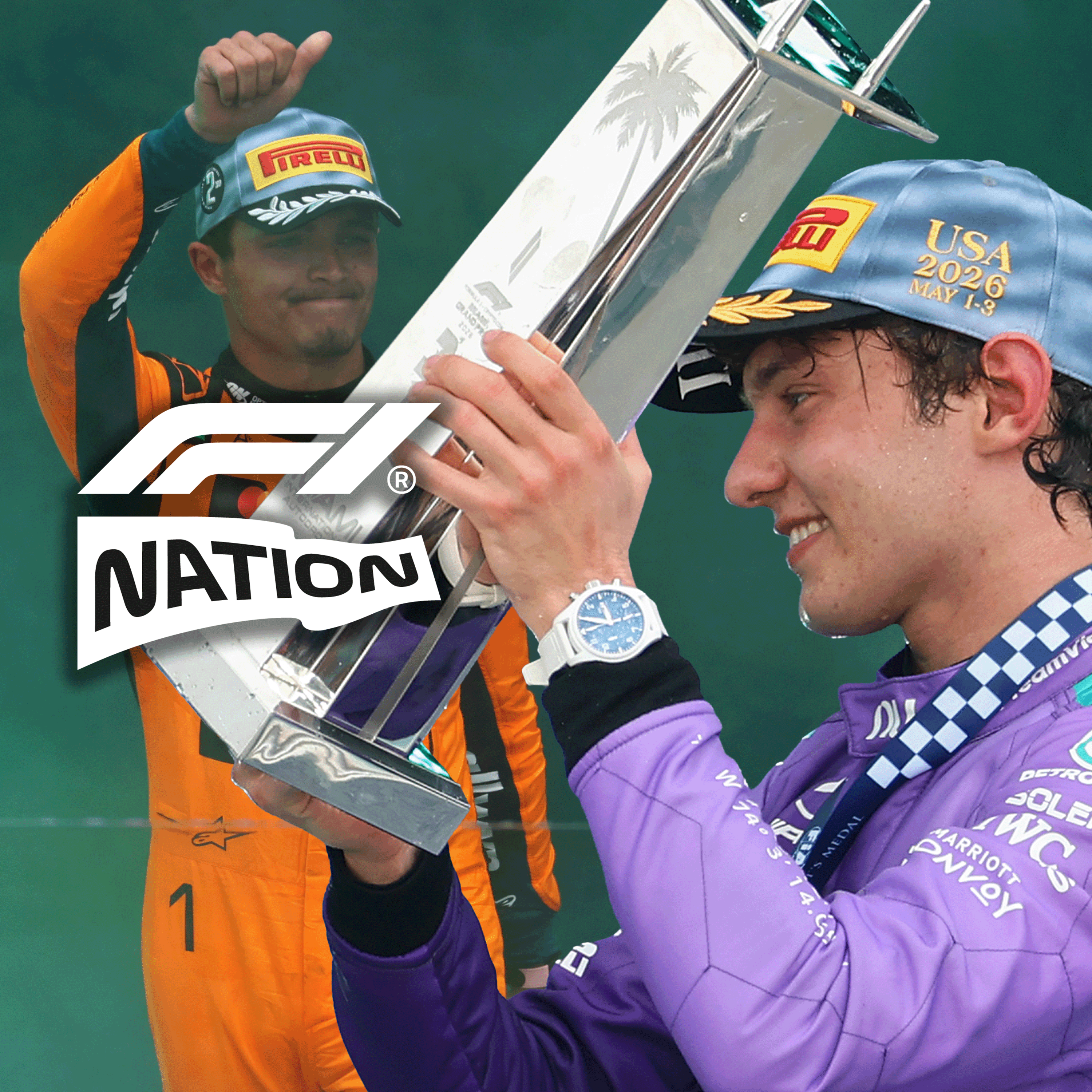
Kimi Antonelli’s Miami win is framed as a sign of remarkable composure, with the panel noting how Mercedes have protected and prepared him for pressure. The conversation then turns to McLaren, who feel a likely victory slipped away through strategy even as their upgraded car looks genuinely stronger. Ferrari’s upgrade gamble appears less effective, while Red Bull’s new package has clearly revived Max Verstappen’s confidence. The episode also highlights Franco Colapinto’s breakthrough, Alpine’s progress, and a tribute to Alex Zanardi.
Tom Clarkson is joined by F1 correspondent Lawrence Barretto and F1TV expert James Hinchcliffe to reflect on an action-packed Miami Grand Prix weekend.
Kimi Antonelli made it three race wins in a row to extend his championship lead to 20 points. Was this the toughest win of Kimi’s career and what does that tell us about him?
On the other side of the Mercedes garage, how will George Russell be feeling about the title fight after losing out to his teammate again? And what do the guys make of George’s comments about the Miami track not suiting him?
Also on the agenda: why Lando Norris missed out on victory, Charles Leclerc’s final lap spin that cost him a podium, Red Bull’s turnaround and a very special day for Franco Colapinto.
Plus, the guys pay tribute to former F1 driver and Paralympian Alex Zanardi, who has passed away at the age of 59.