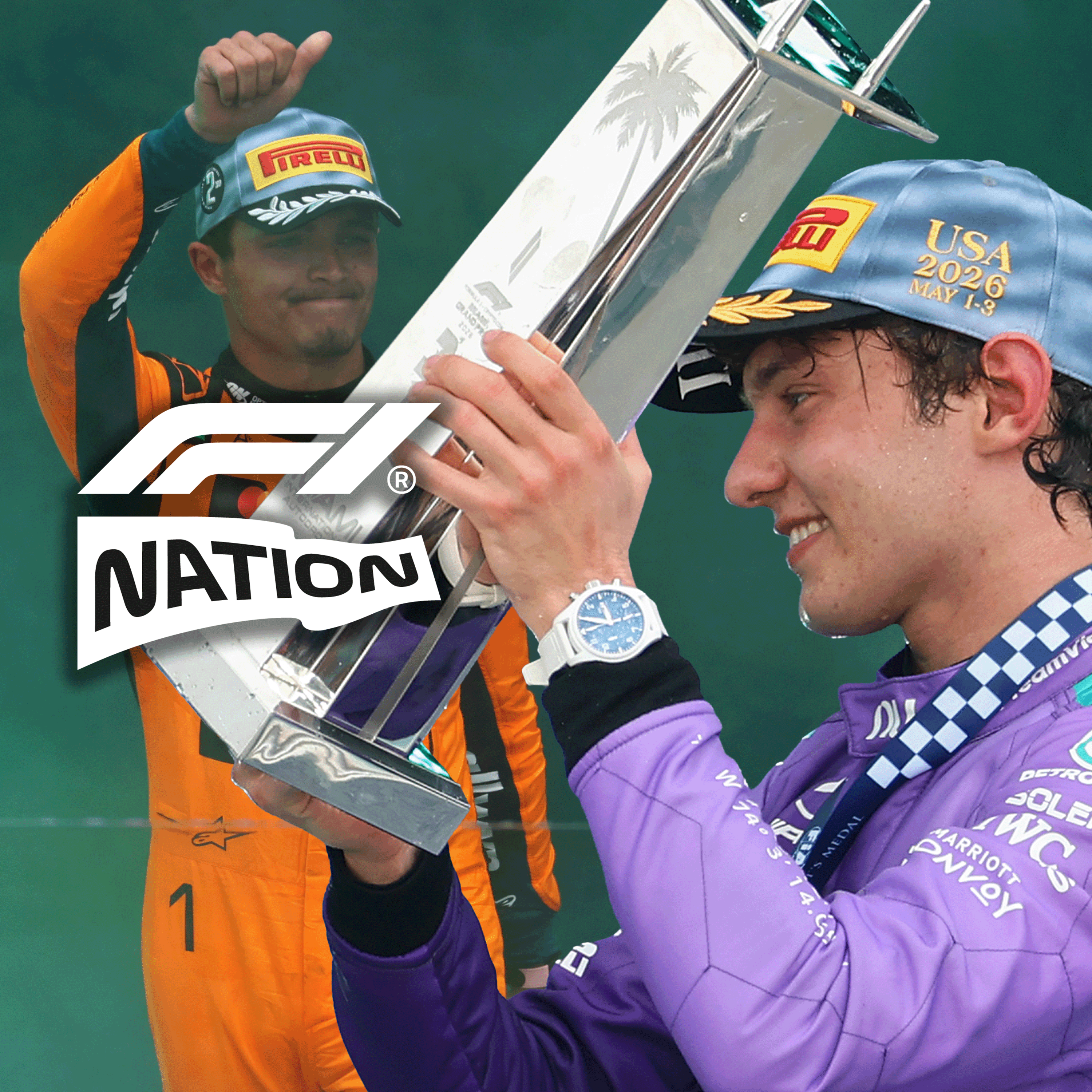
Kimi wins under pressure, but are McLaren closer? Miami GP Review with James Hinchcliffe + Lawrence Barretto
About this episode
Kimi Antonelli’s Miami win is framed as a sign of remarkable composure, with the panel noting how Mercedes have protected and prepared him for pressure. The conversation then turns to McLaren, who feel a likely victory slipped away through strategy even as their upgraded car looks genuinely stronger. Ferrari’s upgrade gamble appears less effective, while Red Bull’s new package has clearly revived Max Verstappen’s confidence. The episode also highlights Franco Colapinto’s breakthrough, Alpine’s progress, and a tribute to Alex Zanardi.
Tom Clarkson is joined by F1 correspondent Lawrence Barretto and F1TV expert James Hinchcliffe to reflect on an action-packed Miami Grand Prix weekend.
Kimi Antonelli made it three race wins in a row to extend his championship lead to 20 points. Was this the toughest win of Kimi’s career and what does that tell us about him?
On the other side of the Mercedes garage, how will George Russell be feeling about the title fight after losing out to his teammate again? And what do the guys make of George’s comments about the Miami track not suiting him?
Also on the agenda: why Lando Norris missed out on victory, Charles Leclerc’s final lap spin that cost him a podium, Red Bull’s turnaround and a very special day for Franco Colapinto.
Plus, the guys pay tribute to former F1 driver and Paralympian Alex Zanardi, who has passed away at the age of 59.
And if you’d like to hear Alex Zanardi’s incredible life story, listen to him in conversation with Tom Clarkson on F1 Beyond The Grid back in 2020.
Miami GP Review
"rain in turns seven and eight... Tell us about the upgrade package, Lawrence..."
This is a recap of the Miami Grand Prix. They’re breaking down the key moments and why the race played out the way it did.
This segment is part of a Miami Grand Prix review, focusing on what happened during the race and how strategy and upgrades shaped the result. It’s a recap-style discussion rather than a deep technical explainer.
Grand Prix
"The test is passed and it's three Grand Prix victories in a row for Kimmy Antonelli! ... After such a long break, we were desperate to get back to racing and the Miami Grand Prix was well worth the wait."
In Formula 1, a “Grand Prix” is just a single race weekend/event. Drivers earn points from each one that add up over the season.
A Grand Prix is a specific Formula 1 race event on the calendar. Each Grand Prix contributes points toward the Drivers’ and Constructors’ championships.
Drivers' and Constructors' championships
"A Grand Prix is a specific Formula 1 race event on the calendar. Each Grand Prix contributes points toward the Drivers’ and Constructors’ championships."
F1 has two big season battles: one for drivers and one for teams. Each race gives points that add up toward those season titles.
In Formula 1, the Drivers’ Championship is for individual drivers based on points, while the Constructors’ Championship is for teams based on the combined performance of their cars. Grand Prix results feed into both standings.
F1 calendar
"...perhaps the most unique paddock on the F1 calendar."
The F1 calendar is the season schedule—where and when the races happen. Saying something is “on the calendar” means it’s an official F1 event.
The F1 calendar is the schedule of all Formula 1 race weekends across the season. When hosts say “on the F1 calendar,” they mean it’s one of the official events.
paddock
"I'm Tom Clarkson, inside the Miami Dolphins' incredible hard rock stadium, perhaps the most unique paddock on the F1 calendar."
In F1, the paddock is the team area at the race weekend. It’s where teams set up and work on things between races.
The paddock is the main area at an F1 event where teams are based between sessions. It’s where team personnel, hospitality, and car-related operations happen before and after track time.
sprint weekend
"To come off a five week break like that onto a sprint weekend, into a sprint weekend. So much, I think, anticipation coming into this one."
A sprint weekend is a special F1 race format with an extra, shorter race on Saturday. The results from that sprint help decide where cars start on Sunday, so teams have to plan carefully.
In Formula 1, a sprint weekend is a format where a shorter “sprint” race happens on Saturday, and it affects grid positions for the main Sunday race. Teams often use it to test upgrades and manage risk because the weekend is compressed compared to a normal race week.
New regulations
"First three races were kind of closely bunched together. New regulations, lots to learn."
When F1 says “new regulations,” it means the rules for how cars can be built and raced have changed. That usually forces teams to rethink their car setup, so it can take a few races to figure out what’s best.
“New regulations” refers to rule changes that can alter how F1 cars are designed and raced, often impacting aerodynamics, power unit usage, and car setup. When rules change, teams typically need time to learn what works, so early results can be unpredictable.
weather played sort of a factor
"Evidently, weather played sort of a factor in the whole thing from start to finish an incredible weekend."
Weather affects how the track grips the tires and how the cars behave. If conditions change, it can be harder to tell whether a car improvement is the real reason for performance.
Weather can strongly influence F1 performance by changing track grip (how well tires stick), cooling conditions, and how predictable car behavior is. That can make it harder to judge whether upgrades are truly working as intended.
upgrade packages
"Yeah, I think that's the beauty of the first big upgrade packages of the season. Obviously, the team had, what, four or five weeks to really refine these and put a bit more budget in."
An upgrade package is when a team brings a set of improvements to the car, like new parts or tweaks. The team can’t always tell immediately how much faster it makes the car, so they learn as the weekend goes on.
Upgrade packages are bundles of new parts and changes a team introduces to improve performance—often including aerodynamic updates, cooling changes, and other technical revisions. The key challenge is that teams may not know the full effect until they gather enough data across practice and the race.
pole positions
"Three on the bounce from three pole positions. He now leads the championship by 20 points... Three poles in a row still hasn't led lap one in any of them..."
Pole position means you start the race from the very front because you were fastest in qualifying. But you can still lose the lead at the start, which is what they’re pointing out.
Pole position is awarded to the driver who qualifies fastest and starts the race from the front of the grid. The hosts note that despite taking pole in three straight races, the driver didn’t lead lap one—highlighting that starting first doesn’t guarantee leading immediately.
gearbox
"Talk us through how he did that, guys, with pressure from the reigning world champion, you know, who was on his gearbox for lap after lap..."
The gearbox is what helps the car choose the right gear for speed and acceleration. When they say someone was “on his gearbox,” they mean they were right behind him and constantly pressuring him.
In F1, the gearbox is the transmission system that selects gears to keep the engine in its optimal power band. The hosts mention the reigning champion being “on his gearbox,” meaning they were very close behind and effectively pressuring him lap after lap.
lap one
"Three poles in a row still hasn't led lap one in any of them, but has come back to win all three of those races..."
Lap one is the very first lap after the race starts. It’s often chaotic, so even if you start first, you might not stay in front right away.
“Lap one” is the first lap of the race, when positions can change quickly due to launches, braking zones, and early traffic. The discussion emphasizes that even with pole, the driver wasn’t leading immediately at the start.
track position
"But the most impressive part about this one was, yep, find a little bit of a strategy play from Mercedes to get him that track position back. But like you say, it wasn't a 14-second gap like he had in Suzuka..."
Track position just means who’s in front on the race track. Teams try to get and keep that advantage because it’s usually easier to manage the race when you’re ahead.
In racing, track position is where a car sits relative to others on the circuit. Strategy often aims to gain or protect track position—especially around pit stops—because being ahead usually means more control and fewer risks.
strategy play
"But the most impressive part about this one was, yep, find a little bit of a strategy play from Mercedes to get him that track position back."
A strategy play is the team making a smart call during the race. It usually involves things like when to pit and which tires to use, and it can help a driver gain an advantage.
A “strategy play” is a tactical decision by the team that changes how the race unfolds—often through pit-stop timing, tire selection, and how aggressively to manage gaps. In F1, small strategy differences can outweigh raw speed because they affect track position.
Mercedes
"But the most impressive part about this one was, yep, find a little bit of a strategy play from Mercedes to get him that track position back."
Mercedes is the F1 team involved in the race strategy. Their decisions—like when to pit and what tires to run—can strongly affect who ends up in front.
Mercedes is the Formula 1 team/constructor referenced here as making a strategy call that helped the driver regain track position. In F1, team strategy can include pit timing, tire choices, and managing gaps to opponents.
paddles on the steering wheel
"So you look at how composed he was at one point complaining about something with the paddles on the steering wheel."
Paddles on the steering wheel are the buttons the driver uses to shift gears. They’re designed so the driver can change gears fast while staying fully in control.
F1 uses paddle shifters mounted on the steering wheel to change gears quickly without removing hands from the wheel. The hosts mention the driver complaining while using them, implying active gear management under pressure.
radio transmissions
"Lando behind, meanwhile, his radio transmissions were dead cool. I mean, that's a champion's transmission..."
Radio transmissions are the messages the driver sends to their team during the race. The tone and timing can reveal how stressed or focused the driver is.
Radio transmissions are the driver-to-team communications sent over F1’s in-car radio system. The hosts contrast the calm, controlled tone of a champion’s radio with how a younger driver’s emotions can show up in their messages.
make a joke about it means he's in a really good place mentally
"He was laughing at the pressure in the press conference after the race... But I mean, I feel to be able to make a joke about it means he's in a really good place mentally."
They’re talking about how the driver is handling stress. If he can joke after a tough race, it usually means he’s not rattled and can focus on fixing things for the next session.
This is about “mental state” and how drivers cope with setbacks in F1. In high-speed racing, staying mentally composed after mistakes or poor starts can improve decision-making, consistency, and how effectively a driver works with the team.
losing two or three places off the start
"...we’re going to get to a point where you don’t have that advantage and losing two or three places off the start isn’t OK. You're not going to be able to bounce back from that every weekend..."
They mean how many positions the driver drops right at the beginning of the race. Early position is valuable in F1, and if you lose a few spots, it can be tough to get them back later.
In F1, “places off the start” refers to how many positions a driver loses immediately when the race begins—typically due to reaction time, launch traction, and first-corner execution. Because overtaking can be difficult, losing multiple spots early can be hard to recover from over a race weekend.
big upgrade package
"there's the caveat that Mercedes hasn't brought their first proper big upgrade package that's coming down the road."
In F1, teams sometimes bring new parts to a race to make the car faster. A “big upgrade package” is a major set of changes, not just a small tweak.
A “big upgrade package” in F1 means a set of new parts and aerodynamic/engineering changes brought to a race to improve performance. It’s often introduced gradually, and teams may be behind competitors until the upgrades arrive.
bad starts
"Kimmy's not going to be able to kind of rely on the car pace advantage that they've got seemingly at the moment to make up for those bad starts."
A “bad start” means the car doesn’t get away well when the race begins. In F1 that’s a big deal because it can cost you positions right away.
“Bad starts” refers to poor launches from the grid—such as losing positions immediately, getting bogged down, or failing to get the car moving efficiently. In F1, starts can heavily influence race outcomes because track position is hard to regain.
Park Formet
"Well, I kind of mentioned it in the in the pre-race show that, you know, down in Park Formet when he got out of the car after qualifying, it wasn't fist pumping, cheering to the crowd."
This sounds like “Parc Fermé,” which is the area where F1 cars are kept after qualifying. Teams have limited ability to change things there, so it’s a controlled environment.
“Park Formet” appears to be a transcription error for “Parc Fermé,” the restricted area where cars are held after qualifying. In Parc Fermé, teams can’t freely work on the car, and changes are tightly controlled.
Toto Wolf
"I remember around the Monza time, Toto Wolf, his boss was quite tough on him and basically said he needs to sort sort himself out, kind of cut out the mistakes... And I think a lot of that credit honestly goes to the architect of the whole thing in Total Wolf"
Toto Wolff is the top boss at Mercedes’ Formula 1 team. He helps decide how the team runs and how drivers are supported and coached.
Toto Wolff is the team principal of Mercedes-AMG Petronas Formula One Team. In F1, the team principal is a key decision-maker who sets strategy, manages drivers, and oversees how the team prepares for races.
Total Wolf
"And I think a lot of that credit honestly goes to the architect of the whole thing in Total Wolf because when he first came in..."
This sounds like a mis-heard version of Toto Wolff, the Mercedes F1 team boss. The point is that he helped drive the plan for how the driver was handled.
This appears to be a transcription error for Toto Wolff, the Mercedes team principal. The speaker credits Wolff with shaping the plan and driver management approach during the driver’s earlier season.
Lewis's switch over to Ferrari
"It was a forced hand because of Lewis's switch over to Ferrari. And Total made that call and they knew they sort of had to bubble wrap him a little bit."
This is about Lewis Hamilton changing teams—from Mercedes to Ferrari. When a top driver switches teams, it can shake things up for everyone else too.
The mention refers to Lewis Hamilton moving from Mercedes to Ferrari. In F1, driver transfers can significantly change team dynamics, development priorities, and how the remaining driver is supported.
bubble wrap him
"And Total Wolf made that call and they knew they sort of had to bubble wrap him a little bit. And they did."
It means they tried to shield him from too much pressure and attention. The idea is to help a driver settle in without everything feeling overwhelming.
“Bubble wrap him” is a metaphor for protecting a less-experienced driver from extra pressure and scrutiny. In F1, teams may limit media exposure and manage expectations so the driver can focus on adapting to the car and race weekend demands.
pace of the car
"And given the pace of the car this year relative to the opposition, thank goodness they gave him that year to bed in last year."
“Pace of the car” just means how fast the car is compared to the others. It’s about both speed and how consistently it can perform.
“Pace of the car” is shorthand for how quickly the car can go over a race distance, including qualifying speed and race consistency. When the hosts compare it to “the opposition,” they’re talking about relative performance versus other teams.
opposition
"And given the pace of the car this year relative to the opposition, thank goodness they gave him that year to bed in last year."
In F1 coverage, “opposition” means the other teams and drivers competing against you. It’s used to frame performance as relative—who is faster and who is closing the gap.
bed in
"thank goodness they gave him that year to bed in last year. Imagine if this was his first season."
“Bed in” refers to a driver spending an initial period adapting to a new car setup, team routines, and race rhythm. In F1, that early adjustment time can make a big difference once the season’s pace and expectations ramp up.
Formula 1 career
"He's only, what, 28 races into his Formula 1 career now? And he's already looking like he's been around for a long time."
This just means how long someone has been racing in Formula 1. The hosts are talking about how fast a driver can learn and compete well.
A “Formula 1 career” refers to a driver’s time competing in the FIA Formula 1 World Championship, where results depend heavily on car performance, team strategy, and driver skill. The hosts are discussing how quickly a driver can adapt and perform at a high level.
buffer
"Because he's got that little buffer which obviously was much smaller here in Miami. But I think that's what makes this win so much more impressive is that buffer had gone effectively."
A “buffer” is just a cushion of time or position. If you’re far enough ahead, you can make a small mistake without losing everything. If that cushion shrinks, you have to be more precise.
In Formula 1, a “buffer” is the safety margin a driver has over the rest of the field—enough gap that small errors or strategy slips don’t immediately ruin their result. When the buffer is smaller (as it was described for Miami), the win becomes harder because there’s less room for mistakes.
Spa
"Remember, he gets that one off opportunity, one race deal at Spa. And he goes and lines up sevens on the grid in a Jordan."
Spa is a well-known Formula 1 race track in Belgium. The hosts are using it as a specific example of a race where something important happened.
Spa refers to the Belgian Grand Prix at Circuit de Spa-Francorchamps, one of F1’s most famous tracks. The segment uses Spa as the example race where a driver got an opportunity and then delivered a strong qualifying/grid position.
grid
"And he goes and lines up sevens on the grid in a Jordan. They just, the really good ones are ready, aren't they, actually, when they first get behind the wheel."
The grid is where cars line up before the race starts. Your grid position depends on qualifying, and it affects how hard the race will be.
The “grid” is the starting order/positions for an F1 race, set by qualifying. When the host says a driver “lines up” on the grid, they’re emphasizing where the car started relative to the rest of the field.
motorsport
"[777.1s] I mean, not taking anything away from them. [778.6s] This is motorsport. [779.4s] These things happen."
Motorsport just means racing competition. In Formula 1, it’s a reminder that even if a driver or team looks strong, things can still go differently during a race.
“Motorsport” refers to competitive racing where cars are pushed hard under strict rules and conditions. In F1, it also implies that results can swing due to strategy, reliability, and track-specific factors—not just raw speed.
data point
"[781.7s] But this one was a lot of much clearer of a victory, like we said. [786.1s] But it's at a track that we know he likes based on one data point, fine. [790.0s] But George has always said he doesn't like, right?"
A “data point” is one specific fact or result. They’re saying one past result is being used as a clue about how the driver will do this time.
A “data point” is a single piece of evidence used to support a conclusion. Here, the speaker is saying they’re using limited past performance information to infer that Kimi Räikkönen (Kimmy) likes the track.
teammate
"[790.0s] But George has always said he doesn't like, right? [792.6s] So three wins on the trot, that is concerning for a teammate, certainly. [798.4s] But we know that Canada is a place that George has been very strong."
A teammate is the other driver who races for the same team. If one driver keeps winning, the other driver feels extra pressure to keep up.
In F1, a “teammate” is the other driver on the same team, and their performance directly affects team dynamics. When one driver wins repeatedly, it can create pressure on the teammate to match pace and strategy.
garage
"[810.7s] If we go to Canada in two weeks time, three weeks time, whatever it is, [815.1s] and all of a sudden Kimmy's ahead again, that's, I think, when the 63 side of the garage needs to [821.6s] start, maybe not panicking, but really coming up with a plan, maybe changing their approach"
In racing, “the garage” is where the team works on the car and makes decisions. The speaker is saying the team needs to react with a better plan.
In F1, “the garage” is shorthand for the team’s operations area—engineers, strategists, and mechanics working between sessions. When the speaker says the “63 side of the garage,” they mean the team group responsible for that driver’s setup and race plan.
approach
"[821.6s] start, maybe not panicking, but really coming up with a plan, maybe changing their approach [826.1s] a little bit, trying to find what you have to do to not just slow him down, but speed yourself up. [831.8s] So it's, again, I said it before the weekend, it's not panic mode yet for George Russell,"
“Approach” means the plan the team is using. They’re saying the team might need to change how they set up and race to do better.
“Approach” here means the team’s overall race plan and setup direction—how they aim to manage pace, tires, and strategy. The speaker is suggesting they may need to adjust their approach to both slow the rival and improve their own performance.
panic mode
"[826.1s] a little bit, trying to find what you have to do to not just slow him down, but speed yourself up. [831.8s] So it's, again, I said it before the weekend, it's not panic mode yet for George Russell, [836.4s] "
“Panic mode” means reacting too quickly and making desperate changes. They’re saying it’s not time for that kind of overreaction yet.
“Panic mode” is a metaphor for overreacting—making rushed changes instead of sticking to a structured development and race-planning process. The speaker is saying George Russell’s situation doesn’t yet require drastic, emotional adjustments.
media day
"Is it a bit deftest when George was saying on Thursday during media day, yeah, I don't like this track. This isn't my track."
“Media day” is when F1 drivers do interviews with reporters before the race weekend. It’s basically the press-and-promo portion of the event, before the cars hit the track.
In Formula 1, “media day” is a scheduled day where drivers and teams do interviews and promotional activities for the press before a race weekend. It’s often where drivers talk about expectations, track feel, and strategy themes they’re thinking about.
mechanical reasons
"So I think he can probably compartmentalize those ones and think, all right, but this one, he was convincingly defeated. And that has got to hurt Hinge, right? From a race and driver perspective, you always want to beat your teammate, and he's been beating definitively this weekend. But like you say, it's the first one that he can't use the book of driver excuses as to why. So it's the first one. It's not a trend yet, yet. But what Kimmy's doing now, and I was really hoping we had a race that was interrupted by rain... In China, it was mechanical reasons why he got pulled out of the fight."
“Mechanical reasons” means the car had a technical problem. If that happens, the driver can’t just “drive better” to fix it—something on the car needs to work properly.
“Mechanical reasons” refers to a car problem—like a component failure or technical issue—that forces a driver to retire or lose competitiveness. In F1 analysis, it’s important because it’s not about driver error or strategy; it’s about reliability and car setup.
pitted one lap later
"In Japan, had he pitted one lap later, probably could have been fighting for the win. So I think he can probably compartmentalize those ones and think, all right, but this one, he was convincingly defeated."
A “pit” is when the car stops to change tires (and sometimes make other adjustments). “One lap later” means they came in slightly later than planned, which can change how the race plays out.
“Pitted one lap later” refers to delaying a pit stop by a single lap. In F1, that timing can affect track position, tire temperature and wear, and whether you get stuck behind slower cars—so one lap can be the difference between fighting for the win or falling back.
driver excuses
"But like you say, it's the first one that he can't use the book of driver excuses as to why. So it's the first one. It's not a trend yet, yet."
This phrase means the usual reasons someone might give for a tough race. The speaker is saying this time there isn’t an easy explanation that lets the driver “blame” something else.
“Driver excuses” is a shorthand for explanations drivers or teams use after a bad result—like mechanical issues, strategy problems, or incidents. The point here is that this time the usual “reasons” don’t fully apply, making the defeat feel more definitive.
race that was interrupted by rain
"But what Kimmy's doing now, and I was really hoping we had a race that was interrupted by rain, if I'm totally honest, because dealing with those conditions and getting thrown that curveball, that wrench in the plan, it would have been really interesting to see how a driver with Kimmy's level of experience reacted and coped with that..."
If rain hits during the race, the track gets slippery and visibility can drop. Drivers have to change how they brake, turn, and accelerate, and sometimes they switch tires.
An F1 race “interrupted by rain” usually means conditions change mid-race, forcing drivers to adapt quickly—often including switching tires and changing driving style for less grip. It’s a big variable because it can reshuffle who manages traction and visibility best.
Monaco
"…when we get back to Europe and we get to your Monaco's in New Spain, to New Austria's in Silverstones…"
Monaco is a famous F1 race track in Europe. It’s known for being very twisty and slow, so cars behave differently there than on faster tracks.
Monaco is referenced as one of the European races on the calendar, and it’s used as a benchmark for how the car might perform on different track types. In F1 discussion, Monaco often comes up because its tight, slow corners demand very specific setup and traction behavior.
Silverstones
"…Monaco's in New Spain, to New Austria's in Silverstones, I still think he believes…"
Silverstone is an F1 track in the UK. The layout and grip levels are different from other races, so the car’s handling can change a lot.
Silverstone is mentioned as a track where performance could change compared with the current circuit. Different tracks have different grip levels and corner types, so the same car can feel very different from race to race.
four-wheel sliding
"He doesn't want four-wheel sliding, as he called it here, right? Hinch, just what is four-wheel sliding? A four-wheel drift? ... So you're not fighting an imbalance. You're just fighting a lack of grip."
It means the tires aren’t gripping well at all, so the whole car starts to slide. Instead of the car “turning” normally, you have to drive ahead of what the car will do because it’s harder to control.
“Four-wheel sliding” describes a situation where the car loses grip at both the front and rear, so it slides rather than rotating cleanly around one end. The driver can’t rely on a normal understeer/oversteer balance and instead has to manage a general lack of traction through the corner and onto the exit.
Canada
"…and he's got to win in Canada. That is a George track. So if he doesn't win there…"
Canada is being treated like a key race where the result matters a lot. The hosts think it could suit certain drivers, so they’re watching closely.
Canada is discussed as a “must-win” / “must-beat” race, implying a pivotal points opportunity. The transcript frames it as a track where the driver’s strengths could show up, making the result especially important for the championship context.
understeering
"Yeah, essentially, when you come off a corner... if you're understeering, the front's not quite turning, but the back's got enough grip."
Understeer is when the front tires can’t grip enough, so the car won’t turn into the corner like you expect. It feels like the car is pushing wide.
Understeer is when the front tires lose grip first, so the car doesn’t turn as much as the driver wants. In the transcript, it’s contrasted with oversteer to explain how different grip problems feel at corner entry and mid-corner.
corner balance
"…you're talking about corner balance or car balance, rather, if you're understeering..."
Corner balance is about how the car’s weight is set up for turning. If it’s not balanced right, the car will either push wide or slide the rear more than you want.
Corner balance is how the car’s weight is distributed left-to-right and front-to-rear for cornering. In racing, it affects whether the car tends to understeer or oversteer as fuel load, tire wear, and track grip change.
oversteering
"If you're oversteering, the rear's sliding and trying to pass the front of the car, a four-wheel slide is just that."
Oversteer is when the back tires lose grip, so the car rotates or swings more than you want. It can feel like the rear is trying to pass the front.
Oversteer is when the rear tires lose grip first, causing the car to rotate more than intended. The transcript uses it to set up the idea that “four-wheel sliding” is different because neither end is well-gripped.
low-grip circuits
"We did this comparison from Oscar and Lando a bunch in the last third of the season last year when we went to these low-grip circuits."
Low-grip circuits are tracks where the tires don’t grip as well. That makes the car harder to control, and some drivers handle it better than others.
Low-grip circuits are tracks where the tires can’t generate as much traction, often due to surface, temperature, or setup. The transcript notes that this can favor certain driving styles and car characteristics, changing who has the advantage.
undercut
"But I think had they not got undercut by Mercedes and Kimmy, he would have won this Grand Prix..."
Undercut means pitting earlier than another car so you can drive faster on fresh tires. If it works, you can come out ahead after both cars have stopped.
An undercut is a pit-stop strategy where a driver pits earlier than a rival and uses fresh tires to set faster laps. If timed well, the earlier stop can put the driver ahead when the other car pits later.
strategy misstep
"Let's not have it be a strategy, you know, misstep from McLaren."
A strategy misstep means the team’s plan during the race didn’t work out. In F1, that can happen if you pit at the wrong time or choose the wrong tire, and it can cost you the win.
A strategy misstep is when a team’s race plan—pit timing, tire choice, or sequencing—doesn’t play out as expected and costs track position or points. In F1, small timing errors can be amplified by pit-stop windows and tire wear.
full wets
"so they didn't hit and then have to pit three laps later for interns or full wets or whatever."
Full wets are special tires for heavy rain. They’re designed to grip the road when there’s lots of water on the track.
“Full wets” refers to F1’s wet-weather tires designed for heavy rain. They have deep tread to channel water and maintain grip when the track is very wet.
safety car
"Max almost tipped the hand a little bit because he was so quick when he did that early stop under the safety car and came back out."
The safety car is a pace car that comes out when the track isn’t safe. It slows everyone down, and that can be a good time to change tires or make a pit stop.
A safety car is deployed during a race when conditions are dangerous (like debris or heavy rain). It neutralizes the race by controlling the pace, which can make pit stops and tire strategy much more effective.
debrief
"Oh, I think, you know, when they're in the debrief or first thing tomorrow morning, they're going to be delighted with how this weekend went..."
A debrief is a team meeting after the race to review what happened. They look at data and talk about what they should repeat or fix.
A debrief is the post-session meeting where the team reviews data, driver feedback, and race events to decide what worked and what didn’t. It’s especially important after a strategic or weather-affected race.
Montreal
"But the second half is coming in Canada and to the point where you're going to get a beast bet car in Montreal..."
Montreal is the next race location they’re talking about. They’re saying more updates are coming there and it could change who’s fastest.
Montreal is mentioned as the next race venue where further upgrades are expected. The hosts connect the upgrade timeline to how teams will perform in the next round.
constructors and driver's championships
"they want to be defending both of their constructors and driver's championships because"
F1 has two main title races: one for the team (based on both cars’ points) and one for the driver (based on that driver’s points). Teams think about both when planning strategy.
In F1, the Constructors’ Championship is won by the team based on combined points from both cars, while the Drivers’ Championship is won by an individual driver’s points. The hosts emphasize that teams care about both standings when making strategic calls.
championship fight
"...what they've delivered here put for me pulls them back into the championship fight and should probably worry everyone else..."
The championship fight is the season-long race to win the overall title. Drivers earn points at every Grand Prix, so results that seem small can still matter a lot.
A championship fight is the battle for the season title, determined by accumulating points race by race. In F1, even small differences in finishing positions can swing the standings, especially when rivals are close.
points totals
"Championship fight, I'm just looking at my points totals. Norris is 51, Antonelli's on 100."
Points totals are just the running score for each driver across the season. Because points are awarded based on where you finish, the totals show who’s really close in the title race.
Points totals refer to the cumulative score a driver has earned across the season. In F1, the points system rewards finishing positions, so tracking totals shows how close the title contenders are and how much a single race can change the standings.
intra-team battle
"Look, we discussed the intra-team battle at Mercedes between Antonelli and Russell."
An intra-team battle means two drivers from the same Formula 1 team are racing each other for the best results. It can affect team decisions and who’s helping the car develop.
An intra-team battle is competition between two drivers on the same team. Teams often have to balance support, strategy, and development priorities, so these matchups can be as important as rivalries between different constructors.
lap time
"...But in terms of lap time, I felt he had the upper hand, whereas here it was very much Norris..."
Lap time is the time it takes to do one full lap around the track. If someone has better lap times, it usually means they’re going faster, even if the race result looks different.
Lap time is how long it takes to complete one circuit, and it’s a key indicator of raw pace. When the hosts compare lap time versus race results, they’re discussing whether a driver was faster overall even if the finishing order didn’t fully reflect it.
outqualified
"...a Norris track, never been outqualified by a teammate in the Grand Prix here."
Outqualified means one driver got a worse qualifying result than another driver. Qualifying matters because it sets where you start the race, which can make it easier or harder to fight for position.
To be outqualified means a driver was beaten in qualifying—i.e., their qualifying position was worse than a teammate’s. In F1, qualifying performance strongly affects race strategy because starting position influences track position and overtaking opportunities.
reliability issues
"Norris had more troubles, reliability issues in practice, so didn't get as many laps. And obviously, with the rule set still being in its infancy..."
Reliability issues mean the car had problems that stopped it from running normally. If the car can’t complete laps in practice, the team has less time to learn what to fix.
In Formula 1, reliability issues are problems that prevent the car from running as intended—often during practice or qualifying. Even if the car is fast, reliability problems can limit laps and data, which hurts setup and race readiness.
rule set still being in its infancy
"And obviously, with the rule set still being in its infancy, drivers still kind of figuring that stuff out. I'm not sure we have enough true data points..."
When the rules are brand new, teams are still learning how to make the cars work best under them. So it’s harder to tell who is truly faster because people are still experimenting.
When a new F1 rule set is still early in its life, teams and drivers are still learning how to extract performance within the constraints. That means results can be harder to compare because everyone is still figuring out setups, tire behavior, and race strategy under the new regulations.
McLaren
"I'm not sure we have enough true data points to have a really good sense on kind of if there's a hierarchy between the two of them at McLaren right now. I think both have had strong weekends..."
McLaren is a Formula 1 team. In this segment, they’re talking about how competitive McLaren’s car and drivers are compared with other teams.
McLaren is one of F1’s top constructor teams, and the episode discusses whether its drivers are close to each other in performance. The hosts also compare McLaren’s upgrade progress against rivals to judge who is improving fastest.
one lap pace
"Qualifying was a key area that they wanted to work on, so you know, the one lap pace. And I think Charles probably realized very early on..."
One-lap pace is how fast the car is for a single quick lap. Qualifying depends heavily on that, because you’re trying to set the best time before traffic and tire drop-off hurt you.
One-lap pace is how quickly a car can complete a single flying lap, which is crucial for qualifying. A team can be strong in race trim but still struggle to qualify if their one-lap performance isn’t competitive.
cost cap development budget
"they just hadn't shot the gap in that metric. And I think that will be a concern because it will almost certainly have been a big part of their cost cap development budget that they would have spent on this package."
F1 teams have a spending limit. If they spend money on upgrades but don’t get the expected speed, it’s a problem because they can’t just overspend to fix it later.
The cost cap in F1 limits how much teams can spend over a season, including development work. If Ferrari’s upgrade package didn’t deliver the expected performance—especially in qualifying—it can be a big deal because that spend could have been used for other improvements.
parts and they don't work
"Ferrari have had a habit in the last couple of years of bringing in parts and they don't work. So I think that they probably shouldn't be too hard on themselves..."
Teams try new upgrades to make the car faster. If the parts “don’t work,” it means the upgrade didn’t improve the car the way they hoped, or it even hurt performance.
In F1, teams constantly test new parts and upgrade packages. Saying parts “don’t work” means the intended performance gain didn’t show up—or the changes made the car worse in key areas like balance, tire performance, or aerodynamic efficiency.
90 minutes of practice
"they just haven't found how to get the most out of it because they only have 90 minutes of practice."
F1 teams don’t get unlimited time to test. If practice is short, it’s harder to learn whether new parts are actually helping and to adjust the car.
In Formula 1, practice time is limited, so teams have less opportunity to test new parts and refine setup. With only a short window, it’s harder to confirm what’s working and what needs adjustment.
tire life
"Lately in a tire life, slightly offline and it's, I don't want to say it's easy to do, but it's easier than you probably think to do."
Tire life means how long the tires stay in good condition. As tires wear, they lose grip and the car gets harder to drive fast.
Tire life refers to how long the tires remain effective before they degrade. In F1, managing tire life is crucial because once tires wear out, grip drops and lap times suffer.
tapping the wall
"Just having that battle... it led to pretty big consequences, tapping the wall, damaging the left front, and then falling down the order."
Tapping the wall means the car hits the barrier. Even a small crash can hurt the car’s speed and handling, and it can force the driver to fall back.
Tapping the wall means making contact with the track barrier, usually at low-to-moderate speed but still enough to cause damage. In F1, even light impacts can affect aerodynamics, cooling, and the car’s ability to stay competitive.
left front
"tapping the wall, damaging the left front, and then falling down the order."
Left front means the front-left side of the car. If that area gets damaged, the car can feel unstable or pull, and it may lose speed quickly.
The left front is the front-left corner of the car, including components like the front wing area, suspension, and steering-related parts. Damage here can quickly disrupt alignment and aerodynamics, making the car difficult to drive consistently.
contact with Colopinto
"You had the damage to Lewis's car early on in the race from, I think it was contact with Colopinto because we actually, we did get, we caught Fred on F1 TV after the, after the race"
If two cars touch, it can damage the car and make it hard to keep racing well. It often costs time and position, and the driver may never recover.
Contact with another car in F1 can cause immediate damage and force a driver to lose track position. Even if the impact doesn’t end the race instantly, it can compromise aerodynamics and tire wear, effectively ruining race strategy.
F1 TV
"we actually, we did get, we caught Fred on F1 TV after the, after the race and said that just essentially ended Lewis's race"
F1 TV is the official F1 streaming platform. Here, it’s where they talked about the incident after the race.
F1 TV is the Formula 1 streaming service used to watch sessions and post-race content. In this context, it’s where the team/people discussed what happened after the race.
floor
"performance standpoint. He just did so much damage to the floor and the barge boards."
The “floor” is the bottom of the F1 car that helps it stick to the track using aerodynamics. If it gets damaged, the car can lose grip and feel less stable.
In an F1 car, the “floor” is a major aerodynamic surface that helps generate downforce by shaping airflow underneath the car. Damage to the floor can significantly hurt grip and stability because it disrupts that airflow.
barge boards
"He just did so much damage to the floor and the barge boards."
Barge boards are small fins on the sides of the car that help the airflow behave better. If they’re damaged, the car can lose downforce and feel slower or less planted.
“Barge boards” are aerodynamic fins mounted along the sides of an F1 car’s bodywork. They help manage airflow around the car, improving efficiency and downforce; damage can reduce aerodynamic performance.
P3
"Some promise certainly, but tough result. You say missed opportunity. How much do you think missed, missed from a P3 point of view?"
“P3” just means third place. In F1 they use “P” for “position,” so P3 is position three.
In Formula 1, “P3” means finishing in third place. It’s a shorthand for position on the race result or at a specific moment in the race.
turn one
"and was, you know, P1 at the exit of turn one, missed opportunity and that that was a race they should have, could have, would have won?"
“Turn one” is the first corner after the race starts. Because everyone is bunched up, it’s a common place to gain or lose positions quickly.
“Turn one” is the first corner of a Grand Prix circuit, typically where the field is most compressed right after the start. Small differences in launch, braking, and traction can create big position swings immediately.
P1
"and was, you know, P1 at the exit of turn one, missed opportunity and that that was a race they should have, could have, would have won?"
“P1” means first place. It’s basically the leader of the race at that point in time.
“P1” means first place—leading the race at that moment. In F1 commentary it’s often used for track position during specific race phases, not just the final result.
make one change at a time
"This is like a, the number one rule of engineering is make one change at a time. So you can isolate what's actually better and worse."
It means engineers try to change just one thing so they know what caused the improvement or problem. If you change many things at once, it’s harder to tell what actually helped.
This is an engineering method: changing only one variable at a time so you can clearly attribute performance gains or losses to that specific change. In F1, limited running and tight schedules can make this harder, especially when multiple upgrades arrive together.
no testing and a single practice session
"They don't have that freedom with, with no testing and a single practice session, you're bolting on 11, 12 different new components."
Teams use practice to try new parts and learn what works. With no testing and only one practice session, they have less time to figure out which changes are actually improving the car.
F1 teams normally use testing and practice sessions to evaluate new parts and setups. When there’s “no testing” and only “a single practice session,” teams have less time to learn what each change does, so upgrades can be harder to optimize.
Formula One car
"And all of these things, they, they work together. It's nothing's working in isolation on a Formula One car."
An F1 car is a whole system, not a set of separate parts. Changing one thing can affect other things, so it’s hard to predict results from a single change.
This refers to the full F1 vehicle as an integrated system where aerodynamics, tires, suspension, and power delivery interact. The key point in the segment is that changes don’t behave independently—so upgrades can have combined effects.
Andrea Stella
"It's one of those sneaky things that you could see, you know, masterminded by an Andrea Stella."
Andrea Stella is a senior leader at McLaren. The hosts are suggesting the team’s upgrade plan and timing were very deliberate.
Andrea Stella is a key McLaren team leader (team principal/CEO role depending on the season). Mentioning him here implies the upgrade strategy and decision-making are being carefully planned.
knock on effect
"And then the knock on effect is, yeah, we can do a little bit better job of isolating what's really performing well."
A “knock-on effect” is when one change causes other changes later on. In this case, delaying parts changes how much time engineers have to test and improve the car.
In racing development, a “knock-on effect” means one decision (like delaying or advancing parts) triggers downstream consequences. Here, changing the development timeline affects how well the team can isolate what’s actually working and ultimately how much performance they can extract.
isolating what's really performing well
"And then the knock on effect is, yeah, we can do a little bit better job of isolating what's really performing well."
It means figuring out which car changes actually make it faster. Instead of mixing everything together, the team tries to test updates so they know what’s really helping.
“Isolating” performance means separating which specific updates are responsible for gains, rather than guessing based on overall results. In Formula 1, teams run controlled comparisons across sessions to identify the true cause of speed improvements.

Ferrari
"And we've seen a trend with Lewis at Ferrari that when he doesn't start off the weekend strongly, he finds it quite hard to catch back up."
They’re talking about Hamilton’s Ferrari and how his results depend on how well the car is working at the start of the weekend. If the car isn’t right early, it can be harder to catch up later.
The speaker refers to Lewis Hamilton’s time with Ferrari, comparing how he performs when the team starts the weekend strongly versus when it doesn’t. In F1, early-session setup and car balance can strongly influence how quickly a driver can adapt later.
downforce
"...these cars are being lighter and a little more nimble, even with less downforce, that's still just fundamentally..."
Downforce is the “push down” from the car’s shape and wings that makes the tires grip the road better. In corners, more downforce usually means the car can turn in faster and feel more stable.
Downforce is the downward aerodynamic force that helps a race car stick to the track at speed. More downforce generally improves cornering grip, while less downforce can make the car feel less planted.
ground effects cars
"...more towards his style than, than the ground effects cars were."
Ground effects are a way race cars make downforce using the space under the car. Because it depends on how close the car is to the track, the car can behave differently if it rides higher or lower.
Ground-effects cars use the floor/underbody shape to generate aerodynamic downforce by accelerating airflow under the car. This makes the car’s grip and balance strongly dependent on ride height and how the car moves over bumps.
Q3
"...Max Verstappen couldn't even get into Q3 last time out at Suzuka. I know this is a very different racetrack..."
Qualifying is how F1 decides the starting order. Q3 is the last and most important qualifying segment—if you make it there, you’re usually fighting for the best starting spots.
Q3 is the final session of Formula 1 qualifying where the fastest drivers set the times that determine the top grid positions. If you don’t reach Q3, you typically start further back than the front-runners.
Suzuka
"...Max Verstappen couldn't even get into Q3 last time out at Suzuka."
Suzuka is a well-known F1 track in Japan. People bring it up because it’s a tough circuit that can expose differences between cars and teams.
Suzuka is a famous Formula 1 circuit in Japan known for its high-speed corners and distinctive layout. It’s often used as a reference point when discussing how teams perform on different track types.
Red Bull
"put Max out of the midfield, Red Bull out of the midfield, but actually it's hauled him specifically back into the fight for pole position again"
Red Bull Racing is the Formula 1 team and brand being discussed here. The hosts credit Red Bull’s development approach for turning an initially underperforming car into a competitive one with major upgrades.
midfield
"has not only put Max out of the midfield, Red Bull out of the midfield, but actually it's hauled him specifically back into the fight for pole position again"
The midfield is the middle of the pack in F1. It means teams that usually aren’t battling for wins, but they’re not the slowest either.
In F1, the midfield is the group of teams that are not consistently fighting for the front (pole and wins) but also aren’t at the back. When the speaker says the upgrades moved Red Bull out of the midfield, they mean the car’s pace improved enough to challenge for top results.
steering system
"But there was also a change to the steering system. There was something in that car from, he said, the first"
The steering system is what connects the driver’s steering wheel to the front wheels. If a team changes it, the car can feel more responsive and easier to place into corners.
The steering system is the hardware and control setup that turns the car’s wheels in response to the driver’s inputs. In F1, changes to steering can affect how quickly the car responds, how much grip it feels it has, and how consistent it is through different corners.
feedback that you need
"lap he did at Barcelona in the steering that was giving him the wrong feeling. And if a driver's [2222.2s] not connected to the car, it's not giving you the feedback that you need. You're never going to be [2226.7s] able to get the best out of yourself."
Race cars have to “tell” the driver what they’re doing. If the steering and controls don’t feel right, the driver can’t adjust quickly enough to go faster.
In racing, “feedback” is the information the driver feels through the steering, seat, and pedals that tells them how the car is behaving. If the car isn’t communicating clearly, the driver can’t fine-tune inputs to extract the best lap time.
front end
"And he said one of the big changes was less about pure [2230.8s] performance and more about giving him that feel that he needs through the front end, [2234.1s] through the steering, and then he can go attack the performance that they've added to the car."
“Front end” means the part of the car that steers and turns—mostly the front tires and suspension. If it feels better, the driver can turn in more confidently and push harder.
The “front end” is the front portion of the car—especially the front tires, steering response, and front suspension behavior. When teams talk about improving feel “through the front end,” they’re usually referring to how confidently the car turns in and how it communicates grip at the front.
front suspension change
"I'm sure it was an option. It's like that the front suspension change that McLaren had two [2291.6s] years ago, right? Landon wanted it. There was something in the front end that he didn't like. [2295.2s] They've made an adjustment. Oscar tried it. He's like, I don't prefer it. I went back to the old [2299.6s] one."
The front suspension is what connects the front wheels to the car and controls how they move. Changing it can make the car feel more stable and easier to steer, especially when turning hard.
A front suspension change alters how the front wheels move and how the car maintains tire contact over bumps and during cornering. In F1, even small front-end suspension updates can significantly change steering response and tire grip, which is why drivers may prefer different setups.
tires
"And was still able to make up so much progress even on those tires, which would have been pretty worse for wear."
In F1, tires aren’t just “rubber.” Their grip changes as they heat up and wear out, and that can make the car faster or harder to drive.
In racing, “tires” refers to the rubber compound and its grip level, which changes as the tire heats up and wears. Tire condition strongly affects lap times and how predictable the car feels in corners.
Franco Colopinto
"Now, guys, Franco Colopinto, I think a lesson we've learnt this weekend is that quick handshake..."
Franco Colapinto is the driver the hosts are talking about. They’re saying he showed strong speed and turned it into good results, which matters for his chances with the team.
Franco Colapinto is the driver being discussed as having strong pace and converting it into results at Alpine. The segment focuses on his performance relative to Pierre Gasly and what it could mean for his future with the team.
Request an Explanation
Heard something you'd like explained? We'll add it to this episode.
Sign in to request explanations for terms you heard.
Want to learn more?
Browse our glossary for plain-English explanations of automotive terms, jargon, and concepts.
Help improve this episode
See something that's not quite right? Our annotations are AI-generated and can sometimes miss the mark. Click the flag icon on any annotation to suggest a correction.