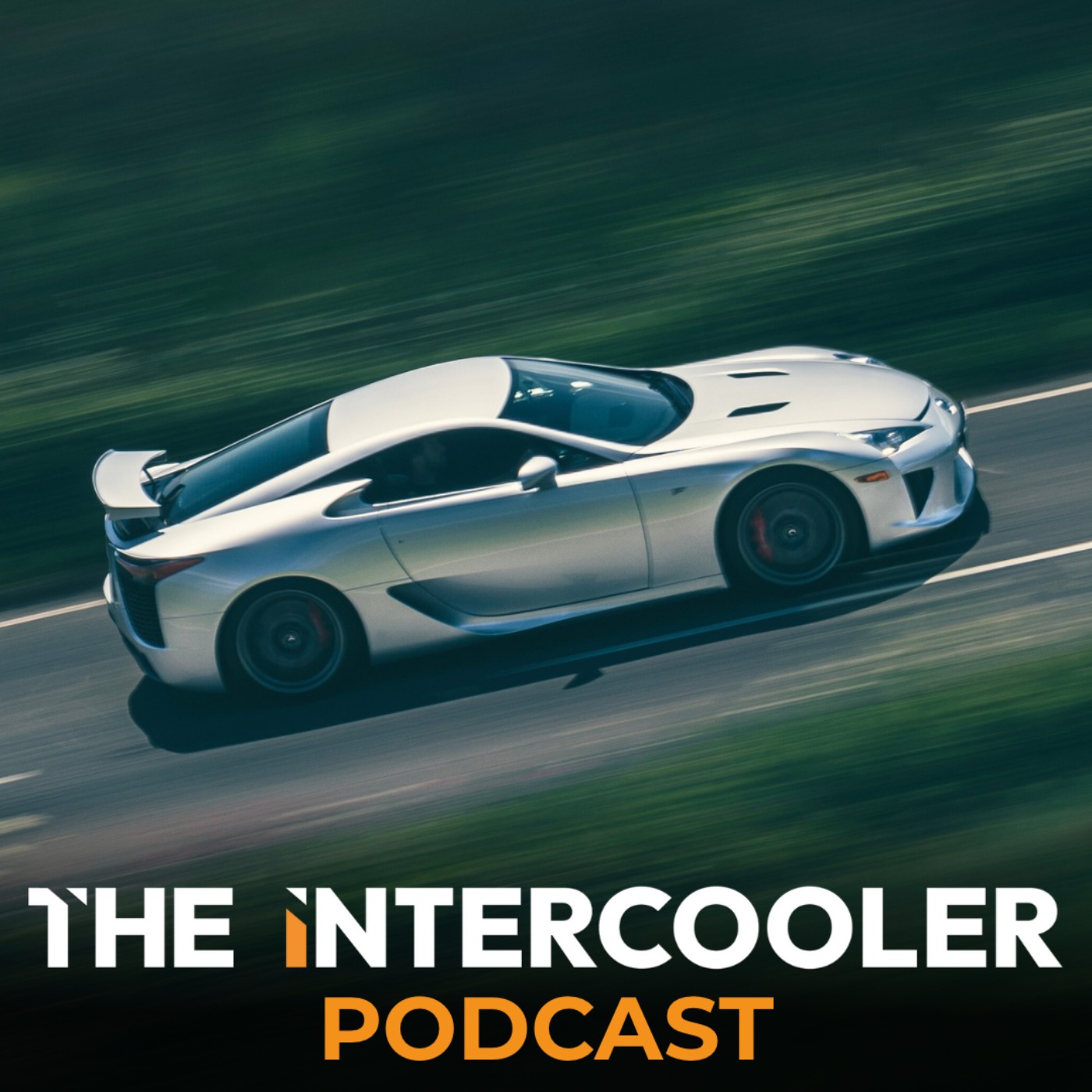
John Watson, a highly underrated Formula One and Group C racing legend, shares insights from his career, including near championship success and iconic wins. He reflects on the qualities beyond talent needed to succeed in F1, his memorable pole position at Monaco, and the unique challenges of street circuits. Watson also discusses his experiences with Tom Walkenshaw's Jaguar and factory Porsche teams in Group C racing, highlighting differences in car dynamics and team culture. The episode touches on notable teammates, tragic racing incidents, and Watson’s deep passion for motorsport history.
Live from Bicester Scramble, Dan Prosser and Andrew Frankel interview Britain’s #1 F1 driver of the early 80s, John Watson. Which was his best win in F1, how did he survive his biggest racing accident, and how did a Porsche 962 compare to a Jaguar XJR-9? Oh, and just how fast was Stefan Bellof - could he have been F1 World Champion?
Use coupon code pod20 at checkout to get 20% off an annual subscription to The Intercooler's online car magazine for the first year! Listen to this podcast ad-free, and enjoy a subscriber-only midweek podcast too. With a 30-day free trial, you can try it risk-free – https://www.the-intercooler.com/subscribe/
"This is a man who came within one race of winning the Formula One World Championship."
Formula One is the top type of car racing in the world, where drivers race very fast cars on different tracks to win a big championship. It's like the biggest car race competition there is.
The Formula One World Championship is the highest class of international auto racing for single-seater formula racing cars, sanctioned by the FIA. It consists of a series of races known as Grands Prix held worldwide, where drivers and teams compete for the championship titles.
"a man who won five Grand Prixs, who was instrumental in Jaguar winning the World Sports Car Championship in 1987."
A Grand Prix is one of the big races in the Formula One racing season. Drivers race in many of these to try and win the whole championship.
A Grand Prix is a single race within the Formula One World Championship series. Each Grand Prix is held at a different racing circuit and contributes points towards the overall championship standings for drivers and teams.
"who was instrumental in Jaguar winning the World Sports Car Championship in 1987."
The World Sports Car Championship was a big car racing competition where special sports cars raced long races to see who was the best.
The World Sports Car Championship was an international racing series featuring sports prototype and grand touring cars. It was a prestigious competition where manufacturers and drivers competed in endurance races around the world.
"We'll talk a bit about TWR itself, your time with Tom."
TWR is a company that builds and races cars in big competitions like Formula One. They help make race cars faster and better.
TWR stands for Tom Walkinshaw Racing, a motorsport and engineering company known for its involvement in various racing series including touring cars and Formula One. It played a significant role in motorsport history through car development and racing team management.
"You qualified on pole at the Monaco Grand Prix in 77, almost half a second, a huge margin. Is that, that's a phenomenal achievement to get pole at Monaco? Pole at Monaco is, yeah. That's something else. You must still be very proud of that. I mean, yes, I was. Unfortunately, I was unable, I didn't take advantage of pole position because the way the grid was laid out in those days, pole position was actually just at the point where"
Pole position means starting the race at the very front because you were the fastest in qualifying. It helps you get ahead of other cars right from the beginning.
Pole position refers to the first starting spot on the grid in a race, awarded to the driver who achieves the fastest qualifying time. It is a significant advantage because it places the driver at the front of the pack at the start.
"So when I released the clutch, I got too much wheel spin, and Judy Schechter, who was alongside me, gained the advantage."
Wheel spin is when the car's tires spin in place instead of gripping the road, which can make the car slide or slow down.
Wheel spin occurs when the driven wheels lose traction and spin faster than the car is moving, often causing loss of control or slower acceleration. It can happen when too much power is applied too quickly, especially on low-grip surfaces.
"Driving around Monaco, qualifying a Formula One car around Monaco, when you see the onboard footage, it's electrifying, isn't it?"
Onboard footage is video taken from a camera inside the race car so you can see what the driver sees and how the car moves.
Onboard footage refers to video recorded from a camera mounted inside or on a race car, showing the driver's perspective and the car's movement during a race or qualifying.
"Driving around Monaco, qualifying a Formula One car around Monaco, when you see the onboard footage, it's electrifying, isn't it?"
Qualifying is a session before the race where drivers try to drive the fastest lap to decide who starts in which position.
Qualifying is the process before a race where drivers compete to set the fastest lap time. The results determine the starting order or grid positions for the race.
"Maybe what I learned by racing in Ireland within the confines of very fundamentally dangerous road circuits was to drive within those confines, and of course Monaco is a case in point where you would have to drive very much within those confines."
Road circuits are race tracks made from regular roads where cars race. They are usually narrow and have less space to drive safely, so drivers have to be very careful.
Road circuits are racing tracks that use public roads or streets, often narrow and with limited runoff areas, making them more challenging and dangerous compared to purpose-built racetracks.
"The other circuit I was referring to, which I actually find even more enjoyable, was a circuit in Barcelona called Morgue Park."
A racing circuit is a special track where cars race, with lots of turns and hills to make it exciting.
A racing circuit is a closed track designed specifically for motor racing, featuring a variety of turns and elevation changes to challenge drivers and cars.
"they're just too big, too fast for that nature of circuit, but certainly for a Formula One car with a naturally-acerated 3-litre Cosworth V8 engine, absolutely made in heaven."
A naturally-aspirated engine is a type of engine that breathes air naturally without using extra devices to push air in, making it sound and feel different when it runs.
A naturally-aspirated engine draws air into the combustion chamber without the use of forced induction like turbochargers or superchargers. This often results in a more linear power delivery and distinct engine sound.
"you are either one of one or two people to race both factory Porsches and factory Jaguars in the Group C era."
Group C was a type of car race in the 1980s where special cars raced for a long time and had to use fuel carefully to win.
Group C was a category of sports car racing introduced in the 1980s, featuring prototype race cars with a focus on fuel efficiency and endurance racing. It was prominent in events like the 24 Hours of Le Mans.
"to the factory Porsche team. Were they completely different experiences for you?"
The factory Porsche team is the official group of drivers and cars that Porsche supports in races.
A factory Porsche team refers to the official racing team supported and run by Porsche itself, often featuring top drivers and cutting-edge technology.
The Porsche 956 is a special race car made for long races. It was very fast and won many important races in the 1980s.
The Porsche 956 is a Group C sports-prototype racing car introduced in 1982, known for its aerodynamic design and dominance in endurance racing such as the 24 Hours of Le Mans.
"...ly untouchable. In Le Mans configuration, the Le Mans Porsche configuration, I think is probably the best Le M..."
The Porsche Macan is a small SUV that is fun to drive and feels fast like a sports car. It’s good for people who want a car that can carry things but also be exciting to drive. People talk about it because it’s a mix of a family car and a race car.
The Porsche Macan is a compact luxury SUV known for its sporty handling and performance, often praised for bringing Porsche's driving dynamics to a more practical vehicle segment. While not directly related to Le Mans racing, the Macan benefits from Porsche's motorsport expertise, making it a popular choice for those wanting a blend of everyday usability and spirited driving. It is frequently mentioned in discussions about sporty SUVs.
"The center of gravity was much higher as a consequence."
Center of gravity is like the balance point of a car. If it's lower, the car stays steadier and doesn't tip over as easily when turning.
Center of gravity refers to the point where the entire weight of a car is considered to be concentrated. A lower center of gravity generally improves handling and stability, especially in racing.
"The material and carbon fiber, which is the material, had been used previously as a replacement part for a metal part. Carbon fiber is a material in its own right, and it needs to be acknowledged, respected, and used in its own form, not as a substitute for another material."
Carbon fiber is a special material made of tiny carbon threads. It's very strong but light, so car makers use it to make parts that help cars go faster and use less fuel.
Carbon fiber is a strong, lightweight composite material made from thin strands of carbon. It is widely used in automotive applications for parts that benefit from reduced weight and increased strength, such as body panels and structural components.
"Spun across the racetrack, hit the barrier on the inside of the circuit, effectively ripped the gearbox from the engine, the engine from the chassis,"
The gearbox helps the car change how fast it goes by switching gears, kind of like changing speeds on a bike.
The gearbox is a mechanical component that transmits power from the engine to the wheels, allowing the driver to change gears and control the vehicle's speed and torque.
"...e 1984 European Touring Car Championship winning Jaguar XJS over there. So a fine driver. Did you ever get to..."
The Jaguar XJ-S is a fancy, sporty car made a long time ago that was really good at racing in Europe. People talk about it because it looks cool and was fast enough to win important car races.
The Jaguar XJ-S is a luxury grand tourer produced from the mid-1970s through the early 1990s, known for its distinctive styling and powerful engines. The 1984 European Touring Car Championship-winning XJ-S highlights its motorsport pedigree, showcasing Jaguar's competitive edge in touring car racing during that era. It is often discussed for its blend of performance and classic British luxury.
"In Formula Two. So that was in Formula Two, European Formula Two Championship, a great championship. 35 or 40 cars entered to a race."
This was a big car race series in Europe where many drivers competed to prove themselves before moving up to the biggest races.
The European Formula Two Championship was a prominent racing series in the 1960s and 1970s, known for large fields of competitive drivers and cars, acting as a feeder series to Formula One.
"...ifference between an aluminium American developed XJR, the 5, we still had AV-12 in it. Yes. And then ..."
The Jaguar XJR is a fast and special car made for racing and driving on the street. It has a strong engine and a light frame, which helped it win many races. People talk about it because it shows how Jaguar made really good race cars.
The Jaguar XJR refers to a series of high-performance racing and road cars, including the XJR-5, which featured an American-developed aluminum chassis paired with Jaguar's renowned V12 engine. These cars are significant for their success in endurance racing, blending advanced engineering with powerful performance. Discussions often focus on the technical differences and racing heritage of various XJR models.
"I know that Audi ran their car the other day in Barcelona. It's certainly the engine."
Audi is a car company from Germany that makes fancy cars and also builds engines for racing cars in Formula One.
Audi is a German automobile manufacturer known for its luxury vehicles and involvement in motorsports, including Formula One with their recent entry as an engine supplier and team partner.
"It's certainly the engine. What I've seen on my phone, the engine sounded great. I'm a fan of naturally aspirated V8s, V10s, V12s."
These are types of car engines with 8, 10, or 12 cylinders arranged in a V shape. They don't use extra devices to push air in, so they rely on normal air to work.
Naturally aspirated engines are internal combustion engines that rely on atmospheric pressure for air intake, without turbochargers or superchargers. V8, V10, and V12 refer to the number of cylinders arranged in a V configuration, affecting power and smoothness.
Select text to request an explanation
I'm delighted to be here today at the first Sunday scramble of 2026 at a rather chilly
pistol motion.
The champ about to come up on stage.
I don't understand why he has not had massive recognition, much greater than he has.
This is a man who came within one race of winning the Formula One World Championship.
This is the man who had two of the greatest back to front Formula One wins that has ever
been, a man who won five Grand Prixs, who was instrumental in Jaguar winning the World
Sports Car Championship in 1987.
Honestly, I think he was Britain's top Formula One driver for six consecutive seasons.
This is, I think, Britain's most underrated Formula One driver.
His name is John Watson, and John, would you like to come and join us on stage now?
Thank you.
Thank you.
Thank you, Andrew.
Welcome, John.
Thank you.
Great to have you here.
This morning, John, we had Ian Callum in that chair, and so we were talking largely about
the design of road cars.
So with you here, we're going to talk mostly about the racing side of TWR.
We'll talk a bit about TWR itself, your time with Tom.
We also want to hear about Formula One.
OK.
As Andrew says, a vastly, vastly underrated racing career.
Most underrated, I think.
Yeah.
Can I start?
How do you feel about that?
How do you feel about that label, about being regarded as being, and why do you think that
is?
Do you feel you've not had the recognition you deserve?
I think recognition is whatever it is it is.
I mean, in reflection, on reflection, throughout my 10 years in Formula One, I think I could
summarize it by saying I should have done better, and I could have done better, but
you can't change history.
And I think that I had a wonderful time in Formula One, 152 Gouraume-Prix, small number
of successes.
But I think what I learned is that, ultimately, talent in itself isn't necessarily the key
to winning a world championship.
There's other qualities.
And some of my teammates, notably Nicky Larder and Alain Prost, who I briefly had a teammate
with, had certain qualities which weren't natural to me, particularly in the case of
Nicky.
These be certain sort of political qualities?
No, not necessarily political.
You could maybe analyze it to say there's an element of politics within it.
But I think it's the character of a person.
Some people are naturally either more assertive or more self-confidence and project that confidence
in a manner which is something a team is looking for.
And maybe a Formula One team in particular would argue, but the time you reach Formula
One, you shouldn't need being babyed or being given an assistance.
But not every racing driver, even world champions, are hard-nosed, thick-skinned racing drivers,
many are not.
But there are also many that are that hard-skinned, totally self-focused, don't give a, you know
what, about anybody else.
And they can project that in a team.
And a team can feed off that as much as a driver needs to feed off the team.
And you talk about these very single-minded, laser-focused drivers.
They tend not to make great sports car drivers where you're sharing with other people.
Absolutely.
Welcome to all of this.
Let's continue on Formula One, because we're there right now.
You qualified on pole at the Monaco Grand Prix in 77, almost half a second, a huge margin.
Is that, that's a phenomenal achievement to get pole at Monaco?
Pole at Monaco is, yeah.
That's something else.
You must still be very proud of that.
I mean, yes, I was.
Unfortunately, I was unable, I didn't take advantage of pole position because the way
the grid was laid out in those days, pole position was actually just at the point where
there was a public crossing on the highway.
So when I released the clutch, I got too much wheel spin, and Judy Schechter, who was
alongside me, gained the advantage.
Now the following year, I was on the front row of the grid again, and Carlos Reutemann
was on pole position.
And I got the advantage from that front row grid and led Carlos into turn one.
So whether it was down to the layout or the roads with whatever the material they used
to make out, the white blocks that demarcate a public crossing, I don't know.
Driving around Monaco, qualifying a Formula One car around Monaco, when you see the onboard
footage, it's electrifying, isn't it?
Is it the most exciting thing you can do in a racing car, or do you prefer an expansive
open circuit where you can really bring the car to life?
I think one of the joys of racing on what I would call a street circuit or a street road
circuit, and I've got one other racetrack of that ilk in mind, which I think is even,
for me, was even better than Monaco.
But the precision that was required or is currently required to navigate your way around
whatever number of turns Monaco has these days.
And one little error is the only error you're going to make.
And maybe because I came from a background of racing in Ireland initially, on certain
circuits, particularly a place called Dunboyne, a road circuit just outside Dublin, and Phoenix
Park itself within Dublin, you had to self-educate yourself to drive within the confines of the
circuit.
Whereas if you had started your racing career over, let's say in England, particularly maybe
in Scotland or, well, mainly in England, a lot of the racetracks were former as we
are here today, a military airfield, and so you'd big wide open spaces.
Maybe what I learned by racing in Ireland within the confines of very fundamentally
dangerous road circuits was to drive within those confines, and of course Monaco is a
case in point where you would have to drive very much within those confines.
And the degree of enjoyment, satisfaction that I received from doing so was really what
made it enjoyable.
I can only imagine the thrill of a Formula One car around that place.
The other circuit I was referring to, which I actually find even more enjoyable, was a
circuit in Barcelona called Morgue Park.
Yeah, which they stopped using.
But sadly it got stopped for Formula One because of a very bad accident in 1975, but it was
really a racetrack built within a public park in Barcelona, and it had a lot of elevation
ups and downs.
It just had a rhythm, an even better rhythm than Monaco has, and there was a much higher
speed.
And I fell in love with that circuit the first time I went there, 1970, and I always felt
it would be a wonderful racetrack, not for the current group of Formula One cars, because
they're just too big, too fast for that nature of circuit, but certainly for a Formula One
car with a naturally-acerated 3-litre Cosworth V8 engine, absolutely made in heaven.
Wow.
We will obviously get back to Formula One shortly, but just because we're here to celebrate
the life and work of Tom Walkenshaw, and I think there are cars in this room that you
raced in period, you are, I think possibly, maybe Ori Pescaroli, maybe the only other,
but you are either one of one or two people to race both factory Porsches and factory
Jaguars in the Group C era.
So you are uniquely qualified to tell us both the differences between what an XJR9 Jaguar
felt like compared to a 962, and also the different ways that Tom Walkenshaw went racing
to the factory Porsche team.
Were they completely different experiences for you?
Well, first of all, I didn't get involved with Tom until 1987, when the XJR8s and 9s
were competing.
I raced a factory Porsche for the first time, and that was a passion of mine.
I was like, I'm a Porsche nut.
I've been so since I was nine years of age, and eventually to drive for a factory Porsche
was fulfillment of a childhood dream.
And the first race I competed in was in Spa in 1984, when the Rothmans Porsche team entered
a third car, Verne Schupin and I drove that car.
The difference that I discovered driving a Group C car compared to what I'd spent ten
years racing was there were very physical cars, quite heavy to drive, the steering was
needed to sit relatively close to the steering wheel to get sufficient leverage to be able
to turn the wheel.
But there were quick cars, I mean, I don't know what the lap timing around every racetrack
would have been, but certainly the difference between the tail of a Formula One field and
the front of a Group C field was virtually nothing.
So these cars were generating lots of downforce, lots of grip.
So by the time I got into, well, let's talk about the Porsche experience first of all.
All the Porsche I raced in 1984, and I did effectively two races, but a further trip
was entered for when Porsche were developing the PDK gearbox.
But because it was a work in progress, the team withdrew the car following practice because
they realized there were reliability problems and they didn't want to wash the linen in
public.
So I raced in Spa and then went to Mount Fuji, to the Fuji circuit at the end of 1984.
Stefan Beloff and Derek Bel were teammates in that car, and because Derek couldn't win
the drivers' championship, Stefan could.
So Porsche shipped Derek out to America to compete in IMSO where he had a chance to win
that championship.
Yes, and put you in the Stefan.
And I was in the Stefan.
So what was he like?
Awesome.
I mean, the guy, I mean, one of the nicest, nicest people you've ever met.
And he was just an out and out, unbelievably fast race driver.
And the Porsche team, particularly the team that worked on that car, Derek and Stefan's
car, and the man who ran that car was called Klaus Bischoff.
I know him.
And Klaus formed a relationship of bond with Stefan, which was just one of those bonds
that you see occasionally in any form of motor racing.
And he was idolized because he just simply was the quickest guy, and those are 956.
And I mean, to think of one example was in the 1000 kilometers at Nürburgring, in qualifying,
he set a lap time, which was just outrageous.
I mean, just blew the doors of everybody else.
Now he went off in the race, and I remember, I used to live in Bogne, Regis, and Derek
Bell was a Bogne resident, David Perdy likewise, and we would play tennis once or twice a week.
And of course, it'd be always fun to wind Derek up and say, come on, Derek, how come
this kid's blowing your doors off?
And of course, Derek would go, immediately, you know, but you know, but you know, but actually
when it comes to the race, we're very similar.
And you know, I've done them all, and I've won them all.
And all the usual, you know what, but Stefan was just such an amazing guy.
So we went to Fujian, the first practice session, Mr. Falk, Peter Falk was the team manager.
And being a very formal, correct gentleman, he addressed me as Mr. Watson.
So Mr. Watson, would you please go out and do 10 laps?
So I have a night and fulfilled my obligation doing 10 laps, came in, established a time.
Mr. Bell off, your turn, go out and do it.
I think Stefan on his first flying lap was quicker than I had been over my 10 laps.
And he just bonded with a 9-5-6.
It was his natural home.
He loved the car.
He ragged that car.
I don't think I've ever seen another driver in a 9-5-6.
And there have been some great drivers in 5-6s and 6-2s who could drive a car with such commitment
and still managed to basically just go quicker than everybody else.
And the tragedy that occurred a year later at Spa, that should never have happened.
It was just, I don't know what to say about it, probably say less than more because...
Racing accident?
It was an accident, it was an avoidable accident.
And both drivers were guilty in effect of neither was prepared to concede.
And sadly, the outcome was we lost a young German driver who arguably,
given the right opportunity, would have gone on to be a Formula One World Champion,
without hesitation.
Yeah. Well, we remember his performance at Monaco in 84.
He could have won Monaco 84.
Could have done.
I mean, everybody talks about what Senna was doing in the Tollman.
But actually, he spent in the Tyrol was actually quicker than Senna was in the Tollman.
And of course, Alan Prost was waiting for Jackie Hicks to put the flag out of lap early
and stop the race.
Yes.
That's a can of worms.
So can we just progress because now we've talked about the Porsche sports car.
What was the Jaguar sports car like in comparison to drive?
And what was Tom like to race for compared to Peter Falk?
Within Porsche, you had two different car setups.
One was the sprint car setup and the other was the Le Mans setup.
And Jaguar followed suit.
The sprint Porsche, up until the point when Tom in 87 and 88,
really a full on attack on the World Sports Car Championship was essentially untouchable.
In Le Mans configuration, the Le Mans Porsche configuration,
I think is probably the best Le Mans car I've ever raced.
I've only raced seven times and twice in Porsche.
So the long tail, I felt just the ideal combination of balance gave lots of confidence.
And it was it was forgiving.
In 87, when the silk cut Jaguar set off on the World Championship trail and Le Mans,
we blew Porsche out of the water because the Jaguar was simply a much quicker car.
It had a full carbon fiber chassis.
It had a tall narrow V12 engine which enabled Tony Southgate to produce a very,
very efficient underside to the car.
So the Don Force, the Jaguar producers way beyond what Porsche had because they had a flat six engine
which precluded really the aerodynamic potential being a lot less forgiving, I'm guessing.
But in the Le Mans configuration, that overall Don Force figure wasn't the criteria.
It was drivability.
And in 87, the team then produced a Le Mans package for the Jaguar.
But the car lost too much of that Don Force and it highlighted some of these shortcomings
of the configuration of the Jaguar, namely that the Jaguar engine for all the benefits it had by
being narrow and tall, take away 50 or 60% of the Don Force to Google Le Mans.
It made the car, the handling was a lot less enjoyable.
The center of gravity was much higher as a consequence.
So it was not an easy car to drive at Le Mans in 87.
So for 88, the team then sort of went midway between a sprint and a Le Mans setup
and it was a much, much better car.
And of course in 88, they won their first race at Le Mans.
And it was a very, very good car.
I still think overall the Porsche Le Mans setup in the experience I had was
the more comfortable of the two.
The Jaguar was maybe marginally quicker, but certainly maybe marginally more
nervy.
A big, heavy V12 behind you.
The Jaguar engine was a long, tall, heavy bit of conventary engineering.
It was never really intended to be a racing engine, albeit if you look at the XJ,
this is the 13.
The 13, yeah.
But I don't know if that's the same motor that's in.
It's, they originate from the same place, but they're very different engines.
But the center of gravity in the, if you look at these cars today, you wouldn't
realize it, but the center of gravity is quite high.
And to illustrate just how critical that is, in 88, Tom decided that we needed to get
some more horsepower.
And the single overhead cam V12 engine had more or less reached its potential.
So he instructed Alan Scott, who was the engineer doing all the development work for
the race engine, to design, develop a four valve cylinder head.
And that ran for the first time in a race car at the 1000 kilometers of brand's hatch.
And I was given the task of going out and running it.
And again, it was the same sensation that we had with the Le Mans car in 87.
There was now with a four cam engine and whatever else was associated,
the center of gravity was so high, the balance of the car and sort of the back end taking control
of the front end of the car.
Eventually the project was halted.
And the reason I understand, this is something maybe not generally very well known,
the engine that we use, the seven liter V12 single cam engine,
had exhaust pipes of a particular, primary pipes of a particular diameter.
One day when they're in the engine shop, they were doing an engine test.
And the V12 engine that was used in the IMSA series was not the seven liter,
it was the six liter version.
And it ran slightly smaller diameter primary pipes.
And by mistake, somebody fitted the IMSA primary exhaust to the group C engine.
And then in the dynamometer and all of a sudden, wow, what's going on here?
We're getting different figures, different power, different torque figures.
And it was simply because actually the exhaust system that the six liter engine had been running
in America was producing more power and better drivability than that had been fitted to the
seven liter engine.
So that sort of shit canned, if you want, the four valve project, which was casting up other
issues and problems, especially in terms of the overall handling of the car.
And what was Tom's approach?
I mean, was he autocratic over every detail?
Or did he step back and allow his trusted lieutenants to do what they needed to do?
Well, I mean, I'd met Tom initially in 1971 when he set off on a Formula Two career in a
712 March, I think sponsored by a Curia car.
I think if I remember, he might have had a shunt and broken an ankle.
So last contact and then obviously through the 70s, getting involved with his engineering
business and then running other manufacturers, cars and championships.
So by the time came round to the middle 80s, and my Formula One career had ended at the end of 83,
but I didn't feel retirement as something as a natural progression.
And Group C was, I thought was a very nice way, I call it a tapering down of professional
racing career.
And I got invited to do a test down at Polrica with a number of other drivers to drive in the
87 season.
First thing that was obvious was that everybody who drove the Jaguar for the first time spun it.
Just, it was a slightly different car to any other Group C car.
It was much, much stiffer.
And if you didn't have tire temperature and we were running Dunlop tires and Dunlop made,
I think you might say, unique tires for this car, which had I think a carbon fiber carcass.
And Porsche never ran those tires to my knowledge.
They were exclusive to Jaguar.
So everything was quite stiff.
So everybody spun it.
Even Jackie Stewart, who was doing a track day test in the car for a TV series he was making
for North America.
I remember.
I don't want to say, but he stuffed it, didn't he?
He stuffed it.
And it's all on YouTube.
Wow.
Yeah.
And I think it's, I don't know.
I wasn't present to know what happened, but even it was a car that you had to acknowledge its
qualities.
And until you knew precisely what the car would do and not do, first time in the car,
I think every driver had a quick spin.
But it was a fantastic car.
And it would just produce downforce levels, which Group C had never seen.
Plus it was a carbon fiber chassis.
So it was using the technology that Formula One and Evolved.
And with the levels of downforce that these cars were producing, you wanted a much more
stable and secure platform to enable that performance, that downforce to be
accessed, to give you the performance to be able to go quicker than your competitors.
And of course, you have a particular reason to be grateful for carbon fiber.
Monza?
Well, I mean, it was a little incident that occurred coming out of Les Moutreux.
And I mean, the curbing now at Les Moutreux and Les Moutreux on that matter.
Before you do this, can we just set the scene a little bit?
Because you were in the McLaren, the MP4-1, the first carbon fiber Formula One car to
actually race, Lotus would say they're 88, but I know it raced, and the Italian Grand Prix.
And yeah, you have a...
The first thing that happened when McLaren and John Barnard, Ron Dennis, British Aerospace,
Hercules Corporation in North America, this project, what nobody really knew,
what would happen if you had a big one?
Someone had to find out.
You were the big.
The material and carbon fiber, which is the material, had been used previously
as a replacement part for a metal part.
Carbon fiber is a material in its own right, and it needs to be acknowledged, respected,
and used in its own form, not as a substitute for another material.
So I had my Chuck Yeager moment.
And did anybody know who Chuck Yeager is?
He was the first man to break the sign barrier.
Is that right?
He was absolutely the first man to break the sign barrier.
A little rocket chip.
So my Chuck Yeager moment was driving carbon fiber McLaren chassis at,
actually it was a press day at Silverstone, and thinking what happens if I have a shunt?
Am I going to lose limbs?
Am I going to die?
We didn't know.
Now, I suppose to be unkind, my teammate for that season was Andrea De Cesaris,
and you might say that he was a crash test dummy.
Andrea De Cesaris, I thought he was no.
I mean Andrea was a very young guy, super quick, but sometimes just too quick.
Sadly, he's not with us any longer.
But Andrea had a lot of minor shunts and did all the crash testing for the team.
But coming back to Andrea, what you were saying about Monza during the race,
I was in a group of, I think, three cars, and I was looking, coming into Lesmote 2,
which was a very quick corner of this period, unlike today, it's been emasculated,
it's been slowed down because the runoff areas are restricted at Monza.
But the curbing on the outside was sort of quite like a banana curb.
And I let the car run slightly too wide on the exit, and the left wheels ran up the top of the
curb, but then they dropped down, and then allowed the chassis of the car to do this,
and it just rotated the car anywhere.
Spun across the racetrack, hit the barrier on the inside of the circuit,
effectively ripped the gearbox from the engine, the engine from the chassis,
none of which I was aware of until I got out of the car, by the way.
And that was the benefit of a full carbon fiber chassis, because
it fulfilled the design criteria of all the people that I've mentioned,
John Barnard, BAC, Hercules Corporation.
I stepped out of the car, I mean, I saw an engine sliding across the racetrack, I go,
shit, who's that? I didn't know it was my engine until I looked at the back of the car,
where's the gearbox, where's the engine? The gearbox is wedged in the barrier,
the engine slid across the racetrack, Alberto was coming behind, and the engine and the
Tyrell collided 200 yards further on the track, and that spun Michele out of the race.
I went back to the garage and said, sorry guys, cars damaged, and anyway, they got the car back,
and that chassis was never used again. But I think the Hercules Corporation at one point
expressed an interest in having access to it, because they're in the business of making
materials for military, and particularly for helicopters. And for a helicopter that's in a
war zone and flying low over whatever terrain, they're vulnerable to ground fire,
and the Marines or whatever US marooned military were seeking a material that would,
they could add to the belly of a helicopter to give the occupants and the helicopter more
protection and to protect the helicopter, basically. So I understand, I don't know, maybe
it's a bit of a myth or a rumor, but I understood that the benefit of the accident was that when
they had that chassis, they were able to put up the video of the accident and be, oh my god,
there's the poor guy dead. No, here's the car he stepped out of, the driver's cockpit,
completely intact, no damage whatsoever. Can I ask you the unknowable question?
What do you think would have happened if you'd been in a conventional aluminium car
and had the same accident? I think there would probably been, I mean, there was a sort of a
exploded, but it lasted about a second and that was it. I suspect that probably you would have
ripped the fuel tank out of the car if it was a regular aluminium metal frame chassis,
and then you'd have had a conflagration which would have been enormous. So arguably you might
have found yourself trapped in the car, maybe you might have found yourself potentially injured
in a way which would have made it difficult to get out, but fire would be the real concern.
And I think that with the beginning of dry fuel brake connectors, which was
a part of what John Barnard did with the integral design of the car,
I stepped out of the car completely uninjured. Four days later, five days later, I went to
Donington Park because a racing driver, a former racing driver needed a major cash injection
because his passion, which was his airline, was struggling because the government of that country
were trying to nail him high up and no done. So my former teammate at Brabham, Nicky Larder,
rocked up at Donington to drive one of our remaining cars, and I drove it before Nicky drove it and
to show or prove that there was no damage to me physically or mentally. I set the quickest lap
that I'd ever done in that car at Donington. So no psychological damage, no physical damage.
I've always wondered that. Move on, just move on. You weren't, of course,
Andrew, don't dwell on something that never happened. There are certain breed, aren't they?
Nevertheless, you raced through both in your times in the sort of junior formula and then
formula one through one of the most dangerous eras, and you would have come across some
terrible sites and you would have lost some friends. Did it ever give you pause for thought?
Was that one of the reasons that you, I presume it wasn't one of the reasons that you stopped
because things were getting better by then, weren't they? Well, first of all, I didn't stop
voluntarily. It was a fate of complete. But in that era, I think the way we might have protected
ourselves in terms of, it's more on reflection, you see the statistics of that sort of, let's say
all the way through until we got into the turbo era and beyond that,
we believed that we had the best engineering, the best manufacturing, the best everything.
So we thought these cars we were racing, this is the best that's available. Now, obviously,
if you had an accident on certain circuits, the consequences could be more severe than another
circuit. I like to think I tried to drive within the confines of that knowledge.
I think other competitors of my time, maybe had a different perspective and some of them survived.
Sadly, others didn't. And I suppose maybe to summarize it, you have to calculate risk. And
I always, I felt maybe as you get more grown up, maybe more mature, you adapt a more,
don't go into a cul-de-sac because there's no exit. Don't commit to doing something unless you've
got a, you can see the exit. So maybe that's where I find myself in, certainly in the mid-70s
and all the way through until the end of 83. Can we talk about your best in your view,
performances in Formula One? Can I propose one? I'm going to take you back to Long Beach 1983.
Twenty-second on the grid. How did he do in that race? You won the race. You are still,
I think, John, you can confirm this. Are you still the person to have won a Formula One race
from furthest back on the grid? There is an opportunity this year for that record to be
equal. Of course. Equalled. Maybe. You said it first. You said it first. I mean, we didn't,
Nikki and I started 21st, 22nd, I think. That wasn't done voluntarily. The simple,
or the reasons why we qualified so poorly was the McLaren was a very light car on its tires.
Michelin made outstanding Grand Prix tires. But in a qualifying setup with low fuel,
you might say maximum attack configuration, we couldn't generate core tire temperature.
We could get surface temperature, but you need to get core tire temperature. Come the race when
you put in your whatever 40 gallons or 45 gallons of fuel, the static weight of the car went up.
So there was more energy being put into the tire. Consequently, the tire, the sidewall of the tire,
the core of the tire would generate temperature. Then the car performed, as it should have done,
would, we'd like to have done in qualifying, especially on a street track where the grip
levels were fundamentally lower than on a permanent race track. So we started the race and
a number of drivers retired, some for self-inflicted reasons, other mechanical reasons. But Nikki and
I went forward in tandem. And looking back two weeks earlier in Brazil, I had a particularly good
race in Brazil until the fortieth retirement. This is the first year also of the flat bottom
regulation, which the president of the FIA, Jean-Marie Ballest, had imposed on Formula One.
So it was a bit of a whole new world, people getting to know how the cars would react with the
tires and different circuits. But as we move forward, I had it in my mind. I'm not going to let
that little, the word ends in K. Have you worked it out yet?
Yes. Get away from me because I knew if he got a car between us, then I would lose that contact.
And eventually we found ourselves running first and second. I think second and anyway, whatever.
And I was quite determined to overtake Nikki and he was equally determined to not let me overtake.
But we both raced cleanly. There was no weaving around or blocking or whatever. And coming down
the main straight, there was a long curve in it, down into the first sort of tight,
right, left, right. I made an audacious overtaking maneuver. I was fractionally later in the brakes.
And one of the brakes snatched away. And he went like, oh, what did you do that for?
I didn't do it on purpose. The brake grabbed. But once I got ahead of him, then I was able
to drive away and won the race very comfortably. And following the race, Nikki had had a physical
trainer who had worked with him for many years, particularly following his accident at Nürburgring,
a wonderful man called Willi Dungal, who I worship. And for me, one of the, there's maybe half a
dozen people in my life who I've got great respect and admiration for. Pierre Du Pasquet,
Michelin's another one, by the way, but Willi Dungal for sure. And what he helped Nikki do,
recover from his accident, and what he helped Nikki with physically with his training or lack
of training or whatever it was, and self-discipline, I got inducted into the program in 1983. I loved
it because it gave me so that's the kind of additional strength and self-belief that having
somebody there to assist get there, that's what he did for me. So we had a couple of weeks or
10 days between Brazil and Long Beach, where it was Willi and me just doing light training and
focusing on the race. So I felt particularly strong, got the lead, won the race, and Willi said afterwards,
totally on, I didn't know why, I said, I knew you were going to win today.
Because he, through all his experience of working with Don Hilsky Racist, which is very,
his background was, he had the ability to see beyond just the physical person, he could see
into the person and see that person's qualities and strengths. And he saw certain things obviously
with Nikki, but he saw other qualities and things within me. And I was extremely flattered by
that observation and it was a very memorable day. Wow. Fantastic. I want to talk a little bit
about Tom Walkinshaw. We know that he was a fantastic driver himself. Yes, he was. Several
of his racing cars are over there, the 1984 European Touring Car Championship winning
Jaguar XJS over there. So a fine driver. Did you ever get to see him drive at a test session or
anything at all? Or at an earlier career? No, the only time I really was on a race track with
Tom would have been in 1971. In Formula Two. So that was in Formula Two, European Formula
Two Championship, a great championship. 35 or 40 cars entered to a race. I mean, just wonderful
racing. And if you look at Formula Two today, shadow of what European Formula Two Championship
would have been in those early 70s. But Tom was a very, very successful race driver,
very competitive. Again, the focus that Tom had all the way through his life, not just as a driver,
but as a setting up his business and setting up the race team. And by the time I got to Jaguar,
Tom was considered, you don't mess with Tom. Sure. But what he did, he provided you
with the very best equipment and something else, which I know people might sort of
not totally understand. But there were two people in my career. Every driver's got a contract.
And in that contract, there will be dates in which you will receive some of money for your services.
And the two people that I find honored, the three people that honored those terms and conditions
were in no particular order, Boney Eccleston, Roger Penske, and Tom Wolkenshaw. Whatever the
payment dates were, you were paid. Now, I had other people who basically dicked me around
because they could. I can't imagine who you're talking about. They could do. Yeah.
And it's disrespectful. It's demotivating for you as well, isn't it? I find it disrespectful.
When you drove for Tom, you got the very best equipment that he is an engineering team
from within what the regulations permitted and regulations permitted carbon fiber.
Tom realized that that's the way to go with high downforce, very powerful, very quick Group C cars.
Porsche had ruled the roost in Group C really since the introduction of the 956 booth as the factory
team, but also with many very successful private entry. I forget all the German brothers,
Kramer brothers, and they just ruled the roost. When the original, the green versions of the XJR
8s and 9s appeared, and I think the first time it appeared was 85 when it raced at Spa.
That was the beginning of changing of the guard within Group C in terms of sprint races.
I may have completely misremembered this. Something in here tells me you raced an XJR
5, the aluminium car in America. Oh, no. I raced at Le Mans in a Group 44 car.
Yes. The difference between an aluminium American developed XJR, the 5, we still had AV-12 in it.
Yes. And then you went to the carbon fiber car. I'm guessing night and day.
I think, first of all, that car had ran an IMSA engine regulations, so it certainly wasn't
anywhere as quick as the comparable Porsche of the day. Also, it didn't have the levels of
downforce. I mean, it was very nice. Lee Dykstra was the designer of the car, a very clever engineer,
and that car was extremely successful in IMSA racing in North America. Again, the more configuration,
I don't remember it specifically, but certainly I know racing in IMSA days,
that car won a lot of races and was competitive with Porsche and whatever else was being raced.
But coming into Europe in Group C and going to Le Mans in 1984, I mean, Bob Julius brought the
entire Group 44 team over. It was like a military exercise. And Bob, again, a very single-minded,
focused team principal, very like Tom in many ways. Here's what we do. Here's how we do it.
And if it doesn't suit you, on your bike. So the way that Tom ran the team and the way that the
people that he employed to run the team was very impressive. It was the nearest thing
in Group C that I'd ever experienced compared to Formula One. I did that level of engineering
evolution and fundamentally taking an engine which was not ideal actually in its weight,
its length and its height, but through engineering and through what Tony Southgate did and others
who worked on the project, was to make an extremely competitive race car. And Tom said,
there are the cars. This is what you need to do. In 87, we won all but one race. That was Le Mans.
And just dominated the championship. Fantastic. So I just want to finish up on Tom. From a
professional racing driver's point of view, when you know that your team boss himself was a very
accomplished racing driver, is there some reassurance in that or does it mean that he
speaks the language and he can understand the things that you're saying to him?
Well, I think, I mean, sometimes racing drivers have a habit of coming out and expressing a view
about something which is fundamentally better described as bullshit. Yeah, it happens. Sorry
to use that. It's a foul word to use in the Sunday morning. But essentially racing drivers,
that's a sort of an art and a skill that they've evolved and developed. Tom could see through
that like a laser beam. So he knew when somebody was spoofing and when somebody was
being accurate and saying, this isn't the car. This is that we have a problem. In other words,
if you wanted to disguise a shortcoming on your part, you needed to be on your tools to get away
with it. Yeah. Yeah. Can I ask you, do you still follow Formula One? Yes, I do. Thoughts on the
26th season with the new rules? I mean, it's a bit of an unknown. I don't know what we can
expect. I know that Audi ran their car the other day in Barcelona. It's certainly the engine.
What I've seen on my phone, the engine sounded great. I'm a fan of naturally aspirated V8s,
V10s, V12s. It's battle gearboxes. And yes, I would like to see the driver involvement more
of one that I'm familiar with. I acknowledge and accept that current drivers are going to drive
extremely technically evolving and even more so on 26. You've got adjustable wings,
adjustable aerodynamics, plus an even bigger electrical involvement. So they're not necessarily
my kind of cars. But at the end of the day, Formula One for me is ultimately about the driver,
not about the technology, except the technology is phenomenal. But to me, it's about the driver.
It is a driver's champion. They say all of us should be. So we've run out of time.
Early in the conversation, you said you could have done better in Formula One, but actually
you won five Formula One Grand Prix. You went to the final round of the 82 season in contention
to win the championship. You won more races that year than the bloke who did win the championship.
Andrew, here's a question for you. You're good at statistics. Over the three seasons that
Nicky and I were teammates, first at Brabham in 78 and then at McLaren 82-83,
who scored more points over those three seasons? No, let me think, John.
There you go. Have you got an answer? I'm guessing it was Jay Watson, the squire.
No, it wasn't. Follow it up, follow on. So who was it then? I'm asking you. It wasn't me,
so who was it? Nicky. No, it wasn't Nicky either. Oh, you mean in all of Formula One?
No, over the three seasons that we were teammates, if you counted up the points that we scored over
those three championship seasons, we ended up with equal points. A little non-stat. There you go.
Caroon. We're missing you, Caroon. There is that man. Well, John, listen, it's been great to
learn a bit more about Tom Walkinshaw. Great to hear about your career. It was a fine professional
racing career. Could it have done better? No, no, no. It could have done better. But look,
it is what it is, and I think every driver throughout their life and career could say,
I could have done better. Some are outstanding achievements. Some never fulfill the potential.
I fulfilled some potential. Maybe it could have done better. No, maybe about it. It should have
done better. Well, there we go. Listen, thank you so much for your time. Everyone, please,
a round of applause for John Watson. Thank you so much. Thank you very much. That was great.
Thank you, John. Thank you very much. All the best.
Request an explanation for:
3 cars
3 cars featured
Request an Explanation
Heard something you'd like explained? We'll add it to this episode.
Sign in to request explanations for terms you heard.
Want to learn more?
Browse our glossary for plain-English explanations of automotive terms, jargon, and concepts.
See something that's not quite right? Our annotations are AI-generated and can sometimes miss the mark.
Click the flag icon on any annotation to suggest a correction.