About this episode
“Widowmaker” is introduced as a slang catch-all for cars with a reputation for being “a bit tricky, bit spiky,” often tied to specific Porsche 911 Turbo eras. The hosts trace the term to aviation, then dig into why certain 911s and other performance cars feel dangerous: tire grip changes, turbo lag, lift-off weight transfer, and wet-weather behavior. They broaden beyond Porsches into swing-axle quirks, traction-control limits, and even motorcycle instability—where sudden loss of grip can be unforgiving.
Andrew Frankel and Dan Prosser are joined by Ti contributor Gez Medinger to take on the spiky subject of cars that bite when you least expect it. Unsurprisingly, there might be a 911 or two mentioned.
Use coupon code pod20 at checkout to get 20% off an annual subscription to The Intercooler's online car magazine for the first year! Listen to this podcast ad-free, and enjoy a subscriber-only midweek podcast too. With a 30-day free trial, you can try it risk-free – https://www.the-intercooler.com/subscribe/
Find out more about JBR Capital here – https://www.jbrcapital.com
Use coupon code Ti10 to get 10% off your Supernatural Car Care order – https://supernaturalcarcare.com/
Hosted on Acast. See acast.com/privacy for more information.
widow maker cars
"We're talking about widow maker cars. Bit of an unsavory term, isn't it? Widowmaker. But it's it's not our term. It's a handy sort of catch all for what is it Andrew cars with a reputation for being a bit tricky, bit spiky."
“Widow maker cars” is a nickname for cars people say are hard to drive and can get you into trouble. It’s not a technical category—more like a warning label based on reputation.
“Widow maker cars” is a slang term for certain vehicles that have a reputation for being especially difficult or dangerous to drive. The hosts describe it as a “catch all” for cars that are “tricky” and “spiky,” implying they can be unforgiving and lead to serious consequences.

Mercury Marauder
"...ion and two particular planes. There was the B 26 Marauder in World War Two, which became famous for the say..."
The Mercury Marauder is a vehicle name, but in the podcast it’s mainly being connected to a famous WWII aircraft called the B-26 Marauder. The point is the name “Marauder” and why it’s well known. The discussion isn’t focused on the car’s performance.
The Mercury Marauder is a name associated with vehicles used by Mercury, and the podcast context shifts to the WWII-era B-26 Marauder aircraft. The mention is about the “Marauder” name and its historical fame, rather than about the car’s driving traits. It’s included because the conversation is exploring the meaning and background of the term.

Jensen Interceptor
"...l rate and that would be. Unbelievable. It was an interceptor. Basically, his job was to take off, go up, shoot..."
The Jensen Interceptor is an older-style grand touring car made in the 1960s. It was designed for comfortable long-distance driving while still being fast. The podcast brings it up mainly because it relates to the term “interceptor.”
The Jensen Interceptor is a classic British grand tourer from the 1960s, built for comfortable high-speed cruising. It’s significant because it represents a particular era of performance styling and long-distance capability. In the podcast context, it’s mentioned in a discussion about the word “interceptor” and its meaning rather than as a modern performance benchmark.
rear engine, flat six
"Okay, well, shall we shall we just I mean, shall we just deal with the rear engine flat six elephant in the room and just just go through the 911s that are on this list?"
This means the engine is mounted in the back, and it’s a six-cylinder design where the cylinders sit opposite each other like a “boxer.” Putting that engine in the rear changes how the car feels and handles.
“Rear engine flat six” describes a Porsche 911 layout where a six-cylinder engine sits at the back and uses a horizontally opposed “boxer” cylinder arrangement. This layout affects weight distribution and steering feel, which can make the car feel very different from front-engine cars.
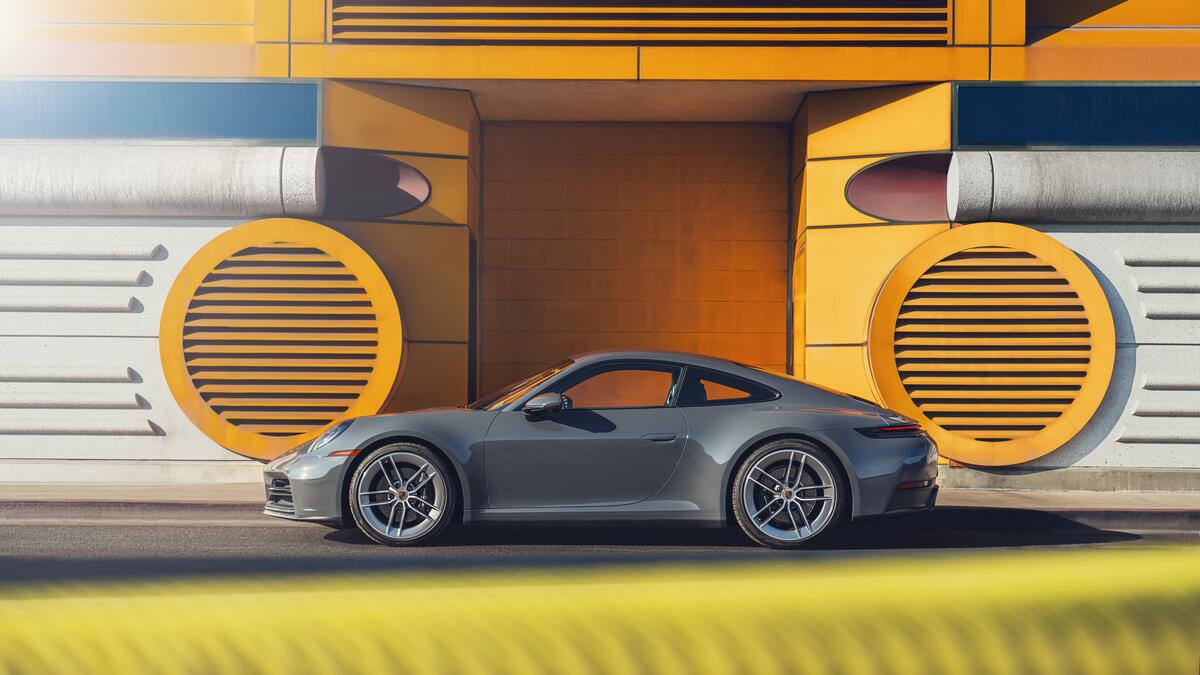
911 930 Turbo
"...3, but I think it went into production in 74, the 930 turbo as is. But even by then, 911s had a reputation fo..."
The 911 is Porsche’s famous sports car model. The podcast is talking about an early turbo version that started production around the mid-1970s. It also notes that 911s already had a reputation for how they behaved on the road.
This refers to the Porsche 911 line in general, with the podcast specifically mentioning the 1974-era production of the 930 turbo. The 911 is significant because its turbocharged variants helped define the modern idea of a high-performance, everyday sports car. In the context provided, it’s also used to highlight that 911s already had a reputation for certain handling or stability traits by that time.
widow makers
"And this is why I kind of wanted to bunk or I want to separate the cars that are widow makers from the cars that merely have the reputation of being widow makers."
“Widowmaker” is a nickname for a car that’s known for being risky—like it can get out of shape quickly. The host is saying some cars truly earn the label, while others just get talked about that way.
“Widowmaker” is an enthusiast term for a car that’s especially dangerous or easy to lose control of, often due to a combination of power, traction limits, and handling balance. In this segment, the host contrasts true “widowmaker” cars with other cars that only have the reputation.
short wheel bases
"Really early 911s have short wheel bases and they did have this reputation for throwing people off off the road."
Wheelbase is the distance between the front and rear wheels. A shorter wheelbase can make a car turn in quickly, but it can also make it feel twitchier or less stable when you’re going fast.
Wheelbase is the distance between the front and rear axles. A shorter wheelbase generally makes a car more responsive to steering inputs, but it can also make it feel less stable at high speed and during sudden weight shifts.
front and rear tire widths
"…when you used to get these huge disparity between front and rear tire widths…"
This is when the tires are different widths on the front versus the back. Wider rear tires can help the car hook up, but if the front tires don’t match, the car may not turn in as well and can push wide.
Front/rear tire width disparity means the car runs different tire widths on the front and rear axles. Wider rear tires can increase rear grip and traction, but they can also shift the handling balance toward understeer if the front doesn’t have enough grip to match.
turbo lag
"…particularly with things like turbo lag. And the reason you got huge disparity for the front and rear tire widths…"
Turbo lag is the momentary delay before a turbo engine really “kicks in.” That delay can affect how the car grips the road when you’re accelerating or backing off the gas.
Turbo lag is the delay between pressing the accelerator and the turbocharger producing full boost pressure. It can change how quickly the car’s traction and balance respond, which matters a lot when you’re transitioning between throttle and lift-off.
understeer
"But what that meant was the cars would just understeer and understeer and I've driven these cars and they do they understeer huge amount."
Understeer is when you turn the steering wheel but the car doesn’t rotate enough and instead keeps going straight. It usually happens when the front tires lose grip first.
Understeer is when a car turns less than the driver intends—typically the front tires lose grip first. In this segment, the host explains that adding more rear tire grip (to improve traction) can still lead to understeer, especially if the front end doesn’t have enough grip.
forward weight transference
"…that's when those sort of cars could get you into trouble because you'd get this forward weight transference."
When you lift off the gas (or brake), the car’s weight shifts forward. That can make the rear tires grip less, which can destabilize the car—especially on wet or fast corners.
Forward weight transfer is the shift of the car’s load toward the front axle when you lift off the throttle or brake. That can reduce rear grip and increase front grip, which can worsen understeer and make the car more likely to lose traction at the rear.
lift
"What would you traditionally do for cars understeering when you'd lift off, wouldn't you?"
“Lift” here means taking your foot off the gas. On some cars, that can make the car shift weight and lose traction, so it can get unstable if you’re going fast or the road is wet.
In driving terms, “lift” means easing off the throttle. On cars with tricky balance, lifting can trigger weight transfer and traction changes that lead to over-rotation or loss of control if you’re not prepared to counter it.
rear tire did give up their grip
"…when those rear tire did give up their grip, and an enormous amount of weight started moving sideways."
If the rear tires lose traction, the back of the car can start to slide or rotate unexpectedly. That’s often where handling problems turn into real trouble.
When the rear tires “give up” their grip, the rear axle loses traction and the car can start to rotate or slide. This is a key step in the host’s explanation of how lifting off in a car with understeer tendencies can lead to a sudden loss of control.
weight moving sideways
"…and an enormous amount of weight started moving sideways. That's when you had to be really quick and accurate."
This is what happens when the car starts sliding sideways. When the tires can’t hold the road, the car’s weight shifts laterally and it becomes much harder to steer back under control.
Sideways weight movement describes the car’s mass shifting laterally as it begins to slide or rotate. Once the tires lose grip, lateral load transfer can happen quickly, making the car harder to correct without precise throttle and steering inputs.
reestablish
"…most importantly, get back on the power, reestablish"
Here, “reestablish” means getting traction back by smoothly applying the gas again. The point is that you have to do it quickly and correctly to stop the car from sliding.
“Reestablish” in this context refers to restoring traction by getting back on the power after the car has started to lose grip. The host is emphasizing that the timing and precision of throttle application are critical to regain stability.
spare wheel back in the nose
"But then we put the spare wheel back in the nose and it was fine. Yeah. And that was the only problem I had all weekend with that car."
Moving the spare wheel changes where the car’s weight sits. On a rear-engine Porsche 911, that can change how stable the car feels, especially when you’re driving quickly on a track.
Putting the spare wheel back in the nose changes the car’s weight distribution and front-end mass. In a rear-engine Porsche 911, small shifts in front/rear balance can noticeably affect stability and how the car “wanders” on track.
two liter Porsche Cup series
"And you go you go and watch the two liter Porsche Cup series and the way people drive those cars."
They’re talking about a Porsche racing series for smaller, two-liter cars. The idea is that if you see how skilled drivers handle them, you learn how the cars really behave.
This refers to a Porsche one-make racing series for “two-liter” cars, where driver technique and car behavior are closely linked because the cars are similar. Watching how people drive these cars is used as evidence for how predictable (or not) certain handling traits can be.
onboard
"some amazing footage of someone driving with a some on board [462.3s] someone driving one of those around spa and tell me that's a"
“On board” means the video camera is inside the car. You can see what the driver sees while they’re driving, which makes it easier to judge how the car handles.
“On board” footage is recorded from cameras mounted on the car, typically showing the driver’s view and steering/braking inputs. It’s commonly used to analyze handling, braking points, and traction limits.
locking up their front tires
"And also they were [509.7s] prone to locking up their front tires in the wet. That is a [513.0s] genuine problem with those cars."
Locking up the front tires means the wheels stop spinning and start sliding. That usually makes braking less effective and makes it harder to steer, especially on wet pavement.
“Locking up” means the tires stop rotating and skid during braking, which drastically reduces braking effectiveness and steering control. It’s especially likely when grip is low (like wet conditions) and the driver brakes too hard or too abruptly.
slow in fast out
"And if you try to drive a G series nine 11 [541.2s] like a catering, you're going to get yourself into all sorts of [543.4s] trouble. If you applied the general rules of nine 11 [546.8s] driving, which are always slow in fast out. So you minimize the"
“Slow in, fast out” means you take it easy at the beginning of the turn, then get on the gas sooner as you straighten up. It helps the car stay stable and get better grip when you accelerate.
“Slow in, fast out” is a driving technique where you enter a corner more gently to keep the car stable, then accelerate earlier as traction returns. It’s often used to manage cars that are sensitive to balance changes near turn-in and exit.
front to rear
"amounts of grip. And again, this disparity front to rear and [584.7s] yeah, that car was"
“Front to rear” means the car’s grip balance between the front tires and the rear tires. If one end has much more grip than the other, the car can feel unpredictable in corners.
“Front to rear” disparity refers to an imbalance in traction or handling between the front and rear axles. When that balance is extreme, the car can transition from stable to surprising quickly as load shifts during braking, turn-in, and throttle application.
air cooled
"when they went from air cooled to water cooled. And they got, you [601.5s] know, a longer wheelbase, it was a completely new car."
“Air cooled” means the engine is cooled mainly by air flowing over it, not by coolant through a radiator. The host brings it up because it marks a major change in how later 911s were engineered.
“Air cooled” describes an engine cooling system that relies on airflow over the engine rather than liquid coolant circulating through a radiator. The host uses it to explain why the 911’s evolution changed at certain generation steps.
water cooled
"when they went from air cooled to water cooled. And they got, you [601.5s] know, a longer wheelbase, it was a completely new car."
“Water cooled” means the engine uses coolant (liquid) to move heat to a radiator. The host mentions it because it’s tied to a big generation shift in the 911.
“Water cooled” refers to using liquid coolant to carry heat away from the engine to a radiator. In this segment, it’s used as a shorthand for the 911 generation change that the host says is different from the earlier air-cooled turbo evolution.
arrival of
"And again, it was the disparity of front to rear grip in it and the arrival of because I mean, that was a you know, a they taken the four wheel drive away"
This phrase looks incomplete in the transcript, so it doesn’t clearly name a specific car feature or technique.
This appears to be part of a longer phrase describing a change in conditions or setup that affects handling. As written, “arrival of” is incomplete, so it’s not a clearly defined automotive term by itself.
four wheel drive
"because I mean, that was a you know, a they taken the four wheel drive away, which were obviously for the GT2, which is a significant thing."
Four-wheel drive means the car powers all four wheels instead of just two. That usually helps the car stick to the road better, especially when it’s wet or slippery.
Four-wheel drive (4WD) sends power to both the front and rear axles, improving traction—especially on low-grip surfaces like wet roads. Removing or changing 4WD behavior can significantly alter how a car transfers power and how stable it feels under acceleration.
wet
"I've driven quite a few but never in the wet. And always on modern tires, which perhaps makes a difference."
When roads are wet, tires don’t grip as well. The speaker is saying their experience in older 911s didn’t include wet conditions, which can make driving much harder.
Wet driving dramatically reduces tire grip due to water on the road surface, increasing the importance of tire choice and traction control. That’s why the speaker emphasizes they haven’t had trouble in an older 911—except they haven’t experienced it in the wet.
modern tires
"And always on modern tires, which perhaps makes a difference. But I suppose a huge difference."
Newer tires usually grip the road better, especially when it’s wet. The speaker thinks that using newer tires could be why they felt comfortable.
Modern tires typically use newer rubber compounds and tread designs that can provide better wet traction and more consistent grip as they wear. In this context, the speaker suggests tire freshness/technology may explain why they didn’t struggle in an older 911.
National Express coach
"But I do remember being on a National Express coach years and years ago, on the M4 on my way to Heathrow."
National Express is a UK bus/coach service. The speaker is just telling you about an old trip they took, not describing a specific car feature.
National Express is a UK intercity coach operator, and the speaker is using it as a personal reference point for a past trip. This mention isn’t about car tech, but it anchors the timeline and conditions (darkness) of an earlier drive experience.
M4
"But I do remember being on a National Express coach years and years ago, on the M4 on my way to Heathrow. And it was dark."
The M4 is a big highway in the UK. The speaker is using it as background for an old memory, not talking about car engineering.
The M4 is a major motorway in the UK, commonly used for trips between London and South Wales. The speaker mentions it to set the scene for an earlier journey (darkness) rather than to discuss any specific vehicle dynamics.
aquaplaning
"If it was wet or icy, you know, a bit of aquaplaning, and, you [795.6s] know, maybe somebody figures that out and tries to do something"
Aquaplaning is when water on the road gets between your tires and the pavement. Your tires can’t grip as well, so the car can start sliding or steering becomes unreliable.
Aquaplaning is when tires lose contact with the road because a film of water builds up, so the car starts to “float” and steering/braking effectiveness drops. On wet or icy motorways, it can make a vehicle suddenly drift or rotate, especially if speed is too high for the conditions.
997 GT2 RS
"I have particular experience of the 997 GT2 RS and its widow making capacity, because it tried to make a widow of my wife."
This is a very extreme Porsche 911 variant. The speaker is saying it’s so powerful and tricky that it can lead to scary outcomes—like the crash story they’re describing.
The Porsche 997 GT2 RS is a high-performance 911 variant known for extreme straight-line speed and track-focused behavior. In this segment, the host ties it to “widow making” because it’s the car that was involved in a serious accident attempt at an airfield.
handling shot
"I had a medium sized accident in one trying to do a handling shot on an airfield back in 2010, which I've spoken about on this podcast before."
A “handling shot” is a photo where the car is shown moving in a dramatic way, like turning hard or sliding a bit. The speaker says the photographer wanted one more shot, which led to the risky moment.
A “handling shot” is a photographer’s request to capture a car looking dynamic—often with visible steering angle, lateral motion, or controlled sliding. In this story, it’s the reason the driver pushes the car into a dramatic sideways moment on an airfield.
airfield
"I had a medium sized accident in one trying to do a handling shot on an airfield back in 2010, which I've spoken about on this podcast before."
An airfield is a large open area used for aircraft. In this story, it’s where the photographer wanted a dramatic car photo, away from normal traffic.
An airfield is an open, controlled space that’s sometimes used for filming or driving practice because it has long, flat areas and fewer traffic constraints than public roads. Here, it’s the location where the driver attempted a dramatic sideways “handling shot.”
sideways shot
"he wasn't happy. So he said, Oh, just one more and give it everything. So I did. And I sort of drifted this thing past the camera and it was all going well for him."
A “sideways shot” is a video/photo where the car is intentionally turned so it slides or oversteers a bit. The speaker says it was going well until it suddenly wasn’t.
A “sideways shot” refers to filming the car with visible oversteer or a controlled slide so the tires and body show lateral motion. The speaker describes drifting the car past the camera, which is exactly the kind of maneuver that can quickly exceed grip.
drifted
"And I sort of drifted this thing past the camera and it was all going well for him."
“Drifted” means the car was sliding sideways instead of gripping normally. The speaker is warning that it can feel controllable right up until it suddenly isn’t.
“Drifted” here means the car was rotated and slid with the tires losing grip in a controlled way, typically associated with oversteer. The speaker’s point is that even a controlled-looking slide can tip into a loss of control when traction suddenly disappears.
standard bits
"Later on the same day, they had to knit back to the factory and get some bits because that weren't standard 911 bits on it."
“Standard bits” means the original factory parts. The speaker is saying the car needed replacement parts that were not the usual factory ones.
“Standard bits” refers to factory-standard parts rather than aftermarket or non-original components. The speaker says the car had to be returned to the factory to get parts that weren’t standard, implying the accident revealed or damaged non-stock components.
Michelin have introduced a new cup two tire
"[1007.0s] to control. I think there are two things these days, which [1010.4s] owners do, there's Michelin have introduced a new cup two tire"
Michelin’s “Cup 2” is a type of performance tire meant for aggressive driving. Better tires can make a car feel more predictable when you’re pushing it hard.
“Cup 2” refers to Michelin’s Pilot Sport Cup 2 line of track-focused tires. These tires are designed for high grip and consistent performance under hard driving, which can change how a car behaves near the limit.
suspension
"I think some owners are also modifying suspension and GO as well, which helps. So if you drive a well sorted Carrara GT now..."
Suspension is what connects the wheels to the car and controls how the car moves over bumps and turns. If you adjust it, the tires can stay planted better. In this story, that helps make the car less unpredictable when driven hard.
Suspension is the system of springs, dampers, and linkages that controls how the tires stay in contact with the road. On cars like the Carrera GT, changing suspension setup can reduce harshness and improve stability when you drive aggressively. That’s why the host mentions owners modifying suspension to make the car more controllable.
GO
"I think some owners are also modifying suspension and GO as well, which helps. So if you drive a well sorted Carrara GT now..."
The transcript says “GO,” but it doesn’t clearly match a standard car part name. It sounds like the host was talking about another modification besides suspension, but the exact word is unclear here. If you replay that moment, you may hear the correct component name.
“GO” appears to be a transcription error or shorthand for another drivetrain/handling-related modification. Because the surrounding context is about making the Carrera GT more controllable via setup changes, it likely refers to a specific component or system, but the exact term isn’t clear from the transcript. This annotation is low-confidence and meant to flag that the audio likely contains a clearer automotive term.

718 Cayman GT4
"I remember talking to Walter Roll at a, it was a Porsche launcher at Nock Hill, and he drove me around Nock Hill in a 718 Cayman GT4, which was great."
This is a Porsche 718 Cayman GT4, a car built for track driving. It has its engine in the middle and is designed to feel sharp and responsive. The host uses it to set the stage before talking about how the older Carrera GT can get unpredictable when you push it.
The Porsche 718 Cayman GT4 is a track-focused Cayman with a mid-engine layout and a naturally aspirated powertrain tuned for response and balance. In this story, it’s used as the baseline for how the driver experiences handling before hearing about the more demanding Carrera GT. The point is that even a modern GT4 can feel lively, but the Carrera GT is often described as more unpredictable when pushed.
Nürburgring Nordschleife
"And he told me this story about a Carrera GT. They had the Nürburgring Nordschleife, and it was for a German magazine..."
This is the famous Nürburgring “North Loop” in Germany. It’s a very challenging track that tests how well a car grips and handles in lots of different situations. The story says the Carrera GT was driven there for a magazine.
The Nürburgring Nordschleife is the “north loop” of Germany’s Nürburgring, a long, complex circuit with big elevation changes and many corners. It’s widely used as a benchmark for car development because it stresses traction, braking, and stability repeatedly. In the segment, it’s where the Carrera GT story took place for a German magazine shoot.

Porsche Carrera GT
"... And Walter, he told me that he set a time in the Carrera GT and nobody else could get within, I think he said..."
The Porsche Carrera GT is a very rare, high-performance supercar from Porsche. It’s built to be extremely quick and exciting to drive. The podcast mentions it because someone set a standout lap time and others couldn’t come close.
The Porsche Carrera GT is a rare, supercar-level Porsche built for extreme performance and driver engagement. It’s significant because it’s known for being very fast and for having a reputation that attracts stories and comparisons among enthusiasts. In the podcast context, it’s mentioned through a personal timing story that highlights how hard it is to match its performance.
Nordchleaf
"Well, those new tires, Porsche released some information, I think, saying that they were 20 seconds faster round the Nordchleaf than the original ones."
Nordschleife is a very famous, very twisty race track in Germany. People use it to compare how fast cars are, especially when talking about tires and handling upgrades.
Nordschleife (spoken here as “Nordchleaf”) is the long, twisty north loop of the Nürburgring in Germany, famous for elevation changes and technical corners. Lap-time comparisons there are often used to quantify how much tires or suspension updates improve real-world performance.
swing axles
"cars with swing axles, cars which are okay in the drive but [1200.7s] become terrible in the wet. ... [1219.1s] anybody doesn't know what swing axles are, it's a former fully independent rear suspension."
Swing axles are a type of rear suspension where the rear wheels move independently. The way the axle pivots can make the car feel unpredictable, particularly when you brake hard or drive on slippery roads.
Swing axles are an independent rear suspension design where each rear half-shaft is hinged near the middle of the car. As the suspension moves during acceleration or braking, the axle angle changes, which can create handling instability—especially in hard braking or wet conditions.

Mercedes-Benz Mercedes 300
"...go? Well, let's do swing out so and can I throw a Mercedes 300 SL at you, Andrew?"
The Mercedes-Benz 300 SEL 6.3 (W109) is an older Mercedes luxury sedan. It’s known for having a very large engine for a comfortable car. The podcast brings it up as an example of a standout Mercedes performance model.
The Mercedes-Benz 300 SEL 6.3 (W109) is a classic luxury performance sedan known for its large engine and strong straight-line performance. It’s significant because it represents a period when Mercedes offered big, powerful engines in a comfortable, executive package. In the podcast context, it’s mentioned as a comparison point to other iconic Mercedes models.

Mercedes 300 SL
"Well, let's do swing out so and can I throw a Mercedes 300 SL at [1207.4s] you, Andrew? [1208.4s] Well, you can, but it would just crash into the one I've [1210.4s] already got my list."
The Mercedes 300 SL is a famous older Mercedes sports car. Here it’s mentioned as an example while they talk about how swing-axle suspensions can behave badly.
The Mercedes 300 SL is a classic Mercedes-Benz sports car known for its distinctive design and high-performance reputation. In this segment it’s used as a stand-in for the kind of car that might be affected by swing-axle handling behavior.
contact patch of the tire
"Because instead of the tire being flat on the ground, it increasingly goes to its edges. And that is why cars like the 300 SL..."
It’s the part of the tire that’s touching the ground. In a turn, the tire can lean over so the “touch area” shifts toward the tire’s edges, which changes how much grip you get.
The contact patch is the small area of a tire that actually touches the road. When the tire is loaded and the car is cornering, the tire can ride more on its edges, changing grip and how predictable the car feels.

Porsche 356
"And that is why cars like the 300 SL, like the Porsche 356, like the early Chevrolet Corvair, had reputations for being very true."
The Porsche 356 is an early Porsche sports car. The host is using it as an example of a car that feels stable and predictable in corners when you drive it correctly.
The Porsche 356 is an early Porsche sports car that’s often praised for its balanced, predictable handling when the tires are kept in their grip range. In this segment, it’s used as an example of a car that feels “true” because of how it behaves as the tire contact patch shifts during cornering.

early Chevrolet Corvair
"And that is why cars like the 300 SL, like the Porsche 356, like the early Chevrolet Corvair, had reputations for being very true."
The Chevrolet Corvair is an older Chevy with a very distinctive driving feel. The host is mentioning early Corvairs as cars that were known for being stable in corners when you respect how they grip the road.
The Chevrolet Corvair is an early rear-engine American sports/compact that enthusiasts often discuss for its distinctive handling traits. Here it’s grouped with the 300 SL and Porsche 356 as an example of a car known for being stable and predictable when driven properly.
gull wings
"I have driven gull wings very fast. And they were actually kind of okay. But again, it's massively big..."
Gull-wing doors are the kind that open upward instead of outward. The host is also saying that cars with this style often need careful driving because their handling and braking aren’t as forgiving as modern cars.
Gull-wing doors are a body design where the doors hinge at the roof and swing upward like a bird’s wings. In this segment, the host connects the gull-wing cars’ reputation to how you must drive them carefully, because their dynamics and braking capability demand respect.
double wishbone
"Before people started doing things like double wishbones back there. But they came with problems, which is why today there are no cars with swing axle rear suspension."
Double wishbones are a suspension design that uses two arms to guide the wheel’s movement. It helps the tire stay planted more consistently, which makes the car easier to control.
Double wishbones (double A-arms) are a modern-style suspension layout that uses two control arms per wheel to control wheel motion. Compared with swing axles, it keeps the tire’s contact patch more consistent through suspension travel, improving grip and predictability.
trail break
"Well, if you tried to trail break it into the corner, you'd just be off. You just be off because you'd lose so much grip at the back..."
Trail braking is the technique of continuing to brake while turning into a corner, then gradually releasing the brakes as the car rotates. The transcript connects it to swing-axle behavior: using this modern driving approach can trigger a sudden loss of rear grip.
rear track
"You'd lose so much grip at the back through these twin problems of a narrowing the rear track and be taking the car off its contact patch."
Rear track is how far apart the rear wheels are. With swing axles, the rear wheel positions can shift as the suspension moves, which can make the car less stable in a corner.
Rear track is the distance between the left and right rear wheels. In swing-axle suspensions, this effective track can change as the suspension moves, which can alter stability and contribute to sudden rear grip loss.
weight rearward
"And again, the only remedy more important than creating with the steering was to get that weight rearward again, just get back on the gas."
“Weight rearward” means more of the car’s load is on the back wheels. That can help the rear tires grip again, which is especially important if the rear starts sliding.
“Weight rearward” refers to shifting the car’s load toward the rear axle, which increases rear tire grip and helps stabilize the car during cornering. The transcript frames it as the key remedy when a swing-axle rear loses traction.
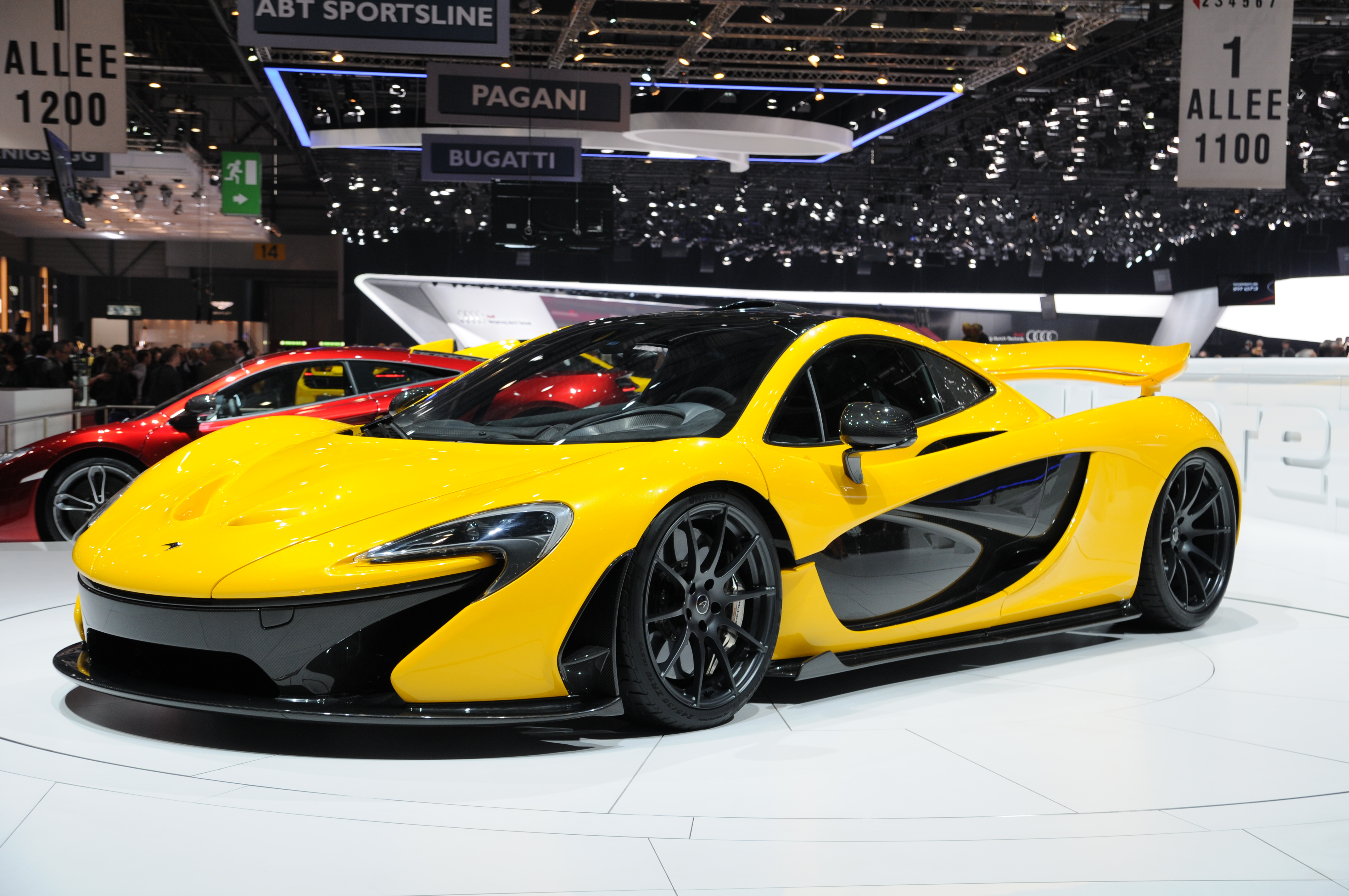
McLaren P one
"And you just think I mean, I [1479.1s] found one we said McLaren P one, Saunders, Noble M 600s. These [1483.4s] are fantastic handling cars."
The McLaren P1 is a very high-end supercar. In this discussion, it’s mentioned as one of the cars people argue can have handling surprises, even though it’s generally considered impressive.
The McLaren P1 is a hybrid supercar from McLaren, famous for its high-performance engineering and track-capable behavior. The host is using it as an example of a car that can still show up on “dodgy handling” lists despite being widely regarded as a great handler.

Fiat 600
"...ound one we said McLaren P one, Saunders, Noble M 600s. These are fantastic handling cars. Don't underst..."
The Fiat 600 is a small classic car from Italy. Because it’s compact and light, it can feel quick and fun to drive. The podcast is mentioning it as an example of a car that handles well.
The Fiat 600 is a small, classic Italian car known for being lightweight and compact, which can make it feel lively and agile. In the podcast context, it’s grouped with other handling-focused cars, suggesting it’s remembered for its driving feel. It’s discussed because small cars can still deliver engaging dynamics when they’re set up well.

M600 Noble M 600S
"...ean, I found one we said McLaren P one, Saunders, Noble M 600s. These are fantastic handling cars. Don't underst..."
The M600 is a performance car mentioned in the podcast as a handling-focused model. The discussion suggests it’s known for feeling good to drive. It’s brought up as part of a group of cars that are praised for their driving feel.
The M600 is referenced in the podcast alongside other specific “M” cars like the McLaren P1 and Noble M600, in a discussion about handling. It’s significant in that context because it’s being treated as a performance-focused machine rather than a luxury cruiser. The podcast implies it’s a car with excellent driving dynamics that deserves attention.

Dodge Viper
"Anyway. So [1487.9s] car Dodge Viper is the absolute prime example. Yeah, I've [1494.6s] mentioned this on the podcast on a previous podcast."
The Dodge Viper is a big, powerful sports car. Here, the point is that in the wet it can feel dangerously unstable, so you have to be much more careful than you might expect.
The Dodge Viper is known for its huge V10 power and raw, aggressive driving feel. In this segment, the host highlights how the Viper can become especially treacherous in wet conditions, tying that behavior to tire grip and suspension/handling balance.
massive tires
"They were terrible in the wet and massive [1522.9s] tires. They would have been firestones or good years, I [1526.7s] guess, but you know, 30 year old technology, huge amounts of"
Even if a car has very wide tires, it can still lose grip in the wet. Tire age and tread condition matter a lot for how safely the car can stick to the road.
Tire grip is what ultimately determines how safely a car can turn and accelerate, especially in the wet. Even with very wide “massive” tires, older tire compounds or limited tread can reduce traction and make handling feel unpredictable.
huge amounts of torque
"They would have been firestones or good years, I [1526.7s] guess, but you know, 30 year old technology, huge amounts of [1531.8s] torque, massively fat, probably not much tread on them."
Torque is the engine’s twisting force that makes the car pull. In the wet, too much torque can make the tires lose grip quickly, so the car can feel unstable.
Torque is the twisting force the engine produces, and it strongly affects how hard the car accelerates and how much load transfers to the tires. In low-grip conditions like wet weather, high torque can overwhelm traction and trigger sudden oversteer or loss of control.
Bridgestones
"But back in the day, done lots of bridge stones. I mean, I thought in the drives actually to 20 was a fabulous handling car."
They’re talking about Bridgestone tires. Different tire brands and types can grip better or worse in rain, which changes how safe and controllable a car feels.
“Bridge stones” is the speaker’s reference to Bridgestone tires. Tire brand and model matter because different compounds and tread patterns can dramatically change wet traction and steering feel.
Milbrook
"when we did the original road test back in 1992, we spent three days with one. And we were on the test track at Milbrook..."
Milbrook is a test track in the UK. It’s where cars are driven hard in controlled conditions so people can judge handling more reliably than on normal roads.
Milbrook is a UK proving ground/test facility where automakers and magazines run handling and durability tests. In this segment, it’s used to give credibility to the speaker’s 1992 road test experience and the car’s behavior on a controlled track.

Toyota MR2
"And the other one that's on the list is the second generation MR2. Yeah, Toyota. Yeah, they've got a reputation, haven't they?"
They’re talking about Toyota’s MR2 sports car, specifically the second generation. The key idea is that some people think it handles badly or feels tricky in the wet, even if it can be great in dry conditions.
The MR2 is Toyota’s mid-engine sports car line, and the speaker specifically calls out the second generation. They’re discussing its reputation for handling—especially how it can feel “a proper handful” in wet conditions—contrasting magazine coverage with their own experience.
non assisted steering
"It did have quite slow, non assisted steering. So it did take quite a lot of collecting up. But I didn't feel there was anything inherently vicious about it"
Non-assisted steering means there’s no power help from the car. You have to do more of the work with your hands, which can make the car feel harder to control when it’s moving around.
Non-assisted steering means the steering system relies on the driver’s muscle power rather than hydraulic or electric power assistance. That typically increases steering effort and can make quick corrections feel slower or more demanding, especially when the car is sliding.
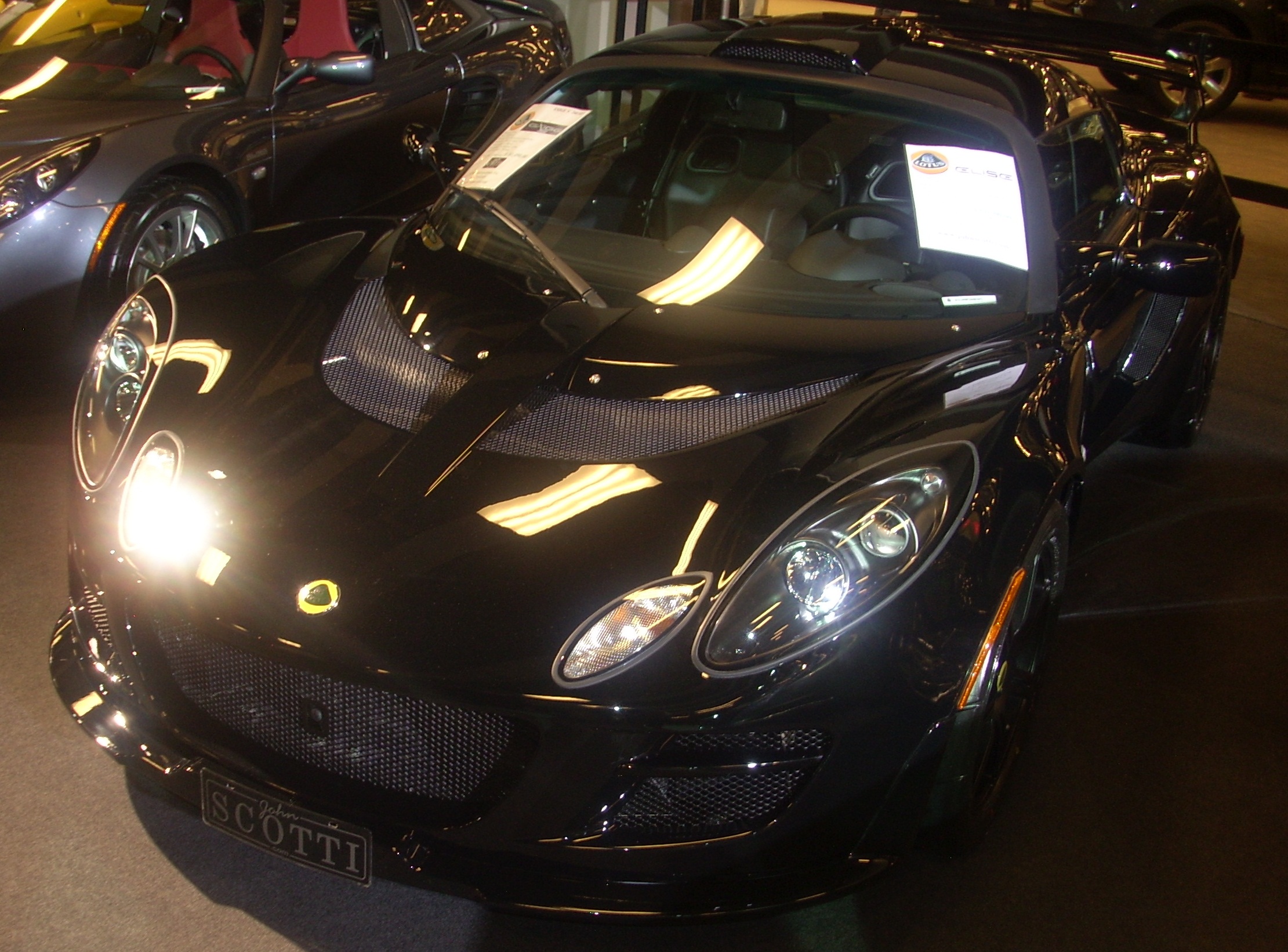
Lotus Elise
"And it's a absolutely delightful car in the dry. And you can have the tail out a little bit in the wet. But once you get past whatever number of degrees it is, it's gonna you're not getting it back. And I think part of this is exacerbated a by the geo you're running. And I'm running quite aggressive geo on it and the S1 but in itself anyway is already snappier than the later generations of Elise."
The Lotus Elise is a small, lightweight sports car with the engine mounted behind the front seats. The “S1” means the early version, and the host is saying it can feel great in dry weather but gets very difficult once the wet grip drops.
The Lotus Elise is a lightweight, mid-engined sports car known for sharp handling and quick steering response. In this segment, the speaker specifically mentions an S1 Elise, which is the early first-generation Elise, and describes how it behaves in heavy rain at Donnington.
Donnington
"But I have had an experience in my S1 Elise around Donnington in the pouring wet. Yeah, I bet. Yeah. And it's a absolutely delightful car in the dry."
Donnington is a race track in the UK. The host is using it to describe what happened when they drove the car in very heavy rain.
Donnington (likely Donington Park) is a UK circuit where drivers test car balance and traction under real track conditions. In this context, the speaker uses it as a reference point for how the Elise behaves in “pouring wet” conditions.
Geo
"And I think part of this is exacerbated a by the geo you're running. And I'm running quite aggressive geo on it and the S1 but in itself anyway is already snappier than the later generations of Elise."
“Geo” here means the car’s alignment and suspension setup—how the wheels are angled. A more aggressive setup can make the car feel sharper, but in the wet it can also make it easier to lose grip and harder to get back under control.
“Geo” is short for suspension geometry—alignment settings like camber, toe, and caster that determine how the tires contact the road. Aggressive suspension geometry can improve responsiveness in dry conditions, but it can also make wet traction loss more abrupt and harder to recover from.
pit lane
"Did you find yourself trundling down a pit lane in a grassy car? I certainly found myself trundling back into back into the pits with more grass on the car than it should have had."
On a race track, the pit lane is the area where cars pull in for service. Here it’s being used to describe coming back to the pits after something went wrong on track.
A pit lane is the controlled lane on a race track where cars enter to receive service during a race weekend. In the context of the speaker’s story, “trundling down a pit lane” implies they returned to the pits after a mistake or loss of control.
traction and stability control
"I count myself really blessed to have had my, you know, the first 20 years of my car journalism career in what I would call the modern era or the traction and stability control era."
This is about the car’s electronic helpers that stop the wheels from spinning too much and help keep the car pointed the right way. They’re especially useful on wet roads, where it’s easier to lose grip.
“Traction and stability control” refers to electronic systems that detect wheel slip and loss of directional control, then intervene by reducing engine power and/or applying brakes. The speaker frames this as a modern driving era where these systems act as a safety net against spins, especially in wet conditions.
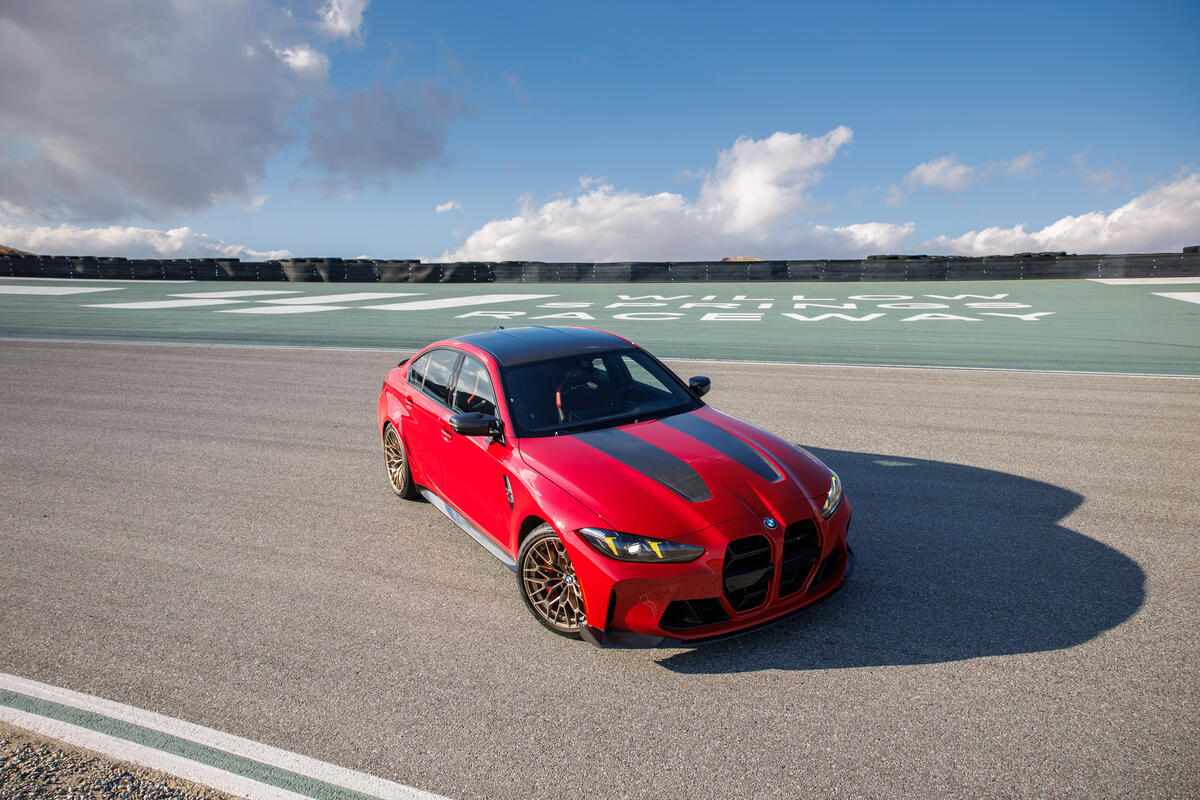
turbocharged BMW M3
"It's only because I've mostly driven cars with, you know, by now quite sophisticated safety nets, electronic safety nets that my bacon has been saved a few times, but I've come close, particularly in the first turbocharged BMW M3 and M4, those sister cars."
This is a high-performance BMW M3 that uses a turbo engine. The point here is that modern safety electronics help keep the car under control when the road is slippery, like in the wet.
The BMW M3 is BMW’s performance “M” model, and the speaker specifically calls out the early turbocharged versions. In the traction-and-stability-control era, these cars rely heavily on electronics to help prevent spins when you’re “in too hot” or lose grip in the wet.
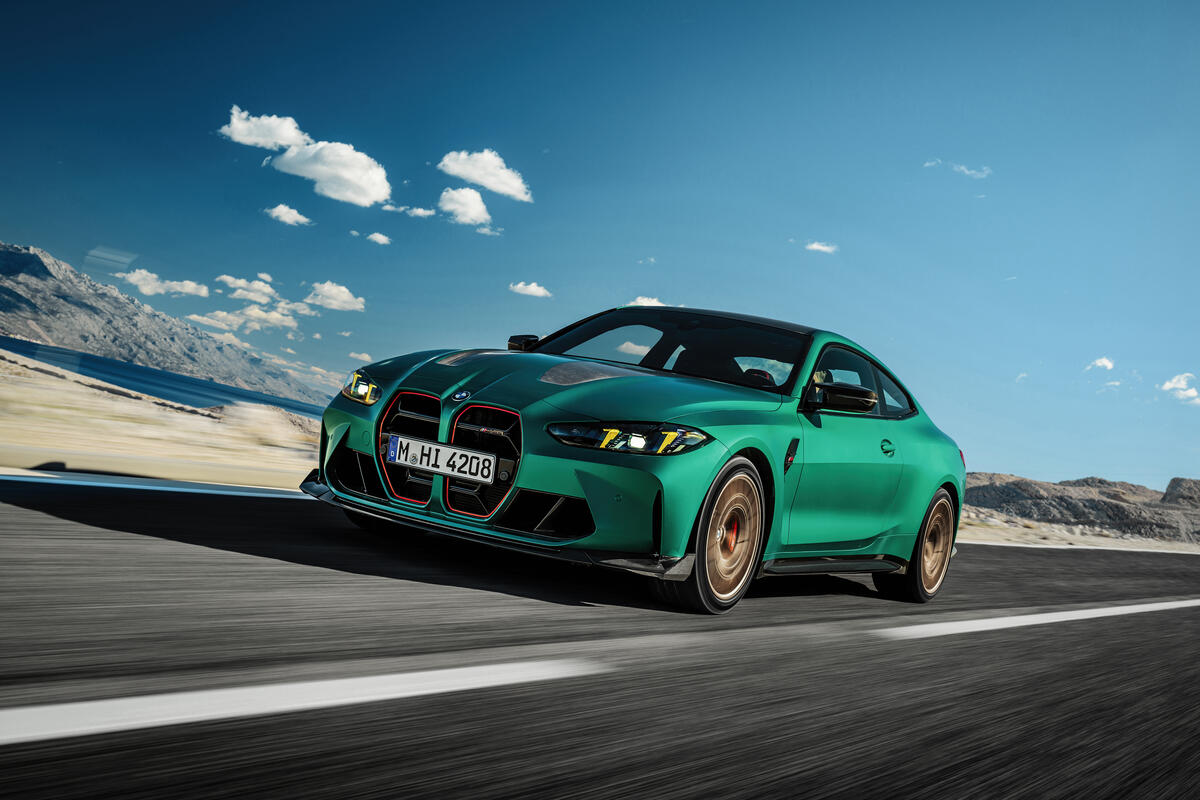
M4
"And that road is a tricky road, lots of undulations. And it was an M4. And my God, it felt like a liability, that thing, even with the systems fully on."
The BMW M4 is BMW’s high-performance version of the 4 Series. The host is saying that in bad weather it can feel scary because the engine’s power comes on suddenly and the tires can lose grip without much warning.
BMW M4 is the performance coupe/convertible from BMW’s M division, known for using a turbocharged engine and high torque. In this segment, the host describes how the M4 can feel unpredictable in wet, cold conditions because of how quickly turbo power arrives and how the drivetrain and traction systems react.
turbocharged torque
"And it was there was something about the power and the torque delivery in those cars that sudden unrushing turbocharged torque."
“Turbocharged torque” means the twisting pulling force from a turbo engine. On slippery roads, that sudden surge of power can make the car harder to control.
Turbocharged torque is the twisting force produced by an engine that uses a turbocharger to increase airflow. Because a turbo can spool up and then deliver boost, the torque can feel sudden—especially noticeable when traction is limited on wet or cold roads.
differential settings
"And it was something about the differential settings and the DCT transmission, the way it would shift up."
The differential is what sends power to the wheels. “Differential settings” means how that power-splitting behavior is tuned, and on slippery roads it can change whether the car feels stable or starts to slip.
Differential settings refer to how the differential (the gearbox that splits power to the driven wheels) is tuned to manage traction. In performance cars, different settings can change how easily the car transfers power between wheels, which strongly affects grip and stability when roads are wet.
DCT transmission
"And it was something about the differential settings and the DCT transmission, the way it would shift up."
DCT means dual-clutch transmission, a type of automatic that shifts quickly using two clutches. In wet weather, quick gear changes can make the car’s behavior feel more abrupt and harder to predict.
DCT transmission stands for dual-clutch transmission, which uses two clutches to pre-select gears for faster shifts than a traditional automatic. The host links the DCT’s shift behavior to the car’s traction feel, especially in slippery conditions where sudden drivetrain changes can affect stability.
brake traction
"You could just lose brake traction in an instant with no indication that it was about to happen."
Brake traction is how much grip the tires have when you slow down. On wet roads that grip can disappear quickly, so the car may start to slide without much warning.
Brake traction is the grip available at the tires when braking or when the car is transferring load under deceleration. If traction is low (like on greasy wet roads), the tires can lose grip suddenly, leading to instability even if the driver doesn’t feel an obvious warning first.
Cerberus Speed 12
"in particular, the Cerberus Speed 12, which I think Peter Wheeler drove and said no one should ever have one of these. It's an absolute liability."
The Cerberus Speed 12 is a very rare, extreme sports car. The hosts are talking about it as an example of a car that might be powerful and exciting, but could also be hard to control or not fully engineered for everyday-friendly behavior.
The Cerberus Speed 12 is an ultra-rare, track-focused sports car built around the idea of extreme power in a lightweight package. Here, it’s used as an example of a car that Peter Wheeler drove and that the hosts describe as potentially “absolute liability,” implying it may be difficult to live with or not fully sorted dynamically.
Peter Wheeler
"in particular, the Cerberus Speed 12, which I think Peter Wheeler drove and said no one should ever have one of these. It's an absolute liability."
Peter Wheeler is referenced here as the person who drove the Cerberus Speed 12 and gave a strongly negative verdict on owning one. In this context, his opinion is being used to frame the car as potentially dangerous or poorly suited to normal ownership.

TVR V8S
"There was the TVR V8S. Okay, so this is like a late 1980s car, but essentially the old Tamar design from the 1970s into which they put a V8 engine. And it's one of the cars, one of very, very few cars..."
The TVR V8S is a British sports car from the late 1980s with a V8 engine. The host is saying that, when they tried to push it hard, it felt dangerously unstable—more like an aero/overall stability problem than just “the steering is too loose or too tight.”
The TVR V8S is a late-1980s TVR sports car that uses a V8 engine and is known for being a rare, high-performance model in TVR’s lineup. In this segment, the host highlights its handling instability during high-speed runs, describing it as fundamentally wrong in how it behaves rather than a simple oversteer/understeer balance issue.
top speed run
"In fact, I'm off hand, I'm trying to think of another where I've abandoned doing a top speed run on the Norbert Bolt. And it was, I was only doing 140 something, I think we're doing 146."
A top speed run is when someone tries to drive as fast as the car can go in a controlled way. It’s often used to see whether the car stays stable at very high speeds.
A top speed run is a controlled attempt to reach a vehicle’s maximum speed, typically on a long, straight section of road or track. It’s a common way to evaluate aerodynamic stability and high-speed behavior, not just raw power.
Norbert Bolt
"In fact, I'm off hand, I'm trying to think of another where I've abandoned doing a top speed run on the Norbert Bolt. And it was, I was only doing 140 something, I think we're doing 146."
Norbert Bolt is the place the host mentions for their high-speed attempt. They’re saying the car felt too unstable there, so they stopped pushing it.
Norbert Bolt appears here as the location where the host attempted a top speed run and then backed out due to instability. In context, it’s treated like a specific high-speed testing spot/route where aerodynamic stability matters.

TVR T350
"Yeah, I've only driven three TVRs over the years. A T350, a sagorous, and most recently, a Camira, that was a convertible one, wasn't it?"
The TVR T350 is a British sports car. The host is mentioning it because they’ve driven it and are talking about how TVRs feel—how easy they are to control and whether they seem “snappy” or scary.
The TVR T350 is a model from British sports-car maker TVR, built around a lightweight, rear-wheel-drive philosophy. In the context of this discussion, it’s one of the speaker’s personal TVRs, brought up to compare how these cars behave (especially traction and throttle response).
TVR Camira
"Yeah, I've only driven three TVRs over the years. A T350, a sagorous, and most recently, a Camira, that was a convertible one, wasn't it?"
The TVR Camira is an older TVR sports car. The host brings it up because they’re talking about how TVRs can feel easier to drive than people assume, and how traction control changes the experience.
The TVR Camira is a 1980s TVR model, notable here because the speaker specifically mentions it as a convertible and discusses how its traction control and throttle feel affect drivability. It’s included in a personal “TVRs I’ve driven” comparison about whether the cars feel dangerous, especially in wet conditions.
throttle pedal travel
"But and they've got that blackpool traction control, haven't they? That very, very long throttle pedal travel. They're just, it sort of seems to make it a bit easier."
Throttle pedal travel is the physical distance the accelerator pedal moves from idle to full throttle. Longer travel is often used to make the throttle response more gradual, which can help drivers meter power smoothly and reduce abruptness.
traction was very rarely a problem
"They're always set up to be really soft at the back. We always said that they did that to get them all to 60 times. So yes, in attraction was very rarely a problem in one of those."
“Traction” means how much grip the tires have on the road. The speaker is saying that in their experience, the car usually didn’t spin its wheels or lose grip.
“Traction” here refers to tire grip—how well the driven wheels can accelerate without slipping. The speaker is saying that, in their experience with these TVRs, the car’s setup and traction control meant the tires rarely lost grip.
60 times
"They're always set up to be really soft at the back. We always said that they did that to get them all to 60 times. So yes, in attraction was very rarely a problem in one of those."
“60 times” is a drag-racing measurement of how quickly a car gets off the line. The idea is that suspension tuning can help the tires grip better right at the start.
“60 times” usually refers to drag-racing elapsed time for reaching 60 feet (often written as “60-foot time”). Softer rear suspension can help the car plant the tires and improve that early acceleration measurement.

Ferrari 348
"While I'm not going to dwell on because I spent so much time telling people what a terrible handling car that is, which is the Ferrari 348. I think we all know about that."
The Ferrari 348 is an older Ferrari with a V8 engine. Some people say it doesn’t handle as well as you’d expect for the brand, and that’s why it comes up in discussions about “bad handling.”
The Ferrari 348 is a mid-1980s/early-1990s V8 Ferrari known for its 90-degree “Tipo F119” V8 and classic rear-drive layout. It’s become a talking point among enthusiasts because some owners/drivers criticize its chassis balance and steering feel compared with what you’d expect from a Ferrari.

Ferrari 348
"...hat a terrible handling car that is, which is the Ferrari 348. I think we all know about that. I can remember L..."
oversteer
"But yeah, they would just, they would oversteer a little bit and then they would spin without warning."
Oversteer is when the back of the car starts to slide more than the front. The host is saying the car can begin sliding and then suddenly spin.
Oversteer is when a car’s rear end loses grip more than the front, causing the car to rotate toward the outside of a turn. In this segment, the host describes a sequence where the car “oversteer[s] a little bit” and then escalates into a spin, which is a classic warning sign of a handling balance problem.
spin without warning
"But yeah, they would just, they would oversteer a little bit and then they would spin without warning."
“Spin without warning” means the car suddenly turns sideways and rotates quickly, with little time to react. It’s the kind of behavior that makes a car feel unsafe when you push it.
A “spin without warning” describes a sudden loss of directional control where the car rotates rapidly, often after the driver has only a brief moment of notice. In handling discussions, it usually points to abrupt traction or balance changes—like a rear-end grip drop—rather than a gradual, progressive slide.
Bedford
"And I recently, I said recently, maybe four or five years ago, I went back to Bedford with three different 348s."
Bedford is a motorsport venue in the UK where drivers test and evaluate cars on track. Here, the host says they went back to Bedford with multiple Ferrari 348s to compare whether the handling behavior they’d experienced was consistent.
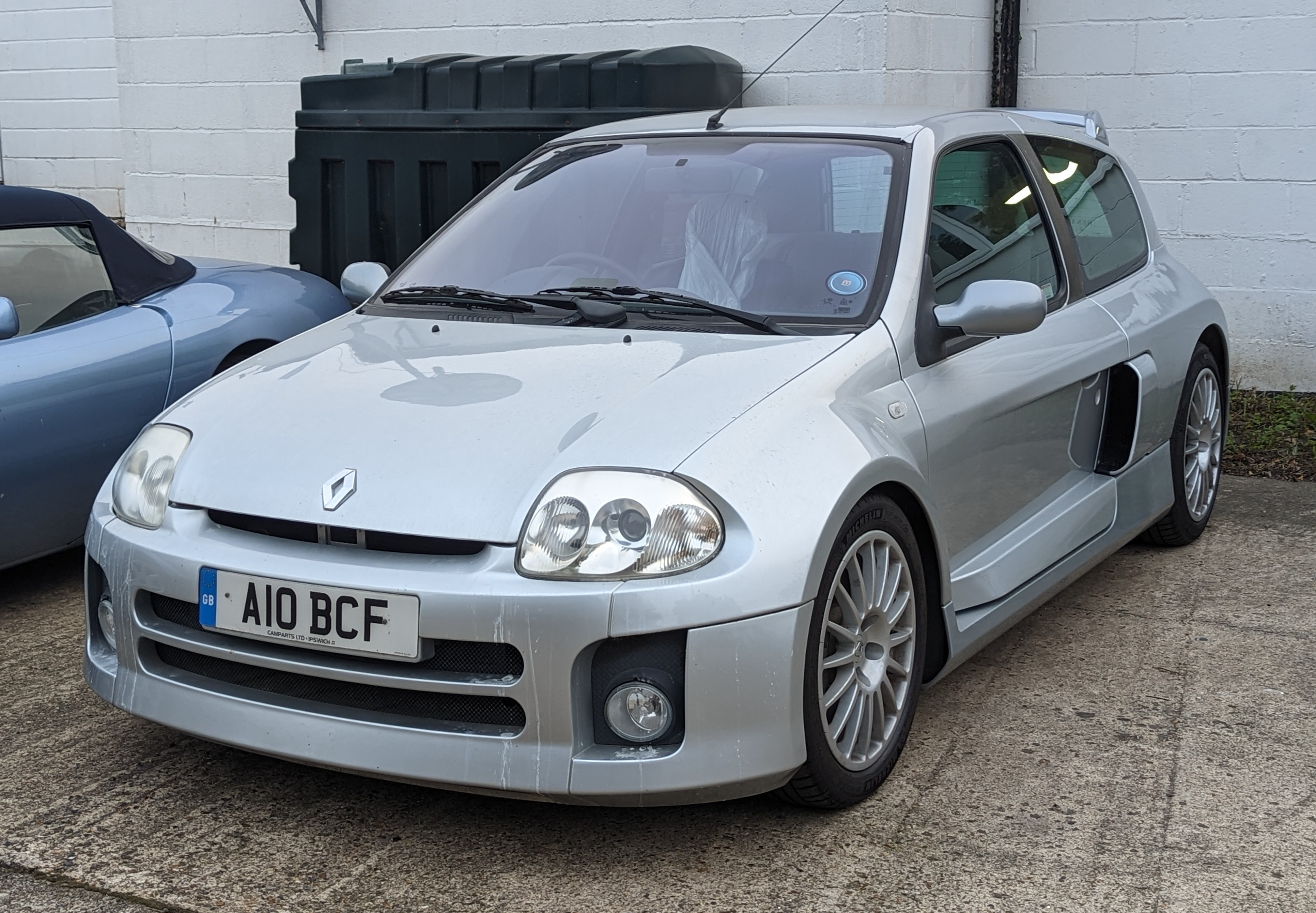
Renault Clio V6
"Oh, sorry. And suddenly you're just facing the way you came. Gen one Clio V6. Yes. Terrible handling car. Unforg-"
The Renault Clio V6 (first generation) is a special, V6-powered version of the Clio that many people find hard to control when you push it. The host is saying it can start sliding and then suddenly spin, which is scary if you’re not expecting it.
The Renault Clio V6 (first generation) is a rare hot hatch that uses a V6 engine and is infamous for being extremely twitchy and difficult to drive at the limit. Here, the host calls it a “terrible handling car,” describing how it can oversteer and then spin without warning—exactly the kind of behavior that makes it a cautionary tale for chassis balance.
Tom Walker
"I mean, TWR, Tom Walker's racing did that car. What were they thinking of?"
Tom Walker is mentioned in connection with racing (via TWR). The host is using that racing link to highlight how notable the Clio V6’s handling reputation was.
Tom Walker is referenced here as being associated with TWR, which the host links to the Renault Clio V6. The point is that a racing team/driver connection is used to explain why the car’s handling reputation matters in real-world competition.
twitchy
"It was just, it was so twitchy. I don't know whether they were trying to follow in the footsteps of, do you remember the original Renault 5 mid-engine turbo?"
“Twitchy” means the car feels jumpy or overly sensitive. The host is saying it can change behavior suddenly, which makes it hard to control.
“Twitchy” is enthusiast slang for a car that responds too abruptly—steering and balance changes happen quickly and can feel unpredictable. In this segment, the host uses it to describe the Clio V6’s tendency to behave erratically, especially near the limit.
British B-road
"I remember thinking that when I drove a Clio V6 on a British B-road, classic British B-road, I was just thinking, I'd be so much faster down here and have more fun in a Clio Trophy."
In the UK, a “B-road” is a smaller, secondary road. “Classic British B-road” usually means twisty, narrow roads where driving skill and car handling matter a lot.
A “B-road” in the UK is a secondary road (below A-roads in the road hierarchy) that’s often narrower and more winding than main routes. When enthusiasts say “classic British B-road,” they usually mean tight bends, limited sightlines, and a road that rewards momentum and good chassis control.

Clio Trophy
"I remember thinking that when I drove a Clio V6 on a British B-road, classic British B-road, I was just thinking, I'd be so much faster down here and have more fun in a Clio Trophy."
The Renault Clio Trophy is a track-focused Clio variant (often associated with one-make racing) tuned for sharper response and more driver engagement than a standard road car. Here it’s contrasted with a Clio V6 experience to highlight how different Clio setups can feel dramatically different on the same road.

F12 TDF
"F12 TDF. Correct. Give that man a prize. F12 TDF. It was deliberately, I couldn't talk to people at Ferrari about this, and they"
The Ferrari F12 TDF is a special Ferrari built to feel intense and challenging to drive. The point here is that it’s “scary” on purpose, because Ferrari wanted that kind of driver experience.
The Ferrari F12 TDF is a special edition of the Ferrari F12 that’s known for being intentionally “scary” in how it communicates grip and balance to the driver. In this segment, the hosts suggest Ferrari designed it to feel that way—so the handling character is part of the car’s identity, not an accident.
skid
"And I kind of knew because of the story I was doing, that we needed to do a skid in it. And I said to the photographer, right, I'm going to do this once."
A skid is when the tires lose traction and the car starts sliding. It usually happens on slippery roads, like wet pavement or snow/ice.
A skid is when a car’s tires lose grip and slide instead of rolling normally. It’s often caused by braking too hard, accelerating too aggressively, or turning on low-traction surfaces like wet roads or slush.
CT off
"it's probably a decade later, I still remember that sense of trepidation when I went into sort of CT off, and I approached the corner."
“CT off” means turning off traction control. Traction control helps prevent wheel spin and sliding, so turning it off makes the car easier to lose grip.
“CT off” refers to turning off a traction-control-related system (commonly “traction control”). With it disabled, the car is more likely to allow wheel slip, which can make slides/skids easier to provoke but harder to control.
cup two tires
"It was on cup two tyres, which is just not what you want in those sorts of conditions anyway, even when you're not in a spiky car, and getting home and thinking just..."
“Cup Two” is a performance tire made by Michelin. It’s great for fast driving, but in wet or slushy weather it may not grip as well as winter or all-season tires.
“Cup Two” refers to Michelin Pilot Sport Cup 2 tires, which are track-focused “summer” performance tires. They typically offer strong dry grip, but in wet/slushy conditions they can be less confidence-inspiring than tires designed for cold weather or all-season use.
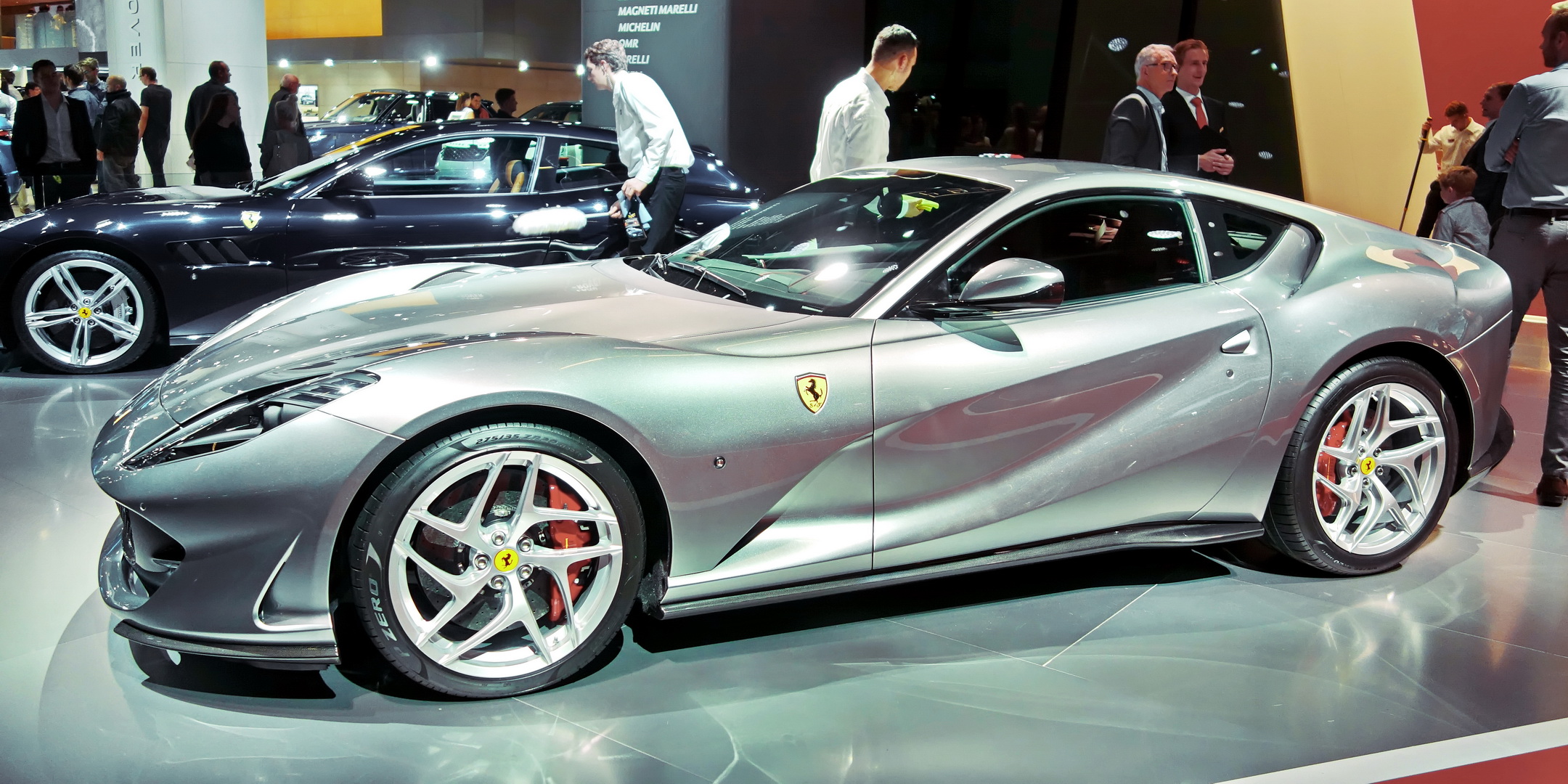
Ferrari 812 comp
"But we we had it with an 812 comp, didn't we? Which is even more powerful somehow."
This is a Ferrari grand tourer with a big V12 engine that revs hard. The hosts are saying it feels thrilling but can also get tricky quickly if you push it.
The Ferrari 812 is a flagship grand tourer built around a naturally aspirated V12 engine, tuned for high-revving response. In this segment, the host compares the 812 to other Ferrari road cars and highlights how quickly it can feel “on the edge.”
Request an Explanation
Heard something you'd like explained? We'll add it to this episode.
Sign in to request explanations for terms you heard.
Want to learn more?
Browse our glossary for plain-English explanations of automotive terms, jargon, and concepts.
Help improve this episode
See something that's not quite right? Our annotations are AI-generated and can sometimes miss the mark. Click the flag icon on any annotation to suggest a correction.