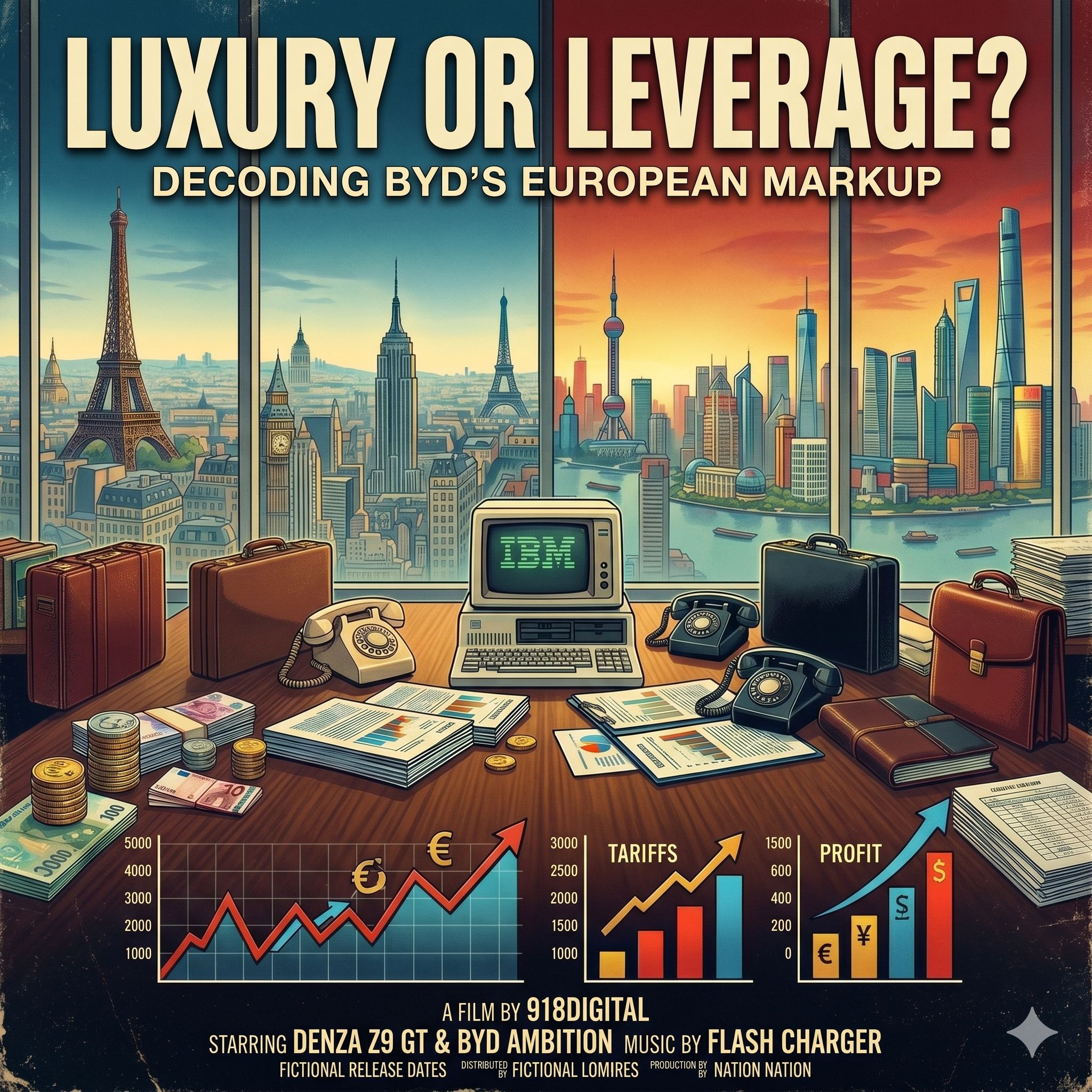
Luxury or Leverage? Decoding BYD’s European Markup
About this episode
Bode digs into BYD’s Denza Z9 GT, a premium EV that challenges assumptions about Chinese brands being purely budget-focused. After a personal intro about procrastination and overpreparing for guest spots, he explains Denza’s Mercedes-BYD origins and how it’s now fully owned by BYD. The spotlight is on the Z9 GT’s wild specs: 1,140 horsepower, 2.7-second 0-60 time, a 122 kWh battery, three motors, rear-biased driving, and crab-walk maneuvering. The big question is whether BYD is using Europe’s luxury market to justify a higher markup.
This episode of Kilowatt dives into the staggering engineering and questionable economics of BYD’s luxury powerhouse, the Denza Z9 GT. Originally born from a partnership with Mercedes-Benz, the Denza brand is now striking out on its own with a 1,140-horsepower "shooting brake" that boasts some of the most advanced chassis tech on the planet. We explore its incredible ability to "crab walk" and pivot, its massive 1.5-megawatt charging capability, and why it might just be the fastest-charging EV in the world. However, the real conversation starts with the sticker shock: why does a car that costs roughly $40,000 in China command a staggering $134,000 price tag in Europe? We break down the impact of EU tariffs, shipping costs, and BYD’s aggressive strategy to pivot from a budget brand to a premium Porsche competitor. Plus, a special thank you to David for joining our Patreon family.
Other Podcasts:
News Links:
- DTNS Episode
- EU Sets Final Tariffs on China-Made Electric Vehicle Imports
- The $100,000 Markup: Why BYD’s $40k EV Costs $134k in Europe
- Meet the BYD Denza Z9 GT: The Fastest-Charging Car in the World
*Show Art Created By Gemini
Hosted by Simplecast, an AdsWizz company. See pcm.adswizz.com for information about our collection and use of personal data for advertising.
Firestone
""That's why for 125 years, Firestone has been building tires with one thing in mind, to deliver products that are as reliable as you are. Firestone, always dependable since 1900.""
Firestone makes tires for cars and trucks. In this ad, they’re saying their tires are built to be dependable.
Firestone is a tire brand, and here it appears in a sponsorship message. Tires are one of the most important safety and performance components on any vehicle, especially EVs where weight and torque can affect wear.
State Farm
""State Farm Life Insurance can help protect your family's financial well-being through life's milestones. Your State Farm agent can help you choose flexible coverage you can adjust as your family's needs change.""
State Farm is a big insurance company. They’re advertising life insurance here, not cars.
State Farm is an insurance company, mentioned here in a sponsorship read. It’s not an automotive part or car brand, but it’s relevant to vehicle ownership because insurance is a major cost for drivers.
electric vehicles
""Hello, everyone, and welcome to Kilowatt, a podcast about electric vehicles, renewable energy, autonomous driving, and much, much more.""
Electric vehicles are cars that run on batteries instead of gasoline. This podcast talks about EVs and the technology around them.
This is the main subject area of the podcast: electric vehicles, or EVs. The show focuses on EV news, technology, and related topics like renewable energy and autonomous driving.
renewable energy
""Hello, everyone, and welcome to Kilowatt, a podcast about electric vehicles, renewable energy, autonomous driving, and much, much more.""
Renewable energy means power from sources like the sun and wind. The podcast covers that because it connects to electric cars and charging.
Renewable energy is a major topic area for the podcast, alongside EVs and autonomous driving. It refers to power sources like solar and wind that can be replenished naturally.
autonomous driving
""Hello, everyone, and welcome to Kilowatt, a podcast about electric vehicles, renewable energy, autonomous driving, and much, much more.""
Autonomous driving means cars that can help drive themselves. The podcast includes that topic because it’s part of modern EV tech.
Autonomous driving is another core topic of the podcast. It refers to vehicles that can drive themselves with varying levels of driver assistance or full self-driving capability.
Daily Tech News Show
"And this is a story that I actually did on the Daily Tech News show yesterday. So if you came over here from DTNS, thank you very much. ... The first, I think it was the first time I was on DTNS."
This is another show the host was on. He’s saying he talked about the same news there and is now giving a fuller version here.
This is a reference to the Daily Tech News Show, another podcast where the host says he covered the same story. It helps explain why he’s recapping the topic here with more detail.
AI in video games
"And they were talking about some story and Tom just throws to me. And he's like, what do you think about XYZ? I think it was AI in video games and like, basically AI building an infinite world, which, you know,"
He’s talking about a different subject he was asked about before: artificial intelligence in video games. It’s just a quick reference to another conversation.
The host briefly mentions a prior discussion about AI in video games. This is a topic reference rather than an automotive concept, but it marks what he was talking about on the other show.

Z9 Denza Z9
"So I overprepared for those. And that's why I have so much content on the Denza Z9 GT car. And we're gonna go into a little bit more detail like I said about that today."
This is the exact car they’re talking about. Denza is a luxury EV brand tied to BYD, and the Z9 GT is one of its models.
The Denza Z9 GT is the specific EV model the hosts are preparing to discuss in detail. Denza is BYD's premium sub-brand, so this name matters because it signals both the brand positioning and the car being analyzed.
premium car brand
"It is BYD, the premium car brand. Or excuse me, it's Denza, the premium car brand that happens to be owned by BYD Group."
This means a nicer, more expensive car brand. It usually has more features and a more upscale feel than the cheaper models people associate with the parent company.
A premium car brand is a manufacturer or sub-brand positioned above mainstream value brands, usually with more upscale materials, features, and pricing. Here, the speaker is clarifying that Denza is intended to sit above BYD’s budget-oriented image.
bell and whistles
"Is it going to have every bell and whistle? No, but will it have more bells and whistles than another car that costs $13,000? Yes, it absolutely will."
This just means extra fancy features. Things like nicer screens, better seats, and more tech count as bells and whistles.
“Bell and whistles” is a slang term for extra features and luxury equipment. The speaker uses it to describe how a car can be inexpensive yet still come with a lot of amenities.
joint venture
"Just a little bit of history. Initially Denza was founded in 2010 and it was a joint venture between Mercedes-Benz and BYD."
This means two companies teamed up to start a business together. In this case, Mercedes-Benz and BYD worked together on Denza.
A joint venture is a business arrangement where two companies create or operate something together. Denza was originally founded as a joint venture between Mercedes-Benz and BYD, which helps explain its brand history.
Mercedes-Benz
"Initially Denza was founded in 2010 and it was a joint venture between Mercedes-Benz and BYD."
Mercedes-Benz is the luxury car company from Germany. The hosts mention it because it helped start Denza with BYD.
Mercedes-Benz is the German luxury automaker mentioned here as Denza’s original joint-venture partner. Its involvement signals that Denza was conceived with a more premium positioning than BYD’s mass-market image.
BYD Group
"But in China, if you want to sell your cars in, if you want to sell your cars in China and you're not Tesla, then you need to partner up with a Chinese firm in a joint venture. So I don't know what the initial motivations for this were, but Mercedes and BYD Group partnered to build this premium brand Denza."
BYD is a big Chinese car company. Here, the hosts are talking about how BYD ended up owning Denza by itself.
BYD Group is the Chinese automaker that became the sole owner of Denza after Mercedes exited the joint venture. In this context, it matters because the episode is discussing how BYD controls the brand and can set its pricing and strategy in Europe.
premium brand
"But in China, if you want to sell your cars in, if you want to sell your cars in China and you're not Tesla, then you need to partner up with a Chinese firm in a joint venture. So I don't know what the initial motivations for this were, but Mercedes and BYD Group partnered to build this premium brand Denza."
A premium brand is a nicer, more expensive car brand. It usually has more features and a fancier image than a regular brand.
A premium brand is positioned above mainstream brands in price, features, and perceived quality, but not necessarily at the very top of the luxury market. Denza is being described this way to signal that it’s meant to compete on upscale image and equipment.

D9
"So now it's a wholly owned BYD company. Denza makes the D9, which is a minivan, but they're also making this premium, I think it's a sedan, it looks like a sedan to me."
The Denza D9 is a minivan made by Denza. The hosts are using it as an example of the kinds of cars the brand sells.
The Denza D9 is a minivan from BYD’s Denza brand. It’s mentioned here as one of the brand’s products, helping illustrate that Denza is not just a concept or trim line but a real vehicle lineup.
minivan
"So now it's a wholly owned BYD company. Denza makes the D9, which is a minivan, but they're also making this premium, I think it's a sedan, it looks like a sedan to me."
A minivan is a boxy family car with lots of room inside. It’s usually built to carry people comfortably rather than to be sporty.
A minivan is a family-oriented vehicle with a tall cabin and sliding-door practicality, usually optimized for passenger and cargo space. The speaker uses it to classify the Denza D9’s body style.
crossover
"Denza makes the D9, which is a minivan, but they're also making this premium, I think it's a sedan, it looks like a sedan to me. It could be a crossover, it could be kind of a wagon."
A crossover is kind of a mix between a car and an SUV. It sits a little higher and usually looks more rugged than a sedan.
A crossover is a vehicle that blends car-like driving with SUV-like styling and ride height. The hosts are unsure whether the Denza model is a sedan, crossover, or wagon, so the term is used as part of body-style speculation.
wagon
"Denza makes the D9, which is a minivan, but they're also making this premium, I think it's a sedan, it looks like a sedan to me. It could be a crossover, it could be kind of a wagon."
A wagon is a car with extra space in the back, like a longer sedan. People often use it when they want more cargo room without buying an SUV.
A wagon is a car body style with a longer roof and cargo area than a sedan, usually emphasizing utility while keeping a low ride height. It’s mentioned here as one of the possible shapes of the Denza model being discussed.
plug-in hybrid
"It comes in a plug-in hybrid version, or a plug-in EV version, and a battery electric version. So plug-in hybrid EV, yeah, and battery electric version."
This is a car that can run on electricity for a while, but also has a gas engine. You can plug it in to charge the battery instead of only filling it with gas.
A plug-in hybrid combines a gasoline engine with an electric motor and a rechargeable battery that can be charged from an outlet. It can usually drive some distance on electricity alone before the engine takes over.
battery electric version
"or a plug-in EV version, and a battery electric version. So plug-in hybrid EV, yeah, and battery electric version. So we're going to talk more about the battery electric version today."
This means the car is fully electric. It doesn’t use gas at all and gets all of its power from a battery.
A battery electric vehicle, or BEV, runs only on electricity and has no gasoline engine. In this context, the hosts are narrowing the discussion to the fully electric version of the BYD Z9 GT.

BYD Z9 GT
"So we're going to talk more about the battery electric version today. So the specs for the Z9 GT, which is the specific car that we're going to talk about today."
This is a specific electric car made by BYD, a Chinese car company. They’re talking about the version that runs only on electricity and comparing its performance to other fast EVs.
The BYD Z9 GT is the specific model being discussed here. BYD is the Chinese automaker, and the hosts are focusing on the battery-electric version of this car and its performance specs.
trim
"Depending on the trim you pick, these kind of vary, but I picked one trim just to keep it simple. An impressive trim to keep it simple."
A trim is like a version of the same car with different features. One trim might have more power or nicer equipment than another.
A trim is a specific equipment level or configuration of a car. Different trims can change the features, performance, and price, which is why the speaker says the specs vary depending on the trim.
horsepower
"An impressive trim to keep it simple. But you're going to get 1,140 horsepower. It'll go 0 to 60 in 2.7 seconds, 0 to 62 miles per hour in 2.7 seconds,"
Horsepower is a way to talk about how strong a car’s powertrain is. More horsepower usually means the car can accelerate harder and feel faster.
Horsepower is a measure of engine or motor output, commonly used to describe a vehicle’s performance. Here it’s being used to emphasize how powerful the BYD Z9 GT is.
0 to 60
"It'll go 0 to 60 in 2.7 seconds, 0 to 62 miles per hour in 2.7 seconds, and that's 0 to 100 kilometers. And that's impressive for a lot of reasons,"
This is a simple way to measure how fast a car can speed up from stopped. A lower number means the car is quicker off the line.
0 to 60 is a common acceleration benchmark measuring how quickly a car can go from a standstill to 60 mph. The hosts use it to show that the BYD Z9 GT is extremely quick.

Tesla Model S Plaid
"And that's impressive for a lot of reasons, just because, you know, that's Model S Plaid territory right there. But also, like the Lucid Air,"
This is Tesla’s super-fast version of the Model S sedan. The hosts are comparing the BYD’s speed to one of the quickest electric cars on sale.
The Tesla Model S Plaid is being used as a benchmark for performance. The speaker is saying the BYD Z9 GT’s acceleration is in the same territory as Tesla’s high-performance Model S Plaid.

Lucid Air
"that's Model S Plaid territory right there. But also, like the Lucid Air,"
This is a luxury electric car from Lucid. The hosts are using it as another example of a very fast, high-end EV.
The Lucid Air is another performance EV benchmark being referenced for comparison. It helps frame the BYD Z9 GT as a car competing with other premium electric sedans.
122 kilowatt hour battery
"You're going to get a 122 kilowatt hour battery, and that's, you know, okay. You get 372 miles of range, which is not the best range that you are going to get for 122 kilowatt hours."
This is the big battery that powers the electric car. A larger battery usually means more range, but it also adds weight and can take longer to charge.
A 122 kWh battery is the energy storage pack in an EV, and its size strongly affects range, weight, and charging time. In this segment, it’s being used to frame the Z9 GT’s efficiency and range relative to its battery capacity.
range
"You get 372 miles of range, which is not the best range that you are going to get for 122 kilowatt hours. We can have some improved efficiencies, but still, not too shabby."
Range just means how far the car can go before it needs to be charged again. In electric cars, it’s one of the biggest things people care about.
Range is how far an EV can travel on a full charge. The hosts are comparing the Z9 GT’s claimed range to what you might expect from a battery of that size.
efficiencies
"You get 372 miles of range, which is not the best range that you are going to get for 122 kilowatt hours. We can have some improved efficiencies, but still, not too shabby."
Efficiency is about how wisely the car uses its battery power. A more efficient EV goes farther without needing a bigger battery.
Efficiency in an EV refers to how much distance the car can travel for a given amount of battery energy. The speakers are saying the Z9 GT could do better here, since its range is only average for such a large battery pack.
three motors
"One of the cool things about this car, and this one cool thing does several things cool, but one of the cool things about this car is it's got three motors. So it's got one motor up front, and it's got two motors in the back."
This car has three electric motors instead of just one or two. That usually means more power and better control over how the car puts power down.
A three-motor EV uses three electric drive motors to provide power and traction. Here, the layout is one front motor and two rear motors, which helps explain the car’s performance and rear-drive behavior.
rear-wheel drive
"So it's got one motor up front, and it's got two motors in the back. And most of the time, this car drives around as a real rear-wheel drive."
Rear-wheel drive means the back wheels push the car forward. It often changes how a car feels when it accelerates and handles.
Rear-wheel drive means the rear wheels are doing the work of moving the car. The hosts note that even with multiple motors, this EV often behaves like a rear-drive car.
all-wheel drive
"But then also, when it needs that extra traction, the all-wheel drive will kick in, so that front motor will kick in, and you'll have that option."
This means the car can power all four wheels instead of just two. That helps the car hold on better when the road is slippery or when it needs more grip.
All-wheel drive sends power to both the front and rear wheels, either all the time or when traction is needed. It is often used to improve grip in slippery conditions or when extra traction is useful.
crab walk
"The other thing is, is this car will drive diagonally. It will do what's called a crab walk, because the rear tires will turn a little bit. So that's super cool."
This is a trick where the car can move sideways at an angle instead of only straight forward or backward. It helps in tight spaces and looks unusual when you see it happen.
Crab walk is a steering feature where the wheels can turn so the vehicle moves diagonally, like a crab. It is usually enabled by independent steering of the rear wheels, and sometimes all four wheels, to improve maneuverability.
pivot mode
"But the thing that I found to be the coolest feature, actually it's the second coolest feature, but the thing that I found to be the second coolest feature, I guess, is it has a pivot mode. So one of the things that people mention for this is the pivot mode is going to help with parallel parking, for instance."
This is a special driving mode that helps the car turn or swing around more easily in tight spots. It can make parking and low-speed maneuvering much simpler.
Pivot mode is a maneuvering feature that lets a vehicle rotate around a point to help with tight turns or parking. In EVs and advanced vehicles, it usually relies on coordinated motor and steering control.
parallel parking
"is the pivot mode is going to help with parallel parking, for instance."
This is when you park along the street, with the car lined up with the curb. It can be tricky because you have to fit into a tight space between other cars.
Parallel parking is parking a car lengthwise along the curb, usually between two other parked vehicles. It is a common low-speed maneuver that benefits from features like rear-wheel steering or pivot modes.
infotainment screen
"This is all done on the screen, on the infotainment screen. So when you pull it up, it'll show the car,"
This is the big screen in the car that controls music, maps, and settings. In this case, it’s also used to turn on the parking feature.
The infotainment screen is the car's central display for media, navigation, vehicle settings, and other controls. Here, it’s where the driver selects the pivot mode and adjusts how far the car will rotate.
360 degrees
"You could technically, I guess, pivot in 360 degrees, but you can say how far you want it to pivot,"
This means a full spin all the way around. They’re saying the car might be able to turn that much if you wanted it to.
A 360-degree rotation means a full turn all the way around. Here, the speaker is suggesting the car could theoretically pivot through a full circle, depending on how the feature is set.
wear on the tires
"[996.0s] BYD, or DINZA, says that this is not going to chew up the tires. [1002.0s] You know, it's got minimal wear on the tires. [1004.0s] We'll kind of see where that goes. [1006.0s] It does seem like it would have a little bit, [1010.0s] a little bit more wear on the tires"
This means how fast the tires get worn down. They’re wondering if the car will make the tires last a long time or wear out quickly.
Tire wear is how quickly a vehicle’s tires lose tread from use. Here they’re discussing whether the car’s driving behavior will cause the tires to wear out faster.
rear wheels
"[1021.0s] The other thing with this car [1023.0s] is it's got a really good turning radius, [1025.0s] partly because of the way that the wheels work in the back."
These are the back wheels on the car. They’re part of why the car can turn so tightly.
The rear wheels are the wheels at the back of the vehicle. The speaker is saying their steering or movement helps improve the car’s turning radius.
pricing
"[1031.0s] It's being sold in China now. [1033.0s] It's going to be sold in Australia. [1035.0s] Although Australia pricing, there is reports [1038.0s] on what the Australia pricing is going to be, [1040.0s] but nothing's been officially announced by DINZA."
This means how much the car costs. They’re talking about what it might sell for in different countries.
Pricing refers to the amount a vehicle is expected to cost in a given market. Here they’re comparing reported Australian pricing with estimated U.S. pricing.
turning radius in European cities
"But if you're driving a car in China, especially in congested cities, or you're driving the car in European towns and cities, you know, parking, some of the streets can be narrow. This car has an incredible turning radius."
The hosts are talking about why some cars work well in Europe even if they’re big. Tight streets and parking make it important for a car to turn easily.
This segment is about how urban driving conditions in Europe affect what makes a car practical. Narrow streets, parking constraints, and maneuverability can make a larger car feel more usable if it has a tight turning radius.
flash chargers
"BYD has these flash chargers, which are like one and a half megawatt chargers. So it can fill the battery in the BYD."
Flash chargers are super-fast chargers for electric cars. They can add a lot of battery charge much faster than a normal charger.
Flash chargers are ultra-fast EV chargers designed to add a large amount of range in a very short time. In this context, the hosts are referring to BYD’s high-power charging system.
megawatt chargers
"BYD has these flash chargers, which are like one and a half megawatt chargers. So it can fill the battery in the BYD."
This is a very powerful electric car charger. It can charge much faster than the chargers most people use every day.
A megawatt charger is an extremely high-power EV charger measured in megawatts rather than kilowatts. This indicates charging hardware capable of very rapid energy transfer, far beyond typical home or public chargers.
Blade II batteries
"The BYD is using, or excuse me, pardon me, the Denza. The Denza is using BYD's Blade II batteries."
These are BYD’s own electric car batteries. The speaker is saying Denza uses BYD’s newer Blade II battery design.
Blade II batteries are BYD’s battery packs, part of the company’s battery technology lineup. The name refers to BYD’s blade-style cell architecture, which is known for packaging efficiency and safety-focused design.
LFP
"And they're LFP. And there's a bunch of magic that goes on. But the lithium-ion phosphate batteries are more robust."
LFP is a kind of EV battery. It tends to last a long time and be safer, but it usually gives you less range for the same battery size.
LFP stands for lithium iron phosphate, a type of lithium-ion battery chemistry. It’s known for better durability, thermal stability, and lower cost than some other chemistries, though it usually stores less energy for its size.
NMC batteries
"They're not as energy dense as NMC batteries, but they're more robust. They're able to shove so much power through cooling and battery management"
NMC is another type of EV battery. It can pack more range into the same space than LFP, but it’s usually pricier and not quite as tough.
NMC means nickel manganese cobalt, another common lithium-ion battery chemistry used in EVs. Compared with LFP, NMC batteries generally have higher energy density, which helps maximize range, but they can be more expensive and more sensitive to heat and long-term wear.
battery management
"They're able to shove so much power through cooling and battery management and the battery chemistry. They're able to shove so much energy into this battery."
This is the car’s battery control system. It helps keep the battery safe and lets it charge quickly without overheating.
Battery management refers to the systems that monitor and control an EV battery’s temperature, charging, voltage, and safety limits. It’s a key part of making fast charging possible without damaging the pack.
10 to 97%
"You can charge this battery from 10 to 97% in about nine minutes with the BYD flash charger. And as far as I know from what I read, there's only like six BYD flash chargers"
This means the car can go from almost empty to nearly full very quickly. Charging usually gets slower near the top, so companies often stop the claim before 100%.
This is a fast-charging window, showing how much battery state of charge can be added in a short time. Automakers often quote a range like this because charging slows down near the top of the battery to protect it and reduce heat.
BYD flash charger
"You can charge this battery from 10 to 97% in about nine minutes with the BYD flash charger. And as far as I know from what I read, there's only like six BYD flash chargers"
This is a super-fast charger made by BYD. It can add a lot of battery charge in just a few minutes, but there aren’t many of them yet.
The BYD flash charger is a high-power DC fast charger designed to add a large amount of range in a very short time. It’s notable here because the hosts are discussing extremely fast charging speeds and the limited number of chargers available outside China.
regenerative braking
"in this test because it leaves 3% for regenerative braking. Because once you charge an EV to 100%, you have no more regenerative braking."
This is a way electric cars recover energy when you slow down. Instead of wasting that energy as heat, the car puts some of it back into the battery.
Regenerative braking is the system that turns the electric motor into a generator when slowing down, sending energy back into the battery. The speaker is noting that some EVs reserve a little battery capacity so regen still works near the top of the charge.
1.5 megawatt charger
"Pretty impressive, especially when you consider like a 1.5 megawatt charger. You know, there are some chargers that are 600 kilowatts, not megawatts, kilowatts."
This is a super-powerful fast charger for electric cars. It can add range much faster than the chargers most people see today.
A 1.5 megawatt charger is an ultra-high-power DC fast charger capable of delivering extremely large amounts of energy very quickly. The comparison here is meant to show how unusually fast this EV’s charging claim is versus typical public fast chargers.
kilowatts
"there are some chargers that are 600 kilowatts, not megawatts, kilowatts. And you know, the Tesla chargers are typically around like 325 kilowatts."
Kilowatts are a way to measure how fast electricity can be delivered. For EV charging, a bigger number usually means faster charging.
Kilowatts are a unit of power used to describe charging speed. The hosts are contrasting kilowatts with megawatts to show how much more powerful the Denza charging claim is.
battery degradation
"I would like to see where this car is in a couple of years to see what kind of battery degradation we're seeing. But for right now, it's very impressive."
This means the battery slowly gets worse as it ages. In an electric car, that can mean less driving range and slower charging later on.
Battery degradation is the gradual loss of battery capacity and performance over time. In EVs, it affects range and charging behavior, so the hosts are wondering how this car will hold up after a few years.
console
"Now, can I tell you please about the coolest feature of this car, which is in the console between the driver and the passenger in the front seat, there's a little space that will keep things cool or hot."
This is the middle area between the driver and passenger seats. In this car, it has a special storage spot that can keep things cold or warm.
The console is the center section between the front seats. Here it’s being discussed because it contains a cooled or heated storage compartment, which is the feature the speaker finds especially cool.
refrigerator or warmer
"between the driver and the passenger in the front seat, there's a little space that will keep things cool or hot. So there's like a little refrigerator or warmer. You can choose which one you want it to be in that space,"
It’s a little compartment in the car that can make drinks or snacks cold or warm. The speaker is highlighting it as a fancy extra feature.
This is a heated and cooled storage compartment built into the car’s console. It can function like a mini fridge or a warming box, which is a luxury convenience feature in some EVs.
heated and cooled storage compartment
""which I think honestly is amazing, especially for somebody who lives in Arizona, being able to keep things cool, especially if it's something small, where you're running in, running a second errand." "Like if we go grocery shopping, you can't put a lot in here. So it's not like I can put every cold product.""
They’re talking about a car feature that can warm up or cool down small items. It’s like a mini hot-and-cold storage box built into the car.
The hosts are discussing a vehicle feature that can keep items warm or cold, likely a small refrigerated/heated console bin. This is a comfort and convenience topic rather than a performance or mechanical one.
little container in between the seats
""So it's not like I can put every cold product. But if we go grocery shopping and I grab some, let's say meat or whatever, I can stick it in this little container in between the seats and run in and check my mail, for instance, and not worry about tainting or ruining the meat that I just bought." "It just gives you some more options. But obviously the other thing is you can keep food warm in there or you can put your drinks in there and keep it cool.""
This is a small storage box between the front seats that can keep things hot or cold. It’s handy if you want to leave food or drinks in the car for a short time.
This refers to a center-console storage compartment with temperature control, essentially a heated and cooled bin between the front seats. It’s a convenience feature that lets you keep groceries, drinks, or snacks at the right temperature while running errands.
duties
"like in 2024, we talked about how the European Union put tariffs or duties on Chinese-built EVs. I was reading an autoblog article"
A duty is a fee added when something is imported from another country. It works a lot like a tariff and can push prices up.
Duties are another word for import taxes or customs charges. In this context, they’re part of the policy that makes Chinese-built EVs more expensive in Europe.
Autoblog
"I was reading an autoblog article and they are reporting that there's a standard 10% tariff for products coming out of China."
Autoblog is a car news website. The hosts are using it as a source for the pricing and tariff information.
Autoblog is an automotive news site being cited as the source for the tariff reporting. It’s not the subject of the episode, but it provides the article the hosts are referencing.
10% tariff
"and they are reporting that there's a standard 10% tariff for products coming out of China. I don't know if that's all products, but we'll just say standard 10% tariff."
This means an extra 10 percent tax is added to something coming from China. That kind of fee can make a car cost a lot more in another market.
This refers to a 10 percent import tax being discussed as a baseline charge on products from China. In the episode, it’s used to help explain why the European price is so much higher than the China price.
European Union
"is that in February of 2026, the European Union passed a law that will allow automakers to negotiate tariff prices or tariff percentages on specific models of cars."
The European Union is a group of European countries that share some laws and trade rules. Here, it’s the organization deciding how imported cars get taxed.
The European Union is the political and economic bloc that sets rules for member countries, including trade policy. In this segment, it’s the body that can adjust tariff treatment for specific imported car models.
Chinese-built car
"So if for some reason, let's say Volkswagen wants to bring a Chinese-built car into the EU, they can do that and then they can also talk to the EU and say, hey, can we get a deal on this?"
This just means a car made in China. Where a car is built can change how much tax it gets when it’s sold in another region.
A Chinese-built car is a vehicle manufactured in China, which matters because import duties often depend on where the car was built. The hosts are using this as the example for how tariff negotiations might work.
Volkswagen
"So if for some reason, let's say Volkswagen wants to bring a Chinese-built car into the EU, they can do that and then they can also talk to the EU and say, hey, can we get a deal on this?"
Volkswagen is a big car company from Germany. They’re being used as an example of a brand that might try to lower import taxes on a car made in China.
Volkswagen is a major German automaker. It’s mentioned here as a hypothetical example of a company that might import a China-built vehicle into the EU.
assembled in China
"Because X amount of the vehicle is actually, while it's assembled in China, we're getting so much parts from the European Union areas. Can we get a break on this?"
This means the car is put together in China. That matters because governments often tax cars based on where they were assembled.
This refers to the vehicle’s final assembly location, which can affect trade treatment and tariffs. The point here is that even if some parts come from Europe, the car may still be treated as a Chinese-built product.
parts
"Because X amount of the vehicle is actually, while it's assembled in China, we're getting so much parts from the European Union areas. Can we get a break on this?"
Parts are the pieces that go into building a car. They’re talking about where those pieces come from and whether that affects taxes.
Parts are the individual components that make up a vehicle. The discussion here is about how sourcing a lot of parts from Europe might help a company argue for lower tariffs.
115,000 euros
"but still with those tariffs, we wouldn't see the price go from 34,000 euros to 115,000 euros."
This is the much higher price they’re saying the car would not reach just because of tariffs. It’s used to show how extreme the markup would be.
This is the high-end example price the hosts say would be unrealistic after tariffs. It’s used to emphasize that tariffs alone wouldn’t explain such a huge jump.
34,000 euros
"but still with those tariffs, we wouldn't see the price go from 34,000 euros to 115,000 euros."
This is the car’s starting price in euros. The hosts are comparing it to a much higher number to show how taxes can affect the sticker price.
This is the lower price point being used as the example starting price before tariffs or markup. It helps illustrate how dramatically the final price could change.
homologation
"And then there's homologation, which is an approval, basically it's the testing and approval process for these governments to say, this car is safe to drive on our roads and meets all of our standards. There's tweaks for the European market not only for them to meet those safety standards that Europe has, but also maybe they're tweaking some things to make it more appealing to Europeans."
This is the process of getting a car officially approved for sale in a country or region. The car has to pass local rules before people can buy and drive it there.
Homologation is the official approval process a car has to pass before it can be sold or driven in a particular market. It usually involves testing for safety, emissions, and compliance with local regulations, and it can add cost and time to bringing a car to market.
European market
"There's tweaks for the European market not only for them to meet those safety standards that Europe has, but also maybe they're tweaking some things to make it more appealing to Europeans. And we're gonna have different sensibilities when we're talking about folks who live in China and folks who live in the EU."
This means the car is being adapted for buyers in Europe. Different countries can want different features and have different rules, so the car may need changes before it can be sold there.
The European market refers to the set of regulations, preferences, and buying habits that automakers have to account for when selling cars in Europe. In this context, it explains why a vehicle might need changes beyond simple shipping costs, including safety compliance and region-specific tuning or features.
warranty claims
"So there's that, that adds a little bit of money. There's potential for dealers, warranty claims. They're paying Daniel Craig who was the last James Bond."
This is when owners ask the company to fix something under the car’s warranty. If a company expects a lot of these, it may charge more for the car to cover those costs.
Warranty claims are requests for repairs or replacements covered by the manufacturer’s warranty. They matter because expected warranty costs can be built into a car’s price, especially for new brands or vehicles entering a new market.
James Bond
"There's potential for dealers, warranty claims. They're paying Daniel Craig who was the last James Bond. They're paying him to be the spokesman of the brand because it's supposed to be,"
James Bond is a famous movie spy character. Car companies sometimes use that image to make a brand seem cool or premium.
James Bond is a fictional character often used in car marketing because of his association with style, performance, and luxury. Here, the reference is to Daniel Craig’s role as Bond, which is being used to discuss brand image and endorsement value.
value added tax
"The other thing is that I think it was unnoticed and I was guilty of this for sure early on or even when I say early on, we'll say seven years in. I was guilty of this as well, but in Europe, the value added tax, right?"
VAT is a sales tax system used in many countries. In Europe, the price you see for a car is often much closer to what you actually pay.
Value added tax, or VAT, is a consumption tax added at each stage of production and sale, and in consumer pricing it often shows up as part of the advertised price in Europe. The hosts are contrasting that with U.S. pricing, where tax and fees are often added later.
out the door
"when you go to Europe for the most part and you buy a car, if it says that it costs $40,000 or 40,000 euros for the car, the car's gonna be pretty close out the door for 40,000 euros."
This is the final price you actually pay to drive the car home. It includes the extra charges, not just the advertised price.
"Out the door" or OTD price means the total amount a buyer pays to leave with the car, including taxes, fees, and other required charges. The discussion here is about how European advertised prices are often closer to OTD than U.S. sticker prices.
add-ons
"they say the car is gonna cost $40,000 and then you have to pay for the undercoding and the this and the that and the waxing the glass and all the nonsense that they add on to the car that you don't get to choose if you get that or not."
These are extra things a dealer adds to the car price. They can make the car cost a lot more than the advertised number.
Add-ons are extra dealer-installed or dealer-required products and services that get added to the vehicle price. In this segment, the hosts are criticizing the way U.S. dealers tack on items like undercoating and glass treatment to raise the final cost.
dealer fees
"when you go to Europe for the most part and you buy a car, if it says that it costs $40,000 or 40,000 euros for the car, the car's gonna be pretty close out the door for 40,000 euros. Like there might be some things here and there that you have to pay, but it's not like the United States when the car, they say the car is gonna cost $40,000 and then you have to pay for the undercoding and the this and the that and the waxing the glass and all the nonsense that they add on to the car that you don't get to choose if you get that or not. You don't get to decline it. So the car costs $40,000 and then these other products cost another $2,500 because they wanna check up the price. And then you gotta pay tax on top of that"
These are extra charges from the dealership that get added to the car's price. They make the car more expensive than the sticker price.
Dealer fees are extra charges added by a dealership on top of the vehicle's advertised price. They can include documentation fees, prep charges, or other markups, and they increase the final amount before tax.
undercoating
"and then you have to pay for the undercoding and the this and the that and the waxing the glass and all the nonsense that they add on to the car that you don't get to choose if you get that or not."
It's a coating put on the bottom of a car to help protect it. Dealers sometimes sell it as an extra charge.
Undercoating is a protective coating applied to the underside of a vehicle, often sold as an add-on by dealers. It is sometimes legitimate rust protection, but it is also commonly used as a high-margin upsell.
registration fees
"and then there's registration fees and all this other stuff. So with that, you know, a $40,000 car might cost $48,000"
When you buy a car, there are extra government fees to put it in your name and make it legal to drive. Those fees are separate from the car’s sticker price.
Registration fees are the government charges required to legally register a vehicle for road use. They’re part of the out-the-door cost and can vary a lot by state or country.
purchase price
"that gets put into the purchase price that some of which you don't want, all of which you probably don't wanna pay"
This is the money you pay to get the car. It can be different from the advertised price once extra charges are added.
The purchase price is the amount you actually pay to buy the car, often before or after fees depending on context. In dealership discussions, it’s important because add-ons, taxes, and registration can push the final cost much higher.
taxes
"Like you legitimately have to pay taxes. You legitimately don't have to pay somebody to wax your glass or whatever nonsense"
When you buy a car, the government takes a cut called taxes. You usually can’t avoid paying them.
Taxes are mandatory government charges added to a vehicle purchase. They’re a major part of the final out-the-door price and are distinct from dealer add-ons or optional extras.
tariffs
"So with that, if you take the tariffs, the home allegation, the shipping, the warranty stuff, the European market tweaks,"
A tariff is an extra tax on something brought in from another country. For cars, that can make an imported vehicle much more expensive.
Tariffs are taxes or duties placed on imported goods, including cars. In automotive pricing, they can significantly raise the cost of a vehicle sold in another market.
shipping
"the home allegation, the shipping, the warranty stuff, the European market tweaks, the boatload of money they're paying Daniel Craig,"
This is the cost of moving the car from where it’s made to where it’s sold. That cost gets added into the final price.
Shipping refers to the cost of transporting vehicles from one market to another. For imported cars, logistics can add meaningful expense before the car even reaches a dealer.
localization of money
"Excuse me, I am terrible at my localization of money. Does that justify 115,000 euros versus 34,000 euros is what it starts at in China?"
They’re joking about converting prices between currencies. A car can seem cheaper or more expensive depending on whether the price is in dollars or euros.
This is a humorous way of referring to currency conversion and comparing prices across markets. It matters because a car’s price can look very different depending on whether it’s quoted in dollars or euros and whether taxes are included.
premium European car market
"I believe that BYD sees an opportunity to compete in the European car market. Actually, I should say premium European car market because they're not competing on the low end. They think they can compete with Porsche, Audi, Mercedes, BMW."
This part is about the fancy, expensive side of the European car market. They’re asking whether a Chinese EV brand can charge luxury-car money and be taken seriously.
This is the episode’s main discussion segment: whether Denza/BYD can position a Chinese EV as a premium product in Europe. The hosts are comparing pricing and brand positioning against established luxury automakers.
Porsche
"They think they can compete with Porsche, Audi, Mercedes, BMW. Even Lucid is in the EU just a little bit."
Porsche is a famous luxury sports-car brand. They’re using it as an example of the kind of expensive car Denza wants to be compared with.
Porsche is being used as a benchmark for premium European pricing and brand status. The hosts are saying Denza thinks it can compete at that level.
BMW
"They think they can compete with Porsche, Audi, Mercedes, BMW. Even Lucid is in the EU just a little bit."
BMW is a major luxury car brand. They’re saying Denza wants to be in the same conversation as BMW.
BMW is included as part of the premium European set Denza is trying to match. It signals that the discussion is about luxury-brand positioning, not mass-market EVs.
Audi
"They think they can compete with Porsche, Audi, Mercedes, BMW. Even Lucid is in the EU just a little bit."
Audi is a well-known upscale car brand. It’s mentioned here as one of the companies Denza wants to compete with.
Audi is one of the established premium brands Denza is being compared against. It helps frame the level of market segment BYD is targeting in Europe.
price accordingly
"And if you're going to put yourself against these folks, you need to price accordingly. So kind of as a point of reference, and I don't know if you can hear this..."
It means setting the price to match the kind of car you want people to think it is. If you want to be seen as luxury, you usually have to charge like luxury.
This refers to pricing a product to match the market segment and brand image you’re targeting. Here, it means Denza is charging premium-car money because it wants to be seen alongside luxury brands.
Luxury EV price comparison
"then they have to compete in that same realm when it comes to price. Now, I'm just going to kind of read off a couple cars that are in that price range. And then I have a reason for doing this, but we'll start off with the Porsche Panamera."
They’re lining up a bunch of expensive electric cars to show what kind of market price they’re talking about. It’s basically a way to say, “Here’s the class of vehicles this one is competing with.”
The hosts are comparing a set of high-end electric and hybrid cars to establish the market segment and pricing context for the discussion. This helps frame where the vehicle being discussed sits against established luxury EVs in Europe.

Porsche Panamera
"but we'll start off with the Porsche Panamera. This car starts at 99,000 euros, and that's for the hybrid. Higher if you want the full battery electric vehicle."
This is Porsche’s big sporty luxury sedan. They’re using it as an example of a very expensive car in the same general price range.
The Porsche Panamera is Porsche’s large luxury performance sedan, and here it’s being used as a price benchmark in the premium EV/hybrid market. The mention of the hybrid version matters because it shows the car is being discussed as part of the electrified luxury segment.
battery electric vehicle
"This car starts at 99,000 euros, and that's for the hybrid. Higher if you want the full battery electric vehicle. The Porsche Taycan starts at 103,000 euros right around there."
This means a car that runs only on electricity and charges from a plug. There’s no gas engine in it.
A battery electric vehicle, or BEV, runs only on electricity and has no gasoline engine. The speaker is contrasting the hybrid Panamera with a fully electric version, which is relevant to the pricing discussion.

Porsche Taycan
"The Porsche Taycan starts at 103,000 euros right around there. The Audi RS e-tron, a bit more affordable at 90,000 euros, where it starts the Mercedes EQS, which is probably more comparable to this car, at 94,000 euros."
This is Porsche’s all-electric performance car. They’re comparing its price to other expensive electric luxury cars.
The Porsche Taycan is Porsche’s dedicated electric sports sedan/wagon family and is a key reference point in the premium EV market. It’s being used here to show how closely priced it is to the Panamera and other luxury EVs.

Audi Rs
"The Porsche Taycan starts at 103,000 euros right around there. The Audi RS e-tron, a bit more affordable at 90,000 euros, where it starts the Mercedes EQS, which is probably more comparable to this car, at 94,000 euros."
This is Audi’s sporty electric car. They’re using it to compare prices with other expensive EVs.
This refers to Audi’s high-performance electric model line, likely the RS e-tron GT in this context, though the transcript truncates the full name. It’s included as a lower-priced comparison point within the same luxury EV segment.
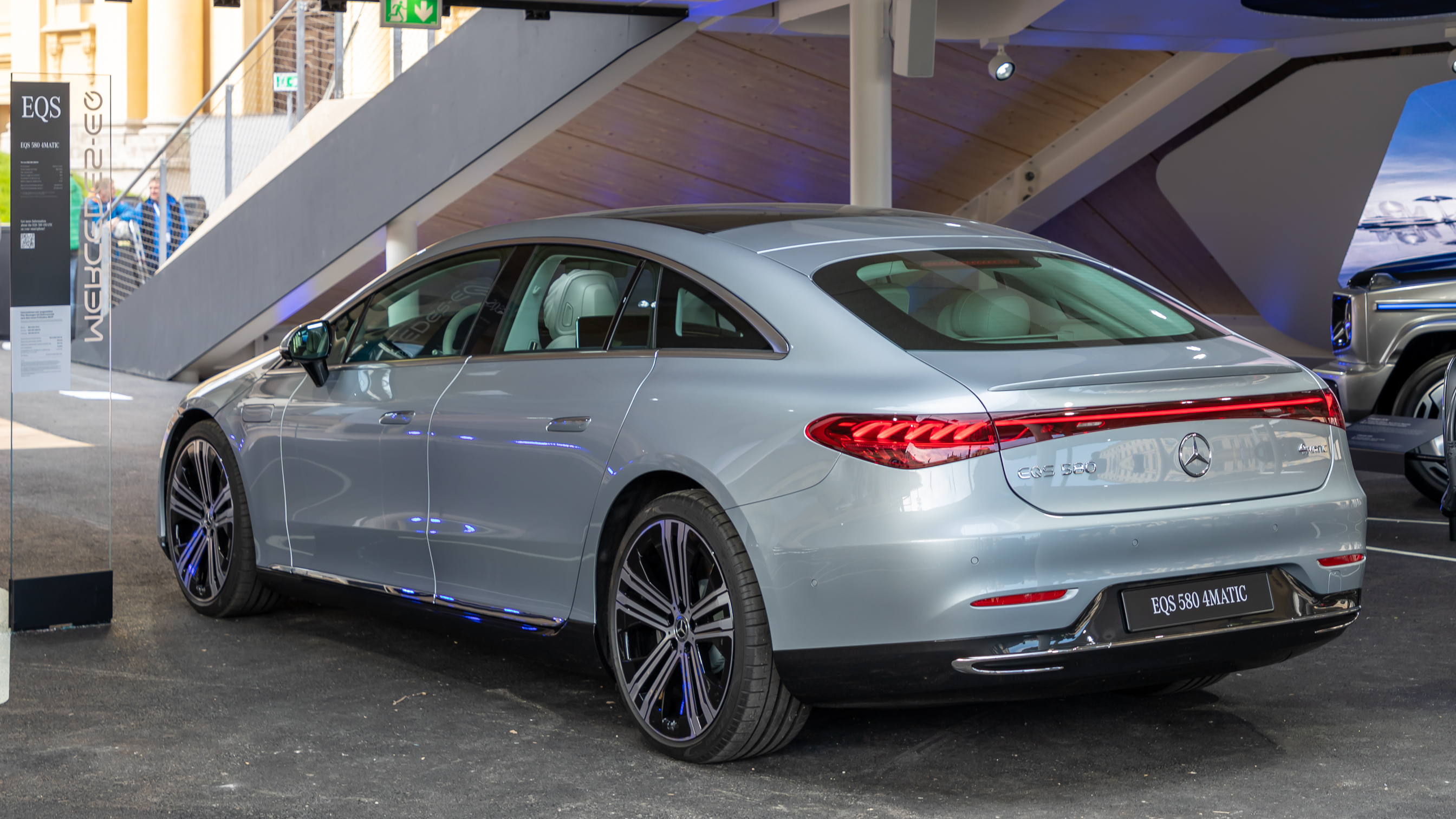
Mercedes EQS
"where it starts the Mercedes EQS, which is probably more comparable to this car, at 94,000 euros. The Lucid Air Grand Touring is sitting at 120,000 euros."
This is Mercedes-Benz’s big luxury electric sedan. It’s being compared to other expensive EVs to show where the price lands.
The Mercedes EQS is Mercedes-Benz’s flagship electric luxury sedan and a direct competitor in the premium EV space. The speaker suggests it is the closest comparison to the vehicle being discussed because of its size, luxury positioning, and price.
apples to apples
"If we're comparing apples to apples, they're all probably pretty close to this. Not to say that they are, like, dead on."
It means comparing things fairly, like comparing similar cars instead of totally different ones. They’re saying these vehicles are in the same general category.
This is a comparison phrase meaning the speaker is trying to compare similar things on equal footing. In car discussions, it usually means comparing vehicles in the same class, price band, or feature set.
EU
"This is, BYD sees an opportunity at this premium brand, at this premium range in the EU, and they're going to price their car accordingly. Why wouldn't you?"
EU means Europe as a big market area with shared rules. They’re talking about how much the car costs in Europe.
EU stands for the European Union, the regional market being discussed. It matters here because pricing and brand positioning can differ significantly between Europe and other markets like China.
gouging
"You want to make as much money as you can as a company while not gouging people? And maybe they are gouging people, but I don't think they are."
This means charging way too much money on purpose. They’re arguing about whether the car is overpriced.
Gouging means charging an unfairly high price, often because buyers have limited alternatives or strong demand. The hosts are debating whether BYD’s pricing is merely premium or crosses into exploitative territory.
BYD Z9
"they probably have good data to show that people will pay $115,000 for the Z9, but while they're trying to work on this, the market will tell them,"
This is the car they’re talking about. It’s a BYD model, and the hosts are debating whether people would really pay that much for it.
The BYD Z9 is the specific vehicle being discussed in this pricing debate. BYD is using it as an example of how much the market might bear for a high-end EV with unusual features.
market will tell them
"but while they're trying to work on this, the market will tell them, is this a good price or do we need to lower the price? And they will do that,"
It means customers decide if the price is right by whether they buy it. If people don’t want it at that price, the company has to change the price.
This is a pricing concept: the market response reveals whether a product is priced correctly. If buyers don’t respond, the company may need to lower the price; if demand is strong, it can hold or raise it.
features
"based on the features that it has, and it has some cool features, they're also kind of niche, like the pivot thing is really neat,"
These are the special things the car can do or comes with. The hosts are deciding whether those extras make the car worth the money.
In automotive discussions, features are the equipment or capabilities that differentiate one vehicle from another. The hosts are weighing whether the Z9’s features are compelling enough to support a high price.
price premium
"like the pivot thing is really neat, but is it worth another $15,000 to be able to pivot? No, I don't think so. So my general feeling is that this car should start"
It’s the extra money added on top because of a special feature or nicer version. Here they’re asking if one gimmick is really worth that much more.
A price premium is the extra amount a buyer pays for a feature, trim, or product positioning beyond the base value. The speaker is arguing that the pivot feature may not justify a $15,000 premium.
Request an Explanation
Heard something you'd like explained? We'll add it to this episode.
Sign in to request explanations for terms you heard.
Want to learn more?
Browse our glossary for plain-English explanations of automotive terms, jargon, and concepts.
Help improve this episode
See something that's not quite right? Our annotations are AI-generated and can sometimes miss the mark. Click the flag icon on any annotation to suggest a correction.