
MP 1704: The Week In IndyCar, June 18 2026
About this episode
Road America sets the tone for the week’s IndyCar preview, with the host urging listeners to get there early and calling out Turn 1 as the most dramatic spectator spot—especially during qualifying. The conversation then shifts to team continuity after Dennis Reinbold’s passing, including succession, crew staffing, and ongoing investor/co-owner discussions. Later, the hosts dig into IndyCar’s 2028 IR 28/engine-regulation timeline, why hybrid-era performance feels different, and how charter rules could shape 2027 entry counts. They close with “silly season” contract timing and the question of who can beat Alex Palou.
It's The Week In IndyCar Listener Q&A show, which uses listener-driven comments and questions covering a variety of topics submitted by open-wheel fans via social media.
TOPICS: Dennis Reinbold, DRR's continuation, 2028 car, and more!
NEW show stickers and retro racing memorabilia: ThePruettStore.com
EVERY episode is graciously supported by the Justice Brothers and TorontoMotorsports.com.
If you'd like to join the PrueDay podcast listener group, send an email to [email protected] and you'll be invited to participate in the Discord chat that takes place every day and meet up with your new family at IndyCar events.
Play on Podbean.com: https://marshallpruett.podbean.com/
Subscribe: https://marshallpruettpodcast.com/subscribe
Join our Facebook Group: https://www.facebook.com/MarshallPruettPodcast
[WTI]
IndyCar
"Welcome to the Marshall Pro podcast in your week in IndyCar listener Q&A. Hey, we're getting back to racing after a rare weekend off."
IndyCar is a major American race series for open-wheel cars. Races happen on different kinds of tracks, and teams tune the cars to match each track.
IndyCar is the top open-wheel racing series in North America, featuring purpose-built race cars and a mix of oval and road-course events. The series emphasizes driver skill plus engineering setup work across different track types.
Mealy-Waquay
"Flying into Mealy-Waquay, get in super, super early Friday morning about 2 AM. And if we sleep for a little bit and then drive up, it'd be a busy Friday morning and then early afternoon."
The transcript says “Mealy-Waquay,” but it’s probably the name of a race location that got spelled wrong in the captions. The key point is that the host is flying in early for the IndyCar weekend at that track.
“Mealy-Waquay” appears to be a mis-transcription of a race venue name, likely referring to an IndyCar stop. Because the exact track name isn’t clear from the transcript text, listeners may need the show’s full audio or corrected spelling to identify the circuit.
practice session
"And then we will get busy with the practice session and then get rolling with the rest of the weekend. And good old Road America."
A practice session is when teams get time on the track before the main event. They use it to figure out how the car feels and adjust so they’re ready to race.
In IndyCar, a practice session is on-track time where teams test setups, tire behavior, and driving approaches before qualifying and the race. It’s when engineers and drivers gather data to improve performance for the weekend.
Penske Entertainment
"IndyCar, since it was bought by Penske Entertainment has been absolutely unwilling to do anything speculative, announce anything before it's a million percent concrete."
Penske Entertainment is the company that owns and operates IndyCar. The host uses it to explain why the series is cautious about announcing engine-regulation details until they’re fully locked down.
homologation
"It's the service period. What's open for homologation and in what timeline? Every three years, every five, every two."
Homologation is the official sign-off that race rules and parts are approved. It’s how IndyCar decides what teams are allowed to change and what has to stay the same.
Homologation is the formal approval process for race-car parts and specifications. In IndyCar, it determines what can be changed (and when) under the engine-regulation rules so teams can develop within the approved framework.
service period
"It's the service period. What's open for homologation and in what timeline?"
A “service period” is a set time window in the rules where teams are allowed to use a specific approved setup. During that window, some changes may be allowed while others aren’t.
In racing engine rules, a “service period” is the defined window during which teams can operate under a particular homologated specification and schedule. The host is framing it as the time when certain parts are open for approval changes.
2.4 liter twin turbo V6
"but these are the same 2.4 liter twin turbo V6s that Chevy and Honda built and tested."
It’s an engine that has six cylinders arranged in a V shape, uses two turbochargers to make more power, and has a total displacement of 2.4 liters. The key point here is that IndyCar’s engine package is based on this twin-turbo V6 design.
A 2.4-liter twin-turbo V6 is a V6 engine with two turbochargers feeding compressed air into the cylinders. In this IndyCar context, the host says the current engine platform is shared in concept by Chevrolet and Honda, and that the “motors themselves are done” while the regulation details are still being finalized.
mothballed
"which was not a huge amount, but those have just been mothballed sitting, doing nothing [1159.5s] because they never came to life."
“Mothballed” means something was put aside and not used for a while. It’s basically stored away instead of being actively used.
To "mothball" something means to take it out of active use and store it away, usually because it isn’t ready or won’t be used yet. In racing terms here, it suggests engines that were built but never started running in anger, then were stored instead of being installed and raced.
NDA
"Final thing I'll mention [1348.7s] is apparently everyone's under some sort of NDA. You go to the manufacturers and say,"
An NDA is a legal promise not to share certain information. Here, it’s why people involved in the project can’t talk openly about what’s happening.
An NDA (non-disclosure agreement) is a legal contract that prevents people from sharing details publicly. In this context, it explains why manufacturers and teams can’t freely discuss the 2028 IndyCar hardware and testing plans.
Road America
"My question is about the upcoming race at Road America. What's your favorite spot around the track to take in the action..."
Road America is a well-known race track. The cars go very fast there, and the host is saying Turn 1 is the most exciting place to watch because you can see them coming over a hill and then diving into the corner.
Road America is a famous road course in the U.S. known for long straights, big elevation changes, and fast, flowing corners. In this segment, the host focuses on how Turn 1 is visually dramatic because cars crest a hill and then brake/turn downhill into the corner at very high speed.
crest that hill
"The cars come bombing down that long front straight, crest that hill, it's downhill run towards turn one."
“Crest that hill” means the car goes over the top of a bump or hill. The car’s behavior can change right after the crest, especially when it then has to head downhill into a corner.
“Crest that hill” refers to the car reaching the top of a rise, where suspension and aerodynamic load can change quickly. On a downhill run into a corner, cresting can make the car feel especially light or unsettled before it commits to the turn.
exit curbing
"The tail away tails away, crashing over the exit curbing, sometimes running too late bouncing around."
“Exit curbing” is the curb at the end of a turn. Drivers sometimes ride over it to stay on the quickest path, but it can make the car bounce or feel unstable.
“Exit curbing” means using the raised curb at the exit of a corner, typically to help the driver keep the car on the fastest line. The host mentions cars “crashing over” it, highlighting how aggressive curb use can unsettle the car and cause bouncing.
kink
"Now I know most folks when they think of like crazy speed and things to witness, you think of the kink down in turn 11..."
A “kink” is a quick bend in the track. It’s not a big corner, but it can still be fast and tricky—here the host is saying another part of the track is more exciting to watch.
A “kink” is a short, often fast direction change in a track layout—less of a full corner and more of a quick bend. The host compares the visual drama of Turn 1 versus the kink in Turn 11, saying Turn 1 feels more dynamic to watch.
qualifying
"And if you had to pick a session to do that, do that during qualifying. Because this is where as gripped up as the cars are, as lowest fuel, as maximum attack..."
Qualifying is when drivers try to set the fastest lap to decide where they start for the race. The host suggests going then because the cars are set up to go as fast as possible.
Qualifying is the session where drivers set their fastest lap times to determine starting positions for the race. The host recommends watching Turn 1 during qualifying because cars are typically running with low fuel and maximum effort, making the speeds and car behavior especially intense.
lowest fuel
"Because this is where as gripped up as the cars are, as lowest fuel, as maximum attack, that is truly something to behold."
Lowest fuel means the car has less gas onboard. Less weight usually helps the car accelerate and turn faster, which is why it matters most when drivers are chasing their best lap.
“Lowest fuel” refers to running the car with very little fuel onboard, which reduces weight and helps lap times. The host ties it to qualifying, where cars often carry minimal fuel to maximize speed and responsiveness.
gripped up
"Because this is where as gripped up as the cars are, as lowest fuel, as maximum attack, that is truly something to behold."
“Gripped up” means the tires have good traction. When grip is high, the car can turn and slow down more sharply without sliding.
“Gripped up” describes a car that has strong tire grip, allowing it to brake, turn, and accelerate with confidence. The host connects it to qualifying conditions, implying the tires and setup are delivering their best traction for the lap.
maximum attack
"Because this is where as gripped up as the cars are, as lowest fuel, as maximum attack, that is truly something to behold."
“Maximum attack” just means the driver is going all-out. They’re trying to squeeze the most speed and grip out of the car for the fastest lap.
“Maximum attack” is a racing phrase meaning the driver is pushing the car as hard as possible—braking later, turning in aggressively, and holding speed through the corner. Here it’s used to explain why Turn 1 during qualifying looks so extreme.
energy storage system
"saying it now. And that's hybrid things that the 100 plus pounds that this energy storage system [1751.6s] and motor generator unit bring to the quality of racing is still being sought."
This is the battery-like part that stores energy so the car can use it later. In a race car, adding it can change weight and balance, which affects how the car brakes and turns.
An energy storage system in a hybrid race car is the component that stores electrical energy for later use. In IndyCar, it’s paired with an electric motor/generator, and its mass and packaging can influence handling, especially under braking and in corner entry.
motor generator unit
"[1751.6s] and motor generator unit bring to the quality of racing is still being sought. [1761.7s] We know that it ticks a really big marketing requirement for one of the two manufacturers,"
The motor-generator is the electric unit that can help drive the car and also recharge energy when you slow down. Because it’s working during braking and deceleration, it can change how stable the car feels entering corners.
A motor generator unit (MGU) is the hybrid component that can both provide electric power (as a motor) and generate electricity during deceleration/braking (as a generator). That energy recovery changes how the car manages traction and braking, which can alter cornering confidence.
braking zones
"Just saying that the addition of the hybrid [1878.7s] has dulled the performance of the cars enough in the corners, under braking, the ability to attack [1886.6s] braking zones, fly through medium to high speed corners in the same capacity that has been"
A braking zone is the part of the track where you slow down before turning. If the car’s braking behavior changes (for example, because of the hybrid system), it can be harder to brake as late or as confidently.
“Braking zones” are the specific track areas where drivers slow down for a corner. In racing with hybrid systems, the way energy recovery and braking forces are managed can affect how consistently the car can decelerate and rotate into the turn.
tires
"but they loved that version of it way more than this one because they didn't [1918.1s] have to be afraid of trying too hard and the car just falling out from under them or destroying the [1925.0s] tires."
Tires are what actually grip the track. The host is saying the newer cars can make it easier to overdo the grip, so the car can slide or the tires can get destroyed faster.
In racing, “tires” are the consumable contact patch that determines grip and how much the car can be pushed before it loses traction. The host’s point is that the newer hybrid-era setup makes it easier for the car to overwhelm the tires, leading to loss of control or excessive tire damage.
chassis
"Back in the day teams either made [2154.7s] their own chassis or bought Reynards marches, Lola's etc."
A chassis is the main “frame” of the race car. It’s the foundation that other parts attach to, and in IndyCar the rules can limit how much teams are allowed to customize it.
In racing, a chassis is the car’s main structural platform that everything else mounts to—suspension, aero components, and the drivetrain package. The host contrasts older IndyCar practices (teams building or buying chassis and then adding custom parts) with the newer era where teams have less freedom to individualize the car.
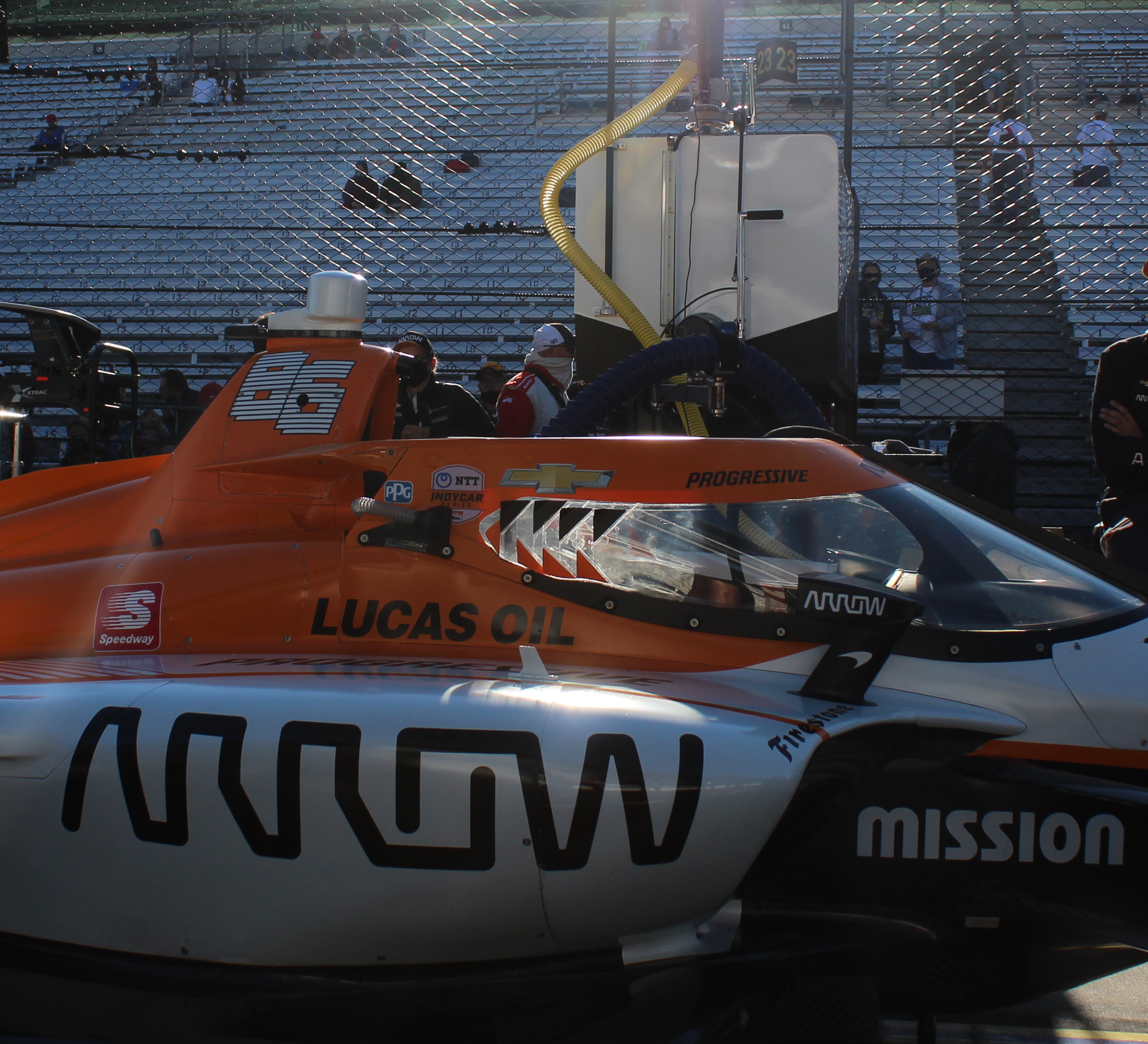
Dallara DW 12
"So no, I think [2218.2s] we're truly Randy looking at a continuation of the Dallara DW 12 model by I don't mean the model [2228.4s] itself, but the actual regulation model of you buy it, you use it as delivered."
The Dallara DW 12 is the main race car chassis IndyCar teams use. The series controls most of the design, so teams can’t freely change everything—they mostly work with approved parts and options.
The Dallara DW 12 is the IndyCar chassis used in the 2020s, built around the series’ current technical regulations. In this segment, the host is framing the DW 12 as a “continuation” baseline for the next generation, with factory-approved options and limited scope for team-by-team customization.
factory purchased parts
"But these are all factory [2241.8s] purchased parts in the only approved ones to use."
This means teams have to use parts that are officially provided/approved by the series or manufacturer. It limits how much teams can experiment or build their own unique setup.
“Factory purchased parts” means components teams must buy through the approved supply route rather than sourcing or designing their own. In this segment, it’s used to argue that the new IndyCar rules reduce team-by-team personalization by restricting what’s allowed on the car.

I R 28
"And I do think it actually goes one step [2249.4s] farther in that looking at ways, are there any areas of the DW 12, any things that we could [2258.4s] actually carry over to the 2028 car, the I R 28."
The “I R 28” is the next IndyCar race car chassis that teams will move to after the current one. The key point here is that the series will still limit what teams can change, even though some parts may carry over.
“I R 28” refers to the next IndyCar chassis generation coming after the DW 12 era. The discussion emphasizes that it will be delivered with factory-approved parts/options and that only certain areas (like wheels) are expected to carry over from the DW 12 program.
magnesium
"going to be trading the material from magnesium to aluminum."
Magnesium and aluminum are metals used to make wheels. The lighter the wheel, the easier it is for the suspension to control the car over bumps, so changing wheel material can change how the car feels.
Magnesium is a lightweight metal used in some racing wheels to reduce unsprung mass. The host says IndyCar teams are switching wheel material from magnesium to aluminum ahead of the next chassis generation, which can affect weight and handling characteristics.
OZs
"There's been no spec vendor for what teams are currently using been a blend of OZs and [2293.4s] BBS."
OZ is a company that makes wheels. In this IndyCar discussion, it’s being named as one of the wheel brands teams have been using before the new wheel rules take effect.
OZ (OZ Racing) is a wheel brand commonly seen in motorsport and performance applications. Here it’s mentioned as a dominant supplier in the current IndyCar wheel ecosystem before the new spec wheels arrive for the next chassis cycle.
BBS
"But the new wheels that are coming that everyone [2302.3s] has to buy for 2027 will indeed carry over to the 2028 car made by BBS."
BBS makes wheels. The host is saying the next required wheel spec for IndyCar will come from BBS and will still be used when the newer chassis arrives.
BBS is a well-known wheel manufacturer with a long motorsport history. The host says the new wheels required for 2027 will be made by BBS and will carry over into the 2028 car program.
arrow lip
"And in a change there, [2312.5s] they're removing the arrow lip that you see on the front wheels that do indeed help the car a [2317.6s] little bit aerodynamically."
An “arrow lip” is a specific wheel-edge shape/feature that can influence airflow around the wheel. The host notes it helps the car aerodynamically, and that it’s being removed on the new front wheel design.
aeroscreen
"Dixon never went back to back. I reminded him Polo's only driven this modern 2020 era aeroscreen car."
An aeroscreen is a protective clear shield above the driver’s head in IndyCar. It’s there to help keep debris away and improve safety in crashes. When people talk about “the aeroscreen car,” they mean the newer safety-era IndyCar setup.
The aeroscreen is IndyCar’s cockpit safety device: a clear protective screen mounted above and around the driver to help deflect debris and reduce head injury risk. It became a defining feature of the “modern” IndyCar era referenced here. When someone says a driver has only raced in the “aeroscreen car,” they mean the post-introduction safety configuration.
Scott Dixon
"Would say that once he reaches, if he reaches five or six, yeah, we do need to start talking about as I have and some of us have who've been there for all of Scott Dixon's American career. I mean, he's the modern goat, period."
Scott Dixon is a top IndyCar driver. The host is arguing that he’s the best of his generation based on how many championships he’s won. The discussion is comparing his achievements to another driver’s streak.
Scott Dixon is an IndyCar driver and the dominant championship figure in the modern era. The host frames him as the “modern goat,” emphasizing his American IndyCar career and the scale of his title success. This matters to listeners because the Dixon-vs-Polo debate is really about how to compare championship eras and competition levels.
AJ Foyt
"Still needs to get to seven for Dixon to match AJ Foyt and obviously to eight to take that all time, but no one ever thought anyone was going to get close to AJ like that."
A.J. Foyt is one of the most famous IndyCar/open-wheel drivers in American racing history. The host is using him as a record-holder reference point for championships. The idea is: how many titles would it take for Dixon to match or beat the all-time best?
A.J. Foyt is a legendary American open-wheel racing driver and a historical benchmark for IndyCar championship records. The host mentions Dixon needing to reach “seven” to match Foyt, and “eight” to take the all-time lead. That comparison is central to how IndyCar fans talk about “greatest of all time.”
hybrid
"Obviously, he's won championships without the hybrid, has won with the hybrid. He's the only person to win championships with the hybrid to state that correctly, I guess."
In IndyCar, “hybrid” means the car can save energy and then use it later to help with acceleration. It’s not just a normal gasoline-only setup—drivers and teams manage when that extra energy gets used.
In IndyCar, the “hybrid” refers to an energy-recovery system that supplements the car’s power. It stores energy under braking and deploys it to help acceleration, changing how the car is driven and how teams manage power throughout a race.
DW12 spec
"Dario has that terrible, terrible close to his career there. But that is in the kind of normal DW12 spec. 2015 first year of the manufacturer arrow kits"
“DW12 spec” is IndyCar’s specific ruleset for a particular generation of race car. Think of it like the official blueprint the teams have to build to, so everyone’s cars are comparable.
“DW12 spec” refers to the IndyCar chassis/engine package associated with the Dallara DW12 generation. It’s a specific technical rule set that defines the car’s baseline design and performance characteristics, so results across years can be compared within that framework.
manufacturer arrow kits
"that is in the kind of normal DW12 spec. 2015 first year of the manufacturer arrow kits with insane downforce."
“Manufacturer arrow kits” are IndyCar bodywork/aero parts that differ by manufacturer. They can change how much grip the car has and how it behaves in corners, even though the series rules still keep things fairly controlled.
“Manufacturer arrow kits” describes a period when IndyCar introduced manufacturer-specific aerodynamic “arrow” bodywork components. The goal was to let engine manufacturers express themselves aerodynamically while still staying within the overall IndyCar rules, which can materially affect downforce and balance.
Chevrolet
"And this also, with the team having switched to Chevrolet from Honda, wins that championship, right? So that's pretty wild. Then you look at what he does in 2018, first year of the"
Chevrolet is mentioned as the car’s engine manufacturer in IndyCar. Different manufacturers can have different engine behavior, so teams may need to adjust how they set up and drive the car.
Chevrolet is referenced here as the engine/manufacturer partner in IndyCar. In the hybrid-era and aero-rule changes, switching manufacturer relationships (Chevrolet vs Honda) can influence engine characteristics and how teams optimize the car’s overall setup.
universal arrow kit
"universal arrow kit. So done away with the insane downforce and custom aerodynamics. So insane,"
A universal kit means IndyCar gives teams a more standardized body/aero package. That way, teams can’t gain huge advantages just by designing totally unique aero parts.
The “universal arrow kit” is a standardized IndyCar body/aero package intended to limit how much teams can develop unique aerodynamic solutions. The goal is to reduce performance gaps driven by aero experimentation and make racing outcomes more about driver skill and setup within tighter constraints.
custom aerodynamics
"universal arrow kit. So done away with the insane downforce and custom aerodynamics. So insane,"
Custom aerodynamics are special shapes and parts on a race car that are made to help it handle better. If the rules take that away, everyone has to use more similar aero setups.
Custom aerodynamics refers to team-specific aerodynamic parts and shaping that are designed to maximize performance beyond the baseline rules. When a series moves toward more standardized aero packages, it reduces how much teams can differentiate with bespoke bodywork and wings.
downforce
"universal arrow kit. So done away with the insane downforce and custom aerodynamics. So insane,"
Downforce is the “push down” from the air on a race car. More downforce usually means the tires stick better in corners, so the car can go faster and feel more stable.
Downforce is the aerodynamic force that pushes a race car downward to increase tire grip. In IndyCar, changes to aero rules can drastically alter how much downforce teams can generate, which affects cornering speed and stability.
arrow screen
"then adds the 2020 championship as well, first year of the arrow screen. So again, I realize that"
“Arrow screen” here appears to refer to a specific IndyCar aero/bodywork element introduced as part of the arrow kit era. It’s discussed as a first-year change, implying it affected car behavior and competition once teams adapted to it.
manner in which championships are earned
"So the manner in which championships are earned does matter. Can't I can't argue that at all."
They’re talking about how you win a championship—whether it’s by dominating races, being consistently near the front, or scoring in a particular way. That affects how we compare drivers from different years.
This is a discussion concept about how championship points and race results translate into overall titles. The hosts are arguing that the “how” (dominance, consistency, points structure) matters when comparing achievements across eras.
Alex Palo
"Who’s better in terms of talent at their peak? Knowing that Alex is at his peak right now."
Alex Palou is an IndyCar driver. The host is saying Palou is currently driving at an especially high level, which makes the comparison to Scott Dixon interesting.
Alex Palou is an IndyCar driver discussed here as being “at his peak right now,” with recent championship success. The host frames Palou’s current dominance as a key part of the comparison against Scott Dixon’s historical peak.
Kyle Kirkwood
"Because the only driver I can think of right now, other than Kyle Kirkwood, we'll see if some others prove that they deserve to be mentioned in this."
Kyle Kirkwood is an IndyCar driver. The host mentions him as someone who could potentially join the conversation about the very best drivers right now.
Kyle Kirkwood is an IndyCar driver mentioned as a possible future challenger in the conversation about who could match Alex Palou at his peak. The host is using him as a “maybe” candidate among current drivers.
push to pass
"the Penske push to pass contra taunts in 2024. So the ability to instruct basically a blow by and allowance for no real deactivation of push to pass, which is something that is done from race control..."
“Push to pass” is a button/feature in some race cars that temporarily gives you extra power so you can overtake. The rules control when and how it can be used, so teams can’t just change it however they want.
“Push to pass” is a race feature that gives an extra performance boost for a limited time or under specific rules. In IndyCar, it’s managed by the car’s control systems and governed by regulations so teams can’t freely alter how it works.
race control
"...which is something that is done from race control, there is the ability to basically say, no, it's always going to be on that can be done in the software."
“Race control” is the officials’ command center during a race. They watch what’s happening and make sure rules are followed, including controlling certain car features.
“Race control” is the centralized officiating and management team that monitors the race and enforces rules. For features like push to pass, race control can control or authorize aspects of the system to keep competition compliant.
engine control modules
"the only real onboard computers that govern anything that would need to stay within compliance would be the engine control modules, ECM ECU, whatever a manufacturer might call theirs, things like setting of rev limits..."
Engine control modules are the car’s main computers for the engine. They help control things like how high the engine can rev, and the rules can restrict who is allowed to change them.
Engine control modules (ECMs) are the car’s onboard computers that manage engine functions. They can enforce critical limits like rev limits, and in IndyCar rules the manufacturer controls them heavily to prevent teams from changing compliance-critical behavior.
ECM ECU
"...the engine control modules, ECM ECU, whatever a manufacturer might call theirs, things like setting of rev limits and such."
ECM/ECU are the engine’s control computer. It decides how the engine runs, including limits that keep the car within the rules.
ECM/ECU are acronyms for the engine control unit/computer. They’re the onboard electronics that run the engine’s control logic, including compliance-related settings such as rev limits.
compliance
"the only real onboard computers that govern anything that would need to stay within compliance would be the engine control modules... But that's not an item that teams are allowed into."
In motorsport, “compliance” means meeting the technical and software rules set by the sanctioning body. The discussion here centers on which onboard systems teams can modify versus which must remain controlled by manufacturers to stay within those regulations.
rev limits
"...things like setting of rev limits and such. But that's not an item that teams are allowed into."
Rev limits are the maximum RPM the engine is allowed to reach. The car’s computer enforces them to protect the engine and stay within the rules.
Rev limits are programmed maximum engine speeds (RPM) that the ECU/ECM enforces. They’re important in racing because they protect the engine and also help keep cars within the performance and compliance rules.
Chip Ganassi Racing
"to sever a 23 year, 23, however many years it's been relationship with Ganassi, right? Tempted by money is not the thing could be for another driver."
Chip Ganassi Racing is a well-known IndyCar racing team. The host is saying that the team’s whole setup has been built around a specific driver for a long time.
Chip Ganassi Racing (often shortened to Ganassi) is a major IndyCar team with a long history of building competitive cars around top drivers. In this segment, the host emphasizes that the #9 Honda program has been structured around Scott Dixon for years.
engineered, developed, tuned
"That car is engineered, developed, tuned to exactly what he wants and needs. An entire organization that is yours. I realize Alex Polo has been the guy getting the results"
It means the team doesn’t just build a car once—they keep improving it and adjusting it so it feels right for the driver. The host is arguing that leaving that kind of tailored setup means starting over.
These words describe the iterative process of setting up an IndyCar for a specific driver: engineering the car’s baseline, developing updates over time, and tuning the setup to match the driver’s feedback and driving style. The host’s point is that Dixon’s long tenure means the car and team are optimized around him.
Alex Polo
"An entire organization that is yours. I realize Alex Polo has been the guy getting the results and the championship. I get that."
Alex Polo is an IndyCar figure the host credits with results. The point here is that results don’t necessarily mean the whole team is built around him the way it is for Scott Dixon.
Alex Polo is mentioned as the person “getting the results” and the championship in the context of the Ganassi program. The host’s argument is that even if Polo has produced results, the overall team identity and long-term build direction are still tied to Scott Dixon.
Pato Award
"But this is not your team. This is not your car. You're starting from scratch. So you go from being the guy who is chip Ganassi racing with a car that is truly built around you too. All right, let's start over. None of these things apply. It's not your team. Happy to have you here. But this has all been built around Pato."
This sounds like the host is talking about Pato O’Ward, an IndyCar driver. The key idea is that the car and team have been set up around him, so switching teams would mean giving that up.
“Pato Award” appears to be a mis-transcription of Pato O’Ward, an IndyCar driver. The host repeatedly emphasizes that the team and car have been built around him, which is central to the argument about why leaving that setup would be unusual.
Aaron McLaren
"Are you going to leave that to go to a team that isn't yours? Aaron McLaren is the one that's been rumored, right? Cool. That entire team"
The host is talking about a rumored driver move involving someone named “Aaron McLaren.” The transcript text looks uncertain, but the idea is that the driver would be considering switching teams.
“Aaron McLaren” is likely a mis-transcription of a driver name (the segment discusses a rumored move involving “Aaron McLaren specifically”). Because the name doesn’t clearly match a known IndyCar driver as written, this annotation is low-confidence and mainly flags that the host is discussing a specific rumored driver candidate.
Christian Lundgaard
"That entire team is built around Pato Award. That car been developed around Pato. Christian Lundgaard has been very helpful in bringing the development tuning of it to a more central position."
Christian Lundgaard is an IndyCar driver. The host is saying he helped the team organize how they develop and fine-tune the car more centrally.
Christian Lundgaard is mentioned in relation to helping bring development and tuning “to a more central position.” That implies a shift in how the team organizes feedback and car development work across drivers and engineers.
number one or number two driver
"But this is a team that already has a number one or number two driver. Signing of a Scott Dixon. Again, I mean, you'd have to look at him and say your number one, you're right there."
Teams often have a main driver they focus on first, and another driver who gets support second. The host is saying that even if a driver is fast, the team might still be organized around someone else as the top priority.
In IndyCar (and other motorsports), a “number one” driver is the team’s primary priority for strategy, development focus, and support, while a “number two” driver is typically secondary. The discussion here is about how driver roles affect whether a driver is truly moving into a team built around them.
Andretti Global
"Let's say Andretti Global. Cool. Got it. Again, amazing team, amazing everything. That is Kyle Kirkwood's team built around him."
Andretti Global is a racing team in IndyCar. The host is comparing it to staying with the team that’s already built around you versus joining a new team and having to rebuild everything.
Andretti Global is an IndyCar team organization. Here, it’s used as an example of a different team environment where a driver would be starting from scratch rather than keeping a car and organization already optimized around them.
charters
"They're wanting to create value in charters. This is an attempt to inflate charter value."
A charter is like a guaranteed spot for an IndyCar team to race. The discussion is about rules that restrict how many extra (non-chartered) cars can show up at most races, which affects how valuable those guaranteed spots are.
In IndyCar, a charter is a team’s guaranteed entry right—essentially a slot that lets the team compete in the series. The host argues the rule change is meant to “inflate charter value,” limiting how many non-chartered cars can race at events (except the Indy 500).
2027 rules
"I can find no sense that this makes, not right now at least, knowing that this rules coming into play for 2027, which says zero non charter cars can run at every single race, except for the Indy 500."
The hosts are talking about IndyCar’s planned rules for 2027. The key issue is whether teams without guaranteed spots can run extra cars, and the host thinks the decision is poorly timed.
This segment centers on IndyCar’s planned 2027 rule changes affecting how many non-chartered cars can enter races. The host criticizes the timing, arguing teams need every chance to earn money as costs rise.
non charter cars
"which says zero non charter cars can run at every single race, except for the Indy 500."
Non-charter cars are race entries that don’t have the guaranteed charter slot. The host is saying that starting in 2027, teams without charters would be blocked from running extra cars at most IndyCar races (with the Indy 500 as the exception).
“Non-charter cars” are entries that do not have a charter-guaranteed spot, meaning they can be limited or excluded by entry rules. The host says the 2027 rules would allow zero non-chartered cars to run at every race except the Indy 500.
DW12s
"Hey, we're truly just using up the DW12s that are going to go away and be useless, using up the spare like we're getting everything out of them before they turn into dust."
The DW12 is the main IndyCar race car chassis that teams have been using. The point here is that teams could run extra cars using the older DW12 before it’s replaced, which would help them make more money.
In IndyCar, the DW12 is the long-running chassis platform used by most teams in the series. The host is talking about “DW12s” as the outgoing generation that teams can run to earn extra money before it’s retired.
NXT
"And we could use that money by running some kids in NXT or some of the ones who are floating around in Indy cars, it is, we might have a little bit of money to spend or a lot of money to spend."
NXT is a feeder series where younger drivers race to develop and move up. The host is saying teams might use extra funding to support those drivers instead of running extra cars.
NXT is IndyCar’s development ladder series, used to give drivers a path toward higher-level IndyCar competition. The host mentions running “kids” in NXT as an alternative use of money if teams can’t run extra cars in the main series.
Request an Explanation
Heard something you'd like explained? We'll add it to this episode.
Sign in to request explanations for terms you heard.
Want to learn more?
Browse our glossary for plain-English explanations of automotive terms, jargon, and concepts.
Help improve this episode
See something that's not quite right? Our annotations are AI-generated and can sometimes miss the mark. Click the flag icon on any annotation to suggest a correction.