No Sale! Car Wrecked During Auction, E85 Fuel Just $2.99 - Shift & Steer EP569
About this episode
From Indy 500 crash talk to a long car-collection detour, the hosts then get practical about real-world breakdowns. They recap auction chaos—like a wrecked Mach 1 with a stuck throttle—and explain how insurance paperwork can keep a car from crossing the block. The most detailed thread is their Mini Cooper brake failure: mushy pedal, a two-piece caliper coming apart, roadside bleeding, and immobilizer fuel cut-off. They also pivot to a bargain fuel scare: “the fuel was only 2.99 a gallon… So I filled up and then I realized it was E85.”
This is Shift and Steer, your quick-hit automotive news podcast.
On this episode #569:
• Brad Fanshaw's Muscle Car Tech on YouTube @TheBradFanshaw Channel
• E85 is Just $2.99 gallon in California
• Car Wrecked at Auction - No Sale!
• Brad & Aaron go to Car Events
• bonspeedStreetWear.com & drinkbravago.com
Let us know your thoughts about our shows; hit us up on Instagram @ShiftSteerMedia or [email protected].
VISIT US ONLINE: https://www.shiftandsteer.com/
FOLLOW US IN INSTAGRAM: @ShiftSteerMedia
@Bradley_Fanshaw
@bonspeed_Street_Wear
@Motorator
@AaronHagar
Hosted by Simplecast, an AdsWizz company. See pcm.adswizz.com for information about our collection and use of personal data for advertising.

Jaguar Type Jaguar
"Cobras and like K.R.'s D type Jaguar, which is vintage."
The Jaguar F-Type is a modern sports car made by Jaguar. It’s built to be quick and fun to drive, especially when you’re taking corners. It gets mentioned in conversations about Jaguar’s classic racing cars because it continues that sports-car tradition.
The Jaguar F-Type is a modern Jaguar sports car designed for performance and driver engagement, and it’s often discussed alongside other Jaguar sports legends. In the context provided, it’s grouped with iconic vintage Jaguars like the D-Type, highlighting Jaguar’s long history of track-focused cars. The F-Type is relevant because it’s a contemporary way to experience that “Jaguar sports car” feel.

Porsche 914
"man sports car, much like a 914 would. But yeah, it's super fun."
The Porsche 914 is a classic sports car with the engine placed near the middle of the car. That design helps it feel balanced when you turn. People bring it up because it’s often described as enjoyable and easy to have fun in.
The Porsche 914 is a mid-engine sports car known for being lightweight and fun to drive, with a layout that puts the engine behind the driver for balanced handling. It’s often discussed as an approachable entry into classic Porsche-style driving dynamics. In a conversation about “super fun” sports cars, the 914 fits because it’s a compact, engaging platform that rewards driving skill.

Lancia B20
"beautiful Lancia B20. [639.2s] But this year, this year, [640.8s] we had a unicorn."
The Lancia B20 is an old-school Italian sports car. People like it because it was built with racing in mind, and it’s a well-known classic among collectors.
The Lancia B20 is a classic Lancia sports car from the 1950s, known for its lightweight, race-bred design and period-correct Italian engineering. It’s a notable name in vintage rally and racing circles, especially among collectors who care about original-era performance and provenance.
short wheelbase
"[643.7s] Lamal Prep 1961 Ferrari [646.6s] short wheelbase Lusos. [649.5s] I think the silver one raced in"
“Short wheelbase” means the car’s front-to-rear spacing is shorter. Shorter wheelbases often make cars feel more nimble when turning.
Short wheelbase means the distance between the front and rear axles is smaller than on a longer version of the same platform. That typically makes the car feel more agile and quicker to rotate in corners, but it can also make it less stable at very high speeds compared with longer-wheelbase setups.
test cars
"[658.1s] I believe this one was one of the [659.8s] test cars or something for them [661.2s] off. [661.8s] Anyway, the gentleman and his wife"
A “test car” is basically a car used to try things out—like new parts or settings—before they’re finalized. It can mean the car has special development history.
“Test cars” are vehicles built or prepared to evaluate parts, setups, or development changes before they’re finalized for production or customer racing. In vintage racing talk, this often implies the car may have unique history, configurations, or engineering tweaks compared with a typical race entry.
brakes started to go out
"behind that Ferrari and and my brakes started to go out and I'm like, it's pulling hard to the left and the pedals getting pretty mushy."
When someone says the brakes “started to go out,” it means the car wasn’t stopping as it should. If the pedal feels soft or the car pulls to one side, it can mean the brakes aren’t working evenly.
“Brakes started to go out” describes a loss of braking effectiveness, often from a hydraulic issue, air in the system, or brake fluid problems. The symptoms mentioned—pulling hard to the left and mushy pedals—are classic signs that something in the brake system isn’t applying evenly.
pulling hard to the left
"I'm like, it's pulling hard to the left and the pedals getting pretty mushy."
If the car pulls to one side when you brake, it usually means one side is braking more than the other. That can be caused by a problem with a brake caliper or uneven brake wear.
“Pulling hard to the left” while braking suggests uneven braking force between left and right wheels. That can come from a sticking caliper, uneven pad/rotor condition, or a hydraulic imbalance, and it’s important because it can make the car harder to control under braking.
pedals getting pretty mushy
"I'm like, it's pulling hard to the left and the pedals getting pretty mushy. And I'm like, what is going on?"
A “mushy” brake pedal usually means the brake hydraulics aren’t firm—commonly due to air in the brake lines, low brake fluid, or a failing master cylinder. It’s a warning sign because it can reduce braking power and increase stopping distance.
two piece billet machined
"be coming out of the two piece billet machined, you know, four pot caliper I've got on [...] And I'm like, son of a bitch, the that the whole brake piece that like the two piece caliper unit was coming apart."
They’re talking about a brake caliper made in two halves from a solid block of metal. If those halves aren’t clamped together tightly, the brake can develop a small gap and start acting wrong.
This describes a brake caliper that’s built in two separate halves, machined from billet aluminum. A two-piece design can be more modular, but it also means the halves must stay tightly clamped together to prevent leaks or misalignment.
four pot caliper
"billet machined, you know, four pot caliper I've got on [...] And I'm looking at it and I see a little bit of a gap."
A four-pot caliper is a brake caliper with four small pistons that squeeze the brake pads against the rotor. That helps the braking force apply more evenly.
A “four-pot” caliper uses four pistons (often two on each side of the caliper) to clamp the brake pads. More pistons can help distribute clamping force more evenly and improve braking consistency, especially under repeated hard stops.
bleeder valve
"And so it made just a little gap where the bleeder valve goes through to the other side."
The bleeder valve is the little valve you open to push old fluid and air out of the brake system. Keeping it properly sealed matters for getting the brakes to feel firm and consistent.
The bleeder valve is the small valve used to remove air from the brake hydraulic system during bleeding. If a caliper is slightly loose, the bleeder area can be affected, which may contribute to uneven pressure or persistent air in the lines.
two piece caliper
"The two piece caliper on my truck. I'm coming home from work..."
Your brakes use a part called a caliper to squeeze the brake pads against the spinning brake disc. A “two-piece caliper” means that caliper is made from two main sections, so if bolts or parts come loose, it can separate and cause braking problems.
A brake caliper is the clamp that squeezes the brake pads against the rotor to slow the car. A “two-piece caliper” typically means the caliper body is built in two sections (rather than one solid casting), which can affect how it’s assembled and how it fails if hardware loosens or fractures.
pedal goes to the floor
"So I start to drive, pedal goes to the floor and ..."
If the brake pedal suddenly drops to the floor, it often means the brakes aren’t building pressure like they should. That can be caused by a leak or a brake component coming apart, so the pedal feels soft or useless.
When the brake pedal “goes to the floor,” it usually indicates a loss of hydraulic pressure in the brake system. That can happen if a line fails, fluid leaks out, or a caliper/connection separates, leaving the pedal with little or no braking force.
monoblock caliper
"So this is this is why we've always cautioned the two piece caliper. Why so many companies do a monoblock caliper for that reason."
A monoblock caliper is one solid piece instead of two bolted halves. Because it’s stiffer, it’s less likely to move around when you brake hard.
A monoblock caliper is machined as a single piece, rather than assembled from multiple halves. That rigidity helps resist caliper flex or misalignment under hard braking, which can reduce the chance of brake damage.
thread lock
"You can use a little thread lock. But I just kept thinking I would probably take out those Allen head bolts, get some good"
Thread lock is a product you put on bolt threads so they don’t back out over time. It helps keep brake parts tight and correctly aligned.
Thread lock is a chemical adhesive applied to bolt threads to prevent them from loosening from vibration. On brake hardware, it can help maintain clamp force so the caliper stays properly positioned.
Allen head bolts
"But I just kept thinking I would probably take out those Allen head bolts, get some good"
Allen head bolts are bolts you tighten with a hex key. On brakes, they hold important parts in place, so getting the right key and tightening them properly is important.
Allen head bolts are fasteners tightened with an internal hex (Allen) key. In brake calipers, they’re commonly used for mounting hardware, and using the correct size and torque matters to avoid loosening or stripping.
safety wire
"Exactly. And safety wire. That's exactly why I'm right."
Safety wire is a little wire that ties down bolts so they can’t back out. People use it when they really don’t want a fastener to loosen while the car is moving.
Safety wire is a thin wire used to lock fasteners (like bolts or fittings) so they can’t loosen from vibration. It’s commonly used in motorsports and aircraft-style maintenance where a fastener coming loose would be dangerous.

Mini Cooper
"it hit us with such [1221.4s] it was so violent in that little [1223.5s] Mini Cooper that it [1225.4s] triggered the let me see if I can [1227.4s] get this right. It triggered"
A Mini Cooper is a small car. Here, when it hits a rock hard, the car’s electronics react by shutting things down to help protect the vehicle.
The Mini Cooper is a small, front-wheel-drive car known for being compact and maneuverable. In this story, a violent rock impact triggers the car’s safety/anti-theft electronics, showing how modern Minis can respond to crashes by disabling key systems.
immobilizer
"it triggered the let me see if I can [1227.4s] get this right. It triggered [1228.9s] the the immobilizer [1231.8s] unit like like like there's [1233.6s] an immobilizer unit in this car"
An immobilizer is an anti-theft feature. It helps stop the car from starting unless it recognizes the right key, and in some situations it can also disable fuel after a crash.
An immobilizer is an anti-theft system that prevents the engine from starting unless the correct key/transponder is recognized. In crash events, some cars also use immobilizer-related logic to disable fuel delivery as part of a safety response.
fuel cut-off
"And it shuts off the fuel and it [1238.3s] shuts off how I say it's a fuel cut [1240.3s] off. It's probably going to cut off. [1242.3s] Yeah. Well, it's it's a whole"
A fuel cut-off is an automatic shutdown of fuel delivery, typically triggered by sensors during a crash. The goal is to reduce the risk of fire or further engine operation when the vehicle is damaged.
brake hopper
"But when you said the brake hopper was going out, you were at the back of the pack."
“Brake hopper” sounds like a nickname for a brake problem or a part that’s failing. The important part is that it was leaking brake fluid onto other cars, which can damage paint.
“Brake hopper” appears to be a colloquial or mis-transcribed term for a brake-related component or condition that’s “going out,” likely referring to a failing brake system part. In context, it’s treated as something that can leak brake fluid onto other cars.
brake fluid
"If you were in the front of the pack and you were getting brake fluid on like the Ferrari and the Cobra and they all went and they're like wiping it off the paint and it's like etched in."
Brake fluid is the special liquid that helps your brake pedal push the brakes. If it gets on paint or other surfaces, it can eat or stain them, so it should be cleaned quickly.
Brake fluid is a hydraulic fluid used in a car’s braking system to transfer force from the brake pedal to the brakes. It’s corrosive to many materials and can damage paint and finishes if it spills.
Ferrari
"If you were in the front of the pack and you were getting brake fluid on like the Ferrari and the Cobra and they all went and they're like wiping it off the paint and it's like etched in."
Ferrari is a famous sports-car brand. Here it’s mentioned just to illustrate that brake fluid can ruin paint on expensive cars too.
Ferrari is an Italian performance car brand known for high-end sports cars. In this segment, it’s used as an example of a car whose paint can be damaged by brake fluid.
Cobra
"If you were in the front of the pack and you were getting brake fluid on like the Ferrari and the Cobra and they all went and they're like wiping it off the paint and it's like etched in."
“Cobra” is a well-known sports-car name. In this story, it’s mentioned because brake fluid can damage paint on cars like that.
“Cobra” refers to the Shelby Cobra nameplate, a classic American sports car associated with the Shelby brand. In this segment, it’s another example of a car whose paint can be etched by brake fluid.
front disc
"[1385.3s] I didn't have brake cleaner to clean [1386.8s] the the front disc. [1388.6s] But the same thing, I just wiped it [1390.2s] down with water as best I could."
The “front disc” is the front brake rotor. Keeping that surface clean helps the brakes bite consistently and reduces the chance of annoying brake problems.
A “disc” here refers to a disc brake rotor on the front axle. Cleaning the rotor surface matters because brake dust, moisture, or residue can affect braking feel and can contribute to issues like uneven braking or noise.
bleed again
"[1393.4s] The pedals a little bit lower, [1395.0s] like it's a little softer. [1397.5s] So I'll need to bleed again. [1399.9s] But for a side of the road bleed,"
Bleeding the brakes means getting trapped air out of the brake lines. Air makes the brake pedal feel spongier, so bleeding helps the brakes work normally again.
“Bleeding” refers to removing air from a hydraulic brake system. If the pedal feels softer or lower, air may have gotten into the lines, so bleeding restores proper brake pressure and pedal feel.

Chevrolet Corvette
"...irst time when I was driving dad's his his his 67 Corvette. Misha and I drove it back, you"
The Chevrolet Corvette is a sports car made by Chevrolet. A “67 Corvette” refers to the 1967 model year, which is a classic version of the car. People talk about it because it’s well-known and often remembered as a fun, powerful car to drive.
The Chevrolet Corvette is a long-running American sports car line, and the “67 Corvette” mentioned points to the first-generation C2 era. It’s significant because it’s a classic performance car that many enthusiasts associate with early Corvette styling and driving character. It also comes up naturally in personal driving stories because it’s a recognizable, iconic model year.
valve spring compression tool
"So I don't need like on a thing like that my valve spring compression tool or or my piston ring."
This tool compresses the engine’s valve spring so you can remove or install the small parts that hold the valve in place. It’s needed for valve work because the spring is under a lot of force.
A valve spring compression tool is used to compress the valve springs so the valve keepers can be removed or installed. It’s a specialized engine tool—without it, you can’t safely service the valvetrain components.
piston ring
"So I don't need like on a thing like that my valve spring compression tool or or my piston ring."
Piston rings are rings on the piston that help seal the engine so combustion gases don’t leak past. They also help manage oil in the cylinder.
Piston rings are the metal rings on a piston that seal the combustion chamber and help control oil consumption. They also transfer heat from the piston to the cylinder wall, and they’re serviced with specific measuring tools when replacing them.
ring gapper
"No, the ring gapper."
A ring gapper is used to check the small gap at the ends of piston rings. Getting that gap right helps the rings seal properly as the engine heats up.
A ring gapper is a tool used to measure and/or set the end gap of piston rings. The correct ring gap is important because it affects how the rings expand with heat and how well they seal.
torque arm
"or or or that big giant eight foot torque arm for your center lock Porsche wheels."
A torque arm is basically a long lever that helps you apply a lot of twisting force. Here it’s mentioned as a tool to deal with a very tight wheel fastener.
A torque arm is a lever-like tool used to apply high turning force to a fastener or hub. In this context, the “big giant eight foot torque arm” suggests using a long handle to generate enough torque to loosen or tighten a center-lock wheel fastener.
center lock
"or or or that big giant eight foot torque arm for your center lock Porsche wheels."
“Center lock” refers to a wheel design where the wheel is secured by a single central fastener rather than multiple lug nuts. It’s common on some performance cars and requires specific tools to remove or install the wheel safely.
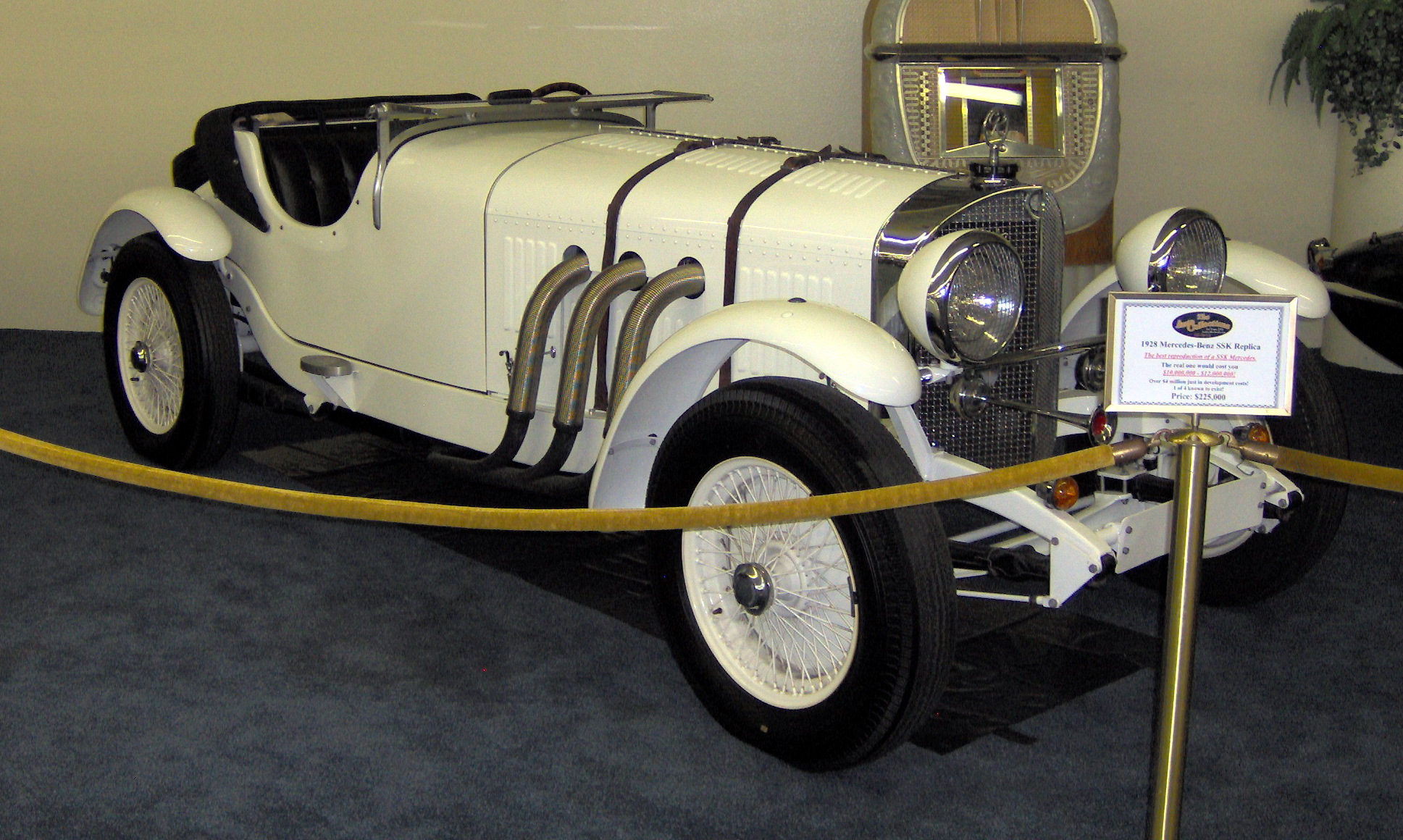
Mercedes-Benz SSK
"...u see there. And I mean they have everything from SSK Mercedes and V12 Cadillacs to wild gassers. I'm s..."
The Mercedes-Benz SSK is an old Mercedes sports car from the 1920s. It used a supercharger, which helps it make strong power for its time. It’s often mentioned because it’s a famous example of early, high-performance engineering.
The Mercedes-Benz SSK is a vintage, high-performance Mercedes built in the 1920s, famous for its supercharged power and racing heritage. It’s the kind of car collectors and historians bring up when discussing early “wild” performance machines. In a lineup that includes other extreme classics, the SSK stands out as a legendary supercharged grand tourer/racer.
under the hood
"He opens the hood. It is completely bone stock, nothing even touched and dirty as hell."
“Under the hood” means looking at the engine area. People check it to see if the car looks cared for or if parts look recently replaced.
“Under the hood” refers to the engine bay area where you can inspect the engine and related components. In car-auction or judging contexts, it’s often used as a quick proxy for how the car has been maintained and whether parts look original or recently replaced.
bone stock
"It is completely bone stock, nothing even touched and dirty as hell."
“Bone stock” means the car is basically as it came from the factory, not modified. At an auction, that can be a good sign because it suggests fewer unknown changes.
“Bone stock” means the car is essentially in factory-original condition, with no meaningful modifications. In enthusiast and auction judging, it matters because modified cars can be harder to value and may have unknown reliability or fitment history.
alternator
"the only thing I see is a brand new shiny alternator, you know, like he just got it at Napa"
The alternator is what keeps the car’s battery charged while you drive. If it’s brand new compared to everything else, it usually means someone replaced that part recently.
An alternator is the electrical generator on a car that powers the vehicle’s electronics and recharges the battery while the engine is running. If it looks newly replaced while the rest of the engine bay is dirty or untouched, it can indicate selective recent maintenance rather than a fully refreshed setup.
Napa
"like he just got it at Napa, you know, and, because everything else is covered in grease and dirt"
NAPA is a parts store/brand people use to buy replacement car parts. Saying it was “at Napa” implies the part was replaced using an aftermarket source.
NAPA (often referring to NAPA Auto Parts) is a well-known aftermarket parts retailer and brand in the U.S. Mentioning “Napa” in this context suggests the alternator was purchased as a replacement part from a mainstream parts supplier rather than being an original-equipment component.

Chevrolet Chevelle
"So there was a guy there that had a 69 Chevelle. And it, it was not a show car. It was a nice clean driver and we come walking up to it..."
A 1969 Chevelle is a classic Chevrolet from the muscle-car era. Here, the point is that this one is a well-kept driver and still has a lot of original details, not a heavily restored show-car look.
The Chevrolet Chevelle is a classic American muscle-era car, and a 1969 Chevelle is especially sought after for its styling and period-correct details. In this segment, the host highlights a 1969 Chevelle that’s described as a “nice clean driver” with original colors and components, which is a big part of why it stands out at a judging event.
vinyl top
"It was brown with like a cream top, not a vinyl top, a painted top. Well, I knew right away I went, wow, this looks like that was the original color..."
A vinyl top is a roof covering on some classic cars that’s made to look like vinyl/leather. In this story, the car doesn’t have that—its roof is painted the contrasting color instead, which the host says is rarer.
A vinyl top is a factory-style roof covering made to look like leather or vinyl, often used on classic cars to create a contrasting upper look. The host contrasts it with a “painted top,” saying that most buyers who went with a two-tone look chose a vinyl top, making the painted-top example more unusual.
two tone
"And it, it was brown with like a cream top, not a vinyl top, a painted top. Well, I knew right away I went, wow, this looks like that was the original color. And two tone in 69, like 66, 7, 8, 9, really rare."
“Two tone” means the car has two different paint colors, usually one on the top and a different one on the bottom. The host is saying this particular two-color setup was uncommon for that year.
“Two tone” refers to a paint scheme where the car uses two different colors—commonly a contrasting upper and lower body color. On a 1969 Chevelle, the host notes that two-tone combinations were rare, and that many buyers who wanted a two-tone look instead chose a vinyl top.
upper radiator hose
"And he opens the hood and when he replaced like the upper radiator hose, he made sure he got a GM radiator hose. Just like a Napa or something."
The upper radiator hose is the coolant hose that carries hot engine coolant from the engine toward the radiator. The host emphasizes that when it was replaced, the owner chose a GM radiator hose, which supports the car’s “period-correct/original” theme.
GM radiator hose
"And he opens the hood and when he replaced like the upper radiator hose, he made sure he got a GM radiator hose. Just like a Napa or something."
This means the hose was replaced with one meant to match what GM originally used. The host is using it as evidence the car has been kept in a more original, correct way.
A “GM radiator hose” means the replacement coolant hose was sourced to match GM’s original equipment (OEM) style. In judging terms, using the correct brand/spec part helps preserve originality and can be a sign the car has been maintained with period-appropriate components.
factory original
"And, you know, the car was, you know, that old, but it was like the interior wasn't a repop interior. It was a well-maintained cream, you know, interior that was somebody took good care of and it was factory original."
“Factory original” means the car still has the original-style parts and look from when it was built. The host is saying this Chevelle’s interior and details weren’t replaced with cheap copies.
“Factory original” means the car’s components and appearance are as they were when the vehicle left the factory, rather than being replaced with aftermarket or restyled parts. The host uses it to explain why the interior and other details are valued—because they’re described as not being “repop” (reproduction) and instead well maintained.
E85
"“Hey, I know we got a couple other things to talk about, but before we do, I wanted to ask you, the other day I pulled into a gas station and the fuel was only 2.99 a gallon… So I filled up and then I realized it was E85. Is that going to be a problem for my… for my truck?”"
E85 is a type of fuel that’s mostly alcohol (ethanol) mixed with regular gasoline. Some cars and trucks are built to use it, but others aren’t, so it can cause problems if your vehicle isn’t meant for it.
E85 is a fuel blend made mostly of ethanol (about 85% ethanol) mixed with gasoline. It can be cheaper, but not every truck is designed to run on it—flex-fuel vehicles can, while others may need different fueling or tuning to avoid drivability issues.
octane sensor
"If you do not have the octane sensor, then yes."
The octane sensor is a sensor that helps the car figure out what kind of gasoline you put in. It then adjusts the engine timing so the engine doesn’t knock and get damaged.
An octane sensor helps an engine detect the fuel’s knock resistance (octane rating). That information lets the engine adjust ignition timing to reduce knocking and protect the engine.
flex fuel vehicle
"And it's doesn't, there's no notification on there that says, [3101.2s] if you're not a flex fuel vehicle, do not use this a good harm your motor or anything like that."
A flex fuel vehicle is built to run on different fuel mixes, especially gasoline blended with ethanol. The car has sensors so it can adjust itself for the fuel you’re using.
A flex fuel vehicle is designed to run on more than one fuel blend, typically gasoline mixed with ethanol (like E85). It uses sensors and engine calibration to handle the different fuel properties safely.
diesel fuel
"And I noticed they carry two types of diesel there. And I had to go in and ask the guy, hey, which diesel do I use?"
Diesel fuel can come in different versions depending on how it’s regulated and taxed. The speaker is saying some diesel is intended for certain uses (like farm vehicles), and using the wrong one can cause trouble.
Diesel fuel can be sold in different regulated forms, and the differences can be tied to taxes and intended use. In the segment, the host describes two types of diesel at a station and how one is meant for farm or other off-road uses.

3500 Dodge 3500
"And I just bought an old diesel truck, about a 2008 Dodge 3500 to tow the Airstream safely."
A 2008 Dodge 3500 is a heavy-duty truck that’s often used for towing. Here, it’s the truck the speaker bought to pull an Airstream trailer.
The Dodge 3500 (from the 2008 model year) is a heavy-duty pickup commonly used for towing. In this segment, it’s specifically mentioned as the truck the host bought to tow an Airstream safely.
run pretty lean
"Well, the air fuel mixture would be different and you'd run pretty lean without... But dangerous for the engine because it would potentially cause it to run lean."
Running lean means the engine isn’t getting enough fuel. That can make it run hotter and can damage engine parts over time.
Running lean means the engine is getting relatively less fuel than it needs for the amount of air. That can increase stress on components and raise combustion temperatures, which is why the hosts call it dangerous for the engine.
air fuel mixture
"Well, the air fuel mixture would be different and you'd run pretty lean without. And it also eats lots of stuff in those motors."
Your engine needs the right balance of air and fuel. If there’s too much air compared to fuel, the engine can run too hot and be at risk.
The air-fuel mixture is the ratio of air to fuel entering the engine. If the mixture is off—like running too lean (too much air for the amount of fuel)—combustion temperatures and conditions can become harmful to the engine.
fuel lines
"The ethanol does eat fuel lines. Probably less of an issue on modern cars, but yeah, the extra ethanol does eat fuel lines."
Fuel lines are the tubes that move fuel to the engine. Ethanol fuels can wear out some fuel-line materials faster than regular gasoline.
Fuel lines are the hoses/tubing that carry fuel from the tank to the engine. Ethanol in fuels like E85 can be more aggressive than gasoline, so it may degrade certain materials and cause leaks or fuel-system issues.
knock sensors
"But dangerous for the engine because it would potentially cause it to run lean. Like you'll have your knock sensors and stuff in the modern cars and it'll try to adjust for some amount of octane."
Knock sensors help the engine detect harmful pinging/knocking. The computer then makes adjustments to keep combustion under control.
Knock sensors detect engine knock (abnormal combustion). Modern engines use that feedback to adjust timing and fueling to reduce knock risk, which matters when fuel octane changes.
octane ranging from 100 to 105
"it can be a misnomer too because E85 has an octane ranging from 100 to 105. So that sounds like, oh my God, that's great."
E85 can have a very high octane number (they mention 100 to 105). High octane sounds great, but it still has to match what the engine is designed to use.
The octane rating for E85 can vary, and the hosts cite a range of 100 to 105. That high octane is one reason people associate E85 with racing fuel, but the engine still needs the correct calibration and fuel-system compatibility.
40% less efficient
"And yeah, but E85 is cheaper because it's like 40% less efficient. Right, right."
E85 usually contains less usable energy per gallon than regular gasoline. So you often have to use more fuel to get similar results.
E85 is often described as less energy-dense than gasoline, meaning you typically need more fuel to produce the same amount of work. That’s why the hosts mention it being “less efficient,” even if it has high octane.
manual transmission
"And they said, it was a manual transmission. And he goes, I know there's all about reactions, but if the throttle stuck, why don't you just push in the clutch or turn off the ignition?"
A manual transmission is the kind of car where you use a clutch pedal and shift gears yourself. In a scary moment like a stuck gas pedal, the clutch can help you reduce how much power the engine sends to the wheels.
A manual transmission is a gearbox that requires the driver to use a clutch pedal and shift gears manually. It changes how you respond to a stuck-throttle situation because the clutch can disconnect engine power from the drivetrain.
throttle stuck
"And he goes, I know there's all about reactions, but if the throttle stuck, why don't you just push in the clutch or turn off the ignition? You know?"
“Throttle stuck” means the gas pedal (or the mechanism behind it) won’t let the engine slow down. If that happens, drivers may need to shut the engine off or use the clutch to stop power from reaching the wheels.
“Throttle stuck” means the accelerator/throttle plate can’t return to idle, so the engine keeps making power even when the driver tries to release the pedal. In an emergency, common advice is to cut ignition and/or use the clutch to reduce wheel torque.
push in the clutch
"but if the throttle stuck, why don't you just push in the clutch or turn off the ignition? You know? But not everyone is that fast on the..."
In a manual car, pushing the clutch pedal disconnects the engine from the wheels. That can help if the car is still trying to move because the gas is stuck.
Pushing in the clutch disengages the engine from the transmission in a manual car. That can help reduce how much engine torque reaches the wheels during a problem like a stuck throttle, especially at low speeds.
carpet could have slid under the gas pedal
"Well, the carpet could have slid under the gas pedal and locked it in play. I mean, who knows?"
Sometimes a floor mat or carpet can move and get under the gas pedal. If it does, it can keep the gas pedal pressed even when you’re trying to stop.
If a floor mat or carpet slides under the accelerator pedal, it can physically hold the pedal down and mimic a mechanical “stuck throttle.” This is a known hazard in cars with loose or improperly secured floor coverings.
burnouts
"I don't think it was doing burnouts inside. Right. It was powerful. I think he was trying to lock up the rear, right?"
A burnout is when the driver makes the tires spin without moving forward much. It usually happens when the tires lose grip.
A burnout is when a driver spins the driven wheels to generate tire smoke and heat. In this context, they’re talking about wheel slip and traction loss while trying to control the car.
lock up the rear
"I think he was trying to lock up the rear, right? He was trying to lock up or lock up the front and was doing its own little burnout."
“Locking up the rear” means the back tires stop rolling and start sliding. When that happens, the car can become hard to steer.
“Locking up” the rear means the rear wheels stop rotating and slide because braking (or traction) is too aggressive. That typically reduces steering control and can contribute to loss of control, especially on low-grip surfaces.
power brakes
"when you're pushing these cars, if they've got power brakes and it's not running, you go to hit the brakes. If you're going down the ramp on the other side, you don't have a lot of braking power either."
Power brakes help you stop with less pedal effort. If the engine isn’t running, that help can be gone, so braking can feel much weaker.
Power brakes use a booster (often vacuum or hydraulic assist) to multiply braking force. If the car isn’t running, the booster may not provide assist, so braking can feel weak—especially when you’re moving the car on/off a ramp.
Barrett Jackson
"I mean, I remember years ago when we were consulting for Barrett Jackson and this all came up and we talked about it. And that's when we suggested the white glove service,"
Barrett-Jackson is a well-known collector-car auction company. The hosts mention it to reference prior consulting and safety practices around moving cars during auction logistics.
white glove service
"and this all came up and we talked about it. And that's when we suggested the white glove service,"
“White glove service” means extra careful, professional handling. Here it’s about reducing the chances of damage or accidents when cars are being moved around.
“White glove service” is a service level where staff handle vehicles with extra care and controlled procedures rather than casual handling. In auction contexts, it usually means minimizing risk while moving cars around ramps, lots, and staging areas.
Request an Explanation
Heard something you'd like explained? We'll add it to this episode.
Sign in to request explanations for terms you heard.
Want to learn more?
Browse our glossary for plain-English explanations of automotive terms, jargon, and concepts.
Help improve this episode
See something that's not quite right? Our annotations are AI-generated and can sometimes miss the mark. Click the flag icon on any annotation to suggest a correction.