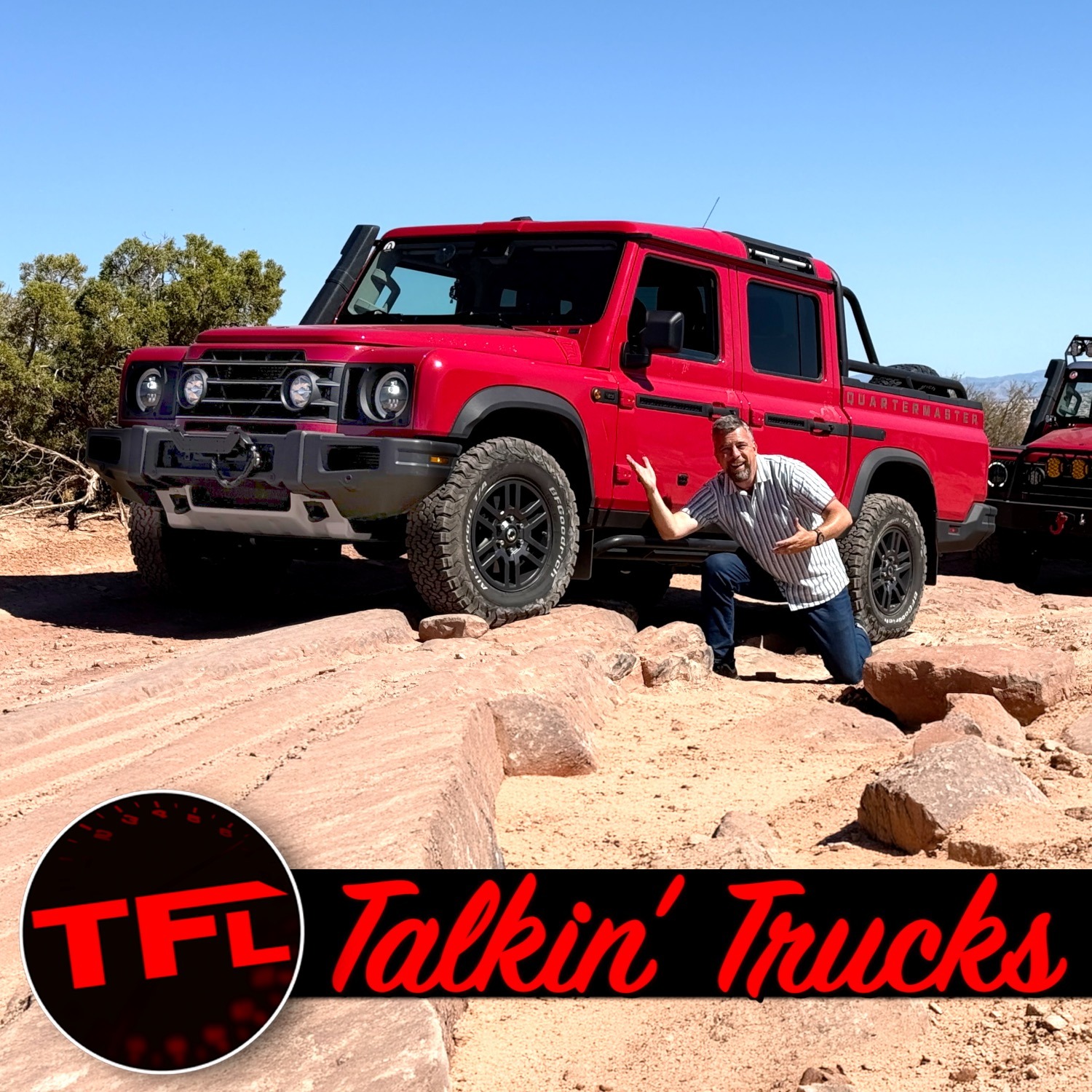
Offroad Truck Lovers - Buy These Pickups Before It’s Too Late! | Ep. 330
About this episode
The hosts kick off with a debate on what makes a pickup great off-road versus on-road, then tie their Moab testing to traditional hardware like ladder-frame design, solid axles, and lockers. Portal axles come up as a clearance hack—though they’re expensive and need gear-oil maintenance. They also cover rock-crawling realities: approach/breakover/departure angles, visibility limits from modern hood shapes, and why locker/low-range behavior can be finicky. The episode closes with practical buying and ownership talk, including emissions-delete and warranty concerns.
( https://www.alltfl.com/ ) Check out our new spot to find ALL our content!
In this episode, Andre and Kase dive deep into the age-old debate: Does the "perfect" off-road truck actually exist, or is every great trail rig a massive compromise on the pavement?
The catalyst for today’s discussion is the arrival of the Ineos Grenadier Quartermaster in the TFL test fleet. Andre recently took this old-school, solid-axle pickup on a 360-mile trek from Boulder to Moab for a massive gathering of nearly 200 Ineos vehicles. We break down how it handled the long highway miles versus nine hours of grueling technical trails in Utah.
We also take a look at a wild project from our friend Jay Couch—a portal-axle equipped Grenadier on 37s—and discuss why portal axles might be the ultimate (if expensive) solution for ground clearance.
( http://www.patreon.com/tflcar ) Visit our Patreon page to support the TFL team!
Advertising Inquiries: https://redcircle.com/brands
Privacy & Opt-Out: https://redcircle.com/privacy

Unimog
"And the way that we know Jay couch is because he's a big unimog guy. Yeah. So generally, his two primary areas have been first and foremost, building some insane half million dollar plus unimog campers, even racing unimogs all kind of crazy stuff."
Unimog is a rugged off-road truck line that can be built for all kinds of specialized uses. The hosts are saying Jay Couch really likes them and even builds and races custom versions.
Unimog is a Mercedes-Benz off-road truck platform known for extreme versatility, including specialized military and industrial configurations. The hosts mention Jay Couch as a “big unimog guy,” including building custom unimog campers and racing unimogs, which signals how serious and capable the vehicle is in off-road contexts.
6x6, 8x8, and 10x10
"He's got also has a lot of six by six, eight by eight and even 10 by 10, military off-road vehicles, which are pretty cool. But he's also a big G-wagon guy..."
“6x6,” “8x8,” and “10x10” tell you how many wheels a vehicle has and how many of them get power. More driven wheels usually means better grip when the terrain is rough.
The “6x6,” “8x8,” and “10x10” notation describes how many wheels a vehicle has and how many are driven. More driven wheels generally improves traction and low-speed control for heavy off-road and military-style applications.

G-Class Gwagon
"[SPEAKER_00]: He's got also has a lot of six by six, eight by eight and even 10 by 10, military off-road vehicles, which are pretty cool. [SPEAKER_00]: But he's also a big G-wagon guy, and I think that this Ineos appealed to him in a special kind of way, but of course, if J couch is going to do anything with Ineos, it's going to be over the top because that's how we operate. [SPEAKER_01]: Exactly, so, and just really quick before we look at J-Struck as well."
The G-Class is a luxury SUV that’s also built to go off-road. The podcast mentions special versions with extra wheels, like 6x6 and 8x8, which are made for extreme terrain. It’s being discussed because it has a reputation for rugged capability.
The G-Class (often called the G-Wagon) is a boxy, luxury off-road SUV known for its rugged design and ability to handle serious terrain. The podcast mentions multiple extreme, military-style variants like 6x6, 8x8, and even 10x10, emphasizing how far the platform can be taken. That’s why it comes up—because it’s both an off-road icon and a base for unusual, high-capability configurations.

Ineos Grenadier
"Ineo is guaranteed here, and I want to hit these points. The chassis is a ladder frame, so it's a body-on-frame vehicle. It's got solid axles front and rear."
The Ineos Grenadier is an off-road truck designed with a classic truck structure. It uses a ladder-style frame, heavy-duty axles, and it can be equipped with locking differentials so it can keep traction on tough trails.
The Ineos Grenadier is a modern off-road truck built around traditional, truck-like hardware. In this segment, the hosts highlight its ladder-frame body-on-frame layout, solid front and rear axles, and factory-available locking differentials—key traits for serious trail use.
ladder frame
"The chassis is a ladder frame, so it's a body-on-frame vehicle. It's got solid axles front and rear."
A ladder frame is the truck’s main metal skeleton. It’s built like two long rails with bars connecting them, and it’s popular on off-road trucks because it’s tough over bumps and rough terrain.
A ladder frame is a rigid, rectangular frame made of two long rails connected by crossmembers. It’s common on traditional off-road and work trucks because it’s strong and can better tolerate heavy loads and rough trail impacts.
body-on-frame
"The chassis is a ladder frame, so it's a body-on-frame vehicle. It's got solid axles front and rear."
Body-on-frame means the car’s body sits on top of a separate heavy-duty frame. Off-road trucks use this because it tends to be stronger when you hit rocks, ruts, and big bumps.
Body-on-frame means the vehicle’s body is mounted on a separate, full frame (instead of being integrated like a unibody). For off-roading, this usually helps with durability and allows the suspension and drivetrain to work with more traditional, rugged geometry.
solid axles front and rear
"It's got solid axles front and rear. It also has locking differential front and rear, which are optional, actually, but you could equip it from the factory."
Solid axles connect the wheels with a rigid bar. That helps the truck keep traction when the ground is uneven, because the wheels can follow bumps and dips more effectively.
Solid axles are axles where the left and right wheels are connected by a rigid beam, so they move together as a unit. With solid axles on both front and rear, the truck can keep tires in contact over uneven terrain, which is a big advantage for off-road traction and articulation.
locking differential
"It also has locking differential front and rear, which are optional, actually, but you could equip it from the factory. Yeah."
A locking differential makes both wheels on the same axle turn together. If one wheel starts slipping, it helps the other wheel still get power so the truck can keep going.
A locking differential forces both wheels on an axle to rotate at the same speed. That prevents one wheel from spinning freely when it loses traction, which helps a truck move forward in mud, sand, or rock crawling where grip is uneven.
pinion angle
"with these innios vehicles in particular, if you try to lift them very heavily, much beyond an inch and a half or two inches, the pinion angle on the drive shaft gets pretty crazy, it builds up a lot of heat and the vehicles just not have destroyed itself after that."
Pinion angle is the alignment angle of the gears that send power to the driveshaft. If you lift the truck too high, that angle can get off, making the drivetrain work harder and run hotter.
Pinion angle is the orientation of the differential’s driveshaft “pinion” relative to the driveshaft and the rest of the drivetrain. When you lift a truck too much, the pinion angle can become misaligned, increasing driveshaft vibration and heat, which can accelerate wear or damage.
drive shaft
"the pinion angle on the drive shaft gets pretty crazy, it builds up a lot of heat and the vehicles just not have destroyed itself after that."
The drive shaft is the part that carries power from the drivetrain to the axle. If the truck is lifted and the angles change too much, it can cause extra stress and heat.
The drive shaft (prop shaft) transfers torque from the transmission/differential area to the axle(s). If the lift changes drivetrain angles too much (like with pinion angle), the drive shaft can run with higher vibration and heat, stressing components over time.
portal axles
"Now the other cool thing about portal axles is you get a lot of ground and a lot of extra ground clearance versus doing a suspension lift because your axle moves that further from the ground... And you could put tiny tires on it still and still have a lift."
Portal axles are a special axle design that gives you extra ground clearance. Instead of lifting the whole suspension, the axle’s gearing is arranged so the wheels sit higher off the ground.
Portal axles are a drivetrain layout where the axle centerline is lowered and the final drive gears “port” the wheel upward, effectively raising the vehicle’s ground clearance without raising the whole suspension. That means you can get more clearance even with smaller tires, because the axle/gearbox assembly sits differently relative to the body.
suspension lift
"typically solid axle vehicles one of the perks usually versus independent front suspension is that it's a little easier to get away with the geometry of lifting them more heavily, but not so much the case with these grenadiers... So if you do a typical suspension lift, the only way your axle is getting higher up off the ground and offering you more clearance is by running a bigger tire"
A suspension lift raises the truck by changing the suspension. It can improve clearance, but it can also mess with how the drivetrain angles line up.
A suspension lift raises the vehicle’s body relative to the axles by changing suspension components or geometry. The tradeoff is that lifting also changes drivetrain angles, which can create issues like driveshaft stress if the lift is too large.
gear oil
"Portals are very expensive and they do require maintenance because they have gear oil in them."
Gear oil is the special lubricant that keeps gears from wearing out. Portal axles have extra gears inside, so they need gear oil and periodic service.
Gear oil is the lubricant used in differentials and gearboxes to handle high loads and sliding contact between gear teeth. Portal axles contain additional gearing, so they require gear oil inside the axle housings, which adds maintenance requirements compared with simpler axle designs.
Camel Trophy
"And you look back at photos from camel trophy back in the day and some land rovers that did some really incredible things in those competitions and difficult tasks off-road. They were never running really huge tires."
Camel Trophy was a famous off-road event where teams drove 4x4s through very challenging terrain. They mention it to make the point that you don’t always need huge tires to do well off-road.
The Camel Trophy was a long-running off-road competition known for testing 4x4s and drivers in remote, difficult terrain. The hosts reference it to illustrate how classic Land Rovers performed in tough conditions without relying on extremely large tires.
heavy foot
"because back then, people had skill. Sure, they also had a heavy foot. You know, carry some momentum and a lot of articulation."
“Heavy foot” just means driving with more throttle than usual. Off-road, that can help keep speed and momentum when you hit rough sections.
“Heavy foot” is slang for aggressive throttle use—pressing the accelerator more than average. In off-road contexts, it often implies using more power to keep momentum through obstacles.
articulation
"Sure, they also had a heavy foot. Yes. You know, carry some momentum and a lot of articulation. The interesting thing actually about a stock grenadier, whether it's the SUV that they call the wagon, or the pickup truck version of it, the quartermaster, like what you brought out to Moab."
Articulation is how much a vehicle’s suspension can move up and down on one axle while keeping tires in contact with uneven terrain. More articulation helps maintain traction over bumps and dips, which matters a lot in off-road competitions.
Ineos Grenadier Quartermaster
"The interesting thing actually about a stock grenadier, whether it's the SUV that they call the wagon, or the pickup truck version of it, the quartermaster, like what you brought out to Moab. Is it even though they don't look like they have a whole lot of clearance?"
The Ineos Grenadier Quartermaster is the pickup version of the Grenadier. They’re talking about it as an off-road truck that can handle trails like Moab, even if it doesn’t look like it has huge clearance at first glance.
The Ineos Grenadier Quartermaster is the pickup version of the Grenadier lineup, designed to keep the same off-road “tool truck” concept while adding a bed. Here it’s referenced in the context of trail capability around Moab and how the truck’s stance/clearance affects perception versus real-world performance.
portals
"Well, because I think this, the granite deer that he brought on 37's, so those portals allowed him to put a 37-inch tall tire pretty easily... So if the stock Granidier has about 10 inches of ground clearance, J told me his portals are offering about four and a half inches of lift."
In off-road truck talk, “portals” are axle parts that add extra clearance under the truck. They help the truck sit higher so bigger tires can fit and the wheels can clear obstacles.
“Portals” in an off-road truck context usually refers to portal axles—gearboxes integrated into the wheel hubs. They effectively raise the axle centerline and increase ground clearance without needing as much suspension lift.
37's
"Well, because I think this, the granite deer that he brought on 37's, so those portals allowed him to put a 37-inch tall tire pretty easily, also much wider tires as well without rubbing."
“37’s” means the truck is running very large tires—about 37 inches tall. Larger tires usually help the truck clear rocks and ruts, but they can require lift and careful fitment so they don’t rub.
“37’s” refers to 37-inch tall off-road tires. Bigger tire diameter increases ground clearance and can improve obstacle clearance, but it also affects fitment, steering/suspension geometry, and rubbing clearance.
test bed
"This is kind of his test bed, right? So it's not really like, hey, Jay, you know, how much is this going to cost? Because he's kind of testing things out, for sure, getting it fit it."
A “test bed” is basically a trial platform. They’re using the truck to try out the parts and make sure everything fits and works well off-road.
A “test bed” is a vehicle setup used to trial modifications in real-world conditions. In this context, they’re describing how the truck is being used to evaluate fitment and how well the off-road parts work before selling or sharing the concept.
ground clearance
"I mean, because ground clearance is insane. So if the stock Granidier has about 10 inches of ground clearance, J told me his portals are offering about four and a half inches of lift."
Ground clearance is how high the truck sits off the ground. The higher it is, the less likely you are to hit the bottom of the truck when driving off-road.
Ground clearance is the distance between the lowest part of the vehicle and the ground. More ground clearance helps reduce the chance of scraping the undercarriage on rocks, ruts, and uneven trails.
Litek
"There is a German company called Litek. Litek. Thanks so, yes."
They’re a German company that makes an off-road “portal kit.” The kit helps change how the wheels sit on the truck, which can improve clearance for rough terrain.
Litek is a German company mentioned in the context of off-road “portal kit” installations. A portal kit changes how the axles sit and how the wheels are packaged, which can affect ground clearance and vehicle stance.
portal kit
"they also had a portal kit that was fitted to a lot of any else grenadiers. And it looked neat, but it also looked pretty top-heavy."
A portal kit is an off-road upgrade that raises the wheels using gearing near the hubs. It can give you more clearance for rocks and ruts, though the truck’s overall balance can change.
A portal kit is an off-road modification that uses “portal” gearboxes at the wheel hubs to raise the axle centerline. That increases ground clearance without needing to lift the whole suspension as much, but it can also make the vehicle feel more top-heavy depending on the overall setup.
track width
"They're very, very narrow track width vehicles. If I remember correctly, and if you don't believe me, feel free to Google this."
Track width is how wide the truck is from one wheel to the other. A wider track usually feels more stable, while a narrow track can feel tippier, especially if the truck sits higher.
Track width is the distance between the left and right wheels on the same axle. Wider track width generally improves lateral stability because it increases the “stance” of the vehicle, while narrow track width can make it feel more tippy—especially when combined with a higher center of gravity.

Ford Focus
"But I'm pretty sure the track width of a Ford Focus. is wider than the old G-Wag and the old solid axle G-Wagans before they updated them in 2018."
They bring up the Ford Focus to make a comparison about width. The point is that the Focus can be wider than older solid-axle G-Wagons, which can make the truck feel less tippy.
The Ford Focus is mentioned as a reference point for track width. The host is arguing that even a small car can have a wider track than older solid-axle Mercedes-Benz G-Wagons, which affects perceived stability.
tippy
"It's not like they get tippy and and also we can talk about with a little bit later because when you have a super white truck like an empty wrap there Yeah, you you have trouble fitting into some trails."
“Tippy” is shorthand for a vehicle feeling like it will tip over, which relates to rollover risk. Width, suspension geometry, and how the truck is loaded all affect how stable it feels on uneven terrain.
rock crawling
"Yeah, so when we typically talk about off-roading, we are talking about rock crawling, because we live in the Rocky Mountains and Rocky is an accurate description."
Rock crawling is off-roading over rocks at very low speeds. You’re trying to keep the tires gripping while you carefully climb or go down obstacles.
Rock crawling is a slow, technical form of off-roading where the goal is to maintain traction while climbing or descending rocks and obstacles. It typically emphasizes low-speed control, articulation, and clearance—hence the discussion about vehicle width and suspension/axle setups.

F-150 Raptor
".... [SPEAKER_00]: I think that like the majority of raptor trucks, for example, those are more high speed of..."
The Ford F-150 is a full-size pickup truck. The podcast is talking about Raptor versions, which are built to drive faster and handle rough roads. So the F-150 is mentioned as the base truck line for that kind of performance setup.
The Ford F-150 is a full-size pickup that comes in many configurations, including performance-focused variants. In the podcast excerpt, it’s referenced in relation to “Raptor” trucks and how they’re more oriented toward higher-speed driving. That makes the F-150 relevant because it’s the platform for those high-performance off-road models.
solid axle configuration
"And traditionally speaking, solid axle configuration is a great setup for rock crawling. Especially because they articulate really well"
A solid axle connects both wheels with one sturdy bar. When you hit rocks, it helps the tires stay on the ground so you can keep traction.
A solid axle configuration means the left and right wheels are connected by a single rigid axle beam. On rock crawling, that design helps the truck keep more tire contact as the suspension moves over uneven rocks, which improves traction.
articulate
"Especially because they articulate really well it's not to say that you can't design in an independent front suspension that articulate to really well. There's a lot of very, very capable rock buggy"
Articulation is how much the suspension can “flex” so the wheels can move independently over bumps. More flex usually means better tire contact and traction off-road.
In off-roading, “articulation” refers to how well a suspension can move so one wheel can travel up while the other travels down. More articulation usually helps maintain tire contact on rocks and ruts, improving grip.
independent front suspension
"it’s not to say that you can't design in an independent front suspension that articulate to really well. There's a lot of very, very capable rock buggy, some crazy machines that run IFS"
Independent front suspension means the left and right front wheels can move separately. That can still work great off-road, but it may not match a solid axle’s wheel-to-wheel flexibility in extreme crawling.
Independent front suspension (IFS) means each front wheel moves separately rather than being tied together by a solid axle. It can still provide strong articulation with the right geometry and setup, but it often trades off some rock-crawling performance compared with a solid axle.
sway bar disconnect
"for example, the full size for Bronco, independent front suspension with a sway bar disconnect and you get fantastic amount of articulation from that"
A sway bar disconnect lets the suspension move more freely. Off-road, that can help each wheel stay in contact with the ground when the truck is twisting over rocks.
A sway bar disconnect temporarily separates the anti-roll bar so it doesn’t resist suspension movement. On a rock-crawling truck, disconnecting the sway bar can increase articulation and help the wheels follow the terrain more independently.

Ford Bronco
"for example, the full size for Bronco, independent front suspension with a sway bar disconnect and you get fantastic amount of articulation from that"
The Ford Bronco is built for off-road driving. Here, they’re talking about how its suspension can be tuned (with a sway bar disconnect) to let the wheels move more over rocks.
The Ford Bronco is a modern off-road truck known for trail-focused suspension options. In this segment, the hosts highlight its independent front suspension setup with a sway bar disconnect to improve articulation for rock crawling.

Chevrolet Colorado ZR2
"I think a good example of that is the Colorado ZR2 in the Canyon 84X because those trucks have independent front suspension like all of the GM trucks, but they're great rock crawlers because they're very tall and they have front and rear lockers."
The Chevrolet Colorado ZR2 is an off-road-focused version of the Colorado. They’re saying it can still rock-crawl well even without a solid front axle because it has good ground clearance and locking differentials.
The Chevrolet Colorado ZR2 is a factory off-road trim built around trail capability rather than just styling. The hosts point out that even with independent front suspension, it can still crawl well thanks to its height/clearance and front and rear lockers for traction.
lockers
"because those trucks have independent front suspension like all of the GM trucks, but they're great rock crawlers because they're very tall and they have front and rear lockers."
Lockers are traction aids that make both wheels on an axle turn together. When one wheel loses grip on rocks, the other wheel can still pull you through.
Lockers are differential locking systems that force the left and right wheels on an axle to rotate together. On rock crawling, that helps prevent one wheel from spinning uselessly when traction is uneven, improving the truck’s ability to move forward.
live front axle
"But it is cool to see a truck on the market with a live front axle with a solid front axle because at this point, there is the grenadier and the Jeep Gladiator."
A live front axle is a solid front axle that’s connected to the drive system. Off-road, it can help the truck keep traction and let the wheels move well over rocks.
A live front axle is a solid axle where the axle assembly is connected to the drivetrain, so it both supports the vehicle and drives the wheels. For rock crawling, a live front axle is often favored because it can provide strong wheel articulation and traction over uneven ground.

Ram Heavy Duty
"There's the heavy duty ram and the heavy duty Ford. That's about it."
Ram Heavy Duty is Ram’s big, heavy-duty truck line. The hosts mention it because it’s one of the few trucks you can buy new that still uses a solid front axle.
Ram Heavy Duty refers to Ram’s heavy-duty pickup line, built for towing and work use. Here it’s mentioned alongside other brands as one of the limited set of trucks available with a solid front axle configuration.

Dodge Ram
"...ER_00]: Yes. [SPEAKER_00]: There's the heavy duty ram and the heavy duty Ford. [SPEAKER_00]: That's abo..."
The Dodge Ram is a full-size pickup truck. When people say “heavy duty,” they usually mean it’s built for towing and hauling more than a regular pickup. The podcast mentions it while comparing heavy-duty trucks.
The Dodge Ram (often referred to as the Ram heavy-duty line when discussing towing and hauling) is a full-size pickup known for work-focused configurations. The podcast excerpt specifically mentions “heavy duty Ram” in the same breath as “heavy duty Ford,” suggesting a discussion about capability and truck-of-choice decisions. That makes it relevant to a truck podcast because heavy-duty trucks are typically judged by towing, payload, and durability.
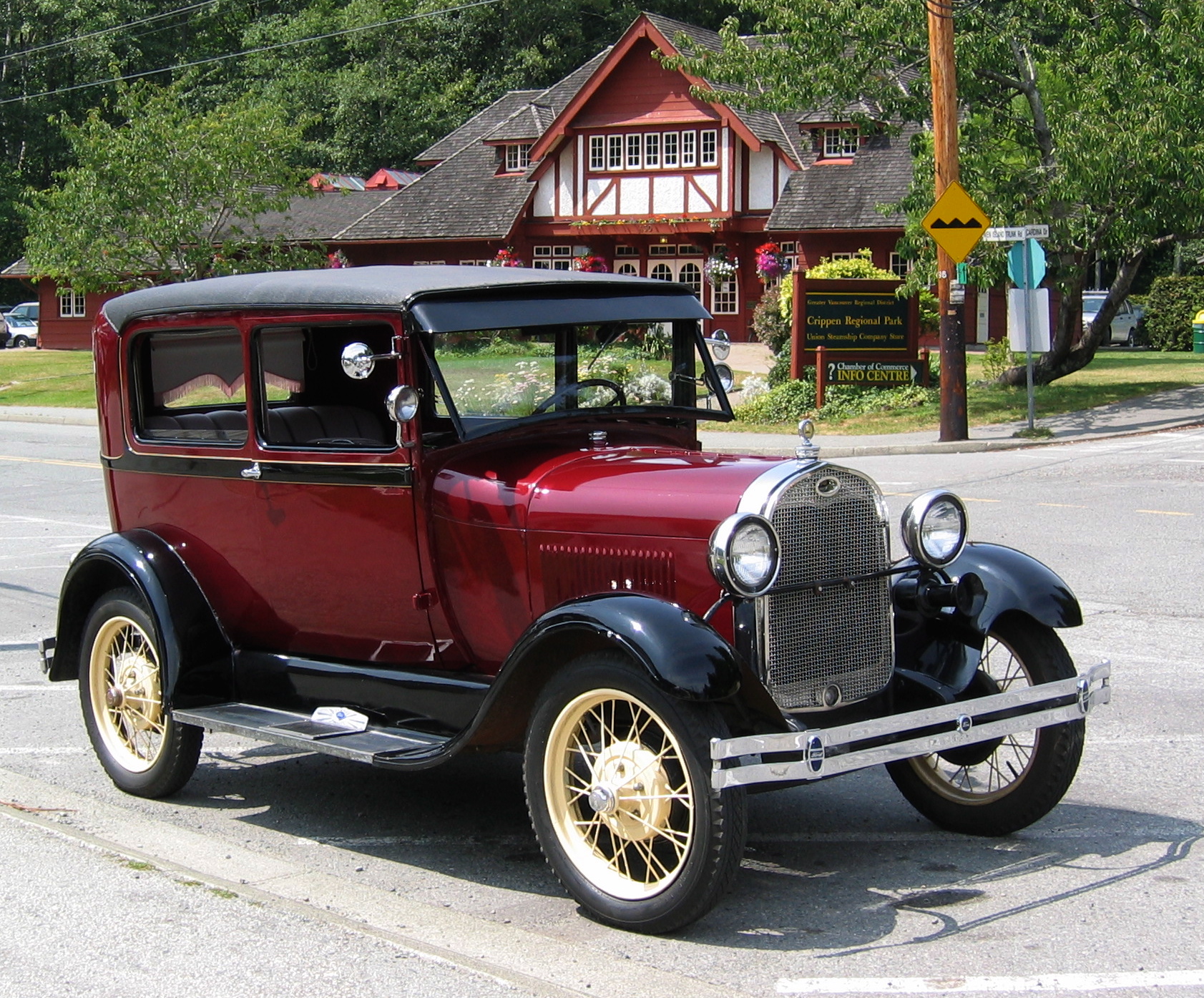
Ford Super Duty
"they would never consider a GM, HD truck because of the independent, because of the independence suspension, and they always say, you know, the Ford Super Duty and the RAM heavy duty trucks."
Ford’s Super Duty is a heavy-duty truck line meant for serious towing and work. The hosts bring it up as a popular pick for people who prefer certain heavy-duty truck designs.
The Ford Super Duty is Ford’s heavy-duty pickup line built for towing and work use. In this episode, it’s mentioned as a go-to choice in the heavy-duty segment, contrasted with GM’s heavy-duty trucks.
independent suspension
"they would never consider a GM, HD truck because of the independent, because of the independence suspension"
Independent suspension is when each wheel can move up and down more on its own. Some off-road people don’t like it as much as a solid axle, but others prefer it because it can ride and handle better on the road.
Independent suspension means each wheel can move somewhat independently, rather than both sides being mechanically linked. In trucks, some off-road buyers prefer solid-axle setups for durability and predictable articulation, while others like independent suspension for ride quality and on-road control.

RAM heavy duty trucks
"they always say, you know, the Ford Super Duty and the RAM heavy duty trucks."
RAM makes heavy-duty pickup trucks designed for towing and tough use. In the conversation, RAM is mentioned alongside Ford as a preferred option in the heavy-duty truck world.
RAM’s heavy-duty trucks are the brand’s lineup of large pickups aimed at towing, hauling, and off-road capability. Here, they’re grouped with the Ford Super Duty as the “heavy-duty” choices people prefer over GM due to suspension design preferences.
desert running
"you can have a good all-around truck that can do some rock crawling and can do some desert running"
Desert running is off-road driving across rough, sandy terrain. It usually requires suspension travel and stability so the truck can handle bumps and ruts.
Desert running refers to off-road driving across sandy or uneven desert terrain, where suspension travel, tire choice, and stability at speed are key. It’s mentioned here as another use case for an all-around truck that still works as a daily driver.
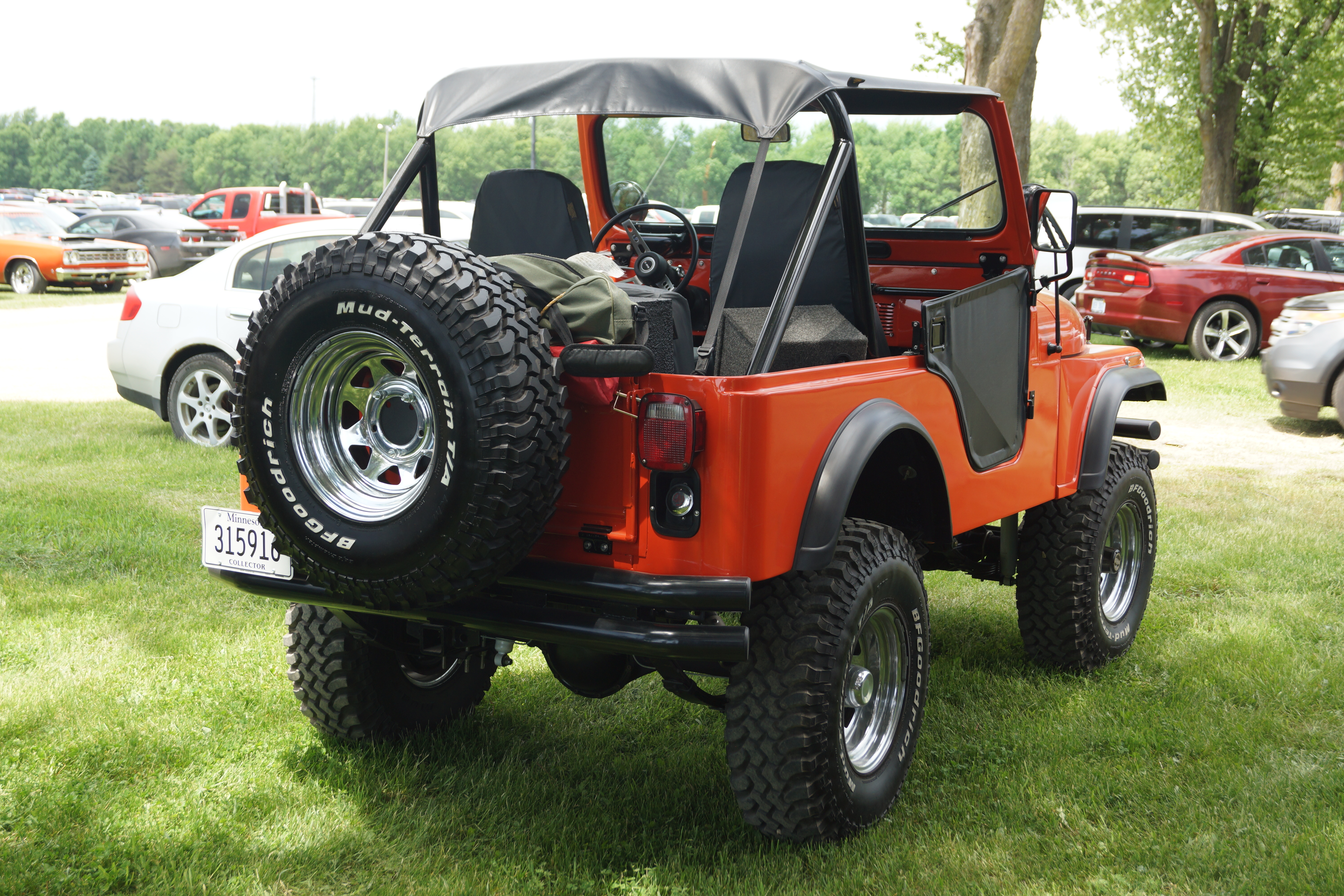
Jeep Cj2A
"I love solid front axles. It's how I learned how to drive a lot of an old CJ2A."
The CJ2A is an old Jeep that’s famous for being tough and capable off-road. The host mentions it to explain they’re used to the way solid-axle vehicles drive.
The CJ2A is an early Jeep model known for its simple, rugged, off-road-focused design. The host says they learned to drive in vehicles with a solid front end like the CJ2A, which highlights how solid-axle behavior feels to them.
Lane Rover
"you know, without giving them too much praise and lighting comments on fire. Lane Rover does a great job, or has in the past of making some vehicles that have cross-linked air suspension fully independent"
This sounds like “Land Rover,” a brand that makes SUVs built for off-road. The host is saying Land Rover has made suspension systems that work well both off-road and on regular roads.
“Lane Rover” appears to be a transcription error for Land Rover, a brand known for off-road-capable SUVs. The host specifically credits Land Rover’s suspension engineering—fully independent setups with air suspension—for combining off-road wheel movement with good on-road driving.
cross-linked air suspension
"Lane Rover does a great job, or has in the past of making some vehicles that have cross-linked air suspension fully independent that still articulates really well"
Cross-linked air suspension is an air-spring suspension system where the left and right sides are connected in a way that helps the truck/suv stay controlled over bumps. The goal is better off-road wheel movement without giving up too much ride quality on the road.
Cross-linked air suspension uses air springs with plumbing/valving that links left and right sides to help control how the vehicle levels and how the suspension responds over uneven ground. In the episode, it’s paired with fully independent suspension to maintain good articulation and clearance while still driving well on-road.
NVH
"The Honda Ridgeline is what I think a lot of engineers are targeting for NVH, noise vibration and harshness that kind of experience."
NVH is a measure of how much noise, shaking, and roughness you feel in the cabin. Lower NVH usually means the ride feels smoother and more “refined.”
NVH stands for noise, vibration, and harshness—how much sound, shaking, and harsh feel the vehicle transmits to the driver and passengers. Automakers tune NVH to make a vehicle feel more refined, especially in unibody crossovers and family trucks.

Honda Ridgeline
"No shade to the Honda Rich line. The Honda, the Honda Ridgeline is what I think a lot of engineers are targeting for NVH, noise vibration and harshness that kind of experience."
The Honda Ridgeline is a pickup that’s tuned to feel smoother and more comfortable, kind of like Honda’s SUVs. The point here is that it doesn’t drive like a typical rougher, more old-school truck.
The Honda Ridgeline is a pickup truck designed to feel more like a comfortable crossover than a traditional body-on-frame truck. The hosts connect it to NVH tuning and note that it drives more like a Honda CR-V or Pilot than a “truck” in the classic sense.

Honda Crv
"There's a Ridgeline drives a lot like a CRV across over or you know, a Honda pilot."
The Honda CR-V is a crossover SUV. In this segment it’s mentioned to explain that the Ridgeline feels more like an SUV to drive than like a classic truck.
The Honda CR-V is a compact crossover that’s used here as a driving feel comparison. The host is saying the Ridgeline drives more like an SUV (CR-V) than like a traditional truck with a more rugged, truck-like setup.

Honda Pilot
"There's a Ridgeline drives a lot like a CRV across over or you know, a Honda pilot."
The Honda Pilot is a larger family SUV. It’s mentioned to help you picture the Ridgeline’s driving feel as more SUV-like than truck-like.
The Honda Pilot is a midsize SUV used here as another benchmark for “SUV-like” driving feel. The host’s point is that the Ridgeline doesn’t behave like a traditional truck, and instead feels closer to how a Pilot drives.

Ferrari F50
"[SPEAKER_01]: There is a way, I think there is a way to make a truck with a front solid axle be refined. [SPEAKER_01]: When I drive a super duty and let's say like an F-50 and we're not talking about like chassis cabs that beat you up because they have really stiff springs and they're meant for something else. [SPEAKER_01]: but like I have to 50 or so, it feels trucky and feels big and strong, but it also feels like I can go a thousand miles in one, like from here to Phoenix, without a lot of fatigue, you know, without feeling like I need to saw it to wheel a little bit or, you know, [SPEAKER_01]: However, when you lift those guys, there is also something called death wobble, where, right, so that can come up if you improperly lift something, or with the same thing as your audience."
The Ferrari F50 is a very high-end sports car made for performance. The podcast mentions it to talk about how refinement can exist even in a vehicle that’s meant to be exciting to drive. It’s being used as a reference point in a discussion about ride and handling feel.
The Ferrari F50 is a high-performance supercar known for its track-oriented design and extreme driving character. In the podcast context, it’s brought up as part of a discussion about whether a truck with a front solid axle can still feel refined—using the F50 as an example of refinement in a very different vehicle category. That contrast is used to frame what “refined” can mean across vehicle types.
death wobble
"However, when you lift those guys, there is also something called death wobble, where, right, so that can come up if you improperly lift something, or with the same thing as your audience."
Death wobble is when a truck starts shaking violently from the front end, usually through the steering. It’s often triggered by suspension problems or an improper lift setup.
Death wobble is a severe steering/suspension vibration that can cause a truck to violently shake, often at certain speeds. It’s commonly associated with worn or improperly set suspension components—especially after lifting a solid-axle truck—leading to instability in the steering and front suspension.
neglected maintenance
"Yeah, neglected maintenance. So, scary and comfortable."
Neglected maintenance means letting wear items go too long without service, which can allow suspension and steering components to become loose or out of spec. On trucks with solid axles, that can increase the likelihood of instability problems like steering vibrations.
solid axle steering trade-offs
"You know, the whole solid axle experience... So that's the trade-off. Spending nine hours off-road over rough terrain and rocky terrain in Moam versus spending six hours on-road..."
They’re talking about why solid-axle trucks can feel great off-road but different on the highway. They also explain that steering behavior can be affected by both the truck’s design and whether key parts are worn out.
This segment compares how solid-axle vehicles can feel different on-road versus off-road, and how steering feel depends on both vehicle generation and maintenance condition. It also highlights that some steering “quirks” can be intentional design choices for trail driving.
ball joints
"Like, yeah, well, I'm pretty sure that jeep that you drove on the highway once was a lifted YJ Wrangler that had never seen a pair of ball joints or tie rod ends..."
Ball joints are parts that let the suspension move while keeping the wheels pointed correctly. If they’re worn, the steering can feel sloppy or unsafe.
Ball joints are suspension joints that allow controlled movement between the steering knuckle and suspension arms. When they wear out, steering can get loose or unpredictable—especially noticeable on a lifted solid-axle Jeep.
tie rod ends
"Like, yeah, well, I'm pretty sure that jeep that you drove on the highway once was a lifted YJ Wrangler that had never seen a pair of ball joints or tie rod ends..."
Tie rod ends are steering linkage parts that help move the wheels when you turn the wheel. If they wear out, the steering can feel loose and inaccurate.
Tie rod ends connect the steering linkage to the steering knuckles and help transmit driver input to the wheels. Worn tie rod ends can cause wandering, play in the steering, and a “sketchy” feel at speed.

Jeep Wrangler JL
"So, what what the solid axle was then versus a brand new JL Wrangler, they're very different. And I actually think that the gladiator and the Wrangler have better steering with their solid front axle than the inials does."
The Jeep Wrangler JL is a newer Wrangler generation. The discussion is basically that newer Wranglers can feel more controlled and refined than older ones—especially if the older one has worn steering parts.
The Jeep Wrangler JL is the modern Wrangler generation that brought updates to steering and overall on-road manners compared with older Wranglers. The hosts contrast it with a worn, lifted YJ and discuss how steering feel differs between generations even when both use solid front axle setups.
return on center
"The Ineos steering, granted your steering, doesn't really return on center. After, after you complete the turn, it's like that the caster is maybe not quite here."
“Return on center” is the steering tendency to naturally straighten itself after you complete a turn. If it doesn’t return well, the steering can feel like it stays “off” or requires more driver correction—something the host ties to the Ineos’s steering setup.
caster
"After, after you complete the turn, it's like that the caster is maybe not quite here. Yeah, and I think that was on purpose."
Caster is an angle built into the front suspension that influences how the steering feels and whether it wants to straighten itself after a turn. The host thinks the Ineos is set up so it feels more direct off-road rather than perfectly self-centering.
Caster is the steering-axis angle (tilt) that affects how the wheels behave when turning and how the steering wants to self-center. The host suggests the Ineos’s caster/steering geometry is intentionally set so the wheel doesn’t fully self-center after a turn, improving off-road feedback.
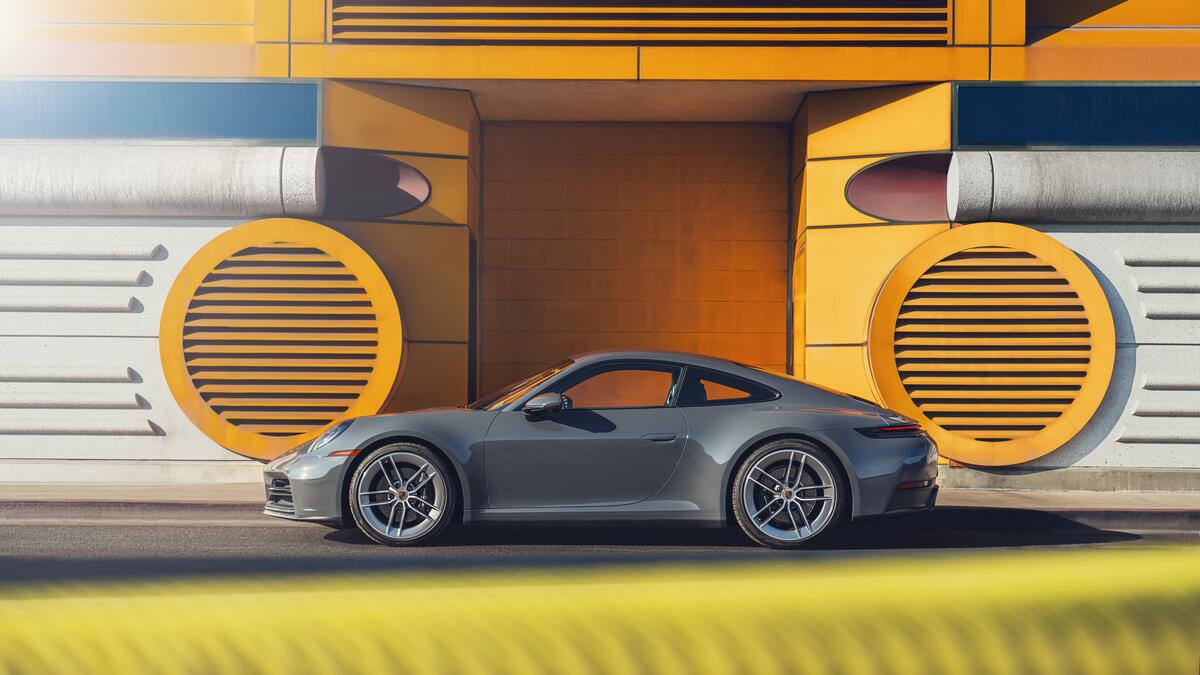
Porsche 911
"[SPEAKER_01]: So it doesn't [SPEAKER_00]: Yeah, I think that's one of the things that they've worked on and had and they tried to help it improve It's also a lot of turns locked a lot a lot So you're shuffling the wheel around a bunch. [SPEAKER_00]: So again, the the in yells is an enthusiast vehicle and enthusiast vehicles are always compromised [SPEAKER_00]: think about something like a portion 9-11, if you tried to convince, you know, your wife or somebody that this was a smart buy, they would say, well, you know, it's got a tiny trunk in the back seat, so you can't really use them. [SPEAKER_00]: And, right, yeah, that's because it's an enthusiast vehicle and it's compromised to be a sports car."
The Porsche 911 is a sports car designed for fast driving and cornering. People talk about it a lot because it feels responsive when you turn the steering wheel. The podcast is referencing how it handles when you’re making lots of turns.
The Porsche 911 is a long-running sports car known for its distinctive design and performance-focused engineering. It comes up in driving discussions because it’s capable of handling lots of steering input and sustained cornering. In the podcast excerpt, it’s referenced in the context of how the car behaves when you’re turning a lot.
solid front axles
"It's got solid front axles, it's got the option of these lockers. It's, body on frame, it's very traditional in all of those ways, which is going to have an impact on the way that it drives and the way it operates."
Solid front axles connect both front wheels with a rigid axle. That can help the tires stay in contact with the ground when you hit rocks, ruts, or uneven trails.
Solid front axles are an axle design where the left and right wheels are connected by a single rigid assembly. Off-road, this can help maintain wheel contact over uneven ground, especially when paired with appropriate suspension travel and traction aids.
delete
"Um, he says, my son-in-law wants to delete his 2025 GMC 3-liter Duramax turbo diesel. He's convinced it won't void his warranty."
Here, “delete” means taking out emissions equipment from the truck. People do it to change performance or simplify the system, but it can cause legal trouble and may affect warranty coverage.
In truck circles, “delete” usually means removing or bypassing emissions-control hardware (and often related software) on a diesel. The goal is typically to reduce restrictions and change how the engine runs, but it can create legal and warranty risks.
DLEF
"if you remove deleting means removing emissions equipment, so basically almost like straight piping it, maybe putting a muffler, but removing the DPS, EGR, DLEF, EGR, DLEF, maybe."
DLEF refers to an emissions system component on some diesel trucks. When people “delete” it, they remove parts that help the truck meet emissions standards.
DLEF is an emissions-related system name used in some diesel setups (often tied to diesel exhaust fluid/aftertreatment strategies). In the context of “deleting,” it refers to removing parts of the aftertreatment system, which can increase exhaust output and bypass emissions controls.
EGR
"if you remove deleting means removing emissions equipment, so basically almost like straight piping it, maybe putting a muffler, but removing the DPS, EGR, DLEF, EGR, DLEF, maybe."
EGR is a system that sends a bit of exhaust back into the engine. It helps the truck burn cleaner, and deleting it usually means the truck no longer follows emissions rules.
EGR (exhaust gas recirculation) routes some exhaust back into the engine to reduce combustion temperatures and lower nitrogen-oxide emissions. Removing or deleting EGR changes how the engine manages emissions and can affect drivability and legal compliance.
straight piping
"if you remove deleting means removing emissions equipment, so basically almost like straight piping it, maybe putting a muffler, but removing the DPS, EGR, DLEF, EGR, DLEF, maybe."
Straight piping means removing the muffler and other exhaust restrictions so exhaust flows directly out. It typically makes more noise and can change backpressure, which may alter how the engine and turbo spool feel compared with stock.
warranty
"So, and this is a newer truck. So, as such, first of all, it almost surely will avoid warranty."
Warranty is the manufacturer’s promise to pay for certain repairs. If you modify the emissions system, the company may refuse to cover problems later.
In this context, warranty refers to the manufacturer’s coverage for repairs. The speaker is saying that deleting/removing emissions equipment on a newer truck can cause the truck to lose warranty coverage.
street legal
"That is something that you could buy brand new with a solid axle edition of the vehicles that we were talking about, though they're not street legal."
Street legal means you’re allowed to drive it on public roads. If it’s not street legal, you may not be able to register it or pass inspections where you live.
Street legal means the vehicle meets the legal requirements to be driven on public roads, including emissions and safety equipment. The speaker notes that some solid-axle editions aren’t street legal, limiting where they can be registered and used.
wheelbase
"And I think the rocks are also, it's trying to combine payload capability, the wheelbase that it has with different springs, because it has a lot of payload. And when you put a different spring on, they'll be a little bit less flex in that."
Wheelbase is how long the truck is from front wheels to rear wheels. That length changes how stable and how “maneuverable” the truck feels over bumps and obstacles.
Wheelbase is the distance between the front and rear axles (or wheels) on a vehicle. It affects stability, ride comfort, and how the truck’s suspension geometry behaves over obstacles—so it’s relevant when discussing how a pickup balances payload and off-road compliance.
payload capability
"And I think the rocks are also, it's trying to combine payload capability, the wheelbase that it has with different springs, because it has a lot of payload. And when you put a different spring on, they'll be a little bit less flex in that."
Payload capability is how much weight a truck can carry in addition to its own curb weight. In this segment, the host links payload to suspension tuning—using different springs to manage how the truck flexes and handles when loaded.
springs
"And I think the rocks are also, it's trying to combine payload capability, the wheelbase that it has with different springs, because it has a lot of payload. And when you put a different spring on, they'll be a little bit less flex in that."
Springs are what help the truck absorb bumps. If you change them to be stiffer, the suspension usually moves less, which can affect how well the truck grips on rough trails.
Springs are suspension components that support the vehicle’s weight and help control how it moves over bumps. Changing spring rates (stiffer vs softer) can reduce suspension “flex” and alter how well the truck maintains traction off-road.
Cognito
"Remember, we went to Cognito, I think, was the aftermarket company, and we got some beefier components for it, because some of those components are just thin, and unless you actually use it, which is using it after out."
Cognito makes aftermarket upgrades for off-road trucks. The idea is to replace weaker factory parts with stronger ones so they last when you drive hard off-road.
Cognito is an aftermarket off-road parts company known for suspension upgrades. In this segment, the hosts mention going to Cognito to get beefier components so the truck can handle off-road punishment without certain parts failing.
airing down
"Exactly, but you know what, when when I aired down, we did seven mile and backwards bill trails. ... Earring down to about, I went to about 26 PSI because I didn't want to go too low, I don't know just the thing that I do."
Airing down is when you let some air out of your tires for off-road driving. It helps the tires grip better on dirt and rocks and can make the ride less bouncy.
Airing down means reducing tire pressure before off-roading. Lower pressure increases the tire’s contact patch and sidewall flexibility, which can improve traction and ride comfort on uneven trails—like when they mention going to about 26 PSI.
Moab
"Yeah, and well, and also the granted near quartermaster is built at the factory in France, so it has a lot going against it with chicken tacks and other territory on the truck. ... When I was there in Moab, near Moab, and..."
Moab is a well-known off-road area in Utah. People go there for trails, and the hosts are describing their experience driving in that region.
Moab is a famous off-road destination in Utah, known for trails and rock crawling. The hosts mention being near Moab while discussing airing down and how the truck felt after long off-road driving.
cliffhanger 2.0
"Well, and Tommy and I, we took that Grenadier and a Jeep Gladiator up cliffhanger 2.0, which isn't a trail that we've been using as often recently. And it's a very difficult trail we broke."
“Cliffhanger 2.0” is the name of a particular off-road trail they drove. They’re saying it’s a tough route and they tested two trucks on it.
“Cliffhanger 2.0” appears to be a specific off-road trail route used by the hosts for testing trucks. They describe it as difficult and note they took both the Grenadier and a Jeep Gladiator up it.

Jeep Gladiator
"Well, and Tommy and I, we took that Grenadier and a Jeep Gladiator up cliffhanger 2.0, which isn't a trail that we've been using as often recently. And it's a very difficult trail we broke."
The Jeep Gladiator is a Jeep pickup designed for off-road use. In this segment, they’re taking it on a very difficult trail to see how well it handles rough terrain.
The Jeep Gladiator is Jeep’s pickup truck, built on a Jeep platform with off-road-focused hardware. Here it’s used alongside the Grenadier on a tough trail, highlighting how both trucks are evaluated for real off-road capability.

Ram Rebel
"And we actually broke. Was it a front drive shaft a long time ago on a ram rebel? I slightly lifted ram rebel."
The Ram Rebel is a truck trim meant for off-road driving. Here they’re talking about breaking a front drive shaft, which is part of the drivetrain that can get stressed when you lift the truck and run bigger tires.
The Ram Rebel is an off-road-focused trim of the Ram pickup line, built for tougher trails than a typical work truck. In this segment, they mention a broken front drive shaft on a Ram Rebel, which points to how drivetrain components can be stressed when the truck is lifted and fitted with larger tires.
bigger tires
"It wasn't a stock truck, so it probably was a little bit stressed because we lifted it and put bigger tires on it, but we did break a rebel."
Bigger tires can help a truck roll over obstacles and clear the ground better. But they can also put extra strain on parts of the drivetrain, especially when combined with a lift.
Bigger tires increase the tire’s diameter and contact patch, which can improve ground clearance and off-road obstacle handling. They also change drivetrain loading and angles, which can raise stress on components like drive shafts if the truck is lifted.
traction
"It was beautiful in this video, but the NEOs and the Jeep, both did a great job getting up this very challenging stretch of trail, challenging as far as traction is concerned especially."
Traction just means how well the tires can grip the ground. On rough trails, the surface changes as you drive, so grip can get better or worse each time.
Traction is how much grip the tires can get from the ground without slipping. On off-road trails, traction changes constantly as tires dig into soft dirt, move rocks, and alter the surface, which is why the trail can feel different every run.
winch
"I'm not so surprised that a lot of people don't option the winch because the winch from the factory on these is pretty expensive."
A winch is a powered cable that can pull you (or another vehicle) out of a stuck situation. The hosts are saying the factory winch option costs a lot, so not everyone orders it.
A winch is a motorized cable-and-drum device used to pull the vehicle out of trouble or to assist another vehicle. Factory winches are often expensive, so some buyers skip them—though on very rugged trails, having one can be a big safety and recovery advantage.
quad motor system
"Because remember years back, when we first heard about the Rivian R1T and the R1S and the four motors, the quad motor system, I thought it was the end game."
A quad motor system means the truck or SUV has four electric motors working at the same time. Because each motor can be controlled separately, the vehicle can send power to the wheels that have grip, but the computer has to do it correctly.
A quad motor system uses four electric motors (typically one per wheel) to drive the vehicle. That lets the vehicle independently control how much torque each wheel gets, which can improve traction and off-road control—but it also depends heavily on software logic.

Rivian R1T
"Because remember years back, when we first heard about the Rivian R1T and the R1S and the four motors, the quad motor system, I thought it was the end game."
The Rivian R1T is an electric pickup built with off-roading in mind. Here, they’re talking about how its multiple electric motors and computer control send power to the wheels when traction is tricky.
The Rivian R1T is an electric pickup truck known for its off-road focus and advanced drive system. In this segment, it’s discussed in the context of a quad-motor setup and how software controls power delivery to the wheels.

Rivian R1S
"Because remember years back, when we first heard about the Rivian R1T and the R1S and the four motors, the quad motor system, I thought it was the end game."
The Rivian R1S is Rivian’s electric SUV. They mention it alongside the R1T because both use multiple electric motors, and the computer has to manage traction off-road.
The Rivian R1S is an electric SUV from Rivian, also built around a multi-motor drivetrain. In this discussion, it’s grouped with the R1T to explain how quad-motor control and traction management work in real-world testing.
E-locker
"Yeah, so it seems like on the software side of things, whenever you have an E-locker where basically the software is trying to send power to the wheels that still have traction."
An E-locker is a computer-controlled way to “lock” how power is shared between wheels. The idea is to keep both sides working together when traction is uneven, but the software has to time it correctly.
An E-locker is an electronically controlled locking differential concept—here, the discussion is about software coordinating power delivery when a wheel loses traction. The key point is that if the software sends torque to wheels that still have grip/traction expectations wrong, the system can behave less effectively than intended.
torque
"And also Rivian since then came out with a two motor system... system that you kind of use the other thing that I think is a limiting factor with them is that those electric motors obviously they produce a boatload of torque, right?"
Torque is the force that helps the vehicle move and pull, especially at low speeds or when climbing. The hosts also point out that dyno testing can make torque numbers feel confusing on EVs because the measurement method is indirect.
Torque is the twisting force an engine or motor produces, and it strongly influences how easily a vehicle can accelerate or climb at low speeds. In EVs, torque numbers can be confusing because dyno testing measures horsepower directly and then calculates torque from RPM, which can make the reported torque feel “wonky.”
dyno
"And when measuring, measuring torque in an EV is a little wonky because when you put a vehicle on a dyno it's, it's a little counterintuitive, but on a dyno the dyno actually measures horsepower measures of the work being done, but it calculates torque based on RPM."
A dyno (dynamometer) is a test device that measures how much power a vehicle makes under controlled conditions. The segment notes that it measures horsepower directly and then derives torque from RPM, which can make EV torque measurements seem counterintuitive.
low range
"Okay, but as much torque as EVs do have huge amounts They don't have the advantage of the multiplication of gearing that you get in a combustion vehicle with not only several gears in its transmission But a low range Transparency and the axle as well too."
Low range is an off-road gear setting that makes the vehicle crawl and pull harder at low speed. The point here is that EVs already have strong torque, but they may not get the same extra “gear multiplication” that traditional trucks use.
Low range is a gearing mode (common in off-road 4x4s) that multiplies torque at the wheels for slow, difficult terrain. The hosts contrast this with EVs: even though EVs make lots of torque, they don’t always get the same gearing multiplication benefits from a multi-gear transmission and transfer case.
electric G wagon, the G580 with EQ technology
"One interesting thing though, it's it's kind of equipped on the wrong vehicle because there's not really an off-road package of it, but the electric G wagon, the G580 with EQ technology. has low range gearing, so it's a quad motor vehicle, one electric motor for each wheel..."
The Mercedes-Benz G580 with EQ technology is an electric version of the classic G-Wagen formula: a body-on-frame off-road platform with serious low-speed capability. In this setup, it uses a quad-motor layout (one motor per wheel) and low-range gearing so it can crawl and handle obstacles like a traditional off-road SUV.
G-wagon
"It's just limited on tires and clearance because it's a G-wagon... But the four wheel drive system they engineered into this electric G-wack is really good."
“G-wagon” usually means the Mercedes-Benz G-Class. It’s famous for being tough off-road, and in this clip they’re discussing how its tires and clearance affect how well it does on dirt.
“G-wagon” is the enthusiast nickname for the Mercedes-Benz G-Class, a boxy off-road SUV known for its rugged ladder-frame roots and serious off-road hardware. In this segment, they’re talking about how the G-Class setup (tires, clearance, and drivetrain) affects real-world traction and maneuvering on dirt.
slip test
"But we put it on the slip test. It did fantastic."
A slip test is a way to see how well a vehicle can keep moving when the tires start to lose grip. It checks whether the truck can control wheel spin and still make progress.
A slip test is a traction evaluation where the vehicle is driven under conditions designed to provoke wheel slip, revealing how well the drivetrain and traction control manage loss of grip. Results help compare how different tires and drivetrains behave when traction is limited.
slicks
"I know, it's got slicks for like racing... It looks so out of place on the dirt because of the wheel tire package because of the clearance."
Slicks are special race tires that have almost no tread. They can grip really well on a clean, dry surface, but they may not work as well on dirt because they don’t have the pattern to dig in.
Slicks are race tires with little to no tread pattern, designed to maximize contact patch and grip on dry track surfaces. On dirt or wet conditions, slicks can be less effective because they don’t have the tread blocks and channels to bite and evacuate debris.
four wheel drive system
"But the four wheel drive system they engineered into this electric G-wack is really good."
Four-wheel drive means power goes to all four wheels. That usually helps the truck move better on slippery or uneven ground.
A four-wheel drive (4WD) system sends power to all four wheels to improve traction when grip is limited. How it’s engineered—such as torque distribution and low-speed control—can make a big difference in off-road situations.
tank turn
"Oh, I see you doing the tank turn, too. Whoo!"
A tank turn is when a vehicle basically spins around in place. It happens by making the wheels on opposite sides move in opposite directions.
A tank turn is a low-speed maneuver where the vehicle rotates in place by driving the wheels on one side in the opposite direction of the other side. It’s commonly associated with vehicles that have very effective low-speed traction and steering control.
depreciation
"Did you wagon will take some of this thing out of the depreciation? Probably."
Depreciation is how much the car’s resale value goes down as time passes. They’re wondering if buying this kind of truck/SUV could help reduce that loss.
Depreciation is how much a vehicle’s value drops over time. The hosts are discussing whether a “wagon” (likely meaning a vehicle purchase) could reduce the financial hit from depreciation, especially for an electric Mercedes G-Wagon.

Mercedes G-Wagon
"Because ultimately, even though the sales on the electric G wagons aren't huge, I think people would still like to have a G wagon of some sort. And I don't think these are ever going to be $15,000 cars."
The Mercedes G-Wagon is a tough, off-road SUV. Here, they’re talking about an electric version and whether people will still want a G-Wagon even if the electric sales aren’t huge.
The Mercedes G-Wagon is a boxy, off-road-focused SUV known for its rugged design and go-anywhere reputation. In this segment, the hosts discuss the electric G-Wagon and how it might affect depreciation and buyer interest compared with traditional G-Wagons.

Dodge Power Wagon
"...d from rebel at the time, there wasn't the diesel power wagon, but even, you know, regular power wagon, [SPEAKE..."
The Dodge Power Wagon is a pickup truck version that’s built for off-road and tough jobs. The podcast is talking about different Power Wagon options, including whether a diesel version was available at the time. It’s mentioned because it’s designed to handle rough driving.
The Dodge Power Wagon is a heavy-duty, off-road-oriented version of the Ram pickup line, designed for tough terrain and work use. The podcast mentions it in the context of diesel availability and also references the “regular” Power Wagon, indicating they’re discussing different Power Wagon configurations. It’s a relevant truck to bring up because it’s specifically built around off-road capability rather than just towing.
fake scoop
"they all have a performance kind of appearance hood that has a basically a fake scoop scoop it's going to be more of a hood bulge I guess than it's a bulge which is not functional and it takes away visibility. [3148.2s] [SPEAKER_00]: Yeah so on the off road trims of the truck your visibility is actually worse and it's really bad."
A “fake scoop” is a hood feature that looks like it’s for airflow, but it doesn’t actually do much. In this case, it also makes the hood shape taller, which can block your view of the trail.
A “fake scoop” is an intake-looking feature on the hood that’s mostly cosmetic rather than feeding air to an engine. Because it raises the hood profile, it can worsen forward visibility when you’re driving off-road or climbing hills.
heightened seating position
"Well, there would be a way to put a real number on it and it would depend a little bit on your heightened seating position, but it's maybe 10. [3165.6s] [SPEAKER_00]: ten feet or more in front of you that you can't see past."
This just means the driver sits higher up in the truck. Even then, the hood and windshield shape can still block your view of what’s right in front of you on the trail.
A heightened seating position means the driver sits higher than in a typical car, which usually improves sightlines. But the hosts are arguing that even with that advantage, hood shape and windshield geometry can still create a large blind zone ahead—especially on uneven terrain.
camera systems
"because the camera systems, even though they can be helpful, they kind of flatten things out it's hard to get a real feel for it. So, uh, yeah, visibility in a lot of modern cars, not really a thing."
Camera systems are the built-in cameras that show you what’s around the car. They can help in tight spots, but off-road they might not show distance and depth as clearly as looking directly.
Camera systems in modern vehicles (like rear-view or surround cameras) provide a video view to help with parking and low-speed maneuvering. Off-road, they can be less reliable than direct sightlines because they may compress depth and obscure how far obstacles really are.
visibility
"because the camera systems, even though they can be helpful, they kind of flatten things out it's hard to get a real feel for it. So, uh, yeah, visibility in a lot of modern cars, not really a thing."
Visibility is how well you can see what’s around you while driving. Off-road, it matters a lot because you need to judge obstacles and distance, and cameras don’t always show depth the way your eyes do.
In off-roading, visibility refers to how well a driver can see obstacles, trail edges, and clearance around the vehicle. Camera systems can help, but they can also flatten depth cues, making it harder to judge distance and terrain shape.
extension line
"So you could bring your own extension case through the extension line. And also snatch blocks."
An extension line is extra cable you add so the winch can reach farther. It’s useful when the anchor point is too far away.
An extension line is extra cable added to a winch setup to reach farther than the winch’s standard cable length. In recovery, it’s often used when the anchor point is beyond the winch’s reach.
snatch blocks
"So you could bring your own extension case through the extension line. And also snatch blocks. You can do multiplication."
A snatch block is a pulley for your winch cable. It helps you change the cable’s direction and can make the winch pull harder in certain setups.
A snatch block is a pulley used in winching that changes the direction of the cable and can improve pulling efficiency. By routing the cable through the pulley, you can reduce side-loading and—depending on the rig—multiply effective pulling force.
Request an Explanation
Heard something you'd like explained? We'll add it to this episode.
Sign in to request explanations for terms you heard.
Want to learn more?
Browse our glossary for plain-English explanations of automotive terms, jargon, and concepts.
Help improve this episode
See something that's not quite right? Our annotations are AI-generated and can sometimes miss the mark. Click the flag icon on any annotation to suggest a correction.