Peak Porsche - Volvo, Longing For A Car That Talks Back, Innocuous But Fun | Episode 1,040
About this episode
Hyundai and Kia steal the early spotlight with new concepts and EV updates, including Hyundai’s body-on-frame Boulder concept and Kia’s multi-powertrain 2027 Seltos plus EV3 range/trim details. The hosts then “peak” their way through brands, arguing Porsche’s 2011 lineup (manual GT3/GT3 RS/GT2 RS) and comparing it to other eras like 1987 Porsche. The show expands into Ram TRX, Rivian R3, Rolls Royce Phantom, Subaru’s peak years, Tesla’s Model S era, and Toyota/Volkswagen/Volvo picks. Listener Q&As focus on finding commuter-fun cars under $20k and a towing-capable, low-perception track setup.

Subaru Outback
"...his channel right now. It is the brand-new Super Outback, like totally rethought Super Outback versus the ..."
The Subaru Outback is a wagon-style car that’s designed to handle different weather and road conditions. The podcast mentions a new version that was redesigned. It’s brought up because it’s meant to be a versatile everyday vehicle.
The Subaru Outback is a crossover wagon built for comfort and all-weather capability, often appealing to drivers who want a versatile daily vehicle. The podcast references a “brand-new Super Outback” and says it was “totally rethought,” indicating a major redesign. It’s discussed because the Outback is a popular choice for people who want wagon practicality with SUV-like capability.
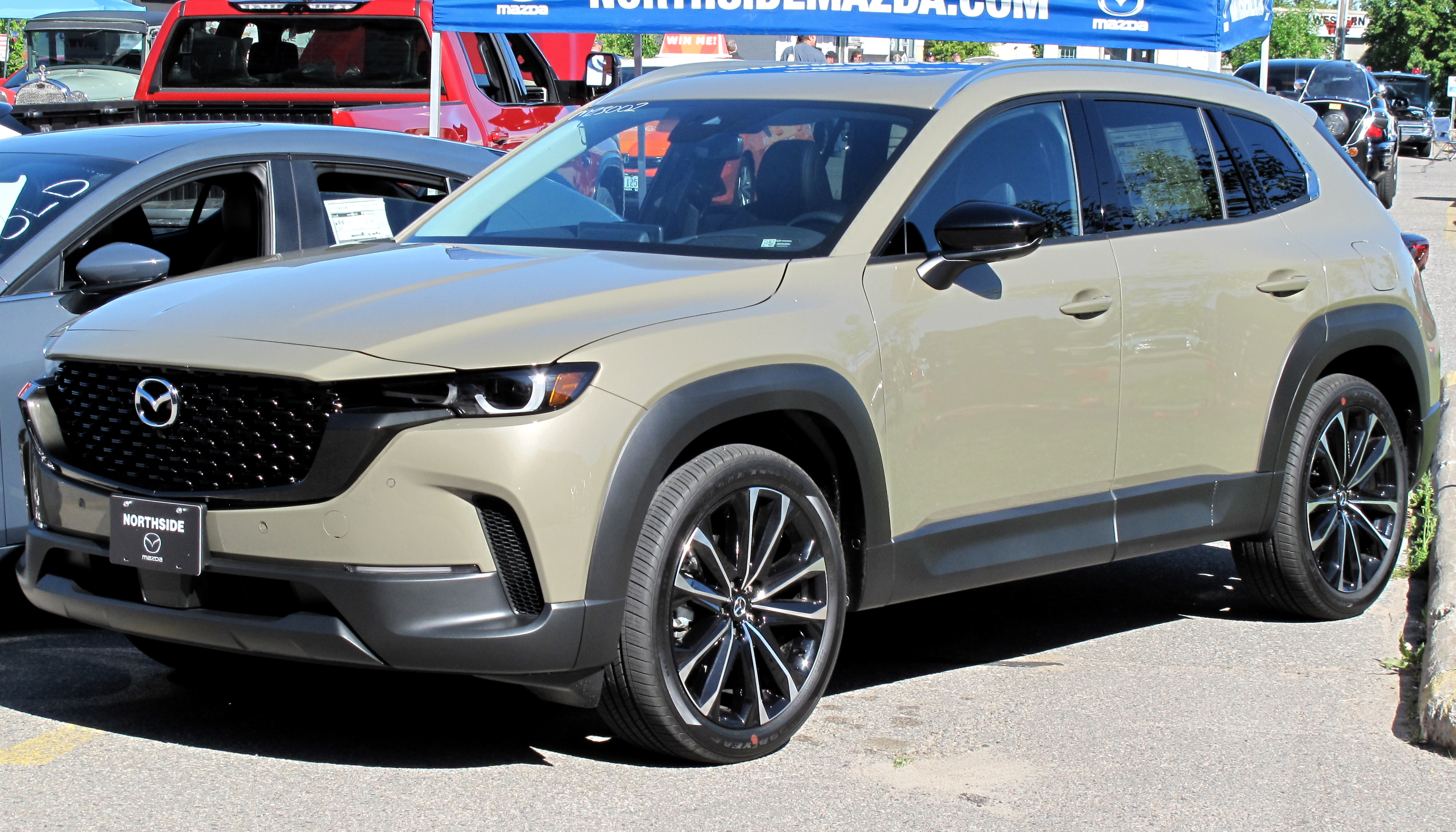
Mazda Cx50
"Yes. And more SUV than ever. Against the Mazda CX-50, which frankly exists because the Outback exists. So that's something we wanted to do for a while. Hopefully you've seen that."
The Mazda CX-50 is a compact SUV. The podcast compares it to the Outback, suggesting they target similar shoppers. It’s brought up because it’s meant to feel more like an SUV than smaller crossovers.
The Mazda CX-50 is a compact crossover SUV aimed at buyers who want more SUV capability than a typical car. The podcast compares it to the Outback and says the CX-50 exists partly because the Outback exists, implying it’s competing for similar buyers. It’s discussed because it’s positioned as “more SUV than ever” within Mazda’s lineup.
body-on-frame
"I am so excited for Hyundai to go into this market of body on frame. They're claiming they're going to be investing heavily doing a pickup truck version as well."
Body-on-frame means the car’s body sits on a separate metal frame underneath. Trucks use this a lot because it’s strong for towing and rough roads.
“Body-on-frame” is a truck/SUV construction method where the body is mounted on a separate ladder-like frame. It’s common for pickups and off-road vehicles because it can handle towing and rough terrain well, though it can feel less “car-like” than unibody designs.
Hyundai Steel
"Because they have to involve Hyundai Steel, part of the Hyundai Motor Group, inspired by the advanced steel technologies pioneered by Hyundai Steel."
Hyundai Steel is part of the Hyundai group that makes steel. They’re basically saying the concept uses special steel and manufacturing know-how.
Hyundai Steel is the steelmaking arm within the Hyundai Motor Group. In the transcript, it’s used to justify the “advanced steel technologies” behind the concept’s materials and marketing language.
aftermarket industry
"But there is no aftermarket industry for products for Hyundai off-road vehicles like there is for Jeeps, Broncos and Toyotas."
Aftermarket parts are things made by companies other than the car brand. If there’s a big aftermarket, it’s easier to buy add-ons like racks, winches, and other upgrades for that vehicle.
The aftermarket industry is the ecosystem of third-party companies that make parts and accessories for a vehicle model. When a brand has a strong aftermarket, owners can easily find upgrades like off-road gear, protection, and convenience items.
Packaging
"[315.1s] I agree. [315.9s] Packaging. [316.5s] I'm sure there'll be a miles per gallon difference."
Packaging is how the car’s parts are laid out so everything fits and still works well. It can affect what drivetrain options the engineers can use.
In vehicle design, “packaging” refers to how components are arranged to fit within the body and meet constraints like crash structure, cooling, and interior space. It often determines whether a certain transmission or drivetrain layout is feasible.
all-wheel drive
"[340.6s] Also, Kia has introduced the EV3 up to 320 miles of estimated range available all-wheel [347.9s] drive, making 261 horsepower and 288 horsepower on the GT models. [353.4s] But that is low horsepower for an EV."
All-wheel drive means the car can send power to multiple wheels. That usually helps it grip better on slippery roads.
All-wheel drive (AWD) sends power to more than one axle, improving traction in low-grip conditions like rain, snow, or dirt. For EVs, AWD can also change how power is delivered and may affect efficiency.
horsepower
"Stop chasing horsepower. Let's make them less, make them smaller. Especially if this is an entry-level bottom of the market EV, there's no horsepower bragging to be done here."
Horsepower is basically how strong the motor is. But for most drivers, the bigger deal is how far the car can go and how efficiently it uses energy.
Horsepower is a measure of engine (or motor) output power. In EV discussions, people often focus on horsepower numbers, but that can distract from what matters more day to day like efficiency, range, and weight.
Kia
"Design language really is nice and really matches. So Kia has really found their niche, their design language. Speaking of lower entry-level EVs, this is one that North America does not get."
Kia is a car brand. The speaker is saying Kia has a clear style that makes its cars feel like they belong together.
Kia is a major automaker that has been leaning into a more recognizable design identity across its lineup. In EVs especially, “design language” can affect how the car looks, how it’s packaged, and even how aerodynamic it is.
City runabout
"City runabout. It works in Europe, and I think it could work in cities in the US, but of course, we don't get it."
A “city runabout” is a small, efficient vehicle intended primarily for urban driving—short distances, frequent stops, and tight parking. In EV discussions, this often ties to battery size/efficiency tradeoffs and whether the vehicle’s range matches typical city usage.
AC Delco Original Equipment
"Get the most out of your vehicle with GM Genuine Parts and AC Delco Original Equipment. The only parts designed, engineered, tested, and backed by General Motors."
AC Delco is GM’s own parts brand. “Original Equipment” means the parts are meant to match what came on the car from the factory.
AC Delco is GM’s parts brand, and “Original Equipment” indicates parts intended to be equivalent to what GM installs on new vehicles. The segment frames these as designed, engineered, tested, and supported by General Motors.
GM Genuine Parts
"Get the most out of your vehicle with GM Genuine Parts and AC Delco Original Equipment."
GM Genuine Parts are replacement parts made for General Motors vehicles. The idea is that they’re designed to fit and work like the original parts.
“GM Genuine Parts” refers to parts made by or for General Motors that are intended to match original specifications. In the segment, it’s paired with AC Delco as part of a GM-branded parts strategy for repairs and maintenance.
FCP Euro
"We're adding FCP Euro as our partners and supporters... For nearly 40 years, FCP Euro has been an industry-leading supplier... They offer a lifetime replacement guarantee on everything, including consumables like brake pads, wiper blades, and even oil filters."
FCP Euro is a company that sells car parts, especially for European cars. They’re advertising a “lifetime replacement” promise, meaning if you replace certain parts, they’ll help you get replacements again.
FCP Euro is an aftermarket parts retailer known for supplying OEM-quality parts and performance upgrades, especially for European brands. The segment highlights their “lifetime replacement guarantee,” including for consumables, which is a notable ownership/value proposition.
Porsche
"That means BMW, Audi, Volkswagen, Mini, Mercedes, Volvo, Porsche, and even Saab."
Porsche is one of the brands they say they can get parts for. Since this episode is Porsche-focused, it’s a relevant nod to the kind of cars their catalog covers.
Porsche is explicitly named as one of the brands FCP Euro supports. Given the podcast’s “Peak Porsche” framing, this is a direct tie-in to the audience’s likely interest in European performance cars and parts sourcing.
consumables
"Anyway, they offer a lifetime replacement guarantee on everything, including consumables like brake pads, wiper blades, and even oil filters."
“Consumables” are wear items that get used up over time and need periodic replacement, such as brake pads, wiper blades, and oil filters. The segment’s emphasis is that the lifetime guarantee covers these routine maintenance items, not just major components.
brake pads
"...including consumables like brake pads, wiper blades, and even oil filters."
Brake pads are the parts that squeeze against the rotors to slow the car down. They wear out over time, so they’re a normal maintenance item.
Brake pads are friction materials that clamp against the brake rotor to slow the car. They’re a classic consumable item, and the segment highlights them as being covered by FCP Euro’s lifetime replacement guarantee.
oil filters
"...including consumables like brake pads, wiper blades, and even oil filters."
Oil filters remove contaminants from engine oil to help protect engine components. The segment lists oil filters as covered consumables under the lifetime replacement guarantee, tying into regular maintenance costs.
replacement / send back the old one / receive a credit
"Buy a replacement, send back the old one, and receive a credit for the full amount. For your Saab!"
This is a program where you buy a replacement part, then return the old part and get money credited back. It can make repairs cheaper because you’re not paying full price twice.
This describes a parts return or “core” credit-style program where you buy a replacement part, then send the old one back to receive credit. It’s commonly used for certain components and can lower the effective cost of repairs or maintenance.
Rivian
"[1052.1s] And I think 2021 was the throwdown. [1054.7s] Rivian is on our list. [1056.4s] And even though they're a feisty new car company,"
Rivian is a company that makes electric vehicles. Here, they’re talking about how good Rivian’s next big model will be compared to what’s already out.
Rivian is an EV maker known for building electric trucks and SUVs with a strong focus on design and off-road capability. In this segment, the hosts are evaluating Rivian’s “peak” products and how the lineup is evolving.

Rivian R1 S
"The R1 T and R1 S are excellent. They're very, very good."
The R1 S is Rivian’s SUV. The host is basically saying both the truck and SUV versions are really good.
Rivian R1 S is the SUV variant of Rivian’s R1 lineup. The speaker groups it with the R1 T as an “excellent” option, suggesting the overall R1 family is worth considering.

Rivian R1 T
"The R1 T and R1 S are excellent. They're very, very good."
The R1 T is Rivian’s truck model. In the conversation, the speaker is saying it’s a really good vehicle, particularly if you can find a good deal.
Rivian R1 T refers to the R1-series truck variant. The host calls the R1 T (and the R1 S) “excellent,” emphasizing that these models are still strong choices, especially when found at good used pricing.
Rolls Royce
"Well, then I will jump forward to Rolls Royce and we never talk about rolls on the show."
Rolls-Royce is a luxury car brand known for very high-end, expensive vehicles. The host is basically saying they’re moving on to talk about that next.
Rolls-Royce is referenced as the next topic, signaling a shift from Rivian/Porsche-adjacent comparisons to ultra-luxury territory. Even without details here, it frames the show’s “everyday driver” debate as spanning very different price and ownership worlds.
BMW
"But the interesting thing in 2010 is this is right after BMW releases, ... Think about how much BMW was killing it in the early 2000s. They're doing those great cars of the 90s and early 2000s that we loved."
BMW is a big German car company. In this conversation, it’s important because BMW owned Rolls-Royce and helped shape what came next.
BMW is a major German automaker and, in the early 2000s, played a key role in the modern era of Rolls-Royce ownership. The speaker frames BMW’s influence as part of why Rolls-Royce products were reintroduced and refreshed.
drop top
"suicide door, crazy phantom with the umbrella and you could get the drop top. And I love that this photo happens to be a drop top in the snow. You want to really throw down how much you don't need a drop top."
A “drop top” refers to a convertible (open-air) body style. The speaker emphasizes the absurdity and fun of having a convertible Rolls-Royce Phantom in winter conditions, turning it into a “why not?” luxury flex.

Rolls Royce Phantom
"Would you like to drive yourself in your phantom, sir? ... about a seventy one thousand dollar phantom. I mean, when those dipped like 60 or 50, it's still a lot of money. But I just wonder what the maintenance is like on that."
The Rolls-Royce Phantom is a top-of-the-line luxury car. It’s the kind of car people buy for comfort and prestige, and it can be expensive to run and maintain.
The Rolls-Royce Phantom is the brand’s flagship luxury sedan. In the transcript, it’s discussed in the context of different Phantom body styles/variants and how much it costs to own today.
front wheel drive
"And we have also explicitly said being front wheel drive does not mean it is not an enthusiast car or you are not an enthusiast for liking front wheel drive..."
Front-wheel drive means the front wheels do the work of moving the car. Some people think it makes cars less “fun,” but plenty of FWD cars are still genuinely sporty.
Front-wheel drive (FWD) means the engine’s power is sent to the front wheels. It’s often debated in enthusiast circles because it can affect handling feel and traction characteristics compared with rear-wheel drive or all-wheel drive.
Saab
"...but still sob Viggen. I can't believe pretty sure at that point, but still sob Viggen... but sobs. It's all about it."
Saab is a car brand with a strong fan base. In this episode, they’re talking about Saabs—especially the 9-3 Viggen—and how the brand feels unique and memorable.
Saab is a Swedish automaker known for distinctive styling and a loyal enthusiast following. In this segment, Saab is central to the conversation, especially the 9-3 Viggen and the brand’s reputation for bold color and personality.

Saab 9-3
"I'm showing a nine three. You just know it's a sob. Well, if you see a nine three silhouette, you don't have to know anything about cars, but I think you know that is a sob."
The Saab 9-3 is a Saab model that was popular around the year 2000. People can often recognize it just by its shape, even if they don’t know much about cars.
The Saab 9-3 is a compact executive car from Saab, and in this segment the host is talking about the late-1990s/around-2000 styling. The “silhouette” comment highlights how recognizable the Saab 9-3’s design is even to people who don’t know cars.

Tesla Model S
"I think that's been peak with the styling. I think that's been peak for Tesla because in the cyber, well, cyber anything has come along and kind of taken them off their peak. And I think that Model S was a great looking car when it was first introduced..."
The Tesla Model S is an all-electric luxury sedan. The speakers are basically saying it looked best in the early versions and that later changes didn’t improve the look as much.
The Tesla Model S is Tesla’s flagship electric sedan. In this segment, the hosts discuss it as a design benchmark for Tesla, especially around the early years of the car’s introduction and later refinements.
Griot's
"We always take speed shine on every shoot, helping us spot clean cars at a moment's notice. They're foaming glass cleaner is the quickest and best way we've ever found to get windows cleaned before a big day of driving."
Griot's is a company that makes car cleaning and detailing products. The hosts are saying their products work well for getting a car looking good before a trip.
Griot's Garage is an automotive detailing and car-care brand known for products like glass cleaners, wash buckets, and other detailing supplies. In the segment, they’re being used as an example of reliable, easy-to-use products for pre-road-trip cleaning.
TT
"They're doing TT, which is cool. That's right. They're actually going to have the first time ever that HOD has done any time trial events."
TT just means “time trial.” It’s a track event where you’re focused on your lap times, not just driving around.
TT is shorthand for “time trial,” a motorsport format where drivers attempt to record the best lap times under event rules. In practice, it often means more emphasis on lap-time consistency and sometimes different session structure than a standard open-lapping day.
grip
"And so instantly you knew there's no grip in these tires. Be very ginger. Be very careful."
Grip is the tire’s ability to generate traction with the road surface. In cold weather, tire rubber stiffens and grip drops, which is why the speaker emphasizes being careful when the tires are “rock hard.”
Request an Explanation
Heard something you'd like explained? We'll add it to this episode.
Sign in to request explanations for terms you heard.
Want to learn more?
Browse our glossary for plain-English explanations of automotive terms, jargon, and concepts.
Help improve this episode
See something that's not quite right? Our annotations are AI-generated and can sometimes miss the mark. Click the flag icon on any annotation to suggest a correction.