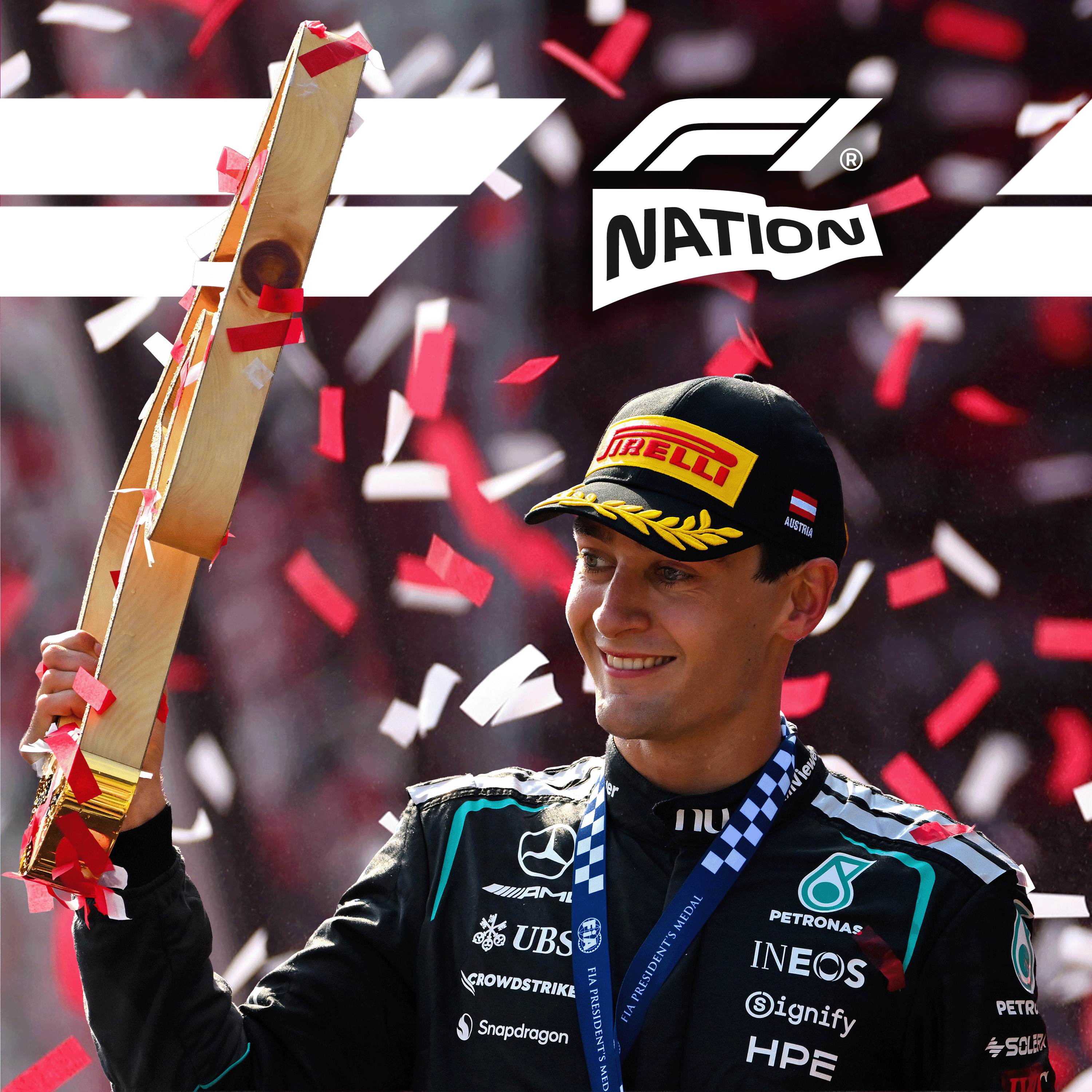
‘Resilient’ Russell + resurgent Max – Austrian GP Review
About this episode
George Russell's dramatic victory at the Austrian Grand Prix takes center stage as F1 TV experts James Hinchcliffe and Alex Brundle join Tom Clarkson to dissect a thrilling race. The panel analyzes Russell's high racing IQ and mental resilience under pressure, contrasting his experienced leadership at Mercedes with Kimi Antonelli's scrappy performance. They also debate Max Verstappen's resurgent pace in the upgraded Red Bull, McLaren's missed opportunities, and Ferrari's ongoing struggles. It is an insightful breakdown of driver psychology, team strategy, and the shifting dynamics at the front of the grid.
Tom Clarkson is joined in the Red Bull Ring paddock by F1TV experts James Hinchcliffe and Alex Brundle to analyse the Austrian Grand Prix.
George Russell got back to winning ways for the first time since the season-opener in Australia. He retakes second place in the championship standings, reducing the gap to leader Kimi Antonelli to 40 points. How did George overcome the threat of Max Verstappen in the Red Bull? What does this win mean for his title challenge? And how impressive was his racing IQ to take pole position?
On the other side of the garage, Kimi Antonelli overcame a tricky start and brake issues to finish third. But with George taking 28 points out of his lead over the last two races, how will Kimi be feeling about his own title hopes?
Verstappen secured his best result of the season with P2, so why was he back in contention at the front and does this mean he’ll be consistently competitive going forward?
Plus, the guys discuss a frustrating race for Ferrari after winning last time out in Barcelona and whether pressure is building on McLaren having also been off the pace in Spielberg.
George Russell
"The second Grand Prix victory of the season. George Russell wins the Austrian Grand Prix."
A highly talented British racing driver who drives for the Mercedes team in Formula 1. He is known for being very smart and strategic while driving at over 200 mph.
British Formula 1 driver who joined Mercedes-AMG Petronas in 2022 after a standout junior career and three seasons with Williams. Known for his exceptional qualifying pace and cerebral approach to race strategy, he secured his maiden F1 victory at the 2022 São Paulo Grand Prix.
Max Verstappen
"Max Verstappen saying after the race that he's finally got a car that he can fight with."
An incredibly fast Dutch racing driver who has won multiple Formula 1 World Championships with the Red Bull team. He is famous for his aggressive driving style and relentless speed.
Dutch Formula 1 driver who debuted in 2015 and became the youngest ever Grand Prix winner at age 18. Driving for Red Bull Racing, he won consecutive World Championships starting in 2021, establishing himself as one of the most dominant and aggressive drivers in motorsport history.
Kimi Antonelli
"I think it's a race that got away for Antonelli firstly with the breaking issues at the start..."
A young Italian racing driver who is considered a future superstar. He was signed by the famous Mercedes Formula 1 team at a very young age because of his incredible speed.
Andrea Kimi Antonelli is a highly touted Italian racing prodigy who bypassed Formula 3 to compete in Formula 2 before being fast-tracked into a Mercedes Formula 1 seat. He is widely regarded as one of the most promising young talents of his generation.
virtual safety car
"...or not quite calling it as quickly enough but when he looked at his pace towards the end of the race actually he was relatively quick..."
A system used during minor track cleanups where all drivers must slow down to a safe speed immediately, but they stay spread out across the track instead of gathering behind a real safety car.
An F1 safety protocol (abbreviated as VSC) used during minor track incidents where drivers must reduce their speed by a set percentage (usually around 30-40%) and maintain a consistent gap to the car ahead, rather than bunching up behind a physical safety car.
undercut
"...actually Verstappen manages to drive the red bull into undercut range of Russell..."
A racing trick where a driver stops for fresh tires earlier than the car in front of them. The new tires make them go much faster, allowing them to take the lead when the other car finally stops for tires later.
A pit stop strategy where a trailing driver pits earlier than the car ahead to take advantage of the immediate grip and speed of fresh tires. If executed correctly, the driver can set fast enough lap times to leapfrog the rival when they eventually make their pit stop.
tire degradation
"...I think their tire degradation was so poor I don't think that was the plan..."
How quickly a tire wears out and loses its grip as it gets hot and used during a race. When tires degrade, the car starts to slide around and go slower.
The physical wear and thermal breakdown of a racing tire's rubber compound over a stint. This leads to a progressive loss of grip, sliding, and slower lap times, forcing teams to manage tire temperatures and plan pit stops carefully.
downforce
"...so then Silverstone's a low downforce racetrack if they're not flat in cops corner it's a high downforce racetrack..."
The invisible force of air pushing down on a race car, acting like an upside-down airplane wing. This helps the tires stick to the road so the car can take corners at incredibly high speeds without sliding off.
An aerodynamic force that pushes a vehicle down toward the track surface. Created by wings, diffusers, and bodywork, downforce increases tire grip and cornering speeds without adding physical mass to the car.
ground effect
"...I mean I know that I know with the ground effect cars but I'm going way before that..."
A design trick that uses the airflow underneath the car to suck it down onto the track, making it stick to the road. This allows cars to follow each other closely and pass more easily.
An aerodynamic design philosophy where the underside of the car is shaped to create low pressure, effectively sucking the vehicle to the track. Reintroduced to Formula 1 in 2022, it allows cars to generate massive downforce while producing less turbulent air for cars following behind.
brake regeneration
"...managing the brake system because of the regeneration which makes it really hard to manage the temperature of the brakes..."
A system in hybrid and electric cars that captures the energy normally wasted when slowing down and turns it into electricity to charge the battery. It also helps slow the car down, which can make managing brake temperatures tricky.
A system in modern hybrid race cars (like F1's MGU-K) that harvests kinetic energy from the rear axle during braking, converting it into electrical energy to charge the hybrid battery. This process creates significant drag on the rear axle, which must be carefully balanced with the traditional hydraulic brakes.

Lola T292
"...what are you driving there all sorts of old tin boxes Lola T292 and some Mustangs and all sorts of lovely sideways stuff..."
A classic, open-cockpit race car from the 1970s built for endurance racing. It is small, extremely light, and very fast, designed purely to win races on historic European tracks.
The Lola T292 is a historic Group 5 sports prototype race car developed by Lola Cars in 1973. Powered by highly tuned 2.0-liter engines like the Cosworth BDG, it was a dominant force in European sports car racing during the 1970s.

Ford Mustang
"...Lola T292 and some Mustangs and all sorts of lovely sideways stuff so I'm going to be checking out Lando Norris's lines around Silverstone to make sure my Mustang on crossplies is going in the right place..."
A famous American sports car known for its classic styling and powerful V8 engine. It is a favorite in historic racing events where drivers slide them around corners.
The Ford Mustang is an iconic American pony car manufactured by Ford since 1964. Alex Brundle refers to racing a historic, early-generation Mustang on vintage crossply tires at the Silverstone Classic.
crossply tires
"...to make sure my Mustang on crossplies is going in the right place..."
An old-fashioned type of tire design used on classic cars. They don't grip the road as tightly as modern tires, which makes the car slide around in a fun, predictable way.
An older style of tire construction (also known as bias-ply) where the internal ply cords run diagonally across the tire's tread. Unlike modern radial tires, crossplies allow for a much higher slip angle, resulting in progressive, controllable slides that are characteristic of historic racing.
Request an Explanation
Heard something you'd like explained? We'll add it to this episode.
Sign in to request explanations for terms you heard.
Want to learn more?
Browse our glossary for plain-English explanations of automotive terms, jargon, and concepts.
Help improve this episode
See something that's not quite right? Our annotations are AI-generated and can sometimes miss the mark. Click the flag icon on any annotation to suggest a correction.