Rivian R2 first drive, BYD goes nuts on flash charging, Donut Lab's miracle battery is dead, and more
About this episode
Rivian R2 gets a hands-on first drive in a classic woods-and-camping event near Park City, Utah, where the car impresses with planted highway manners, strong efficiency for its class, and real-world fast charging on a 400V setup (about 170 kW peak). The discussion also digs into the R2’s adventure-friendly details—off-road-capable tires, a sliding rear window, and a roof-rack tent—while debating launch timing for LiDAR-based autonomy and the lack of vehicle-to-grid readiness. The show then tees up BYD’s aggressive flash-charging push, China’s electrification impact on air pollution, BMW’s I-Extreme rideshare momentum, and Donut Lab’s battery program looking bleak.
In the Electrek Podcast, we discuss the most popular news in the world of sustainable transport and energy. In this week’s episode, we discuss our Rivian R2 first drive, BYD going nuts on flash charging, Donut Lab's miracle battery being seemingly dead, and more.

Dodge Charger
"...ey're gonna I'll test the when it comes to to the charger. So that's One of the most beneficial things for ..."
The Dodge Charger is a large four-door car that’s built to feel powerful when you drive. People talk about it a lot because it can be sporty and fun, not just practical. In the podcast, they’re likely testing or comparing it to see how it feels in real use.
The Dodge Charger is a full-size American four-door sedan known for strong performance and a long-running history in muscle-car culture. It often comes up in podcasts when discussing driving impressions, upgrades, or what makes it “beneficial” or appealing compared with other options. In this episode context, it sounds like the Charger is being evaluated as part of a practical test or comparison.
off-roading
"We went up to the mountains like you do at a typical Rivian event ... We went off-roading. We went on the highways a little bit"
Off-roading means driving on rough or unpaved ground instead of normal roads. They’re saying the event tested the car in more than one kind of driving.
Off-roading is driving on unpaved or uneven terrain where traction and suspension travel matter more than on-road grip. Mentioning it alongside highway driving implies the R2 was evaluated for both everyday road manners and rough-surface capability.
charging
"Because of ran that work was right by our hotel. We got to do a little charging as well ... so we got really the full experience with this thing and"
For an electric car, “charging” means putting electricity back into the battery. They’re saying they got to try that part during the trip, not only driving.
In EV talk, “charging” means replenishing the battery by plugging into a power source. The context here suggests they sampled the EV’s ability to add energy during the event, not just driving it around.
top speed
"You know, we had this thing going top speed on the highway. It's like super fast. She feels super planted"
Top speed is the maximum speed a vehicle can reach under its own power. Here it’s used to describe the R2’s highway performance feel, alongside comments about stability.

Tesla Model Y
"I mean you and I talked about this before like how in the world is this vehicle as efficient as a Tesla Model Y and not It's not as efficient as a Model Y But as efficient as the Model Y specs"
The Tesla Model Y is an electric SUV that a lot of people use as a reference point. Here, they’re basically saying the Rivian R2 should be compared to how efficient the Model Y is.
Tesla Model Y is a mainstream electric crossover used as a benchmark for efficiency and real-world range. In this segment, the hosts compare the Rivian R2’s efficiency and range against the Model Y’s published/expected numbers.
kilowatt hour battery
"So, you know, this way over 300 miles of range 80 88 kilowatt hour battery"
kWh is a way to measure how much energy the car’s battery can hold. A bigger number usually means the car can go farther, if the car uses energy at a similar rate.
A kilowatt-hour (kWh) battery is a measure of how much electrical energy the battery pack can store. More kWh generally means more potential range, assuming efficiency is similar.
off-road tires
"You know those tires are no like those are off-road tires I mean they have you know Where they call them street tires, but you know when we took them off-road"
Off-road tires have tread meant for dirt and rough ground. They often make the car less efficient on regular roads, so range can drop compared to street tires.
Off-road tires are designed with more aggressive tread patterns to grip on dirt, sand, and uneven surfaces. They usually increase rolling resistance on pavement, which can reduce efficiency and range compared with street-oriented tires.
street tires
"Where they call them street tires, but you know when we took them off-road They were obviously the big off-road tires at a low spec"
Street tires are made mainly for driving on regular roads. They tend to waste less energy than more aggressive off-road tires, which helps range.
Street tires are road-oriented tires optimized for pavement grip, comfort, and lower rolling resistance. In this discussion, the hosts connect tire choice to efficiency and range, noting that “street” tires can still be more efficient than smaller-wheel off-road tires.
400 volt
"It's got really fast charging but not You know Hyundai 800 volt Porsche 800 volt. It's still 400 volt. So You're looking at like 220 240 kilowatts"
400 volts is the electrical “system voltage” inside the EV. It matters because it affects how easily the car can accept fast charging power.
“400 volt” refers to the vehicle’s high-voltage electrical system level. Higher-voltage EV architectures can reduce current for a given power level, which can help charging performance and reduce heat in cables/components.
kilowatts
"So You're looking at like 220 240 kilowatts We went up to 170 but we were we were started as data charge of 56"
Kilowatts tell you how much charging power the charger is delivering. More kW usually means faster charging, at least up to the car’s limits.
Kilowatts (kW) measure charging power—how fast energy is delivered from the charger to the battery. The hosts cite expected charging power in the 220–240 kW range, then compare it to what they actually saw.
CCS combos
"I had about 50 percent Nax Chargers 50 percent CCS combos"
CCS is a fast-charging plug standard used by many electric cars. “CCS combos” just means the station has the CCS fast-charging ports.
CCS (Combined Charging System) is the common fast-charging standard for many EVs in North America and Europe. “CCS combos” refers to the specific CCS connector/port configuration used at charging stations.

Ford Bronco
"...l the windows open it really feels kind of like a Bronco where you know They have a roof they have a treeh..."
The Ford Bronco is an SUV made for driving on rough roads and trails. It can also be driven in an open-air way, so when the windows are open it can feel more like you’re outside. That’s why the host is comparing the feeling to a Bronco.
The Ford Bronco is a rugged SUV designed for off-road capability, with features that emphasize open-air driving and trail readiness. The podcast mention about feeling like a Bronco with the windows open points to its character—how it can feel more “outdoorsy” than a typical SUV. It’s a common topic when discussing comfort, driving feel, and the experience of using the vehicle’s removable/opening roof options.

Chevy Silverado
"Not quite as big as the R1 and certainly not as big as you know the Ford F-150 Lightning or even the Chevy Silverado, but still pretty solid"
The Chevrolet Silverado is a big American pickup truck. The host is using it as a reference point for how large the Rivian feels.
The Chevrolet Silverado is a full-size pickup line, and here it’s referenced as another size benchmark. The host is comparing the Rivian’s packaging to how big a typical Silverado is.

Ford F-150 Lightning
"Not quite as big as the R1 and certainly not as big as you know the Ford F-150 Lightning or even the Chevy Silverado, but still pretty solid"
The Ford F-150 Lightning is Ford’s electric pickup truck. The host mentions it to compare size—saying the Rivian is smaller than the Lightning.
The Ford F-150 Lightning is Ford’s electric version of the F-150 pickup. In this segment it’s used as a size and practicality benchmark, with the Rivian being described as smaller than the Lightning.

Rivian R1S
"...on the highway was smooth, but still You know the R1s were a little bit jerky Compared to because you k..."
The Rivian R1S is an electric SUV, meaning it runs on batteries instead of gasoline. The podcast is talking about how it drives—smooth on the highway, but with some noticeable jerky feeling in certain situations. That helps listeners understand what daily driving might feel like.
The Rivian R1S is an all-electric SUV built on Rivian’s electric platform, aimed at combining everyday usability with off-road ability. The podcast notes that it felt smooth on the highway but “a little bit jerky” compared to something else, which is the kind of real-world driving feedback people care about with EVs. It’s discussed because it’s a flagship model and its ride/drive behavior is a key part of the ownership experience.
autonomy
"The big question so we're scrolling down to the article right now big questions for me were autonomy and Vehicle to grid or vehicle to X The problem with the autonomy is that? [...] so you're purchasing a premium car even the launch edition has you know forever autonomy, but"
Here, autonomy means how much the car can drive on its own. The host is basically saying the car’s built-in tech determines what it can do, and you can’t easily “upgrade” that later.
In this context, autonomy means the vehicle’s ability to drive itself using sensors and onboard computing. The host is saying the hardware in the car (what you’re buying) limits how capable the autonomy can be, even for launch editions.
Vehicle to grid
"big questions for me were autonomy and Vehicle to grid or vehicle to X The problem with the autonomy is that?"
Vehicle to grid means your electric car can potentially send power back to the electricity network. The host is treating it as a major feature question for the new Rivian.
Vehicle to grid (V2G) is a system where an electric vehicle can send electricity back to the power grid (not just charge from it). The host groups it with “vehicle to X,” implying broader bidirectional energy use beyond just the grid.
vehicle to X
"big questions for me were autonomy and Vehicle to grid or vehicle to X The problem with the autonomy is that?"
Vehicle to X is a general way of saying the car can send electricity to other places besides just charging. Think “power out of the car” for homes or other equipment.
Vehicle to X is an umbrella term for bidirectional charging where the car can provide power to something other than the grid—like a home, building, or other electrical loads. It’s mentioned alongside vehicle-to-grid to frame the broader “bidirectional energy” idea.
inverter inside the car is bidirectional
"I would assume that at least it's not a hardware upgrade on that front like yeah I would assume that at least it's not a hardware upgrade on that front like yeah I would assume that the inverter inside the car is bidirectional the charging system is bidirectional so that it might be more a question of that"
The inverter is the electronics that manage power between the battery and the rest of the electrical system. “Bidirectional” means it can send power out as well as take power in, which is what you need for vehicle-to-home or vehicle-to-grid.
A car’s inverter converts electricity between AC (house/grid) and DC (battery). If it’s “bidirectional,” it can both charge the battery from AC and also export power from the battery back out to AC for home or grid use.
self-drive to level three
"The ability to to self-drive to level three. I think I think there's"
“Level 3” means the car can do a lot of the driving by itself in specific situations. But the driver still has to be ready to take over if the system asks.
“Level 3” refers to SAE automated driving levels, where the car can handle most driving tasks in certain conditions, but the driver must be ready to take over when prompted. This is more capable than driver-assist, but it’s not full autonomy where the driver never has to intervene.
LiDAR sensor
"They they don't care that the car doesn't come with the LiDAR sensor now ... Until so it's coming later this year, right? Is that what they said the LiDAR?"
LiDAR is a sensor that uses lasers to “see” the world in 3D. It helps the car understand distances better, which can make advanced driving features work more reliably.
A LiDAR sensor uses laser pulses to measure distances and build a detailed 3D map of the surroundings. In advanced driver-assistance and self-driving systems, LiDAR can improve object detection and depth perception, which is why some versions of vehicles are marketed as having it.
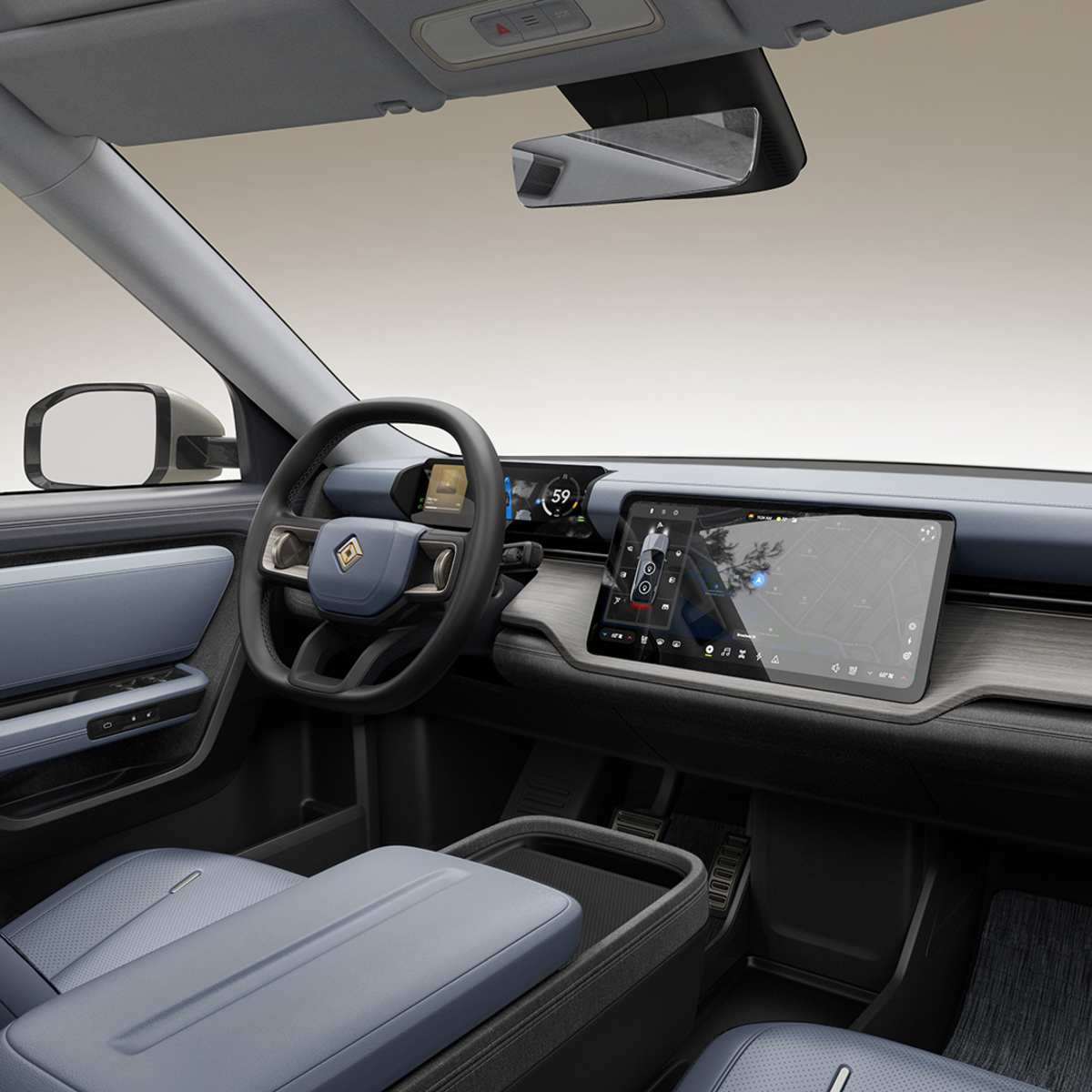
Rivian R2
"I think it's a real possibility that it's enough that it's gonna fill up the order book for Rivian Until so it's coming later this year, right? Is that what they said the LiDAR? ... but so I think it's not it's not too bad ... it hurts their resell value too because as soon as the LiDAR version comes out probably hurts the resell value of the early R2s"
Rivian R2 is an upcoming Rivian electric car. The hosts are talking about how a later version that adds extra sensing tech (LiDAR) could make early versions harder to resell for as much money.
Rivian R2 is an upcoming Rivian electric vehicle, and this segment focuses on how its hardware and software roadmap affects buyers. The discussion specifically contrasts an earlier R2 configuration versus a later version that adds LiDAR, which can change buyer demand and what owners can sell the car for later.
order book
"I think it's a real possibility that it's enough that it's gonna fill up the order book for Rivian"
An order book is basically how many people have already placed orders for a product. The idea here is that demand might be strong enough to keep production plans full.
An order book is the list of customer orders a company has received for a product, often used to gauge demand and production planning. The hosts suggest that enough interest in the Rivian R2 could fill the order book even if some buyers don’t care about LiDAR.
resell value
"it hurts their resell value too because as soon as the LiDAR version comes out probably hurts the resell value of the early R2s"
Resell value is what you can sell the car for after you’ve owned it. The point being made is that if a better version comes out, early cars may be worth less.
Resell value is the price an owner can realistically get when selling the car later. Here, the hosts argue that introducing a LiDAR-equipped version later could reduce what early R2 buyers can get, because the newer hardware makes earlier cars less desirable.

Tesla Roadster
"You had all the Tesla vehicles available for sale except the Roadster You've been a mullaby driver for half a decade at this point"
The Tesla Roadster is Tesla’s high-performance electric sports car, historically positioned as a halo product for the brand. In this segment, it’s mentioned as the one Tesla model the speaker hasn’t owned among the other Tesla vehicles available for sale.
FSD
"Especially for you who's been burnt on the of the FSD front for so long You don't want to just buy or two of them having the same situation"
FSD stands for Full Self-Driving. It’s a software system in some Teslas that tries to automate parts of driving, but it still depends on the driver and can be misused.
FSD (Full Self-Driving) is Tesla’s driver-assistance software package that’s marketed as enabling more automated driving behaviors than basic cruise control. In this discussion, the host argues about how Tesla and other automakers should think about autonomy “levels,” and how misuse can be dangerous.
level four
"The the definition of level three is just unlike level four You just in particular situation and there's a delay between the switchover from the autonomous system and the driver"
“Level four” means the car can handle driving on its own in certain areas/conditions without needing the driver to immediately take over. The host is saying level three is different because the driver has to respond during a handoff.
“Level four” is a higher SAE autonomy level where the vehicle can perform the driving task without expecting driver takeover within defined conditions. The host’s point is that level three and level four differ in how the handoff works, including the delay between automation and driver control.
byd
"All right, let's talk about byd a little bit [1145.5s] um [1146.7s] Talk about the flash charging."
BYD is the company the hosts are talking about. They say BYD showed a charging technology designed to charge EVs extremely fast, and they’re rolling it out quickly.
BYD is the automaker discussed for unveiling a flash-charging technology with very high power output. The hosts emphasize both the technical capability and the rollout/deployment rate, framing it as a major challenge to existing charging leaders.
zero to 70
"You can charge a zero to [1172.0s] 70 in roughly, you know, 56 minute you can charge 200 percent under 10 minutes."
“Zero to 70” means going from an empty battery (0%) to about 70% charged. It’s a quick way to compare how fast different charging systems can add usable battery.
“Zero to 70” is shorthand for charging from 0% battery state-of-charge up to about 70% in a stated time. It’s a common way to compare fast-charging performance because the early part of a charge session is where high-power charging is most valuable.
Supercharger network
"So obviously tesla is the leader there as the you know, global [1197.2s] Supercharger network is the only global network out there [1200.5s] In north america specifically."
The Supercharger network is Tesla’s network of fast public charging stations. The hosts are comparing how widespread and fast it is versus other charging networks.
The Supercharger network is Tesla’s network of high-power public fast-charging stations. In this segment, it’s used as a benchmark for charging availability and deployment scale, with the hosts contrasting it against other networks in Europe and China.
station
"A station is sort of the equivalent to a tesla station is just that there's only two charge Cable per station"
A station is a charging location. But one station can have more or fewer charging spots, so you can’t compare networks fairly just by counting stations.
In this context, a station is a charging site that may contain multiple stalls/connectors. The host emphasizes that BYD’s “station” is not directly comparable to Tesla’s because BYD has fewer charging cables per station.
stall
"So so the the stall number if you want to compare it to you know, we call it charging guns stall to you know Supercharger stall total you basically have to double the the number of station"
A stall is one spot where one car can charge. Two networks can have the same number of sites but very different numbers of cars able to charge at once.
A stall is a single charging position at a station—one car can charge there at a time. Comparing “stalls” is more meaningful than comparing “stations” because different networks may have different numbers of charging connectors per site.
deployment rate
"You can you know get more cars fully charged on the road faster the deployment rate right now based on last quarter from tesla The data last quarter. Uh, it's 400 of just over 400 megawatts per month"
Deployment rate means how fast charging stations (or their capacity) are being rolled out. Higher deployment rate means more charging capability becomes available sooner.
Deployment rate here means how quickly charging infrastructure capacity is being added or scaled. The speaker ties it to power delivered per month and compares that scaling pace between Tesla and BYD.
megawatts per month
"The data last quarter. Uh, it's 400 of just over 400 megawatts per month While byd is reaching almost a gigawatt per month more than twice the deployment capacity of tesla right now."
Megawatts measure how much power a charger can deliver. Saying “megawatts per month” is basically a way to talk about how much new charging capability is being installed each month.
Megawatts (MW) measure electrical power, not energy. “Megawatts per month” is being used as a proxy for how much charging capacity is being added each month—i.e., how much total charger power the network can deliver after expansion.
gigawatts
"Just in total power if you go total power tesla is about 20 gigawatts of total power Wide byd is at 8.6."
Gigawatts are a bigger unit for electricity power. The episode is using them to compare how large each charging network’s total power capacity is.
Gigawatts (GW) are a larger unit of electrical power (1 GW = 1,000 MW). The speaker uses total gigawatt figures to compare the overall scale of Tesla’s and BYD’s charging capacity.
super chargers
"even like we we talk about 10 uh 10,000 chargers versus 80,000 super chargers for tesla But if you look right now as the gigawatt capacity"
Superchargers are Tesla’s fast charging stations. The hosts are comparing Tesla’s network to BYD’s, and they’re saying the total charging power matters more than just the raw number of stations.
“Superchargers” refers to Tesla’s fast-charging network. The speaker contrasts the number of Tesla superchargers with the number of BYD flash-charging stations, then argues that total power capacity (gigawatts) is the more meaningful comparison.
range
"And we've been impressed with the with the range has been getting we we had a report [1906.0s] You know the last podcast or the one before that from the norway test"
For electric cars, “range” means how far you can drive before the battery runs low. It’s the key number people care about when deciding if an EV fits their routine.
In EV context, “range” means how far the car can drive on a full battery charge under a specified test or driving conditions. Range claims matter because they determine whether an EV can realistically cover daily trips and longer routes without charging.
kilowatt hours per 100 kilometers
"Um [1941.4s] 20.3 kilowatt hour per 100 miles 12.6 kilowatt hours per 100 kilometers that was the efficiency that was achieved [1948.7s] Still 2% of the battery capacity of the end of the journey too so we could you know, the"
This is the same efficiency idea as “kWh per 100 miles,” but measured in kilometers. It helps you compare how much electricity the car needs to drive 100 km.
“Kilowatt hours per 100 kilometers” is the metric version of EV efficiency, showing energy use for 100 km. It’s the same idea as kWh/100 miles, just using kilometers instead of miles, and it’s used to compare efficiency across EVs.
kilowatt hour per 100 miles
"Um [1941.4s] 20.3 kilowatt hour per 100 miles 12.6 kilowatt hours per 100 kilometers that was the efficiency that was achieved [1948.7s] Still 2% of the battery capacity of the end of the journey too so we could you know, the"
This is a way to measure how efficiently an electric car uses electricity. It tells you how many kilowatt-hours it takes to drive 100 miles—less usually means you’ll go farther on the same battery.
“Kilowatt hour per 100 miles” is an EV efficiency metric that describes how much electrical energy the car uses to travel 100 miles. Lower kWh/100 miles generally means the EV is more efficient, which helps extend real-world range.
battery capacity
"Still 2% of the battery capacity of the end of the journey too so we could you know, the [1953.6s] The chicken doubt they didn't want to push it all the way through didn't want to deal with the"
“Battery capacity” is the total amount of electrical energy stored in the EV’s battery, typically measured in kilowatt-hours (kWh). In range tests, knowing remaining battery capacity helps explain how much buffer the car had at the end of the drive.
elevation
"Uh, there was some elevation nearly 2000 meter of elevation [1965.9s] No, I think the region is really good on this too"
Elevation means hills and altitude changes. Going uphill usually drains an EV’s battery faster, so range tests on hilly routes can look worse than on flat roads.
“Elevation” matters for EV range because climbing uses more energy than flat driving, while descending can partially recover energy (depending on regen). That’s why test routes with significant altitude change can produce different efficiency and range results.

BMW i3
"I like basically added Three versions of the i3 and then they just fired everybody started to fre..."
The BMW i3 is a small electric car made by BMW. It was sold in a few different versions, which can matter for features and how it drives. The podcast is likely summarizing those versions so listeners know what they’re looking at.
The BMW i3 is a compact electric car that BMW offered in multiple versions during its production run. The podcast mention about “added three versions” suggests they’re discussing how the i3 lineup evolved over time. It’s often brought up when talking about EV history, model changes, and what buyers should know when shopping older electric cars.
autonomously ride
"Uber is going to have a Rivian r2. That's uh able to You know autonomously ride hell so"
“Autonomously ride” means the car can drive itself. In this context, it’s about a self-driving ride-hailing service.
“Autonomously ride” here means the vehicle can operate without a human driver, using autonomous driving technology to navigate and control the car. The host uses it to describe the Rivian R2’s role in a potential Uber robo-taxi scenario.
robo taxi
"so Uh robo taxi, which I'm like hey if you're building that for uber. Why don't you build that for everybody? but"
A “robo taxi” is a self-driving taxi you can summon like a rideshare. Instead of a human driver, the car handles the driving.
“Robo taxi” refers to a ride-hailing service where the vehicle drives itself using autonomous driving systems. The host frames it as something Uber could deploy with the Rivian R2, while also questioning why it wouldn’t be offered more broadly.
geofence area
"I think you don't want like you can do something with uber Just like tesla does in austin with the geofence area And you know make make a robo taxi for that rather than just consumer in general"
A geofence area is a defined geographic boundary (often mapped in software) where an autonomous or assisted-driving feature is allowed to operate. The host compares Uber’s approach to Tesla’s in Austin, implying Tesla’s self-driving behavior may be limited to a specific mapped zone.
donut lab
"All right before we jump into the comment section I want to talk a little bit about donut lab So we've been we've been following this story for a long time. We interviewed the ceo in january"
Donut Lab is a battery-tech company. The host is saying their big “miracle battery” claim seems to have failed or stopped working.
Donut Lab is a company working on battery technology, and the host says its “miracle battery” story has been followed for a long time. In this segment, the host notes that the battery is “dead,” implying the technology or its promise didn’t pan out as expected.
solid state battery
"It uh, you know, it's first solid state battery in the production ev this production ev is supposed to be the verge motorcycle"
Most EV batteries use a liquid inside them. A solid state battery swaps that liquid for a solid material, which could store more energy and be safer—but it’s tough to make in large quantities.
A solid state battery is a type of lithium battery that uses a solid electrolyte instead of the liquid electrolyte found in most today’s EV packs. That design can enable higher energy density and potentially safer operation, but it’s also harder to manufacture reliably at scale.
energy density
"The the battery was supposed to have 400 watt hours per kilogram of energy density"
Energy density is basically how much “power storage” you get from a certain amount of battery weight. More energy density usually means more range without adding as much weight.
Energy density is how much electrical energy a battery can store for a given mass (here, watt-hours per kilogram). Higher energy density generally means more driving range for the same battery weight, or less weight for the same range.
cycles of capacity
"Much higher than you know, the the best commercial batteries available right now was supposed to Have a 100000 cycles of capacity, which means it's gonna last like hundreds of years really"
A battery “cycle” is one full charge and discharge. “Cycles of capacity” is a way to estimate how many times the battery can do that before it starts losing a lot of its usable storage.
“Cycles” refers to repeated charge-and-discharge events, and “capacity” is the battery’s usable energy storage. A claim like “100000 cycles of capacity” is an endurance metric intended to show how long the battery can keep delivering near-usable performance before significant degradation.
fast charge and discharge
"it was supposed to have extremely fast charge and discharge [2338.0s] It was you know, a perfect battery."
Fast charge/discharge means the battery can take in power quickly and also release power quickly. For EVs, that’s important for quick charging and for strong acceleration or repeated hard use.
Fast charge and discharge describes how quickly a battery can accept energy (charge) and deliver energy (discharge) without excessive heating or rapid degradation. In EVs, this matters for charging speed and for how well the battery can handle repeated high-power demands.
independent testing
"He was they were supposed to release independent testing of the battery cells to prove that uh, it was capable of doing what they were doing"
Independent testing means battery performance is evaluated by an outside lab rather than the company making the claim. For new battery technologies, this is crucial because it helps verify metrics like energy density, cycle life, and charge behavior under controlled, repeatable conditions.
nmc lithium ion battery cell
"[2521.4s] Everything points to what they got tested and what they put in the bike [2526.3s] Was just a regular nmc litsium ion battery cell [2532.3s] There's no evidence of the contrary and then on the other side."
NMC is a type of lithium-ion battery chemistry. It’s made with a cathode material that contains nickel, manganese, and cobalt, and it’s widely used in EV batteries.
NMC (often written as NMC) refers to a lithium-ion battery chemistry that uses nickel, manganese, and cobalt in the cathode. It’s a common EV battery type because it balances energy density and cost, but performance depends heavily on cell design and manufacturing quality.
cd coating
"[2540.5s] and that the [2542.9s] that cd coating the german company that [2545.7s] had all the patent for the screen printing [2548.5s] Came a process behind the the battery manufacturing"
“CD coating” here appears to be a specific manufacturing step or surface treatment applied during battery production—likely intended to improve performance or enable a claimed breakthrough. Because the host says the underlying technology “is just not there,” the point is that the coating claim may not translate into real, scalable cell performance.
screen printing
"[2542.9s] that cd coating the german company that [2545.7s] had all the patent for the screen printing [2548.5s] Came a process behind the the battery manufacturing"
Screen printing is a way to apply a material in a precise pattern using a stencil-like screen. In batteries, it can be used to put coatings onto parts of the cell in a controlled way.
Screen printing is a manufacturing method where a pattern (often a coating or conductive layer) is deposited through a mesh screen. In battery contexts, it can be used to apply electrode coatings or functional layers with controlled thickness and patterning—so it matters whether the claimed process actually produces measurable cell improvements.
economic production of those cells
"[2608.6s] You know, they might have seen things that's really impressive that they think as a breakthrough, but that the production [2615.3s] the realistic [2616.5s] Scaling and and you know economic production of those cells is a lot further out or maybe even not possible than what they were"
This is about whether the battery idea can be made in large quantities without becoming too expensive. The hosts are saying the breakthrough may not be practical to produce at scale yet.
“Economic production” refers to whether a battery technology can be manufactured at scale for a cost that makes sense commercially. Even if lab results look impressive, the episode argues that realistic scaling and cost-effective manufacturing may be “further out” or not possible.

Subaru Trail Seeker
"...ng on rick mcdonald 7075 our friend just bought a Subaru trail seeker Those are pretty sweet. It seems to be the most l..."
The Subaru Trailseeker is a version of a Subaru that’s meant for outdoor and adventure use. The podcast is saying it looks like a good choice because it’s set up for that kind of driving. It’s being discussed as a standout option for people who want more than a basic trim.
The Subaru Trailseeker is a trim/package aimed at buyers who want more capability and adventure-focused features. The podcast calls it “pretty sweet” and suggests it’s a strong option in its category, likely due to how it’s set up for outdoor use. It’s mentioned because trim levels like this can change how the vehicle fits different lifestyles.

Subaru R2
"...re pretty sweet. It seems to be the most like the r2 I think there's room in the market for both, but ..."
The Subaru R2 is a small car from Subaru. The podcast is saying it could fit well in the market because it offers something that certain buyers want. They’re discussing whether there’s enough demand for this kind of small vehicle.
The Subaru R2 is a small, compact vehicle that’s being discussed as having a place in the market alongside other similar offerings. The podcast comment suggests there’s room for both models, implying the R2 targets buyers who want a small, practical car. It’s mentioned because its positioning and appeal are part of the broader lineup conversation.
ultra-fast chargers
"It is like 20 to 30 ultra-fast chargers every 50 miles on the highways more or less"
Ultra-fast chargers are the really high-power charging stations that can add a lot of range quickly. Your car has to be able to accept that high power for you to get the full benefit.
“Ultra-fast chargers” are high-power DC fast-charging stations designed to add a lot of battery range in a short time. In practice, the exact benefit depends on the car’s charging hardware and how much power the station can deliver at that moment.
250
"I just see the the the power ... it can be you know, 250 can be 150 station"
“250” is basically how powerful the charger is. A higher number usually means faster charging, but your car still has to be able to accept that power.
The “250” here is shorthand for a high-power charging rate (commonly 250 kW-class) that can significantly reduce charging time versus lower-power stations. Whether you actually get the full 250 kW depends on the EV’s maximum charging capability and battery state.
lift kit
"Uh for light off-road trails fire roads would be crazy to install lift kit on a model y all-wheel drive Just want to do very light off-roading washboard roads. Nothing gnarly"
A lift kit is a set of parts that raises a car higher off the ground. It can help with clearance, but it doesn’t automatically make a car good at rough off-road driving.
A lift kit raises a vehicle’s ride height by changing suspension components. On an EV crossover like the Tesla Model Y, the host is saying it’s unnecessary (and potentially counterproductive) for light off-road use because the suspension geometry and tires are still the limiting factors.
washboard roads
"Just want to do very light off-roading washboard roads. Nothing gnarly Yeah"
Washboard roads are bumpy, ribbed roads that make the car shake and bounce. Cars with suspension tuned for normal roads can feel rough or struggle there.
Washboard roads are surfaces covered with repeated ridges that cause the vehicle to bounce and vibrate. They’re especially punishing on suspension setups not designed for off-road compliance, which is why the host is cautious about taking a Model Y off-road.
California sequoias
"All the nordic countries uk netherlands denmark have working chargers everywhere I camped in the california sequoias that's the limit with charging network the road into kink's canyon ends in deep"
The California Sequoias is a remote part of California. The host is using it to show that in far-off areas, EV charging can be harder to find.
The California Sequoias refers to the Sequoia area in California, used here as an example of a remote region where charging coverage can be limited. The host contrasts it with places that have “working chargers everywhere.”
Request an Explanation
Heard something you'd like explained? We'll add it to this episode.
Sign in to request explanations for terms you heard.
Want to learn more?
Browse our glossary for plain-English explanations of automotive terms, jargon, and concepts.
Help improve this episode
See something that's not quite right? Our annotations are AI-generated and can sometimes miss the mark. Click the flag icon on any annotation to suggest a correction.