Regulatory clarity means the government makes the rules clearer. The hosts are saying clearer rules would help car companies plan for competition and compliance.
Leap Motor is a Chinese electric car brand. The hosts bring it up because a partnership involving the brand could be affected by U.S. policy decisions.
Polestar makes electric cars. The segment is saying that Polestar’s U.S. sales/distribution will change in 2027, so dealers won’t be selling them there anymore.
Ed Morse Automotive Group is a company that owns multiple car dealerships. Here, they’re adding a new Mercedes-Benz store in Montana and growing their luxury lineup.
Mercedes-Benz is a luxury car brand. The hosts are saying a new Mercedes-Benz dealership location was added in Montana as part of a larger dealership-group expansion.
A used-car buying center is a dedicated team inside a dealership that’s responsible for finding and purchasing used cars. Instead of everyone doing it ad hoc, there’s a focused group that handles it.
A service concierge is a person who helps manage the service experience—like scheduling and keeping customers informed. The goal is to make service feel smoother and more organized.
Autoacquire is a company mentioned as helping set up the dealership’s used-car buying process. It sounds like they provide help or expertise for finding inventory.
Frank Knox is the person the speaker credits with helping set up their used-car buying strategy. He’s described as instrumental in building that department.
The general manager is the person running the dealership day-to-day. The discussion here is about how leaders can stop asking questions once they’ve been in the role awhile.
MPI stands for a multi-point inspection. It’s a checklist that a shop uses to look over a car in a consistent way, so nothing important gets missed and the process is the same for every customer.
The service drive is the part of the dealership where you pull in to drop off your car for service. Standardizing it means the dealership runs that check-in process the same way for every customer.
In dealership operations, ROs typically means repair orders—paperwork that documents the customer’s request, the technician’s findings, and the work to be performed. Tracking ROs is a core way to measure service throughput and consistency.
Concept
replace what we sold the day before
They’re talking about keeping the lot stocked by buying replacements right after they sell cars. The point is to replace the right kinds of cars so you don’t lose money on the next ones.
If a car sits for a long time, it means it’s not selling. The speaker is saying that if a car has been sitting (like 65 days) and you already lost money on it, you shouldn’t just repeat that same mistake by replacing it.
Standardization here means the dealership uses the same checklist and steps for every used car. That way, each car gets handled consistently from cleaning/repairs all the way to being ready to sell.
Reconditioning is what a dealership does to make a used car ready to sell. Think repairs and cleanup to address problems and improve how the car looks and drives.
Merchandising is how the dealership “puts the car on display” for buyers. That includes things like how it’s listed online and how it’s presented to customers.
Brand
been fast
“Been fast” is the name the host is using for the dealership they work with. They’re saying their EV inventory and website presence help bring in buyers.
An EV brand means a company that sells electric cars under its own name. The speaker is saying that brand’s popularity spread, and the dealership stocked used EVs to meet local interest.
Used EVs are electric cars that someone owned before and are now being sold again. People shopping for them often care a lot about the battery and how practical the car is to charge and live with.
Inventory just means the cars the dealership has on hand to sell. Here, they’re talking about having enough used electric cars available to draw in shoppers.
Tesla is the best-known EV brand in the U.S., so its products are often already “top of mind” for shoppers. The speaker contrasts that with the need for a dealer to build visibility for other used EVs.
Model year is the manufacturer’s yearly “version” of a car. Dealerships plan ahead for the next model year so they know what will be coming in and can prepare their inventory.
Black Book is a pricing guide/data service that dealers use to estimate what used cars are worth. It helps them understand market prices and trends.
Term
Manheim Cox
This is another industry data source dealers use to track used-car prices. The speaker is using it to show what cars are actually selling for, not just what people think they’re worth.
“EV values” just means what used electric cars are selling for. Dealers watch this because it affects what they can pay for trade-ins and what they can sell them for.
“Lease returns” are cars that people give back when their lease is finished. If lots of them come back at the same time, used-car prices can drop because there are more cars for sale.
A “separate book” means treating EVs like their own inventory category instead of lumping them in with gas cars. That helps you price and manage them correctly because they don’t behave the same way in the market.
The EV market is the segment of the automotive industry focused on electric vehicles and their pricing, supply, and demand. The host is pointing out that EV used-car pricing has become more competitive and practical for buyers.
They’re talking about how fast they can get cars into the part of the inventory system customers will actually see and buy. “Sub five-day” means they want it to happen in less than five days.
Recon tracking and flow refers to monitoring the reconditioning pipeline—how cars move through stages and how long they spend in each step. Using tracking/flow helps identify bottlenecks so the dealership can keep acquisition-to-ready times on target.
Term
build and buy planning
Build and buy planning is the operational planning process that decides how many vehicles to produce (“build”) versus acquire (“buy”) to meet inventory needs. In this context, it’s tied to using automated data to forecast and schedule inventory movement.
Automated data refers to system-generated inputs (from internal tools and possibly connected sources) that feed planning and inventory decisions without manual entry. In dealership operations, it helps keep acquisition and reconditioning metrics current.
Term
kicked
“Kicked” here sounds like dealer slang for a car that gets removed from the active plan. It usually means it didn’t meet the dealer’s standards, so they move it out of the normal process.
Term
wholesale customers
Wholesale customers are people or businesses that buy cars from dealers to resell them, not to buy them as a retail customer. It’s usually a faster way to sell inventory than retail.
Concept
salvager rebuilt title
A “salvage rebuilt title” means the car was once written off as a total loss, then it was repaired and allowed back on the road. Dealers often avoid representing these cars because buyers may worry about the damage history and future reliability.
Wholesale auctions are where dealers bid on used cars in bulk. Dealers use them to find inventory, and the auction schedule affects how fast they can turn cars around for sale.
CRM is software that helps a dealership keep track of customers and leads. It’s basically a system for managing who you talked to, what they wanted, and what you need to do next.
A repair order is the dealership’s work ticket for a car. It spells out what needs fixing and how it will be handled (like warranty vs. customer-paid).
Rapid recon is a fast “get it ready to sell” process for used cars. The goal is to fix the important stuff and clean up the car quickly so it can hit the lot.
Recon centers are places dealerships send used cars to be fixed up and prepared for sale. They can handle repairs and cosmetic work so the car is ready for customers.
A paint booth is a special room where cars are painted. It helps painters apply paint cleanly and consistently, which is important for fixing cosmetic damage on used cars.
Audi Daytona refers to an Audi dealership store location/brand presence in Daytona. In the segment, it’s discussed as part of Drive Mart’s expansion and as a place to transfer proven performance from another Audi store.
Audi North Orlando is an Audi dealership that the speaker says is doing very well. They’re using it as proof that the approach can be repeated at another Audi store.
Driver's Mart is the name of a used-car store brand. The idea is that it focuses on selling used cars, not new-car franchises, and it targets higher-value used vehicles.
Certified pre-owned cars are used cars that have been inspected and approved under a specific program, usually with extra protections. The speakers are saying Driver's Mart has different standards than the manufacturer’s CPO program.
The “wholesale world” is where cars are sold to other dealers instead of being sold directly to the public. The segment is saying only certain cars make it through their filters to be sold that way.
A used car superstore concept means running used-car sales like a specialized business, with inventory and standards handled in one place. The speakers say they built it to sort certain cars into a dedicated used-car brand.
“Kick cars” is a dealer term for cars that don’t qualify for a certain program or standard. In this segment, they’re the cars that get redirected from new-car channels into the used-car operation.
Proprietary software means the company has its own software tools that aren’t shared publicly. The hosts are hinting that these tools help run the used-car operation.
The Volkswagen Jetta is a smaller sedan meant for commuting and everyday errands. People talk about it a lot because some owners have had different experiences with repairs and maintenance. What matters most is the car’s specific year and how well it was maintained.
The Ford F-150 Lightning is a pickup truck that runs on electricity instead of gasoline. It uses a battery and you charge it, usually at home or with public chargers. When people shop for one used, they often focus on charging and battery-related questions.
“The desk” is the part of the dealership that handles deal pricing and approvals. It’s where decisions get made about what a used car is worth and how the deal is put together.
Concept
values come plummeting down
This is about used-car prices falling fast. When that happens, dealers have to update what they pay and what they list cars for so they don’t lose money on inventory.
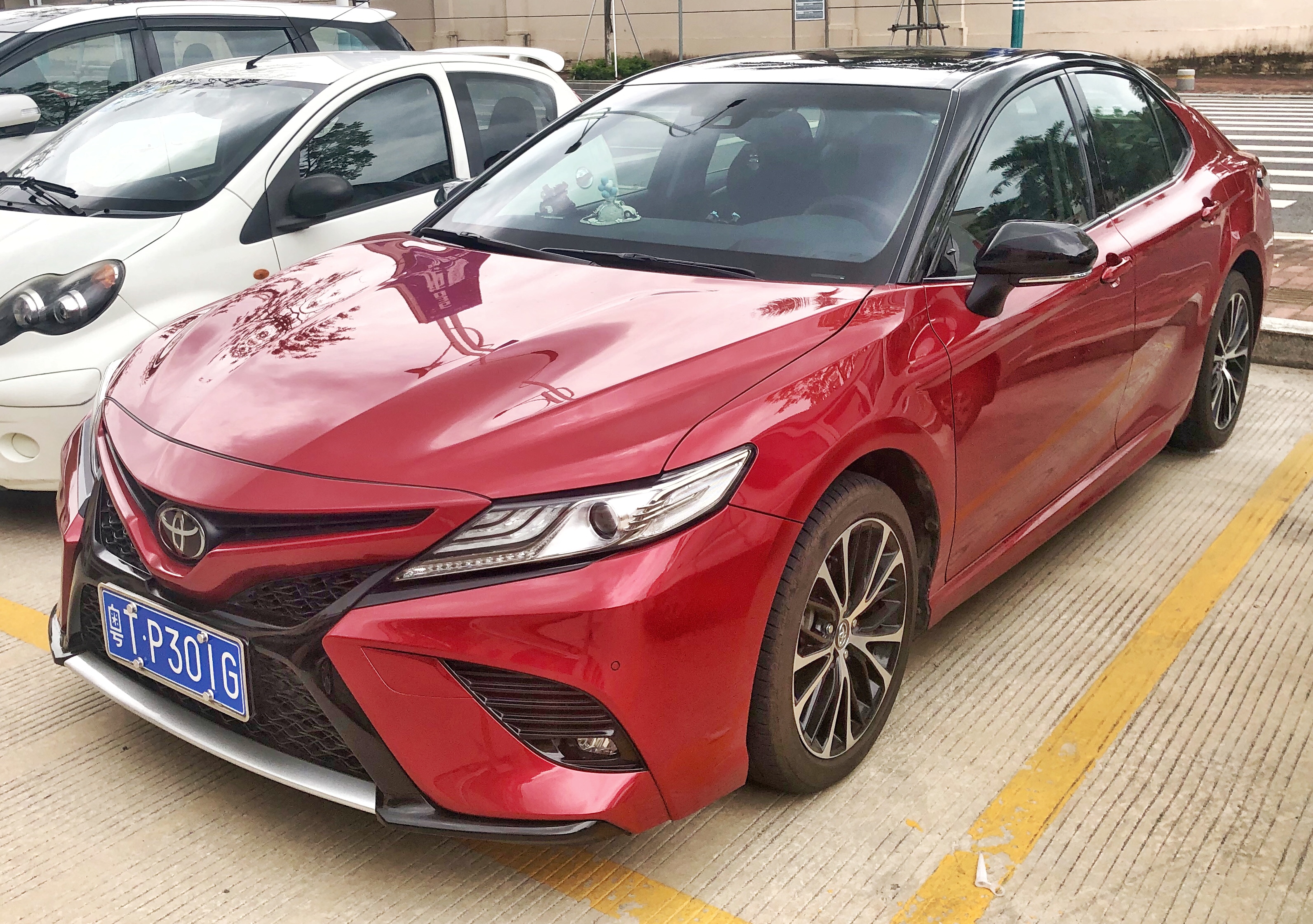
The Toyota Camry is a regular family car that’s built for everyday driving. It’s popular because it’s comfortable and usually easy to live with. People may talk about it differently depending on the specific year and what they expect from it.
Concept
three day training event
They’re talking about a required training program for new salespeople. It’s meant to teach them how to evaluate used cars and understand why a car is priced the way it is.
“Best price first store” means they try to list used cars at a strong price right away. Instead of lowering the price later, they focus on getting the pricing right from the beginning.
“Days to frontline” means how many days it takes a used car to go from being received and fixed up to being ready for customers to buy. The faster you get cars ready, the quicker you can start selling them.
A “recon manager” runs the dealer’s reconditioning workflow—coordinating the repairs, detailing, and readiness steps that turn used inventory into sellable cars. In this segment, the recon manager is measured on achieving a fast turnaround time (sub-five days).
“Recon parts” are the parts a dealer needs to fix up a used car so it’s ready to sell. If those parts are hard to get, the car can’t be finished quickly.
“Warranty work” means repairs covered by the car’s warranty. Those repairs can take time and use shop resources, which can slow down how fast other cars get ready to sell.
“Recon cars” are used cars that the dealer is getting ready to sell. They may need repairs or cleanup first, and that preparation time is what they’re trying to shorten.
“Fixed operations” is the dealership’s service department—where cars get repaired and maintained. If that shop is busy, it can slow down how quickly reconditioning cars get finished.
“Recall issues” are problems the manufacturer says need fixing for safety reasons. If a car has an open recall, the dealer may need to repair it before the car is ready to sell.
Term
hard day look
A “hard day look” means the team watches the clock closely and has a firm deadline for getting cars ready. If cars start running behind, leadership steps in to fix the process.
A “centralized team” is a group that oversees the process across many dealership locations. They step in when cars are taking too long to get ready.
Term
monthly visits
“Monthly visits” means managers regularly go to the dealership locations to check on how things are going. It’s part of how they keep cars from getting stuck in the reconditioning pipeline.
“Service advisors” are the people you talk to at the service department. They help organize repairs, and the discussion suggests recon work needs its own focus separate from normal service priorities.
A “recon production manager” is in charge of keeping the reconditioning process moving. They help make sure cars get fixed and ready on time, not stuck waiting for other priorities.
Term
lot over capacity
“Lot over capacity” means the dealership has more cars than it can handle comfortably at once. When that happens, they have to prioritize which cars get fixed first so the backlog doesn’t explode.
The Ford F-150 is a popular full-size pickup truck. In this discussion, it’s used as an example of a used truck that should move fast when it’s marketed and stocked in the right way.
Term
cost per unit on recon average
This is the average amount of money the dealership spends to get each used car ready to sell. “Recon” just means the work done to fix and refresh the car after it’s been traded in or acquired.
“Speed to frontline” means how fast the dealership gets cars onto the sales lot. If it takes too long, the cars sit longer and the dealership spends more money waiting.
“Segmentation” here means breaking inventory into groups, like different types or price levels of used cars. That way the dealership can manage buying and prep costs for each group instead of treating every car the same.
This is the average total cost the dealership pays to get used cars into inventory. They track it to make sure they’re buying cars at prices that make sense for what they plan to sell them for.
“Reload balancing” means moving and prioritizing cars so the dealership always has enough ready to sell. It helps prevent too many cars from sitting in the “not ready yet” stage.
LIVE
We're doing better as a result of social media presence.
It doesn't do those three things then it's on the chopping block.
It's in return on investment discussion.
Hey everybody, welcome back to another episode of The Daily Dealer Live.
I'm your host, Sam Darkin.
Thanks for choosing to be here on this Monday, July 13th.
If you're a NASCAR fan and you were awake last night watching the Atlanta race, our
own Carson Hosevar crushed it into the final laps.
They had a rain delay and he was vying for first place, led the last several laps vying
for first among four on the final lap.
Ended up finishing fourth, which props to Carson and his tenacity.
But let's not talk NASCAR, although it's fun to talk about.
Let's talk today's show coming up today.
We've got an incredible show for you.
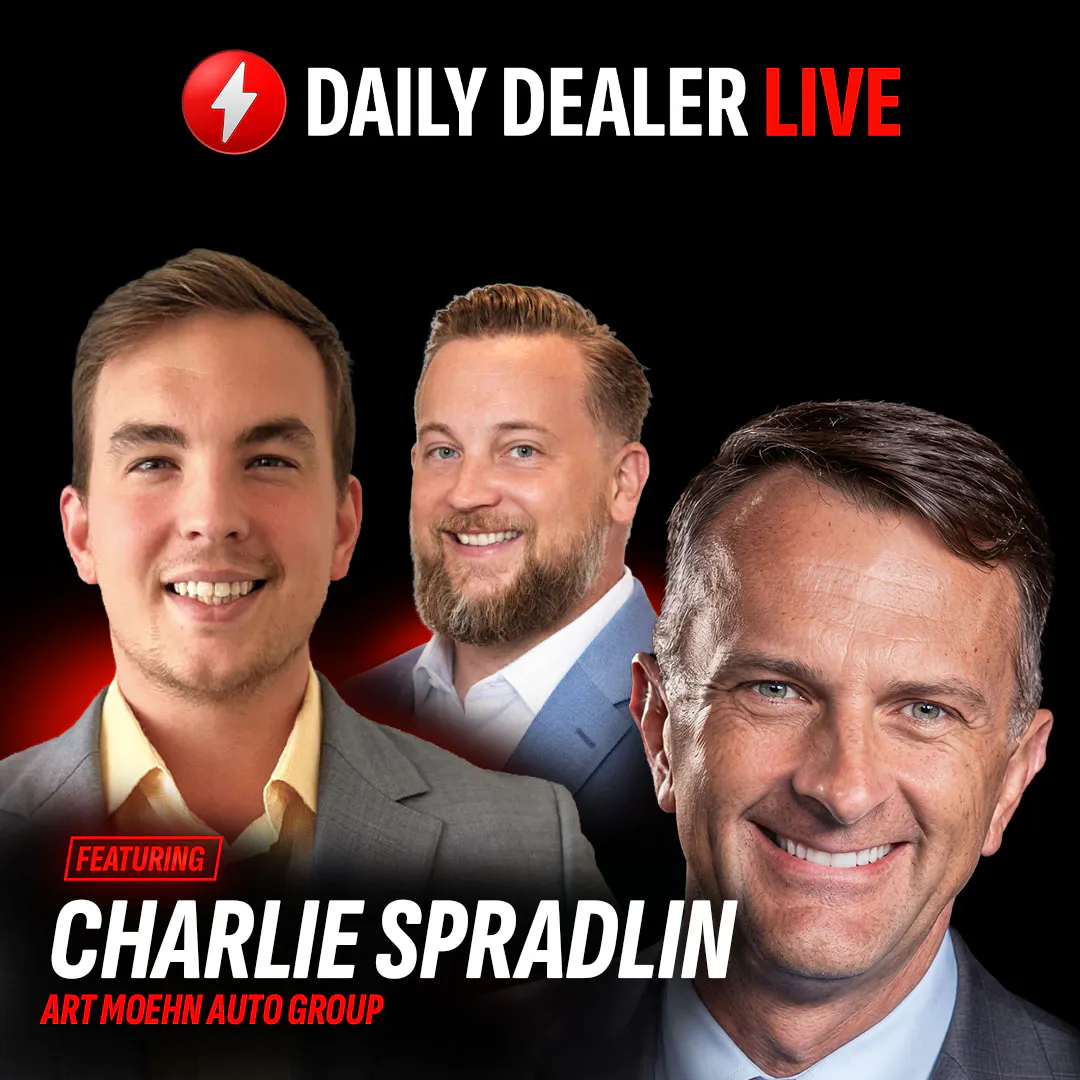
Charlie Spradlin, general manager of ArtMain Auto Group.
Chevrolet Honda under one campus.
Charlie's bringing the strategies, fueling real growth in his stores, starting with a
golden rule of inventory.
Replace what you sold yesterday.
It's simple to say, hard to execute, but it works.
Second, a returning favorite.
John Murphy used vehicle director at Huller Classic Automotive, 13 rooftops across Orlando,
nearly every brand out there, plus a new Ford store in the mix.
John was back with us in March today.
He's back to talk standardization and how you scale what works across that many locations.
We've got two great guests, two conversations you can actually take back to your store.
We're streaming live across all CDG social media platforms as a reminder.
Everybody knows we're here Monday, Wednesday, Friday, 1pm Eastern.
Friday of this week will be an exception.
Coming up this Friday, we're going to stream live from Boulder, Colorado and a CDG gone
live in the wild.
I love that pic, by the way.
You can see me on the clip.
We're going to have an amazing experience with a bunch of dealers in Boulder led by the
car dealership guy himself, Yossi Levi.
I'll be there.
Multiple large dealers and large dealer groups will be in attendance.
The goal of this is to share, to learn, to grow.
It's basically daily dealer live.
It's basically the circles groups live and in person.
So I'm excited to broadcast via Starlink from the mountain in Boulder coming up Friday.
1pm mountain.
So we're shifting from Eastern to Mountain.
We'll remind you as we get towards the end of today's show.
Post your comments into today's show.
We're streaming live across all CDG social media platforms.
We'll bring you into today's show vis-a-vis your comments.
But first, before we do that, let's hit today's automotive industry headlines.
Up first today, we're on top of dealer athlete partnerships in auto retail.
And Dave Canton Group, which recently launched an advisory practice focused on exactly this,
is out with guidance on how to approach them the right way.
The biggest mistake, according to CDG president Brian Gordon, is choosing an athlete based on
national name recognition rather than whether they actually reflect the dealership's values
in community.
Roles need to be clearly defined from day one, whether the athlete is hands-on or a strategic
partner.
And the economics need to reflect that split honestly.
Beyond that, the company said a well-structured partnership can strengthen OEM relationships,
help secure new points, and support employee recruitment and retention.
It's worth noting that Neil Deals since 2021 have also expanded the pipeline with college
athletes and their managers increasingly open to auto retail partnerships,
which makes these tips even more helpful.
And as an aside, I tease Carson Josevar.
We sponsor him in the world of Ziggler on the Ziggler.com,
just like Rick Hendrick sponsors NASCAR.
And Carson has been a fun guy to watch.
Again, I go back to last night, watch what he did on the last few laps of that contentious race.
He was singing in the car.
And that's the type of approach and attitude we at our auto group like.
So I may bring a clip from that in.
So props to the Canton group for supporting and giving some ideas on how to form those
relationships with athletes.
Back to the news.
Up next, we have a data point worth watching for fixed ops.
Cercano reports that US sales revenue and automotive hand tools rose 3.2% in 12 months
ending March, 2026 and unit sales of motor oil and filters have grown 3% or more for three
consecutive years at retail.
DoorDash entered the auto parts category in late June, giving consumers on-demand access
to more than 200,000 parts through their phones.
DoorDash parts.
Dealers are still well positioned on quality and expertise and JD Power's 2026 CSI shows
overall satisfaction is improving, but the gap is harder to close.
But the gap, that's harder to close the speed because dealer maintenance visits
average 1.61 hours for mass market customers while 62% of aftermarket visits for similar
work wrapping under an hour.
Convenience and wait time are where independent shops and now DoorDash are gaining ground.
And that's the pressure point for fixed ops to address.
As an aside, DoorDash parts delivery.
What a cool automotive industry we live in today.
Never thought I'd see that.
Moving on to a reminder.
From the Senate level, a committee vote is set for July 18th on bipartisan legislation
that would effectively seal the U.S. market from Chinese automakers.
And as an aside, we've had this debate many times on the show.
Back at it, the bill sponsored by Ohio Republican Bernie Moreno and Michigan Democrat,
Alyssa Slotkin would codify the Biden-era Commerce Department rule barring Chinese
passions or vehicles from U.S.
expanded to cover parts and vehicle software developed in partnership with China or other
adversarial nations.
The broader legislative push has been building all year.
In March, major automaker and dealer groups sent a letter urging the administration to
block Chinese brands and 70 House Democrats separately called for the same.
If the bill advances, it gives the industry more regulatory clarity on the competitive
landscape, though the unresolved questions around Chinese brands like Volvo and Stilanus's
Leap Motor partnership will remain complicated territory.
And as an aside, if you're a Polestar dealer this July of 2026, you know you won't be selling
those in the U.S. next year, 2027.
Customer base vehicles in the U.S. all aside, it's out at the moment.
So we will continue to follow this developing story as it relates to Chinese vehicles sold
in the U.S.
Back at the news.
Finally, we turn to the CDG Bicell Tracker.
Cue the tracker.
And finally in Bicell News, Ed Morse, there you go.
Ed Morse Automotive Group officially added Mercedes-Benz of Billings in Montana on July
8th, the group's third luxury brand and 61st overall store.
The deal marks Ed Morse's entry into Montana and adds Mercedes alongside Cadillac and Porsche
in a luxury portfolio that didn't exist two years ago.
Teddy Morse, who took over after his grandfather, after his father's death a decade ago this
month and has grown the group from 14 stores to 61, told CDG News he wants to be the largest
privately held dealer in America.
His team's anniversary year slogan.
Some people say 80 years is a legacy.
We say it's just the beginning.
I think that's a great tagline.
And that's an awesome goal to have anywhere in automotive.
And that, folks, is a wrap on today's automotive industry headlines.
All right, here's what I like.
Let's go to the chat for a moment.
And the chat is live with your comments.
I'm going to read off here.
Ken C. comes in and says, under the layers, it is tough times with a bright automotive future.
Not all glitter, not all that glitters is gold.
Hang in there as I do.
I listen, learn, and preach CDG-like gospel.
I do think it's interesting.
How's automotive this July, 2026?
You've got your answer posted into the comments.
We'd love to bring that into the conversation as we attack used cars today.
And Ken C. also says, I know 10 families with cars, two cars, 2016 and older.
Future is bright, but the experience for them has got to be on point when they finally go
back to buy a vehicle at a dealership.
And then yoga cars comes in and says, hey, I'm curious how Starlink will hold up live in Colorado.
Looking forward to outdoor episode.
By the way, Elon Musk, we're throwing it out there.
We'd love to have you on the show.
So if you want to come on and be part of our Starlink live on top of a mountain in Boulder,
Colorado, come on in.
And then we've got just a ton of comments in the chat.
Lauren Klein, homegrown athletes are always the best.
We agree with you on that with Carson Josevar.
And then Dale in progress, do it yourself, auto maintenance.
More folks are worried about the price of the dealership being too high.
But also some people just like to work on their cars as well.
Well, let's jump into today's use car focused episode.
Let's turn to Charlie Spradlin, GM Art Main Auto Group.
Charlie, welcome to the show.
Hey, thanks for having me.
I appreciate it.
I work side to have you here.
So tell us a little bit about yourself, Charlie, and how's business July of 2026?
Man, I guess a little bit about myself.
I've been doing this, but in the car business for 12 years now.
Coming up on 12 years, just recently took over as our store's GM with our fixed
operation guy kind of departing.
So I ran the sales departments for both of our stores, three stores,
depending on the conversation.
And then I just recently took over as GM.
So I'm excited about that.
But man, business in June was really good.
July is also really good.
Yeah, no complaints.
Yeah, no complaints.
I think it depends on where you're at and what you have going on.
You know what your processes are.
But overall, I think we're poised for a pretty good summer.
So I'm looking forward to it.
So Charlie, is this your first time in the GM position outside a sales manager and fixed
operation?
It is.
I've been here at the store for the entire time I've been in the business.
All right.
So and how long have you been in GM now?
Oh, officially?
About one month.
One month.
All right.
This is cool.
What's one thing that surprises you most or has surprised you most about the gig of
general manager that you hadn't fully expected in this first month?
How similar my processes and sales are translating to success and service?
Like right?
Give us an example.
What's one process?
You know, I just I didn't spend a lot of time and it's just not where I came from.
But the road to the sale is it's just very similar inside of a service lane.
And I hadn't really dug into it before.
I had a good relationship communicating with the other parts of the team,
you know, trying to find success with each other.
But I just I didn't spend a day doing what they do.
And the more I get involved with it, the more I realize that it's I mean,
it's the same.
It's different.
It's a different product.
You know, it's a it's a different environment, but it's the same road to the sale.
And I just found that to be really refreshing, you know.
Charlie, what do you say to people in 2026 and say,
hey, you know what, automotive used to be fun.
It's just not as much fun anymore.
It's a hard it's a it's a grind, particularly coming outside of COVID.
What's your response to that, Charlie?
Either your mindset stinks or you're in the wrong place.
I couldn't imagine doing anything else.
This is this is way too much fun.
Yeah, yeah.
When the challenge, I think is what makes it fun.
I mean, who wants to do something that's easy all the time?
Where's the fuck now?
Yeah, yeah.
So, Charlie, you wrote down in your intake today, you said,
hey, used car acquisition is one of the most important things we do at our store
at our group right now.
Why is that?
And what is it about acquisition that's making you successful in 2026, Charlie?
I mean, I think an immediate, I mean, just obvious point is that you can't rely on new
cars currently, at least in my opinion, in my experience.
It's kind of at a place where we don't have a surplus.
We're going to inventory is going to continue to be a crunch.
And if you're relying on someone else to deliver you cars to sell,
you're going to have bad months.
You're going to have really bad months.
Then you'll have a good month, but then you'll be back to having bad months.
And when you're tied to incentives and rebates and lease programs, it's just you don't have
control of your destiny, man.
And I can't imagine having all these people working for you and you don't have the road map
to success, you're just relying on that factory push.
So US cars feeds the entire operation from top to bottom, every single department.
And man, it's something that you can have control over.
So you have to be a focus.
So you have two good brands.
You've got Honda and you've got Chevrolet.
But they're both brands that have exercised some sort of discipline in production.
Could you sell more if you had more new inventory?
And what would your message be to both Honda and Chevy about, hey, we need more?
Or are you happy where you are as it relates to inventory in 2026?
Yeah, I'd love more inventory, as long as it was the right inventory.
I think that's kind of, I think we've learned significantly in the last few years that just
having inventory doesn't make a difference.
You have to have the cars that people want.
And more importantly, right now, they can afford.
And affordability being, I mean, just, I mean, it's all that anybody talks about.
This is so much money, inflation this, prices that, gas this, eggs that, and man,
if they can't afford it, they're not going to buy them.
And I think there are certain brands that that's affordability is not an issue.
But I don't think Chevrolet and Honda are those brands.
Yeah, yeah.
So you were on our use car round table many months ago.
And if I remember right, you talked about the importance of, as it relates to use car,
replace what you sold the day before.
Was that your strategy?
And break down that for us this July of 2026.
Is it still holding up?
And then how do you execute on that rule daily in July?
Yeah, so obviously, no Glenn Lundy.
He has beat that into my brain over the last couple of years.
If I didn't have that mantra in my head every day,
I don't think that we'd be having the success that we have.
But that being said, it has to just be a standard that you hold your team accountable to.
And it can only be your mission.
I think it's the biggest thing that I've learned in the last 68 10 months,
is that just because I care about it doesn't mean it's going to happen.
I have to tell the story.
I have to paint the picture that it needs to be important to everybody.
And why?
And a big part of that is your service team.
Like your service team needs to understand why it's so important,
why we have to have this influx, why we have to have this speed
of getting things to the lot in time, why we're a priority,
not just paying customers, but your biggest customer that gets forgotten about has to be a priority.
But I've hired the right people.
I've put them in place to hold that standard.
And then I keep them accountable.
And man, it starts flowing once you really have that dialed in.
All right.
So let's, let's break it down.
But before we do, let's go into the chat here.
Lauren Klein says, mapping your customer experience in the service lane is so important.
No one falls the same process and the customer suffers, if that's the case.
And then just for Jordan Cox comes in says, there's a reason Charlie's now GM at Art Main Auto Group.
He takes the bowls by the horns, creates his own inventory and his own economy
through great inventory decisions.
So Charlie, as you're looking to replace every used car you sell,
what is your best acquisition source in July of 2026?
Where are you finding your best used cars by rank, maybe top three sources, Charlie?
I mean, I'm probably going to get a little bit of flag for it, but the auction is still incredible.
So tons of cars to be bought and tons of money to be made.
But we have a, we're probably a 60, 40 split with customer acquisition, trade ins off the street,
service lane, and then we're probably about 35, 40% auction, which is a substantial amount of cars
in the auction. Like last month, we took through our process, 260 cars.
We didn't sell 260 cars, but that's the intake and outtake.
And so, I mean, we're, I mean, obviously everybody wants to buy every car they can from the street
and from the customer. And I think that's great. But when you're trying to replace what you sold
the day before, it's impossible to do that strictly by those means. And so the auction
comes into play and it's really, really important to have that as part of your strategy.
Do you have any type of a used car buying center? Have you gotten into that strategy?
A lot of used car managers have.
Yep. So we have like officially created that department, so to speak. It has its own manager,
it has its own buyers. We have a service concierge, service lane concierge,
who works in that department as well. That was helped. We really created that. I didn't know
what I was doing. So I talked to the right people and found the right people. But Frank Knox with
Autoacquire, he's been instrumental in helping me create that. I just, I think it's so
important if you don't know what you're doing to not act like you do and just ask for help.
Usually that costs money, but it's way more effective and efficient than spending your
wheels and wasting a bunch of money trying it and dabbling for 12 months and really never get
anywhere. Yeah. It's interesting, Charlie, because a lot of leaders once they've become
in that GM role, that general manager role, I've found it becomes sometimes tougher to continue
to ask for help or be curious or ask questions. How do you challenge yourself to continually
be curious in the new role? Because a lot of leaders, once they've been in that role for a while,
start to know what they know and sometimes things you don't know that can get you into trouble.
To your point, how do you stay curious, Charlie? Well, I mean, I just, it's not in my nature to
like put my walls up and just act like I know everything. I just, I don't know how, I don't
know how you have that conversation with people because you're going to make mistakes and you're
going to make them in front of people all the time. So like this idea of like burying your head in the
sand and being like, no, no, no, I know what I'm talking about because my position is important.
I just, I find that to be such a crazy way to live and to lead. My team knows that I want their
success. I beat that into their heads and we're going to find different ways to get there. We're
going to screw up. We're in it together. But man, they know that I'm moving forward. Like,
there's a lot more confidence in the person who's willing to be like, hey, I screwed up.
We're going to pivot and I'm going to, you know, I'm going to do it right. I said it on a clip
or in a conversation the other day, but how do you, how do you act like you're infallible and
then have three bad months in a row? I don't know. I don't know how anybody believes you after that.
You know, so. Well, it's funny because you can pretend to be infallible to know what you're
doing, have three rough months, you get humbled and then you go back and you get curious and you're
teachable and then it all turns around. It flips back around. You get, you go back to the basics
and you have that success again. So it is almost kind of an, it's a, it can be an odd little,
it can be an odd trap. When you were on the show last time, we did talk use car acquisition in the
service lane. How many vehicles are you selling or buying, let's say June of 2026 out of your
service lane and are those numbers increasing? You mentioned you've got to dedicate a buy center
now to it, Charlie. Yeah, we're, I mean, we're averaging in the mid 20s to 30 a month now.
It was a little bit tough in the fall. We were really struggling to find success. We had, we had
some early success tapered off a little bit, but now it's pretty consistent. We have a good process.
We currently use a combination of sky vision and auto acquire to mine the database,
but the service lane as a whole has become really steady, which is kind of interesting.
And I think as we get better, it's just going to continue to grow slowly. And if I can just keep
a steady growth in it, I'm going to be really happy about that. But yeah, and those cars are
obviously incredibly profitable, you know, down the front and the back and every, every which way
you do it, those are, those are the best cars you can possibly buy, it feels like. Yeah,
yeah, customers are so happy. Oh my gosh. You mentioned mining the data through those tools.
Have you done a CDP? Have you cleansed data, done the CDP and all that to make the data more potent,
or is that something you've looked at and are still looking at, Charlie?
No, I, we could, we could definitely do a better job cleansing the data.
By, by using auto acquire, they have this, they have an AI software that runs a campaign.
The AI completely takes over the contact the customers, the phone calls, which has been
really interesting. And so in that way, it's efficient as far as manpower goes,
because the AI is handling all the data that's bad. So you're kind of finding that out pretty
quick, but I don't, our DMS has never been perfect. We've switched CRMs a bunch of times.
We have thousands of duplicates, you know. Who are you with right now, CRM-wise? Drive-centric,
which is, which is the least amount of duplicates we've created to my service. It's pleasure.
But so, so what has kept you from going in and doing a full data cleanse,
creating the CDP and, and, and doing that? Just, do you think the tech's not quite there yet,
Charlie? If, I mean, just in my, in my own way, candidly, I just haven't,
I haven't gotten around to it, you know. I'm sure it's important and I need to get it done.
But there's a lot of things that need to get done all the time, but that's, that's certainly on my,
on my list of things to learn and understand. You know, Charlie, I would go back to Ken Cee's
comment. I'm scrolling back up to try to find it where he said, when we started the show, he,
he came in and he said, Hey, under layers, it's tough times with a bright automotive future. He
glitters is golden. I think that's right. Like you've got to find those technologies and those
processes and systems in the right time and then implement them. You can't just do everything
because, because it's interesting. And the CDP piece, the data cleanse piece, I do think those
are important, but I think everybody's got to find the right tech at the right moment. We had Dennis
Gingrich on last week and, you know, he took almost a year just researching all the different
options, trying to figure out which way to go. So Ken Cee, speaking of which says, Charlie,
who are you using for MPI and what are the stats? Do you do a video MPI? What is this?
What does that service process look like? No, so I'm glad to take the conversation.
No, my team wasn't in the past and that's like number one on my list of things to update in
our service process. I, like in my brain, I can't see why we wouldn't use MPI. Like it doesn't,
it doesn't make sense. And so as I'm learning, that's one of the things that I plan to tackle
right away is standardizing. I don't know who the person that made the comment, but standardizing
the process of a customer coming through the service drive and getting the exact same experience
every single time, you know, I don't know who it is, but someone always makes the analogy of
McDonald's fries. Maybe it's Clint Luddy. I don't know. But it's always where you go. It's always
the same. And, you know, we're doing about 2000 ROs in our service drive. It should be the same.
We should be the best at it. And so they do a great job. And I think they're wonderful,
but we can make some improvements for sure on the standardization of the process.
So, well, Charlie, we appreciate you joining the show today, sharing your ideas on process,
particularly as you get into the GM role. I know the GM title may be a month, but it is interesting
how I think in your case, watching you from the use car round table up to today, you have started,
you've been in that job. You've been doing that job for a long time before you ever got the title.
And I think that's the truth of automotive. And leadership in automotive is you just kind of
start doing the thing. And after a while, the title comes, but your impact as the leader
is there long before. So looking ahead, Charlie, last question, then we'll have you back for the
round table. Looking ahead, what are you working on the next six months? What do you want to get
dialed in to have a successful close to 2026? I want to standardize my service drive process,
educate myself in the time being so I know what I'm doing ultimately, even though it won't be
enough. And then continuing to replace what we sold the day before. If you don't have a strategy,
if you're not replacing the right cars, and obviously that doesn't mean replacing the wrong
cars. If a car sat for 65 days and you lost $800 under a thousand, like you shouldn't be replacing
that car. But replacing the right cars that you sold the day before, those two things are just
going to continue to bring us success as we close out the year. So I'm looking forward to it.
Charlie Spradlin, GM Art Main Auto Group, congrats on your promotion.
Thanks for coming back after an elite showing on our used car round table. And we'll have you back
in a moment for this round table as we wrap out today's show. Charlie, thanks for being on,
Daily Live Live. Appreciate you. It's fun to have repeat returns back to celebrate their success
with them. Let's, before we go on today, talk Presidio for a moment, the Presidio group.
Today's episode is brought to you by the Presidio group. You probably know Presidio is one of the
top advisors in the dealership buy, sell space. They've worked on some of the most significant
transactions in the industry, but they're also producing some of the best
market intelligence out there. Back by real world investment baking experience and data,
check out their new research and reports portal at thepresidiogroup.com. For M&A Insights, Blue Sky
Multiple's exclusive benchmark data with NCM Associates and analysis on the trends shaping
automotive retail. We appreciate the Presidio group for supporting today's content,
including that elite conversation we just had with Charlie Spradlin and all things used car
acquisition, used car sales, service operations. And it is cool to see so many who've been on the show
growing in their leadership, taking on new roles, responsibilities,
and just absolutely crushing. I also appreciate his humility and curiosity and wanting to continue
to learn in this automotive industry. I think one of the biggest challenges anybody can have
in automotive in 2026 is thinking they know everything or anything or most things because
this industry continues to evolve and change so quickly. I think it's tough to know much.
We've got a bunch of comments again coming in. Lauren Klein talking about the prior segment,
map it out. And we also have a comment from Ben's by Jose M1. I'm in the first,
I'm in my first car sales position at Mercedes. What would be the best advice you could give me
just starting out in such a high end dealership? And I love advice wise. We'll ask a Ram table,
both Charlie and John at the very end. One of the greatest pieces of advice I think for sales is try
connecting with every customer in an unusual and interesting way. Learn as much as you possibly
possibly can, but become elite at solving problems, running towards people's problems,
whether it's customers coming in for service, customers coming in for sales,
customers coming in trying to trade in that used car, a GM trying to get something done,
a service manager, an office person. If you become elite at helping others solve their problems,
you will be outrageously successful in automotive. All right, let's keep today's show going. Let's
classic automotive in Windmere, Florida. John, welcome to the show.
Yeah, thank you for having me again. It's good to have you back. Hey, what advice would you give
Ben's about his first sales position at a Mercedes Benz store? What would you say?
tell him to do? Well, I love what you said, but more than anything with that sales position is
the experience with the customer, right? And connecting with them is so important. So with
Google and AI now at the forefront, they're going to come in researched and ready for the most part,
especially to have that appointment. So find that common ground, connect. And one thing I will
always tell a sales team or a new sales member, be high energy. Yeah. Oh, yeah. Yeah, bring the
energy. Yeah, it's stressful, right? Yeah. And so I'm going to throw something else out there.
Tell me what you think about this. I think old school automotive was about trying to kind of
hang on to the customer long term, kind of slow walk them down a road. I think in 2026, it's speed
to execution and transparency. It's getting customers answers to questions and solving their
problems as quickly as we possibly can. Thoroughly and efficiently and accurately, but also speed
to execution has something to do with it in 2026. John, thoughts? I couldn't agree more. It's the
way we're conditioned now. Look at the most successful retailers out there and they've
streamlined that efficiency where that efficiency becomes elite versus maybe the more experience,
right? Yeah. All right, John, tell us how's life a hauler classic automotive? What's up there?
Use car director? Yeah. Well, life's good. You know, we were happy to see there's a lot of
reporting out there, right? We were happy to see that in 25, we were listed amongst one of those
lists as one of the five largest gains in used retail sales year over year.
Dude, that's a huge, that's a huge accolade. That's a huge accomplishment to have such a
big increase year over year. How did you do it? How did you get that record? I mean,
obviously, to be recognized that way, top five is big, but to actually get those results is
even bigger. It's not easy in this in this marketplace, John. Give us some tips.
I'm going to sound like a broken record with people in process, right? But in the used car
world, kind of seguating off of, you know, our first guest here is Charlie is standardization,
right? If you don't know how to treat the car, well, hey, the product, getting the car by any
means, right? But if you don't have it standardized to process and with that car's journey through
reconditioning all the way up to merchandising, and then that process then goes into the sales
process. And then if you're not measuring it and continuing to adjust and adapt, it all comes
crumbling down. I love it. We want to talk that entire process start to finish, but I also want
to go to the chat because we promise to bring our viewer comments. And Lauren Klein comes in,
says, Haller Classic has been fast, super interested in hearing about how that's working out.
There's been a lot of talk about been fast and the news and the media and elsewhere.
How is it going? Well, you know, we are a very proud been fast dealer. I think we're right there,
number two, maybe flirt with number one in the nation with in terms of overall new car,
been fast rankings, you know, the been fast location to is on one of the campuses, right? So
you have this EV brand that's emerging, right? In the United States, it came heavy out of the
West Coast. Now we brought it all the way east. And we had a general manager talk about people in
process, right? That really took the bull by the horn, so to speak, and got that product out there
in the local community. But also, we got 155 used EVs in inventory. So we can have great used EV
presence that if been fast, doesn't organically grab someone's attention. You know, it's not
something that's on the top of someone's mind, like a Tesla product. If we have a good used EV
presence, and they're engaged in our websites, it can lead them to been fast. But then fast is,
is, you know, they're treating us well as well. We got fresh inventory coming as early as August
this year, 2027 model your product. So we're excited for that.
So the automotive retired guy comes into the chat says, and you don't have to comment on this,
but he's reporting then fast down here in Fort Lauderdale, Florida,
Holland has returned the franchise back. So it's interesting, we reported last week some news from,
I think it was CDK that released data about EV, kind of buying preferences. And I'm going to
slaughter the percent. So I apologize to CDK, but something like, you know, of EV owners last year,
70% were considering buying a gas for their next vehicle. But this year, it went down to in the
teens, I think it was maybe 18%. Are you seeing an increased interest and preference in EVs,
even with the federal rebate gone, John? Definitely with recent recent activity,
right? Yeah, gas prices are up. Yeah. Yeah. So so there's a cause and effect there. Definitely saw
the demand. I think all of us that are in the used car world saw the reporting via Blackbook or
Manhattan Cox, you know, what those vehicles were transacting at and they bucked the depreciation
trend, right? But definitely demand is up. I think we're also seeing, as we see every year,
right? New consumers, new generations of consumers coming in, you know, and we talk about efficiency
and speed in the sales process. We'll think about car ownership as well. EVs offer a completely
different experience that newer generations of car buyers that now have the means and the one
to buy want to engage with. And I hate to say that they're seeing on the news, the news is
dictating how much money they're going to spend on their fuel purchase this week. You know,
an EV is kind of a nice second thought there. And now that affordability has really come
ahead with EVs, that's a big part of it. So John, a lot of pundits and automotive thought EV values
would go off a cliff because a lot of lease returns were going to come up over the next few years
as OEMs pushed that with the tax rebates and then just a sheer flood of quantity.
How do you, as a used director at a super successful organization, how do you buy used EVs in
2026? What are your tips for doing that? I think used car or used EV and EV pricing right-sized.
You know, I was always a big fan of saying they should have their separate book, right?
You know, it's an interesting product. And obviously we've been on quite a journey
for those of us who've been in the business last decade, decade and a half or so with EVs.
But I think they've right-sized. And you know, the strategy is clear. I think with ever used car
now more than ever, what value does this car give to your end consumer and take that seriously?
Replaceability comes into the play here or the thought process. But when it comes to
sourcing used EVs, A, I think they're, because they're a lot more affordable because the supply
is out there, it allows for us as retailers to not have to lean on a rebate to get them sold
and to really price them where it makes sense as a plan B or maybe multiple plans A for that
customer, meaning they're coming in and they have a nice vehicle or a hybrid vehicle. And now the
pricing of a really well-loved used vehicle, used EV is right there at the same price point.
That's really the big thing in the EV market is pricing has come down to a much more practical
area. All right. Let's talk used vehicle acquisition. We can't miss that. You've had huge
increases year over year. When you were on the show last time, you talked about how
data frontline five days was your goal. You'd market red if it went over 10.
But your goal was sub five-day acquisition of frontline. How's that going today, July of 2026?
Are you hitting those targets? And how much has hitting those targets or not been part of your
success these past couple of years, John? It's a pillar to the success. So recon standardization,
reconditioning standardization, how we process a car. This has been a heavy lift last couple
of years since joining the organization. But that lift started with understanding what our
identity was and then creating a playbook as a result. But you rolled that out in 23. And now,
as we're sitting July of 26, I'm looking at a sheet that our centralized team puts together
for every GM. And it has on there shades of green, orange and red on recon tracking and flow. But
at our two reconditioning centers, proud to report we're still sub five-day. We teeter right against
that. And that's all built on standardizing. It's built on planning the month from the very
first. We have automated data that gets fed into our build and buy planning. And we even load
how many cars we should build per day and where heavy met cars should sit in terms of the week,
Monday through Friday. So that's really a recipe for success. I'm also looking here,
how quickly do you get a unit that doesn't meet your standard or meets your identity out of your
ecosystem? That's super important to keeping that down as well. And again, as I'm looking at this
reporting, the teams already have kicked. I'm using industry term kicked. Sorry about that.
From roughly 360 cars so far this month, setting them out to our wholesale customers.
So give me an example of a vehicle that doesn't fit what you would consider to be viable in the
group. What's a vehicle that you would say, hey, what would be one of those 300 vehicles that you
punt on? Well, I do have to say, we're proud 88-year organization. So we're not going to stand behind
or represent a car that has a salvager rebuilt title. I knew that that's an industry and that's
a segment for some of our viewers and out there. But those are automatic, right? But I wrote down
here and I could talk reconditioning all day. But if this playbook in that segment, which is what do
I kick, what do I build? If that's not evolving and changing as the market is and the consumer
demand is, you're doing it wrong. But out of those cars right now, there's plenty of inventory
out there. We know the market is coming down. I think nationally we're up what, 18% depending
on who you talk to and see in terms of retail listings. So there's no need to build potentially
projects right now, mileage parameters, year parameters, right? LTV, finance ability,
everything that makes our world go around, those are all thought about. But I will say at Friday,
at the end of the day, when our wholesale auctions are complete and our retail sales are heading
into the weekend, a centralized team, one that's in these four walls here, we talk about what do
we need to change appraisal wise? Do we need to make any adjustments to our build, do not build
lists? What's in WIP? What's in WIP over five days, seven days, 10 days, 21 days? That's all part
of it, just a weekly Friday meeting. All right. So Lauren Klein comes in and says, what systems
are you using to get those through recon and on the front lines so quickly? So talk to us about
the process that you use as kind of the bones of building this. What are the systems? Is it a
particular CRM, DMS? What are you using? Great question. And because we have the rooftops we
have and adding more, fortunately, we do have multiple DMSs and multiple service platforms,
right? So that could be complicated. So we want to think that this is centralized.
I'm definitely a big fan of if you can build it, that's ideal. So we do have a lot of internal
reporting. And we do track units via our DMSs with the centralized team. We have operations
coordinator that's sitting next to me and an administrator, and that's tracked daily. But
well, first off, our standards are our playbook, right? So it's internal use only.
And that's internal. And we follow that to a T. Depending on what DMS is, how we
write up the repair order. And then we have rule sets for flowing the car, right? What needs
cosmetic, mechanical, warranty, repair, et cetera. But we have a lot of systems that are our own to
track that. Yeah. So internal proprietary systems. So but it would be something like maybe like a rapid
recon or Reynolds has a version of the tool and it would track that VIN from start to finish.
And you mentioned you've got, I think you said you've got two recon facilities or recon centers
across the 13 rooftops. How do you position those recon centers geographically? And then once
that vehicle's recon, how do you decide where to take that vehicle to and allow it to become a
used car? Well, first off, it's Orlando. So real estate's valuable. So as we approach building
our use, use car department to where where hollow classic wants it to be. And we definitely want
it to be well up there 25, maybe 50,000 used cars a year, right? But geographically, it's where was
the space. And then again, to service the dealerships that these units would go to, if that's the case.
Now, we do have the driver's mart used car superstore brands. So those recon centers are
situated right next to those two stores, which only makes sense. And then again, where can we fit
paint booth and and the amount of lifts we need, you know, our winter park facility is a facility
that had a massive outfit in 24. And, and it has over 50 service bays, for example, you know,
full full body shop capability. You know, it's it's quite a robust place. And then the northern
reconditioning center is a nice segue to Daytona, for example, as we have a Audi Daytona store coming
online soon enough. Wow. Oh, you're opening a store in Daytona? Yes. Very nice. A franchise
or independent will be part of Drive Mart. So it's Audi Daytona. So that will be an Audi store.
We do have an outstanding Audi store, Audi North Orlando recognizes top 15 in that brand. So
super proud of them. But we're going to take that success, send it to Daytona. And then Driver's
Mart, again, as the used car guy, I selfishly like it because we can put those up a lot easier than
we can we can put the new car franchises, right? Yeah, whose idea was it to create the Driver's
Mart brand, the Driver Mart brand? So that that came from our board. And it's really executing
on, you know, again, as we're looking in our new car franchises, what's coming in the pipeline,
and then just simply does not meet a new car standard of vehicle, right? Or maybe they're
oversaturated, or maybe there's recalls that have nuances that just again, don't fit that new car
brand. So as we develop standards, we're very careful to understand what our new car stores
needed outside of certified pre-owned. And what Driver's Mart identity was for that high value,
not cheapest, but high value used vehicle. And I say that because Driver's Mart can sell
it $150,000 car as well as a $5,000 car. But all those cars that made it to the wholesale world,
there had to have been a filter. So the board at the time and the executive team at the time
decided, hey, what if we had a used car superstore concept where we filtered these kick cars
through to this facility, and then it was born from that and has grown to now it has cars purchased
directly for it as well. Yeah, very cool. Lauren Klein comes in, she says, LOL, we want the secret
sauce. So she's referring to wanting the picture of the proprietary software. But
props to you guys for creating that used car brand. And you sometimes see ebbs and flows and
used car demand and the ability to actually have those vehicles. What a great way to capitalize.
That's a great way to capitalize on demand and also deal with some of those vehicles that others
might push out. So talking of Driver Mart superstores, do you have any expansion plans or
operational updates to Driver Mart? You know, you've shared the Daytona Audi plans. What about
Driver Mart used? Yeah, absolutely. So short answer is yes, expansion. We've earmarked
properties to help expand the footprint of those stores. And like with anything, and I alluded to
at the end of 23, kind of understanding what's the basis, what's the foundation of building the
program. 24 start to execute and bring people in. 25 really kind of start to fire on all cylinders.
Well, in 26 year, it added to 27. Now it's time to really put some growth plans in place. And as we
start to grow those internal people and processes and see the consistent success, let's say, now we
can start adding to it. But we do have properties that we would like to immediately or as soon as
possible put Driver Mart superstores on and hopefully give some of our competitors and viewers
some heartburn as we put them next to them. Well, John, congrats on your group's success.
Congrats on being recognized nationally and a lot of those rankings for fastest growth and used.
I am, you know, as we wrap up before we go into the roundtable, just, you know, you mentioned kind
of your corporate structure or your auto groups. You've got a board. Would you just describe for
us? What does that look like? How many people are part of that corporate team? What does your
corporate organizational structure look like? Every group is so different. And at 13 rooftop,
what have you scaled to, John? Sure. And growing. And again, it's always evolving, right? Like we
should be doing in the used car business. But we have our board. And then we have our executive
team that reports to the board and they have daily or to me weekly, if not bi-weekly meetings,
which is great. There's always communication. But your executive team reports to the board.
And then you have field support, people like myself. There's a fixed operations director,
Mr. Tori Boomer, who's well known in many parts. You know, he's my counterpart and myself in the
used car world. We have corporate trainers and marketing. They all are housed in our
centralized location. And we're there simply to support the stores in specialty projects and growth
and managing people and you name it. So I would call it, you know, coming from in my background
CarMax, let's say I would call it much more flat. The general managers at all the locations are the
owners of their locations and stores. But I think we can tie Bo on it and say, if you're going to have
the legacy and again, 88 years of stewardship like we have in successful stewardship here in
Central Florida, we all have to look, walk and talk a certain way. And that's really, you know,
main goal of the centralized the corporate team. And how big does the other group want to become?
I mean, you're obviously growing, you're acquiring, you're buying points. Is there a
goal? Or is it as big as we can get? No, I think that there's goals and aspirations. And you know,
one of the things that made me excited to be honored to be offered to join the group was
were those goals. So, you know, I don't think it's necessarily a number, but I do know that our
board and our executive team like destinations and dealerships that have the ability to sell a lot
of cars. So whether, you know, where it takes maybe an operator, you know, four or five stores
to do what we would do with one or two stores, you know, that would be the mindset. But I do know
that, you know, I could proudly say we our next milestone is 25,000 used cars a year. And then
we do have a big audacious goal of 50,000 used cars a year. And we can kind of back in the math
from that. Yeah, love it. Well, John Murphy used vehicle director at Haller Classic Automotive
Group. Thanks for being on Daily Deal Live. We'll have you back in a moment for the roundtable.
Sounds good. Yeah, you know, it's so interesting to learn from people who are having success.
And you see that year over year increase. Again, recognized top five in increase is huge. And they
just keep on growing to double from, you know, a big goal to 24. And then a big Harry audacious
goal to 50 is very cool to everybody in the chat. Thanks for joining. A lot of conversation between
eager K the automotive retired guy as always. And of course, Lauren Klein's getting into the
comments. I'm just seeing all this. There's a lot of conversation on Volkswagen on Jetta.
And obviously with the scout thing that Volkswagen is trying to do here in the US,
but then also some of the reorg that's going on with Volkswagen currently,
there's much to debate about, about that, but we're not talking new cars today. We're talking
used cars. So let's bring in the round table as we round out today's show. Charlie Spradlin,
General Manager, Art main auto group and John Murphy used vehicle director at Haller Classic
Automotive. Thank you both for being on the show today. So all right, here we go. Give me what's,
we're going to do just kind of a lightning round. What's the hardest part of used cars right now?
Acquisition, recon or the desk? Charlie, let's start with you.
I mean, I think it's acquisition. I think if you have a recon process that's standardized and you're
good, I love John's model. That's awesome. But acquisitions got to be if you don't have them,
you can't sell them. Yeah, John, acquisition, recon or the desk? Yeah, I think this is a fun
question because it's maybe differences in where we are, stages of growth, right? I think in 23,
24, we'd say acquisitions. I think right now it's, we have the inventory, process,
let's execute. So I'm going to say the desk and understanding all the nuances that are happening,
especially as values come plummeting down. How do you train a desk in 2026 to be better at used
car execution, John? And by the way, anybody that has your phone number just needs to start calling
you right now. That's the fun way to get on Daily Deal Live. I'm kidding. I don't know if that's it,
but sorry about that, guys. It's all good. Well, you have to be unapologetic about what a used car
is, right? So a new car franchise minded dealer group, used cars are a shock. Whether they're
whether they're the rental used car that's been perhaps not as loved as a grandma's
Camry that was stowed away in the garage most of the time, there's going to be differences and
nuances there. But I think the biggest piece of success we've had as new people come onto the
desk and these sales team members is we actually in our onboarding and our required three day
training event for our sales team, we have a whole half day earmarked for used and it really
harps on standards and how we find the values on our cars. And if you don't understand what you're
looking at or why it's priced or where it's priced, we are the best price first store, all of our
stores. That's super important with us. You've got to understand the why behind it. Eager K comes
into the chat, Charlie, and says acquisition is the most important thing. And he goes on to say
smart acquisitions, not just any acquisitions. So acquisition v desk, great conversation.
Give me your average. We talked a lot about days to frontline, starting with you, John,
what's your average days to frontline across your group and then Charlie.
So coming out of the recon centers, we're just a shade under five days, however, between, you know,
47, 48, something like that. At the new car franchises, it's a bit longer, right around six
or seven days. Okay, Charlie. Yeah, I knew this was going to come up when we talked about, I pulled
it out. In June, it was 6.24 days. Yeah, what would you, what do you both want it to
be? What would your ideal target be if you could wave a magic wand and have any days to frontline?
Yesterday. Yeah, sub five. I mean, we have, we have a recon manager in our setup and his goal
is sub five days. So he's paying bonuses off that. And in July of 2026, Charlie, what's the biggest
obstacle to sub five days today, right now? Vacation time. Vacation, John, biggest, biggest
obstacle. Oh, man. I would say, you know, parts, parts can be a real, real headache. Parts, parts
supply. And then that is so true. Recon parts, that is tough right now, isn't it? Yep. And warranty
work. You know, we have a juggernaut in fixed operations and, you know, recon cars, user
deprioritized understandably to our, to our customers. How do you, how do you address that,
John, in such a large group? I hear all the time, Hey, you know, our, you know, this particular
vehicle is aged because parts delay, you know, recall issues, you know, whatever else we have
to hang on to it longer to get it ready to be on the frontline. How do you address that, John,
as a process? Force the ask, say the quiet thing out loud, right? So if we put a hard day look,
so the centralized team will start to intervene. You know, we live in days of seven or increments
of seven days where they, we will start to proactively ask questions back to the locations.
People like myself, we do monthly visits with the stores. We just, we're just always bringing it up,
right? But also with internal service advisors and recon production manager love that Charlie has,
that as well, that's super important, someone that's not retail or service lane focused,
but recon focused, right? Two different processes. But that role or those roles,
because we will have deep prioritized re-conditioning vehicles, especially with supply and the lot
over capacity or at capacity. Well, that's where you have to find the time during the week where
those cars are forced to be addressed, right? And that's just, that's just, you know, teamwork
across the board all the way up to the GM.
Charlie, fastest moving used car brand in July 26. Toyota, John, you've, you've got 13 rooftops.
Use cars of your brands. Who's your fastest mover? Ford? Ford trucks. Ford trucks. Let's go. Okay.
EVs or just truck, gas trucks? Well, if we're fortunate to have a used EV truck,
yes, that's super fast. You know, you said EVs too. We're very proud of that.
You know, the EVs move quick, but if you're a Ford F-150 sitting in the holoclassic ecosystem,
you're going to get sold. Yeah. Chase volume or protect margin in 2026. Charlie, and then John.
I think volume is your margin. So yeah, yeah. Thoughts on that Charlie or John?
Really well said, Charlie. Volume is your margin. Manage it. Manage it daily. And also you have to
make the choices fast, right? You got to kick a car fast. If the values change, that car needs to
change. And it's your job as operators to bring in inventory or adjust inventory to manage that
margin. All right. Three most important used vehicle KPIs as we ran out today in 2026. Three
numbers that you live and die by in 2026. John, go. Well, okay. Well, it's going to be cost per
unit on recon average, right? Speed to frontline. And it's got to have a segmentation part of it. So
what's our acquisition cost average across segments coming out? So we have the right inventory.
We're not over-reconditioning it and we're putting it frontline as quickly as we can.
All right, Charlie. Yeah, that. I mean, days to frontline is super important. I think my average
retail investment, like what kind, what price of cars am I selling? Yeah, everything he said.
It's like those are the most important ones. What about aged? What day will you punt of
used inventory? What's your age policy in July of 2068? Hang on to stuff a little longer
because they're tougher to get or are you getting rid of vehicles faster?
Notice we avoided that age question in July. Yeah. Absolutely age process and policy in place
here at our organization. We track that. I'm looking at it now. So not only the day supply
that we're carrying in the store, both in a live or frontline inventory, but also including WIP.
Super important to understand is reload balancing. And then, yeah, there are just
certain points where you have to adjust, move on, move out. Charlie, is age a thing or in
the dog days of summer is that, hey, be patient because it'll sell? No, I don't believe in waiting
for cars to sell. I do think it just needs to be managed. I can't imagine managing on a massive
scale. I think you'd have to have a hard line like with 13 different stores. You probably
would have to have a hard line. But at 45 days, we start to get a little couple of ants in our
pants. And then we start getting aggressive from there. So my biggest thing is if I'm going to
take a loss on the auction, I better be trying to take that loss on the lot. So which I think stops
that aging problem from happening for the most part. All right, we're going to give Ken see
our last comment today. But before we go to that, he just typed it into the chat.
Best lead source. Add lead source for used cars in 2026, John.
Starting with me. Yeah, we have a lot of great vendors that support this. Can I say that first?
Yes, you can. But you have to pick a winner. That's the show transparent. We execute. We tell the truth.
Okay. There's a lot of great ones out there right now. But
you know, it's quickly. AI is a big thing. Can your dealers be seen? Can your dealers be seen
through Google and organically your website? Okay. All right. He dodged that question beautifully,
by the way, Charlie. I got to tell you. All right, best ad lead source. Yeah, our best ROI,
but it's also our biggest spend as auto trader. But outside of that, it's Facebook.
Our social media sells a ton of cars. Yeah. Facebook, John, is it a thing or not? I get
mixed reviews every now and again on Facebook. We're taking it seriously enough here at
Holler Classic that we we onboarded some really great marketing talent at the end of last year.
And they're fun. They're exciting. And we'll see where this journey goes.
Yeah, I like it. All right, Ken see returning to him for the last question starting with you,
Charlie. What's your biggest fear in business for 2026? We think about the last half of the year.
My biggest fear is that the people around me, I let them get complacent. I think as long as I
keep everybody moving, rowing the boat in the same direction, it's been a really, I mean,
we've had a month or two that's bad. We've had a great year overall, and we're going to continue
to do so. So we're just not going to slow down. All right, John. I'm going to go on an outward
look on this one. You know, FTC came came barreling down right May 1st. And we needed to continue
to be flushed out and processed. It's created an interesting dynamic, including price increases
across the board, a lot of one pricing. But biggest fear is we don't follow through fully with what
at least we're saying we want in the industry. It's going to change a lot. All right. All right,
John. Last question for you just super fast because we are completely out of town
time. You're in Orlando, which means you're at the doorstep of Disney World. What's one thing
most people would not expect about selling cars in Disney World? How many people actually buy a
car to go home? Oh, okay. All right. So they fly in, they can't fly out. So they got to buy a car.
I like it. Something like that. Yeah. All right. Charlie Spradlin, General Manager,
Art Main Auto Group. John Murphy, Used Vehicle Director, a Haller Classic Automotive. Thank
you both for being on today's Daily Dealer Live. We appreciate you being here. Thanks for having
you. Thank you. And a reminder to our listening audience, we are live this Friday,
Boulder, Colorado, CDG Experience on a mountain. It'll be just right after we do some rock climbing.
You can catch me, the mic, the camera. We'll have special guests there live and on the spot.
Come learn with us. Come grow with us. A Daily Dealer Live, 1 p.m. mountains. That means our
normal 1 p.m. Eastern will then go to 1 p.m. We'll go to 3 p.m. Eastern, 1 p.m. mountain time.
Again, live from Boulder, Colorado. And to you, our Daily Dealer listening audience,
thanks for watching Daily Dealer Live, where we break down the biggest moves in the car business
as they happen. Don't forget we're live here every Monday, Wednesday, 1 p.m. Eastern. This
Friday, 3 p.m. Eastern. So if this is your world, hit like, hit subscribe, turn on those notifications
so you never, ever miss a beat. We'll see you next episode. Thanks for being here, everybody.
About this episode
Charlie Spradlin and John Murphy dig into how dealers win in 2026—starting with inventory rules like “Replace what you sold yesterday,” then scaling standardized processes across stores. Used-car acquisition gets framed as a daily execution grind: sub-five-day frontline targets, avoiding over-reconditioning, and using auctions plus service-lane trade-ins. The show also covers industry headlines (DoorDash auto parts, dealer service timing, and proposed China-related legislation) and dealership-group moves, including Ed Morse’s Mercedes expansion and Polestar’s U.S. timeline.
Today's show features:
- Charlie Spradlin, General Manager at Art Moehn Auto Group
- John Murphy, Used Vehicle Director at Holler-Classic Automotive
This episode is brought to you by:
Presidio – Today’s episode is brought to you by The Presidio Group, one of the automotive industry’s leading buy-sell advisors. Visit Presidio’s new Research & Reports portal for M&A insights, blue sky multiples, exclusive benchmark data with NCM Associates, dealer sentiment, and analysis of the trends shaping automotive retail at thepresidiogroup.com. Check it out at https://thepresidiogroup.com
Check out Car Dealership Guy’s stuff:
CDG Circles ➤ https://cdgcircles.com/
CDG News ➤ https://news.dealershipguy.com/
CDG Jobs ➤ https://jobs.dealershipguy.com/
CDG Recruiting ➤ https://www.cdgrecruiting.com/
My Socials:
X ➤ https://www.twitter.com/GuyDealership
Instagram ➤ https://www.instagram.com/cardealershipguy/
TikTok ➤ https://www.tiktok.com/@guydealership
LinkedIn ➤ https://www.linkedin.com/company/cardealershipguy/
Threads ➤ https://www.threads.net/@cardealershipguy
Facebook ➤ https://www.facebook.com/profile.php?id=100077402857683
Everything else ➤ dealershipguy.com