
About this episode
Rexy’s Detroit struggles become the episode’s springboard: BOP changes like “They took power out of the car. They put weight into the car.” can punish cars on slow, traffic-heavy street circuits. The hosts connect that to broader racing incentives—“if you're fighting for a championship, you need to run all the races”—and to real-world logistics like sanctioning and shipping. The conversation then pivots to Porsche 911 pricing, where rising “futures based pricing” and IMS/bore-scoring worries reshape what buyers choose, and when.
Thank You to the Kimchi Crew
Before we get into it, a genuine thank you to everyone who listens, supports the show, and keeps this community alive. You know who you are. We do this because we love it, and you make it worth doing. Now let's get into it.
Detroit IMSA: BOP'd Into Irrelevance
The Porsche GT3R at Detroit was so heavily Balance of Performance'd that it was barely a factor, and the prototype entries qualified so far back in such a short enduro format that catching up was a near-impossible ask before the green flag even dropped. But let's be honest with ourselves here: IMSA was on GM's side from the jump. The race is in Detroit, GM's backyard, and anyone paying attention could feel the gravitational pull toward keeping the home team looking good. This isn't new. The frustration with series organizers placating to manufacturers based on geography or politics is real, and it's a recurring stain on what should be a pure competition. When the racing result feels predetermined by the city it's held in, that's a problem worth calling out.
The 911 Market Is Not Coming Back Down
We touched the surface of this last episode when we talked about Mezger-engine GT3s drying up and the 993 price surge, but it's time to go deeper because the numbers are getting genuinely hard to rationalize. 997 Carrera S's: a green manual with 35k miles is asking $108k. Midnight blue, 55k miles, manual, asking $90k. For a Carrera S. Let that sit. 996 Turbos, which we've covered before, are now seeing 95k-mile manual cars asking $90k. The market logic here is that against the backdrop of new Porsche prices, these feel like deals to people entering the hobby. And look, we get it, but that doesn't make the numbers any less wild.
The broader picture is this: if you are chasing a manual 911 of any generation, any configuration, the era of stumbling into a good deal is over. Base 991.1s with 50 to 80k miles are moving at $65k to $80k. Base Carrera, not an S, not a GTS. And before anyone says you can still find a reasonable 996 base 911 for $35k to $40k with 90k miles -- we'd push back hard on that. That is not a bargain. That is a lot of money for a car that will demand attention and investment. The "affordable 911" narrative needs to be retired.
Here's the thing we want to be transparent about: there is zero financial incentive for us to tell you to go buy a car. We don't get a cut. But if you want a manual 911 and you're sitting on the fence, today is genuinely the better bet than tomorrow, because every data point we're seeing says the floor keeps rising regardless of generation. This is not a bubble in the traditional sense. These are driver's cars with a finite supply of desirable manual configurations in a world that stopped producing them. Why do you think this keeps going up? We'd love to hear from the community on that.
What makes this genuinely upsetting, not just analytically frustrating, is that the price appreciation is pricing out exactly the people who should be owning these cars. The passionate ones. The ones who would drive them, maintain them right, and actually care. Instead they end up with people for whom it's a flex or a garage sculpture. That's a gut punch for anyone who's been in this community long enough to remember when that wasn't the case.
JC9 Carrera GT: A Solution Looking for a Problem
The JC9 is essentially a reimagined Carrera GT body with visual cues borrowed from the 917. On paper that sounds compelling, but sitting with it longer brings up some real questions. The Carrera GT doesn't need to be fixed. It is one of the most celebrated analog driver's cars ever made. Slapping a new body on the concept and marketing it to ultra-wealthy buyers who want something exclusive feels like the automotive equivalent of a solution looking for a problem. KISS. Keep it simple. The military drilled that into some of us for good reason, and it applies here. The original formula was right. The more the car world chases bespoke reinventions of icons for nine-figure clientele, the further it drifts from what made those icons matter in the first place. Thoughts on this one? We have mixed feelings and we're not hiding it.
Indecent 911 Hatchback Wagon: Cool Idea or Vaporware?
The renders coming out of Indecent for a custom 911 hatchback/wagon are genuinely striking. They look cool. Full stop. But the question that always follows something like this is whether this is another "put your money where your mouth is" moment, where the concept gets traction on the internet and then quietly disappears when build deposits don't materialize. The 911 community has seen this cycle before. People love the idea of something unconventional until they have to actually commit to it. Is there a real market for a coachbuilt 911 wagon? Maybe. Is the execution going to live up to renders that were made to generate buzz? That's always the harder question. What do you think -- cool and you'd want one, or a stunt?
Outro
That's a wrap on this one. Catch us at pcartalk.com for upcoming events, support the show over at Patreon.com/pcartalk, and find us on social at @pcartalk. As always -- Kimchi Crew: Steve, Leslie, Chris, Ken, Aaron, Matthew, Sean, and Nik.
Detroit
"Alright, so Detroit, little excerpt on that, like the, I don't know if you guys watched that race, but it's a couple things to mention about that."
They’re talking about the Detroit race and what happened there. The point is that the rules/adjustments seemed to affect the cars’ results.
“Detroit” here is shorthand for the Detroit race weekend context the hosts are discussing, including how race officials applied performance balancing. It’s used to frame why the outcome felt predictable.
BOP'd
"The GT3R, Rexy as everybody knows, was like heavily BOP'd. I mean like heavily BOP'd. They took power out of the car. They put weight into the car."
BOP means race officials tweak cars so they don’t all end up with the same advantage. They might add weight or limit power so different cars can compete more evenly.
BOP (Balance of Performance) is a race series method of adjusting cars so they’re closer in speed. Adjustments can include adding weight and reducing power, which changes how quickly a car accelerates and how it behaves in corners.
torque
"And if you don't know, you should know if you're listening to this podcast, those cars don't have a terrible amount of torque to begin with."
Torque is the “pulling power” of the engine. More torque usually helps you accelerate harder, especially when you’re not going fast yet.
Torque is the engine’s twisting force that helps the car accelerate, especially at lower speeds. In racing, if a car has limited torque, it can struggle to make up time when it can’t carry much speed between corners.
city course
"So when you're running a city course, like there is a million turns, you're going pretty slow. So you're not able to carry a lot of speed because also there's a lot of traffic."
A city course is a race track made out of regular city streets. It usually has lots of tight turns and slower speeds, so it’s harder to carry momentum like you would on a normal race circuit.
A “city course” is a street-circuit layout built on public roads, typically with tight turns and frequent braking zones. Because speeds are lower and there’s often traffic, cars that rely on high-speed momentum can be disadvantaged.

Chevrolet Corvette
"And if you look at it, it kind of feels that way because the prototype cars, the Cadillacs did really well. The Corvettes did really well."
They’re saying the Corvette race cars did really well in that event. Corvette is a Chevrolet model that’s been used in racing for years.
The hosts mention “Corvettes” as prototype race cars that performed well in the same endurance-racing context. Chevrolet’s Corvette program has a long history in sports car racing and often appears in top-tier endurance classes.
Emsa
"I'm not hating, but I'm saying if you watch enough Emsa, you can see between the lines this happens pretty often where Emsa will placate towards certain brands in certain locations"
“Emsa” is a reference to the endurance racing series they’re talking about. They’re saying that, over time, it can seem like some brands get treated more favorably than others.
“Emsa” is a motorsport series reference (commonly used to mean IMSA’s endurance racing era/branding). The hosts use it to argue that performance balancing and scheduling can appear to favor certain manufacturers in certain places.

Ford Gt
"like when the Ford GT came out, they got to run basically full gamut and no BOPs at all, won a championship and then they left."
The Ford GT is a special Ford supercar that also raced in endurance events. They’re using it as an example of how race rules can affect which brands end up winning.
The Ford GT is a mid-engine supercar built by Ford for endurance racing and customer competition programs. The hosts reference it as an example of a manufacturer that initially ran with minimal BOP adjustments and won a championship.
catch 22
"…it's if you're fighting for a championship, you need to run all the races. So that's the catch 22 on that."
A “catch 22” means you’re stuck because every option has a downside. The speaker is saying teams need to race the whole season to win the championship, but that costs a lot of money.
A “catch 22” describes a situation where two conditions conflict, leaving no good option. Here, it’s used to explain the tension between needing to run all races for a championship and the financial risk of teams committing to a full season.
1.7 mile track
"…if they're going to be 1.7 mile track, why can't there be anything in St. Pete?"
That “1.7 mile” number is how long one lap is. Shorter tracks usually mean you run into other cars more often, which changes how hard it is to pass and stay in control.
A “1.7 mile track” refers to the circuit length, which strongly affects racing strategy and how often cars encounter traffic. Shorter laps typically mean more lapped traffic and more frequent opportunities to gain or lose time.
St. Pete
"…if they're going to be 1.7 mile track, why can't there be anything in St. Pete?"
“St. Pete” is short for St. Petersburg, Florida. It’s a place that hosts racing events, so the speaker is talking about whether that city should have more dates on the schedule.
“St. Pete” refers to St. Petersburg, Florida, which hosts major motorsport events. In racing discussions, it’s often shorthand for the local street/road course venue used for series races.
road races
"I mean, it's so important NASCAR even has like where they run road races. Other than just like circular stuff like something under two miles,"
A road race is a race on a track that’s more like normal roads than a simple oval. Cars have to turn and slow down a lot more, so tires and handling are a big deal.
Road races are races held on courses that use public roads or road-course layouts rather than an oval track. They typically involve more varied corners and braking zones, so car setup and tire management matter a lot.
MSA approving
"Either make that race car, making it race car viable, essentially. And then MSA approving that, okay, this road is good enough to do this. So I think there's a lot that goes into that."
MSA approval is basically permission from the racing authority. They check that the track is safe and meets rules, so a certain type of race car is allowed to compete there.
MSA approval refers to a sanctioning body (the MSA, historically the Motorsport Association) deciding whether a venue and course meet safety and technical requirements. In practice, that approval is what allows certain categories of cars to race on that specific road course.
Cupcar
"But you would think, I mean, they run Cupcar stuff in St. Pete. They've run IndyCar here."
“Cupcar” means the main NASCAR stock-car class. The host is saying that kind of top-level NASCAR car has raced on that track before.
“Cupcar” is shorthand for NASCAR Cup Series-style stock cars. These are purpose-built race cars with specific aerodynamic and chassis setups, and they’re used here to argue that the track/road surface can support top-level racing.
IndyCar
"But you would think, I mean, they run Cupcar stuff in St. Pete. They've run IndyCar here."
IndyCar is a major U.S. open-wheel racing series. The cars are built for fast tracks, so if IndyCar can race there, the track must be up to the job.
IndyCar is the top open-wheel racing series in the United States. IndyCar cars are designed for high-speed road courses and ovals, so mentioning IndyCar supports the argument that the venue is capable of handling demanding race conditions.
National Group C cars
"I'm sure it's good enough to run any of those MSA prototypes, any of that stuff. So they ran the National Group C cars in Damba, the fairgrounds."
Group C was a sports-prototype racing category used in endurance racing, with cars built around efficiency and performance rules. Mentioning “National Group C cars” implies a specific class of prototype-style race cars that were run at the venue.
Damba, the fairgrounds
"So they ran the National Group C cars in Damba, the fairgrounds. And honestly, I don't think it's a lack of, it's not a big enough market"
This is a fairgrounds location the host is referencing as a past racing venue. They’re using it to show that different kinds of race cars have been run there before.
“Damba, the fairgrounds” refers to a fairground venue used for racing in the discussion. The host is using it as a historical example of where certain prototype race categories were run.
Formula 1
"Like they would, from a population standpoint, they can't argue that because there's a gazillion people live in Miami, they already have a good enough track to run Formula 1 there."
Formula 1 is the top global open-wheel racing series. It’s used here as an example of the kind of event that proves a track can be made to work.
Formula 1 (F1) is the highest level of open-wheel motorsport, known for highly advanced aerodynamics and engineering. The host uses F1 as a benchmark for what a city-track could handle if the venue is properly adapted and approved.
city bidding for it
"But think about it, at the beginning of the year,"
“City bidding” means the city tries to win the right to host the race. They have to organize permits, logistics, and costs so the event can actually be scheduled and run.
“City bidding” is the process where a city competes to host a major racing event. It matters because the host city has to commit resources, coordinate logistics, and negotiate with the event organizer to make the race happen.
Sebring
"they're in Florida, they're at Daytona, then they're in Sebring in March. They could run [442.5s] somewhere in February, like a road track, because they're already, they stay in Florida."
Sebring is another big race track in Florida. It’s especially known for endurance races where cars have to last and stay consistent for a long time.
Sebring refers to Sebring International Raceway in Florida, famous for endurance racing and a rougher, more abrasive track surface. It’s often used to test how well cars and teams can manage tires, brakes, and consistency over long stints.
Daytona
"they're in Florida, they're at Daytona, then they're in Sebring in March. They could run [442.5s] somewhere in February, like a road track, because they're already, they stay in Florida."
Daytona is a major race track in Florida. It’s known for big, high-speed races and it’s a common stop on sports car racing schedules.
Daytona refers to Daytona International Speedway in Florida, one of the most famous venues for endurance and sports car racing in the U.S. It’s a key part of many racing calendars because it supports high-speed racing and large fan events.
Miami
"So that would be very easy to run a road race, hour and a half, two-hour race, city race, [490.9s] either in Miami or St. Pete, as you said, because already here."
Miami is mentioned as a possible city-race location. Racing on city streets is different from normal tracks because the course is tighter and the surface can be less predictable.
Miami is referenced as a possible location for a city street race. Street circuits change the setup and driving demands versus permanent tracks because of tighter corners, barriers, and surface variability.

Porsche 963
"And then Florida in February is definitely the place you want to be at. Or the 963's BOP as well. I just felt like we just, as Porsche is showing, it just, what didn't seem the same like it's been the last few races. [530.1s] The cars didn't, they were also BOP, but not as heavy."
The Porsche 963 is a Porsche race car built for major endurance races. It’s the kind of car that competes in the top prototype classes and has to follow race rules like BOP to keep competition close.
The Porsche 963 is Porsche’s modern Le Mans–class prototype built for top-level endurance racing. It’s part of the current wave of factory prototypes designed to run long stints and compete under Balance of Performance rules.
GTP cars
"The cars didn't, they were also BOP, but not as heavy. I mean, you could tell by quality, the cars weren't good, like meaning the GTP cars. Even Heinrich, I want to say Heinrich dominated. [545.7s] Well, he's been on fire."
GTP is the top prototype class used in IMSA endurance racing (Grand Touring Prototype). These cars are purpose-built race prototypes, and their competitiveness can change depending on track length and race format.
data
"The weird part about that is those teams are so [571.7s] dynamic. I don't understand why there's so much fluctuation. They have a ton of data is what"
They’re talking about the information teams collect from the car during testing and races. That data helps them figure out what the car is doing and how to adjust for the next event.
The host mentions teams having “a ton of data,” referring to the telemetry and performance information teams collect during practice and races. In endurance racing, teams use this data to adjust strategy and car setup, which can explain why performance can fluctuate across different tracks and race lengths.
setups
"we're going to be doing that because because he said setups in three different car while the same car twice and then his Mustang sampling car, obviously it's probably the same setup or close."
A “setup” is how a race car is adjusted for a specific track. It can include suspension and tire settings, and it can make the car handle better or worse.
In racing, a “setup” is the specific configuration of the car to match a track and conditions—things like suspension settings, tire pressures, and alignment. Even if two cars are the same model, different setups can change grip, balance, and lap time.

Ford Mustang
"...fferent car while the same car twice and then his Mustang sampling car, obviously it's probably the same se..."
The Ford Mustang is a sporty car made by Ford. It’s popular in the U.S. and comes in different versions, including coupe and convertible. In the podcast, it sounds like someone is driving or showing a specific Mustang to compare how it feels.
The Ford Mustang is a long-running American sports coupe/convertible known for its strong performance options and recognizable styling. It often comes up in podcasts because it’s a common “sampling” car—people compare how different trims or generations drive and feel. In your context, it’s mentioned as the host’s Mustang “sampling car,” suggesting it’s being used to represent a particular version or setup.
scrambling
"But that setup is probably not set up for that tight track. So they were probably scrambling to try to figure that out."
“Scrambling” here means they’re rushing to fix the car because it’s not working well on that track. They try changes quickly to see if the car gets better.
In racing, “scrambling” describes the frantic process of changing the car and trying to recover after the setup doesn’t match the track. It often involves quick adjustments and iterative testing to regain grip and balance.
factory team
"And Porsche is only going to help so much because that's a customer racing team and they're a factory team. So they share data, but they don't share everything."
A “factory team” is the official racing team supported by the car maker. They can share some information, but not everything, so customer teams still have to figure out parts of the setup themselves.
A “factory team” is a racing team backed directly by the car manufacturer. They may share some development data with customer teams, but they typically keep key details proprietary, which is why the host says Porsche “doesn’t share everything.”
P eight
"once I saw where we qualified, I knew we had no shot because you're not going from P eight to one unless there's a monster crash"
“P eight” refers to position eight on the grid or in the running order (P = position). The host’s point is that starting from P8 makes it extremely hard to reach P1 in a short race unless there’s a major incident.
DNF
"there's a monster crash, which does happen at those things because they bottleneck up. Like if one car messes up, there's a lot of people can get into traffic and pretty much DNF a lot of people."
DNF means the car didn’t finish the race. In crowded races, crashes or getting stuck in traffic can end your run early.
DNF stands for “Did Not Finish.” In short races, traffic and incidents can quickly force cars out of the race, so a DNF can happen even if the car is otherwise capable.
Long Beach
"But yeah, in those, the bad part about those races just like Long Beach, like if you're not, if you don't call a good thing, yeah, if you're not spreading the entire time"
Long Beach is a race track in California that’s tight and crowded. The host is saying races there can be chaotic, especially if cars bunch up.
Long Beach refers to the Long Beach street circuit in California, known for tight corners and heavy traffic. The host compares the race dynamics there to other short races where spreading out and avoiding congestion is crucial.
fender clip
"you're done. Yeah, like prime example, like if you get your fender clip, not even your fault, just trying to get through something and you could be qualified... and they got to replace the front clip."
A “fender clip” is a front body panel section that gets replaced after damage. If another car hits your front corner, the team may have to replace that part, which can end your race or put you way behind.
A “fender clip” is a bodywork repair that replaces a section of the front end—typically including the fender area—after a collision. In racing, getting clipped can force teams to swap that damaged body section, which can cost track position and time.
GTD
"P2 P3 and somebody as you're lapping your first or second lap and you're lapping the GTD cars, you get clipped on a fender..."
GTD is the name of a racing category. Cars in that category race together, and when you’re lapping them you can get caught in traffic—sometimes leading to contact and damage.
GTD is a racing class designation used in sports-car endurance racing (most commonly in IMSA). It groups production-based cars that compete against each other, and faster classes can lap them—creating traffic and “getting clipped” risks.
Nürburgring
"similar crap that happened at the Nurburgring, you know, he was he was on fire, like he was he was going to be great. And then patch oil and can't do anything about it. You know, that motor goes right into the wall."
The Nürburgring is a legendary race track in Germany. It’s known for being really tough, and in long races a crash or mechanical problem can ruin your whole day fast.
The Nürburgring is a famous motorsport venue in Germany, known for its challenging Nordschleife circuit layout and frequent use as a benchmark track. In endurance racing, incidents and mechanical failures there can end a strong run quickly.
patch oil
"And then patch oil and can't do anything about it. You know, that motor goes right into the wall. And that's it lights out."
“Patch oil” means there’s a spot of oil on the track. Oil makes the tires slip more than normal, so drivers can lose control very quickly.
“Patch oil” refers to a localized area of oil on the racing surface. Even a small spill can dramatically reduce tire grip, causing sudden loss of traction and leading to spins or wall contact.
24 hour Rolex
"So since we're on the race topic, you see the rumors about Max racing at the 24 hour Rolex."
They’re talking about a 24-hour endurance race and rumors about who might compete. It’s the kind of event where strategy and staying out of trouble matter a lot.
This segment shifts into discussion about a long-distance endurance event where teams race for 24 hours. The hosts are talking about rumors and driver plans related to that race.
highlight reel wins
"you know, he wants to hit all of the highlight reel wins, I want to win overall at Le Mans,"
“Highlight reel wins” are the big, flashy wins people remember. It’s the kind of success that makes headlines, not just steady results.
“Highlight reel wins” means victories that are especially memorable or attention-grabbing—often the kind that define a driver’s reputation. In motorsport talk, it usually contrasts with more subtle success like consistent points finishes.
F1
"like those kind of things to in addition to what he's continued to do in F1. It's not,"
F1 stands for Formula 1, the highest level of car racing. Drivers and teams compete across many races, and points add up over the season.
F1 is Formula 1, the top tier of open-wheel racing run under the FIA. It’s a season-long championship where teams race highly engineered cars and earn points based on race results.
Red Bull
"And I think it's good for his brand. I think it's good for the brand of Red Bull, like, and I think it's, I think it's a way for Red Bull to kind of give him a consolation, especially when their F1 car is not as optimum as it used to be."
Red Bull is a company that sponsors and runs a Formula 1 racing team. When they talk about “the brand,” they mean how the team’s success and driver image reflect on Red Bull.
Red Bull is the energy-drink brand that also runs a Formula 1 team. In F1, the team’s performance and driver support are closely tied to the brand’s public image and marketing.
consolation
"and I think it's a way for Red Bull to kind of give him a consolation, especially when their F1 car is not as optimum as it used to be."
Here, “consolation” means something that helps make up for not getting the main result. Like a backup win or benefit when the car isn’t performing at its best.
In this context, “consolation” means a secondary benefit or emotional/brand payoff when the primary goal (winning with the current F1 car) isn’t going as well. It’s about managing expectations and maintaining motivation or public perception.
Nurburgring
"“...you guys are going to give me a race team to run at Nurburgring. You’re going to give me a race team in a car to run at Le Mans.”"
Nürburgring is a famous race track in Germany. It’s known for being really challenging, so drivers and car companies use it to prove how fast and capable a car is.
The Nürburgring is a major motorsport venue in Germany, best known for the Nordschleife (the “North Loop”) and its long, demanding lap. Formula 1 and other top series use it for high-profile testing and events, so it’s a common benchmark for performance and driver skill.
Le Mans
"“...you’re going to give me a race team in a car to run at Le Mans. And Daytona.”"
Le Mans is a legendary endurance race in France. Cars race for a full day, so staying reliable and managing strategy is just as important as being fast.
Le Mans refers to the Circuit de la Sarthe in France, home of the 24 Hours of Le Mans endurance race. It’s famous for multi-class racing, long stints, and how reliability and strategy matter as much as outright speed.
Monza
"“Speaking of European things though, I sent you that clip of Monza... It’s the car flipped. Yeah. To come back on track.”"
Monza is a famous race track in Italy. It’s known for going very fast, and when lots of cars bunch up, crashes can happen in a really intense way.
Monza is the Autodromo Nazionale Monza in Italy, one of the most iconic Formula 1 circuits. It’s known for its high-speed layout and heavy braking zones, which can make traffic and accidents—especially around bottlenecks—particularly dramatic.
bottleneck
"“...it’s the car flipped. Yeah. To come back on track. I was like, whoa, that’s just like the craziest accident bottleneck situation.”"
A bottleneck is where the track effectively gets narrower or more crowded. When lots of cars arrive at once, it’s harder to avoid collisions.
A bottleneck is a section of track where many cars are forced into less space—often due to a narrow corner, chicane, or traffic. In racing, bottlenecks increase the chance of contact because cars arrive “super hot” and have less room to react.
trigger happy
"“...It’s just everybody’s trigger happy, man. Yeah. Instead of like, you don’t know Monza,”"
“Trigger happy” here means people are being too quick to act—like they’re making aggressive moves without waiting. In racing, that can lead to mistakes when cars are close together.
“Trigger happy” is a slang way to say drivers are acting too aggressively or too quickly—making sudden moves or decisions without enough caution. In racing context, it often points to drivers being overly eager during tight, high-speed moments.
escape
"which should the first turn is that's a hard hairpin to the right. When they have an escape"
An escape area is extra space near the track that helps a car slow down safely if it misses the turn. It’s basically a safety buffer for drivers.
An escape area (often called a run-off or escape road) is a section of track designed to help cars slow down safely if they go off course. The hosts mention it in the context of a difficult first turn, implying the track has a dedicated safety/containment feature for mistakes.
hairpin
"hard ass breaks. Like because you said it's a hairpin, like it's like hard hairpin right."
A hairpin is a super tight corner that you usually have to slow down a lot for. In a race, it’s harder because other cars are braking and turning at the same time.
A hairpin is a very tight, slow corner that requires heavy braking and precise steering to stay on line. The hosts describe it as a hard braking zone and note how overshooting it becomes especially difficult when multiple cars are on track at once.
qualifying
"I'm sure when you're out there qualifying and you you have a clean road, that's easy to navigate."
Qualifying is when drivers go for their best single lap to set up where they’ll start the race. It’s usually easier to drive fast when the track is less crowded than during the race.
Qualifying is the session where drivers try to set the fastest lap time to determine starting positions for the race. The hosts contrast qualifying conditions (cleaner track) with race conditions where traffic makes braking and corner entry harder.
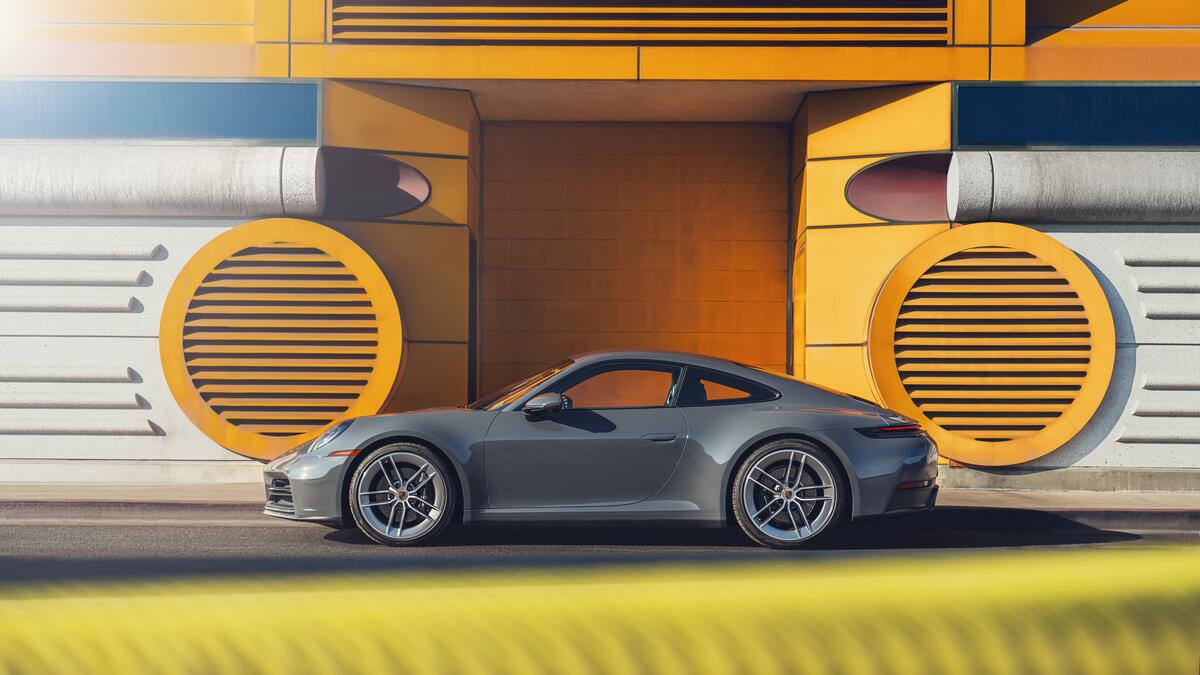
Porsche Carrera S
"That's just 100,000 mile plus car ask is like 80,000 on a Carrera S. Don't get me wrong. I think they're great cars."
This is a Porsche 911 “Carrera S” version. It’s one of the more performance-oriented 911 trims. The hosts are pointing out that even with high mileage, the market can price these cars extremely high.
The Porsche 911 Carrera S is a performance-focused trim of the 911 line, known for its rear-engine layout and strong balance between everyday usability and track-capable driving. In this segment, it’s used as a real-world pricing example for how expensive certain mileage levels have become.
air cooled
"You could still buy an air cooled car at 75 thousand dollars. Exactly."
“Air-cooled” means the engine is cooled mainly by air flowing over it, not by coolant in a radiator. Some older Porsche models are famous for this design, and that reputation affects how people value them.
“Air-cooled” refers to an engine design that uses airflow over the engine to remove heat instead of relying on a liquid coolant system. Classic Porsche 911 variants are often discussed in this context because the air-cooled era is a major part of their enthusiast appeal and market identity.
futures based pricing
"I don't understand how we're having like futures based pricing. When they're not, it's not."
This means people are buying a car now because they think it’ll be worth more in the future. The hosts are saying that can inflate prices even if the car isn’t old enough to be considered a true classic yet.
“Futures-based pricing” is the idea that buyers are paying today based on what a car is expected to be worth later, not just its current condition and mileage. The hosts argue that this can push prices beyond what makes sense for the present, especially for cars that aren’t yet “classic” in the mainstream sense.
classic status
"No, or they are cool. It's where 30 to 40 years old before they're not even classic status yet."
“Classic status” is when a car becomes widely seen as an important, collectible model. The hosts are saying the market is treating some cars like classics even though they’re not there yet.
“Classic status” is an enthusiast and market milestone where a car becomes widely recognized as historically significant or desirable, often leading to stronger demand and higher prices. The segment contrasts cars that are still too new to be “classic” with the way the market is already pricing them like they are.
manual transmission
"we're saying if you wanted a good car that was kind of modern and you're not hung up on a GT car, but you want a manual transmission."
A manual transmission is the kind of car where you choose gears yourself using a clutch and a shifter. The hosts are saying that people who specifically want manuals may end up paying more or finding fewer cars.
A manual transmission is a gearbox operated by the driver using a clutch pedal and gear lever. In this segment, it’s used as a key buying requirement because it narrows the supply of eligible cars and can affect pricing.
GT car
"we're saying if you wanted a good car that was kind of modern and you're not hung up on a GT car, but you want a manual transmission."
A “GT car” usually means a more performance-focused version of a model line, often with track-oriented tuning. The hosts are comparing those expensive versions to cheaper 911s that still feel special.
“GT car” refers to Porsche’s higher-performance, track-focused trims (often labeled GT3/GT3 RS/GT2 variants depending on generation) that typically cost more than mainstream Carrera models. The hosts contrast GT cars with more attainable 911 options for buyers who want the 911 experience but not the top-tier GT pricing.
sweet spot
"advised by people like us and other people and say, Hey, you want to get into a [1500.6s] sweet spot and you want to and so maybe people bought two years ago..."
A “sweet spot” means the best deal or the best balance. The hosts are using it to point to the 911 version that gives buyers the most satisfaction without the highest GT prices.
“Sweet spot” is a market term for the best combination of value, desirability, and practicality—where buyers feel they’re getting the most for their money. In this segment, it’s used to describe which 911 variant to target when you want a manual and a modern-feeling car without paying GT-car money.
halo effect
"It's that the halo effect of all the other cars being so expensive [1509.9s] like I can get 90% of the yeah."
The halo effect is when one popular, expensive thing makes other similar things seem more valuable. The hosts are saying expensive Porsche models can pull up prices for other 911s too.
The halo effect is when the high price or desirability of one product category makes related models seem more valuable too. Here, the hosts suggest that because other Porsche models are getting expensive, buyers and pricing for 997-era cars are also rising and supply is “drying up.”
FOMO
"resource is drying up and people are like getting that FOMO effect of, uh-oh, if I don't get one,"
FOMO means “fear of missing out.” In this context, it’s when people feel like they have to buy a car quickly because it might get more expensive or harder to find later.
FOMO (fear of missing out) is the anxiety-driven urge to buy now because you think the opportunity will disappear. In car markets, it often shows up when supply tightens and prices rise, pushing buyers to act before they feel priced out.
sports exhaust
"It's like you're seeing base model cars that asks on them and they don't even have sports exhaust and they're missing stuff, meaning they don't have every box checked on that option list,"
“Sports exhaust” usually means an upgraded exhaust that makes the car sound more exciting than the base exhaust. Here, the host is noting some cars don’t have that upgrade.
A “sports exhaust” is an upgraded exhaust system option that’s typically tuned for a more aggressive sound (and sometimes different flow characteristics) compared with the standard exhaust. The host is saying some listings are missing that option, meaning they’re not fully optioned.
PDK
"because they bring even more PDK cars, 65,000 with like 80,000 miles on it to like less miles, maybe 80 grand on base models."
PDK is Porsche’s dual-clutch automatic transmission. Instead of a traditional automatic, it shifts very quickly and feels more like a performance gearbox.
PDK is Porsche Doppelkupplung, Porsche’s dual-clutch automatic transmission. It’s known for fast, smooth gear changes and is a major part of why many Porsche 911 buyers prefer certain transmission configurations.
quarterly rollouts
"Yeah, but that just shows you the brand new pricing with Porsche. As we reported when they did those quarterly rollouts, when they kept doing another price increase,"
The host is talking about Porsche changing prices on a regular schedule. When new-car prices go up, people often turn to used cars instead, which can raise used prices too.
“Quarterly rollouts” here refers to Porsche’s periodic pricing updates and/or market adjustments that happen on a schedule. The host connects these rollouts to how price increases can push buyers toward used cars and older model years.
996 turbos
"And we talked about it with the 996 turbos. I'm talking about like 100,000 mile 996 turbos for $80,000."
This is talking about a Porsche 911 Turbo from the 996 generation. The host is discussing what they cost used and a known reliability concern that can affect them.
Porsche 911 (996) Turbo models are the 996-generation 911s with forced induction, and they’re a major part of the used-market conversation. The host cites specific pricing and availability, and later mentions the IMS bearing issue that affects some 996-era cars.
IMS bearing
"even with the dreaded IMS bearing that people got to flip out or whatever they got to do and, you know, get"
The IMS bearing is a small internal engine part in some Porsche 911s. If it fails, it can become an expensive repair, so people watch for it when buying used.
The IMS bearing (Intermediate Shaft bearing) is a component in certain Porsche 911 engines that can wear or fail. The host calls it “dreaded” because it’s a well-known risk that can drive buyer anxiety and affect used pricing.
bore scoring
"but going back to, you know, the S's, it is shocking to me because they do suffer from bore scoring."
Bore scoring means the inside walls of the engine cylinders get scratched or worn. It can hurt engine health, and the host is saying it’s a known issue on some Porsche 911 S engines.
Bore scoring is damage inside an engine’s cylinder bores, where metal gets scratched or worn. The host says Porsche 911 S models “suffer from bore scoring,” and links it to heat and oil delivery issues that can be more pronounced on certain cylinders.
cylinder bank four and six
"And it's not the boogeyman that the internet like that actually is pretty common with the S's, especially I think it's cylinder bank four and six."
Cylinder banks are just groupings of cylinders inside the engine. The host is saying the problem shows up more on specific groups (bank four and six) because those cylinders run hotter and may not get enough oil.
Cylinder banks are groups of cylinders in a V- or horizontally opposed engine layout. The host claims bore scoring is “pretty common” on cylinder bank four and six, attributing it to rear cylinders running hotter and not getting enough oil.
engine out
"because it's engine out. You got to put Nick a cell sleeves in there. But once you do that,"
“Engine out” means the mechanic has to take the engine out of the car to fix something. It’s usually a bigger, more expensive job than repairs you can do without removing the engine.
“Engine out” means removing the engine from the car to access a problem area. It usually indicates a labor-heavy repair because you have to disassemble a lot just to reach the component.
hydraulic steering
"So you're all in it at 95. I mean, if it's your forever car, I guess it's not that bad because if you retrospect that driving experience, you still have hydraulic spirit steering. So you could either spend 95 for that car or go spend 95 for a 991.1 or two."
Hydraulic steering uses fluid pressure to help you turn the wheel. Some drivers prefer the feel because it can feel more “connected” than electric assist.
Hydraulic steering uses a pump and fluid to assist steering effort. Compared with electric power steering, it can feel different in terms of feedback and how the steering responds at low vs. high speeds.
nostalgia factor
"The 991 is a great car too. It really is. I think it's a nostalgia factor from those people and, you know, time and place versus like it's again, a lot of stuff is subjective on whether it's better or not better."
“Nostalgia factor” means people may prefer a car because it reminds them of a time in their life or because they associate it with good experiences. That can matter even if newer cars are objectively better in some ways.
“Nostalgia factor” describes how memories, timing, and personal experience can shape what people think is “best.” In car debates, it often means the emotional attachment to an older generation influences opinions beyond objective specs.
AC
"especially if they're chasing a modern feel, meaning with like AC and air and heat and some heated seats,"
AC means the car’s air-conditioning. They’re saying some people want the newer cars because they’re more comfortable day-to-day, with features like AC and heat.
AC here means the air-conditioning system. The hosts are contrasting “modern feel” with older cars by pointing out comfort features like AC and cabin climate control.
heated seats
"especially if they're chasing a modern feel, meaning with like AC and air and heat and some heated seats,"
Heated seats warm you up while you drive. It’s a comfort feature that makes an older car feel less “modern” if it doesn’t have it.
Heated seats use electric heating elements to warm the seat cushions and/or backrests. It’s a comfort feature that can strongly affect how “modern” a car feels in cold weather.
bone stock
"You got 355 bone stock, some tuning, some exhaust. You could probably you could probably bump that motor close to 400,"
“Bone stock” means the car is basically exactly as it came from the factory, with no meaningful upgrades. The speaker is using it to set a baseline before talking about making more power.
“Bone stock” means the car is essentially unmodified from factory specification. Here, the host says a Porsche 911 is “355 bone stock” (referring to horsepower) and then mentions tuning/exhaust to raise output.
sleeves
"and then you do the sleeves on it, and you got a manual car."
“Sleeves” are like replacement inner walls for the engine’s cylinders. Mechanics do it to fix wear or to help the engine handle more power when building it up.
“Sleeves” refers to installing cylinder liners inside an engine’s cylinders, typically to restore worn bores or to support higher-performance builds. The host is describing a power path: starting from a stock-output baseline, then tuning/exhaust, then adding sleeves to enable higher output.
GT3
"And that's draw money too. Yeah. Right. Goodbye GT3. I mean, I know that's not everybody's cup of tea."
“GT3” is Porsche’s more track-focused 911. The speaker is saying it’s a very different kind of car than a more comfortable daily-style setup.
“GT3” refers to the Porsche 911 GT3, a track-focused variant known for performance-oriented tuning and driver-focused dynamics. The host frames it as a different “animal” than the softer daily/bull-car idea, and uses it to contrast what they’d pay for versus what they’re seeing in the market.
daily
"“...Meaning there's a big ask for that car. And I'm not parking it. I'm going to drive it because it would be my daily.”"
“Daily” just means the car would be your everyday driver, not something you only take out occasionally. If it’s a daily, you usually care more about practical costs and convenience.
In enthusiast talk, “daily” means the car is intended to be used as a regular everyday vehicle rather than a weekend-only toy. That changes how people evaluate tradeoffs like comfort, running costs, and how much they’re willing to spend on repairs or upgrades.
cylinder walls
"“...just to do the cylinder walls on it because I'm not that in love with that chassis...”"
The cylinder walls are inside the engine where the pistons move. If they need work, it usually means a big, expensive engine repair rather than a normal service.
“Cylinder walls” are the inner surfaces of the engine’s cylinders where the piston rings seal and the pistons move. When someone says they’d spend money “to do the cylinder walls,” they’re talking about a major engine rebuild/repair job, not routine maintenance.
motor
"“...instead of spend a little bit and then do the motor and like all that other stuff...”"
Here, “motor” means the engine. The point is whether it’s cheaper overall to buy a more expensive car now or buy a cheaper one and then pay for engine work later.
In this context, “motor” means the engine assembly itself. The speaker contrasts spending money on the engine later versus buying a car that already costs more up front, which is a common way enthusiasts think about total cost of ownership.
analog
"“...it was like, oh, well, you know, it's, it's analog, it's this, I have two analog cars...”"
“Analog” means the car feels more old-school and mechanical, with less reliance on computers. The speaker is saying they like that kind of feel, so it changes how they judge the car.
“Analog” here means a driving experience that relies more on mechanical feel and traditional controls rather than heavy electronic intervention. The speaker is implying they prefer that kind of character, which affects how much they’re willing to invest in a specific chassis.
clutch
"the seats are kind of chewed up, I got to do some like reupholstery stuff and maybe do some like a clutch and all that stuff and I can I can get away with spending maybe 10 grand just to do a refresh"
The clutch is what lets you shift gears smoothly. If it’s worn out, you may need to replace it as part of keeping the car running.
A clutch is the friction device that connects and disconnects the engine from the transmission, allowing smooth gear changes. Replacing a clutch is a common “wear item” cost on cars with a manual gearbox (or a manual-style drivetrain).
future future classic
"And I'm not, I'm not signing up for that. So we're saying get the future future classic. Well, I just think every we say this, but every passing year, like whatever,"
A “future classic” is a car people think will become collectible and valuable later. The host is basically saying some modern cars will be appreciated more in the future.
“Future classic” is an enthusiast term for a car expected to gain long-term collector value and reputation. The host’s “future future classic” framing suggests they believe today’s 911-era cars will be looked at as classics once enough time passes and the market matures.
oil analysis
"Okay, I know this is part of the thing. I'm going to keep an eye on it. You know, I'll send my oil out to Blackstone Laboratories for oil analysis, and I'll keep an eye on it."
Oil analysis means sending used engine oil to a lab to check what’s happening inside the engine. It can help you spot early warning signs before a problem gets expensive.
Oil analysis is testing used oil to look for wear metals, contamination, and other indicators of engine health. Enthusiasts use it to decide whether an engine is trending toward problems or staying clean over time.
Blackstone Laboratories
"I'll send my oil out to Blackstone Laboratories for oil analysis, and I'll keep an eye on it."
Blackstone Laboratories is a company that tests the oil from your car. They look for signs of wear so you can make smarter decisions about maintenance.
Blackstone Laboratories is a well-known oil-testing company that analyzes submitted engine oil samples. In enthusiast circles, it’s used to interpret wear trends and contamination levels to help guide maintenance decisions.
bass boat glitter paint in my oil
"when it's ready, and I start seeing, you know, bass boat glitter paint in my oil, then I'll go to a nickel cell lining on on the and I'll sack up and I'll pay the money because I love this car"
That phrase is a colorful way of saying the oil has lots of tiny metal particles in it. If you see that kind of wear debris, it usually means the engine needs attention.
“Bass boat glitter” is a colorful way to describe metallic debris suspended in engine oil—often interpreted as abnormal wear. The host is implying that if oil analysis shows lots of metal, it’s time to address the engine rather than just maintaining it.
nickel cell lining
"then I'll go to a nickel cell lining on on the and I'll sack up and I'll pay the money because I love this car"
This sounds like a type of engine repair where the inside of the cylinder gets a special lining. The host is saying they’d do it only if the oil results suggest the engine is wearing out.
“Nickel cell lining” appears to refer to a cylinder-lining or bore treatment involving nickel-based material. In context, the host is describing a costly engine repair step triggered by signs of internal wear seen via oil analysis.
driver air
"they always blow up? Well, you did that. That's driver air. It's like, okay."
“Driver air” sounds like a joking way to blame the driver—meaning the way someone drives could contribute to problems. The host is arguing about whether failures come from the car being built wrong or from driving habits.
“Driver air” here appears to be slang for air introduced by the driver’s actions—most likely referring to how driving style or inputs can affect engine stress and failure risk. The host contrasts it with “assembly air,” suggesting they’re debating whether failures are caused by build quality or by how the car is driven.
assembly air
"I think that's assembly air. It's like Legos, right?"
“Assembly air” is a joking phrase meaning the problem might come from how the car was built. The host is pushing back on the idea that it’s mainly the driver’s fault.
“Assembly air” is slang in this context for issues caused during manufacturing/assembly rather than by the driver. The host’s point is that some engine failures may be rooted in how the cars are put together, not just how they’re driven.
911 market is on fire
"Let's take my 95 and go towards a GT car or turbo car at that point. I mean, I just think that the 911 market is on fire right now and nobody's really talking about it."
When someone says the “911 market is on fire,” they mean Porsche 911 prices and demand are going up fast. The host is basically warning that waiting could make it harder or more expensive to buy.
Saying the “911 market is on fire” is a shorthand for rapidly rising demand and prices for Porsche 911s. The host implies this is happening broadly and not just for one specific variant, and that buyers shouldn’t assume prices will soften soon.
NA
"But I'm just saying these NA cars that aren't [2627.8s] super powerful, that you got to roll them out and get all the RPM out of them, the best way to [2633.0s] experience them is a manual transmission."
NA means the engine doesn’t use a turbo or supercharger. The host is saying these engines are more about revving and using the gears to get the most out of them.
NA here means naturally aspirated, i.e., an engine that makes power without a turbocharger or supercharger. The host’s point is that these NA cars aren’t “super powerful,” so the fun comes from revving them and using the manual gearbox to keep the engine in its power band.
Porsche 997 C2S
"like when we brought up the 997 C2S, [2757.1s] it has its engine niggles and the IMS, a lot of people go and do it."
This refers to a Porsche 911 from the 997 generation, specifically the Carrera S (C2S). The host says it can have some engine-related quirks and a known issue involving the IMS that people often address to reduce risk.
The Porsche 997 is the 911 generation from the mid-2000s, and the “C2S” is the Carrera S in a rear-wheel-drive configuration. The host specifically calls out “engine niggles” and the IMS issue on the 997 C2S, noting that many owners address the IMS proactively because it’s not a one-and-done fix forever.
preventative maintenance
"If you go that way and you don't do preventative maintenance, meaning like [2804.3s] multiple IMS bearings, and I think that's another, while we're on that topic, because we're good at [2809.5s] spiraling, that's a, that's a wear item."
Preventative maintenance means fixing or checking common problem areas before they break. The host is saying that doing the IMS-related work ahead of time is part of that approach.
Preventative maintenance here means proactively addressing known weak points before they fail, rather than waiting for symptoms. The host ties it directly to IMS bearing work, arguing that skipping that proactive step is why some owners end up with problems.
belt degradated
"belt degradated. But it's been a year. Yeah. So it's similar situation like that you're going to"
Belts can wear out just from time, heat, and vibration—even if you don’t drive much. That’s why people replace them on a schedule, not only based on miles.
This refers to belt degradation—rubber/compound belts slowly wear out with age and heat cycles, even if the car doesn’t rack up many miles. In practice, belt wear can lead to loss of function or failure, which is why enthusiasts often replace belts on a time interval rather than waiting for mileage.
wear item
"It's almost kind of the point where if you're in love with that chassis, you should approach that as that is a wear item. And that is a serviceable item, meaning every three to four years,"
A wear item is a part that naturally wears out over time. Instead of waiting for it to fail, you plan to replace it on a schedule.
A “wear item” is a component expected to deteriorate over time and eventually need replacement. The host is framing the bearing-related part as something you should plan to service every few years because it’s not designed to last indefinitely.
serviceable item
"And that is a serviceable item, meaning every three to four years, you should probably, yeah, you should be looking at that at least."
A serviceable item is something you can check and fix (or replace) as maintenance. The idea is to stay ahead of problems instead of reacting after it breaks.
A “serviceable item” is a component that can be inspected and replaced as part of routine maintenance. Here, the host suggests a time-based interval (every three to four years) because the part’s failure risk is significant and there’s little warning.
grenade
"Like when that one goes, that's a grenade. Yeah. Yeah. If you're one of those very, very few like 0.5% people that caught it as it was happening, you'll get maybe some like shimmer."
“Grenade” here means it can fail suddenly and badly, not slowly. The scary part is that you might not get much warning before it’s over.
Calling it a “grenade” is a metaphor for sudden, catastrophic failure. The host’s point is that when this particular component fails, it often does so without meaningful prior warning—so the consequences can be severe.
shimmer
"If you're one of those very, very few like 0.5% people that caught it as it was happening, you'll get maybe some like shimmer. And then it's like, uh, but most of the time it's game over."
“Shimmer” sounds like a small early clue that something is going wrong. The host is saying only a tiny fraction of people notice it before the failure becomes catastrophic.
In this context, “shimmer” likely describes a brief visual or sensory sign that a failure is occurring in real time. The host contrasts this rare early detection with the more common outcome: failure with no warning.
0.5% people
"If you're one of those very, very few like 0.5% people that caught it as it was happening, you'll get maybe some like shimmer."
The “0.5%” is basically saying almost nobody notices the problem early. That’s why the host recommends replacing it on a schedule instead of waiting for symptoms.
The host is using “0.5%” to quantify how rarely drivers catch the failure while it’s happening. It’s an emphasis on the lack of early warning and the importance of preventive replacement intervals.
40, 50,000 miles
"because you think about, well, I did it. So it's going to, it's, it was already good for, you know, 40, 50,000 miles. Should you be okay?"
They’re talking about how long it can last in miles before it fails. But the host’s message is that miles don’t tell the whole story—time and heat matter too.
This is a mileage-based lifespan estimate the host uses to argue the part might “seem fine” after tens of thousands of miles. The key point is that mileage alone isn’t a reliable predictor when age/heat cycles drive degradation.
no man's land
"So I feel like it falls in that weird, like no man's land personally for me because you got people that have the money."
“No man’s land” is the host’s way of saying the car is in an awkward price spot. It’s not cheap enough to be a casual first Porsche, but it’s also not rare/expensive enough to be a guaranteed “special car” for everyone.
“No man’s land” here is a pricing/positioning concept: a car that’s too expensive to be an easy entry-level purchase, but not expensive enough to be treated as a fully “special-occasion” collectible. The host argues the 996 is stuck in that middle ground, changing how buyers choose between different 911s.
cars and coffee
"with their friends going up to the mountains or having fun with that, or they're going to cars and coffee, they're not they're not just tooling them around on a regular basis, usually."
“Cars and coffee” is a casual car meet where people show up with their cars and hang out, usually over coffee. The hosts are using it as an example of how enthusiasts are using these cars.
“Cars and coffee” is a recurring informal car meet where enthusiasts gather to talk about cars, often in the morning. The hosts use it to describe how certain older Porsches are being enjoyed and showcased, not just driven casually.

Porsche 914
"I think you brought up a good point, though, with the 914, because I think that could be like the 914 of the 911 era, essentially."
A Porsche 914 is an older Porsche model (from the 1960s/70s) that has a mid-engine layout. The hosts are saying its price pattern might end up looking like other 911-era Porsches: regular examples stay similar, while the special ones get much more expensive.
The Porsche 914 is a mid-engine Porsche from the 1960s/early 1970s era that the hosts compare to later 911 generations in terms of how values can “hover” until special variants pull ahead. In this segment, they argue the 914 could follow a similar pricing trajectory to the 996/997 era cars.
race gas
"But I think we're right now, somebody's put some, you know, race gas in the tank, because there's a little bit more power in that market right now."
Race gas is a higher-performance gasoline than what you usually buy at a regular gas station. The idea is that it can help the engine make a bit more power, and the hosts think that’s happening in some of these cars right now.
Race gas is high-performance fuel formulated for motorsport use, typically with higher octane than regular pump gasoline. In this segment, the hosts suggest someone is using race gas to extract “a little bit more power,” which they connect to current market momentum for these cars.
cab
"even 991s. If you're okay with a cab, they're still attractively priced. But maybe not forever though, because of that rising tide, but right now they still are."
“Cab” here means a convertible—one where the roof can be removed. The host is saying the car can look great with the roof down, but the roof-up look can be less flattering.
In this context, “cab” means a cabriolet (convertible) roof configuration. The host is arguing that the roof-up styling and the way the roof mechanism changes the body lines can make some 911 convertibles look awkward compared with the same car with the top down.
Request an Explanation
Heard something you'd like explained? We'll add it to this episode.
Sign in to request explanations for terms you heard.
Want to learn more?
Browse our glossary for plain-English explanations of automotive terms, jargon, and concepts.
Help improve this episode
See something that's not quite right? Our annotations are AI-generated and can sometimes miss the mark. Click the flag icon on any annotation to suggest a correction.