
Cold Roads, Missing GT3s, and Porsche's Quiet Exit
About this episode
Cold roads, missing GT3s, and Porsche’s quiet exit—P-Car Talk Podcast bounces from winter rally realities (no meaningful heat, pitted windshields, and rock-throwing tire grip) to Nürburgring 24-hour hype and Manthey. The conversation then turns to Porsche’s broader corporate shakeups: job cuts, EV strategy doubts, and how timing/accounting can make “losses” feel different. Finally, the hosts dig into the GT3/911 market—why listings dry up, how prices spike around age thresholds, and what that means for buyers.
Ruckus Debrief
Ruckus is in the rearview and the roads delivered. Cold weather, beautiful scenery, and rock chips that serve as a reminder you actually drove the thing. This is what it's for. No complaints from anyone in the crew — the kind of event you start planning to return to before you've even unpacked.
The Headlines: Porsche Jobs, Nurburgring, and Luft Atlanta
Porsche is cutting 500 jobs tied to ongoing revenue pressure and nobody here is happy about it. We never like to see people lose their jobs — full stop. On the racing side, the 24 Hours of the Nurburgring is right around the corner, which means a lot of sleepless nights ahead for the right reasons. And for the enthusiast crowd, Luft is headed to Atlanta this October. Last year it was North Carolina, so the southeast is getting some real love on the calendar right now.
Vanthoor to McLaren — And What Porsche Isn't Saying
Laurens Vanthoor is joining McLaren's hypercar program on loan from Porsche for 2027. No official announcement about what this means for Porsche's factory team presence, but the crew has seen this movie before. When Porsche starts farming out factory drivers and running every livery they can on the factory car, it's usually a preview of an exit — the same pattern played out before they stepped back from the RSR program. Nothing confirmed, but the read here is that Porsche is pulling back from that factory hypercar effort whether they've said so or not.
997 GT3s Are Gone — And the Price Is Whatever the Seller Wants
The 997 GT3 market has reached a point that only a handful of models ever hit: the cars aren't listed because the owners aren't selling. When they do transact, it's a phone call, not a listing. Word of mouth, private deals, specialty dealers with one car every few months. A 997.1 GT3 with a minor Carfax note and 60,000 miles is moving at $175,000, and the crew doesn't think that's anywhere near the ceiling. The reason this happens isn't complicated — as more people enter the Porsche world and chase a real driving experience, demand for the cars that actually deliver it concentrates. Supply doesn't move. Price does. The only honest answer a seller can give a buyer right now is: find me another one.
Thank you for the support — it genuinely means everything.
Follow us at pcartalk.com for events, Patreon.com/pcartalk for the P-car Club, and @pcartalk everywhere else.
Kimchi Crew: Steve, Leslie, Chris, Ken, Aaron, Matthew, Sean, and Nik.

Chevrolet Corvette
"Guess topic today? Corvettes. That's how we'll phase it in."
The Chevrolet Corvette is a sports car made by Chevrolet. It’s built to be fun to drive and fast, and it has been around for a long time. People talk about it a lot because different versions over the years have different features and performance.
The Chevrolet Corvette is a long-running American sports car known for its performance-focused design and its role as a flagship model for the brand. It’s often discussed because it represents a consistent evolution of technology and driving character over many generations. In a podcast, “Corvettes” are a natural topic because there’s a deep history and a wide range of enthusiast interest across model years.
air cool rally
"Alright, so I was at Ruckus which was great is an air cool rally hosted by Charles Stanley and his family."
“Air-cooled” means the engine uses air to stay cool, not coolant flowing through the engine. This rally is themed around that kind of Porsche.
“Air cool” is shorthand for air-cooled engines—engines that rely on airflow over the cylinders instead of using liquid coolant to remove heat. Porsche’s air-cooled cars (like the 911 (964) mentioned right after) are often associated with this kind of rally culture.
zero climate control
"but in a car it has zero climate control. Cold is better than hot every day of the week."
Climate control is the system that automatically keeps the cabin at a set temperature. “Zero climate control” means the car doesn’t really manage cabin temperature for you, so it stays cold.
“Climate control” refers to an automatic system that regulates cabin temperature (typically by controlling heater output and airflow). Saying “zero climate control” implies the car lacks automatic temperature regulation, so cabin heat is minimal or manual-only.
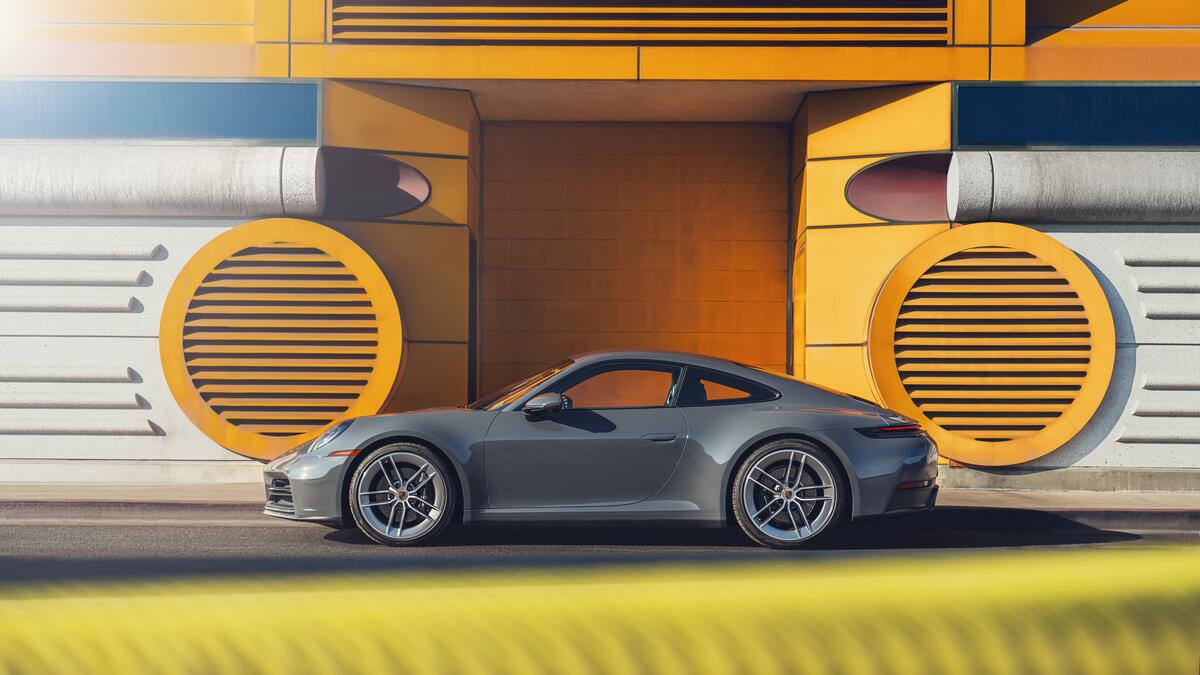
Porsche 993
"That front of that poor 993 basically got sandblasted. The carbon fiber hood is just tatted up."
A Porsche 993 is a specific older 911 generation. Here, the speaker says the front of one got hit so hard with grit that it looked like it was sandblasted.
The Porsche 993 is the last air-cooled generation of the 911, and it’s known for its classic shape and analog driving feel. In this segment, the host describes the front end of a 993 getting sandblasted, which highlights how exposed bodywork can be during track or event driving.
sandblasted
"That front of that poor 993 basically got sandblasted. The carbon fiber hood is just tatted up."
“Sandblasted” is a descriptive way to say the car’s paint and surfaces were aggressively abraded by loose grit. In driving events, leftover gravel or debris can be thrown up by tires and quickly strip paint from leading edges and front bodywork.
carbon fiber hood
"The carbon fiber hood is just tatted up. But I mean it's fine. It's a weapon."
A carbon fiber hood is a lighter-than-steel hood made from a strong composite material. The speaker is saying the hood got beat up by debris.
A carbon fiber hood is a lightweight body panel made from carbon-fiber composite. Because it’s a composite material, it can get visibly damaged (chips, scuffs, or surface damage) when debris like gravel gets thrown up at speed.
leftover gravel from the winter
"there's no paint left. I think it was leftover gravel from the winter still that hasn't been cleaned up is what I think it is."
Leftover gravel from winter implies debris remained on the route or surface after seasonal weather. That kind of grit can be kicked up by tires during an event, causing rapid paint loss and damage to front-end surfaces.
contact patch
"I was following a 993 C4S big contact patch so throwing a lot of rocks [391.7s] on a constant basis."
The contact patch is the part of the tire that touches the ground. More grip usually means the tire is pressing down more effectively, and on a rough road that can stir up rocks.
The contact patch is the portion of the tire that’s actually touching the road at any moment. A “bigger” or more loaded contact patch usually means more grip, but it can also increase how much debris gets thrown if the road surface is loose or rocky.
low light conditions
"where it really really impacts it at least from what I've noticed [448.5s] is driving in low light conditions when you have to use headlights"
Low light conditions are basically nighttime or near-night driving. The host is saying that windshield damage matters more then, because headlights from other cars can glare and make it harder to see.
Low light conditions are when visibility is limited by darkness or glare, making optical issues more noticeable. In this segment, the host explains that windshield damage becomes especially problematic at night because headlight glare and beam scattering reduce effective sight distance.
headlights being shined at you
"and there's headlights being shined at you because then [455.9s] there's just like visibility is ass."
Headlight glare happens when bright beams from oncoming cars scatter in the driver’s eyes or reflect off surfaces. Here, the host ties glare to windshield pitting, which breaks up light and makes the scene harder to read at eye level.
little pits
"And all of those little pits just break up that [464.0s] "
“Little pits” are tiny dents/holes in the windshield from things like rocks. They can make headlights and street lights look blurry or harsh, which hurts night visibility.
“Little pits” refers to small pockmarks in the windshield surface, often caused by rock impacts. These imperfections can scatter and distort light—especially at night—so the driver perceives reduced clarity and more glare.
24 hours of Nürburgring
"Another race event coming up. 24 hours of Nurburgring is coming up this weekend. So always a great event. Porsche usually dominates that event."
This is a race that lasts an entire day—24 hours—on the Nürburgring track in Germany. Because it’s so long, the cars have to stay fast and reliable for the whole time, not just for a few laps.
The “24 hours of Nürburgring” is a 24-hour endurance race at Germany’s Nürburgring circuit. It’s known for testing reliability and efficiency as much as outright speed, which is why manufacturers like Porsche often take it very seriously.
Manthey
"I know I was gonna watch just because he is racing but Manthey always brings it. There's some cool stuff this year."
Manthey is a racing team that works with Porsche cars. The host is saying Manthey is usually very strong when it comes to racing.
Manthey is a motorsport team and Porsche-focused racing outfit known for preparing and running cars in endurance events. When the host says “Manthey always brings it,” they’re crediting the team’s consistent competitiveness.
Luft
"…same thing with what he did with the last Luft he's involved…"
“Luft” sounds like shorthand for an enthusiast Porsche meet. The point is that the organizer previously helped coordinate where cars would be parked together.
“Luft” here appears to refer to a Porsche/air-cooled enthusiast gathering (often associated with the “Luftgekühlt” community). The speaker is using it as a prior example of how the organizer coordinated car parking and grouping.
Targa event
"…tailor something from the Targa event that has like Targa parking…"
A “Targa event” is a Porsche-focused driving event where cars are organized for routes and parking/show moments. Here, they’re talking about arranging where people’s cars will be placed.
A “Targa” event is a Porsche-themed driving event centered on the Targa-style format—typically a scenic route with organized parking and show elements. In this context, it’s being used to describe how cars can be grouped and displayed together.
hypercar
"being loaned out by Porsche for the 2027 season to run McLaren hypercar with them"
A hypercar is a very high-end, race-focused car category. Here it means McLaren’s top-level racing car for that 2027 program.
A hypercar is a top-tier, high-performance race category/vehicle class designed to compete at the highest endurance and prototype-like levels. In this context, “McLaren hypercar” refers to McLaren’s high-profile racing machine for the 2027 season.
McLaren
"to run McLaren hypercar with them ... that's what I saw this announcement for Vanthoren and McLaren"
McLaren is a racing team (and car brand) that competes at a very high level. The discussion here is about McLaren running a hypercar program in 2027.
McLaren is a motorsport team/brand that competes in top-level endurance and hypercar-style racing. In this segment, the hosts connect McLaren to a “hypercar” program for the 2027 season, implying a high-profile factory-level effort.
factory team
"like without them saying that they're not going to run in the following remaining Porsche factory team ... like I think that's what that means to me"
A factory team is the automaker’s own official racing team. If a company doesn’t run a factory team, it may rely more on customers or other teams instead.
A “factory team” is a racing team directly supported and managed by the automaker itself, typically using the manufacturer’s cars, engineering, and resources. The hosts use the phrase to argue that Porsche’s driver “loan” and lack of announcements may indicate whether it will run a full factory program next year.

Porsche 963
"Heinrich moved suddenly what I saw first was Heinrich moved to the 963 which he was already there"
The Porsche 963 is Porsche’s purpose-built race car for endurance events like Le Mans. Here, the hosts mention it because a driver moving to it can hint at what Porsche is prioritizing.
The Porsche 963 is Porsche’s modern Le Mans–prototype race car built for top-tier endurance racing. In the segment, Heinrich moving to the 963 is treated as a meaningful clue about Porsche’s racing plans.
liveries
"they're running all the liveries that they ... we've seen this with the RSR before where they don't make an announcement until like the end of the year"
A livery is the car’s race paint and decals—its look. The hosts are saying Porsche may use different looks at events to signal plans before they officially announce them.
A livery is the car’s paint scheme and graphic design used for racing. The hosts suggest Porsche sometimes runs special liveries at events before making a formal announcement, using the visual branding as a clue to what’s really going on behind the scenes.
Penske
"[1444.2s] could just be a Penske only run next year [1447.8s] and not Porsche Penske in that same way it could be"
Penske is a well-known racing organization that fields cars and manages teams. The hosts are talking about whether a future race effort could be run by Penske instead of Porsche’s usual setup.
Penske is a major motorsport team/organization that runs racing programs across multiple series. Here, the hosts speculate about a “Penske only run,” meaning a different team structure or entry plan than Porsche’s usual involvement.

Ford Mustang
"...like but as soon as Heinrich won the race and the Mustang sampling car would half lap to go and the factory..."
The Ford Mustang is a performance car from Ford. It’s known for being sporty and powerful, and it has been made in many versions over the years. People often bring it up when talking about racing and cars built for speed.
The Ford Mustang is a popular American performance car that’s been produced for decades, with many generations and variations. It’s significant because it’s one of the most recognizable “muscle car” style models, and it’s frequently used as a benchmark when discussing racing and factory performance. In the podcast context, it’s mentioned in connection with a specific racing/factory sampling story, which highlights its performance heritage.
retainer
"but if you really felt that way they clearly [1494.7s] don't because they have him on retainer [1498.7s] that's what everybody said"
A retainer is money paid to keep someone tied to a deal. Here it means the driver is still under contract even if they’re not actively racing for that team at the moment.
A retainer is a paid agreement where a team or manufacturer keeps a driver under contract even if they’re not racing for that team every event. The hosts use it to argue that Porsche wouldn’t “let him go” if they’re still paying to secure his availability or loyalty.
loan him out
"but I'm just saying like why if you're gonna just let him go then [1505.1s] why would you loan him out and keep him on retainer [1510.2s] unless you're just so like just don't want to let him go"
“Loaning” a driver out means letting them race or work with another team for a while. The hosts are basically asking why that would happen if the driver is still contractually tied to Porsche.
In motorsport, “loaning” a driver out means temporarily placing them with another team or program while they remain tied to their original contract. The hosts question why a driver would be both retained and also sent to do work that could overlap with the manufacturer’s own racing goals.
GCP
"why would you let him do anything that's gonna directly compete with your program for GCP [1517.5s] that's what I don't get because no matter if he doesn't share any"
GCP is an internal Porsche racing program label. The idea here is that Porsche has a customer-focused racing effort, and they wouldn’t want a driver’s outside activities to interfere with it.
GCP is used in Porsche motorsport contexts to refer to Porsche’s customer racing / customer program umbrella (often discussed alongside factory and customer entries). The hosts are implying that letting a driver do something that competes with Porsche’s GCP would be counterproductive.
protect Porsche
"but now that you say that out loud [1532.6s] it's actually probably to protect Porsche because"
They’re saying Porsche might be keeping things controlled so important racing know-how doesn’t end up helping a rival. Even if nobody talks about “secrets,” people can learn patterns and methods that carry over.
The hosts suggest Porsche may be managing driver placement to reduce the risk of sensitive technical knowledge leaking between programs. In endurance racing, even without “sharing secrets,” experience and setup approaches can effectively transfer, so teams often try to control who is exposed to what.
set the car up
"so they're talking yeah to McLaren and it's like look he can help you set the car up for like racing for him and all that other stuff"
“Set the car up” means tuning the race car for the track. It’s about adjusting details so the car handles well and the driver can go faster with confidence.
“Set the car up” refers to race-car setup: adjusting things like suspension, tire pressures, alignment, and aerodynamic balance so the car behaves predictably at speed. The goal is usually to improve grip, stability, and lap-time consistency for a specific track and driving style.
gather data
"but if you're like trying to gather data for like off our cars like he can't answer those questions"
In racing, “gather data” means recording performance info from the car while it’s running. Teams use it to figure out what’s going wrong or what to change to make the car faster.
In racing, “gather data” means collecting telemetry and other performance information during testing or events to understand how the car is behaving. That data is then used to refine setup and strategy, such as identifying where the car is losing grip or stability.
chassis
"it looks like they're running the same chassis that Porsche is running too I mean it's not the same car but it's the same people who build the chassis for Porsche"
The “chassis” is the main frame/structure of the race car. It affects how the car handles, so if two teams use similar chassis designs or builders, the cars may feel more alike.
A “chassis” is the car’s core structure that suspension, steering, and many other systems attach to, and it strongly influences handling. The segment suggests Porsche and McLaren share the same chassis-building people, implying similar underlying vehicle behavior and setup approaches.
learning curve
"he's gonna probably help their learning curve a lot but I mean way more than it would be just a brand new guy"
A “learning curve” is how long it takes to get used to a new race car. If the team is already familiar with similar cars and people, they can improve faster.
A “learning curve” in motorsport is how quickly a driver and team adapt to a new car, chassis, or regulations. If the team already has similar people and hardware, the learning curve is shorter because they can reuse knowledge about how the car responds.
factory racing
"from Porsche yet if they're gonna continue factory racing next year this is all speculation from Aaron and I but you follow racing long enough"
Factory racing is when the car brand itself runs the competition program. It’s not just hobby racing—there’s a plan to learn things from the races and then decide what to do next.
“Factory racing” means the automaker’s own team and resources run the race program, rather than a private team. The hosts are implying Porsche’s involvement is strategic: run the program, collect data, then stop when the goals are met.
prototype car
"you know they're not gonna run they know they never run a prototype car indefinitely they have their internal clock"
A prototype car is a special race car built to try out new ideas. The point is to learn from it, and then move on once they’ve gotten the information they need.
A prototype car is a race car built to test new technology and concepts, not necessarily a car that will be sold to customers. The hosts say Porsche “never run a prototype car indefinitely,” meaning they’ll retire it after they’ve gathered enough performance and reliability data.
team championship
"I mean they have a you know team championship they have drivers championships already yeah"
A team championship is a season-long competition where teams earn points based on race results. The hosts are saying Porsche’s teams and drivers have already done well, but Le Mans is still the big missing piece.
A team championship is a points-based title awarded to racing teams across a season, based on how their cars finish in each race. The hosts contrast it with driver championships and suggest Porsche has already secured those but is still chasing Le Mans.
drivers championships
"team championship they have drivers championships already yeah I think the only thing that's eluded them is what Le Mans right"
A drivers championship is like a season-long scoring race for individual drivers. The hosts are saying Porsche’s drivers have already won titles, but Le Mans is still the standout goal.
A drivers championship is a points-based title awarded to individual drivers over a racing season. The hosts mention it alongside the team championship to frame what Porsche has already achieved versus what they still want from Le Mans.
Le Mans
"I think the only thing that's eluded them is what Le Mans right they're gonna bring in Brumos again"
Le Mans is a famous long-distance race. It’s a big deal in motorsport, and the hosts are treating it like a key target for Porsche.
Le Mans refers to the 24 Hours of Le Mans, one of the most prestigious endurance races in the world. The hosts are discussing it as the remaining major goal (“what Le Mans right”) and how Porsche’s participation could shape the next racing storyline.
Brumos
"they're gonna bring in Brumos again so it's gonna be a Brumos-Pensky matchup run the Brumos colors"
Brumos is a racing team that’s closely tied to Porsche racing. The hosts are talking about them showing up again and using their recognizable team colors.
Brumos is a Porsche-associated racing team known for competing in endurance events and for using Porsche-based race cars. In this segment, the hosts mention “Brumos colors” and a Brumos-vs-Pensky matchup as part of their Le Mans speculation.
market comps
"because I'm not really when you own the car at least for me I'm not really looking at comps on that car because you already own the car"
“Comps” means comparing your car to similar ones that are being sold. The host is saying that if you’re not planning to sell, you don’t really need to watch those comparisons.
“Comps” (comparables) are used to estimate a car’s value by looking at similar cars for sale or recent sales. The host is saying that if you already own the Porsche, you may not track comps because you’re not trying to sell and you’re not trying to time the market.
market drying up
"and we're talking GT products they're just kind of dried up meaning there's onesies and twosies for sale out there but"
“Market drying up” means fewer people are buying, so cars don’t sell as quickly. Even if cars are for sale, owners may hold onto them instead of moving them.
“Market drying up” describes a situation where there are fewer active buyers or less willingness to pay, so sales slow down even if cars are still listed. In this segment, the host ties it to GT3 supply/availability and owners holding cars rather than selling.
onesies and twosies
"meaning there's onesies and twosies for sale out there but"
It’s a casual phrase meaning there aren’t many cars available—just a few here and there. That usually makes the market feel inconsistent.
“Onesies and twosies” is a colloquial way to say there are only a small number of cars available—like one or two listings at a time. In a market context, it implies limited inventory and uneven availability rather than steady, frequent supply.

Ferrari F40
"... if you and you can argue stuff like you know the F40 that they made over a thousand like was it 1200 o..."
The Ferrari F40 is a very rare, high-performance supercar made by Ferrari. It’s famous partly because only a limited number were built. The podcast brings it up in the context of production numbers, which helps explain its rarity.
The Ferrari F40 is a high-performance supercar produced in limited numbers, and it’s widely remembered as one of Ferrari’s most iconic “last of an era” style cars. It’s discussed often because of its special place in Ferrari history and because production volume is relatively low compared with many mainstream cars. The podcast’s mention of how many were made ties directly to why the F40 is so sought after.
consignment shop
"those cars usually don't make it to a consignment shop they usually don't make it to"
A consignment shop is a place that sells your car for you and keeps a percentage if it sells. The hosts are saying these special Porsches often don’t end up there.
A consignment shop sells a car on behalf of the owner, typically taking a cut of the sale price. The hosts are contrasting that with how certain Porsche models circulate mostly through private, enthusiast-to-enthusiast channels.
car auction site
"they usually don't make it to an auction site they usually don't make it to a car gurus or auto trader"
A car auction site is where cars get sold to the highest bidder. The hosts are saying these Porsches usually don’t go through that kind of public bidding process.
A car auction site is a marketplace where vehicles are sold to the highest bidder, often with dealer and investor participation. The hosts imply that GT3/RS demand is so strong that these cars rarely reach auctions and instead trade privately.
word of mouth situation
"they make it to a word of mouth situation and usually there's group of friends"
“Word of mouth” means people find buyers through friends and personal contacts. The hosts are saying that’s how many GT3/RS cars are sold, so fewer show up publicly.
“Word of mouth” here means sales happen through personal networks rather than public listings. That kind of private circulation can keep supply low on mainstream sites, which helps explain why prices don’t soften quickly.
market value
"yeah so now you're paying market value for the thing that you just sold right"
“Market value” means what people are actually paying for a car at this moment. The point here is that if prices rise, the next car you want can cost more than you expected.
“Market value” is the price a car can realistically sell for right now based on current demand and supply—not the sticker price or what it cost when new. The host is describing how, after selling a car, buyers often have to pay market value (or more) for the next one.
reallocate those funds
"most people I feel like if they hang on to them long enough and they're making that significant money they reallocate those funds to probably a different brand or at least a different year car"
They mean selling one car and using the money to buy something else. Here, it’s about people shifting their budget to a different brand or newer model when prices rise.
In car-enthusiast terms, “reallocate those funds” means taking the profit from a sale and moving it into a different car—often a different brand or a newer model year. This segment frames it as a common behavior when certain cars appreciate quickly.
super charged
"that's probably why there's they're being super charged because it's a different feeling from the newer GT3's"
In this context, “super charged” doesn’t mean a new engine part. It means the prices or interest are ramping up quickly.
Here, “super charged” is being used figuratively to mean prices or demand are accelerating faster than before. It’s not necessarily referring to a turbo/supercharger hardware change—more like “the market is heating up.”
stockpile has been dried up
"so it's one of those things where it's [2453.8s] the stockpile has been dried up [2455.7s] this is you know that everybody knows that they haven't made those"
“Dried up stockpile” is a market term meaning the supply of a particular used car has been exhausted. When a model is out of production for a long time, fewer cars remain available, which can push prices up and make “cheap” examples harder to find.
accident owners
"but I feel like [2464.9s] there's the people that have them know [2467.5s] what they have I don't think there's any accident owners anymore"
They’re talking about who ends up owning the car. The idea is that fewer “random” owners have them now, and more people who really know what they’re buying do.
“Accident owners” appears to be a mis-transcription of “enthusiast owners” or “accidental owners,” referring to people who end up with a car without being the original target buyer. The speaker’s point is that the ownership base has shifted toward people who specifically seek out and understand the GT3.
Porsche 911 GT3
"you would just you're going to be looking for these cars I don't think you're just in an accident but oh I got a GT3 or a 3RS"
The Porsche 911 GT3 is a special version of the 911 made for driving hard. People want it because it’s built to feel more like a race car than a normal 911.
Porsche 911 GT3 is a track-focused 911 variant built around a high-revving performance package rather than just styling. In enthusiast circles, “GT3” is shorthand for a specific kind of Porsche: lightweight-ish, performance-oriented, and typically sought after in limited supply.
limited supply / hard-to-source allocation dynamics
"they have a very exclusive group of people that have a lot of funds that access to funds and they're even having a hard time sourcing cars or getting cars and getting those types of cars"
They’re talking about how some rare cars are difficult to find, even if someone has a lot of money. Getting one often depends on who you know and how quickly you can act, not just paying the price.
The hosts are describing how some Porsche models become “hard to source” even for wealthy buyers because supply is limited and demand is concentrated. This creates an allocation-like dynamic where access depends on networks, timing, and dealer relationships rather than just money.
refinement and maturation
"it's a similar experience to the newer GT3's you can tell that there's obviously been a refinement and a maturation"
They mean newer versions of the car feel more polished and better sorted. It’s like the design got improved and “figured out” over time.
“Refinement and maturation” is enthusiast shorthand for how newer generations of a model improve over time—smoother drivability, better integration of systems, and fewer “early-generation” quirks. In GT3 talk, it often means the car feels more polished and predictable than earlier versions.
visceral experience
"I think a lot of people are I hate this word but it's used a lot that visceral experience right like it's"
“Visceral experience” means the car’s feel hits you in a very immediate, emotional way—like how it sounds and responds. It’s more about how it makes you react than about specs.
“Visceral experience” is a car-enthusiast way of describing how a vehicle feels and sounds in a direct, emotional, body-level way—before you even think about numbers. The host is using it to talk about how older vs newer cars can feel meaningfully different, even if they’re both recognizable as the same model family.
air-cooled
"there's been enough time where it's very much air-cooled, water-cooled"
Air-cooled means the engine is cooled mainly by air flowing over it, not by coolant running through a radiator. It’s a different approach than most modern cars use.
“Air-cooled” describes an engine cooling system that relies on airflow over the engine to remove heat, rather than using liquid coolant through a radiator. Porsche uses this term most famously for older 911 generations, where the engine is cooled primarily by air passing over finned cylinders.
water-cooled
"there's been enough time where it's very much air-cooled, water-cooled"
Water-cooled means the engine uses liquid coolant to move heat to a radiator. It’s the common system in most modern cars.
“Water-cooled” refers to an engine cooling system that uses liquid coolant to carry heat away from the engine to a radiator. In Porsche’s context, this is often used to contrast later 911-era engines that moved away from the earlier air-cooled approach.
hits 25 years old
"if it's a special car for whatever reason once a car hits 25 years old and it's not exactly 25 it's around the 27th"
The host is pointing to a common enthusiast/collector timeline: once a car reaches roughly the 25–27 year mark, it often starts shifting into “vintage” status in the public mind and in collector pricing. This is presented as a general pattern across car brands, not just Porsche.
nitrous
"every single car if it's special hits like a little bit of like like a nitrous like in price"
Nitrous is a system that adds nitrous oxide to the engine. It gives the car a temporary power boost, kind of like a short “extra push.”
“Nitrous” usually refers to nitrous oxide used in an engine to temporarily increase power. It works by adding oxygen to the combustion process, allowing more fuel to be burned for a short boost.
price spike after a "peak" age milestone
"like initially like right after that peak of like okay it's 22, 23, 24 years old, 25 years old around there like it just shoots up"
They’re talking about how car prices can jump at certain ages. Once more people start treating the car like a collectible, the demand (and price) can rise again.
The hosts are describing how collectible-car pricing can jump after a certain “age” threshold, then plateau, and later rise again. In enthusiast circles, this often ties to when cars become eligible for classic/collector status and when more buyers enter the market.
25-year rule
"and we'll see if we start seeing stuff come from Japan and everywhere else because now it's 25 year rule"
The “25-year rule” is a legal cutoff where older cars may get easier treatment to own or import. When that happens, more people can buy them, which can push prices up.
A “25-year rule” generally refers to regulations that change how older vehicles are treated—often easing importation, registration, or emissions requirements once they reach a certain age. That can expand the buyer pool and affect pricing for cars that are close to (or just past) the threshold.
classic/collector-market awareness driving demand
"then it's really on because then everybody knows about it which is crazy that it has to have"
They’re explaining that when more people hear about a car, more people want it. If the supply doesn’t change, that can make prices go up.
This segment describes how marketing and “awareness” can shift a car from an enthusiast-only interest into broader collector demand. When more buyers learn about a model, prices can rise because demand increases faster than supply.
Fortune 500
"they're the Fortune 500 magazine"
“Fortune 500” is a widely recognized ranking of the largest U.S. companies by revenue. The hosts use it as an analogy for mainstream visibility—suggesting Porsche is “everywhere” in the way that Fortune 500 coverage is.
V12
"because of the sound it creates you know the engine behind you the V12 [2845.8s] the manual gated you know all that stuff"
A V12 is an engine with 12 cylinders. It’s known for a distinctive sound and smooth power delivery, which is why the hosts say it makes the car feel special.
A V12 is an engine with 12 cylinders arranged in a “V” shape (two banks of six). In this segment, the V12 is part of what makes the car’s sound and feel special—so the “driving experience” is tied to the engine’s character.
manual gated
"the engine behind you the V12 [2845.8s] the manual gated you know all that stuff the Lambo doors"
“Gated” refers to a manual transmission shifter that moves through a defined gate pattern in the console, rather than a looser or electronic selector feel. The hosts are pointing out that the tactile, mechanical feel of a gated manual is part of the overall experience.
Lambo doors
"the manual gated you know all that stuff the Lambo doors [2850.1s] go along with that car that's what makes that like"
“Lambo doors” are doors that open upward like a scissor motion. People associate that look with Lamborghini, and it adds a flashy, special feel when you use the car.
“Lambo doors” is a common enthusiast term for scissor-style doors that pivot upward, associated with Lamborghini. The hosts list them as part of the visual drama and “allure” that contributes to the car’s overall appeal.
bone stock
"and anything from bone stock to really modded so whatever [2916.0s] you wanted you could pretty much find it and this was only"
“Bone stock” means the car is basically how it left the factory, with no big modifications. They’re saying you can find Porsche cars in every condition, from stock to heavily changed.
“Bone stock” means a car that’s essentially unmodified from the factory—no meaningful aftermarket upgrades or changes. In the segment, it’s used to contrast with heavily modified cars, emphasizing that buyers can find anything from stock to extreme builds.
poverty spec
"and now those cars are [2931.2s] poverty spec ones are 99 thousand dollars like nice [2934.6s] spec ones are 130 so"
“Poverty spec” is slang for a car that has fewer options and features than the nicer versions. The hosts are pointing out that even the “basic” ones can still be extremely expensive.
“Poverty spec” is enthusiast slang for a car optioned with fewer features than the “nice spec” versions—often meaning less equipment, fewer comfort/tech items, and sometimes a more basic trim. The hosts use it to argue that even the “less equipped” Porsche 911s can command very high prices.
Arctic Silver
"not collector quality 50,000 miles Arctic Silver nothing crazy [3080.1s] bone stocker"
Arctic Silver is the name of a specific paint color on a Porsche. The host is using it to describe which exact-looking car they mean.
Arctic Silver is a factory paint color name used on certain Porsche models. The host mentions it as part of the car’s description to help listeners understand the specific “driver” example being priced.
rising tide
"and then just like anything we always talk about this you know rising tide [3111.1s] so like what we it hasn't happened yet"
“Rising tide” means prices in one classic-car group can pull up prices in other groups too. If demand is strong for certain cars, other cars often get more expensive as well.
“Rising tide” is the idea that when one part of the collector-car market goes up, it tends to lift prices across related categories. The speaker argues that Porsche 911 values rising can spill over into other classic cars because buyers broaden their search.
offset
"with like 17 inch cup ones looking goofy with the offset from factory you know"
Offset is how the wheel is positioned relative to the car. It affects whether the wheel looks right and whether it rubs or clears suspension parts.
Wheel offset is how far the wheel’s mounting surface sits inboard or outboard relative to the wheel’s centerline. Changing offset affects fitment—how the wheel sits in the wheel well—and can influence clearance with suspension components and the overall stance.
deferred maintenance
"and then you gotta take it and hopefully there's no deferred maintenance and then and then doing whatever you want to do suspension wheels"
Deferred maintenance means the car didn’t get its planned upkeep on time. If you buy it like that, you may have to pay later for repairs that were delayed.
Deferred maintenance is when scheduled repairs or service are postponed, so problems build up over time. On an older performance car like a Porsche 911 (993), catching deferred maintenance early matters because it can turn into expensive, multi-system work.
suspension
"and then doing whatever you want to do suspension wheels"
Suspension is the system that connects the car to its wheels and controls ride quality and handling. When enthusiasts talk about “doing whatever you want to do suspension,” they usually mean upgrades like springs, dampers, and alignment changes to improve how the car corners and rides.
track experience
"how many times have we talked to people that have never done a track experience or never done a rally or never done anything and the minute they drive that car at 78 tenths for the first time"
A track experience is a supervised driving session on a race track. You learn how the car behaves when you push it, with an instructor helping you stay safe.
A track experience is a guided driving session on a closed course where instructors teach you how to drive faster and safer than you can on public roads. It’s often used to show how a car’s grip, braking, and steering feel at real speed.
78 tenths
"and the minute they drive that car at 78 tenths for the first time that first time they get out of the car"
“78 tenths” is a way of saying you’re driving pretty close to the car’s limit—like about 78% of what it can do. It’s a shorthand for “this is fast and you’re right near the edge.”
“78 tenths” is a shorthand for driving at about 0.78 (78%) of the car’s available performance limit—typically referring to lateral grip, braking capability, or overall pace. Enthusiasts use it to describe how close you are to the edge without needing exact lap-time numbers.
PEC Atlanta
"at a minimum should go to like PEC Atlanta and experience a controlled track day there right by instructors"
PEC Atlanta is a Porsche track experience event. You drive on a track with instructors so you can learn how the car handles when you push it.
PEC Atlanta refers to a Porsche Experience Center event location where drivers can learn and drive Porsche cars on a controlled track with instructors. It’s commonly used as an entry point for people who want to understand what the car can do before taking their own car out.

Porsche Cayman
"like the 2.5 turbo Cayman S that's tuned and has great suspension and sway bars and you know polyurethane bushings and solid you know monoballs"
This is a Porsche Cayman S, a smaller Porsche with the engine placed closer to the middle. They’re saying that with upgrades and tuning, it can feel way more aggressive and capable than you’d expect.
The Porsche Cayman S (with a 2.5-liter turbo setup in this discussion) is a mid-engine Porsche that’s praised for balance and responsiveness. The host highlights that tuning plus chassis upgrades can make it feel dramatically sharper in real driving.
sway bars
"that's tuned and has great suspension and sway bars and you know polyurethane bushings and solid you know monoballs"
Sway bars help keep the car from leaning too much in turns. That makes the car feel more stable and easier to control when you’re driving fast.
Sway bars (anti-roll bars) reduce body roll when you corner, keeping the car flatter and more predictable. On a tuned Porsche Cayman S, stiffer or better-specified sway bars can improve cornering response.
polyurethane bushings
"and you know polyurethane bushings and solid you know monoballs and all that stuff"
Bushings are small rubbery parts that let suspension components move. Polyurethane is stiffer than rubber, so the car responds more quickly when you turn.
Polyurethane bushings replace softer rubber bushings to reduce flex in the suspension links. That typically sharpens steering feel and helps the car hold its line more consistently under load.
monoballs
"polyurethane bushings and solid you know monoballs and all that stuff and then you get in there"
Monoballs are upgraded suspension joints that let the suspension move with less “squish.” That makes the car feel more direct, but it can be less comfortable and may wear faster.
Monoballs are spherical bearing-style suspension mounts that replace conventional rubber bushings. They reduce compliance (unwanted movement), improving steering precision and feedback—at the cost of more harshness and wear.
downpipes
"if you go and put a tune on it and you put new downpipes you can even keep the factory exhaust"
Downpipes are part of the exhaust system that connect the turbo to the rest of the exhaust. Swapping them can help the engine breathe better and make more power.
Downpipes are exhaust components that route exhaust gases from the turbo to the rest of the exhaust system. Aftermarket downpipes can reduce restrictions and change exhaust flow, which often helps turbo cars make more power when paired with a tune.
factory exhaust
"and you put new downpipes you can even keep the factory exhaust"
Factory exhaust is the stock exhaust that came with the car. They’re saying you don’t necessarily have to replace everything to get a performance improvement.
Factory exhaust means the original equipment exhaust system installed by the manufacturer. The host’s point is that you can still upgrade key parts like downpipes and keep the rest of the exhaust stock.
new cats
"and just put new cats on it to let that thing breathe better [3798.1s] dude that's like 450 horsepower and 3,000"
“Cats” are catalytic converters—parts that clean up exhaust fumes. If you replace them, the exhaust can flow a bit better, which can make the car feel and sound less restricted.
“Cats” is short for catalytic converters, emissions-control devices that help reduce harmful exhaust gases. Replacing them can change exhaust flow and sound, which is why someone might do it to “let that thing breathe better.”
mid engine
"[3798.1s] dude that's like 450 horsepower and 3,000 [3802.0s] pounds like in mid engine [3804.8s] are you allowed justifying your daily or no no I'm probably not going"
“Mid engine” means the engine sits near the middle of the car instead of the front or the back. That can help the car feel more balanced when you turn.
A mid-engine layout places the engine closer to the center of the car, typically behind the driver but ahead of the rear axle. That helps balance weight distribution and can improve handling response compared with front- or rear-engine layouts.
wide body
"I've kind of moved off the [3853.0s] career tease on those kind of chasing like a wide body so that's why [3856.9s] I say 4S for those [3858.7s] no I just kind of like the body like you know they didn't go to full wide body [3865.2s] till 992 like with the base"
“Wide body” means the car’s fenders are wider, which lets it run wider tires. The host is talking about how Porsche’s wide-body look showed up later in the 911 lineup.
“Wide body” refers to a wider fender/body configuration that increases track width and allows for wider tires. On the 911, the host is contrasting when Porsche adopted full wide-body styling across generations (991.2 vs 992).
Stage 1 tune
"explain deep dive on them like numbers on these things after you tune them and you do stuff and not even like major stuff. I'm talking about like a Stage 1 tune"
A Stage 1 tune is a software update for the engine. It’s usually the first, simpler step in tuning—more power without tearing the car apart.
A “Stage 1 tune” is an aftermarket engine calibration that typically focuses on software changes (and sometimes basic supporting hardware) rather than major mechanical upgrades. It’s meant to improve power and throttle response while keeping the car’s core components largely stock.
quarter mile
"Cat Deli car does runs like a 10.8 quarter mile base car"
A quarter mile is a common drag-racing distance. People use it to compare how fast cars accelerate in a way that depends on traction and gearing.
The “quarter mile” is a drag-racing distance (1,320 feet / 402 meters) used to compare acceleration performance. Many enthusiasts use quarter-mile times because they reflect how well a car builds speed under real traction and gearing constraints.
0 to 60 time
"like 0 to 60 time is like not that that matters but it's like 3334"
0 to 60 time is how fast a car gets from stopped to 60 mph. It depends a lot on grip (tires) and how the car launches.
“0 to 60 time” measures how quickly a car accelerates from a standstill to 60 mph. It’s a popular benchmark for everyday drivability, but it can be influenced by traction, tire choice, and how the car launches.
sports chrono
"some of them came with sports chrono some of them didn't some come with sports exhaust some didn't"
Sports Chrono is a Porsche option that adds extra performance features and driving modes. The speaker cares whether the car has it because it affects how the car behaves.
“Sports Chrono” is a Porsche option package that typically adds performance-oriented driving modes and an enhanced driver interface for timing/launch features. In this segment, it’s part of the “spec chasing” because some cars have it and others don’t.
sports exhaust
"some come with sports exhaust some didn't ... I want the fact PSC Porsche sports exhaust from factory because all I want to do is I actually want to change the cats"
Sports exhaust is an upgraded exhaust option that’s meant to change the sound (and sometimes the flow) compared to the standard setup. The speaker is saying they prefer the factory version.
“Sports exhaust” is a Porsche option for a more performance-focused exhaust system, usually tuned for a different sound and sometimes improved flow. The speaker prefers the factory Porsche sports exhaust and discusses wanting to keep certain factory components while changing other parts.
launch control
"Yeah because it still has like launch control like"
Launch control is a system that helps the car get moving fast from a stop. It manages power and traction so the wheels don’t just spin.
Launch control is a feature that helps a car accelerate from a standstill with optimized engine management and traction control. It’s designed to reduce wheelspin and keep the car in its best operating range during hard starts.
valve
"because all I want to do is I actually want to change the cats because I still want to have the valve factory valve in it"
Here, “valve” means a mechanism in the exhaust that can open or close to change how the exhaust sounds and breathes. The speaker wants to keep the factory one.
In this context, “valve” refers to an exhaust valve system that changes exhaust flow and sound characteristics. The speaker wants to keep the factory valve setup while modifying other exhaust-related components.
lowering springs
"just a tune probably lowering springs yeah cat delete and then just drive it every day..."
Lowering springs make the car sit closer to the ground. That can look better and feel more planted, but it may ride a bit firmer and you’ll have less clearance over bumps.
Lowering springs are suspension springs designed to reduce ride height. Lowering can improve appearance and reduce body roll, but it can also affect ride comfort and ground clearance—important for a daily driver.
cat delete
"lowering springs yeah cat delete and then just drive it every day I try not to monkey with it too much..."
“Cat delete” removes the catalytic converter. That can make the exhaust sound different and may be illegal in some places because it affects emissions.
“Cat delete” means removing the catalytic converter(s) and replacing them with straight pipes or alternative exhaust components. This can change emissions compliance and typically increases exhaust noise; it’s also the kind of mod that may be illegal depending on local regulations.
poverty turbo
"essentially I'm doing poverty turbo at turbo s stuff nice so that's kind of why I'm chasing yeah poverty turbo s"
“Poverty turbo” is a nickname for trying to get turbo-like performance without buying the most expensive turbo version. People do it by tuning the car and adding parts so it feels closer to the higher-end model.
“Poverty turbo” is enthusiast slang for building a car that feels like a turbo model without paying for the full factory turbo-spec version. It usually implies using tuning and/or parts to approximate the performance of a higher trim, while keeping costs closer to a base model.
EPA
"yeah well we always know that they're oh they're have way more power than they claim anyways from the starting point so there's that thanks EPA"
EPA is a U.S. government agency that tests and regulates how cars are measured for things like emissions and efficiency. The point here is that official numbers don’t always match what people get when they tune or drive the car.
The EPA (Environmental Protection Agency) is the U.S. agency that sets rules for how vehicles are tested and how emissions and some efficiency-related figures are reported. The host is implying that official ratings can differ from what enthusiasts see in practice, especially when comparing power/efficiency expectations.
analog tack
"but again I think the max two for me would be 992.1 because I still like the analog tack in that car yeah because when they go to dot two it's digital"
They’re talking about the tachometer, which shows engine RPM. “Analog” means it uses a needle and dial, while “digital” means it’s shown on a screen.
An “analog tack” here means an analog tachometer—an engine RPM gauge with a physical needle and dial. The host contrasts it with a later setup that becomes “digital,” implying a change in how RPM information is displayed to the driver.
digital
"analog tack in that car yeah because when they go to dot two it's digital"
Here “digital” means the RPM gauge is shown on a screen instead of using a needle and dial. It’s a different look and feel while driving.
In this context, “digital” refers to the tachometer/instrument display switching from analog gauges to a screen-based readout. That changes the driver’s experience because RPM information is presented differently (pixels vs a needle).
inlets
"turbo s you know with the inlets they they don't have to mess with that like they're like okay basically from base all the way up to c4s we're in gts"
Inlets are openings/ducts that feed air into a system—often for cooling or for supplying air to turbochargers and intercoolers. Here, they’re talking about how the Turbo S’s inlet design can be used without needing major changes when adapting or building something based on the same underlying 911 “shell.”
shell
"we're good to go like we're using the same shell but the inlets in there same Colin"
“Shell” here means the main body structure the car is built on. They’re saying multiple 911 versions share that same basic platform, so parts and bodywork can be similar.
In this context, “shell” means the shared body structure/platform that different 911 variants are built on. They’re saying that from base models up through the C4S/GTS range, the underlying shell is the same, so many fitment or bodywork elements carry over.
RWB
"Colin Nakira Akai to run RWB this like turbo s for us we have the Zefriel's version"
RWB is a Porsche customization brand that’s famous for making 911s wider and more aggressive-looking. They’re talking about using an RWB-style Turbo S approach and what parts you can reuse.
RWB refers to Rauh-Welt Begriff, a Japanese Porsche customization brand known for widebody “restyle” builds. In this segment, they’re discussing running an RWB-style Turbo S setup and how certain components (like inlets) can be carried over from other 911 variants.
Zefriel's version
"turbo s for us we have the Zefriel's version but yeah so that's kind of where I'm at with it"
“Zefriel’s version” sounds like another person’s take on the same kind of Porsche build. They’re basically saying their setup is similar to what someone else has done.
“Zefriel’s version” appears to refer to a specific RWB-style build or interpretation associated with that person’s car. The hosts are comparing their approach to another example, implying there are multiple ways to execute the same general idea.
Arctic gray
"991.2 I think it's that Arctic gray sometimes they call it wolf gray but it's basically what like Nikki Fox's car is Albert's old car used to be"
Arctic gray is a specific Porsche paint color. They’re saying it can look gray-blue, and that people sometimes call it something else too.
“Arctic gray” is a Porsche paint color name used for certain 911s, and it’s being described as having a gray-blue character. The hosts also mention an alternate nickname (“wolf gray”), emphasizing how Porsche color names can vary by community and perception.
Request an Explanation
Heard something you'd like explained? We'll add it to this episode.
Sign in to request explanations for terms you heard.
Want to learn more?
Browse our glossary for plain-English explanations of automotive terms, jargon, and concepts.
Help improve this episode
See something that's not quite right? Our annotations are AI-generated and can sometimes miss the mark. Click the flag icon on any annotation to suggest a correction.