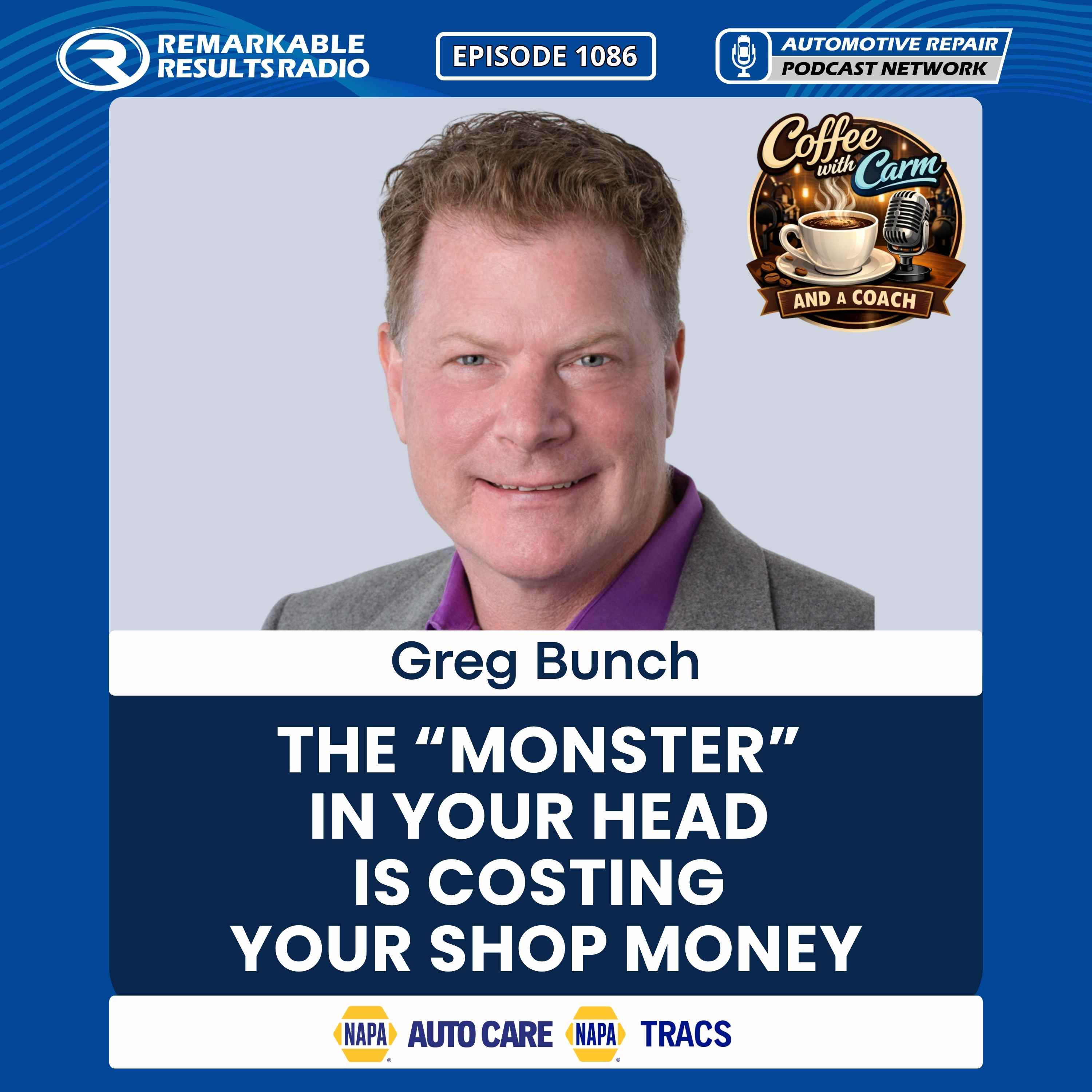
The “Monster” in Your Head Is Costing Your Shop Money [RR 1086]
About this episode
Greg Bunch and Carm Capriotto dig into the “monster voice” that keeps shop leaders from doing the hard, profitable work—like calling decline customers, confronting technicians, and following inspection protocols. Using neuroscience-style reasoning and a Proverbs-based framework (wisdom, knowledge, understanding, diligence, and right choices), they argue success is blocked less by external forces than by an overprotective inner guard. Real shop examples include missed upsell/decline work, pencil-whipped inspections, and emotional decision-making around employees. The episode ends with practical challenges: measure KPIs, run surveys, and rate yourself/your team.
In this episode of Coffee with Carm and a Coach, host Carm Capriotto sits down with Greg Bunch, business coach and Founder at Transformers Institute and owner of Aspen Auto Clinic, to unpack the mindset barriers that quietly limit leadership and growth in auto repair.
At the center of the conversation is the “monster” voice that is wired for survival, not success. While it once kept us safe, today it often holds leaders and advisors back from difficult but necessary actions: addressing underperformance, having honest conversations, or confidently recommending needed work. Left unchecked, that fear can cost shops hundreds of thousands, even millions, in missed opportunities.
Greg shares five foundational pillars for effective leadership:
- Wisdom: Surrounding yourself with the right voices and guidance
- Knowledge: Understanding your numbers and facts without emotion
- Understanding: Knowing what those numbers actually mean in your business
- Diligence: Doing what needs to be done, even when it’s uncomfortable
- Right Choices: Staying aligned with your values, no matter the pressure
Together, Carm and Greg explore how business is ultimately an emotional math problem, a constant balance between data-driven decisions and the human side of leadership. They also challenge listeners to become perpetual students, actively seek honest feedback, and confront the habits that hold them back.
The episode wraps with a powerful reminder: long-term success comes from “slow dimes,” not “fast nickels.” Doing the job right, every time, builds trust, safety, and sustainable profitability.
Greg Bunch, Aspen Auto Clinic, Transformers Institute. Listen to Greg’s previous episodes HERE. https://transformersinstitute.com/ Thanks to our Partners, NAPA Auto Care and NAPA TRACS Learn more about NAPA Auto Care and the benefits of being part of the NAPA family by visiting https://www.napaonline.com/en/auto-care NAPA TRACS will move your shop into the SMS fast lane with onsite training and six days a week of support and local representation. Find NAPA TRACS on the Web at http://napatracs.com/ Connect with the Podcast: - Follow on Facebook: https://www.facebook.com/RemarkableResultsRadioPodcast/ - Join Our Virtual Toastmasters Club: https://remarkableresults.biz/toastmasters - Join Our Private Facebook Community: https://www.facebook.com/groups/1734687266778976 - Subscribe on YouTube: https://www.youtube.com/carmcapriotto - Follow on LinkedIn: https://www.linkedin.com/in/carmcapriotto/ - Follow on Instagram: https://www.instagram.com/remarkableresultsradiopodcast/ - Visit the Website: https://remarkableresults.biz/ - Join our Insider List: https://remarkableresults.biz/insider - All books mentioned on our podcasts: https://remarkableresults.biz/books - Our Classroom page for personal or team learning: https://remarkableresults.biz/classroom - Buy Me a Coffee: https://www.buymeacoffee.com/carm - Special episode collections: https://remarkableresults.biz/collections - The Automotive Repair Podcast Network: https://automotiverepairpodcastnetwork.com/ - Remarkable Results Radio Podcast with Carm Capriotto: Advancing the Aftermarket by Facilitating Wisdom Through Story Telling and Open Discussion. https://remarkableresults.biz/ - Diagnosing the Aftermarket A to Z with Matt Fanslow: From Diagnostics to Metallica and Mental Health, Matt Fanslow is Lifting the Hood on Life. https://mattfanslow.captivate.fm/ - Business by the Numbers with Hunt Demarest: Understand the Numbers of Your Business with CPA Hunt Demarest. https://huntdemarest.captivate.fm/ - The Auto Repair Marketing Podcast with Kim and Brian Walker: Marketing Experts Brian & Kim Walker Work with Shop Owners to Take it to the Next Level. https://autorepairmarketing.captivate.fm/ - The Weekly Blitz with Chris Cotton: Weekly Inspiration with Business Coach Chris Cotton from AutoFix - Auto Shop Coaching. https://chriscotton.captivate.fm/ - Speak Up! Effective Communication with Craig O'Neill: Develop Interpersonal and Professional Communication Skills when Speaking to Audiences of Any Size. https://craigoneill.captivate.fmNAPA Autocare
"Listen, thank you so much to NAP Autocare and NAP Attracts. Hey, you know the technician shortage is real, but NAP Autocare has a solution at no cost to members."
NAPA Autocare is a NAPA program that helps auto repair shops and techs. Here, they’re talking about support and training to help shops find and keep technicians.
NAPA Autocare is a NAPA-branded program focused on supporting automotive repair shops and technicians. In this segment, it’s positioned as helping address the technician shortage through member benefits.
NAP Autocare Apprentice Program
"The NAP Autocare Apprentice Program builds tomorrow's technicians through a two-year, nine-stage curriculum. Learn more at member.napaautocare.com or talk to your NAPA representative today."
This is NAPA’s apprenticeship-style training program for new mechanics. They say it takes about two years and is broken into multiple stages so trainees learn step by step.
The NAPA Autocare Apprentice Program is described as a structured training pathway for future technicians. It uses a two-year, nine-stage curriculum to build skills over time.
NAPATRACS.com
"Let us prove to you that Tracks is the single best shop management system in the business. Find NAPA Tracks on the web at NAPATRACS.com."
They’re giving a website link so you can look up NAPA Tracks. It’s the place to learn more about the program they just described.
NAPATRACS.com is referenced as the website where listeners can learn more about NAPA Tracks. It’s essentially a call-to-action for the shop management system mentioned earlier.
Aspen Auto Clinics
"Greg Bunch, Transformers Institute and the owner of Aspen Auto Clinics and we've known each other for so many,"
Aspen Auto Clinics is the auto shop Greg Bunch owns. The episode uses his experience to talk about how better communication can improve how a shop runs.
Aspen Auto Clinics is mentioned as the shop Greg Bunch owns. The episode’s theme is improving shop performance, and the owner’s perspective is used to connect communication habits to real business outcomes.
service advisors
"if you've got service advisors, right, that we all look at our average written, you know, it's $2,500, right? If our service advisor closed 50% of that, right? They're a rock star, $1,200."
Service advisors are the people who talk to customers, write up the repair estimate, and get approval to do the work. Their numbers can make or break how much money the shop actually makes.
Service advisors are the customer-facing staff who write estimates, explain needed repairs, and get authorization. Their performance (like close ratio and average written) strongly influences shop throughput and profitability.
CRM
"And people are like, well, you know, we got a CRM, [596.6s] they get a follow-up email, they get a text message, maybe."
CRM is a software tool that helps a business keep track of customers and leads. It can also send follow-up messages so customers don’t get forgotten.
CRM stands for Customer Relationship Management. In a shop or dealership context, it’s the system used to track leads, customer interactions, and automated follow-ups like emails and texts.
protocol
"[607.0s] I don't mean to interrupt you, [608.2s] but I wrote this great blog about protocols. [611.2s] And I said, you know, maybe it's possible"
A protocol is a clear, repeatable set of rules for how to handle a task. The speaker is saying it’s not enough to name the protocol—you also need the specific steps that make it happen.
In operations, a protocol is a standardized set of steps for how something should be done. The speaker contrasts having a high-level protocol (like for QC) with not having the underlying process steps that actually make it work.
QC
"[629.0s] or respect what those processes are [634.9s] because, hey, we've got a protocol on QC. [637.7s] What's the process underneath that"
QC means Quality Control—basically, the checks that confirm the work is correct. The speaker is asking what the actual step-by-step process is behind those QC checks.
QC typically means Quality Control, the checks used to ensure work meets standards. The speaker mentions having a protocol on QC, then asks what the process is underneath it—i.e., the concrete steps that ensure quality.
inventory check
"They're gonna find every reason, let me do a parts return, let me do an inventory check, let me clean the bathroom."
An inventory check is basically counting and verifying what parts the shop actually has. It helps prevent ordering the wrong thing or running out at the wrong time.
An inventory check is verifying what parts are on hand versus what the shop’s system says it has. In a repair shop, inaccurate inventory can cause delays, wrong parts ordering, and lost sales opportunities.
technician shortage
"Hey, you know, it's no secret the automotive industry is facing a technician shortage, but Napa Auto Care has stepped up with a powerful solution, the Napa Auto Care Apprentice Program."
A technician shortage means there aren’t enough trained mechanics available. When that happens, shops can’t get as many cars fixed as quickly.
A technician shortage means there aren’t enough trained automotive technicians to meet shop demand. This can lead to longer wait times, higher labor costs, and reduced capacity for repairs and maintenance.
McNeill's Auto Care
"This program was pioneered by shop owners, Pete McNeill and master technician, Jake Sorensen at McNeill's Auto Care in Sandy, Utah."
McNeill's Auto Care is a local repair shop mentioned as an example. They helped create an apprenticeship approach so they could train new mechanics.
McNeill's Auto Care is referenced as the shop where the apprenticeship concept was pioneered. The segment uses it as a real-world example of shop owners building training pipelines to secure future staffing.
structured training
"By recruiting motivated individuals with the right passion and attitude and providing them with structured training, they approved that apprentices could become the next generation of skilled certified technicians."
Structured training refers to an organized, step-by-step learning plan rather than informal “on-the-job” learning. In apprenticeship models, it helps ensure apprentices build the right skills in a consistent order.
Napa Auto Tech
"with in-depth classroom videos, instructor-led Napa Auto Tech classes, web-based courses, and hands-on training with a mentor."
Napa Auto Tech is a training program for people learning to work on cars. It’s meant to teach you the skills shops need, not just give general information.
Napa Auto Tech is Napa Auto Care’s training program brand. It’s positioned as instructor-led automotive education that leads to industry-recognized credentials for technicians.
ASE certifications
"Graduates earn four ASE certifications, the G1, A4, A5, and air conditioning, and are officially registered with the Department of Labor as Journey Workers Automotive Technicians."
ASE (Automotive Service Excellence) certifications are industry credentials that verify a technician’s knowledge in specific areas. This segment says graduates earn four ASE certifications, including one for air conditioning.
Department of Labor
"and are officially registered with the Department of Labor as Journey Workers Automotive Technicians."
The Department of Labor is a U.S. government agency involved in labor and workforce programs. The segment uses it to support the claim that the training program’s graduates are officially registered as journey workers.
billable hours
"As apprentices gain skills, they generate billable hours, often boosting shop profits as early as stage five."
Billable hours are the labor time a shop charges customers for. The segment argues that as apprentices gain skills, they can start producing billable work, improving shop profitability.
Carlisle tools
"Plus Napa now offers a new apprentice toolkit developed with Carlisle tools at an exclusive price, helping break down one of the biggest barriers for new technicians, the cost of tools."
Carlisle is an automotive tools brand referenced here as the supplier for an apprentice toolkit. The segment emphasizes an exclusive price to reduce the upfront cost of buying tools.
cost of tools
"helping break down one of the biggest barriers for new technicians, the cost of tools."
Tooling cost is a major barrier for new technicians because modern diagnostics and repair require specialized equipment. The segment highlights an apprentice toolkit designed to reduce that upfront financial hurdle.
shop management system
"Let's face it, your shop management system is the single most important tool in your shop, period. Napa Tracks offers the industry's best post-sale support..."
A shop management system is the software that helps an auto shop run smoothly. It helps keep track of jobs and money so the shop can make better decisions and avoid wasted time.
A shop management system is software used by auto repair businesses to manage day-to-day operations—commonly including job tracking, scheduling, customer communication, and financial reporting. The episode frames it as the most important tool because it directly affects efficiency and profit visibility.
Napa Tracks
"Napa Tracks was built from the ground up to make your business more profitable and efficient. We provide an extensive set of tools to increase and track profitability in real time."
Napa Tracks is software for auto repair shops. It helps the shop organize work and keep an eye on how profitable things are, and it also includes training and support for the people using it.
Napa Tracks is a shop management system aimed at helping auto repair businesses run more efficiently. It’s positioned as a tool to track profitability in real time and support training and customer service for shop staff.
post-sale support
"Napa Tracks offers the industry's best post-sale support hands down and we train your people on site."
Post-sale support is the help you get after you buy the software. For a shop, that can mean training and support so the system actually gets used correctly.
Post-sale support refers to help provided after a customer purchases a product—such as onboarding, training, troubleshooting, and ongoing assistance. In the context of a shop management system, strong post-sale support can reduce downtime and improve adoption by shop staff.
deferred maintenance
"and now that car is on the road, there's a breakdown, there's something, the deferred maintenance, the cost of further issue."
Deferred maintenance means you delay fixing something that should be serviced now. If you wait, the problem can grow and end up costing more later.
Deferred maintenance is when needed service is postponed, so small problems get a chance to worsen. In a shop context, it often shows up as repeat visits, bigger repairs later, and higher total cost for the customer.
Transformers Institute
"[1564.1s] Hey, I just want to remind everyone, [1565.6s] we're here coffee with Carmen, a coach. [1567.6s] We're with Greg Bunch from the Transformers Institute. [1570.2s] Appreciate you being here."
They mention the Transformers Institute as the group Greg Bunch is associated with. It’s mainly background for who’s speaking, not a car-tech detail.
The Transformers Institute is referenced as the organization where Greg Bunch works. In this episode it’s part of the host/guest context rather than a technical automotive topic.
piece of machinery
"[1783.0s] And I remember getting a little bit more psychology here [1786.1s] when I was a technician, cars that come in and out, [1789.0s] they become a piece of machinery that you're looking at."
They’re saying technicians can start thinking of the car as just a machine. But the customer is a person too, and treating it that way can improve how the job feels and how customers trust you.
The speaker contrasts treating cars as mere objects (“piece of machinery”) versus recognizing the people behind them. In service work, this mindset affects communication, empathy, and ultimately customer satisfaction and retention.
human element
"[1815.9s] It put a human element into that vehicle [1818.1s] that you're driving knowing that, [1819.6s] hey, your mom's in the hospital, two states away, [1822.1s] you're gonna be driving it."
They’re saying car work isn’t just mechanical—it affects real people. If you remember that, you’re more likely to do the job carefully instead of rushing.
“Human element” here refers to recognizing that vehicle repairs affect real people’s lives, not just the car. The speaker ties this to customer circumstances (like a family member in the hospital) to motivate technicians to be more careful and thorough.
underground fuel tank replacement (Colorado requirement)
"We had a shop owner that was about to buy a gas station [1924.7s] that has a repair shop that the tanks are 39 years old. [1928.6s] Well, in the state of Colorado, [1930.9s] they're mandatory pulled and replaced at 40 years."
They’re talking about underground gas tanks that have to be replaced after they get old. If you buy a place and the tanks are near the end of their life, you could be forced to pay for the replacement—and possibly more repairs if problems show up.
The segment discusses Colorado rules that require underground fuel storage tanks to be pulled and replaced after a certain age. This matters because tank work can be expensive and can uncover additional issues once the tanks are opened up.
CPA
"[1984.0s] And then we have knowledge. [1986.0s] CPA is the one that gives us our knowledge, right? [1988.7s] That doesn't hold back to say you're making money,"
CPA means a Certified Public Accountant. They help businesses understand their finances—like what’s really profitable—using numbers instead of feelings.
CPA usually means Certified Public Accountant, a professional who helps businesses with taxes, bookkeeping, and financial reporting. In this context, the speaker is using a CPA as a source of “facts” about whether the shop is actually making money.
margins
"[1988.7s] That doesn't hold back to say you're making money, [1990.9s] you're losing money, hear your margins, your KPIs. [1994.5s] Their knowledge is really unemotional."
Margins are how much money you keep after paying your costs. If margins are shrinking, it usually means the shop isn’t as profitable as it seems.
Margins are the percentage of revenue that remains after costs. For a shop, tracking margins helps you understand whether pricing and labor efficiency are actually producing profit, not just revenue.
KPIs
"[1988.7s] That doesn't hold back to say you're making money, [1990.9s] you're losing money, hear your margins, your KPIs. [1994.5s] Their knowledge is really unemotional."
KPIs are the numbers a business watches to see if it’s doing well. They help you spot problems early instead of guessing.
KPIs (Key Performance Indicators) are measurable metrics used to track how well a business is performing. In a shop setting, KPIs might include things like labor hours sold, job completion rate, and profitability targets.
SurveyMonkey
"I've got another client that recently did an anonymous survey, right, SurveyMonkey or something like that, and that promoter score internal for his employees, right?"
SurveyMonkey is a website where you can create surveys and collect answers. Here, it’s being used to ask employees questions anonymously.
SurveyMonkey is an online survey platform used to collect structured feedback from employees, customers, or peers. In this episode, it’s referenced as the tool for running an anonymous internal survey to measure sentiment and performance.
Request an Explanation
Heard something you'd like explained? We'll add it to this episode.
Sign in to request explanations for terms you heard.
Want to learn more?
Browse our glossary for plain-English explanations of automotive terms, jargon, and concepts.
Help improve this episode
See something that's not quite right? Our annotations are AI-generated and can sometimes miss the mark. Click the flag icon on any annotation to suggest a correction.