NAPA Autocare is a NAPA program that helps auto repair shops and techs. Here, they’re talking about support and training to help shops find and keep technicians.
This is NAPA’s apprenticeship-style training program for new mechanics. They say it takes about two years and is broken into multiple stages so trainees learn step by step.
Aspen Auto Clinics is the auto shop Greg Bunch owns. The episode uses his experience to talk about how better communication can improve how a shop runs.
Service advisors are the people who talk to customers, write up the repair estimate, and get approval to do the work. Their numbers can make or break how much money the shop actually makes.
A protocol is a clear, repeatable set of rules for how to handle a task. The speaker is saying it’s not enough to name the protocol—you also need the specific steps that make it happen.
Concept
QC
QC means Quality Control—basically, the checks that confirm the work is correct. The speaker is asking what the actual step-by-step process is behind those QC checks.
An inventory check is basically counting and verifying what parts the shop actually has. It helps prevent ordering the wrong thing or running out at the wrong time.
Structured training refers to an organized, step-by-step learning plan rather than informal “on-the-job” learning. In apprenticeship models, it helps ensure apprentices build the right skills in a consistent order.
Napa Auto Tech is a training program for people learning to work on cars. It’s meant to teach you the skills shops need, not just give general information.
ASE (Automotive Service Excellence) certifications are industry credentials that verify a technician’s knowledge in specific areas. This segment says graduates earn four ASE certifications, including one for air conditioning.
The Department of Labor is a U.S. government agency involved in labor and workforce programs. The segment uses it to support the claim that the training program’s graduates are officially registered as journey workers.
Billable hours are the labor time a shop charges customers for. The segment argues that as apprentices gain skills, they can start producing billable work, improving shop profitability.
Carlisle is an automotive tools brand referenced here as the supplier for an apprentice toolkit. The segment emphasizes an exclusive price to reduce the upfront cost of buying tools.
Tooling cost is a major barrier for new technicians because modern diagnostics and repair require specialized equipment. The segment highlights an apprentice toolkit designed to reduce that upfront financial hurdle.
A shop management system is the software that helps an auto shop run smoothly. It helps keep track of jobs and money so the shop can make better decisions and avoid wasted time.
Napa Tracks is software for auto repair shops. It helps the shop organize work and keep an eye on how profitable things are, and it also includes training and support for the people using it.
Post-sale support is the help you get after you buy the software. For a shop, that can mean training and support so the system actually gets used correctly.
They’re saying technicians can start thinking of the car as just a machine. But the customer is a person too, and treating it that way can improve how the job feels and how customers trust you.
They’re saying car work isn’t just mechanical—it affects real people. If you remember that, you’re more likely to do the job carefully instead of rushing.
They’re talking about underground gas tanks that have to be replaced after they get old. If you buy a place and the tanks are near the end of their life, you could be forced to pay for the replacement—and possibly more repairs if problems show up.
CPA means a Certified Public Accountant. They help businesses understand their finances—like what’s really profitable—using numbers instead of feelings.
SurveyMonkey is a website where you can create surveys and collect answers. Here, it’s being used to ask employees questions anonymously.
LIVE
This is the Automotive Repair Podcast Network.
Hey, welcome everyone.
Carm Capriotto, good to see you.
Good to have you here.
Always appreciative to your support
and your listenership over all these years
as we're heading into celebrating our 11th year
of doing this podcast.
I have to tell you, we're so committed
to delivering authentic and actionable content
that directly addresses the evolving challenges
that you have inside of our great
professional automotive industry.
We're gonna do a Coffee with Carm and a Coach episode today.
I'm with Greg Bunch, can't wait to introduce Greg.
But don't forget, we have our really cool app
that we've worked on so patiently over the last year
for your smartphone, the Automotive Repair Podcast Network.
All the shows that are on the network are there.
You can save favorites, you can build category libraries,
you can see your recently played.
Just go subscribe, go to Google Play, go to Apple,
go to AutomotiveRepairPodcastnetwork.com forward slash app.
We put these QR code links all over the place
so you can get up and on for that.
And don't forget, in case you're watching on YouTube,
please subscribe.
We'd always love to have you as a subscriber
so when we do release this.
Listen, thank you so much to NAP Autocare and NAP Attracts.
Hey, you know the technician shortage is real,
but NAP Autocare has a solution at no cost to members.
The NAP Autocare Apprentice Program builds
tomorrow's technicians through a two-year,
nine-stage curriculum.
Learn more at member.napaautocare.com
or talk to your NAPA representative today.
Hey, did you know that NAPA Tracks has on-site training
plus six days a week support?
It all starts when a local representative meets with you
to learn about your business and how you run it.
After all, it's your shop, so it's your choice.
Let us prove to you that Tracks
is the single best shop management system in the business.
Find NAPA Tracks on the web at NAPATRACS.com.
Okay, let's get on with Greg.
Hi, Greg.
Hello, hello.
Glad to be here, sir.
Thank you, good to have you here.
Oh, by the way, so this is coffee with Carmen and Coach.
I love that graphic that I made.
That is so cool, absolutely.
That is just too cool.
And then we have this really cool background
that you're all gonna see in a little bit
with a brewing cup of coffee.
And I said, Greg, you gotta have your coffee.
And he said he has his.
I got my coffee here.
And I have mine, so, okay.
This is going to be a very powerful framework
of a leadership episode.
It's kind of like this, everyone,
because Greg and I have already discussed this
and I was blown away by what he's bringing to you.
It's like we all have two voices inside of us
that every shop owner, every specialist,
every service advisor has,
one voice builds you and the other one destroys you.
And Greg is gonna teach you how to have those pillars,
if you will, of voices help build you, right, Greg?
Yes, we're gonna go as far as we can.
This is great.
All these people inside of us
and all these particular pillars,
I just love your premise.
This is really gonna elevate our listener.
You bet.
Now I'm excited to bring this to the table.
And really, we're not obviously gonna get
quote unquote religious on the show here,
but we've got our inner voice, right,
which is that wants us to succeed,
that wants us to do well,
that wants us to be successful,
the true essence of who we are.
But we have some other voices that go on in our head
that try and tell us,
nah, you don't really wanna do that, right?
And if you study neuroscience
and I don't claim to be one,
I don't play one on TV,
but I've been reading a lot about human behavior
as a business coach and really,
you become a life coach in a lot of different ways.
The question becomes, okay, why is human beings,
if we know what we're supposed to do,
why don't we do it, right?
So there's a lot to unpack there.
And I think we have this,
what I call the monster voice.
And that is that voice.
And I give a whole presentation on this,
but it's the overprotective security guard.
And so, you know, when we were kids,
you know, whether it was,
hey, I don't wanna be the one not picked on kickball
or, you know, I don't wanna be the one
that's ostracized for saying something that, you know,
I believe or, you know, you're figuring out socially
who you wanna be, who your friends are,
what life is gonna be like, you know,
maybe you've got parents that were a certain way, right?
Whether they were helicopter parents,
whether they were, you know, super authoritative type,
maybe they were absentee
and you had to be the adult in the family.
This overprotective security guard
is always talking to us about how to make us comfortable
and how to make us safe.
And you go all the way back into human behavior
and go, why do we behave the way we do?
Why do we do things the way we do?
And the only way man has survived thousands of years
has been because we survive in tribes.
You know, if you're in a tribe
and you're all gathered around the campfire,
you're not gonna wanna get kicked out of that
because literally you could be, you know,
kicked out into the jungle and eaten by a wild animal
and not only you lose your own life,
but lose your, you know, your legacy, right?
Your offspring becoming part of a tribe
and staying within that tribe
literally was a point of life and death back in the day.
Well, now, right, it may have an emotional pain,
but it's not necessarily life or death,
but you know, you see somebody's willing to share
their opinion just between you and that person,
but you put them in a crowd
and they may have a strong belief they're not gonna voice
and that it really traces back to,
hey, I don't wanna rock the boat.
I don't wanna be seen by the quote unquote tribe
as being an outsider.
And so this voice that we have,
it's not really designed to make us successful.
It's not designed to push the envelope.
It's not designed to push us out of our comfort zone.
It's designed to keep us safe.
And then you can, you know, again,
maybe just hovering a little bit
on the religious side of things, right?
That we all have us in nature
and it doesn't matter what you take all the religions
of the world or all the philosophical views in the world.
You know, I think everybody knows
that human beings have a propensity to be selfish,
to do things in our own self-interest
that could be harmful to ourselves, to other people.
So I think that voice is in there too,
but as I've been studying this and learning this,
really there's a separation between those two voices,
three voices really, right?
That you're authentic self,
you've got this overprotective security guard in our brain
and then we have what I'm gonna call the sin nature
that says, hey, you know what?
You can get away with this
or just that selfishness really
that I think we all are born with
and well have to fight.
You know, Greg, ever since you told me
about the monster voice,
I started to really think about it a lot
and I started to think that, do we get that?
Does it overwhelm us when we have fatigue or stress
or maybe we're a little bit in isolation
or we're overwhelmed, we're financially pressured,
we're exhausted, we're unsupported
and that monster voice has a chance
to take over a little bit of our world.
Absolutely.
I was talking to a client yesterday
and he's involved in a family business.
He's got some frustrations
that his wife is sharing about the family dynamics
and it's a multi-store generational business.
So she's got pressuring him,
hey, you need to get your part of it, right?
That you do more than your brothers
that are involved in the business.
So you got a family dynamic,
you've got a business dynamic,
you've got a marital dynamic in there
and I'm sure that his monster is saying,
hey, I wanna keep the piece,
I don't wanna rock that boat.
What if I have this really tough conversation
with my dad and it doesn't go well, right?
What if I don't have that conversation
and now I'm at odds with my wife?
What if I have this conversation
and dad agrees and the wife agrees
but my brothers are now gonna push back
and think that there's favoritism.
So that monster is in there saying,
well, just let it go, just keep the status quo
and then what's happening,
it's eating him up inside,
that he's not speaking up.
So it can get really heavy.
Wow, you just described a huge issue
that goes on inside of family businesses every day.
Right, we do a lot of service advisor training
and it's not that a service advisor
doesn't know what to do all the time
but it's getting them to do it.
I always joke around at our company, right?
You know what, I forgot to properly introduce you
in the beginning, I'm embarrassed.
Greg Bunch, Transformers Institute
and the owner of Aspen Auto Clinics
and we've known each other for so many,
so many years, done so many episodes together.
So yes, this guy's the real deal.
All right, go ahead.
So I'm looking at my own business, right?
My six repair shops,
even though I feel like we do a pretty darn good job,
there's, you know, because I've got six locations,
there's approximately a million dollars a month of work
that doesn't get sold immediately, right?
And I think everybody knows, right,
that if you add 100% close ratio on every single thing,
everybody recommended, right?
We're gonna show up at your shop and say, show me, right?
That, you know, if you've got service advisors, right,
that we all look at our average written, you know,
it's $2,500, right?
If our service advisor closed 50% of that, right?
They're a rock star, $1,200.
You know, most general repair shops
aren't even at that level, right?
They're maybe $800, $900.
So all of that additional work that doesn't get sold,
what happens, right?
And I ask my coaching clients and ask the industry,
like, what do you do?
And people are like, well, you know, we got a CRM,
they get a follow-up email, they get a text message, maybe.
And a lot of people are literally just relying
that the customer is gonna remember it and come back.
You know what bothers the hell out of me?
I don't mean to interrupt you,
but I wrote this great blog about protocols.
And I said, you know, maybe it's possible
that you're not being able to install the processes
inside of your systems because you're in a little too deep.
Now, if you thought up top as a protocol,
what's the protocol for follow-up and follow-through?
What's the protocol?
And then you can design your processes under it.
My thought was that maybe we would get more done
or respect what those processes are
because, hey, we've got a protocol on QC.
What's the process underneath that
that actually makes it work?
Anyway, I didn't mean to bump into you,
but you're exactly right.
Well, so let's take this from the monster perspective, right?
Psychological, and I'll go into my other pillars
that you referenced earlier in the show here.
A million dollars of work that's not being sold, right?
If you go to your advisor and just say,
hey, why don't you jump on the phone, right?
Kind of have a slow day today.
You know, not a lot on the schedule tomorrow.
Why don't you call some of that decline work
and try and fill up the schedule?
Well, the reality is, and I'm sure shop owners
are gonna shake their head when I say this,
your service riders would probably rather
go clean the bathroom than go do that, okay?
They're gonna find every reason,
let me do a parts return, let me do an inventory check,
let me clean the bathroom.
So the question is, again, why aren't they doing that?
And to me, and the service advisors that I've talked to,
right, it goes back to that monster voice going,
well, you don't wanna bug people.
You don't wanna annoy people
because once in a while, you're gonna step on a landmine,
right?
You're gonna find out that they took it
to their uncle Sam, that you're gonna find out
that they don't believe the repair that was done,
that you charged more than the guy down the street.
And you get a few of those calls
and now your protective monster says,
well, don't do that again, that hurts.
Nobody likes to feel rejected, you just got rejected,
you got kicked out of the village, per se,
of your customer base.
Now realizing that 95% of those people
are gonna be thankful that you called
and got them rescheduled, but we've hone in on those people
that we had a negative experience with.
The other pillars that you were talking about,
and I can go as deep as we can,
I know we're gonna have a short amount of time here together
for how deep this can really go.
But as I did a study, I was inspired by a book
and really took that on and really studied
the book of Proverbs.
And again, not trying to get religious,
but there's a lot of wisdom that is packed into Proverbs.
And so part of the premise of the book
is this guy had told his friend
that had been fired from like nine different jobs
and was really struggling with his career to say,
you know what, read the book of Proverbs for two years,
there's 31 Proverbs, you read one a day,
and you just work on applying those principles to your life,
you'll see that within a couple of years,
your life is gonna look differently.
And he tells the story that took him probably about a year
to really turn things around in his life,
and the guy's a successful multi-millionaire business owner
now.
And so, and I had been doing that already where,
and I'd gone through seasons of life
for kind of reading through those and like,
okay, there's some cool stuff in here,
but digging deeper and going,
okay, what do these words really mean?
So there were four words that really stood out,
and that was wisdom, knowledge, understanding,
and diligence.
It's peppered throughout the all 31 Proverbs.
So I'm like, okay, what does that really mean?
And I added one from a class I took back in my early 20s,
even before I owned any kind of business,
and that was when they said,
when you're reading something and it says righteous,
think of the word right choices, right?
So I added that pillar in there too.
As I was studying this and going, okay,
wisdom is really, you know,
knowing what that right decision is.
So, you know, Dave Ramsey talks about this
on his radio show, right?
I provide wisdom, you know,
the same thing that your grandmother would have told you.
I think we all know wise principles when it comes to money,
and that is don't spend as much as you make,
save for a rainy day.
Like we all know that's good wisdom.
And so then we have knowledge, right?
So knowledge would be, okay, how much do I make?
How much are my bills?
What can I do?
You know, how much do I need to invest?
Where can I put an investment, right?
So that's the knowledge component.
So somebody could know that and still not do it.
And then understanding is, okay,
you know, what are the interest rates that I can get?
What is the risk level of those investments?
You know, understanding how money flows
in and out of their budget or, you know,
household or within their business.
Now the key comes up is diligence.
Diligence is that guy that doesn't care how you feel.
And if you read the book, Atomic Habits,
that's really what it's about.
Like, diligence is doing what you know
that needs to be done whether you feel like it or not.
And then right choices would be,
hey, I'm not gonna do something immoral,
illegal to generate money, right?
I'm gonna do it in an honest ethical way.
It's not gonna violate my core values.
And so as I looked at these five different pillars
that come out of there and studying
what each of those words mean,
one of the things that gets brought up in my coaching calls
as we're talking about this is,
man, the one I struggle with the most is diligence.
And I'm like, so that goes back
to that component of human behavior.
If we know the right thing to do,
we understand the numbers, we understand our financials,
we understand money coming in and out.
Why do we not diligently save money?
Why do we make impulse purchases?
Why do we not do those things that we know what to do?
Why do we hold onto that employee that is on our payroll
that really isn't earning their keep, right?
All those components go into diligence.
And so that's where that study goes,
okay, there's gotta be something holding us back
as human beings from doing what we know needs to be done.
And that's where I came up with this concept
of the monster, right?
This overprotective security guard.
If you remember the movie The Village by Midnight Shalaman.
Oh, right, yeah.
I'd seen that movie a couple of times
and it really didn't hit me
until I started putting this together.
And if you remember the monsters,
and maybe people wanna go back and watch that movie now,
but those monsters, they weren't there to kill people.
They were that overprotective security guard.
The elders of that village believe
that if we scare people,
we'll keep them in our little safe village, right?
They won't go outside and find out
there's a whole nother dangerous world out there,
but they were using this fear tactic
that if you go beyond the fence,
these monsters are gonna eat you, they're gonna kill you.
So I kind of look at that same kind of a monster.
That's what's in our head.
Like, hey, Karm, you don't wanna go do this or that, right?
What if people don't like it?
What if you get rejected?
What if it takes more time?
What if it means you gotta get up earlier in the morning?
Whatever that might be
that have an uncomfortable conversation.
Showing up when it's hard.
And so you have to figure out a way
and there's different protocols
to kind of overcome that voice, right?
Of saying, and one of the tools is
literally you take five seconds,
you shut down that voice.
Like, I know this is the right thing to do.
I may not feel like it, but I'm gonna do it anyway.
And so really where I looked at,
and then I've read a lot of leadership books.
I've read a lot of business books and self-help books
and podcasts and all that.
And I go, every one of them I've ever listened to
all tie back to one of these five pillars, right?
Atomic habits is about diligence.
From good to great is all about wisdom
and knowledge and understanding, right?
That you tie it back and go,
man, there's just so much to unpack there.
What's the enemy of our success, right?
It's usually not an external force.
It's an internal voice
that's holding us back from our true potential.
Hey, you know, it's no secret
the automotive industry is facing a technician shortage,
but Napa Auto Care has stepped up
with a powerful solution,
the Napa Auto Care Apprentice Program.
And the best part, it's completely free for members.
This program was pioneered by shop owners,
Pete McNeill and master technician, Jake Sorensen
at McNeill's Auto Care in Sandy, Utah.
They recognized that waiting for skilled technicians
to appear wasn't an option.
So they built a program to grow their own.
By recruiting motivated individuals
with the right passion and attitude
and providing them with structured training,
they approved that apprentices
could become the next generation
of skilled certified technicians.
The program features a comprehensive
nine-stage curriculum
with in-depth classroom videos,
instructor-led Napa Auto Tech classes,
web-based courses, and hands-on training with a mentor.
Apprentices move at their own pace,
typically completing the program within two years.
Graduates earn four ASE certifications,
the G1, A4, A5, and air conditioning,
and are officially registered with the Department of Labor
as Journey Workers Automotive Technicians.
And here's the business benefit.
As apprentices gain skills,
they generate billable hours,
often boosting shop profits as early as stage five.
Plus Napa now offers a new apprentice toolkit
developed with Carlisle tools at an exclusive price,
helping break down one of the biggest barriers
for new technicians, the cost of tools.
Together, Napa Auto Care and your shop
can tackle the technician shortage head on.
Start now, grow your own talent
and build your bench for the future.
Visit member.napaautocare.com or contact
your Napa representative today
and get started with your apprentice program.
Let's face it, your shop management system
is the single most important tool in your shop, period.
Napa Tracks was built from the ground up
to make your business more profitable and efficient.
We provide an extensive set of tools
to increase and track profitability in real time.
Napa Tracks offers the industry's best post-sale support
hands down and we train your people on site.
Yep, on site and we offer remote refresher training
10 times a week and customer support is open
six days a week.
Give us a call, visit the website
or join our Facebook community today to learn more.
We'll prove to you that Tracks is the single best
shop management system in the business.
Napa Tracks is always customized and tailored for you
whether you're a one man shop
or a large multi-bay or multi-location company.
After all, it's your shop.
So it's your choice.
Visit us on the web at Napa Tracks.
That's N-A-P-A-T-R-A-C-S dot com.
Greg, it's amazing as I'm sitting here listening to you
to discuss diligence.
And I think of examples like
we've got to follow the processes every time.
We have to perform complete inspections.
We have to train and educate
when we don't want to and when we're tired.
We have to have those hard conversations.
And if we can do that
and respect that the monster is not talking to us
but we have to be strong in our diligence,
we're gonna have a lot of success.
I think it's also gonna build our reputation
not only as a business but as a leader.
Absolutely.
And you think about consistency in a shop, right?
A lot of shops, the success
or whether they have a good day or bad day
is truly based on the mood of the owner,
the manager, the service advisor, the technician, right?
You just pencil-whipped an inspection.
So old school started out on paper.
I know we all have probably everybody has DVIs now.
So I'm the service advisor
and Karm's kind of that senior tech, grumpy guy
but does good work but you pencil-whipped an inspection
and I know it.
So the monster is gonna say,
you know what, just leave Karm alone,
he's having a bad day.
I don't wanna have that confrontation.
But what does that do?
Cascade that all the way through the customer experience.
I don't confront you.
So I just, you know,
write up the few little things that you wrote down.
I talk about those things with a customer
and now that car is on the road,
there's a breakdown,
there's something, the deferred maintenance,
the cost of further issue.
Now that customer is back upset at us
and it all ties back to my unwillingness
to have a tough conversation with that master technician
and say, we have a protocol here, right?
Every single car gets inspected every single time.
There are no shortcuts.
I need this thing done correctly.
Even if that, you know,
you're gonna bite my head off, right?
Like, it doesn't matter.
We have a system and a process to follow in my shop.
It doesn't matter what mood you're in.
Doesn't matter that you don't feel like it.
Doesn't matter that you gotta pull that car back in
and do the job right.
If that system is not followed
because it's based on somebody's mood,
the customer suffers from that.
The business suffers from that.
Yeah, I'm just thinking here.
Here's this guy Karm over in the shop
who failed to do it completely right.
And I'm, if you will, a shop manager knowing this
and thinking of what goes on inside of my mind
is what kind of conversation can I,
should I have with Karm, legacy guy, he knows better.
And I think part of us overthinking what we should do
prevents us from doing it a lot of times.
Absolutely.
Well, if you think about it, right?
What does a service advisor really get paid for?
They get paid to properly communicate.
Be the client advocate.
So if you are the client advocate,
you know you've got to get this person on your side.
The inspection, okay, it's about safety reliability
and it's about trust.
We can't miss stuff even though they may not be happy
that they may have to have it done.
But today in our whole professional world,
the DVI, the comprehensive inspection
of safety inspection on that vehicle
is it was brilliant when it was discovered.
And I think we looked at it as a toy,
but it's part of our professionalism.
Karm, have you ever driven a like performance car
like on a track with a instructor
or anything like that in your life?
I could have, but I didn't.
Okay.
Well, it's an interesting experience.
So I've got an older 2002, 911 and took it to the track.
I'm not like racing people, right?
But it was like a Porsche event
and they put a driving instructor in the car with you.
And so, you know, you get warmed up, you go around the track
and we all have like this internal gut
of when we hit the brakes,
how fast we can take that corner.
Now the instructor that knows another level
is saying, okay, hold off, hold off, hold off, now break,
right, or push, push, push through that corner.
And what I found is my car outperformed my gut feeling,
meaning that that car could outperform
where my level of safety and comfort was.
And I wouldn't have pushed it
if I didn't have that person sitting next to me,
knowing my car better,
knowing how to drive on a track like that
and getting more out of that car and out of me.
But what I had to do is push past my fear
that I'm gonna roll the car, spin out of control,
gonna not be able to break fast enough, right?
So we take that analogy and we put it on the sales counter
of a lot of service advisors will only talk to a customer,
confront that technician up to that level
where that nod in their stomach is telling them
that that's far enough.
But true success comes from pushing past that,
having that tough conversation.
Again, whether you're a shop owner with your employees,
with a vendor, with a customer,
being able to push past that fear,
that monster that says, hey,
if you have this tough conversation,
maybe that person isn't gonna like you.
Maybe they quit on you.
Maybe they bad mouth you, whatever that is.
But is it the right thing to do?
Is it the wise thing to do?
Do you understand the consequences of not doing it?
Well, then that means you push past that nod in your stomach
and you have that conversation.
And believe me, I don't have this mastered either.
I'm not perfect at it.
There's conversations that I need to be having
that I've been putting off
because the monster says that's gonna hurt.
That's gonna potentially have a negative effect short-term.
But the other voice says,
but Greg, it's the right thing to do.
It needs to happen.
You've got to address this behavior.
So powerful.
Hey, I just want to remind everyone,
we're here coffee with Carmen, a coach.
We're with Greg Bunch from the Transformers Institute.
Appreciate you being here.
And the CEO of Aspen Autoclinic Six shops
out there in Colorado.
This has been brilliant so far.
I think you're motivating our listener
to dig down deep inside and find,
we talk about leadership all the time,
but I think this is almost,
I don't know if it's hovering over leadership,
if it's supporting, it's the foundation,
but there's so much here.
Please do a personal reflection on all of Greg's points
and say, hey, I am and I'm not.
And if you're not,
figure out how to get better at these levels, these pillars.
Another one that I run into with shop owners
is if they don't want to look at their KPIs,
if they're, no, they're not good.
They don't want to look at their profit loss statement
if it's not good.
So, but you can't manage what you don't measure.
And I believe me, I've done it too.
Like, oh man, this was not a great month.
You open up your QuickBooks
or your bookkeeper sends you the report.
You're like, okay, here we go.
But I don't want to look, right?
And that head in the sand type mentality.
And there's another part of Proverbs
where, you know, King Solomon writes,
you know, know the condition of your flocks.
That's where you're, you know, the wool from your sheep,
you know, that's what they make the clothing,
the food and all that.
It's a call no matter what position we have in life.
Like we have to know, right?
And that's that knowledge.
Like, do I really know what's going on?
Or do I put my head in the sand and I'll,
as long as I don't know, it's not going to hurt me.
So there's where knowledge says, I'm sorry,
I don't mean to get unemotional on you,
but you need to know what's really going on.
When you and I were talking,
you said something to me, I wrote down,
you said business is an emotional math problem.
I wish I was the one that said that,
but I, I read that somewhere, I'm let,
that was like a big light bulb that went off, right?
That everything in the business has emotions tied to it.
The emotions of our customers,
the emotion of our employees, our emotions,
when really, like you said, it's like a,
it's a math problem, right?
So that's where knowledge and understanding come in,
and go, hey, I know you may feel emotion for this employee,
but they're not pulling their weight or whatever that might be.
And, you know, are you making a business decision?
Are you making an emotional decision?
And if you confront that,
and you ask yourself that question,
and some people will literally say, Greg,
I know I'm making an emotional decision.
This guy's been with me 25 years.
He worked for my dad before I took over the business.
I am willing to take a hit on my numbers
because of the emotional attachment I have to this employee.
What am I gonna say to that?
They own it.
They're putting that relationship above, right?
Their profit margin, that's their choice.
They're the business owner.
But my job as a coach is to get them to look in the mirror,
be able to voice that and admit that,
and then understand now I own the consequences
of that decision.
Someone either on a previous episode
or somewhere I read this or heard this,
fast nickels, slow dimes.
And when I was thinking of the issue that we had
with the disgruntled Karm in the bays
who didn't do a complete job,
he was going for fast nickels,
and my job is for slow dimes.
That would have motivated me knowing
that we can't do things fast
because the fast nickels could have lost that customer.
And we have to do things proper and right
so slow dimes gets us
where we ultimately, long-term strategically,
always wanna be with our clients.
Anyway, you just made me think of that.
No, no, that's good.
And I remember getting a little bit more psychology here
when I was a technician, cars that come in and out,
they become a piece of machinery that you're looking at.
And so when I had the opportunity to meet the family
that was gonna be in that vehicle
or the driver of that vehicle,
be able to look them in the eye, shake their hand,
it did something to me as a technician to go,
you know what, I just met that guy.
I just looked him in the eyes, I shook his hand,
told him he's gonna be in good hands.
I need to do a much better job.
I need to be even more thorough.
It put a human element into that vehicle
that you're driving knowing that,
hey, your mom's in the hospital, two states away,
you're gonna be driving it.
I better make sure this thing is just perfect.
And so the technicians, we have to talk about that.
There's a human element
that these are not just a piece of machinery.
These are people rely on us
to make sure that their transportation is safe.
And so that nickel guy,
how could we have maybe changed that, right?
Understand who drives that car,
maybe even if they're waiting in the waiting room,
bring them back, show them, introduce them.
And that may reframe that guy
trying to just get through the day
and pencil whip something to go,
you know what, I do need to slow down.
I need to do this job correctly for that person.
Greg, let's jump in to wisdom.
Wisdom.
So where I started with this garment,
I'll have to send you a picture there.
I don't know if you can put it on this,
but I went on to Amazon and I bought a costume.
I think it was a Moses costume, right?
I was looking for that robe
and then a long gray beard and gray hair.
And so I was at the mastermind meeting
and we were on a break.
Nobody knew what was going on.
So here I come from the back of the room up on stage.
You know, people are snickering,
like what the heck is going on?
And then I read this monologue
as if I'm father wisdom, right?
Personified this character and talk about, you know,
that the more we tap into wisdom
and people have to define really what wisdom is
and what that looks like.
So, but I define like, you know, if you listen to me
and I'm here, I'm available,
there's a lot of different places to gather wisdom,
but the first step in this is wisdom.
And so Proverbs again says there's wisdom
and a multitude of counselors.
So one of the reasons we have our mastermind groups
is there's wisdom.
We had a shop owner that was about to buy a gas station
that has a repair shop that the tanks are 39 years old.
Well, in the state of Colorado,
they're mandatory pulled and replaced at 40 years.
Well, obviously the guy knew that
while he was trying to sell it.
And so the wisdom in the room said,
hey, this is not a good idea.
Here's what's going on, right?
And if they get into those tanks
and then they find there's a leak, right?
You're now on the hook for all of that.
So wisdom in the multitude of counselors
and whether that's, you know, hey, a marketing campaign,
a, you know, a pay plan change,
a buying another building or, you know,
buying and doing an acquisition, right?
So there's a lot of wisdom out there.
And, you know, I think Jim Rohn said it,
you become the five people you surround yourself with
and the five books that you read.
What that principle is about wisdom,
who are you listening to?
The guys that don't have any money in savings
and spend it all on beer and pizza on Fridays
or the people that are building success and longterm.
You've got to find out what your source of wisdom is
and tap into that and listen to it.
And then we have knowledge.
CPA is the one that gives us our knowledge, right?
That doesn't hold back to say you're making money,
you're losing money, hear your margins, your KPIs.
Their knowledge is really unemotional.
It's either this is the facts and this is the truth,
whether you like it or not.
So how willing are we to listen to that voice of knowledge
and go, this is where I'm really at in life?
Knowledge in my mind is learned and earned.
Absolutely.
And so is wisdom, right?
That there's an element of,
I used to teach my kids this, right?
That smart people learn from their own mistakes.
Wise people learn from other people's mistakes.
Years ago, as I kept going to
more and more training and being involved in
masterminds and associations,
and then all of my selling the business
and then working for corporate America,
I started to realize that I was a perpetual student.
Those two words just flowed out of my mouth.
I own them words, I think, and I speak about that a lot.
As a leader of any organism,
an individual who's picked the role in the shop,
you have to be a perpetual student.
How they look at the opportunities that they have
as clients and what should be fixed
and what shouldn't be fixed.
They're out there gaining knowledge
and you have to learn how that adapts
and how you end up building that relationship
to not be a perpetual student in today's life
and or in this professional industry of ours is wrong.
And it's truly dangerous for our careers.
So we've probably both talked to people
that said, I don't want anything to do with AI, right?
It's the antichrist or whatever.
Well, you better have a knowledge of what AI is now,
where it's going and how it's going to affect our industry,
right? That's you can't put your head in the sand
and expect to survive if you don't know what's happening
regarding AI and what it's going to do on an industry.
You've had them on the show before.
We've done episodes on AI.
We have a marketing perspective on, you know, instead of SEO,
it's AEO, but we also,
I'm getting ready to do an episode with Chris Cloutier.
I mean, this guy's deep in AI.
He's told me a book to read that I read on it
and I fell in love with what AI is today,
where it came from, what it is today and where it's going
and how it can help you.
So yeah, we can't ignore it to your point.
So you've had him on our, you know,
he's a friend of our network here, right?
Brian Sump spent on your show before.
And so yeah, so he was in the room.
We're talking about knowledge, right?
Let's get real personal here.
He was at some kind of a conference or something
and they had this, you know, as a husband,
how would your wife rate you from one to 10, right?
One, you're a piece of crap.
10, you're Prince Charming, the best thing in the world.
So the speaker challenged everybody,
text your wife right now and get what that number is.
You talk about knowledge, not wanting to know,
like, who is brave enough to do that?
Brian Sump was brave enough to do that, right?
And I think the number came back at a seven,
which is, I think, pretty darn good.
And then he had a conversation with his wife,
okay, what do I need to do to make that an eight or nine?
So that's taking wisdom.
Don't get shocked if your relationship's not where it is.
Knowledge is your wife's really telling you
where things are at.
And then understanding is understanding
what do I need to do, right?
And if that means, you know, for my wife and I,
that I stopped working at six o'clock at night,
even though I could work till midnight,
I need to cap it off, right?
That becomes that time.
Wisdom, knowledge, understanding, diligence says,
okay, it's six o'clock.
I know that Karm wants to talk,
but let's postpone that till tomorrow, right?
Like, honor that commitment diligently.
And maybe there's room for, you know, once in a while
that, you know, hey, there's just an exception to the role.
But right now, that number can go up.
Tying all of those things together
for improving your relationship and improving your business.
Okay, so a great episode.
But what we have to do right now
is to challenge every listener, male, female,
whatever job it is in the industry,
to go out and get rated.
Go ask one to 10, ask your employees, ask your peers,
ask your significant other, ask your family,
and collect those pieces of data
and find out what your maybe,
maybe averages at work, averages at home.
And I love what Brian said, what can I do to go from seven,
maybe to eight, honey, I know I'm not perfect,
but what do I have to do?
And, you know, I think that, well, what a learning curve.
You can't let your ego get in the way.
And that's the monster I don't want to face out.
And so, you know, asking our employees,
I've got another client that recently did
an anonymous survey, right, SurveyMonkey
or something like that,
and that promoter score internal for his employees, right?
And learned a lot of very valuable information, right?
I think I'm the best employer in the world.
Well, 30% of my team doesn't, why not?
And it's not always pay, right?
It's whatever, hey, I want it, you know,
you told me we were gonna get more education
when I came to work here or work environment
or whatever that might be.
We can't fix things if we don't have those numbers, right?
Sending out a survey to our customers.
I'm, you know, we just had our mastermind meeting
a couple of weeks ago and we sent out a survey
and it's like, okay, let's find out what people said.
Now, me, I really didn't want to do it
because I'm like, no, it was a great meeting.
Everybody's happy.
Well, I think everybody was, but there was a few that like,
okay, there's some good points that we need to listen to.
You and I both do industry events and speaking
and there's always those surveys and human nature is,
we're gonna gravitate towards the negative ones,
but we need to know what they are.
We need to look at, you know, is that just an outlier
or did I really say, um, way too many times
or did I not respect, I got in trouble one time
and I made an inappropriate crack about, you know,
that a shop was full of ex-cons or something like that
where, you know, that, you know,
people have people's perception of a shop
and I had a gentleman come up
and I sincerely apologized.
It wasn't part of my script, but like, you know,
he was an ex-con and he had some of the work for him,
but he's like, look, we all turned our lives around, right?
It was 20 years ago, we made some mistakes, like,
and I'm like, you know what,
that was absolutely wrong of me to go down that road.
Learned a lesson from that.
Greg, listen, it's happened to me.
I've been there and I've done that.
Felt so ashamed, if you will, after I apologized
and I said, you ass, I just kept being down on myself,
but it didn't stop me, okay?
It honed my skills, if you will,
it honed my better judgment.
It honed my, if you will, impromptu-ness of,
you just thought it, it doesn't mean you have to say it.
Moment, right?
And part of what I think has helped me
over the last three years
is when we formed our Toastmasters group,
Remarkable Results Toastmasters,
and it makes you value the words that come out of you
if they're important and if they're not
and how you can speak
and a lot of times in Toastmasters,
it's not what you say, but it's how you say it.
My dad used to say that all the time.
You can tell somebody you'd go to hell
and they punch you in the face
or they high-five you and laugh.
It's a lot of how you say it.
Hey, thanks for letting me know where I gotta go.
I know, oh my God.
And again, this sounds like Pastor Greg here speaking.
I don't mean it to be that way,
but again, a proverb, power, life and death
are in the power of the tongue, right?
So our words have power
and the words that we speak
and the words we don't speak.
This is a perfect end, what you just said.
And I know you could go on for two hours
and dive really deep in this.
Do you give this class when you're out at conferences?
Not yet.
So I have, for my internal Transformers group,
I created this notebook with a dialogue.
And so when I came out on stage,
I read and I didn't memorize it
because it was like a page and a half
where I'm that character.
And then I had Doris, who's on my team.
So I think she was knowledge.
I had Seth Thorson, who was understanding.
I had Fernando, who's on my team, was right choices
and whom I'm missing, diligence.
I had somebody else stand up and do diligence, right?
So we all read our parts
and then as we went through it, we made notes.
Okay, what came out of that?
What spoke to you?
And then on the last Mastermind group,
I actually, even though I bought a monster mask,
I was going to do the monologue as the monster,
but I created an AI monster
with the creepy background music and everything
and the character.
So I started with the monster dialogue
and then we went into a group discussion
on listening to our monster.
What's he saying to us?
Where is that monster voice holding us back
from being more successful in our life?
And where did that programming come from?
And going back and understanding, you know, as kids,
you know, like I said earlier,
the kids that, you know, the parents were kids themselves
or weren't there, those kids had to grow up fast.
And a lot of those turned into
what we now do is our control freaks,
which can be, you can leverage that for success,
that, you know, there's an element of being in control
that brings business success and life success,
but it can also go too far and stunt your growth.
That the people please are right,
that, hey, I wasn't accepted in my social circle.
Maybe I wasn't accepted very well in my family
and I knew that I had to walk on eggshells
and just be agreeable to everybody.
Well, great, you know, that can be great
to a certain extent for bringing on employees
and being a good service writer and all that,
but it can be detrimental when you're putting that ahead
of what's right for the business,
what's right for that customer, you know,
whether it's asking for that money,
asking for that sale, letting that employee go,
that shouldn't be there.
So you've got these strengths and weaknesses
that are all birthed out of our childhood experiences
and you're never going to silence the monster,
but you got to put them in its place
and say, what am I really listening to?
Am I listening to this overprotective security guard?
You know, again, that you could use
a Scooby-Doo analogy too, right?
That there was always this monster that was scary
and really what it was is you pull the mask off
and it's just some guy trying to protect his comfort zone.
I'm going to encourage you to create this
and take this on the road.
And I think the title of it is silence the monster.
And I think people, you know,
and once you put your subtitle below that,
I think you'll pack the class
because every single one of us knows that we have
this alter ego sometimes not good.
The monster side that gets in our way
of being super successful,
I think you could pack the classes all the time.
And I got to go back to the monster mask
and that whole thing, you know,
I've given my keynote on the rise of the specialist
a bunch of times, a bunch of times,
dozen 14, 15 times in the last year and a half.
And probably half of them might come out
in a chef's jacket.
And it's kind of, if you will, a uniform
because the whole concept of this thing came out
from the professionalism of the food industry
and what respect chefs have.
And then you think about what we look like in our industry
to take the chef's jacket off
and they usually have another kind of uniform under that.
I don't want to give away the whole premise
of what the keynote's about,
but I encourage you silence the monster.
What a great seminar that would be.
Thank you so much, Greg Bunch.
Transformers Institute, how do they get a whole of you?
TransformersInstitute.com, got our phone number,
got my email on there, fill out a form,
let us know how we can definitely help.
And whether that's service advisor training,
mastermind group, we have online training,
we have online groups, we have in-person groups,
you name it, you know, somebody's got, you know,
if they're from $800,000 and they want to grow
and we've got programs that help people grow multi-store,
we help multi-store owners, we've got, you know,
clients that are doing over $20 million in sales
and, you know, helping them build their leadership team,
train their leadership team, whether it's, you know,
shop foreman, store managers, COOs, director of operations.
In fact, you know, the COO group is heading down to Texas
to be with one of our multi-store shops down there
and learn from each other.
So we got, you know, really the only thing
that we don't work on is the technical training.
There's plenty of great people out there
and great companies doing that,
but everything else we cover to help a shop owner
and their team be successful.
Well, thank you so much for being here with me,
coffee with Karm and a coach.
Thanks, Greg.
Thanks for being on board to listen and learn
from the Premier Automotive Repair Business Podcast,
Remarkable Results Radio.
Get your episodic education on the ARPN listening app
at automotiverepairpodcastnetwork.com.
Also enjoy the podcast
on our Karm Capriato YouTube channel.
Karm is all for advancing
the professional automotive service industry
until next time.
About this episode
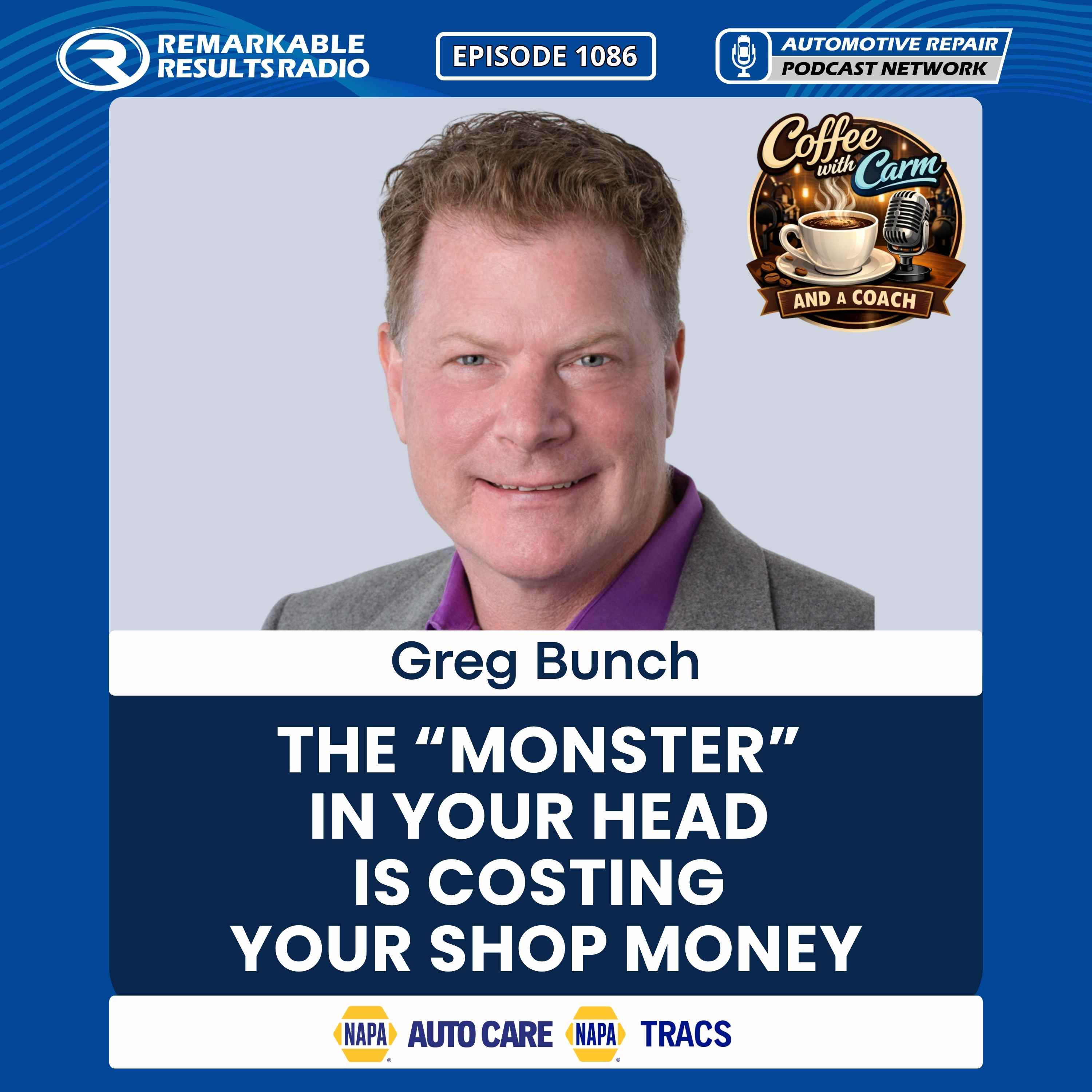
Greg Bunch and Carm Capriotto dig into the “monster voice” that keeps shop leaders from doing the hard, profitable work—like calling decline customers, confronting technicians, and following inspection protocols. Using neuroscience-style reasoning and a Proverbs-based framework (wisdom, knowledge, understanding, diligence, and right choices), they argue success is blocked less by external forces than by an overprotective inner guard. Real shop examples include missed upsell/decline work, pencil-whipped inspections, and emotional decision-making around employees. The episode ends with practical challenges: measure KPIs, run surveys, and rate yourself/your team.
In this episode of Coffee with Carm and a Coach, host Carm Capriotto sits down with Greg Bunch, business coach and Founder at Transformers Institute and owner of Aspen Auto Clinic, to unpack the mindset barriers that quietly limit leadership and growth in auto repair.
At the center of the conversation is the “monster” voice that is wired for survival, not success. While it once kept us safe, today it often holds leaders and advisors back from difficult but necessary actions: addressing underperformance, having honest conversations, or confidently recommending needed work. Left unchecked, that fear can cost shops hundreds of thousands, even millions, in missed opportunities.
Greg shares five foundational pillars for effective leadership:
Wisdom: Surrounding yourself with the right voices and guidance
Knowledge: Understanding your numbers and facts without emotion
Understanding: Knowing what those numbers actually mean in your business
Diligence: Doing what needs to be done, even when it’s uncomfortable
Right Choices: Staying aligned with your values, no matter the pressure
Together, Carm and Greg explore how business is ultimately an emotional math problem, a constant balance between data-driven decisions and the human side of leadership. They also challenge listeners to become perpetual students, actively seek honest feedback, and confront the habits that hold them back.
The episode wraps with a powerful reminder: long-term success comes from “slow dimes,” not “fast nickels.” Doing the job right, every time, builds trust, safety, and sustainable profitability.