The Motorsport Brief | F1 The World’s Most Brutal Sport
About this episode
With F1 on pause after cancelled races, Rusty’s Garage brings Stuart Bell—longtime F1 journalist and author of Formula One: the World’s Most Brutal Sport—for a deep look at what “brutal” really means. They cover the physical strain on drivers, the relentless team workload and logistics, and the political/commercial pressure behind massive sponsor deals. Bell also shares his own path into the paddock, from early Grand Prix inspiration to landing quotes from Schumacher, plus stories on F1’s global growth in places like Japan and China, and how social media can worsen driver stress.
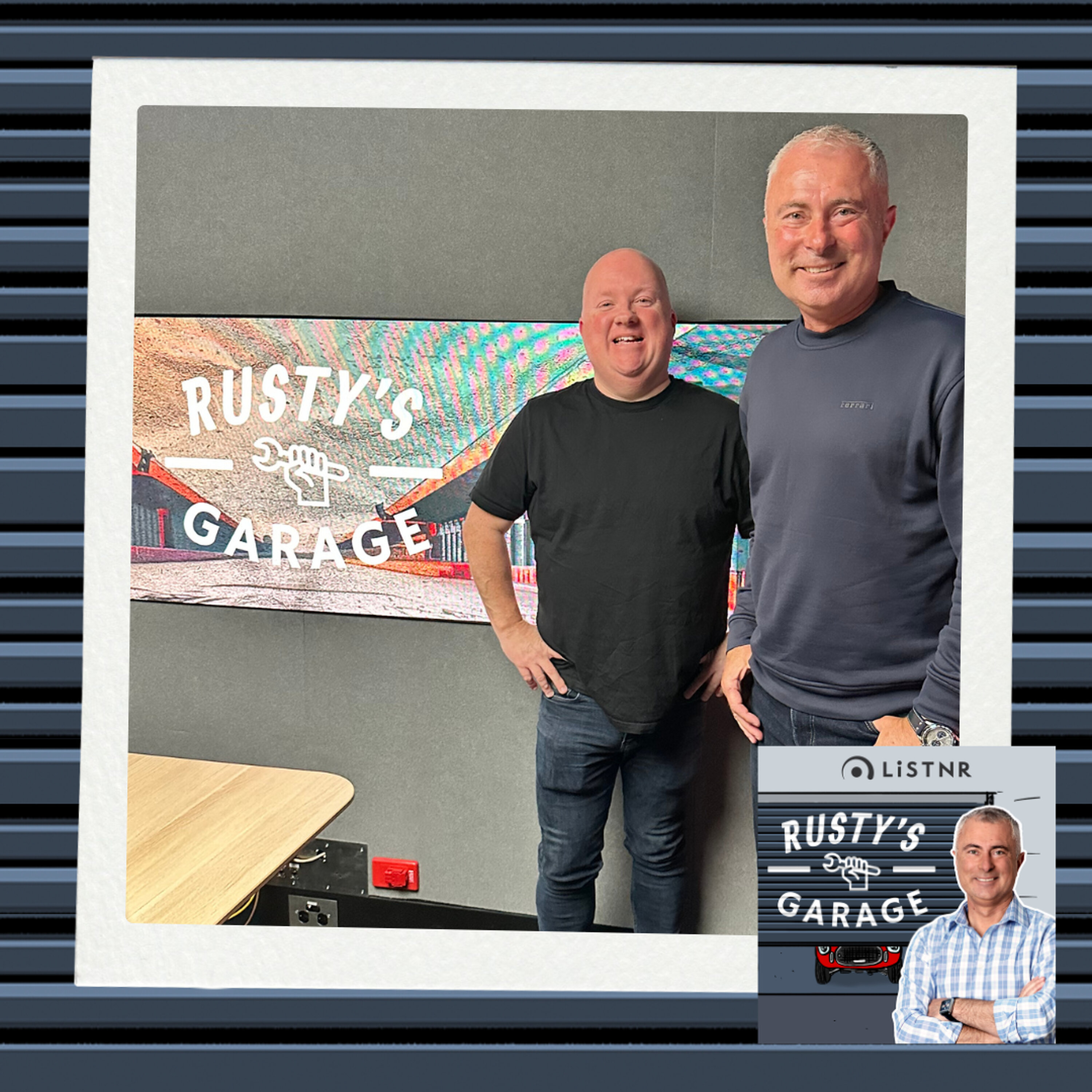
That’s the title of a new book by respected writer Stewart Bell and he’s in the Garage studio to talk about it in a special bonus shortcast in our feed this week.
Bell has been a regular in the Formula One paddock since the late 90’s covering it for print media, digital, social and television for Associated Press, Sky Sports UK, publications in Hong Kong, India, Top Gear, GQ & more.
Gunter Steiner wrote the foreword for the book and he reminds us that the ‘brutality’ can mean many things. It’s a game with huge public interest now so there is no hiding when it comes to failure or things going wrong….it means immense pressure in all facets of the business.
Sure for the drivers there’s huge physical forces that come from racing the fastest cars, there’s danger including reflections on the death of the great Ayrton Senna….not to mention the cutthroat politics, the grueling schedule as well as the demands on the team 24/7.
While we can’t talk about every chapter in the book (that’s for you to enjoy) it does include quotes from everyone from Oscar Piastri to Alain Prost, and it leans heavily on Stewart’s impressive 20 year interview archive.
The now-retired Daniel Ricciardo is a prominent feature. Bell was there during the anguish at McLaren and how he shaped Lando Norris' future (in a positive way).
You can find more on Stewart here:
https://www.penguin.com.au/authors/stewart-bell
The book is published by Penguin & you can find it in all the usual places:
https://www.penguin.com.au/books/formula-one-the-worlds-most-brutal-sport-9781761357916
Head to Rusty's Facebook, Twitter or Instagram and give us your feedback and let us know who you want to hear from on Rusty's Garage
See omnystudio.com/listener for privacy information.
Formula One (F1)
"You know, Rusty here with the cancellation of the next two races on the Canada. We have a month with no F1s, so today I thought we'd chat to Stuart Bell..."
Formula One, or F1, is the highest level of race car driving in the world. Teams build super-advanced cars and race them on tracks around the globe.
Formula One (F1) is the top tier of open-wheel motorsport, run as a global championship with teams and drivers competing on race weekends. The sport is known for tight rules, high engineering budgets, and a relentless schedule of races around the world.
paddock
"...Stuart Bell, someone who's been a regular in the paddock since the late 90s, covering it for print media, digital, social and television."
In racing, the paddock is like the busy backstage area near the track. Teams get ready there, and media and guests hang around to watch what’s going on.
The paddock is the team and media hub at an F1 race weekend, where cars are prepared and people from teams, sponsors, and press gather. It’s where you’ll see team personnel, hospitality, and a lot of behind-the-scenes activity.
GT4
"Jack is racing a McLaren in GT4 in Australia and he really turned heads at the opening round with his performance."
GT4 is a type of race series for sports cars that are closer to regular road cars than the top-level race cars. The rules help different brands race against each other more fairly.
GT4 is a sports-car racing class designed to be more affordable and accessible than higher-tier GT categories. Cars are based on production models, with performance balanced by regulations so different makes can compete closely.
F1 Racing
"...and then went back to Tokyo and just downloaded all that sort of information and then got in contact with F1 Racing. That was my sort of Bible that I was reading at that stage."
F1 Racing was a magazine that covered Formula One. It had stories and details about races and teams, and it was a way to learn more about the sport.
F1 Racing was a long-running motorsport magazine focused on Formula One coverage, including technical analysis, race reports, and team/driver features. For many fans, it served as a primary source of detailed F1 information.
Aston Martin
"...I sent him a huge 5,000 word essay and he was just like, it needs to be cut down completely and gave me all that sort of feedback and then basically yeah, from there I contacted papers..."
Aston Martin is a car company that also competes in Formula One. In this story, it’s mentioned because someone the speaker worked with later moved to that team.
Aston Martin is a British automaker and Formula One team, competing at the highest level of motorsport. In the transcript, it’s referenced as the current employer of a media contact, highlighting the close ties between F1 journalism and team operations.
junior categories
"Obviously a long way to go but yeah, from there I just, he suggests I do all the junior categories and I did the state racing for motorsport news..."
Junior categories are the lower-level racing series that come before the top tier like Formula One. Drivers usually start there to gain experience and get noticed.
In motorsport, “junior categories” refers to feeder series below F1 where drivers develop skills and build a record before moving up. The idea is that you earn credibility and experience step-by-step through the racing ladder.

Michael Schumacher
"maybe Mark Webber, tell us about that. Absolutely, so you know, I've been pitching [274.4s] and doing a little bit of work here and there but basically one of the people I pitched to was [278.9s] Noel Prentice at the South China Morning Post and he said, look, if you can get me a quote from [284.1s] Michael Schumacher"
Michael Schumacher was one of the most famous race car drivers in Formula One history. People still talk about him because he dominated the sport for years.
Michael Schumacher is a legendary Formula One driver, widely regarded as one of the sport’s greatest. The transcript uses him as a major “sports star” reference tied to the F1 world.
Grand Prix
"that got published, that got me into the past, into the [305.9s] Grand Prix and then from there, I mean, at that stage Formula One wasn't a sexy sport"
In Formula One, a Grand Prix is basically a race weekend. There are sessions before the main race, and then the big race happens.
A Grand Prix is an F1 race event, typically held over a weekend with practice, qualifying, and the main race. The transcript uses it as shorthand for the F1 calendar and the “entry point” into the sport.
Albert Park
"It was unbelievable, [367.2s] you know, I'd seen Albert Park and, you know, that international atmosphere that, you know,"
Albert Park is a famous race track used for Formula One in Australia. The speaker is comparing what it’s like there versus another iconic track.
Albert Park is a well-known circuit in Melbourne that hosts the Australian Grand Prix. The transcript contrasts having seen Albert Park with the “iconic track” experience of going to another venue.
Suzuka
"like Suzuka, you know, you're just blown away by the, you know, the elevation change, by the fans, [383.4s] by the, you know, the passion that they have."
Suzuka is a well-known race track in Japan. It has tricky parts and big elevation changes that make driving more demanding.
Suzuka is a famous Japanese circuit known for its elevation changes and challenging layout. Those features make it a standout venue in motorsport and can significantly affect driver workload and car setup.
typhoon
"it was a typhoon [388.0s] coming through so one of the days was cancelled but, you know, we were still there just, you know,"
A typhoon is a very strong storm. If it hits a race weekend, it can cause delays or cancellations and make the track conditions much harder for drivers.
A typhoon is a severe tropical storm, and it can disrupt race weekends by affecting track safety and scheduling. In motorsport, extreme weather can lead to cancellations or delays and changes in how teams approach tire and brake temperatures.
F1
"Quite a funny story on a personal note where at the very first race [439.5s] ever there for F1 in Shanghai, I went and we were lucky enough to go and cover it..."
F1 refers to Formula 1, the top level of open-wheel racing. It’s organized around teams and drivers competing across a global calendar of races.
Shanghai
"at the very first race [439.5s] ever there for F1 in Shanghai, I went and we were lucky enough to go and cover it..."
Shanghai is the city where an F1 race was held. The track there has its own layout, and that changes how teams set up their cars.
Shanghai is referenced as the location of an F1 race, which is held at the Shanghai International Circuit. Track layout and local conditions can strongly affect car setup and race outcomes.
Formula 1
"Formula 1 is glamorous, love it, you know, it does draw the best from people that are going to involve with it but I think it's, you know, I'm trying to show that, hey, there's a real sort of intensity and super hard work behind everyone who's in the paddock... It is, I think, the world's most brutal sport..."
Formula 1 is the highest level of open-wheel race car racing. It’s not just about driving fast—there’s also a lot of behind-the-scenes politics and decision-making.
Formula 1 (F1) is the top tier of open-wheel racing, run by teams and governed by FIA rules. It’s known for high-speed competition, but the sport also involves major off-track factors like team politics, contracts, and driver management.
intensely political game
"It is an intensely political game and so on. Trying to come up with just the concept of a book when there are many in that space."
F1 can be political because who gets opportunities and what teams do isn’t only about speed on track. Contracts, relationships, and strategy behind the scenes matter a lot.
F1 is often described as “political” because outcomes depend not only on racing performance, but also on relationships, contracts, team strategy, and influence among stakeholders. This can include negotiations over seats, sponsorship, and technical direction.
mid-season driver changes
"Well, I think last year we saw a lot of, you know, huge mid-season driver changes. We saw Liam Lawson, Jettison from the Red Bull Drive..."
Mid-season driver changes are when F1 teams replace or swap drivers during the racing calendar rather than waiting for the next season. These moves often reflect performance, sponsorship/contract issues, or team strategy—and they can dramatically affect results.
doom-scrolling
"They were basically encouraged to get off social media to remove the apps from their phone because they were basically doom-scrolling in their driver room to, you know, understand what's being said about them and that sort of thing."
Doom-scrolling means getting stuck endlessly reading stressful or negative stuff online. Here, it’s described as something drivers were doing that could hurt their focus and mood.
Doom-scrolling is the habit of repeatedly scrolling through negative or anxiety-inducing content. In this context, the speaker says a driver was encouraged to stop because they were spending time in their driver room reading what people were saying about them.
volume of weight a driver might lose during the race
"In talking brutality, not everybody that is a newcomer to the sport appreciates the physicalities of it. Just how the volume of weight a driver might lose during the race, the fluid they'll consume in the race and so on."
Drivers can lose noticeable body weight during a race because they sweat a lot in the hot cockpit. That’s why staying hydrated is a big deal.
This refers to how much body weight drivers can lose during an F1 race due to sweating in extreme cockpit heat. It’s a practical indicator of dehydration risk and why hydration planning is critical.
F2
"you are spending eight million US dollars to get from carting all the way through to F2. That's top drives and that's assuming that they win each of the championships"
F2 is a step just below F1 where drivers race to prove they’re ready for the top level. Doing well there can open the door to an F1 seat.
F2 (Formula 2) is the main feeder series directly below Formula 1. Drivers typically use it to prove they can handle faster cars, higher competition, and race-weekend pressure before moving to F1.
logical progression
"to F2. That's top drives and that's assuming that they win each of the championships and it's a logical progression."
It’s the usual path racers take as they move up. Each level is harder than the last, so you build skills step by step.
The “logical progression” refers to the common career ladder in motorsport: karting → junior formulas → F2 → F1. It’s designed to match increasing car speed, technical complexity, and competitive pressure at each step.
physio
"I spoke with Phil Young, who was Jensen Button's physio and he talks about all sorts of bringing them up to speed in terms of their physical preparation"
A physio is a physical therapist. For race drivers, they help keep the body strong and ready so racing doesn’t break them down.
A physio (physiotherapist) supports drivers with injury prevention, recovery, and physical conditioning. In F1, this is especially important because drivers endure extreme G-forces and must stay responsive throughout long, demanding stints.
contract negotiations
"Let's see it. And I think even in the book we talk about Danny Riccardo, who I covered very, very closely all the way through his career and we talked about sort of contract negotiations through there"
Contract negotiations are the business process of securing a driver’s seat, role, and terms with a team. In F1, these talks can strongly influence a driver’s mindset and how they’re treated within the team.
double and triple headers
"The proliferance of double and triple headers mean you're away for longer."
Sometimes F1 runs multiple races back-to-back at the same place. That leaves less time to rest and get ready, so it’s harder on everyone.
A double header means two races at the same venue over consecutive weekends; a triple header is three. These compressed schedules increase travel and recovery strain for teams and media.
sponsors switch from teams
"...it's not uncommon across motor racing generally to sometimes see sponsors switch from teams, you know, people poaching and so on."
Sponsors pay teams to be associated with them. Sometimes sponsors change teams, usually because of contract timing or business decisions.
In F1, sponsors often negotiate multi-year deals, but it’s not unusual for sponsorship relationships to change when contracts end or teams become more/less attractive commercially. This affects team budgets and the overall business strategy around branding.
Oracle
"Yeah. I mean, Oracle signed with Red Bull Racing... 500 million US dollars."
Oracle is a big company that sponsors F1 teams. The point is that sponsorship money in F1 can be enormous.
Oracle is an enterprise software company that has sponsored Formula 1 through Red Bull Racing. The mention is about how large modern F1 sponsorship deals can be.
Yeti
"staying with Red Bull, if you look at Yeti, [1186.8s] they look at how they can sort of benefit from this, from a sustainability point of view,"
Yeti is a consumer brand that appears in the F1 sponsor ecosystem discussed here. The point is that sponsors can align with teams on themes like sustainability and shared marketing, creating value for both sides.
world championship
"...when Lewis Hamilton won his seventh world championship for F1."
A “world championship” in F1 refers to the season-long title decided by points across races. Drivers accumulate points based on finishing positions, and the highest total at season end wins the championship.
Request an Explanation
Heard something you'd like explained? We'll add it to this episode.
Sign in to request explanations for terms you heard.
Want to learn more?
Browse our glossary for plain-English explanations of automotive terms, jargon, and concepts.
Help improve this episode
See something that's not quite right? Our annotations are AI-generated and can sometimes miss the mark. Click the flag icon on any annotation to suggest a correction.