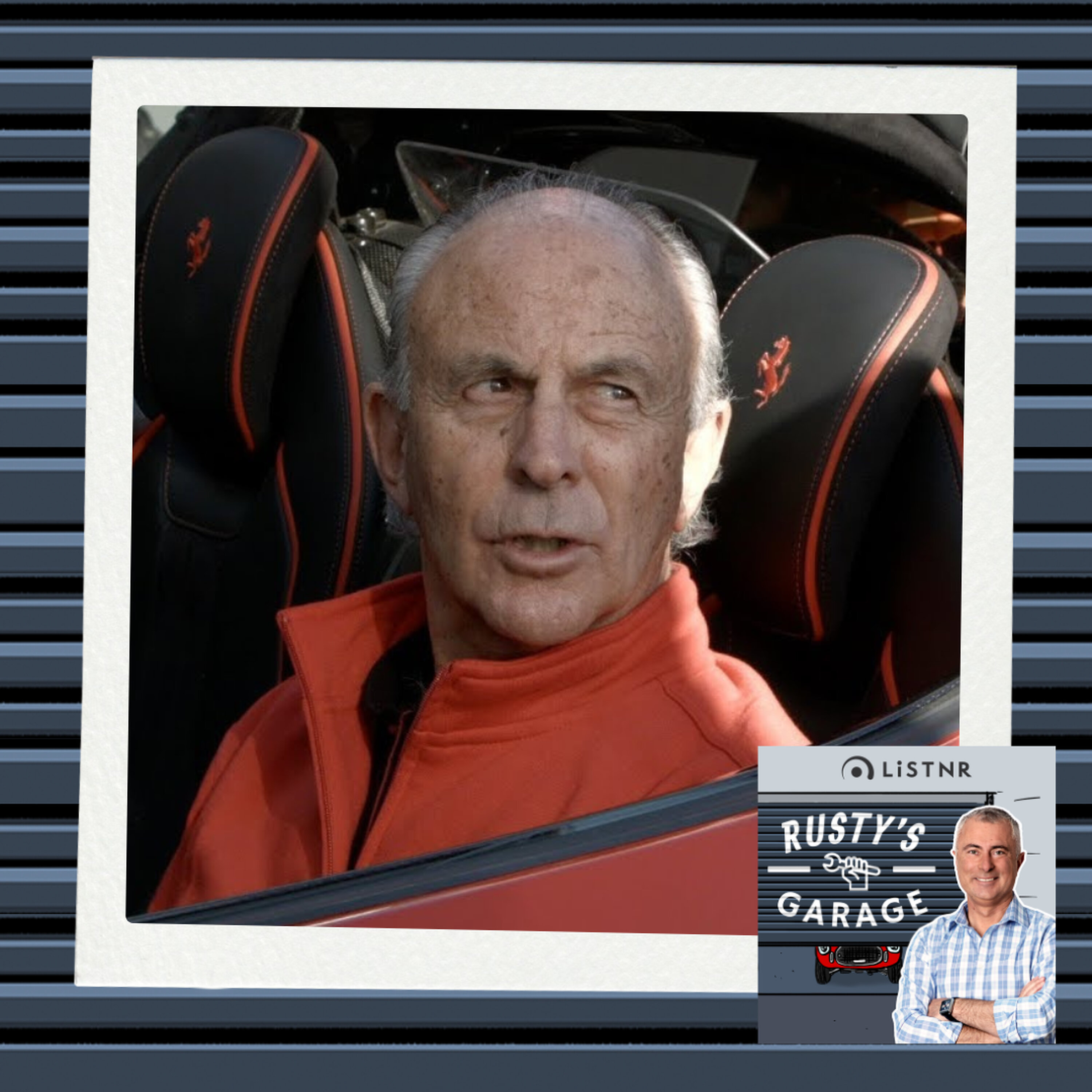
The Motorsport Brief | Tim Schenken from the Garage back catalogue
About this episode
Tim Schenken joins Rusty’s Garage for a back-catalogue chat that traces his early-70s push toward Formula One and the era’s real dangers. Recorded ahead of the 2018 Australian Grand Prix, the conversation moves from safety and driver mindset to what podiums and pace really depend on—timing, the car, and team support. Along the way, Schenken recalls Ferrari encounters at Monza, endurance stints at the Nürburgring, and the engineering feel of classic open-top machinery.
The next two weeks are some of the best on the annual Motorsport calendar with the Monaco Grand Prix and the 24 hours of Le Mans.
For this episode of the Brief we have gone right back to season 1 (2018) to bring you a slice of an episode you may not have heard before - Tim Schenken.
Tim is one of only a handful of Aussie’s to race Formula 1 at Monaco and he went on to race sportscars for Ferrari. Working with an emerging Ron Dennis and memories of Bernie Ecclestone, a then relatively new player in F1. Thinking he was being pranked when Enzo Ferrari asked to meet him and the priceless car he turned down the chance to own. Tim went on to have an incredible career working for the Governing Body in Australia then called CAMS and now Motorsport Australia. A respected Clerk of the Course at the Australian Grand Prix who has been awarded and OAM for his services and rightly inducted into the Hall of Fame.
If you enjoy this and would like to hear more search for the full Feature Episode with Tim Schenken released back in March 2018.
https://www.australianmotorsporthalloffame.com.au/inductees/tim-schenken/
Head to Rusty's Facebook, Twitter or Instagram and give us your feedback and let us know who you want to hear from on Rusty's Garage
See omnystudio.com/listener for privacy information
See omnystudio.com/listener for privacy information.
podium
"The record shows a podium there over 34 starts in the game but it probably didn't yield you it's fair to say the kind of success that you'd enjoyed in the Formula just beneath it."
A podium in racing means you finished in the top three. In Formula One, that’s usually the biggest moment of the weekend for a driver or team.
In Formula One, a podium is finishing a race in the top three positions (1st, 2nd, or 3rd). It’s a key measure of success because it comes with trophies and significant points toward the championship.
Timing
"Timing is a big thing in Formula One it really depends on the car that you get in I mean it's not a question of your ability it's also about the wheels beneath you isn't it?"
In racing, timing is about choosing the right moments to go fast or make moves. Even if you’re a great driver, the car has to be capable of doing it.
In Formula One, “timing” refers to how well a driver and team execute race-critical moments—especially when to push, when to manage tires/fuel, and how to time laps relative to traffic and strategy. It’s not just driver skill; the car’s setup and performance strongly affect what timing is possible.
Brabham's
"Yes that's true and I mean I had that year with Brabham's end of the year Ron Turinac told me that he'd sold the company to Bernie Eccleston"
Brabham is the name of a Formula One team. Driving for a team like that means your results depend heavily on the car and how the team sets it up.
Brabham (often spelled “Brabham” as the team/constructor) is a historic Formula One racing team associated with the Brabham name. When Tim Schenken references “Brabham’s,” he’s talking about driving for that team, where car competitiveness and timing/strategy matter a lot.
Bernie Eccleston
"Ron Turinac told me that he'd sold the company to Bernie Eccleston I sort of knew Bernie a little bit"
Bernie Ecclestone was a powerful person behind Formula One, especially on the business and management side. He influenced how the sport was organized and run.
Bernie Ecclestone was a major figure in Formula One’s business side, known for running and shaping the sport’s commercial interests. In this segment, Tim Schenken connects Ecclestone to team/management changes that affected how championships and teams were run.
Formula 1
"[563.9s] to an app in our first season that you might even realize is in our library of feature with Tim [569.8s] Schenken the Aussie who made it to Formula 1 and as you're about to hear ahead of the Lamar 24"
Formula 1 (F1) is the top tier of open-wheel single-seater racing, run as a global championship. In this segment it’s used to frame Tim Schenken’s career path—he reached F1, but also had a major sports-car chapter.
sports car racing
"[591.6s] car racing how did that I mean you always seem to drivers back then seem to do so much racing [597.6s] whether it was open-wheelers or sports cars whatever it may have been but how did the"
Sports car racing is racing with cars that are built for endurance and track competition. It’s different from open-wheel racing because the cars are more like sports cars you’d see on the road—just modified for racing.
Sports car racing is a form of motorsport where purpose-built or race-prepped cars compete in endurance-style events and championships. It’s distinct from open-wheel racing (like Formula 1) because the cars are based on sports-car platforms and often race for longer stints.
Monza
"[597.6s] whether it was open-wheelers or sports cars whatever it may have been but how did the [601.5s] entrain to sports car racing come about well that started 1971 at Monza and during I was"
Monza is a world-famous race track in Italy. It’s the kind of place where big racing events happen, so it’s a natural setting for a motorsport career story.
Monza is a famous racing circuit in Italy, best known for high-speed corners and long straights. It’s a key venue for major motorsport series, so it often shows up in stories about Formula 1 and sports-car racing.
Peter Shetty
"[616.5s] that I should come to the Ferrari track after practice to meet their team manager Peter Shetty"
Peter Shetty is the Ferrari team manager Tim Schenken was told to meet. He’s important in the story because he’s the person who could help Tim get a chance to drive for Ferrari.
Peter Shetty is referenced here as the Ferrari team manager Tim Schenken was directed to meet after practice. In the context of the story, he represents the decision-makers who could open (or close) a driver opportunity with Ferrari.
Enzo Ferrari
"[676.5s] Ferrari transporter or truck as it was in those days and thinking or any moment someone's going [682.6s] to say you idiot Schenken but we got all the way to the truck into the truck Peter Shetty there he [682.6s] was in a hell of a state because Enzo Ferrari had come up the night before to meet me"
Enzo Ferrari was the man behind Ferrari. In this story, he ended up meeting Tim Schenken, which is why it becomes such a big turning point.
Enzo Ferrari was the founder and driving force behind Ferrari, and he personally involved himself in the brand’s racing operations. In this segment, the surprise is that Enzo Ferrari had come to meet Schenken the night before, turning the meeting into a pivotal moment.
sports cars
"apart from signing a contract and then later on when we were racing we do a test session at with the sports cars maybe at Monza"
“Sports cars” means the race cars used in endurance-style events, not the single-seat open-wheel cars. They’re designed to go fast for long periods.
“Sports cars” here refers to race cars built for endurance and road-racing events, typically distinct from single-seater Formula 1 machinery. In the era being discussed, sports-car programs were a major part of manufacturers’ racing identities.
Maranello
"would always come there if the cars were running there have lunch with him as well at the factory in Maranello but the thing about Enzo was that you could tell he was a special person"
Maranello is where Ferrari is based in Italy. It’s basically Ferrari’s home base, so talking about being there “at the factory” means it was an inside, brand-focused visit.
Maranello is the home of Ferrari in Italy, and it’s closely associated with the brand’s factory and engineering culture. When the speaker mentions having lunch there “at the factory,” it signals direct involvement with Ferrari’s internal team environment.
Nürburgring
"endurance races with them from the 1000k race in Buenos Aires also at the at the Nürburgring why did it work so well for you"
The Nürburgring is a famous race track in Germany. It’s known for being tough on cars and drivers, so it’s a good place to see how well a car really works.
The Nürburgring is a major German motorsport venue, famous for its challenging layouts and elevation changes. It’s often used as a benchmark for car development because it stresses traction, braking, and driver confidence over long, varied sections.
set up skills
"Ronnie was such a natural driver he didn't have any set up skills so quite often he'd may run the car first I'd got in and drive the car and I had trouble driving then quickly and adjust the car got the car right"
“Set up skills” means knowing how to adjust the car so it feels right. It’s about getting the handling and response to match the driver, not just driving fast.
“Set up skills” refers to a driver’s ability to help dial in the car’s setup—things like balance and how the car responds to steering, throttle, and braking. The speaker contrasts Ronnie Peterson’s natural driving with a more hands-on approach to adjusting the car.
tires
"got in and drive the car and I had trouble driving then quickly and adjust the car got the car right when that first happened I thought my god he's going to be blitz me in times he never actually went any faster it just made the car easy to drive and it took less out on the car and the tires and the brakes"
In racing, tires aren’t just rubber—they’re the main contact with the road. If the car is set up well, the tires last longer and the car is easier to drive hard.
In racing, “tires” are a performance-critical consumable that strongly affects grip, braking distance, and how quickly the car can be driven hard. The speaker links setup changes to reducing stress on tires and brakes, which is central to endurance pace and consistency.
monocoque chassis
"the Matra team who came with a monocoque chassis and because Matra was involved in the aircraft [880.3s] industry the car was the aerodynamics of the car were probably just properly designed to find"
A monocoque chassis means the car’s body acts like the main structure, instead of using a separate heavy frame. That can make the car stiffer and better able to handle racing forces.
A monocoque chassis is a body structure where the shell itself provides most of the strength and stiffness, rather than relying primarily on a separate frame. Schenken links this to Matra’s aircraft-industry background, implying it helped with rigidity and packaging for racing aerodynamics.
aerodynamics
"industry the car was the aerodynamics of the car were probably just properly designed to find [888.9s] and they were much better cars so we weren't we weren't king of the kids uh in king of the mountain [894.7s] in 73 describe for us the 72 car because you know we're talking uh open top sports car"
Aerodynamics is how the shape of the car interacts with the air. Better aerodynamics can help the car stay stable and go faster, especially at high speed.
Aerodynamics is how air flows around a car, affecting drag, downforce, and stability at speed. Schenken credits Matra’s aircraft-industry involvement with getting the car’s aerodynamics “properly designed,” and later mentions improved aerodynamics the following year.
flat 12
"well they had the flat 12 3-liter Formula [910.6s] 1 engine detuned slightly because they were 1000 kilometer races I guess it had 450 brake horsepower"
A flat-12 is a type of engine with 12 cylinders arranged in two flat rows that sit opposite each other. Here, they’re saying the race car used a 3-liter version of that engine design, tuned down for long-distance racing.
A “flat 12” is an engine with 12 cylinders arranged in a horizontally opposed layout (two banks of six lying flat). In this segment, Schenken says the car used a flat-12 3-liter Formula 1 engine, detuned for endurance-style 1000-kilometer races.
detuned
"1 engine detuned slightly because they were 1000 kilometer races I guess it had 450 brake horsepower [916.8s] was a tube chassis short short wheelbase so they were quite difficult to drive on through fast"
Detuned means the engine is set up to make a bit less power on purpose. The trade-off is usually better durability and steadier performance for long races.
Detuned means the engine is intentionally tuned to produce less peak power than its maximum potential. Schenken explains this was done so the Formula 1-derived flat-12 could survive and perform reliably over 1000-kilometer races.
tube chassis
"was a tube chassis short short wheelbase so they were quite difficult to drive on through fast [924.9s] corners the following year they had better aerodynamics than a longer a longer wheelbase"
A tube chassis is a car built around a metal tube frame. In this case, combined with a short wheelbase, it made the car harder to handle at high speed in corners.
A tube chassis uses a framework made from metal tubes to support the car’s structure and mount components. Schenken pairs it with a short wheelbase, noting it made the car difficult to drive through fast corners.
wheelbase
"was a tube chassis short short wheelbase so they were quite difficult to drive on through fast [924.9s] corners the following year they had better aerodynamics than a longer a longer wheelbase but [931.2s] so was your typical sports car of the time"
Wheelbase is the distance between the front and rear wheels. Changing it can affect how a car behaves in corners and at speed.
Wheelbase is the distance between the front and rear axles. Schenken contrasts a short wheelbase (making the car difficult in fast corners) with a longer wheelbase, and says the next year’s car improved aerodynamics despite the wheelbase change.
Hewland gearbox
"lovely gearbox in the Ferrari very different from the [937.4s] Hewland gearbox was heavy and clunky the Ferrari gearbox you could just change with your two fingers"
Hewland is a company that makes race-car gearboxes. Here, they’re saying the Hewland gearbox felt heavier and harder to shift than the Ferrari gearbox.
Hewland is a well-known racing gearbox supplier, often used in historic and contemporary motorsport. Schenken describes the Hewland gearbox as heavy and clunky compared with the Ferrari gearbox’s lighter, easier shifting action.

Ferrari 312b
"I don't think anybody did in those days for nearly double the amount crazy was the 312b [1029.9s] what was which car was it well I think they call it 312 pb because a bit of confusion because they [1035.1s] also refer to the Formula 1 car of the time as a 312b"
Ferrari 312b is the name of a well-known Ferrari race car from the early 1970s. In this discussion, they’re clarifying what “312b” refers to and why people sometimes mix it up with another Ferrari from the same time period.
The Ferrari 312b is a famous Ferrari race car name from the early 1970s, tied to the company’s Formula 1-era engine family. In this segment, Tim Schenken explains the “312b” label and how it can be confused with the Formula 1 car designation of the same era.
Nurburgring
"the Nurburgring I don't know why a lot of people talk about as being the green hell and this that and the other but for some reason I just seem to suit my style"
The Nürburgring is a legendary race track in Germany. It’s known for being really challenging, so people use it to judge how good a car is at handling and staying fast.
The Nürburgring is a famous German racing circuit known especially for the Nordschleife (“Green Hell”), with long lap distances and lots of elevation changes. It’s often used as a benchmark for how well sports cars handle and how consistent they are over many corners.
green hell
"I don't know why a lot of people talk about as being the green hell and this that and the other but for some reason I just seem to suit my style"
“Green Hell” is a nickname for the Nürburgring’s toughest track section. It means it’s extremely hard to drive fast without mistakes.
“Green Hell” is a nickname for the Nürburgring’s Nordschleife, reflecting how dense forests surround the track and how punishing it can be. Drivers often describe it as mentally and physically demanding because small mistakes compound over a very long lap.
72 hour touring car race
"in 1969 it must have been driving for Ford Germany in a 72 hour touring car race with three drivers on the north and south circuit so the total lap distance was 30 kilometers"
That’s an endurance race for touring cars that lasts for days. The goal is to keep the car running and stay consistent for a long time, not just go fast for a few laps.
A “72 hour touring car race” describes an endurance event where touring cars run continuously for multiple days. The key challenge is maintaining speed and reliability while adapting to changing conditions over very long stints.
Le Mans
"he went on to drive a Porsche to second in class at Le Mans in 1976"
Le Mans refers to the 24 Hours of Le Mans, one of the world’s most important endurance races held in France. Finishing “second in class” means the car was ranked within its specific category (like prototype vs. production-based entries).
Lakeside
"plus wowing Toyota in touring cars at places like Lakeside and Bathurst"
Lakeside is a race track location mentioned as a place where touring cars raced. Different tracks can make the same car behave differently.
Lakeside is a motorsport venue referenced here as a location where Toyota competed in touring cars. Track-specific venues matter because layout and surface strongly influence race strategy and car setup.
Bathurst
"plus wowing Toyota in touring cars at places like Lakeside and Bathurst"
Bathurst is a famous race track in Australia. Touring-car races there are tough, so drivers and cars have to stay consistent and handle pressure well.
Bathurst refers to the Australian circuit used for major touring-car racing, where endurance and strategy are crucial. It’s a standout venue because its layout rewards traction and driver consistency under pressure.
Toyota
"plus wowing Toyota in touring cars at places like Lakeside and Bathurst"
Toyota is the car brand being talked about here. They’re saying Toyota did really well in touring-car races at those tracks.
Toyota is the car brand mentioned in the context of touring-car racing success at venues like Lakeside and Bathurst. Toyota’s motorsport involvement is often associated with strong development and race-ready reliability in production-based categories.
Request an Explanation
Heard something you'd like explained? We'll add it to this episode.
Sign in to request explanations for terms you heard.
Want to learn more?
Browse our glossary for plain-English explanations of automotive terms, jargon, and concepts.
Help improve this episode
See something that's not quite right? Our annotations are AI-generated and can sometimes miss the mark. Click the flag icon on any annotation to suggest a correction.