The Pay Cut Ultimatum: How One BMW Store Flipped VSC Penetration (+ the 0% Solution for Cash Buyers) | Industry Spotlight
Car Dealership Guy Podcast
The Pay Cut Ultimatum: How One BMW Store Flipped VSC Penetration (+ the 0% Solution for Cash Buyers) | Industry SpotlightCar Dealership Guy Podcast · Apr 21, 2026
Annotations will appear as you listen
0:00
37:47
Term
0% solution for cash buyers
A “0% solution” usually means the dealer is offering a deal where the customer doesn’t pay extra interest. For cash buyers, it’s a way to make the purchase feel like a financing offer even if they’re paying upfront.
It means: out of all the car buyers, how many end up purchasing an extended coverage plan. If more people buy it, the dealership earns more money in the finance office and those cars come back for service later.
“FNI” here refers to finance and insurance products—things like VSCs, GAP coverage, and other add-ons sold alongside the vehicle. These products are important because they can generate higher margins than the car sale itself.
The idea is to turn someone who just bought a car into someone who keeps coming back for service. If they have coverage, they’re more likely to use the dealership for repairs.
These are extended coverage plans for expensive-to-fix luxury cars. The point is that they can still help customers and keep them coming back for service.
Service Payment Plan (SPP) is a company involved in the service-contract/payment side of the dealership business. They’re mentioned as supporting the episode and the solutions being discussed.
A finance manager is the person at the dealership who handles the paperwork and optional add-on products. They often get incentives based on how many customers buy those add-ons.
A pay plan is how the dealership decides how you get paid. It can include bonuses for hitting certain goals. Here, the new pay plan made selling service contracts matter a lot more.
This is a pay-plan feature where your commission depends on selling service plans. If you don’t have it, you’re not rewarded for pushing those plans. Once it’s added, selling them becomes a big part of your paycheck.
They’re talking about a BMW dealership and why it couldn’t hit the same sales targets for add-on service plans. The point is that BMW customers and purchase patterns can be different.
“Finance penetration” means what share of buyers are taking out a loan instead of paying cash. If more people finance, the dealership usually has more chances to sell extra coverage.
A lease is when you’re basically renting the car for a few years and then turning it back in. Because you don’t own it for as long, some people are less interested in buying extra repair plans.
A service contract is like an extended warranty you can buy when you purchase a car. It’s meant to help pay for repairs later, and the podcast is talking about how many customers actually choose to buy it.
Concept
trade-in value vs retail value delta
Dealers and banks can use different numbers for your trade-in. If the trade-in number is much lower than the retail number, it can make your loan math worse and leave less room for extras.
This means lenders other than the brand’s own financing. Some of them limit how much they’ll lend, which can make it harder to bundle extras into the loan.
A credit union is a type of bank that’s owned by its members. When it finances your car, it may limit how much money they’ll lend, which can affect add-ons.
Mercedes-Benz is referenced as the brand context for the speaker’s earlier dealership experience. That matters because VSC penetration strategies and store processes can vary by brand and dealer group.
Hendrick is the dealership group the speaker worked for. Groups like that often have their own rules and training that affect how salespeople sell add-ons.
Concept
SPP Express
SPP Express is basically a faster way for a dealership to set up a payment plan for services. It reduces the manual paperwork and makes it easier to get approved and funded.
Concept
collect 10% upfront
In some payment plans, the customer pays a deposit first—here, they mention 10%. That initial payment helps get the rest of the plan approved.
Concept
American credit acceptance
This sounds like a specific way the dealership (or partner) checks and approves customers for financing. Some customers hit their limit, so they can’t get the usual approval.
The “0% option” described here is a financing-style offer for purchasing a service contract with no interest and no credit check. The key idea is removing credit barriers so more customers can buy coverage, effectively increasing conversion rates.
Term
0%
“0%” usually means the dealership is offering a loan with no interest for a set time. That can make the monthly payment easier to swallow and encourages more people to finance instead of paying cash.
The segment frames a VSC as a strategic “core product” because it supports both profitability and customer confidence. For dealerships, it can improve attachment rates (more customers buying it) and help drive longer-term relationships through reduced repair-cost anxiety for the buyer.
Retention means getting customers to keep coming back. Instead of only making money on the first sale, the dealership wants customers to return for service and future deals.
Term
FNI protection products
Dealers have a finance-and-insurance department that sells add-ons for the car purchase. “Protection products” are things like plans that help pay for repairs later.
“Variable operations” is basically the sales side of the dealership. It can change month to month, so they’re saying sales and finance need to work together with service to keep customers coming back.
They’re talking about a BMW X5 from 2018. Even though it’s not a brand-new car, repairs can still cost a lot because parts and service for BMWs tend to be expensive.
They’re pointing out that BMW repairs often use BMW-branded parts, which can be expensive. So the repair cost doesn’t automatically get cheaper just because the car is older.
They’re saying they don’t have a cheaper, stripped-down option. Their approach is more about paying for protection than offering the lowest possible payment.
They’re describing a way to keep your monthly cost more predictable. The idea is that if something breaks, you’re less likely to get hit with a big surprise bill.
Warranty coverage means if something covered breaks, the plan helps pay for the repair. They’re saying that reduces stress because you’re not paying everything out of pocket.
A deductible is the part you pay first when you use a repair plan. They’re saying their plans often don’t require that upfront payment, so repairs are less costly for the customer.
A subprime bank is a lender that serves people with lower credit scores. Because the risk is higher, the loan usually comes with a higher interest rate.
USAA is a bank/lender that some customers use. They mentioned it as an example of a lender the customer might use instead of the dealership.
Concept
rehash opportunity isn't there
They’re saying there’s less room to change the deal after it’s approved. If the customer’s loan terms are already set, it’s harder to add extra coverage like a warranty.
Car
BMW
They’re talking about BMW service contracts—extended coverage sold for BMWs. The key point is that the warranty costs can be high enough that it’s difficult to add them to certain financing situations.
A powertrain warranty is coverage for the big moving parts of the car, like the engine and transmission. It’s usually more expensive than basic coverage, so it affects whether a dealer can offer it in every deal.
A cash deal is when the buyer isn’t taking out a loan for the car (or is paying a big chunk upfront). Dealers still may offer extra protection plans, but the sales approach can be different.
A finance charge is the extra cost you pay for borrowing money, usually from interest. If it’s “no additional finance charge,” you’re not paying extra interest on the loan.
A “hard pull” is a credit check that can slightly hurt your credit score for a short time. A “soft pull” is usually just informational and doesn’t meaningfully change your score.
This is about how the dealership uses a financing deal to encourage a purchase. The host is saying customers react differently based on their credit, so the dealer has to explain the offer in a way that removes confusion.
This is a way dealers sell something by saying, “It’s like paying cash, but you can pay over time.” The dealer is trying to cover the extra financing cost so it feels like you’re not paying more.
Term
protect your product
This phrase usually means buying extra coverage for the car—like repairs if something breaks. The dealer is saying you can get that coverage without paying more.
They’re saying don’t just sell the idea—show the real numbers. For car deals, that means making it clear what the customer is paying and what they’re getting.
Term
SPP utilization
“SPP utilization” sounds like a specific dealership process or program (often an internal sales/finance workflow) measured by how often it’s used. The speaker compares performance “pre and post” SPP utilization, implying the process changed outcomes.
“Penetration” just means how many customers say yes. In this case, it’s how often buyers choose the dealership’s service coverage, not just the car itself.
PVR is basically “how much money each car deal brings in.” They’re comparing PVR before and after they changed how aggressively they sold the service coverage.
Concept
attach rate
Attach rate means “how often customers add something extra to the deal.” In this case, it’s how many buyers also choose the service coverage.
An SPP contract is basically a dealership “service plan” you can buy with your car and pay for over time. The concern is that if people cancel, the dealership may have to pay money back later, which can wipe out the profit.
Cancellation rate means how many people back out of the plan after buying it. If lots of customers cancel, the dealership can get hit with refunds later and make less money overall.
Chargebacks are when money the dealership expected to keep gets taken back later. With service plans, cancellations can trigger these refunds, so the dealership ends up losing the profit it thought it made.
Subprime means the customer’s credit is riskier, so they’re more likely to struggle with payments. When customers are more likely to cancel, the dealership can lose money on the extra coverage it sold.
Cancellations are when a customer decides to cancel the extra coverage they bought. If more people cancel, the dealership can end up losing money and may even have to pay back part of what it earned.
A finance customer is someone who’s paying through a loan. The hosts are comparing how often service contracts get sold with financed purchases versus cash purchases.
“Objection of cost” means the customer says the add-on is too pricey. The hosts are saying you can still win some of those customers by changing how you ask or how you package the offer.
Company
FNI University
FNI University sounds like a training program for dealership finance and insurance teams. The speaker is saying they learned how to approach selling these add-ons there.
E-contracting just means the dealership (or provider) sells and signs the agreement online instead of using paper forms. The big benefit is that payment and contract details get entered right away, which helps prevent mistakes that can lead to cancellations.
Menu integration refers to connecting a dealership’s product/finance “menu” software with the service-contract provider’s system. When the contract is sold through that connected menu, the provider can collect the customer’s initial payment and receive the contract data directly, reducing errors and improving cancellation rates.
An impact printer is an old-school printer that prints by striking the paper. The point here is that paper-and-printer workflows were slower and more error-prone than today’s electronic process.
A credit inquiry is when a company checks your credit history. Some inquiries can affect your credit score, so the host is saying this plan avoids that.
Here, “payment method” just means how you pay—like a debit card or credit card. The point being made is that they don’t need your credit info to set it up.
“Reverse the charge” means getting the money back from your card company if something goes wrong. The host is saying you can dispute/cancel the payment if you think your card details were misused.
The FTC (Federal Trade Commission) sending a letter to dealer groups signals regulatory scrutiny around how dealers advertise prices online. For listeners, this matters because pricing/advertising practices can affect compliance and consumer expectations.
Concept
non-cancelable products
Non-cancelable products are add-ons you buy that you can’t just back out of later. That’s why the details and disclosures matter so customers know what they’re agreeing to.
Information security means keeping customer details safe from hackers or misuse. In car finance, that includes things like personal and financial information.
PCI compliant means the company meets security rules for taking credit/debit cards. It’s meant to protect customers’ card information from being exposed.
A soft pull is a credit check that usually doesn’t hurt your credit score. A hard pull is a credit check that can affect your score, so it’s a bigger deal for customers.
They’re talking about whether the payment plan requires a Social Security number. That’s sensitive personal information, and collecting it can create legal and privacy problems if handled the wrong way.
A class action lawsuit is when lots of people with the same complaint sue together. The host is saying one customer could start it, and it could cost a dealership group a lot.
“Attaching” a product to a customer’s personal credit means the financing or payment structure is tied to the buyer’s credit profile rather than being handled purely through the dealership’s internal process. The speaker argues this can create long-term consequences and reputational damage if customers cancel later.
The segment highlights a common F&I (finance and insurance) issue: when customers cancel add-on products, aggressive follow-up can create a bad customer experience and harm the dealership’s reputation. The speaker frames it as an industry-wide need to handle cancellations carefully and avoid pursuing customers after they’ve canceled.
Paint and fabric protection is an add-on meant to help keep your car’s surfaces cleaner and easier to maintain. If you cancel the plan, the dealership/provider may have to unwind the sale.
The speaker emphasizes that even if a third party manages the product, the customer associates the transaction with the dealership. That means the dealer (and its partners) must act responsibly after the sale because customer trust is tied to the dealership brand.
FNI is the part of the dealership process where they set up financing and then offer optional protection products. It’s basically the steps that happen after you pick the car, to help you pay for it and add coverage.
Instead of sending the same offer to everyone, the dealership uses information to figure out who is likely to qualify. Then they contact those people with an offer that fits them, which usually leads to better results.
A DMS is the dealership’s main computer system for tracking customers and deals. “Integrations” means other tools can connect to it so the dealership can automatically find who qualifies for an offer and contact them.
They’re describing a way for customers to buy add-ons online or by text/email instead of coming into the dealership. It helps dealers sell even when people aren’t trading in as often.
It’s a clickable link the dealership sends to you by text or email. You can look at what’s available and buy without having to call or come in right away.
If people don’t trade in as often, dealerships sell fewer new cars. So they try harder to make money by offering add-ons and coverage to current owners.
Term
safe and secure
They’re emphasizing that buying online should protect your information. It’s about making sure the process is trustworthy, not sketchy.
Remote purchasing means you can choose and buy a vehicle without going to the dealership in person. The dealer sends you a link, you look at your options online, and you can complete the deal from home.
An extended warranty is extra coverage after the original warranty runs out. It can help pay for repairs, but you still want to check what’s included and what’s excluded.
Term
service riders
“Service riders” here refers to service department staff or a referral channel associated with the service drive who identify customers who are good candidates for a service contract. The dealership uses them to route leads into the coverage presentation process.
A referral program is a system where one group at the dealership points customers to another group. In this case, the service team helps find customers who are more likely to want a warranty plan.
Darwin is a computer system the dealership uses to show customers the warranty/service-plan options. It helps the salesperson pull up the right coverage and price fast.
The finance office (F&I) is where dealerships typically present and sell products like service contracts, vehicle protection, and financing. The segment ends by asking for best practices for presenting SPP in that environment, implying a sales process tailored to F&I.
LIVE
Hey everybody, welcome to another episode
of the Cardinalship Guy Industry Spotlight.
I'm your host, Sam Dark.
And coming up this episode,
meet a finance manager who got an ultimatum from his new GM,
raise vehicle service contract penetration,
or take a pay cut.
His scramble to find a solution
didn't just save his paycheck,
but it also drove VSC sales up over 20%.
We're breaking down why VSCs are one of the most lucrative
FNI products in the finance office,
how they're turning one-time buyers
into loyal service customers,
and why luxury vehicle repair contracts
don't have to be a dead end,
even when traditional lenders say no.
Joining the show today is Luke Parker,
finance manager at BMW Greensboro,
and Eric Wilgus,
director of dealer success at Service Payment Plan,
props to SPP for supporting today's content.
Now, let's get into it.
So Luke Parker, welcome to the Cardinalship Guy
industry spotlight.
Thanks Sam, happy to be here.
Tell us a little bit about yourself,
what you do there at BMW Greensboro.
So I'm the finance manager.
I've been here for two and a half years,
and I've been a finance manager slash director
for the last 14 years.
Okay, now you had something pop up in your world
that shook your world a little bit,
as it does oftentimes for finance managers.
June of 2025, a new GM hit the store
and came in with a new rally.
Tell us what that GM did that changed the goal post for you.
Well, so he actually started in February,
and he was real sly.
He was real sly.
He, March or April, he comes in,
we're having our morning meeting,
he goes, hey man, you think you get 50% VSC penetration?
We were running around 30, and I said, I don't know.
He goes, tell you what, if you hit 50% VSC,
I'll give you a few thousand dollars bonus, whatever.
And just for this month, just see if you can do it.
I don't know if you can do it.
Ooh, I do like that, that's a good approach, okay.
Oh, he just slid right in there.
And so I hit 51, 52, just kind of bare,
just over the finish line.
And so the next month he goes,
hey, you think he did that again?
I was like, I don't know,
he wants more money, I said sure.
So he put out the bonus again, I hit it again.
And then June 1st, slid into my office
with little pay plans, say, hey buddy,
got something for you, here you go.
And yeah, it's changed my pay plan.
And I went from no service contract penetration component
to my pay plan to 56% to max out the pay plan.
I don't look at minimums, but yeah, max it out, it's 56% now.
And up to that time at that BMW store in your store,
you were at 36.9%, right?
So that's a significant increase,
20 points almost to hit the max threshold,
which is what you were used to hitting.
When you got that new pay plan,
what went through your mind?
Oh, shit, I'm gonna have to do something
because I really like my paycheck
and I don't like watching it go this direction.
So yeah, I was scrambling for a hot second.
What were some of the reasons, Luke,
that you said to yourself at a BMW store
you couldn't month after month do the 50%?
By the way, he was sly,
getting you to do it two months on a big cash bonus.
But what were some of the reasons you felt like in 2025
and 2026, 50% plus pen at a BMW store
was difficult to impossible?
I think it was a combination of two things.
Number one is we do a lot of cash
and we do a lot of leases.
So while we might average 68% finance penetration,
15% to 20% of that is leases,
but in a very short term,
not a lot of opportunity for service contracts specifically.
But the other half of that coin is just,
there was never an expectation.
It was just like, hey, luxury customers
don't keep their cars as long.
They just don't buy service contracts as much.
Our customers are just different
and they don't need a service contract.
They're not gonna keep the car.
And then the other objection I hear a lot is,
hey, BMW financial, the back-end allowances
don't make enough room oftentimes for a VSC.
Is that fair?
Is that something you heard or experienced?
Not so much BMW financial, but just outside financing.
So a lot of times because of really conditioning costs,
the delta between the trade-in value,
which most of the banks go off of for the value
and the retail is pretty big.
So when you go with a lot of these outside finance companies,
credit unions, et cetera,
they do cap the customer on what they can actually finance.
And then if you roll in any kind of negative equity,
which we're seeing a lot more lately,
that just eats into that profitability there.
Yeah.
And yet on the flip side of that,
logically you think about it, inflation is going up,
cost of repair, cost of parts,
all the different reasons that we advocate to a customer
to create value on a service contract is there, right?
And it's there in spades in BMW as it is Mercedes-Benz
and every other high-end vehicle, right?
And so the exposure to a customer is higher.
So what was your first reaction?
Now you've got this new pay plan.
You've done the 50% plus twice, two months in a row.
Did you have faith and confidence you could continue it?
What did you do to help make sure you could maximize
your pay plan month after month?
To be honest with you,
the hitting that 50% lowered my PVR
because I was just stripping out products
and just doing everything I could to hit that number.
And I knew that wasn't sustainable.
You have to keep the PVR high
in addition to hitting the VSC.
So I started kind of looking and digging
and just trying to figure out,
do I sleep in the service department
and become best friends with all the service writers
and just try my hardest to sell VSCs
to people that are in service
or maybe there's another option.
And I do work the service department regularly
and I do have great relationships with them,
but that's a small part of the deal.
But then there was this guy named Eric
that came in when I was working for Mercedes-Benz
with Hendrick, this was probably close to 10 years ago.
And he told us about service payment plan.
So, we use Darwin for our menu provider
and I just, I never really looked,
but on the products where you can select
and rate all your products right underneath that,
it said SPP Express and it had some check boxes
next to some things and whatnot.
And I honestly hadn't even really looked at it before,
but then I went, wait a minute, I said SPP, I knew about that.
But when I used to do SPP, you had to manually,
type in all the customer's information into the PDF,
print it out, send it in, get it funded,
collect 10% upfront on a card or whatever.
And it was kind of a pain.
So then I see Express, blah, blah, blah.
I'm like, what is this?
So, call my buddy Eric, say Eric,
tell him about SPP Express.
So, he walked me through it and my God,
it was the easiest thing.
It was just so easy there, it was foolproof.
So, I started incorporating that into every presentation,
I mean, just every kind of presentation
and people ate it up, the people with $100,000 check
to purchase a car that don't wanna dip into investments
or just like free money down to the people
who are capped out with American credit acceptance
and they're like, hey, I really wanna service contract,
but can't fit into the back end.
We got an option for ya.
So, enter Eric, Director of Dealer Success Service
Payment Plan, Inc. Welcome to the show.
So, when you got the phone call from Luke
and he's like, hey, my cheese has been moved,
I've gotta get 20 points additional on VSC Pen,
I've gotta get serious about selling the value of the VSC.
Is that a common call for you
and what was your reaction and response when he said,
hey, teach me more about this Express?
No, absolutely, a lot of the leads we get
are from dealers who have a situation
where they need to sell a service contract.
Maybe they've got a customer in front of them,
they've got a customer coming in
and for one reason or another,
they've got headwinds in front of them
that's gonna make it harder to sell that product
in a traditional sense.
So, we've got a 0% option that's no credit check,
everybody qualifies, it's same as cash over time.
And as Luke said, we've got integration now
in almost every major menu provider
that makes it as easy as it's ever been
to put a customer on 0% and increase penetration and PVR.
So, it's a very exciting time
to be helping out dealers like Luke.
Why is the vehicle service contract?
It's a core product.
Why is that so important?
A GM comes into Luke's store and says,
hey, I'm gonna raise your goal by 20 points
because I know the value of the VSC.
What is the value of a vehicle service contract
to a dealership, to a dealer group,
to an organization, and to the customer
that makes it such a crucial product to advocate for?
The service contract, it's always been one
of the most lucrative products that can be sold in FNI.
And I think dealers are always looking for ways
to increase penetration, not only for FNI gross,
but in today's market, retention is probably
as important as it's ever been.
You hear that word all over the place
and it makes complete sense.
There's a lot of competition today
and it's coming from every direction.
And it's important as ever for dealers
to keep customers in the service department,
in the showroom, and one of the best ways traditionally
to do that is to sell FNI protection products
like vehicle service contracts.
So it's a cornerstone to the FNI manager's pay plan
and I think it's a very strategic product
to keep customers in franchise dealerships.
Yeah, so Luke, as you've pursued this goal
and we'll talk about how you achieve success
through using this service payment plan,
are you buying into the vision of the vehicle service
contract and the value of the customer into the store?
Retention is everything.
We do fixed ops every Friday,
daily dealer live, 1 p.m. Eastern.
And retention is the buzzword in fixed ops right now
and we've got to be great partners in variable operations
in the finance department on that retention, Luke.
You're absolutely right.
I think a vehicle service contract
is really important on a product like BMW,
especially for people that are buying older BMWs
because you'll have someone purchase,
let's say it's 2018 X5
and it might only cost them $18,000 plus taxes,
but the repair bills are the same as a new car
because it's still BMW parts.
We don't have a budget option.
We're not like Cadillac has GM and Alexis has Toyota.
We don't have a cheap alternative.
It's one of my favorite things to tell customers
is those repair bills are gonna be basically the same
as a new car if something comes up.
So the way that I present my payment options is
I say, hey, this is your unprotected payment at $450
and this is your protected payment option at 550
or unfortunately we can't finance this in with the car
for you, but the great news is that your protected payment
will be a combined 650 for 24 payments
and then you'll just have the car payment at 450
for the next three years while this vehicle is paid off,
that you still have your warranty coverage.
That way they have full peace of mind and confidence
that they can drive this vehicle
and if something does happen to it
rather than scrounging for thousands of dollars for a repair,
they just, there's no deductible from with most of our plans,
they just get into their rental vehicle,
their loan or car and go.
So that's the way you present the product.
What percentage of the time are you utilizing SPP
and how do you decide when and what scenarios to use it
as a solution for payment affordability and budget
for the customer?
So year to date, we are as a store
at 56.1% service contract penetration.
Wow, yeah.
Taking out after sales, which is the SPP contracts and such,
we're at 41%.
So a full 15% increase just with service payment plan.
I present service payment plan any time someone declines
coverage for any reason or the bank declines
the coverage for them.
So a great example is I had a customer yesterday
financed with a subprime bank, rough credit score,
older car, the service contract was $7,000
and the bank was gonna do about 2,600.
So I presented as, hey, Mr. Customer, great news.
I worked really hard to get your rate down
from 27.99 to 26% for you.
So, and I worked even harder to get your coverage protected,
coverage options for you.
So here's your payment for your vehicle.
Here's an option for a coverage for your vehicle
with 0% interest, so you're saving a ton of money.
And then when I presented it that way,
the difference in payment between the,
if you could have financed it with the subprime bank
at 26% versus 0% over 24 months,
the difference in payment was about $80 monthly,
but paying off that warranty in two years instead of six.
So it was a complete no-brainer.
The guy was so happy to be able to get coverage
and he actually is a mechanic that works on cars himself.
So he saw the value in the service contract,
but he didn't have $7,000 to give us up for it.
So he did serve a payment plan.
Are you, so 15 points of your total 56% VSC pen year to date
is SPP, it's this alternate form.
If you didn't have that,
you probably wouldn't have sold those service contracts
because you're being limited by the bank.
It's a cash deal by the consumer.
There's a whole host of different reasons.
In the old world, what would you have tried to do?
I mean, you probably just would have tried
to expand the bank call and then if you couldn't have,
you just, you would have been out of options.
This gives you another resource.
I would say a solid 50% of our service payment plan contracts
that we do are actually outside finance,
where the customer is financing the car
just through their own credit union or their own bank.
And they don't either came in with a check
with a limited amount for the approval,
like USAA or something along those lines
or maybe federal power check.
And they just don't have the flexibility
to increase that financed amount.
So then we just provide this as just an option for them.
And so I'd say that's probably about 50% of our VSC
is some kind of outside finance or just straight cash.
So to answer your question, a lot of time,
there's the opportunity for rehash just really isn't there
because you are limited on those.
But even the subprime that we have done lately
because of the cost of BMW service contracts,
you just can't fit them in on a subprime
for the majority of the time.
I mean, my cost on a three year powertrain warranty
for a, you know, five year old 612 BMW is $3,000.
So if I'm occasionally-
And that's cost, that's before you market up.
So yeah.
That's, we don't pack or anything like that.
So I mean, that is actual cost.
So Eric, Luke makes a great point.
We're in an environment where the cost of contracts
are going up, cost of repair, cost of labor,
everything is going up.
The customer is keeping the vehicle longer,
which actually sets up for better protection.
Are you seeing nationally arise in the use of this
as a tool to help with affordability
so that customers can buy it?
And if so, what are some best practices
if I'm a finance manager looking to see
when and where to use this?
Over the last 18 months,
we've gotten many calls from dealers,
just like Luke, with these types of issues.
We've got a lot of cash deals.
We're seeing negative equity have more of an impact
in what they're able to advance,
what they're able to sell to the customer.
So dealers are looking for solutions
to sell additional products.
So what we're able to do is position it
so that they can notify the customer,
we've got a 0% option.
There's no credit check, they automatically qualify,
and there's no additional finance charge to the customer.
And that's a really important thing
for finance managers to know,
but I also encourage them to impart that wisdom
on the customer because when a customer here is 0%,
what tends to happen is a customer with good credit
is gonna say, well, do I really want this?
I'm proud of my credit score.
Maybe my credit's frozen.
I'm not interested in having a soft pull, a hard pull,
having anything added to my debt history.
On the other side of the spectrum,
a customer with poor credit is gonna hear 0%
and they're gonna say, wait a second,
I never get approved for these offers through the store.
There's no-
I won't qualify.
So it's really important for everybody
to let the customers know how easy it is
to get into this program.
And that allows the dealer to present it as an incentive.
This is not a program necessarily
that customers always need, but it's a great deal.
And if it's presented in that way,
especially to a cash buyer where we can let them know,
hey, we've got a same as cash over time payment option,
we at the store are gonna incur the costs
of that payment option.
And we wanna present this to you as a valued customer
so you have the ability to protect your product
without spending anything additional.
That gets the customer very excited.
They appreciate that.
And we see the ability for dealers
to close additional sales by making that presentation.
Yeah, Luke, for a finance manager
that's listening right now and he's skeptical,
he's saying, hey, I've heard of SPP.
It hasn't worked for me in the past
because fill in the reason, fill in the blank.
What would you say to that finance manager
that's skeptical about it working regularly?
I think the biggest thing as a finance manager
in my opinion is not just hearing what somebody says,
the nice things they say about a product or a service,
it's the numbers behind it that speak,
they just stand on their own.
So I'll give you the numbers really quick
for last year, pre and post SPP utilization.
I'm just speaking my personal numbers here, not for the store.
My total PVR was $2740, $1,400 even PVR,
for a cash at 36.9% VSE penetration,
January through May of last year.
June through December, I jumped $400 PVR on my cash,
2015 average, and $3250, so $500 jump in my total PVR
from June to December, just with that extra focus
on the VSE and my VSE penetration went to 59.9%.
Almost 60, yeah, touching on 60% VSE penetration.
So Adam, he's the variable ops director
for the Hudson Auto Group wrote the entire company an email
and he said, look, I myself didn't see that VSE pen
could be as significant in a luxury brand
like Mercedes or BMW.
But he said, Luke showed me otherwise
by utilizing this process and practice.
Customers do actually need the service contract.
They value the protection.
They see the value if it's presented correctly.
And then Adam asked you to do something interesting.
What did he ask you to do?
So Adam asked me to basically do a presentation
for all of the top performers in our company
at our Winter Circle event
on the value of service payment plan
and how to use it and how to integrate it
into your presentation.
He said I had about 20 minutes to do my presentation
and I think we went about 35
and I never got the, you know, it's time to tap.
So it just kind of wrapped up,
but it was, I feel like it was really, really good information
and a lot of people, even the top performers
in the company don't necessarily know about
or use it to full potential.
So there will be finance managers
that are watching this show that are saying, yeah, but,
and so I wanna give you some of the yeah, buts.
And these are things that I hear, all right?
First is, yeah, but you know what?
The cancellation rate on SPP contracts is through the roof.
And at the end of the day, you may sell that contract,
but you're gonna end up with a lot of charge backs
after the fact and it's not worth,
the potential charge backs down the road
just aren't worth the profit you're gonna make today.
What do you say to that person, Luke and then Eric?
What I say to that person is
if you only target a specific demographic
of people that are more prone to budgetary issues
and you know, things of that nature,
then yes, your charge backs may be higher,
but if you target the entire,
your entire spectrum of your customers,
100% to 100% of people, 100% of the time,
you're going to average much, much lower charge backs.
And then the other thing I would say
is if you don't sell the product,
then you don't have a chance to have a charge back.
You know, if there's no guarantee
that something will come back.
Yeah, no risk, no risk, no reward.
Eric, what do you say?
Charge backs are crazy with SPP.
It's not even worth the hassle.
Well, you know, I definitely want to echo
what Luke said about the strategy.
Some people get caught into the mindset,
I'm only going to offer SPP when I need it.
What that translates to is,
I'm only going to utilize this in a subprime situation.
And that is naturally going to feed
into a higher rate of cancellations.
Ooh, that's a good point.
And you say, this doesn't work.
So what we want to do is get dealers to understand,
hey, you know, even though historically,
service contract pen on cash deals is not so great,
this is an area where we can increase that.
You know, Luke is living proof
that you can bring that number up.
Which by the way, I hear that all the time
and I absolutely don't believe it.
A cash customer needs a service contract protection
against repairs as much as a finance customer does.
In fact, in some cases, a cash customer
may need it even that much more.
And I agree with you advocating just not to just your subprime,
which naturally is going to have a higher instance
of cancellation, that's got to be part of the success.
Lots of different portfolio type of customers
that you can put on SPP, obviously cash buyer,
even a customer that's declining protection products
because of objection of cost.
You're always looking at those additional opportunities
to ask for the product a different way.
That's something I learned very well coming
out of FNI University.
We're always looking for that additional way
to come in that contract a little bit differently.
But by diversifying that portfolio,
that's one of the ways that you can keep cancellations down.
But what I will tell you has been the biggest driver
of reducing cancellation rates is e-contracting.
We're integrating in just about every major menu provider
that's out there and where we don't have menu integration,
we've got SPP Express.
Why does integration help reduce cancellations, Eric?
So the way the program works today
is when a contract is sold through the menu,
SPP is actually collecting the customer's first installment
at time of sale as the down payment.
So that ensures that we have gotten valid payment information,
that customer's contract is coming directly into our system.
So we have it even before the customer has left the box.
Got it.
When I started with the company in 2008,
it was paper only.
Like Luke said, we had to use the impact printer,
hopefully put the pen hard enough
so you can get through all three copies.
Hopefully we could read it.
And this is even hoping that the contract got to us timely.
So it could be three months or longer
before we would get that contract,
start collecting payments from the customer.
And by that time, the customer may have even forgotten
that they purchased the thing.
So all of that fed into a cycle
of higher non-payment cancellations, especially upfront.
With us e-contracting and getting that information cleanly,
it has dramatically reduced our cancellations.
That makes sense.
All right, we've spent a lot of time on VSC.
How do you deal with this?
I wanna be able to contract other products than VSC.
There are other products the customers are interested in.
Why can't I have an SPP
that would adapt to those other products, Eric?
Well, you can.
And that's one of the big changes here
that we've had the last several years.
In fact, I was just on a call yesterday
with a variable director who had been in the business
for 30 years and used SPP.
First question they had was,
back then I could only do service contracts.
Can I do additional products?
And the answer is yes.
We're doing service contracts, maintenance,
tire and wheels, bundle.
Really any product that can be canceled
with a prorated refund to the customer,
you can put on SPP.
So we are more than just service contracts.
And even today, we're seeing some of these tire
and wheel bundles about just as expensive
as a vehicle service contract is.
So you can combine these products on SPP.
You can also do them as standalone products
on the payment plan.
So we've really opened up SPP
to all the different types of products
that FNI managers are incentivized to sell.
We already talked a little bit about,
some of the challenges a customer hears 0%
if they have poor credit,
they think it's too good to be true,
so they decline it or they hear 0%,
they don't wanna hit on their credit.
But Luke, how do you deal with the objection
from a customer where they just don't trust
a third party financing this?
They don't want it to impact anything.
The number one thing that I explain to customers
is service payment plan doesn't take your social.
They don't do any kind of credit inquiry.
All they take from you is a payment method.
And it's really simple with basically any credit card
and most debit cards to cancel or reverse the charge
if something happens and you feel like
your information was compromised.
I just stress the fact with the customers
that I have been using this company for years, 10 years plus.
And if you have any problems, you can call them directly.
Here's their phone number on page two of your contract.
Here's my personal cell phone number.
If you have any problems, give me a call.
But I think the main selling point on that front
is they're not taking your social.
They're not doing a hard pull.
If you stop paying, you're getting a refund of some kind
because you're paying off the contract faster
than you're using it.
Which brings up a great point.
So we're an environment.
Last month, the FTC sent out a letter to 97 dealer groups
and it was around advertising price online
and then disclosure products in the finance process.
Not all financing products are equal in April of 2026.
Some of them walk a gray line.
Eric, you don't pull customers credit.
You don't do non-cancelable products.
Is there a line there that's intended to help protect dealers?
And if so, why?
And what are some of the things that other products
that compete in this space are doing
that tend to challenge that?
And you end up seeing in auto news as an example
of something that's been caught the attention of the FTC
or other regulatory agencies.
Oh, sure.
No, I mean, obviously we are designed
to increase product penetration,
but compliance and security is more important than ever.
I'll have several meetings every week
just talking about how we keep information safe,
how we keep customers data safe.
So we take that very seriously.
And with how simple our program is,
there is no credit check.
We're not doing a soft pull.
We're not doing a hard pull.
There's no social security number
that is transacted with us at all.
So contracts come into our system cleanly.
We are PCI compliant.
We take that very seriously.
So a contract comes into my system.
I can't even see that customer's form of payment.
I can see the last four of the card number.
We take that all very seriously.
And that's very unique in the payment plan space.
Most of the other providers out there
are requesting some sort of a soft pull, hard pull.
It's going on customer's credit.
You have to submit social security numbers
to get access to the payment plan.
So as a dealership, as a dealer group,
you've really got to consider,
is that something that is good for our business?
All it takes is one customer that knows their rights
that can cause a class action lawsuit
and put you in dire straits there.
So we take that very seriously
and that adds to the legitimacy that SPP has
at dealer groups like Luke's.
Yeah, and I think a highlight of the product itself
is it doesn't attach the customer's personal credit long term.
So if the customer decides to cancel the product
a year down the road, everybody walks away, right?
The product gets canceled,
that charge back comes back to the dealership,
but you as SPP don't pursue that customer for a balanced do.
And there are companies out there in this space
that are trying to be appealing.
And I think they do attach to the customer's personal credit.
And I think that is a challenge in our industry.
I think that gives us all a bad name
when a company is trying to pursue a customer
for a service contract that they ended up cancelling later
or paint and fabric or any of these other products.
And I think that's something the industry needs
to be super careful about avoiding now and go forward.
Yeah, our president is very upfront
with the responsibility that SPP has to a dealership.
And we know that whatever happens
after that customer is contracted,
yeah, they're an SPP customer,
but the customer associates that transaction
with their dealership.
So in a lot of ways, we are a reflection of the dealer
and we take that responsibility very seriously.
We have a lot of repeat customers too.
Some customers will go back into a dealership
and say, hey, I had a great experience
with that 0% option.
And you even see additional sales come from that as well.
Referrals to friends, referrals to customers.
So that's a big part.
The reason we've been so successful
going on for decades now
and it's something we take very seriously.
So thinking about the future, Eric,
where do you see tools like the SPP
fitting into the FNI process,
especially as things move more online
and become more digital and automated, Eric?
Yeah, absolutely.
So as I said, we've got integration
and all the different menu providers,
but we're really not stopping there.
We've got programs that are designed
to reach out to customers that we know
are eligible for products through DMS integrations,
sometimes through direct integration with administrators,
where we can send an offer to a customer at 0%
and a customer can take advantage of the value of the product
and the value of 0%.
I think with younger generations too,
everybody is looking for more information.
They're going online to try and figure out,
what are my options?
And how can I make this purchase more affordable?
So we are making sure that we are available in that space
so the customers can contract with SPP
within the dealership and outside of the store.
One of our most popular features is a link that
a dealer can create and send to a customer by a text or email
where they can view their options
and purchase products remotely.
And in the environment that we're in right now,
where we've already identified customers
are keeping cars longer,
maybe customers are not coming in to trade out
as quickly as they used to,
dealers are looking for additional ways
to sell products to customers
and being able to meet that customer online
in a way where it's safe and secure
is a big part of how dealers are gonna have to transact.
And how do you activate that process with the text?
Yeah, so there's a website that we host
called SPP Express, works a lot like a menu.
He writes e-contracts products
and dealer will quote the plan,
they will customize it to what they wanna present
to the customer with a click of a button,
we create a link and then that dealer can text a customer
or email that link to a customer,
they can view their options remotely
and purchase from the comfort at their own home.
So that is a process that's bringing in a lot of business,
started in earnest during the pandemic,
but it is grown to be one of our most popular tools
that we have.
And who do dealers or finance managers
reach out to for training on that and how to do that?
That's our team at SPP.
So we've got a dealer success team that I head up
and we've got point people all corners of the country
that will do remote training as well as in-store training.
So every day we're training dealers, agents,
field reps, administrators on how to take advantage
of the SPP program.
So any information you would need,
you would just reach out to dealersuccess.sppink.net
and we'll be very excited
to share some of these stories with you.
And Luke, as we wrap up today, I just wanted to ask,
are you going into the service drive
and selling service contracts in there?
Are you having any success with that?
Is that something you've implemented
as part of your process?
We've set up a referral program for our service riders
where they have someone
that is a good candidate for a service contract.
We have them basically just send us their info
or bring them over and sometimes they just text me
and be like, hey, I've got somebody over here right now
and can you talk to them?
And I just bring my laptop over,
pull up Darwin, present the options for coverage with them,
click SPP and right in Darwin,
it just shows you the breakdown of product
and then payment with SPP for that product.
So it makes it really easy.
And then we can enroll it, SPP does the payment.
I mean, as soon as I say yes, they'll take the product,
it's maybe a three-minute process to wrap up the paperwork.
So Eric, what are some best practices
for presenting the product SPP in a finance office
to finance managers who are watching today?
So what I want finance managers to be thinking about
is with every deal that comes in,
there are certain situations
where you're not gonna present SPP right away,
but you may wanna be more proactive.
So if you know you've got a cash deal,
you're gonna wanna be proactive with SPP.
We have dealers that will present SPP to a cash buyer
before they even ask for the check.
And that's because we don't wanna turn a no into a yes.
We don't sell a lot of contracts on cash buyers
to begin with, you really have nothing to lose.
So I'm gonna present my best option
that meets that customer where they are.
They're already looking at trying
to avoid finance charges.
I'm gonna present them with my best option, which is 0%.
If you know you're going into a deal where you're capped
or you've got limited back and advance,
think about how you wanna restructure that deal
with SPP in mind.
Keep in mind, there are some big products we can't do.
So we can't put gap on the payment plan.
We can't do hard ads that are non-cancelable.
So what you may wanna do is think about
putting those products in the car note
and then putting your service contract
and tire and wheel bundles at full retail with SPP.
Even with the payment plan fee that we're going to collect,
you're still probably gonna make more gross
by structuring the deal that way
instead of trying to discount everything
and putting into that car note.
We don't really recommend changing the menu process.
Obviously if a customer can include that product
with the car note, that's better for the customer,
better for the dealer.
But if you get to that point in the deal,
right around accept decline
where that customer has not purchased products,
let the customer know that SPP is an option.
We can keep that base payment as low as possible.
We can put everything else on a SPP plan at 0%.
Maybe even show a customer, especially a used customer,
how much they're gonna save an interest
at that point by separating the products with SPP.
One really effective way for using SPP on subprime
or capped deals like Eric said,
is presenting a four column menu
where your first or first and second columns
include what can be financed with the bank.
And then your third and or fourth column
includes those products that can be financed with the bank
plus your service payment plan products.
And the really cool thing with the menu is it builds,
it shows you the payment on the product itself.
So when I present my menus to my customer,
I always go for the full coverage first
and I'll explain to them that this first three items
can be included with the financing
and then these are gonna be financed separate.
So this would be your combined monthly payment for those.
And then after the service payment plan contracts paid off,
then you just have the regular bank finance payment leftover.
And that makes it really easy for the customer
to see their total cost of ownership upfront,
but also understand that that payment
is only gonna be that payment for 18 or 24 months.
And then it's going to basically drop back down.
Well, Luke, final thought,
what's one thing you wished every finance manager knew
going into 2026 or what's your next big challenge
that you're looking to overcome at your BMW store?
Now that you've got your VSC pen solved.
Just bigger, higher PBR.
Yeah, the big thing with these SPP contracts
is they all count toward as cash PBR.
So it helps out on that front.
And the more you sell, the more you make.
Yeah.
Well, we appreciate you both being on the show.
Luke Parker, Eric Wilgos,
appreciate you both being on Cardiola Ship Guy Industry Spotlight
and sharing this best practice
for increasing your VSC pen preserving PBR
and protecting the customer along the process.
Thanks for both being on the show.
About this episode
BMW Greensboro finance manager Luke Parker explains how a new GM forced a 50%+ VSC penetration goal—then threatened a pay cut if it wasn’t hit. Luke’s breakthrough was Service Payment Plan’s “0% solution,” which helped him jump from ~37% VSC penetration to a 56% maxed pay-plan rate, with SPP driving about 15 points. The discussion covers why VSCs matter for retention, how 0% works for cash and capped deals, and how e-contracting reduces cancellations. Eric Wilgus also addresses compliance, objections, and expanding beyond VSCs into maintenance and tire/wheel bundles.
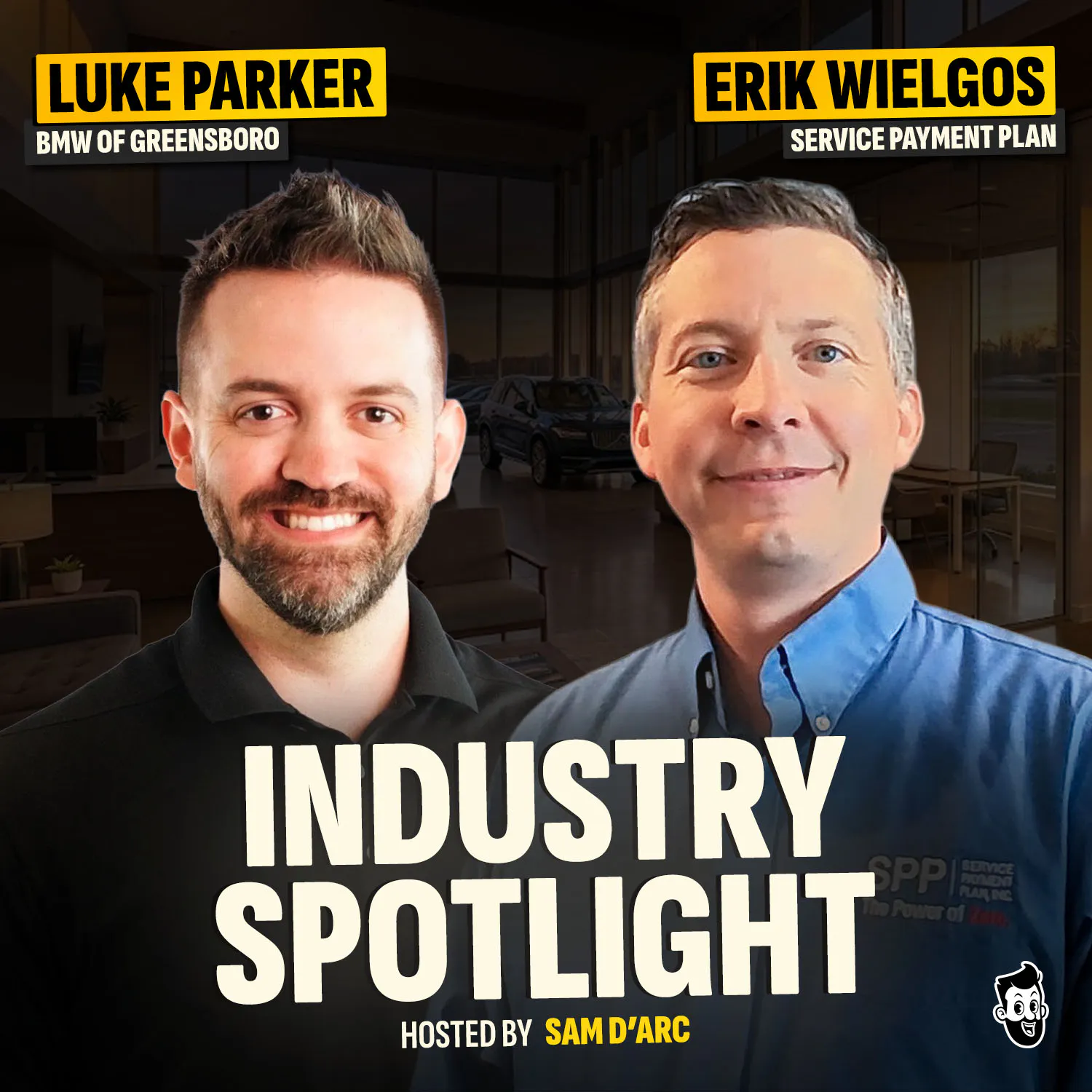
In this episode of the Industry Spotlight, joining host Sam D’Arc are Luke Parker, Finance Manager at BMW Greensboro and Erik Wielgos, Director of Dealer Success at Service Payment Plan to discuss how after a new GM changed the goalposts with a "50% penetration or pay cut" ultimatum, Luke Parker had to find a way to sell VSCs to customers the banks wouldn't touch.
This conversation breaks down the tactical shift from traditional financing to 0% payment plans that drove a 20% surge in F&I performance.
We explore how to handle luxury repair objections, the reality of chargebacks, and the massive untapped opportunity in cash-buyer protection.
This episode of the Car Dealership Guy Podcast is brought to you by Service Payment Plan.
Service Payment Plan - Service Payment Plan, Inc. (SPP) is the industry leader in providing interest-free payment plans for F&I products sold throughout the United States and Canada. SPP enables the auto industry’s leading dealers, administrators, and OEMs to provide their customers with an affordable and customizable method to protect their vehicles. With its 40+-year history of unparalleled service, long-standing partnerships, and integrations with the leading software platforms in the industry, SPP stands at the forefront of the future of automotive retail. Contact us @ [email protected] to learn more
Check out Car Dealership Guy’s stuff:
For dealers:
CDG Circles ➤ https://cdgcircles.com/
Industry job board ➤ http://jobs.dealershipguy.com
Dealership recruiting ➤ http://www.cdgrecruiting.com
Fix your dealership’s social media ➤ http://www.trynomad.co
Request to be a podcast guest ➤ http://www.cdgguest.com
For industry vendors:
Advertise with Car Dealership Guy ➤ http://www.cdgpartner.com
Industry job board ➤ http://jobs.dealershipguy.com
Request to be a podcast guest ➤ http://www.cdgguest.com
Topics:
01:35 The Sly GM Move That Forced A Scramble.
03:00 Why Luxury Customers "Don't Buy" VSCs.
07:45 The 0% Fix When Banks Say No.
12:00 How SPP Added 15 Points Overnight.
18:15 The $500 PVR Jump That Changed Everything.
21:15 Why Targeting Subprime Destroys Chargebacks.
24:20 Selling More Than VSCs With SPP.
26:45 Why No Credit Check Is A Compliance Shield.
33:45 The Service Drive Trick That Closes In 3 Minutes.
Car Dealership Guy Socials:
X ➤ x.com/GuyDealership
Instagram ➤ instagram.com/cardealershipguy/
TikTok ➤ tiktok.com/@guydealership
LinkedIn ➤ linkedin.com/company/cardealershipguy
Threads ➤ threads.net/@cardealershipguy
Facebook ➤ facebook.com/profile.php?id=100077402857683
Everything else ➤ dealershipguy.com