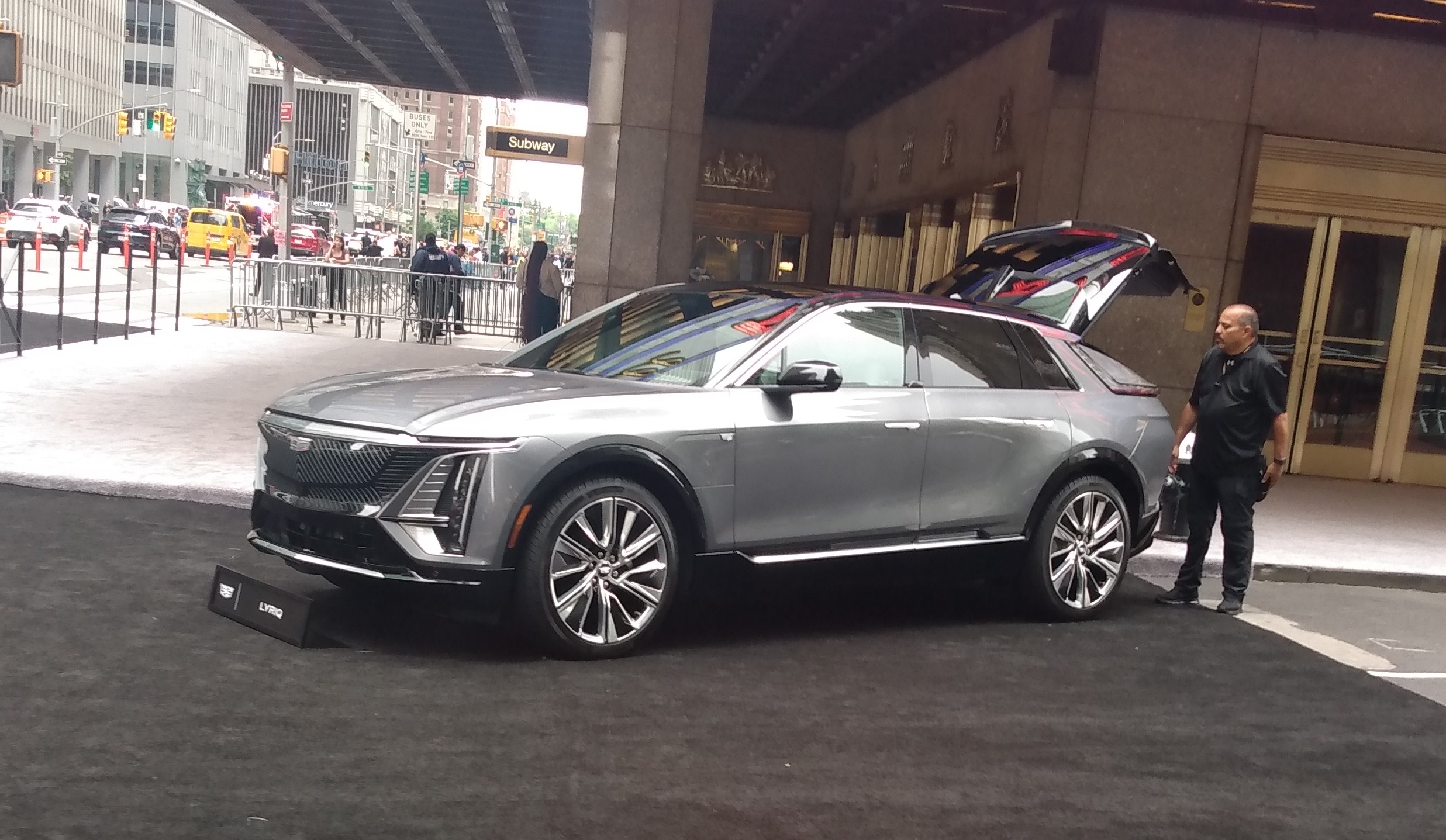
Lucid is a company that makes electric cars. The hosts are saying Lucid is in serious trouble because it’s not selling enough cars and its stock has dropped a lot.
A turnaround plan is what a company makes when it’s struggling and needs to get back on track. It usually involves changes meant to improve sales and reduce problems.
“Stock crashed” means the company’s share price dropped a lot quickly. The hosts use it as a sign that investors are worried about how well the company is doing.
EV sales just means how many electric cars people are buying. The hosts are saying sales dropped after the tax credit changed, so companies had to offer more discounts.
This means the price is usually set, and you don’t bargain with a salesperson. The hosts are saying that even with fixed pricing, the company still has to offer big discounts.
A dealer network is the set of car dealerships a brand uses to sell cars and provide service. If an EV company doesn’t have enough dealers, it can be harder for customers to buy and get help later.
The “EV wave” means the big push toward electric cars. The point here is that some companies planned their future around EVs and then ran into trouble when sales were slower than expected.
“EV investments” are the billions of dollars car companies put into making electric cars. The hosts are saying some companies lost money and had to admit those plans weren’t working out.
A “multi-billion dollar charge” is a big financial hit a company records in its accounting. Here, it’s described as related to EV plans losing value because sales didn’t go as hoped.
Term
$7,500 incentives
The “$7,500 incentives” are government money that can lower what you pay for certain electric cars. The hosts are debating whether taking that help away made EV sales drop too much.
A “tax credit” is a government benefit that reduces your taxes. The hosts are saying that even if EV buyers got a $7,500 credit, expensive EVs might still have a limited buyer pool.
This is a way of saying the company was losing money on each vehicle it sold, at least when you look at the basic cost to build the cars versus the sales price. It’s not just overall business expenses—it’s the core production math.
Rivian is a company that makes electric vehicles. The discussion here is about whether government money helped them stay afloat, and what might have happened without it.
A government subsidy is money the government gives to help make something cheaper or more affordable. In this case, it’s about helping EVs sell better by reducing the cost for buyers.
The powertrain is the main set of parts that makes the car move. It includes things like the engine or electric motor and the components that send power to the wheels.
Alfa Romeo is a car brand from Italy. In this segment, the hosts use it as an example of a company that may be struggling because the cars are priced higher than many buyers feel they’re worth.
VW Group is the big company behind Volkswagen and several other car brands. The point here is that even a major group can struggle when costs are high and customers don’t want to pay the prices being asked.
Jaguar is a luxury car brand from the UK. Here it’s mentioned as an example of a brand that may be priced too high for what customers feel they’re getting.
Fiat is a car company from Italy. The host is saying it has left and returned to the market more than once, which shows how brands can change over time.
Triumph is a British car brand name the host brings up as an example of brands that have come and gone. It supports the idea that some brands don’t survive long-term.
Sterling is mentioned as one of the older British car brands that the host says didn’t last. It’s part of the broader point that many brands eventually vanish.
The Volkswagen Taos is a compact crossover SUV positioned below VW’s larger models. The host suggests it could be removed from the United States lineup as part of Volkswagen’s product cuts, which would effectively end that model’s U.S. availability.
“Product cuts” means a company is trimming its lineup—dropping some models from sale. It usually happens when those models aren’t selling enough or the company wants to focus on other cars.
The Volkswagen Jetta is a small car (a sedan) meant for everyday commuting. It’s the kind of vehicle people choose for practicality and efficiency. The podcast mentions it because Volkswagen may be changing which models it sells in the United States.
The Oldsmobile Cutlass was a very popular American car line back in the late 1970s and early 1980s. The hosts bring it up to show that even once-massive brands can disappear.
Honda is a well-known Japanese car brand. It’s mentioned here because the discussion is about big companies possibly combining or working together more.
Toyota is a major automaker, and the host says its CEO suggested Japanese car companies should work together more. It’s used to reinforce the idea of consolidation.
A product pipeline is the planned sequence of new vehicles and updates a company intends to launch over time. In automotive coverage, it’s often used to discuss what models are coming next and how a brand will respond to trends like affordability or changing consumer tastes.
Vehicle affordability means whether people can afford to buy a car without stretching their budget too much. The host is saying this is a big issue right now and it’s affecting what car companies plan to sell.
Chevy is short for Chevrolet, a brand owned by General Motors. The host is saying GM is leaning on cheaper Chevrolet models to attract buyers who are worried about price.
Buick is a car brand. Here, the hosts are worried that some Buicks are made in China, which could make them vulnerable to U.S. rules that limit imports.
Excess capacity means a factory can make more cars than people are buying. If too many cars are being produced, the company has a harder time making good money.
Import tariffs are taxes on products shipped into a country. For cars, they can make imported vehicles more expensive, which can change what people choose to buy.
An EV truck is a truck that runs on electricity from a battery. The discussion here is about whether these trucks can be sold for really low prices like $30,000 or $40,000.
Term
affordable ability issue
They’re talking about whether regular people can actually afford the new cars being offered, especially electric ones. The point is that the industry keeps saying it’s a problem, but the prices don’t seem to come down.
The Cadillac Escalade is a big luxury SUV. The hosts mention it because Cadillac is still selling gas versions even while it plans more electric models.
The Cadillac Lyriq is an electric Cadillac model. The host mentions it in a list of Cadillac’s EV plans to make the point that the lineup could become more expensive.
Infiniti is a luxury car brand. The host thinks it’s trying to compete with the biggest German luxury brands, but doesn’t have the same pull with buyers.
The Jeep Grand Wagoneer is the more expensive, higher-end version of the Wagoneer. The host is saying that making it extremely pricey doesn’t match what buyers are actually asking for.
“Stalantis” sounds like Stellantis, a big car company that owns multiple brands. The host is saying Stellantis has tried expensive, niche products that didn’t get much demand.
The Jeep Grand Cherokee is a larger SUV made for both regular driving and rougher roads. It’s the kind of vehicle people buy when they want space and capability. In the podcast, it’s brought up because Jeep’s higher-priced models are being discussed.
The Infiniti QX80 is Infiniti’s big luxury SUV. It’s meant to feel upscale and “top of the line,” and the host is saying it doesn’t have the same brand prestige as some rivals, which affects sales.
In this context, “cache” means how much respect or status people think a brand has. The host is saying Infiniti doesn’t have as much of that prestige as some German luxury brands.
Lexus is Toyota’s luxury car brand. The hosts mention it in a story about a Michael Jordan autograph and how that kind of celebrity tie-in can change what people pay later.
Invoice price is basically what the dealer pays the car company for the car. If MSRP is much higher, the dealer can offer a “discount” and still make money.
A discount is a lower price than the sticker or list price. The hosts are saying you should look beyond the headline discount because the dealer may still profit in other ways.
Financing means paying for the car over time with a loan or lease. The hosts are pointing out that dealers can make money through the financing deal too, not only the car price.
A high performance variant is the “stronger” or sportier version of the same model. The hosts say Infiniti is delaying it and that it’ll cost much more than the regular version.
LIVE
Every team, every topic, everywhere, this is Belize.
It's noon here in Ventner City, New Jersey, and our nation's capital, Washington, D.C.,
and this is Carriage Live for Wednesday, July 15th, with your hosts, me, Ray, here in my
living room and vendor, and Zach, Zach all inked up in Washington.
How did the tattoo session go last night, handsome?
I got a tattoo.
I just, again, love my news to share, but you know what?
Dad wants to share it.
So there we go.
That was good.
Also, we're wearing matching colors again.
So are you rooting for Argentina this afternoon, too?
I was just dressed like this for a TV interview, so I would.
Today's show is brought to you by Carriage.com.
We're jumping straight into things, folks.
If we can help you out with anything car buying related, we'd love to.
Check out the website back at CarEdge.com.
We're up to almost seven years of working on all the resources that are there back on CarEdge.com.
We have a car search, a buying service, Ask Car Edge, our research center, dealer reviews,
and so much more.
Check it out back at CarEdge.com.
We're going to jump right into it, the car brands that are going extinct.
Before we do, we will ask, what was your TV interview?
I'm sorry, I didn't ask.
Well, no, I haven't done it yet.
I have a TV interview scheduled for 1.30 this afternoon with one of the fine stations in
San Antonio.
And I just thought a light blue and white is a nice color combination in the summer.
And, well, it just happens to go with Argentina.
But I wasn't thinking of Argentina at the time.
CarEdge community in San Antonio, stay tuned for that.
We're starting here, Dad.
There's a car brand that's on the brink of extinction.
And that would be Lucid.
They've recently hired an organization to help them support their turnaround plan.
As you can see here, their stock crashed over 50% yesterday.
But let's start here, Pops.
Lucid sales only 721 vehicles in the month of May.
It is hard to be an automaker.
And we've seen a lot of automakers over the past couple of years go bankrupt and go extinct.
We had even some talk for a period there about an automaker as big as Nissan needing
a lifeline to be able to sustain themselves.
So let's start here.
The first automaker we will talk about today that has the potential to be like the dinosaurs.
Lucid, what's the story at Lucid, Dad?
721 vehicles sold is not enough, I don't think.
I'm pretty sure it's not.
I mean, are they building them by hand?
And that's why they can only make 721.
I'm pretty sure they made more than 721 vehicles.
And I'm pretty sure selling 721 vehicles in a month doesn't make you a viable automaker
in terms of of your competitors out there.
If you're competing with Rivian and them too, you know, that's their cousin.
If you're if you're competing with Rivian, and I believe they are, not that Rivian
sells enough cars either or trucks, but 721, that's ridiculous.
I mean, these are like Fiat numbers.
OK, this is.
Yeah, you know, even even even the.
Yeah, it's Saudi backers must be thinking we can't.
I mean, if if they dumped live, you just got to live off.
You just kind of believe they're getting ready to dump Lucid.
I mean, how many billions are you going to lose on on a vehicle?
Even though they get great reviews on a vehicle that well, 721 people bought in May.
I mean, what what the numbers dropped down to in June?
Yeah, so let's talk about this a little bit, Dad.
Ever since the federal government got rid of the $7,500 tax incentive,
EV sales have not been great.
And unfortunately, that's meant that the manufacturers have to step up their
incentives, fortunately for us consumers, but unfortunately for them right now.
And many of the Lucid products, you can get $7,500, $10,000 off of the MSRP.
These are negotiation free dealerships.
You're just buying directly from the manufacturer, but they're having to
incentivize a significant amount to try and move the metal.
And you see those $10,000 discounts and yet the sales are still not there.
Lucid could be one of these manufacturers that goes by the wayside.
And they would not be the first EV automaker that has tried to break in here
to the United States, and it was ultimately gone by the way of the dinosaurs,
gone extinct.
You mean like Fisker?
Fisker is one.
I'm thinking about Lordstown Motors was another who's trying to break in.
Yeah, it's VinFast still operation.
So I was just thinking about VinFast as well.
They were one of the brands I wanted to talk about today.
Like they've started to build out a dealer network, but you know,
are they even selling cars?
So there are many of these EV automakers that are really struggling
and are not able to sell vehicles.
And I think it's a direct relation to how expensive they are.
Oh yeah, Rick reminding us as well, Polestar.
Polestar just got kicked out of the country.
I mean, there are so many auto brands that are going to be extinct here
in the United States.
And for those of you that are thinking, well, you're just being hyperbolic,
car brands don't go extinct.
I love Wikipedia for so many reasons.
They have the whole page that goes on for, you know, we could spend hours.
List of defunct automobile manufacturers of the United States.
There's a lot of them. Wow.
This, unfortunately, is pretty normal.
What we're seeing right now, I mean, automakers occasionally go out of business.
I mean, hell, dad, there's some automakers on this list, like Lincoln.
Where'd it go?
Lincoln Motor Company, they went out of business already once before.
I mean, they're back now, but they already went bankrupt.
And, you know, people take a shot.
Sometimes it works, sometimes it doesn't.
You know, everybody bought in to the EV wave of the future.
And in many parts of the world, it took off much more so than it did in this country.
Yes, EVs still sell.
They just don't sell at the numbers that the manufacturers had originally anticipated.
I mean, not even close to them.
Even close, yeah.
Yes, and many, many manufacturers have written off their EV investments,
taken huge multi-billion dollar charges to write down and write off their EV investments
and are backing away from it.
When the government did away with the $7,500 incentives, you know, really, is that enough?
Would Lucid still be in the position they're in today, even if there was a $7,500 tax credit from the government?
You're talking about vehicles that are, in most cases, pretty damn close to $100,000.
Yeah.
You've really got a limited market as to who wants to buy them,
whether there's a government subsidy to encourage it or not.
And if I remember correctly, back in their heyday, when their previous CEO was raking
in like $370 million a year in income, and they were losing on average $300,000 per vehicle sold,
you know, from all the initial investments.
Yeah, think about that for a second.
$300,000 per vehicle sold in negative gross profit losses.
Yes, you know, but you have all the startup costs and it ain't cheap to start building
cars, but was there really ever a future there, would Rivians still be in the position they're in today,
if there was that $7,500 government subsidy?
And I believe they still would be.
Let's pivot off of EVs, Dad, because there are other brands that are also struggling,
and it kind of fits a similar narrative.
You can get rid of the powertrain and it kind of just comes back to price.
You know which brand I'm thinking of next?
I don't know.
Alfa Romeo. Alfa Romeo is an example of a brand.
I mean, this is in car dealership guy news from yesterday.
Alfa Romeo pushes back on exit rumors as questions over US strategy persist.
Excuse me.
In a lot of ways, these brands are just like a price-to-value equation that is totally out of
whack that consumers have rejected paying those prices and the manufacturers running out of money.
There are countless others that we'll get into here.
I mean, VW Group in many ways is experiencing this right now.
Nissan for a long time was and I think probably still is continuing to experience this.
There are many brands. Jaguar. Jaguar is a perfect example, just the price.
Yeah. Thank you, Mr. C. Northeast.
There are many examples here and you can get rid of the powertrain.
The interesting thing about the powertrain, obviously, is for a while the other government
was trying to influence our shopping decisions and so they were subsidizing things.
But regardless, it just comes back to a fund that will supply and demand.
These are manufacturers that have way too much supply and not enough demand.
In my lifetime, in the automotive industry, I watched a number of brands, many of them far,
come and go. Fiat came and went and then came back again and might go again.
Fiat is another example. I mean, what do they even sell here anymore at this point?
What do they sell? 50 cars a month, if you're right?
And then Alfa Romeo came and went and came back again and might go away again.
Citroën was a French car. A came and went, didn't come back again.
Peugeot, another French car, came and went, never came back again.
So it's not like there are vehicles that there were, oh my God,
English brands, Sterling, Triumph, MG. I mean, there were so many English brands.
Many came and went, came back again. And then trust me, many dealers have been wondering for
years, do they really have a solid business plan to keep many in the United States moving forward?
Yeah, you go. Etzo, I mean, there are just so, so many. And what it indicates to me
is there's only so many dollars to be spent by consumers. You can have way too many choices.
Some choices are, even though they might be viable initially, aren't. And so they go by
the wayside. It's unfortunate what happens. The list is long, very long. And that was just
in my recent history in automotive. Yeah, and it gets within even maybe the brand
stays around in some capacity, but certain models go by the wayside. Here's what's super
interesting. Like VW, one of the largest, most powerful automakers in the history of our world.
Well, they're doing product cuts. I mean, we are looking at likely the Jetta and the Taos go away
in the United States. Like that is a real consideration right now. And that's not
necessarily losing VW as a brand in the United States. So are these brands going extinct? No.
But the Jetta and the Taos might go extinct in the United States. When we're starting to look at,
and we're going to spend some time here today looking at General Motors' future vehicle pipeline,
it's super interesting that some of those vehicles might not make it. And it all comes
back to what you were describing, which is like people buy them. That's really,
really how to score new people buy these things. And if they don't.
Can I share with you a vehicle that was the number one selling vehicle in the United States,
I believe, in the late 70s or early 80s? Please enlighten me.
The Oldsmobile Cutlass. Okay, Oldsmobile doesn't exist anymore.
Yeah, wow.
Pontiac doesn't exist anymore. So this is not a new thing. Does it really make sense
for Lucid to continue? Is there really a path forward for a company like Lucid
that has lost as many billions of dollars as it has lost over its history?
Is there really a path forward for them to continue? And I think my guess is that the good
folks at Lucid and the folks that they've employed at Alex Partners to come up with a plan
probably understand that there isn't. And they're probably in agreement that there isn't really a
path forward. They might try and forge one, but there really isn't. I mean, there's no need
in this world for that brand to exist. There just really isn't.
Really cool hardware. I mean, don't get me wrong. They've built some gorgeous looking cars and there
are aspects of their vehicles. Like hopefully that gets repurposed for other automakers and
things like that. But I do think you and I have said this for a while now. I think we're entering a
new era of consolidation of automakers. I mean, look, last year it didn't happen,
but there were a lot of rumors and talks of Nissan and Honda merging together.
Recently, we didn't even talk about it on the show, but the CEO of Toyota came out and said,
Japanese automakers need to work more closely together. We need to get less and work more.
You saw that. Yeah, they need to work more collaboratively as opposed to competitively.
I think we're entering a really interesting era for the auto industry of consolidation.
We're going to see brands get folded up into bigger conglomerates and things like that.
And ultimately, I'm really interested to see what impact that has on pricing, on technology,
on what's available for consumers. But it's pretty obvious here that there are going to be
some doors that shudder. I mean, these manufacturers are the blind shut. I mean,
it's just clear as day that they are not making money. And when that happens, eventually,
eventually you go out of business. One would think that's pretty much the way it's supposed to
work. I know when I had my Gulf USA store in Mesa, Arizona, the strangest thing happened.
When the money ran out, the business closed. The sad part was that the biggest sales day
I ever had at my Gulf USA store in Mesa, Arizona was the first day of my going out of business
sale. That was the best dollar day I ever had. Had I known that, I would have done it the first day.
And I would have saved myself five years. But I didn't know. But the point is, when the money
runs out, the business goes. And you look at a business like Lucid. At a certain point,
their benefactors are going to say, yeah, maybe eight billions enough, we've lost already. We
don't need to lose anymore. It doesn't matter how much more money we have. We don't need to lose
more. And it won't stop. Yeah. It's really interesting. I want to turn our attention
to what's going on over at General Motors. We've got some updated product pipeline
visibility from our friends over at Automotive News. And you'll see here that affordability
concerns is again, one of the things that's being called out here. I want to show you what
executives from General Motors have said. GM executives say that their lineup will
insulate them from any sharp changes in consumer preferences amid rising concerns
across the industry about vehicle affordability. Executives in recent months have touted
six Chevy and Buick name plates starting at less than $30,000. So you start to look here
at the future product pipeline for a brand like General Motors. And it's super interesting that.
I mean, many of their bets from an affordability standpoint are really on Buick, which is interesting
because Buick in many ways could have been a brand that we also would have said might go the way of
the dinosaurs that might go extinct, that so many of their bets are actually from an affordability
standpoint made right here with this particular brand. The funny thing is, is their customer base
30 years ago did go by way of the dinosaur. Because trust me, at a Buick dealership in the 80s
and 90s, there wasn't brand loyalty in the sense that it was the last car those customers bought.
That's how aged those people were. It was always an older client hell brand. One of the things that
concerns me about what Buick's doing. And the reason it concerns me is we know that
the federal government has stepped in and said they're not going to allow Polestar to sell new
Polstars in 2027 because it's primarily a Chinese automobile manufacturer. Most of the
inexpensive Buicks that they're selling are manufactured in China. Will the U.S. government
step in and say to them, you can't bring those cars into the country anymore?
So interesting. And I want a real concern. I completely agree. And I want to tie it back to
the Volkswagen story a little bit here because one of the paragraphs in the Volkswagen story is
VW Group is grappling with high cost and excess capacity at German factories on top of rising
Chinese competition, U.S. import tariffs and shifting customer preferences. Their profits
have sliced in half between 2021 and 2025. There's that word again, competition from China at the
exact same time when you can't sell a car that was made in China or at least the precedent that
we're setting with Polestar. Yeah, that's so fascinating. These cheaper Buicks may not even
be available in the United States because of where they're produced. That's crazy.
Yeah. I mean, when you think about what's going on to the Polestar brand,
you have to think at a certain point that the government turns its attention to the domestic
brands that are importing cars from China. They're not being built domestically. So
what are the implications of that? Will the government step in and say, hey, that's great.
We're so happy that you have these affordable vehicles. Oh, by the way, you can't burn them
into the country anymore. And that could happen. And then if I remember, I saw a headline that
made me chuckle yesterday. And you know I love to chuckle. Yeah, you love to chuckle.
But the headline was Ford is coming out with a $30,000 EV. Sure they are. Yeah, an EV truck.
Sure they are. Yeah. Wait, I remember when they came out with a sub $40,000 EV truck,
that was never a sub $40,000 EV truck. Yeah. So why would the sub $30,000 EV truck be a
sub $30,000? You know, you hear some of these things, you read some of these headlines,
and you go, whose butts are they trying to blow this smoke up? I mean, you know, it is absolute.
And yes, since Chevy is a GM senator, we have to address the affordable
ability issue. They've all said it, nobody's done anything about it.
I'm like a broken record, I say it every day, but I say it every day because it's only true.
But that's what's so interesting about taking a moment here to look at the future product pipeline
from these manufacturers. Again, Buick, that's where it seems like GM is making their big bets.
I mean, look at this. These are all gas or hybrid powertrain vehicles. And the expectation is that
they're at price points that are affordable. The issue that you just made us aware of,
these vehicles, many of them are made in China, and we have a precedent being set right now that
Chinese vehicles will not be able to be sold in the United States. Then you look at the rest of their
lineup, Cadillac. But we don't expect Cadillac to be the affordable option from General Motors.
The interesting thing here, Dad, is that obviously there's a push for still gasoline vehicles like
the Escalade, but look at this. They're still pushing forward on the Celestic. They're still
pushing forward on the Escalade IQ, which is the electric version. They're still pushing forward
on the Lyric, the Vistik, the Optik. I mean, I see a slippery slope here for Cadillac,
where price points are going to be through the roof. And also, these are not going to be
hybrid powertrains. They're either going to be these big V8 engines in those Cadillac Escalades,
or they're going to be these IC vehicles. I don't mean that as like, I have an IC. They all end
an IC, like Lyric and Celestic and Vistik. Well, and the thing was, five years ago,
they told their dealers, when they called some of the dealer network and bought many of their
dealers out, we're going all electric. Either you come with us, or if you'd like not to,
we'll compensate you for your existing dealership and shutter it. So the first one on that list
was a gasoline-powered car. So they are going to continue with the gas powertrains and hybrid
powertrains as opposed to all battery electric. The difference is with Cadillac, it's not supposed
to be a mass market brand in the sense that it's supposed to be affordable for the mass market.
It's supposed to be affordable for a few, a sizeable few, but a few who want to buy American
luxury as opposed to European luxury. Which also we need to talk about. I don't have a Q'd for today's
show, but Infinity trying to compete with Mercedes-Benz right now. We'll turn our attention there in a
second. They're going to come out with a version of one of their SUVs to compete with the AMG.
Can I help Infinity? Yeah, exactly. Let me pull up the article, put it up on the screen.
Well, let me just give them some free advice. Save your money. You're not AMG. You're never
going to be AMG. You're never going to have the appeal that AMG has. You're not going to attract
the same buyer that wants to buy an AMG. Stop kidding yourselves. Stop playing in a sandbox
you don't belong in. Just continue to make whatever it is that you make that you sell on
few numbers and move along with life. But don't think you're going to compete with AMG and it's
going to be like the halo from the brand. It's not. In three years, we'll be reading about
how they've done away with that vehicle because nobody bought the damn thing. Because people who
want that type of stuff are going to buy the, they're either going to buy an X vehicle from BMW
or they're going to buy an AMG from Mercedes, but they ain't buying it as an Infinity.
Can we just for a moment here, because a lot of today's shows obviously talking about manufacturers
who we think have the chance or the opportunity to go out of business, I want to show y'all how
out of touch some manufacturers have become debt. Do you have any clue what a QX80 right now from
Infinity costs? A new 2027 QX80. Is that their big thing that's based off of the Armada? Yeah.
I got to believe it's between 80 and $100,000. Okay. I'm glad you're sitting down. You're
ready for this? Yeah. Went to the car edge car search, went for Infinity QX80. The MSRP on this
one's $117,400 if I may, because again, this does tie in. The QX80 Redsport is expected to carry a
roughly $30,000 premium over the standard QX80 Sport trim, which starts at $103,945.
We're talking about folks. This is how out of touch some auto bakers are. Already,
they're producing $120,000 Infinities. I'm rounding up $117,400 Infinities. Yes,
I think this is the only appropriate response. Red, they're talking about delaying the production
of the one that's going to be a $30,000 premium over the standard Sport trim. I mean, this is just
like when we do, these car brands are going extinct again in five years and we're talking
about Infinity being in financial trouble. It seems to me they're following the Stalantis path of
let's make $120,000 Jeep Wagoneer, Grand Wagoneer. Nobody's asking for it.
Nobody woke up in the morning and said, damn, I need $120,000 Jeep Grand Wagoneer. Realistically,
there's not a whole lot of people waking up every morning going, I kind of get me $100,000
$1,000 QX80 from Infinity. Infinity doesn't have the same cache. It doesn't make the same statement
that BMW makes or Mercedes makes. It is, here's the best way I can put it. I remember having this
conversation with my Acura rep and the same would apply to Infinity that applies to Acura,
in my mind. If people buy a Lexus, a BMW or Mercedes, it is making a statement that they have
achieved a life goal of some type. They have achieved a certain level of success and they
feel like they are showing the world that achievement. When people buy an Acura or people
buy an Infinity, they feel like they bought a car. That's a big difference. It doesn't
necessarily equate to they've achieved some goal in life. The goal in life is not to own an Acura
or an Infinity. It's not. For that showy person who's been saving up and went,
yeah, I completely... It doesn't have the same cache. It just doesn't. It doesn't say the same
thing about you. It doesn't really say you're a successful person. What it says is you're not
such a successful person, but you want to give the idea that maybe you might be.
I don't know. Different people have different interpretations of it, but I hear what you're
saying and these manufacturers think, okay, well, let's try and play in that space and just for
context here. On that Infinity QX80 autograph in Scottsdale, Arizona, in the last 45 days,
we've got zero of the 46 that are available that have sold.
Yeah. Well, maybe the problem is it doesn't have anybody's autograph that's worth the money.
I'm just thinking, you're on an orthoday bed. I remember when we were Scottsdale Acura and we
were on the McDowell Road in Scottsdale and South Scottsdale and just up the street from our
Alexis store that we had. Michael Jordan decided to give up basketball and play baseball.
Yeah, yeah, of course. Our Lexus store thought it would be a good idea to provide him with an
automobile. Wow. The concept behind it was, well, we'll get him to autograph it. When we go to sell
it, somebody's buying a used Lexus with Michael Jordan's autograph. Somebody would pay for that,
but if it has Ray Schiff's autograph on that Infinity, I don't think anybody's paying that
kind of money for it. So it depends on the autograph. That's a really funny story and that
is very true. Again, I think there's a lot of dealerships or excuse me, manufacturers who are
just out of touch with reality. This is back on thecaredge.com website for this particular
2027 Infinity QX80 autograph. The fascinating thing again is there's 46 for sale right now.
There are zero that have sold in the last 45 days. The dealer loves this stat. I mean,
the invoice price on this thing is $108,000. There's almost $9,000 in markup on this Infinity
from invoice to MSRP. No wonder the dealerships happy to offer a $4,000 discount. If someone
actually just takes up, they're still making thousands upon thousands of dollars. They're
even gotten into how much Infinity is paying them to sell it. Oh my gosh. Yeah, I'm financing and
things like that. Again, the irony in this is Infinity just made the great strategic decision
to delay the high performance variant of this that's going to be roughly $30,000 more expensive
than the standard QX80 trim. We're not. Absolutely not so, especially in the context of the
conversation we're having today, which is there are automakers out there that are claiming they're
not going to go bankrupt, but they seem like they're on the precipice of bankruptcy or,
in the case of Volkswagen, they're pulling really, really, really important vehicles from
potential US distribution because they can't afford to sell them in the US. What a topsy-turvy
turbulent time in the auto industry. There are certain brands that they build in Europe
that they're thinking of doing away with certain brands in Europe that are part of the
part of the Volkswagen umbrella. It's happening. It really is happening.
I do think on the other side of this, I think we both agree there will be consolidation.
Infinity will never go away, in my opinion. Just like Lincoln went bankrupt in 1914,
we're still around today. The brand has value. There's going to be someone who values that,
but I don't know. Maybe they change ownership. Maybe they totally refresh how they approach
their operations. $140,000 infinities just doesn't pencil in my mind, Pops.
Well, thankfully, it probably doesn't pencil in an infinity's mind either.
They came to their senses, yes. We'll see. Folks, if we can help you out with anything,
again, today's show is brought to you by caredge.com. It is such a privilege. It makes us so
excited to know that we're able to help so many people back at caredge.com.
We have a car search. We have our buying service, which I should talk more about one of these days.
Caredge concierge, the AI car shopping as well. Learn more. Meet the team of experts who work on
this. Read all the details. Schedule a phone call with us. See how much we've saved for folks.
Please, please, please spend some time back on the website learning about our buying services.
If you're not using our research center, Ask Car Edge, Daily Reviews,
a lot of free stuff there that's meant to help you navigate the car buying journey,
so thrilled, humbled to be able to help as many people as we do. Please,
tell a friend and about caredge.com and keep tuning in here on Car Edge Live. We have
so much fun Monday through Friday. It's always great to spend the time with you, Dad, and obviously
with everyone who tunes in. Yes, it's always a pleasure to have this conversation.
Yeah, it's a joy. It's a highlight of my day. All right, folks, we're back tomorrow with more
Car Edge Live. Dad, enjoy your afternoon. See you back here after your San Antonio interview.
Can't wait to hear how it goes. Yeah, well, I'm a busy camper. I got a
San Antonio interview and I got a CNN phone interview. People just want to hear what I have
to say and I have no idea why. Love you, Dad. We're back tomorrow. See you, everyone.
Love you too, handsome. If you liked the show, please take a moment to rate, review, and subscribe.
It really does help the show to grow. Thank you for listening.
About this episode
The hosts kick off by zeroing in on “the car brands that are going extinct,” then focus on EV pressure—especially Lucid—citing low sales, a sharp stock drop, and the end of the $7,500 tax incentive. They connect weak demand to bigger discounts and question whether startups can survive. From model “extinction” (like VW trims) to consolidation, they argue pricing, profitability, and incentives shape who gets folded into the future.
Today on CarEdge Live, Ray and Zach discuss the latest news of automaker bankruptcy. Tune in to learn more! Hosted by Simplecast, an AdsWizz company. See https://pcm.adswizz.com
for information about our collection and use of personal data for
advertising.