
wire edge
“Wire edge” is a particular look/trim detail on the car. The host is using it like a fingerprint to tell which version of the car it is.

MG Metro
The MG Metro is a sportier version of the Austin Metro, sold with an MG badge. The host is using it to explain how the newer model replaced the earlier one.

Austin Metro
The Austin Metro is the standard version of the Metro. The host is saying this specific car is an Austin Metro, before it was replaced by the MG-badged version.
MG 1300S
The MG 1300S is a specific MG version from the S-series family. Here, the big points are that it’s a 1.3-liter model and that the speaker is comparing what the original cars were supposed to look like inside versus what this one has.
right hand drive
Right-hand drive means the steering wheel is on the right side of the car. The speaker is saying the car was brought back from abroad and then modified so it could be driven like a UK car.
left-to-right
“Left-to-right” here is a quick way of talking about which side the driver’s controls are on. The speaker is basically comparing the setup of different cars when they’re configured for different countries.
opaline
Opaline is a named paint color. In this episode, it’s how the speaker identifies the car’s light green exterior color.
upholstery
Upholstery refers to the interior trim materials—like seats and door panels—rather than the car’s mechanical parts. The speaker emphasizes that original 1300S cars had specific upholstery expectations, and that this car’s interior differs (beige cloth versus the traditional setup).
beige cloth interior
This just means the inside of the car uses light beige fabric seats and trim. The speaker is using it to judge whether the car still matches what the original 1300S would have had.
one owner
A “one-owner” car means it was owned by just one person. People like that because it usually means the car’s history is simpler and it may have been looked after.
original purchase invoice
The original purchase invoice is the paperwork from when the car was bought. It can show what the car was ordered with and helps prove the car’s history.
rare steel sunroof
A “rare steel sunroof” means the car has a metal sunroof, not just a basic opening. The host is saying this particular sunroof setup is unusual for this model.
factory sunroof
A “factory sunroof” means it was built into the car from the start, not added later. Collectors usually prefer this because it’s more original.
Mark I
“Mark I” means the first version of that model. It helps tell which early production cars you’re looking at, since later ones can be different.
Vermilion
Vermilion is the name of the car’s paint color. The host is saying this car was originally painted Vermilion, before the brand switched to a different named color later.
Cinnabar Red
Cinnabar Red is another named paint color used on these cars. The host says it replaced Vermilion, so it’s part of figuring out the car’s correct original color history.
high line
“Highline” means a nicer, more optioned-up version of the car than the basic one. Here, the host is using it to explain what the letters “HL” stand for.
wings and bonnets
These are body parts. “Wings” are the outer fenders, and the “bonnet” is the hood, and the host is noting they’re missing some pieces for the restoration.
Minnie Haynes manual
A Haynes manual is a step-by-step repair guide for a specific car. Here, the host is using it like a reference to help identify which version the car is.
press car
A press car is a car the media gets access to for reviews and photos. It’s usually arranged so journalists can talk about the car before or around its release.
British Leyland
British Leyland was a big British car company group that made lots of cars in the UK. Here, the host is looking for old records from that era about a specific press car.
Vanden Place
“Vanden Place” sounds like it’s meant to be Vanden Plas, which is a name used for nicer, more upscale versions of some British cars. In this episode it’s part of the special Metro’s name.
VP500
VP500 is the name/code for this special Metro variant. The “500” connects to the idea that it was made to mark a 500,000-unit milestone.
500,000th Metro
The “500,000th Metro” means the Metro hit half a million units built. Special versions were sometimes made to celebrate milestones like that, which is why these cars can be harder to find.
pepperpot alloys
Pepperpot alloys are a type of classic wheel design with lots of small holes. They’re a distinctive look that helps identify certain special editions.
limited numbers
“Limited numbers” means only a small number of these cars were made. Collectors usually like that because it makes the car rarer.
upgraded in-car entertainment
This means the car had a better radio/audio system than the standard version. For collectors, having the original upgraded setup can make the car more desirable.
manual transmission
Manual means you change gears yourself using a clutch and a gear stick. This segment says these cars were all manual.
gold stripe
A gold stripe is a decorative line on the car’s body. Here, it’s part of the special look that helps identify this limited Metro.
TLC
“TLC” just means the car needs some extra love—like cleaning up and doing any small fixes. It suggests the car isn’t fully sorted, but it could be made really nice.
MOT
In the UK, an MOT is a yearly inspection that checks whether a car is safe and meets emissions rules. If a car “has an MOT,” it means it’s been checked and is legally road-legal at least for that period.
laser-etched number
A laser-etched number is a permanent ID mark made with a laser. Collectors use it to confirm the car is the real deal and matches the claimed build number.
limited edition
A limited edition means only a small number of cars were made. Because there are fewer of them, they tend to be rarer—and often more interesting to collectors.
one of six
“One of six” indicates an extremely small production or surviving count, which strongly affects collector interest. In this context, it’s used to emphasize how few similar cars exist in the relevant configuration.
certificate
A certificate is paperwork that proves what the car is and that it matches the claimed special version. Collectors care because it helps verify authenticity.
one-off
A one-off means it was built as a single unique car, not one of many. In this story, it’s a custom VP500 order with specific options.
abandoned floor interior
This phrase sounds like a specific interior style or material choice for the car. The key point is that the host is listing the exact custom options from the original order.
K-series
The K-series is a type of engine family that Rover later used. The host is saying the car they’re talking about came before that engine was introduced.
Metro L spec
“L spec” is the simpler, more basic trim level. The host’s point is that this car starts from a basic Metro, but it gets upgraded with the MG Metro engine.
badge engineering
Badge engineering is when two car brands sell almost the same car, but with different badges and styling details. The underlying car is often very similar, even if it looks different on the outside.

Austin 1100
The Austin 1100 is an older British compact car. In this episode, it’s brought up to show how the same basic car idea could be sold with different brand badges.
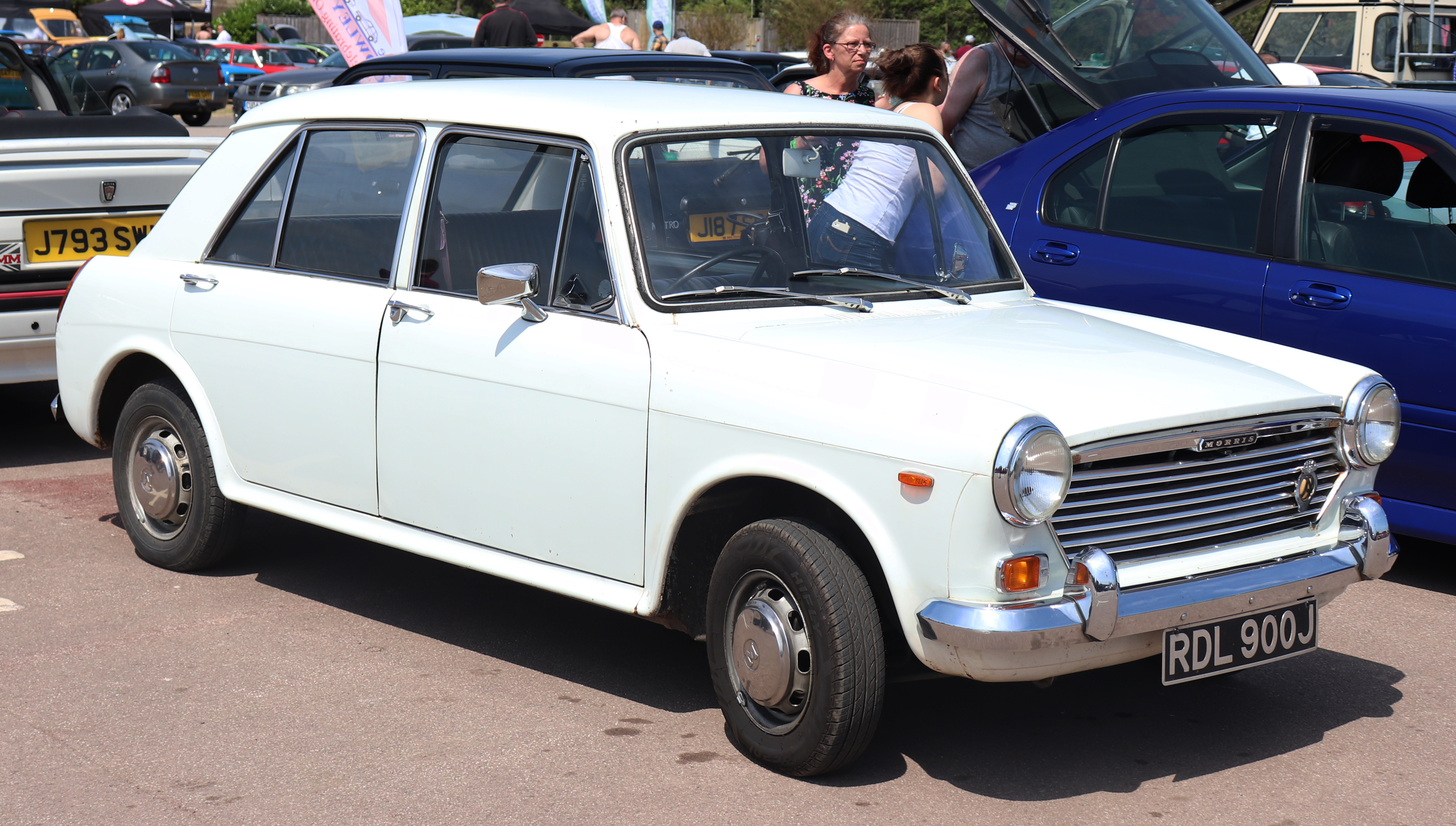
Morris 1100
The Morris 1100 is an older Morris model that’s being mentioned alongside the Austin 1100. The takeaway here is that car makers often reused the same basic design across brands.
big bore exhaust
A big bore exhaust is an exhaust system with bigger pipes than the factory. Bigger pipes usually make the car breathe easier and sound louder/deeper.
standing exhaust
“Standing exhaust” here means an exhaust setup that’s already fitted/available for the car. They’re saying it’s tough to find the right one for a Metro these days.
non-original colours
“Non-original colours” means the car was painted a color it didn’t come with from the factory. Collectors often care because it changes how “original” the car looks.
non-original headlamps
“Non-original headlamps” means the headlights aren’t the exact ones the car originally had. It can happen after repairs or upgrades, and it matters for originality.
spotlights
Spotlights are extra lights you can mount to help you see farther down the road. In this conversation, they’re checking if the car’s spotlights are original or added later.
boy racer box
“Boy racer box” is slang for the flashy, modified look people associate with younger drivers. They’re basically saying the car might have been styled up in that kind of way.
Italian tune up
An “Italian tune-up” is a nickname for taking the car out and driving it more aggressively than usual. People do it to help clean the engine and make it feel more responsive.

Honda Civic Type R
The Honda Civic Type R is a sporty version of the Civic that’s meant to be fast and fun to drive. Here, they’re talking about the car’s setup and how it feels on the road.
bored-out 1275 engine
“Bored out” means the engine cylinders were enlarged to make the engine bigger. That usually helps it make more power compared to the original size.
side-mounted exhaust
A side-mounted exhaust puts the exhaust pipe and tip on the side of the car. It can affect the sound and how the car is laid out under the body.
go-kart
When someone says “go-kart,” they mean the car feels small and nimble, with quick steering and an easy, fun drive. It’s a comparison to how karts feel, not a specific part.
twin-carb
Twin carbs means there are two carburetors feeding the engine. They need to be adjusted so the engine gets the right fuel/air mixture for smooth running.
998 Metro L
This is a specific early Austin/Morris Metro version with a 998cc engine and an “L” trim level. The host is saying that if you want a Metro exactly as it left the factory, this isn’t the kind of car being discussed.
horses for courses
It means different people like different things. In this case, some buyers want an original car, while others want a modified one that’s fun and characterful—even if it’s not comfortable.
purest VP Philly Boots It's Your Own Car stance
They’re talking about a disagreement in car culture: some people want cars kept original, while others believe the owner should modify their own car however they like. It’s basically a “purist vs personal choice” argument.
racing seats
Racing seats are special seats meant for driving hard. They hold you in place better in corners and are often lighter than normal seats.
track day
A track day is when people drive their own cars on a racetrack. It’s usually for practice and learning, not for formal racing.
matching numbers
“Matching numbers” is when the important parts on a car are the original ones that go with the vehicle’s identity. Collectors usually like it because it means the car hasn’t been heavily modified.
originality
In classic-car collecting, “originality” refers to how much of the car remains as it was when built—especially original engine, trim, and configuration. The host frames originality as the main driver of value when comparing an engine swap versus keeping the original small engine.
MG Express
The MG Express is a van model based on MG’s small-car platform. The host is saying MG/Rover should have made it earlier, and then explains how it relates to the Rover 25 and MG ZR.
PL
“PL” is an abbreviation the speaker is using for a particular plan or timeline. The excerpt doesn’t say what it stands for, so we can’t be sure exactly which program they mean.

Rover Commerce
The Rover Commerce is a Rover-branded van. The speaker is comparing it to the MG Express and explaining how both were related to the Rover 25 platform.
stickers
Here, “stickers” means decals or badges on the outside of the van. The host is saying they should match the MG Metro van identity.
reliable little car
The speaker is just saying the car is dependable. They don’t mention a specific mechanical reason in this part of the transcript.
pearl white
“Pearl white” is a white paint that has tiny shimmer particles in it. That shimmer makes the car look more interesting than a plain, flat white.
gearbot
“Gearbot” here means an automatic-style gearbox that handles the shifting for you. The speaker’s point is that if the gearbox doesn’t change, the driving feel stays similar.
boomier
“Boomier” means it sounds more “thumpy” or resonant. The speaker says it’s because the van has less insulation, especially toward the back.
insulation
They mean the materials that help keep noise down and reduce heat. Less insulation in the back means more noise and echo inside the van.
Echo
“Echo” means the sound bounces around inside the van and comes back to you. The speaker is saying the interior makes that happen a bit more.
7075
They’re talking about cruising speed—basically saying it can keep going at a steady fast pace for a long time. The exact units are unclear from the transcript, but it’s about sustained highway driving.
1272
“1272” likely means the engine size is about 1.272 liters (1,272 cc). They’re saying that engine size is why the van can comfortably keep a steady speed all day.
five-speed gearbox
A five-speed gearbox is a manual transmission with five forward gears. It helps the engine stay in the right rev range, but it can be harder to keep strong if the car is pushed hard.
A-series engine
The A-Series is a classic British engine design used in older small cars. Here, the point is that those cars weren’t originally paired with a five-speed transmission.
turbos blew their boxes
“Blowing their boxes” means the transmission fails. Turbo engines can make a lot more twisting force than the gearbox can safely handle, so it can break.
recommissioning
Recommissioning means getting a car that’s been sitting back to a safe, usable condition. It usually involves inspections and basic checks before you drive it again.
jump pack
A jump pack is a portable battery you can use to start a car when the battery is too weak. It’s handy for cars that haven’t been driven in a while.
Kawasaki Green
“Kawasaki Green” is just a nickname for a bright green paint color. Here it’s being used to tell which car they mean based on its color.
raspy exhaust note
“Exhaust note” just means the sound the exhaust makes. “Raspy” means it sounds rough and gritty, and the host says that sound is part of what makes the car fun.
not going fast but you feel like you are
Some cars make you feel like you’re going quicker than you really are. The host’s point is that the fun comes from how the car feels and sounds, not from chasing high speeds.
