Celebrating 50 years of National Parts Depot, Rick Schmidt shares the inspiring story of how the family business evolved from selling Thunderbird parts to becoming a leader in Mustang parts. He discusses the challenges faced in the early years, including financial struggles and the decision to expand into other markets. The episode also touches on the importance of setting goals, both personally and professionally, and includes insights into the current muscle car market, auction strategies, and the future of the classic car industry.
National Parts Depot is celebrating an incredible milestone — 50 years in business — and we’re sitting down with Rick Schmidt for a special Ask Rick episode to talk about the journey that built one of the most respected names in classic car restoration. From its humble beginnings in a family basement to becoming a global leader in restoration parts, Rick shares the story of how his father Jim Schmidt built NPD through hard work, vision, and a relentless commitment to serving enthusiasts. We also dive into Rick’s leadership philosophy, the evolution of the restoration market, and what the next fifty years may hold.
It’s also auction season, and Rick is ready to help us make some money. We break down what it takes to buy right, sell smart, and turn a profit with a quick flip. With a goal of keeping the upfront cost under $30K, Rick walks us through which cars make sense to chase at the January auctions — and which ones to leave on the block. If you’re looking to sharpen your auction strategy, this is an episode you won’t want to miss.
"...the big leap into the future, Ford Mustang Parts."
The Ford Mustang is a famous sports car that many people recognize. It has been around for a long time and is loved for its speed and cool design.
The Ford Mustang is an iconic American muscle car that has been in production since 1964. It is known for its performance, style, and cultural significance in the automotive world.
"...dedicated to people worldwide who love American muscle cars. If you're buying, selling, restoring, even racing them..."
American muscle cars are fast cars made in the U.S. that often have big engines. People love them for their power and cool looks, and they are popular for racing and collecting.
American muscle cars are high-performance vehicles that originated in the United States, typically characterized by powerful engines and aggressive styling. They are popular among car enthusiasts for their speed and performance.
"I want the real thing with a stick shift and a handbrake."
A stick shift is a type of car transmission that you control with a gear stick. It lets you change gears manually, which some drivers prefer for better control.
A stick shift refers to a manual transmission system where the driver uses a gear stick to change gears. This type of transmission allows for more control over the vehicle's power and speed.
"...m, I want to see a real photo of a real new Dodge Charger with a real V8 in it. Yes, I realize the new V8 ..."
The Dodge Charger is a big car that looks sporty and has strong engines, especially the V8 ones. It's famous for being fast and stylish, which is why people often talk about it when discussing cool cars.
The Dodge Charger is a full-size sedan known for its muscular design and powerful engine options, particularly its V8 variants. It has a rich history in American automotive culture, often associated with performance and style, making it a popular topic in discussions about classic and modern muscle cars.
"...ind of on the nice to have list. Chassis for the Chevelle, engine for the generally in a transmission, eng..."
The Chevrolet Chevelle is a car that was made from the 1960s to the 1970s and is loved for its powerful engines and classic look. Many people enjoy collecting these cars because they represent a fun time in automotive history.
The Chevrolet Chevelle was a mid-size car produced from 1964 to 1977, known for its performance variants, especially the SS models. It is celebrated for its classic muscle car appeal and remains a favorite among collectors and enthusiasts.
"...I wouldn't necessarily mind racing a legends car if I have the time, because that's certainly the most direct thing that I could do, but I need to drive something..."
Legends cars are mini race cars that look like old classic cars. They're fun to drive and are used in local racing events because they're cheaper and easier to handle than full-sized race cars.
Legends cars are small, purpose-built race cars designed to resemble classic American automobiles. They are typically powered by four-cylinder engines and are popular in grassroots racing due to their affordability and ease of use.
"...at Auburn Dale Speedway at Winter Haven, Florida on January 2nd. The first big event of the year there is called the Winter Nationals..."
Auburndale Speedway is a racetrack in Florida where people can watch and participate in car races. It's a well-known place for local racing events.
Auburndale Speedway is a short track located in Winter Haven, Florida, known for hosting various racing events, including legends car races. It's a popular venue for local racing enthusiasts.
"...this will be the end of legends. It's time to move on to the next thing after this, probably late models..."
Late models are a kind of race car that are faster and more advanced than legends cars. They are often used in professional racing and have special designs to help them go really fast.
Late models are a type of race car used in various forms of stock car racing, characterized by their aerodynamic design and powerful engines. They are typically used in professional racing series and are known for their speed and competitiveness.
"...I want to get him some experience in a rally car weekend, and I want him to go to a session..."
Rally cars are special cars made for racing on different types of roads, like dirt or snow. They are built to handle tough conditions and are very fun to drive.
Rally cars are specially modified vehicles designed for rally racing, which takes place on a variety of surfaces including dirt, gravel, and snow. They are built for high performance and handling in challenging conditions.
"...he's also in a very specific lane. He's a top fuel NHRA driver. For Dallas, this is the year to keep trying stuff..."
Top Fuel is a type of drag racing where cars go really fast in a straight line. The drivers use powerful cars that can reach incredible speeds in just a few seconds.
Top Fuel is a class of drag racing in the National Hot Rod Association (NHRA) known for its high-speed, powerful race cars that can reach speeds over 330 mph. These cars are powered by supercharged engines and are designed for short, straight-line races on a drag strip.
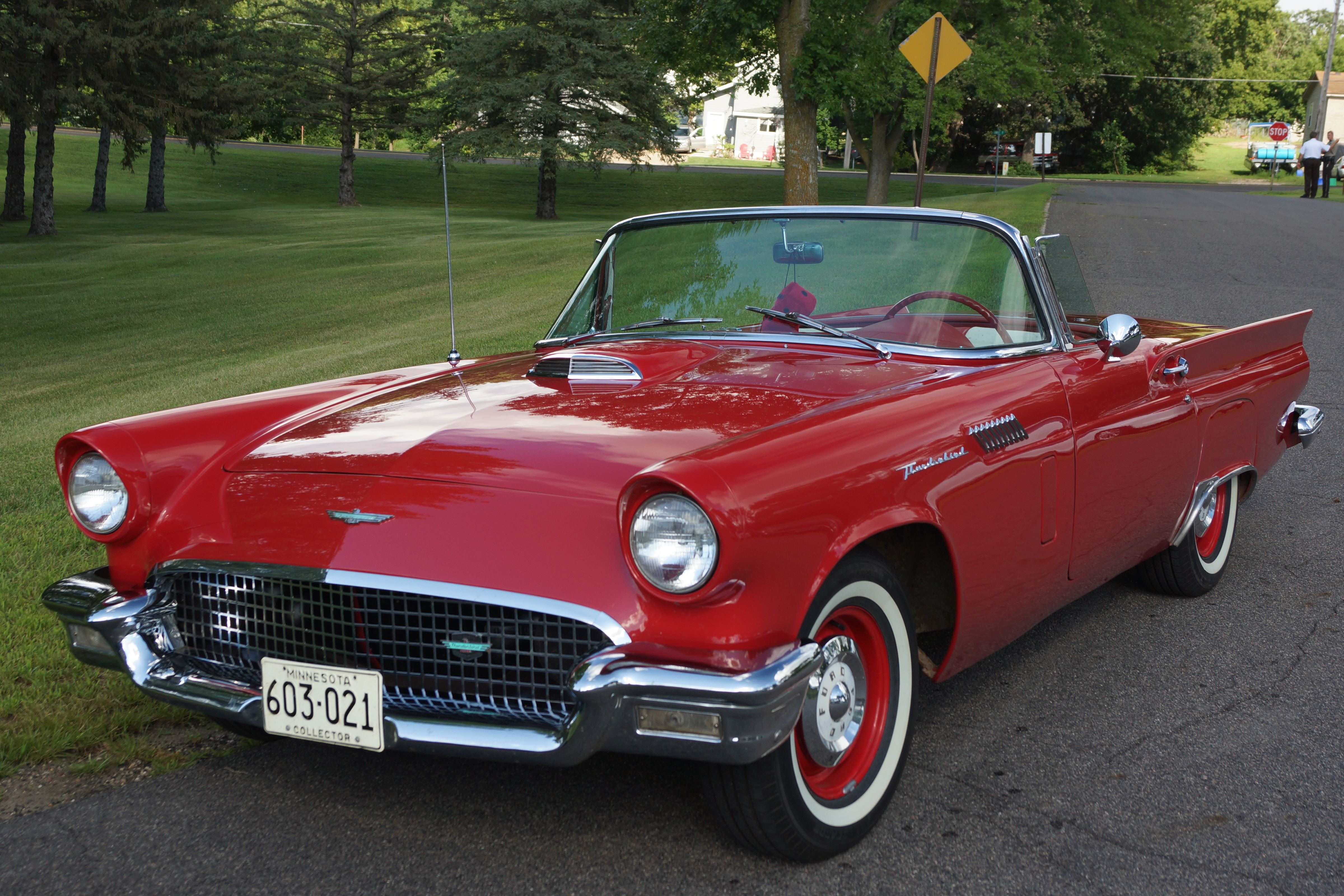
"...what he knew best was the 55 to 57 Thunderbirds, because that's, he bought one for himself as a daily driver when he turned 16. And he restored another one all through the 60s. He knew those cars from bumper to bumper..."
The Ford Thunderbird is a famous car made by Ford between 1955 and 1957. It's known for being stylish and comfortable, and many people love it for its classic look.
The Ford Thunderbird is a classic American car produced from 1955 to 1957, known for its distinctive styling and luxury features. It was originally designed as a personal luxury car and has become an iconic symbol of the era.
"...just a savvy marketing decision. It is also a tip of the hat and our support for the Bible of the automotive hobby Hemmings Motor News..."
Hemmings Motor News is a magazine where people can buy and sell classic cars and car parts. It's very popular among car lovers and collectors.
Hemmings Motor News is a well-known publication that focuses on classic cars and the automotive hobby. It serves as a marketplace for buying and selling vintage vehicles and parts, making it a key resource for enthusiasts.
"...mostly just a new old stock, commonly available Ford parts..."
New old stock means items that were made a long time ago but are still brand new and unused. This is often used for car parts that are no longer in production but are still available.
New old stock (NOS) refers to unused products that were manufactured long ago but have never been sold or used. In the automotive context, it often pertains to parts that are still in their original packaging and condition.
"...that's why he chose the name National Parts Depot, which he pretty much ripped off from Ford."
National Parts Depot is a company that sells parts for older cars, helping people fix and restore them. They focus on classic models like the Ford Thunderbird.
National Parts Depot is a company that specializes in providing reproduction parts for classic cars, particularly for models like the Ford Thunderbird. They offer a wide range of parts to help restore and maintain vintage vehicles.
"...he was very, very cognizant that the new upcoming big thing Corvettes were already monopolized. That market was already saturated with suppliers..."
The Chevrolet Corvette is a well-known sports car that many people admire for its speed and unique look. It's been popular among car lovers for many years.
The Chevrolet Corvette is an iconic American sports car known for its performance and distinctive design. It has a strong following among car collectors and enthusiasts.
"...At that time, second gen Camaros were just used cars. Nobody thought of that being a restoration parts business at that time..."
The Chevrolet Camaro is another classic American sports car that came out after the Mustang. It's known for its performance and style, and many people enjoy restoring them.
The Chevrolet Camaro is a pony car that was first introduced in 1966 as a competitor to the Ford Mustang. It has become a popular choice for car enthusiasts, especially in the restoration market.
"...and then beyond that was three separate bays that comprised a full service restoration facility of the highest order."
Mustang parts are the different pieces that make up a Ford Mustang car. People buy these parts to fix or upgrade their Mustangs.
Mustang parts refer to the various components and accessories specifically designed for Ford Mustang vehicles, which are often sought after for restoration and customization.
"...the second bay was paint, and the third bay was bodywork, which is a very, very filthy bay if anybody's working in the body shop."
A body shop is a place where cars are fixed, especially when they have dents or scratches. They help make the outside of the car look good again.
A body shop is a facility where vehicles are repaired and restored, particularly focusing on the exterior bodywork, including collision repairs and painting.
"...inished the first job number one, which was a 67 Mustang GT8 coupe that we own. We've had in the collection no..."
The Ford Mustang GT is a fast and stylish version of the Mustang, which is a famous American sports car. It's known for its strong engine and cool looks, making it a favorite among car lovers.
The Ford Mustang GT is a high-performance variant of the iconic Mustang sports car, known for its powerful V8 engine and sporty design. It has been a symbol of American muscle since its introduction in 1964, making it a frequent topic in automotive discussions.
"...one of the marquee shops for a restoration that was really over the top for the time as far as thoroughness and quality..."
Restoration means fixing up an old car to make it look and work like it did when it was new. It can take a lot of time and money to do this right.
Restoration refers to the process of returning a vehicle to its original condition, often involving repairs, refinishing, and replacement of parts. This can be a meticulous and expensive process, especially for classic cars.
The 1971 Cadillac is a luxury car from the early 1970s. Cadillacs are known for their comfort and style, making them popular among car enthusiasts and collectors.
The 1971 Cadillac is a classic American car known for its luxury features and distinctive design. Cadillacs from this era often represent a significant part of automotive history and are sought after by collectors.
"...three cars that are all for sale right now on Bring a Trailer..."
Bring a Trailer is a website where people can buy and sell special cars, like classic or rare models, through online auctions.
Bring a Trailer is an online auction platform specializing in classic and enthusiast vehicles. It connects buyers and sellers, providing a marketplace for unique cars.
"El Dorado convertible. Black with red interior. Is that black or is that like a dark gray? No, it's a dark blue in this picture."
The Cadillac El Dorado is a fancy car made by Cadillac, known for being stylish and luxurious. It was made for many years and is often sought after by collectors, especially the convertible version.
The Cadillac El Dorado is a luxury car that was produced by Cadillac from 1953 to 2002. It is known for its distinctive styling and was often available as a convertible, making it a popular choice among collectors.
"...that's a sweet spot for mileage for 51,000 miles on it. It's quote unquote low miles and it's probably the original engine and driveline..."
'Low miles' means the car hasn't been driven very much, which is usually a good thing because it means it's likely in better condition than cars that have been driven a lot.
'Low miles' refers to a vehicle that has been driven a relatively short distance compared to typical usage. This is often considered a positive factor in determining a car's value and condition, as lower mileage can indicate less wear and tear.
"...I think the Coupe de Ville's and the mainline Cadillacs of this era were actually more attractive cars than the El Dorados..."
The Cadillac Coupe de Ville is a large, fancy car that was popular in America for many years. It was known for being stylish and luxurious.
The Cadillac Coupe de Ville is a full-size luxury coupe that was produced by Cadillac from 1949 to 1993. It is known for its elegant design and was a symbol of American luxury during its time.
"...wo, another convertible and a nice one? The 1991 Camaro Z28 convertible, white, which is a nice color for th..."
The Chevrolet Camaro Z28 is a special version of the Camaro that is designed for speed and performance. It's been around since the late 1960s and is popular for its racing background and sporty feel.
The Chevrolet Camaro Z28 is a performance-oriented version of the Camaro, known for its powerful engines and sporty handling. First introduced in 1967, the Z28 has become an iconic model in the muscle car segment, often discussed for its racing heritage and performance capabilities.
"It's a five liter automatic transmission, 16 inch wheels."
An automatic transmission helps the car change gears by itself, so you don't have to do it manually. It's easier to drive, especially in traffic.
An automatic transmission is a type of vehicle transmission that automatically changes the gear ratios as the vehicle moves, allowing the driver to focus on driving without needing to manually shift gears.
"It's a five liter automatic transmission, 16 inch wheels. It's just like a nice clean cruiser."
A 'five liter' engine means the engine is big and powerful, which helps the car go fast. It's a common size for sporty cars.
The term 'five liter' refers to the engine displacement, indicating that the engine has a total volume of five liters. This size typically suggests a V8 engine, which is known for providing strong performance in muscle cars.
"I've never been a huge fan of the third gen F bodies just from a kind of a build quality and standpoint."
F bodies are a type of car made by GM that includes the Camaro and Firebird. They're known for being sporty and fun to drive.
The term 'F bodies' refers to a platform used by General Motors for the Chevrolet Camaro and Pontiac Firebird models produced from the late 1970s to the early 2000s. These cars are known for their sporty design and performance.
"... literally ruled the streets and the Camaros and Firebirds at a hard time dealing with us. Were these good ..."
The Pontiac Firebird is a classic car that was made for speed and style from the late 1960s to the early 2000s. It was very popular and often raced against another car called the Camaro, which is why it's often mentioned in car discussions.
The Pontiac Firebird was a classic American muscle car produced from 1967 to 2002, known for its performance and distinctive styling. It competed closely with the Chevrolet Camaro and became a symbol of the muscle car era, making it a significant part of automotive history.
"I'm leaning towards the Z28 based on the premise..."
The Z28 is a special version of the Chevrolet Camaro that is designed for better performance and handling. It's often sought after by car lovers.
The Chevrolet Z28 is a performance-oriented variant of the Camaro, known for its powerful engines and sporty features. It's a popular choice among muscle car enthusiasts.
"...t's car number three? 440 powered, 69th to myth, Roadrunner hard top. Illicolor combination. This is like a ..."
The Plymouth Roadrunner is a classic car that was made in the late 1960s and 1970s, known for being fast and having a fun horn that goes 'beep-beep.' It's popular among car fans because it was a cool and affordable option for speed.
The Plymouth Roadrunner is a classic muscle car produced from 1968 to 1980, known for its performance and distinctive 'beep-beep' horn. It was designed to be a more affordable muscle car, making it a significant part of American automotive history and a beloved choice among enthusiasts.
"...whether or not it's fitted with a 440 under prior ownership. So it didn't come from the factory with the 440..."
The 440 engine is a big V8 engine made by Chrysler. It's known for being powerful and is often used in fast cars from the muscle car era.
The 440 engine refers to a 7.2-liter V8 engine produced by Chrysler, known for its high performance and power, commonly found in muscle cars like the Plymouth Road Runner. It was a popular choice for enthusiasts seeking speed and acceleration.
Select text to request an explanation
The Muscle Car Place online podcast episode number 635.
This week it's the first show of 2026 and it's a new beginning.
We have new dreams, new goals, new achievements to be done, and also new milestones.
Rick Schmidt is here to kick off the new year with the celebration of 50 years of National
Parks Depot.
Now, any business, a family business or otherwise that can survive 50 years is a remarkable thing.
But it didn't always go as well as it is now.
They started out with Nut and Bolt Kits, then they did high-end restorations.
That didn't turn a profit.
And then finally the big leap into the future, Ford Mustang Parts.
A family business is a 24, 7, 365 kind of life and for Rick growing up in it, wasn't
something he necessarily wanted to take over, but he sure is glad he did.
Our Mustang Parts line is really the core of the sun for National Parks Depot.
So, to this day it's the largest market there is in the classic parts realm and it's not
because Mustangs are better than other cars, it's because they've, for decades, not been
just popular, but plentiful, and plentiful, means you have to sell a lot of parts.
This is the Muscle Car Place online podcast, brought to you by National Parks Depot.
This is the weekly show dedicated to people worldwide who love American muscle cars.
If you're buying, selling, restoring, even racing them, this is the place for you.
Now, here's your host, Rob Kibbey.
Yes, indeed, I am Rob Kibbey and welcome to the Muscle Car Place podcast.
Well, here we are, everybody, the first show of the new year.
And Rick is going to start us off with a tale that'll be inspiring, if anything else,
and it will inspire you to do the right thing for the long run.
And doing stuff for the long run is at times murky, unclear.
Sometimes you don't know if it's going to work out.
But in your heart, in your gut, if you know this is the thing I should be doing, stick it out.
And in your heart, if you know this is not the thing I should be doing,
it's okay to quit. It really is. It really is okay to quit.
Give it your all. But at some point, be honest with yourself, this isn't going to work.
I'll have more of that in my upcoming talk about goals for this year for myself.
Now, the story of NPD and what has made it succeed when so many others around it like it failed
is remarkable. Now, Rick, I don't know if he shares this or not,
but it is fun to have your own business. It's really fun to have your own business.
It's also really not fun to have your own business.
And you can't have one with the other.
Rick will share all that here as well as growing up in a 24-7, 365 type of family business.
It's hard. I think you're going to love it.
Plus, we take a look at some cars to flip for the January auctions,
make a little money. That's always fun.
Now, point of news. Since the Kibbe and Friends show was recorded this week on January 5th,
yes, I have heard the news and I've seen all this stuff that the Hemi really is coming back
in the charger for 2027. Unless I've missed something though, I haven't yet seen a real
photo. I have only seen rendering, cool renderings, but at this point, I want proof.
I want the real thing. And while I'm at it, I'd like the real thing with a stick shift and a
handbrake. But at the minimum, I want to see a real photo of a real new Dodge Charger with a
real V8 in it. Yes, I realize the new V8 may not be as good as the six that's in there now.
I don't care. I want the V8. I think I read an article somewhere is that who put it? Maybe the
car and driver. They said, people want chargers that don't require chargers. You know what I mean?
I'm hoping that'll come to, man, here in 2026, we've only got, well, basically two
muscle cars left, the Mustang and the charger. And you might say that neither one is. I mean,
they both kind of blur some lines, don't they? Well, let's talk about 2026 goals. Now, goal
setting, I will tell you, is important to me. It is one of many things that led to me being able
to leave my cubicle from a regular day job and go have my own business. I'm not here to tell you
that everything went great and perfectly and well. In fact, it's been a roller coaster. Things got
kind of good, then things got kind of terrible for about two years. And then things got kind of
good and then things got better again. But that's how it is when you're somewhat self-employed
or in a very, very small business. But setting goals, I will tell you, for me at least, has been
mandatory to move the needle. Without them, I'm lazy. I get sedentary. I do the same thing over
and over every day and expect different results. That doesn't work. That's the definition of insanity.
So without goals, without measurable goals, I can tell you that I wouldn't have
probably left that cubicle. And I sure am glad I am. There are a lot of lines of thought on this.
Some people say, do seven areas of your life. I just do three. I used to do that. I kind of
whittled it down. So I do this. I do personal goals, career goals, and health goals. That's
all I do. I've done those a number of different ways over the years. But personal is a combination
of stuff like social interactions you want to have, stuff for your family, intellectual
growth for yourself, spiritual growth, your life with the Lord. That's all under the personal
section. Then career goals, careers, exactly what it sounds like, career business, whatever that is,
then health is exactly what it sounds like. And if all of that is stuff that doesn't
push your trigger, just do this. Answer these three questions. Who do you want to meet this year?
Where do you want to go this year? Who do you want to be this year? Let me say that again.
These are mine. I made this up. Who do you want to meet this year? Where do you want to go this
year? Who do you want to be this year? Well, I'm going to give you my personal goals here. So
my personal goals cover a lot of ground. Again, social, family, intellectual, spiritual.
But for my kids, I want to take my oldest daughter to Alaska this year. She has a goal to hit all
50 states by age 21. Alaska is next up. That would be a great summer vacation. Want to do that.
I want to take Dallas to another full racing season and build his career to a point
that he's a brand and teach him along the way of how to take it over for himself.
He'll turn 18 at the end of this year. He needs to be in charge of his future, not me. I want to
be there and help him achieve his goals just like all my kids. But it'll be his bag, not mine.
I would not be serving my son very well if I just kept doing stuff for him. And I'm not just
doing stuff for him now. I mean, he puts in work, but the next step next year is his.
And it's my job to get him prepared for that. This will be a big year of racing. I'll touch
more on that on the Dallas Kibbut racing update coming up later. And for my daughter, Noelle,
she has dancing dreams, man. She wants to live a life of poverty.
She really has her heart set on making a dance academy this summer. I don't know that it's a
real money spend, but it's a very high competition spend. She'll have to audition her way in the
door. I hope that that can happen. So my wife is mostly running her dancing career, but there's
a lot that has to happen. And all the kids are in school, M's in college and the other two kids
are in high school. So there's a lot to do right now. This year will be my wife and I's 25th
wedding anniversary. I want to take her on a trip somewhere, just the two of us. And that's
really hard for us to do because we have a lot of balls in the air and we don't necessarily
have a great way to leave two high school kids at home alone right now. But that's a goal. I want
to do it. And then I want to finish a goal I failed at last year. My goal last year was to read the
whole Bible in a year. And I didn't make it, but I failed at it. I've read lots of the Bible
throughout my life, but I have never covered or cover made it all the way through. Well, last year
I got about a sixth the way through. So I have five, six to go. I will finish that this year.
Career. I have three businesses. Muscle Car Place Network is just one of them. And Muscle
Car Place in itself is a pretty complicated one. It's got lots of moving parts, but it's really
just one big business. I have another two, and one of those needs to end. And it doesn't need to
end, but it needs for me to exit. I started the process of that on July 1st, 2025, with the exit
date of June 30th. That's the date. I'm not going to speak too much more of it than that,
but there have been a lot of things in process since that time. It's a business that is fun,
but it takes up a lot of time. And it's time for somebody else to take the reins and it has the
capability to be successful. Just need somebody else to breathe on it right now. I want to do
another car build this year and possibly sell it as a sweepstakes car. As you know, I don't think
it's any surprise that I'd love to be in the new car building business. That's a pretty big jump,
but doing the car flip business, I could do that. And I would like to introduce that into our business
this year. I'd also like to be an astronaut. But I'm crossing that off the list for now. It's not
really attainable. There are several goals that are important to me. And they're kind of on the
nice to have list. Chassis for the Chevelle, engine for the generally in a transmission,
engine for the these are all goals that I've had for several years. They've all taken a backseat
because of time and finances to other goals that are more important than me. But maybe this is the
year with the right industry partners, they can happen. But they can't just happen on my own
checkbook. I don't have those kinds of funds. I want to build the brand of the Kibbe and French
show. I'm just going down the list here, build the brand of the Kibbe and French show on YouTube.
And to some extent muscle car places as well. When you're in the audio podcast business like I am,
you get an audience like you, a friend, like somebody who listens to you often in their ears
directly, like with your buds. And that listens to you maybe for 45 minutes or an hour at a time.
It's a lot. Video is a way to get a broad content, but sometimes it's not very deep.
If you put out a 30 minute video, you're lucky if you get somebody to watch it for two minutes,
right? I mean, we all do it. But the truth is, that's where the masses are. YouTube is the largest
video platform in the world. It surpasses television. So that's a place that we've got to be.
And our niche on the Kibbe and French show is Duke to Hazard. No surprise there. This is the year I
want to get a license from Warner Brothers to sell merch. And it's not that you can't sell
Duke's merch, but in a lot of people do, but I want to sell the real stuff. I think that's an
attainable goal this year. Also, my final career goal, this can take a backseat to building cars
too. I want to race a car this year. And I really haven't decided what it is. I wouldn't necessarily
mind racing a legends car if I have the time, because that's certainly the most direct thing
that I could do, but I need to drive something. I'm happy driving all my own cars, autocross,
stunt, driving, rally, those are all fine. But I need to find a specific measurable goal to be
able to race a car this year. I need a little fun. Another business goal is to add an airplane to
my business with me flying. I do have a license. I'm not current. I would like to become a safe
current pilot this year, but I can't do that and race a car this year. It's too much. I've got to
pick one and only one. The one that makes the most logical sense is to get into flying, because
Dallas, I know I got to do a lot of travel this year. The one that makes the most fun is for me
to be the driver. That would be awesome. Health goal. All right. Here's the health goal for 2026.
A, it's totally vanity, but B, I just want to see if it can be done, because as of my current age
of 50.5 years old, it's never happened ever. I want to see abs. I want to see if it's possible
for this Swedish heritage body to produce abs. Now, I don't think I want to live the life it
takes to maintain that, but I just want to know one time, can I do it? Now, last year I lost 25
pounds. I've maintained that. I put on a little muscle last year, not nearly enough, so this year
I do have a goal to put on another 5, 10 pounds of muscle, but at age 50.5, I want to see if I can
get abs. My goal is by spring break. Again, I don't think I can live the life that it takes to
keep that. I can certainly keep the current weight that I am, or maybe I'd like to trim down another
5 pounds maybe, but my main goal after the abs is then to maintain a weight with good muscle
tone and all that, because A, it makes me feel better. I mean, you do feel better about yourself
when you look a little better, but I also physically feel better. I really used to get sick all the
time. I was always sick in one way or another. I wasn't really sick at all last year. It's got to
be because of the weight loss, but what I didn't get good at last year was eating real meals.
Everything was just basically ingredients like chicken, broccoli, rice, egg whites, all things
that are super easy to track. One real success to any form of weight loss is to eat the same
things all the time that are really good for you, and for the most part, do. But if you want to go
sit down with your family and have an appetizer or a main course and a dessert,
that's a lot of calories at a restaurant. But just to do that at home, far simpler,
I haven't figured that out yet. I don't yet know how to do that. I would like to get back to that,
because sitting down at a family meal is nice. It's a very pleasant thing.
Again, those are my goals, and there's lots of them in there, but really, it's personal,
it's career, and it's health. If that's just too much for you or not in your lane, do this instead.
Who do you want to meet? Where do you want to go? Who do you want to be?
And no matter what route you go, do the smart method. Specific, measurable, attainable,
realistic, and timely. And timely means that you have a deadline on it. Specific is it's very clear
what it is. Measurable is you know how you're getting there. Attainable means you can do it.
Realistic means you have the ability to do it. So for example, I said I want to be an astronaut.
I do, but I don't have the realistic ability to do that. It's also not attainable.
It is specific. It's very measurable. I can put a timeline on it, but the other two things won't
happen. To race a car, I got to put some specifics on that, but hopefully that all helps. Okay,
I'll hold you. I'll hold you. You'll hold me to this, because you know, last year I didn't even
want to tell you guys I was trying to lose weight. I was embarrassed to say it. It was in some ways
harder than I thought it would be and far easier. It really wasn't that bad. It took a long time.
It took a long time to get the first 10 pounds off, which was opposite of what I was told would
happen. I was told the first 10 pounds just melt to it. No, not for me. That first 10 pounds just,
it didn't want to leave. And then the next 10 pounds, it did want to leave. It went opposite of
that. So, Byrne, let's go ahead and cue the Dallas KB Racing Car Update, please.
So, the 26th season for Dallas has started. Now, I didn't say the legends racing update,
because he won't just be racing a legends car this year, but he'll do all the big legends
races this year. If you're not familiar, legends cars are great little entry level race car that
for a realistic cost, you can get a lot of skills on. It's real racing against real competition
at real tracks. And he started testing at Auburn Dale Speedway at Winter Haven, Florida on January
2nd. The first big event of the year there is called the Winter Nationals. It's a six-day event,
February 8th through 13th. Every day is a practice day, a heat, and a race. You're on a controlled
set of tires. It's a lot of racing. It's really hard and it's the best competition.
The goal for this year is for Dallas in legends car now, not just go turn laps and get seat time.
Now he needs to race the good guys, and mainly only the good guys. That's what's left now to do
with legends cars this year. He may never exit legends permanently in the future. I mean,
Bubba Wallace still races a legends car, but for this year, for the main kind of racing,
this will be the end of legends. It's time to move on to the next thing after this,
probably late models. I do have a goal to get him in some late model tests and some races this
year. I already have a few things in the works for both of those items, but also he just likes to
drive. I want to get him some experience in a rally car weekend, and I want him to go to a session
of drifting and some stunt driving. He just wants to drive. Now that's a problem. I get that passion,
but racing and getting paid to drive are two different things, and racing is a backwards
business. The movie F1 is a little bit of a lie. Being a racing nomad in multiple disciplines
for top pro money, unless you're AJ Ford or Troy Stewart, it rarely works out that that's the
focus usually in your disciplines. Clay Millican in his late 50s is having the best part of his
racing career right now. He's stuck it out for the best parts, and he's getting them now,
but he's also in a very specific lane. He's a top fuel NHRA driver. For Dallas, this is the year to
keep trying stuff. I mean, he's still young enough to try stuff, but he'll be a senior in high school
this year. He needs to start making some moves. A lot of kids his age have already made those moves.
I know that. It's sometimes tough to swallow and understand that maybe it's too late for this.
I don't think so. I think we move kids up too fast these days. In every sport,
you see kids who are burned out on playing baseball by the time they're in ninth grade.
I don't think Dallas would ever get burned out on racing, but I do think that people jumping into
late models just so that they can get seen while they're 16 or 17 years old at the top level is
maybe a little stupid. Certainly expensive. Okay, so that concludes the Dallas Kibbe Racing Car
Legends update, or just the normal update. Cue the exit. All right, before we get to our interview
with Rick, hey, I know that life isn't all rose and sunshine for many of you out there, but it
eyes him so this week about the day he shot Will Ferrell with an animal trichelizer in the
nook for the movie Old School. Well, actually the part where he gave him mouth to mouth afterwards.
It's not as funny, but you know, when I pull him out later, I pull him out of the water and it
gives him mouth to mouth. Like the first take, I did it and Will's like, what are you doing?
He's like, you could kill somebody because I breathe air into him. Like I was trying to give
him CPR like a moron, like instead of acting, like I blew air into his mouth and he was like,
dude, it's like that's not safe. I'm like, oh man, I almost killed Will Ferrell. He's pissed at me
right now. That sticks out because that was a bummer moment for many reasons, but also like, dude,
learn to act. Oh, there you go. No matter how bad your day is, you didn't almost kill Will Ferrell
today. So there's that. All right, let's move forward. Up next is Mr. Rick Schmidt for the
very first interview of 2026 and the story of National Parts Depot's 50 years and counting run.
Burn, roll and please. The Muscle Car Place weekly podcast interview is brought to you by our good
friends at National Parts Depot. See them through the link at themusclecarplace.com.
Up next on the National Parts Depot hotline first for 2026 is Mr. Rick Schmidt from NPD. Rick,
happy New Year. Happy New Year. As you know, and as our listeners now know, we record these
sometimes many weeks in advance. We are recording this more than a week before Christmas, but as
you hear this, it is January 9th. The New Year baby has come. The ball has dropped. Rick, do you
stay up until the 31st, like midnight for the New Year? Yes, I do. You do? You watch it happen?
Yes, I do. And sometimes one of my gentlemen who pretty much runs all for the operations
aspect of the NPD warehouses, he and his wife have not every year, but they tend to like to put on a
nice New Year's Eve party. So when they do have a party, we'll Uber over there and have a good time
and Uber home eventually. And when they don't, just stay home and watch the New Year's Eve programming
and kind of like Christmas Eve and just kick back and enjoy, you know, take it all in, enjoy. Yeah.
And this New Year is very special for me and for us here at NPD as this marks our 50th anniversary
year, which is pretty mind blowing. The more I sink my head into it, how long it's been,
where we started. It went back and remembering the early days in the 80s and the 90s, just
scraping and scrambling. So 2026 in many aspects is a really, really special year for us.
Well, I thought that's what we could talk about today, because over on our Kibben Friends show,
NPD sponsors the new segment. And we have nothing to do with the fact that you're turning 50 years
old, but we have been promoting the hell out of it. Well, thank you. And I'm excited for that.
Like you mentioned watching the New Year ring in, my wife and daughter went to New York,
maybe February of 2025 for a little trip. My wife sent me a picture from our hotel room.
She said, I think I'm looking at the ball that drops like on top of this other and she sent
me a picture. It was like during the daytime. I think it is, you know, the cotton ball that
drops. That is neat to me. I like to see the New Year ring in. And I do, like you say, reflect
on the year that was. And I kind of like all the little countdowns they do on TV of
things that happened, monumental stuff in the year prior.
There's numerous different New Year's Eve coverages going on in New York and, you know,
in the Dick Park, where it's now done by Ryan Seacrest, I guess, has always kind of been the
prominent ones, but you can channel surf if you're bored with who they've got his guests,
performers and everything. But I always get a kick out of the unscripted surprises that
always seem to happen in these New Year's Eve celebrations that are televised on TV where
they get a group of guests or at least one guest who's been downtown partying for a little bit
too long to be on TV. And that makes me laugh and I enjoy that. It kind of shows the celebratory
human side of things too, where it's not all, they don't have 100% control over everything.
It's just a big party. The first day of the New Year for them is a rough one. Yes.
Typically. Well, I did want to talk about NPD's 50th anniversary here. I don't know that we've ever
had like a look back through time here, but 50 years of anything is a big deal, especially 50 years
in effectively a family business here. That's what I wanted to do today, Rick. I do want to
walk people through some cars and obviously January's auction month and we have some fun
auction cars to look and I'm totally going to try to make you flip some cars and make some quick
money and all that, but NPD turning 50 this year. So take me back to 1976. Was it called
National Parts Depot in 1976? What did they sell then? Yes, it was. I don't know if it was,
maybe we did have a dysfunctional family. I don't know. I was eight going on nine in 1976.
My dad had been earlier in the 70s and all through the 60s. His career was running my
grandfather's manufacturing business, which was a giant machine shop, of course, because they
manufactured pneumatic valves and cylinders that would be used for automation manufacturing.
Pneumatic valves and cylinders are also what mobilized many of the original characters at
the Disney parks. A lot of my grandfather's stuff got used down there when everything's
air powered. I think it's all electric now. They've converted it. The shark in the movie Jaws,
that's all my grandfather's gear inside that shark. Wow. So it was an interesting company.
My grandfather was sole owner and my dad was basically the operations manager and vice president
of Fabco, and then all of his brothers and even his sister, the whole family worked there,
which had its benefits and had its curses. My dad was always the laser focused workaholic
of the entire family, even more so than my grandfather, because my grandfather really
liked to travel a lot. He sought balance in his life, but my dad had a hard time with the balance,
and he was just work, work, and organized. We should be doing this. So him and my dad
butted heads a lot. So it was, I think, 74, 75 when they finally parted ways. And then my dad bought
some machine, reinstalled it in our basement, started doing piece work, basically outsourced
work for Fabco as a means to continue gathering an income while he decided what to do. And then
what he decided he wanted to do, what his real passion was, was all through his teenage years
in his 20s, he was always collecting and accumulating NOS parts, used parts, buying and
selling interesting cars. He was a huge classic car hobbyist all his life, and he wanted to make
his career. So since what he knew best was the 55 to 57 Thunderbirds, because that's,
he bought one for himself as a daily driver when he turned 16. And he restored another one
all through the 60s. He knew those cars from bumper to bumper, back and forth. He knew every
square inch of the T-birds. So that's what started in the basement of our house. Dad was doing all
the text work and wrote out his own inventory cards and was taking photographs on this photo
photography table. Did I really know what he was doing and what the master plan was at eight years
old, seven years, eight years old as he was working up to this? I didn't have slightest idea what was
going on down there. I was in my own life, went to school, did my homework, and my mom pretty much
dominated my upbringing while dad was work, work, work, work, working in the basement. I'd go down
there and lug them every once in a while. And there was never any discussion as to what is this
going to be. So I was the first person to actually answer the phone when dad put the line in for the
business or eating dinner, phone rings in the office. I jumped up because I always wanted to
be the one who answers the phone. So this is a new phone in the house. So that was even more
exciting. I just didn't even know what the hell it was for. So I picked up the phone. I can hear dad
steps behind me because I just like scared, you know, was away from the kitchen table before he
even knew what was going on. I answered the phone. Some guy on the other end goes, oh,
is this National Parts Depot? And I say real quickly, sorry, you must have the wrong number.
My dad follows me. He's like, oh, no. That's the new business now. And that's how people never
answer that phone again. That is my phone. Luckily, the gentleman called back. Dad,
that might have been his first order for all I knew. And his only source of marketing back then
was a small advertisement in Hemings Motor News. So we started out in the basement of our home
in Gainesville, Florida, 1976 with one small ad placed in Hemings Motor News. So that's another
relationship that we've held for all these 50 years is we started life with Hemings.
And today, if anybody subscribes to Hemings, we own the back cover. We've been advertising
a full page ad on the back cover of Hemings for many years now. It's not just a savvy marketing
decision. It is also a tip of the hat and our support for the Bible of the automotive hobby
Hemings Motor News and the fact that we kicked off our entire business through them.
Was the repertoire of parts, the parts that's selected, were those all just things that your
dad as a hobbyist and knower of Teabirds knew to advertise that other people would want? Like,
how did he make a catalog? Back then, a lot of the 55 to 77 Teabird parts were still available
through Ford. Ford, GM, all of the American auto manufacturers were not so quick to discontinue
service parts for older cars as they are today. Today, everything's just disposable. They just
hope that you drive the wheels off of it, trade it in and get into one. But back then, off a lot
of the Teabird service parts were still available. So it was mostly just a new old stock, commonly
available Ford parts. But the only difference was then, I mean, this is back in the analog universe,
most dealerships did not stock these old Teabird parts. They didn't have them sitting on the
shelves at the dealership parts departments. So if you did walk in there and say, I wanted this or
that, you'd have to go there, sit there at the counter with the guy in this parts book, then
they'd have to order it in and he weren't going to get any kind of special price. He'd need just
be paying a retail for it. Well, the only advantage that dad had was that he kind of had everything
sitting there for 55, seven in original Ford in stock to where you could call him instead of calling
your local Ford dealership and have everything delivered to you in a manner of several days,
instead of how long it would take back then to get stuff ordered into the dealership. So it was
mostly just new old stock Thunderbird parts. And of course, the Teabird market was very vibrant
then. So there were some pioneers, I would point out Larry Thunderbird, Larry and why is his last
name escaping the main now? Because he was a big pioneer in the reproduction Thunderbird parts. He
was starting to reproduce this is and that's, you know, trinkets and things that would go obsolete
from Ford that were good sellers that he thought that would be worthwhile doing. So and then as
time marched on, the other of dad's competitors got into the reproducing parts business and
everybody kind of shared with everybody as far as they were competitors, but they are also willing
to wholesale their exclusive reproduction parts to each other. When did it expand beyond Teabirds?
Pretty quickly. To quote my father, he said to me once, as soon as I realized that I could
pay the bills and put food on the table selling Teabird parts, my next decision was, okay, well,
what comes after this? And that's why he chose the name National Parts Depot,
which he pretty much ripped off from Ford. Ford called its main central parts warehouse there
in Detroit, Michigan and Dearborn, or maybe it was in Livonia. Anyhow, they called their main
parts warehouse their national parts depot. Are you kidding? That's why it's that?
Yes, I didn't know that. So he thought, oh, I'd make a good name. He intentionally wanted something
that was very open-ended so that he wasn't painted in a corner or limited to only selling
Teabird parts for the rest of his life. Everybody else in the business was such and such as
Larry's Teabird parts, prestige thunderbird, thunderbird, thunderbird, thunderbird, and even
the new upcoming Mustang businesses at the time were California Mustang. Mustangs unlimited,
Mustang Mustang. There's a lot of things that my dad did that were a little bit off the beaten
path or kind of revolutionary for the restoration parts business, but he stuck with this generic
national parts depot knowing that he could steer that business anywhere he wanted to steer it
and the name would work. He was very, very cognizant that the new upcoming big thing Corvettes were
already monopolized. That market was already saturated with suppliers because Corvettes were
kind of collector cars from the moment they rolled off the line. But he didn't want to cast his
hook into that pond because it was already too overpopulated. He looked at the Mustang market
and said, look at how many millions they built. This is going to be pretty big. I think I need to
start moving into Mustang parts. And that was the wisest decision that he ever made was going
into the Mustang parts. Our Mustang parts line is really the core of the sun for national parts
depot. To this day, it's the largest market there is in the classic parts realm. And it's
not because Mustangs are better than other cars. It's because they've for decades not been just
popular, but plentiful. And plentiful means you have to sell a lot of parts.
What was the next car after Mustang? What was the next car that wasn't a Ford?
Directly after Mustang and just to prove that my dad's never been just a Ford guy or this guy or
that guy, he immediately jumped into a, he may have done Chevelle first just because he thought
the numbers were better. At that time, second gen Camaros were just used cars.
Nobody thought of that being a restoration parts business at that time. But the Chevelles,
that was 1964 through 72. Whereas the Camaros was only three years. People were really
thinking of, well, that's a classic Camaros, a 60, 70, 99. That was only three years of production.
So dad went to Chevelle first because that was a full eight years of production. Very popular,
very good selling. So it was a Chevelle first. And then it wasn't long after we had the Chevelle
parts on the shelf and a Chevelle catalog out that dad told Mike Cousins, who is our marketing
director, we lost Mike in believe late 2000 for early 2001, but he had an infection that just
took him over like that. And I waved goodbye from him. I said, all right, see you tomorrow.
We'll leave in the office on one day in the next morning, I get the phone call that Mike's no
longer with us. It was huge loss because he was very instrumental in helping my father build MPB
and he researched and laid out, produced all of our catalogs back then. So as soon as we were
done with Chevelle, Mike was off to the races with Camaros. Was your dad just good at looking at the
opportunity of the market and the timing that he was in? Because 50 years in business is hard. I
mean, 50 years in anything is really hard. But those first foundational years is basically where
you can get your foothold. That first decade must have been hard, was it? Oh, yeah. Once he got into
the Mustang parts and things were really cooking, then all of a sudden he's very, very cognizant that
I got to move out my basement. Kind of like a kid doing, starting a business at his parents' home,
you know, in the basement and then kind of move out from underneath my mom and dad and actually
get a space of my own. So he was thinking big. He bought some property right on I-75 with interstate
access there in Gainesville, built a 21,000 square foot warehouse, which he didn't need for the parts
business at that time. But it was his ambition. We were incorporated under the name AutoCraft
Investments when he finally incorporated himself. And National Parts Depot was a DBA underneath
AutoCraft Investments. AutoCraft, he got a dealer's license and he was selling collectible cars from
a showroom in the front of the building. And that showroom faced by 75s, the drivers on the
interstate could see the classic cars and the windows. And then in the middle was our Tibered
and Mustang parts to begin with. And then beyond that was three separate bays that comprised a
full service restoration facility of the highest order. That almost killed the restoration part.
The mental stress, the finances. The first bay was mechanical and assembly,
second bay was paint, and the third bay was bodywork, which is a very, very filthy
bay if anybody's working in the body shop. It's better to have a separate building and
you just do that somewhere else. It's not contaminating everything else. And his joke
all along was like, I make it so much cash in the parts department and I'm taking all that cash
and I'm loading it into a wheelbarrow and I'm walking it out back to the restoration shop so
I can set it on fire. And you've told that story in many times. How many years door to door was
he restoring cars? 1978, nine-ish. I think they finished the first job number one, which was a
67 Mustang GT8 coupe that we own. We've had in the collection now for 35 or 40 years because
we bought it back from the grandson of the guy who had us do it. It was around 78, 79 through
1986, 85, 86. So not a whole lot of time. A lot of cars got done. They were at the time
the restoration business and not the parts business, but the rest of it has also evolved
considerably. And the standards and the quality for craftsmanship and detail and correctness
have increased exponentially since the 70s and the 80s. Dad's shop, Ottercraft, was known
nationally as being one of the marquee shops for a restoration that was really over the top
for the time as far as thoroughness and quality. And they were expensive too, but his customers were
paying the money. We did mostly Teabirds because Teabirds were dad's specialty, but we did some
Mustangs and we did some other unique 63 Thunderbird Sports Roadster. I remember that coming through
the shop, but dad only did stuff high end and high quality. And that was his problem. It was
finding skilled professionals to work for him. Ever so often, dad would go back to inspect
somebody's work, paint, body, mechanical, wherever, and he'd find out that the job was not up to his
standards and he'd tell the guy, okay, I'm going to help you, but we're going to do this all over
again. And whenever he started doing things all over again, his ethics and his sense of right
and wrong would not allow him to bill the customer for those hours. Those hours were on the house
because the customer shouldn't have to pay for things to be done twice or three times over.
Believe it or not, a lot of shops don't operate that way. They screw up, you're paying for the
deal. If your car is on the clock, your car is on the clock, no matter what a mess they're making.
My dad didn't do that. And that made it near impossible for him to make a profit
for storing cars because he was too picky and he was too obsessed with the way that he thought
things should be done and the way the car should turn out. And he wound up doing so many processes
two or three times over before he was finally satisfied that it buried him. So luckily,
we're only into that six or seven. The very last car that was in the shop, that had already fired
everybody. The whole restoration crew out and he had one car that he had to finish and he was
trying to do the whole damn thing himself. He literally did get all the car body work done,
primer blocked, the body was done and he had done the whole entire chassis and engine and
mechanicals himself. But in primer with the chassis finished, he all developed to a friend of his who
also had a Teabird restoration shop in Alabama and had him finish it just because dad needed
it out of his hair. It was monopolizing all of his time and back then he didn't have time.
So that's got finished in Alabama and we own that car now.
Well, we've got the very first car that was completed Outercraft and we got the very last
car that was not really completed by Outercraft. It was done up in Alabama. We bought that back
from that customer as well later on. Were you supposed to be part of this from the get go?
Was it your dad's expectation that you would take the reins? Remember this year you said,
hey, I said, what would you do different if you weren't doing this? And you said, oh,
detail cars or maybe be a dentist. Yeah. I think orthodontist is what I said.
Yeah, orthodontist. My dad was a hard cookie to work with. He was a hard cookie to be a son of
in the 70s and 80s. And in the 80s, his NPD was growing, but all of the challenges of,
I left out the whole entire Jimmy Carter era where dad built that building on an adjustable rate
loan. And at one point in time, he was paying 18% on that loan. And that's another thing that
almost killed national varsity, but before it ever had a chance to be anything.
Death was that construction loan. Those were tight times, stressful times.
You wouldn't have wanted to work for my father back then. He was under a lot of stress.
And there's some of the old employees that worked in the restoration shop and in our sales
department, the parts department, that we're still very close friends with them today. And in
recent years, they've come and visited my dad at his home. His dad's retired and slowed down.
I literally get tears in my eyes sitting there as we're visiting how appreciative they are to my
dad of, you taught me so much. It wasn't easy. And sometimes it was fairly abrasive and abrupt,
but you're always right. And I had a lot to learn and you showed me that and it made me
a better person later on in life. So everybody who was able to ride through that storm back in
those days seemed to be very, very fond of my father. But at the time, I don't think anybody
was very fond of him. And me as a kid, having to deal with him at home and then at work when I would
was working there summers and whatnot, pushing brooms and mowing the yard and everything,
I didn't want that to be my future. But it all just kind of worked out. When I did start,
I helped my dad bailed him out and helped him get our Michigan store put back in shape in 1987.
And then when I came back to Florida and started working full time, as things evolved,
we finally got the business up and making a good regular profit. And his dad finally started to
ease off the gas as far as his own killing himself. Worked at 80, 90, 100 hour weeks.
As things finally started to develop into a real business, and we had a controller and we had a
real accounting office, and once we had a real business, Tim and I started to work together
better. And that evolved through the decades and through the years to the point where we were
really a great team because all of the hard nose aspects that my dad brought and all the discipline
that he brought to the table, I kind of brought in some of my mom's personality as being a good
mediator between the employees and also with customer service. My dad was kind of a hard ass
with customers because he couldn't understand how people could butcher a completely good part.
In his view, when people were saying, well, this part didn't fit or something. My dad's
knee jerk reaction was, well, you don't know what the hell you're doing. That's why you're having
problems. I was kind of the person who got in there and said, you know, we need to be a little
nicer to our customers. So I fit into all the nooks and crannies where my father was not terribly
adept with the business. And between the two of us, we were actually a pretty good match. Did
I plan on doing any of that? No. I had no aspirations early on. I loved my father,
but I certainly did not want to work with him because I thought that that would just be
week after week in hell. The finances side of any businesses is sometimes what takes it down.
It's usually what takes any business down is that their numbers just don't work. But NPDs
have, and I mean, you talked about a construction loan that was difficult. You're also famously
a very conservative company. Your inventory is owned. You have multiple properties. You ride
out the storms. You don't take out the bridge loan every six months. My father's business acumen
and discipline and his ability to do complex mathematical equations in his head, all of
our family kind of has. I was always a math whiz too. I've got a uncle who can pretty much do
calculus in his head, but his ability to understand the business math, understand what it took
to wind up at the end of the month with enough money left over to finance further operations
and his ability to stick strongly to that, you know, because you know, even back then,
we've never been known as a company that does a whole lot of holiday sales,
promotions and discounts and points, clubs. And that really goes back to my dad saying
he'd point to one of our competitors who was given 15% off for the holidays. And he was like,
well, that's a month that they're losing money. They might make those customers happy for a month,
but they are not going to turn a profit that month. And then after the sales over, those
customers aren't going to stay loyal either. They're just going to look for the next discount
somewhere else. He was always very disciplined. He was just like, keep your eyes forward. It's
a business. If you're not making money that you're not picking your payroll and you're not
paying the insurance for your employees and you're not going to have
capital for growth, you've got to stay the course. And he was always very, very disciplined,
where I think a lot of business owners look at around on their competition and they get obsessed
with following and doing the same things they do because they feel insecure and they feel,
well, if we don't do the same things that they do, then they're going to win and we're going to
lose. The winning and losing early comes is very much more complex than that. It involves quality
and it involves speed of service. It involves the experience of your employees. It involves
the ethics of the business. It's not just the price tag on the parts. Either he understood that
or that's what worked out with him because he stubbornly was very disciplined in how he learned
about business. He was never agreeable to wavering from that. What do you think the next 50 years
holds? I don't know. I didn't think I was going to be here for the end of the first 50.
I mean, really, in the 1990s, I think all of us in this industry looked around at each other and
thought by 2025, 2026, all of these old cars will have already been restored and what will be left.
And these modern cars, the math and the numbers don't add up formally. And again, my dad made
his prediction. He says, Rick, I just want you to focus on maintaining a healthy, strong,
ongoing, viable business because he says at the end, there's always going to be a market there
and there's always going to be enough volume to have a nice, profitable business. But you've got
to be the last one standing. To be the last one standing, you've got to not trip over your shoelaces
or get too far over your skis. We're so ambitious that you just invest in this and that. And if
doesn't all go well, you can implode like a black hole. So for the next 50 years, survival,
continuing to be smart, continuing to micromanage our profit and loss statements every single
month to make sure that we are dialed into the recipes that makes us an ongoing, viable company.
And yeah, it's every year, one or more of our longstanding competitors gets bought up by a
private equity firm or the fellow who founded it is going into his 80s and just closes up shops.
Simple as that because he has no family members who want to take it over. I think that the hobby,
and that was dad's prediction, he says, this market, this industry is like a bell curve and it'll
go up and it'll peak and it'll peak and then it'll start to slide down a little bit and it'll slide
down. And he said, and some of the competitors will fall out to the wayside and that's kind of
happened. And he says, and that's going to steady out to a flat line that'll go off into infinity.
And he says, and that's where you really want to be. You want to be one of those last ones
remaining. You can write on that flat line, not into infinity, but the rest of my foreseeable
life that I want to keep this thing going. Well, from me to you, thanks for another year together,
but congrats on 50. You know, you shared some personal stuff in there, but working in a family
business is hard. It just is. Like you said, when the workday is over, all the same people got to
see each other again. And what that means is, in a lot of ways, the workday isn't over. It never
really ends. The personal days are not over. It never really ends. You're just kind of in a
24-7 cycle that is life. But when you wake up at three in the morning,
or two in the morning, and you can't go back to sleep, it's very hard to keep the demons of,
I got to do this tomorrow. I got to do that tomorrow. And what's this ongoing stress?
And how are we going to deal with the health insurance next year if this trend keeps going?
All that stuff spins around your mind endlessly. Weekends, nights, you don't just clock out,
go home. Of course, everybody has their own personal issues to deal with as well. But when
you're a business owner, it's the personal and the business all wrapped up into one big yarn ball.
Well, tell you what, let's do this. It is the month of January. And like you said,
everybody in your family can do math in their head. So let's do a little math in your head.
What we're going to do to end out this episode is, Rick, you are going to look at three cars
to make some quick cash on for auction season. Because you and your dad, you do the math in
your head. Somebody in your family can do calculus. So you are going to flip some cars.
And what you need to do here is pick a car here that you can buy right. Because if this is what
you want to do, if you want to flip a car that you typically make your money buying it because
you know how to sell it, what I've presented for you are three cars that are all for sale right
now on bring a trailer. And the goal is to buy one and you have a price gap. You cannot buy a car
that costs more than $30,000. And your goal is to take it to an auction, any January auction you
wish based on the vehicle type and make a profit. And you want to pick the one that you think you
can make the most on. So what do we have for car number one? Car number one is a 1971 Cadillac
El Dorado convertible. Black with red interior. Is that black or is that like a dark gray? No,
it's a dark blue in this picture. Oh, you're right. Red leather interior looks to be original
interior. Almost certain the car has been repainted on 51,000 miles. Now when it comes to
auctions, cars and you know this price range, I never know what makes a winner or a loser.
Yeah. Sometimes they go for good money. And sometimes they just they walk out the door and
you can't understand how somebody could pay so little. This car has a presence to it.
This little Western car, it looks like it's a year out in Los Angeles. Am I right? Newbury
Park, California. Like I said, original interior that's fairly clean. There's some patina on the
driver's seat. But I'm more particular about that stuff. It seems like patina is getting
to be less and less of an issue with many collectors. They can actually kind of just
enjoy the originality. So I'm trying to step out of my own OCD and this car's got an awful
lot of presence to it. It's a dynamite color combination under the hood. Looks very well
preserved and doesn't look like it's been monkeyed with by shade tree mechanics. It doesn't have
yellow spark plug wires and bunch of incorrect hose clamps and stuff like that. So it looks like
a really pretty nice quality car, but that's a sweet spot for mileage for 51,000 miles on it.
It's quote unquote low miles and it's probably the original engine and driveline and nothing's
been rebuilt, which is good, especially if it's just been serviced religiously all of its life.
So this has all the earmarks of being a really nice quality car. I personally have never been a
huge fan of these big El Dorados. This is what big and little enus drove and
the generation that followed of the convertible El Dorados were so iconic and so handsome. And
these were kind of in comparison, kind of bigger and more bloated and kind of more old foggy ish.
Is that a word? Old foggy ish, then the ones that succeeded it. Yeah, like this way. Also
old foggy ish compared to the really sharp smaller coupes that preceded it. This El Dorado,
all my childhood was never an aspirational car. It was just kind of a big, ugly boat to me.
I've since mellowed my opinion on that and I would love to have this car. Quite honestly, I think
the Coupe de Ville's and the mainline Cadillacs of this era were actually more attractive cars
than the El Dorados. This is one of these weird generations of Cadillacs where I might argue
that the El Dorado was kind of the ugly duckling. They had great photographer do this car because
the photography, I'm saying all this stuff about it, but the car looked dynamite. It's like a
pro photo shoot. I like it, but it's not always been the most desirable of the generation of
El Dorados. Right now, the purchase price is $22,000. Could you make money with that?
At $22,000, yeah, I could make money on it, but who knows where it's going to go.
Just as an offhand thing, there was a thing that had five or six thousand original miles on it,
1971 Mach 1 on Tringer Trailer last week, white with black stripes,
or speed, 351 Cleveland car. Very nice car. Right up to the very end, it was bid up to about
$80,000, $80,000 or $90,000. Right up the very end, which at the time I thought was all the money.
It hammered for over $200,000. So you really don't know what something's going to go for until
the last 30 seconds of the auction and all of a sudden the bidders get serious and it all spirals
up. At $22,000, yeah, you make plenty of money on this car. I think this is a $35,000 car,
but then watch this auction end and it doesn't blow right past that and show that I'm out of
touch with where the market's at right now. I don't know. What do we have for car number two,
another convertible and a nice one? The 1991 Camaro Z28 convertible, white,
which is a nice color for this car. These are the classy vibes, 12,000 original miles.
It's a five liter automatic transmission, 16 inch wheels. It's just like a nice clean cruiser
and it's in like new shape. I've said that before. I don't think it's a mystery. I've never been a
huge fan of the third gen F bodies just from a kind of a build quality and standpoint.
And I was a five liter Mustang guy in the late 80s when we literally ruled the streets and
the Camaros and Firebirds at a hard time dealing with us.
Were these good convertibles?
No, no. Was this a GM?
Like crazy, but again, so did the Mustangs. Now, the 80s and early 90s was not a home market
quality. But here's the deal, just stepping all back from it. There's no denying that
third generation F bodies were drop dead, gorgeous styling-wise. And this is a really,
really pretty car. It's also no mystery that the third generation F bodies,
the Fox body Mustangs have already taken off. These are starting to take off.
So in a manner of speaking, this car has an awful lot of resale potential because this whole
generation and era of Camaros and Firebirds are really taken off right now. I think it's a growing
wave. So even though I'd much rather have that El Dorado cruise around in, I like the vintage
stuff anyhow. I'd much rather have the El Dorado myself personally. But right now,
if I'm looking to make a profit and flip it, especially this thing's only sitting at 13.6
right now, there's a lot of room on this car. I'm leaning towards the Z28 based on the premise
we started out with here.
Okay. How about car number three then? And by the way, all these auctions,
as we do this review, they are all within three hours of ending. So the prices we're giving you
here, you still have three hours to go. And that's usually when there's a tick up here. But what's
car number three? 440 powered, 69th to myth, Roadrunner hard top. Illicolor combination.
This is like a burnt orange, black roof and then a white interior. I love it, whatever it is. Or
25,000 miles shown, three mileage unknown. It's got a Holly four barrel hooker headers,
automatic transmission. It is red paint. It's got a modern stereo and aftermarket gauges.
This is a driver car, not so much a rest of mod, just a driver, muscle car. I can't see
anywhere whether or not it's fitted with a 440 under prior ownership. So it didn't come
from the factory with the 440. So this is not a blue chip collectible. It's a muscle car for
somebody who wants to be a great car. Cool. Color combination. It's not the type of car
where you're going to have three or four serious collectors on an auction going above and beyond
to make it theirs. Cars like this are worth what they're worth. And people kind of stick to their
sanity when it comes to bidding. It's already a $31,000 with three hours left to go. I can't
imagine it going over 40 because it's not even a genuine 440 car. It's not a properly restored car.
It's just a driver and a half fun car. So I can't see it going over 40. And then I'm going to put
it in an auction and try to make money on it. I'll probably lose money on it by the time I pay
for transport and pay the auction fees. Okay. So the Roadrunner is a loser for making money.
Not enough meat on this one. So it's the Caddy or the Camaro?
The El Dorado could survive this and bring a real high price tag just because it's got so much
personality. And where are you going to find another one like this one? Be tough to find.
But that's kind of a gamble. I think the sure money is on the white Z28 unless this
auction goes to the moon in the last several seconds.
How about that? Even you had to pick an F-body.
Yeah. See you. It's just math, right?
I love all cars. I love all cars. But then when you make me compare one to another to another,
then I have to pick my favorites. Rick, there's no wrong answer. It's ask Rick.
We'll track all three and just kind of see where they final out. But for the Camaro,
what's the max price you want to buy it for? 15?
No, no, no. Not that high. It's at 13.6 right now.
Because it's not an IROC. Sure, it's good looking. I would want to get into this no more than the
low 20s with the hopes to be able to get high 20s out of it. But like I said, these are really
starting to scream upward right now. And then maybe it goes into the 30s. And that's where I
could really ring the bell with it. But I would try to have no more than 20 in it.
Okay. Well, Rick, for me to you, congrats on 50 years and happy new year.
Yeah. Well, thanks for letting me because you get me started about 50 years and I can go on
through seven or eight episodes and everybody will be kicked back in their chairs,
taking a nap, listening to me to reminisce about this, isn't that and everything. But
being a family owned business and having them made it 50 years. So we're very, very sentimental
about it. And I hope all of our customers know how much we appreciate them for keeping us
in this and for us to be so strong present day 50 years later is just a blessing. And it's a
surprise 30 years ago, 20 years ago, I wasn't forecasting. I'd be where I'm at right now.
And our customers are what helps make this happen. It's pretty awesome. Thank you, Rick.
Happy new year. See you next month. Happy new year.
Thank you, Rick. Excellent as always. It's going to be a fun year, gang. Alright, that is it for
our very first show of 2026. I will be back next week. But between now and then hit me up on
Facebook or Instagram anytime. Be sure to subscribe to us on Apple podcasts and Spotify
and YouTube. And you can find every single show and all the merch on the homepage of the
muscle car place.com website. And as always, don't forget to keep chasing your dreams like
you've let me chase mine. Yes, that's a new outro. See you later, everybody. Bye bye.
Sponsors often, they make it all possible. See you soon at the muscle car place.
Request an explanation for:
12 cars
Scroll for more
12 cars featured
Request an Explanation
Heard something you'd like explained? We'll add it to this episode.
Sign in to request explanations for terms you heard.
Want to learn more?
Browse our glossary for plain-English explanations of automotive terms, jargon, and concepts.
See something that's not quite right? Our annotations are AI-generated and can sometimes miss the mark.
Click the flag icon on any annotation to suggest a correction.