Tony Stewart and the hosts bounce from Talladega memories to how racing has changed: horsepower got cut, tire and setup rules evolved, and aerodynamics/airflow now shape grip and passing. Stewart compares his era’s 875-hp packages to today’s “500 horsepower,” explains why reduced power changes lift points, and describes restrictor-plate strategy, restarts, and etiquette. The conversation also tracks his path from local dirt and go-karts to IndyCar and beyond, plus a detour into NHRA and drag-racing procedures.
This week on Oil & Whiskey, we sit down with racing legend Tony Stewart.From dirt tracks and Talladega stories to NASCAR, IndyCar, NHRA, sprint cars, and life after Cup racing—this episode goes everywhere.Tony talks about:The moment he knew NASCAR was changingOld-school racing stories most people have never heardGetting pulled over… multiple timesThe chaos of grassroots racing cultureWhy dirt racing still mattersLife after NASCAR and finding new challengesThis wasn’t your typical polished interview. It turned into one of the funniest, most honest conversations we’ve had on the podcast.
Filter:
|
TechnicalToo Afraid to Ask
Term
road course race
"...we were coming from a pavement race, a road course race somewhere, and it was just when everybody..."
A road course is a track layout built to resemble regular roads, with a mix of corners, braking zones, and changing directions. Racing on a road course usually demands strong braking and cornering balance compared with oval or dirt-only formats.
"...it was just when everybody, we were just on the front edge of when guys that were running dirt were going away from knobby tires to the slicks."
Knobby tires have chunky tread that grips dirt better. They’re used when the track surface is loose or bumpy.
Knobby tires have raised tread blocks designed to bite into loose dirt or gravel. They help with traction and steering on uneven, low-grip surfaces compared with smoother tires.
"...when guys that were running dirt were going away from knobby tires to the slicks."
Slicks are smooth tires with almost no tread. They work best on clean, consistent surfaces because they make more contact with the ground.
Slicks are tires with little to no tread, optimized for maximum rubber-to-track contact. They’re typically used on paved or very consistent surfaces because they can’t evacuate water or dirt the way treaded tires can.
"...soft enough to run on dirt tracks and found out they were racing across the street at night."
Dirt tracks are made of packed dirt, not pavement. The surface can get rough and slippery as the race goes on, so tires matter a lot.
Dirt tracks are racing surfaces made of packed soil or clay, which can change grip as cars throw up ruts and debris. Tire choice is especially important because traction can vary lap to lap.
An enduro is a longer race that tests staying power and strategy. Instead of just sprinting, teams manage tires and fuel over time.
An enduro is a long-duration race where the focus is often on endurance, consistency, and strategy rather than just outright speed. In motorsports, it commonly involves running for hours and managing tires, fuel, and driver stints.
"So, you know, two stroke, you lean over to adjust the high speed on it."
A two-stroke engine makes power with every other piston movement, so it can feel quick and lively. It also usually needs special oil handling compared to many four-stroke engines.
A two-stroke engine completes its power cycle in two strokes of the piston, so it tends to make power differently than a four-stroke. In racing contexts, it’s often associated with simpler mechanics and a strong, immediate throttle response—plus it typically requires oil mixing or separate oiling systems depending on the design.
"you lean over to adjust the high speed on it. You reached over, you're holding on a butterfly steering"
“High speed” is the tune for how the engine gets fuel when you’re going fast. Changing it can make the bike/car pull harder—or prevent it from running too lean or too rich at top speed.
“High speed” here refers to the high-speed fuel/air setting on a small racing carburetor (or carb-style fuel system). Adjusting it changes how the engine runs at wide-open throttle, affecting power, throttle response, and whether the engine runs lean or rich at speed.
Term
butterfly steering
"So, you know, two stroke, you lean over to adjust the high speed on it. You reached over, you're holding on a butterfly steering when you reach over right here"
“Butterfly steering” describes a steering setup where the driver uses a small, pivoting control (often a handlebar/lever arrangement) that moves like a butterfly-shaped linkage. In go-kart and small racing applications, it’s a compact way to provide quick steering input with minimal movement.
"and grab the T handle needle. That's how you set the Yamaha."
The “T handle needle” is a knob used to fine-tune how much fuel the engine gets. Small changes can noticeably affect how the engine runs when you’re accelerating or at certain speeds.
A “T handle needle” is the adjustment knob connected to the needle valve in a carburetor-style fuel system. Turning it changes fuel delivery across part of the throttle range, letting the rider tune mixture and engine behavior.
"and grab the T handle needle. That's how you set the Yamaha."
Yamaha is the brand of the engine. The speaker is saying that the tuning steps they just described are how you set up that Yamaha to run right.
Yamaha is the engine brand being referenced, and the speaker is describing how they tune it. In small racing engines (like go-karts/enduro-style setups), Yamaha powerplants are commonly carbureted and tuned with needle/mixture adjustments.
"What was the secret sauce on the tire prep?
[759.4s] Nobody did. Nobody treated tires back then."
Tire prep is what teams do to get race tires ready so they grip well. The goal is to make sure the tires are in the right condition and temperature for the track.
Tire prep is the set of practices used to condition race tires before (and sometimes during) a session to improve grip and consistency. It can include how tires are cleaned, warmed, and treated so the rubber reaches the right temperature and surface state for the track.
Topic
tire treatment and prep culture (back then vs now)
"Nobody treated tires back then.
[761.8s] Really?
[762.4s] We ran treaded tires.
[764.1s] Nobody treated tires with anything."
They’re talking about how race teams used to prepare tires compared to later on. The point is that tire treatment became a bigger part of racing over time.
This segment contrasts older racing practices—where tires were not treated—with later approaches that used more deliberate tire conditioning. It’s essentially a discussion of how tire prep evolved and who adopted it first.
"We ran treaded tires.
[764.1s] Nobody treated tires with anything."
Treaded tires have grooves in them. Those grooves help the tire handle the road surface and can affect how much grip you get in different conditions.
Treaded tires are tires with visible grooves and patterns designed to manage water and debris and to provide mechanical grip. In racing discussions, mentioning treaded tires usually signals a setup where traction and tire behavior are strongly influenced by tire compound and surface texture, not just slick-like grip.
"I got to think about all that fun you had in Talladega at the big track
[786.3s] in the infield across the street."
They mention Talladega and the infield area, basically recalling experiences from racing there. It’s part of the story they’re telling about that time.
The hosts reference Talladega, specifically the infield area, tying the conversation to Tony Stewart’s racing experiences at the track. This functions as a narrative anchor for the episode’s NASCAR-related reminiscing.
"... going to do a commercial tomorrow with Dodge and Ram and we're promoting a truck that has 777 horsepow..."
The Dodge Ram is a large pickup truck designed to carry loads and tow trailers. In this episode, it’s mentioned because the specific truck being discussed has a lot of power. That makes it more than just a basic work truck.
The Dodge Ram is a full-size pickup truck line known for towing and hauling capability, along with available high-performance powertrains. In the podcast context, it’s being promoted as a truck with very high horsepower, which is notable because it shifts the conversation from work duty to outright performance. That’s why it comes up alongside a commercial and a specific power figure.
"I was walking out of the fucking gym this morning and I'm just looking down. I look over and like, there's a fucking F-150 Shelby. And I look at the side, it says like 760 something horsepower."
This is a special, performance-focused version of the Ford F-150 pickup. The host’s point is that you can buy a truck like this from a dealer with big horsepower numbers.
The Ford F-150 Shelby refers to a high-performance version of the F-150 pickup developed under the Shelby performance brand. The key point here is that it’s a street-legal truck you can buy with very high advertised horsepower, which the host contrasts with what NASCAR used to run.
"[1491.9s] I mean, it's well on the horsepower thing to from from hopping into
[1496.0s] three quarter midgets and then you went into Sprint, which that's that's
[1500.0s] what 500 horsepower jump right there."
Horsepower is basically how strong the engine is. More horsepower usually helps the car go faster, but it can also make the car harder to control.
Horsepower is a measure of an engine’s power output—how much work it can do over time. In racing talk, higher horsepower usually means more potential acceleration and top speed, but it also changes how the car must be driven and set up.
Term
car setups
"[1532.2s] in the drastic, seemingly drastic change in driving styles, tracks, car
[1540.6s] setups, horsepower and all of that."
Car setup is the configuration of adjustable parameters—like suspension settings, tire choices, and aerodynamic balance—tuned to a driver’s preferences and a specific track. Changes in setup can dramatically alter how the car responds to steering, braking, and throttle.
"[1549.4s] Even jumping from Sprint to Indy car, because you didn't have a 56
[1555.4s] 78 year like lead up of like, oh, he's getting a little bit better
[1559.8s] this year and he's getting better this year.
[1561.4s] You jumped in to a fucking Indy car, which in that era, it was mid nineties,
[1566.6s] right? Early nineties. Yeah."
Here, “Indy car” means the special open-wheel race cars used in IndyCar racing. They’re built for fast racing and require different tuning than smaller series.
In racing context, “Indy car” specifically means the open-wheel cars competing in IndyCar events, not just any car that happens to be in Indianapolis. These cars are engineered for high-speed stability and frequent setup changes across different track types.
"Yeah. The car that I qualified at the Indy 500 had a at that time, a thousand and eight horsepower was our qualifying motor."
The Indy 500 is a famous big race in the U.S. held at Indianapolis. How you qualify matters a lot because it affects where you start the race.
The Indy 500 is a marquee American open-wheel race held at Indianapolis Motor Speedway, and it’s one of the most important events on the IndyCar calendar. Qualifying performance there is especially critical because it determines starting position for a long, high-speed race.
"And you got to remember in 95 we won the Usak triple crown. So we won the midget sprint and silver crown championships."
The “USAC triple crown” is a big achievement in USAC racing where you win three major titles/events in one season. It’s hard because you have to be good in multiple kinds of races and cars.
The USAC triple crown refers to winning three major USAC championships/series events in a single season. It’s a notable accomplishment because it requires adapting to different car types and racing formats rather than mastering just one discipline.
"So we won the Usak triple crown. So we won the midget sprint and silver crown championships."
Midget racing is a type of open-wheel racing with small, fast cars. A midget sprint championship means you did really well across many races in a season.
USAC “midget” racing uses small, lightweight open-wheel cars that emphasize quick acceleration, traction, and driver skill in tight, high-cornering-speed conditions. Winning a midget sprint championship means consistently performing at the front across a full season of short-race events.
Concept
Silver Crown championships
"So we won the midget sprint and silver crown championships."
Silver Crown is another USAC series with bigger cars and longer races than midget events. Winning it usually means you can handle both speed and staying consistent over a longer run.
USAC Silver Crown refers to a championship for larger, heavier open-wheel cars that race longer distances than typical midget events. It tests endurance, strategy, and setup consistency, not just outright speed.
Concept
dirt modified
"plus on the side, if I had a night off, I had a couple buddies that had a dirt modified, had another guy that had a dirt late model"
A dirt modified is a race car class built for dirt tracks. Driving it is different from pavement because the surface changes grip as you go.
A dirt modified is a type of race car used in dirt-track racing, typically built for durability and traction on loose surfaces. Compared with pavement racing, dirt modifieds demand different driving technique and car setup to manage slide and grip changes.
"had another guy that had a dirt late model that I got a couple rides in."
A dirt late model is a common dirt-racing car class. It’s fast and races closely, and you have to deal with changing traction on the track.
A dirt late model is a dirt-track stock-car style class known for high horsepower and close racing. “Late model” refers to the modern-era body/format rules, and competing in it usually requires mastering traction management on evolving dirt conditions.
"They called it the turn one had banking to it. Going into turn two had a hump over and then down in this big sweeping corner."
Banking is when a race track corner is tilted. That tilt helps the car hold the turn better at speed, but it also changes how the car behaves as you move through the corner.
Banking is the angled shape of a racetrack corner, where the outside edge is higher than the inside. More banking helps cars generate lateral grip and stay stable at speed, but it can also change how the car loads up as you transition through the corner.
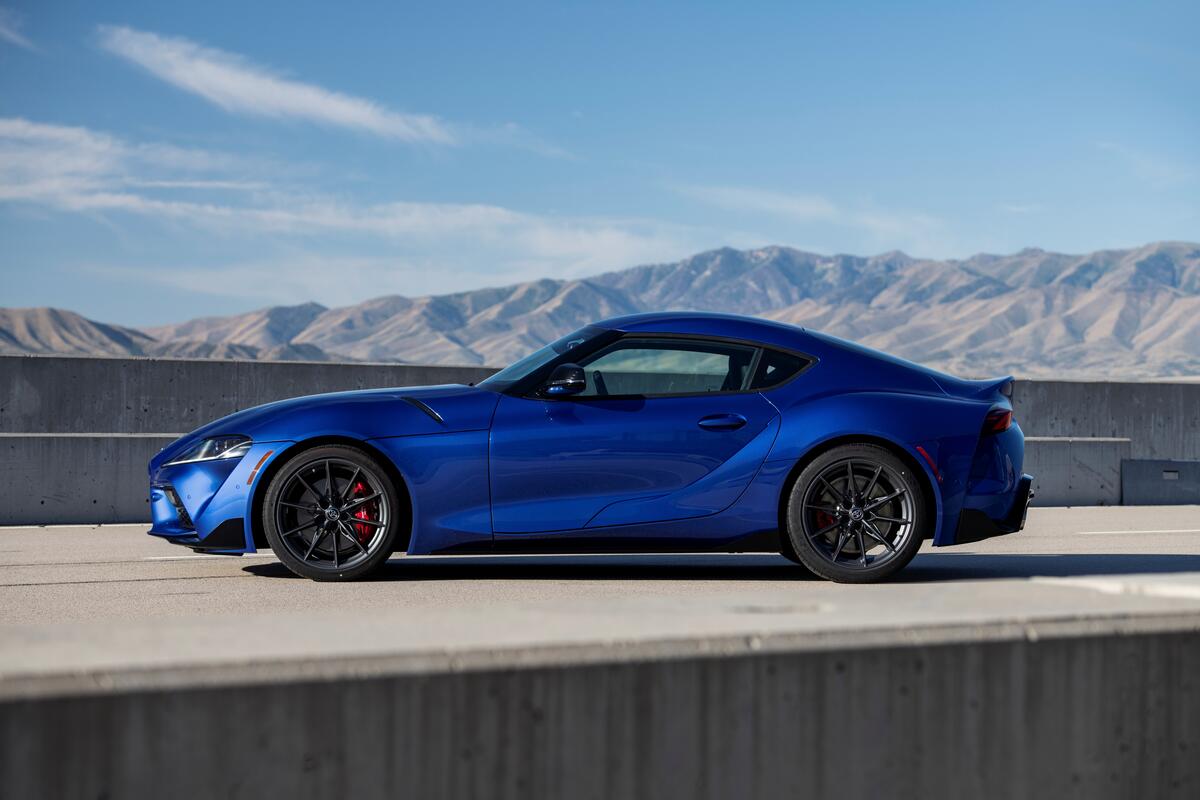
"Going into turn two had a hump over and then down in this big sweeping corner. And it was more than a 90 degree corner. And he had this flat dog leg to the start finish line."
The Toyota Supra is a sports car made for fast driving and good handling. On a track, people talk about it because it can stay stable when the road bends a lot or changes height. That helps the driver keep control and speed through the corner.
The Toyota Supra is a performance sports coupe known for its strong acceleration and driver-focused handling. In a racing or track discussion, it often comes up because its balance of power and stability helps it stay composed through complex corners like long sweepers and elevation changes. That’s why it’s a natural reference when describing how a car behaves from turn-in to the start/finish straight.
"And so off a turn one, when the banking would fall off and those cars had turbochargers on them and where everybody got in trouble was the pace slowed down so much because of the grip that when you went off the corner, now you have turbo lag."
Turbo lag is the short delay before the turbo really starts pushing power. It can make the car feel like it doesn’t accelerate right away when you come out of a turn.
Turbo lag is the delay between when you press the throttle and when a turbocharger can deliver boost. On track, it can make corner exits feel “dead” right when you need immediate acceleration, especially if you’re transitioning from a slow corner to a faster section.
"And so off a turn one, when the banking would fall off and those cars had turbochargers on them and where everybody got in trouble was the pace slowed down so much because of the grip that when you went off the corner, now you have turbo lag."
A turbocharger is a device that uses the engine’s exhaust to force more air into the engine. More air usually means more power, but it can take a moment to spool up after you accelerate.
A turbocharger uses exhaust gas to spin a turbine, which compresses incoming air to increase engine power. In racing, turbochargers let smaller engines make big power, but they introduce boost-control behavior like turbo lag and can affect how power comes on after corner exit.
Concept
crest it over
"And so right about the part where you crest it over was where the turbo would start really bringing the power in."
“Cresting” means going over the top of a hill in the track. As the car goes over, the grip and how the car feels can change, which can make power delivery feel different.
“Cresting” is when the car goes over the top of a rise in the track surface. That change in elevation can alter traction and weight transfer, which affects when the driver feels grip and when the engine’s power delivery (like turbo boost) becomes noticeable.
"But so you're feeling you're feeling G's in inertia.
You're not like these tires are doing this."
“G’s” is a measure of how hard the car is accelerating or turning, compared to gravity. In a corner, those forces can feel strong because your body wants to keep going straight.
“G’s” are a way to describe acceleration forces, measured relative to gravity (1G ≈ the force of gravity). When the speaker says “G’s in inertia,” they’re describing the lateral/turning forces you feel in a corner and how those forces affect grip and vehicle behavior.
"You know, sometimes, you know, cup cars, even that changed over the course
of when I started in Cup in 99 to current, you know, we we never."
“Cup cars” means the NASCAR Cup Series race cars. They’re built to NASCAR rules, so teams can only change certain things to make the car handle better.
“Cup cars” refers to the NASCAR Cup Series stock cars—purpose-built race cars based on production models. In NASCAR, the Cup rulebook and homologation shape how teams can tune aerodynamics and suspension to make the car fast and consistent.
"We ran stiff springs in the front, soft springs in the rear to keep grip.
It wasn't about attitude."
This is about how hard the suspension springs are. Stiffer front springs and softer rear springs change how the car “leans” and grips when you brake and turn.
Spring rate tuning is a core part of race-car suspension setup. Using stiffer front springs and softer rear springs changes how the car transfers load during braking and cornering, which affects grip and balance (how eager it is to turn vs. how stable it feels).
"And then all of a sudden somebody came up the idea through the wind tunnel of
we get the nose down, we get the backup, we get more total down force front and rear."
A wind tunnel is used to measure aerodynamic forces like downforce and drag by testing a car model (or full-scale car) in controlled airflow. In racing, wind-tunnel data helps teams design bodywork and setups that keep the car planted at speed.
"somebody came up the idea through the wind tunnel of
we get the nose down, we get the backup, we get more total down force front and rear."
“Nose down” means the front of the car squats lower. Teams try to control that because it changes how much grip the front tires have when you brake.
“Nose down” describes aerodynamic and/or suspension behavior that pitches the car’s front end downward. In race setups, controlling pitch affects how the front tires load up under braking and how the car transitions into cornering.
"we get the nose down, we get the backup, we get more total down force front and rear.
And that's when the whole game changed."
Downforce is the “suction” effect from the car’s shape and airflow that presses the tires onto the track. More downforce usually means better grip for turning and braking.
Downforce is the aerodynamic force that pushes a car downward toward the track, increasing tire grip. More downforce—especially when balanced front-to-rear—lets a race car brake harder and corner faster without losing traction.
"Well, eventually, though, between the spring rate of the tire and the setup,
it would the nose would rise a little bit."
Spring rate is how stiff the suspension spring is. A higher spring rate resists compression more, which changes how the car’s front and rear move when you brake or change direction.
Spring rate is how resistant a spring is to compression, and it directly influences ride height and suspension pitch under load. In a race car, the spring rate works with tires and aerodynamics to determine how the nose rises or settles after braking and during transitions.
"So the bonus of that is I'm not carrying all the downforce to worry about cutting a tire necessarily, but we didn't have tire pressure sensors then."
Tire pressure sensors are devices that tell the crew if a tire is losing air. If you know early, you can react sooner instead of waiting until the tire feels bad or fails.
Tire pressure sensors (often part of a tire monitoring system) alert the team when a tire’s pressure drops, which can indicate a puncture or slow leak. In racing, earlier detection helps teams decide whether to pit before the tire fails or causes instability.
"The only other time while we were, while you were talking a minute ago, that I was going, where did I ever have anything that was legit fear? Had a loose wheel at a cup race and same type of deal."
A loose wheel means the wheel isn’t tight on the car. That can make the car shake and can get dangerous fast, so it’s something drivers and crews take very seriously.
A loose wheel is a serious safety issue where the wheel isn’t properly secured to the hub. It can cause vibrations, uneven tire wear, and potentially a wheel coming off, so teams treat it as urgent—especially with only a few laps remaining.
"Got a handful of laps left. I don't want to pit. I'm going to go from top five run to somewhere in the late twenties to 30th place in the deal and wrote it out and the vibrations getting worse and getting worse and you know what's going on."
In racing, increasing vibrations often indicate a developing mechanical problem—commonly tire damage, wheel imbalance, or a wheel/hub issue. As the problem worsens, the driver may feel the car becoming unstable and may need to pit or change strategy.
"It's either going to lose enough lug nuts that breaks the wheel or it's just going to break the wheel in general..."
Lug nuts are the bolts that hold your wheel onto the car. If they loosen, the wheel can come off or get damaged, which is dangerous.
Lug nuts are the threaded fasteners that clamp a wheel to the vehicle’s hub. If they loosen, the wheel can shift or separate, which can lead to a wheel failure and loss of control.
"I always think about this, like when you're in a top fuel car and things like things that if something goes wrong..."
A top fuel car is a drag-race car built to go insanely fast in a straight line. If something goes wrong, it happens so quickly that the driver can’t really fix it in time.
A top fuel car is a drag-racing class that uses a purpose-built, supercharged engine and runs extremely high speeds over a very short distance. Because the car is so fast, any mechanical issue can escalate almost instantly, leaving little time to correct.
"...you're doing 300 miles an hour and a quarter mile..."
The quarter mile is a standard drag-racing distance. Since it’s so short, the car gets up to very high speed quickly—so problems show up fast.
The quarter mile (1,320 feet / 402 meters) is the classic drag-racing distance. It’s short enough that cars accelerate from near standstill to extreme speeds before the driver has much time to react to problems.
"Like the, I mean, can you be on a top fuel car? ... Can you steer that thing and really you can correct it? I mean, throttle maybe, right?"
Throttle is how the driver controls how much power the engine makes. In a race, changing throttle can sometimes help, but at very high speed it may be too late to save the situation.
Throttle refers to the driver’s control of engine power by regulating how much air/fuel the engine gets. In racing, throttle changes can sometimes help stabilize a car, but at extreme speeds the window to correct is tiny.
Topic
open wheel drivers
"But can you so, so the things I was telling somebody the other day, buddy in mind, that's open wheel drivers, sprint car driver."
They’re talking about race drivers in open-wheel cars, where the wheels are exposed. The point is that driving skill can look different depending on the type of racing.
This segment contrasts how different racing disciplines judge driving quality. “Open wheel drivers” refers to racers in series where the wheels are exposed (not covered by a full body), such as Indy-style cars and sprint cars.
Topic
sprint car driver
"buddy in mind, that's open wheel drivers, sprint car driver. And, and I was telling him..."
A sprint car is a type of race car that usually runs on short oval tracks. They’re using it to explain that driving skills don’t translate the same way between racing types.
A sprint car driver competes in sprint car racing, typically short oval races with high power-to-weight cars. The episode uses this as an example of how “good driving” can mean different things across disciplines.
"The criteria and drag racing that makes a good driver is cuts a good reaction
[2664.6s] time on the tree, keeps it in the groove."
The “tree” is the start-light system in drag racing. Reaction time is how fast the driver reacts when the lights change—faster reaction usually helps you get moving sooner.
In drag racing, the “tree” is the signal light at the start line. Reaction time on the tree measures how quickly the driver responds to the lights, and it’s a major factor in getting off the line efficiently.
"If the tire spins or shakes and if they shake, they'll spin too, because the
[2694.1s] contact patch is gone at that point."
Your tire only grips the road where it’s actually touching. If the tire starts spinning, that effective grip area stops working, and the car can’t accelerate the way it should.
The contact patch is the portion of the tire that’s actually touching the road. If the tire spins and the contact patch is “gone,” the tire can’t generate the grip needed for acceleration, so the car loses traction.
"But when they spin the tires, a nitro motor wants to be loaded all the time.
[2700.4s] So it's like, you know, short shift and so to speak, and how it kind of"
A “nitro motor” is an engine that uses nitromethane fuel, which is common in high-end drag racing. Because of how that fuel burns, the engine responds differently to throttle and load than a normal gasoline engine.
A nitro motor refers to an engine running on nitromethane-based fuel, common in top-level drag racing. Nitro engines typically need careful throttle control because they rely on fuel flow and engine load to stay in the right operating regime.
"So it's like, you know, short shift and so to speak, and how it kind of
[2703.6s] lugs the motor and you're not really lugging the motor, but it needs to be"
“Short shift” means you shift to the next gear sooner than usual. The goal is to keep the engine in the right zone so it keeps pulling instead of falling off when traction isn’t great.
“Short shift” means shifting gears earlier than you normally would to keep the engine in a favorable RPM/load range. In nitro drag racing, it can help maintain the engine’s required load and avoid bogging or instability when traction is poor.
"and how it kind of
[2703.6s] lugs the motor and you're not really lugging the motor, but it needs to be"
Lugging means the engine is being asked to pull hard at too low of an engine speed. It can feel like the engine is struggling instead of working efficiently.
“Lugging” is when an engine is forced to operate at too low an RPM for the load, so it can’t produce smooth, effective torque. The speaker notes that the situation feels like lugging, but the key is that the nitro engine still needs enough load to behave correctly.
Concept
free the car up
"If you could run flat to make it faster, you just freed it up and it freed the
[2717.2s] motor up, it made everything happier, rolled freer."
“Free the car up” means making the car easier to control and easier to accelerate. The idea is to reduce binding/over-control so it can put power down better—though drag racing doesn’t allow the same kind of “loosen it up” approach.
“Free the car up” is drag-racing/track slang for reducing how tightly the car is constrained—often by changing setup or driving inputs so it can move and accelerate more freely. The speaker contrasts this with drag racing, where traction and throttle timing are more unforgiving.
Term
air compresses
"it's not about crashing the car, air compresses,
[2732.9s] fluid doesn't, liquid doesn't, fuel doesn't."
They’re explaining that gases like air can compress, so the engine doesn’t always respond instantly to what you’re doing with the throttle. That delay can cause a sudden “pop” later instead of smooth power.
The speaker is describing how, in drag racing, staying in the throttle too long can lead to a delayed fuel/combustion event. Air is compressible, so the system can “store” and then release energy/pressure differently than liquids, affecting when the engine actually gets the right mixture.
Term
fuel catches up
"So you stay in the gas longer, you just keep out in fuel to the cylinder, keep
[2738.9s] out in fuel and it'll cycle it through, but eventually the fuel catches up and
[2744.5s] pop."
It means the fuel delivery can lag behind what the engine is doing. If you stay on it too long while the car isn’t hooking up, fuel can arrive late and then ignite all at once.
“Fuel catches up” describes a timing mismatch where the engine’s airflow/pressure and the fuel delivery don’t line up immediately. If the driver holds it too long while traction is lost, fuel can accumulate and then reach the cylinders later, leading to a delayed combustion event (“pop”).
Concept
drag race school
"I mean, I went down to a drag race school in, in Brains in Florida and
[3016.5s] drove Frank Collie's cars and I started in a super comp car."
A “drag race school” is training to learn how to race safely and correctly at a drag strip. It teaches the steps you have to do the same way each run.
A “drag race school” is a training program focused on learning how to run a drag car safely and consistently—things like staging, launch technique, and track procedures. The point is that drag racing isn’t only about speed; it’s also about repeating the right steps every run.
"And so we, he took super comp car down there and he took an alcohol dragster.
[3031.6s] His alcohol dragster is a three speed automatic, uh, runs 220 miles an hour at
[3036.3s] the quarter mile."
An “alcohol dragster” is a drag-racing car that runs on alcohol fuel instead of regular gas. That fuel choice helps the engine make big power for short, repeated race runs.
An “alcohol dragster” is a drag racing car that uses alcohol-based fuel (commonly methanol) instead of gasoline. Alcohol fuels are popular in certain drag classes because they can support high power and strong cooling effects, which helps the engine survive repeated hard runs.
"His alcohol dragster is a three speed automatic, uh, runs 220 miles an hour at
[3036.3s] the quarter mile.
[3037.0s] I'm like, sounds good."
A “three-speed automatic” is a gearbox with three forward gears that changes gears by itself. For drag racing, it’s tuned so the engine stays in the right rev range as the car speeds up.
A “three-speed automatic” is a transmission with three forward gears that shifts automatically rather than requiring a driver to manually select gears. In drag racing, the shift strategy matters because the car needs to stay in the engine’s power band while launching and accelerating down the track.
"So what these guys are doing when, when you do the burnout and come back, they've got to de-ice it."
A burnout is when the driver spins the tires on purpose before the race. It warms the tires so they grip better when you launch.
A burnout is when a drag racer spins the drive wheels while the car is held in place to heat the tires and improve traction. In this segment, it’s part of a pre-run routine that happens before the car goes back in to stage.
"they've got to de-ice it. So they got alcohol spray or whatever. And it, and it dissolves the, the frost on it or whatever."
De-ice means getting rid of frost so the car can work properly. They spray alcohol to melt the ice/frost so nothing gets in the way of the run.
De-ice is removing frost/ice from critical surfaces so the car can run correctly. Here, the speaker describes using an alcohol spray after a burnout to dissolve frost that forms on the car’s components in cold conditions.
"So doing all those steps. And I was struggling with that, the super comp car. And you don't have to do all that with it."
“Super Comp” is a category of drag racing with certain rules about how the cars are set up. The speaker is saying the routine and what you have to worry about can differ by class.
“Super Comp” refers to a drag racing class/ruleset where cars run specific performance and setup constraints. The speaker contrasts it with a dragster routine, implying different pre-run procedures and systems to manage.
"And you don't have to do all that with it. The blower was the part you had to take care of."
A blower is a device that forces more air into the engine. More air usually means more power, and in drag racing it’s something you have to pay close attention to.
A blower is a forced-induction supercharger that compresses air before it enters the engine, helping it make more power. In drag racing, the blower is a key system the driver/crew must manage and keep operating correctly, which is why the speaker says it was the main thing he had to “take care of.”
"and con with confidence that I could do it every time and not, you get to a point as a driver when you're doing things instinctively, not thinking about it"
It means the driver has practiced enough that the actions feel automatic. Instead of thinking step-by-step, the driver just reacts the right way.
In racing, “doing it instinctively” means the driver has built muscle memory and learned the sequence so deeply that actions become automatic. That reduces mental load during high-stakes moments like staging, burnout, and launch.
"And so even driving the nitro car now, Hagen told me, you know, I was a little discouraged."
A “nitro car” is a drag-racing car that runs on nitromethane fuel. Because the fuel behaves differently, the car’s power and how it feels to drive can be noticeably different.
A “nitro car” refers to a drag-racing car that uses nitromethane fuel. Nitro changes how the engine makes power and how the car is tuned, so the driving feel and setup can be very different from gasoline or alcohol-fueled cars.
"It took me a while. I got used to the alcohol car. So I ran full season of alcohol and those cars, the real cars that you're racing are 270 to 280 mile an hour cars."
An “alcohol car” is a drag-racing car that uses alcohol fuel. Since that fuel burns differently than other fuels, the engine response and driving feel are different too.
An “alcohol car” is a drag-racing car that runs on alcohol-based fuel (commonly methanol). Alcohol-fueled engines have different combustion characteristics than nitro or gasoline, which affects power delivery, tuning, and how quickly a driver adapts.
"And so then when Leah decided she wanted to start a family and step down the car to go through a whole season being pregnant and then the second year, you know, raising Dom and getting him off on the right foot. I had to go through that same learning curve again."
A “learning curve” is how long it takes to get used to a new car. Even if you’ve driven before, you still need practice runs to feel comfortable and consistent.
A “learning curve” here means the period of repeated runs needed to adapt your driving inputs to a new car and fuel setup. Even experienced drivers often need many passes to build consistent timing, throttle control, and confidence at speed.
Concept
80 runs
"But the good thing was I'd been through it once and my brain caught up way quicker, but still Hagen and even Leah said it's going to take 80 runs before you get really comfortable in this."
“80 runs” is basically a rule-of-thumb for practice. The more passes you do, the more consistent you get and the better you understand how the car behaves.
“80 runs” is a practical benchmark for how many drag-racing passes it can take before a driver feels truly comfortable. In high-speed racing, consistency comes from repetition—each run provides data and feedback to refine technique and car setup.
"But the good thing was I'd been through it once and my brain caught up way quicker, but still Hagen and even Leah said it's going to take 80 runs before you get really comfortable in this. When you go test, you can do four runs in a day."
Here, “test” means practice sessions at the track. They do a limited number of runs to learn how changes affect the car and to get comfortable.
In this context, “test” refers to track sessions where drivers make multiple runs to evaluate changes and build familiarity. The speaker contrasts test-day workload (four runs) with the longer practice/competition cadence needed to get fully comfortable.
"If the track opens at 10 o'clock, if they're in the water box at 10 o'clock and can be the first one on the track..."
A water box is a wet patch at the drag strip where cars stage before a run. It’s used to help the tires get ready to hook up (grip) right away.
A “water box” is the staging area at a drag strip where cars are positioned over a wet section of track before making a run. The water helps cool and condition the tires so they can generate grip consistently for the first part of the pass.
"...dragging it back, rebuilding the motor, warm up, drag it back up there, make the run..."
Rebuilding the motor means the team takes the engine apart and fixes/refreshes the parts that wear out. It’s something race teams do to keep the engine healthy for repeated runs.
“Rebuilding the motor” means taking the engine apart and replacing worn components so it can survive repeated hard runs. In motorsports testing, frequent rebuilds are common because high heat and high loads accelerate wear.
"...rebuilding the motor, warm up, drag it back up there, make the run..."
Warm up is the short period before the run where the car gets up to the right temperatures. That helps the engine and tires work properly when you start driving hard.
In racing, “warm up” is the process of bringing the engine, drivetrain, and tires up to operating temperature before a run. Proper warm-up improves throttle response, reduces the chance of mechanical issues, and helps tires reach the grip range they need.
"how much throttle input and steering input is there when that thing is hooked up and it is a flawless run?"
Steering input means how you turn the steering wheel and when you do it. For a great run, the driver keeps it controlled so the car stays stable and doesn’t wander.
Steering input is the driver’s commanded steering angle and how quickly it changes. On a “perfect run,” steering input is minimized and precisely timed to keep the car tracking straight and stable under acceleration.
"how much throttle input and steering input is there when that thing is hooked up and it is a flawless run?"
“Hooked up” means the tires are gripping the track well. When that happens, the car can put power down without spinning or shaking.
“Hooked up” describes when the car has enough traction to transfer engine power to the track effectively. If the car is hooked up, the driver can apply throttle confidently; if it isn’t, the tires may spin or the car may shake, forcing the driver to adjust.
"you don't lift unless it spins or shakes or gets you out."
“Spins or shakes” means the car isn’t gripping smoothly. Spinning is wheel slip, and shaking is the car vibrating or acting unstable, which usually makes the run worse.
“Spins or shakes” refers to traction and stability problems during a run. Spinning usually means the tires lose grip, while shaking can indicate instability (like wheel hop or drivetrain oscillation) that ruins repeatability and can risk damage.
"If you get out of the groove and you get one tire out of the groove, the one
that's in the groove is going to out drive the other tire and make your problem
worse."
The “groove” is the best part of the track—the line where the tires stick the most. If you move off it, grip can change quickly and the car can start behaving unpredictably.
In racing, the “groove” is the preferred racing line/track area where tires generate the most grip. If you drift out of that line, traction drops and the car can become harder to control, especially when only one tire loses grip.
"Now with the, with the top fuel car, you got a nose wing on it too.
So you have front downforce and you put input into it and sometimes it'll bring
it, you can bring it back and sometimes it's just not going to bring it back."
A nose wing is a front spoiler-like piece that shapes airflow. Its job is to help press the front of the car down for better grip and control.
A nose wing is an aerodynamic device mounted at the front of a race car to manage airflow and generate downforce. On top fuel cars, it’s used to help keep the front end loaded so the car can respond more consistently to steering/throttle inputs.
Concept
split seconds
"It'll drive through the front tires.
So it's again, it's those split seconds because now you're, you're running
200 and some odd mile an hour by the three 30 and on down."
“Split seconds” highlights how quickly traction, stability, and driver inputs must be managed in drag racing. At very high speeds, tiny changes in grip or alignment can force the car into a different behavior before the driver can correct it.
"You just got to experience it.
You just got, it just has to happen.
And then you're racing simulators for the drag side."
A drag racing simulator is a video/rig setup meant to mimic a drag strip run. The point here is that it still doesn’t feel like the real car, especially the strong physical forces.
Drag racing simulators attempt to recreate the timing, traction events, and vehicle dynamics of a straight-line run. The host suggests current simulators can’t fully reproduce the real-world physical loads (like G forces), limiting how well practice transfers.
"I mean, there just isn't yet.
Um, and it'd be hard to simulate it anyway.
I mean, the biggest thing is the G forces and everything else."
G forces tell you how hard the car is accelerating compared to normal gravity. In drag racing, the body can feel extremely strong forces, and that’s hard to mimic in a simulator.
G forces are a measure of acceleration felt by the driver, expressed in multiples of Earth’s gravity (1G). Drag racing can generate very high G loads during launch and rapid speed changes, which are difficult to replicate in simulators.
Concept
split second decision
"And if an event, we call it an event, if it shakes or spins, even when it shakes, you have to make a split second decision because it's not just shake and get out of it and abort the run."
When a race car starts acting unstable, you don’t have time to think. You have to react instantly—either try to save it or stop the run.
In high-speed racing, drivers sometimes have only a moment to react when the car starts to destabilize. The idea here is that if the car begins to shake or spin, you must decide immediately whether to recover or abort the run.
Concept
abort the run
"because it's not just shake and get out of it and abort the run."
“Abort the run” means giving up on that attempt. If the car is sliding or spinning too much, it’s safer to stop rather than keep going.
“Abort the run” means stopping the attempt rather than continuing when the car is unstable or the situation is unsafe. In racing, continuing through a developing spin or severe shake can damage the car or create a dangerous incident, so drivers choose to end the run early.
"I tell everybody there's like a mild zone and then the heavy zone and it gets in a mild shake... But as soon as it crosses over into that heavy zone is what I call it, you, you have no choice but to bail out of it."
Stewart describes a threshold-based way of judging car stability: a “mild” range where the car can be driven out of the problem, versus a “heavy” range where recovery is no longer realistic. This maps to how tire grip and vehicle balance degrade as a slide/spin develops—once you’re past the limit, the safest move is to bail out.
Concept
pedal it really quick
"You can either bail out of it or the alcohol car, you could pedal it really quick, you would get out of it and get back in it right away, settle it down."
He’s talking about quickly pressing the gas (or easing it) to help the tires regain grip. The idea is to calm the car down so you can drive out of the problem.
This describes a rapid throttle input used to regain traction and settle the car after it starts to slide. The goal is to reduce wheelspin and bring the car back to a controllable balance so the driver can get back on the throttle smoothly.
Term
frequency of the tire
"And it would just, honestly, what it does is it changes the frequency of the tire. So the tire's shaking. Takes it out of that."
Tires can shake or vibrate while you’re driving. That shaking has a “frequency,” meaning how fast it’s happening. If you change the setup enough, the vibration can calm down so the tire rides more smoothly.
When a tire is vibrating, the vibration can show up as a certain “frequency” (how fast the tire oscillates). Changing that frequency—often by adjusting tire setup or balancing—can reduce the shaking and help the tire behave more consistently. In racing, that can matter because vibration can affect grip and tire wear.
"but not at the racetrack in cup racing. ... when I drove in the cup series and when I started in 99, you could outrun the tires."
“Cup racing” is NASCAR’s highest level. The big difference is that the tires wear out fast, so you can’t just push as hard as possible for the whole run.
“Cup racing” refers to NASCAR’s top-level series, where teams race for wins and points using tightly regulated stock cars. Tony Stewart’s point is that tire behavior and management are different at the Cup level than in casual go-kart racing—tires can degrade so quickly that you can’t just drive flat-out for long.
"And if you ran as hard as you could run in 25 laps, your tires would be a soapy dish rack and you were junk and you had to run those things 60 laps."
That phrase describes severe tire degradation: the tire’s tread and sidewall behavior get unstable as the rubber overheats and wears. In NASCAR, that kind of wear can quickly drop grip, forcing drivers to manage pace and tire life rather than running maximum effort for the full stint.
"So if you didn't budget your tires and take care of them, you, you were in trouble."
It means you can’t just drive as hard as possible the whole time. You have to plan how long the tires will last and manage your speed so they don’t wear out too early.
“Budget your tires” means planning how long the tires will last and how aggressively you can drive before they overheat or wear out. NASCAR teams use this to decide when to push, when to back off, and how to manage stint length so the car stays fast enough late in the run.
"You'd catch Mark Martin on the start, on a restart or a run and the crew chief is Greg Zepidelli screaming at me on the radio, take care of their tires."
A restart is when the race starts again after a caution. It’s a critical moment because you’re accelerating hard and tires can get stressed right away.
A restart is the restart of the race after a caution period (like after a crash or debris). Restarts are high-stakes moments because drivers and teams try to regain track position while also protecting tire condition—tires can be sensitive to how hard you accelerate and how you load them right after the field is bunched up.
"I mean, shit, they're racing four lanes underneath the line on the apron.
You don't even worry about that kick track.
Yeah, they do that.
And then they go and turn one and they're 18 wide..."
The apron is the strip of pavement beside the main part of the track. If drivers use it to pass or stay alongside others, the race can get much wider and more crowded.
The apron is the paved area next to the main racing surface (the part where cars normally run). In modern NASCAR-style racing, drivers sometimes use the apron to gain position, which changes how wide the field can run through corners and down straights.
"I mean, shit, they're racing four lanes underneath the line on the apron.
You don't even worry about that kick track.
Yeah, they do that."
A kick track is a rougher part of the track near the main racing line. If you get too far off the “good” surface and hit it, the car loses grip and slows down, which helps keep drivers from wandering.
A kick track is a rougher, often textured or lower-grip surface near the racing line designed to discourage cars from drifting off the ideal groove. If a car hits it, the reduced grip can scrub speed and help keep drivers on the intended racing surface.
Concept
dog leg on the front stretch
"When you're crashing cars on a straightaway on a restart because guys are
running eight different lanes going through a dog leg on the front stretch
and wrecking because of it..."
A dogleg is a part of the track that “bends” in a way that isn’t a smooth straight. That can make cars bunch up and makes it easier for mistakes to cause crashes, especially when the race restarts.
A dogleg is a track section where the direction changes in a way that forces cars to turn more sharply or differently than a simple straight. On the front stretch, that kind of layout can compress the field and make lane choice more critical, increasing the chance of contact during restarts.
Concept
car setup changes
"this is when the game was changing, the setups changed, the tires changed. And the tires change. I mean, I gave good year a really hard time when things changed..."
A “setup” is the combination of adjustable settings (like suspension and tire-related choices) that teams tailor to a specific rules package, track, and tire behavior. When the “game was changing” with tire and setup rules, teams had to adapt how the car loads the tires and how the suspension works under cornering and bumps.
"I got really good at the tire management part of it. Jeff Gordon was phenomenal at it. You know, the older guys were really good at it."
Tire management is basically how you make your tires last while still going fast. It’s about keeping the tires in the right condition so they don’t lose grip too early.
Tire management is how a driver controls tire wear and temperature over a stint so the tires keep producing grip lap after lap. In NASCAR, changes to tire compounds or construction can force teams to rethink driving style and car setup to keep performance consistent.
"we started going to soft springs on the front and riding on bump stops. Well, even though you're on a, technically on a soft spring, all that spring does is let it travel. Then what stops it is that bump stop."
Bump stops are like the suspension’s safety limit. If the car is riding on them, the suspension isn’t working normally anymore, and the ride/handling can feel very different.
Bump stops are suspension limiters that compress when the suspension reaches the end of its travel. When a car is “riding on bump stops,” it’s effectively no longer using the spring’s normal suspension behavior—ride height and compliance are controlled by the bump stop contact, which can drastically change handling.
"So that's when we started blowing right front tires. Well, that wasn't."
“Blowing tires” means the tire fails suddenly. When that happens, the car loses traction fast and it can become very dangerous.
“Blowing tires” means a tire fails catastrophically, usually from overheating, excessive deformation, or damage, leading to sudden loss of grip. In motorsports, it’s often tied to how the tire is loaded and managed—pressure, compound, and construction all matter.
"I gave Goodyear a hard time, but it wasn't because the tires were blowing, but it's because they have to sit there... So Goodyear had to react."
Goodyear makes tires. Here, Stewart is saying they changed the tire design to help prevent tires from failing during racing.
Goodyear is a tire manufacturer that supplies racing tires and can change tire construction to address issues like overheating and blowouts. In this segment, Stewart describes how Goodyear adjusted the tires’ stiffness to stop failures.
"What Goodyear had to do is make the tires so hard that they didn't wear out and, and they stopped blowing tires. They had stiffer sidewalls, which they had to do."
The sidewall is the tire’s “side” section. If it’s stiffer, the tire flexes less when the car loads it hard, which can help stop dangerous tire failures.
The sidewall is the flexible part of a tire between the tread and the bead. In racing, making the sidewalls stiffer changes how the tire deforms under load, which can reduce overheating and help prevent blowouts.
"They had stiffer sidewalls, which they had to do. But it changed, again, it changed the game."
Stiffer sidewalls make the tire less “squishy.” That helps the tire stay more stable when you’re turning hard, which can improve safety and tire life.
Stiffer sidewalls are a tire construction change that reduces tire flex. Less flex can improve stability and durability under heavy cornering loads, and it can reduce the conditions that lead to tire overheating and blowouts.
"...king their money on street tires and truck tires, semi tires. I mean, that's, that's where they make the..."
The Tesla Semi is a large electric truck used to move goods. Because it’s a heavy vehicle, the tires matter a lot for cost and performance. The podcast is talking about how different tire types can change those costs.
The Tesla Semi is an electric heavy-duty truck designed for long-haul freight with an emphasis on reducing emissions and operating costs. The podcast context focuses on tire choices and how tire types affect running costs, which is especially relevant for large trucks where tire wear can be a major expense. That’s why it’s discussed in terms of how fleets manage costs.
Term
arrow game
"Because what was happening was the cut horse power, they
it got to be more of an arrow game.
So the tires got harder, which made arrow more important."
This is about aerodynamics—how the car moves through air. If the rules change so the cars can’t rely as much on engine power, then being in the right airflow (like in clean air) matters more for grip and speed.
“Arrow game” is almost certainly referring to an aerodynamic “airflow” advantage—how much downforce and stability a car gains from its shape and how it interacts with the air. In stock-car racing, this often means the lead car’s clean air lets it generate more effective grip than the cars behind.
Term
arrow grip
"There's two kinds of grip, mechanical grip and arrow grip.
So you start taking the mechanical grip out of it.
Now what happens?
Arrow is more important."
Aerodynamic grip is when the car’s shape pushes it downward onto the track. If that becomes more important than tire bite, then airflow differences between cars matter a lot.
“Arrow grip” refers to aerodynamic grip—traction created by downforce from airflow over the car. When aerodynamic grip becomes a larger share of total grip, small differences in airflow (like being in clean air versus dirty air) can noticeably change how well cars turn and hold speed.
"There's two kinds of grip, mechanical grip and arrow grip.
So you start taking the mechanical grip out of it.
Now what happens?"
Mechanical grip is basically how well the tires can “bite” the road. If that grip gets worse, the car has to rely more on aerodynamic effects to stay planted.
Mechanical grip is the traction a tire gets from contact with the road surface—things like tire compound, tire temperature, suspension setup, and how the car loads the tires. If rules or conditions reduce mechanical grip, drivers become more dependent on aerodynamic grip (downforce) instead.
"So if you're not that lead car and clean air, now the difference in your
package is a much bigger difference of grip."
Clean air means the air hitting the car is smoother and not messed up by another car. The car in front gets that advantage, so the cars behind can feel less planted, especially when aerodynamics matter more.
Clean air is relatively undisturbed airflow around the lead car, which helps it generate aerodynamic downforce more effectively. Cars running behind experience “dirty air,” which can reduce downforce and make their grip and handling worse, especially when aero grip is a bigger part of total grip.
Term
lifting at the three marker
"So when they took the horsepower away, what that changed is now instead of
lifting at the three marker, now you're lifting at the one marker."
Lifting means taking your foot off the gas before the corner. If the lift point changes, drivers can’t enter and turn the same way, so the whole cornering rhythm changes.
In racing, “lifting” means easing off the throttle before a braking/turn-in point to manage speed and balance the car. Moving the lift point earlier or later (here, from the “three marker” to the “one marker”) changes how deep into the corner the driver can carry speed and how the car loads its tires.
Term
lifting at the one marker
"So when they took the horsepower away, what that changed is now instead of
lifting at the three marker, now you're lifting at the one marker.
You're driving in way deeper because you don't have the straightaway speed."
The “marker” is a reference point on the track. If you have to lift at the earlier marker, you’re slowing down sooner because the car can’t accelerate as strongly.
“One marker” is a track-reference point used to describe where drivers start easing off the throttle. When horsepower is reduced, drivers often have to lift earlier (at a smaller marker number), which forces them to adjust corner entry speed and how far they can carry momentum into the turn.
"You're driving in way deeper because you don't have the straightaway speed.
So now you can just drive it off further in the corner."
Straightaway speed is how fast you can go on the straight parts of the track. If the car can’t go as fast there, you have to make up for it by driving differently through the turns.
Straightaway speed is how fast a car can travel on the track’s straight sections, largely driven by engine power and aerodynamic drag. If horsepower is reduced, straightaway speed drops, so drivers may compensate by carrying more speed deeper into corners instead of relying on passing speed on the straights.
"[4361.1s] you had to lift earlier and you couldn't get back in it wide open right away.
[4364.3s] You had to roll in the throttle."
It means taking your foot off the gas sooner. That can slow you down earlier and change how you set up for the next part of the track.
“Lift earlier” means easing off the throttle sooner than before, usually to manage speed into a corner or to set up the car’s balance for the next phase. Earlier lift can reduce how quickly a driver can accelerate, which changes lap-to-lap timing and passing opportunities.
"And if everybody can hold the gas down wide open,
[4373.3s] they can all run damn near the same speed."
“Wide open” means you’re using the gas pedal all the way. If everyone can do that for the same parts of the track, cars may end up going about the same speed.
“Wide open” refers to full-throttle operation, where the driver is requesting maximum engine power. In racing discussions, the point is that if many cars can stay wide open for longer, they may run nearly the same speed, reducing the chances to pass.
"So the only way to do it is the time when we're not on the throttle.
[4387.1s] When that window gets smaller, now you've taken the opportunity away from us."
A “passing window” is the small moment when it’s actually possible to get around another car. If cars are too similar and too fast at the same times, there’s less chance to pass.
A “passing window” is the limited time and speed range during a lap when one car can realistically overtake another. If rules or car behavior allow everyone to stay at similar throttle states and speeds, that window shrinks and passing becomes harder.
"It's called let's race to it's sprint cars, 410 cubic inch sprint cars. Usak is there with the non-wing class and the world of outlaws is there with the wings, nose wing and top wing."
“410 cubic inch” is how big the engine is, measured by displacement. In sprint-car racing, that number helps define the rules for a class, and it affects how strong the engine is and how the cars drive.
“410 cubic inch” refers to engine displacement—410 cubic inches of total cylinder volume—used to define a specific sprint-car class. That displacement level strongly influences power output and how the cars accelerate and carry speed, which is why different classes can race very differently.
"We had a race on the same night and it's actually coming up in a couple of weeks. It's called let's race to it's sprint cars, 410 cubic inch sprint cars. Usak is there with the non-wing class and the world of outlaws is there with the wings, nose wing and top wing."
Some sprint cars race with big wings that push the car down onto the track. The “non-wing” class is the version without those wings, so the cars handle differently and drivers often have to drive and set them up differently.
In sprint-car racing, a “non-wing” class runs cars without the large aerodynamic wing(s) used to generate downforce. Without that extra downforce, the cars typically need different setups and drive styles, and they behave differently in corners than winged cars.
"The world of outlaw race took the green flag on the back stretch. You saw three by the time they came off a turn four to finish the first lap,"
The green flag means the race is officially underway and drivers can go all-out. It’s the signal that turns the event from setup/pacing into real racing.
The “green flag” signals the start (or restart) of a race under full-speed racing conditions. In oval and dirt-track racing, the green-flag moment is when cars transition from pacing/positioning into competitive lap-by-lap racing.
"they were down to two and most of the race, you saw one, maybe two cars in the frame because of the arrow. They separated the closer you get to the car in front of you, the work you lost downforce and you lost grip and then you fell back and then all of a sudden, hey, you got my downforce back. Now I can stay there or catch up."
When you follow closely behind another race car, the air around you changes. That can make your car lose “stickiness” and feel harder to drive. If you time your run and get the airflow right, you can regain grip and stay close.
This segment is describing how drafting and the aerodynamic “air wake” behind another car affect handling. As you get closer, airflow disruption can reduce downforce and traction, forcing the trailing car to fall back unless it can run faster. The speaker’s back-and-forth about losing downforce/grip and then regaining it matches the real-world effect of moving in and out of another car’s aerodynamic wake.
Concept
passing a car by being faster through the barrier
"But you had to, the moral, the story of that was you had to be a lot faster to get through that barrier to be able to pass that guy."
To pass, you usually need more speed and the ability to keep the car planted. If the car in front is affecting your airflow, you can’t just drive up to it—you have to wait for a moment where you can actually make the move. That’s what he means by needing to be a lot faster to get through the “barrier.”
The speaker is talking about racecraft: using speed and momentum to make a pass once aerodynamic conditions allow it. In stock-car racing, “getting through” a slower car often depends on having enough downforce/grip to carry speed and complete the move before the gap closes again. The “had to be a lot faster to get through that barrier” line is essentially describing that aerodynamic/traction-limited passing window.
Company
Mike Helton
"And like I said, Mike Helton and I love Mike Helton. Mike Helton is one of the three most inspirational people in my life, what I've learned from."
Mike Helton is a NASCAR leader. The speaker is saying he learned from him and that it helped him become better at promoting and running his racing business.
Mike Helton is a NASCAR executive figure. In this context, the speaker credits Helton with mentorship and influence on how he approached promoting and running a race track. The mention is more about leadership/industry role than a technical racing detail.
"when I kind of started rising up out of my chair, Mike knew, cause I got invited to the NASCAR hauler a lot for cooking recipes or hey, you know, what about this vacation or whatever?"
A hauler is basically the big truck teams use to bring their race equipment to the track. He’s describing getting invited inside that team transport area.
A NASCAR hauler is the team’s large transport truck used to move cars, equipment, and support gear to and from races. The speaker mentions being invited into the hauler, which signals behind-the-scenes access rather than a driving/technical topic.
Concept
sprint car series
"Um, I own the all-star circuit of champion sprint car series for a while."
Sprint car series is a type of short-track racing with small, fast open-wheel cars. He’s saying he owned a sprint-car racing series for a while, showing he was involved in racing beyond NASCAR.
Sprint car series refers to a form of short-track racing where sprint cars are lightweight, high-power open-wheel race cars. The speaker says he owned the All-Star Circuit of Champion sprint car series, indicating involvement in a specific racing discipline outside NASCAR. This helps listeners understand the speaker’s broader motorsports background.
"Well, problem was I get to about a three second lead. Next thing you know, they throw the caution. Then you have a bad pit stop."
A caution is when the race slows down because something unsafe is on the track. It usually changes pit stops and makes it harder to keep a big lead.
In NASCAR-style racing, a caution (yellow flag) slows the field because of an on-track hazard. When a caution comes out, pit strategy and track position can swing quickly, often turning a comfortable lead into a restart battle.
"Next thing you know, they throw the caution. Then you have a bad pit stop. You get behind."
A pit stop is when the race car pulls into the pits to get serviced. When it happens at the wrong time, you can fall behind; at the right time, you can stay near the front.
A pit stop is when the car enters the pit lane for service during the race—commonly tires, fuel, and adjustments. Pit stop timing is crucial because it can determine whether you lose or gain track position, especially around cautions.
"And so you think back in the day, we, you know, we didn't have transponders and everything else. I mean, you had people that were sitting in a boot in a tower..."
Transponders are electronic devices on race cars that automatically transmit timing and scoring data to track systems. They replaced older manual scoring methods, making lap times and positions more accurate and less dependent on human counting.
"that every time you went by, there was a counter on the on the wall. And when your driver went by the start finish line, you broke the number down on that lap."
The start/finish line is the official line on the track. Every time a car crosses it, that’s used to count the lap and keep the race timing straight.
The start/finish line is the track line where each lap is officially recorded and where the race begins and ends. Timing systems (including transponders) use crossings of this line to determine lap counts and race scoring.
"... her, me and Phil are there. There's a Honda or a Camry or something like that. He's like, yeah, it's gre..."
The Toyota Camry is a regular family sedan meant for daily driving. It’s common on roads, so people often mention it when they’re talking about what kind of car might be around. It’s not usually the focus of performance talk.
The Toyota Camry is a mainstream midsize sedan built for everyday comfort, efficiency, and reliability. It’s mentioned in passing in the podcast as a common, recognizable car—useful when the conversation is about what someone might see or drive in a given setting. Because it’s so widely used, it often serves as a baseline reference point in casual comparisons.
"You teaching his kid the correct context to yell, oh shit, from his car seat on a dirt road out of Talladega?"
A dirt road doesn’t grip like asphalt. Because it’s loose and bumpy, the tires can lose traction more easily, so the car can start sliding.
Driving on a dirt road changes how the tires grip compared with pavement because the surface is loose and uneven. That makes slides and sideways moments more likely, especially when the car is pushed hard.
"Well, we were using the rocks hitting the fender wells. So we would get sideways and you'd start kicking the rocks up"
“Sideways” means the car starts sliding instead of gripping the road. On dirt, it’s easier for the tires to lose traction, so the car can rotate a bit while you’re driving.
“Going sideways” describes a loss of traction where the car’s direction of travel and the direction the wheels are pointing don’t match. On dirt, this often happens when the rear steps out and the driver has to manage the slide.
"Well, we were using the rocks hitting the fender wells. So we would get sideways and you'd start kicking the rocks up"
Fender wells are the areas around the wheel openings. They’re there to help keep rocks and dirt from blasting the rest of the car.
Fender wells (also called wheel wells) are the openings and surrounding panels over the wheel area. They help contain debris and protect the body from rocks and dirt kicked up by the tires.
"like the sun's in her eyes and it's 930 at night. Just like drop a gear if you do this."
“Drop a gear” means shifting into a lower gear. That usually makes the engine spin faster so the car can speed up more quickly.
“Drop a gear” means downshifting—moving to a lower transmission gear. That typically raises engine RPM and can improve acceleration, especially when you need more power quickly.
"And we're in a Dodge Durango with a Hellcat motor in it. I mean, you get there quick."
They’re talking about a Dodge Durango SUV that’s been modified with a “Hellcat” engine. A Hellcat engine is a very powerful Dodge V8, so the SUV becomes much faster than a normal Durango.
A Dodge Durango is a family SUV, but this one is described as having a Hellcat engine swap. The “Hellcat” refers to Dodge’s high-output supercharged V8 family, so putting it in a Durango turns a utility vehicle into something that can accelerate like a performance car.
"... you do this. And we're in a Dodge Durango with a Hellcat motor in it. I mean, you get there quick."
The Dodge Challenger is a performance car built for fast driving. In the podcast, it’s mentioned because it can get you there quickly. That’s mainly due to its powerful engine options.
The Dodge Challenger is a muscle car known for powerful engines and strong straight-line performance. In the podcast, it’s brought up in the context of getting to a destination quickly, which aligns with how the Challenger is often used—fast acceleration and energetic driving. It’s also part of the broader Dodge performance conversation around Hellcat-powered setups.
"So I go, get to 102 and I'd like him at the finish line at the drag strip and looking for the parachutes and stuff."
A drag strip is a purpose-built straight track for drag racing, where cars accelerate over a short distance to measure speed and times. It’s where you’d expect things like staging, full-throttle runs, and safety systems specific to high-speed acceleration.
"and I'd like him at the finish line at the drag strip and looking for the parachutes and stuff."
In drag racing, parachutes are like emergency speed brakes. When the car is going really fast, the parachutes help slow it down safely after the finish.
In drag racing, parachutes are safety devices used to slow the car down after the run. They’re typically deployed at high speed when the car needs extra braking beyond what the tires and brakes can handle.
Concept
reprimanded
"[8281.3s] If you hit each other that hard, everybody was going to the NASCAR hauler
[8284.0s] after it was over to get reprimanded.
[8285.9s] I've said it on the again, not having raced every."
They mean the drivers can get an official warning or penalty after a crash or rough driving. NASCAR officials would review what happened and respond.
In NASCAR, “reprimanded” implies an official penalty or warning after an incident—often tied to driver conduct, contact, or rule violations. The speaker is describing how serious contact can trigger scrutiny from NASCAR officials.
"Further you push the pedal, it's just going to spin the tires more.
[8374.9s] You have to keep the tires relatively hooked up.
[8377.8s] You can have wheels spin and you need to to keep the car rotating,"
Spinning the tires means the tires are turning but the car isn’t gripping and moving as fast as it should. A little can be part of turning/rotation on dirt, but too much slows you down.
Spinning the tires is wheelspin: the tires rotate faster than the car is moving forward, usually because traction is insufficient. On dirt, controlled wheelspin can help keep the car rotating, but excessive wheelspin wastes energy and reduces acceleration.
"literally, like I said, the week before we went to Pomona,
[8555.1s] I won in a Porsche 911 GT3 car with Boris said.
[8559.0s] And I didn't think I would ever do that."
The Porsche 911 GT3 is a race-ready version of the 911. It’s designed for track driving, so winning in one is a big deal for someone used to other kinds of racing.
The Porsche 911 GT3 is a track-focused 911 variant built for racing, typically with a naturally aspirated flat-six and a chassis tuned for grip and braking. In this segment, Tony Stewart mentions winning a race in a Porsche 911 GT3, highlighting how he transitioned into sports-car competition.
"That's a car I had never raced.
[8563.9s] And it was a club race.
[8564.9s] It wasn't like there were 20 heavy hitters there."
A sports car race is a track race on a road course, not an oval or drag strip. It’s about handling corners and managing tires over laps.
A sports car race is road-course racing where cars compete over multiple laps on a circuit, emphasizing braking, cornering, and tire management rather than just straight-line speed. Stewart contrasts this with other disciplines later, underscoring that driving skill transfers—but the demands differ.
Term
TA2 cars
"They were in TA2 cars, so they're lighter cars, more horsepower.
[8586.7s] But that kid, I got the lead and that kid was running me down."
TA2 is a racing class—basically a category of cars that compete under similar rules. The host is saying those cars are lighter and quicker, so they behave differently in a race.
TA2 refers to a class in sports-car road racing (SCCA/IMSA-style “Touring/TA” class naming), where cars are grouped by rules that affect weight and engine output. In the transcript, TA2 cars are described as lighter and more powerful, which is why the competition dynamics are different from heavier classes.
"you know anybody that's ever won a sports car race and a week later
[8600.7s] won a top fuel dragster race?
[8604.7s] I don't know the disciplines."
Top Fuel dragsters are the fastest cars in drag racing, built to launch hard and go down a straight track. Stewart is saying it’s unusual to be able to win in both road racing and drag racing.
A Top Fuel dragster race is the highest tier of drag racing, where purpose-built cars accelerate over a short straight track using extreme power and traction. Stewart’s point is that winning in a sports-car race and then winning in Top Fuel shows how rare it is to master totally different racing disciplines.
"And Ken Block was a big guy and rally cross and world rally and all that stuff.
[8619.0s] And his daughter, Leah, is a great driver."
Rallycross is a kind of racing on a short course that mixes surfaces like gravel and pavement. It’s fast and chaotic-looking because the track changes grip as you drive.
Rallycross is a motorsport where short, mixed-surface tracks (often gravel and asphalt) are raced in a tight, spectator-friendly format. Drivers typically compete in heats and finals, and the cars are built for rapid acceleration and frequent cornering changes.
"And Ken Block was a big guy and rally cross and world rally and all that stuff.
[8619.0s] And his daughter, Leah, is a great driver."
World rally is racing where you drive timed sections on roads that are closed for the event. It’s less like a track lap and more like completing special stages as fast as possible.
World Rally typically refers to rally racing at the international level, where drivers race against the clock on closed public roads. Instead of a standard circuit, the course is made of timed stages, and pace depends heavily on navigation and grip changes.
"[8640.5s] It's when you look at the in car cam, it looks like like the reaction times in that
[8646.2s] seem crazy, like like F one level, you know, just from a spectator from a fan,"
An in-car cam is a camera inside the car that shows what the driver sees. It makes it easier to understand how fast decisions have to happen.
An in-car cam is a camera mounted inside the vehicle, showing the driver’s viewpoint during a run. In rally-style racing, it highlights how quickly drivers react and how much information they must process while staying on pace.
Concept
F one level
"it looks like like the reaction times in that
[8646.2s] seem crazy, like like F one level, you know, just from a spectator from a fan,"
They’re comparing it to Formula 1 because the driving decisions have to happen very quickly. The idea is that rally can be mentally demanding, not just physically intense.
The speaker compares rally reaction demands to Formula 1 (F1) level, meaning extremely fast decision-making and high concentration. The point is that rally can feel just as mentally intense when viewed from the driver’s perspective.
"But they're telling you what's coming and how fast you can do it.
[8668.1s] And you've got to process it."
Pace notes are directions from a co-driver that tell you what the road is about to do. They help the driver get ready for turns and dangers before they arrive.
Pace notes are written instructions (often read by a co-driver) that describe upcoming turns, hazards, and braking points with timing cues. They let the driver prepare for what’s next, which is crucial in rally where you can’t simply “see the whole track” like on a circuit.
"It would take a lot of work and no different than trying to learn a different form of motorsports like drag racing."
“Motorsports” is the umbrella term for organized racing and competition involving vehicles. In this context, it’s used to compare the mental and physical demands of different racing disciplines.
"Well, there were two Daytona 500s that I was in contention for. The first one that came to mind was on a restart late."
The Daytona 500 is NASCAR’s premier race held at Daytona International Speedway. It’s known for high-speed drafting and pack racing, which makes restarts and lane positioning especially influential.
"I was leading the race and this is when the lead lap cars were on the inside and the lead lap cars were on the outside and I was leading the race."
“Lead lap cars” are the cars that haven’t fallen a lap behind the leader. On a restart, where they line up can make it easier—or harder—to get going and move up.
“Lead lap cars” are cars that are on the same lap as the race leader (not a lap down). On restarts, their positioning relative to lapped cars can affect who gets clean space to accelerate and pass.
Term
nose pinned
"Now my car is too free to clean air and has got the nose pinned and now I'm loose."
“Nose pinned” is a driver’s way of saying the car is being pushed hard and held on a tight line. If the driver then says “now I’m loose,” it means the car lost grip and started to slide.
“Nose pinned” is racing slang for having the car pointed aggressively with the front end loaded up—often meaning the driver is applying full throttle and/or holding a high steering angle so the car is “stuck” to the line. In this context, it’s paired with “now I’m loose,” suggesting the setup/traction balance shifted and the car started to oversteer.
"And unfortunately for Kurt and myself, we were in three and four. And at that time of the day, the sun is right in your eyes right in the center of three and four."
“Three and four” means the track’s corner sections labeled 3 and 4. Drivers talk about them because the car can behave differently there, and the sun can hit your eyes in specific corners.
“Three and four” refers to NASCAR track turns 3 and 4, the back-half corners. Drivers often describe handling and visibility issues by corner number because grip, braking zones, and sun angle can vary significantly from one corner to the next.
"tell a story about you and your wife, Linda, 25 years ago, pissed off and you might maybe get
some pit padding, you know, pit passes and stuff like that."
Pit passes are special tickets that let you get closer to the race teams. Instead of just watching from the stands, you can access areas near where cars are serviced.
Pit passes are credentials that let fans or guests access areas near the pit lane during a race weekend. They’re typically limited and can provide closer access to teams, garages, and sometimes driver interactions.
"Can't do anything. Labrum or rotator cuff. Oh, it started
with labrum and was diagnosed as a small, was a small tear."
Your rotator cuff is the set of muscles and tendons that helps control and stabilize your shoulder. If it’s damaged, it can make lifting your arm painful or difficult.
The rotator cuff is a group of muscles and tendons that stabilize the shoulder and enable lifting and rotation. Injuries to the rotator cuff are common in high-load sports and can be career-limiting if not treated properly.
"Labrum or rotator cuff. Oh, it started
with labrum and was diagnosed as a small, was a small tear."
The labrum is cartilage in your shoulder that helps hold the joint together. If it tears, the shoulder can feel unstable and hurt, especially when you move it a lot.
The labrum is a ring of tough cartilage in the shoulder joint that helps stabilize the joint and keep the ball-and-socket aligned. A labrum tear can cause pain and weakness, especially for athletes who need full shoulder range of motion.
"Supposedly the NHRA doctors, the one
that did the surgery."
NHRA is the big organization that runs and regulates drag racing in the U.S. It’s like the governing body for that kind of racing.
NHRA stands for the National Hot Rod Association, the major U.S. organization that sanctions drag racing events. When the speaker references “NHRA doctors,” they’re talking about medical staff associated with that drag-racing world.
"My rotator cuff had a massive dent in it that we tracked back
to Indy car crash at Las Vegas in 96. That was 114 G hit spike of it."
“G” is a way to measure how hard acceleration forces are. “114 G” means the crash hit with an extremely high peak force—about 114 times the force of gravity.
“G” refers to gravitational acceleration, and “114 G” means the body experienced acceleration forces about 114 times normal gravity during the crash. A “hit spike” is the peak force moment, which helps explain why severe injuries can occur even in a short impact.
"I broke my shoulder,
shoulder blade collar bone back of my lip, left hip and pelvis in that crash"
The collar bone is the bone in your upper chest that connects to your shoulder. In serious crashes, it can break and make arm/shoulder movement hard while you heal.
The collar bone (clavicle) is the bone that connects the shoulder to the breastbone. In high-energy crashes, clavicle fractures are common and can significantly affect shoulder function during recovery.
Topic
Gerber collision race
"That's going to be, that's the, the Gerber collision race, isn't it?
Minus the collision, hopefully. Yeah. We might, we should go down."
They’re talking about a particular race weekend called the “Gerber collision” race. It’s basically the event they’re going to watch.
This refers to a specific drag-racing event (the “Gerber collision” race) the hosts are planning to attend. It’s mentioned as part of the weekend plan rather than as a technical topic.
"When we do the warmup, I sit in the car with a, with a mask on a respirator on because
I have to do everything correctly in that car during that warmup..."
A respirator is a breathing mask that helps protect you from bad air. The host says he wears one during warmup because the fumes in that environment can make it hard to breathe.
A respirator is a protective breathing device used to filter or block harmful air contaminants. In drag racing, the host describes wearing one during warmup because nitro-related fumes and smoke can make it hard to breathe safely while seated in the car.
Select text to request an explanation
LinkedIn Hiring Pro can't predict the future, but it can help you feel confident about future hires.
Because Hiring Pro combines real-time insights and candidate data from the LinkedIn network
with the criteria you've set for your role to deliver you a list of top-fit candidates.
Businesses who use LinkedIn are 24% less likely to reopen a role in the next 12 months.
Hire right the first time with LinkedIn Hiring Pro.
Post a free job today at linkedin.com slash quality.
Qualifying purchases on your new card within the first six months of card membership.
Terms apply. Learn more at go.pamx slash graphite.
I'll be honest, I don't even watch anymore. It is so neutered.
They're driving cars with 500 horsepower.
At the peak when I was running, we were at 875 horsepower with those things.
And then they cut the nuts off of them.
We went down to a 775 horsepower package and I was miserable.
You ever get nervous?
In a car?
Oh yeah.
In wife's driving?
Everybody was an elephant on memory.
Remembered exactly how everybody raced each other.
So it just was the etiquette and you had Dale senior.
I mean, you held Dale up, you didn't have a choice.
You were going to move because you either moved yourself and kept it in one piece
or you got moved and you might keep running or you might back the thing in the fence.
But if you backed it in the fence the whole time you're sitting there taking your stuff off,
you're thinking about how did I get here?
You figure that out pretty quick.
At what point in your cup career did you start thinking,
maybe there's something else.
Maybe this isn't what I thought it was going to be
or maybe it's not what it used to be
or maybe there's something else after this
or maybe I just don't feel like doing this anymore.
Obviously it doesn't happen overnight.
There's things that start.
Yeah, but there was a key moment.
Oh, was there?
Yeah, there was absolutely a key moment.
And then the woods of Talladega.
So you're not as busy as you are on this race weekend.
Are we talking about the same thing?
Yeah, I think we got different.
I think he's talking about the prison and strip club dude.
I'm thinking strip club.
Oh.
Okay.
It's not what I'm talking about.
Oh.
Welcome everybody back.
Oil and whiskey, another episode.
This week we have none other than the man, the myth, the legend.
Only driver in history to win an IndyCar championship
and a NASCAR championship,
but you won three NASCAR championships.
Current NHRA top field drag driver
and you were 24 NHRA rookie of the year as well.
I was 24 rookie of the year and 25 regular season champion.
There's a hundred plus other things to go through,
but we want to get to the conversation.
We got time.
We got time.
Let's keep going.
Tell me all the accolades.
Let's get to them.
All right, well, thanks for listening.
Well, it's honestly absolutely a huge honor to come on.
I'm a huge NASCAR fan.
I always have been.
We talked about, you know, from Alabama.
So I've been to, uh, been to a lot of Dagger races,
a lot of other races.
And, um, you've done so many different interviews,
all different types, done a lot of podcasts.
We want to try to do some things different.
We want to try to ask some questions,
but at the same time,
we know that you're probably going to answer things
that you've answered all over the place before.
It's okay.
I'm old.
I've done this a while,
but you do realize the best part of Talladega
is not the 2.66 track.
It's the one across the street, the dirt one.
It's the quarter mile dirt track across the street.
That is the best part about Talladega.
We race go-karts there a lot,
and then would stay for the dirt track race.
When all of you guys would come over there,
that was the whole thing.
You're like, you can be at the little Talladega,
watch the dirt race,
and it's all the NASCAR drivers over there fucking around too.
It was a great time.
So do you know that not the go-kart track
that's behind there now,
but back in, like Kenny Schrader would say,
back in 19-oh shit,
I was there.
I was running a lay-down enduro go-kart
at the big track on the road course.
My filing law did that.
Lay-down.
I did it one year.
Twin McCullis, I think, was it?
Ooh, that'd be fast.
Easy for the older class.
Filling those way older.
Yeah.
But we took our,
I was sponsored by Comet Carts Sales
in Greenfield, Indiana, Mark Dismore,
and we had our pay,
I don't remember,
we were coming from a pavement race,
a road course race somewhere,
and it was just when everybody,
we were just on the front edge of when guys
that were running dirt were going away
from knobby tires to the slicks.
And we were sponsored by an Italian tire company
and their soft tire was actually,
wasn't 100% ideal,
but it was soft enough to run on dirt tracks
and found out they were racing across the street at night.
So we ran the enduro during the day
and hauled ass across the street.
No way.
My dad, I remember, called Dismore
and asked him if we could run the pavement cart on,
and he's like, no way.
We're running for a point championship
on the road course stuff,
and he goes, no, absolutely not.
My dad, who has taught me the art of
it's way easier to ask for forgiveness and permission,
and I have perfected that art, by the way.
That's the way I've always operated.
It's a great deal.
Once you figure it out,
it's a smooth sailing system here,
but we went ahead and ran.
The problem was we were,
we ran the big track, the big dirt track.
We ran the full quarter mile track.
They didn't have a little bit of dirt track.
So we ran on the banked quarter mile track,
which was badass.
We were hammered down in it,
but we were behind a guy
and he had a lead rail that was about
probably inch and three quarter,
two inches thick round,
and that thing bounces off,
falls off his car, bounces one time,
and hits the front porch of the thing like this
and puts this big dent in it.
And that's not like you're just going to
put a suction cup on it and pop it back out.
And man, I mean, I thought we were,
I was a factory driver for a cart builder, you know,
and I thought we were going to get fired
from that deal when we got home.
We didn't win or anything down there.
We didn't even do anything spectacular in that race.
We did better at the road course race
at the big track, but I will never forget that day
when we got back and we,
and Mark saw the front end of that go cart
and that's the most nervous I ever saw my dad
in my entire life to date.
My dad just turned 88 years old and I,
that's the only time,
my mom never even made him that nervous.
Wow.
But I saw, I saw that look on his face
when he told Mark.
That was a big deal.
Like he said, you're doing something.
You're not,
my mother-in-law is a huge Tony Stewart fan,
huge fan, right?
In my father-in-law, go cart racing,
I remember here and still tells the stories.
Birmingham, you had BIR, you know,
back in the day, you know,
and the stories about BIR was crazy.
The wall strips coming down and racing,
you know, wreck and practice and qualifying,
drive them on the street, down to a shop,
fix them, come back out and race.
It was, that was some cool racing,
but they also had in the mid 80s,
I think 85, 86,
they had the downtown Birmingham,
the Grand Prix, the go cart race.
It was the road course and stuff.
I think Michael Walter was racing in that.
He had to be 12, 13 or something, 14 like that.
And him telling the stories
and then talking the stories on the lay down carts,
the twin engine lay down,
Enduro's at the big track at Talladega.
I remember first time him telling me this,
I was probably 21 or 22 and like,
no, not the big track.
He's like, no, the big track and showing pictures like,
oh wow, that's, I mean, think about a go cart
on the big track at Talladega,
laying down, you know, a motor here and
and looking.
It's literally like being on your couch.
Like a loose street dish.
And having the armrest on the end of the couch.
That's what your head's propped up by
and you're looking down at your toes.
That's what it was like to drive those.
And like he said, the motor was literally right
beside your head.
So, you know, two stroke,
you lean over to adjust the high speed on it.
You reached over,
you're holding on a butterfly steering
when you reach over right here
and grab the T handle needle.
That's how you set the Yamaha.
Yeah.
KT 100s.
Yeah.
So, I mean, it was cool.
I mean, I, we ran Daytona,
Rockingham, Charlotte,
Pocono,
Talladega.
I think that was all the cup tracks we ran.
And then we ran,
Road America.
I didn't run.
Road Atlanta.
But they, they ran some really killer tracks.
That's nice.
So, Go Kart obviously is how you got your start.
Yeah.
Yeah.
Started when I was eight.
What?
Yard Kart at eight?
Or you're like, no, I want to go racing.
Go Kart today.
Yard Kart at five.
Okay.
So, my dad and his best friend at the time
went to some auction.
Why?
I don't know.
Five years old don't care.
Come back and my dad's got this grin on his face.
And I remember my mom walking outside
and I remember watching my mom come back inside
and the expressions were drastically different.
And my dad still had that smile on his face
and his buddy comes in and he's,
can't stop smiling because he knows the chaos
that's going to ensue.
He's plenty old enough.
With the parents more of a clash of the parents.
And so over the course of the next two years
I destroyed my mother's backyard
and my dad didn't care.
I didn't care.
And by the time I was eight,
she's like, you either get him a racing car,
but this thing's gone regardless.
Get him a racing car and we're done.
And so I started racing when I was eight
with a five horse Briggs and started up to last.
Dirt track.
Yeah.
Started in local dirt tracks in Columbus,
around Columbus, Indiana and Southern Indiana
and race till I graduated high school
and then I got an opportunity to move up to the next step,
which was a three quarter midget that runs,
you know, the old Honda 750 and then it spelled out four.
Yes.
That's the motors that we ran in the TQs at the time.
And so that was the next step.
How early on in the go-kart deal did you,
or when did you say to yourself,
this is all I want to do.
I just want to race.
Or did you even think about it?
I don't even, I don't think at the age of eight
you think of anything other than I can't wait
to go to races Saturday night and race with my buddies.
Because we were buddies Sunday through Friday.
Saturday we hated each other's guts.
You're racing.
But as soon as we got our trophies after Saturday night,
no matter where we all finished,
Saturday night after we got our trophies,
what time you coming over tomorrow?
And we would meet at somebody's house on our bikes
and that's what we did all day.
It was road bikes all day Sunday and road through the week.
So that was our race in multiple classes,
loading up weight and trying to race as many as you could.
Back then we, at first it was just the Briggs,
the first two years baby or a year.
And then we added a second kart
and ran a KT 100 Yamaha with a 600,000th restrictor.
So I ran the Briggs class and then the two stroke class
and my buddies all did the same thing.
Their dads did the same deal.
So wreck with your buddy in one class
and try to redeem yourself in the other one.
If you wrecked with that same buddy in that class,
the dads were talking at the end of the night.
Two stroke on dirt's just completely different than Briggs.
Way more fun.
Yeah, way more fun, just completely different.
Because you at least have power to pull yourself out of stuff.
Yeah, Briggs was just like everybody got on a rope.
Yeah, it's more of a momentum game.
Yeah.
No throttle response.
Two stroke was obviously overpowered for the track,
but like you said, you had to drive.
And they weren't set up like they are now.
I mean, there wasn't, you know,
they don't have big offset cards and bodies and all that crap on them.
What was the secret sauce on the tire prep?
Nobody did. Nobody treated tires back then.
Really?
We ran treaded tires.
Nobody treated tires with anything.
Back then.
At least not there.
You cheaters down in Alabama brought that shit up north.
They're the ones soaking them in the kiddie pool.
Oh, man.
And then put their kids in it.
I'd say that'd be fine.
We got it down to drainage.
Man, it's going to be a long one.
Exactly right.
It's going to be a fucking long one.
We got somebody else.
I got to think about all that fun you had in Talladega at the big track
in the infield across the street.
All that was brought to you by Alabama.
There was one more thing close to the speedway that I that I got to visit
and enjoy.
So the guy that was my
competition director during my Indy car stint with Menard was Larry Curry.
And
for the record, I had nothing to do with any of this, but he
I think did some money laundering with the company with Menard and
got to go down the street from the racetrack
to the West and where that road tees, you make a left.
And on the right hand side, there's this nice place where a bunch of nice gentlemen
hang out on vacation, enjoy each other's company.
So I got to go down.
Great business man.
Put hanging your head like you may have visited there as well.
I know the place is why he said go down that road.
When he sat down like this was the tell I feel like I'm willing to play poker
right now with this.
Yeah, I got to read on him.
Well, it was just I remember being young,
you know, young enough, but it's probably 22, 23 years old because I moved.
I moved from Georgia when I was 19.
My side of the family has always been from Birmingham.
So I remember going over with my grandparents, stuff like that.
But I remember being of age at that similar establishment, same establishment,
but also thinking even at that young bike.
This is genius.
Like, of course, but at the same time you're thinking, well, this is twice a year.
Like it's the other rest of the time you're in the woods of Talladega.
So you're not as busy as you are on this race weekend.
Are we talking about the same thing?
Yeah, I think we got different.
Yeah.
I think he's going to jail, dude.
I'm thinking strip club.
Oh.
It's not what I'm talking about.
Oh, yeah, he's talking about what?
Oh, what would you go?
What did you miss the read on that?
I know the place you're talking about.
Yeah.
So go out to the race track.
Instead of a right, go to the west.
Okay.
Take that till tease.
Yes.
Make another left and go down a mile or two and on the right hand side without
this big fence around it.
It didn't have a neon sign on it, right?
No.
The neon sign.
Yeah.
We're going to come back to where you were going.
Okay.
Because I got questions now.
Yeah.
But no, the, I would call it technically the big house, but it really wasn't the
big house.
It didn't have a fence around it.
Okay.
For a big house.
Are we catching up?
Okay.
See, this is what happens.
Okay.
You just ran in different circles.
You go down to Alabama and it's like you got a grade on the curve here.
We're going to need, we're probably going to need a white board and a couple pins to
get through this.
Crayons preferably.
Well, you can't wipe them off the board as easy.
So what did you go there for?
He got in trouble.
Oh, he needed to.
And he was in time out.
Okay.
Some other guys that needed to time out apparently, but this was a minimum security time out.
Check yourself.
Facility.
In and out on the weekends?
No.
Oh, you're there.
You're there.
Come, stay, have a great time.
So we tell you to go home and leave.
So, but, and he was a great friend of mine.
And like I said, I had no knowledge of this whatsoever.
But yeah, I was, he was so instrumental in my career as far as, you know, getting out
of open-wheel cars.
And when I say open-wheel cars like sprint cars and midgets, he was responsible for getting
me my opportunity with the IndyCar team.
And even after I left, we, we remained really good friends and, you know, what he had going
on on that side wasn't my business and I had no dog in that fight.
So my relationship with him, in my opinion, didn't need to change.
Right.
I didn't agree with what he did, but not my place to judge either.
So, but, but yeah, we would be down there and I'm like, I'm going to leave on Monday
and go down.
Go see a buddy.
Go see a buddy of mine.
Wasn't the same buddy.
You went and saw him.
No.
No.
Yeah.
Your buddies have all their teeth.
No.
Probably not down there.
Well, it was race weekend.
Most of them.
Because they, they brought in the talent.
Of course.
Yeah.
They showed them.
I'll see now.
This is where I'm confused.
Most of their teeth or most of them had all their teeth.
Most of them had all their teeth.
They brought in the teeth.
They're like, girl, somebody is watching this is going to be keeping score here.
That's a key detail.
You're right.
I feel like it's hurting it to the conversation.
That's one state.
You know, we've, we've toured a lot doing, we've ran around the country doing car show
circuits.
So we've toured a lot of Josh's type of establishments.
I've never been to anything in Alabama.
I don't think there's one on a time down there.
There's one on 78 highway.
If you're headed out to great local track, say re speedway.
Heard of it.
It's a, it's like the Bowman Gray of Alabama, right?
But smaller in everything that you would expect.
Yes.
Smaller.
Everything you would expect and think, but right before you get to that track, there's
a, there's a place I think it's still there forever.
It was, it's called Wesley's booby trap and 78 was also a major before they had the highway.
You know, the interstate that was a lot of truckers would go there and, you know, stop
obviously a booby trap, but the thing about the booby trap was when you went in, you
paid your cover.
I think it was five buck cover, whatever, and they handed you a block, a little two
by four like this, right?
About six inches long cut of two by four, everybody got one when you came in.
And that was when you line the stage, you had to, everybody had to beat on the stage
to get the next girl to come out.
So it's just, you'd hear that was like, we've had enough and you're done.
No, that's to get him to come out.
That's to get everybody to come out like that was the thing that was, that was there.
You know, if you go to like a, you know, your crazy places, like your buff A's, like
they were known for their roles and everybody throw their roles.
Like this place was known for the block of wood and you'd hammer it, hammer it down.
You notice he said six inches, right?
You see what he's selling about six inches, six inch block of wood.
So when back to the racing, or I'm going to get destroyed in there.
I realize this is going to be like a record that the needle can't come off of it.
So that's fine.
I should have known too, because it's not a amount of shit you got at Talladega
from fans, because that I think
as much as you were loved, especially in Dale Jr era, right?
When everybody just, it was Dale Jr.
We were, we were unofficial teammates during that.
So I went from literally being in the shithouse with everybody to straight to the penthouse.
Hell yeah.
And the whole rest of the field knew that too.
They, they actually, it was, it was entertaining to watch
because, you know, obviously during pit stops and everything,
things get shuffled around and everybody gets separated and reorganized.
And when Dale and I started getting together and the reason we got together was,
you know, I had Bobby Lobani as my teammate at that time and Bobby's theory
and what he, how he approached restrictor plate races was different than mine.
And so Dale Jr.
And I thought exactly the same on our approaches on it.
And obviously by yourself, you can't do a damn thing.
You start getting a partner.
Now you got strength and there were strength in numbers.
And when it got to be about the third race between Daytona and Talladega
that we got together and would march and I mean, march to the front.
Yeah.
It took about three shows for those guys to figure that out and realize
we're either getting on the train or getting off the train.
But there was the group that was wanting to be off the train and figured out
we can derail the train as long as we can keep them separated.
And that got to be highly annoying
because it was a shit ton of YouTube videos of you on the radio
talking about how annoying it is.
Yeah. And it got to where you knew there were guys that were making
moves that they would not make, but they were intentional to keep us from getting
together because once you got hooked up, we wouldn't.
We were inseparable at that point because if one of us was whoever was leading
and we didn't care because we it's like if you don't win,
if you got second place points, you got you got second place money and second
place points way better than wrecked and on the truck with tore up race car.
So if we could get there, we were good, but we would not if you went around
a vehicle, you would not just pull back over right away.
You'd wait till the second guy got clear and then we both went at the same time.
And so that's when they realized what exactly what we were doing.
And that the only shot was to keep us split up and and separated.
And they would I don't mean with cars in between us.
I mean, they would keep keep us split in different lines.
But then that was the we figured out once we got split up in separate lines
like that, if we could get to each other, I just dragged the break and open up a hole.
Well, it's like driving on the interstate.
Let it pull over and then it was like game on all over again.
But or vice versa.
But that that element changed.
But seeing that fan base change to those what was crazy.
Yeah. I mean, I've followed NASCAR for a good while.
And it's funny, you know, you've got your tribes, everybody got their tribes.
Traditionally, it was always, you know, your four or five key drivers
and then everybody else, you know, they had fan bases.
But it was your today, it seems like there's.
The top, you get 12 or 15 drivers that have fan bases,
but you don't have the one or two.
You don't have that elite group, right?
You know, it was Jeff, it was Dale.
You had Rusty, you, myself.
Um, but it was, it was a small four to six driver group that were that those
elite guys at the top that had the fan base.
Right.
And then there were great drivers that had good fan bases,
but it wasn't the same as is Dale and Dale.
And you think it's better for the sport now?
I don't know.
I'll be honest, I don't even watch anymore.
It is, it is so neutered.
I mean, they're driving cars with 500 horsepower.
When I, at the peak, when I was running, we were at 875 horsepower,
those things, and then they cut the nuts off of them.
We went down to a 775 horsepower package and I was miserable.
I'm like, these things are pieces of shit.
Those fuckers are 500 horsepower now.
I think they're back up to 600 or six something, but I'm going
to do a commercial tomorrow with Dodge and Ram and we're promoting
a truck that has 777 horsepower that you can buy off a showroom floor.
And you can go to Talladega to the truck race and outrun that thing by
theory, sure, with more power from a street truck that you can buy.
It's like NASCAR, wake the fuck up.
Yeah. What are we doing?
I mean, the new car shit's getting a little crazy, too, though.
I was walking out of the fucking gym this morning and I'm just looking down.
I look over and like, there's a fucking F-150 Shelby.
And I look at the side, it says like 760 something horsepower.
Like you could just some asshole can just go buy this thing.
Yeah.
Like, holy shit, anybody, that's the way it should be.
Yeah. Yeah.
I guess there's enough accessories on that to help that person drive
that thing safely.
I would assume so.
Now, if they learn how to push buttons, they're not ready for so run out of
talent, but it's it's capable.
I mean, it's well on the horsepower thing to from from hopping into
three quarter midgets and then you went into Sprint, which that's that's
what 500 horsepower jump right there.
More than that even 900 plus horsepower in the Sprint.
Right. They are now.
Now they're about 929 25 on the good programs.
The three quarter midgets, the three quarter midget I drive now has about 130
horsepower. Oh, so it's it's a big job. Wow.
So we run 636 Kawasaki's just stock and they're way stronger than those
old Honda 754s.
Wow. So.
But that's a I mean, I'm so intrigued and I'm sure you've talked about this before
in the drastic, seemingly drastic change in driving styles, tracks, car
setups, horsepower and all of that.
That you've done that 678 times.
Yeah. What is it?
Even jumping from Sprint to Indy car, because you didn't have a 56
78 year like lead up of like, oh, he's getting a little bit better
this year and he's getting better this year.
You jumped in to a fucking Indy car, which in that era, it was mid nineties,
right? Early nineties. Yeah.
Mid nineties. They were sixes for sure.
They had all the fucking power.
Yeah. The car that I qualified at the Indy 500 had a at that time,
a thousand and eight horsepower was our qualifying motor.
What's that car weigh?
163650
That's rocket ship. Yeah.
But you won a championship in your second or third year.
Second year.
That what is it in the mind?
What is it about you or you think on the mental side of things that you can
just figure out that car that fast?
Or is it?
I honestly think it's it's because I never just stuck to one form of motor sports.
It wasn't like when I went to any car that I stopped doing all the other stuff.
And you got to remember in 95 we won the Usak triple crown.
So we won the midget sprint and silver crown championships.
So we were we were already running three different cars in a year on a regular
basis, plus on the side, if I had a night off, I had a couple buddies
that had a dirt modified, had another guy that had a dirt late model
that I got a couple rides in.
So I was running different stuff all the time.
So and I honestly believe that's what made it easier
because you never got stuck in a feel.
You know, you didn't say this is how it has to feel
because it's it's a different car every time.
So instead of going, this is the feel I'm looking for.
It turns you in your mindset into what is this car want?
Because I, you know, you talked about going to the Indy car.
I remember running the first Indy car race at Disney World.
And the very first race that I tested there, we practiced qualified race
practice on Saturday, race day on Sunday was hot.
It was like 15 degrees warmer day in Florida.
And everybody's cars were looses all get out.
I qualified like 12th.
I wasn't spectacular in qualifying, but they dropped the rag on that thing.
And people were dropping like flies.
I mean, straight back turns one.
Well, it was turn one, turn two and turn three.
They called it the turn one had banking to it.
Going into turn two had a hump over and then down in this big sweeping corner.
And it was more than a 90 degree corner.
And he had this flat dog leg to the start finish line.
So off a turn one, when the banking would fall off and those cars had
turbochargers on them and where everybody got in trouble was the pace
slowed down so much because of the grip that when you went off the corner,
now you have turbo lag.
And so right about the part where you crest it over was where the turbo
would start really bringing the power in.
It was like driving that KT 100 again on the dirt.
Is that two stroke come in?
Exactly.
But it would do this.
And I just kept driving it that way.
And you do not.
And I didn't know any different because first time I'm racing one of these things.
But I'm like, oh, and it gets your undivided attention.
It wasn't like a spring car getting loose.
But I just ran it that way the whole day.
And I didn't know any different.
Should I let a bunch of the race and then ultimately ended up running second in it.
And it was it just was crazy.
And, you know, after the race, some veteran drivers are like, you can't do that.
You're going to bust your ass.
I'm like, yeah, I felt like I was going to bust my ass about six times during the race.
And they said, well, maybe after the first or second time you do that,
just don't do it anymore, you know, back it up a little bit.
But I just did.
You don't know what you don't know.
Right. And so I was used to hustling.
And that's just what you did.
But so you're feeling you're feeling G's in inertia.
You're not like these tires are doing this.
And I got break feel you can go to car because
at a certain point G's in inertia to a max on a corner would make whatever car
lose it or do whatever it is.
It's no different than having a girlfriend.
You say the right things.
It loves you, say the wrong thing, bite you, smash you.
Same thing with a race car.
What you do with your hands and your feet, it will tell you what it wants,
what it likes and what it dislikes.
You just have to be smart enough to register it and say, yep, that work.
That didn't work and change and adapt to it.
Once you learn how to do that, then set and sale at that point.
But every car has different things that it likes and dislikes.
You know, sometimes, you know, cup cars, even that changed over the course
of when I started in Cup in 99 to current, you know, we we never.
You know, kind of drug the break to hold the nose down.
That wasn't even a thing for years.
We ran stiff springs in the front, soft springs in the rear to keep grip.
It wasn't about attitude.
And then all of a sudden somebody came up the idea through the wind tunnel of
we get the nose down, we get the backup, we get more total down force front and rear.
And that's when the whole game changed.
But then after a while, then it's like, OK, well, you go in and, you know,
you get on the brakes and it will pull the nose down and you get the attitude
right off the ground right where you want to do.
Well, eventually, though, between the spring rate of the tire and the setup,
it would the nose would rise a little bit.
Well, as soon as it would rise, it'd get tight.
So guys figured out, well, if you just drag a little bit of break,
it'll just hold that attitude down and then you got your grip back.
So it's just understanding as a driver, trying things and saying, yeah,
that works, that doesn't work.
Well, now they do it on I-Racing.
I-Racing, you know, and they crash and they go, there's a new car.
Try that again and make a million laps before they ever go to a race track.
So yeah, I get it.
There's all there's.
But you still don't have.
I mean, again, it's why you're the only person in history to win championship
in both. There is something different.
You can listen to a car.
You can do all that.
You jumped in jumping in the Indy car going 230 something miles an hour.
I mean, first Indy 500, you qualified, you know, qualified second, right?
Started the race.
This episode is brought to you by Redfin.
You're listening to a podcast, which means you're probably multitasking.
Maybe even scrolling home listings on Redfin, saving homes without expecting to get them.
But Redfin isn't just built for endless browsing.
It's built to help you find and own a home.
With agents who close twice as many deals, when you find the one,
you've got a real shot at getting it.
Get started at Redfin.com.
Own the dream.
Zootopia 2 has come home to Disney Plus.
Let's go.
Get ready for a new case.
We're going to crack this case and prove we're good partners over time.
New friends.
You are Gary Desnake.
And your last name?
Desnake.
Dream team.
The new habitats.
Zootopia has a secret reptile population.
You can watch the record-breaking phenomenon at home.
You're clearly working at Zootopia 2, now available on Disney Plus rated PG.
Yeah, I.
Yeah, that was a whole long story.
So I qualified on the pole.
Ari Lyandike went out, bumped me off the pole.
Scott Brayton had already qualified my teammate and they.
Scratched his car.
One of the boldest moves in 500 history and qualifying scratched his car that was solid
in the field.
He was in second row and got the backup car out and he went out and beat Ari's time.
What they didn't know is that Ari's car was seven or eight pounds light at the scales
in the threes lap out through his run out.
So that would have moved me back to the pole.
Well, Scotty got the pole out of it.
I was second and then, unfortunately, during practice in between qualifying and the race,
Scotty crashed and passed away in the crash and that moved me back to the pole.
But but yeah, that was that was a whole crazy set of first.
It's first in the 500 and you're there's.
I think you're discrediting the fact that some people are just fucking good at shit.
I know I'm trying to get him to admit that there's an element of that fucking good people.
It's like it's no different than building cars.
Some guys exactly are just fucking good at it.
You can explain it however you want.
Some guys will do it forever and they just can't get in that's that good at doing PR.
Yeah, you know, it's there's everybody in every silo of whatever in life there.
Everybody has their niche, what they're good at and and what they specialize in and what
they just have a natural feel for.
I mean, look at what Jesse James has done, you know, with motorcycles and everything.
I mean, not everybody can sit there and grab a piece of metal and put it on an English
wheel and shape it into what he does.
I was just at his house 33 weeks ago.
We're out there in Austin and you're looking at the same thing.
I mean, then you're leaving.
You're like, he's one of those people that just if he said how do you you can't
quantify it, you can't explain it.
He's just fucking good at it, you know, but it's it's feel.
It's just a feel and it doesn't matter whether you're a CEO of a company.
You just have a feel right for what's the right move to make.
Of course, whether it's driving, whether it's, you know, mechanics, whether it's
crew chiefs.
I mean, there's just guys that have that niche that are good at what they do.
And mine just happens to be in a race car.
I think it was more out of fear than anything.
I realized that in early age, I was too lazy to work a real job and thinking
about driving an hour in rush hour of traffic and a cubicle all day and work
my ass off in a suit and tie and drive an hour back.
That's not me.
So, hey, some guy paid me to drive a race car.
I made enough money.
I literally was working in a machine shop and I wasn't doing anything.
I was just doing monotonous work.
We were, I had a screw machine and tubing and he was making inserts for
motor mounts and shocks for the bolts to go through.
And so they could come off the machine, go in the solvent bucket.
I'd take them out of the bucket, hold four of them at a time and go and deburr them
both sides and throw them in a different bucket.
And they went to a different place and went through a tumbler to debur the
outsides, another place for the adhesive and other play.
I think good year was actually the ones that injection molded the rubber around
them and so that was just part of the process.
We were the first part of the process.
So, but I worked at this machine shop and I went to Phoenix to run the
copper classic, which was midgets and silver crown cars and ran second.
And I was, I made $3,500.
And I was on the red eye flight home because I had to be at work at eight
o'clock in the morning in Indiana.
And thank God, math is one of my stronger subjects.
So this was a layup.
I'm sitting there on the plane and I'm like, I made $3,500 and I'm going to
go to work tomorrow and I'm working for $5 an hour cash.
How many hours?
700 hours to do what I did in one day right here.
So went in the next day and I worked for about three straight days and I went
to him, I said, Hey, I said, I think when the season starts and he owned a
three quarter midget, that's how I got the job there.
And, uh, and he let me off to go race and all that stuff.
But I was, he did after this, but I had to be at work at eight o'clock in
the morning on Monday morning.
And, uh, I said, Hey, as soon as the season opens up, you know, back here, I
said, I think I'm going to, I think I'm going to try to make a run at this and
see if I can make a living doing it.
You know, he was stoked about running second.
You know, it's hard to sit there and argue.
I got to work at the shop 700 hours to make what I made in one day out there.
And it, and it's no guarantee you're going to run second.
It's no, no guarantee you're going to run 20th, you know, but.
Did you have a ride at that point set up ready to go or your own car?
Or did you have to then go, I was on a personal race deal and picking and
choosing, but I got hired after that race full time in that car.
And so I'm like, you know, I'm not going to be scrambling home to try to go to
work the next day when maybe if I pick up more rides like this and different
classes, I can, I can make a run at this and see what happens.
It was about six months later.
I moved down in Rushville, Indiana and got my first apartment in Indianapolis
and it was closer to the shops.
And then it just rolled from there, but you had to take that leap.
You ever get nervous in a car?
Oh, yeah.
Yeah.
Wife's driving or then there's that's, that's, that's all we get out.
We get in that.
No, no, no.
Well, I was just wondering, I mean, I know it sounded, it sounded a very
simple question, but you, you talk through methodically of it's the feel,
right?
And you're, you're listening to the car and you're giving it while you're doing
all of that, you're, you have a project, right?
It's figuring out the car.
You're thinking about that stuff.
At what point do the nerves kick in if they do?
Well, I think the nerves aren't because of what's going on in the race car as
much as it's just reality.
I mean, back in that day, the safety side wasn't as good as it is.
I was running three quarter midgets when Rich Vogler passed away in a sprint car.
Had just got into full midgets and Robbie Stanley passed away in a sprint car.
I think those were kind of the two guys that I knew at that time.
And so the reality of it is you're sitting there going, these are guys that
won championships in these cars and, and they've been in a crash and passed away.
And so, you know, that's the reality of it.
So anybody that gets in a race car and says they're not scared.
And when we say scared, there's way different levels of it.
I don't think it's necessarily being scared as much as it's respect.
You know what can happen.
And if you don't treat it with that respect or, and I'm not going to say
scared necessarily, but if you don't have that respect for it, that's when it's
going to bite you.
That's when you're going to, that's when you're going to do something that
steps over the line of what you should and shouldn't do.
And that's when you're going to pay a price for it.
You just hope it's not the ultimate price.
Is it there's probably a balance of respect and fear, because in a lot of
things, if you go into the shit scared, it'll bite you too.
Like no different than operating a tool.
Yeah, or you want to intimidate.
Yeah.
You come in there and you got a tool that you're like, a little scared of the
fuckers guarantee it's going to bite you.
Absolutely.
There's like, it's got to be a certain level of confidence, but respect for it.
Well, it's especially when you're trying to learn the car or listen to the car.
There's that respect part, but there's also the, you don't know the limit
till you find the limit.
So it's, I got to, it's got to just at least threaten to bite me.
So I know the put the limit, like find the edge and know where it's at.
Find it.
Exactly.
So I think there were two times that I can say that during the race, I was
genuinely scared.
And the first one was the first race at Disney, late in the race, my teammate,
Eddie Chiever crashed in turn one in that bank corner and a safety truck.
And keep in mind, this is a new series.
This was the indie racing league.
They'd split off from, from cart, the other sanctioning body and had their own
new safety crew and all this first race for these guys.
The caution comes out, Chiever crashes.
The safety truck starts up on the racetrack and they're in the groove.
And I'm still slowing down.
I'm not full song, but I'm not at caution speed yet.
It's way too early and they sent them too early.
So my only choice was to go to the outside of it.
Well, my teammate's here and he's about a car width and a half off the wall.
And there's carbon fiber up there by the wall.
I drove over body pieces up by the wall.
Now the good thing is I didn't do it at speed.
So the bonus of that is I'm not carrying all the downforce to worry about
cutting a tire necessarily, but we didn't have tire pressure sensors then.
And literally the crew chief is the same guy that went on vacation, not at your
place of the other place, like your vacation is calling on the radio.
It goes, do you think you cut a tire down?
Do you think you have a tire's going flat?
I said, I don't know.
I said, I don't think so.
And I'm weaving back and forth and it feels right.
I'm like, I don't know.
But then we go back to green with six laps left.
And I'm like, this is, this isn't good.
And so I, I had that fear.
That was genuine fear for six laps and finished that race.
The only other time while we were, while you were talking a minute ago,
that I was going, where did I ever have anything that was legit fear?
Had a loose wheel at a cup race and same type of deal.
Got a handful of laps left.
I don't want to pit.
I'm going to go from top five run to somewhere in the late twenties to 30th
place in the deal and wrote it out and the vibrations getting worse and
getting worse and you know what's going on.
I mean, nuts backing off, off.
And at some point one of two things going to happen.
It's either going to lose enough lug nuts that breaks the wheel or it's just
going to break the wheel in general from hogging the holes out and finished it.
And I mean, scared, scared two mile track, Michigan.
And I'm like, yeah, I didn't, I didn't like that.
I said, man, next time that happens, I, I hate it, but I'm not doing that again.
And yeah, yeah, that's a lot of, a lot on your mind that whole time.
Or you're just sitting there like, you're trying to drive with your fingers
crossed like this.
It's really hard to hold the wheel with your hands, you know, but I always think
about this, like when you're in a top fuel car and things like things that if
something goes wrong, it's going to go wrong so fast because you're, I mean,
you're doing 300 miles an hour and a quarter mile or like a power boat,
you know, you're on a cat boats doing 200 miles an hour.
The things that are going to go wrong in those scenarios, they're going to happen
so damn fast that you can't react.
You can't react, right?
Like the, I mean, can you be on a top fuel car?
Can you steer that thing and really you can correct it?
I mean, throttle maybe, right?
But can you so, so the things I was telling somebody the other day, buddy
in mind, that's open wheel drivers, sprint car driver.
And, and I was telling him, I said, you know, what we consider a good driver in
NASCAR and Indy car and dirt cars, sports cars is a way different grading
system than what you grade drag racers as good drivers.
The criteria and drag racing that makes a good driver is cuts a good reaction
time on the tree, keeps it in the groove.
Biggest thing, especially for rookie drivers, they'll, they'll say, that's a good
driver is you're doing the procedure correct, you're doing, you're doing the
procedure correctly, the cadence of the procedure is correct, you're, you're
doing it right.
The biggest thing is when things go wrong and it's not that it's a steering
issue or something like that.
If the tire spins or shakes and if they shake, they'll spin too, because the
contact patch is gone at that point.
But when they spin the tires, a nitro motor wants to be loaded all the time.
So it's like, you know, short shift and so to speak, and how it kind of
lugs the motor and you're not really lugging the motor, but it needs to be
pulling, it needs to have load on it.
So if, you know, like the cup cars, the way to go faster was free the car up.
If you could run flat to make it faster, you just freed it up and it freed the
motor up, it made everything happier, rolled freer.
You can't do that in drag racing.
So if it spins the tires or shakes the tires and you stay in it too long, if
you stay in the gas too long, it's not about crashing the car, air compresses,
fluid doesn't, liquid doesn't, fuel doesn't.
So you stay in the gas longer, you just keep out in fuel to the cylinder, keep
out in fuel and it'll cycle it through, but eventually the fuel catches up and
pop.
And that turn, that's a easy five figure and can turn into a six figure mistake.
So that, believe it or not, is one of the biggest things that guys go,
that's a good driver.
He's on top of it.
And I told our cup guys our last season, we had Briscoe and Noah Graxen, Josh
Barry and Cole Custer.
I told those guys, I said, you guys know how we drive and make split second
decisions.
They're like, yeah, yeah, yeah.
You know, they're asking me about drag cars.
I said, yeah.
I said, now take that split second decision you made and make a split second
decision off of that.
That's how fast we have to react in those cars.
And it truly is.
The difference in it is when I start driving those cars, I, I'd get to the
top end of the racetrack and turn off and there's three guys that come in the
tow vehicle and they, they take some, they take body panels off.
They unhook a couple of things before they even towed the car back.
And that's the start of the procedure.
And they'd get up there and they're like, how was it?
I'm like, I don't know.
I got here in one piece.
We didn't blow anything up, but I know it sounds really stupid, but the reality of
what was going on is that, you know, the first cone that the increment that
people see from the bleachers, the first cone is a single cone at the 330 mark.
And the car would be at 330 and my brain's back at 200 feet going away.
What are we doing now?
So the moral to the story is your eyes are bringing all this information in and
it's coming in so fast from going from a standing start to accelerate.
I mean, at 60, our first increment, our first timed increment at 60 feet, we're
running 82 miles an hour.
It's stupid.
In 60 feet, it's like, we can throw a rock 60 feet, no problem.
And at 60 feet, we're running 82 miles an hour on average.
And so basically what it was like was old school internet.
It's like dial up internet.
So when we get to the top end, you finish the run and you're like, there's a nipple.
Wait a minute.
We going back to our boy's favorite place, but literally they would get our
first trouble for signing them up for this one.
Hey, we're here for a long, we're here for a good time and a long time.
Normally it's not both, but, but literally when we would tow back to the pit area,
halfway back, your brain's starting to catch up, you know, and it's not sitting
there like old school dog, you know, and trying to connect, it's starting to
download the information.
It's got it in your head.
It just hasn't downloaded it yet.
By the time you'd get back to the pit, get the car in, get it on the jacks, get it
up, drain the fuel and then go in and talk to the crew chiefs.
Got 75% of it downloaded and can intelligently talk about the run a little
bit, not as fine detailed as you would like, but you got some of it.
And then 10 minutes later, it's finished downloading everything and still don't
have great detail about it, but it's no different than lifting weights.
It's like, you know, Matt Hagen, he, he's built like a brick shithouse.
I mean, he could, I don't know if he can bench press 400 pounds, but if anybody
can do it, it's going to be him versus the two of us, but I'm not going to sit
there and go bench press 400 pounds a day.
Now I might get there one day and work up to it, build but not going
to do it today.
Your brain, and you hear people talk about this and they're people that are
way smarter than me.
I'm from Southern Indiana.
We're just not going to get there from there, but you hear them talk about, we
use 17 or 18% of our brain.
And first of all, it's like, who's the person that figured that out?
They're, they're obviously not, they're using more than 17, 18 mark.
But how did they figure that out?
I mean, if you said 20% was good enough, I, that you round up and had been
good with me, but there's something to that.
And I truly believe that my journey in drag racing, that that was the hardest
thing for me, driving the car was fine.
Your ass, that is the feel of what the car is doing.
Every run from run one on knew exactly where we were out on the racetrack.
As far as left to right, you knew what was going on, but your brain and your butt
were out of sync.
The more runs I made, the more my brain started catching up.
And literally, I feel like it was, it's like having her iPhones out and having
multiple apps running at the same time.
There's one that's on the front, but there's others in the background that,
that are out of sight, but they're still working.
And your brain does that.
I mean, I went down to a drag race school in, in Brains in Florida and
drove Frank Collie's cars and I started in a super comp car.
I made six runs in that.
And on the phone, when we were talking about doing this, he goes, you're
going to make three runs in this super comp car and you're going to be bored.
You're not going to, you're going to want to move on.
And so we, he took super comp car down there and he took an alcohol dragster.
His alcohol dragster is a three speed automatic, uh, runs 220 miles an hour at
the quarter mile.
I'm like, sounds good.
You know, he goes, we'll make three runs in that.
You'll be bored.
We'll put you in the alcohol car made six runs in it.
He goes, let's put you in the alcohol car.
And in my head, I'm like, I can't even, I can't even do all the stuff in the
super comp car, right?
You know, and it's just procedure, but it's no radios.
And so you have to know the steps.
You have to know what sequence to do them in.
And especially in a dragster, the motor and everything's behind you.
So what these guys are doing when, when you do the burnout and come back, they've
got to de-ice it.
So they got alcohol spray or whatever.
And it, and it dissolves the, the frost on it or whatever.
And, and then they'll wavy in when it's time to go in.
But in the meantime, you're holding the break with your hand and you're like, I
don't know if they're in front of the rear tires, behind all this
stuff. And you, but you're like, you're responsible for these people that are
around this car.
So that's nerve wracking part that goes with it.
So doing all those steps.
And I was struggling with that, the super comp car.
And you don't have to do all that with it.
The blower was the part you had to take care of.
But I didn't, I, when we left, my wife was with me and we had a camera crew.
We shot stuff for YouTube and, you know, cause we thought, ah, it's going to be
fine. You know, I left there.
She goes, what grade would you give yourself?
I said, a C. She goes, why a C?
I said, there were just a lot of details of it that I didn't feel like I did
correctly and con with confidence that I could do it every time and not, you get
to a point as a driver when you're doing things instinctively, not thinking about
it, it just becomes part of the routine.
And I wasn't there yet.
So I actually went back a second time and one of the biggest things, I remember
we were in the hotel the night before and she goes, what's the single biggest
thing you want to work on?
And I said, I want to get my eyes off the tree to the focal point faster.
I was probably traveling a hundred feet before I could get my eyes locked on
target down track.
Now, again, your, your butt's going, Hey, I got you.
It moves.
I'll tell you what's going on.
But eyesight wise, I could not get off the tree and get to my focal point
quick enough.
So that was, that was the biggest thing I wanted to do.
And this was a three month span between the first time I went down the second
time, so make the first run and I come back and I go in the room with Frank and
we debrief and Leah was really respectful of letting Frank do his deal and not
trying to teach over top of him.
So he gets done and she comes, she knows when he's done, he come, she comes in
with us and she goes, how was it?
I said, you're not going to believe this.
And I'd already told Frank this.
I said, my eyes locked on target immediately and it blew my mind.
I'm like, how does that happen?
And what I truly believe was, it was like the cell phone thing we just
talked about that we went home, my brain was like, we didn't do this right.
We got to figure this out and make the adjustments.
And it's like being in the app in the background because I'm not driving a
car again the next day, but in that three months, my brain caught up and figured
that eyesight deal out and immediately, I mean, I made five runs that day and five
runs the next day with it and every time just spot on with my eyes.
Do you think it was the break in having time to think about it and then come back?
I think just it had time to catch up.
And so even driving the nitro car now, Hagen told me, you know, I was a little
discouraged.
It took me a while.
I got used to the alcohol car.
So I ran full season of alcohol and those cars, the real cars that you're
racing are 270 to 280 mile an hour cars.
I think I went 282 was the fastest I went in the alcohol car.
I ran a full season, ran second world championship points and got beat by
girl, which I heard endless bullshit from all my buddies about that.
But Julie did a great job and had a great team around her.
And so then when Leah decided she wanted to start a family and step down
the car to go through a whole season being pregnant and then the second
year, you know, raising Dom and getting him off on the right foot.
I had to go through that same learning curve again.
But the good thing was I'd been through it once and my brain caught up way
quicker, but still Hagen and even Leah said it's going to take 80 runs before
you get really comfortable in this.
When you go test, you can do four runs in a day.
Guys that are really got a really loaded test test list of things they want to
get done.
If the track opens at 10 o'clock, if they're in the water box at 10 o'clock
and can be the first one on the track and they are hustling all day, they can
get five runs in by the end of the day.
And their tongues are dragging by the end of the day to do five runs.
Cause you're dragging it back, rebuilding the motor, warm up, drag it back up there,
make the run, disassemble, go through that whole cycle five times.
So to do 80 runs, you're a minimum, a minimum of 40 days, which it's not even
realistic cause our, our weekends are two runs on Friday, Saturday.
And if you go to the finals on Sunday, you've made four runs to get to the
finals on Sunday.
So 80 runs is three quarters of a season almost with testing.
So it took the majority of the first season to get really where we wanted to be.
We got 95% of the way there, probably in 30 runs.
The, that last little bit took the rest of the runs to get the rest of the way
they are and really get to where you're really nitpicking what that car is doing
on a run on a perfect run.
I mean, I just obviously a lot like with the car set up for a perfect run, but
how much throttle input and steering input is there when that thing is hooked up
and it is a flawless run?
Are you in and out of the throttle?
Are you giving it any stairs that fuck or just you stay in the gas?
So the whole thing, when that light changes, you get your foot down as quick
as you can get it and you don't lift unless it spins or shakes or gets you out.
If you get out of the groove and you get one tire out of the groove, the one
that's in the groove is going to out drive the other tire and make your problem
worse.
Now with the, with the top fuel car, you got a nose wing on it too.
So you have front downforce and you put input into it and sometimes it'll bring
it, you can bring it back and sometimes it's just not going to bring it back.
It'll drive through the front tires.
So it's again, it's those split seconds because now you're, you're running
200 and some odd mile an hour by the three 30 and on down.
So, you know, at the eighth mile, you're running almost 300 miles an hour at the
eighth mile at 660 feet.
Damn.
So when things happen, it's again, it's happening fast and you got to make
these quick decisions, but it's, it's just amazing though, how you figure it
out, you get caught up.
And the hard part is they're still probably eight or 10 scenarios.
I haven't had happen yet that we know are on the list of things that can happen.
And you can't practice for it.
You can't plan for it.
You just got to experience it.
You just got, it just has to happen.
And then you're racing simulators for the drag side.
I wish I wish there isn't, I mean, there just isn't yet.
Um, and it'd be hard to simulate it anyway.
I mean, the biggest thing is the G forces and everything else.
And I don't care who's simulator you got, what motion base it's got, it can't
replicate it.
So, um, it's, I don't know.
I don't know that even if they did have a, you know, say, I racing decided, you
know what, we're going to add drag racing to this.
It's, it's going to be wild, but it's, it's going to be wild because it's a
tuner's game, you know, where everything I drove in my career, I was 70% of the
equation at the end of the day.
Crew chiefs, the team were 30%.
Now it's the opposite.
Those crew chiefs in the lounge, there's a crew chief and a co-crew chief on
each car, they are 70% of the equation.
I'm 30% of the equation now.
So my job is hit that gas, keep it in the groove.
And if an event, we call it an event, if it shakes or spins, even when it shakes,
you have to make a split second decision because it's not just shake and get
out of it and abort the run.
I tell everybody there's like a mild zone and then the heavy zone and it gets
in a mild shake and the alcohol car was, was big about that.
It would get a mild shake.
And if it stayed in that mild range, it could drive out of it.
But as soon as it crosses over into that heavy zone is what I call it, you, you
have no choice but to bail out of it.
You can either bail out of it or the alcohol car, you could pedal it really
quick, you would get out of it and get back in it right away, settle it down.
And it would just, honestly, what it does is it changes the frequency of the tire.
So the tire's shaking.
Takes it out of that.
Literally all you're doing is just changing the frequency of that and get it
hooked up again and just change it enough to reset it.
You mentioned earlier, jumping back a little bit.
You talked about racing with your buddies in go carts and you'd be friends
all week long, you know, but not at the racetrack in cup racing.
You did, you said what you wanted to say with no filter.
I think that's what I was always enamored by, you know, regardless of what anybody
said, and you had friends enemies.
Did you look at cup racing the same way as when you, all your friends were racing
back things like, well, this is a racetrack, like we can be friends from the week
or was that, that's a, that's a full blown job.
No, I think it's different from the standpoint that when I drove in the cup
series and when I started in 99, you could outrun the tires.
You could run, you know, you go to Rockingham, for example.
And if you ran as hard as you could run in 25 laps, your tires would be a soapy
dish rack and you were junk and you had to run those things 60 laps.
So if you didn't budget your tires and take care of them, you, you were in trouble.
So what would happen?
Mark Martin was great about it.
Mark was probably, I used Mark my entire career when I tell this story.
You'd catch Mark Martin on the start, on a restart or a run and the crew chief
is Greg Zepidelli screaming at me on the radio, take care of their tires.
Take care of your tires.
I am, am and I'd catch Mark and Mark would literally just pull over a
lane like we're talking about on the interstate.
He'd pull over a lane to the inside, let you go straight on by and he'd pull back
in behind you and let you go.
And you'd look in the mirror and in 20 laps, 25 laps, you'd be half a straight
way ahead of him and you're like, I got it going on.
And today might be, today it might be my day.
And then you'd go about 20 more laps and you'd look in the mirror and Mark's a
little bit bigger than he was and 10 more laps, he's a lot bigger.
And then he's on your ass.
And so to your point, you pull over the etiquette, give and take.
And so now it's my turn to do the right thing.
So pull over, you let him go by, you get back in line.
And by the end of the stint, he is a straightaway ahead of you and marching on.
Thank God, you got to make a stop, you know, at some point.
And so that was a good lesson.
But that's, that's kind of the, that was the etiquette.
That was the difference of it.
It wasn't just you were, you know, nowadays in, in the cup side, that's why the
restarts are so chaotic because you've got to get everything you can get on that
restart because after about two laps, probably not going to pass anybody else
the rest of the run till the next pit stop.
So your, your theory is in, I, like we were talking about at the
beginning, right?
I'm driving on the interstate.
If I, if I've got you, I've got you.
Just give up.
And then if you got me, you've got me.
Now, at the end of the race, it's different.
You know, if it's 25 to go, right.
And even the guys that were really good with 25 to go either had it or you didn't.
And, and if you overran your tires and a guy caught you, he's going to get by you.
You're just pissing him off in the meantime, holding him up.
Cause that guy might get two or three more guys before the end of the run.
And the next time you go run each other, the next race a week down the road,
they're going to remember that everybody was an elephant on memory.
Remembered exactly how everybody raced each other.
So it just was the etiquette and, and you had Dale senior.
I mean, you held Dale up, you didn't have a choice.
You were going to move because you either moved yourself and kept it in one
piece or you got moved and you might keep running or you might back the thing in
the fence, but if you backed in the fence the whole time you're sitting there
taking your stuff off, you're thinking about, how did I get here?
You figure that out pretty quick.
And then you got guys like Rusty and, and Mark Martin and Dale Jarrett,
Jeff Burton, Bobby Lobani, obviously as a teammate was great.
They would sit, they would sit you down at the end of it.
And some of them would move you a little bit, but they were a little more
graceful about it. Dale was like, I got shit to do.
You crash and crash.
I got to go, but it's not for me to train or tell you, right.
Exactly. I'm not your dad.
And he told me that one day he goes, I'm not your dad.
Said, well, I kind of wish you were, but yeah, you learned.
I mean, you learned the etiquette of it.
And unfortunately, once Dale senior passed and it wasn't all Dale senior,
but Dale was kind of kept everybody in check.
You know, everybody was all on the same page.
The unfortunate thing that changed the game was technology.
You know, and like I said, we, at the beginning, we ran stiff
springs in the front, soft springs in the rear.
And then all of a sudden we're running really soft springs in the front
on bump stops and way stiffer spring right in the rear to keep the back
held up to get arrow.
And once that shift started changing, the game started changing
and the etiquette started changing.
And then the thing that where I pissed everybody or pissed fans off
was because I was taught a certain way when I came in.
And to me, that was, that was the gospel.
That was the Bible.
You, you did it the way you were taught.
And once the game started changing, I still raced under the same rules
that Dale and Mark Martin and Dale Jarrett and all these guys taught me.
It was still the same deal in my eyes.
I'm like, this is the way I was taught.
You young guys aren't going to come in here and change how this is done.
You're going to respect it like I had to do and like everybody else before me
had to do, but the technology kind of changed that game.
And eventually the etiquette took a big shift and changed a lot.
And I just, I really enjoyed the way that I was taught.
I mean, once I figured it out, I enjoyed that kind of racing.
It was a respect thing.
And then you had young guys that came in and I'm going to use Joey Logano
as an example.
Joey was not that way when he came in.
He was the polar opposite.
He didn't care how people raced.
He was going to go race and he was going to go try to win.
We all tried to win.
Nobody gave anybody anything.
You had to earn it at the end of the day.
But in the process of it, you know, you got pit stops.
You're going to work on your car.
You're going to make it better.
Don't piss a guy off on lap 20 when you're going to, when you really
need to try to pass this guy with 20 to go, you know, so work on your car,
work with each other, give and take.
And at the end of it, take what you, what you can get out of it.
But that changed.
And, and I use Joey as the example because Joey is one of those guys
that absolutely changed how he raced.
Even though the game changed, he changed and raced more respectful of
the older he got and, and he did it the right way.
And he does it the right way.
Now there's still times that Joey will get into a problem with somebody,
but there's guys that are a hell of a lot worse at how their etiquette is versus
Joey, I respect Joey now.
So, uh, I use that, that, that example a lot when it comes to him.
So it's, it's a lot, I don't watch a ton of NASCAR.
So I'm not like real knowledgeable on it, but is it a lack of etiquette now?
Is that what it is?
Or is it it's not necessarily a lack of etiquette as much as it's a lack of
necessity of what you have to do.
I mean, you got on those restarts, you looked at the Phoenix race, they have
the dog leg on the front stretch.
It's the worst design ever.
The guy that redesigned that thing, I remember talking to him, I was one
of the first guys to run on it and do the tire test.
And he goes, what do you think?
And then my head, I'm like, you ruined it.
You know, I loved Phoenix.
Phoenix was one of my favorite places because I, I used to tire test with
Firestone with the Indy car.
We ran the Copper World Classic.
It was a cool racetrack the way it was.
And, uh, the redesign, I mean, you look at where, how they race now.
I mean, shit, they're racing four lanes underneath the line on the apron.
You don't even worry about that kick track.
Yeah, they do that.
And then they go and turn one and they're 18 wide because they can run two
thirds of the way on the apron down to the inside wall.
And it's like, it's not the way it should be in my eyes.
Everybody, all the fans can make their own decision, whether they agree or disagree,
but we all are entitled to our opinion.
I don't think it's right.
I don't like the redesign.
I don't like the way it is.
I don't think on restarts.
When you're crashing cars on a straightaway on a restart because guys are
running eight different lanes going through a dog leg on the front stretch
and wrecking because of it and crashing three or four cars at a time.
It's not, it's not a good thing.
At what point in your cup career did you start thinking, hmm, maybe this,
maybe the pinnacle I thought, maybe there's, maybe there's something else.
Maybe this isn't what I thought it was going to be, or maybe it's not what it
used to be, or maybe there's something else after this, or maybe I just don't
fucking feel like doing this anymore.
When did, I mean, it obviously doesn't happen overnight.
There's things that start.
Yeah, but there was a key moment.
Oh, was there?
Yeah, there was absolutely a key moment.
And there was a, and I think it was plus or minus a year.
It was around 2014 and 20 of us drivers got together.
And this is when the game was changing, the setups changed, the tires changed.
And the tires change.
I mean, I gave good year a really hard time when things changed because I got
really good at the tire management part of it.
Jeff Gordon was phenomenal at it.
You know, the older guys were really good at it.
The young guys struggled.
And so when I got on it and figured it out, I'm like, all right, I like this.
I, I got it going on now.
I got this figured out and we, and we were winning races.
We'd won the championship in 02 and again in 05 and we were, we were
contender to win races and championships every season.
Then when the game changed, we still were in the game, but all of that started
changing.
And so, like I said, we started going to soft springs on the front and riding
on bump stops.
Well, even though you're on a, technically on a soft spring, all that
spring does is let it travel.
Then what stops it is that bump stop.
When you're riding on a bump stop, you're not on a spring anymore.
Even though that it does give a couple thousand of an inch, it doesn't matter.
It's all in the tire.
So that's when we started blowing right front tires.
Well, that wasn't.
I gave Goodyear a hard time, but it wasn't because the tires were
blowing, but it's because they have to sit there.
They're sitting there on, on Sunday night and Monday morning in the bosses
in Akron, Ohio, we're going, what are we doing?
Because it's a bad look for Goodyear to blow tires and you're trying to
sell, trying to run a ad on, on the commercials and sit there and say, Hey,
put your family in the streetcar with our tires on it.
But Hey, watch here after this commercial, two of these guys are going to
bust their ass.
Just don't run on the bump stops.
You'll be fine.
They're going to bust their ass and turn one.
So Goodyear had to react.
And what they did was not, I don't blame them for it anymore.
And, and, but it bothered me because this is how I made my living.
And, and I figured out how to manage my tires.
What Goodyear had to do is make the tires so hard that they didn't wear out
and, and they stopped blowing tires.
They had stiffer sidewalls, which they had to do.
But it changed, again, it changed the game.
And so now you're trying to relearn it.
Well, it bandated everything that, everything that made me good.
And in those early days, it changed it all.
And so then it brought other, it basically brought the setup of the car
to a stronger spot than it was the driver.
And that's, that's when I didn't like it.
When it took me out of the equation and put it more in the hands of the crew
chiefs of if it was right, it was right.
If it wasn't, I couldn't manipulate it anymore.
Just what you had what you had.
So that was when I got really frustrated with Goodyear on.
But at the end of the day, they had to do what they had to do because
they're not Goodyear tire and rubber company isn't getting rich on selling
tires. Yeah, right.
At all.
They're making their money on street tires and truck tires, semi tires.
I mean, that's, that's where they make their money.
So they had to do what they had to do to take care of business.
But that's, that's how the whole game changed.
Do you think most of the older guys are in that same camp?
They want to be the driver control in their own destiny and they're
yes, looking down at the technology and all the sensors and tuning every
single item on the car.
The drivers want to be the decision, the, the difference makers in the equation.
So I guess I kind of got sidetracked on your question.
So 20 of us drivers and in 14 plus or minus a year
got together and said, what, what do we feel like
needs to be changed to make the racing better?
Because what was happening was the cut horse power, they
it got to be more of an arrow game.
So the tires got harder, which made arrow more important.
There's two kinds of grip, mechanical grip and arrow grip.
So you start taking the mechanical grip out of it.
Now what happens?
Arrow is more important.
So if you're not that lead car and clean air, now the difference in your
package is a much bigger difference of grip.
So I'm sure that nothing, the NASCAR and the France family love
more than 20 something drivers come in and tell them what they need to do.
I'm sure that went over well.
But we, we went into it with the attitude of we're all partners on this.
The fans were pissed, the attendance was starting to go down,
the viewership was starting to go down and we're all unhappy.
And they're mad at us because we're mad at the end of the races,
because what we all did and what we were good at making money at,
all of a sudden we weren't doing that.
So when they took the horsepower away, what that changed is now instead of
lifting at the three marker, now you're lifting at the one marker.
You're driving in way deeper because you don't have the straightaway speed.
So now you can just drive it off further in the corner.
So what we all complained about as drivers is we needed more,
what we wanted was more off throttle time, more time when you had,
you had to lift earlier and you couldn't get back in it wide open right away.
You had to roll in the throttle.
That made us as drivers work and do our jobs versus.
And if everybody can hold the gas down wide open,
they can all run damn near the same speed.
It's like driving a roller coaster.
How do you pass?
If you're running 190 and I'm
running 190, how am I going to pass you?
So the only way to do it is the time when we're not on the throttle.
When that window gets smaller, now you've taken the opportunity away from us.
So we had five things that we all agreed on.
And when I, when I say these 20 drivers, these 20 drivers represented all the
manufacturers and every race team, at least one driver from every team in the
series, we're in that group of 20 and we sat down with NASCAR.
And so that moment where I said, yep, I've had enough of this shit was when we
went in there with all five of those things and they shot all five of them
down and said, our data says the other way that it's the opposite.
What you guys are saying on all five accounts.
And I'm like, the guy that said that was a guy that worked for an auto
manufacturer.
I'm not going to say his name because if I ever find him again and I find him in
an alley, I'll beat the brakes off of him.
But never worked on a race car, never drove a race car, never worked on a race
team, worked for an auto manufacturer.
And then he says, our data shows otherwise.
I'm like, well, what is your data?
Did you tell him what he could do with his data?
I did tell him that.
And that's when Mike Helton.
That was also in the room, realized that I was about to climb over this
massive oval table that we were sitting at and choke him out.
So, uh, that's, that was the beginning of the end of the meeting, but we all
agreed on it and, and I tried to even show them.
I mean, I have a dirt track in Ohio, Rossburg, Ohio, we have Eldora Speedway.
We had a race on the same night and it's actually coming up in a couple of
weeks.
It's called let's race to it's sprint cars, 410 cubic inch sprint cars.
Usak is there with the non-wing class and the world of outlaws is there with
the wings, nose wing and top wing.
And the races are drastically and totally different on how they run.
And, um, I showed them the replays in the highlight video of it because I found
it the night before and I showed the group before we went in and I said, Hey,
look at this.
I think this strengthens our case on the arrow side and the non-wing race, the
entire race, the top five and most of the race, the top six were in the
same frame to where you could see also five or six of those cars.
The world of outlaw race took the green flag on the back stretch.
You saw three by the time they came off a turn four to finish the first lap,
they were down to two and most of the race, you saw one, maybe two cars in the
frame because of the arrow.
They separated the closer you get to the car in front of you, the work you lost
downforce and you lost grip and then you fell back and then all of a sudden,
hey, you got my downforce back.
Now I can stay there or catch up.
But you had to, the moral, the story of that was you had to be a lot faster to
get through that barrier to be able to pass that guy.
And so I showed them the video and all that.
And when they sat there and said that, uh, the data was, you know, their data
showed the opposite.
I said, you're a fucking idiot.
I said, you don't even, you don't even know what a race car feels like to drive.
How can you tell me that?
Yeah.
And like I said, Mike Helton and I love Mike Helton.
Mike Helton is one of the three most inspirational people in my life, what
I've learned from.
And, uh, when Mike, when I kind of started rising up out of my chair, Mike knew,
cause I got invited to the NASCAR hauler a lot for cooking recipes or hey, you
know, what about this vacation or whatever?
I, I had reasons why I was in there and, but I learned a lot from Mike and that,
that's what made me a better promoter with my race track.
It made me a better car runner.
Um, I own the all-star circuit of champion sprint car series for a while.
And it made me a better series owner and promoter.
So I learned a lot from Mike about how to do things and why there were even
times when I didn't agree with what NASCAR was doing.
And Mike says, yeah, I know what you're saying and you're not totally wrong on
this, but this is why we have to do this.
And it's, it's like looking at a pie.
It's like, I'm looking at it from one angle.
They're looking at it from a different angle.
Fans are looking at this way, sponsors this way.
And we're all looking at the same thing, but we all have different perspectives
of why it works and doesn't work.
And I was right on my side, but my being right didn't necessarily fit into the total
equation.
So it's like, I didn't always like it when I left the trailer, but I understood
what their stance was on it.
Have you gone back on any of those?
Now that you've been a track owner, a team owner, a series owner and a driver,
and be like, yeah, I was kind of an asshole on some of those.
Oh, I absolutely was an asshole on it, but I was, but I was an asshole fighting
for what I knew was right, but I only knew it from my perspective.
So it's not like you go back and you go, you know what?
I was wrong or I handle, I could I have handled it different?
Yeah, I would.
I'd love to go back and change a lot of things that I did as far as how I handled
things, but the message was right.
And what I was fighting for was right.
I just needed leadership on how to navigate it a little bit different.
Coming up, good guys are doing a brand new show in Nashville.
This is the all new legends of hot rotting presented by BASF May 15th and 16th,
but the all new fairgrounds downtown Nashville.
It's going to be a banger.
All new location, nostalgic celebration of hot rot history and culture
being tribute to the roots of the hobby.
They got over 500 curated and iconic pre-65, pre-65 only.
Enjoy live performances all weekend long on the advanced plating music
stage presented by Allaway's Hot Rod Shop.
And awards, awards are coming back, big awards.
So Bobby Allaway and Allaway's Hot Rod Shop is doing the Builders' Choice Awards.
York Speed Shop is doing the members only speakeasy lounge
presented by Ethos Craft Brewing.
Artists scheduled to perform on the stage include Stacey
Mitchell, Michael Ryan Vance, Austin Moody, Backlit, Alexandria Thomas
and the Nashville Palace Band, Haley Bundy and Jen Boston.
Legends of hot rotting presented by BASF May 15th and 16th.
And as we were talking through all these changes and shit,
I can't help but wonder if if Dale Senior could come back
and put him in a race car.
What would he say about what's going on in NASCAR today?
I don't know what he would say necessarily,
but I can tell you that he would.
There's a lot of things that would not have ended up where they are.
Yeah, he would have. He would have helped squash it.
There's there's things, decisions that were made.
Dale had such a big presence.
I mean, the reality of this, when Bill
France, Jr. was still alive, Bill would have two radios.
One was the NASCAR radio and one was a radio that went to the three car.
OK, he could talk to Dale during the race.
And this is this is real.
This is not bullshit.
This isn't a fairy tale or anything like that.
I mean, it was real.
And I remember somebody telling me a story the other day about him
that he had won the championship, I think, two years in a row.
And Dale got invited to go down
with Bill, Jr. down fishing on the on the out in the ocean.
And he goes, you're not winning the championship next year.
What do you mean? I'm not winning. He goes, no,
you're not going to win three in a row.
And he meant it.
And that's the way it was.
That that was the end of conversation.
And he didn't win the third year in a row.
That's just but it was Bill was really good.
Bill, Jr. was fantastic about the integrity of the show.
Don't stink up the show.
And I remember I got one of the first
times I got invited to the trailer was after I won a race.
Why in the hell am I in trouble and go into the trailer?
And Bill sat me down and he goes, boy,
don't you ever stink up my show like that again?
I said, they're going to water.
I'm trying to think, what the hell did I do?
Well, problem was I get to about a three second lead.
Next thing you know, they throw the caution.
Then you have a bad pit stop.
You get behind.
I'd fight my way back to the lead and get to a three second lead again.
I mean, we had a dominant car that day.
Get to a three second lead caution come out.
We had a lot of cautions that day, but that was he's like,
do not stink up my show.
And so you think back in the day, we, you know,
we didn't have transponders and everything else.
I mean, you had people that were sitting in a boot in a tower
that every time you went by, there was a counter on the on the wall.
And when your driver went by the start finish line,
you broke the number down on that lap.
And that's how they scored the races.
There wasn't transponders.
And so when, when you came down pit road, there were literally two guys
in the scoring tower that had a stopwatch in each hand.
You had four stopwatches total for 43 cars going down pit road.
And all these segments of pit road, they didn't know who was running what.
But if you ruffled their feathers the week before and pissed them off, guess what?
A little fast.
You got, you got a speeding penalty, whether you were speeding or not.
And that's how they kept the balance.
And that's how they kept everything.
If you didn't play by the rules, the way they wanted you to play,
if you were stinking the show up or whatever,
they'd either throw a caution or you get a speeding penalty.
And after you figured out that's what's going on, then you go,
you know what, I don't think I want that penalty next week.
I'm not going to stink.
And so my crew chief got really good.
I mean, we'd get out, get a lead, he'd give me intervals.
And there wasn't a, you know, the three second deal wasn't a hard line or anything,
but it was like, you start getting over two seconds,
you're sitting there looking in the mirror going, man, I got more in the tank here, but
I'll be damned if I'm going out away from that guy any further, no matter what.
Speaking of crew chiefs, we did a little reaching out before the show.
So we've got a buddy and customers been on the podcast for Matt Swadarski, right?
So he's crew chief for wood brothers.
Now he's been with a colleague in a track house reached out.
He said, I'm going to reach out to Darian Grubb and get some
questions or story.
I'm going to read the first part, right?
First off, he says, first, I got to think of something that wouldn't put him in jail
or me in trouble was what me in jail, him, him in jail, him in jail.
At Ikea, your dreams can come true.
Well, maybe not the ones where you're being chased by a monster.
We're talking about kitchen dreams.
And there are key products and solutions for all of them,
whether it's a whole new kitchen, a statement glass wear set, or just new cutlery.
If you've got big dreams or small dreams and any size of budget,
Ikea can help you bring them to life.
Visit Ikea.us slash dream kitchen to learn more.
Dream the possibility.
This episode is brought to you by perfect bistro cat food.
Hey guys, today I'm interviewing my cat about his perfect bistro food.
Percy, you seem to be a big perfect bistro fan.
Care to comment?
Totally.
What do you like about it?
You love the high quality ingredients
and the delicious flavors, of course.
Yeah, that makes a ton of sense.
Listen to Percy, guys.
Visit perfect bistro.com to try it for your cat.
Grub?
Grub.
Grub was straight laced.
There was nothing.
I can't imagine there's anything that's going to put him in jail.
These are all fairly vanilla, right?
So, but it'd be good stories, right?
Sure.
First, I need to ask about the rental car on the Go-Kart track at VIR.
That what?
On the Go-Kart track at VIR.
I don't know that that was a Darian deal necessarily.
That was a Zip-a-Delly deal.
Okay, well, these are stories.
Okay, these are stories he's trying to ask about.
So, I think he purposely didn't self-inflate.
Implicate himself or anything.
He diverted to somebody else.
He knows the story, though.
So, we would test at VIR in Virginia on the road course stuff
to get ready for Sonoma in Watkins Glen.
And it was better for Sonoma because the speeds were slower.
And we would always run two days at a test.
And so, we're probably three quarters of the way through the day.
Like three o'clock it starts raining.
I mean, it's just pouring rain.
And so, we're not even loading up
because it's raining so hard we can't,
we're not going to go from the barn that was the pit area
over to the truck to load everything up
because it's just pouring rain.
So, the guys get the bright idea.
They're going to get the rental cars out
and go make laps around the racetrack.
And the beginning of the great stories, the rental cars.
They're ripping around there and they're going by
and they're leaning on each other a little bit with rental cars.
Pay the seven dollars for the insurance.
I mean, shit, might as well get some mileage out of it.
And they're not leaning on the door panels.
They're just bumper covers and stuff to each other.
And so, I see this and I'm like, Zip, I'll be back.
And I rode with Zippy.
So, I get our rental car.
I rode to the track with him on.
And I'm out there and I'm damn near doing
pit maneuvers with these guys.
Getting them sideways and they're saving it.
It's awesome.
And I finally stop and come in.
Zippadelli's ready to go.
So, we get in the car, we start out on the racetrack
and we are literally, it's probably a 20, 25,
30 minute drive back to the airport.
And we're about halfway back and phone rings.
Zippadelli slows down, turns in this driveway, backs out,
starts back to the racetrack and not saying a word.
I'm like, forget something?
Just shook his head like that.
I'm like, hmm, that's interesting.
So, we get back there and we drive to a spot on the track
and it's over this little crest at a hard right.
And one of them didn't make the corner.
And not only didn't make the corner,
made it all the way through the grass
to this big tire wall down there
and it's got this thing augered in.
I mean, there's tires up to the base of the windshield
on top of the hood of this thing.
And that's one of them.
And then we get back to the pit area
because he hasn't got a chance to rip this guy's ass yet.
So, we get back to the pit area and the other car's got
half the bumper cover ripped off of it.
I had a tiny little paint mark on mine while I had, you know.
And so, we all drive back together,
like we're talking about it out west.
We're all holding hands, driving in line,
real nice and polite.
And we get to the airport.
And I remember we get to the rental car counter and they go,
hey, we got hit in the parking lot.
We went to, we stopped at dinner and, you know,
get a bite to eat when it started raining.
And the lady at the counter goes, no, you didn't.
And they're like, yeah, really, we did.
We just, you know, we didn't call the police or anything.
But yeah, that's what happened.
And he says, no, you didn't.
Says, my brother works for the record company
who pulled me out of the tire wall.
So that was a good one.
And man, Virginia seems to be a place of a lot of good stories.
So the second one I could think of off the top of my head is,
we had tested at Richmond and you go to the airport
and it's a four-lane road that goes in and out of the airport.
And the FBO for the private planes was on the way there.
But there's, you know, you got to turn and there's a gap.
And then you go across the road.
Well, one of the guys is turned and sitting
in the middle of the two lanes.
The second guy is right behind him and he nudges up to him
and puts the bumper to him.
I'm like, well, hell, I can help.
I'm in the third car and I get behind it
and I just put it in low and I floor it.
It pushes me pushing this guy in front of me
and he's now pushing this third guy that's the first one in line.
We push him right out in the middle of the two lanes
and there's cars coming.
There's cars scattering.
And he's got the brakes locked up the whole time.
Well, two cars can push a car.
We augured him out there.
And so that was the first incident that happened.
And then once the second one happened,
we all got called to a coach's office, Coach Gibbs office.
And that was the end of that bullshit.
There was not a scratch on a rental car after that.
Put the squash to that project.
Tell us, is transition over to golf carts?
Or no, we were all scared to death.
I've been called to the called upstairs.
He didn't play, did he?
Does doesn't.
No, no, no.
You got to remember, he had all these football players that,
by the way, the football players and he told me that he goes,
the football players did way worse than you guys did.
I mean, they wrecked hotel rooms.
I mean, they were like the Rolling Stones.
They'd fuck TVs up and everything when you name it.
They broke it.
So we were, we were like the two shrimp appetizer
at the Japanese buffet comparison guys.
We had a, how about rental cars?
We had a controller that worked for us years ago.
And so we, we've all traveled for the last 25 years
and we're, we're car guys.
Well, I'm sure we don't have near the stories
as NASCAR drivers and teams do around rental cars.
However, we know that we all treat a rental car a certain way.
Right.
Not nice.
It's not nice.
Everybody asks, what's your favorite car?
It's a rental car.
It doesn't matter which one it's a rental car.
The, the, the side of that that's equally as important
is not mine.
Not mine.
Yeah.
Which car is your favorite car?
Not mine.
We had this, we had this controller that worked for us
four years ago and his daughter was six, turning 16.
He's talking about buying a car and stuff like that.
And why are we talking about a 16 year old girl
in this conversation?
This, our controller that works for us, his daughter.
Okay.
All right.
This is turning 16.
I'm afraid we're going back to Alabama.
No, this is clean.
This is in Illinois.
It's not related to him.
Making sure.
I don't want this getting me.
It wasn't, it wasn't his sister.
No.
So he's telling us he's going to get,
he's got to get a car for his daughter.
And a week goes by and he's like, oh yeah, I'm,
I'm getting her a, go to, go leave early today,
go get her a car.
I was like, oh, would you get her, me and Phil are there.
There's a Honda or a Camry or something like that.
He's like, yeah, it's great.
You know, getting it from Enterprise.
You know, once the, they, they term,
term out from rental cars, they'll sell them.
So like that.
Me and him are both like, no, don't mind.
He's like, what are you talking about?
It's a rental car.
It's great.
Cause these people take care of them.
They only put a certain amount of miles on them.
And you're just going to and from work.
There's a chance we've driven that.
I said, dude, you have no idea how rental cars are treated.
Do not buy that car.
The one for, don't take it if they give it to you.
They was the wrong.
They, they as an enterprise rental car
treated them a certain way.
It was nice.
They, the ones that they released them out
did not treat them that way.
I said, dude, don't, if you haven't done it,
do not do that.
Don't take it if they give it to you.
Or if it's the right price,
no one, it's a 16 year old kid.
Yeah.
It's gonna get, it's gonna get finished off anywhere.
Just let it be that one.
It's unborrowed time.
My son's why it's funny because like he's been around.
He's been in the fastest cars, the most badass cars.
He loves when it comes to rental car selection time
because he knows that dad is going to fuck that thing up.
And we do some shady stuff.
We're jumping them.
We're, you know, drifting them.
Yeah.
Yeah.
Games change since they're all electric e-brake.
So yeah.
It used to be when you go old school handbrake,
we'd select it and they're like,
pick any of them in row one and we don't,
you're looking in to see what's got the handbrake, you know,
or what's got the floor break you can pump
without the release button.
Yeah.
Now they're all the electric murdered.
We, we would go down a daytown
and this was right at the beginning of my NASCAR career.
You know, I got signed with a Harrier near
who had the 28 Hardee's car with Kaleigh Arbor.
That's, that's who my first car owner was in NASCAR.
So he hires me to run a Bush car.
Same year I get hired to run the Menard car.
So I'm running an Indy car NASCAR at the same time,
but I went down around this world series at,
at New Samaritan Beach nine nights in a row.
So that's why they called it the World Series.
And I'm running a modified down there.
But the guy I was riding with worked for Hoosier tire
and we were really tight.
So for some reason I thought it was a Cadillac,
but it can't be a Cadillac
because they didn't have a handbrake on it.
Whatever the car was had a handbrake.
And so we'd race and every night we'd get done.
We'd come back to this bar daytown of beach
and hang out all night.
And so I was bad.
I was really bad about he's driving along down A1A.
And I just get, there'd be a couple,
you know, a young couple holding the hands
and walking down the sidewalk
and the sidewalk is on the edge of the streets.
And we'd get 20 feet from him and I'd,
I mean,
the noise.
Dude, I'm telling you and any gentleman,
you can tell who's a real man and who's not a real man
because the real man is the one that's closest to the street.
And he's got his significant other guarded on the inside.
You pull that ebrake and he will tackle like a linebacker.
Into bushes or anything else that's to the right
and knock her into whatever's to the right of that.
Thinking that he is dying too.
He's in self-preservation mode
and she's collateral damage at this point.
But I mean, we, we would take him back
to where eventually by the end of the nine days,
you could pull that thing as hard as you wanted
and it didn't drive through it.
Yeah, it stretched the cable so bad.
You didn't have to worry about it.
It was out of play.
That's most of our high school.
So it's a show.
Pop it into neutral and it's very subtly.
And then someone's just laying on the gas
and can't figure it out.
And they grab drive while it's still in RPM.
Oh, that doesn't sound good.
When the guy I was telling you about
that did not go to the shoe shop in Alabama,
I went to hang out with these buddies at extended stay.
He would always get a Cadillac
and his, his favorite thing that we would do,
he always drove.
I know I wasn't allowed to drive anything.
He, he always drove to the track
and I rode with him all the time, 100% of the time.
But his big thing was when we would go somewhere,
especially at the end of the day, he would, you know,
if we're going to Chili's or Applebee's
or somewhere, a restaurant for dinner,
he would start in the parking lot
and he'd just throw it in park.
And then it'd sound like a playing car.
All that parking ball.
And get out of the gas and never touch the brakes.
And he would try to get to the parking spot
and let the park, let it catch and park at the parking spot.
And sometimes we hit the parking curb
and sometimes we were a little short
and sometimes we hit the mark.
I mean, one out of five times we'd hit the mark
and we're like, hey, you know, in cheer
and go in and eat dinner.
But I mean, it's, it's sound like a playing card
in a bicycle.
You're like, all right, we made it this time.
We had a parts guy who would do that,
but it was in our truck.
Yeah, well, of course.
Is he still the parts guy?
No, he's not.
Yeah, see, that was the first sign.
Going to get voted off the island eventually.
Favorite Talladega infield story.
Well, what had happened was actually,
it was with Darien Grimm on this one.
I'm going to take them at something they've never been.
We've been talking about it so many times.
I have threatened to go down and just park my motor home
on Talladega Boulevard there,
which is actually one of the runways that used to be active.
And, but yeah, we, we actually got to go out on Saturday night,
the night before the race and it was Halloween.
And so I got something that covered my face
and I actually got to roam around just like everybody else.
But Darien went, some of the crew guys went.
They left and were good boys because it's a school night.
Right.
Got to go to work the next day.
They left and I was having fun and stay down a little longer.
But yeah, it was a, I saw people that were auditioning
to go work at the shoe shop that you were talking about earlier.
So I've tried to tell them stories.
There's no any wildest story you've ever heard.
If it has to do with Talladega and field,
even if you say, oh, I don't know if that's true,
just believe it is true.
And it's a very educational experience.
It is.
You will learn a lot about a lot of different things.
Cultural and swimming.
Yeah, absolutely.
It will open your eyes to a world that some have not,
oddly enough, some haven't seen that world yet.
I feel like I've seen the world.
I've just never seen it there.
I've never been firsthand.
Yeah.
I've never been to Talladega.
I've experienced probably a lot of the things that go on there,
just never in that setting.
Talladega has never lost a party yet.
No, not yet.
It's as much fun as those Saturday nights are.
Friday nights are fun too.
Saturday nights are fun.
Much fun as you have all night long.
If you, for whatever reason, find yourself up that next morning early enough,
walking through that is like,
it's like they're filming The Walking Dead,
like walking through there the next morning before anybody.
You're like, what is the fucking carnage?
It used to get so bad there with the smoke
because of campfires and everything.
I mean, everybody had a campfire,
but there were nights that there was no breeze
and it would fill the field up so bad.
And it was hot that with the air conditioners on,
the air conditioners are sucking the air in from outside
and sucking it through the seals of the slide ounce on the motorhome.
And I'd finally tap out because oddly enough,
dust and smoke and stuff, allergies.
And so I'm like, all right, I'd call one of the crew guys.
I'm like, hey, I'm on my way, man.
Just throw a pillow in the tub and I'm on my way
and they'd throw a blanket in there.
I'd sleep in the bathtub because it's way better.
I slept way better in a bathtub
than I did in the motorhome with smoke in there.
Damn.
And, but man, it would get wild.
It would.
Very, very friendly women in the South are very friendly.
You find out Saturday night.
Extremely friendly, extremely friendly, all ages.
But the engineering feats of the contraptions
that people would make to either ride on,
pull behind or climb on top of these towers and put things.
It's just every time, I mean, every little campsite
or every little motorhome corner
you would take would be something else.
You're like, how literally like being in water world
or, you know, Mad Max, that thing moves.
Holy shit.
Look at the size of the wheels on that.
Things that we talk about are just going to keep
making full circles at some point.
This is one of those perfect examples
of where in my career I was scared.
I'm looking at this thing and they're like, go up there.
And I wanted to go up there because what was up there
was worth going up for.
I'm looking at the erector set at the bottom.
I'm like, this shit ain't going to work.
And there's already 20 people up there.
And this thing is like this.
And you're like, yeah, yeah, this is a good idea.
Yeah, I'll admire from afar.
We have got one more of Darian's suggestions.
I was like, surely that's not it.
That can't be the only thing.
He's got a couple on.
You teaching his kid the correct context to yell, oh shit,
from his car seat on a dirt road out of Talladega?
True.
Very true.
What specific context do you use to say, oh shit?
Well, we were using the rocks hitting the fender wells.
So we would get sideways and you'd start kicking the rocks up
in the fender wells a little more and oh shit.
So the best thing, I'm going to throw him under the bus here.
So here's the wildest thing.
Darian is the widest white guy you'll ever see.
And his former wife Yolanda, widest girl you'll ever see.
But you got Darian and Yolanda.
Those are not white names.
Yeah, no.
Not historically white names.
Yeah, right.
And these two are married to each other.
And they're the widest people you've ever seen in your life.
So their son, Gavin, who is much older now.
Gavin's a white name.
Yeah, that's a white name.
They made up for it.
Yeah, we cannot continue down this path.
And things go the way we want them to go.
So we're in the motor home again in Virginia at Richmond.
And the girl I was dating at the time, we're over in their motor home.
And Gavin is in diaper still.
And he is, it's pretty close to bedtime.
And Gavin is getting ready for a diaper change.
And they get the diaper off of him and he makes a break for it.
Like he's a Mexican getting ready to cross the border.
He's gone though.
I mean, hauling ass.
And we get laughing.
And we get laughing so hard that he doesn't know,
he's not processing this like we're processing it.
And so he starts dancing and he doesn't have anything on it.
And he's got his little, little combo sitting there
shaking around while he's dancing.
And my girlfriend's there and I said, hey, shake it, shake it,
shake it in front of her, shake it in front of her.
And he is right in front of her.
She's laying sideways on their couch.
And he is shaking it right there.
And she is looking at me like, you dumb ass.
And I'm trying to get my phone to video this stuff.
Because I'm like, somewhere down the road,
Gavin's going to go to his senior prom.
And I'm going to go, hey, this is what you're,
I don't know what your boy has planned for tonight
after the prom's over, but this is what he did to my girlfriend.
So just beware.
But there was a race.
And again, it was back at Richmond.
Wow, everything's at Richmond.
And Gavin was there and Yolanda was not there.
And Darian had him do himself.
And Gavin was not allowed to have sodas.
And so I said, Gavin, hold on to this.
I gave him a Coke.
It was empty.
And I gave him a five hour energy shot bottle.
And I said, hold this in one hand and hold this in the other one.
And it is the best photo I've ever had.
Because his eyes are about a third of the way closed in the photo.
He looks like he is ripped.
And I sent those to Yolanda.
And I left and sent those to Yolanda.
And I hadn't even got to my motor home yet.
And Darian's calling me and he goes, Yolanda's getting ready to call you.
I'm like, about what?
And about that time, Yolanda's calling.
I'm like, never mind.
I'll let you know how it goes in a second.
What are you doing?
You can't give him five hour energy and a Coke.
He can't have that.
He'll be vibrating all night.
He won't go to sleep.
That was five hours ago.
He's fine now.
He's cool enough.
I said, I had one and I'm tired.
I'm ready for bed.
He'll be fine.
I mean, I was the guy that everybody that had a young child, a young boy,
I was the driver they did not want their kid around.
You're the bad uncle?
I was the terrible uncle.
I taught Owen Larson.
I taught Keelan Harvick.
Both of those for sure.
And I'm sure there's somebody.
Oh, Cash, Clint Boyer, Son Cash.
I taught all three of those boys how to say shit.
And the best story on that is we are on pit road before the start of a race.
And I can't remember where it was at, but they kind of lined us up Le Mans style,
you know, at an angle.
And Larson and I had qualified next to each other and I'm in front of him.
So I'm to the left and we're at the door and the girl I was dating at the time,
she's with me and, you know, I talked to Kyle and all that before the race.
And so we're staying there in National Anthems playing and hand over heart.
We're doing the right thing and proud of our country.
And all of a sudden I hear, shit, I looked over my shoulder real slow like this.
And it was Larson's son and his wife is holding him.
And I look over and he looks at me and he smiles.
He goes, shit.
Now.
Oh, Caitlin is Kyle's wife and Caitlin's parents are standing right behind Caitlin.
And I see through Caitlin to her mom and if her eyes were laser beams,
I would have been cut in 8,000 small square, perfect cubes by her eyeballs.
And I turn around because I I'm laughing and I'm laughing so much.
I'm like, please don't let the camera guy come down here during the
national anthem and get me in this on this particular weekend.
And it goes from shit to shit to shit.
And I, I mean, I'm just, I'm break.
I break character, you know, hand still on my heart, but my head's in my lap.
And I mean, I can't stop laughing and I never stopped laughing till they said,
gentlemen, start your engines.
I mean, the national anthem is over.
High five the crew, kiss the girlfriend, get in the car, put the belts on, put the helmet on.
And he says, fired up.
And I finally could quit laughing when he said fired up.
I died laughing.
So the day my son was born, we were racing in Pomona.
And so I fly back to Pomona for the race, which I'll, well, I'll finish that.
And I'll go back to that night too, because that's pretty good story too, but
people are full of surprises, especially when you travel together.
Thankfully, Verbo is not when you book a Verbo,
you get Verbo care and 24 seven life support.
So your house doesn't surprise you like your friends might.
If something's not as described or doesn't work, Verbo is there.
Real people, real support, any time.
Book today on the Verbo app.
If you know you Verbo terms, apply, see verbo.com slash trust for details.
I, we announced, you know, they, because I'm like, TV is going to say that
Dominic was born.
So it's like, we got to send the message out before they do.
And so immediately Larson, Boyer, Harvick, see you in a couple of years, bud.
I said, so I had to tell my wife, I'm like, listen, just so you know,
we got to beat him to the punch.
But this is going to happen.
And instead of you being pissed off and trying to fight these guys,
because my wife used a box in her teens, a whole nother store.
She got her ass kicked by a girl.
She said it's never happened again, took up boxing.
That's a bad thing for a boyfriend to not know until you find out too late.
So you find out, but I said, you can be mad,
but you cannot be mad at them.
You have to be mad at me.
I said, we, and then she looked at me and I said, I have this coming.
So they, they are just anxiously awaiting.
Larson was at the drag races on Saturday and qualifying.
He sees Dominic and he's like, yep, not yet.
It's not time yet.
He's not talking yet.
So I have it coming 100%.
I'll tell you a story about my wife, about my son being born.
So Pomona was the only race that she did not go to the whole time she was pregnant.
And she stood on the starting line with our son in her belly the entire time.
So this kid has heard every loud noise you can possibly imagine.
She's been there in the pit during the warmup, the whole thing.
He doesn't fazing.
He literally, after he was born in the, in the trailer that's 30 feet away from the car,
would sit there and sleep through the entire warmup of a nitro car warming up.
But she, she goes to the hospital in Glendale, Arizona on the west side of Phoenix.
And, and I'm talking to her the whole day.
No, she's on her way.
Kelly Antonelli, she's about five foot two is the lady that runs our entire program.
And I've got this speaking engagement in front of sponsors on Saturday morning.
I know something's not right because Kelly reaches up and puts her hand on my shoulder.
And she never puts her hand on my shoulder.
She reaches up and I finished, I'd finished speaking.
She puts her hand up there and I'm like, look at her funny.
And she's like, Leah's on her way to the hospital.
I'm like, oh, shit.
And we had planned in Bullhead City is where we were going to deliver.
And that's an hour away.
She goes, she's going to Glendale.
I'm like, that's three hours away with a group that was going to deliver us in the midwife.
They are in Glendale for the weekend and coming back to Bullhead after that.
So audible, we're going to, we're going to Glendale.
So I call Leah after that.
I'm like, she's like, I'm driving.
I'm like, what do you mean you're driving?
She goes, yeah, our, you know, one of our friends, Dara drove the first part of it 30
minutes to Parker, Arizona, and they stopped to get fuel and get Leah something to drink.
And Leah had called the midwife and says, can I drive?
She goes, are you having pain?
She goes, no, not right this minute.
She goes, as long as you promise that if things change, you'll swap back.
She goes, absolutely.
She goes, I'm in more pain sitting in the right seat watching this person drive the speed limit.
So Leah switches and she's rifling 95 mile an hour the rest of the way.
I'm like, that's my girl.
So rifles are way to the hospital.
And so I've been, I'm in touch with her the whole day.
So get done with qualifying and I fly to the, to the airport in Glendale.
And they pick me up, take me to the hospital.
I got my little bag.
I mean, we had bags packed for two weeks, the ready to go bag, back.
And I got my bag.
I got all my shit, ready to rip.
So we get in there and I cannot tell you the first thing that she said to me,
because the second thing absolutely blew my mind.
She goes, what is the drop dead time you have to leave here to be at the track on time tomorrow?
And I said, and I literally, this is a true story.
I said, what the fuck is wrong with you?
I said, I don't think that's important right now.
Because I told the guys, the guys are all excited.
I mean, we were qualified.
We're getting ready for race day the next day.
And I had to sit there in front of the guys and go,
I hope I'll see you tomorrow, but I don't know.
And not one guy is disappointed.
They're like, we know we're good.
Go be dad.
Good luck.
I'm like, okay, I'll keep you up to speed.
What's going on?
So she literally says, what time is the drop dead time you have to leave to be at the track
on time in the morning?
And I'm like, this is the girl I married and decided to start a family with.
This made me start rethinking my life decisions here.
This is the mindset of the woman I married.
So it got worse because she stayed in that mindset.
She she's a badass.
And finally, the pains got so severe that she tried all the stuff that you could do
that were layups and low hanging fruit and wanted to do it as natural as possible and
finally tapped out.
And so the other doctor comes in to give the big needle for the epidural.
Thank you.
I've only done this once.
I'm not proficient in the art yet, but goes to get that.
And he asked her or she asked him the same thing because
that a buddy of mine said, when they go to do that, do not stay in that room,
get out of the room and go stand in the hall till it goes out.
And so as soon as that guy came in, I mean, the door never even closed.
I got out the door before it shut.
And so this doctor comes out and he looks over at me and he goes,
you got your hands full.
I said, she asked what time she could have this kid.
Didn't she?
He goes, yep.
Said, can we have this thing by eight o'clock in the morning?
And then he goes, it does not work that way.
And keep in mind, my wife is only two babies her entire life before this.
And I'm like, wow, our goal is just to try to keep him alive.
And we celebrated at Pomona a year later.
And I looked at it.
I'm like, I can't believe the two of us kept him alive an entire year so far.
And so we were celebrating just because we accomplished that.
So, but she delivered at 4.43 in the morning.
And something that was personal to her was she had a very close friendship with Ken Block
and Ken's number was 43.
So 4.43 in the morning.
Wow, unreal that unheard of.
That was Ken speaking and being a part of this.
And no playbook on what you do after that.
So I'm like, I start texting parents.
I text the crew chief.
I said, I will be here.
I don't know what time, but I'm going to be there.
So I'm like, I got to text family members and all this.
And, you know, we did the, I don't know what they call it, the golden hour or whatever,
where it's skin to skin with mom and baby and all that.
And, and I only made one mistake during the whole thing.
I looked down once.
I did, I did one time.
It's all it takes.
It's all it takes once.
And it was just a glance.
It was just a glance.
Yeah, exactly.
That's all it takes.
Eyes out and eyes back.
It's all it takes.
I've done that.
I've done it twice.
Two kids.
Second time.
No.
It all it took is a glance to me to see Chucky when I was 11 years old too.
It scarred me for life.
And just all it takes is a glance.
All I saw was solid black hair and the tips of ears.
Yeah.
And, and I was like a fucking horror movie.
And I sat down on the edge of the bed there for a second.
The doctor looked at me like, what are you doing?
I'm sitting there.
Didn't say anything.
But I'm like, you might need two of these beds here in a second if that happens again.
I was, I was starting to lose my shit.
But no, a really cool deal.
So get on the go to the airport and I'm away to the airport.
I'm like, oh my God, I've got about, you know, start thinking about TV is going to
know about this and say, talk about it.
And I got about a hundred of my buddies and her friends and all these people that I,
they can't, they can't learn about it off the TV.
So I'm on the flight and I thought, I'll get it.
It's a little over an hour flight out there.
I'm like, I'll get a little bit of sleep.
No, there was no sleep because the whole time messages and photos trying to do the whole
thing and not piss anybody off.
So, uh, but yeah, it was a cool deal.
It was a, it was really, and I can honestly say in 47 years of driving a race car that
it was the only moment when I lost in the semifinals, made it to the semis,
made it to the semifinals, lose to Doug Coletta.
And it was the only time in my entire career that I was not upset about losing a race.
If I won it and went to the finals, that was going to be awesome because that's what we do.
That's what we're programmed for.
I lost and I'm like, I get to leave now and go to my family.
And it was the first time that it clicked that I was going to my family.
I wasn't going to my wife.
I was going to my family.
So that was a, that was a priority shift for sure.
I mean, it changes.
That's a, that's a game changer.
But I sat there and thought, man, we are really in trouble when my wife is sitting there
worried about what time I have to leave to go drive her race car.
That's it.
I know, dude.
I mean, I'm impressed.
Take it as a win.
Take it as a win.
I'm impressed.
Honestly, that's, that's a feather in your cap to a certain degree.
But then I'm like, we have to keep this thing alive.
And this is the, this is the most responsible of the two adults in this family.
And this is where her mind is.
It is, it is a little shot when you talk about keeping it alive.
Isn't it a little shocking when they just give it to you and let you leave the hospital?
That's what I was doing.
I was like, here it is.
So we just go like,
I had to like put it in the car and I reverted back to my earlier NASCAR days when I was
getting invited to the trailer.
I cussed this lady for 30 seconds because all she cared about was knowing that I could
buckle it in the seat, not how I could carry it to the car, not how I could get the hooked
up to the base or anything.
Just yep, you got the belts.
Good.
You're good.
I'm like, is there like a manual?
Is there give me at least a one page laminated quick reference guide or something
to get through this?
You go to Pet Supplies Plus and get a guinea pig and they give you like more instructions.
A whole list of shit.
Feed it, water it, clean the cage.
And they'll be on your ass if you don't, too.
Right.
You know, this, that's just like, it's your...
Oh, go, go to adopt a dog.
Go to pay money.
Go to pay a thousand dollars and then fill out and they have to deem if you're worthy or not.
Hmm.
Do you got pictures of the house?
Yeah.
What's your, uh, what's your network?
I'm going to have to see your credit report and then I'll like see your backyard.
You have a sense.
I don't know if, uh, I don't, don't know if the, uh, the men pin is for you.
Right.
Maybe come back for the kid.
They're like, eh, three days.
Yeah, you're good.
Three days.
Turn is the best day.
It was 24 hours later.
I'm wrong.
I think we were in a day and a half.
Day and a half and they're kicking a sound.
Yeah, they turn them in burn.
I'm like, whoa.
And she goes, you got this and turn the lady turns around and walks away.
And I'm like, I'm ready to go choke this lady out.
I'm like, there is no way in hell.
And then it gets worse.
The worst driving exhibition I've ever put on in my life happened once we left the
parking lot.
It took five minutes to get out of the parking lot and it was a hundred yards.
It's like, it doesn't take five minutes to go in her garden.
But I sat at the intersection and I, you know, left, right, left.
Are we good?
We get left, right, left again.
This car is a quarter mile down the road.
I'm like, yeah, I'm not pulling out in front of that car.
You never know.
You never know.
Wait for another five minutes to pull out on the parking lot.
And then my good buddy, Marco Andretti, we made it about 20 minutes down the road.
We're on the interstate.
I'm running five mile an hour over the speed limit and feeling guilty about it.
I mean, semis are going by me.
And I mean, I'm death gripping the wheel because I've never had a semi go by me
so fast in my life.
And so I stop and get gas and put gas in the car.
That was not my fault, by the way.
That was her and she left it that way.
So be stopping at gas.
I need a break anyway.
I need to get circulation back in my fingertips.
Get back on the road.
I've been on the road five more minutes.
Phone rings, FaceTime, Marco, Marco Andretti.
Hey, bud, what's going on?
And I'm feeling guilty because I got one hand on the wheel and one hand on the phone now.
My wife's in the back with the kid and he's like, hey, congrats.
And two minutes in the conversation.
Have you had him over 100 miles an hour yet?
Like, are you shitting me?
I said, did you not just see that R&L carrier semi that just value my doors off and went by me?
He goes, well, that's a shame.
He goes, you know, his daughter's three months older than our son.
And he goes, yeah, I had her 100 mile an hour on the way home.
And I look in the mirror and my wife is looking at me with squint eyes,
like the sun's in her eyes and it's 930 at night.
Just like drop a gear if you do this.
And we're in a Dodge Durango with a Hellcat motor in it.
I mean, you get there quick.
It's run 171.
I that's another allegedly.
Oh, yeah.
That's what I said, too.
We'll come back to that.
So it looks at me and I'm like, this is challenging.
Back to coach again.
Easier to ask for forgiveness than permission.
So I go, get to 102 and I'd like him at the finish line at the drag strip
and looking for the parachutes and stuff.
But she cussed me for another five miles.
I didn't cuss Marco, by the way, because he can hear her from the back seat.
You had to do it.
The only the only good part about that was the NHRA banquet was that night.
And we did get rookie the year that year.
And that's cool.
The whole they're sending me pictures of my face on the screen, but I'm absent.
And I don't have to wear a tuxedo.
I don't have to give a speech where we're uncomfortable shoes that are going to be blisters.
And I'm driving home with my kid in a t-shirt shorts.
I'm happy.
So that's awesome.
The Durango.
Let's go back to the Durango for a second.
Allegedly.
Drove went to came was coming home from an Ascar race with one of Ken's Ken Block's friends,
who's one of my good friends now.
And we were in the last section of I-10 before we get off a court site to go up to Parker and
like have a Sioux City, Arizona.
And so I'm like, let's see what this thing's got.
And we're about five miles, four miles away from it.
So we, I got my elbow on the door and I got my right side tucked in my rib.
Just holding the wheel as steady and smooth as I can in case anything happens.
Got our seatbelts on.
We're semi responsible and maneuvering and get up to 171.
So yeah, 171.
And so this is a month later, month and a half later, and I'm talking to somebody.
I'm like, they're like, how is that thing?
And I said, it hauls ass.
I said, I went 170 in it.
And Leah's behind me.
She goes, no, you didn't.
I said, no, I'm telling you for real.
I did.
You know, I asked Trimner.
He was in the car with me and we got up to 170 right before we turned off.
And she goes, no, you didn't.
I'm like, I'm telling you the truth on this.
If you don't want to believe me, so be it.
But I'm just telling you, she goes, well, you didn't run 170.
She goes, you ran 171.
How do you know we went 171?
She goes, there's a button you hit and it will tell you the max speed.
I'm new to the Dodge program.
I don't know that button exist.
Also don't know where the delete and if there's a delete button.
Resets, resets that anyway.
So, uh, yeah, she called me on on that one.
That was almost as bad as the story of, uh,
she was, she would, she put it on the shelf too.
Yeah, she had it.
Yeah, that's, she knew.
The other one you got to watch out for as the kid gets older,
is they get them on life 360.
We have that now.
Okay.
So they will find out like my son, he was with a buddy of mine
and he was taking them to some skate park
and they're cruising and she's like, Jesus, Steve,
you're doing 130 miles an hour with my son.
It's getting dark out because we don't want them to,
we don't want them to get hurt.
So you got to watch, watch that one
because they'll, they'll nail you.
We're driving to Las Vegas.
This is Leah's nine months pregnant at this point.
And it's the last race she went to.
It was Vegas before Pomona two weeks later.
So two weeks before he's born,
we have this newborn care specialist we hire.
And that's day one to four months.
That's their specialty, how you do not screw this up.
You got this person that makes sure you don't screw this up.
So we're taking her to the track because we want her to know
the layout.
We want her to know how the race weekend works
and what we're up against.
So that way she can plan and whatever we need to get
that we don't have or whatever we need to change,
we can make the adjustments.
And we're on this stretch of road that's, I mean,
plumb bob straight for 16 miles between going to the south edge of,
of from Boulder City, basically up to the east side of Vegas.
And I'm just cruising along.
And when we, when we say cruising along on that section of road,
I mean, Leah and I and loaded up car with the dog and all that,
we'd run 150, 160 and she'd tap on my knee a little bit
when she's like, that's about enough of that.
And we back it down to 130.
And that was an okay, acceptable cruising altitude.
You have two race car drivers at least 90 is sitting still.
Well, it's, I mean, if you don't run that fast,
you're going to get tired and drive off the road because you're falling asleep
because there's nothing going on to get your mind.
And there's not a lot of traffic on it.
It's really, so it's, it just invites you to be stupid.
Of course, I'm more than willing to accommodate.
But we got the newborn care specialist in the back seat.
She's sitting behind Leah.
Leah is good year blimp and we're cruising at a modest 124.
And we are, we've been doing this for 30 minutes.
And I'm like, Oh, no, this, you won't care specialist,
probably going to turn me into child protective services.
And so I'm like, Hey, Lauren, I said, just so you know, when, when Dom comes,
I said, I won't drive like this.
Except on the way from the home from the hospital.
This is my dumb ass not thinking he's still kind of there.
She goes, she leans over Lee and goes, he's right there.
Really?
If he's inside of a human, yeah, in an airbag, I mean, he'll be fine.
Protective barrier.
So it's like, it's better than a Hans.
Yeah, way better.
I mean, any angle we got him covered basically.
So he's in a big water balloon.
He's swimming around.
They're going, man, life's great in here.
It's a little dark, but it's all right.
So I don't, I still can't believe we've kept him alive this long.
He's 17 months old and he's doing great.
And you're in the clear now.
We're just waiting till he can change his own diaper,
feeding himself and do all the stuff.
So I can't screw this up at this point.
You're talking about your wife, like, you know, how focused she was.
Like you got to get to the track.
My wife's very, she's not super sympathetic, right?
My wife is, is it very.
It's not because she worked at the shoe shop.
No, no, no, no, no.
We're on lap four now, by the way.
She drug me out.
I didn't drag her out.
All right.
So that's the, she's very kind, but when it comes to the children,
right, or me inside the household, this is a, she's very much rub some
fucking dirt on it, right?
You'll be fine.
There's a, there's a window.
There's like, there's like a six to seven month window when they were newborns,
right?
Second one, not as much, but the first one.
Okay.
New mom, I'm going to take some advice from you.
Do this.
We're going to worry about stuff.
Once it gets to a certain point, once there's like a little bit of movement and
crawling at that point, this light, the switch flipped and it's like, you'll be fine.
I don't know.
It's like, maybe we should call somebody and then she turns on me like, what are you
fucking pussy?
No, it'll be fine.
Like he's fine.
Hey, it seems like it's been crying for a while.
I think it may be sick or whatever.
It'll be fine.
Okay.
And then they've turned out to be fine.
I got 21 and 22 and 19.
So I'm 0 for three on the walk it offs.
Yeah.
I've got the walk it off with my son twice.
Once was a broken arm.
Once was six or eight stitches in the back of his leg from the dirt bike.
And the walk it off with my daughter was a broken hand.
Yeah.
And I'm like, walk it off.
Like it can't, if it's broke, he can't, he literally can't walk.
Get that from dad, I think.
What's that?
Get that from dad.
Yeah.
So there is a point where you have to sort of identify that like, this kid's hurt.
I believe thoroughly that I can hold my breath underwater for eight, maybe 10 minutes straight.
Because as soon as he got off of four and onto two, you immediately hold your breath
and knock on wood.
This kid is a champion so far on the walking and running stuff.
And, you know, they get, they get walking around and they look like, I'm like,
bud, this is three o'clock at the bar.
You got, you should have stopped drinking two, maybe three hours ago.
And then they go from that.
And they're leading with the head.
Yeah.
But think about this.
I mean, look how big their fucking head is.
As soon as that head gets going somewhere, the feet got to follow the others as well.
Yeah.
Yeah, if not, it's just, it's, we're going.
So you're watching that and every time it's hold your breath because it's the edge of this table
and this chair and that thing and this pot on this and it like, oh my god.
And I mean, literally, I mean, nine o'clock, I'm in bed exhausted and I haven't done a damn thing,
but watch.
But then he goes, then he starts running barefoot.
And again, it's like, you probably had one or two, too many, but you're doing all right.
But he's not going down.
He's just, and his, his run is literally a tenth of a mile an hour faster than his walk is,
but his legs are going like hell.
It seems like it's just like a short stroke motor.
It's like, it's just, it's going to make RPM, but we're really not going to make any speed.
So then you get shoes on him and it's like, oh, here we go.
We're going to start stubbing toes, you know, and tripping on the edge of the shoe and all that.
And same thing.
He's just cruising along.
And I literally can say I've seen him fall down running or walking about four times.
How this kid has done this.
I have no idea because his mom can't even pick up a hairbrush and hold onto it for 30 seconds
without dropping on the floor.
But he's going to be an athlete.
He's a champion.
But he, we've got all kinds of stuff for him to ride on.
You know, his, my, my dad, his grandfather got him an electric Jeep that has the remote.
So you can sit there behind him and drive him around and he loves that.
But wants to sit there and try to spin the tires and adjust the mirror outside of it.
I'm like, this kid's going to be a crew chief or a mechanic.
He's going to work on stuff because everything you give him before he puts it in his mouth,
he's looking at it and you see the eyebrows and all that.
And he's trying to figure it out.
I'm like, this kid already is smarter than me because I already would have put it in my mouth.
But he, he's already, he's already figuring this stuff out.
So I don't know.
Everybody wants to know if he's going to race.
And I'm like, man, I hope he wants to pick up a golf club or a, you know, set of Mac tools
or something that's, if he doesn't want to drive, none of us, none of us except for
his grandfather is going to be pissed off.
So.
We, uh, we got standard questions.
We're going to change the standard questions up just a little bit because, because, um,
first up, your most memorable law enforcement interaction story.
Sounds like there's many.
Yeah, this, we may have to put that to the last question.
Okay.
I will tell you this.
I don't even know if I should say this, but my most recent interactions
have come within the last three weeks.
Oh, I, uh, Boris said and I are good friends and we ran a sports car race and he hooked
me up with a doctor on the north side of San Diego and I went down, uh, to get stem cells
because I have neck problems, back problems from years of racing.
Unfortunately racing won't do that, but the crashes will get to you.
And, uh, so I got hooked up with the doctor and I had an appearance got done with my
parents had this doctor's appointment.
I have no window for air to get down there.
And again, West coast traffic, you could give the state of California 20 lanes each
direction and they will fuck it up and create an entire rolling roadblock.
And so I am in a Dodge, uh, TRX truck and I am doing some driver's shit.
And did not get the radar detector that I guess I didn't know this,
but Leah said it's illegal in California, which I'm glad I didn't get it out because
I would have just got another ticket for this, but, uh, I'm in the diamond lane, carpool lane,
carpooling myself.
It's go fast lane to this.
It's not the go fast lane is to go out there and park and enjoy the scenery lane,
like the other eight lanes to the right of that are.
And I'm weaving in and out and I go under an overpass and on the other side of said
overpass is, uh, officer Pancharello.
And when I see him put his hands on the bars, I immediately, he's been on the force for a while.
He's still an asshole, by the way, but, um, enough that he never got out of first gear
and just idled his way up to me.
I wasn't, but about a hundred yards from him when, when I got stopped.
And, uh, so there were, there were, he gave me a break on the diamond lane.
He did not give me a, he did give me a break on my speed.
I won't divulge what that was, but it was excessive and he did cut me some slack on that.
So now I'm sitting there looking at the clock and looking at the GPS going,
I just lost five minutes and get up.
Now I got to work a little harder and you shouldn't have pulled me over.
Now I got to speed more.
Thus is the next five minutes later.
I get round 25 minutes from him, five
but I'm not five miles from him either.
And if they did the math, it is, it's not going to add up quite correctly.
But this guy's in Tony leaves Indiana driving 62 miles an hour, an hour and a half later.
In southern Indiana, they're going to go ahead and give you a passing grade on this map.
He's a little more agitated on round two.
No, no, oddly enough, no, but what I didn't realize is that in my
haste of getting back to my regularly scheduled programming,
I laid the, it looked like the ticket looked like it came out of the cash register at the
grocery store. You've had two full carts. That's how long this was.
So I've got it laying on the seat and I've pulled over again in the same lane.
I was not in that lane when he got me, but I was closer that way than I was the other way.
And so I eased over there and got way off the road.
That got me some brownie points because I got far enough off the road to take care of them.
He is halfway to the car, to my car from his car.
And I realized the ticket is laying there like a
invitation or the registry book at a wedding when you walk in.
It's right in front of your face.
And I'm like, oh shit, I scooped that thing up, watered up like it's going in the trash,
crammed the cup holder, sunglass, you know, soft case over top of that,
and crammed a Coke over top of that to conceal the evidence.
So anyway, I get both of those out and send photos to management back in the east coast and said,
Houston, we have a problem.
In the meantime, I've still got to go back down here and get back on the job.
And so went right back to our regularly scheduled program and dodged the rest of the
bullets and got there five minutes late, which didn't get me in trouble with the doctor's office,
but made for a hell of a story when I had to skip team dinner because I was a little late
coming back up there.
And I was not willing to go for the trifecta on that trip to come back to Pomona.
They just need it.
I mean, it's California.
They got bad budget.
Just needs a donation to the state patrol.
When you get pulled over, they give you anything.
When your name comes up, they bust your balls, but apparently in the state of California,
the law enforcement officers have no clue about anything,
motorsports and who those motorsports individuals are disconnected from the world.
Go anywhere in the other 49 states and and it rings a bell.
But they were very nice, by the way, they weren't rude.
It wasn't it wasn't that situation at all.
But there was it just was they were to business and that was it.
So anywhere else I'd imagine there's a case to be made that you I can drive that fast.
Given your experience, you're probably safer at higher speeds is what I would.
You know, I might argue.
I would like to believe that as well.
I feel like that's a reasonable statement.
I did have one guy in the Midwest that pulled me over and
I was he said license and registration and he's talking to me.
And I've got my head pointed to the glove box where registration and proof of insurance are.
And he who do you think you are, Tony Stewart?
I said, oh, no, no, I'm Anthony Stewart, though.
And I handed him my license and turned around and he's just handed it back to me.
And he goes, yeah, just take it easy.
He goes, by the way, my buddy's five miles down the road.
So make sure before you get there.
But I mean, how many times is that going to be?
That's pretty awesome.
You're hard to.
Well, one time, literally one time.
And I couldn't stop laughing.
And I bet I called 20 people before I even got that five miles down the road to the next guy.
And I waved to him when I went by because I know he's on the phone with this guy.
And so I just waved when I went by, but I called 20 of my buddies.
I'm like, you are not going to believe what just happened.
I said it was one of the coolest moments of my life.
So holy shit, that is good.
My favorite car movie.
Smoking the bandit hands down.
Hell, yeah.
See, nothing comes close and only one.
Days and only one is a thunder.
No, the cars never got that dirty.
They never hit each other that hard.
If you hit each other that hard, everybody was going to the NASCAR hauler
after it was over to get reprimanded.
I've said it on the again, not having raced every.
I like watching Days of Thunder because of the nostalgia and everything about the movie.
But Talladega Nights is more correct to NASCAR than Days of Thunder.
True.
But I will say this.
I told Richard Freeman, who I drive for on the top fuel side that I said, you know,
when we went our first race, I said, I want it to be like the scene of Days of Thunder
where they ride in the trailer on the way home and they get pulled over.
And I threw a little detail.
We'll tell you the rest of the details of what my request was for this.
But I said this 48 hours before we won our first race and we're all flying home anyway.
So it didn't not applicable.
So I'm hoping somewhere we will make this right and honor my request here.
Let's see.
It's way worse, by the way.
I want to hear.
I guess what I'm excited about.
There's a follow-up story that I definitely am not going to tell right now.
I'm more than willing to share, but it will, yeah.
It's an off-air one.
It's absolutely off-air and I might have to confiscate cell phones and stuff.
We can do that.
No problem.
Let's see.
Next up, best piece of advice you've ever received?
Sometimes you have to slow down to go faster.
And that was tire management.
That was on dirt.
You can't just hold it wide open and it's not going to go faster.
Further you push the pedal, it's just going to spin the tires more.
You have to keep the tires relatively hooked up.
You can have wheels spin and you need to to keep the car rotating,
but sometimes you have to slow down to go faster.
Is that life advice or just racing advice?
That is just racing advice.
There hasn't been any life advice that's remotely registered.
I don't know if that was like real deep or if that was good.
No, no.
This was from a guy that wasn't that deep in general.
But he had driven sprint cars and silver crown cars and midgets.
And I was in the TQ ranks and he was at a race
and I was not doing a very good job of throttle control,
which was used to go carts and you get wide open, you're wide open.
It was not the hot ticket for driving the car I was driving.
What's left, motorsports or racing or driving being behind the wheel of
that you haven't done that you want to do?
That's an excellent question.
The hard part is I really don't have the answer because none of this,
everything that you read and everything stat wise in my career,
none of it was part of a master plan ever.
I never had a, I never was, this is what I want to do.
I want to go NASCAR racing or I want to go Indy car racing.
I literally said when I was in TQ midgets, I said,
if I can get a job driving a sprint car and make enough money to support myself,
that is, that's my lifelong dream.
It's just to be able to support myself driving dirt cars.
So if a door opens, you go through it?
Yeah, opportunities would come and you would take it and
be relatively successful for it and then that expanded.
And then another opportunity opened up because of that and another opportunity.
And it's like the business world.
You just keep going up the ladder, but the ladder was like a tree.
It's like it wasn't just a straight line up to the top of something.
It was up this way and then you try something over here
and you're running something over here and over here.
And at the end of it, it's this nice, big, beautiful tree
with a lot of cool shit going on.
Any motorsport interests you just for fun?
Like Baja stuff, powerboat stuff.
I jokingly told people back in the day, they were like, ah, what's next?
I said, well, there's two things I haven't done that I want to do.
I said, I want to run a swamp buggy down in Florida.
And I want to run a figure eight car at the Indie speed room.
Run the three hour world championship figure eight race.
I've broke my back four times, figure eight stuff.
I'm not willing to miss it in the crossover.
And even though I feel like I legitimately can hold my breath for eight to 10 minutes,
I don't feel like a swamp buggy is necessarily in my best interest.
I haven't heard anybody bring up a swamp buggy since like the ladies.
Diamond P sports, babe.
Watch it on Sunday afternoon.
Oh, yeah.
The Nashville looks like fun.
TNN, man.
When I grew up, it was T in the national network.
And it was the swamp buggy.
Yeah, the sipial.
But the producers were Diamond P sports on CNN.
And that was we were on the same show.
So I thought those were cool.
It's weird because there's always new things coming.
And literally, like I said, the week before we went to Pomona,
I won in a Porsche 911 GT3 car with Boris said.
And I didn't think I would ever do that.
That's a car I had never raced.
And it was a club race.
It wasn't like there were 20 heavy hitters there.
There were three cars.
What my teammate Boris said was one of them.
And he had a problem where he would have annihilated me.
He is a master in a sports car.
He had trouble and finished third.
One of the other two guys broke and his brother was 16 years old.
They were in TA2 cars, so they're lighter cars, more horsepower.
But that kid, I got the lead and that kid was running me down.
And he made one mistake and went off and couldn't run me back down after that.
So I was telling somebody, I said,
you know anybody that's ever won a sports car race and a week later
won a top fuel dragster race?
I don't know the disciplines.
But there's there just as time goes on, there's new forms of motor sports
that keep coming up.
And Ken Block was a big guy and rally cross and world rally and all that stuff.
And his daughter, Leah, is a great driver.
She does awesome in it.
I would like to try rally a little bit.
The only thing that scares me about that is you go off.
There's trees on both sides.
That's hairy like the cliffs and rocks.
And it's not tires.
It's yeah.
Yeah, it's it's out out out.
That's a wild, wild form of motor sports.
It's when you look at the in car cam, it looks like like the reaction times in that
seem crazy, like like F one level, you know, just from a spectator from a fan,
you know, it looks crazy that I feel like I struggle.
I think I would genuinely struggle in it because the person sitting next to you
is like having my wife ride with me the whole time I'm driving.
She's talking.
But they're telling you what's coming and how fast you can do it.
And you've got to process it.
And I've perfected the art of I don't hear anything she says.
So she says that's strike three.
That's the one thing I absolutely hear loud and clear strike three pull over.
We're switching.
It's soft, right?
Yeah.
Right.
Three or four remain so I don't think I would not turn three or not turn four, man.
I don't know where we're going here.
So I couldn't process the audio and the visual and trying to figure out what
you want to do versus what they're telling you.
That's exactly what my concept is, too, is I don't.
It would take a lot of work and no different than trying to learn a different form
of motorsports like drag racing.
I don't know how long it would take me to be able to to listen,
think and execute all at the same time.
So if you could go back and race any race over again, no one what you know now,
one race, what would it be?
I would love to say one of the Indy 500s, probably the 98 Indy 500, but that's not
the one I'm going to pick in this scenario.
I was leading the data.
Well, there were two Daytona 500s that I was in contention for.
The first one that came to mind was on a restart late.
I was leading the race and this is when the lead lap cars were on the inside and
the lead lap cars were on the outside and I was leading the race.
Jeff Gordon was second and the guys would sit there and when we would take off,
we would signal to each other when we're going.
So we all stayed together and Jeff Gordon pulled one of the coolest moves on me
that I was so mad about.
And then after a while, when I got thinking about, I'm like,
the only person I really need to be mad at is myself on this scenario.
And I had my hand out the window and I'm like, okay, okay, okay, go, go.
And I took off and Jeff went 1,001, 1,002 and he took off.
And I got this gap on him and it was like all you had to listen to in the headset was
the whole train came by me and not only did Jeff go by, but
half of the entire field went by me before I got gathered up and got back in line.
And, and he was just smarty.
It was like saying, here, I don't want to lead this race.
You, you go ahead and win.
And I was just doing kind of what I was trying to still do what everybody else was doing.
And, and I just didn't even think about the fact that I just set, set my,
literally set myself up for failure right there.
That's, that's one that got away.
The other one is Kurt Busch and I were the dominant cars in a day 20, 500 later on.
And this was not a NASCAR pit road speeding penalty.
This was a transponder.
I got caught speeding in one of the segments and had to go to the back and my car in the
back in the pack was really tight.
And so over the course of two pit stops, we kept freeing my car up and I'm,
I got back up to the front and got ahead of Kurt.
Now my car is too free to clean air and has got the nose pinned and now I'm loose.
And unfortunately for Kurt and myself, we were in three and four.
And at that time of the day, the sun is right in your eyes right in the center of three and
four. And I got a little bit loose and Kurt was right behind me anyway.
And I don't even know if, if the, if the sun bothered him or not,
but there was no way he couldn't hit me. And it hit me, I wrecked and he wrecked,
took us, I took us both out of it and we were by far the two best cars all day.
One of the two of us was going to win it. And that was one of the 500s that got away as well.
This spring, Uber Eats has you covered.
Whether you're celebrating mom, dad or your favorite grad,
not all of us are great planners and with the Uber Eats gift tub, you don't have to be.
Send flowers, perfume, champagne, or just their favorite meal straight to their door.
Gifts arrive in as little as 25 minutes and you can add a personalized video message for that
additional so not last minute touch. So this spring, get a leg up on gift giving with Uber Eats.
Last minute gifts that land every time. Must be 21 or older to purchase alcohol,
product availability varies per region, see out for details.
Tomorrow morning is knocking, stock your fridge now. How about a creamy mocha frappuccino drink
or a sweet vanilla, smooth caramel maybe, or a white chocolate mocha.
Whichever you choose, delicious coffee awaits.
Find Starbucks Frappuccino drinks wherever you buy your groceries.
Racing that over again, exactly like you just said on that one.
Would you have not freed it up as much and just had to drive through?
If I would have had the crystal ball of saying, yeah, I'm going to get to the lead.
And when I do, my balance is going to be too loose. Absolutely.
Now I don't could you've gotten.
Exactly. That's the question of how much did you have to have to do what you needed to do
to get there? I mean, my balance was perfect on the way up. But then when I got there and
got in clean air, it was over the top. And I don't know. That's that's the hard part is you
just don't know what to do in that scenario. If I had to do it all over again, it's like,
you know, you can't be that free when you get to the lead. But if you're a little tighter,
are you going to be able to get back to the front? So that's wild. The chest, it haunts my dreams.
I would have to imagine, like you said, the things that
and then the next race and then, you know, okay, we're going to do this a different rate.
Because I learned this from this race, we're going to do this a little differently. But that
race is completely different. And the circumstances are completely different. So then it's, it's
always the chase of the, what about this? Well, last time we were at this track, we did this,
let's go to this. Well, this setting sucks. Who said that this setup was going to be good?
Is this shit sucks? Well, technologies surpassed it. Now there's been three tricks since then.
They're way better. But the thing that was the saving grace for Kurt and I and that deal was
when Kurt drove for us at Stuart Haas and Kurt won the Daytona 500. I was on the pit box. My other
three cars are wrecked. I'm on Kurt's pit box. Kurt's been in a wreck, but he's still going and
he ends up winning the Daytona 500. I'm on the pit box. And I remember leaning up to him. I said,
I can't, I'm so happy for you. I said, I'm not happy for me. I'm happy for you because I took you
and I out of an opportunity to win this race years ago. And I didn't win this race. You won this
race, but we won it. That's cool. Made up for this together as a team. And I've never forgot that.
He's never forgot that. That's really wild. When you think about drivers and who you've interacted
with and interactions with the press and saying exactly what you want to say, which is really
most funniest parts. And has there ever been a time I know that because of who you are,
the answer is going to be absolutely not. But was there ever a time in life, a sponsor deal,
personal relationship, anything like that that you had to make the thought of like,
maybe this like saying whatever comes in my mind, I should think about that?
Multiple times actually, believe it or not. But one of the things my dad when he was raising me
said, always fight for what you believe in and fight for it. And so again, those things that I
thought I was right on, I thought through them before I said what I said, but there was a better
way to handle the situation in the big picture than how I handled it. What I was saying was right,
but in the big picture of how it affected the wake behind the boat. You know, you're looking
ahead and you're going and trudging along. What you don't see is the wake behind the boat and the
carnage that goes with that wake. And that's the stuff that I did not see at the time. And finally,
it took a while to learn that. Yeah, think about this a little more because it's not only going
to affect me. I mean, I was affecting people that I loved and cared about and that were teammates and
crew chiefs and sponsors that cared about me too. And what I'm saying is still right, but
I'm affecting these people in a negative way. So yeah, 100% understand the also like again,
do a mind fuck, but just like the racing thing. Good luck, by the way, I'm a professional in
this category as you work. It's like a younger you that you're looking at right now. A rookie,
it's like a rookie version. I honestly feel like Dale Earnhardt sitting over here going,
all right, let's see what you got. Yeah, I mean, because I mean, we've talked about this podcast.
I similarly just, if you're thinking something, you're passionate about something, just say it,
right, I would much rather ask for forgiveness, right, or then down the road, be like, man,
I should have stood up for the pinion that I had, right? But just like you were talking about with
racing and running, rerunning that race again, and you could have free, you know, freed up less,
you know, left a little tighter, but you might not have to get to that position. If you didn't
say some of the things in life, would you be in this situation? Now you can learn for going ahead
and try things a little differently, but thinking that you should have done something differently
is saying that you don't like where you're at. I think what I learned in the process was
there's still those moments where I'm going to fight and dig for what I believe in,
but there has to be a reason and a goal for that. There has to be something that you're trying to
achieve for it to just have an opinion. And I just said this in an interview the other day, I said,
you know, we're in this era with social media and everybody has an opinion. Everybody wants to
tell you where their thoughts. And the amazing thing is I get called this and that on an online
and you go to the racetrack and I've never had one person walk up and say any of the stuff that
they say on the internet, not one person to walk up and say it because they're big pussies. They're
and that's the stuff that pisses me off. It's like, if you really feel that way, at least
have the balls to come up and say it and be ready to have a civilized conversation and say,
why do you have that opinion? And I can about guarantee you nine times out of 10, it's because
of what they've seen or read or heard a sound bite of and they've made their judgment off of that.
And that's not wrong. It's not. I mean, all of us are guilty of the same thing.
Everything that we see here and make opinions are about 100% of the information we have.
The problem is that 100% of the information, most of the time in the big picture is 10% of the
reality of the entire situation. But you can't blame those people for that. They are only basing
their decision off of the information they have. So part of it, they're not wrong on it, but there's
more to it. There's always more to it that lead up to it and that frame that picture the rest of
the way. I think that you that piece of advice right there that you gave us is one of the most
important things, even from this entire podcast, you said is there has to be a reason, a greater
good, a more than just an opinion, an opinion or knowing that you're right because being right
and proving that you're right does for no positive outcome doesn't matter.
Does not matter one bit. Right. It's just to prove that you're right.
That I really wanted to fight for something. What I was fighting for was this big and what I was
sacrificing or potentially risking was this big and I'm like, this isn't worth this. So there's
times when I just will bite my tongue about it and let it go and it's the right way to handle it.
I feel like when, when that equation is equal, we're greater than absolutely hammer down. Let's
go for it. And if you don't like it, tough shit, but this is how I feel about it. This is, and I
will, I won't just say this is how I feel about it. This is why I feel that way. It's no different
than people saying, oh, I hate this and I hate that. I get tired of reading on and I bring out
all the trash, all the trashy people on social media. I bring those guys out in groves. I mean,
I'm like the Pied Piper. Southern Indiana. Southern Indiana is like North Alabama sometimes,
depending on what parts, what county that Indiana you're in. But it's, it's literally about just
trying to figure out what is, what is truly the right way to handle it and, and always thinking
about the big picture. I mean, it's a lot better perspective for me now because I organically
have a wife and a child that everything I say and do is going to fall on those two people,
whether they want it or not, they're not asking for this. But because of me and because of my voice
and because of my opinions, it's going to affect them. I mean, I think about is my son going to go
to school and some kids going to go up to him and say, your dad's an asshole because he said this
on Sunday after he lost a round. And so I, I genuinely think that. And one of the things that
the people asked me in conversation is if you could go back and change one thing,
what would you change? And I would have been nicer to people. And I say that from the standpoint
that what I didn't know in the majority of my professional racing career was balance,
balance in my life, not just my professional life, my personal life. I didn't have balance.
When I met Leah, I didn't always like it, like what we did and, and things that we did in our
off time versus our professional life. There's things that I wanted to be hammered down and
doing this and doing that. And there were times she just wanted to not do anything. And I'm like,
I'm not getting younger. Let's wait, you know, my whole life's been hammered down all the time.
And she's like, yeah, we can't live like that. And it took a while, but I, I have started learning
balance in my life. And that made not only the personal side better, it made the professional
side better. Now you had another element to it with Dominic. And, you know, I was that guy that,
whether I had a girlfriend or not, it did not matter. I mean, the
racing was number one, girlfriend was a distant second and everything else was underneath that.
I mean, distant second to racing. So moral of the story of that is Sunday, if I had a bad day, bad
race, not only myself, but everybody around me, the closest people around me suffered the most
from it. Until the next Sunday till I had a chance to redeem it, right, wrong or indifferent,
until I could redeem that for the next seven days, everybody in my circle and everybody
outside the circle was, was potential collateral damage. That's the way I lived it as a professional
race car driver. I wore my heart on my sleeve. I, if I screwed up, even when I won races,
there were times I was mad when I went home because I knew I could have done a better job,
or I made a mistake that could have cost us the race and we made it by. So
now with Dominic, you get done at, sorry, I don't mean to interrupt you, you'll get done at,
what we might go, you know, perfect example, we raced Charlotte last weekend.
Two qualifying runs Friday, doesn't go down to race track and Friday night is what we call the
money around. It's cool. It's at night conditions are the best. They're going to be the whole weekend
and we don't get down. That's going to set the, at least the top half of the field for sure.
And we don't get down to race track. We don't get down in Q one. We don't get down in Q two.
Go to the hotel and I'm, I'm all right. Come back Saturday, Q three, we got four rounds,
two on Saturday now, Q three, doesn't go down to race track. We're on the bump spot
to not even make the race. If somebody bumps us out at this point,
Q four, we go down and put a respectable rundown, bump ourselves from the 16th up to 12th and
we're in the show. But that normally, I would have been every guy on the team on Sunday when I
got to the race track would have been on, on edge. If that would have been eight, 10, 12 years ago.
And now I went in there Friday night after we didn't get down second run. You want to be frustrated
because you're like, well, we, we definitely aren't going to be in the upper half of the
fields. We're not going to have lane choice on Sunday. And we're, we're back in ourselves in a
corner. And I walk in the hospitality trailer and Dominic's up there in the lounge and looks up at me
points, those two runs didn't mean shit anymore. Yeah. And I never had that balance. I mean,
everything hinged on performance of myself and that race car. That was my temperature gauge.
That was my demeanor. life. And get married and you have a wife that helps create
balance. You have a son that sits there and changes your perspective on everything. And
I can promise you in timing wise, I mean, I don't feel like it's ideal to be, I'll be 55 next month.
And I'm like, it's not ideal to have a one year old son at 55 necessarily. But it's truly the right
time for me to do it. Now I wish the benefits that I've learned in the last 17 months of my life,
I wish I could take those benefits back 25, 30 years and have that balance and sit there and go,
I have no idea. I feel like I would have been a better race car driver than I, than I am now.
It's worked out the way it's supposed to work out. I agree. And that's why I say timing wise,
it's, it's the way it needed to be. But you said again,
should I been a little tighter? I know you would have been the same, you know, it's the same
scenario, but I am in the best place emotionally in my entire life. So the one thing, again, that
I would have go back and changed is I would not have let performance on the racetrack
control my emotions as much as it did. I would have been nicer to people. And I say that to a
degree that when Leah step decided to step out of the car and we did the announcement that she,
we were working on starting a family, I read social media because I wanted to know what
the drag, I don't, I don't know the drag racing fans and the drag racing space because so I wanted
to get the temperature of it. And day after day, I kept reading and there were a couple people
and there's, there's a handful, maybe a dozen people that are on my list of people that I'd
love to have face to face conversation. But one in particular struck a nerve and I sent them a
direct, direct message and I said, I'm picking up what you're putting down loud and clear.
I said, have we met before? Or have we not met? And if we did meet, did I do something? And I said,
to be honest, if we have met, I'm pretty sure you have a reason to be upset. But I'm just curious
what that scenario was. The last person that I saw before I went to the airport to fly to
Glendale when my wife was getting ready to live deliver Dominic was that person,
met that person and invited him to the track, gave him hospitality passes and talked to that guy
every race week. Well, since and him and his wife had a bad experience with me,
you aren't going to believe this in Virginia. You got to be kidding me. And I can almost
probably pick the situation of when it happened. I don't know for sure because it's just impossible
to know. This is a fan at the time that a fan and his wife and a group of fans and I was so
pissed off at the balance of our race car and how we were running that it I absolutely just
unloaded on everybody. And you know, they they wanted what all NASCAR fans want. They won an
autograph and you're walking between the garage and the race trailer and they're going to get
their autographs and I wasn't having it. And so I've reached out to multiple people and actually
I haven't met another one, but had a conversation with one and and his was a little more in depth
about a different scenario that's a lot more touchy and harder hitting than the scenario I
just gave. But his opinion and he changed his tone a little bit, but then he kind of reverted
back to it. And I said, you know, we're 10 years ago, I would want to meet you in a Walmart parking
lot at 2am and we'd sort this out. But I'm in a different place now and I respect your opinion on
it. But we are 100% going to disagree and have to agree to disagree on what you think and what
I know the reality is we're going to agree to disagree on it. And that's for me, that was a
big step to do that. What are you, other than having just surely having a wife and a new child,
what else do you attribute that to? Like how did you, how did you shift yourself mentally,
personally? I don't know that I did that. I would love to give you some professional psychological
really cool answer. I think it's just some point of finally grew up. Honestly, I mean,
it's all right. Don't want to be late to the party in this category, but that's just the way it
worked out. I think I just finally grew up and finally, like I said, had enough structure in
my life that truly changed my perspective more than I thought it would and brought an element
into my life that I didn't realize I was missing that. That's cool. I feel like so honored to even
like hear this part of the story because you can see it like in interviews, right? But you don't,
again, you're seeing the 10%, the 100% we're seeing is the 10%, right? But you can see the
change in answering questions, happiness, joyful stuff. Sometimes I would attribute it like,
well, you don't have the same stress level he was putting on himself before, but you still
got the same stress. You're approaching it in a different way. You're a completely different
interaction with the outside world is completely different than it was.
I 100% agree. I spent, you know, Charlotte's a hard race weekend for us on the drag race side
because you have all the NASCAR fans. I mean, that's the most diecast and baseball cards I
signed the entire years at Charlotte. Do you like going four wide? I love it. Really? Because
there's an element of chaos to it. Surrounded my life. It's going to go wrong. But I mean,
every chance that I had, I mean, there's crew guys from teams and some of them from my own team,
crew chiefs that are retired, that come and want to spend time and visit. But every moment that
I had available that I could go sign, I signed. I never just went and sat in the lounge and took
five minutes to myself and took a breath. From the time I got to the track till the time I left
to go to the hotel each night, I worked the entire time. And you're there to drive a car
less than eight seconds. And you are working a full time job nonstop from the time you get there
till the time you leave. And I think people don't truly understand that. But it's not their
responsibility to understand that either. But it's for us to deal with. And I told Leah Sunday,
I said, I felt it's one of the best weekends I had at the racetrack and didn't win the race. I made
the finals, but it didn't have anything to do with driving the race car. It was how I managed
three failed qualifying attempts with one attempt on the table. It was,
I would say over 50% of it was the amount of fun I actually had with fans at the track wild. And
I normally I want to be accommodating and part of what still gets me in trouble to this day. And
I'm I have a lot of room to finish growing in this category. But one of the things that I get in
trouble is the law supply and demand. And the lines clear out to here. And I know that in I look over
my shoulder and I can tell where they're at in the service of the car. And we got to warm that
thing up as soon as they're done. And I know we're five minutes, maybe 10 out. And I know that how
many people there are, and I can't get that many people done in that. So I am rushing to try to
accommodate everybody. And then there's people that will mistake that as I don't give a shit,
because I'm signing hand and signing hand. And the reality of it is I'm trying to accommodate
everybody. Right. And I physically can't do it. Right. And this week, this past weekend was the
first time that I literally just went a person at a time. And if they just wanted something signed
and a photo, you know, taken with them, and they walked off, so be it. If they had a question,
sign, what's your question? Looked them in the eye and listened to their question and
did my best to answer it. Didn't rush knowing that I may not be able to get through the line,
but I just took time, the time of whatever they asked for within reason. Yeah. And I told Lee,
I said, that's that's the best weekend I had. I truly believe in my entire career. That was the
best weekend I had interacting with race. And I'm like, starting to figure out my flow of how
this is supposed to be. It's cool. It took a long damn time to get here. But and I'm not and I'm
going to have an off day where I'm struggling and, you know, pressured for this or that and or running
behind on schedule and can't accommodate everything. And I'm going to have my moment where I'm going
to stub my toe again. And I'm going to have to read about it on the internet the next day. But
at least the good thing is I know I'm trying, I'm making an effort. I'm consciously trying every
day when we go to the track to be the best race car driver I can be, the best husband I can be,
the best team owner I can be to my two teams, and the best I can be to my team that I'm driving
for in our fans and trying to create that balance that I'm learning is happening in my life of how
to balance it at the racetrack as well. So it's never going to perfect it, but at least the efforts
going into it. And there were people that actually made comments going, wow, that's, it's not how you
used to be. And I'm like, yeah, you get me out of the cancerous environment in NASCAR. And that's
part of it. That was part of it was getting me out of NASCAR, getting me out of an environment
that I was not happy in, and getting me to a different scenario. And I genuinely enjoyed
being around the people. I enjoyed talking to our fans. I enjoyed, I had fun listening to people's
stories. Like I was sitting down at a table with you guys. And I'm like, shit, at some point,
I got to drive a race car. I literally have to go take at least five minutes to change and get
in my uniform to go make this run here. And I'm going to be late, but I really like listening
to this guy or this lady's story. And that's cool. And the takeaway is get on, get on Instagram and
tell a story about you and your wife, Linda, 25 years ago, pissed off and you might maybe get
some pit padding, you know, pit passes and stuff like that. You might get a DM back. That was your
takeaway from all this. My wife, the collateral damage of that was my wife. My wife was sitting
there. I sat there. I had, when that happened, I had shoulder surgery. I just had shoulder surgery.
So literally could not even sleep in our own bed, slept in a recliner, couldn't do anything. I'm
left handed. It was my left shoulder. Can't do anything. Labrum or rotator cuff. Oh, it started
with labrum and was diagnosed as a small, was a small tear. Supposedly the NHRA doctors, the one
that did the surgery. And I remember the last thing I told him before he went to get scrubbed up and
I went into the room to go, he was, uh, I said, Hey, you get in there and there's anything else
wrong. I said, don't screw around, fix it. Don't sit there and wake me up and say, Hey,
there's this and this that's wrong too, but we didn't talk about it. So I can't do it. I said,
you see anything else in there and get it and get it, get it fixed. You know, we got that relationship
with each other and, uh, he woke me up and when I woke up, he was standing and he had a grin on
his face and I'm like, Hey, he goes, you had a yard sale going on. The labor was almost completely
torn. I was in about a real bad way. My rotator cuff had a massive dent in it that we tracked back
to Indy car crash at Las Vegas in 96. That was 114 G hit spike of it. I broke my shoulder,
shoulder blade collar bone back of my lip, left hip and pelvis in that crash
and, uh, had bone, had bone spurs up there as well. So he goes, yeah, you got, you got a yard sale
going on. I said, and we knew timing timeframe wise that this was going to get us right at the
beginning of testing for the next season. And I said, what's that due to our timeframe? He goes,
it doesn't change anything. I'm like, thank God. Wow. So the, um, what's the next race? What's
coming up? We run Valdosta, Georgia this weekend, have a weekend off and then we come to the first
race as a top fuel dragster driver that I am the defending race winner at, which is Joliet here again.
Joliet, right on the 15th through the 17th of May.
That's going to be, that's the, the Gerber collision race, isn't it?
Minus the collision, hopefully. Yeah. We might, we should go down. What else are you going to do?
We should just go down and see the race. That's what we're going to do. We'll be there.
Yeah. I think the good thing is you have a connection with NHA and they, they can literally
take you 15 feet from the back of the car when I hit the gas, which will most likely make you
wish that in whatever you brought to the track included a extra pair of underwear.
You see, you got to do it in Vegas. I do have to do with Jesse James with the
Alexis wild experience. I was trying to be like cool and tough and I'm like, it is nothing like
I'm a fucking tear and, you know, the nitro, it just kills you. But wild experience, man.
And here's the sad thing because if you're going to truly go back, which I believe it will, and
I'm going to hold you to the flame on it, that doesn't change on the fumes. It doesn't matter
how many years you've been a part of that sport. Yeah, I feel like you can't tough that out.
When we do the warmup, I sit in the car with a, with a mask on a respirator on because
I have to do everything correctly in that car during that warmup and I can't see it there and go,
Hey, we got to stop. I can't breathe. I'm choking, blah, blah, blah. And I'm stuck in that car. So
I have to wear a respirator, but I watch crew guys that are sitting there and they can't hardly
finish their job during the warmup because they're choking and and it's rough eyes, water and all
that. It's, but it's something that you need to experience. It's part of the experience of going
to the drag races. It sounds really brutal and mean and all that, but it's not. It's just,
it's part of the experience of sitting there and seeing Nitro. Exactly. That's exactly the best
way to put it. That was truly a hell of an experience. We need to do it. We need to go down
there. It's only a couple of weeks away. Let's do it. What's, what's the other plugs? What business
we got to do? Well, this is NHRA 75th anniversary, which is pretty cool. They got really cool trophies
this year. I'm actually coming in town on Wednesday. I've got an event for R&L Carriers,
who's the sponsor on my car. Super cool company to work for so far. I love the R&L Carriers plug
on the, on the, that was the truck that went by him on the interstate, leaving the thing.
Picked up on that too. And these guys said you weren't that sharp and I'm starting to think
otherwise. I think you're connecting the dots pretty well here. There was another leather
involved. But no bullshit. It wasn't R&L. It just was ironic that it was an R&L truck. But I was
like, I told R&L people and when we have them in hospitality, it's fun because I'll meet people
that started driving trucks three months ago for R&L. And there's people that have been there for
years with R&L working for the company. And it's just fun. Again, it's fun to hear their stories
and talking about it. And I tell them, I'm like, you guys realize that, yeah, you're here this
weekend and you're our teammates. I said, you realize when you're driving down the road on Sunday,
and you're not at the track with us, you're still our teammates. This is still your race team.
And when we win, you win. When we lose, it's my fault. But when I win, we win. We all win.
So it's, that part of it is truly fun. But I got an event with them on Wednesday. I actually
sponsor a couple of the PBA Pro Bowlers. And Sean Rash lives fairly close to Joliet in like 30
minutes. And we go to a bowling center and take both of our TSR teams. And now we're going to
take the R&L team with us and have a great night at a bowling center on Thursday night. And we'll
start running race cars on Friday. Right on. We'll be there. Yeah. This was an awesome one.
Yeah. I'm going to put this one on. This one's on the top. You say that to all of you there.
No, I don't. We say there's a lot of good ones. But sometimes when they're done, Josh's like,
fuck, that was painful. If you don't tell it to them, you just don't say to their face. You
had just given me the tequila I really truly wanted. This would have went in many different
directions. Off the rails. She said no tequila.
I feel like the PR team would have reached out and this thing would have been a 25 minute
long. I know you guys had fun, but we need to scrub that. They've seen the same videos you guys
have seen. She knows that this has bad consequences that come with this. It's good at the house when
I can lock the doors and make sure I can't get out. Of course. This is an amazing time. It was
awesome, man. We really appreciate you coming out. This was a hell of a good time. No, that's
fun. It was good hanging. Maybe one day you'll invite me back because I would love to come back.
Oh, we would love to have you back. Anytime you want to. Anytime. We need to do one.
Maybe we'll do an offsite one. In Alabama. No, we should go to Alabama. There's a couple of places
we all know that we should go shop for shoes while we're on the road. We're joking about that,
but that would be lap five. By the way, for those keeping scores at home, lap five. That would be a
great place to do a live podcast from. Talladega? No. It would be suicide for me. Any of these
shoe shopping type of locations? Oh, those places? Yeah. I'm sure we could reach out. We got some
connections. So here's a little shoe shopping. Useless trivia that for you. My wife, we talked
about how much of a badass my wife is. She literally, when she was trying to become
a professional in drag racing, one of the steps was driving a nostalgia funny car.
And it hinged on having the sponsorship to do it. And I don't know if most people know this,
but I think it's, I feel like it's a really cool story that shows perseverance and dedication and
hard work. She literally was, back in the days of yellow pages still, she was thumbing through a
local yellow pages trying to get last minute sponsorship and literally got, made a cold call
to a shoe shop and landed it for the event. I mean, they'll spend some money. Is there pictures of
that car? I guarantee she has them. Absolutely. Awesome. And that not only went successful,
I think she's, I may be wrong on this part of the story. I think she won the event and it went so
well that she ended up getting that sponsor for the season because there were other shoe shops
across the country and they signed up for the entire season. And I think she ended up winning
the championship as well. Might be a decent podcast sponsorship, right? Anybody want to
any reputable podcast over here? I think this is the only PR person I've had that's
cringed in your life. The sad thing is mindset wise, we have a very similar mindset, which is
also equally as scary, but she does have the professional voice of reason and responsibility
that I sometimes refuse to accept. That's what Phil's here for too. I see it. I can tell. You
can tell when you walk in the room who's the responsible one. Who's the one that plays in
the middle of the field? Who's the dumbass? Who's the wild girl? No problem. Absolutely. Not the
first time I've heard it. Absolutely fucking amazing. Blown away. You never know what you're
going to get with this stuff. You know, and we've more often than not been, been absolutely blown
away. And you're no exception. I appreciate that. It was a lot of fun. I didn't know what I was
getting into today. And they said, we're told me what our last stop was. And they said, I think
you're really going to enjoy it. So they definitely did not oversell it in a way shape or
fashion. Awesome. I hope you had a little bit of fun, but we appreciate it. My pleasure. We'll see
you again next week.
Request an explanation for:
8 cars
Scroll for more
8 cars featured
Request an Explanation
Heard something you'd like explained? We'll add it to this episode.
Sign in to request explanations for terms you heard.
Want to learn more?
Browse our glossary for plain-English explanations of automotive terms, jargon, and concepts.
See something that's not quite right? Our annotations are AI-generated and can sometimes miss the mark.
Click the flag icon on any annotation to suggest a correction.