Ulrich on Work/Life Balance, Camastro Jr. on AI, Bird on Used Sourcing | Daily Dealer Live
About this episode
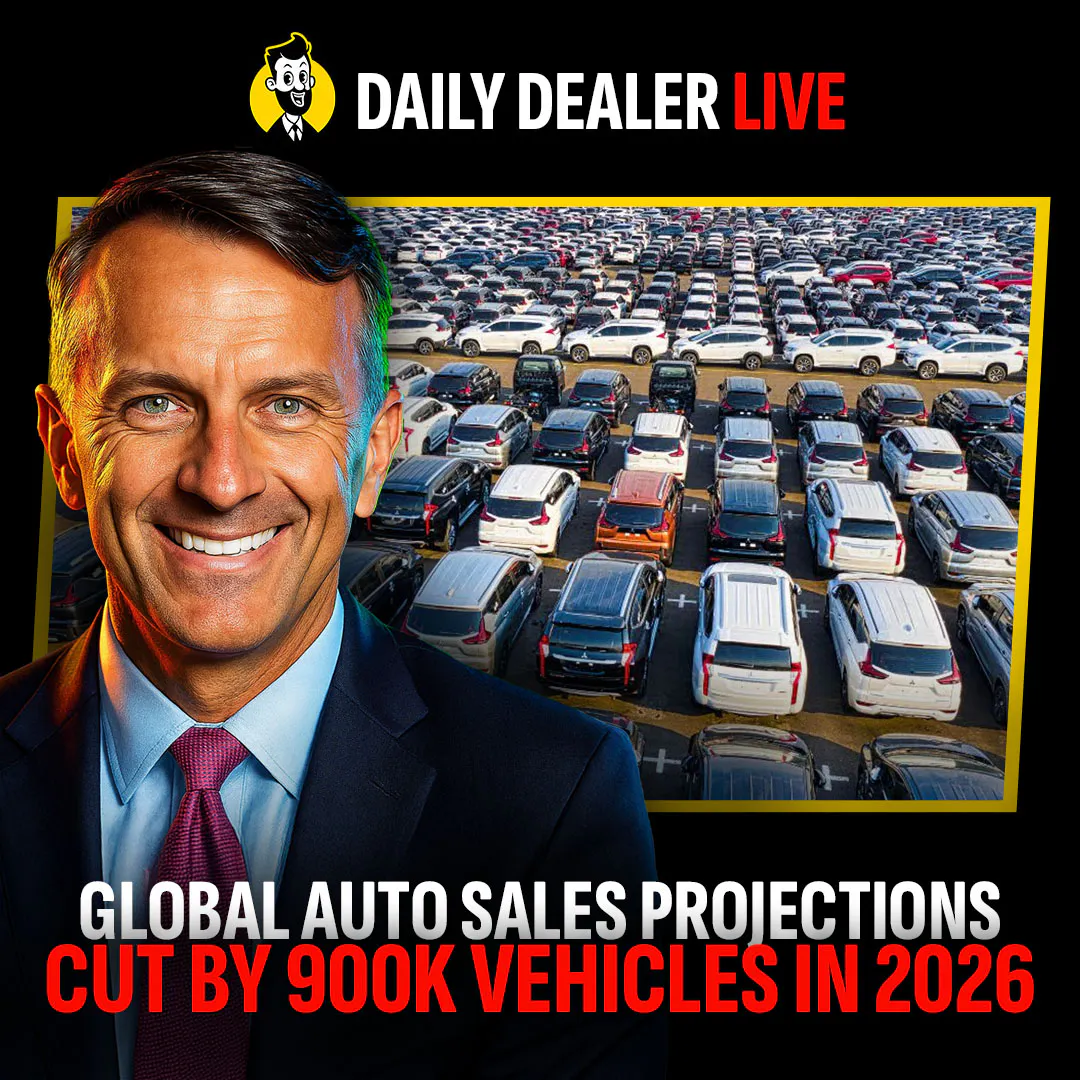
Dealers are getting disciplined fast: Kia warns against broker sales that don’t count for incentives, S&P flags a big 2026 light-vehicle forecast hit tied to the Iran situation, and CarGurus shows new inventory swelling while used demand stays hot. The core interviews spotlight three playbooks: Tustin Ulrich cuts sales staff 35% yet sells more through tight culture, daily standups, and “book club” accountability; Bill Kamastro uses QR-based service booking and voice AI to cut service hold times; and Matthew Bird runs an independent used strategy in Canada using lead response speed, turn/days-to-sell discipline, and lightweight AI tools. The roundtable debates culture, F&I pressure, and broker enforcement.
Kia
"Some breaking news from this morning related to a topic much discussed on this live show. Kia is drawing a hard line on broker sales. Kia America just sent a letter to its active, to its dealer network warning that broker sales activity violates the Kia sales policy and dealer agreement."
Kia is the car brand involved here. They’re telling their dealers that using brokers to sell cars isn’t allowed under their rules.
Kia is the automaker whose dealer network is being addressed in this segment. The key point is Kia America enforcing its sales policy by warning dealers that broker sales violate the dealer agreement.
broker sales
"Some breaking news from this morning related to a topic much discussed on this live show. Kia is drawing a hard line on broker sales. Kia America just sent a letter to its active, to its dealer network warning that broker sales activity violates the Kia sales policy and dealer agreement."
Broker sales means a middleman helps sell cars instead of the dealer handling everything directly. Some car brands don’t like it because it can break their rules for how cars are sold and tracked.
“Broker sales” refers to selling vehicles through a third party (a broker) rather than through the franchised dealer’s normal sales process. In many dealer networks, OEMs restrict or regulate broker activity because it can bypass brand controls and pricing/marketing rules.
dealer agreement
"Kia America just sent a letter to its active, to its dealer network warning that broker sales activity violates the Kia sales policy and dealer agreement. The memo signed by VP of sales operations,"
A dealer agreement is the contract between the car brand and the dealership. It lists the rules the dealer has to follow to stay in good standing.
A dealer agreement is the contract between an automaker (or its regional entity) and a franchised dealer. It spells out what the dealer can and can’t do—like how vehicles are sold, marketed, and who can participate in sales activities.
sales policy
"Kia America just sent a letter to its active, to its dealer network warning that broker sales activity violates the Kia sales policy and dealer agreement. The memo signed by VP of sales operations,"
An OEM sales policy is the set of rules and guidelines governing how vehicles are marketed and sold through the franchised channel. Here, Kia is asserting that broker sales violate that policy, which can lead to compliance actions.
dealer network
"Kia America just sent a letter to its active, to its dealer network warning that broker sales activity violates the Kia sales policy and dealer agreement. The memo signed by VP of sales operations,"
A dealer network is the set of dealerships that sell a brand’s cars. When the brand contacts the network, it’s telling all those dealers the same rule.
A dealer network is the group of franchised dealerships that sell and service a specific automaker’s vehicles in a region. When an OEM sends a memo to the dealer network, it’s typically enforcing policy across many stores at once.
OEM
"We've actually got wind of another letter [210.8s] from another OEM working to confirm that."
OEM just means the car maker itself. When the OEM sends a letter, it usually means the rules for dealers are changing.
OEM stands for Original Equipment Manufacturer—the company that makes the vehicles (and typically runs dealer incentive programs). Letters or memos from an OEM often signal changes in compliance, reporting, or incentive rules.
S&P Global Mobility
"So next up this morning, S&P Global Mobility revised its 2026 Global Light Vehicle Sales [223.1s] forecast this week..."
This is a company that studies car-market data and makes forecasts. Dealers and automakers use their numbers to understand where demand might be heading.
S&P Global Mobility is a data and forecasting firm that tracks vehicle sales, production, and market trends. Their forecasts are widely used by automakers, dealers, and investors to gauge demand.

Chevrolet Trax
"...growing concentrated around 20,000. And the Chevy Trax, Jeep Compass and Kia K4 all posting massive gai..."
The Trax is a small SUV made by Chevrolet. It’s meant for everyday driving and easier parking than bigger SUVs. It’s mentioned because it’s selling well compared with other similar cars.
The Chevrolet Trax is a compact crossover SUV aimed at buyers who want an easy-to-live-with vehicle with good practicality. It comes up in sales discussions because it’s a high-volume, mainstream model that can move overall numbers when demand is strong. In the podcast context, it’s grouped with other models showing large gains, suggesting it’s performing well in its segment.
Honda
"Closing out today with an OEM update, Honda is restructuring R&D, spinning thousands of engineers into an independent unit to move faster."
Honda is the car company in this story. They’re changing how they organize their engineering work to move quicker and compete better.
Honda is the automaker discussed in the OEM update. The speaker says Honda is restructuring its R&D to respond faster to competitive pressure.
follow-up
"And as long as you're diligent and staying on top of your tasks and your follow-up, those are meaning they are small ticket items that should not take hours and hours in a day to do."
Follow-up is the ongoing contact with leads and shoppers after initial interaction—often via calls, texts, and updates. In dealership sales, strong follow-up is a major driver of conversion from interest to purchase.
Book Club
"And so, that's where Book Club was created. Now, in the beginning, it started with a read a chapter a week and we'll talk about it on Fridays."
“Book Club” here is a team learning routine. They read and discuss together so everyone thinks and communicates the same way.
“Book Club” is presented as an internal training and culture-building program. The goal is continuity—shared vocabulary, mindset, and beliefs—so the team stays aligned even with turnover risk in an automotive sales environment.
converting a lead
"...whether it be someone giving crazy good customer service or converting a lead or whatever the win looks like."
“Converting a lead” means turning someone who showed interest (online inquiry, phone call, form fill, etc.) into an actual customer who completes a purchase or next step. Dealerships track this because it directly impacts sales volume and efficiency.
digital dealership
"And it's interesting because the auto industry right now is talking all about this digital dealership, right? AI and technology. But you've kind of gone back to some of the basics..."
A “digital dealership” is when a car store uses more tech and online tools to sell and communicate. The speaker is saying they’re not ignoring tech, but they think the basics still matter a lot.
The term “digital dealership” refers to using software and online tools to run sales and service—like digital retailing, online lead handling, and customer communication. In this segment, it’s contrasted with focusing on in-person fundamentals and team culture.
AI and technology
"The auto industry right now is talking all about this digital dealership, right? AI and technology. But you've kind of gone back to some of the basics..."
In car sales, “AI and technology” usually means computer tools that help with things like replying to leads faster or organizing customer messages. The speaker is basically asking if all that hype is more important than good people and good process.
AI and technology in dealerships usually means using automation and data-driven tools to improve lead response, customer follow-up, and internal workflows. Here, it’s brought up as a current industry focus, then questioned against “basics” like team routines and communication.
service manager
"...the speed of leaders, the speed of the team. It's funny because I was talking to a leader recently, a service manager..."
A service manager is the person who oversees the dealership’s repair/service shop. They help coordinate the work so inspections and repairs get done the right way and on time.
A service manager runs the dealership’s service department operations, including technician scheduling, workflow, and customer communication. They’re often responsible for ensuring inspection processes and repair recommendations are consistent and efficient.
GM
"...I was talking to our own GM here at Ziggler, Zach Terrell earlier today. He was dealing with some problems with the vendor..."
GM here means General Manager, typically the top executive responsible for overall dealership performance. In dealership operations, the GM influences standards for accountability, vendor management, and customer-facing processes.
CRM
"[1631.6s] I'd be nervous [1637.5s] about pen and paper too with much with info security and you're right in digital age. We've [1637.5s] got an obligation to secure things as we're not writing any address, number, anything like that. [1643.6s] All that stored in CRM. It's just a name. Name is the top prospect. That's it."
CRM (Customer Relationship Management) is the system used to store customer/prospect information. In the segment, they emphasize that personal contact details aren’t written down and are instead stored in CRM, with the name used to identify the top prospect.
CDG Circles
"[1669.6s] Tays up. So this is brought to you by CDG Circles, digital peer group for top auto dealers, [1674.3s] private dealer chats, vendor reviews, real insights, confidential, compliant, no travel [1679.4s] required."
CDG Circles is an online group for car dealership owners/managers. They use it to talk with other dealers and share information without having to meet in person.
CDG Circles is described as a digital peer group for top auto dealers. It’s positioned as a place for private dealer chats, vendor reviews, and compliant, confidential discussions without travel.
promoting from within
"So to answer your question, it comes down to one thing. I'm a firm believer in promoting from within and like he had said, he's got people there a long time."
They’re saying it’s better to move people up inside the dealership instead of bringing in outsiders. The idea is that long-time employees already know how the place works and can keep the standards consistent.
The speaker argues that dealerships do better by promoting employees internally rather than hiring from outside. In practice, this can improve consistency in sales process, customer experience, and training culture.
service booking
"So last time you were on the show, you talked about a very manual tech oriented process that you had implemented that helped with your retention and service booking."
Service booking is when a customer schedules their car for maintenance or repairs. If you make it easier to book, customers tend to come back more often.
Service booking refers to scheduling vehicle maintenance/repairs through a dealership’s process. Improving it often boosts retention because customers are more likely to return for future maintenance.
retention
"So last time you were on the show, you talked about a very manual tech oriented process that you had implemented that helped with your retention and service booking."
Retention means getting customers to return again and again. In this context, better follow-up and booking processes help customers keep using the dealership.
In dealership terms, retention is keeping customers coming back for repeat purchases and service. The speaker ties retention to a “manual tech oriented process,” suggesting process improvements can increase repeat visits and booked service.
QR code
"So let's transition to that. So you created a letter, you put a QR code on it, you put your personal cell phone on there."
A QR code is a square barcode you scan with your phone. Here, it’s being used to make it faster for customers to take the next step—like booking service or contacting the right person.
A QR code is a scannable code that quickly directs a user to a link or form. In dealerships, QR codes are often used to streamline appointment booking, lead capture, or service follow-up.
voice AI
"April 2026, that just isn't quite comfortable implementing voice AI yet, right? Technology's great, it's made great strides, and actually astonishing strides over the last year. But it's different in our town, customers really don't want that synthetic voice."
Voice AI is computer software that can talk and understand what you say. Dealerships use it to answer calls or texts automatically, but some people don’t like how it sounds or how it behaves.
Voice AI refers to software that can understand and respond to spoken requests, often using speech recognition and text-to-speech. In a dealership context, it’s used to handle calls or messages automatically, but some customers may dislike the “synthetic” feel.
synthetic voice
"But it's different in our town, customers really don't want that synthetic voice. What was it that pushed you over the top where you said, hey, we're going to give this a try?"
A synthetic voice is a computer-made voice. Some customers prefer talking to a real person, so a dealership might avoid using it.
A synthetic voice is computer-generated speech rather than a human voice. In customer service, it can affect trust and perceived professionalism, which is why some dealerships avoid it or limit its use.
click to text
"So we built in a lot of the communication mechanisms like click to call, click to text. So right from your cell phone, if you throw the throw the entire platform out for a second, let's think about this."
Click to text lets a customer tap a button and start texting the dealership right away. It can speed up responses.
Click to text is a similar feature that starts a text message conversation with the dealership from a button or link. It helps dealerships respond faster and meet customers where they already communicate.
click to call
"So we built in a lot of the communication mechanisms like click to call, click to text. So right from your cell phone, if you throw the throw the entire platform out for a second, let's think about this."
Click to call means you can tap a button and your phone automatically calls the dealership. It makes it easier for customers to reach them quickly.
Click to call is a customer-facing feature that lets someone tap a button on a phone or website to immediately place a call to the dealership. It reduces friction and can increase lead contact rates.
Longo Toyota
"So it is interesting, Longo Toyota came on one of our industry spotlight pods, and they said, hey, if a customer has to call us, it's too late."
Longo Toyota is a dealership group used as an example in the conversation. Their point is that you want to help customers before they feel they have to call you.
Longo Toyota is a Toyota dealership group referenced here as an example from the industry. The quote highlights a common dealership philosophy: if a customer has to call, the opportunity may already be slipping.
Cadillac
"All right, before we wrap up, Cadillac, your Cadillac OEM, we had the head of GM on the show at NADA."
Cadillac is GM’s luxury car brand. They’re talking about how Cadillac is managing supply (inventory) and how the lineup is changing as more cars move toward electric power.
Cadillac is the luxury brand of General Motors (GM). In this segment, the discussion focuses on Cadillac’s product mix and inventory strategy, including how the brand is shifting from internal-combustion vehicles to EVs.
market share
"...I see this time as an opportunity to gobble up market share by doing things that other dealers won't do..."
Market share is basically how much of the local car-buying business you win compared to other dealers. More market share means more customers choosing you.
Market share is the portion of total sales in a region or segment that a dealer group captures. The speaker suggests using customer-focused tactics to increase their share while others don’t.
Auto Trader Canada
"And we talk, Auto Trader Canada here talks a lot about the average value of new cars online and average value of used cars online."
Auto Trader Canada is cited as a source for market pricing benchmarks for both new and used cars online. The speaker uses its “average value” figures to illustrate how dealers can misread their own pricing versus market pricing.
margin erosion
"...you have a disconnect that you're never really going to see or a blind spot that's going to lead to age. It's going to lead to a margin erosion."
Margin erosion is the gradual shrinking of profit per vehicle, often caused by pricing pressure, higher costs, or discounting. In this segment, it’s tied to the dealer’s pricing/value assumptions being out of sync with market reality.
Ford
"it felt like a disadvantage because there's a lot of strength in carrying the Ford banner [3386.1s] or the Kia banner or any of those ones."
Ford is a big car company. If a dealership is “under the Ford banner,” it means they sell and service Ford cars and follow Ford’s rules for how things should be done.
Ford is a major U.S. automaker with a large dealer network. In dealership conversations, “carrying the Ford banner” usually means operating under a Ford-branded franchise and following Ford’s brand standards and approval processes.
VSC
"But we sell for value. I mean, we're at $2,200 a copy at a Cadillac store. And our VSC penetration, our goals are typically to be north of 40% VSC penetration at 1.5 or better products per customer."
VSC means a vehicle service contract—basically an extended warranty-style plan sold by the dealer. It can help cover repair costs after the original warranty ends. They’re talking about how many customers they get to buy it.
VSC stands for Vehicle Service Contract, a dealership-sold extended coverage plan that helps pay for certain repairs after the factory warranty. Dealerships track “VSC penetration” to measure how often customers buy these contracts. The speaker mentions targeting a penetration rate and product-per-customer goals.
Request an Explanation
Heard something you'd like explained? We'll add it to this episode.
Sign in to request explanations for terms you heard.
Want to learn more?
Browse our glossary for plain-English explanations of automotive terms, jargon, and concepts.
Help improve this episode
See something that's not quite right? Our annotations are AI-generated and can sometimes miss the mark. Click the flag icon on any annotation to suggest a correction.