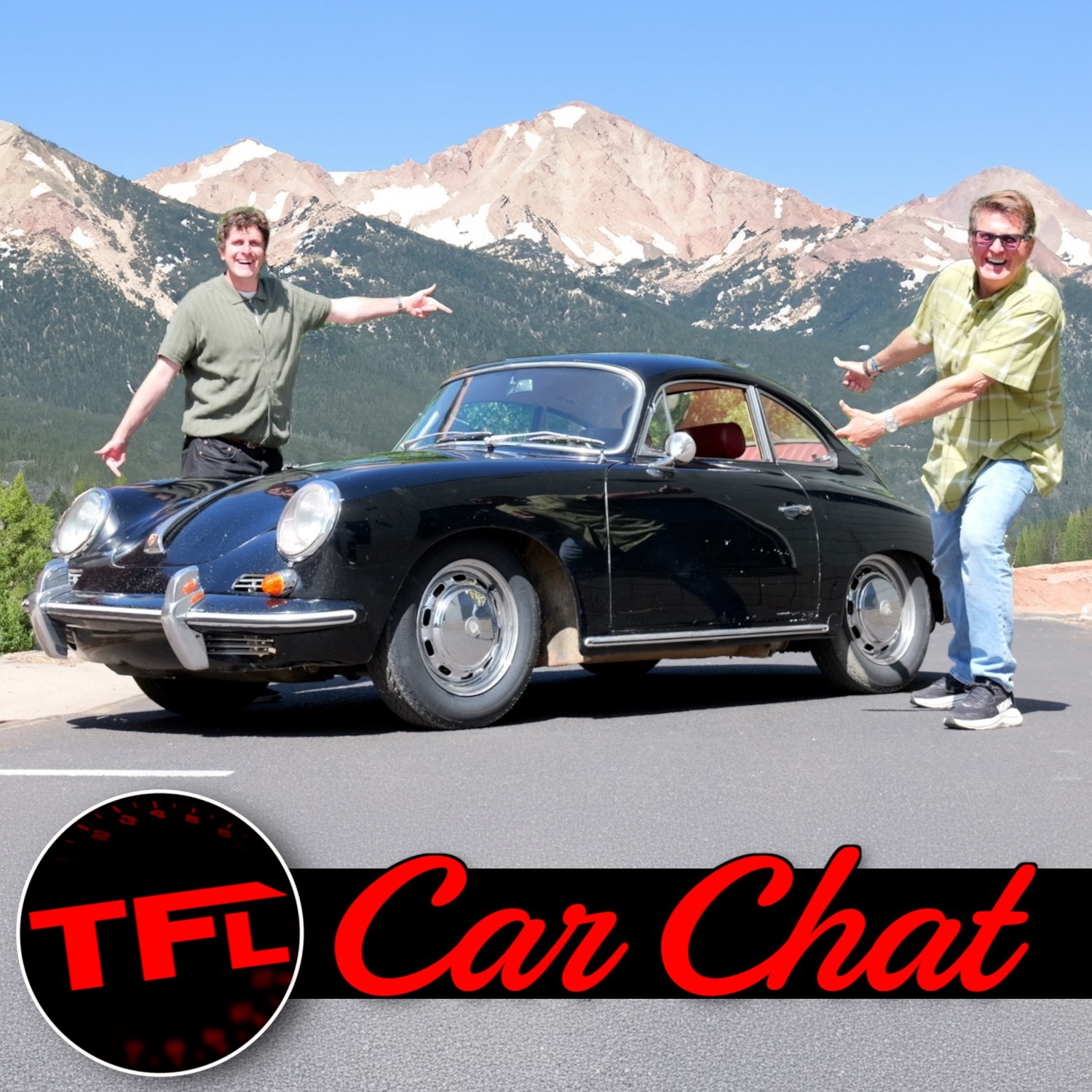
We Just Spent The Most We Ever Have On A Classic Car! | Ep. 340
About this episode
After a fleet update, the hosts kick off with Tesla Full Self-Driving quirks—like prompting for a reason when you intervene and routing differently for work vs. home. The conversation then pivots into Ferrari’s limited-production strategy and how brand image, not just specs, shapes demand. From there, they zoom into classic-car buying and spending: a barn-find C3 Corvette, a 2005 997 Carrera 2 S with seat issues, and a 2010 997.2 Turbo—plus a deep dive on Porsche 356 restoration costs, patina vs. pristine value, and whether to drive or preserve.
( https://www.alltfl.com/ ) Check out our new spot to find ALL our content, from news to videos and our podcasts! In this episode of TFL Car Chat, Roman and Tommy pull back the curtain on the studio garage for a massive, long-overdue fleet update. Roman just bought a new to us classic and had to use several TFL favorites to do so, find out what they are in this episode!
( http://www.patreon.com/tflcar ) Visit our Patreon page to support the TFL team!
Advertising Inquiries: https://redcircle.com/brands
Privacy & Opt-Out: https://redcircle.com/privacy
full self-drive
"I was driving our Tesla the other day and it's got this really great feature full self-drive incredible. You plug in a destination and it takes you there. You never have to touch the wheel"
“Full self-drive” is Tesla software that tries to do more of the driving for you. Even when it’s on, you’re still supposed to watch the road and be ready to take over.
“Full self-drive” is Tesla’s driver-assistance software package that’s marketed as being able to handle more of the driving task than basic autopilot features. In practice, it still requires driver supervision and attention, and it’s designed for specific road/conditions rather than fully autonomous driving everywhere.
route
"and you do that in the morning it'll automatically take you to work and if you're at work and you do that in the afternoon it'll automatically route you to home."
Here, “route” just means the path the car chooses on the map—what roads it thinks you should take to get where you’re going.
In this context, “route” means the navigation plan the car selects—choosing which roads to take to reach a destination. The hosts describe the system changing the route based on whether it thinks you’re heading to work or home at a given time.
full self-driving
"There's a new thing by the way on the full self-driving now every time you intervene it asks you why you're intervened. Do you tell it why? Yeah you can."
“Full self-driving” is a Tesla software feature that helps the car drive. It’s not fully hands-off—you're still expected to watch and take over when it asks or when something goes wrong.
“Full self-driving” is Tesla’s driver-assistance software package marketed as capable of handling more driving tasks than basic autopilot. In practice, it’s still an assisted system that requires driver supervision and can disengage when the driver intervenes.
driver profile
"They say it is. They know who's driving it because you've got a driver profile. Well you don't have a driver profile. No I don't. I use your driver profile."
A driver profile is like a saved profile in the car for a specific person. It can store your preferences, and the car may know which person is driving when you use features or make changes.
A driver profile is a saved user setup in Tesla vehicles that personalizes settings and can be used to identify who is driving. The hosts mention it because the system can attribute interventions to a specific driver even if the message is claimed to be anonymous.
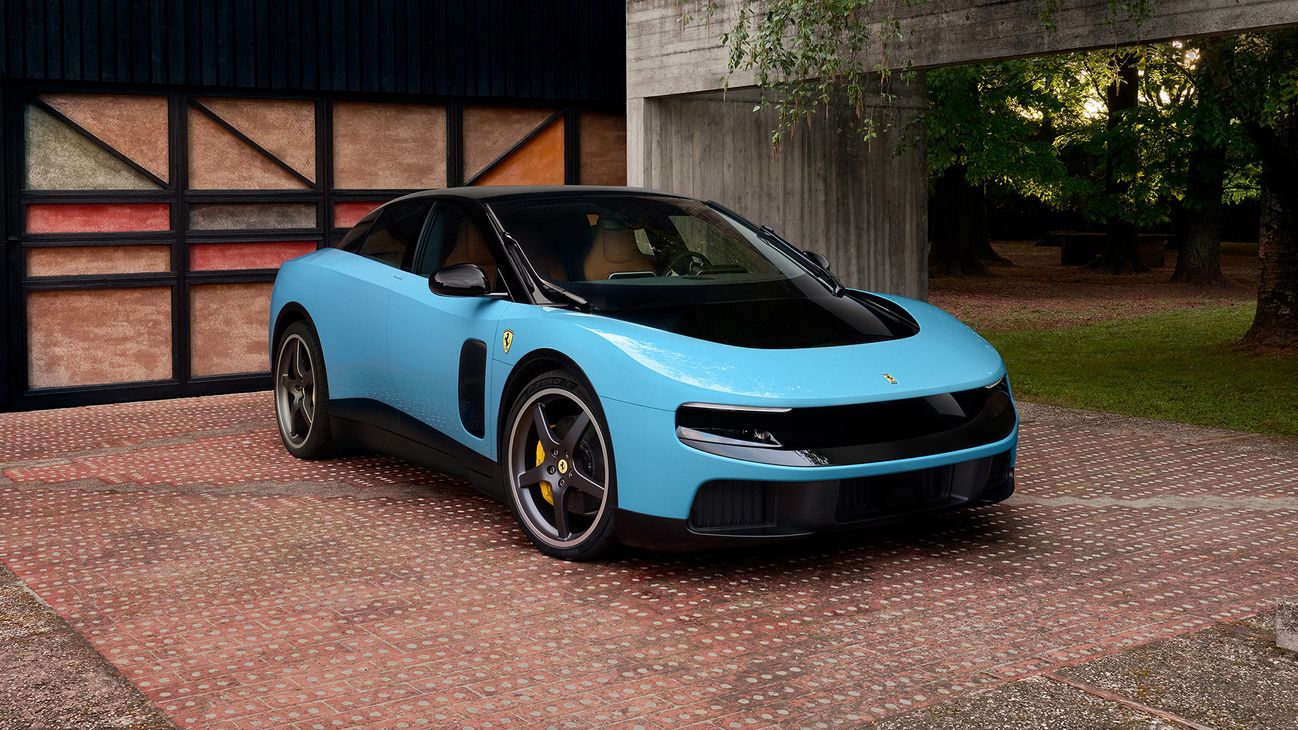
Ferrari Luce
"...t. Cold you get it Lucy Goosey. What's it called? Luce. If you don't read it the Italian way what is it?..."
The Ferrari “Luce” mentioned in the podcast appears to be a specific Ferrari model name being discussed, but the transcript doesn’t provide enough context to identify the exact vehicle with certainty. Because of that, the safest explanation is that it’s a Ferrari-branded model referenced by name in the conversation. It’s brought up as part of the podcast’s broader discussion of notable cars and their names/identities.
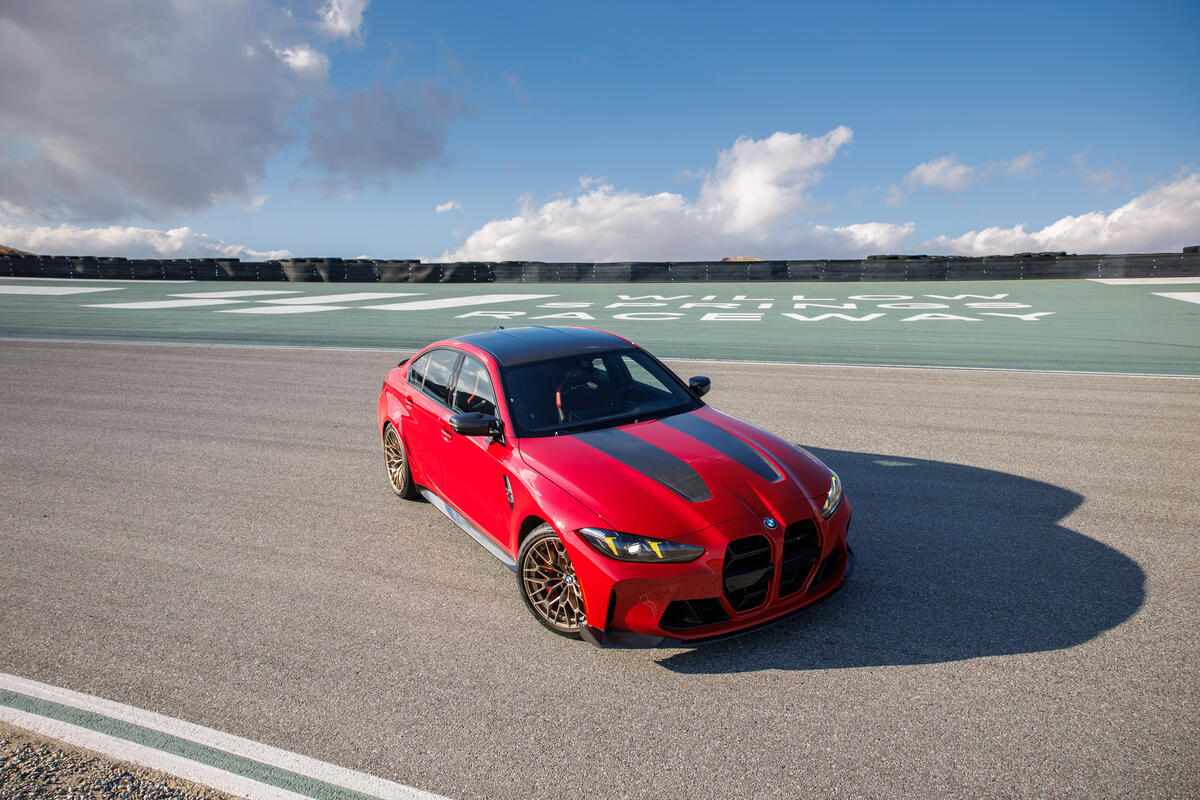
BMW M3
"...ngue. Same thing with the Ferrari if you want the F80 or the upcoming F90 I guess if there'll be one of..."
The BMW M3 is a fast, sporty version of a regular BMW 3 Series. It’s made to feel more exciting to drive, with stronger performance than a standard model. People talk about it a lot because each generation can feel different and more advanced.
The BMW M3 is a high-performance version of the 3 Series, built for drivers who want a sporty, track-capable feel in a practical sedan. In the podcast context, it comes up as a “F80” (a specific M3 generation) and as a possible future “F90,” showing how enthusiasts talk about the model’s evolution. It’s often discussed because it’s a benchmark for performance driving and engineering within its class.
Birkenbag effect
"…you design a luxurious car that has kind of the let's call it the Birkenbag effect. Okay, where where women look at this car and it's not intimidating…"
They’re using a “luxury handbag” style idea to explain car demand. The point is that some products feel more appealing when they look friendly and fashionable, not scary or too aggressive—so more people want them.
The “Birkenbag effect” is a marketing analogy: a luxury item becomes desirable partly because it’s perceived as stylish and socially approachable, not intimidating. In the segment, the host argues Ferrari could broaden its buyer base by designing a more friendly, non-threatening-looking car for women—while keeping it exclusive.

Pontiac Fiero
"one more the one that one I don't think a woman wants a Dyson vacuum that swallowed the back half of a Pontiac Fiero right like the problem you're saying is that women want something different than men in car design"
The Pontiac Fiero is a classic Pontiac sports car. The hosts mention it as a comparison to make a point about how something oversized or weird-looking would look on a real car.
The Pontiac Fiero is a mid-engine sports car from Pontiac, best known for its unusual layout for a relatively affordable 1980s car. In this segment it’s used as a visual reference point for how absurdly large a “vacuum” would look if it swallowed part of a car.

Jeep Wrangler
"like if I asked my friend group or women their dream car is inherently masculine. Most of my girlfriends all have the same. As far as I know they all want Wranglers. No they all want G wagons right which is a grown-up Wrangler."
The Jeep Wrangler is a popular off-road SUV with a very recognizable boxy look. The hosts bring it up as an example of a car design they think people consider “masculine.”
The Jeep Wrangler is a rugged off-road SUV known for its boxy shape and removable roof/doors on many trims. Here it’s referenced as a “masculine” design baseline that some listeners associate with the kind of vehicles women say they want.

G-Class G Wagons
"As far as I know they all want Wranglers. No they all want G wagons right which is a grown-up Wrangler. Yeah but that's an inherently masculine design"
The Mercedes-Benz G-Class is a very distinctive, boxy luxury SUV. The hosts compare it to a Jeep Wrangler to talk about how some car designs feel more “masculine” to people.
The Mercedes-Benz G-Class (often called the “G-Wagon”) is a boxy, body-on-frame luxury SUV with a long reputation for off-road capability. In this discussion it’s used as a more “grown-up” alternative to the Jeep Wrangler, reinforcing the idea that certain shapes read as masculine.
hatchback
"So I don't think that having this rolly-poly little hatchback thing is gonna appeal. It's not a hatchback. It is a hatchback. It's a sedan it's a four door. It's a hatchback isn't it it's got a lift back it's literally a hatchback which is practical."
A hatchback is a car body style where the rear door (the “hatch”) swings upward and provides access to the cargo area. The hosts argue about whether the described vehicle is a hatchback versus a sedan, using the liftback/hatch layout as the practical definition.
complications
"what you're selling is not the brand but you're selling like the complications in a watch the fact that it's a it's a perpetual calendar that does all this other stuff right"
On a watch, “complications” are extra features beyond telling the time—like calendar functions or timers.
In watchmaking, “complications” are additional functions beyond basic timekeeping (like calendars or chronographs). The host uses this as an analogy for how some brands sell advanced features rather than just the brand image.
perpetual calendar
"the fact that it's a it's a perpetual calendar that does all this other stuff right"
A “perpetual calendar” is a watch feature that keeps track of the date automatically, including tricky stuff like leap years, without you adjusting it often.
A “perpetual calendar” is a watch complication that automatically accounts for the varying lengths of months and leap years, so it doesn’t need frequent manual correction. The host mentions it to illustrate how tech-forward brands highlight specific functional features.
torque
"if you're launching an f80 you're going to be talking about lab times horsepower torque"
Torque is the twisting force that helps the car get moving. Cars with more torque often feel punchier when you accelerate from a stop or at low speeds.
“Torque” is the twisting force produced by the engine and transmitted to the wheels. It strongly influences how quickly a car can accelerate, especially at lower speeds, and it’s one of the key performance specs enthusiasts look at.
horsepower
"if you're launching an f80 you're going to be talking about lab times horsepower torque"
Horsepower is a number that describes how much power the car’s engine can produce. Higher horsepower usually means the car can accelerate harder, all else equal.
“Horsepower” is a measure of engine power—how much work the powertrain can do over time. The host contrasts what different brands emphasize (specs like horsepower and torque) versus what they emphasize for marketing and customer appeal.
0 to 60
"this car is actually slow from an electric car point of view 0 to 60 in 2.5 seconds"
“0 to 60” is how fast a car can accelerate from a stop to 60 mph. It’s a quick way to compare straight-line acceleration between cars.
“0 to 60” (0–60 mph) is a common acceleration metric measuring how long it takes a car to reach 60 mph from a standstill. The host uses it to compare real-world acceleration between cars and to argue the Ferrari isn’t targeting the same performance-focused audience as some EVs.

Model Tesla Plaid
"...s you know a plaid will run circles around this a tesla plaid yeah so so my my guess is that they're not going ..."
The Tesla Model S is an electric car, meaning it runs on electricity instead of gasoline. It’s built to be quick and has a lot of modern features. In the podcast, it’s mentioned because people compare how fast different versions of the Model S can be.
The Tesla Model S is an electric performance sedan known for strong acceleration and high-tech features. In the podcast, it’s referenced in a comparison involving a “Plaid,” highlighting how people discuss electric performance figures and expectations. It’s a common topic because it represents Tesla’s flagship approach to speed and daily usability in an electric package.
Rolex
"is Ferrari more of a rolex is that what you're saying as a brand no it's more of an enthusiast ... rolex never departs from what they do ... rolex isn't a publicly traded company"
Rolex is a luxury watch brand. The hosts use it as an example of a brand that doesn’t have the same stock-market pressure as a publicly traded company.
Rolex is a luxury watch brand used here as a comparison point for how a brand behaves when it is not under public-market pressure. The hosts contrast Rolex’s approach with Ferrari’s, emphasizing that Rolex is not publicly traded.
publicly traded company
"rolex isn't a publicly traded company in fact they're a non-profit ... Ferrari by the way became a publicly traded company like five years ago ... that adds a lot of pressure to what the brand is"
A publicly traded company is one whose ownership is split into shares that trade on the stock market. The idea here is that stock-market investors can create extra pressure to keep growing results.
“Publicly traded company” refers to a company whose shares trade on a stock market, meaning investors and quarterly expectations can influence decisions. In the discussion, that investor pressure is contrasted with a brand like Rolex, and it’s linked to how Ferrari might manage production and growth targets.
Aston Martin Lagonda
"but what i'm saying is in my opinion this car is the modern day astin martin leganda do you want to pull that up"
Aston Martin Lagonda is an Aston Martin model that’s remembered for having a very unusual, divisive look. The hosts are saying the car they’re discussing feels like a modern version of that kind of design gamble.
Aston Martin Lagonda is a historically notable Aston Martin model line known for its distinctive, polarizing design—often referenced as a styling misstep. The hosts use it as a comparison for the “modern day” design they’re criticizing, specifically calling out the interior as a bright spot.
wedge car design
"because it had all this cutting-edge technology right the cheese enthusiast it was part of that wedge car design era"
“Wedge” design means the car’s shape looks like a wedge—low and pointy, especially toward the front. The hosts are saying this design style was popular in a certain era and these cars fit that look.
Wedge car design is a styling approach where the body is shaped like a wedge—typically low, sharp, and tapering toward the front—to improve aerodynamics and create a dramatic look. The hosts connect the Lagonda/Luce discussion to the wedge era, implying these cars were built to feel futuristic and performance-oriented.

Porsche Cayenne
"a better analogy would be that this was the cayenne before the cayenne no it actually was going after a different customer base"
The Porsche Cayenne is used as an analogy for how a brand can “go after” a different customer segment by expanding beyond its traditional lineup. Here, the hosts compare the Lagonda’s strategy to the Cayenne’s role as a pivot that brought Porsche into a more family-friendly, mainstream direction.
Top Gear
"i saw a whole piece on top gear about it recently from the 70s"
Top Gear is a TV show about cars. The hosts are saying they recently saw a piece on it that helped explain who the Lagonda was trying to attract.
Top Gear is referenced as a source for a segment about the car’s history and target buyer. In this context, it’s used to support the hosts’ point that the Lagonda was aimed at a different, younger audience than older Aston Martin buyers.
digital cluster
"so i think that it's it's kind of a similarity in a lot of ways and it was it had a whole digital cluster so it was very technologically advanced"
A digital cluster is the screen panel behind the steering wheel that shows things like speed and warnings. The hosts are pointing out that this car had advanced screen-based gauges for its time.
A digital cluster is the driver’s instrument panel (speed, engine info, warnings) displayed using digital screens instead of traditional analog gauges. The hosts mention it to emphasize that the car’s cabin tech was unusually advanced for its era.
digital display
"got a reputation of not you know the it had a completely digital display way before people could actually do digital displays"
A digital display is the car’s dashboard showing info on a screen. Instead of needles and dials, it uses electronic graphics to show things like speed or warnings.
A digital display is an instrument cluster that shows information using electronic screens (like numbers and icons) instead of traditional analog gauges. The hosts are pointing out that the car had a digital display earlier than many people expected at the time.
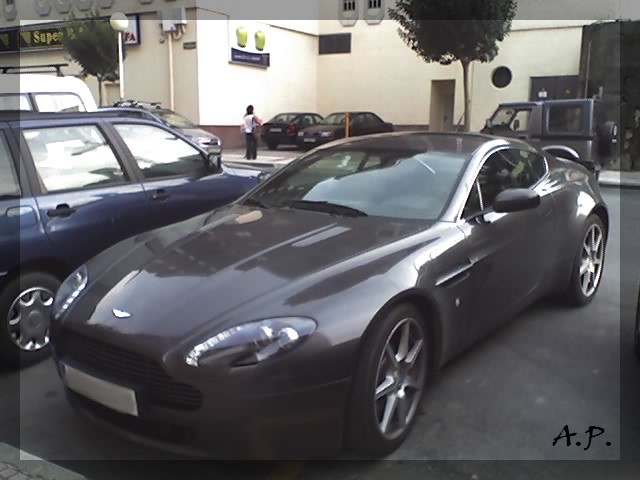
Aston Martin V8 Vantage
"... expensive but they're not as expensive as like a v8 vantage from that era sure much i don't know how much how..."
The Aston Martin V8 Vantage is a luxury sports car. It’s designed to look and feel special, and it has a powerful V8 engine. In the podcast, it’s mentioned because people are comparing how expensive different sports cars can be.
The Aston Martin V8 Vantage is a luxury sports car that blends performance with a premium interior and distinctive styling. The podcast mentions it as “from that era,” comparing expense levels to other high-performance cars. It’s discussed because it’s a recognizable entry point into Aston Martin’s sports-car lineup while still delivering a serious driving experience.
air-cooled
"these things were designed to fit in the smallest european roads post war italy but they really are a great cars to own super simple two cylinder engines air-cooled really clever pieces of engineering"
An air-cooled engine uses air blowing over the engine to keep it from overheating. Instead of coolant running through the engine, it uses airflow to carry the heat away.
Air-cooled engines rely on airflow over the engine’s fins to remove heat instead of using liquid coolant. This is common on classic designs because it can simplify the cooling system and reduce weight.

Volkswagen Beetle
"so we had it for a bunch of videos and then we had it sitting in the office because it fit between the double doors [1067.4s] and i think we had it for like five years i think we bought it what for 15 16 000 yeah and it was [1071.8s] a really cool little car... so we had a beetle which would have been the german car of the people yep"
They’re talking about the Volkswagen Beetle as a famous affordable car for everyday people in Germany. It’s known for being simple and easy to live with, especially compared with many other cars of its era.
The Volkswagen Beetle is discussed as a “car of the people” for Germany after World War II. Its rear-engine, air-cooled layout and simple design made it an iconic, mass-market classic.
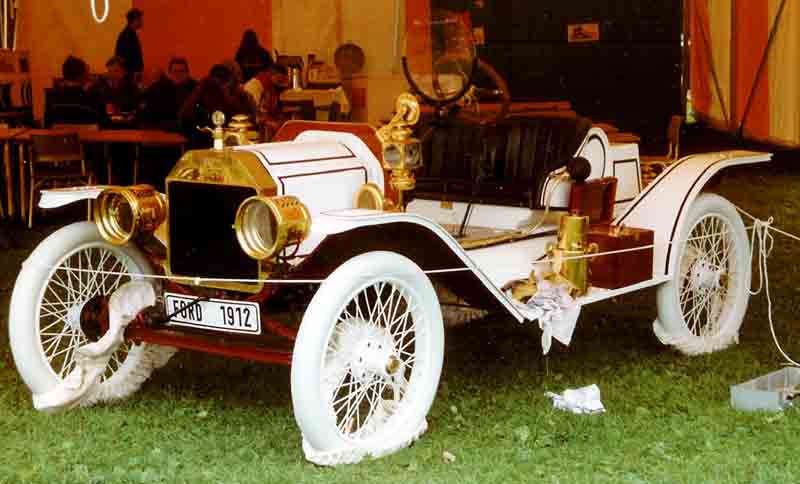
Ford Model T
"and then of course for america we had the model t which kind of came before the war but still it should have"
They mention the Ford Model T as the American version of a car for everyday people. It’s famous for helping make cars affordable for regular folks.
The Ford Model T is cited as the American “car of the people,” even though it predates World War II. It’s historically important for mass production and for making cars affordable to a much wider audience.

Citroën 2CV
"we had the fiat we had the two cv two cv and then of course for america we had the model t"
They mention the Citroën 2CV as a classic small car from France. It was designed to be practical and comfortable on bad roads, using a very simple, no-frills approach.
The Citroën 2CV is a classic French “people’s car” known for its simple, lightweight design and ability to handle rough roads. The episode highlights it as part of a lineup of tiny post-war cars meant to get everyday people moving.

Austin-Healey 800
"speaking of charlie we found out that he was selling his what he had a sports 800 which was the very first toy sports car it even came before the 2000 gt but it's also like a teeny tiny little sports car that also fits perfectly between our doors"
They’re talking about the Austin-Healey 800, an early small British sports car. It’s compact and lightweight, which is why it can fit in their very tight space.
The Austin-Healey 800 is described as an early “toy sports car,” and the host calls it the very first sports 800. It’s a small, lightweight British roadster built around a compact engine, which is why it can fit in the same tight office doorway setup.

Sports 800
"...e found out that he was selling his what he had a sports 800 which was the very first toy sports car it even c..."
The Sports 800 is an older small sports car. It was made to be fun and lightweight, rather than big and heavy. In the podcast, it’s mentioned because it’s considered an early example of a “toy” sports car from its time.
The Sports 800 is a classic small sports car that’s often discussed as an early “toy sports car” from its era. The podcast context calls it “the very first toy sports car,” emphasizing its historical significance and lightweight, fun character. It’s mentioned because classic sports cars like this are frequently valued for their simplicity and period-correct driving experience.
800 cc
"but yeah i mean it's once again 800 cc two cylinder not actually a k car"
“800 cc” is the engine size. It’s a measurement of how much space the engine’s cylinders have, and it helps explain why the car is small and not very powerful.
“800 cc” refers to engine displacement, measured in cubic centimeters. It indicates the total volume of all cylinders, which strongly influences how much air/fuel the engine can process and how it feels in terms of power and torque.
K car
"but yeah i mean it's once again 800 cc two cylinder not actually a k car"
“K car” is a nickname for a particular type of Chrysler car from the 1980s. The host is saying this sports car isn’t that kind of Chrysler.
“K car” is a specific automotive nickname used for Chrysler’s K-platform cars from the 1980s (like the Dodge Aries/Plymouth Reliant). The host is clarifying that this tiny sports car is not one of those K-platform cars.
Toyota Sports 800
"yeah show them because it's a really unique car it has three distinctions tommy which are really cool so before the gt 2000 look of sports 800 cool yeah before the before the gt 2000 which is the james bond toad of the people know which is a million dollar car came the sports 800"
The Toyota Sports 800 is a small classic sports car from Toyota. It’s famous for being light and simple, with a manual gearbox and a special air-cooled engine layout that helps it feel lively even though it’s not fast.
The Toyota Sports 800 is a tiny, classic Japanese sports car known for its lightweight build and rear-wheel-drive layout. In this segment, the host highlights its early place in sports-car history and its distinctive styling, plus the fact it uses a horizontally opposed, air-cooled two-cylinder engine paired with a manual transmission.
manual transmission
"it's got a horizontally opposed two cylinder air cooled engine with a manual transmission and rear wheel drive"
A manual transmission means you choose the gears yourself using a clutch pedal and a shifter. It can make the car feel more connected to the driver.
A manual transmission requires the driver to select gears using a clutch and gear lever, rather than letting the car shift automatically. On older sports cars like the Toyota Sports 800, it’s often part of the intended “driver-focused” feel.
rear wheel drive
"with a manual transmission and rear wheel drive but it looks like something out of kind of an anime"
Rear-wheel drive means the power goes to the back wheels. Many sports cars use it because it can make handling feel more lively and predictable.
Rear-wheel drive (RWD) sends engine power to the rear wheels, which can give a more balanced, “classic sports car” driving feel. It also affects traction and handling behavior compared with front-wheel drive layouts.
clunk coming from the wheel
"really annoying little like clunk coming from the wheel and it ultimately like it just made sense to sell to someone who really knew how to fix it"
A clunk from the wheel usually means something in the suspension or steering isn’t tight or is worn out. It can be caused by parts that have loosened up or developed play over time.
A “clunk” from the wheel is a symptom that can point to suspension or steering components with play or wear, such as worn bushings, ball joints, or loose hardware. The hosts connect the noise to a problem that ultimately required a knowledgeable fix before the car could be sold.

Fiat 500
"...eat guy can you go on craigslist and look up fiat 500 coal and we'll show it to him i can send you the ..."
The Fiat 500 is a small car designed for city driving. Because it’s compact, it’s easier to park and drive in tight spaces. People mention it in the podcast because it’s a specific, easy-to-find kind of small car.
The Fiat 500 is a small city car known for its compact size and easy maneuvering. The podcast context suggests looking up a specific listing (“Fiat 500 coal”), which indicates it’s being discussed as a quirky or niche find. It’s often talked about because it’s a simple, lightweight car that’s popular for urban use.
low balling
"and everybody was like you know low balling me on this car because i don't think they knew knew what it was"
“Low balling” is when someone offers a price that’s way too low. It’s a common tactic in car listings when the buyer thinks they can get a bargain.
“Low balling” means offering an unrealistically low price to buy something. In car sales, it often happens when a buyer thinks the seller is unaware of the car’s actual condition or market value.
Denver
"if you're interested in the car it's on craigslist in denver uh-huh and it says 1971 fiat luso 500 classic very good very nice condition 12 250"
Denver is where the car listing is. If you’re interested, it tells you where you’d have to go to see the car in person.
Denver is the city where the hosts say the classic Fiat 500 listing is located. For buyers, the location matters because it affects how far you’d need to travel to inspect the car and arrange pickup.
sunroof
"i think it's completely sorted it's got the sunroof uh an interior is actually beautiful"
A sunroof is a panel in the roof that lets in extra light and can open for fresh air. On older cars, it’s a nice feature when it works properly.
A sunroof is a glass or fabric panel in the roof that can open for ventilation and light. On classic cars like the Fiat 500 L Lusso, having a working sunroof can be a selling point because it adds convenience and can be harder to keep functional over decades.
Park or Colorado
"also check that out in park or colorado if you're if you're local"
They’re saying the car is in Colorado (near the local area they mention). That matters because it affects how easy it is to go look at the car.
The hosts reference “Park or Colorado” as a local area for the car’s availability. This is relevant because it frames how local the seller is and how practical it is for a buyer to inspect the vehicle.

1968 first year of the C3 Corvette 327 convertible manual three speed
"so this was our 1968 first year of the c3 corvette 327 convertible manual three speed you want to tell your story about when you tried to listen on hagerty"
This is a 1968 Corvette from the C3 generation, with a 327 engine and a manual 3-speed transmission. It’s special because this exact setup—manual 3-speed—is uncommon, so it’s a neat find for collectors.
This is a 1968 Chevrolet Corvette (C3 generation) with the 327 V8 and a manual “three-speed” gearbox. The C3 Corvette is known for its classic late-60s styling, and this specific combo is notable because a manual three-speed Corvette is extremely rare compared with the more common four-speed manuals or automatic transmissions.
Hagerty
"i tried to listen on hagerty uh and i said it was a three speed and he said no they didn't make three speeds and he's like i'm a corvette i wasn't on hagerty it was it was you know who it was it was that guy that you did the charger or challenger video with"
Hagerty is an enthusiast-focused company known for classic-car insurance and for running marketplaces (like auctions/listings) where owners and buyers verify vehicle details. In this segment, the hosts describe a listing dispute about whether Chevrolet made a manual 3-speed C3 Corvette.

Dodge Challenger
"...t was it was that guy that you did the charger or challenger video with that guy no maybe no it was hagerty ye..."
The Dodge Challenger is a muscle car designed to be powerful and fun to drive. People often talk about it alongside the Charger because they’re similar types of performance cars. In the podcast, it comes up because it’s a recognizable model in that muscle-car world.
The Dodge Challenger is a muscle car known for its classic styling and strong performance potential. The podcast references it alongside the Charger, reflecting how enthusiasts often compare these two models and their driving/drag-strip appeal. It’s discussed because it offers a wide range of powertrains and has a large enthusiast following.

Dodge Charger
"... know who it was it was that guy that you did the charger or challenger video with that guy no maybe no it ..."
The Dodge Charger is a car that’s built to be fast and exciting, with powerful engine options. It’s often grouped with other muscle cars because people compare how they drive and how they look. In the podcast, it’s mentioned because it’s a well-known performance model.
The Dodge Charger is a performance-focused sedan/coupe-style muscle car known for its powerful engines and straight-line attitude. The podcast mentions it in the context of a video featuring the Charger and Challenger, which points to how these cars are often discussed together in enthusiast circles. It’s a popular topic because it blends everyday usability with high-performance options.
dog leg three speed
"so it was a dog leg three speed there was also a bean can it had one option and one option only"
A “dog-leg” three-speed is a special way the gears are arranged in a manual transmission. It changes how you move the shifter between gears, so it can feel unusual compared with most 3-speed manuals.
A “dog-leg” three-speed is a manual transmission layout where first gear is positioned to the left/back (instead of in a straight row), and second and third are in the more conventional positions. It’s a distinctive shift pattern that can make the car feel different from typical 3-speed manuals.
bean can
"so it was a dog leg three speed there was also a bean can it had one option and one option only"
“Bean can” is an enthusiast nickname for a particular Corvette exhaust look. It’s basically shorthand collectors use to describe that specific style.
“Bean can” is a collector nickname for a specific Corvette exhaust/tailpipe appearance—typically associated with the early C3-era exhaust design. Enthusiasts use the term as shorthand for that look rather than as a formal option name.
power steering
"no ac no power windows no power steering no uh no power brakes i think it had power brakes maybe but no no power brakes it actually had manual brakes"
Power steering helps you turn the wheel with less effort. In this story, they’re pointing out the car didn’t have that convenience feature.
Power steering uses a pump and hydraulic (or electric) assist to reduce the effort needed to turn the wheel. The hosts are listing what this Corvette lacked to show it was a very basic, stripped configuration.
manual brakes
"no power brakes i think it had power brakes maybe but no no power brakes it actually had manual brakes that's right but really basic specification of car"
Manual brakes are brakes without power assist, so you have to push harder on the pedal. They’re mentioning it to show the car was built with a very minimal equipment list.
Manual brakes mean the brake pedal is not assisted by a power brake system, so the driver must apply more pedal force. The hosts mention this because the car’s spec is unusually basic for a convertible.
original miles
"yeah so for a car that's from you know 45 years old they only have 60 000 miles it's pretty unique and those were original miles the downside to it was it was painted this like very canary yellow"
“Original miles” means the car’s mileage is thought to be the real mileage it’s always had. Low mileage can make a classic more appealing, but it still may need work—especially if it sat for years.
“Original miles” means the odometer reading is believed to be the car’s genuine, unmodified mileage from when it was new. Low original mileage on a decades-old classic can make the car more desirable, but it doesn’t automatically fix issues like paint condition or mechanical wear from sitting.
paint job
"it was painted this like very canary yellow but it was definitely you know not even a 10 foot maybe a 50 foot paint job where you could see somebody rattle candid and they didn't do a very good job"
A “paint job” is the car’s paint work. On classic cars, how well it was repainted can really affect how valuable and how nice it looks, and the host says this one wasn’t done very well.
A “paint job” quality assessment matters on classics because repainting can reduce originality and affect collector value. The host criticizes the finish as uneven enough to be visible from a distance, and contrasts it with the car’s original copper color.
mouse poop
"she contacted another friend of the of the channel who actually dragged it out of the barn vacuumed out about 300 pounds of mouse poop he said um and then got it running because mechanically the car was sorted"
Mouse droppings are a sign the car sat unused for a long time. They can get into the car’s interior and even affect parts like wiring, so cleaning them out is an important first step before trying to get the car running.
Mouse droppings are a practical restoration concern because they can contaminate wiring, insulation, and air passages, and they often indicate long-term storage. The host describes vacuuming out roughly 300 pounds, then getting the car running once the mechanicals were already sorted.
C3s
"and i gotta say tommy uh i do miss this car because it was a lot of fun to drive and the other thing i've noticed is that c3s are coming up usually in the past the the chrome bumper ones in other words the ones from 68 to like 72 were very valuable"
“C3” means a specific generation of the Corvette. It covers the late-60s through early-80s cars, and the hosts are saying more people are starting to appreciate them again—so prices are rising.
“C3” is the Corvette generation code for the 1968–1982 model years. The hosts are specifically discussing how C3 Corvettes—especially the earlier chrome-bumper cars—have changed in value as people rediscover their styling and character.
chrome bumper
"and i gotta say tommy uh i do miss this car because it was a lot of fun to drive and the other thing i've noticed is that c3s are coming up usually in the past the the chrome bumper ones in other words the ones from 68 to like 72 were very valuable"
“Chrome bumper” refers to the earlier C3 Corvette styling with prominent chrome bumpers, commonly associated with the 1968–1972 cars. Enthusiasts often treat these as a distinct sub-era because the look and trim details differ from later, more federally regulated designs.
malaise era
"but then when you got into the malaise era of cars in america in other words when all of the emissions came in and horsepower got cut to like 180"
“Malaise era” is a nickname car fans use for the late 1970s, when stricter emissions rules made cars less powerful. The hosts are saying those cars used to be cheaper because people weren’t as excited about them then.
“Malaise era” is an enthusiast term for the late-1970s period in the U.S. when emissions regulations and fuel economy rules heavily constrained engine output. The hosts connect it to lower horsepower figures and cheaper prices for many cars from that time.

Honda Ridge Line
"we won't spend a lot of time on this one but we sold another car remember [1727.8s] that old honda ridge line that i bought yes at the donate a car auction that we kind of you know fixed up"
The Honda Ridgeline is a pickup truck from Honda that drives more like a car than a traditional truck. Here, the hosts talk about buying and selling one and comparing the older one to a newer version.
The Honda Ridgeline is a unibody pickup-style truck built around car-like driving manners, with a focus on everyday usability rather than hardcore towing. In this segment, they’re discussing an older Ridgeline they bought at a donation auction and comparing it to newer Ridgelines.
alternator
"the alternator failed yeah we had to drag it from walmart yep i was there for that the spool valve gasket failed which killed the alternator"
The alternator is the part that keeps your car’s battery charged and powers the electronics while the engine is running. They’re saying oil from an engine leak got into the alternator and made it fail.
The alternator is the engine-driven generator that powers the vehicle’s electrical system and recharges the battery while you drive. In this segment, a leaking spool valve gasket is described as causing oil to reach the alternator and kill it.
spool valve gasket
"yeah i was there for that the spool [1770.9s] valve gasket failed which killed the alternator yeah but yeah i mean if you're just looking for"
A spool valve gasket is a small sealing part in the engine that helps keep oil where it belongs. If it breaks, oil can leak into other components and cause failures—like the alternator in this story.
A spool valve gasket is part of the engine’s oil-control system that seals where the spool valve assembly operates. If it fails, oil can leak into places it shouldn’t go—here, they say it drips oil into the alternator, which can then fail.
VTEC
"but this was such a good i love this truck so much it's considering buying it but i just didn't really need one but the the driving dynamics of that car the capability for what it is the the payload capacity on that ridge line is more than that ram 2500 we have outside think about that 1530 pounds in the ridge line 1500 pounds in the power wagon so really usable"
VTEC is Honda’s technology that changes how the engine’s valves work to make it run better. They’re saying a gasket related to that system can fail and cause oil leaks.
VTEC (Variable Valve Timing and lift Electronic Control) is Honda’s system for changing camshaft timing and valve lift to improve efficiency and power. The hosts claim the spool valve gasket failure is a common problem on engines with VTEC.
payload capacity
"the driving dynamics of that car the capability for what it is the the payload capacity on that ridge line is more than that ram 2500"
Payload capacity is how much weight a truck can carry safely in the bed (and sometimes inside), after you account for the truck itself. They’re comparing those numbers between trucks to show how practical the Ridgeline is.
Payload capacity is the maximum weight a vehicle can carry in addition to its own weight, typically including passengers and cargo. The hosts use payload capacity numbers to argue the Ridgeline’s bed usefulness is more than many people expect compared with heavy-duty trucks.

Dodge Ram
"...oad capacity on that ridge line is more than that ram 2500 we have outside think about that 1530 pounds..."
The Dodge Ram is a large pickup truck. It’s made for carrying loads and towing trailers. In the podcast, it’s mentioned because people compare how much weight different trucks can handle.
The Dodge Ram is a full-size pickup truck built for hauling and towing, with configurations aimed at work and utility. The podcast mentions payload/towing capacity comparisons, emphasizing how these trucks are often evaluated by what they can carry. It’s discussed because Ram trucks are commonly chosen for practical capability, not just driving feel.

Ram 2500
"the capability for what it is the the payload capacity on that ridge line is more than that ram 2500 we have outside think about that 1530 pounds in the ridge line 1500 pounds in the power wagon"
The Ram 2500 is a big, heavy-duty pickup truck meant for hauling and work. They compare it to the Ridgeline to show the Ridgeline can still be very practical for carrying stuff.
The Ram 2500 is a heavy-duty pickup known for strong towing and payload capability, aimed at work use. The hosts use it as a benchmark to argue the Honda Ridgeline’s bed/payload usefulness can be surprisingly competitive for everyday hauling.

Dodge Power Wagon
"... 1530 pounds in the ridge line 1500 pounds in the power wagon so really usable useful little thing to just kick..."
The Dodge Power Wagon is a pickup truck made for tougher jobs and off-road driving. It’s designed to carry heavier loads and handle rougher conditions than a basic truck. In the podcast, it comes up because people are comparing how much weight it can handle.
The Dodge Power Wagon is a heavy-duty, off-road-oriented version of the Ram pickup line. The podcast compares its payload capacity to another Ram model, emphasizing how it’s chosen for practical capability. It’s discussed because it’s built for tougher work and rough terrain, not just normal commuting.
Ram Power Wagon
"think about that 1530 pounds in the ridge line 1500 pounds in the power wagon"
The Ram Power Wagon is a tougher, off-road-focused version of the Ram trucks. In this clip, it’s brought up just to compare how much weight each truck can carry.
The Ram Power Wagon is a rugged, off-road-oriented variant of the Ram heavy-duty lineup, typically associated with higher-capability hardware for rough terrain. Here it’s mentioned only as a payload comparison point against the Honda Ridgeline.
heated seats
"and basically one of the motors that take a dump so that was wrong and then the heated seats didn't work"
Heated seats are seats with built-in electric heat. If they don’t work, it’s often a switch, wiring, or the heating element inside the seat.
Heated seats use an electrical heating element inside the seat cushions and a control module to warm the upholstery. When they stop working, it can be anything from a failed switch to wiring or the heating element itself.

Land Rover Range Rover
"... found one on craigsist and i called the owner oh range rover sports or yeah range rover sports so i called the..."
The Range Rover is a luxury SUV made by Land Rover. It’s built to be comfortable for everyday driving but also capable on rough roads. People mention it because it’s a premium vehicle with both comfort and capability.
The Land Rover Range Rover is a luxury SUV designed for comfort, off-road capability, and a high-end ownership experience. The podcast context mentions finding a Range Rover Sport listing, which shows how the Range Rover family is commonly shopped and discussed. It’s often talked about because it combines premium features with serious capability.
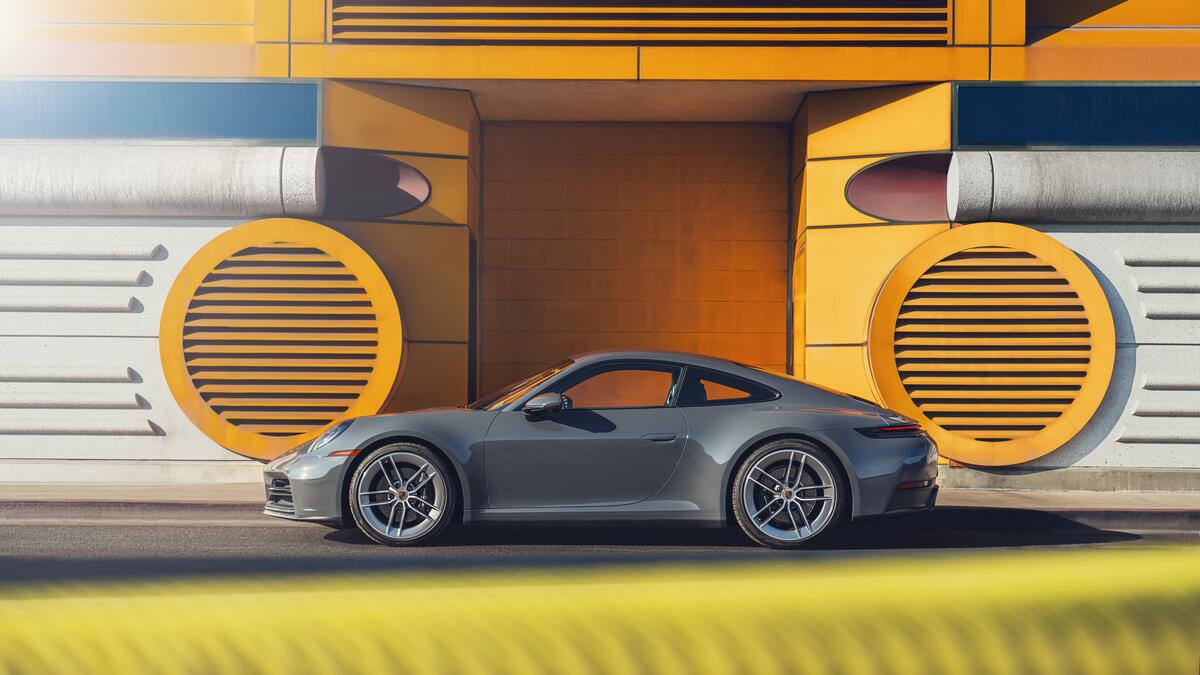
Porsche 911
"he goes it's a 911 i'm like tell me more and he goes it's a coupe and i'm like tell me more because these are the ones you want and he's like well it's an automatic i was like uh i'm like what year [1988.0s] and he goes 2003 i'm like oh 996 and i go how much you want for it 15 and i'm like i'm buying it"
This is a Porsche 911 from the 1996-era generation (the host says it’s a 2003, which is a 996). It’s the classic 911 shape, but this one is described as easy to live with—especially for driving around town.
The Porsche 911 (996) is the late-1990s/early-2000s generation of Porsche’s iconic rear-engine sports car, and it’s known for being a more usable “everyday” 911 than earlier air-cooled cars. In this segment, the host specifically discusses a 2003 911 coupe with an automatic gearbox and how it drove for town cruising.
IMS
"yeah oh god we didn't pay $80,000 for 80,000 miles $15,000 turned out that car had its engine replaced under warranty because the IMS went bad so we had a new engine at 40,000 miles all right"
IMS stands for a specific internal engine part (the intermediate shaft). On some Porsche 911 engines, it can fail and cause major engine problems—so the car may need an engine replacement.
IMS (Intermediate Shaft) is a component in certain Porsche 911 engines that can fail, leading to serious engine damage. The host says the IMS “went bad,” which is why the car received an engine replacement under warranty.
tiptronic five speed
"with that tiptronic five speed it was fun enough on a back road and it was so affordable that you didn't really have to worry about it that much"
Tiptronic is Porsche’s automatic transmission that still lets you choose gears yourself if you want. Here, the host says the car’s five-speed version made it easy and enjoyable for casual driving.
Tiptronic is Porsche’s brand name for an automatic transmission that also lets the driver manually select gears. The host calls it a “tiptronic five speed,” emphasizing that this gearbox made the 996-era 911 fun and relaxed for cruising.
Porsche 911 turbo
"i've always wanted a 911 turbo it's always kind of been my dream car that was a car that i had on my wall as a kid that's a car that was the all conquering all you know autobahn blasting car"
A 911 Turbo is the more powerful, turbocharged version of the Porsche 911. The host is saying they’ve always wanted one, and then they talk about finding a Turbo to buy.
A Porsche 911 Turbo is the turbocharged, high-performance variant of the 911 line, typically associated with strong acceleration and a more “serious” driving experience than naturally aspirated models. The host says it’s been a childhood dream and then mentions a specific Turbo they found for sale.
autobahn
"that's a car that was the all conquering all you know autobahn blasting car that was something that i've always wanted"
The Autobahn is Germany’s highway network, famously associated with very high-speed driving and, in some areas, no universal speed limit. The host uses it as shorthand for the kind of long-distance, high-speed cruising a 911 Turbo is associated with.
ADAS
"but there isn't so much technology that you're overwhelmed with like having the vent controls in the screen or having all this adas which makes driving them just a huge pain"
ADAS are driver-assist features that help you drive, like keeping you in your lane or adjusting cruise control. The host is saying some cars have so many of these features that it can make driving less enjoyable.
ADAS stands for Advanced Driver-Assistance Systems—features like lane-keeping, adaptive cruise control, and other automated safety/comfort functions. The host argues that too much ADAS can make driving feel painful or distracting in certain modern cars.
direct injected engine
"from the metzger engine to a direct injected engine and a lot of people like the older ones but the 997 is having a moment prices on the turbos are up like 50%"
Direct injection means the fuel is sprayed straight into the engine’s cylinders. It’s a more modern way to deliver fuel that can help the engine run better, but it’s different from older systems.
A direct injected engine sprays fuel directly into the combustion chamber instead of into the intake tract. That can improve efficiency and throttle response, but it also changes maintenance considerations versus older fuel-delivery designs.
air oil separator
"so we put a new alternator in it um we put a new air oil separator in it yeah the alternator took the window regulators are new our friends at michelin gave us new tires"
An air oil separator helps stop oil vapor from getting into places it shouldn’t. Replacing it can reduce oil mess and help the engine breathe properly.
An air oil separator (often part of the crankcase ventilation system) separates oil mist from blow-by gases before they’re routed back into the intake. It helps reduce oil consumption and keeps the intake tract cleaner.
window regulators
"yeah the alternator took the window regulators are new our friends at michelin gave us new tires"
Window regulators are the parts that raise and lower your power windows. If they break, the window may get stuck or stop moving.
Window regulators are the mechanisms that move power windows up and down. When they fail, windows may move slowly, stop working, or make grinding noises.
Michelin
"the window regulators are new our friends at michelin gave us new tires so there's brand new michelin's houseport for us so thank you michelin"
Michelin is a well-known tire maker. The hosts are saying Michelin provided new tires for the car they were working on.
Michelin is a tire brand, and here it’s mentioned because the hosts received new Michelin tires for the car. Tire choice matters for grip and ride feel, especially on a fast, performance-oriented car like a 911 Turbo.
zero to 60
"it's got 60 7 000 miles it's very fast i think it's a three second car zero to 60 so we'll be doing videos on that we did our first which will be comparing the blue car this car is silver to the turbo"
Zero to 60 is how fast a car can go from stopped to 60 mph. It’s a simple way to compare how quickly different cars accelerate.
Zero to 60 (often written as 0–60 mph) is a performance metric measuring how quickly a car accelerates from a standstill to 60 mph. It’s commonly used to compare acceleration between cars, especially performance models.
triple digits
"and so that car is for sale and i gotta tell you tommy i love that turbo good that's great it's got 60 7 000 miles it's very fast i think it's a three second car zero to 60 so we'll be doing videos on that we did our first which will be comparing the blue car this car is silver to the turbo i just drove it up the mountains it's scary fast in fact the problem with it is you're doing triple digits before you know it"
“Triple digits” just means 100 mph or faster. They’re saying the car gets that fast really quickly without you realizing it.
“Triple digits” is slang for speeds of 100 mph or more. The hosts use it to emphasize how quickly the 911 Turbo reaches very high speed during normal driving.
analog
"but the magic in that car is the fact that i think a lot of people right now yearn for an analog [2324.9s] experience they want something that they can touch feel actually operate [2337.2s] with buttons where there isn't a computer between you and the driving experience"
Here “analog” means the car is more old-school: you use real knobs and buttons and it feels more directly connected to what you’re doing. The idea is less screen-and-software, more direct driving.
In car talk, “analog” usually means physical controls and direct mechanical/driver feedback rather than relying on screens and software-mediated behavior. The host frames it as a desire to “touch, feel, and operate” the car without a computer layer between driver and driving.
Porsche 911 GT3 RS
"“everybody today wants the rs models because they're very analog or the gt3 rs if we're being specific”"
The Porsche 911 GT3 RS is the hardcore, track-oriented version of the 911. The hosts say people want it, but it costs a lot of money to buy.
The Porsche 911 GT3 RS is a track-focused 911 variant known for being more extreme than standard models, which is why the hosts say “everybody today wants the rs models” and then specify the GT3 RS. They also mention typical pricing for these cars, framing it as an expensive way to get the experience.
cob tune
"“because the turbo puts out 500 horsepower this one has a cob tune on it”"
A “tune” is software changes made to the car’s computer. A COBB tune is a popular aftermarket version that can make the car respond and perform differently than it does from the factory.
A “cob tune” refers to an aftermarket ECU calibration (a software “tune”) from COBB Tuning, used to change engine and drivability behavior. In this context, it’s used to explain why the car’s performance can be different from stock.
Sport and the Sport plus buttons
"“but it's also the sport and the sport plus buttons aren't working so selton's going to hopefully get that fixed”"
These are drive modes you select with buttons. They change how the car behaves—like how quickly it responds to the gas—and if they’re broken, the car won’t feel right.
“Sport” and “Sport Plus” buttons are drive-mode selectors that change how the car responds—often including throttle mapping and turbo boost behavior. Here, the hosts say those buttons aren’t working, and that affects throttle response and boost/launch features.
over boost feature
"“it only changes the the throttle response it also changes as an over boost feature”"
On turbo cars, an “over boost” mode briefly pushes more boost pressure to help the car accelerate harder. If that feature isn’t working, the car won’t feel as strong when you ask for power.
An “over boost feature” is a turbo control strategy that temporarily allows higher boost pressure than normal to improve acceleration. The hosts say it’s tied to the Sport/Sport Plus mode buttons, so if it’s not working, throttle response and boost behavior change.
launch control
"“it also does launch control and if those two features aren't working”"
Launch control is a system that helps a car get off the line quickly and consistently. It’s especially important for drag racing because it helps the car hook up and accelerate more effectively.
Launch control is an electronic system that manages engine output and drivetrain behavior to produce consistent, optimized acceleration from a standstill. The hosts connect it to the same Sport/Sport Plus mode issue, implying that without it, drag-strip performance will be worse.
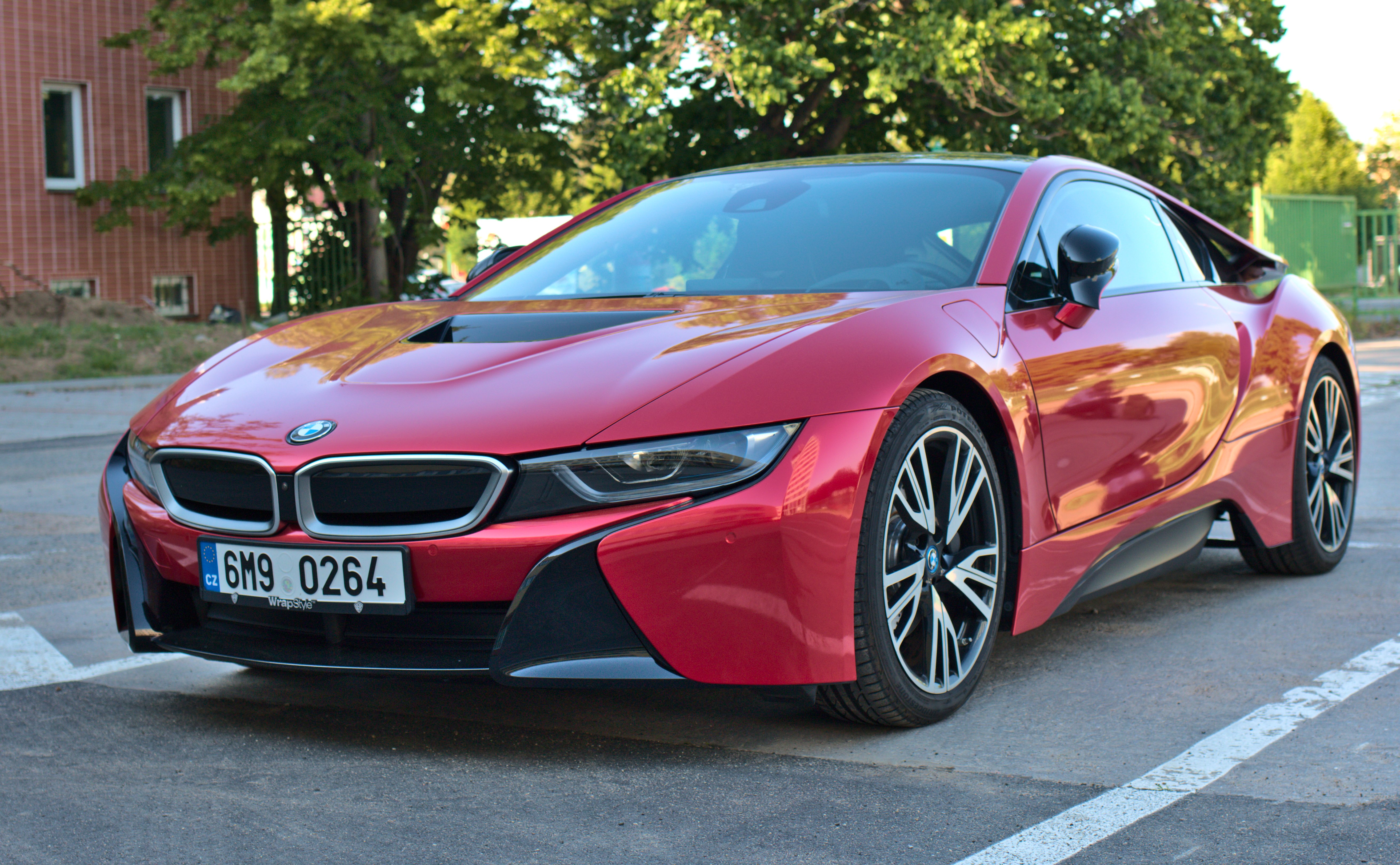
i8 (I12)
"...5 2015 is the era to go right same thing with our i8 it's also yeah i love the i8 yeah where you have ..."
The BMW i8 is a sports car that uses both electricity and gasoline. That means it can drive using electric power and also use a gas engine when needed. In the podcast, it’s mentioned because it’s a special kind of performance car from that time period.
The BMW i8 is a plug-in hybrid sports car that combines an electric setup with a gasoline engine for performance and efficiency. The podcast mentions the “2015 era” and references the i8 as a similar kind of car in the discussion, suggesting it’s being compared in terms of what you get for the money and how it feels to drive. It’s often discussed because it’s a distinctive, tech-forward sports car rather than a traditional gas-only design.

1962 Porsche 356 b
"“this is our newest newest newest purchase which is a 1962 uh Porsche 356 b which is kind of the wellspring of all 9 11's”"
This is a very early Porsche sports car: the 356 B from 1962. It’s important because it’s part of the history that eventually leads to the Porsche 911.
The Porsche 356 is the brand’s original sports-car foundation, and the 1962 Porsche 356 B is one of the most historically significant early variants. It’s often described as the “wellspring” that leads to later Porsche identity and engineering directions, including the lineage that culminates in the 911.
pre 356
"an a and then there's a pre 356 but basically this is this is the start of Porsche after uh [2567.8s] fernadette Porsche went from making Beatles to making Porsches actually well tanks he went"
“Pre 356” means “before the Porsche 356,” which was Porsche’s early famous sports car. The host is using it to talk about Porsche’s earlier days before that model.
“Pre 356” refers to Porsche cars made before the Porsche 356, which is the company’s early production sports car. In this context, the host is contrasting Porsche’s earlier history with the start of the brand’s path toward the cars people associate with Porsche today.
Ferdinand Porsche
"[2567.8s] fernadette Porsche went from making Beatles to making Porsches actually well tanks he went [2572.7s] from making Beatles and then tanks for Hitler yes and that's not whitewash that he tried to [2579.2s] design a tiger too let's not whitewash that and he did the beetle for you know for Hitler as well"
Ferdinand Porsche was a famous car engineer behind early Volkswagen and Porsche designs. The host is mentioning his history to explain how Porsche’s story began.
Ferdinand Porsche was an Austrian-German automotive engineer whose work shaped major Volkswagen and Porsche projects. This segment references his controversial wartime designs and then connects his influence to the Porsche brand’s later direction.
Craigslist classic-car purchase story
"i've always dreamed of owning one of these and when i was on craigslist and i saw this car pop up [2618.4s] i thought you didn't but when i was a kid you didn't like these i remember you called them [2622.5s] bathtubs yeah yeah yeah but as i've got things change as you get more into the brand then you start to [2628.9s] understand it and the value of these actually are coming down they're down like 30 percent and that's [2633.5s] because the people who collect these are are dying once upon a time this was like like if you were"
They talk about finding a classic car on Craigslist, making an offer, and then getting it checked by a mechanic. It’s the story of how the purchase happened.
This segment covers how the host found the classic car on Craigslist, negotiated the price, and then brought it to a mechanic for assessment. It’s a narrative about buying and initial due diligence rather than a technical deep dive.
bathtubs
"i thought you didn't but when i was a kid you didn't like these i remember you called them [2622.5s] bathtubs yeah yeah yeah but as i've got things change as you get more into the brand then you start to [2628.9s] understand it and the value of these actually are coming down they're down like 30 percent and that's"
“Bathtubs” is an enthusiast nickname for early Porsche 911s, referring to their rounded, low, wide body shape. It’s not a formal model name, but it’s a recognizable way people talk about the classic 911 look.
C2
"once upon a time this was like like if you were [2639.6s] in america in the 60s you could have bought a c2 for how much well i mean you you could have bought [2647.3s] a Corvette with 350 horsepower you know and and this this huge rumbling va or you could have spent"
C2 is a nickname for a specific generation of Chevrolet Corvette from the 1960s. In this story, it’s mentioned as a reference point for what those Corvettes cost compared to the Porsche.
C2 is a Corvette generation code referring to the 1963–1967 Corvette. Here it’s used as a shorthand in a pricing comparison: the host says you could have bought a C2 Corvette for less money than the classic Porsche they’re discussing.
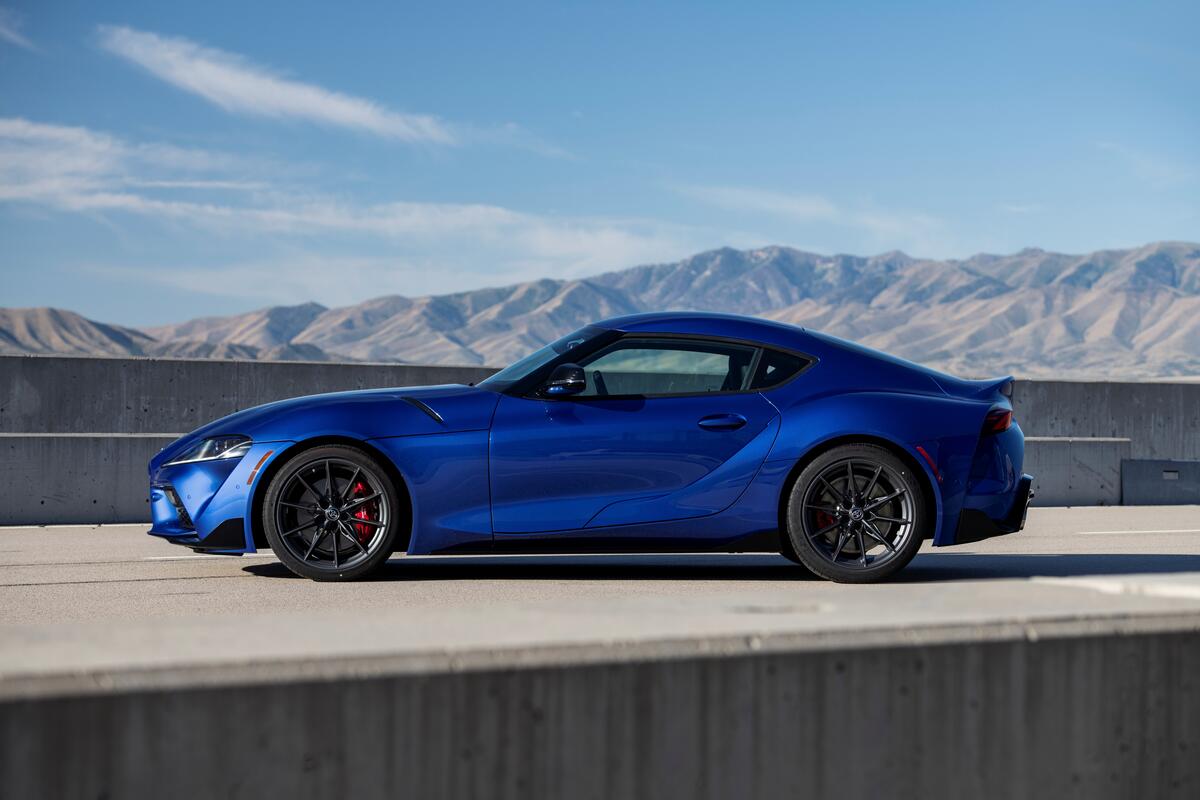
Toyota A90
"a Corvette with 350 horsepower you know and and this this huge rumbling va or you could have spent a lot more money in about a 90 horsepower bathtub so it was kind of a hard it was a hard argument to make but if you know you know yeah so these cars were incredibly dynamically right they could"
The Toyota Supra is a sports car made by Toyota. It’s designed to be fast and fun, with an engine tuned for performance. In the podcast, it’s mentioned because people compare how much power and driving feel it offers.
The Toyota Supra is a sports car known for its performance-focused engineering and strong enthusiast appeal. In the podcast, it’s discussed in a power/engine-character comparison, contrasting what you get in terms of performance and feel. It comes up often because it’s a modern performance icon with a reputation for being quick and engaging.
va
"[2647.3s] a Corvette with 350 horsepower you know and and this this huge rumbling va or you could have spent [2654.4s] a lot more money in about a 90 horsepower bathtub so it was kind of a hard it was a hard argument"
“VA” sounds like the host is referring to a V8 engine—an engine with eight cylinders. They’re comparing that kind of big American engine to the smaller, lower-horsepower Porsche of that era.
“VA” here appears to be a shorthand for a V8 engine (“V-A” as spoken), used to contrast the Corvette’s big American V8 sound and power with the Porsche’s much lower horsepower at the time. It’s not a formal engine designation on its own, but it’s clearly pointing to the engine configuration.
outlaws
"there's two kinds there's the original kind and then there are outlaws and the outlaws have upgraded engines"
“Outlaws” here means classic cars that aren’t kept completely original. They’ve often been modified so they’re more fun to drive, even if they’re not as “collector-correct.”
In classic Porsche circles, “outlaws” usually refers to cars that are intentionally modified or not kept strictly original—often with swapped parts, upgrades, and a less-collector-pure approach. The tradeoff is usually lower originality (and sometimes lower value) in exchange for drivability and personal taste.
compression
"it's got more compression in the standard car it's got um you know it's like the whole engine's a little bit hotter"
Here “compression” is about how tightly the engine squeezes the fuel-air mixture before it ignites. More squeeze can make the engine stronger, but it has to be set up correctly.
In an engine context, “compression” refers to the compression ratio—the amount the air-fuel mixture is squeezed before ignition. Higher compression generally improves efficiency and can make an engine feel stronger, but it can also require better fuel and careful tuning.
carburetors
"it's got more compression in the standard car it's got um you know it's like the whole engine's a little bit hotter different carburetors"
Carburetors are the parts that mix fuel with air so the engine can burn it. Swapping or changing them can change how the car starts and drives.
Carburetors are fuel-mixing devices that meter gasoline and mix it with air before it enters the engine. On older cars like the Porsche 356, changing carburetors can significantly alter throttle response and how the engine runs.
numbers matching
"it's not the engine it was born with right so it's not numbers matching but for the price it's about as cheap as a running and driving 356 comes"
“Numbers matching” means the car still has the original parts it left the factory with, like the original engine. Collectors like it because it’s more authentic and usually worth more.
“Numbers matching” means the car’s major components (especially the engine) are the original ones that were installed at the factory, often verified by matching serial numbers. Collectors usually pay a premium for numbers-matching cars because it preserves historical authenticity.
disc brakes
"it's had an engine rebuild it's been converted to disc brakes the steering's great"
Disc brakes are a braking system where pads squeeze a metal disc to slow the car down. Converting to discs is often done to get better stopping power and more consistent braking.
Disc brakes use brake pads clamping onto a spinning disc to slow the car. Converting a classic from drum brakes to disc brakes is a common upgrade because discs typically provide stronger, more consistent braking—especially with repeated use.
Request an Explanation
Heard something you'd like explained? We'll add it to this episode.
Sign in to request explanations for terms you heard.
Want to learn more?
Browse our glossary for plain-English explanations of automotive terms, jargon, and concepts.
Help improve this episode
See something that's not quite right? Our annotations are AI-generated and can sometimes miss the mark. Click the flag icon on any annotation to suggest a correction.