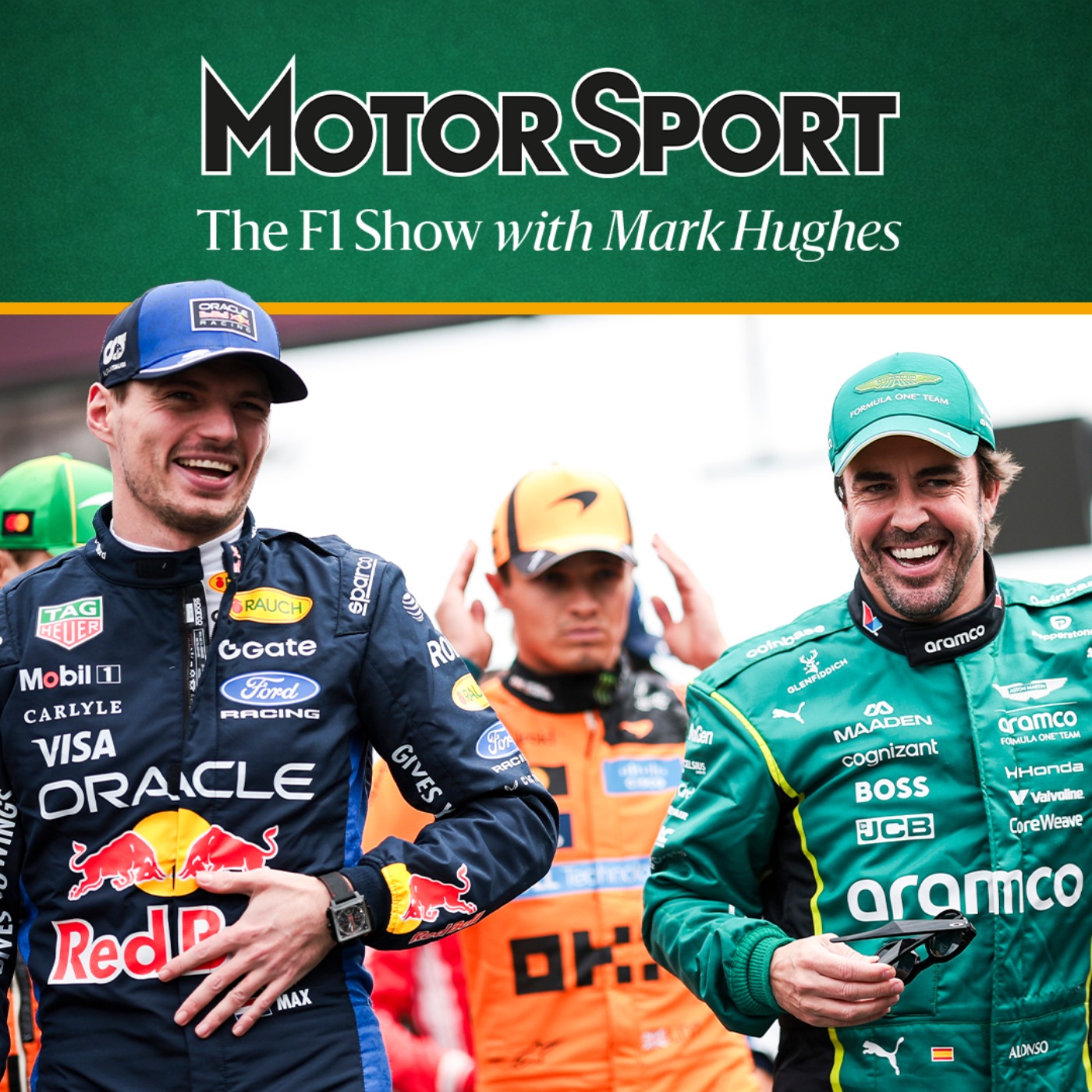
Why Fernando Alonso still has what it takes to win a third F1 championship
About this episode
Mark Hughes makes the case that Fernando Alonso’s age is far less important than his feel, adaptability, and relentless desire to win. He argues that elite F1 drivers can stay near their peak well into their 40s, and that Alonso’s ability to read awkward cars, manage traffic, and adjust instantly to changing conditions still sets him apart. The conversation also touches on Aston Martin’s future, with Adrian Newey and the engine partnership seen as reasons Alonso may stay committed.
How old is too old for an F1 driver? Fernando Alonso says he’s ready to race on into his late forties and Mark Hughes says he still has the talent, the adaptability and the burning desire to fight for a world championship — in fact, in some areas, he's better than any other driver.
Plus: F1 is back on track this weekend - will we see a new frontrunner after a month of frantic factory work?
More from Mark Hughes and Bryn Lucas on the stories that really matter, in the latest episode of the Motor Sport F1 Show.
Subscribe now for every weekly episode and tell us what you want to know from Mark. Send us a message on social media or find this podcast at https://go.motorsportmagazine.com/48zc2cS and drop your questions in the comments. He'll answer a selection of the best every week.
Read Mark's column every Wednesday at https://go.motorsportmagazine.com/48zc2cS
Hosted on Acast. See acast.com/privacy for more information.
Grand Prix
"Well, Mark, we are on the build up finally to a Grand Prix. It feels like a very long time since we've said that."
A Grand Prix is just a major Formula 1 race weekend. Drivers race on a track, and the results help decide the season champion.
A Grand Prix is a Formula 1 race event held on a specific circuit, typically as part of a multi-race season. Each Grand Prix contributes points toward the World Championship standings.
Miami
"Nothing really to do with Miami to start with, actually. Some news that came out just very recently at Monaco, the historic racer in Monaco,"
The hosts reference Miami as the next or relevant Formula 1 race location in the season schedule. It’s used here as a time anchor for what’s coming up.
Monaco
"Some news that came out just very recently at Monaco, the historic racer in Monaco, Fernando Alonso has hinted, suggested even that he wants to continue into the next season, 2027,"
They’re talking about Monaco because that’s where the latest F1 news came from. Monaco is famous for being a very challenging, twisty track.
Monaco is called out as the place where recent news broke, tying the discussion to a specific Grand Prix weekend. Monaco is also well known in F1 for its tight, slow street circuit layout.
Formula One driver
"Yeah, it's a fascinating subject, because I think there's a general perception that you can't really be a quick Formula One driver once you've passed your mid-30s sort of thing,"
A Formula One driver is someone who races in the highest level of open-wheel racing. They’re debating whether drivers can still be fast after a certain age.
A Formula One driver is a professional racing driver competing in F1, the top tier of open-wheel motorsport. The segment discusses how driver age and experience relate to staying fast at the highest level.
reaction delay
"connected to our inner ear, and without the normal reaction delay because it's subconscious, [330.0s] and so that feel and that sense of yaw and rotation is what defines how quick one guy is"
Reaction delay is the time it takes your brain to go from noticing something to acting on it. The point here is that good driving isn’t just about fast conscious reactions—it’s about sensing and responding in a more automatic way.
“Reaction delay” refers to the time lag between sensing something and making a conscious response. The segment argues that effective driving relies less on delayed, conscious reactions and more on subconscious processing that reduces the lag.
yaw and rotation
"and so that feel and that sense of yaw and rotation is what defines how quick one guy is, [339.4s] and how naturally quick one guy is compared to another guy."
Yaw and rotation describe how the car turns or twists in the air—especially how the front of the car swings left or right. Drivers learn to “feel” these changes so they can react quickly and drive the car smoothly.
“Yaw” is the car’s rotation around its vertical axis—think of the nose swinging left or right. The discussion links a driver’s “feel” for yaw/rotation to how quickly they can sense and respond to the car’s balance changes during cornering.
G-forces
"you're staying trim, you're working out in a gym, [387.3s] you're keeping your neck strong, those sorts of things, and physically you're able to deal with the G-forces [391.7s] that an F1 car is throwing at you and those sorts of factors"
G-forces are how hard the car is pushing you during driving—like how heavy you feel in a fast corner. In F1, those forces can be extremely high, so drivers train to handle them without getting too tired.
“G-forces” are the acceleration forces a driver experiences, expressed in multiples of Earth’s gravity (1G). In F1, cornering, braking, and acceleration can subject the driver to very high G-loads, which affects fatigue and how well they can stay focused and control the car.
barometer
"I wonder if there's a difference in his barometer now to what he sees as his target... you ideally need a super quick barometer of a current driver alongside you in the same car."
In this context, “barometer” means a measuring stick. The idea is that a very fast teammate helps show whether you’re keeping up with the pace needed to win.
Here, “barometer” is used in a racing-performance sense: a reference point that indicates how well a driver is doing relative to the competition. The hosts say a “super quick” teammate/driver alongside you acts like a real-time benchmark for pace and competitiveness.
competitive car
"...of course you need the competitive car to do that, and you ideally need a super quick barometer of a current driver alongside you in the same car."
A “competitive car” is a car that’s fast enough to fight near the front. In racing, you can be skilled, but you still need a car that can actually win races.
A “competitive car” is a race car that has enough pace and reliability to consistently challenge for top positions. In F1, even an elite driver can’t win if the car can’t generate the required performance in qualifying and races.
mindset
"Will his mindset change, birth of his child? Is that going to change his mindset, the risk, rewards, fights?"
“Mindset” here means how the driver thinks and decides when racing. The hosts are wondering if becoming a parent changes how he handles risk and competition.
In motorsport, “mindset” refers to a driver’s mental approach to risk, motivation, and decision-making under pressure. The segment discusses whether major life changes could affect how a driver weighs risk versus reward in racing.
one lap qualifying pace
"[706.8s] I think the natural traits that he's always had are actually very well suited to a long career because his one lap qualifying pace, although extremely good, is not the most outstanding thing about his whole game."
Qualifying pace is how quickly a driver can do their best timed lap. It’s different from race pace, which is about staying fast for many laps.
“Qualifying pace” is how fast a driver can go over a single timed lap, usually to set the starting position for the race. “One lap qualifying pace” emphasizes peak speed and efficiency for that short stint rather than long-run race consistency.
car by the scruff of the neck
"[736.2s] It's his ability to get a car by the scruff of the neck and just sort of get any sort of tune from it, regardless of how ill-balanced it is or how awkward it is and how much it's changing."
It means he can quickly figure out what the car is doing and adjust his driving to match. Even if the car feels weird or changes a lot, he can still make it work.
This is a metaphor for a driver’s ability to quickly “read” what the car is doing and adjust their driving to suit it, even when the setup is awkward or the car is behaving unpredictably. In F1 terms, it points to adaptability to balance changes and evolving handling.
wheel-to-wheel
"[796.6s] And the other thing that he's better than anyone I've ever seen is his sense of where he is in traffic in a wheel-to-wheel situation."
Wheel-to-wheel means racing right next to another car. It’s the most intense kind of driving because you have to stay close without touching.
“Wheel-to-wheel” describes racing side-by-side with other cars, where there’s little margin for error and positioning matters. It highlights how a driver manages gaps, braking/turn-in timing, and spatial awareness during direct competition.
pit wall
"[839.9s] He's brilliant at that. He's brilliant at understanding strategy as a race is evolving and as the track is evolving and he understands the implications straight away and he asks the right questions to the pit wall."
The pit wall is where the team watches the race and talks to the driver. They help with strategy and decisions while the car is out on track.
The “pit wall” is the team’s operations area near the pit lane where engineers and strategists monitor the race and communicate instructions to the driver. It’s where strategy calls, tire/energy management guidance, and race-position decisions are coordinated.
strategy as a race is evolving
"[839.9s] He's brilliant at that. He's brilliant at understanding strategy as a race is evolving and as the track is evolving and he understands the implications straight away and he asks the right questions to the pit wall."
It means the race plan changes as the race unfolds. Teams keep adjusting based on tires, other cars, and how the track changes.
This refers to in-race strategy adapting to changing conditions—such as tire wear, traffic, safety cars, and track grip evolving over time. In F1, strategy is dynamic: teams continuously reassess the best plan based on what competitors and the track are doing.
front-running car
"[893.0s] If you were in a front-running car, would he be able to, do you think, run and beat the likes of Vax and Lando and Oscar and George Russell and Antonelli, all those sort of front-running drivers?"
A “front-running car” is a race car that’s usually fast enough to be near the front of the pack. The hosts are asking whether Alonso could keep up with other top drivers if he had a car like that.
In Formula 1, a “front-running car” is one that’s consistently capable of fighting at the front of the grid—typically near the front in qualifying and regularly contending for race wins. The discussion is about whether Alonso could match other top drivers if he had a car of that caliber.
world championship
"[946.2s] And fight for a world championship if he was ever in a title of the car."
The “world championship” is the main championship F1 crowns at the end of the season. They’re saying Alonso could realistically contend for the top prize if his car is good enough.
In F1, the “world championship” refers to the season-long battle for the Drivers’ Championship (and separately the Constructors’ Championship). The speaker is arguing Alonso could fight for the top title if he gets into a title-winning car.
Aston Martin
"[979.1s] Whether the sands of time run out on his career before Aston Martin or another team get their act together on that note. [985.9s] Has he seen something at Aston Martin?"
Aston Martin is the Formula 1 team/brand being talked about in connection with Alonso. They’re discussing whether the team’s new car and upgrades will make it fast enough to challenge for wins and championships.
Aston Martin is the Formula 1 team/brand discussed here as the potential destination (or current home) for Fernando Alonso. The hosts reference the team’s recent car launch and development progress, including concerns about the power unit and hopes for competitiveness later in the season.
power unit
"[988.0s] I remember at the build up to this season, the launch with all the cars were testing out in Bahrain and that Aston Martin appeared and everyone was like, [994.4s] wow, this car is staggering and then it kind of disappointed with what was going on with the power unit."
In F1, the “power unit” is the whole high-tech engine package that makes the car go, including the turbo engine and the hybrid energy parts. They’re saying the car looked promising, but the engine/hybrid system wasn’t delivering as expected.
F1’s “power unit” is the complete hybrid engine system used in modern cars, combining a turbocharged internal-combustion engine with energy-recovery components and control electronics. When the hosts say the Aston Martin “disappointed” due to the power unit, they’re pointing to issues with the car’s overall hybrid performance rather than just the engine alone.
testing out in Bahrain
"[988.0s] I remember at the build up to this season, the launch with all the cars were testing out in Bahrain and that Aston Martin appeared and everyone was like, [994.4s] wow, this car is staggering and then it kind of disappointed with what was going on with the power unit."
Bahrain is where F1 teams often test cars to see how new updates perform. The hosts are using that test to explain why Aston Martin looked promising at first but didn’t deliver as expected.
Bahrain is a common F1 testing location where teams run development work and evaluate new parts before/around the start of the season. The segment uses this as context for why Aston Martin initially looked strong, then later struggled due to power-unit performance.
chassis
"[999.4s] But do you think that Philando has maybe seen something in that chassis, in that design, in that power unit development that makes him think, [1008.5s] OK, by the end of this season, this car is going to be competitive."
The “chassis” is basically the car’s skeleton or frame. It affects how the car handles and how well it can be set up for racing.
A “chassis” is the car’s structural foundation—its frame and mounting points—which strongly affects handling, stiffness, and how well the car can be tuned. In this segment, the speaker links the chassis/design to the team’s belief that the car will become competitive by improving the overall package.
engine partner
"[1027.3s] It's faith that this team has all the budget it needs. [1031.0s] It has everything required in terms of has an engine partner it can work hand in hand with."
An “engine partner” is the company that provides the engine system for the F1 team. The idea is that if the partnership is strong, the team can develop the car’s power and reliability better over time.
An “engine partner” in F1 is the company that supplies the team’s power unit (or key parts of it), working alongside the team to integrate and develop the system. The segment suggests Aston Martin’s confidence comes from having a workable partnership that can improve performance together.
Adrian Newey
"[1031.0s] It has everything required in terms of has an engine partner it can work hand in hand with. [1039.4s] It has Adrian Newey, which is probably the biggest thing that gives him that faith."
Adrian Newey is a top F1 car designer. The hosts are saying that having him on the team is a major reason they believe the car can improve and become competitive.
Adrian Newey is a highly influential F1 technical designer/engineer known for leading championship-winning car development. The segment treats his involvement with Aston Martin as the biggest reason the team believes it can turn the car into a front-running package.
technical thing
"[1046.3s] I don't think he's necessary looking at it and saying I can spot a technical thing here that's going to give us a big advantage, [1052.5s] although that car is extraordinarily different from most of the others around it."
Here “technical thing” means a specific engineering change to the car. The speaker is saying it’s not just one easy fix—there are bigger differences in how the car works.
In F1 talk, a “technical thing” usually means a specific engineering change—like an aerodynamic update or mechanical tweak—that could improve performance. The speaker is saying the driver isn’t just spotting one obvious advantage, because the car is very different from others.
improvement curve
"So I think the longer it takes this season for that improvement curve to become apparent. [1096.0s] I think the greater the chances are of Fernando staying on because he wants that."
It’s basically a “how fast things get better” timeline. The speaker is saying the car/team might improve later in the season, and that timing affects decisions.
An “improvement curve” is the expected timeline of how quickly a team’s car upgrades start working. In F1, it often refers to how performance rises as development parts are introduced and the car is refined through the season.
Mercedes
"[1130.1s] I don't think he's going to get a sudden opportunity to join Mercedes or Ferraris or McLaren. [1137.9s] I don't think that those teams would be looking to disrupt what they've got just to accommodate him."
Mercedes is another F1 team. The speaker is saying it probably wouldn’t change its plans just to fit Alonso in.
Mercedes is mentioned as a potential F1 team Alonso could join, but the speaker argues it’s unlikely. The point is about how top teams protect their current plans and driver lineup rather than making disruptive changes midstream.
McLaren
"[1130.1s] I don't think he's going to get a sudden opportunity to join Mercedes or Ferraris or McLaren. [1137.9s] I don't think that those teams would be looking to disrupt what they've got just to accommodate him."
McLaren is another racing team in Formula 1. The speaker is saying they probably wouldn’t change their plans just to fit Alonso in.
McLaren is mentioned as another top F1 team Alonso could theoretically join. The speaker says those teams are unlikely to disrupt their current direction just to make room for him.
Ferraris
"[1130.1s] I don't think he's going to get a sudden opportunity to join Mercedes or Ferraris or McLaren. [1137.9s] I don't think that those teams would be looking to disrupt what they've got just to accommodate him."
Ferrari is another F1 team. The speaker is saying they likely wouldn’t change their whole plan just for Alonso.
Ferraris is how the transcript refers to Ferrari as a potential F1 destination. The speaker’s argument is that Ferrari (like other top teams) wouldn’t restructure its existing setup just to accommodate a driver change.
contracts
"Just staying with Fernando, though, is he the cork in the bottle when it comes down to contracts and where drivers will end up for 2027? Because there are quite a lot of contracts up or nearing the end or open contracts that could be released at the end of the season, things like that."
A driver contract is the official agreement between a driver and a team. If it’s close to ending, the team may have to decide whether to renew or let the driver move, which can change who gets a seat.
In Formula 1, driver contracts are employment agreements that can run for multiple seasons and include clauses about performance, team options, and timing of renewals. When contracts are nearing the end, it can open up seats for other drivers at the end of the season.
GT World Challenge Europe
"He always seems to be a bit grumpy around the F1 pit lane, although I have to say he was in GT World Challenge Europe just a couple of weeks ago at Paul Ricard and he raced in that race."
GT World Challenge Europe is a racing series for sports cars (not Formula 1). They’re mentioning it to point out that Lance Stroll has been competing in other races too.
GT World Challenge Europe is a sports-car racing series for GT (grand touring) cars, typically featuring professional and amateur drivers. The segment uses it to show that Lance Stroll has been racing outside F1 recently.
F1 pit lane
"He always seems to be a bit grumpy around the F1 pit lane, although I have to say he was in GT World Challenge Europe just a couple of weeks ago at Paul Ricard and he raced in that race."
The pit lane is where the teams work on the car during a race. It’s a busy, high-pressure area, so the comment is about how the driver seems to act there.
The pit lane is the area beside the track where teams operate during a race—servicing the car, making tire changes, and coordinating strategy. Being “grumpy around the F1 pit lane” is a behavioral observation tied to how a driver handles the intense, high-pressure environment.
Paul Ricard
"He always seems to be a bit grumpy around the F1 pit lane, although I have to say he was in GT World Challenge Europe just a couple of weeks ago at Paul Ricard and he raced in that race."
Paul Ricard is a famous race track in France. The hosts are saying that Stroll raced there recently.
Paul Ricard is a well-known motorsport circuit in France used for many racing events. Mentioning it grounds where the GT World Challenge Europe race took place.
nuclear fallout
"Yeah, I think a good luck with trying to compose that. It would be a nuclear fallout. But also, I don't think Lawrence would do that."
“Nuclear fallout” is a dramatic way to say “big consequences.” They mean that if a top driver retires, it could cause a lot of other teams to reshuffle their plans.
“Nuclear fallout” is a metaphor for a major, far-reaching consequence. Here it describes how a high-profile F1 retirement (like Lewis Hamilton) could trigger a chain reaction in driver seats and team decisions.
enforced hiatus
"And one of the big stories or one of the stories going around in Formula One is that we've had a roughly a month off from race to race because of this enforced hiatus."
It means there’s a forced break between races. Teams use that extra time to improve the cars before the next race.
An enforced hiatus is a forced break in the racing calendar where teams don’t race for a period. In F1, that downtime is often used to develop and install upgrades before the next event.
major upgrade
"It's usually quite subtle visually when they do a major upgrade. And they'll say things like 90% of the surfaces of this car are different to how they were prior to the upgrade and you look at it and you think, where?"
A major upgrade in F1 is a substantial development package that can change how the car behaves, even if it doesn’t look dramatically different from the outside. Teams often describe it in terms like “most surfaces are different,” reflecting aerodynamic and mechanical changes within the rules.
airflow
"So yeah, but that can work the air in a fundamentally different way and it can give a completely different regime to the airflow and what they're trying to do with it yet."
Airflow is how air flows around the car. If teams change body shapes and parts, the air can move differently, and the car can feel like it’s working in a totally different way.
In F1, airflow refers to how air moves around and through the car’s aerodynamic surfaces. Small geometry changes can alter airflow patterns, which can shift the car’s aerodynamic “operating window” (how it works best across speeds and conditions).
tightly controlled set of regulations
"But it's a very tightly controlled set of regulations that they're working within. So one look radically different and I'm sure as we all drill down into it and we all get a bit more of a close up look at it."
F1 has strict rules about what teams are allowed to change. So even when the car gets upgraded a lot, it still has to stay within those limits.
F1 performance is heavily shaped by a tightly controlled rulebook that limits what teams can change. Because of that, even major upgrades are often constrained to specific aerodynamic and technical areas rather than unrestricted redesigns.
simulator
"I imagine they've had a fair bit of time in the simulator working out the way the power unit operates. I didn't say the R word, the power unit operates."
A simulator is a computer-based system used to model the car and help drivers and engineers develop setup and strategy. In F1, teams use it to understand how the power unit and car systems behave without waiting for track testing.
upgrades
"I also suspect as well, Mark, that if McLaren are saying that they've got some significant upgrades that the majority, if not all of the other teams will have a similar level of upgrades coming of new packages along the way."
In F1, an “upgrade” is a change to the car—like new parts or software—to make it faster. Teams bring upgrades during the season to try to gain time versus other teams.
In Formula 1, “upgrades” are new or revised parts and software updates brought to the car to improve performance. They can target aerodynamics, cooling, weight distribution, or how the car behaves in different conditions.
power plan
"McLaren were already getting closer to Mercedes over the first three races as they better understood the power plan and they were saying that, you know, by the time of Japan, Andrea Stiller was saying,"
A “power plan” is how the team decides to use the car’s power during a lap. It’s basically the strategy for when the car should push harder versus save energy.
A “power plan” in F1 refers to how the car’s power unit is managed and deployed across the lap—how much energy is used, when, and how the engine and energy systems are controlled. Small differences in power delivery and energy usage can translate into measurable lap-time gaps.
lap time deficit
"yeah, we think we've eradicated almost all of the power unit understanding deficit. So that lap time deficit you've seen now is a couple of tenths. That's where we are with the car."
A “lap time deficit” is the time difference between cars—typically between teams or drivers—over a lap. In F1 analysis, even small deficits (like a couple of tenths of a second) can determine who qualifies higher and who finishes ahead.
two tenths
"So if they had an upgrade that was worth two tenths and Mercedes upgrade didn't bring anything, then yeah, you could be looking at, you know, a competitive, a fully competitive Mercedes and McLaren going up against a Mercedes."
“Two tenths” means two-tenths of a second (0.2s). In F1, that’s a big difference because races and qualifying are often decided by very small margins.
“Two tenths” refers to 0.2 seconds per lap, a common way F1 teams talk about performance gaps. Because F1 races are decided by fractions of a second, a change of a couple of tenths can be the difference between fighting for position or falling behind.
sprint weekend
"Do you think they would have preferred to have had a non sprint weekend on this return? I know they got a longer FP1, they got a 90 minute FP1, but do you think the teams would have preferred to have a standard regular inverted commas for a pre weekend?"
A “sprint weekend” is an F1 race format where a shorter qualifying-style race (the Sprint) determines the grid for the main Grand Prix. It changes how teams plan practice, setup, and tire/energy usage across the weekend.
FP1
"Do you think they would have preferred to have had a non sprint weekend on this return? I know they got a longer FP1, they got a 90 minute FP1, but do you think the teams would have preferred to have a standard regular inverted commas for a pre weekend?"
FP1 is “Free Practice 1,” the first on-track practice session of an F1 race weekend. Teams use FP1 to test setups, gather data, and evaluate how the car behaves before qualifying and any Sprint or race.
Toyota A90
"It's possible, but it would be a very good upgrade to get two tenths from, you know, in one, but it's not unheard of. So yeah, I wouldn't rule it out. I'd be surprised if it was suddenly the car and left everything else for dead, but let's see. Do you think they would have preferred to have had a non sprint weekend on this return? I know they got a longer FP1, they got a 90 minute FP1, but do you think the teams would have preferred to have a standard regular inverted commas for a pre weekend? Oh, absolutely they would, yeah. All the engineers would anyway. I think some of the drivers quite like the idea of just getting straight in, even though they might pitch about it. I think especially if they fall on the right side of the favourable side of that, you know, throwing everything up in the air."
The Toyota Supra is a sports car made for fast driving. People often modify it to make it quicker and improve how it handles. In the podcast, it’s mentioned because upgrades might help it gain small amounts of speed or lap time.
The Toyota Supra is a sports coupe known for its performance-focused design and strong aftermarket support. In a motorsport context, it may come up as a platform that can be tuned and developed to gain measurable lap-time improvements. That’s why it could be discussed alongside the idea of finding small gains—like fractions of a second—through upgrades.
Alpine
"No, I don't think we are. I think the decision of the Renault board over what it wants to do with the Alpine team and the various possibilities and offers it has in front of it and how they're going to move forward from that is sort of taking the ball out of Christian's court really."
Alpine is the Formula 1 team brand. In this part, they’re talking about Alpine’s situation and how Renault’s decisions could affect the team’s direction.
Alpine is the F1 team brand discussed here in relation to Renault’s board decisions. The segment frames Alpine’s situation as part of the broader uncertainty around team leadership and future plans.
Renault
"No, I don't think we are. I think the decision of the Renault board over what it wants to do with the Alpine team and the various possibilities and offers it has in front of it and how they're going to move forward from that is sort of taking the ball out of Christian's court really."
Renault is a major motorsport brand involved in Formula 1. Here, they’re talking about Renault’s internal decisions and how that could influence what happens with team leadership.
Renault is referenced as a company/brand making decisions about its F1 team structure and future direction. The hosts mention Renault’s board and how those decisions affect where team leadership (Christian Horner) might end up.
mid-corner snap
"I think they have banished that feature that Charles Leclerc in qualifying, spring qualifying in China, whereby he lifted the throttle to 98% to correct the mid-corner snap and that completely confused the,"
“Mid-corner snap” refers to an abrupt change in the car’s behavior while the car is still turning—often a sudden loss or gain of grip that can rotate the car unexpectedly. Drivers and engineers try to prevent it because it can ruin the lap and make the car harder to drive consistently.
lifted the throttle to 98%
"I think they have banished that feature that Charles Leclerc in qualifying, spring qualifying in China, whereby he lifted the throttle to 98% to correct the mid-corner snap and that completely confused the,"
That means the driver backed off the gas a little while turning. In F1, even small throttle changes can help the car stay stable and not upset its handling.
In F1, “lifting the throttle” means reducing throttle input mid-corner. The “98%” framing suggests the driver wasn’t going to full lift-off, but used a very specific throttle reduction to manage the car’s balance and stability.
straight line speed
"...it led to a sequence of events that hurt his straight line speed and ruined his lap. They've got rid of that, that little nuance in the way that the software is configured."
It’s how fast the car can go when you’re not cornering. If something upsets the car’s balance or aerodynamics, it can make the car slower on the straights.
Straight-line speed is how quickly the car can travel on the sections of track where it’s mostly accelerating rather than turning. In F1, it’s influenced by engine power delivery, aerodynamic drag, and how the car is set up after qualifying or during the race.
algorithm deciding what's the most efficient use of the power in terms of lap time
"He is still going to have the algorithm deciding what's the most efficient use of the power in terms of lap time, so not fully in control and fully in the driver's control."
Modern F1 cars use computer control to decide how to deliver engine power. The goal is to make the car faster around the lap, not just let the driver do everything manually.
This describes F1’s electronic engine and driveline control systems that manage how power is delivered. Instead of the driver directly commanding everything, software uses sensor data and models to optimize power usage for lap-time performance.
regulation changes
"...when they have a month of upgrades, regulation changes to cope with and just one practice session?"
“Regulation changes” refers to rule updates that alter how cars are built and operated. Even small changes can force teams to redesign parts, update software, and revise setup targets—especially when combined with a tight sprint-weekend schedule.
reset
"Yeah, and you're right. It's a little bit of a reset, a very early reset, just four races into the season, but yeah, it is. It's potentially very much a reset. So yeah, it's going to be intriguing."
Here “reset” means things are starting over in a way that could change who’s fastest. With new updates and a tight schedule, the usual pecking order might not hold.
In this context, “reset” means a fresh start in competitiveness due to schedule timing and changing conditions (like upgrades and rule changes). The host is suggesting the field may be less predictable early in the season again.
Istanbul Park
"I happen to love Istanbul Park. It's a great place to go to, but what are your thoughts? Yeah, I love the place. I love the circuit. It's one of the great tracks."
Istanbul Park is the circuit in Turkey that hosts the Turkish Grand Prix. The hosts describe it as a track that quickly became a fan favorite and a place drivers enjoy racing.
COVID
"It's sort of hovered around on the margins for a while, hasn't it? And it's sort of filled in now and again as required during moments of crisis and COVID and things like that."
COVID is mentioned as the reason the race schedule got disrupted for a while. They’re saying the Turkish Grand Prix wasn’t always on the calendar during that period.
COVID is referenced as a period when the F1 calendar was disrupted, causing races like the Turkish Grand Prix to appear only sporadically. Here it’s used to explain why the event “hovered around on the margins” before returning.
flat out qualifying battle
"What I hope is that we see a good flat out qualifying battle for the first time this season, where the drivers can properly attack all the corners. I think the circuit layout is friendly enough to make that feasible combination with the latest tweaks that there have been."
This means qualifying where the drivers are going all-out and it’s a close fight for the best lap times. The goal is that they can really attack the track’s corners instead of being held back.
“Flat out qualifying battle” describes a qualifying session where drivers push at maximum effort and trade fast laps closely. It implies cars can attack corners hard and still maintain enough grip and control to set competitive times.
overtaking points
"I think there's a good chance Miami could deliver. There's some very good, strong overtaking points out there in Miami. There's a good mix out there..."
Overtaking points are places on the track where it’s easier for one car to pass another. They’re saying Miami has good areas for passing.
Overtaking points are specific areas of a circuit where conditions make passing more likely—often due to braking zones, corner exits, or straight-line opportunities. The hosts say Miami has several strong spots to pass, which can make the race more entertaining.
Request an Explanation
Heard something you'd like explained? We'll add it to this episode.
Sign in to request explanations for terms you heard.
Want to learn more?
Browse our glossary for plain-English explanations of automotive terms, jargon, and concepts.
Help improve this episode
See something that's not quite right? Our annotations are AI-generated and can sometimes miss the mark. Click the flag icon on any annotation to suggest a correction.