Why Shops Lose Technicians Overnight | Lisa Coyle and Kat Ayers from Promotive
About this episode
Technicians don’t just disappear—shops lose them through slow, biased, or mismatched hiring, plus culture and leadership problems that make people feel stuck. Promotive’s Lisa Coyle and Kat Ayers explain how a virtual recruiter can speed screening (even late-night) and improve consistency, while also reducing discrimination tied to names, age, or prior shops. They argue talent isn’t one “mold,” and that retention depends on accountability, communication, and creating an environment people don’t want to leave.
Like the show? Show your support by using our sponsors.
Promotive can help you find your dream job. Touch HERE to see open jobs.
Need to update your shop systems and software? Try Tekmetric HERE
Launch your tool game to the next level with Launch Tech USA! HERE
In this episode, Jeff Compton talks with Promotive’s Lisa Coyle and Kat Ayers about what’s changing in technician hiring, including their AI virtual recruiter and how it helps shops with consistency, speed-to-lead, and 24/7 candidate screening. They discuss common hiring bias, why resumes often don’t reflect real skill, how to interpret job hopping, and why following application instructions matters. The episode also covers shop culture and leadership as key retention drivers, how slow follow-up hurts candidate experience, and what Promotive is building next—expanded platform features, more automation, and plans to move into the Canadian market.
Timestamps:
0:00 Podcast Kickoff
00:28 Fishing and Seafood Talk
03:10 Bass Tournaments and Hockey
06:30 What’s New at Promotive
08:06 AI Recruiting Benefits
11:13 Bias and Hiring Fairness
20:03 Resume Gaps and Progress
22:58 Following Instructions Matters
24:43 Job Hopping Explained
29:56 Walk-In Resumes vs Process
34:35 Call Screen Limits
36:23 Tagging Resumes For Future
37:59 Techs Becoming Advisors
42:56 Trade Shows And Outreach
48:26 Cold Calls And Data
52:42 Industry Negativity And AI
01:00:20 Robots Costs And Culture
01:06:41 Leadership Questions And Nepotism
01:10:20 Multi Interview Triangulation
01:12:13 Candidate Experience Matters
01:16:11 Rehiring and Keeping Benches
01:21:27 Job Searching Is Normal
01:24:41 Legacy Over Resentment
01:29:13 Plan B and Hard Questions
01:32:02 What Have You Done Today
01:34:14 Promotive Roadmap and Events
01:37:18 Canada Expansion and Languages
01:39:44 Hockey Talk and Show Circuit
01:44:35 Final Thanks and Wrap Up
Follow/Subscribe to the show on social media!
TikTok - https://www.tiktok.com/@jeffcompton7
YouTube - https://www.youtube.com/@TheJadedMechanic
Facebook - https://www.facebook.com/profile.php?id=100091347564232

Subaru 360
"Yeah. No, and a te- a technician, a candidate, you know, service advisor, whoever, learns a lot about the entity that they want to go work for, they think they do, um, by seeing what their process is like and what that professionalism is like. And, you know, are they constantly moving the interview? Are they showing up for the interview? Did they forget? Are they flustered and not even prepared for the interview? Um, and when you just walk in, of course you, again, as a salesperson, I used to have, uh, at 360's office when we had a- an office, um, I had on the sign, on the, the signage on the front door said, "Solicitors welcome. We're hiring." Um- Right ... I would love that right at that time. But now fast-forward 10 years later, it would drive me nuts if somebody just showed up, um, for me, let alone my team. Especially depending on the day of the week. You know, Monday mornings the shops are typically- Yeah ... super, super busy, right?"
The Subaru 360 is a very small older car made by Subaru, designed to be simple and efficient. Because it’s an older, basic-style vehicle, it can be a good example for learning how service work is done and how problems are found. That’s likely why it’s mentioned alongside ideas about learning through real processes.
The Subaru 360 is a compact, early kei-class car from Subaru, built for small size and efficient everyday use. It’s often discussed in training or historical contexts because older vehicles can highlight basic service processes, inspection habits, and how technicians learn to diagnose issues with simpler systems. In the podcast excerpt, it fits the theme of learning by observing a car’s process and how it’s handled in service.
technician interview
"rather let the candidate really tell their story and tell, you know, "I'm a technician. I'm gonna do a technician interview, which means I'll get asked many standard questions and some additional things.""
A technician interview is how a shop checks whether someone can actually do the job of fixing cars. It usually includes questions that test how they think and how they handle real situations.
A technician interview is a structured hiring process focused on assessing a candidate’s ability to diagnose and repair vehicles. In this context, the hosts discuss standard questions plus additional checks to see whether the candidate can connect the dots.
QA
"we listen to a lot of calls to make sure, like, okay, well, did that person get tripped up because of something like we could manage versus did they just get tripped up because, like, they really were not connecting how the dots- Yeah"
QA means quality checks. In this case, they review interview calls to see whether the questions or process are causing confusion, or if the candidate just isn’t following along.
QA here means quality assurance: the shop listens to calls to verify the interview process is working as intended. The goal is to determine whether candidates are confused by something the shop controls or whether they simply aren’t connecting the information.
service advisor role
"But let's just say that we have a service advisor role and that technician's applied to the service advisor role, and they take the screen as a service advisor."
A service advisor is the person who talks to customers about car problems and helps set up the repair. They work with the technician and decide what gets done first and what can wait.
In a dealership or independent shop, a service advisor is the customer-facing role that translates customer concerns into repair orders. They coordinate with technicians, manage priorities, and communicate what should be done now versus later.
tag that candidate also as a technician in our database
"We still have their resume. Right. And we are able to tag that candidate also as a technician in our database. So they might apply for a service advisor role, but we reach out to them a year or two later about a technician role- Right ... uh, that we have that we think they could be a fit for."
They keep candidate profiles in a system and label what kind of work the person is suited for. Later, when a role opens that fits better, they reach out again.
This describes a recruiting workflow where candidates are categorized in a database based on their skills and past experience, not just the job they initially applied for. The shop then re-engages them later when a better-matching role opens.
tie rod
"They know when they look at the vehicle how to prioritize this is safety, this is convenience... they can walk out and look at that tie rod and go, "You know, yeah, it's really dangerous,""
A tie rod is part of the steering system that helps control where the front wheels point. If it’s loose or worn, steering can feel wrong and it can be dangerous.
A tie rod is a steering linkage component that helps transmit driver input to the front wheels. When it’s worn or loose, it can create unsafe steering behavior, which is why the hosts treat it as a safety priority.
bushing
"they can walk out and look at that tie rod and go, "You know, yeah, it's really dangerous," or, "Yeah, it's got enough play in that bushing that, you know, you need-- you've got three months and then you should think about doing it again,""
A bushing is a small part that helps suspension/steering move smoothly and reduces shaking. If it wears out, things can get loose and you may need to address it sooner.
A bushing is a suspension or steering component that uses rubber or similar material to reduce vibration and allow controlled movement. Worn bushings can introduce play (looseness), which affects handling and can be a “do it again soon” maintenance item.
DBI
"and I think again, you've, you all heard me say it now, I think the service writer role is a role that a lot of technicians can fill... and it's the same on a DBI, I hated the yellow."
DBI sounds like a shop’s internal way of labeling how urgent something is. The speaker is saying that when it’s “yellow,” people may interpret it differently—some think it’s urgent, others think it can wait.
DBI is used as an internal shorthand for a triage/communication system where “yellow” indicates an intermediate status rather than an immediate stop. The speaker’s point is that different people interpret that status differently, which affects how urgent repairs are treated.
tipping point in the industry
"And I think we're right on the tipping point in the industry, and I don't think a lot of people realize it."
They’re saying the repair business may be getting so expensive that regular people can’t afford to fix their cars anymore. It’s not about buying the car—it’s about paying for repairs when something breaks.
This phrase describes a threshold where rising costs (especially labor and parts) push typical customers out of being able to afford repairs. The host argues the industry is approaching a point where many people can still pay monthly car payments, but not the one-off bills that come with maintenance and repairs.
TPMS
"Uh, her winter tire, again, it was a TPMS conversation that- Got a lot of people upset."
TPMS is the system that checks your tire pressure. If a tire is low, it can trigger a warning light so you know something’s wrong before it becomes a bigger problem.
TPMS (Tire Pressure Monitoring System) is the car’s system that monitors tire pressure and alerts the driver when a tire is under- or over-inflated. It’s relevant here because the host describes a tire blowout and a TPMS-related conversation that upset the customer.

Nissan Rogue
"We sold them a Nissan Rogue, and she had a, right before Christmas, had a blowout. Uh, her winter tire, again, it was a TPMS conversation that-"
The Nissan Rogue is a common SUV. Here it’s used as an example of a normal, everyday car where even a tire problem can become expensive for someone who’s already tight on money.
The Nissan Rogue is a popular compact crossover SUV from Nissan, and it’s often used as a real-world example of how repair costs can strain household budgets. In this segment, the host specifically ties it to a tire-related issue and the financial difficulty of replacing tires.
tire changing unit
"Um, these robotics to put in your shop to have a tire changing unit, uh, they're $300,000 to $500,000."
A tire changing unit is an automated shop machine used to remove and install tires with less manual labor than traditional equipment. In this segment, the hosts discuss “robotics” for tire changing and how expensive and backordered these systems can be for independent shops.

Alpine A110
"I only s- I didn't see it firsthand. I saw it in the, on the internet somewhere. And it was a robot that was painting, and then all of a sudden it, it became like I don't know, had a failure or it hit something, and all of a sudden the paint was just like this all over everything, this abstract-looking... And it looked very, in a way, almost violent the way it, it failed 'cause the robot failed and then the paint got all, you know, cattywampus. There's a redneck word. And, um, and it was very telling how that was very much, I think, what's gonna be happening in technology. And we've got-- We see car companies like, there's a company somebody talked about today called Slate, which they're trying to bring EVs that are gonna be able to plug into a 110 outlet. And initially, Jeffrey Bezos is the head investor in it. It was gonna be a $20,000 little truck. Now it's gonna be a f- probably closer to 30, which is still very cheap for a truck. I use air quotes because you can only buy it in two-wheel drive, and it's about the size of, say, like a little Ford Maverick, right?"
The Alpine A110 is a small sports car built for quick handling and responsive driving. It’s the kind of car where details matter a lot, so if something goes wrong during building or repair, it can be noticeable. That’s why it might be mentioned in a story about a problem or a process that didn’t go as planned.
The Alpine A110 is a lightweight, mid-engine sports car known for its agile handling and classic rally-inspired design. In a podcast context, it may come up when discussing how modern manufacturing or repair processes handle specialized, performance-focused components—especially if there’s mention of a “failure” after a robotic or automated operation. Because it’s a distinctive, performance-oriented car, it’s often used as an example when talking about precision work and troubleshooting.
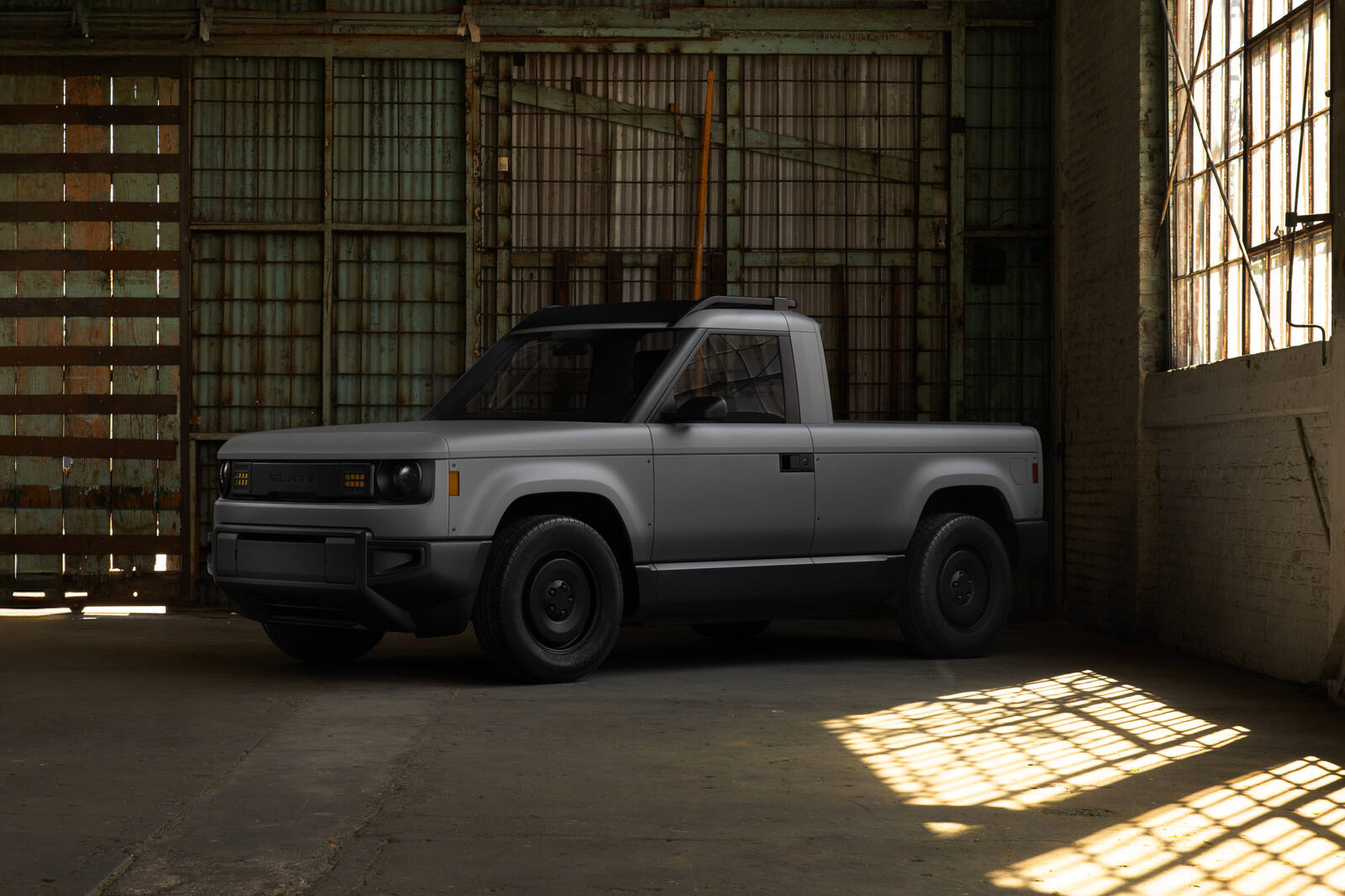
Slate Truck
"There's a company somebody talked about today called Slate, which they're trying to bring EVs that are gonna be able to plug into a 110 outlet. And initially, Jeffrey Bezos is the head investor in it. It was gonna be a $20,000 little truck. Now it's gonna be probably closer to 30, which is still very cheap for a truck."
The hosts bring up Slate, a new electric truck company backed by Jeff Bezos. It's a small, cheap pickup that plugs into a normal wall outlet, originally meant to cost about $20,000 but now closer to $30,000.
The hosts mention Slate, the Bezos-backed EV startup, and its small electric truck that can charge from a standard 110-volt outlet. Originally pitched near $20,000, the price has crept closer to $30,000; it's two-wheel-drive only and roughly Ford Maverick-sized — cited here as an example of cheap-EV promises versus the reality of servicing them.

Ford Maverick
"It was gonna be a $20,000 little truck. Now it's gonna be a f- probably closer to 30, which is still very cheap for a truck. I use air quotes because you can only buy it in two-wheel drive, and it's about the size of, say, like a little Ford Maverick, right?"
The Ford Maverick is a small pickup truck. They mention it to give you a mental picture of the EV truck’s size.
The Ford Maverick is a small pickup truck used as a size reference in the discussion. The hosts compare the proposed EV truck’s dimensions to the Maverick to help listeners visualize how big it is.

Ford Ranger
"Is a Ford Maverick the same as a Ford Ranger? Are they like- So- ... the same?"
The Ford Ranger is another pickup truck model. They’re basically asking whether the Maverick and Ranger are the same kind of truck or if they’re different.
The Ford Ranger is a compact pickup truck, and the hosts discuss whether the Maverick is “the same” as the Ranger. This is a quick clarification about how different Ford small-truck models relate in size and positioning.
plan B
"I'll say something about this when we talked about the plan B, and no technician wants to be the plan B. It happens very much often in this industry now that a lot of us, because, like, the talent pool's getting pretty shallow, so we're all starting to know necessarily who's trying, always trying to hire."
“Plan B” is the person you hire only if your first choice doesn’t work out. The point is that it can feel bad for the technician and stressful for the shop because it’s not the best-starting situation for trust.
In hiring, “plan B” means a candidate who gets considered only after the primary choice falls through. In a tight technician market, being treated as a backup can make technicians feel undervalued and put both sides in a tense, defensive dynamic.
talent pool's getting pretty shallow
"I'll say something about this when we talked about the plan B, and no technician wants to be the plan B. It happens very much often in this industry now that a lot of us, because, like, the talent pool's getting pretty shallow, so we're all starting to know necessarily who's trying, always trying to hire."
A “shallow talent pool” means there aren’t many skilled people available for the job. When that happens, shops have to move faster and sometimes settle for a backup candidate.
A “shallow talent pool” means there are fewer qualified technicians available to hire. That increases competition among shops, makes offers harder to fill quickly, and can lead to more “plan B” hiring when the first choice isn’t available.
equity
"And we, when we bring people onto Promotive, uh, we do offer equity, uh, in the company. We want other people to, uh, be successful, not just from their own salary and bonuses of their performance, but we want them to operate like partners here."
Here, “equity” means the employees can own part of the company. It’s meant to make them feel invested in the shop’s success, not just paid for hours worked.
In this context, “equity” means ownership interest in the company rather than just wages. The hosts say Promotive offers equity to align technicians’ incentives with the shop’s long-term success and encourage partner-like behavior.
Promotive
"And we, when we bring people onto Promotive, uh, we do offer equity, uh, in the company. We want other people to, uh, be successful, not just from their own salary and bonuses of their performance, but we want them to operate like partners here."
Promotive is the shop/company they’re talking about. They explain how they try to keep technicians motivated and involved in the business.
Promotive is the company being discussed as the shop that’s hiring and setting expectations for technicians. The hosts describe its approach to incentives and culture, including how they want employees to contribute day-to-day.
diag
"Are you a pain in the ass? Like, are you showing up late every day, but because it's Jeff and he's the only guy that knows how to diag, right, like, then, like, I gotta tolerate it."
“Diag” means diagnosing the problem—figuring out what’s actually wrong with the car. A tech who’s good at diag can save time and avoid fixing the wrong thing.
“Diag” is short for diagnostic work—figuring out what’s causing a vehicle’s symptoms (like a warning light, drivability issue, or noise). In shops, technicians who are strong at diag can become key because they reduce guesswork and speed up correct repairs.
Request an Explanation
Heard something you'd like explained? We'll add it to this episode.
Sign in to request explanations for terms you heard.
Want to learn more?
Browse our glossary for plain-English explanations of automotive terms, jargon, and concepts.
Help improve this episode
See something that's not quite right? Our annotations are AI-generated and can sometimes miss the mark. Click the flag icon on any annotation to suggest a correction.