
Will Your Next Car Come With a 'Kill Switch'? | Talking Cars with Consumer Reports #516
About this episode
In this episode, we separate fact from fiction about viral claims that a government-mandated "kill switch" for cars is coming in 2027. Our experts explain what the law actually says, how alcohol-impairment detection technology is being developed, and what that means for you when you make your next car purchase. We also answer an audience question about whether newer cars are really safer than older models and how advanced safety systems differ from driver convenience features.
SHOW NOTES:
0:00 - Intro
1:10 - The 2027 Car 'Kill Switch' myth
2:05 - What is the HALT Drunk Driving Act?
7:51 - Direct Driver Monitoring Systems (DDMS)
10:30 - Audience Question: Are newer cars really safer?
13:03 - How Advanced Driver Safety Systems help prevent crashes
15:54 - Convenience Features vs. Real Safety Technology
24:03 - Why Modern Safety Features Matter
LINKS:
No, Your Car Isn't Getting a 'Kill Switch' in 2027: https://www.consumerreports.org/cars/car-safety/2027-car-kill-switch-explained-a2146992793/?EXTKEY=YSOCIAL_YT
Driver Monitoring Systems Can Help You Be Safer on the Road: https://www.consumerreports.org/cars/car-safety/driver-monitoring-systems-ford-gm-earn-points-in-cr-tests-a6530426322/?EXTKEY=YSOCIAL_YT
Consumer Reports' Car Safety Guide: https://www.consumerreports.org/cars/safety-guide/?EXTKEY=YSOCIAL_YT
Find the Safest New Car Using Consumer Reports' Safety Verdict: https://www.consumerreports.org/cars/car-safety/how-to-find-safest-new-car-using-crs-safety-verdict-a3169270635/?EXTKEY=YSOCIAL_YT
kill switch
"People have been talking about this supposed kill switch that's coming to cars or a new surveillance law."
A “kill switch” is something that can shut a car down so it won’t run. In this episode, the hosts say the internet is using that scary term for something that’s actually different.
A “kill switch” is a device or system that can disable a vehicle’s operation. In the context of this episode, people are incorrectly using the term to describe a proposed safety/monitoring requirement rather than a true remote “turn it off” feature.
BAC level
"vehicles will need to be fitted with a device that passively monitors the essential BAC level of a driver."
BAC means how much alcohol is in your blood. The idea described here is that the car would watch for that level and stop you from driving if it’s too high.
BAC (blood alcohol concentration) is the measured amount of alcohol in a person’s blood. The episode describes a system that “passively monitors” a driver’s BAC and then restricts vehicle operation if it’s at or above the legal limit.
Halt Drunk Driving Act
"This has to do with a law passed in 2021... The act that was passed is the Halt Drunk Driving Act."
The “Halt Drunk Driving Act” is the law the hosts say is causing the rumor. They explain it’s about preventing drunk driving, not turning cars off for other reasons.
The “Halt Drunk Driving Act” is the specific law the hosts say is behind the 2027 timeline being discussed online. They use it to clarify that the requirement is tied to drunk-driving prevention, not a general “surveillance” or remote shutdown feature.
passively monitors
"vehicles will need to be fitted with a device that passively monitors the essential BAC level of a driver."
“Passively monitors” means the car would check you without you doing a separate test. The host’s point is that it’s meant to detect drunk driving automatically.
“Passively monitors” means the system checks the driver’s condition without requiring an active action like blowing into a breathalyzer. In this episode’s description, the vehicle would continuously or automatically assess BAC and then enforce restrictions if needed.
legal limit
"If that level is determined to be at or above the legal limit, then the system will need to prevent or limit the operation of the vehicle."
The “legal limit” is the BAC level where driving becomes illegal. If the car detects you’re at or above that level, it would restrict the car from operating normally.
The “legal limit” is the maximum BAC value allowed by law for driving. The episode explains that if the monitored BAC is at or above that threshold, the system must prevent or limit vehicle operation.
prevent or limit the operation of the vehicle
"then the system will need to prevent or limit the operation of the vehicle. It could be slowing it down."
This is what the car would do if it thinks you’re too intoxicated to drive. It could slow you down, stop you from going fast, or even prevent the car from starting.
This describes enforcement behavior where the car restricts driving when the driver’s BAC is too high. The hosts give examples like slowing the vehicle, preventing high-speed operation, or stopping the car from starting.
breath test
"The requirements are that it has to passively detect that. That means that it can be a path of breath test. That means that it can be a path of breath test."
A breath test measures alcohol in a person’s breath to estimate BAC. The transcript describes a “passively detect” approach where the system can use a breath sample without requiring the driver to blow into a tube.
direct driver monitoring system
"There's also work with direct driver monitoring systems, which might be where some people are getting that misconstrued. Direct driver monitoring is typically associated with the use of L2 automation."
Direct driver monitoring systems are cameras or sensors that watch the driver. They can warn you or limit certain driver-assist features if you’re not looking at the road.
Direct driver monitoring systems use sensors (often cameras) to watch the driver’s behavior, such as whether their eyes are on the road. They’re commonly tied to advanced driver-assistance features, gating or alerting when the driver isn’t paying attention.
L2 automation
"Direct driver monitoring is typically associated with the use of L2 automation. So lane-centering assistance combined with adaptive cruise control, just ensuring that the driver's eyes are looking at the road"
L2 automation means the car can help with steering and speed, but you still have to watch the road and be ready to take over. It’s not fully self-driving.
L2 automation refers to SAE Level 2 driving automation, where the car can control steering and speed under certain conditions, but the human driver must remain engaged and monitor the road. The transcript links L2 to lane-centering assistance and adaptive cruise control.
lane centering assistance
"So lane-centering assistance combined with adaptive cruise control, just ensuring that the driver's eyes are looking at the road in order to be able to use that."
Lane-centering assistance helps keep your car in the middle of the lane. It’s a steering help feature, and you still need to pay attention.
Lane-centering assistance is a driver-assistance feature that helps keep the vehicle centered within its lane using steering inputs. It’s often part of Level 2 systems and typically requires the driver to stay attentive.
NHTSA
"So as part of NHTSA being told that they had to come up with standards for this and figure it out, Congress told NHTSA they had to figure this out."
NHTSA is a U.S. government agency responsible for vehicle safety rules. In this discussion, it’s the agency asked to create standards for new safety technology.
NHTSA is the U.S. National Highway Traffic Safety Administration, the agency that sets and enforces many vehicle safety standards. In the transcript, Congress directs NHTSA to develop standards for alcohol-impaired driving prevention technologies.
standards development timeline
"And the most recent one, they said, not happening anytime soon. Yes. So every single year at this point,"
They talk about how long it may take for the government to create rules for this technology. The takeaway is that it likely won’t arrive right away.
The hosts discuss how the regulatory process is progressing, including that NHTSA reported the effort is not expected to happen soon. This frames whether “kill switch” style requirements could appear in the near term.
safety standards
"they have to go to Congress and tell them exactly what you're saying of, this is not going to be part of the safety standard because it's not ready yet. And so they did that this year and"
A safety standard is a set of rules that says what a safety feature has to accomplish and how it should be tested. If the testing rules aren’t ready, the feature may not be required yet.
A safety standard is an official rule or requirement that defines what a technology must do and how it must be evaluated for safety. Here, the point is that regulators haven’t yet set a test standard to prove the technology works, so it isn’t being implemented yet.
OE support
"And certain systems, and this strikes me as a system that would be difficult to diagnose. And what level of OE support is there? How do you diagnose it? How do you repair it?"
OE support means help from the carmaker—like the right tools and instructions to fix the car. The host is wondering whether mechanics would have enough official support to diagnose and repair the system.
OE support means support provided by the original equipment manufacturer (the carmaker), such as diagnostic tools, software access, and repair guidance. The host is questioning how much OE support would exist for diagnosing and repairing a complex system if it fails.
out of warranty
"And what is the cost to repair it eventually? If this system fails, does your car not work? And you have a used car that's out of warranty. I have to spend, I don't know, thousands of dollars"
Being “out of warranty” means the car is no longer covered by the manufacturer’s warranty terms, so repairs may cost the owner fully. The host connects this to the concern that a failed safety/disable system could be expensive to fix on a used car.
evaluation protocol
"And these are those things that are going to go into, when they come up with the evaluation protocol, there's always a dollar amount. And it's always puts a dollar amount on everything."
An evaluation protocol is basically the official test plan for checking if a new safety system actually works. Without it, it’s difficult to prove the system is effective.
An evaluation protocol is a formal testing and assessment plan that regulators or researchers use to measure whether a technology is effective. The hosts argue that without such a protocol, it’s hard to confirm performance and justify mandatory rollout.
warrant on star
"First of all, with a warrant on star can already shut off a car if it's stolen. So that's been happening for decades now."
This sounds like OnStar, a service that can connect your car to help. The host is saying it can already help disable a stolen car, even before any new kill-switch rules.
“Warrant on star” appears to refer to OnStar, a telematics service that can help with vehicle tracking and remote functions. The host claims OnStar can already shut off a stolen car, which is used as a contrast to how a new kill-switch system would work.
infrared eye tracking
"And that's because there's an infrared eye tracking built in. That's what's that's direct driver monitoring system. Yes."
Infrared eye tracking uses special light to monitor where your eyes are looking. The car uses that information to tell whether you’re paying attention or distracted.
Infrared eye tracking is a DMS method that uses infrared light to track where the driver is looking. Because it can detect gaze direction and eye movement patterns, it’s useful for identifying distraction and potentially impairment-related behavior.
alcohol impairment
"And that is also something that they're considering doing for alcohol impairment because there are certain eye movement patterns that can be associated with alcohol impairment or another substance impairment."
Alcohol impairment means your ability to drive is worse because you’ve been drinking. The idea here is that the car may be able to detect signs of impairment by how your eyes move.
Alcohol impairment refers to reduced driving ability caused by alcohol consumption. The segment explains that DMS research looks at eye movement patterns that may correlate with alcohol impairment (and other substance impairment).
drowsiness
"Or a medical event, in drowsiness as well. Drowsiness, absolutely. So this, this technology is hopefully going to be able to be used across multiple different types of driver impairment, not just drunk, but drowsy, like you said, um, distracted."
Drowsiness means you’re too sleepy to drive safely. The car can potentially detect it by watching your eyes and driving behavior and then warn you.
Drowsiness is reduced alertness that can make drivers as unsafe as intoxication. The segment notes that driver monitoring systems are being researched to detect drowsiness using eye and behavior patterns, not just alcohol-related impairment.
emergency services
"And had you not, had you been incapacitated, there are vehicles that can bring the vehicle to a stop and can call emergency services."
Emergency services are the help you call when there’s an urgent situation. The point here is that some cars can automatically stop and contact responders if the driver can’t.
Emergency services are the public responders (like ambulance or police dispatch) contacted during urgent incidents. The segment describes vehicles that, if the driver is incapacitated, can bring the car to a stop and call emergency services.
2027 law timing
"It's not an invasion of privacy, the way that folks are necessarily making it sound. And more importantly, it's, it's not a law that's going into effect in 2027. So we can get past that."
They talk about when a rule is supposed to start. The message is that it’s not happening in 2027, so people shouldn’t panic-buy based on internet rumors.
The hosts discuss a timeline for when a related law would take effect, emphasizing that it is not scheduled to begin in 2027. This is used to argue against rushing to buy a new car based on rumors.
T-boned
"Because it's not only just them, but, you know, you can be a good driver, but you can get T-boned going through an intersection."
A T-bone crash is when one car hits the side of another car. It can be very serious because the side of the car often has less protection than the front.
A “T-bone” crash is a side-impact collision where one vehicle hits another broadside, forming a “T” shape. It’s especially dangerous because side structures and occupants can be exposed to high forces with less room to absorb impact.
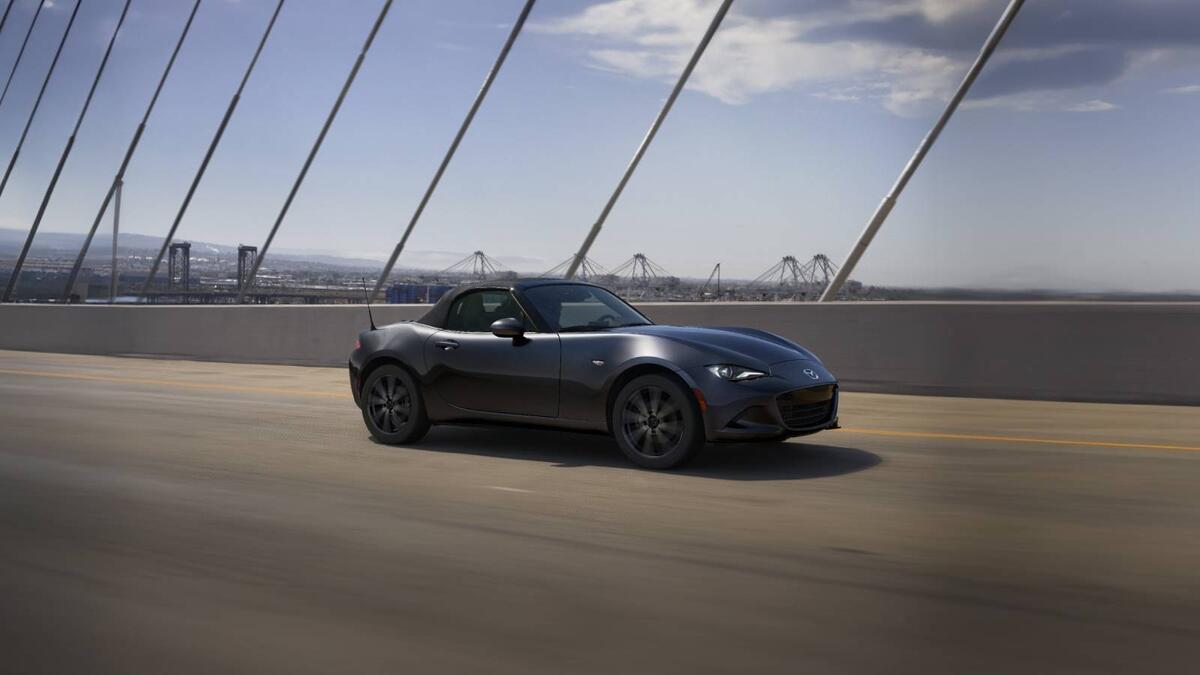
Mazda MX-5 / Miata
"...to it. And not just because I drive a 30-year-old Miata. Good for you, Kazuki. ADAS, the Advanced Driver ..."
The Miata is a small two-seat car made for driving on roads, with a focus on feeling connected to the car. Newer versions can include safety features that help the driver, like systems that assist with things such as staying in the lane or avoiding collisions. That’s likely what the podcast is referring to when it mentions ADAS.
The Mazda MX-5, commonly called the Miata, is a lightweight two-seat roadster known for simple, fun driving and strong enthusiast appeal. It’s often discussed in the context of modern updates—like ADAS (Advanced Driver Assistance Systems)—because newer Miatas can add safety and convenience tech while keeping the core “small and nimble” character. That’s why it may come up alongside talk about driver-assist features rather than just its classic design.
ADAS
"Good for you, Kazuki. ADAS, the Advanced Driver Assistance System, has been developed rapidly thanks to automakers and regulations over the past decades."
ADAS means “driver assist” tech. It helps the car notice things like lanes and traffic and can warn you or assist with steering and speed so driving is safer.
ADAS stands for Advanced Driver Assistance System. It’s a suite of technologies that help drivers by monitoring the road and vehicle conditions and providing warnings or partial control, such as keeping the car centered in a lane or maintaining speed.
cell phone usage while driving
"One of the main reasons is cell phone usage while driving. And I think ADAS functions such as adaptive cruise control and lane keeping assistance systems are giving drivers more opportunities to use their cell phones while driving."
Using your phone while driving is dangerous because it pulls your attention away from the road. Even quick glances can slow your reaction and make it harder to notice hazards.
Cell phone usage while driving refers to operating or interacting with a phone during vehicle operation, which distracts the driver’s attention. In safety discussions, it’s often cited as a major contributor to crashes because reaction time and situational awareness drop.
lane keeping assist system
"And I think ADAS functions such as adaptive cruise control and lane keeping assistance systems are giving drivers more opportunities to use their cell phones while driving."
Lane keeping assist helps stop you from drifting out of your lane. It watches the lane lines and can nudge the steering or warn you if you start to wander.
Lane keeping assistance systems use cameras and/or sensors to detect lane markings and help keep the vehicle within its lane. They typically provide steering assistance and/or alerts if the car drifts.

Chevrolet Blazer
"Yes, it was a 2026 Chevy Blazer against a 1996 Blazer. And you can see that when they have a, what is it? ... the dummy in the 1996 one was projected to likely have fatal injuries, whereas the driver of the 2026 Blazer would walk away with bumps and bruises."
This is a newer Chevrolet Blazer SUV. The point of mentioning it is that newer Blazers are designed to keep people safer in crashes, especially when compared to much older models.
The Chevrolet Blazer is a midsize SUV, and this comparison highlights how a 2026 model’s safety systems and crash structure can reduce injury severity versus an older vehicle. In this segment, the hosts reference an IIHS test where the newer Blazer’s occupant protection is much better.
overlap
"And you can see that when they have a, what is it? It's the overlap. Yeah, it's the overlap. So like if someone goes over the center line..."
An “overlap” crash is when the front of the car hits something but only part of the front end makes contact. That can be harder to protect against, so it’s a useful way to test real-world crash safety.
In crash testing, an overlap crash means only part of the vehicle’s front end hits the other object or vehicle, rather than the full width. This is important because it changes how forces load the structure and how well occupant protection systems manage intrusion into the cabin.
lane keeping assistance
"Kazuki was referring to of adaptive cruise control and lane keeping assistance. So the IIHS, the Insurance Institute for Highway Safety, they did a study..."
Lane keeping assistance helps keep the car in its lane. If you start to drift—like from distraction—it can warn you or help steer you back.
Lane keeping assistance is a driver-assistance feature that helps prevent unintentional lane departures by monitoring lane markings. Depending on the system, it may provide steering input or warnings when the vehicle drifts out of its lane.
Insurance Institute for Highway Safety
"So the IIHS, the Insurance Institute for Highway Safety, they did a study on crash reduction benefits of current safety features..."
This is a safety organization that tests cars and studies how well safety features work. Here, they’re used as the source for data on how much newer safety tech helps prevent crashes.
The Insurance Institute for Highway Safety (IIHS) is a U.S. nonprofit organization that evaluates vehicle crashworthiness and driver-assistance technologies. In this segment, it’s cited for studying how safety features reduce crashes and injuries using real-world data.
automatic emergency braking
"That's a huge number. That's the automatic emergency braking that you should never encounter unless you're a serial Something happens. And then when you add in the pedestrian detection,"
Automatic emergency braking is a system that can brake for you if it thinks a crash is about to happen. It’s meant to help when you don’t notice in time.
Automatic emergency braking (AEB) is a safety system that detects an imminent collision and applies the brakes automatically to reduce speed or avoid the crash. It’s typically designed to work when the driver doesn’t react in time.
pedestrian detection
"Something happens. And then when you add in the pedestrian detection,"
Pedestrian detection means the car can recognize people on or near the road. It helps safety systems respond to pedestrians, not just other cars.
Pedestrian detection is a sensing capability (usually camera and/or radar-based) that identifies people walking near the roadway. When paired with systems like AEB, it helps the car react appropriately to pedestrians rather than only vehicles.
lane departure warning
"For lane departure warning, [851.3s] so this is specifically single vehicle crashes, side swipes, and head-on crashes due to the [857.1s] vehicle departing the lane, 11% reduction in crash rates and a 21% reduction in injury. [864.0s] So those are just warnings."
Lane departure warning (LDW) alerts the driver when the vehicle detects it’s drifting out of its lane. It’s typically a warning-only system (beeps/visual alerts) rather than actively steering the car back.
blind spot warning
"And actually the lane departure warning, they found that the fatal crash rate reduced by 86%. [884.5s] So this is definitely effective. It's astonishing. And blind spot warning, [891.0s] 14% reduction in crashes, rear AEB for backing up crashes, 78%."
Blind spot warning helps you notice cars you can’t easily see in your mirrors. If another vehicle is in your blind spot, the car alerts you—especially when you’re changing lanes.
Blind spot warning alerts the driver to vehicles in areas that are hard to see in the mirrors. It typically uses sensors to detect cars alongside or slightly behind the vehicle and warns before a lane change.
AEB
"And blind spot warning, [891.0s] 14% reduction in crashes, rear AEB for backing up crashes, 78%. I could go on and on."
AEB means the car can brake by itself in an emergency. If it thinks a crash is about to happen, it tries to stop or slow down to reduce damage and injuries.
AEB stands for “automatic emergency braking.” It’s a safety system that detects an imminent collision and applies the brakes automatically, often with reduced stopping distance compared to a human reaction.
fail safe
"whatever, [954.1s] you've got all kinds of things going on, these systems are things that you're talking about [959.5s] that should be fail safes. You should not be relying on these systems. Oh, it doesn't matter."
“Fail safes” are safety features meant to help if things don’t go as planned. The takeaway is that you shouldn’t assume the car will always save you—you still have to drive carefully.
“Fail safes” refers to safety systems designed to reduce harm if something goes wrong, but they still shouldn’t be treated as fully reliable. The host’s point is that drivers should not depend on these systems as a substitute for attention and correct driving.
naturalistic studies
"They have an advanced vehicle technologies consortium. And so they do a lot of research, real-world research naturalistic studies about different vehicles of using their level two system."
Naturalistic studies are real-world observations. Instead of testing in a lab, researchers watch what drivers actually do in everyday traffic.
Naturalistic studies observe people driving in real-world conditions rather than on a closed test track. This helps researchers measure how drivers actually behave when using driver-assistance features.
adaptive cruise control
"naturalistic studies about different vehicles of using their level two system. So the adaptive cruise control and lane-centering versus manual driving."
Adaptive cruise control is like cruise control that can react to the car in front of you. It helps keep a safe distance by slowing down and speeding up automatically.
Adaptive cruise control is a driver-assistance feature that automatically adjusts your car’s speed to maintain a set following distance from the vehicle ahead. Unlike traditional cruise control, it can slow down and speed back up as traffic changes.
level two system
"They have an advanced vehicle technologies consortium. And so they do a lot of research, real-world research naturalistic studies about different vehicles of using their level two system."
Level two means the car can help with steering and speed, but you’re still in charge. You have to watch the road and be ready to take over.
A “level two” driver-assistance system refers to SAE automation levels where the car can assist with both steering and speed, but the human driver must remain responsible and attentive. In practice, it’s not full self-driving; you’re still expected to monitor the road and take over when needed.
self-driving feature
"And there's no commercial available self-driving feature today. I mean, there were Waymo and those things. You can't go buy one of those."
They’re talking about the difference between helpful driving tech and real self-driving. The claim here is that you can’t just buy a fully self-driving system that lets you stop paying attention.
The discussion distinguishes between driver-assistance systems and true self-driving features that you can buy and use without active human supervision. The point is that, at the time of the episode, commercially available “self-driving” is limited and not something most consumers can simply purchase as a complete solution.
Waymo
"And there's no commercial available self-driving feature today. I mean, there were Waymo and those things. You can't go buy one of those."
Waymo is a company that works on self-driving cars. The host is using it as an example of self-driving tech that you can’t just buy like a normal car option.
Waymo is a company known for developing autonomous-driving technology. In the context of this episode, it’s referenced as an example of self-driving systems that exist, but aren’t available for typical consumers to purchase as a consumer product.
Consumer Reports
"We did an analysis, Consumer Reports did of vehicles, model year vehicles, 2003 through 2021 on our own fleet of vehicles that we purchased,"
Consumer Reports is a group that tests products and publishes results. In this segment, they’re saying they studied how much extra driver-assistance tech adds to car prices.
Consumer Reports is an independent consumer advocacy organization known for testing and evaluating products, including vehicles. Here, it’s cited as having analyzed vehicle pricing and technology costs using its own purchased fleet.
National Consumers League
"There's another report by, I was so interested about this, but the National Consumers League, they did a more recent report and they found that the increased cost per new"
The National Consumers League is a consumer advocacy group. They’re mentioned because they published a report about how much more expensive newer cars are becoming.
The National Consumers League is a consumer advocacy organization. In this segment, it’s referenced as having published a report finding that the cost of new vehicles increased, tied to factors beyond just safety technology.
trimflation
"trimflation, I love that. And then also the selling of more premium. Trimflation, I love that."
Trimflation is when car prices go up because more people are being pushed into pricier versions of the same model. Instead of adding value, the average buyer ends up paying more for higher trims.
Trimflation is a consumer-cost phenomenon where automakers raise prices by shifting buyers toward higher-priced trims and options, rather than increasing base-model content. The result is that the average transaction price rises, even if the underlying vehicle platform changes little.
air bags
"So when I, I do want to say though, point out that the $630, those are things like airbags and anything that's safety related, but it's backup cameras."
Airbags are safety cushions that pop out during a crash. They’re designed to help protect your head and chest when the car suddenly slows down.
Airbags are inflatable safety cushions that deploy extremely quickly during a crash to help reduce head and chest injuries. They work with crash sensors and seatbelt pretensioning systems to manage occupant forces in the first moments of impact.
backup camera
"point out that the $630, those are things like airbags and anything that's safety related, but it's backup cameras. Yeah."
A backup camera shows what’s behind the car on the screen. It helps you avoid hitting people or objects when you’re backing up.
Backup cameras (rear-view cameras) provide a video view behind the vehicle to help drivers avoid low-speed collisions when reversing. They’re often paired with parking sensors and are part of broader crash-avoidance and visibility safety improvements.
National Car Assessment Program
"The National Car Assessment Program doesn't require like lane departure warning, all of those things yet."
The National Car Assessment Program is a safety testing program that rates cars. It helps show how well vehicles protect people in crash tests.
The National Car Assessment Program (NCAP) is a vehicle safety testing and rating program used to evaluate crash performance. In the U.S., it’s associated with NHTSA and helps consumers compare how different vehicles perform in standardized crash tests.
societal benefit
"on average, every dollar invested in safety technology has a more than $24 in societal benefit generated from that."
Societal benefit is the idea that safety technology creates value beyond individual drivers—like fewer injuries, lower medical costs, and reduced emergency response strain. The discussion frames safety spending as producing large downstream benefits for the broader economy and public health.
congressional budget office
"Every single time you see like a regulation from NHTSA, there's a congressional budget office looks at, and it can be a little grim, but it can be, well, it saves this many lives"
The Congressional Budget Office is a U.S. government group that estimates what government policies will cost and what effects they’ll have. Here, they’re used to estimate the benefits of safety regulations in economic terms.
The Congressional Budget Office (CBO) is a U.S. government agency that analyzes the budgetary and economic impacts of federal policies. In the context of vehicle safety rules, it may estimate how many lives are saved and translate those outcomes into economic effects.
stability control
"your newer cars have better stability control, traction control. They can help you recover [1287.4s] a slide or something a whole lot easier."
Stability control is a safety feature that helps the car stay pointed the way you’re steering. If the car starts to slide, it can brake specific wheels and reduce power to help you recover.
Stability control is an electronic system that helps keep a car going in the direction the driver intends. It uses sensors (like steering angle and wheel speed) to detect skids and can apply individual brakes and reduce engine power to regain control.
traction control
"your newer cars have better stability control, traction control. They can help you recover [1287.4s] a slide or something a whole lot easier."
Traction control helps prevent the wheels from spinning when you accelerate. If a wheel starts to slip, the car cuts power and may brake that wheel to regain grip.
Traction control is an electronic system that limits wheel spin when accelerating. If the drive wheels lose grip, it reduces engine power and/or applies brakes to the slipping wheel to help the car move forward without spinning out.
crumple zones
"Not to mention, you know, Matt, you talked about crumple zones and more airbags [1295.2s] and stuff like that."
Crumple zones are parts of the car that are designed to crumple in a crash. That controlled crumpling helps protect passengers by absorbing crash energy.
Crumple zones are engineered areas of a vehicle designed to deform in a crash. By absorbing energy and controlling how the car collapses, they help reduce the forces transmitted to occupants.
aftermarket replacement
"Not to mention, I mean, shocks and struts are worn out and, you know, you have aftermarket [1324.0s] replacement brakes that might not offer the same stopping power as original tires."
Aftermarket replacement brakes are brake parts you buy from companies other than the car’s original manufacturer. Not all of them stop the same way, so it’s worth choosing reputable parts.
Aftermarket replacement brakes are non-OEM brake components installed as replacements. Quality and friction material choices vary widely, so some aftermarket setups may not match the original equipment’s stopping performance and feel.
shocks and struts
"Not to mention, I mean, shocks and struts are worn out and, you know, you have aftermarket [1324.0s] replacement brakes that might not offer the same stopping power as original tires."
Shocks and struts help smooth out bumps and keep the tires planted. If they’re worn out, the ride gets bouncy and the car can handle worse, especially in emergency maneuvers.
Shocks and struts are suspension components that control how the car moves over bumps and how quickly the suspension settles. When they wear out, the tires can lose contact with the road more easily, which hurts handling and braking stability.
bushings
"Yeah, but your bushings are 30 years old and they are shot. [1339.4s] So, you know, you don't have the same stability out of the car and things like that."
Bushings are small mounting pieces that help suspension parts stay aligned. If they wear out, the car can feel loose and handle less predictably.
Bushings are rubber or elastomer mounts that connect suspension parts and allow controlled movement. When bushings age and crack, they add looseness and reduce steering/handling precision because the suspension geometry can shift under load.
child seats
"cars that you put your family in, [1368.8s] like we test child seats here. You want to put your child in a really good child seat."
Child seats are car seats made to protect kids during crashes. They’re designed to hold the child safely and are meant to be installed the right way, not just placed loosely.
Child seats are child restraint systems designed to protect infants and children in crashes. Modern seats are engineered and tested for proper fit and crash performance, and they’re typically used with specific installation methods to keep the child securely positioned.
rear-facing child seat
"Or looking at really old child seats are kind of scary. They had like a cage one. He's putting [1379.9s] a kid in like a dog cage and putting them back seat."
A rear-facing child seat is the common setup for babies and small kids where they face the back of the car. It’s designed to better protect their head and neck in a crash.
A rear-facing child seat is a car seat orientation where the child faces the back of the vehicle. This position is widely recommended for younger children because it helps distribute crash forces across the seat and the child’s back/neck area more effectively than forward-facing setups.

Porsche 911
"...uring, and then after. Having a car that can call 911. You know, the person comes over, you know, if yo..."
The Porsche 911 is a high-performance sports car built for fast, exciting driving. Some versions include an emergency feature that can place a call for help if something serious happens. The podcast is likely highlighting that safety/assistance capability.
The Porsche 911 is a long-running sports car known for its distinctive design and performance-focused engineering. It’s a frequent topic in podcasts because it blends everyday usability with high capability, and modern models can include connected services. The mention of “call 911” points to an emergency-calling feature that can automatically contact help if the car detects a serious incident.
head on collision
"I've been in the head on collision. It was basically like the moderate overlap front."
A head-on collision is when two cars hit each other front-to-front. It’s one of the most serious crash types, so how the car is built can make a big difference.
A head-on collision is a crash where the front of one vehicle strikes the front of another. It’s especially dangerous because the impact energy is concentrated into the front structure, so vehicle design and crash protection matter a lot.

71 Chevrolet C10
"But I was in like a 71 Chevrolet C10. It was rough. Luckily, it was slow speed."
A 1971 Chevrolet C10 is an older full-size pickup. The host is describing how rough it was to get out after a crash in that kind of older truck.
The Chevrolet C10 is a classic full-size pickup from Chevrolet’s 1960s–1970s truck era. In this story, the 1971 C10 is used as an example of what a low-speed head-on collision can feel like inside an older, less advanced vehicle.
crash ratings
"I would absolutely go onto IHS's website and check out the crash ratings for a vehicle that you're interested in, because you'd be surprised."
Crash ratings are scores from safety tests that show how well a car protects people in crashes. They’re a quick way to compare different vehicles’ safety performance.
Crash ratings are standardized scores from safety testing programs that evaluate how well a vehicle protects occupants in different crash scenarios. They typically include both crashworthiness (injury protection) and, in some systems, crash-avoidance performance.
crash avoidance technology
"We take into account the crash avoidance technology that the sort of ADAS things we're talking about."
Crash avoidance technology is a set of safety features that try to help you avoid a crash. They can warn you and sometimes even slow the car automatically if they detect danger.
Crash avoidance technology refers to driver-assistance systems designed to help prevent or reduce the severity of crashes. Examples include automatic emergency braking and other sensors/alerts that detect hazards and intervene when needed.
stopping distances
"how nimble a car is and how it can avoid, you know, the stopping distances in some cars are 20 feet longer than other ones."
Stopping distance is how far a car travels before it fully stops. It depends on things like brakes, tires, and how heavy the car is.
Stopping distance is the total distance a vehicle travels from when the driver begins braking (or when braking is triggered) until the car comes to a complete stop. It depends on factors like tire grip, brake performance, vehicle weight, and how quickly the system can respond.
crash avoidance maneuvers
"we do out there on the track, these crash avoidance maneuvers, something falls off the truck in front of you and you have to swerve like that or go around,"
Crash avoidance maneuvers are test situations that mimic emergency driving. The goal is to see if the car can react safely when something unexpected happens.
Crash avoidance maneuvers are controlled test actions meant to simulate real-world emergency driving situations. They often involve sudden swerves or obstacle avoidance to see whether the vehicle can maintain stability and reduce collision risk.
ABS
"Yeah, it happens very quickly. But I would also as a driver get on the brakes early, get on the brakes hard, let the ABS do its thing. Try out your ABS before you actually use it."
ABS is the system that prevents your wheels from locking up when you brake hard. That helps you keep control and steer while stopping.
ABS (anti-lock braking system) prevents the wheels from locking up during hard braking. When the driver brakes too hard and traction is about to be lost, ABS rapidly pulses brake pressure so the tires keep rolling and steering remains possible.
full traction limit
"But what it's going to do, it's going to be the same effect. AEB will break at the full traction limit. ABS will come in."
It means the most grip your tires can get from the road. If you brake harder than that, the tires can lose grip and stopping becomes less effective—so the car’s systems try to stay right at that edge.
The full traction limit is the maximum grip available between the tires and the road surface. Braking at (or near) this limit maximizes stopping power, but going beyond it causes wheel lock (ABS intervenes) or reduced control.
Request an Explanation
Heard something you'd like explained? We'll add it to this episode.
Sign in to request explanations for terms you heard.
Want to learn more?
Browse our glossary for plain-English explanations of automotive terms, jargon, and concepts.
Help improve this episode
See something that's not quite right? Our annotations are AI-generated and can sometimes miss the mark. Click the flag icon on any annotation to suggest a correction.