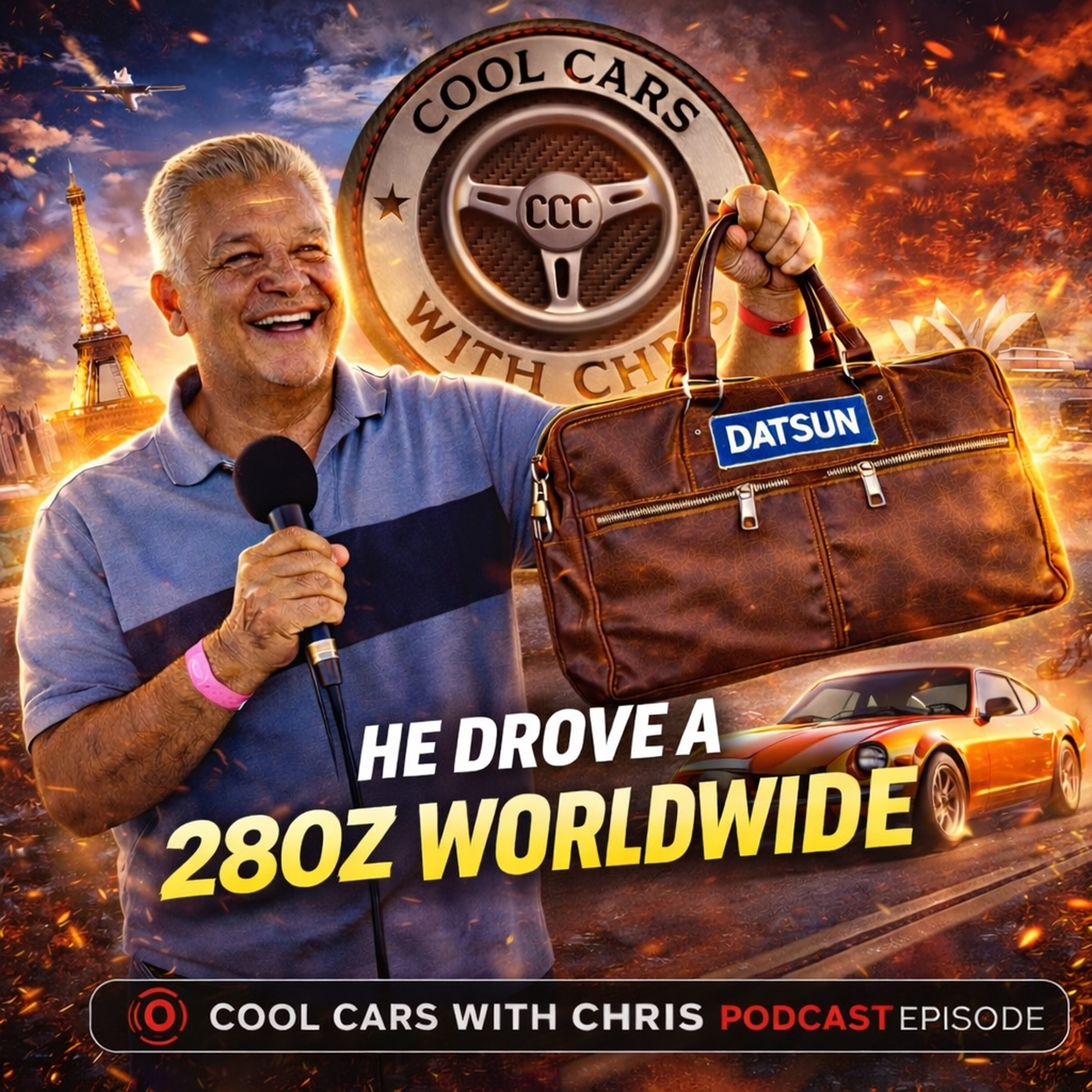
030 | Datsun 280Z World Travel Story + Custom Leather Car Builds | Manuel Gutierrez
About this episode
Manuel Gutierrez stops by Willow Springs to talk about his leather craftsmanship and his legendary 280Z travel story. After retiring in 2001, he started making 100% leather overnight bags, tool bags, shift boots, and brake-handle covers—using leftover leather and adding custom logos for Z clubs and customers. He also shares how his 1976 280Z went with him through military postings, including Germany and a run on the Autobahn where Mercedes and BMWs easily passed him. He’s now restoring a 78 and building a 74 260Z, aiming to keep them original while upgrading to a stronger 5-speed.
In this episode of Cool Cars with Chris, recorded live at Willow Springs Raceway, Chris sits down with Manuel Gutierrez—a lifelong car enthusiast, Datsun Z owner, and skilled leather craftsman.
Manuel shares the incredible story of his 1976 Datsun 280Z, a car that quite literally traveled the world with him during his military career. From Hawaii to Spain to Germany, this classic Z became more than just a car—it became a passport to unforgettable experiences.
Hear what it was like driving a vintage 280Z on the legendary Autobahn, going up against high-performance European cars like Mercedes and BMW, and capturing a once-in-a-lifetime photo of his Z near the Eiffel Tower.
But this episode isn’t just about cars.
After retiring, Manuel turned necessity into creativity—building his own travel bag, which sparked a passion for crafting custom leather car accessories. Today, he creates handmade leather bags, shift boots, brake handle covers, and tool kits designed specifically for Nissan and Datsun enthusiasts.
Chris and Manuel also dive into:
- The culture and community behind classic Nissan Z cars
- Restoring Datsun 240Z, 260Z, and 280Z models
- Keeping builds original vs. modern upgrades
- Popular modifications like 5-speed transmission swaps
- The rising cost of classic car parts and sourcing challenges
- Custom automotive craftsmanship and personalization
Whether you're into classic car restoration, JDM legends, or unique automotive craftsmanship, this episode delivers real stories, practical insight, and passion from the heart of the Z community.
📍 Recorded live at Willow Springs Raceway
🔗 Follow & Support Cool Cars with Chris
🌐 Website:
https://coolcarswithchris.com/
📸 Instagram:
https://www.instagram.com/cool_cars_with_chris619/
▶️ YouTube:
https://www.youtube.com/@CoolCarswithChris619
00:00 🚗 Intro – Cool Cars with Chris Podcast
00:08 📍 Live from Willow Springs Raceway
00:32 👋 Meet Manuel Gutierrez & His Leather Craftsmanship
01:48 👜 Handmade Leather Bags, Shift Boots & Car Accessories
02:32 🔧 How Retirement Sparked a Custom Leather Business
03:19 🏁 Custom Logos, Z Community & Client Builds
04:22 🚘 First Car Story – 1976 Datsun 280Z
04:56 🌍 Traveling the World with a Z (Hawaii, Spain, Germany)
05:55 ⚡ Driving a 280Z on the Autobahn Experience
06:38 📸 Eiffel Tower Story with a Classic Z Car
06:56 🔥 Current Builds – 280Z Daily Driver & 260Z Project
07:12 🎨 Restoration Tips – Keeping Classic Cars Original
08:01 ⚙️ Performance Upgrades – 5-Speed Swaps & Transmissions
08:33 💸 Rising Costs of Classic Car Parts & Sourcing
08:58 💼 Selling Handmade Leather Goods & Pricing
09:22 🧵 How the Products Are Made (San Diego + Tijuana)
09:50 👋 Outro & Wrap-Up
#Datsun280Z #NissanZ #ClassicCars #CarPodcast #JDM #CarRestoration #CarCulture
Willow Springs
"we are going back over to Willow Springs because in these next series of episodes, there are going to be interviews we conducted right there at the track live at Willow Springs."
Willow Springs is a race track. The episode is recorded there, so the conversation is tied to driving culture and track life.
Willow Springs refers to a motorsports track in California where the hosts conducted interviews. Track locations matter because they set the context for how cars are driven and discussed.

Z Cars
"it wouldn't be a true Z community without talking about Z cars. And Manuel had a 280Z. He took a thing all over the world, which is pretty crazy to do. Think about this. You've got a 280Z and it travels with you everywhere, including to Germany."
The Nissan 280Z is a classic sports car in the Z family. Manuel talks about using his 280Z for big trips, which shows how these cars can be more than just weekend toys.
The Nissan 280Z is a classic Z-car from the late 1960s/early 1970s era, known for its lightweight feel and strong enthusiast following. In this episode, it’s central because Manuel used his 280Z for long-distance travel, including a trip to Germany.
Autobahn
"including to Germany. And he actually took that car on, yes, the Autobahn. And he'll tell you what that experience was like going to head to head against cars like likes of Mercedes, BMW, things like that, Porsche, things like that."
The Autobahn is Germany’s highway system. Manuel’s story matters because it’s a place where cars can be pushed harder for longer stretches than typical roads.
The Autobahn is Germany’s famous highway system, known for long stretches where speed limits may not be universally enforced. Driving a classic car there is a notable challenge because it tests stability, cooling, and sustained high-speed comfort.
Mercedes
"And he'll tell you what that experience was like going to head to head against cars like likes of Mercedes, BMW, things like that, Porsche, things like that."
Mercedes is a major luxury car brand. Manuel is basically saying his Z-car was going up against big-name cars on the highway.
Mercedes-Benz is mentioned as part of the competition Manuel faced while driving on the Autobahn. It helps listeners understand the caliber of cars he was comparing his Nissan 280Z against.
BMW
"going to head to head against cars like likes of Mercedes, BMW, things like that, Porsche, things like that."
BMW is another big European car brand. In the story, it’s part of the list of cars Manuel was comparing his Z against.
BMW is named alongside other European brands as the kind of cars Manuel encountered while driving on the Autobahn. This frames the story as a comparison against modern (or at least mainstream) performance/luxury machinery.
Porsche
"Mercedes, BMW, things like that, Porsche, things like that. So here's that story."
Porsche is a well-known performance brand. Mentioning it signals that Manuel’s Nissan 280Z was being compared to serious sports cars on the road.
Porsche is included in the list of brands Manuel went up against on the Autobahn. For enthusiasts, Porsche is a key benchmark for handling and performance, so it elevates the “head-to-head” storytelling.
deer leather
"Are they all made out of leather? They're all leather, original and deer leather, lambskin. This is my deer skin."
Deer leather is leather made from deer hide. It’s one of the materials Manuel uses to make his custom bags and car-related leather pieces.
Deer leather is a type of hide used for upholstery and accessories, valued for its feel and durability. In this episode it’s part of Manuel’s custom leather bag and interior accessory work for his Z-car lifestyle.
lambskin
"They're all leather, original and deer leather, lambskin. This is my deer skin."
Lambskin is a type of leather made from lamb hides. It’s commonly used when you want a softer, higher-end feel.
Lambskin is a softer, finer leather often used for premium goods because it tends to be supple and comfortable. Manuel mentions it as one of the leathers he uses for his custom leather bags and related accessories.
stick shift boots
"And with the leftover bags or left over leather, I started making the stick shift boots, not the vinyl that you get from the dealer"
A stick shift boot is the cover around the gear shifter. It helps protect the shifter and it’s also a place where custom leather can make the interior look nicer.
A stick shift boot (shift-gaiter) is the leather or rubber cover around the gear shifter to protect the mechanism and keep dirt out. Manuel contrasts his custom leather boots with the vinyl versions commonly sold by dealers.
tool bag
"[181.4s] If you're going to travel like I travel, you need a tool bag. Wow, this looks great. [185.6s] Wow, they feel good too. They feel actually real. It's all real leather, real leather, real 100% [190.9s] leather. Everything has a liner in there too. No way."
A tool bag is where you keep your tools so they’re easy to grab when you need them. The speaker is saying that if you travel a lot, having one makes life easier.
A “tool bag” is a dedicated storage organizer for carrying tools, often designed to be portable and easy to access during travel or roadside work. In car culture, a well-made tool bag is also part of the overall “preparedness” and personalization of a build.
real leather
"[185.6s] Wow, they feel good too. They feel actually real. It's all real leather, real leather, real 100% [190.9s] leather. Everything has a liner in there too. No way. I'm going to have to commission you for [194.7s] some in-car stuff."
They’re emphasizing that it’s made from actual leather, not a cheaper imitation. Real leather usually feels better and can last longer if it’s cared for.
“Real leather” indicates the material used for the custom bag and related in-car accessories. Leather quality matters for durability, feel, and how well it ages, especially for items that get handled frequently.
copyright
"[210.3s] just Gonzales. Anyway, I have so many customers. Yeah, can't think right now, but I can make the [215.5s] logo logo. Just give me a logo. I'll take, well, have you had any issues with like, we make logos? [219.8s] Have you had any issues like copyright and things like that? You know what? I live in San Diego and"
They’re talking about whether using logos could cause legal problems. Copyright is basically the legal protection for creative designs.
The speaker brings up “copyright” when discussing making logos for customers. It’s a reminder that using someone else’s logo or artwork can require permission, and that custom work may need to be handled carefully to avoid legal issues.
laser
"[231.2s] See what it is. And I get my friend, he's got the laser, he's got the logo machine, [237.1s] and I just need a good quality picture. And then we transfer from his computer to his machine, [241.6s] and he does all the programming and, oh yeah, it's very simple."
They’re using a laser machine to put logos onto the leather. You send the design from a computer, and the machine marks it accurately.
A “laser” logo machine is commonly used to engrave or mark leather and other materials with consistent designs. In this context, it’s part of the process for transferring a logo from a computer to the physical leather item.
Z Clubs
"[262.3s] After I retired like 2001, well, I was on my retirement. I couldn't afford a real travel bag, [269.2s] so I go, I'll make it, and then I'll start putting logos. Yeah, there we go. That's nice. That's [274.3s] how I just started and caught on. People wanted it and word of mouth and all the Z Clubs and [279.8s] you build it and they'll come."
A “Z Club” is a group of people who all share the same interest in the Z-car. They help each other find parts, share builds, and spread recommendations.
“Z Clubs” refers to enthusiast clubs centered on the Nissan/Datsun Z-car platform. These communities often drive parts sourcing, meetups, and word-of-mouth support for specialty services like custom leather interiors and accessories.
everyday driver
"...Right now I have a 78 that I finished restoring like three years ago. It's my everyday driver."
An “everyday driver” means the car is used regularly, like a normal commuter car. For a classic Z, that usually means it’s been maintained and made dependable. So it’s not only for looking at—it’s actually being driven.
An “everyday driver” is a vehicle you use regularly for normal commuting and errands, not just for shows or weekend cruising. With classic cars like a Z, this usually means the owner has addressed reliability and maintenance needs so it can be used without constant breakdowns. It also affects how restorations are prioritized—drivability often matters as much as appearance.
restoring
"...I have a 78 that I finished restoring like three years ago. It's my everyday driver..."
Restoring a classic car typically means returning it to a factory-correct or at least “as-new” condition through body, mechanical, and interior work. For Z-cars, restoration can include sourcing hard-to-find parts and deciding how original to keep the car versus upgrading for modern reliability. The guest’s timeline (“finished restoring like three years ago”) suggests a multi-year project.

74 260Z
"...and I'm building a 74, 260Z that I'm almost done with."
The Datsun 260Z is an earlier Z-car in the same family, and the guest says they’re building a 1974 260Z. These builds often involve sourcing correct trim and mechanical parts, then upgrading reliability and drivability while keeping the car’s classic character. The “almost done” status suggests an ongoing restoration project rather than a finished, stock car.

Datsun 280Z
"...If it was a four-speed, five-speed automatic, it's all in the bar. You can figure it out by the wire. And what about mechanical though? Like what's your first thing you do mechanical wise?... I like to keep it original, but I do like five-speed, so I put a five-speed in... keep the like 280zx five-speed..."
The Datsun 280Z is an old-school sports car that a lot of people love restoring. Here, they’re talking about how to keep the car looking and feeling original, but still make it nicer to drive.
The Datsun 280Z is a classic Z-car from Nissan’s earlier Datsun era, known for its simple, mod-friendly layout and strong enthusiast following. In this segment, the host discusses keeping the car original while upgrading the gearbox to improve drivability.
VIN
"...so you're going to find out through the VIN, but I don't get that in that. I don't need to get that detail to find out."
VIN stands for Vehicle Identification Number, a unique code assigned to each car. It can be used to look up factory information like trim and sometimes drivetrain details, which helps restorers confirm what the car originally came with.
four-speed
"...If it was a four-speed, five-speed automatic, it's all in the bar. You can figure it out by the wire."
A four-speed means the car has four forward gears. The speaker is saying many of these older cars started with a four-speed, but they prefer a five-speed.
A four-speed refers to a transmission with four forward gears. In classic Z-cars, many examples came with four-speed setups, and the speaker is contrasting that with the desire for a five-speed for better gearing and feel.
five-speed
"...I like to keep it original, but I do like five-speed, so I put a five-speed in... The fifth gear wasn't very strong..."
A five-speed has one more gear than a four-speed. That extra gear can make the car feel smoother and can help it cruise more comfortably.
A five-speed transmission adds an extra gear compared to four-speed units, which can improve cruising rpm and overall drivability. The speaker specifically prefers a five-speed swap because they believe the original fifth gear option was weak in some setups.

280ZX five-speed
"...The fifth gear wasn't very strong, so I like to keep the like 280zx five-speed to make the desire. And there's a lot of aftermarket..."
The 280ZX is the later Z-car generation, and its five-speed gearbox is being used as an upgrade path. The speaker claims the original cars were typically four-speed and that the fifth gear in the 280ZX setup is stronger, making it a desirable swap.
aftermarket
"...And there's a lot of aftermarket, you know, commissions you can buy for these? There's a lot of aftermarket, but I try to keep my car as original as I can."
Aftermarket parts are replacement or upgrade parts made by other brands. They can be helpful when OEM parts are hard to find, but they may change the car from stock.
Aftermarket parts are components made by companies other than the original manufacturer. The speaker mentions aftermarket options for these Z-cars, but also notes they try to avoid straying too far from original.
keep the car as original as I can
"...There's a lot of aftermarket... but I try to keep my car as original as I can. Yeah, sometimes you just can't."
This is the restoration philosophy of preserving factory-correct appearance and components rather than turning the car into a modernized custom. It often guides choices like repainting back to original colors, using period-appropriate parts, and limiting non-original upgrades.
supply chain drop-off
"...Are you, are you having, are you seeing that like any supply chain drop off with like with certain parts and things like things that are just a little bit harder to find now, or you can find it just about anything, but you're gonna pay a lot. Everything skyrocketed..."
A supply chain drop-off refers to disruptions that reduce availability of parts, which can lead to higher prices and longer wait times. The speaker connects this to classic-car parts being harder to find and “everything skyrocketed.”
Tijuana
"...if I did, I usually, yeah, that were, at least made in Tijuana. Are these actually made in Tijuana, or they made, yes, they're all fabric, they're all etched in Tijuana..."
They mention Tijuana as the place where the materials are made and sold. In a car context, that usually means the leather or upholstery is coming from a specific supplier.
Tijuana is mentioned as the location where the leather/fabric items are made and sold, implying a custom upholstery or leather-supply source. For classic-car owners, knowing where upholstery materials are sourced can matter for quality, cost, and authenticity.
Tandy Leather
"but normally I like good quality leather, so I go to Tandy Leather, San Diego, and I, oh, they're nice."
Tandy Leather is a store where you can buy leather and leather-making supplies. People use it when they’re doing custom leather work, like upgrading seats or interior panels.
Tandy Leather is a well-known leatherworking retailer that sells hides, tools, and supplies for custom leather projects. In the context of this episode, it’s being used as a source for higher-quality leather for car-related interior work.
Request an Explanation
Heard something you'd like explained? We'll add it to this episode.
Sign in to request explanations for terms you heard.
Want to learn more?
Browse our glossary for plain-English explanations of automotive terms, jargon, and concepts.
Help improve this episode
See something that's not quite right? Our annotations are AI-generated and can sometimes miss the mark. Click the flag icon on any annotation to suggest a correction.