About this episode
Travel chaos opens the show with stories of bumpy flights, diversions to tiny airports, and tense crosswind landings. The hosts then pivot to vehicle reviews: a Chevy Equinox EV gets praise for interior quality, ride comfort, and “enough” real-world range, while the lack of native Apple CarPlay/Android Auto becomes the big caveat. A Honda Pilot AWD is praised as a smooth, quiet, family-focused three-row with strong practicality. The rest of the discussion covers Mazda safety strategy, Mercedes’ evolving electrified lineup and steer-by-wire, GM/Ford/Nissan EV program shifts, plus Robotaxi investment skepticism and NHTSA/NTSB autopilot oversight.
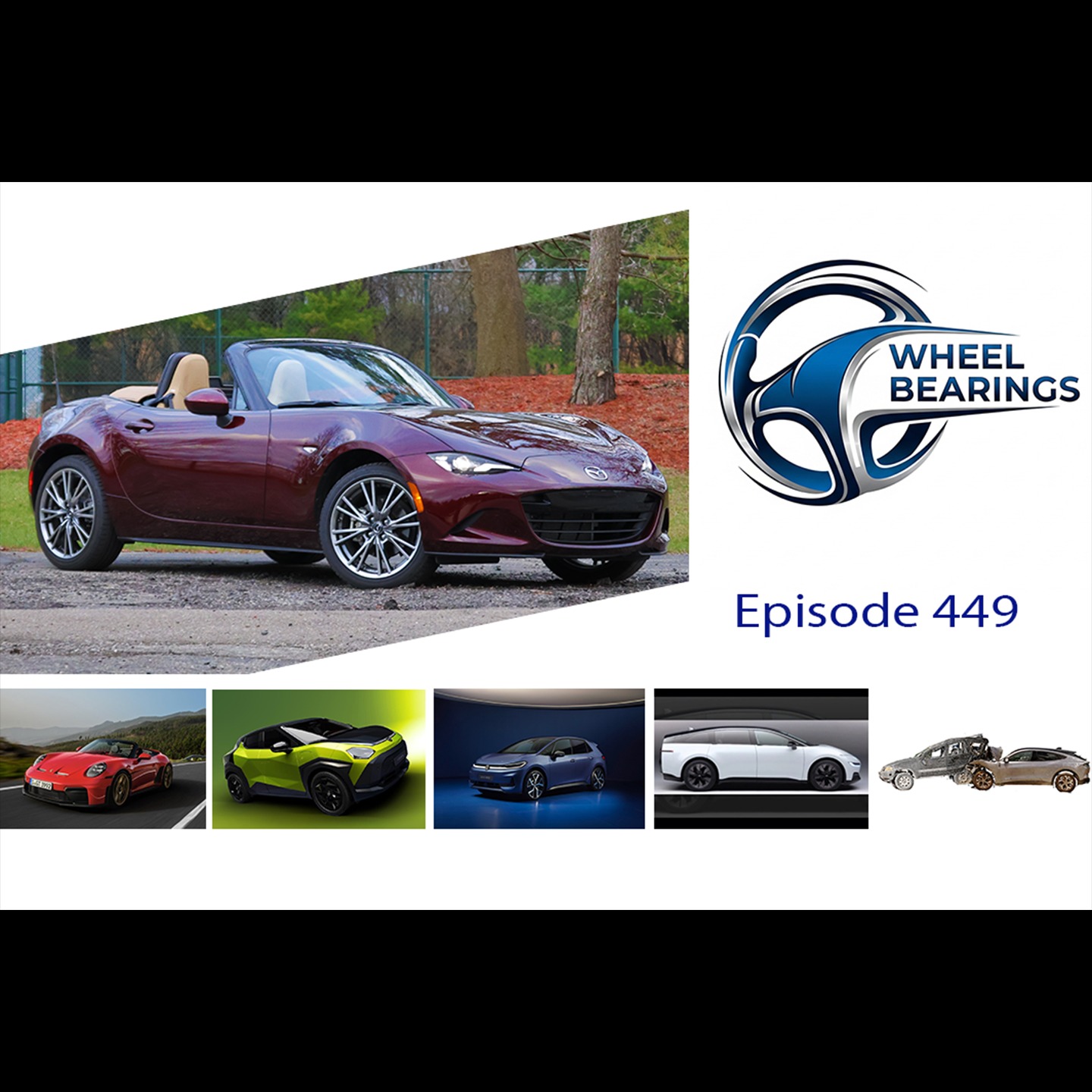
After last week's travel challenges, Robbie and Nicole are back. Nicole has driven the Chevrolet Equinox EV and the Honda Pilot Elite while Sam had the Mazda MX-5 Miata 35th Anniversary Edition.
Robbie tells us about the new Mercedes-Benz GLE and GLS and we discuss the company's new drive by wire system. GM is apparently going to build a new Buick sedan as well as a new Camaro. Nissan has a new electric Juke for the rest of the world and Porsche has a convertible 911 GT3 S/C with a manual transmission. Uber is pouring $10 billion into robotaxis. VW has a revamped with ID3 Neo with all the switches. Doug Field is leaving Ford and that might signal the end of the Model E division as it basically gets rolled back into the main Ford. Ford's cancelled 3-row electric crossover has been visible on Field's linkedin page for at least a year. Honda is killing it's e:Ny1 in the UK and the Ontario government and Unifor have rejected Stellantis' plan to assembly Leap Motor knockdown kits in Canada. The NTSB has issued its report on a pair of fatal BlueCruise crashes. Nicole interviews Mazda director of safety strategy and communications Jennifer Morrison and Lucid head of Air and Gravity product Rob Whitley.
Links
GM preps new Buick sedan alongside redesigned Cadillac CT5, Chevrolet Camaro, source says
The First Electric Nissan Juke Is A Radical Departure
The 2027 Porsche 911 GT3 S/C Is a Manual, Drop-Top Salute to the NA Flat-Six
Uber eyes $10B robotaxi investment: Financial Times | Smart Cities Dive
Doug Field leaves and Ford Reorgs
Honda e:Ny1 Withdrawn from Sale in U.K. —
DefinitelyNotAGuruStellantis Brampton plant plans stall after Leapmotor kit cars pitch rejected
Ford's Never-Seen, Canceled Moonshot EV Has Been Hiding in Plain Sight Online for a Yearlain-sight-online-for-a-year
NTSB Finds Automation Overreliance Contributed to Two Fatal Ford BlueCruise Crashes
Our Sponsors:
* Check out Peace Corps: https://peacecorps.gov/serve
Advertising Inquiries: https://redcircle.com/brands
Privacy & Opt-Out: https://redcircle.com/privacy
crosswind landings
"But one more thing flying related, you know, one thing that's always interesting to watch on YouTube is videos of planes doing crosswind landings when you got heavy crosswinds and the planes are basically coming in sideways"
Sometimes the wind blows sideways across the runway. That makes the plane want to drift sideways, so the pilot has to steer and line it up carefully to land safely.
A crosswind landing is when the wind hits the runway from the side, pushing the aircraft sideways. Pilots use special control inputs (like crab/side-slip and then aligning with the runway) to keep the aircraft stable and prevent drifting off the centerline.
turbo prop
"this is like a 15 20 seat you know turbo prop to in turbo prop and you know so basically everybody's got a window seat"
A turboprop is a plane engine that uses a turbine to spin a propeller. It’s common on regional flights and smaller aircraft.
A turboprop is an aircraft powered by a turbine engine that drives a propeller. Compared with jets, turboprops are often used on shorter regional routes and can be efficient at lower speeds and altitudes.
holding pattern
"we've been circling for like an hour a good amount of fuel so we're going to make one more pass"
A holding pattern is like a planned “wait loop” in the sky. The plane keeps flying that route until it’s cleared to land.
A holding pattern is a predefined path an aircraft flies while waiting for clearance to land or proceed. It’s used when weather or air traffic delays the approach, and it’s managed to keep fuel and timing within safe limits.
circling for fuel
"he and even said we've been circling for like an hour a good amount of fuel so we're going to make one more pass"
Sometimes the plane can’t land right away, so it has to keep flying around in a holding pattern. That uses fuel, so pilots watch their fuel carefully.
“Circling” while waiting is a common aviation procedure when the destination can’t accept the aircraft immediately (weather, runway conditions, or traffic). The aircraft burns fuel during the holding pattern, so fuel planning is critical to avoid running low before a landing opportunity.
go-around
"we took the almost landed but didn't."
If the landing doesn’t look safe, the pilot can stop the attempt and climb back up to try again. That’s called a go-around.
A go-around is when a pilot aborts the landing attempt and climbs away to try again later. It’s commonly used when conditions aren’t safe—like strong winds, unstable approach, or insufficient runway alignment.
Chevy Equinox
"Nicole, what do you even drive us? ... The Chevy Equinox EVA, why would that catch flack on social media? ... So I have Equinox TV, which I actually enjoyed driving. It has 315 miles-ish of range depending on the trim that you're getting."
The Chevrolet Equinox is a small SUV/crossover from Chevy. The speaker is talking about a specific version of it and why people online have strong opinions. They also describe what it’s like inside and what screens/tech it has.
The Chevrolet Equinox is a compact crossover SUV. In this segment, the host talks about how it’s being discussed online and then focuses on its driving experience, interior layout, and available tech features like screens and a digital gauge cluster. They also mention different trims that affect pricing and range.
EVA
"The Chevy Equinox EVA, why would that catch flack on social media? Everyone was hating on it people weren't meant I like you just put up the normal videos I do like hey here's the inside here's how it looks"
“EVA” here seems to be a label for a particular version of the Equinox. The hosts are using it to distinguish which model people are criticizing, not as a general car feature.
In this transcript, “EVA” appears to be shorthand for a specific Equinox variant or platform name used in the discussion. It’s mentioned alongside “Chevy Equinox,” suggesting it’s the version people were arguing about online.
315 miles-ish of range
"So I have Equinox TV, which I actually enjoyed driving. It has 315 miles-ish of range depending on the trim that you're getting."
Range means how far the car can go before you need to recharge. The speaker says this one is around 315 miles, but the exact number changes depending on which version you buy.
“Range” is how far a vehicle can travel on a full charge (for an EV) or a full tank (for a gas car). The speaker notes the Equinox’s range is roughly 315 miles and that it varies by trim, which is important when comparing real-world usability.
range depending on the trim
"So I have Equinox TV, which I actually enjoyed driving. It has 315 miles-ish of range depending on the trim that you're getting."
Even if it’s the same car model, different versions can go different distances. The battery and other choices (like wheels and features) can change how efficiently the car uses energy.
EV range can vary by trim because different battery sizes, wheel/tire choices, and equipment packages change efficiency and weight. That’s why two versions of the same model name can have noticeably different real-world driving potential.
17-inch, 7-inch, 7-inch screen
"It has 315 miles-ish of range depending on the trim that you're getting. There's a really big 17-inch, 7-inch, 7-inch screen. You have a digital instrument cluster."
The car has multiple screens—one big one and two smaller ones. More screens can mean more features, but it also changes how easy it is to use the controls while driving.
This describes a multi-screen infotainment setup, where the vehicle uses several displays for media, navigation, and vehicle settings. Screen size and layout matter because they affect usability (touch targets, visibility, and how quickly you can find key info).
digital instrument cluster
"There's a really big 17-inch, 7-inch, 7-inch screen. You have a digital instrument cluster. It starts, there's the LT1, which starts at 3495, there's the RS, which is 44,95."
A digital instrument cluster replaces traditional analog gauges with screens that can display speed, battery/charge info, navigation, and other driving data. It often allows different layouts by mode or trim, and it can make the dashboard feel more modern.
RS
"It starts, there's the LT1, which starts at 3495, there's the RS, which is 44,95. So it's like reasonably priced."
“RS” here is another trim level of the Equinox. The speaker is saying it costs more than the base trim and likely adds extra features.
“RS” is mentioned as a higher trim level than “LT1,” with a higher starting price. In many brands, an “RS” trim typically indicates a more feature-rich or sport-oriented configuration, though the exact differences depend on the model year and market.
LT1
"You have a digital instrument cluster. It starts, there's the LT1, which starts at 3495, there's the RS, which is 44,95. So it's like reasonably priced."
“LT1” sounds like a specific trim level (a version) of the Equinox. Different trims usually come with different features, and the speaker is saying this one starts at a lower price than the higher trim.
“LT1” is referenced as a trim level for the Equinox, tied to starting price. Trim levels typically change equipment content (tech, interior materials, powertrain details) and therefore affect both cost and features.
interiors can look kind of cheap
"I think my biggest criticism of Chevy is normally that the interiors can look kind of cheap."
This is a subjective but common buyer concern: perceived interior quality. It often comes down to materials, fit-and-finish, and how surfaces reflect light—things that can affect how “premium” the cabin feels even if the car drives well.
horsepower
"So if you have the front wheel drive, it's 220 horsepower, 143."
Horsepower is a way to describe how strong the engine is. More horsepower usually means it can accelerate more easily, but it’s not the only thing that matters.
Horsepower is a measure of an engine’s ability to do work—how much power it can produce. Higher horsepower generally helps with acceleration and passing, but real-world feel also depends heavily on gearing, weight, and torque.
front wheel drive
"So if you have the front wheel drive, it's 220 horsepower, 143."
Front-wheel drive means the front tires do the work of moving the car. It’s common on SUVs because it’s efficient and usually good in everyday weather.
Front-wheel drive (FWD) means the engine sends power to the front wheels. It’s common in crossovers because it typically packages efficiently, can improve traction in wet conditions, and often helps keep costs down compared with all-wheel drive.
pound-feet-a-torque
"pound-feet-a-torque. The owl drive, which is what I have, is, or had, was 300 horsepower and 335 pound-feet-a-torque."
Torque is the engine’s pulling force. It’s a big reason a car feels responsive when you accelerate, even if horsepower is similar.
Torque (often measured in pound-feet) describes the twisting force the engine produces. Torque is especially important for how quickly a car feels like it responds when you press the pedal, particularly at lower speeds.
drives like me via a mash the go pedal
"So it's a little bit more of, in many ways, drives like me via a mash the, I guess, I won't call it gas anyway, so it looks like it's so pompous. Go pedal. Mash the go pedal. And it goes."
They’re talking about how quickly the car reacts when you press the gas. Some cars feel eager and smooth, while others feel delayed.
This is the host describing throttle response—how the car’s power delivery feels when you press the accelerator. A vehicle can feel “responsive” even without huge horsepower numbers, depending on how quickly the engine and drivetrain build torque and how the transmission manages shifts.
cargo room 57.2 cubic feet
"There's cargo room 57.2 cubic feet if you fold the second row. That's plenty cargo room and if you have those rear seats up..."
Cargo volume tells you how much space you have for luggage and groceries. “57.2 cubic feet” is the amount of room when you fold the back seats down.
Cargo volume in cubic feet is a standardized way to compare how much stuff a vehicle can carry. Here, the host is quoting the cargo space when the second row is folded, which matters for road trips and moving larger items.
EVs getting a bad rap
"I think it's, you know, EVs are getting a bad rap with the woman, a lot of people are showing anti-evish. I am not, I like this one."
They’re talking about how some people don’t like EVs and spread negative opinions about them. The point is that the criticism isn’t always fair, and EVs can still make sense for everyday driving.
The host is addressing the idea that electric vehicles (EVs) are unfairly criticized or stereotyped. This is a common theme in EV debates—people may focus on drawbacks like charging convenience or range anxiety while ignoring real-world use and improvements.
300 miles of range
"300 miles of range. I feel like it's three, 15 divert hate. That's more than enough, like that's enough."
Range is the distance an EV can go before the battery runs low. Saying “300 miles” is meant to reassure listeners that the car can handle most trips without constant charging.
“Range” is how far an EV can drive on a full charge before it needs charging. Mentioning “300 miles” frames the discussion around whether EVs can realistically cover typical daily or occasional road-trip needs.
road trip a couple of times a year
"You don't road trip every single day of your life. You road trip a couple of times a year, if that. You're not probably maybe, maybe."
They’re saying most people don’t take long trips all the time. So if an EV can handle the occasional road trip, it may still be a good fit even if it’s not perfect for every extreme situation.
This is a real-world usage concept: many drivers don’t need maximum range every day, only for occasional longer trips. The argument is that EV range should be evaluated against typical driving patterns rather than worst-case scenarios.
charge once a week
"[650.3s] [SPEAKER_01]: You can charge once a week and you'd be good. [652.2s] [SPEAKER_05]: Once a week is all you need to do."
The point here is that most people can plug in at home and only need to charge occasionally. If you don’t drive huge distances every day, home charging covers your routine.
This is the idea of home charging as the default for EV ownership. If your daily driving is modest, you can typically top up at home on a schedule rather than relying on frequent public charging.
range will come down
"[653.4s] [SPEAKER_01]: In winter, maybe twice. [654.7s] [SPEAKER_05]: Right. [654.9s] [SPEAKER_05]: Because your mileage, your range will come down"
When it’s cold outside, an EV usually can’t go as far on a full charge. The battery works less efficiently and the car uses extra energy to keep you warm.
In winter, electric vehicles often show reduced range because cold temperatures hurt battery efficiency and increase energy use for heating. Tire grip and aerodynamic performance can also worsen, which further increases consumption.
public charging
"[688.7s] [SPEAKER_05]: You don't need to go places. [690.3s] [SPEAKER_01]: And you know what? [690.9s] [SPEAKER_01]: There's a there's a lot more public charging up there now than it was six months ago, a year ago, two years ago, and it's getting more reliable too."
Public charging is the network of chargers you use when you’re not at home. More chargers and better reliability make longer trips and backup charging easier.
Public charging availability and reliability are key factors for EV drivers who occasionally need to travel farther than their home charging routine supports. As networks expand, wait times and “out of service” issues generally improve.
charging stations near me
"[699.4s] [SPEAKER_05]: It's continually increasing the number places where you can charge even some of the charging stations near me where there were [SPEAKER_05]: say two charging chargers at it, or maybe four, they have actually gotten a little bit bigger. [712.3s] [SPEAKER_05]: The two's are now fours, the fours are now sixes. [715.3s] [SPEAKER_05]: So they've upgraded some of the ones that are there."
The speaker is describing how charger sites are being upgraded—adding more stalls/ports so more vehicles can charge at the same time. This reduces bottlenecks during peak usage and improves the odds you’ll find an available plug.
Subaru BRZ
"...i think i still have the brz and when i go to the airport that's what i drive... which means i'm like oh this sucks... Which is I'm driving the BRZ on the highway, which is like okay, it's fine."
The Subaru BRZ is a small sports car that’s meant to feel fun to drive. Here, the host is talking about using it for trips and how it fits into their routine while gas prices are high.
The Subaru BRZ is a compact sports coupe known for its balanced handling and driver-focused feel. In this segment, it’s mentioned as the car the speaker drives to the airport and on the highway, and they’re comparing its day-to-day practicality and enjoyment against higher fuel costs.
DC fast charging
"...according to the alternative fuels data center Across the US and Canada there are 17,585 DC fast charging locations with 79,739 charging ports That's a lot... So basically, you can find a place to charge your car."
DC fast charging is the “quick charge” option for electric cars. Instead of waiting a long time, you can add a useful amount of battery power relatively quickly at public stations.
DC fast charging is a method of charging an EV using direct current at high power, allowing much quicker top-ups than standard home charging. The segment cites the number of DC fast charging locations and charging ports across the US and Canada to argue that finding a place to charge is increasingly practical.
charging ports
"...there are 17,585 DC fast charging locations with 79,739 charging ports That's a lot... So basically, you can find a place to charge your car."
A charging port is the actual plug-in spot at a charging station. More ports usually means more chances to charge without waiting.
Charging ports are the individual connectors at a charging station where you plug in your vehicle. The segment uses the total number of charging ports (not just locations) to emphasize availability and reduce the chance of being blocked by another car.
Alternative Fuels Data Center charging stats
"No matter how fast or where you are in that car, you're having fun... but I'm like I wish we had a second UV Right right right now according to the alternative fuels data center Across the US and Canada there are 17,585 DC fast charging locations..."
They’re using an official data source to talk about how many EV charging stations exist. The point is to show that charging is becoming easier to find.
The hosts reference the Alternative Fuels Data Center to provide nationwide charging infrastructure numbers. This is used as evidence in their argument that EV charging access is improving.
Hyundai Ioniq 5
"I mean, I've wrote chapter Ionic five a bunch of times... So I like the ion... I like the ion... I like the ion..."
The Hyundai Ioniq 5 is an all-electric car. They’re talking about it in the context of EVs being easier to charge and whether it’s something they’d consider.
The Hyundai Ioniq 5 is an electric crossover built around fast-charging capability and a modern EV layout. The hosts reference it multiple times, suggesting it’s part of their EV “consideration set” discussion in the context of charging access and real-world usability.
smartphone projection
"It's the fact that this is one of the GM EVs that does not have support for smartphone projection... So that means no car play, no Android Auto."
Smartphone projection is when your phone connects to the car so you can use apps on the car screen. If the car doesn’t support it, you usually have to rely on the car’s own built-in menus instead.
“Smartphone projection” refers to using your phone’s apps on the car’s infotainment screen via systems like Apple CarPlay or Android Auto. If a vehicle lacks support for it, you may be limited to the car’s built-in interface instead of the familiar phone-based one.
CarPlay
"So that means no car play, no Android Auto... Does that impact your feelings about whether or not to, that you would consider buying something like this?"
Apple CarPlay lets you use your iPhone apps on the car’s screen. If a car doesn’t support it, you can’t use that familiar iPhone interface in the same way.
Apple CarPlay mirrors compatible iPhone apps onto the vehicle’s infotainment display, typically for navigation, calls, and music. In this segment, the lack of CarPlay support is presented as a potential downside when considering the GM EV.
Android Auto
"So that means no car play, no Android Auto... Does that impact your feelings about whether or not to, that you would consider buying something like this?"
Android Auto lets you use certain Android phone apps on the car’s screen. If the car doesn’t support it, you lose that option and have to use the car’s built-in system instead.
Android Auto is Google’s system for projecting compatible Android phone apps onto the car’s infotainment screen. The hosts mention that without it, the GM EV can’t use the same phone-based app experience.
BOS
"Currently, the only infotainment system that I think works without having to use car play is Mercedes and BOS."
“BOS” is mentioned alongside Mercedes as another example of a car system that doesn’t require CarPlay. The exact brand name is unclear from the transcript.
“BOS” appears to be a transcription error or shorthand for a brand name in the infotainment comparison. The context suggests it’s another manufacturer whose infotainment can work without CarPlay.
Google built in
"And it does have, so the thing with the Equinox 2, it has, um, [SPEAKER_05]: Google built in. So you can do the hey Google."
“Google built in” means the car’s screen can use Google features without you having to rely only on your phone. It’s mainly about navigation and voice help.
“Google built in” refers to an infotainment setup where Google services (like voice assistant and maps) are integrated directly into the vehicle. This can reduce the need to rely on a phone for navigation and commands.
hey Google
"So you can do the hey Google. Take me to my favorite ice complaints, whatever."
“Hey Google” is the phrase you say to wake up the car’s voice assistant. Then you can ask it to do things like start navigation.
“Hey Google” is the wake phrase that activates the Google Assistant in the car. It’s used to trigger voice commands like navigation requests without touching the screen.
Google Assistant
"And I really like the Google Assistant and the Google voice. I like being able to say that I feel like it's really good at hearing."
Google Assistant is the car’s voice “helper.” You talk to it, and it tries to understand what you want and do it.
Google Assistant is the voice assistant that interprets spoken requests and carries them out through the vehicle’s infotainment system. The speaker is praising its ability to understand and respond accurately.
Google Maps
"And the other thing you can do is, because using Google Maps, you've got Google Maps on your phone, either Android or Apple, you can do your root."
Google Maps is the navigation app that helps you plan and follow routes. They’re saying you can plan ahead on your phone and then use it in the car.
Google Maps is the navigation service used for route planning and guidance. The speaker describes using Google Maps on a phone (Android or Apple) and then planning routes ahead of time.
Google account
"You can have the vehicle tied to your Google account. You can set it up in your Google account. You can do your route on your phone or on your computer and then just send it to the car."
A Google account link lets the car remember your settings and connect your navigation features to you. They’re saying you set that up through your Google account.
Linking the vehicle to a Google account allows personalized services like saving preferences and syncing navigation/route planning. The speaker specifically mentions setting it up in the Google account.
Send a planned route to the car
"You can do your route on your phone or on your computer and then just send it to the car. Mm-hmm. So, you know, if you're planning a long trip, you can just, you know, figure everything out beforehand."
This describes a workflow where you plan a route on your phone or computer and then transmit it to the vehicle’s navigation system. It’s a convenience feature for long trips because it reduces fiddling with settings after you’re already driving.
destination charges
"Do you want to do destination charges on Alan? ... Tell you what the, what's a, it's really nice. Like you told the price."
Destination charges are the cost to get the car shipped to the dealer. Depending on the website, that fee might be included in the price you see or added later at the end.
Destination charges are fees for shipping the vehicle from the factory to the dealership. Some manufacturers include this in the advertised price, while others show it separately later, which can make comparisons between listings confusing.
Chevy.com
"I just pulled up Chevy.com. ... GM does say like the price that they show right off the top includes the destination charge."
Chevy.com is where you can look up Chevrolet pricing online. They’re using it to show that the price shown may already include the delivery fee.
Chevy.com is Chevrolet’s official online storefront where pricing and configuration details are shown. Here it’s used as an example of how GM presents the advertised price as including destination charges.
MSRP vs out-the-door pricing
"So they don't show you an MSRP and then way down at the end of the process."
MSRP is the sticker price number the company starts with. The “out-the-door” price is what you actually pay after adding delivery, taxes, and other fees.
MSRP is the manufacturer’s suggested price, but the final amount you pay can differ once destination, taxes, registration, and dealer fees are added. This segment highlights the difference between seeing an “all-in” advertised price versus being shown MSRP first and then adding fees later in the buying process.
out-the-door price surprises
"And then you think, you know, where you are, and you get to the end. And there's a lovely surprise of like that was being so careful. And now there's an extra $2,000 on there that I didn't know was going to happen."
The speakers are reacting to unexpected add-on costs that change the final “out-the-door” number (the total you pay including certain fees). This is a common shopping issue: the advertised price can differ from what you actually end up paying once all fees and charges are included.
all-wheel drive
"This week, I had the 20, 26, 100 pilot all wheel drive leaked. So that's it's kind of a national."
All-wheel drive means the car can send power to more than one set of wheels. That usually helps you stay in control on slippery roads because the tires can grip better.
All-wheel drive (AWD) is a drivetrain setup that can send torque to multiple wheels, usually the front and rear. It’s designed to improve traction and stability when conditions are poor, like rain, snow, or loose surfaces.
price bread
"[1184.0s] [SPEAKER_05]: My elite comes in at $53,495. [1188.0s] [SPEAKER_05]: So there's about a $10,000 price bread between them."
They’re talking about the price difference between two versions of the same car. It’s basically “how much more you pay” to move up a trim level.
“Price bread” here is clearly a colloquial way of saying the price gap between two trims. The key takeaway is that the speaker is comparing MSRP-style pricing between the base and a higher “elite” trim.
$53,000 when all is said and done
"[1247.2s] [SPEAKER_05]: Yeah, you know. [1247.2s] [SPEAKER_05]: So anyway, so you're looking at about for this one, about $53,000 when all is said and done. [1254.9s] [SPEAKER_05]: So it's like that a light refresh to the share."
“When all is said and done” usually refers to the out-the-door (OTD) price—what you actually pay after adding taxes, registration, and dealer fees. It’s different from the sticker price because those extra costs can move the final number.
light refresh
"[1254.9s] [SPEAKER_05]: So it's like that a light refresh to the share. [1257.0s] [SPEAKER_05]: It's nothing like dramatically different. [1259.8s] [SPEAKER_05]: There's now a standard 12.3 inch touch screen."
A light refresh means the car got updated, but not completely redesigned. Usually it’s small changes like new screens or minor styling tweaks.
A “light refresh” is a mid-cycle update to a model that typically changes styling, tech, and trim features without fully redesigning the platform. It’s often used to keep a vehicle competitive until the next major generation.
12.3 inch touch screen
"[1257.0s] [SPEAKER_05]: It's nothing like dramatically different. [1259.8s] [SPEAKER_05]: There's now a standard 12.3 inch touch screen. [1263.6s] [SPEAKER_05]: You get a tempo to inch digital instrument cluster."
A 12.3-inch touch screen refers to the infotainment display size, which often controls navigation, media, and vehicle settings. Larger screens are common in newer refreshes and can also affect usability and driver interaction.
360 degree cameras
"Also, I decided I love 360 degree cameras, the ones that show you all the way around the car."
These cameras show you what’s around the car from above. It makes parking and backing out in tight spots much easier.
A 360-degree camera system uses multiple cameras around the vehicle to create a bird’s-eye or all-around view. This helps with low-speed maneuvering, parking, and avoiding obstacles when visibility is limited.
10-speed automatic
"There is a 3.5 litre v6, 285 horsepower, 262 pound feet, 10-speed automatic."
This is an automatic gearbox with many gear steps. It helps the car shift in a way that can feel smoother and keep the engine working efficiently.
A 10-speed automatic transmission uses ten gear ratios to keep the engine in its efficient or power-friendly range. More gears can help with smoother acceleration and better fuel economy, depending on the calibration.
3.5 litre V6
"There is a 3.5 litre v6, 285 horsepower, 262 pound feet, 10-speed automatic."
This is the engine type and size: it’s a V6 with 3.5 liters of total displacement. Bigger displacement often means the engine can make stronger power, depending on tuning.
A 3.5-liter V6 is an engine with six cylinders arranged in a V layout and a total displacement of 3.5 liters. Displacement is one way manufacturers describe engine size, which often correlates with power and torque potential.
drive modes
"You get a bunch of drive modes, including snow moan, which thankfully, I'm not going to get to try again until next, let's hope December, because snow is still melting, hopefully."
Drive modes are settings that change how the car behaves. For example, a snow mode usually makes the car easier to control on slippery roads.
Drive modes change how the vehicle responds to your inputs by adjusting things like throttle mapping, steering feel, transmission behavior, and traction control. They’re meant to tailor drivability for different conditions such as snow, rain, or normal driving.
snow mode
"You get a bunch of drive modes, including snow moan, which thankfully, I'm not going to get to try again until next, let's hope December, because snow is still melting, hopefully."
Snow mode helps the car grip better on icy or snowy roads. It usually makes acceleration gentler so the wheels don’t spin.
Snow mode is a drive setting designed to improve traction on slippery surfaces. It typically reduces wheel spin by altering throttle response and traction-control behavior so the car accelerates more smoothly.
towing capacity
"Are you can tow 5,000 pounds on the olive drama model, so you can tow a good bunch."
Towing capacity is how much weight the car can pull safely. It’s important to stay within the rating so the brakes and cooling can handle the load.
Towing capacity is the maximum weight a vehicle is rated to tow safely under specified conditions. It depends on the drivetrain, cooling system, brakes, and sometimes the specific trim and equipment.
ground clearance
"The ground clearance, they have a trail sport in this, trail sport gets an extra inch."
Ground clearance is how high the car sits from the ground. Higher clearance can help you drive over bumps and rough paths without hitting the bottom.
Ground clearance is the distance between the lowest part of the vehicle and the road. More clearance helps reduce the chance of scraping the underbody on rough roads or trails.
Trail Sport
"The ground clearance, they have a trail sport in this, trail sport gets an extra inch."
Trail Sport is a version of the car meant for more rugged driving. Here, it’s described as having extra height so you’re less likely to scrape on uneven roads.
Trail Sport is a trim/package name that typically focuses on off-road capability. In this context, it’s associated with increased ground clearance (an extra inch) to better handle rougher surfaces.
three rows of seating
"[1384.9s] [SPEAKER_01]: So in most cases, yes. [1386.6s] [SPEAKER_05]: So you get three rows of seating. [1388.9s] [SPEAKER_05]: You're gonna get either seven or eight passenger."
Three rows of seats means there’s room for more passengers—usually families or carpooling. The downside is that the back seats can be a bit cramped, and you may have less space for luggage.
Three-row seating is a common layout in family SUVs and minivans, letting them carry more passengers than two-row vehicles. The tradeoff is that the third row can be tighter, and cargo space may shrink when it’s in use.
captains chairs
"[1391.0s] [SPEAKER_05]: So it depends. [1391.5s] [SPEAKER_05]: There's captains chairs that take it down to seven or you have a seating for eight. [1396.5s] [SPEAKER_05]: It's actually really roomy and as I'm saying this I just realized last night's left over."
Captains chairs are separate seats instead of a bench. They usually make the middle row more comfortable, but they can mean fewer total seats.
Captains chairs are individual, separated seats—typically in the second row of a three-row SUV. They often reduce seating capacity from eight to seven, but they can improve comfort and access to the third row.
cargo volume (with seats folded)
"You have a good amount of space in here to you get up to 113.7 cubic feet depending, you know, fold everything down. So you get a good amount of space. This is a pretty roomy vehicle."
This is about how much room you have when you fold the seats. It’s a better way to judge usefulness than just looking at the vehicle’s size.
Cargo volume with seats folded is a practical way to compare how flexible an SUV is for real-world hauling. It matters because the “usable” space changes dramatically depending on whether the seats are up or down.
113.7 cubic feet
"So there's. You have a good amount of space in here to you get up to 113.7 cubic feet depending, you know, fold everything down. So you get a good amount of space."
That number is how much stuff the vehicle can carry. It’s measured in cubic feet, and it usually assumes you fold the seats down.
This is a cargo-volume measurement, usually describing how much space the vehicle can hold with seats folded. Larger numbers generally mean more usable room for luggage, gear, or bulky items.
BMW Z3
"...e about this is sometimes you get that larger SUV Z3 rows. [SPEAKER_05]: They get a little unwieldy fe..."
The BMW Z3 is a small sports car, usually a two-seat roadster. The podcast is talking about how it can feel a bit hard to manage depending on the situation. Like any car, it has wheel bearings that can wear out over time.
The BMW Z3 is a compact two-seat roadster that’s known for its classic sports-car character. The podcast’s mention about “unwieldy” suggests discussion around size and handling, especially when comparing different body or seating arrangements. In a wheel-bearing context, it’s a reminder that even smaller sports cars can develop wheel bearing issues from age and driving conditions.
three-row SUV
"You've suddenly feel like you're driving a three row. This doesn't feel like it actually drives really nicely. It still has plenty of power."
A three-row SUV is the kind of SUV with an extra row of seats for more people. Sometimes they feel big and hard to drive, but the host says this one doesn’t.
A three-row SUV is designed to seat more passengers, but it can feel bulky or “heavy” to drive compared with smaller crossovers. The segment highlights how this vehicle avoids that typical unwieldy feel.
3 row
"I may have caught, yeah, we're in the equinox you knew so but I so I really like driving and that's what you kind of want in a in a three row. You've got family presumably you have kids and keeping those kids comfortable and asleep once they fall asleep."
“Three-row” means the SUV has extra seats in the back for more passengers. The host is saying this matters for families, especially on long drives.
A “three-row” vehicle has seating for up to seven or eight people, depending on configuration. The segment ties three-row practicality to family needs like keeping kids comfortable and asleep during road trips.
pilot
"So I generally like the pilot. I generally like Honda's. I feel like they're solid vehicles. I feel like they're pricing is sometimes a little on the high side like for this though."
They’re talking about the Honda Pilot, a family SUV with three rows. The main idea is that it rides smoothly and quietly, which helps keep kids comfortable on trips.
The Honda Pilot is a three-row family SUV. In this segment, the hosts focus on comfort (quietness and smoothness), ride quality over rough pavement, and practicality for road trips with kids.
road tripping
"It's important, especially if you're road tripping, you don't want to have your kids waking up just because you went over a bump or because the pavement changed on the highway or because you had to slam on the brakes or whatever."
“Road tripping” here highlights how ride comfort and noise matter over long distances, especially with children. The host connects bump absorption, braking events, and changing pavement to whether kids wake up and stay comfortable.
19 city 25 highway 21 combined
"And for fuel economy on this, because we were talking about things, it is rated 19 city 25 highway 21 combined. Not bad for 3 row."
Those numbers are how efficiently the car uses gas in different types of driving: city, highway, and an overall average. The point is that the three-row SUV still gets decent mileage.
These are EPA-style fuel economy ratings: miles per gallon (MPG) for city driving, highway driving, and a combined average. The host uses the numbers to argue the Pilot is not a “gas guzzler” even as a three-row SUV.
reliability
"I think it does exactly what you want a Fam leave vehicle to do and Honda has a good reputation and their reliability is good So your worries about being stuck on the side of the road on a road trip are Minimal could always happen, but I feel like buying a Honda reduces the chances of that likelihood."
Reliability means the car is less likely to break down. The host is saying Honda’s reputation makes them feel safer on long trips.
Reliability refers to how consistently a vehicle avoids major breakdowns over time. The host frames Honda’s reputation as reducing the odds of being stranded during a road trip.
35th anniversary edition
"And what made the 35th anniversary special distinct from other meadows is the color and trim combination."
A 35th anniversary edition is a limited version of a car made to celebrate a milestone. Usually it’s special because of the paint, interior, and features, not because the engine is completely different.
A “35th anniversary edition” typically marks a milestone with limited availability and unique styling details. In this case, the speaker emphasizes that the mechanical fundamentals are the same as other Miatas, while the special edition differentiates itself through color and trim.
Mazda MX-5 / Miata
"This was actually a 2025 Mazda Miata MX-5, a 35th anniversary edition."
They’re reviewing a special 2025 Mazda Miata/MX-5. It’s a limited 35th anniversary version, mostly known for its look and interior rather than a brand-new design.
The speaker is talking about a 2025 Mazda Miata MX-5 (Miata is Mazda’s roadster; MX-5 is the model name used in some markets). This specific example is a 35th anniversary edition, which is mainly a special appearance package rather than a totally new car.
Mazda Cx90
"[SPEAKER_01]: And what made the 35th anniversary special distinct from other meadows is the color and trim combination. [SPEAKER_01]: You know, it, you know, mechanically it's the same as every other mehata, but the the 35th anniversary special is finished in the artisan red metallic, which is that deeper burgundy red that they introduced on the CX 90 a couple years ago. [SPEAKER_01]: So, you know, obviously, you know, Soul Crystal Red is still the best one, but this is a very nice color, and, you know, it's a, it's a try coat, you know, so they do three base coats of the color, and then clear coat it, and, you know, especially in the sun, it looks fabulous."
The Mazda CX-90 is a larger SUV. The podcast is talking about a special 35th anniversary version, mainly focused on different color and interior trim. Even with different styling, it still has wheel bearings that can wear out like on other SUVs.
The Mazda CX-90 is a larger Mazda SUV, and the podcast specifically references a 35th anniversary edition. It notes that the special part is the color and trim, while the underlying mechanics are described as the same as other versions. In a wheel-bearing discussion, it’s relevant because the wheel-end components are still part of the same SUV platform and can wear similarly over time.
Artisan Red Metallic
"mechanically it's the same as every other mehata, but the the 35th anniversary special is finished in the artisan red metallic..."
This is the name of the car’s paint color. The speaker says it’s a deep red and that the paint is built up in layers, which helps it look especially good in the sun.
“Artisan Red Metallic” is a specific Mazda paint color described as a deeper burgundy red. The speaker also notes it uses a multi-step paint process (multiple base coats plus clear coat), which affects how it looks in sunlight.
try coat
"it's a, it's a try coat, you know, so they do three base coats of the color, and then clear coat it"
They’re talking about how the paint is applied in layers. Doing multiple color coats and then a clear coat can make the color look deeper and shinier, especially in bright sun.
The speaker is describing a “three-coat” paint system: multiple base coats of color followed by a clear coat. More layers can improve depth and gloss, which is why metallic colors often look especially vibrant under direct sunlight.
Tan Napa leather interior
"So, you have the Artisan Red Metallic and then Tan Napa leather interior and also the top."
Napa leather is a higher-end type of leather used for seats and trim. They’re pointing out that the tan leather (and tan top) looks great with the darker red paint.
“Napa leather” refers to a premium leather upholstery material known for a soft, high-quality feel. The speaker pairs it with the red paint and mentions the tan top, highlighting how the interior and exterior color combination changes the car’s overall vibe.
Chevrolet Corvette
"it's not going to win drag races against Corvettes or Mustangs, but it doesn't have to, because it's going to get around corners faster than most of them anyway."
They’re using Corvettes as an example of a faster, more powerful sports car. The point is that the Miata doesn’t need huge power to feel quick because it handles well.
The speaker compares the Miata’s performance to “Corvettes,” using them as a reference point for straight-line speed. The key idea is that even if the Miata isn’t built to win drag races, its lightweight design and handling can make it faster-feeling through corners.
Ford Mustang
"it's not going to win drag races against Corvettes or Mustangs, but it doesn't have to, because it's going to get around corners faster than most of them anyway."
They’re referencing Mustangs as another car type that’s often about quick acceleration. Their point is that the Miata can still feel quicker in real driving because it handles so well.
The speaker mentions “Mustangs” as another benchmark for drag-race-style performance. The takeaway is that the Miata’s strengths are cornering and nimble driving dynamics rather than raw acceleration.
two liter naturally aspirated four cylinder
"Like all current me out is, it's got a two liter naturally aspirated four cylinder..."
This describes the engine: it’s 2.0 liters, has four cylinders, and it doesn’t use a turbocharger. That usually means the car’s response to your gas pedal feels smooth and straightforward.
A “two-liter naturally aspirated four-cylinder” means the engine is 2.0L, uses four cylinders, and doesn’t rely on a turbocharger or supercharger for airflow. Naturally aspirated engines typically deliver a more linear throttle response and predictable power delivery, which suits a lightweight sports car like the Miata.
17-inch alloy wheels
"It's the 17-inch wheels, 17-inch alloy wheels on this one, they're silver finish on there."
These are the car’s wheels: 17 inches wide and made from a lightweight metal. Wheel size and material can change how the car feels and how it rides.
“17-inch alloy wheels” are wheels made from an aluminum alloy, typically chosen for lower weight and better heat handling than steel wheels. Wheel size and design can affect ride comfort, steering feel, and how the car looks.
belt line
"But the modern mehata is, you know, the belt line is a lot higher... And I feel, I almost feel like I'm sitting on it rather than in it."
The belt line is where the side windows meet the body. They’re saying the newer Miata sits you in a way that feels different—more like you’re sitting on the car than down inside it.
The “belt line” is the height of the car’s body along the side windows. The speaker uses it to describe seating position and visibility: a higher belt line can make you feel more “on” the car rather than “in” it, changing the perceived driving posture.
cup holders
"[1908.4s] [SPEAKER_01]: My only complaint about the interior of the Miata is the cup holders... [1930.0s] [SPEAKER_01]: if you pull your arm way back, you will hit them with your elbow."
Cup holders are where the car stores your drinks. This host is saying the Miata’s cup holders are positioned in a way that can get in the way of your arm while driving.
Cup holders are the built-in storage/retention points for drinks. Here, the host critiques their placement, explaining that the location forces tall/long-arm drivers to hit them with an elbow.
daily driver
"[1941.5s] [SPEAKER_01]: I could easily live with one of these cars as a daily driver It's just it's just so much fun to drive... [1952.7s] [SPEAKER_01]: It's so much fun to drive if you fit it if it fits you you're golden if it doesn't"
A daily driver is the car you’d use most days for errands and commuting. The host’s point is that the Miata can be a great everyday car if you’re comfortable in it.
A “daily driver” is a vehicle you use regularly for everyday trips rather than just occasional weekend driving. The host is weighing the Miata’s fun factor against practical fit/comfort—suggesting it can work as a daily driver if you fit well.
Ford Excursion
"... back into my BRZ, my BRZ felt like a like a Ford excursion. [SPEAKER_02]: There's just so much more room."
The Ford Excursion is a very large SUV. The podcast is using it as a comparison to describe how much more room it feels like. Bigger vehicles can also put more load on parts like wheel bearings.
The Ford Excursion is a large, body-on-frame SUV known for its big size and lots of interior space. The podcast uses it as a comparison point for how much room a driver felt when switching back to a different car. In a wheel-bearing discussion, it’s relevant because larger vehicles can experience different wheel-end wear patterns due to weight and driving conditions.
360 degree camera view
"And the great thing about having a Miata, it doesn't matter if you have a 360 degree camera view. You don't need it because you just get around."
A 360 camera system shows a top-down view of the car using cameras around it. They’re saying the Miata is small and easy to see, so you might not rely on that feature.
A “360 degree camera view” uses multiple cameras around the car to create a bird’s-eye image for parking and low-speed maneuvering. The hosts argue that for a Miata, you may not need it because visibility and the small size make it easier to place the car.
inflation calculator
"like my car was $13,000 when it first came out, but when you run that through an inflation calculator, actually not a whole lot different today because the 2026 Miata starts at 30,430 dollars"
An inflation calculator helps you compare money from different years. It answers: “If that car cost $X back then, what would it be worth in today’s dollars?”
An inflation calculator adjusts past prices into today’s dollars using inflation data. The speaker uses it to compare the Miata’s original price to the current MSRP, showing how the “real” cost changes over time.
Mercedes-Benz GLE
"I didn't get to drive, but it was really impressive how well this thing handled doing some really weird, crazy off-roading that again, no one's ever going to do in a GLE."
The Mercedes-Benz GLE is a luxury SUV. Here they’re basically saying it can handle off-road situations better than you might expect for a comfort-focused SUV.
The Mercedes-Benz GLE is a midsize luxury SUV known for comfort on-road and available off-road capability. In this segment, the host compares its off-road behavior to other Mercedes SUVs, emphasizing how capable the GLE is in “weird” terrain situations.
G-Class Gwagon
"I mean, they wouldn't even do it in a G-wagon to be honest, and the G-wagon could like deal with this, like, no problem."
The Mercedes-Benz G-Class is the classic “G-wagon,” known for being tough off-road. They’re using it as the standard for off-road ability.
The Mercedes-Benz G-Class (often called the “G-wagon”) is a boxy, body-on-frame luxury SUV famous for serious off-road hardware. The host uses it as a benchmark, saying the GLE’s off-road performance is comparable to what you’d expect from the G-Class.
plug-in hybrid
"So the JLE is their plug-in hybrid, and it will do probably, okay, so there's a lot of confusion on the range for this when they had the event."
A plug-in hybrid is a car that can run on electricity for a while, but it also has a gas engine for longer trips. You can charge it by plugging it in.
A plug-in hybrid (PHEV) combines an internal-combustion engine with an electric motor and a battery you can recharge from an external power source. That allows a meaningful “electric-only” driving range, after which the gas engine and hybrid system take over.
WLTP
"finally after I looked it up, this vehicle brought based on the WLTP number that they gave us with kilometers."
WLTP (Worldwide Harmonised Light Vehicles Test Procedure) is a standardized testing method used in Europe to estimate fuel economy and electric range. Because it’s measured under specific lab conditions, WLTP range numbers often don’t match real-world driving exactly.
M256 M Evo
"That was just the the motor itself, which is the M256 M Evo. Again, this is one of their updated motors."
M256 M Evo is Mercedes’ name for a particular updated engine/motor design. Here they’re using it to explain what kind of power unit is powering the hybrid setup.
M256 M Evo is an internal engine-family designation Mercedes uses for a specific updated powerplant. In this segment, it’s described as the motor itself within the plug-in hybrid system, along with its output figures (horsepower and torque).
Miller cycle
"That's an updated motor, it's on a Miller, Miller cycle."
The Miller cycle is a way of tuning an engine to be more efficient. It changes valve timing so the engine can get more work out of the fuel.
The Miller cycle is an engine operating strategy that improves efficiency by modifying how the intake valve timing works. In practice, it can help reduce fuel consumption and emissions while still producing useful power.
exhaust
"It has a new cylinder head, improved intake, exhaust, ports, new, a new cam shaft."
The exhaust is how the engine sends out the gases after combustion. A better exhaust setup can help the engine “empty out” more easily, which can improve power.
The exhaust system routes burned gases out of the engine. Exhaust improvements (including porting and cam timing changes) can reduce backpressure and help the engine expel gases more effectively, supporting power gains.
intake
"It has a new cylinder head, improved intake, exhaust, ports, new, a new cam shaft."
The intake is how the engine gets air. If the intake is improved, the engine can get the right amount of air more easily, which can help performance and efficiency.
The intake system brings air (and sometimes fuel) into the engine. Improving intake design—like port shape or airflow paths—can increase volumetric efficiency, which supports higher power and better efficiency.
cylinder head
"It has a new cylinder head, improved intake, exhaust, ports, new, a new cam shaft."
The cylinder head sits on top of the engine. It controls how air and fuel enter and how exhaust leaves, so improving it can help the engine breathe better and make more power.
The cylinder head is the top part of an engine that houses key components like the intake and exhaust ports and the valves. Changes to the cylinder head can improve airflow, which helps the engine make more power and run more efficiently.
cam shaft
"It has a new cylinder head, improved intake, exhaust, ports, new, a new cam shaft."
The camshaft is like the engine’s timing controller for the valves. If you change it, you can change how the engine breathes at different speeds, which can make it pull harder or rev higher.
The camshaft controls valve timing by opening and closing the intake and exhaust valves. A new camshaft profile can shift where the engine makes power—often enabling higher revs and a broader or “extended” torque curve.
extended torque curve
"it's higher revving, they have extended torque curve, it's got turbo, it's just they've done a lot to these motors, these gas motors in order to increase power and efficiency"
Torque is the twisting force that gets you moving. An “extended torque curve” means the engine makes strong pulling power across more of the RPM range, so it’s easier to drive without constantly revving.
An extended torque curve means the engine produces useful torque over a wider range of RPMs, not just at one narrow band. That typically makes the car feel more flexible in real driving because you don’t need to keep it in a specific rev range.
GM
"...when you see places like Ford who's pulling back But then you see GM and Hyundai, and they continue to push forward."
GM is mentioned as another big automaker. The point here is that they’re still investing in electrified vehicles rather than slowing down.
GM (General Motors) is referenced as continuing to push forward with electrification. In this segment, it’s part of a broader comparison of how major automakers are responding to the transition to electric vehicles.
EQ lineup
"I think their biggest issue was the EQ lineup initially. They didn't look like a Mercedes."
EQ is Mercedes-Benz’s line of electric cars. The speaker says early EQ models didn’t match what some buyers expected a Mercedes to look like, which hurt acceptance even if the tech was good.
The “EQ lineup” refers to Mercedes-Benz’s electric vehicle family. The speaker’s point is that early EQ models had a styling/identity issue—people wanted them to look like Mercedes cars even when using different powertrains.
CCS
"...what is interesting about this vehicle is it has a it's going to have a a CCS. It's not going to have an axe and a charge AC at 9.6 kilowatts..."
CCS (Combined Charging System) is a common DC fast-charging standard for many plug-in hybrids and EVs. It determines the connector type and charging communication so the car can draw high power from compatible chargers.
AMG version
"Yeah, so yeah, so I think of the vehicles, you know, they also have an AMG version. I didn't get to drive any of these vehicles."
AMG is Mercedes’ performance division. An “AMG version” usually means the car is set up to feel quicker and more sporty than the regular model.
AMG is Mercedes-Benz’s performance brand, and an “AMG version” typically means a higher-output engine tune, sportier suspension/brakes, and more aggressive styling. Even when the base model is a hybrid or SUV, the AMG variant is usually tuned for sharper driving feel.
GLS
"The GLS looks really nice. All of them have physical, uh, what do you call them?"
The Mercedes-Benz GLS is a big, upscale SUV. It’s the kind of vehicle people buy for a comfortable, premium ride and lots of space.
The Mercedes-Benz GLS is the brand’s large luxury SUV, positioned above the GLE in size and comfort. When someone says the GLS “looks really nice,” they’re likely talking about the newest design direction and interior tech.
passenger side screen
"They do all still have the passenger side screen, which again, I talked to them about it. I talked to regular people."
Some newer cars put a screen in front of the passenger too. That lets the passenger control things like music and navigation without needing the driver to do it.
A passenger-side screen is an infotainment display aimed at the front passenger, letting them control media, navigation, and sometimes vehicle settings. It’s part of the broader trend toward “multi-screen” cabins in modern luxury cars.
global cars
"[2699.9s] [SPEAKER_02]: They're building global cars, you know, if you're an automaker right now..."
They mean cars that are built to work for lots of countries, not just one region. Making fewer unique versions can make the whole business cheaper and easier to manage.
The hosts discuss “global cars” as vehicles designed to be sold across many markets with fewer unique variations. This approach can reduce manufacturing and inventory complexity, especially when overall sales are down.
Audi A5
"[2720.0s] [SPEAKER_02]: Yeah, I think an Audi was really smart with the new A5, where they've gotten rid of like the four engine choices..."
They’re using the Audi A5 as an example of a car model where Audi simplified the engine lineup. Instead of many different engine versions, most buyers get essentially the same main engine package.
The Audi A5 is referenced as an example of a modern strategy: reducing the number of engine choices to one primary option. That can lower complexity for manufacturing and inventory, and it changes how customers “trade up” between trims.
consolidating
"[2783.4s] [SPEAKER_02]: Mercedes, like BMW... Just sort of consolidating and being a little bit smarter about how you build these vehicles."
They’re talking about consolidating as making fewer different versions of cars and using shared parts. That can reduce cost and make it easier to build cars efficiently.
“Consolidating” here refers to automakers reducing the number of different platforms, powertrain configurations, or production paths. By sharing components and manufacturing steps, companies can lower cost and respond faster to demand changes.
Fiat 500e
"...e only one, it's got an Inline 4, the 450 and the 500E, both have the same engine. [SPEAKER_02]: Those a..."
The Fiat 500e is a small electric car. The podcast says it’s offered in different versions but uses the same basic motor setup. Like other cars, it has wheel bearings that can wear out over time.
The Fiat 500e is a small electric car, and the podcast notes that it uses an inline-four motor and is offered in at least the 500e and 450 variants with shared engine architecture. Small EVs like this are often discussed for city-friendly size and straightforward ownership. Even in a compact EV, wheel bearings are still normal wear items that can require service.
Inline 4
"[2796.8s] [SPEAKER_02]: ...the GLAs you've got a 350, which is the only one, it's got an Inline 4..."
An “inline 4” is an engine with four cylinders lined up in a row. It’s a common engine layout, and it’s often chosen for good efficiency and simpler packaging.
“Inline 4” means a four-cylinder engine where all cylinders are arranged in a single straight line. In practice, it’s often used for efficiency and packaging, and it’s one of the engine layouts the hosts list for the Mercedes lineup.
Inline 6
"[2807.5s] [SPEAKER_02]: ...the 450 and the 500E, both have the same engine. [2807.5s] [SPEAKER_02]: Those are Inline 6s..."
An “inline 6” is an engine with six cylinders in a straight line. It’s known for smoothness, and in this discussion it’s one of the main engine types used across certain Mercedes trims.
“Inline 6” refers to a six-cylinder engine with all cylinders in a single straight line. The hosts use it to differentiate Mercedes engine options, noting that some trims share the same inline-6 architecture.
V8
"[2823.3s] [SPEAKER_02]: ...and of course the GLS 580 is a 4-liter V8."
A “V8” is an engine with eight cylinders arranged in two sides that form a V shape. It’s typically associated with stronger performance and smooth power delivery.
“V8” describes an eight-cylinder engine arranged in a V shape (two banks of four cylinders). The hosts mention a V8 in the context of the Mercedes GLA “580” variant to show how higher-number trims can correspond to different engine layouts.
hybrid system
"[2823.3s] [SPEAKER_02]: ...one of the engines also, it's part of a hybrid system..."
A hybrid system uses both a gas engine and an electric motor. The car can use electricity sometimes, and it also helps the gas engine work more efficiently.
A “hybrid system” combines an internal-combustion engine with an electric motor and battery to improve efficiency and/or performance. In the transcript, the hybrid system is tied to specific Mercedes trims and is part of the broader “gas, hybrid, EV” transition strategy.
power trains
"[2871.4s] [SPEAKER_02]: It's very interesting to talk to Mercedes about their power trains because they are making fundamental changes to these motors..."
“Powertrain” is the stuff that makes the car move—like the engine and any electric motors. They’re saying Mercedes is redesigning how those systems work together in newer vehicles.
“Power trains” refers to the full set of components that generate and deliver power to move the vehicle, including engine, electric motors, transmissions, and related systems. The hosts discuss how Mercedes is changing its powertrain approach across gas, hybrid, and EV platforms.
buttons
"[2914.5s] [SPEAKER_02]: ...but but again, you're paying a lot of money for Mercedes. [2919.6s] [SPEAKER_02]: You still get some buttons. [2920.7s] [SPEAKER_02]: They put the rockers on the steering."
The transcript notes that the car still has “buttons,” implying a preference for physical controls even as vehicles add more screens and digital interfaces. This is a user-experience point tied to modern cockpit design.
rockers on the steering
"[2919.6s] [SPEAKER_02]: You still get some buttons. [2920.7s] [SPEAKER_02]: They put the rockers on the steering."
They’re talking about small switch controls on the steering wheel. Instead of using only touchscreen menus, you can flip a switch to control things while driving.
“Rockers on the steering” likely refers to rocker-switch style controls mounted on the steering wheel. These are common for functions like driver-assist settings, audio, or cruise control, and they’re part of the physical-control design the hosts are discussing.
Mercedes EQS
"...there was another bit of news that came out from Mercedes... which was around the steering system on the EQS, so they've got a revamped version of the EQS coming."
The Mercedes EQS is an all-electric Mercedes sedan. They’re talking about a newer version and how its steering system is being redesigned.
The Mercedes EQS is Mercedes-Benz’s full-size electric luxury sedan. In this segment, the hosts discuss a revamped EQS and focus on changes to its steering system and exterior design cues.
signature headlights
"...they're all adopting these similar signature headlights, you know, that started on the CLA..."
Signature headlights are the distinctive headlight shapes a brand uses so you can recognize the car quickly. The hosts say Mercedes is carrying that lighting style across multiple models.
“Signature headlights” refers to a brand’s recognizable lighting design elements that help identify the model at a glance. The hosts connect this to Mercedes’ design language that started on the Mercedes CLA, then spread across other models like the EQS.
Mercedes CLA
"...that started on the CLA, where you've got the Mercedes 3.8 star lit in..."
The Mercedes CLA is a smaller Mercedes model. The hosts mention it because it’s where this headlight design style first showed up.
The Mercedes CLA is a compact luxury sedan/coupe line that the hosts cite as the starting point for Mercedes’ newer “signature” headlight design. They use it as a reference for how the lighting theme has spread to larger models.
steer-by-wire system
"...they showed off the new stir-by wire system that's on there. And like the one on the cyber truck, there's no mechanical connection between the steering yoke and yes, there's a yoke now..."
Steer-by-wire means your steering input is handled electronically instead of through direct mechanical parts. That can make the cabin feel different and may require special safety testing rules.
A steer-by-wire system replaces the traditional mechanical linkage between the steering wheel/yoke and the steering mechanism with electronic controls. Inputs are sent to actuators, which can allow different steering ratios and packaging benefits, but it also shifts the experience and safety/regulatory considerations toward software and redundancy.
steering yoke
"...there's no mechanical connection between the steering yoke and yes, there's a yoke now, no steering wheel and the wheels."
A steering yoke is a different steering shape than a normal wheel. Because it’s often used with electronic steering, it can be mounted in a way that changes what you can see through the windshield.
A steering yoke is a steering control shaped like a partial ring or bar, rather than a conventional round steering wheel. In steer-by-wire setups, the yoke can be packaged differently, and the hosts note it affects visibility and the driving feel.
Tesla Cybertruck
"...they showed off the new stir-by wire system that's on there. And like the one on the cyber truck, there's no mechanical connection between the steering yoke and yes, there's a yoke now..."
The Tesla Cybertruck is an electric truck with a very unusual steering setup. The hosts use it as a reference point for how steer-by-wire works in practice.
The Tesla Cybertruck is an electric pickup known for its unconventional design, including steer-by-wire. The hosts compare the EQS’s steer-by-wire approach to the Cybertruck’s lack of a direct mechanical connection between the steering input and the wheels.
limit the total lock to lock... about 170 degrees
"...it’s got a limit the total lock to lock during angle to about 170 degrees. So it’s just short of going to, you know, 90 degrees..."
“Lock-to-lock” is the total steering angle range from full left to full right. Limiting it to about 170 degrees means the yoke won’t require large hand-over-hand movement, changing how steering effort and driver input feel compared with typical steering wheels.
crash testing regulations for steering wheels
"...potentially pose a problem in China. They may not be able to... regulation changes in China because of the way they test through the crash testing for the steering wheels... specifically looking at the impact on the top part of the steering wheel itself."
Car safety rules often require specific crash-test setups. If the steering control looks different (like no top part of a wheel), the test may not work the way regulators expect.
The hosts discuss how steering-wheel regulations can be written around specific physical features—like the “top part” of a steering wheel—during crash testing. If a vehicle uses a yoke or removes the top portion, it may not fit the test assumptions, potentially causing regulatory test failures unless rules change.
LEDs
"[3170.4s] [SPEAKER_02]: I forgot the the new lighting system as fitch Presley um it has a larger light field so you're getting more of a spread with these new lights and all these vehicles and they're using 5% less energy so it's a bunch of little teeny tiny LEDs so it's pretty so that's kind of cool"
LEDs are a type of light bulb technology. They use less power than older lighting and can be arranged to create a better beam pattern.
LEDs (light-emitting diodes) are used for automotive lighting because they’re efficient and can be packaged into complex light signatures. The segment suggests newer lighting systems use many small LEDs to improve the light pattern while reducing energy use.
Level 3 and Level 4
"[3189.0s] [SPEAKER_02]: Especially when you're looking at vehicles that at some point they want to have level 3 and level 4, which means that computing is in a cyclopalado power."
Level 3 and Level 4 are categories for how automated a car is. Higher levels mean the car can do more of the driving itself, with Level 4 being the most capable (usually within certain limits).
“Level 3” and “Level 4” refer to higher automation levels in SAE autonomous driving definitions. Level 3 typically expects the driver to take over when requested, while Level 4 is designed to handle driving in specific conditions without continuous driver supervision.
Tesla Model X
"[3224.2s] [SPEAKER_01]: I mean, you know, Tesla did eventually go back to a conventional steering wheel in the Model S and Model X, but they didn't have, they didn't, those cars didn't have steer by wire."
The Tesla Model X is an electric SUV. The episode mentions it because Tesla changed the steering wheel design and the speaker brings up that it didn’t use steer-by-wire.
The Tesla Model X is Tesla’s electric SUV. In the segment, it’s referenced alongside the Model S as another example where Tesla returned to a conventional steering wheel, and the speaker notes it lacked steer-by-wire.
Tesla Model S
"[3224.2s] [SPEAKER_01]: I mean, you know, Tesla did eventually go back to a conventional steering wheel in the Model S and Model X, but they didn't have, they didn't, those cars didn't have steer by wire."
The Tesla Model S is an electric luxury sedan. Here it’s mentioned because Tesla changed its steering wheel design over time, going back to a more normal steering wheel.
The Tesla Model S is one of Tesla’s flagship electric sedans. In this discussion, it’s used as an example of Tesla moving back to a conventional steering wheel after experimenting with a yoke-style wheel.
General Motors
"[3251.1s] [SPEAKER_01]: General Motors. [3252.8s] [SPEAKER_01]: They've got two assembly plants in Lansing, Michigan."
General Motors is one of the big car companies in the U.S. The hosts are talking about GM’s factories in Michigan and which cars they build there.
General Motors (GM) is a major global automaker with large manufacturing footprints in the U.S. Here, the discussion focuses on GM’s assembly plants in Lansing, Michigan, and which Cadillac models are produced at those facilities.
Cadillac CT4
"[SPEAKER_01]: They've got two assembly plants in Lansing, Michigan. [SPEAKER_01]: Grand River assembly plant is where they currently produce the Cadillac CT-4 CT-5, although I think the CT-4 They may have ended production of that, but they're building the CT-5 there. [SPEAKER_01]: They used to build the last the 6th gen Camaro there and they're now getting ready for the next revamp They're doing updated a new version of the CT-5 They have supposedly Greenlit a new seventh generation Camaro [SPEAKER_01]: That's going to be built there, and apparently a new sedan for Buick."
The Cadillac CT4 is a compact luxury sedan. The podcast is talking about where it’s built in Michigan. Like other cars, it has wheel bearings that can wear out over time.
The Cadillac CT4 is a compact luxury sedan, and the podcast mentions it in the context of Cadillac’s Michigan assembly plants that also produce the CT5. That kind of production detail helps explain how the lineup is manufactured and supported. For a wheel-bearing episode, it’s another example of a common luxury sedan where wheel-end wear can become a maintenance topic.
Cadillac CT5
"[SPEAKER_01]: They've got two assembly plants in Lansing, Michigan. [SPEAKER_01]: Grand River assembly plant is where they currently produce the Cadillac CT-4 CT-5, although I think the CT-4 They may have ended production of that, but they're building the CT-5 there. [SPEAKER_01]: They used to build the last the 6th gen Camaro there and they're now getting ready for the next revamp They're doing updated a new version of the CT-5 They have supposedly Greenlit a new seventh generation Camaro [SPEAKER_01]: That's going to be built there, and apparently a new sedan for Buick."
The Cadillac CT5 is a midsize luxury sedan. The podcast mentions the Michigan assembly plants that build it. Like other cars, it has wheel bearings that can wear out and may need repair.
The Cadillac CT5 is a midsize luxury sedan, and the podcast discusses where it’s assembled in Michigan. Assembly location can matter for understanding production timelines and how vehicles are built. In a wheel-bearing episode, it’s included as another mainstream luxury model where wheel-end components can wear and become a service item.
Chevrolet Camaro
"They used to build the last the 6th gen Camaro there and they're now getting ready for the next revamp... Greenlit a new seventh generation Camaro"
The Chevrolet Camaro is a classic American sports car. When people talk about a new “generation,” it usually means a big redesign—new tech, new styling, and sometimes new engines or hybrid/electric options.
The Chevrolet Camaro is a long-running American pony car. The hosts mention a potential “seventh generation Camaro,” which implies a major redesign cycle and likely a shift in platform, powertrains, and styling.
Buick Grand National
"No buick has had a bigger impact... than the grand national... Like I wanted to buy a grand national since I was a little kid... So if they're not building a grand national, what are they even doing?"
The Buick Grand National is a famous performance car from Buick that people still talk about. It’s especially remembered for being fast and cool, so when someone says “bring it back,” fans expect it to feel like the original spirit.
The Buick Grand National is a culturally iconic American performance car, especially known for its turbocharged V6 and strong enthusiast following. The hosts discuss whether Buick will bring it back and even reference an electric Grand National concept, showing how the name carries expectations.
turbocharged 3.8 liter V6
"So do you think they should bring back the old turbocharged 3.8 liter V6?"
A turbocharged engine uses a device that squeezes more air into the engine, which helps it make more power. A “3.8-liter V6” is the engine size and cylinder layout, and it’s the kind of setup people associate with certain classic performance Buicks.
“Turbocharged 3.8 liter V6” refers to a 3.8L V6 engine that uses a turbocharger to force more air into the cylinders, enabling higher power than a naturally aspirated version. The hosts are debating whether bringing back that specific engine would satisfy Grand National fans.
electric Grand National
"Oh, they also had one in the watchman. It was electric... They had a electric grand national... Well, I don't think this is going to be electric."
An “electric Grand National” would be a version of that famous car that runs on electricity instead of gas. Fans often debate whether it can still feel like the original if the powertrain changes.
An “electric Grand National” is a hypothetical or concept direction where the Grand National nameplate would be powered by electric motors instead of a turbocharged V6. The discussion highlights the tension between preserving the identity of a performance icon and adopting new powertrain technology.
alpha platform
"it's going to be on the same alpha platform as the CTS or the CT5..."
A platform is the basic “underbody design” a car is built on. If two cars share the same platform, they often share parts and engineering, which can affect how they drive and how expensive they are to build.
The “alpha platform” refers to a shared vehicle architecture used across multiple General Motors brands. Sharing a platform can reduce development costs and standardize components, but it also influences ride/handling characteristics and how easily different body styles (like sedans) can be built.
Cadillac CTS
"it's going to be on the same alpha platform as the CTS or the CT5"
The Cadillac CTS is another Cadillac luxury sedan. Mentioning it alongside the CT-5 suggests they’re related in how they’re built, which can influence things like driving feel and interior packaging.
The Cadillac CTS is a midsize luxury sedan that shares GM underpinnings with other Cadillac models. The hosts mention it in the context of the “alpha platform,” implying shared architecture between CTS and CT-5.
Acura
"It's like a Ford or Acura."
They mention Acura as another well-known car brand. The conversation isn’t about a specific Acura model—just the idea that people don’t want two-door cars as much.
Acura is mentioned alongside Ford as another mainstream brand. In this context, it’s used to compare how the world has shifted away from two-door practicality.
two-door cars
"This is how, you know, the world doesn't want to buy two door cars anymore... I got my two door car."
They’re talking about how fewer people want two-door cars now. The main issue is that getting into the back seat is harder, so it’s less convenient for families or groups.
The hosts are discussing how buyer preferences have shifted away from two-door cars, largely because they’re less convenient for rear-seat access and everyday passenger use. This is a practical usability tradeoff: even if the car is fun to drive, the entry/exit process can limit who can ride comfortably.
Nissan Rogue
"[3482.1s] [SPEAKER_01]: So last week, Chad and I did discuss the... it was just before the event that Nissan did in Japan... And we did talk about the new rogue, which is coming this fall... [3499.3s] ...initially Hybrid system on there which I drove..."
The Nissan Rogue is a popular family SUV. In this episode, they’re talking about a new version coming soon that will start out with a hybrid option, and they’re sharing impressions from driving it.
The Nissan Rogue is Nissan’s compact crossover SUV, and the hosts are discussing a new Rogue coming “this fall.” They mention it will be offered with a hybrid powertrain initially and that one of them drove it, including time in Japan and Los Angeles.
e-Powered vehicle
"[3547.2s] [SPEAKER_01]: Have you driven in the e-powered vehicle? [3551.0s] [SPEAKER_05]: Uh, I don't know that I have."
Nissan’s “e-Powered” is their electrified setup. It’s designed so the car feels more like an electric vehicle, while the gas engine helps provide electricity when needed.
“e-Powered” is Nissan’s branding for its electrified powertrain approach, typically involving an electric motor driving the wheels with a gasoline engine acting as a generator (rather than directly driving the wheels). The host asks whether someone has driven an e-Powered Nissan before, implying it’s a distinct driving experience from a conventional hybrid.
design language
"...making it look a little bit more more exciting... the front end looks really nice I think they take a lot from the ria... Looking at this, it does adopt a lot of the design language from the hyperpunk concept..."
“Design language” refers to the recognizable styling cues a brand uses across models—shapes, proportions, lighting signatures, and surface treatments. Here, the hosts connect the new Juke’s look to earlier concept styling, suggesting Nissan is carrying forward a consistent visual theme.
Nissan Juke
"Well, they also showed off the new Nissan juke, which we are not getting, unfortunately. And it's going to be an EV, and like prior generations of juke, it's a little different looking."
The Nissan Juke is a small crossover that’s famous for having a weird, eye-catching design. Here they’re talking about the newer Juke looking more modern and different from the older ones, and that the next one is expected to be electric.
The Nissan Juke is a small crossover known for its distinctive, quirky styling. In this segment, the hosts discuss the new Nissan Juke’s updated look, including its EV plan and how the design language is evolving from earlier Juke generations.
2023 Tokyo Show
"Looking at this, it does adopt a lot of the design language from the hyperpunk concept that they showed at the 2023 Tokyo Show."
The Tokyo Motor Show is a big auto event where companies show off new cars and concepts. Here, it’s mentioned to explain where the design inspiration came from.
This refers to the Tokyo Motor Show, where automakers often debut concept vehicles and future design directions. In the segment, it’s used as the context for when the Hyperpunk concept was shown.
irregular hexagon
"...what is shape is that is that would be uh two three four five six hexagon... it's sort it's sort of an uneven head it's not it's an irregular hexagon."
They’re describing the headlight shape as an irregular hexagon. Headlights aren’t just functional—they also help define the car’s personality and style.
This is a description of the headlight shape the hosts are discussing. Headlight geometry is part of a car’s lighting signature—small shape changes can make the front end look more aggressive or more “futuristic.”
creases in the doors
"but then there's so many, there's so many creases in the angles in the doors, the sheet metal is not flat. It's like crease crease crease crease crease crease."
Creases are the sharp lines you see in the car’s body panels. They change how the car looks in different lighting and can make it seem more “angular” or sporty.
“Creases” are sharp body lines pressed into sheet metal. Multiple creases can make a vehicle look more sculpted and dynamic, but they also affect how light reflects across the panels.
whimsy
"[3799.3s] [SPEAKER_02]: Yeah, and he was saying like in the United States, we don't have like a lot of... [3803.5s] [SPEAKER_02]: Like, like, charm doesn't, or, or, or, or, or whimsy."
The speaker is talking about “whimsy” in car design—how playful, quirky styling choices may land differently depending on a market’s tastes. It’s a reminder that design language isn’t universal; what feels expressive in one region can feel out of place in another.
"Clicks" and car culture uniformity
"Because it's two, every United States is so much like high school like everyone wants to be just like everyone else like you pick your click and then you're just going to you're going to put that uniform on... We're all going to drive a gray or white car."
They’re talking about social groups and how people tend to copy what’s “normal” or popular. They’re using that idea to describe why certain car colors and choices feel common.
The hosts use “clicks” as a metaphor for social groups and uniform behavior, comparing it to how people choose similar cars and lifestyles. While not a technical automotive concept, it’s a cultural framing that helps explain why certain car colors and brands become “default” choices in a market.
EV platform sharing
"So, this is apparently going to be using the same platform as the Leaf. So, same 52 kilowatt hour and 75 kilowatt hour batteries..."
Platform sharing means different cars are built using the same basic design. For electric cars, that can help manufacturers keep costs down and offer similar battery/range setups.
Platform sharing means multiple vehicles are built on the same underlying architecture (battery placement, structural design, and key components). For EVs, this can reduce development cost and make it easier to offer multiple battery sizes and powertrain configurations across models.
Nissan Leaf
"So, this is apparently going to be using the same platform as the Leaf. So, same 52 kilowatt hour and 75 kilowatt hour batteries, saying up to 386 miles of WLTP range."
The Nissan Leaf is an electric car. The hosts are saying the upcoming EV will be built on a similar design and use similar battery sizes, so its range should be in the same ballpark as the Leaf.
The Nissan Leaf is an all-electric compact car that’s often used as a benchmark for battery size and range. In this segment, the hosts say the new EV will use the same platform and battery options as the Leaf, which helps listeners estimate performance and packaging.
Battery capacity (52 kWh and 75 kWh)
"So, this is apparently going to be using the same platform as the Leaf. So, same 52 kilowatt hour and 75 kilowatt hour batteries, saying up to 386 miles of WLTP range."
An EV’s battery size is measured in kWh. Bigger battery usually means more potential range, and the hosts are using the 52 kWh and 75 kWh options to estimate how far the car could go.
Battery capacity, measured in kilowatt-hours (kWh), is a key driver of an EV’s potential range and how quickly it can be charged (depending on charging system and power limits). The hosts cite 52 kWh and 75 kWh battery options to explain why the EV could achieve a certain WLTP range.
EPA cycle
"So, it'll probably be around 305, 310 similar to the Leaf if you were ever to test it on the EPA cycle, which since they're not going to sell it here, probably no reason to do that."
The EPA cycle is the official U.S. test used to estimate EV range. It’s a different test than WLTP, so the EPA number usually comes out lower.
The EPA cycle refers to the U.S. Environmental Protection Agency’s standardized testing procedure for fuel economy and EV range. Because it uses different test conditions than WLTP, EPA-rated range is often lower, so comparing EPA vs WLTP helps set realistic expectations.
Toyota Chr
"You know, put this up against the Toyota CHR. That would be interesting."
The Toyota C-HR is a small crossover. The hosts are basically saying the new EV could be compared to it because they’re aiming at similar customers.
The Toyota C-HR (often written as CH-R) is a small crossover that’s commonly compared against other compact crossovers and EVs. The hosts mention it as a benchmark competitor, implying the upcoming Nissan EV would target a similar buyer segment.
Nissan Kicks
"Nissan makes really good inexpensive cars that's my my big takeaway from Nissan is they just they make these really fun power trains... like you know the kicks is better than the ultima the leaf is better than the leaf was better than the area..."
The Nissan Kicks is a small, budget-friendly crossover. The host is using it as an example of Nissan making cars that feel engaging without being expensive.
The Nissan Kicks is a subcompact crossover positioned as an affordable, practical alternative in Nissan’s lineup. Here it’s used as part of the hosts’ argument that Nissan tends to deliver “fun” and value-focused powertrains in entry-level vehicles.
"Fold-tastic"
"It's fold-tastic at the opposite end of the spectrum. Or she introduced, get another, I think this is about the 378 different variation on the 9-11."
“Fold-tastic” sounds like a fun way to describe something that folds up or down in the car. The transcript doesn’t say exactly what part, so it’s hard to pin down.
“Fold-tastic” appears to be a playful phrase likely referring to a feature that folds (often seats, cargo covers, or a convertible-like mechanism). The transcript doesn’t provide enough detail to identify the exact automotive feature, so this is a low-confidence annotation.
convertible
"Yeah, it's got, you know, all the, the GT3 goodness, but it's, it's a convertible. Yeah, you're losing some of the rigidity because it's a convertible setup."
A convertible removes the fixed roof structure, which can reduce chassis rigidity compared with a hardtop. On a performance car like a GT3, that matters because stiffness helps maintain suspension geometry under cornering loads.
Porsche 911 GT3 SC
"This is the 9-11 GT3 SC, which is the first time they've done a convertible version of a 9-11 GT3. Yeah, it's got, you know, all the, the GT3 goodness, but it's, it's a convertible."
They’re talking about a special Porsche 911 GT3 that’s built for performance, but with the top down. It’s basically a track-style 911, just in a convertible version.
This segment is about the Porsche 911 GT3 SC, a special GT3 variant that’s being offered as a convertible. The “GT3” part signals a track-focused 911 package, while the “SC” denotes a specific special-edition configuration Porsche is using for this model run.
manual transmission
"It's available with a manual transmission. Yeah, which is, which is outstanding."
A manual transmission lets the driver select gears directly with a clutch and shifter, which many enthusiasts prefer for engagement and control. On a track-oriented car, it can also change how the engine’s powerband is used compared with an automatic.
flat six
"And it's a naturally aspirated four liter flat six, 102 horsepower at 9,000 rpm. This is a party mobio."
A flat-six is a type of engine where the cylinders sit opposite each other like a “pancake.” Porsche uses this design because it can help the car feel more balanced.
A flat-six is an engine layout where six cylinders are arranged in two banks horizontally opposed. Porsche is known for this layout because it can help keep the center of gravity lower and improve balance, which is beneficial for handling.
GT3 track-focused ownership vs casual driving
"And I see a lot of people by GT3s who have no business behind the wheel of a GT3. They can drive me so, like they don't have to do it, they don't have to corner, they don't have to do anything."
They’re talking about people who buy a track-focused Porsche GT3 but don’t really drive it like a track car. The argument is whether that’s “wrong,” or whether it’s still fun even without track days.
The hosts discuss the idea that some owners buy GT3s without driving them in the way they’re designed—i.e., without cornering hard or taking them to a track. This is a common enthusiast debate: whether a performance car’s value is tied to track use or can still be enjoyed on the street.
chassis rigidity
"I think some people are going to get all upset because like, well, the GT3, you know, you're losing some of the rigidity because it's a convertible setup."
Chassis rigidity refers to how much the car’s body resists twisting and flexing under load. Less rigidity can change how suspension geometry behaves mid-corner, which can affect steering feel and lap-time consistency—especially on track-focused cars.
hardtop
"Yeah, you're gonna buy the hardtop. So I support this manual convertible GT3."
A hardtop is the non-convertible version with a fixed roof. It’s usually stiffer, so it can handle better when you drive aggressively.
A hardtop is the fixed-roof version of a convertible, typically offering higher structural stiffness and often better track performance. The speaker contrasts buying the hardtop if you want the most “real GT3” experience.
starting price
"The GT3SC 273,350 dollars starting price starting. That's starting price."
Starting price is the lowest price you can pay for the car before you add options. In this case, the speaker says custom paint can push the total way higher.
“Starting price” is the base MSRP-like figure before options. The speaker then explains how personalization (like paint) can add substantial cost on top of that initial number.
custom paint
"Then when you bring in your paint chip and say, I want it to be this color, then they'll charge you another 30 grand or so for that, for painting it and whatever custom color you want."
Custom paint means you pick a specific color from the options (or a special one). The speaker is saying that choosing a custom color can cost a lot extra.
Custom paint and color selection are common high-margin options on luxury and specialty cars. The transcript highlights that bringing a “paint chip” (choosing a specific color) can add tens of thousands of dollars.
red plaid interiors
"And, you know, doing unique contours, I do like the red plaid interiors on these press photos. Yeah, the red plaid is really nice."
They’re talking about a bold interior design—red plaid upholstery. It’s the kind of option that makes the car look more unique inside.
“Red plaid interiors” refers to a distinctive upholstery pattern and color theme inside the car. Unique interior trims are part of the personalization that can make limited-performance models feel more special—and can also drive option pricing.
Porsche 911
"[4203.0s] [SPEAKER_05]: I was in LA last week and I visited a friend who has 9 11 and he has a tan like that dark saddle kind of interior and he had a green plaid like a green and blue plaid."
A Porsche 911 is a famous sports car model from Porsche. The speaker is mentioning it because their friend’s 911 has a distinctive interior color and plaid pattern they liked.
The Porsche 911 is the iconic rear-engine sports car line, known for its long-running design and many interior and trim combinations. In this segment, it’s used as a reference point for a specific interior theme—tan/dark saddle tones with a green plaid accent.
Volkswagen Id3
"[4215.9s] [SPEAKER_05]: Oh my gosh, [SPEAKER_01]: All right, let's see, Volkswagen, the ID3 Neo has now been revealed, so this is a significant update to the ID3..."
Volkswagen’s ID.3 is an electric car. The “Neo” part is a newer version, and the big point they’re making is that the inside gets redesigned more than the outside.
The Volkswagen ID.3 is VW’s compact electric hatchback, and the “Neo” name here refers to an updated version. In this segment, the hosts highlight that VW is giving EVs more conventional model naming and that the update brings styling changes and a major interior refresh.
Volkswagen ID.2
"..., and they're now, you know, as they did with the ID2 Polo, they're putting actual names on their EVs, ..."
The ID. Polo is an electric version of a small car concept, and the podcast says they’re using real names for EVs. That means it’s meant to be easier for buyers to recognize. Even though it’s electric, it still has wheel bearings that can wear out like other cars.
The ID. Polo refers to a Volkswagen EV strategy where EVs are given more recognizable names rather than only internal ID designations. The podcast mentions “ID2 Polo” and that they’re putting actual names on their EVs, which signals a branding and product approach shift. In a wheel-bearing discussion, it’s relevant as an EV model that will still use conventional wheel bearings as part of its suspension and wheel assemblies.
"Putting actual names on their EVs"
"[4215.9s] [SPEAKER_05]: Oh my gosh, [SPEAKER_01]: All right, let's see, Volkswagen, the ID3 Neo has now been revealed... they're putting actual names on their EVs..."
Car brands sometimes use confusing naming for electric models. The point here is that Volkswagen is trying to make EV model names easier to understand, so shoppers don’t have to decode the lineup.
EV naming can be confusing when a brand uses internal codes or a broad family name. Here, the hosts say Volkswagen is moving toward clearer, more traditional model naming—similar to how they handled the ID.2/“Polo” comparison—so buyers can more easily tell which EV they’re looking at.
front fascia
"[4247.7s] [SPEAKER_01]: And it has, you know, the exterior doesn't look dramatically different, you know, it's a revised the front fascia and the lights and stuff."
The front fascia is basically the car’s front styling panel area—think bumper/grille look. It’s where designers change the “face” of the car, even if it doesn’t look totally different overall.
The front fascia is the front-end body section that includes visible styling elements like the grille area, bumper shape, and surrounding trim. When the hosts say the ID.3 Neo has a revised front fascia and lights, they mean the exterior styling cues are updated even if the overall shape stays similar.
haptic touch controls
"And on the steering wheel, you got actual buttons there too instead of the touch, the haptic touch controls they had before."
Haptic touch is a touch screen control that vibrates so it feels more like a real button. In this segment, they prefer the normal buttons because they’re more straightforward.
Haptic touch controls use touch surfaces that provide vibration/feedback so the driver feels a “button press” without a physical button. The hosts contrast this with a traditional button layout on the steering wheel.
Volkswagen Id Buzz
"And he's going to lift in the ID4 and then update it ID buzz. And yeah, that's better, et cetera."
The Volkswagen ID. Buzz is an electric van based on the old-school VW bus idea. The hosts bring it up as another electric Volkswagen that fits the same overall plan.
The Volkswagen ID. Buzz is an electric van concept/production model in the ID lineup, inspired by the classic Microbus. Here it’s mentioned as part of the broader Volkswagen electric strategy and “updates” conversation.
Volkswagen Id4
"And even though they have stopped production of the ID4 in Chattanooga, they have said that we're going to get an updated ID4 at some point. And so it will undoubtedly have this interior in it, which is a good thing."
The Volkswagen ID.4 is an electric SUV. They’re talking about updates to it—basically, the company changing the car’s production and promising a refreshed version later.
The Volkswagen ID.4 is an all-electric SUV in Volkswagen’s ID family. In this segment, the hosts discuss its interior design and the idea of an updated version arriving after production changes in Chattanooga.
"boring" car appeal
"The idea for isn't bad, it's just, I think I wrote, I think I did a video about it's a bore, it's sort of a boring car. Yeah. But it does the thing... how many boring gas cars are on the market? ... It is, it's, it's, it's a very boring car, but it's, it's, it's."
When people call a car “boring,” they usually mean it’s not flashy or sporty—it’s just easy and practical. The point here is that lots of buyers still want that kind of car.
“Boring” in car talk usually means predictable, easy-to-drive, and not especially exciting in styling or performance. The hosts connect this to mainstream success—how a car can be popular even if it doesn’t feel thrilling.
Toyota RAV4
"Yeah, you don't know what else is boring? A Toyota RAF4. And it's the best selling name plate in America."
The Toyota RAV4 is a very common, practical compact SUV. They’re basically saying it’s not exciting, but it sells well because it’s dependable and easy to live with.
The Toyota RAV4 is a compact SUV and one of the best-selling nameplates in the U.S. The hosts use it as an example of a “boring” but popular vehicle—highlighting how mainstream reliability and practicality can outweigh excitement.
400 volt
"It's still 400 volt, but it's still like it's the [SPEAKER_01]: Yeah, so hopefully we will get an ID4 with all these upgrades before too long."
“400 volt” is the electrical voltage the EV uses. It can affect how efficiently the car can take power from a charger, which relates to charging speed.
“400 volt” refers to the EV’s electrical system voltage. Higher-voltage architectures can enable more efficient power delivery and, depending on the charger and vehicle design, faster charging.
Uber
"All right, Uber, you know, back in 2018, Uber was the first company to have somebody killed with one of their autonomous vehicles... They abandoned their whole AV development program, sold it off to Aurora..."
Uber is talking about autonomous cars (robotaxis) and changing how it operates. Instead of just using regular drivers, it wants to run its own fleet of self-driving vehicles.
Uber is shifting its strategy toward owning and operating fleets of autonomous vehicles rather than relying on drivers. The segment mentions Uber abandoning its earlier autonomous vehicle development and later funding/partnering to deploy robotaxis.
Aurora
"...They abandoned their whole AV development program, sold it off to Aurora, and then in the last couple of years..."
Aurora is referenced here as the company Uber sold its autonomous vehicle development program to. In the AV ecosystem, Aurora is known for developing self-driving technology and partnerships for deployment.
Robotaxis
"...they've been throwing money at just about everybody that's working on AVs to get rubbo taxis into their fleet as soon as possible... They're running Robo Taxis in Dallas and Houston..."
Robotaxis are autonomous vehicles operating as ride-hailing services without a human driver. This segment frames robotaxis as a major investment area for Uber, with deployments planned across multiple cities.
Rivian
"Rivians, Rivian could do anything in the world to be, they could have made the best EV truck on the planet, but until they started talking about EVs, then they got a spike in their stock price."
Rivian is an EV manufacturer mentioned as an example of how autonomous/EV-related announcements can move a company’s stock price. The hosts suggest that investor attention can spike even before a company’s technology is fully proven or profitable.
asset-light model
"So that's a fundamental shift for Uber, going from an asset-light model where they rely on drivers to bring the vehicles to them and to owning their own fleets."
An “asset-light model” means a company doesn’t own the vehicles it uses to provide service; it relies on partners or drivers to supply the cars. The hosts contrast this with Uber moving toward owning/operating its own autonomous fleets.
Remote monitoring / remote control
"...when the car gets confused and you have to call home and someone's like looking through a little. [4663.9s] [SPEAKER_02]: you know, a monitor and controlling the car who does, and there's so many things that are going on..."
When a self-driving car has trouble, people may watch it from far away and help it out. That’s what “remote monitoring/control” means—humans step in when the car isn’t sure.
Remote monitoring and remote control refer to human operators watching a self-driving vehicle’s status and taking action when the system is confused or encounters an edge case. This is a common operational layer in early autonomy deployments, because fully autonomous behavior isn’t always guaranteed in every situation.
Product creation and industrialization group
"...they've created something called the called now, the product creation and industrialization group, which is being... [4805.4s] [SPEAKER_01]: ...integrates Ford's electric vehicle digital and design team with its global industrial system."
This is a new Ford team meant to connect designing products with actually building them at scale. The idea is to bring EV and software work closer to manufacturing so new cars can be produced more smoothly.
This refers to a new Ford organizational unit focused on taking products from concept through manufacturing and scaling. In the transcript, it’s described as integrating Ford’s electric vehicle, digital, and design teams with its global industrial system.
skunk works
"Alan Clark, his new title, he had been leading the advanced EV program, the skunk works... they want to bring the new electronic architecture that the stock works developed across the board to all their vehicles"
A “skunk works” is a special team inside a big company that moves faster to develop new tech. The idea is to test and build something ambitious without the usual slow process.
“Skunk works” refers to a small, semi-independent team inside a larger company that builds advanced technology quickly, often with fewer bureaucratic constraints. In this segment, the speaker says Ford’s skunk works developed an electronic architecture and software approach that they want to roll out across all vehicles.
Universal Electric Vehicle Platform
"...he'll continue to leading the Advanced Electric Vehicle Development Team in Long Beach, and working on launching the Universal Electric Vehicle Platform."
A universal platform is like a shared blueprint for many cars. The goal is to make it easier to build different versions and keep the car’s software up to date.
A universal platform is a shared vehicle “foundation” designed to support multiple powertrains and vehicle types. Here, the speaker claims Ford’s plan is to launch a Universal Electric Vehicle Platform and use a common electronic architecture so vehicles can receive consistent software updates.
Model E
"So what, you know, what exactly is left of Model E? I'm guessing that within the next few months, we will see forward and now set, yeah, we're just gonna go back to one automotive business."
“Model E” is brought up as part of Ford’s EV plans. The speaker is basically asking what’s still left of that initiative and how it will change.
“Model E” is mentioned as something the speaker is trying to understand—what remains of it and what happens next. In context, it appears tied to Ford’s EV strategy and how parts of that plan may be merged back into the main organization.
OTA updates
"...they want to bring the new electronic architecture that the stock works developed across the board to all their vehicles so they can have full OTA updates on everything they build, you know, whether it's got gas, hybrid, diesel, whatever, it's all going to be updateable."
OTA updates mean the car can get software updates over the internet without visiting a shop. The speaker is saying the new system will let many different cars receive updates.
OTA (over-the-air) updates are software updates delivered wirelessly to a vehicle, similar to how phones update apps. The speaker ties OTA capability to a new electronic architecture so cars can be updated regardless of whether they’re gas, hybrid, or diesel.
level 2 plus and level 3 ADAS
"They're going to have all the new software in there so that they can support the new level 2 plus and level 3 ADAS systems, they're basically just taking everything from the scum works..."
ADAS are safety/driver-assist features that help the car stay in its lane and manage speed. “Level 2+” and “Level 3” are ways of describing how much driving the car can do versus how much the human still has to watch.
ADAS (Advanced Driver-Assistance Systems) are features like adaptive cruise and lane centering that assist the driver. “Level 2+” and “Level 3” refer to higher automation tiers: Level 2+ typically adds more capability while still requiring the driver to monitor, while Level 3 is designed for the car to handle more driving tasks under certain conditions with the driver ready to take over.
Ford F150 Lightning
"The F-150 Lightning, it was a bad, I mean, it was a bad decision. Like the amount they thought they were going to make."
The Ford F-150 Lightning is an electric pickup truck version of the regular F-150. People talk about it because it was a big, expensive EV push by Ford.
The Ford F-150 Lightning is an all-electric version of the popular F-150 pickup. It’s often discussed as a high-profile EV bet because it ties EV tech to a mainstream truck platform and customer base.
Ford Etransit
"But it's still a wonderful vehicle, the M-F-Grade vehicle, the E-transit was great. And I have a whole video about the E-transit that is now dusting the wind because if I get, I'm not going to do that anymore."
The E-Transit is Ford’s electric delivery van. It’s the kind of EV that businesses consider based on whether it can handle their routes and charging.
The E-Transit refers to Ford’s electric version of the Transit van. In fleet and commercial use, electric vans are evaluated on charging access, operating costs, and how well the range matches daily routes.
EV incentives
"...the industry is so messed up right now trying to decide what to make and the whole push for EVs and not a push for EVs and people want to buy them and people don't want to buy them and there's an incentive and there's not an incentive and it was a tough call."
EV incentives are discounts or credits that make electric cars cheaper to buy. If incentives come and go, it can be hard for companies to predict how many EVs people will actually want.
EV incentives are government or utility programs that reduce the effective cost of buying an electric vehicle. The discussion highlights how incentives can change demand and make it harder for automakers to plan production and profitability.
cancel whole companies
"I mean, well, they've been sentled cars to be honest, but cancel whole companies. What was the one, the Sony, if you'd look think?"
Sometimes car companies stop or cancel EV projects if they think they won’t sell or won’t make money. It’s basically a “we’re not going to build that anymore” decision.
The hosts are referring to automakers canceling EV programs or even entire vehicle projects when they don’t look financially viable. This is a common industry response when demand, funding, or technology timelines shift.
Sony
"What was the one, the Sony, if you'd look think? Yeah, well, that was that was a boom... So the smartest thing that Sony ever did was allow Honda to cancel the car that no one was going to buy."
Sony is mentioned because it got involved in a car idea, but it didn’t make sense commercially. The story is about canceling something that people weren’t going to buy.
Sony is referenced as a company that backed a car project that ultimately got canceled. The point is that even well-known tech brands can misjudge consumer demand and end up pulling the plug.
F series
"Listen, they have the F series to keep them going for decades."
Ford’s “F series” is their pickup truck family. The point here is that the regular gas trucks keep selling, so they can help pay for bigger experiments like EVs.
The “F series” is Ford’s long-running lineup of pickups, led by the F-150. The hosts mention it as a financial backstop—meaning Ford’s traditional truck sales can help fund riskier projects like EVs.
fleet vehicles
"Okay? All right, I guess at the fact that the F-150 Lightning is not a huge fleet vehicle But the GM's the Silverado EV is"
A fleet vehicle is a vehicle owned by a company or city and used for work. Fleets can make EVs easier to adopt because they buy many vehicles and use them consistently.
“Fleet vehicles” are cars and trucks owned by businesses, municipalities, or contractors and used as part of daily operations. Fleets matter in EV adoption because they can buy in volume, standardize charging and maintenance, and keep vehicles in service long enough to spread out the higher upfront cost.
Chevrolet Silverado EV
"Okay? All right, I guess at the fact that the F-150 Lightning is not a huge fleet vehicle But the GM's the Silverado EV is I mean, GM is very, I've talked to GM a couple of times about their EVs"
The Chevrolet Silverado EV is GM’s electric pickup. The hosts say GM has been trying to sell these to fleets because fleets can use them a lot and help justify the cost.
The Chevrolet Silverado EV is GM’s electric pickup truck meant to compete with the F-150 Lightning. The discussion highlights GM’s strategy of pushing EVs into fleet operations because fleets can make EV adoption financially easier and more predictable.
Lincoln
"the only hint we had gotten up until this week was the link in star concept from 2022 and if you remember that"
Lincoln is Ford’s luxury brand. The hosts are talking about how an electric concept could eventually turn into a Lincoln vehicle.
Lincoln is Ford’s luxury brand, and the hosts discuss how a new electric vehicle concept could become a Lincoln model. This matters because luxury branding influences target buyers, pricing, and how EV features are packaged.
Lincoln Aviator
"So kind of an electric replacement for the aviator."
The Lincoln Aviator is a luxury SUV with three rows of seats. The hosts are saying a future electric Lincoln model could be meant to replace it.
The Lincoln Aviator is a three-row luxury SUV from Lincoln. The hosts describe a “electric replacement” concept for the Aviator, using it as a reference point for what a future Lincoln EV crossover could replace.
crossover
"This is apparently the crossover that they were building, that they were going to build in Oakville, Ontario. What do you think?"
A crossover is basically a car that’s built to feel more like an SUV. It usually sits higher, has more room, and is meant to be easier to live with than a traditional truck-based SUV.
A crossover is a vehicle type that blends features of a passenger car with SUV traits, usually using a unibody platform and car-like ride/handling. They’re often marketed as family-friendly because they offer higher seating and flexible cargo space compared with sedans.
Oakville, Ontario
"This is apparently the crossover that they were building, that they were going to build in Oakville, Ontario. What do you think?"
Oakville, Ontario is a place in Canada where cars are (or were) built. Mentioning the location helps explain where the company planned to manufacture the vehicle.
Oakville, Ontario is a major Canadian manufacturing hub, and it’s often associated with vehicle production and assembly plants. When hosts mention a specific location like this, they’re usually talking about where a model or platform was planned to be built.
aerodynamic
"It is clearly very aerodynamic. Yeah. But the third row in this thing would have definitely been a child only."
Aerodynamic just means the car is shaped to cut through the air more easily. That can help it use less fuel and feel steadier at speed.
Aerodynamic design refers to shaping a vehicle to reduce air resistance (drag) as it moves. Better aerodynamics can improve fuel economy and high-speed stability, but it can also affect packaging and visibility depending on the body shape.
third row
"But the third row in this thing would have definitely been a child only. Third row. Just a bunch down. Yeah, there's no way that could have been usable by anybody."
A third row is the extra seat row behind the main back seats. On some crossovers it’s really cramped, so it’s more comfortable for kids than adults.
A third row is the extra seating behind the second row, typically found in larger crossovers and SUVs. When a vehicle is designed with a compact footprint, the third row can become tight—often best suited for children or short trips rather than comfortable adult seating.
Dodge Magnum
"Yeah, really, you should bring back the Dodge Magnum. Make that a movie. Absolutely. Hey, yeah. Dodge Magnum, that was a dope man, that thing was perfect."
The Dodge Magnum was a Dodge car that looked like a wagon but had a more aggressive, sporty vibe. People liked it because it had real everyday space, but it didn’t feel like a boring family car.
The Dodge Magnum was a wagon-like, performance-leaning family car sold by Dodge, best known for its long-roof “wagon” shape with a more aggressive, muscular look. In the enthusiast world it’s remembered as a unique blend of practicality and attitude, which is why people still talk about bringing it back.
fell apart after about 5-10 years
"Yeah, a lot of them once upon a time. Yeah, I mean, I think they all just fell apart after about 5-10 years."
That phrase usually means the car didn’t last as long as it should have. After several years, parts may start breaking or wearing out sooner than you’d hope.
This is a common ownership complaint that points to durability and long-term reliability issues—whether from rust, wear items, or design/quality problems. When someone says a car “fell apart” after a relatively short period, it usually means multiple components started failing or the vehicle deteriorated faster than expected.
Honda E.N.Y.1
"[5493.6s] [SPEAKER_01]: Oh, Honda also killed another EV. [5497.6s] [SPEAKER_01]: The E and Y1. ... [5528.0s] [SPEAKER_01]: Um, and then this one was developed for the Chinese market, the E.N.Y.1. [5543.9s] [SPEAKER_05]: ...it literally just says it's pronounced E.N.Y.1."
Honda E.N.Y.1 is an electric Honda made for China. In the episode, they explain it’s related to the HR-V, but it’s based on the HR-V design used in that market, not the one sold elsewhere.
Honda E.N.Y.1 is an electric vehicle developed for the Chinese market, described in the transcript as an electric version of the HR-V. The hosts also emphasize that it’s tied to a region-specific HR-V platform, and they joke about the pronunciation and meaning of the name.
EV program cancellation / "killed" model
"[5493.6s] [SPEAKER_01]: Oh, Honda also killed another EV. ... [5547.4s] [SPEAKER_02]: Everything about this car was cursed though, like it was too expensive. [5552.7s] [SPEAKER_02]: It wasn't, it's not a Honda of a Honda."
They’re talking about Honda stopping an electric vehicle plan. That usually means the company decided it wasn’t worth continuing—often because it was too expensive or didn’t land with buyers.
The hosts say Honda “killed” another EV, implying the project was discontinued. In practice, EV cancellations often happen when costs rise, demand doesn’t meet targets, or the product doesn’t perform well enough versus competitors.
Honda Fit
"[5505.6s] [SPEAKER_01]: ...everywhere else they get one that's based on the Honda Fit or jazz as it's called called in some markets."
The Honda Fit is a small hatchback that’s popular for being roomy for its size. In this conversation, it matters because Honda reuses that platform for certain HR-V versions in other countries.
The Honda Fit (sold as the Jazz in many markets) is a subcompact hatchback known for its packaging and versatility. The transcript notes that some regions’ HR-V is based on the Fit/Jazz platform, which means the crossover’s fundamentals can differ from the HR-V sold elsewhere.
Honda Civic
"...s you know the HRV they sell here is based on the civic and everywhere else they get one that's based on ..."
The Honda Civic is a regular, everyday car that many people buy. It’s common enough that people often use it as a reference point when talking about car parts and maintenance. Wheel bearings can wear out on many cars like this one.
The Honda Civic is a compact car that’s widely sold and known for practical everyday use. It often gets referenced because other models and markets may use similar platforms or design approaches. In a wheel-bearing podcast, it’s a common baseline vehicle that helps listeners relate to how wear items behave across many mainstream cars.
Honda Hrv
"[5505.6s] [SPEAKER_01]: This is basically, [SPEAKER_01]: I mean this this was to initially develop for the Chinese market it's basically an electric version of the HRV that they sell in the rest of the world so we we have a fundamentally different HRV from what everybody else gets you know the HRV they sell here is based on the civic and everywhere else they get one that's based on the Honda Fit or jazz as it's called called in some markets."
The Honda HR-V is a small crossover. The key point here is that Honda uses different base designs depending on the country, so the “same” model name can drive and feel different.
The Honda HR-V is a subcompact crossover that Honda sells in multiple markets. In the transcript, the hosts highlight that the HR-V’s underlying platform differs by region—one version is based on the Honda Civic, while another is based on the Honda Fit/Jazz.
Region-specific platform differences
"[5505.6s] [SPEAKER_01]: ...it's basically an electric version of the HRV that they sell in the rest of the world so we we have a fundamentally different HRV from what everybody else gets you know the HRV they sell here is based on the civic and everywhere else they get one that's based on the Honda Fit or jazz as it's called called in some markets."
Sometimes the same car name sold in different countries is built on different “base” designs. That can make the car feel and behave differently, even if the badge looks the same.
The transcript points out that Honda uses different base platforms for the HR-V depending on the market (Civic-based in one region, Fit/Jazz-based in others). This is important because it can change packaging, driving feel, and even how well an EV conversion fits the underlying architecture.
Honda Jazz
"[5505.6s] [SPEAKER_01]: ...everywhere else they get one that's based on the Honda Fit or jazz as it's called called in some markets."
The Honda Jazz is basically the Honda Fit, just sold under a different name in some countries. Here it’s mentioned because it affects what the HR-V is built on.
The Honda Jazz is the name used in many non-U.S. markets for the same model sold as the Honda Fit. The transcript uses this to explain that the HR-V’s platform can be derived from the Fit/Jazz architecture depending on region.
Dodge Charger
"...5 minutes to charge from 10 to 80 percent on a DC charger. [SPEAKER_01]: Yeah."
The Dodge Charger is a car that’s built for strong performance, and some versions can be electric. The podcast mentions how quickly it can charge on a fast charger. Even electric cars still have wheel bearings that can wear out over time.
The Dodge Charger is a performance-oriented sedan that’s also known for being offered with different powertrains, including electric variants. Charging time and charging behavior are often part of the conversation when EVs are discussed, which fits the podcast’s mention of DC charging. Wheel bearings can still be a maintenance topic because the front and rear wheel assemblies use bearings that wear with mileage and conditions.
Toyota bZ4X
"...ll the traits that we disliked about the original BZ4X, like taking 45 minutes to charge from 10 to 80 p..."
The Toyota bZ4X is an electric SUV. The podcast is talking about how long it takes to charge it using a fast charger. Even though it’s electric, it still has wheel bearings that can wear out.
The Toyota bZ4X is an electric SUV built around battery-electric driving and charging convenience. The podcast references charging time from 10% to 80% on a DC charger, which is a key real-world metric for EV owners. As with other EVs, wheel bearings remain a standard maintenance item because the wheel hubs and bearings still wear with mileage and road conditions.
DC charger charging time (10% to 80%)
"...like taking 45 minutes to charge from 10 to 80 percent on a DC charger."
EV fast charging isn’t equally fast the whole time. A common way to compare chargers is to look at how long it takes to go from about 10% to 80%, because the car usually slows down as the battery gets fuller.
Charging time is often discussed using a “10% to 80%” window because it’s a common, comparable metric across DC fast chargers. Many EVs charge quickly at first, then slow down as the battery fills, so 10–80% can be a better indicator of real-world fast-charging usefulness than a full 0–100% time.
kei-car (k-car)
"...it's based on a k-car on the n-1 uh... and uh... you know it's got wider fenders..."
In Japan, there are special rules for tiny cars called kei-cars. They’re small and efficient by design, and people sometimes make fun versions of them.
A kei-car (Japanese “k-car”) is a category of very small cars in Japan with strict size and engine limits. Because they’re designed to be compact and efficient, kei-car platforms are often used as the base for small, affordable, and sometimes sporty variants.
Dodge Challenger
"...t that's the plant that used to build the charger challenger crisis three hundred and they were going to build..."
The Dodge Challenger is a performance car, often called a muscle car. The podcast is referencing where it was built and how production plans changed. Like any car, it has wheel bearings that can wear out with use.
The Dodge Challenger is a muscle car known for its long hood, aggressive styling, and performance heritage. It can come up in discussions about production history and how certain models were built at specific plants. For a wheel-bearing-focused episode, it’s relevant as another example of a vehicle where wheel-end components can wear depending on driving and mileage.
Leapmotor EVs
"...still at us making a pitch to build uh... leap motor e-vees and they're a brampton Ontario assembly plant... and they proposed a plan to assemble lead motor EVs in that factory."
Leapmotor makes electric cars. The discussion is about whether they’ll build those EVs in an existing factory in Ontario instead of building something else there.
Leapmotor is an EV-focused automaker, and the hosts discuss plans to assemble Leapmotor electric vehicles in a Brampton, Ontario plant. This is an example of how automakers can repurpose existing North American manufacturing capacity for new EV brands.
Stellantis
"...still at us making a pitch to build uh... leap motor e-vees and they're a brampton Ontario assembly plant..."
Stellantis is a big car company that owns multiple brands. Here, they’re talking about what that company planned to build in an Ontario factory and how trade tariffs changed those plans.
The transcript mentions Stellantis (via “still at us making a pitch”), which is the automaker behind brands like Chrysler and Dodge. In this segment, Stellantis is discussed in relation to plans to use an Ontario plant for new vehicle production.
tariffs
"And then last spring, after tariffs, they decided to kill that plan..."
Tariffs are extra taxes on imports. If they make a project too expensive, companies may cancel plans even after they’ve already started preparing the factory.
Tariffs are taxes imposed on imported goods, and they can change the cost of sourcing parts or selling vehicles in a market. In the transcript, tariffs are cited as a reason Stellantis abandoned a plan even after the factory had begun retooling.
retooling a factory
"...they decided to kill that plan, even though they had already started retooling the plant."
Retooling is when a factory is changed so it can build a different product. If plans change after the factory is already updated, the company has to figure out what to do with the facility.
“Retooling” means updating or replacing parts of a manufacturing plant so it can build a different vehicle or component. When a company changes plans—like canceling a model due to tariffs—it may still have already spent money to prepare the factory for that new production.
provincial government in Ontario incentives
"And as part of that, they had gotten a bunch of incentives from the provincial government in Ontario."
Ontario offered financial incentives to help make the factory plan work. When plans change, those incentives can still influence what the company tries to do next.
The segment notes that the provincial government in Ontario provided incentives as part of the original manufacturing plan. These incentives can materially affect whether a company chooses to build vehicles locally, especially when tariffs or other policy changes disrupt the business case.
complete knockdown kits
"Because it turns out that what still antes actually wanted to do there was build these lead motor vehicles from complete knockdown kits. which, you know, what that is basically is they partially assemble and put together a kit with all the parts for a car, put it in a crate, ship it to some plant overseas, and then do the final assembly there."
Instead of shipping a finished car, the company ships the parts in boxes. Then they put the car together at another factory, usually at the destination country.
A “complete knockdown” (CKD) kit is a way to manufacture cars by shipping most parts in crates to another country, then doing final assembly locally. It’s often used to reduce tariffs and meet local-content rules while still keeping much of the work centralized.
final assembly
"...ship it to some plant overseas, and then do the final assembly there. So they can say, yeah, it's assembled, it's assembled here."
Final assembly is when the car is actually finished—parts get put together and the vehicle is completed. In this plan, that happens at the local factory after shipping parts in.
Final assembly is the last stage of building a vehicle, where major components are installed and the car is completed for sale. In CKD operations, final assembly is done at the destination plant after parts are shipped in.
National Transportation Safety Board
"Yeah So we'll see if they have anything to say about the Brampton plant then Brampton It's finally Yeah, National Transportation Safety Board recently released the report back in early 2024. There were two fatal crashes involving Mustang Lockies operating on blue crews."
The NTSB is a U.S. agency that studies serious crashes. They look at what happened and then suggest changes to improve safety.
The National Transportation Safety Board (NTSB) is a U.S. agency that investigates transportation accidents and publishes findings and safety recommendations. In the segment, the NTSB report is tied to crash investigations and proposed improvements.
fatal crashes
"There were two fatal crashes involving Mustang Lockies operating on blue crews. And the NTSB did an investigation into those and came up with some good recommendations as they usually do."
A fatal crash is a crash where someone dies. Serious crashes like this often lead to investigations to figure out what went wrong and how to prevent it.
“Fatal crashes” refers to accidents resulting in deaths, which typically trigger formal investigations and safety recommendations. The segment uses this to frame why an agency report exists and why changes might follow.
construction zone speed limit change
"And then the other one was involved in a Maki going almost 75 miles an hour in a construction zone that was marked for 45 miles an hour."
They’re pointing out that in a construction zone the speed limit is lower, but the car was going much faster than that. Going too fast in work zones is especially dangerous because the road conditions are different.
The segment contrasts a construction-zone speed limit (marked for 45 mph) with a vehicle speed “almost 75 miles an hour,” highlighting how speed management is critical in work zones. Work zones often have changing lane layouts and reduced visibility, so exceeding limits increases risk substantially.
NTSB
"And so, you know, NTSB made some recommendations. You know, they're calling on improvements to the driver monitor systems..."
The NTSB is a government group that looks into crashes, figures out what likely caused them, and then suggests safety changes. They don’t write the rules themselves—they recommend improvements.
The NTSB (National Transportation Safety Board) investigates transportation accidents and publishes findings and safety recommendations. In this segment, they’re pushing for stronger testing and better driver-monitoring for vehicles using advanced driver assistance and autonomy features.
driver monitor systems
"...improvements to the driver monitor systems to better be able to detect when drivers are impaired or non-responsive..."
These systems try to tell whether the driver is paying attention and able to take over. The complaint here is that current systems may not catch impairment or unresponsiveness reliably enough.
Driver monitor systems use cameras and sensors to watch the driver’s attention and responsiveness. The NTSB recommendations in the segment focus on improving detection of impaired or non-responsive drivers, especially when hands-free or semi-autonomous modes are active.
preformance testing protocols
"...more stringent performance testing protocols, which right now there are none. There's none at all in the US."
This is about how regulators test safety systems before and during approval. The point is that the current testing requirements may not be strict enough to catch dangerous behavior.
Performance testing protocols are structured ways to evaluate how driver-assistance and autonomy systems behave under real-world and edge-case conditions. The segment claims NTSB wants more stringent testing because, as described, there currently aren’t adequate performance tests in the U.S. for these systems.
automatic emergency braking systems
"...it should not disable things like automatic emergency braking systems. So it should still be able to detect and stop the vehicle or at least hit the brakes."
AEB is the feature that can brake by itself if it thinks a crash is about to happen. The point is that it shouldn’t be turned off just because the car is in an assisted driving mode.
Automatic emergency braking (AEB) is a safety feature that detects an imminent collision and applies the brakes automatically. The segment argues that AEB should remain active even when a vehicle is in hands-free/automation mode, so the car can still stop or slow down if the driver doesn’t respond.
hands free mode
"...when they're operating in hands free mode, that it should not disable things like automatic emergency braking systems..."
Hands-free mode is when the car is doing more of the driving and the driver is supposed to supervise. The concern is that the car’s safety features and speed behavior should still be tightly controlled.
Hands-free mode refers to driver-assistance operation where the driver is not actively steering (and may not be actively monitoring as closely). The segment discusses safety expectations in this mode—like keeping AEB available and limiting how fast the car can go relative to posted speed limits.
autonomous move
"When you're on autonomous move, those things get disabled. I don't think I do that this minute."
They’re talking about a driving mode where the car is doing the driving. The worry is that the car may turn off important safety features when it’s in that mode.
“Autonomous move” is used here to describe a mode where the vehicle is operating autonomously (or semi-autonomously) rather than relying on the driver’s immediate control. The speakers claim that some safety systems get disabled in that mode, which is a key concern in the NTSB recommendations being discussed.
Intelligent speed assistance
"...they should have Intelligent speed assistance that should not allow the vehicle to go... more than 20 miles an hour over posted speed limits"
This is a system that helps the car respect speed limits using what it reads from signs or maps. The idea here is to cap how much faster than the limit the car is allowed to go in assisted modes.
Intelligent Speed Assistance (ISA) uses navigation/sign recognition and vehicle controls to help keep the car from exceeding speed limits. In this segment, it’s mentioned as a recommendation to prevent hands-free automation from allowing the vehicle to go too far over posted limits.
eliminate existing regulations
"All they want to do is eliminate existing regulations. Yeah."
They’re saying the policy approach might be to remove rules instead of adding new safety rules. The worry is that could weaken oversight of driver-assistance technology.
The hosts discuss a policy direction where the government would focus on removing existing regulations rather than introducing new ones. In the context of the segment, this is tied to concerns about whether safety requirements for advanced driver-assistance systems will be strengthened.
National Highway Traffic Safety Administration
"That's up to the National Highway Traffic Safety Administration to make the rules and enforce those rules. And NTSB has always been exceptional..."
This is the U.S. agency that makes and enforces many vehicle safety rules. The discussion is basically: NTSB finds problems and recommends changes, but NHTSA is the one expected to turn those into enforceable rules.
The National Highway Traffic Safety Administration (NHTSA) is the U.S. agency responsible for setting vehicle safety standards and enforcing many regulations. The hosts contrast NHTSA’s role with the NTSB’s—saying NHTSA hasn’t updated or enforced rules quickly enough for driver-assistance and autonomy systems.
Lucid Air
"...product, what is the head of product, pricing and lucid air production marketing and management, it says in h..."
The Lucid Air is an electric car made by Lucid. The podcast is talking about how the company plans it—like pricing and production. Even electric cars still have wheel bearings that can wear out.
The Lucid Air is Lucid’s electric sedan, and it’s often discussed in terms of product planning, pricing, and production. The podcast mention ties to how the company manages the Air program and what that means for availability. Regardless of model, wheel bearings are still standard wear components that can be part of ownership conversations.
Top Safety Pick Plus
"[6283.1s] [SPEAKER_05]: 8, 20, 26, I, I, H, as top safety pick plus the Fools in your lineup, which is the most of any automakers that's still correct."
“Top Safety Pick Plus” is a safety award given after crash tests. If a car earns it, it means the vehicle did very well in those safety evaluations.
“Top Safety Pick Plus” is an award level from the Insurance Institute for Highway Safety (IIHS), indicating a vehicle performed at the highest tier in crashworthiness and safety testing. When the hosts say Mazda has multiple models earning it, they’re highlighting the brand’s strong safety results across its lineup.
top safety rating
"I mean, there's not a makers of how cars for ages that they cannot get that award on certain vehicles because they just can't swing it because it's not just one or two things, it's a huge number of things you guys have to hit in order to get that top safety rating."
Safety ratings are scores given to cars after testing and data analysis. To get the best score, a car has to do well in several crash situations, not just one.
The “top safety rating” refers to how vehicles are scored by safety programs based on crash tests and real-world crash data. Achieving the highest score usually requires strong performance across multiple categories, not just one feature.
real-world crashes
"Right, if it really is a stack up, what we do, like big picture a long term answer how we do this is we're aligning internally on what truly does affect vehicle road safety in real-world crashes."
Real-world crashes are what actually happens to cars and people on public roads. Instead of only testing in a lab, engineers use that information to improve how the car protects occupants in the situations that cause the most injuries.
“Real-world crashes” are the actual crash scenarios that happen on roads, not just controlled test conditions. Automakers use this information to decide which injury patterns and failure modes to target with crash avoidance tech and occupant protection systems.
insurance plan data
"They're using the insurance plan data to look at what's happening in the real world or typically using crash data to look at what's happening in the real world."
“Insurance plan data” means using claims and injury outcomes from real accidents to understand which crash types lead to the most harm. Automakers can then prioritize engineering changes that reduce those specific injuries.
side impact testing
"So that's what happened when I just updated their side impact testing about four years ago. And Mazda's our CX5 was the very first and only small S2D to do well in that test for a few years."
Side-impact testing is a safety test for crashes where another vehicle hits you from the side. It checks whether the car’s body stays strong and whether the safety restraints help protect your body.
Side-impact testing evaluates how well a vehicle protects occupants when struck from the side. It typically measures structural integrity, intrusion resistance, and how restraint systems work to reduce injury risk.
seat belt pretensioners
"But the reason we built our vehicle so strong and done that work on the side and packed and on the side and packed air bags and seat belt pretensioners and just overall the structure of the cage to work for a side impact so well, which is the part of still getting in the eye to us."
Seat belt pretensioners are mechanisms that pull your seat belt tighter right when a crash begins. That helps keep you properly positioned so you’re less likely to move too far before the airbags do their job.
Seat belt pretensioners tighten the seat belts immediately at the start of a crash. This reduces slack so occupants are held in position earlier, improving how airbags and the vehicle structure work together.
structure of the cage
"But the reason we built our vehicle so strong and done that work on the side and packed and on the side and packed air bags and seat belt pretensioners and just overall the structure of the cage to work for a side impact so well, which is the part of still getting in the eye to us."
“Structure of the cage” describes the passenger compartment’s rigid body structure designed to maintain space around occupants during a crash. In side impacts, stronger door/side structures help limit intrusion and support the effectiveness of airbags and belts.
side and packed air bags
"But the reason we built our vehicle so strong and done that work on the side and packed and on the side and packed air bags and seat belt pretensioners and just overall the structure of the cage to work for a side impact so well, which is the part of still getting in the eye to us."
Side airbags are safety cushions that deploy during a side crash. They’re meant to help protect you from hitting hard surfaces inside the car.
This refers to side airbags designed to deploy in a side collision to help protect occupants’ torso and head areas. In side-impact performance, airbag coverage and deployment timing are critical to reducing injury.
side-impact crashes
"So you mentioned in that that part of what made that more challenging the side impacts was it's no longer today. It's sometimes a giant SUV hitting a small sedan across over."
A side-impact crash is when another car hits you from the side. It can be especially dangerous if the other vehicle is bigger and moving fast, because it brings more force into your car’s doors and side body.
Side-impact crashes are collisions where the struck vehicle is hit from the side, often with less room for the cabin to deform safely. The severity can increase when the other vehicle is a larger, faster-moving SUV or truck, because more momentum and energy are transferred into the struck vehicle’s side structure.
energy dissipation
"So what we really had to do was think about how we absorb that, how do we dissipate the energy? So the steel structure, we use the ultra-high strength tensile steel."
In a crash, a lot of energy has to go somewhere. Energy dissipation means the car is designed to “give” in a controlled way so the force doesn’t slam straight into the people inside.
Energy dissipation is how a vehicle manages crash energy so it doesn’t all transfer into the occupants. In practice, engineers use structural design that deforms in a controlled way (rather than staying rigid), spreading forces over time and space to reduce intrusion into the passenger compartment.
ultra-high strength tensile steel
"So the steel structure, we use the ultra-high strength tensile steel. And it's a kind of steel that when you hit it, it doesn't steel can break pretty quickly."
This is a special kind of very strong steel used in the car’s frame. In a crash, engineers can shape it so it helps the car deform in a controlled way instead of letting the cabin get crushed.
Ultra-high strength tensile steel (UHSS) is a type of steel used in vehicle structures because it can handle high loads while still being formable. In crash design, UHSS can be used strategically so that, under impact, parts deform and redirect forces outward rather than allowing the cabin to be pushed inward.
crash-worthiness
"So it really is not just airbags and seepults, although that is a component of this as well, it's about energy dissipation as a strategic approach to crash-worthiness."
Crash-worthiness is how well a car protects you in a crash. It includes the car’s body structure and safety systems working together, not just airbags.
Crash-worthiness is the overall ability of a vehicle to protect occupants in a collision. It’s not just about airbags; it also depends on how the structure absorbs and redirects forces, how restraint systems work, and how much the passenger compartment intrudes during impact.
moderate front overlap crash
"And that also helps with the new moderate front overlap crash. So that's a vehicle that hits the stationary barrier at 40 miles an hour with a 40% overlap."
This is a crash test where the front of the car hits a barrier but only part of the front area is involved. Because it’s an offset hit, the car has to manage the forces carefully to keep the cabin and occupants protected.
A moderate front overlap crash is a standardized test where only part of the vehicle’s front area hits a barrier, simulating real-world offset impacts. The transcript describes a scenario at 40 mph with a 40% overlap, which makes occupant protection heavily dependent on structural energy management and restraint performance.
seat belts
"That one is also a lot about energy dissipation, but even more maybe about seat belts in that one, because for a crash is a lot about seat belts."
Seat belts keep you from flying forward during a crash. They help hold you in the right spot so your body doesn’t hit the steering wheel, dashboard, or windshield.
Seat belts are occupant restraint systems designed to keep people positioned during a crash and reduce the risk of ejection and excessive forward motion. In offset and overlap impacts, belt performance becomes especially important because the vehicle’s structure may not absorb energy as evenly as in full-width frontal impacts.
ADAS systems
"play into things like the ADAS systems. How much does that impact you getting these ratings, and how much does it improve the safety overall due to think of Mazda's vehicles?"
ADAS are driver-assist features that help you avoid accidents. They can warn you or even step in to slow the car if a crash seems likely.
ADAS (Advanced Driver-Assistance Systems) are technologies that help prevent crashes or reduce their severity, such as automatic emergency braking and lane-keeping features. They can influence a vehicle’s safety performance, especially in how safety agencies evaluate certain crash-avoidance and mitigation capabilities.
crash testing ones
"it's a stack up of these of all of these requirements and if you get good ratings, good or acceptable ratings and some of these categories. So these are all the crash testing ones."
Safety ratings are based on crash tests. Different tests simulate different types of crashes, and your score depends on how well the car does in each one.
The hosts describe safety ratings as being built from multiple crash-test categories. Each category evaluates different crash scenarios, and the overall rating depends on performance across them.
rear seat dummy
"There's this small overlap, the moderate front overlap, that's the updated one, that has the rear seat dummy now, that's the one we've been writing a lot, the update aside."
The rear seat dummy is a test mannequin placed in the back seat. It measures how hard the car would hit a person in the rear during a crash.
A “dummy” is an instrumented crash-test manikin used to measure forces on occupants’ bodies. Mentioning a rear seat dummy indicates the test is evaluating rear-seat occupant protection, not just front occupants.
crash prevention test
"You can get good or acceptable in the pedestrian for a crash prevention test... Headlights are a really important and almost foundational component of crash avoidance."
Crash prevention tests check how good a car is at stopping or avoiding accidents before impact. They test the car’s sensors and safety features in realistic situations, like spotting people in the road.
A crash prevention test evaluates how well a vehicle can avoid or mitigate collisions using driver-assistance systems. In these programs, vehicles are scored on specific scenarios (like pedestrian detection) and sometimes on lighting and visibility performance as well.
IHS
"And that's why IHS includes headlight... in their top safety pit plus criteria."
The podcast mentions IHS as the group that sets part of the safety score. They include headlight performance, meaning good lighting can help a vehicle rank higher.
IHS is referenced as the organization that includes headlight performance in its Top Safety criteria. This matters because it ties lighting/visibility directly to overall safety scoring, not just crash impact results.
Top Safety+ criteria
"in their top safety pit plus criteria... You've got three categories here that are crash testing and three that are crashable items."
Top Safety+ is a safety score that looks at more than just crash results. It also considers how well the car can help prevent a crash in real-world situations.
Top Safety+ (as described) is a scoring framework that combines crash testing results with crash-avoidance performance. The transcript suggests it includes multiple categories, including pedestrian-related scenarios and also headlight/visibility considerations.
pedestrian front cross prevention
"The pedestrian front cross prevention that's now done in daytime and nighttime... because pedestrians can't really be seen that well with radars."
This is a test of whether the car can spot a person in the road and help avoid hitting them. It’s checked in both day and night, so the system has to work in different visibility conditions.
This refers to a pedestrian-focused crash-avoidance scenario where the vehicle detects pedestrians and attempts to prevent a collision. The transcript highlights that performance is evaluated in both daytime and nighttime, requiring sensors that work across lighting conditions.
radars
"because pedestrians can't really be seen that well with radars."
Radar is another type of sensor that helps the car detect objects. In this discussion, they’re saying radar may not always “see” pedestrians as reliably as cameras, especially when visibility is tough.
Radar is a sensor technology used for detecting objects and relative motion, but the transcript claims it can be less effective for pedestrian detection in certain conditions. This is why the discussion emphasizes camera capability for pedestrian scenarios.
Front Craft Prevention 2.0
"And then the Front Craft Prevention 2.0, which is now a trailer target, a lower cycle target, and a car target."
This sounds like a newer version of a front-end safety test. It likely checks the car’s ability to avoid collisions with different kinds of targets, not just one simple case.
“Front Craft Prevention 2.0” appears to be an updated front-end crash-avoidance test or program version. The transcript describes it using multiple target types (including trailer/lower-cycle/car targets), implying broader scenario coverage.
adaptive front headlights
"Well, the headlights because there are two trims of headlights that is pretty normal to have both good and acceptable, because our adaptive front headlights are the ones that do the turning with the steering wheel and those are on the upper trim."
Adaptive headlights change where the lights point when you turn the steering wheel. That can help you see around corners better than fixed headlights.
Adaptive front headlights adjust their aim based on steering input, so the lights move toward where you’re turning. In this segment, they’re tied to a higher trim level, which can affect real-world visibility and ratings.
crash avoidance technology
"And this will be our new updated electrical architecture, a new all-new sensor suite, new front facing camera, new logic in our crash avoidance technology."
Crash avoidance systems try to prevent accidents by watching for danger and reacting quickly. They use sensors and computer logic to decide when to warn you or intervene.
Crash avoidance technology uses sensors and software to detect hazards and help prevent or mitigate collisions. The speaker mentions new logic and a new sensor suite, implying updates to how the system perceives threats and decides what actions to take.
electrical architecture
"And this will be our new updated electrical architecture, a new all-new sensor suite, new front facing camera, new logic in our crash avoidance technology."
Electrical architecture is basically the car’s electronic “wiring and communication system.” When it’s updated, it can make room for newer safety tech and cameras/sensors to work better.
Electrical architecture is the overall layout of a vehicle’s electronics—how modules communicate and how power/data are routed. Updating it often enables newer sensor integration, faster processing, and more advanced driver-assistance features.
sensor suite
"And this will be our new updated electrical architecture, a new all-new sensor suite, new front facing camera, new logic in our crash avoidance technology."
A sensor suite is the set of sensors the car uses to “see” what’s happening around it. More or better sensors can improve how safety systems understand the situation.
A sensor suite is the collection of sensors used by driver-assistance and safety systems. Here, the speaker pairs it with a new front-facing camera, suggesting a coordinated update to how the car detects the road and potential hazards.
front facing camera
"And this will be our new updated electrical architecture, a new all-new sensor suite, new front facing camera, new logic in our crash avoidance technology."
A front camera watches what’s in front of the car. It helps safety systems recognize things like lanes and nearby vehicles.
A front-facing camera is used to detect lane markings, vehicles, pedestrians, and other road features for driver-assistance functions. In this segment, it’s part of a broader update that includes new sensor hardware and crash-avoidance logic.
small overlap and side impact tests
"So this test will be done We actually runs these two tests the the small overlap and the side impact we're allowed to run those internally now And submit all of that data, the dummy sensor data, and the video data to IHS."
Small overlap and side impact are crash-test categories that evaluate how well a vehicle protects occupants in different collision types. The speaker notes they run these tests internally and then submit the resulting data, indicating these are key parts of the safety validation process.
dummy sensor data
"And submit all of that data, the dummy sensor data, and the video data to IHS."
Dummy sensor data comes from instrumented crash-test dummies that measure forces and accelerations during a collision. That data helps engineers evaluate injury risk and whether the restraint systems and vehicle structure perform as intended.
headlight testing
"And then they will also run their own headlight testing. It's very unique. No one else does it."
Headlight testing checks whether the lights are aimed correctly and illuminate the road well. It’s usually done with standardized procedures so results are comparable.
Headlight testing evaluates how well lighting performs—typically beam pattern, aim, and visibility under controlled conditions. The speaker emphasizes that their headlight evaluation is unique and includes both internal and external/contracted components.
safety features "green boxes" on a list
"[6915.5s] [SPEAKER_05]: As things change, vehicles get bigger, all these different things, what is your biggest challenge in continuing to get all those nice little green boxes on this list of safety features? [6927.5s] [SPEAKER_03]: Yeah, I mean, the biggest challenge is truly keeping pace"
The “green boxes” metaphor refers to a checklist-style scoring system for safety features. The speaker’s focus is on keeping up with updates so vehicles can earn those marks, which drives how automakers prioritize safety development.
product cycle
"[6941.5s] [SPEAKER_03]: So sometimes you've just reinvented a model, you've just done your updates and then you need to move on to the next product cycle in next model. [6951.4s] [SPEAKER_03]: And keeping pace with all eight models is something that Mazda has really done an outstanding job on."
A product cycle is basically the schedule for designing and updating a car. If safety rules change, the company has to decide early enough to build the new tech before the next update is locked in.
A product cycle is the timeline automakers use to develop, update, and launch vehicles and their systems. The speaker contrasts “reinventing a model” with needing to move on to the next cycle, which makes it hard to incorporate new safety criteria quickly.
upstream
"[6973.3s] [SPEAKER_03]: But the thing that's really differentiated Mazda is that we're doing it further upstream. [6978.4s] [SPEAKER_03]: Maybe it's helpful that we only have eight models and not 25, right?"
“Upstream” here means doing the safety work early, not at the last minute. If you plan early, it’s easier to build the safety tech into the car instead of trying to add it later.
“Upstream” means integrating safety technology earlier in the development process rather than waiting until later stages. The speaker argues Mazda differentiates itself by baking safety tech in earlier so it’s ready when the criteria are evaluated.
safety features criteria two years ahead of time
"[7010.2s] [SPEAKER_03]: So we have to be thinking, [SPEAKER_03]: two years ahead of what we're doing for your predictions on a two-year criteria, this is what I'm trying to say. [7019.4s] [SPEAKER_07]: Yeah. [7020.0s] [SPEAKER_03]: And we do that by having a really close relationship with the high chest, like going to conferences and events where they're talking, because even though they're not publishing their criteria to two years out, they're talking about it"
They’re saying safety tests get planned ahead of time, but cars take years to redesign. So automakers have to guess what the rules will be and start building for it early.
The speaker describes a mismatch between how far in advance safety testing criteria are set and how long it takes to refresh vehicles. They say criteria may arrive about two years early, while the vehicle product cycle is closer to four years, forcing long-range planning.
blind spot monitoring
"So the first which ties the consumer reports athlete is blind spot monitoring. ... But for consumer reports, it's just one of their foundational requirements that we have blind spot monitoring systems, which have no federal federal motor vehicle safety standard that requires those"
Blind spot monitoring is a system that helps you notice cars that are hiding in your blind spots. When you’re about to change lanes, it can warn you so you don’t pull out into another vehicle. The point here is that it can prevent crashes even if it isn’t legally required everywhere.
Blind spot monitoring uses sensors to detect vehicles in areas you can’t easily see in your mirrors. It typically alerts you when you’re about to change lanes and another car is alongside or approaching in your blind spot. In this segment, the host argues it’s helpful for crash avoidance and reducing insurance claims, even though there’s no federal requirement for it.
no federal motor vehicle safety standard
"It's not required for IHS at all. ... But for consumer reports, it's just one of their foundational requirements that we have blind spot monitoring systems, which have no federal federal motor vehicle safety standard that requires those"
The segment highlights that some driver-assistance features aren’t mandated by a federal safety standard, meaning automakers can choose whether to include them. That affects how consistent the technology is across vehicles and trims. The host contrasts this with Consumer Reports’ expectations and real-world benefits.
rear cross traveler
"... and that's also packaged with the rear cross traveler. [7143.7s] [SPEAKER_03]: It's the same general technology."
This feature helps when you’re backing out of a parking space. If a car is coming from the side, it can warn you so you don’t pull out into it. Here, the host says it comes together with blind spot monitoring.
Rear cross-traffic alert (often marketed similarly to “rear cross traffic”) uses sensors to detect vehicles approaching from the sides when you’re backing out of a parking spot. It warns the driver to help prevent side-impact crashes. In the segment, it’s described as being packaged with blind spot monitoring and using the same general technology.
side-brain ours
"It's the same general technology. [7145.4s] [SPEAKER_03]: It uses side-brain ours. [7147.5s] [SPEAKER_03]: So that's a technology that I just doesn't say anything about."
The speaker is talking about the technology inside these safety systems that lets the car detect other vehicles. The exact wording in the transcript looks garbled, but the idea is that the same sensing approach powers both features. If you hear this episode, it may be worth double-checking the exact system name.
The transcript appears to reference the sensor/technology used for these driver-assistance systems, but the phrase “side-brain ours” is likely a transcription error. The context suggests it’s the underlying sensing tech that enables blind spot monitoring and rear cross-traffic alert. Because the exact term is unclear, this annotation flags it as a potentially mis-transcribed technology name rather than a confirmed component.
traffic sign recognition
"Another one is traffic sign recognition. It's the speed technology that says like that's able to use either mapping data or camera and see if the [SPEAKER_03]: If the speed of the vehicle is matched, it's been the rowing and providing a series of different alerts."
Traffic sign recognition is a system that looks at the road signs using a camera. It can then warn you or remind you about things like speed limits.
Traffic sign recognition is a driver-assistance feature that uses cameras and/or mapping data to identify road signs (like speed limits) and then inform the driver. In this segment, it’s described as generating alerts when the vehicle’s speed matches what the system reads from the environment.
speed technology
"It's the speed technology that says like that's able to use either mapping data or camera... so we've already started to roll that out as standard technology... It's available on all of our other products, and now it's standard on the CFS5."
“Speed technology” here means car features that help you control your speed or warn you when you’re going too fast. The goal is to reduce crashes by encouraging safer driving.
In this context, “speed technology” refers to driver-assistance systems that help manage or warn about speed to reduce crash risk. The speaker connects it to their safety goal (“30 by 30”) and says they’re rolling it out as standard equipment.
30 by 30
"That's a technology that is standard on the new CX5, and I just is thinking about it, and they've mentioned it as part of they have this program called 30 by 30... They would like to reduce 30% of crashes by 2030."
“30 by 30” is a goal to make driving safer by cutting crashes over time. The idea is to use technology in cars to help drivers slow down and avoid dangerous situations.
“30 by 30” is a safety initiative aimed at reducing crashes by 30% by the year 2030. The segment ties it directly to speed-related crash risk and to rolling out driver-assistance features as standard equipment.
CX5
"That's a technology that is standard on the new CX5, and I just is thinking about it, and they've mentioned it as part of they have this program called 30 by 30... It's available on all of our other products, and now it's standard on the CFS5."
The Mazda CX-5 is a popular SUV. The host is saying that newer versions of the CX-5 include safety features by default, not as optional add-ons.
The Mazda CX-5 is a compact crossover SUV, and the speaker says certain driver-assistance technologies are standard on the “new CX-5.” In this segment, the focus is on safety tech that helps reduce crashes by managing speed and alerting the driver.
seat belt reminder
"The seat belt reminder. So, I was going to have a seat belt reminder icons in our vehicle since I think 2018 model year... And then finally, just published their final rule."
A seat belt reminder is the warning light or chime that tells you to buckle your seat belt. The segment suggests rules are pushing automakers to include it.
A seat belt reminder is an in-cabin alert (typically visual and/or audible) that reminds occupants to buckle up. The speaker also mentions government regulation efforts and a final rule, implying this feature is becoming mandatory and/or standardized.
do your research when it comes to buying consumer products
"[7319.9s] [SPEAKER_03]: You have to do your research when it comes to buying consumer products. [7323.5s] [SPEAKER_03]: Whether that's a dishwasher or a sofa, whatever, you could say where products are not created equal, right? [7334.4s] [SPEAKER_03]: We all know that from the things that we purchase those that are in our daily lives."
They’re encouraging people to look things up and compare before buying. The same logic applies to cars: don’t just trust the ads—check what’s actually true about safety and performance.
The speaker generalizes a “research first” approach to consumer purchases, then applies it to cars. The underlying idea is that product quality and safety outcomes aren’t uniform, so buyers should compare evidence rather than rely on marketing.
crash-avoided technologies are unregulated
"[7339.4s] [SPEAKER_03]: I think that a lot of people are surprised to know that these crash-avoided technologies are unregulated. [7348.7s] [SPEAKER_03]: and that they have to do their research to protect their families and really have a wonderful drive and not when it involves an accident, right?"
The segment suggests that certain crash-avoidance features (like driver-assist systems) aren’t governed by strict regulations in the way people might assume. That means performance can vary by brand and system, so buyers should research how the tech is tested and rated.
world car work for the gravity
"[7410.1s] [SPEAKER_05]: product and pricing and as you're so talk a little bit about you just guys just won the world car work for the gravity. [7415.5s] [SPEAKER_00]: Yes."
It sounds like they’re talking about some kind of big automotive event or award, and they mention “gravity,” but the audio/text is unclear. It would help to confirm what exact car or company they mean so you know what the story is really about.
The phrase appears to reference a “World Car” event or award context tied to “gravity,” but the transcript is too garbled to confirm what specific automotive program or product is meant. In car-industry talk, “gravity” could be a mishearing of a brand, model name, or a technical/marketing term, so listeners would benefit from clarification of the exact reference.
trade-in mix (ICE vs EV)
"So the number one trade-in for air is test them out of us, so that is why it twice the amount of the number two. We are having a lot of a lot of, and I think some of that's due to the recent cancellation, which was announced on the last next."
The speaker discusses how much of the incoming customer base is coming from ICE vehicles versus current EV owners, and how that affects sales. This “trade-in mix” is important because it indicates whether an EV is mainly converting gas-car buyers or capturing existing EV demand.
Bmw 5
"We do see a lot of, like, ice, like BMW 5 series Mercedes 8-class going into air, and similarly with gravity, the data is still, there's a lag of that data that we use for a few months, but we do have a few months of data to go on."
They’re talking about what people drive today before switching to an electric vehicle. The BMW 5 Series is one example of a popular non-electric car that some EV buyers are coming from.
The speaker mentions BMW’s 5 Series as an example of an ICE (internal-combustion-engine) vehicle that customers are trading in. In this context, it’s used to show what kinds of prior cars are moving into the EV brand being discussed.
Bmw X7
"I'm more saying that, you know, those GLS Mercedes GLS customers, BMW X7 customers are coming into gravity."
They’re pointing out that buyers of a premium SUV like the BMW X7 are also considering this electric vehicle. It helps explain who the EV is attracting.
The BMW X7 is a full-size luxury SUV. Mentioning X7 customers “coming into gravity” implies the EV model is pulling buyers from high-end, established SUV segments rather than only from mainstream or early-adopter EV shoppers.
miles per kilowatt hour
"Specifically, it has a miles per kilowatt hour rating of five... despite that the size of the car, the performance capability."
Miles per kilowatt-hour is a way to measure how efficiently an EV uses its battery. If the number is higher, the car typically goes farther on the same amount of electricity.
Miles per kilowatt-hour (mi/kWh) is an efficiency measure for electric vehicles, showing how many miles you can drive per unit of battery energy. Higher mi/kWh generally means better energy efficiency, which can translate to more real-world range.
high range fast charging
"...those key attributes of high range fast charging and great performance dynamics are going to be a key to that vehicle as well."
“High range fast charging” refers to EVs that combine strong driving range with the ability to recharge quickly at compatible chargers. The hosts are arguing that these traits—range and charging speed—will be key selling points for the upcoming SUV/crossover.
Lucid Gravity
"...most efficient sold in America. [SPEAKER_00]: and gravity is the most efficient SUV, so what you'll see is ..."
The Lucid Gravity is an electric SUV. The podcast is talking about how efficient it is, meaning it can go farther on the energy it uses. It still has normal car parts like wheel bearings that can wear out.
The Lucid Gravity is an upcoming Lucid electric SUV positioned as a more efficient option in its class. The podcast frames it around efficiency and how that affects real-world driving and ownership. Even as an EV SUV, it still uses wheel bearings as part of the suspension and wheel assemblies, which is why it can appear in a wheel-bearing discussion.
ETAs
"Do you know, do you know how quickly those are coming?... Do we have ETAs on those yet?"
ETA just means “when it should arrive.” In car sales, ETAs help people know when they can expect a new vehicle to show up.
ETAs (estimated time of arrival) are the expected delivery windows for new vehicles or product launches. The hosts are asking whether they have ETAs for upcoming models, which matters for inventory planning and customer expectations.
EV market penetration
"...what remains is that that study increase in ED market penetration... So by 2035, The expectation is that EVAs will comprise three and a half times the mix..."
Market penetration means how much of the market EVs take up—like what percent of cars sold are electric. They’re saying EVs are expected to become a much bigger part of the market over time.
Market penetration is the share of total sales or the share of the overall vehicle mix that EVs represent. The segment uses a forecast (by 2035) to argue EVs will grow substantially over the next decade, affecting product planning and strategy.
fuel prices
"...based on current fuel prices, there are immense savings with our products... customer EVs... because they're the most efficient EVs..."
Fuel prices strongly influence operating cost comparisons between EVs and internal-combustion vehicles. The segment argues that with current fuel prices, the savings from EV efficiency become more significant for buyers.
efficiency
"...because they're the most efficient EVs, either in the industry, or in their segment as a place to gravity..."
Efficiency means how much energy the car uses to go a certain distance. A more efficient EV typically costs less to drive because it needs less electricity per mile.
Efficiency in EV context usually refers to how much energy the vehicle uses to travel a given distance. The hosts claim their EVs are among the most efficient in their segment, which directly impacts charging costs and total cost of ownership.
ICE competitor
"...gravity versus its main ice competitor, a buyer could save about $10,000..."
ICE competitor means the main gas-powered rival. They’re comparing how much money you’d save driving the EV instead of a gas car.
ICE stands for internal combustion engine, meaning gasoline- or diesel-powered vehicles. The hosts compare an EV’s running costs against its “main ICE competitor,” using efficiency to estimate potential savings.
total cost over five years
"...a buyer could save about $10,000, and then a full energy class over five years... there is, you can save about $6,000 over five years..."
The segment discusses projected savings over a multi-year ownership window (five years), which is a common way to compare EVs vs gas cars. It ties savings to assumptions like fuel/energy prices and vehicle efficiency rather than just purchase price.
EV
"So for someone looking for an EV right now, first of all, being never had one to."
An EV is a car that runs on electricity stored in a battery. Instead of buying gas, you charge it—usually at home.
EV stands for electric vehicle—cars powered primarily by an electric motor and a battery instead of a gasoline engine. The hosts are discussing what makes EV ownership appealing, especially for people who are new to the category.
home charger
"Charged at home only and ever had to read in line... Just on a regular [SPEAKER_00]: like $120, so it was, yeah, and most people don't realize that, they think, oh, I meant have to spend $2,000 for a home charger."
A home charger is how you charge your EV at home. The hosts are saying you don’t necessarily need a costly setup right away to charge—basic options can work too.
A home charger is an EV charging setup installed at your residence, typically providing faster and more convenient charging than plugging into a basic outlet. The segment emphasizes that you may not need an expensive dedicated charger to get started, because charging can still work with simpler outlets.
120 gold outlet
"I have been turning it so even a two-pronged 120 gold outlet. That's all I used."
They’re talking about charging from a normal household outlet (120 volts). It usually charges more slowly than a special home charger, but it can still be practical if you can plug in for hours.
This appears to refer to a standard 120V household outlet (often called a “120-volt” outlet) used for EV charging via a portable charger. Charging on 120V is usually slower than dedicated Level 2 charging, but it can still be enough for many drivers if they have time to charge overnight.
Level 2 charging
"Just on a regular [SPEAKER_00]: like $120, so it was, yeah, and most people don't realize that, they think, oh, I meant have to spend $2,000 for a home charger."
Level 2 charging is the faster kind of home EV charging. In this segment, they’re basically saying you might not need the expensive faster setup immediately to make EVs work.
Level 2 charging is the common home charging standard (typically 240V) that delivers faster charging than a basic 120V outlet. The hosts contrast the idea that you must spend a lot for a home charger with the reality that simpler charging can still cover everyday needs.
on road trips
"So the convenience is amazing. I, you know, of course on road trips, you know, I drove from Tampa to Wally."
For EV road trips, you can’t just drive like a gas car—you have to plan where you’ll charge. They’re sharing that their EV worked for a long drive too.
Road trips for EVs require planning charging stops along the route. The segment’s mention of driving from Tampa to “Wally” (likely a city name) ties EV ownership to real-world travel logistics.
public charge
"[8028.0s] [SPEAKER_00]: Not fast. [8028.7s] [SPEAKER_00]: 600 miles. [8030.7s] [SPEAKER_00]: But so I did public charge sometimes, never had issues, but, you know, I just love the convenience."
They mean charging their EV at public charging stations, not at home. It’s a convenience thing—how easy it is to plug in and keep driving.
“Public charge” refers to charging an EV at shared charging stations (often DC fast chargers) instead of charging at home. The hosts mention they used public charging without issues, which speaks to real-world reliability and convenience of charging infrastructure.
exterior styling
"[8067.5s] [SPEAKER_00]: And that's where we're saying number one purpose reason for error is often exterior styling. [8072.7s] [SPEAKER_00]: So it's a beautiful far back and forth a bit, between an exterior styling and the sort of technical innovations."
“Exterior styling” is the visual design of a vehicle—how it looks on the outside. The hosts frame it as a common reason people choose or judge a car, then contrast it with “technical innovations,” which are the engineering features that affect performance and usability.
Request an Explanation
Heard something you'd like explained? We'll add it to this episode.
Sign in to request explanations for terms you heard.
Want to learn more?
Browse our glossary for plain-English explanations of automotive terms, jargon, and concepts.
Help improve this episode
See something that's not quite right? Our annotations are AI-generated and can sometimes miss the mark. Click the flag icon on any annotation to suggest a correction.
2 community members have helped improve this episode.