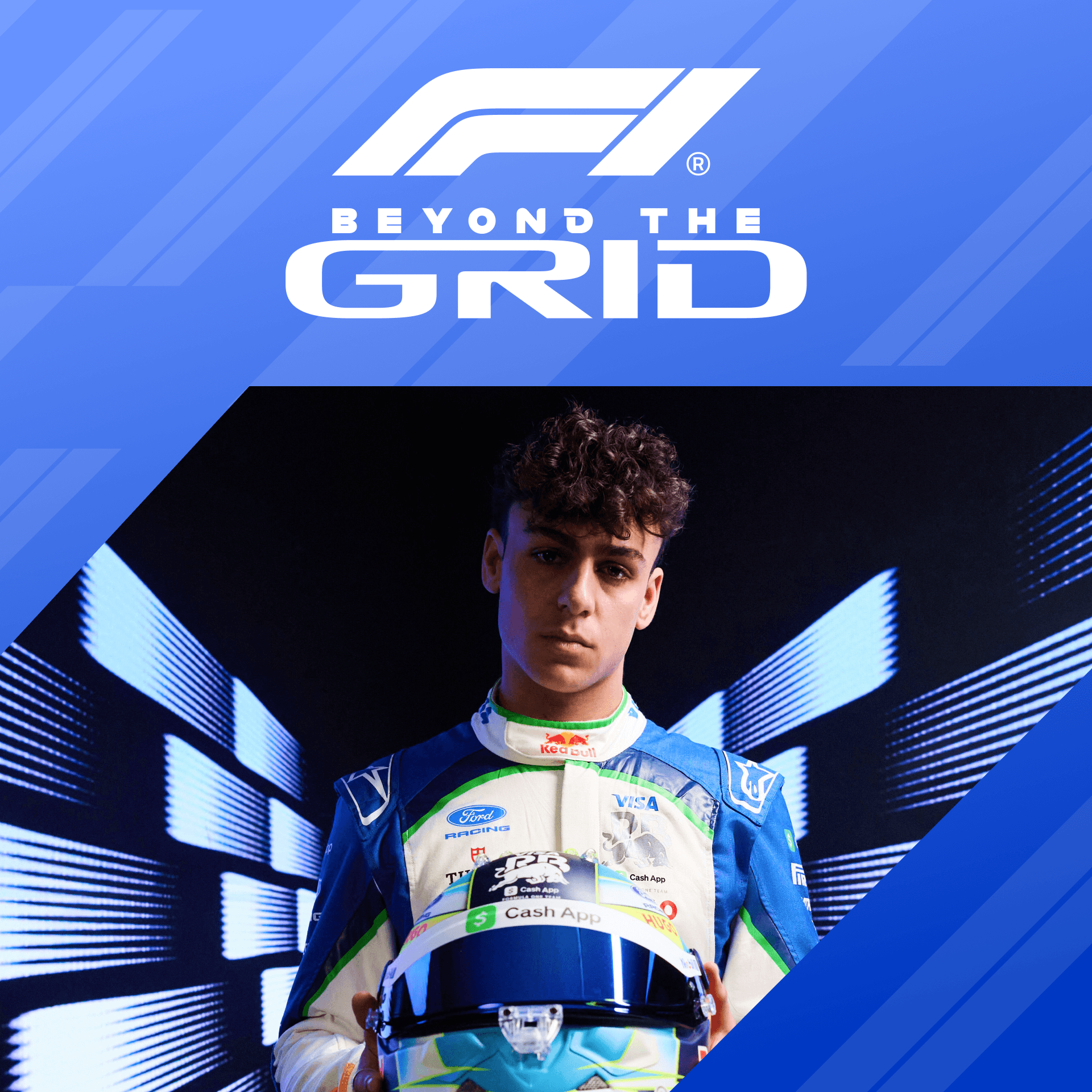
Arvid Lindblad: fast, fresh and fearless
About this episode
Arvid Lindblad reflects on his rapid rise to Formula One, from watching races as a four-year-old to scoring points on debut in Melbourne at 18. He talks through the physical demands of F2 versus F1, the mental side of racing, and how running, sim work and coaching help him prepare. The episode also digs into his family background, early karting days, and the role Oliver Rowland has played as mentor, coach and guide.
Arvid tells Tom Clarkson how he went from watching F1 on TV aged 4 to racing in F1 aged 18, inspired and supported by his family, his coach – the racing driver Olly Rowland – and Helmut Marko, Red Bull’s former Motorsport Advisor. He explains the coaching which helped him beat more experienced drivers as he progressed up the motorsport ladder in ever-faster cars.
Arvid also looks back to his Formula 1 debut in Australia, where he overtook Lewis Hamilton and Lando Norris at the start and scored points at the end, and relives the stunning qualifying lap in Japan which saw him eliminate Max Verstappen.
This episode is sponsored by:
Bitdefender: visit bitdefender.com to learn more about how Bitdefender supports Ferrari to stay ahead of cyber threats and how you can make your digital life safer
Rag&Bone: for a limited time, our listeners get 20% off their entire order with code GRID at Rag-Bone.com
CarGurus: go to cargurus.co.uk for complete vehicle details without any surprises
Cadillac
"[90.1s] Cadillac has entered Formula One, [92.8s] deepening the racing pedigree [94.7s] behind every V-series on the road."
Cadillac is a luxury car brand. They’re talking about their performance “V-series” cars and saying their racing background helps make those cars feel more exciting.
Cadillac is the luxury brand from General Motors, and it’s been building performance-focused “V-series” models for years. In this segment, they’re positioning Cadillac as entering Formula One and tying that racing credibility to their road cars.
Formula One
"[90.1s] Cadillac has entered Formula One, [92.8s] deepening the racing pedigree [94.7s] behind every V-series on the road."
Formula One (F1) is the top tier of open-wheel racing, known for cutting-edge engineering and strict technical rules. When a car brand claims “racing pedigree” from F1, it’s usually a marketing way of saying their technology, development, and performance focus are influenced by motorsport.

Cadillac Lyric
"[103.9s] Experience the quickest Cadillac ever, [106.5s] the all-electric Lyric V, [108.5s] the peak performance of the CT5V Blackwing,"
Cadillac is calling the Lyriq V an all-electric performance car. “V” generally means it’s meant to be quicker and sportier than regular trims.
The Cadillac Lyriq V (spoken here as “Lyric V”) is described as the brand’s all-electric performance model in this segment. The “V” naming is Cadillac’s performance trim family, and “all-electric” signals it’s powered by batteries rather than a traditional internal-combustion engine.
CT5V Blackwing
"[106.5s] the all-electric Lyric V, [108.5s] the peak performance of the CT5V Blackwing, [112.0s] the nimble agility of the OPTIQ V,"
The CT5V Blackwing is Cadillac’s top performance version of the CT5. It’s the “Blackwing” badge that usually means it’s tuned to feel more powerful and more exciting to drive.
The Cadillac CT5V Blackwing is a high-performance variant of the CT5, positioned here as the “peak performance” model. “Blackwing” is Cadillac’s performance sub-brand name, typically associated with more aggressive tuning and track-capable driving dynamics.

OPTIQ V
"[108.5s] the peak performance of the CT5V Blackwing, [112.0s] the nimble agility of the OPTIQ V, [114.5s] and the legendary Roar of the Escalade V,"
The OPTIQ V is a Cadillac model meant to feel quick and easy to handle. The “V” badge usually means it’s tuned for more sporty driving than the regular version.
The Cadillac OPTIQ V is described as “nimble agility,” indicating a smaller, more maneuverable performance-oriented V-series model. In Cadillac’s naming, “V” typically signals sportier tuning compared with standard trims.

Cadillac Escalade
"[112.0s] the nimble agility of the OPTIQ V, [114.5s] and the legendary Roar of the Escalade V, [118.4s] all engineered to thrill."
The Escalade V is a high-performance Escalade SUV. It’s meant to keep the big, luxurious feel but add more punch and sportier driving behavior.
The Cadillac Escalade V is the performance version of the Escalade SUV, referenced here with “legendary Roar.” “V” indicates a higher-performance trim, and the Escalade platform is known for combining luxury with stronger acceleration and sportier calibration.
sitting on the grid
"So remember, sitting on the grid before the race, just like really feeling the moment, you know?"
The grid is where the race cars line up at the start of the event. “Sitting on the grid” means you’re ready to go, waiting for the start lights to turn on.
The “grid” is the starting area where cars line up in their assigned positions before the race begins. “Sitting on the grid” captures the pre-start tension and the moment just before the start lights, when drivers finalize routines and prepare to launch.
lights
"Cars forming into position, and the last car is in place. It will be time to look to the lights."
At the start of an F1 race, there are lights that tell everyone when to go. The driver has to be ready to accelerate right away when the lights change.
In F1, the start is controlled by a set of lights that signal when the race begins. Drivers must be ready to launch immediately when the lights go out, balancing acceleration with traction and avoiding a jump start.
Grand Prix driver
"Arvid Lindblad, the fourth youngest Grand Prix driver in history, showed he belongs on track with the very best."
A Grand Prix driver is an F1 driver. They race in big events around the world and score points over the season.
A “Grand Prix driver” refers to someone who competes in Formula 1’s Grand Prix events. It’s the top level of open-wheel racing, where drivers race for points across a season.
wheel-to-wheel
"In his first race, Arvid jewelled wheel-to-wheel with Lando Norris and Lewis Hamilton. He finished in the points."
Wheel-to-wheel means two cars are racing side-by-side. They’re close enough that the drivers are fighting for the same space on the track.
“Wheel-to-wheel” describes racing side-by-side with the cars very close together, often with minimal margin for error. In F1, it usually means drivers are actively competing for position rather than running in clean air.
first race and early F1 results
"In his first race, Arvid jewelled wheel-to-wheel with Lando Norris and Lewis Hamilton. He finished in the points. On just his third F1 weekend, he outqualified Max Verstappen."
They’re talking about how Arvid did right away in F1—strong qualifying and scoring points early. It’s a quick look at his first results.
This segment highlights Arvid Lindblad’s early F1 milestones: racing wheel-to-wheel in his first race, finishing in the points, and outqualifying Max Verstappen on his third weekend. It’s essentially a “start of career” recap.
outqualified
"On just his third F1 weekend, he outqualified Max Verstappen. In his words,"
Outqualify means one driver was quicker in qualifying than another. That usually helps them start the race closer to the front.
To “outqualify” means a driver sets a faster qualifying lap than another driver, earning a better starting position for the race. In F1, qualifying performance is a strong indicator of one-lap pace and car balance.
Red Bull
"His family, his coach, racing driver Oliver Rowland [263.1s] and Red Bull's former motorsport advisor, Helmut Marco, [266.4s] helped him get there."
Red Bull is a big racing team in Formula 1. They also help behind the scenes with advice and support for drivers and teams.
Red Bull is a major Formula 1 team and motorsport organization. In this context, “Red Bull’s former motorsport advisor” refers to the company’s broader role in driver development and technical/strategy support.
driver development
"And you can really tell how much Arvid's enjoying [268.0s] living his life's ambition. [271.0s] living his life's ambition. [276.7s] How are you?"
Driver development means helping a young driver improve step by step. It can include coaching, advice, and getting the right chances to race and learn.
“Driver development” is the process of building a racing driver’s skills through coaching, mentorship, and access to competitive opportunities. The transcript links this to Arvid Lindblad’s support from people with motorsport experience, showing how talent is shaped beyond just raw driving ability.
tests
"Obviously, it started quite early with, you know, [291.0s] we had three tests already starting in January, [294.0s] so it's been quite intense."
In F1, “tests” are structured on-track sessions used to evaluate car performance, gather data, and refine setup. They’re especially important early in the season when teams are still learning how the car behaves and what changes are needed.
Formula 2 (F2) cars are more physical
"I think people maybe underestimate how physical the F2 cars are as well. It's different... the physical demands between F2 and F1... because so F2 is a car itself... I'd say it's actually more physical..."
They’re saying Formula 2 feels more “work” for your body than Formula 1. Because the car has fewer helpers, you have to push harder on the steering and brakes, so it’s more tiring and requires more physical effort.
The speaker is contrasting how physically demanding Formula 2 (F2) cars can be compared with Formula 1 (F1). With fewer driver aids and heavier steering/braking effort, the driver must use more raw strength and technique, especially in high-speed cornering.
physical demands between F2 and F1
"It's different, you know, what you have to, the physical demands between F2 and F1... because you have... it's really heavy... you almost lose a bit of feeling... it's like just brute force trying to make it turn."
They’re talking about how hard it is to drive the cars in different series. In F2, the driver may have to fight the steering more, which can make it harder to feel the car’s behavior precisely.
This is about how driver workload differs between Formula 2 and Formula 1 due to car setup and driver-assistance levels. The speaker highlights that reduced assistance can lead to “brute force” steering effort and reduced fine “feel” when the driver is fighting the car.
power steering
"So there's no power steering, the brakes much heavier. The pressure on the brake pedal... like there's none, so it's really heavy."
Power steering is what helps you turn the wheel with less effort. If a car has little or no power steering, you have to use more strength to steer, especially at speed.
Power steering uses hydraulic or electric assistance to reduce the driver’s effort when turning the wheel. The speaker notes that in Formula 2 there’s essentially no power steering, which makes steering effort much higher, particularly through fast corners.
brakes much heavier
"So there's no power steering, the brakes much heavier. The pressure on the brake pedal. Yeah, you have to really slam it,"
Heavier brakes means you have to push the brake pedal harder than usual. That changes how you brake and how much strength you need during a race.
“Heavier brakes” means the brake system requires more pedal force to achieve the same deceleration. In high-performance open-wheel cars, this often reflects reduced assistance and different brake hydraulics, so drivers must press harder and manage pedal feel precisely.
Silverstone cornering (F2/F1 cockpit reach)
"So let's imagine cops at Silverstone, very, very quick corner, whatever car you're in. Are you almost having to sort of wedge an elbow against the side of the cockpit in F2? Not so much, because of the shape of the corner,"
They’re imagining what it’s like to drive at Silverstone and how hard you have to work with your arms and body in tight corners. It’s less about the exact racing line and more about the physical challenge.
The hosts use Silverstone as a mental picture to discuss how tight and demanding certain corners are for a driver’s body position. The point is about physical constraints—how much steering force and cockpit geometry can affect where you can place your arms.
turn three Barcelona
"Um, turn three Barcelona. Is that bad? I'd say more like Qatar, does it 12, 13, 14."
They’re talking about a particular corner at Barcelona (turn three) to compare how hard it feels to steer and move your arms. It’s a way to make the driving feel more concrete.
“Turn three Barcelona” refers to a specific corner at the Circuit de Barcelona-Catalunya, used here as a reference point for how difficult it is to physically manage steering and arm position. Corner-by-corner comparisons are common in driver interviews because they describe real, repeatable sensations.
Qatar (turns 12-14)
"I'd say more like Qatar, does it 12, 13, 14. It's, you can't really wedge your arm in, because you're always unwinding, but it's kind of just, you turn,"
They mention Qatar’s later corners to explain which parts of the lap feel most demanding. Different tracks force you to turn in different ways, so the driving workload changes.
The speaker references Qatar’s later turns (12, 13, 14) to describe how steering demands and body positioning change across a lap. This highlights how track layout influences steering angle duration and the physical workload on the driver.
unwinding
"Is that bad? I'd say more like Qatar, does it 12, 13, 14. It's, you can't really wedge your arm in, because you're always unwinding, but it's kind of just, you turn,"
When you’re done turning into a corner, you gradually straighten the steering back out. That’s what “unwinding” means, and it helps the car move more smoothly.
“Unwinding” refers to easing the steering angle back toward center as the car transitions out of a corner. Drivers do this to reduce tire scrub and help the car rotate and accelerate smoothly, especially in high-speed sequences where steering inputs must be precise.
Kuali (driver memory of steering limit)
"and I remember to a point where one lap in Kuali, I knew the car could do it, so I went in a bit quicker, and I just got to a point where I just couldn't physically turn the wheel anymore."
They’re recalling a time at a track (Kuali) when they pushed the car and hit a point where they couldn’t turn the wheel anymore. It shows how intense steering can get when the car is loaded up.
“Kuali” appears to be a circuit reference where the driver recalls reaching a physical steering limit after pushing the car harder. Even without naming the exact track, the key idea is that steering effort and mechanical grip can combine to create a moment where you can’t physically turn the wheel further.
F2 to F1 transition
"I mean, coming from F2, it's easy. I mean, F2, I mean, it was in Kuali for like one lap, it was really hard. Then in the race, it wasn't as extreme as that..."
They’re talking about how racing in Formula 2 prepares you for Formula 1. Some tracks felt much harder than others, and the difficulty didn’t always carry over the same way into the race.
The speaker is describing moving from Formula 2 (F2) to Formula 1 (F1). They note that certain track conditions made the car feel extremely challenging in F2, but that the intensity varied by circuit and race context.
F1 neck strain and downforce
"But then obviously F1, as everyone knows, the neck is a big thing, because the cars are faster, there's more downforce. So the neck's the main thing..."
They’re saying that in Formula 1 the cars push down harder on the track, especially in fast corners. That extra force makes your neck work much harder, so neck strength and endurance matter.
They connect Formula 1’s higher speeds and increased downforce to greater physical load on the driver’s neck. In F1, downforce pushes the driver into the seat more strongly through corners, which can make neck endurance a key performance factor.
cardio and physical training for F1
"but then also the races are longer. So you need to be more just physically fit. So there's more cardio that comes with that."
They’re saying F1 races last longer, so you need more stamina. That means training isn’t just about driving skill—it’s also about being fit enough to handle the whole race.
The speaker links longer Formula 1 race durations to the need for better overall fitness, including cardiovascular endurance. This changes training priorities compared with shorter or less physically demanding racing formats.
Technology makes all the difference in who has a clear advantage
"[576.1s] Technology makes all the difference in who has a clear advantage, [580.4s] where Bitdefender is renowned for driving leading edge innovation in cybersecurity. [586.0s] Bitdefender helps safeguard the data of Ferrari."
The idea here is that today’s racing advantage often comes from technology, not just the engine. Even computer systems and data tools can help teams make better decisions and stay ahead.
This is a general motorsport concept: modern racing performance isn’t only about the car’s mechanical parts, but also about the technology around it (data, communications, and systems). In F1, that can include everything from telemetry and strategy tooling to cybersecurity for connected systems.
Ferrari
"[586.0s] Bitdefender helps safeguard the data of Ferrari. [589.7s] They supercharge the cybersecurity team's ability [592.0s] to swiftly identify and respond to any threat that arises."
Ferrari is a famous racing and car company from Italy. Here, they’re mentioned because their computer systems and data are being protected from cyber threats.
Ferrari is an Italian Formula 1 constructor and road-car brand. In this segment, it’s mentioned as the organization whose data is protected by Bitdefender’s cybersecurity tools.
Bitdefender
"Visit bitdefender.com to learn more about how Bitdefender supports Ferrari to stay ahead of cyber threats"
Bitdefender is a company that helps protect computers and phones from hackers and malware. They’re mentioned here because even racing teams like Ferrari need strong digital security to keep systems safe.
Bitdefender is a cybersecurity company that provides antivirus and threat-protection software. In this segment, it’s mentioned as supporting Ferrari with protection against cyber threats, tying motorsport to modern digital security needs.
cut through the chaos
"When you need the right person to cut through the chaos, this is a job for indeed sponsored jobs."
This phrase is more about attitude than car tech. It means acting decisively when things are hectic, like during a chaotic race moment.
This is a general phrase, but in a motorsport context it echoes the idea of making decisive, confidence-driven moves when conditions are messy—like traffic, safety cars, or close racing. It’s not a technical racing term, but it frames the competitive mindset.
launch
"Hamilton's got a good launch on back corner. About to go wheel-to-wheel."
A “launch” is how strongly a car gets moving at the beginning of a race moment—like right after a corner. If it’s good, the car can pull ahead or set up a pass sooner.
In racing, a “launch” refers to how well a car gets up to speed at the start of a maneuver—often the initial acceleration out of a corner or from a standing start. A good launch can improve your ability to challenge for position immediately.
3-1
"Are we about to go 3-1? Lindblad prices are getting through."
“3-1” sounds like a quick shorthand the commentators are using for how things are lining up. From this snippet alone, it’s not clear whether it’s about positions, gaps, or some other race math.
“3-1” appears to be shorthand for a race position or points/odds-style split, but the exact meaning isn’t fully clear from the excerpt alone. It likely refers to how the field is stacking up as the cars approach a battle for position.
Melbourne (F1)
"When I say Melbourne to you, what springs to mind? The first thing that happens… butterflies already. And Goosebumps just thinking about it."
When they say “Melbourne,” they’re talking about the F1 race weekend in Australia. Drivers often remember it because it’s a special early-season event.
“Melbourne” refers to the Formula One event held in Melbourne, Australia, which is commonly associated with the Australian Grand Prix. The track and weekend atmosphere are often discussed because they’re early-season and can set the tone for a driver’s year.
Q3
"And then obviously the way the weekend went as well, it was Q3, then finishing the points, but even running P3 at one point on lap one,"
In qualifying, drivers get multiple timed sessions. Q3 is the last and most important one, where only the fastest cars from earlier sessions get to fight for the best grid spots.
Q3 is the final segment of Formula 1 qualifying (and similarly structured qualifying in other open-wheel series). Drivers aim to set their fastest lap in the shortest window of track time to secure the best starting position.
lap one
"...but even running P3 at one point on lap one, it was just a pretty magical weekend."
Lap one is the first lap after the cars launch from the grid. It’s usually hectic because everyone is trying to get positions while the tires are still warming up.
“Lap one” is the first full lap after the start, when the field is still sorting itself out. It’s often the most chaotic moment because drivers manage tire grip, traffic, and overtakes right after the race begins.
P3
"...but even running P3 at one point on lap one, it was just a pretty magical weekend."
P3 just means “third place.” If you’re P3 on lap one, you’re near the front almost immediately after the race starts.
P3 means third place in the race classification at that moment. In F1, running P3 on lap one implies the driver gained positions early and was competitive right from the start.
F1
"...sitting on the grid, obviously the grid in F1 is completely different to F2. In F2, there's basically no grid procedure."
F1 is the highest level of open-wheel racing. It has a big, structured race weekend and a very different start-day experience than lower series.
F1 refers to Formula 1, the top tier of open-wheel racing with its own race weekend format, qualifying sessions, and start procedures. The speaker contrasts F1’s grid atmosphere and procedures with F2.
grid procedure
"In F2, there's basically no grid procedure. We never get out the cars, but in F1, the grandstand's completely packed, the music, the vibe, everything's so exciting."
The grid procedure is the official pre-start routine—how the cars line up and what happens as the start approaches. The key point here is that F1 builds more structure and spectacle into that moment than F2.
A “grid procedure” is the formal process cars follow before and during the start—how they line up, when they’re allowed to move, and how the start sequence is managed. The speaker notes that F2 has minimal or no grid procedure, while F1 has a more structured, ceremonial start.
F2
"In F2, there's basically no grid procedure. We never get out the cars, but in F1, the grandstand's completely packed, the music, the vibe,"
F2 is a lower-tier series that helps drivers move up toward F1. The race weekend feels less ceremonial, especially around the grid and start routine.
F2 refers to Formula 2, a feeder series that uses a different race-weekend format and typically a less elaborate grid/start experience than F1. The speaker specifically mentions the lack of a “grid procedure” and that they don’t get out of the cars.
left the car on the grid
"Because the first time in your career that you have left the car on the grid, what did you do?"
Leaving the car on the grid refers to the driver stepping away from their F1 car after it’s positioned for the start. In modern F1, there are strict timing and procedural rules about when drivers must return to the car for the anthem, formation lap, and start.
garage
"We went to the garage, went to the bathroom, had a bit of a sit down, bit of a chill out,"
In F1, the garage is the team’s area near the track where they handle the car and team stuff. It’s a place drivers can go briefly before they have to be back for the next step.
The “garage” in F1 is the team’s working area adjacent to the pit lane where the car is serviced and where team staff manage pre-race routines. It’s also where drivers may go between on-track moments and official ceremonies.
National Anthem
"you have about five minutes before you have to go back for the National Anthem. I remember that quite well."
The National Anthem is a formal ceremony before the race. Drivers have to be in the right place at the right time, so there’s not much freedom to wander around.
The National Anthem is part of the official pre-race ceremony in many countries, and F1 has a structured schedule around it. Drivers must be in the designated positions (often on the grid or podium area) when it happens, which is why the transcript mentions a tight time window.
getting back to the car
"And then I said, yeah, when I got back to the car, I was really chill. And then I was starting just to get ready."
After a big moment, a driver has to quickly switch back into race mode. That means getting ready to drive and follow the exact steps needed to start and race.
In F1, “getting back to the car” usually means transitioning from the emotional/ceremonial moment back into the highly structured pre-race routine. Drivers must quickly reset focus for things like cockpit checks, start procedures, and race strategy execution.
race to do
"I had to sort of calm myself down because, you know, I had a race to do. I don't know, it really hit me that sort of thing, you know, because it's, I don't know, maybe it's hard to relate to."
In racing, you don’t have much time to think—you have to perform right away. Even if something emotional happens, the race schedule keeps moving.
The phrase highlights the time-critical nature of F1 weekends: even emotional moments are followed by immediate performance demands. Between sessions, drivers and teams operate on tight schedules, so mental reset is part of execution.
formation lap
"the formation lap starts, just focused on obviously trying to manage the procedures. It's all quite new with these new cars with the battery."
Before the race really starts, the cars do a “follow-the-leader” lap to get lined up. Drivers use it to make sure they’re ready and that all the race-start steps are done correctly.
A formation lap is the warm-up lap where the cars line up and follow the pace car/leader before the race starts. It’s used to get everyone synchronized and to ensure procedures are followed before the lights go out.
new cars with the battery
"It's all quite new with these new cars with the battery. I luckily did that quite well."
In modern Formula 1, the “battery” refers to the energy storage system used with the hybrid power unit. Drivers and teams manage when and how that stored energy is deployed, which adds new procedures and workload compared with older eras.
grid box
"So I remember I parked in the grid box feeling really cool. Lights start coming on."
The grid box is your exact parking spot on the starting grid. Right before the race starts, you use that space to get ready and make sure everything is set for the lights.
A grid box is the marked starting position on the grid where a driver’s car sits before the race start. Drivers typically use the time in the grid box to complete final checks and be ready for the start sequence when the lights come on.
went for every gap I could find
"And then as soon as the lights went out, [1021.8s] I was just went for every gap I could find"
They mean they tried to slip into any opening between other cars right after the race started. It’s a fast, risky way to move up positions early.
This describes a common racing strategy at the start: looking for small openings (“gaps”) between cars to gain positions quickly. In F1, the first laps are especially chaotic, so drivers must balance aggression with control to avoid contact while still maximizing track position.
P4 / P3 (position)
"And before I knew it, I was in P4. ... I was like, oh my God, I've just, I'm in P3."
“P4” and “P3” mean the driver is running 4th or 3rd in the race at that time. It’s basically their current rank on track.
In Formula 1, “P” refers to your finishing position at that moment in the race (e.g., P4, P3). When the speaker says they were “in P4” and later “in P3,” they mean they climbed to those ranks by gaining places during the race.
opening lap
"It reminded me of Lewis's opening lap in Formula One, Melbourne, 2007. You hadn't even been born at this point, but you know, he was fearless."
The opening lap is the very first lap of the race. It’s when drivers try to gain positions quickly, but they also have to be careful because the tires and track grip are still coming up to speed.
In Formula One, the opening lap is the first lap after the start, when positions are often made or lost quickly. Drivers look for early gaps in traffic and must manage tire temperature and grip while pushing hard.
around the outside
"He went around the outside of Fernando Alonso, his guarantee made at the time."
“Around the outside” means passing a car by going wide through a corner instead of taking the inside line. It can be bold because you need enough space and grip to make it work.
“Around the outside” describes an overtaking move where a driver passes on the outer line of a corner, typically with later braking and a wider arc. It’s high-risk because traction and space are limited, but it can work when the inside line is defended.
gaps
"And just seeing you go for those gaps and not be intimidated by the champions that were around you was an extraordinary thing."
A “gap” is an opening between cars where you can try to pass or move over. It’s not just luck—drivers have to judge distance and timing very quickly.
In racing, “gaps” are openings in traffic where a driver can attempt an overtake or position change. Finding gaps requires reading speed differentials, braking zones, and the behavior of cars around you.
winter testing
"What were your expectations going into Melbourne? Because at least it looked like winter testing had gone well."
Winter testing is the pre-season period where F1 teams run cars to develop setups, validate upgrades, and build driver confidence. Results from testing can hint at readiness, but they don’t guarantee performance once qualifying and race conditions arrive.
Bahrain last day of testing
"I remember last day in Bahrain, you had the highest lap count of anybody, I think. You know, did you feel ready?"
They’re referencing a pre-season test in Bahrain. The idea is that on the final day, the driver did a lot of laps, which usually means the car was running well and the team was prepared.
Bahrain is commonly used for pre-season running in Formula One, and the “last day” implies a late-stage check on pace and reliability. The host notes the driver had the highest lap count, which often correlates with preparedness and confidence.
qualifying
"So you feel like you're ready, but you can never say with confidence, never know, until you're in qualifying, until you're in the race and it's really happening."
Qualifying is the session that sets where cars start on the grid for the race. It’s a key moment because it shows how fast the car really is under race-like pressure.
Qualifying in Formula One determines the starting grid for the race, so it’s often where teams learn whether their setup and pace translate to real performance. The segment highlights that readiness can’t be confirmed until qualifying happens.
procedures
"The goals I had coming into the weekend were very focused on myself, doing the basics well, nailing the procedures and just, yeah, getting,"
In racing, “procedures” are the step-by-step habits you do every time you drive. If you do them the same way each session, you make fewer mistakes and stay consistent.
In motorsport, “procedures” are the repeatable routines you follow to prepare for and execute each session—things like setup checks, start routines, and on-track communication. Getting these right reduces mistakes and helps a driver perform consistently while the car and track conditions change.
being fearless
"It was one of them also was, you know, being, I wouldn't say being fearless, but, you know, getting stuck in, you know, and I'd say on that side, I'm quite lucky,"
When people say “fearless” in racing, they usually mean being confident and committed—like braking and turning without hesitating. It’s about controlling nerves so you can drive consistently.
“Fearless” in racing usually means pushing confidence and commitment—turning in decisively, braking firmly, and trusting the car at the limit. It’s less about having no fear and more about managing risk and staying composed when conditions or performance are uncertain.
emotions under control
"And you were able to keep your emotions under control as well. Yeah, I don't know. I feel like I'm not a particularly emotional person when I'm in the car."
In racing, staying calm matters because if you get frustrated you can start making bad decisions. Keeping your emotions in check helps you drive smarter and stay consistent.
Managing emotions is a key performance factor in motorsport because mistakes often come from frustration, overdriving, or reacting to setbacks. Keeping composure helps drivers make better decisions about pace, tire management, and when to push versus when to recover.
Formula E
"This is Oliver Rowland as a reigning Formula E world champion. So he knows his eggs, right? He knows how to drive a car."
Formula E is a racing series where the cars are fully electric. Being a world champion there means the person is an extremely skilled race driver, even though it’s a different series than Formula One.
Formula E is an all-electric open-wheel racing series. When the guest is described as a “reigning Formula E world champion,” it highlights that their coach (Oliver Rowland) has proven success in high-level electric racing, which still requires elite car control and racecraft.
data
"just as another set of eyes and ears really, you know, look at the data with him or make any sort of recommendations"
Here, “data” means the car’s performance information recorded during sessions. Engineers and drivers look at it to figure out what’s working and what needs changing to go faster.
In F1, “data” usually refers to telemetry and performance logs collected from the car during practice and qualifying. A driver and engineer use it to spot patterns—like where time is gained or lost—and to adjust setup and driving approach.
telemetry
"look at the data with him or make any sort of recommendations, if that's the right word."
Telemetry is the car’s live “numbers” from sensors. It helps teams understand exactly what the driver did and how the car behaved, not just what it felt like.
Telemetry is the stream of sensor data from the race car—things like speed, throttle/brake use, steering inputs, and temperatures. It’s crucial in modern F1 because it turns “feel” into measurable evidence for setup and strategy changes.
Premier
"I know Pedro from, because when I was in Premier and he's a really cool guy"
“Premier” sounds like a team or workplace Pedro Matos used to be with. In racing, who you’ve worked with before can affect how well you can help a driver.
“Premier” appears to be a team or organization connected to Pedro Matos’s prior role. In F1, engineers and analysts often move between teams, and their past relationships can shape how they support a driver.
opening three races
"You know, you said you didn't have expectations at any of the opening three races. Did your approach change going into China just a week after Melbourne..."
In Formula 1, the “opening races” are the first events of the season. Drivers and teams are still figuring out how fast they really are, so approaches can be more cautious early on.
The “opening three races” refers to the early portion of an F1 season, when teams and drivers are still learning the car’s behavior and the competitive order. It’s often a period where drivers may take a lower-risk approach while gathering data and confidence.
China
"Did your approach change going into China just a week after Melbourne, having had all that success... It was a new track for me as my first weekend."
“China” means the next Formula 1 race after Melbourne, held at a track the driver hadn’t raced on before. New tracks can feel tough because you don’t yet know the best braking points and lines.
“China” here refers to the Formula 1 Chinese Grand Prix, which is typically held at the Shanghai circuit. The host is discussing how the driver’s mindset and approach changed (or didn’t) when moving from Melbourne to a new track so soon.
confidence in myself
"I would say I had a bit more confidence in myself... Maybe I had a little bit more belief. But honestly, on an approach point of view..."
They’re saying that after doing well early, they felt more confident. In racing, that can change how boldly you push, especially when you’re trying to balance speed with not making mistakes.
The driver describes gaining “confidence” after proving their pace early in the season. In F1, confidence can influence decision-making—how aggressively a driver attacks gaps, manages tires, and chooses risk levels under pressure.
new track for me as my first weekend
"I knew China was going to be a really difficult challenge. It was a new track for me as my first weekend."
A driver’s “first weekend” on a new circuit is when they have limited track-specific knowledge—like braking zones, corner entry/exit behavior, and tire wear patterns. That uncertainty often shapes how they manage risk and confidence during practice and qualifying.
sprint weekend
"Being a sprint weekend, though, it kind of, the format is almost more like Formula Two, isn't it?"
In a sprint weekend, there’s a smaller race before the main Grand Prix. The result helps decide where drivers start on Sunday, so teams have to plan differently and take more chances.
A sprint weekend is an F1 format where a shorter “sprint” race is held on Saturday and influences the starting grid for Sunday’s Grand Prix. It changes strategy and risk levels because drivers can gain grid positions without waiting for the main race.
Formula Two
"the format is almost more like Formula Two, isn't it? It is closer to Formula Two."
Formula Two is a racing series that helps drivers move up toward Formula 1. The speaker is saying the sprint weekend felt similar to how F2 weekends run.
Formula Two (F2) is the FIA’s main feeder series to F1, and its race weekend structure can feel similar to certain F1 formats. When the host says the sprint weekend is “almost more like Formula Two,” they’re comparing how the weekend’s pacing and competitive rhythm feel.
Formula Three
"because F2 and F3 are the same. They're very similar. So yeah, that helped out a little bit, you could say."
Formula Three is a step in the junior racing ladder. The guest is saying that the experience from F2 and F3 is similar enough that it helped him adapt.
Formula Three (F3) is another junior single-seater series below F2 in the FIA ladder. The speaker’s point that “F2 and F3 are the same” is about how similar the cars and weekend routines can feel for drivers coming through the junior ranks.
Japan
"Fast forward to two weeks later. We're now in Japan. Again, the approach is the same, right?"
They’re talking about the next F1 race, which takes place in Japan. The conversation then moves toward what it’s like to drive the track there.
The segment shifts to the Japanese round of the F1 calendar, which is typically associated with a specific circuit and high-speed characteristics. Here, “Japan” is used as a location marker for the next race weekend and the discussion of track familiarity.
Suzuki
"But what about Suzuki? Can I just ask you about the track?"
They bring up “Suzuki” and then immediately talk about the track. That likely means they’re referring to the circuit name/venue in Japan.
“Suzuki” is mentioned right before the host asks about the track, suggesting it’s likely a reference to the Japanese circuit or venue name. In F1 context, this is probably pointing listeners toward the specific track being discussed.
iconic circuit
"How many times have you played it on the F1 game? You know, what was it like to drive such an iconic circuit? It was amazing."
An “iconic circuit” is a famous race track. The guest is saying it was special to drive because of what the track is known for.
An “iconic circuit” is a track that’s widely recognized for its history, layout, and challenge level—often producing memorable racing moments. The guest’s reaction highlights how track character and speed influence driver anticipation and preparation.
high speed
"I mean, I think there's not that many tracks now that are such high speed,"
A “high speed” track is one where cars spend a lot of time going fast through corners. That means setup and driver confidence matter a lot because the car has to feel stable at speed.
“High speed” tracks emphasize sustained cornering speed, aerodynamic efficiency, and stability at speed. Drivers often prepare differently for these circuits because small setup changes can have a bigger effect on confidence and lap time.
subconscious driving
"because everything's happening so quickly and you're so in the zone, you can't think everything's almost subconscious. And it's rare that you do think, but there are, you know, laps that are a bit more,"
At very high speed, you can’t really “think” about every move. With practice, your hands and feet start doing the right things automatically, while your brain mainly watches what’s happening around you.
The speaker describes how, at racing pace, driving inputs become automatic rather than consciously planned. This is often the result of repetition and muscle memory, letting the driver focus on perception and decision-making instead of thinking through every action.
early karting days
"so pure, that it almost reminded me of my early karting days, you know, when you're just driving, you're not thinking you're just sending it, you know, you're just having fun, you're just really, just you and the cart and just going."
Karting is usually how racers start out. It’s where you learn the basics of driving fast—like when to brake and how to steer—before moving up to bigger cars.
Karting is a common grassroots path into motorsport, where drivers learn fundamentals like throttle control, braking points, and racing lines at lower speeds. The speaker connects the feeling of pure, instinctive driving back to those early karting experiences.
Ayrton Senna
"Did I read that you were a Senna fan? You are a Senna fan, Ayrton Senna? Not really. Okay. Where did I read that? I would say I have a massive respect for Ayrton and, you know, obviously what he's done in the sport is unbelievable."
Ayrton Senna was a legendary Formula 1 driver. People admire him not just for winning, but for how fearless and skilled he was, and the way he changed what it meant to race.
Ayrton Senna is one of Formula 1’s most influential drivers, known for exceptional pace, racecraft, and mental toughness. The discussion frames the guest as a fan who respects Senna’s achievements and impact on the sport.
Suzuka
"The only reason I ask about him is I find whenever I'm at Suzuka, it's the one place that I feel the bond between Senna and now is strongest, because the track hasn't changed."
Suzuka Circuit is a famous Formula 1 venue in Japan known for its distinctive layout and high-speed cornering. The speaker highlights it as a place where Senna’s legacy feels especially connected to the present because the track’s character hasn’t changed much.

Acura NSX
"...age on YouTube of Senna driving, I think it's an NSX in his, you know, in his civvies, and he's got......"
The Acura NSX is a sports car made by Honda’s luxury division. It’s designed to be fast and handle well, and it’s known for being a special, high-performance model. If it shows up in a story or video, it’s usually because it’s a recognizable car associated with that era.
The Acura NSX is a mid-engine sports car built by Honda’s luxury brand, known for combining everyday drivability with high-performance handling. It’s often discussed in motorsport and car-history circles because it represents a modern era of Japanese supercar engineering. In a podcast context, it may come up when referencing iconic drivers or memorable footage where the NSX appears in non-racing settings.
heel and towing
"You watch him stabbing at the throttle and heel and towing, which I guess you haven't had to do in your career."
This is a driving technique used when slowing down for a corner. The driver uses the brake and a quick throttle blip at the same time so the car doesn’t jerk when changing gears.
“Heel and towing” appears to refer to heel-and-toe downshifting, a technique where the driver uses the heel on the brake and the toe to blip the throttle. The goal is to match engine speed to the gearbox so the car rotates smoothly and avoids upsetting the balance under braking.
quality lap
"But look, final thing on Suzuka is that quality lap. Everyone in the team said it was an absolute, it was a giant of a lap."
A “quality lap” in racing is a lap that’s not just fast, but executed cleanly—hitting the right lines, maintaining traction, and carrying momentum. Teams often use this term to describe a lap that proves the car and driver are working at peak performance, even if conditions make absolute speed harder.
Q2
"That's the one I'm referring to, you know, it put Max Verstappen out in Q2."
F1 qualifying is split into parts (Q1, Q2, Q3). Q2 is the middle part, and if you’re not fast enough by the cutoff time, you get eliminated and won’t race in the final part.
In Formula 1 qualifying, Q2 is the second segment of the session. Drivers who are slower than the cutoff are eliminated and do not advance to Q3, so being “out in Q2” means you didn’t make the top group for the final shootout.
FP1 / FP2 / FP3
"FP1 went okay, but then I missed all of FP2 with an issue. I'd missed a good chunk of FP3."
F1 weekends have practice sessions before qualifying. FP1/FP2/FP3 are times to test the car and get comfortable with the track so you’re ready to qualify.
FP1, FP2, and FP3 are the three practice sessions in an F1 race weekend. They’re used to learn the car’s setup, understand tire behavior, and build track confidence before qualifying.
commitment
"so you need a lot of commitment, which means you need confidence. You need laps to build that confidence."
“Commitment” means you fully trust your line and your braking/turn-in and go for it. On a fast track, hesitation costs time and can make the car feel unstable.
In racing, “commitment” means committing fully to the racing line and braking/turn-in points, especially in fast corners. On a track like Suzuka, that commitment is tied to confidence built from practice laps and consistent car behavior.
cutoff
"looking on the timesheet, seeing I was about four tenths off the cutoff."
In qualifying, there’s a time limit that decides who moves on. If you’re a little slower than that limit, you get knocked out even if you did a good lap.
The qualifying “cutoff” is the lap-time threshold that determines which drivers advance to the next session. If you’re “four tenths off the cutoff,” you’re close but still not fast enough to progress, which adds pressure to find time in limited attempts.
low fuel
"the last lap on low fuel, I'm just going to send it and just go have some fun..."
Low fuel means the car has less weight because it’s carrying less gas. That usually helps the car feel quicker and easier to drive fast for a lap.
“Low fuel” means the car is running with less fuel than earlier in the session, reducing weight and improving acceleration and braking. In qualifying, teams use fuel strategies so the driver can push hardest during the lightest-fuel laps.
yellow flag
"And same in China with the yellow flag coming out. I didn't feel like I got that one lap where I could just switch off my brain..."
A yellow flag means there’s something unsafe on the track. Drivers have to slow down and be careful, which can mess up their best lap in qualifying.
A yellow flag warns drivers that there’s danger on track, so they must reduce speed and be prepared for obstacles. It can ruin a qualifying lap because it disrupts the driver’s rhythm and lap timing, and it often forces a lift or slower corner entry.
four tenths
"I sort of hooked up well. And where did you find that four tenths? It was a bit everywhere."
“Four tenths” is 0.4 seconds, which is a lot in racing. In qualifying, even tiny improvements can add up to a big time gap.
“Four tenths” means four tenths of a second (0.4s), a large margin in F1 qualifying where laps are often decided by fractions. When a driver asks “where did you find that,” they’re discussing how small improvements across multiple corners add up.
sector one
"there was a good chunk in sector one, there's probably two tenths in sector one. But then..."
The lap is split into sections called sectors, and timing is measured separately for each one. If someone finds time in sector one, they’re driving that first part of the lap faster than before.
F1 tracks are divided into timing sectors, and drivers are measured on how fast they are through each sector. Finding “two tenths” in sector one means they gained a significant chunk of time early in the lap, even if other parts were less strong.
hairpin
"there was a bit in, in the hairpin and 11, a bit more in 13, 14..."
A hairpin is a very tight corner where you slow down a lot. It’s tricky because you have to brake hard and then accelerate out cleanly.
A hairpin is a very tight, slow corner that typically demands strong braking, precise turn-in, and good traction on exit. In qualifying, hairpins are often where drivers can lose (or gain) time because small errors are magnified at low speed.
tires overheat
"it's a double apex, the tires overheat, all this kind of stuff, just got that spot on."
Tires can get too hot, and when they do, they don’t grip as well. That can make the car feel harder to drive fast and can ruin lap time.
“Tires overheat” refers to the tire temperature rising beyond the ideal operating window, which can reduce grip and make the car feel inconsistent. In F1, drivers and teams manage this through driving style, brake points, and tire management so performance doesn’t fall off mid-lap.
double apex
"which is not easy there because, you know, it's a double apex, the tires overheat..."
A double apex is a cornering line where you touch the inside twice—once earlier and once later. It helps you carry speed, but it’s harder because you have to place the car perfectly.
A double-apex cornering line means the driver reaches the apex, then moves out slightly, and hits a second apex later in the corner. It’s used to manage speed and traction, but it can be difficult because it requires very consistent car balance and tire grip.
straight
"So, I had lots of energy for the straight. So, I gained a little bit more on the straight, even though I was quicker in the corner as well."
A straight is the part of the track where you’re mostly accelerating. If you exit the previous corner faster, you carry more speed down the straight and can gain time.
The straight is where the car’s top speed and acceleration matter most, and where small differences in corner exit speed compound into larger time gaps. The speaker notes gaining on the straight even while being quicker in the corner, highlighting how exit speed and traction feed directly into straight-line performance.
Lasher Cane
"I mean, I remember coming into the lasher cane and I think at this point, I was half second up on the dash... That was all in the lasher cane. I was like, just don't mess it up, just nail it."
This sounds like the name of a particular corner on the track. Drivers talk about it because each corner has its own braking point and line, and that’s where time gains usually come from.
“Lasher Cane” appears to be a specific corner/section of the circuit being referenced for braking and exit timing. In lap analysis, naming a corner like this helps pinpoint where the driver gained or lost time (e.g., entry speed, braking point, and curb usage).
Delta
"But then, yeah, I don't know. I just broke late, got the curb nicely and Delta went up to like six and a half tenths. And then I crossed the line."
“Delta” is the time difference shown on the driver’s timing screen versus a reference lap (often the current best lap or another benchmark). When the delta “went up,” it indicates the driver’s lap timing improved relative to that reference, typically due to better braking, cornering, or exit speed.
broke late
"But then, yeah, I don't know. I just broke late, got the curb nicely and Delta went up to like six and a half tenths."
“Broke late” means you brake later than normal, closer to the corner. That can make you faster, but it’s risky—if you brake too late, you can lose grip or miss the corner.
“Broke late” means braking closer to the corner than usual, which can reduce the time spent slowing down and allow a sharper turn-in. It’s a common performance technique, but it demands confidence because braking too late can lock up tires or force the car to run wide.
curb
"But then, yeah, I don't know. I just broke late, got the curb nicely and Delta went up to like six and a half tenths."
A curb is the raised edge at the side of the track. Drivers try to use it to help the car turn in and exit faster, but you have to do it smoothly so the car doesn’t bounce or lose grip.
Using a curb correctly means placing the tires on the raised edge (or just brushing it) to tighten the racing line and improve corner exit. “Got the curb nicely” suggests the driver maintained control and didn’t upset the car’s balance while using the track edge to gain time.
Arvid Lindblad
"The rookie driver, 18 years of age. Arvid Lindblad knocks out the four-time champ. An almighty shock at a circuit for Stappen has made his own."
This part is about Arvid Lindblad and his performance—how he drove the lap and what it meant for qualifying.
This segment centers on Arvid Lindblad’s qualifying/performance and how he handled key moments on track. It’s a driver-focused discussion tied to lap timing, corner execution, and advancing into Q3.
neutral car
"You know, you said the team gave you a really good car. I guess every racing driver wants a neutral car."
A neutral car is one that feels balanced in corners. It doesn’t feel like it’s pushing outward or sliding the back around, so it’s easier to drive fast consistently.
A “neutral” car is one that balances front and rear grip so it neither pushes wide (understeer) nor snaps the rear around (oversteer). In F1 terms, it usually means predictable rotation and consistent behavior as fuel load, tire wear, and track conditions change.
oversteer
"I would say I'm probably more on the oversteer than the understeer side. I don't really like understeer."
Oversteer is when the back of the car feels like it slides outward in a turn. Some drivers like it because it can help the car rotate and turn in quicker, but if it’s too much the car can get hard to control.
Oversteer is when a car’s rear end wants to step out more than the front, making the car rotate into the corner. Drivers often prefer a certain amount of oversteer because it can help the car turn in and change direction faster—though too much can make it unstable.
Request an Explanation
Heard something you'd like explained? We'll add it to this episode.
Sign in to request explanations for terms you heard.
Want to learn more?
Browse our glossary for plain-English explanations of automotive terms, jargon, and concepts.
Help improve this episode
See something that's not quite right? Our annotations are AI-generated and can sometimes miss the mark. Click the flag icon on any annotation to suggest a correction.