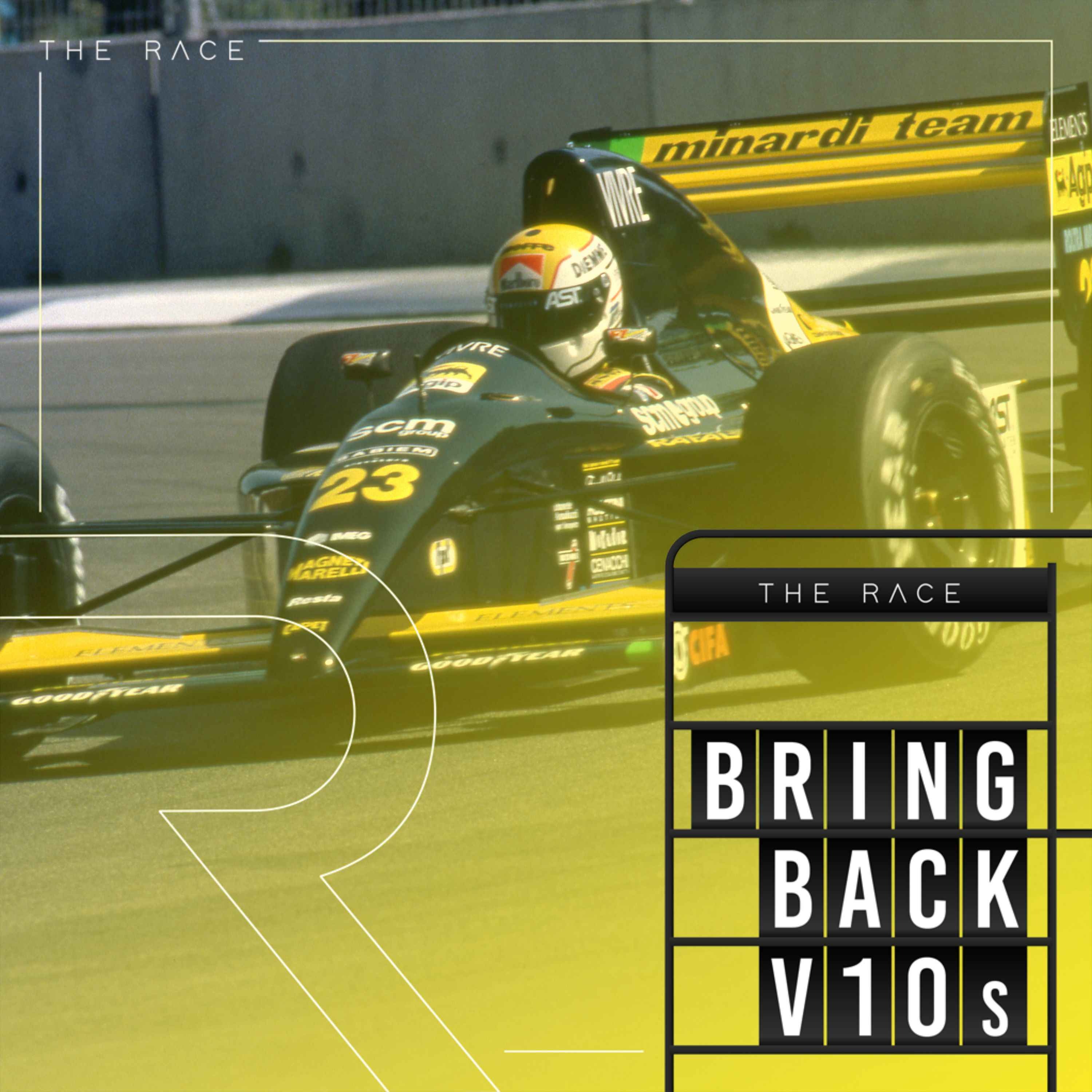
Bring Back V10s: The cult heroes who helped shape F1's V10 era
About this episode
A panel of F1 writers and hosts tackle the “bring back V10s” idea—borrowing a Premier League “cult heroes” social trend—to celebrate drivers who defined the V10 era through memorable moments, not dominance. Gwen Freeman is joined by Ed Straw, Ben Anderson, and Matt Beer, who explain the rules: each person picks two “cult” V10-era drivers without sharing lists ahead of time. Matt kicks off with Jarno Trulli, praised for the “Trulli train,” chaotic highs and lows, and a career that lingered through good and bad machinery.
Bring Back V10s celebrates some key names from F1's V10 era who aren't necessarily remembered purely for their outright achievements behind the wheel.
Before Season 13 draws to a close, we decided to borrow English football's 'Barclaysmen' social media trend, picking out drivers who made a memorable impression on the V10 era without ever really being considered in the top echelon of drivers.
Glenn Freeman, Edd Straw, Matt Beer and Ben Anderson all did their best to grapple with the concept, and got to pick two drivers each. But we didn't share our choices beforehand, meaning everybody needed to bring back-ups.
So get ready for a nostalgic chat about occasional race winners, plucky backmarkers, unlikely title contenders, nomadic journeymen, and - somehow - even an F1 world champion!
Get bonus F1 podcasts, extra content and ad-free listening, sign-up to The Race Members' Club on Patreon today.
Hosted on Acast. See acast.com/privacy for more information.
V10 era
"So my criteria to start with was I spent most of F1's V10 era waiting for people to be good... For me, V10's is spending a decade knowing that Michael Schumacher was the best, but waiting for people to challenge him."
In Formula 1, the “V10 era” means the time when the main race engines had 10 cylinders in a V shape. The hosts are talking about that whole period and how hard it was for other drivers to beat the top guy.
“V10 era” refers to the period in Formula 1 when the sport’s top-level engines were V10s (10 cylinders arranged in a V shape). In this segment, the hosts frame it as a decade-long backdrop for driver rivalries—especially around Michael Schumacher’s dominance and the lack of consistent challengers.
Michael Schumacher
"For me, V10's is spending a decade knowing that Michael Schumacher was the best, but waiting for people to challenge him."
Michael Schumacher is one of the greatest Formula 1 drivers ever. In this discussion, he’s treated as the top standard that everyone else had to beat during the V10 years.
Michael Schumacher is the most dominant driver associated with the V10 era, and the host uses him as the benchmark for why the period felt like it needed a real challenger. The segment’s framing is that Schumacher was “the best,” while others struggled to consistently match him.
Yanno Trulli
"And then there were people who I put a lot of faith into as a teenager. And for me, they are the V10's men. So I'm going to start with Yanno Trulli... I convinced myself... that the 99 Prost was actually a turning point for Prost and spent a lot of that season waiting for Trulli to do something really good in that car..."
Jarno Trulli is a Formula 1 driver the host thinks deserved more credit in the V10 years. They talk about how he seemed like he could challenge the very best, but also how his results were often disappointing.
Jarno Trulli (spoken here as “Yanno Trulli”) is discussed as a “V10’s man” because the host believed he had the potential to become a real Schumacher threat. The segment connects Trulli’s early promise to specific teams and moments—like his debut with Prost and later his move to Jordan—while also criticizing how often he didn’t deliver consistently.
qualifying performance
"I put great faith in his man, you call qualifying performance on his debut in the Prost, stepping in for Olivia Panes, before realizing that that was a really good Saturday."
Qualifying performance in F1 refers to how fast a driver is in the timed qualifying session, which determines starting position for the race. The host uses it to argue that Trulli’s debut showed promise—because strong qualifying often translates into better race opportunities.
Prost
"you call qualifying performance on his debut in the Prost, stepping in for Olivia Panes... I convinced myself... that the 99 Prost was actually a turning point for Prost"
Prost is the Formula 1 team name. When the host says Trulli drove a “Prost,” they mean he was racing in a car built and run by that team, which affects how competitive he could be.
Prost is the Formula 1 team name the host associates with Trulli’s debut and later seasons. In this segment, “Prost” is used as the constructor/team context for the car Trulli drove (including references like “the 99 Prost”), which matters because team performance and car development strongly affect results.
stepping in
"you call qualifying performance on his debut in the Prost, stepping in for Olivia Panes, before realizing that that was a really good Saturday."
In F1, “stepping in” typically means a driver temporarily replaces another driver—often due to injury, illness, or availability. Here, the host says Trulli stepped in for another driver at Prost, which is relevant because it explains how Trulli got an opportunity to show his pace.
Yarno Trulli
"Oh, yeah, yeah, Yarno Trulli definitely came into my consideration. He's on my very long, long list... So, yeah, I approve of Trulli because Trulli's the one who you'll hit on various little moments where it was great."
Yarno Trulli is a famous Formula 1 driver from Italy. The hosts are talking about why he matters to the V10 era—he could be great at qualifying, but he wasn’t always consistently at the front in races.
Yarno Trulli is an Italian Formula 1 driver who raced during the V10 era and became known for a mix of strong qualifying and inconsistent race weekends. In this segment, the hosts discuss why he’s included in a “Bring Back V10s” conversation and reference his reputation for moments of brilliance rather than a consistently dominant season.
Trulli train
"You have the Trulli train as well, which of course is another good element for it. That's effectively, it's sort of seen as being famous for being a bit bad..."
“Trulli train” is a nickname fans used for a recurring on-track situation involving Yarno Trulli. It basically means other cars ended up bunched up behind him, like a little procession, instead of everyone spreading out.
“Trulli train” is a fan/insider nickname for a pattern associated with Yarno Trulli: when he’s running in a way that leads to a chain of cars following him closely rather than breaking away cleanly. The hosts treat it as a culturally recognizable moment from his F1 time, tied to how unpredictable his race execution could be.
letting downness
"And yeah, the word that Matt came with, that letting downness, was that the word you coined? Letty Downey. Letty Downey. He was Letty Downey, but Letty Downey while being good enough to actually be genuine, you're good in that narrow window when everything was great."
“Letting downness” is a made-up phrase the hosts use to describe a driver who can be good, but not always deliver the big results you’d expect. They’re using it to explain why Trulli could look great at times but not always stay consistently dominant.
“Letting downness” (as coined/used here) is a descriptive label for a perceived pattern in a driver’s results: being “good enough” to be genuinely competitive, but not delivering consistently at the very top. In this segment, it’s applied to Trulli as a way to explain why he could have standout qualifying but sometimes fail to convert that into consistently great race outcomes.
Monaco
"I can't remember which one it might, but I feel like it might have been around a Monaco, kind of mid 2000s kind of time. Ben, any thoughts?"
Monaco is the famous F1 race held on very narrow city streets. It’s known for being tricky and for making qualifying especially important.
Monaco refers to the Monaco Grand Prix weekend, famous for tight streets, low average speeds, and a high premium on qualifying and driver precision. The hosts mention “around a Monaco” as a time marker for when Trulli’s haircut was in the news.
V10s era
"particularly in the early part of the V10s era, sort of single-handedly dragging that team to results sometimes."
“V10s era” means the time in Formula 1 when most of the cars used V10 engines. People talk about it because the engines had a very distinctive feel and sound, and it influenced how the cars drove.
The “V10s era” refers to the period in Formula 1 when the dominant engine configuration was a V10. That era is remembered for a distinctive engine sound and character, and it shaped how cars behaved and how drivers were evaluated.
Minardi
"Yeah, having those kind of memorable little high points as a, as a Minardi driver, you know, is the sort of thing that will come up in conversation between us."
Minardi was a Formula 1 team that usually didn’t have the best car. When a driver did well in a Minardi, it stood out because they were fighting with fewer resources than the top teams.
Minardi was an F1 team known for operating at the back of the grid for much of its existence. Drivers who did well in a Minardi were often seen as “cult heroes” because they extracted strong results from limited resources.
Estaril
"Oh, he led a lap, Estaril. Ed, I've got to throw to you next because, I mean, Ben had barely finished saying Pierre Luigi Martini."
“Estaril” sounds like Estoril, a race track in Portugal. The hosts mention it because it’s where Martini did something notable—like leading a lap.
“Estaril” is almost certainly a mishearing of Estoril, the Portuguese circuit used for Formula 1 events. It’s referenced here in the context of Martini “leading a lap,” which would be a standout moment for a backmarker driver.
Pierre Luigi Martini
"Oh, he led a lap, Estaril. Ed, I've got to throw to you next because, I mean, Ben had barely finished saying Pierre Luigi Martini."
Pierre Luigi Martini was a Formula 1 driver from Italy. The hosts are talking about how he managed to do impressive things in a weaker team like Minardi, which made him memorable to fans.
Pierre Luigi Martini is an Italian racing driver best known for his time in Formula 1 with Minardi. In this segment, the hosts highlight his ability to be competitive despite the team’s backmarker status, including a notable qualifying/starting performance.
front row
"And I remember when Pierre Luigi Martini put it on the front row, Phoenix, on those Pirelli tyres."
In F1, the “front row” is where the two fastest cars start the race. If a Minardi driver is on the front row, that’s a huge surprise because they usually start much further back.
“Front row” in Formula 1 means qualifying in the top two positions, so the car starts directly on the front of the grid. For a Minardi driver, putting the car on the front row would be an extraordinary result.
Pirelli
"And I remember when Pierre Luigi Martini put it on the front row, Phoenix, on those Pirelli tyres."
Pirelli makes the tires. In racing, tires matter a lot for grip and speed, so mentioning Pirelli is a way of saying what rubber the car was using when it did well.
Pirelli is the tire manufacturer referenced here, and in F1 the tire choice and performance can strongly affect qualifying and race pace. The hosts are pointing out that Martini’s front-row performance came on Pirelli tires.
B10s
"But, yeah, no doubt Martini was a very, very capable and quick driver. But I think in the B10s here, he got maybe nine points finishes."
“B10s” looks like it should be “V10s,” referring to the V10 engine era in Formula 1. They’re talking about how Martini did during that time.
“B10s” appears to be a transcription error for “V10s,” matching the episode’s theme about the V10 era in Formula 1. The hosts are using it to frame Martini’s results during that period.

Alpina B10
"...very capable and quick driver. But I think in the B10s here, he got maybe nine points finishes. So he's ..."
The Alpina B10 is a luxury sedan that’s tuned for better performance than a standard version. It’s built to feel smooth and comfortable, but still drive quickly. In the podcast, “B10s” likely refers to that car model in relation to racing or results.
The Alpina B10 is a performance-oriented luxury sedan built by Alpina, known for tuning and refining a high-performance platform for strong real-world drivability. It’s the kind of car that can be discussed in motorsport-adjacent conversations because it’s fast and capable, even if it isn’t an F1 car. The podcast reference to “B10s” and points finishes suggests the name is being used to talk about specific race results or a driver’s performance in that context.
led a lap
"was there much more to it other than he led a lap, he qualified in the front row at Phoenix, [957.3s] then vanished, and then he looked all right, but disappeared quite early, really, in the era. ... [1011.0s] what gets over the line for me is the fact that you can go, oh, he led a lap and all we put it"
“Led a lap” means they were in the lead for at least one lap. Even if they didn’t win the whole race, it shows they had the pace to be first for a while.
“Led a lap” means the driver was in first place at some point during a lap, even if they didn’t necessarily win the race. In F1, leading laps is often used as a marker of competitiveness, especially for teams that don’t usually fight for wins.
Phoenix
"was there much more to it other than he led a lap, he qualified in the front row at Phoenix, [957.3s] then vanished, and then he looked all right, but disappeared quite early, really, in the era."
They’re talking about a race weekend in Phoenix. In F1, qualifying determines where you start the race, and starting near the front row is a big advantage.
Phoenix here refers to a Formula 1 qualifying session at Phoenix, which is shorthand for the Phoenix race venue used in the series’ history. In F1, qualifying position (like starting from the front row) is crucial because it heavily influences track position for the race.
car control
"His whole career was in it. He was a driver with enormous car control [1073.1s] without the other connective things to make it all come together and deliver on what he could have"
“Car control” means how well a driver can keep the car stable and pointed correctly while going fast. It’s about making the car behave predictably, especially when the tires don’t have much grip.
“Car control” in motorsport refers to a driver’s ability to manage the car’s balance—throttle, braking, steering, and traction—especially when grip is limited. It’s often what separates a driver who can extract performance from one who can’t, even with similar machinery.
Senna
"to. He did along the way produce a wonderful performance, the Phoenix battle with Senna, [1086.3s] of course, the point on debut."
Senna was one of the greatest Formula 1 drivers ever. The hosts are saying another driver had a famous, exciting fight against Senna that people still remember.
“Senna” refers to Ayrton Senna, a legendary Formula 1 driver known for his speed and racecraft. In this segment, the hosts mention a “Phoenix battle” with Senna, framing it as a memorable rivalry moment from the V10 era.
Bring Back V10s
"[1092.3s] more talks about Bring Back V10s for the race. He should have won the Monza in the Benetton, [1096.9s] Nürburgring 95. So, he does so because everybody will remember him, but he's almost overrated"
This is the main idea of the episode: the hosts are arguing for bringing back V10 engines in F1. They use driver stories to explain what made that time period memorable.
This is the episode’s central theme: a debate about why fans want to see V10 engines return to Formula 1. The segment uses driver stories—missed-win moments, “next big thing” hopes, and Schumacher-era contrast—to argue what made the V10 period special.
Monza
"He should have won the Monza in the Benetton, [1096.9s] Nürburgring 95."
Monza is one of the most famous race tracks in Formula 1, in Italy. Winning there is a big deal because it’s a historic, high-profile race.
Monza is the famous Italian circuit (Autodromo Nazionale Monza) that hosts the Italian Grand Prix. It’s a key venue in F1 history, so “winning Monza” is shorthand for achieving a major, high-pressure victory.
Nürburgring 95
"He should have won the Monza in the Benetton, [1096.9s] Nürburgring 95. So, he does so because everybody will remember him, but he's almost overrated"
This refers to a race at the Nürburgring in 1995. The Nürburgring is a legendary German track, and the “95” is pointing to that specific year.
“Nürburgring 95” points to the Nürburgring race in 1995, a period when F1 cars were still powered by V10 engines. The hosts use it as a specific missed-win reference tied to the V10-era narrative.
John O'Lacy
"Plus, I think if you look at Michael Schumacher and John O'Lacy, [1129.4s] you have the story of the Bring Back V10s era there."
John O’Lacy is being discussed as a driver from the V10-era story the hosts are telling. They’re saying he had talent and exciting moments, but didn’t always turn that into the biggest, most consistent wins.
John O’Lacy is referenced as a driver tied to the “Bring Back V10s” era narrative. The hosts frame him as a “next big thing” who had talent but didn’t fully convert it into consistent top results, and they list memorable moments from his career.
hands at 10 to 2
"but also just that, that driving style, that having the hands at 10 to 2 [1295.0s] on the steering wheel, but that is so emblazoned in my mind as a kid growing up watching everyone"
“Hands at 10 to 2” describes a steering-wheel grip position where the driver’s hands are placed around the 10 o’clock and 2 o’clock marks. In racing commentary, it’s often treated as a recognizable signature because it can reflect a driver’s technique and comfort with steering inputs.
Johnny Herbert
"even at those, I guess the sour years or maybe [1353.8s] his most anonymous bit, and he's managing to sort of falls out with Johnny Herbert along the way"
Johnny Herbert is a former Formula 1 driver. The hosts are using his name to point out that the driver they’re talking about had conflicts and drama with other drivers during his career.
Johnny Herbert is a former Formula 1 driver who raced in the 1990s and early 2000s. Here, the hosts mention him in the context of a rivalry/falling-out with the driver they’re discussing, highlighting how team dynamics and on-track relationships shaped storylines.
John Lacey
"But there's always a reason to talk about John Lacey. There are probably aren't many episodes in where he hasn't appeared in your notes somewhere in research... So yeah, I'll take it. He's part of the tale, isn't he?"
John Lacey is an F1 driver the hosts talk about a lot. They say he was a “throwback” driver who didn’t like newer computer-assisted driving features, and he also stood out with his helmet and visibility choices.
John Lacey is discussed as a key figure in the F1 V10-era story, especially for his driving style and how he related to evolving driver aids. The hosts highlight his resistance to traction control and his early adoption of distinctive safety/visibility gear like the side-exit “headrest” style and a chrome crash helmet trend.
traction control
"He was one of those reigning against traction control. And I think he even refused to drive with it... So that really sticks in my mind..."
Traction control is a computer feature that helps prevent the tires from spinning when you accelerate. It can change how much power the engine delivers so the car keeps grip.
Traction control is an electronic system that reduces wheel spin by cutting engine power and/or adjusting throttle when the tires lose grip. In F1, it became a major part of how cars were driven and tuned, and the hosts contrast drivers who embraced it versus those who resisted it.
wheel slip
"So you do still get some wheel slip because that's the fastest way. So yeah, Lacey couldn't grasp any of that."
Wheel slip is when the tires spin faster than the car is moving forward. The hosts say some slip can actually help you accelerate fastest, as long as it’s controlled.
Wheel slip is when the driven wheels rotate faster than the car is actually moving, meaning the tires are losing grip. The hosts note that Schumacher understood how to manage traction control while still allowing some wheel slip because it can be the fastest way to accelerate.
cockpit sides
"I think he also scores points to me for before high cockpit sides came along, the massive headling out the side of the car."
Cockpit sides are the protective structures around the driver’s seat area. The hosts are saying Lacey was doing something noticeable before those protections became standard.
“Cockpit sides” refers to the side structures around the driver’s cockpit that evolved for safety and protection in modern F1. The hosts mention Lacey scoring points for being ahead of the trend before these prominent side protections became common.
chrome crash helmet trend
"And also really it was kind of the pioneer of the chrome crash helmet trend that happened around the turn of the century."
The chrome crash helmet trend is when F1 drivers started wearing shiny, reflective helmets. The hosts say Lacey was an early adopter and helped make that look popular.
The “chrome crash helmet trend” refers to drivers adopting highly reflective, chrome-finish helmets as a visible style choice in the late 1990s/around the turn of the century. The hosts credit Lacey as one of the first to commit to it, before it spread to other drivers.
put all of his eggs in the McLaren basket
"He then did that classic thing where he put all of his eggs in the McLaren basket for 1994."
It’s an expression meaning he focused almost entirely on one chance instead of pursuing several paths. Here, it describes how Brundle’s hopes were tied to getting into McLaren.
This is a metaphor for committing heavily to one opportunity rather than keeping multiple options open. In the context of the segment, it describes Brundle’s strategy around securing a McLaren drive in 1994.

McLaren
"But then that meant he got to drive for McLaren, one of F1's greatest teams in one of its least successful season or least memorable seasons"
McLaren is a famous Formula 1 racing team. The episode is talking about Martin Brundle finally getting a McLaren seat in 1994, even though that season didn’t go well for the team.
McLaren is one of Formula 1’s most historic teams, known for strong engineering and frequent title contention. In this segment, the focus is on Martin Brundle getting a McLaren drive in 1994, which is tied to the team’s struggles that year.
British Grand Prix
"which of course was where he had the famous moment where his car became ablaze at the start of the British Grand Prix."
The British Grand Prix is one of Formula 1’s traditional races, held in the UK. The segment references a famous moment at the British Grand Prix where Brundle’s car caught fire at the start, making it an iconic piece of F1 history.
Silverstone
"that over like the McLaren blowing up on the grid at Silverstone. It was very hard on his sleeve"
Silverstone is a major F1 race track in the UK. It’s the kind of place where big moments and breakdowns get a lot of attention.
Silverstone is a famous Formula 1 circuit in the UK, known for fast corners and high-speed character. It’s one of the sport’s most important venues, so incidents there are widely remembered.
grid
"that over like the McLaren blowing up on the grid at Silverstone. It was very hard on his sleeve"
In F1, the grid is where cars line up to start the race. If something “blows up on the grid,” it broke before the race could really begin.
In Formula 1, the grid is the starting positions lineup for the race, arranged by qualifying results. When a car “blows up on the grid,” it means it failed before or right as the race was about to start.
podiums
"having got the McLaren drive and done okay with it with some with some good races and some podiums."
A podium finish means the car came in 1st, 2nd, or 3rd. The host is saying Brundle had some strong results like that.
A podium in Formula 1 means finishing in the top three positions of a race. The host mentions Brundle getting podiums, which is a key measure of success in F1.
Nigel Mansell
"Okay, on paper he gets dropped for Nigel Mansell and reality gets dropped for his mate Mark Blundell"
Nigel Mansell is one of the most famous F1 drivers from the UK. The host brings him up because his presence affected who drove which car and when.
Nigel Mansell is a legendary British Formula 1 driver, known for aggressive driving and winning the 1992 World Championship. In this segment, he’s used as the benchmark for why Brundle’s seat situation changed.
Mark Blundell
"Okay, on paper he gets dropped for Nigel Mansell and reality gets dropped for his mate Mark Blundell who wasn't as good as him"
Mark Blundell is an F1 driver who took over a seat in the situation the host is describing. The host thinks Brundle would have done better than Blundell.
Mark Blundell is a former Formula 1 driver who replaced Martin Brundle in the McLaren context discussed here. The host argues Blundell wasn’t as strong as Brundle, affecting expectations for results.
Mercedes engine
"a year of continuity with McLaren and the Mercedes engine that blew up less than the Peugeot might have been quite a decent a decent 95 for Brundle there"
In F1, the engine is the car’s main power unit. The host is saying the Mercedes engine was more reliable than the Peugeot one that year.
In F1, the engine is the power unit supplied to the car, and different engine manufacturers can vary a lot in reliability and performance. Here, the host contrasts the Mercedes engine’s failure rate with the Peugeot engine.
Peugeot
"the Mercedes engine that blew up less than the Peugeot might have been quite a decent a decent 95 for Brundle there"
Peugeot is mentioned here because it supplied engines for some F1 teams. The host is comparing how often those engines failed versus Mercedes.
Peugeot is referenced as an engine supplier in the F1 context, where teams used different power units. The host is using it to compare reliability against Mercedes.
Giancarlo Fisichella
"Now my memory of his 97 commentary I felt at the time like there were a few too many occasions where he wanted to be back in the car a little bit too much. I think Giancarlo Fisichella got quite a rough ride from him at times"
Giancarlo Fisichella is an F1 driver. The host is saying Brundle’s commentary style could be a bit tough on him at times.
Giancarlo Fisichella is an Italian Formula 1 driver who, in this segment, is described as taking a “rough ride” from Brundle during commentary. The host frames it around how Brundle related to Fisichella’s seat situation and personality.
ITV
"there were broadcasters everywhere copying the thing that he and ITV created."
ITV is a TV network in the UK. The hosts are saying that ITV helped create an F1 broadcast style that other broadcasters later copied.
ITV is a UK television network mentioned as part of what the hosts credit with creating a particular F1 broadcast style. Here, they say Brundle and ITV’s approach influenced other broadcasters to copy that format.
Martin Brundle
"I would say if you are new-ish to F1 you probably don't realise how good Martin Brundle was as a commentator and pundit because I think a lot of people are as good as he is now and there's not many times I listen to a commentary and go wow that was super insightful or funny"
Martin Brundle is an ex–Formula 1 driver who became a TV commentator. The hosts are saying he was unusually good at explaining what’s happening on track and making it entertaining, not just reading the race results.
Martin Brundle is a former Formula 1 driver who later became a prominent commentator and pundit. In this segment, the hosts argue he “raised the game” for what a driver-turned-broadcaster should do, blending technical insight with humor and on-track understanding.
driver pundit
"so yeah absolute definite pick on and off track. I didn't actually have Brundle on my consensus list but I should have done. ... he really raised the game for what a driver pundit should be doing"
A “driver pundit” is a broadcaster who’s a former (or current) racing driver and provides analysis on TV or radio. The hosts argue Brundle changed expectations by offering more insightful, driver-like commentary rather than generic race talk.
Ron Dennis
"Ron Dennis doing that old school thing of thinking oh that'll keep you on your toes which was yeah"
Ron Dennis was a major leader in Formula 1, especially connected with McLaren. Here, the hosts are mentioning his management style and how it affected drivers.
Ron Dennis is a well-known Formula 1 team principal, most associated with McLaren. In this segment, he’s referenced for a leadership style—making decisions intended to keep drivers “on their toes.”
Ferrari
"like Fissey Keller turns up in the back of a Ferrari garage or something now like long retired"
Ferrari is a famous Formula 1 team. In this part, it’s just used as the backdrop for an anecdote about people and driver stories.
Ferrari is one of Formula 1’s most prominent teams and a major symbol of the sport’s history. Here it’s referenced as a setting (“Ferrari garage”) to anchor the anecdote about driver chatter and reputations.
Heinz Hald Frenzen
"I am going for for reasons that are to follow I'm going for Heinz Hald Frenzen and my reasons are not just because he was quite good but not a great"
Heinz-Harald Frentzen was a Formula 1 driver in the 1990s. The hosts are saying Williams bet on him, but his time there didn’t go as well as they hoped.
Heinz-Harald Frentzen is a German Formula 1 driver known for his performances in the V10 era. The segment highlights his move into Williams and how the team’s faith in him didn’t match the expectations, contrasting his earlier reputation with his later results.
Damon Hill
"one of the defining things that happened in the v10 era was Damon Hill getting dropped by Williams when he was on his way to winning the world championship"
Damon Hill was a top Formula 1 driver for Williams. The hosts are talking about a controversial moment where Williams replaced him even though he was doing well in the season.
Damon Hill is a British Formula 1 driver who won the World Championship in the Williams V10 era. In this segment, he’s discussed as being dropped by Williams right when he was on track to win the title, which is framed as a key moment in the V10-era storylines.
Williams
"one of the defining things that happened in the v10 era was Damon Hill getting dropped by Williams"
Williams is the storied Formula 1 team that competed at the front during the V10 era. Here, the hosts discuss Williams’ decision to drop Damon Hill and their later “peak” period, tying team strategy and driver choices directly to championship outcomes.
Jordan
"he is he is the only guy who almost managed to fight for a championship for Jordan like the ultimate kind of v10 era team"
Jordan was a Formula 1 team that, in the V10 era, could occasionally challenge for major results despite not being a top-tier powerhouse. The segment frames Jordan as the “ultimate” V10-era team for Frentzen because he nearly fought for a championship with them.
midseason
"he gets a couple years later he's fired midseason by Jordan and he starts rattling around"
“Midseason” means it happened during the racing year, not after it ended. In F1, changing drivers during the year can disrupt how the team works with the car.
“Midseason” in F1 means a driver change (or firing) that happens during the ongoing championship calendar rather than between seasons. Because F1 cars and setups are refined over time, a midseason change often signals instability and can affect results quickly.
journeyman career
"when they're when they die so it becomes a bit of a journeyman career as well so I just feel that"
A “journeyman career” means someone who keeps switching teams. In racing, that can make it harder to get the same level of results because every team has a different car and setup.
A “journeyman career” describes a driver who moves between teams frequently rather than building a long run with one outfit. In F1, that often means adapting to different cars, engineers, and development directions, which can shape how consistently a driver can challenge for wins or titles.
Hungary
"wondering how as a 16 year old I tried to make a case for him being really good and unlucky in lots of races and that case holds up for what Hungary and that's it all your disappointments"
“Hungary” here means the Hungarian Grand Prix race. The hosts are saying that at that event, Frenzen’s results were a letdown compared to what they hoped for.
“Hungary” refers to the Hungarian Grand Prix venue on the F1 calendar, where results can strongly influence championship momentum. The hosts connect Frenzen’s “disappointments” to races in Hungary, implying a specific event where expectations didn’t match outcomes.
coalescing
"it didn't feel like it was him dragging Jordan it felt like the team coalescing into one of those vintage seasons"
Here, “coalescing” just means everything came together. The hosts are saying the team and driver seemed to click as one unit during 1999.
In this F1 context, “coalescing” describes a team and driver aligning into a unified, high-performing unit. The hosts suggest Jordan’s 1999 form “coalesced” around Frentzen, making the season feel like a team story as much as an individual one.
setup things
"with actually often some really detailed insights like he'll talk about setup things or things that weren't working on the cars which I know fans love"
“Setup” is how an F1 car is tuned to match a track and a driver. It can include adjustments to how the car handles and how the tires work.
In F1, “setup” refers to how a car is adjusted to suit a driver and track—things like suspension settings, aerodynamic balance, and tire behavior. When the host says Frentzen talks about “setup things,” they mean technical details about why the car did or didn’t work.
Joss Verstappen
"first up is Ed I'm going to go for Joss Verstappen always a controversial figure but turned up with a huge amount of fanfare got on the front page cover of autosport after that famous footwork test"
Joss Verstappen is a former Formula 1 driver. The hosts talk about him as someone who got a lot of attention early, then had a mixed career with some standout moments.
Joss Verstappen is a former Formula 1 driver known for his time in the sport during the 1990s. In this segment, he’s discussed as a controversial but high-profile figure who had early promise, including a notable “footwork test,” followed by a career described as inconsistent in results.
footwork
"got on the front page cover of autosport after that famous footwork test everyone was very excited"
Footwork is the name of an F1 team. The host mentions a “footwork test” as a big early event that helped put Joss Verstappen in the spotlight.
Footwork is a Formula 1 team name referenced here in connection with a “famous footwork test.” In F1, tests and rookie evaluations can be major moments because they shape early career opportunities and public expectations.
Benetton
"had those two podiums with with Benetton in 94 when he got the outings for Benetton because Lato was was injured"
Benetton is an F1 team. The host is saying Verstappen had strong results with Benetton in 1994, including podiums that happened because another driver was injured.
Benetton is a Formula 1 team/constructor that competed through the 1990s. The segment references Joss Verstappen’s time with Benetton in 1994, including podiums that came after Lato was injured, which ties the driver’s results to team circumstances.
DNFs
"but most of his career after that Benetton disappointment in 94 is just lots of DNFs some finishes rarely in the points"
DNF stands for “did not finish.” It means the driver couldn’t complete the race, often due to a crash or mechanical problem.
DNFs means “Did Not Finish,” a race result where a driver fails to complete the event. In F1 discussions, DNFs are important because they often reflect mechanical problems, crashes, or strategy issues that prevent points-scoring finishes.
Yann Magnuson
"“...he turned up to replace yann madden yann magnuson and basically it's blown the way by rubens...”"
Yann Magnuson is mentioned as the driver who was replaced. The point is that a change like this can open the door for another driver to get a real opportunity.
Yann Magnuson is referenced as the driver being replaced, implying a mid-season driver change. The segment treats it as part of how the driver got a chance and then performed.
Rubens Barrichello
"“...it's blown the way by rubens barrakello and I think if you're a midfield team...”"
Rubens Barrichello is a famous Brazilian F1 driver who raced for many years and scored lots of podiums. Here, he’s mentioned in relation to how a driver’s career played out.
Rubens Barrichello is a Brazilian Formula 1 driver known for long-term competitiveness and many podiums across his career. In this segment, he’s referenced as part of a driver’s career arc and timing of opportunities.
midfield team
"“...if you're a midfield team there's kind of no point because he's probably going to blow more chances than he's going to fulfill but for a back market team...”"
A midfield team is usually good enough to score points, but it’s not regularly battling for wins. They’re often trying to improve steadily rather than taking huge risks.
A “midfield team” is an F1 constructor that typically fights for points but isn’t consistently competing for podiums or wins. The discussion implies that for these teams, taking a chance on a driver who may struggle can be less attractive than for teams further back.
back market team
"“...but for a back market team who has no chance most of the time but might want one really crazy headline he was your guy...”"
This means a team that usually struggles and is near the back of the pack. For teams like that, opportunities for success are rarer, so they may gamble more on drivers.
“Back market team” is a colloquial way of describing a team at the back of the field—one that rarely has a realistic shot at top results. The speaker contrasts this with midfield teams, arguing that lower-tier teams sometimes need to take chances on drivers.
one shot qualifying
"“...it’s that classic thing of something that’s cool it's nice because it's minardi it's the thing everybody hoped would happen at some point in one shot qualifying so exactly what you wanted was that you get kind of the moment...”"
It’s a qualifying format where you don’t get many tries to set your fastest lap. You have to nail it on the one (or very few) chances you get, because conditions can change quickly.
“One shot qualifying” refers to a format where each driver effectively gets a single timed attempt (or a very limited number of attempts) to set their best lap. That makes qualifying more about getting one perfect run—track conditions and timing matter a lot.
pole position
"“...it would almost be too memorable if it was oh yeah remember the minardi one shot pole position but the minardi's being fastest on a friday qualifying him in the first year of one shot...”"
Pole position means you start the race from the very front. It usually comes from being the fastest in qualifying, and it can help you avoid getting stuck in traffic at the start.
Pole position is the starting spot at the very front of the grid, awarded to the driver who qualifies fastest. In F1, it’s a big deal because it reduces traffic risk at the start and can make strategy easier.

Ford Maverick
"...ashion icon throughout his career just a complete maverick personality throughout his time in formula one so..."
The Ford Maverick is a small pickup truck made by Ford. It’s meant for normal daily driving, but it also has a bed for carrying things. In the podcast, the word “maverick” is probably being used to describe a bold or independent personality.
The Ford Maverick is a compact pickup truck designed for everyday driving and practical hauling. It’s often discussed because it represents a more accessible, mainstream approach to the pickup segment, making it a common point of reference when someone talks about a “maverick” personality or theme. In a podcast context, the name is likely being used as a metaphor rather than a deep dive into racing technology.
pay drivers
"…there was this narrative that everyone who was good in form of 3000 was not getting in because pay drivers…"
“Pay drivers” are racers who get a seat partly because they can bring money to the team. That can be controversial because it may mean less money-driven drivers don’t get opportunities.
“Pay drivers” are drivers whose teams sign them partly because they bring money or sponsorship funding, rather than purely because of race results. In F1, this can create controversy because it may block more purely merit-based talent from seats.
Deniz
"…deniz is like the the big bogeyman pay driver of the era in many ways the fact he starts off at a terrible team…"
“Deniz” is the driver the host is talking about in this argument. They’re using his career as an example of how money could affect who got the best F1 opportunities.
“Deniz” here refers to Deniz (Deniz) as a pay-driver figure the host argues was central to the V10-era narrative. The segment frames his career moves as illustrating how funding could influence competitive seats.
outqualified
"…the fact he outqualified damon hill at arrows at both spa and sezuka…"
“Outqualified” means one driver set a faster qualifying lap than another. In F1, that usually means they start the race in a better position.
“Outqualified” means beating another driver in qualifying—setting a faster lap time and therefore starting ahead on the grid. In F1, qualifying performance is often used as a strong indicator of raw pace.
Sezuka
"…the fact he outqualified damon hill at arrows at both spa and sezuka…"
“Sezuka” means Suzuka, a well-known F1 track in Japan. It’s famous for being technical and fast, so qualifying well there matters.
“Sezuka” is the transcript’s phonetic reference to Suzuka, the Japanese circuit known for its distinctive layout and high-speed direction changes. It’s often used to judge how well a car handles under load.
Spa
"…the fact he outqualified damon hill at arrows at both spa and sezuka…"
“Spa” is a famous F1 track in Belgium. It’s known for being twisty and challenging, so doing well there is a good sign of pace.
“Spa” refers to the Belgian Grand Prix circuit at Spa-Francorchamps, a track known for elevation changes and high-speed corners. It’s a frequent benchmark for car balance and driver skill.
Mika Salo
"what is this saying about mikosalo who i had really high hopes for if he ever got a top drive and who did quite well for a bit at some tracks at ferrari..."
Mika Salo was a Finnish Formula 1 driver. The hosts mention him as a driver they thought could have done more if he had the right chance, and they connect that to how people were judged in that time period.
Mika Salo is a Finnish Formula 1 driver who, in the 1990s, drove for Ferrari and was seen as having potential. The segment frames him as someone the hosts expected to break through if he got the right opportunity, linking his career trajectory to the era’s driver-reputation debates.
John Lacy
"what is this saying about john lacy who we all thought could be a world champion and then we're not that surprised now when he's behind pedro deniz on the grid..."
John Lacy is mentioned as someone the hosts thought might have been a world champion. They’re using his career as an example of how the era’s outcomes didn’t line up with what people expected.
John Lacy is referenced here as a driver the hosts believed could have become a world champion. The discussion uses him as an example of how, in the “V10 era” storylines, expectations didn’t always match what happened on track.
Pedro Diniz
"the pedro deniz story arc of encapsulating the worst of the paid driver bogie man and then making you reassess a bunch of people who you thought were good..."
Pedro Diniz was a Formula 1 driver from Brazil. The hosts are talking about how he was viewed by fans and media—sometimes unfairly—as a “pay driver,” and whether his later career changed that opinion.
Pedro Diniz was a Brazilian Formula 1 driver often associated with the “pay driver” stereotype during the 1990s. In this segment, the hosts discuss how his results and reputation fit into a broader narrative about drivers being judged differently depending on who had backing and when they appeared on the grid.
paid driver
"the pedro deniz story arc of encapsulating the worst of the paid driver bogie man and then making you reassess..."
A “paid driver” is a Formula 1 driver who secures a seat partly (or primarily) through bringing sponsorship money rather than purely through results. The hosts use the term as part of a critique of how money-backed drivers were perceived and how that perception affected how fans ranked other drivers.
V10z era
"just plays into the v10z era storylines for me adding the fact he started out in an atrocious ugly very yellow 40..."
“V10z era” is the hosts’ way of talking about the time in Formula 1 when the cars had V10 engines. They’re using it to set up the episode’s theme and to talk about how people’s careers and reputations turned out.
“V10z era” appears to be the hosts’ stylized way of referring to the V10-engine period in F1, tying it to the episode’s theme of “bring back V10s.” In context, it’s used to describe how the era’s engine character and the drivers’ outcomes created memorable (and sometimes disappointing) storylines.
roll hoop
"even no burgering 99 makes a contribution to by having his roll hoop ripped off in that terrifying and bizarre shunt..."
A “roll hoop” is a safety bar/structure on the car meant to protect the driver if the car flips or crashes hard. The hosts mention it being torn off to show how violent the accident was.
A “roll hoop” is a protective structure on an F1 car designed to help prevent the driver from being crushed in a rollover or heavy impact. The segment mentions it being ripped off in a crash, highlighting the severity of the shunt and the car’s safety hardware being stressed.
shunt
"roll hoop ripped off in that terrifying and bizarre shunt yeah somehow not washing his own head..."
A “shunt” just means a sudden crash or impact. The hosts are using it to describe a violent accident in that season.
In motorsport, a “shunt” is a sudden collision or impact, often involving a car being struck or hitting something abruptly. Here it’s used to describe a terrifying crash where safety components were damaged.
Tarso Marquez
"period i mean ed you'll be big fans of drivers like tarso marquez and matzakani and stuff that were just there too briefly you know the the money runs out or the team is not in good enough shape"
Tarso Marquez is a driver name the hosts bring up while talking about how some drivers only get short runs in F1. They’re using him as an example of how money and team situation can limit opportunities.
Tarso Marquez is mentioned as one of the drivers the hosts associate with brief appearances and the financial realities of F1 seats. The point is less about technical detail and more about how driver careers can be shaped by team stability and funding.
Matzakani
"period i mean ed you'll be big fans of drivers like tarso marquez and matzakani and stuff that were just there too briefly you know the the money runs out or the team is not in good enough shape"
Matzakani is another driver name the hosts mention. They’re using it to illustrate that some drivers don’t stay long because the team’s finances or competitiveness aren’t strong enough.
Matzakani is mentioned alongside other drivers as someone who appeared briefly in F1. The hosts connect these short stints to funding and team competitiveness rather than to a specific technical story.
big manufacturer period
"but yeah deniz did do it he was like and also i suppose he did it in that area where formula is starting to move towards the big manufacturer period so there's you're picking off a few of these independents that are like not able to do those deals"
The “big manufacturer period” means a time when big car companies got more involved in F1. That changed which teams could afford top drivers and how seats were offered.
The “big manufacturer period” refers to an era when major car makers (manufacturers) became heavily involved in F1, shaping team resources and driver recruitment. The hosts argue this shift reduced opportunities for some independents and changed how drivers were valued.
Ricardo Rosset
"this you mentioned tato markets i think it's not tato markets even ricardo rosset as well they sort of flipped it because you look at their like from the 3000 record and go no they should get in on merit and then they get there and it's like oh no they're crap they're pay drivers"
Ricardo Rosset is brought up in a debate about how drivers are chosen for F1 seats. The hosts are basically saying that some drivers looked like they deserved a chance, but then didn’t live up to expectations once they were there.
Ricardo Rosset is cited as part of a comparison about whether drivers “get in on merit” versus being “pay drivers.” The hosts argue that some drivers’ reputations changed once they were in F1, affecting how fans and teams judged them.
helmet designs
"he also had a quite fun helmet with an arrow on with arrows on it so he had direction instructions [3896.8s] as well which i quite enjoyed you know there were lots of good helmet designs or striking helmet [3903.5s] designs in this era but deniz certainly had one of those memorable crash helmet design"
In Formula 1, the helmet isn’t just for protection—it’s also how drivers show their style. The hosts are talking about how some helmet designs were so recognizable you could tell who it belonged to.
In F1, a driver’s helmet is more than safety gear—it’s also a personal branding canvas with distinctive graphics. This segment specifically discusses how certain helmet designs were memorable and identifiable at a glance.
Pedro de la Rosa
"matt went for jano trilley and pedro deniz [3925.9s] ben went for uh pierluigi martini and jack villner of bar era yeah okay"
Pedro de la Rosa is a former Formula 1 driver from Spain. The hosts mention him here as someone they want to include when talking about the V10 era.
Pedro de la Rosa is a Spanish Formula 1 driver who’s often associated with the sport’s earlier eras and development roles. In this segment, he’s listed as one of the hosts’ chosen “cult heroes” for the V10-era theme.
Request an Explanation
Heard something you'd like explained? We'll add it to this episode.
Sign in to request explanations for terms you heard.
Want to learn more?
Browse our glossary for plain-English explanations of automotive terms, jargon, and concepts.
Help improve this episode
See something that's not quite right? Our annotations are AI-generated and can sometimes miss the mark. Click the flag icon on any annotation to suggest a correction.