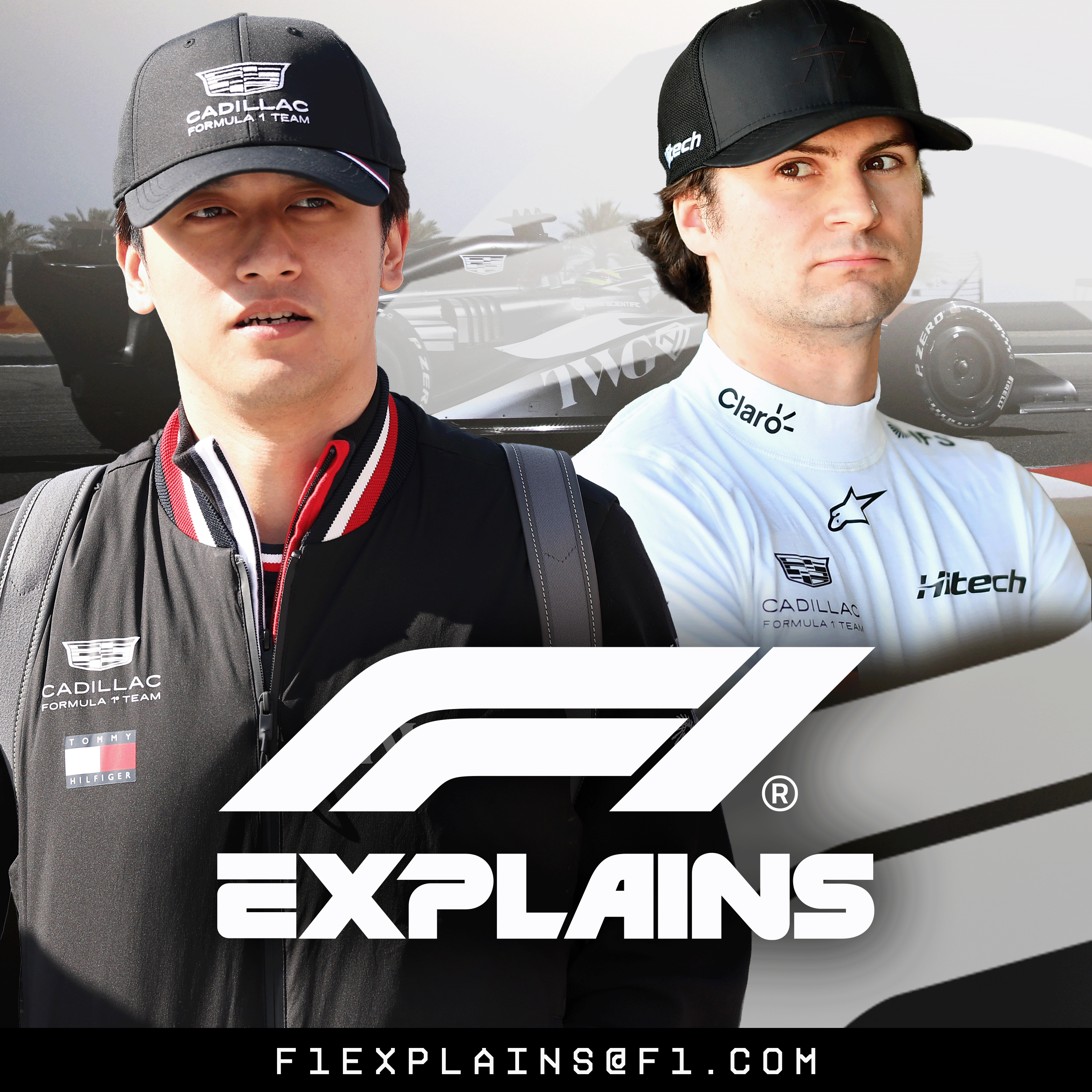
Cadillac’s Colton Herta + Zhou Guanyu live in Miami
About this episode
Colton Herta and Zhou Guanyu join the hosts on Miami Beach to talk through Cadillac’s first home Grand Prix, the challenge of building a Formula 1 team from scratch, and what their different driver roles involve. They also compare F2, F1, and IndyCar preparation, dig into simulator limits, and explain how reserve drivers stay race-ready. The conversation closes on the physical grind of hot weekends, recovery routines, and a light beachside cameo from a fan’s dog.
What’s the difference between a ‘Test Driver’ and a ‘Reserve Driver’? Well, who better to answer that than Cadillac Test Driver Colton Herta and Reserve Driver Zhou Guanyu?
Colton and Zhou join Christian Hewgill ahead of Cadillac’s first home race in Miami to answer your questions about Formula 1.
How does F2 compare to Colton’s previous career in IndyCar? What’s it like working with Valtteri Bottas and Sergio Perez? Who replaces a driver if they are injured or ill? How close is simulator performance to the real car? And why do drivers sometimes plunge themselves into ice baths after a race?
Miami Grand Prix
"...about an hour from the circuit where the Grand Prix will be this weekend, because for the first ever time at the Miami Grand Prix, we have also taken over a big chunk of the beach for the official Fan Fest."
The Miami Grand Prix is the Formula 1 race weekend in Miami. This episode is happening nearby and mentions the Fan Fest too.
The Miami Grand Prix is the Formula 1 race event being discussed, including its location and the weekend schedule. The episode also ties it to the Fan Fest on Miami Beach.
Cadillac
"...is where we are going to be doing this week's episode of F1 Explains with some special guests from Cadillac, their test and reserve drivers Colton Herter and Joe Granieu."
Cadillac is a car brand that’s involved with the racing program. In this episode, they’re connected to the drivers who are there as test and reserve drivers.
Cadillac is the automaker sponsoring and supporting drivers in this F1-related context. Here, it’s specifically tied to their test and reserve driver program and the drivers attending the Miami event.
test and reserve drivers
"...with some special guests from Cadillac, their test and reserve drivers Colton Herter and Joe Granieu."
A test and reserve driver is like a backup and helper for the team. They practice and support development, and they can replace a main driver if needed.
A test and reserve driver is an alternate who helps the team with development work (testing, simulator/track evaluation) and can step in if a main driver can’t race. They’re often highly skilled and may get opportunities depending on circumstances.
Formula 2
"...Colton is an IndyCar winner who is racing in Formula 2 this season, hoping to get enough super license points to one day be able to get himself on to the Formula 1 grid."
Formula 2 is a stepping-stone series that helps drivers earn their way to Formula 1. It’s where many future F1 drivers race before getting a chance in F1.
Formula 2 (F2) is the main “feeder” series for Formula 1, designed to develop drivers and prepare them for F1 competition. The episode frames Colton Herta’s current season in F2 as part of his route to the F1 grid.
super license points
"...Colton Herter and Joe Granieu. Joe is of course a Formula 1 veteran of several seasons racing with the Sauber Alfa Romeo team and Colton is an IndyCar winner who is racing in Formula 2 this season, hoping to get enough super license points to one day be able to get himself on to the Formula 1 grid."
To race in Formula 1, drivers need special permission called a Super Licence. They earn it by scoring points in other racing series first.
In Formula 1, drivers need a Super Licence to race, and they earn it by collecting Super Licence points from recognized feeder series. The points system controls who can graduate to the F1 grid.
Formula 1 grid
"...hoping to get enough super license points to one day be able to get himself on to the Formula 1 grid."
The Formula 1 grid is the group of drivers who are allowed to race in F1. Colton’s goal is to earn a spot there.
The “F1 grid” is the starting lineup for a Formula 1 race, and by extension it means being accepted to race in Formula 1. The episode uses it to describe Colton Herta’s goal of reaching F1.
Miami Beach Fan Fest
"...to put your questions to them right here at the Miami Beach Fan Fest. Guys, we've got a full on TV show style set here..."
This is a fan event in Miami Beach connected to the racing weekend. It’s where drivers come out to meet fans and answer questions.
Miami Beach Fan Fest is the fan event where supporters gather around the racing weekend. In this segment, it’s where the hosts bring drivers on stage to answer questions.
sector one
"Yeah, I mean the track is absolutely, you know, it's a great track with a lot of hard sections, especially sector one or that, but then you know, but then you know, we're building and making the track get better..."
Racetracks are split into a few sections so teams can measure performance lap-by-lap. “Sector one” just means the first timed part of the track.
A track is often divided into sections called sectors. Sector one is the first timed portion of the lap, and it’s where drivers can set up the rest of their lap with braking and corner entry choices.
Formula One
"...and of course Formula One is the way to go. Oh, absolutely. Right, Colton, you..."
Formula One is the highest level of open-wheel racing in the world. It’s the main racing series fans come for at events like this.
Formula One (F1) is the top tier of open-wheel racing, featuring teams, constructors, and drivers competing on purpose-built race cars. In this segment, it’s referenced as the main event driving the weekend’s excitement.
IndyCar
"...especially inside the race car. We do a lot of racing in IndyCar in Florida, obviously, and so I have that experience..."
IndyCar is a big open-wheel racing series based mainly in the United States. The driver is saying they’ve raced there before, so Miami’s similar racing environment feels familiar.
IndyCar is a major American open-wheel racing series. The speaker mentions racing in IndyCar in Florida, which helps explain their familiarity with the conditions and circuits in that region.
F2 race
"...it wasn't something that was on my bingo card this year that we're going to be able to have an F2 race in the States, so I'm excited for it."
F2 is a racing series that acts like a stepping stone toward Formula One. The driver is happy they get to race there in Miami.
F2 usually refers to Formula 2, the feeder series that supports Formula One weekends. The speaker is excited that a Formula 2 race is being held in the United States this year.
Homestead Miami
"IndyCar used to race at Homestead Miami down south. I've raced there a couple of times in junior series..."
Homestead Miami is a race track near Miami that has hosted major racing events. The guest is saying they’ve raced there before, just not in this specific Miami event.
Homestead Miami refers to the racing venue in the Miami area that has hosted IndyCar events in the past. The speaker notes that IndyCar used to race there, and they’ve competed there in junior categories.
F2
"Colton, you mentioned that you didn't expect to be racing F2 in America this year... It's going to be an F2 race this weekend."
F2 refers to Formula 2, a feeder series for drivers aiming to reach Formula One. The segment discusses racing an F2 weekend in America and what the first F2 experience was like.
feature race
"And P7 in the feature race, an up and down weekend elsewhere, but it must have been a challenge to adjust from IndyCar."
In Formula 2, the weekend typically includes multiple races, including a “feature race” (the main race) and a shorter sprint race. The segment references finishing P7 in the feature race, which is the more significant result of the weekend.
rubber gets put down
"As far as how rubber gets put down, there's not a huge track evolution through the weekend. So maybe the car might feel a little bit more on top of the track and sliding a little bit more,"
When lots of cars drive on the track, they leave rubber behind. That rubber usually makes the surface stickier, so the tires can grip better.
“Rubber gets put down” refers to tire rubber transferring onto the racing line as cars run. That rubber typically increases grip and changes tire behavior, which is why teams watch how quickly the track improves.
track evolution
"As far as how rubber gets put down, there's not a huge track evolution through the weekend. So maybe the car might feel a little bit more on top of the track and sliding a little bit more,"
Track evolution means the track gets better (or sometimes worse) during the weekend. As cars drive on it, rubber builds up and the surface can become grippier, changing how the cars handle.
In Formula 1, “track evolution” is how the circuit changes over a race weekend as rubber is laid down and conditions shift. More rubber usually increases grip, which can make the car feel more predictable as sessions progress.
FP2
"But then when you finish your FP1 to FP2, it reset back to zero. So yeah, you need to adapt your car, your setup, due to that."
FP2 is the second practice session. Teams use it to keep adjusting the car and to see how changes in the track affect grip and handling.
FP2 is the second free practice session, typically later in the weekend schedule. Like FP1, it’s used for setup work, but teams also reassess after changes in track condition and rubbering-in.
setup
"So yeah, you need to adapt your car, your setup, due to that. So it's a challenging and one and also is how much comfortable you are in this high-speed assist because there's no room for error."
A setup is how the team adjusts the car to match the track. If the track grip changes, they tweak the car so it drives predictably again.
A “setup” is the car’s configuration—adjustments to things like suspension, wing angles, tire pressures, and balance—tailored to the track and conditions. In Miami’s variable grip, teams may need to change setup between sessions to stay consistent.
high-speed assist
"So it's a challenging and one and also is how much comfortable you are in this high-speed assist because there's no room for error. You know, you're going there with such a high speed and then with a little error with the surface, you just go straight into the world basically."
High-speed assist is anything that helps the car stay stable when you’re going very fast. The discussion is basically saying that at those speeds, you can’t afford mistakes because the car can get out of shape quickly.
“High-speed assist” refers to driver aids and/or aerodynamic/vehicle assistance that help stability at high speeds. The key point here is that at Miami speeds, small errors can be unforgiving, so the car’s behavior under assistance matters a lot.
relayed the circuit
"I remember the second year they'd relayed the circuit and it was dusty because they'd relayed it. I was in the pit lane for FP1 and the cars go out on the track and there's these plumes of dust"
“Relayed the circuit” means the track surface was resurfaced or relaid with new material. New or dusty resurfacing can temporarily reduce grip and change how tires build rubber, which affects car setup and driving confidence.
plumes of dust
"I was in the pit lane for FP1 and the cars go out on the track and there's these plumes of dust from where the circuit has been relayed. I was just a sweaty mess covered in dust"
Plumes of dust are clouds of dust the cars throw up. Dust on the track can make it harder for tires to grip, so the car may feel unpredictable.
“Plumes of dust” describes visible dust kicked up when cars run on a freshly resurfaced or dusty track. Dust can reduce effective tire grip and make the car feel less consistent, especially early in sessions.
wash a little bit of the track
"But the track, do they clean that every evening to make sure they wash a little bit of the track, just to clear off the dust to help us when we start the session."
They clean the track a bit before practice. The goal is to remove dust so the tires can grip better when cars start the session.
Washing the track is a procedure to reduce dust and debris before sessions. Less dust generally improves tire grip and helps the circuit behave more consistently when teams start running.
grip
"So it's not so dusty, which is just improving for the grip. It's very important. But then, besides from that, it is something quite special about Miami"
Grip is how well the tires can stick to the road. More grip usually means the car turns and stops more confidently instead of sliding.
“Grip” is how much traction the tires have against the track surface. Higher grip means the car can brake, turn, and accelerate with less sliding, which is especially critical when the surface is slippery or dusty.
simulator
"Everything's starting from scratch, and then you try to build up your team, build up your facility, build up your simulator, your factory, your wind tunnel, your cars, you know, just all these little things really matter."
A simulator is like an advanced driving computer system. It helps the team test how the car might behave and helps the driver practice and improve without using the real race car every time.
In F1, a simulator is a high-fidelity driving and vehicle-performance tool used to help drivers and engineers understand car behavior. It supports setup decisions and development work without needing to run the car on track every time.
cars
"...your simulator, your factory, your wind tunnel, your cars, you know, just all these little things really matter."
In this context, “cars” means the special race cars built for Formula One. They’re not like normal road cars—teams constantly adjust and improve them for each race.
In F1, “the cars” refers to the purpose-built single-seat race cars that teams design and continuously update. Their performance depends heavily on aerodynamics, power unit integration, chassis setup, and tire behavior.
wind tunnel
"...build up your facility, build up your simulator, your factory, your wind tunnel, your cars, you know, just all these little things really matter."
A wind tunnel is a lab where air is blown over the car parts to see how they affect speed and grip. F1 teams use it to improve how the car “cuts through” air and how much it sticks to the track.
A wind tunnel is used to study aerodynamic forces by pushing air over a scale model or full-size components. In F1, it helps teams refine downforce and drag by testing wing and body shapes under controlled airflow.
arrow packaged
"...we are making sure the ability is well, we're finishing the race, and we're improving, we're getting our arrow packaged improving."
This sounds like they’re talking about the car’s aerodynamic setup—basically the wing and body shape choices. Improving that package can make the car grip better and go faster.
“Arrow packaged” is almost certainly a transcription of “aero packaged,” meaning the aerodynamic package (wings, bodywork, and related aero components) is being improved. In F1, aero packaging changes how the car generates downforce and drag, which directly affects lap times and stability.
FP1
"First of which is in Barcelona, I understand. How excited are you to get out there into a Formula One car? ... I presume it was in an FP1 session."
FP1 is the first practice session during an F1 weekend. It’s when teams and drivers test the car and learn the track before qualifying and the race.
FP1 means “Free Practice 1,” the first on-track practice session of an F1 race weekend. Teams use it to gather data, check car setup, and help drivers get comfortable with the circuit and conditions.
Pirelli tire testing
"... right after I'm done with that, we got Joe in the, in the car for two days for Pirelli tire testing."
Pirelli is the tire supplier in F1, and tire testing is when they check how their tires perform. It helps them and the teams learn what the tires are like in real driving.
Pirelli tire testing refers to sessions where the tire manufacturer evaluates tire behavior and performance. In F1, these tests help teams and Pirelli understand how tires work across different conditions and car setups.
Spielberg
"... Fernando Alonso when I was having the first FP1 in 2021 in Spielberg."
Spielberg is where the Red Bull Ring race track is in Austria. It’s a real F1 circuit, and the track layout can make practice sessions a big deal.
Spielberg is the location of the Red Bull Ring, an F1 circuit in Austria. The track is known for its fast corners and elevation changes, which can make early practice sessions especially important for setup.
test drivers
"Hannah says, I would love to learn more about the differences between reserve drivers and test drivers. Are there any rules about those roles? So Joe, your title is reserve driver. Colton,"
A test driver helps the team by evaluating the car and new parts. They may do special sessions to see how changes affect speed and handling.
A test driver is a driver focused on development work—helping the team evaluate updates, run test programs, and sometimes do tire testing. In F1, test work can include track sessions and structured evaluation of car performance.
brand new chassis and floor
"...we introduced this brand new chassis and floor and the car. So we've been working together in that way..."
The chassis is basically the car’s main frame. The floor is the bottom part that helps the car stick to the track by shaping airflow—so changing both is a big deal for how the car drives.
In F1, the chassis is the car’s main structural base, and the floor is the underside panel that shapes airflow to generate downforce. A “brand new chassis and floor” usually signals a major aerodynamic and performance reset for the team, affecting balance, grip, and how the car responds to steering and throttle.
Valtteri Bottas
"Although I think since you last worked together, he's become this social media sensation. Is he always filming things and that sort of thing? He's become such a viral superstar, Valtteri Bottas."
Valtteri Bottas is the driver being talked about. They mention that he’s very active online and that fans seem to like seeing his life off the track too.
Valtteri Bottas is discussed as a driver who has become especially visible online, described as a “viral superstar.” The conversation uses him to explain how driver personalities and off-track activities can influence team culture and fan engagement.
reserved driver
"Well, normally it's the reserved driver, because for a reserved driver, you have to have a super license. And then that's why the team always need a reserved driver for their, for their like team. And also there's some reserved"
A reserved driver is basically the team’s backup. If the main driver can’t race because of injury or illness, the reserved driver can take over. They’re chosen ahead of time so the team has a qualified replacement ready.
In Formula 1, a reserved driver is an officially registered backup who can step in if a race driver is injured or sick. They’re part of a team’s contingency plan and are expected to be ready to drive at short notice.
step in last minute
"And we've seen loads of examples in recent years in Formula One, drivers having to step in last minute. Nick Holkenberg gained a bit of a reputation at one point for it, stepping in on a few occasions."
Sometimes a driver can’t race, and a backup driver has to take over quickly. The team needs that person ready so they can jump in and drive the car with minimal disruption.
“Stepping in last minute” refers to a reserve or alternate driver replacing a race driver due to illness, injury, or other unforeseen issues. In F1, teams must be ready to swap drivers quickly while still meeting session and car-prep requirements.
FP ones
"the most important thing for me is the on track time that you get and, and doing the FP ones, that's where, as a driver, I think you could be most helpful towards the team."
FP stands for practice sessions during the race weekend. Drivers use these sessions to test the car and get comfortable with the track before the important qualifying and race.
“FP” refers to Formula One practice sessions (Free Practice). The transcript’s “FP ones” points to the early practice runs where drivers gather data, test setups, and learn the track so the team can prepare for qualifying and the race.
permanent road courses
"Yeah, and, and no, it's, it's pretty straightforward when you're doing the prep for, for the permanent road courses."
A permanent road course is a real race track that’s built for racing. It’s not a regular city street setup, so it stays the same more often and is easier to prepare for.
A permanent road course is a track built specifically for racing, with fixed track layout and facilities, unlike temporary street circuits. Drivers can prepare more consistently because the track surface and layout are stable from year to year.
ovals
"Obviously there's less prep on ovals now this year."
Ovals are race tracks shaped like an oval. They usually involve mostly turning one direction at high speed, so driving style and car setup habits can be different from road courses.
Ovals are oval-shaped circuits where cars run mostly left turns at high speed, often with different aerodynamic and tire demands than road courses. Drivers coming from oval-heavy series (like IndyCar) typically have to adjust technique when moving to more braking-heavy, multi-direction road courses.
G force
"...just because you don't really get this G force feeling, you don't get this fear or this issue on your mind..."
G-force is how hard the car is pushing you during driving—like when you brake hard or take a fast corner. It’s measured in “G,” where 1G is basically the force of gravity.
“G force” is the acceleration a driver feels relative to gravity, especially during hard cornering, braking, and acceleration. Higher G-forces increase physical load and can affect grip, braking performance, and how close a driver is to the car’s limits.
cockpit
"...the exactly same cockpit, same seat, same pedals, same steering wheel. So, we just get used to that."
The cockpit is where the driver sits and controls the car. If the simulator matches the real car’s seat and controls, it’s easier to drive the same way on race day.
The cockpit is the driver’s working area inside the car, including the seating position and controls layout. Keeping the cockpit consistent between simulator and real car helps drivers transfer muscle memory for steering, pedal placement, and sightlines.
race weekend
"So, the driver get to a race weekend like Miami, we're ready. We know what's happening and then if there's something change, emergency, we are there for that."
A race weekend is the whole event leading up to the race—practice, qualifying, and then the race. Teams use the time to adjust the car and be ready for anything that changes.
A race weekend is the full multi-day event around a Grand Prix, including practice sessions, qualifying, and the race itself. Drivers and teams use it to fine-tune setup and respond to changes like track conditions or technical issues.
resetting your session
"[1466.6s] that's differently simulated because you can try to set up driving a little bit over the limit [1471.6s] because you knew if there's something happen, you're resetting your will, you know, [1475.7s] you're resetting your session, you can go again, so that's the biggest difference, but then,"
If you crash in a simulator, you can usually restart right away and try again. In real racing, a crash can cost a lot more time and damage, so you’re more cautious.
In racing practice, a crash or incident can end a run and require restarting—often with a new session or attempt. The discussion highlights that in simulators you can “reset” quickly, which changes how drivers explore the car’s limits compared to real life.
track time
"[1517.4s] but for the most part, you know, it's such an important tool because not only is it, [1523.1s] you know, impossible to really get track time outside of F1 weekends, it's so expensive if you [1528.0s] do. So, you know, having a tool that's relatively cheap compared to the real thing is super important."
Track time just means how long you get to drive on the real race track. Outside of race weekends, it’s hard and expensive to get much of it, so teams rely more on simulators.
“Track time” is the actual driving time on a race circuit. In F1, getting track time outside official race weekends is extremely limited, so simulators become a major substitute for practice and development.
data
"[1551.0s] are race drivers or when we are, let's say, after the race weekend, we're always trying to get back [1557.0s] on the sim, so we're making sure we get the right feedback, the right data, we're carrying exactly"
“Data” means the numbers and measurements the team collects while driving. It helps engineers understand what’s happening and improve the car and simulator.
Here, “data” refers to the measurable information teams collect from the car and driver inputs during simulation and testing. Drivers feed back what they felt so engineers can align the simulator and car setup with reality.
telemetries
"...look similar on the telemetries compared to real life. And also, you know, we can understand a little bit, what's the difference on the track?"
Telemetry is basically the car’s “data log” from a lap. By comparing it between the simulator and the real car, teams can tell if the driving is truly the same.
Telemetry is the stream of recorded car data (like speed, throttle/brake use, and steering inputs) during a run. Comparing telemetry from the simulator to real laps helps teams see whether the driver is repeating the same driving behavior.
laser scan track
"...Is there something we need to change on the laser scan track? So, yeah, there's all these little details..."
A “laser scan track” refers to using laser-based surveying to capture a circuit’s precise geometry—curbs, banking, and surface details. Teams use that data to improve simulation accuracy and reduce the gap between sim driving and real driving.
ice baths
"Tommy says, why do drivers take ice baths after races? ... Colton, how are you with the ice bath? ... the big part of that is to lower the core temp."
After a race, drivers get very hot inside the car. An ice bath helps cool them down fast so they can feel better and recover sooner for what comes next.
Ice baths are a post-race recovery practice where drivers sit in very cold water to bring their body temperature down quickly. In F1, that matters because drivers are overheated from the hot cockpit and heavy clothing, especially in humid or hot races.
core temp
"...the big part of that is to lower the core temp. You know, your internal body temperature is so hot inside the race car..."
Core temperature is your body’s internal heat level. Lowering it helps you cool down more effectively after the race.
“Core temp” means the temperature of the body’s internal organs and deep tissues, not just skin temperature. Lowering core temperature helps drivers recover faster after being cooked in the cockpit.
muscle recovery
"And Joe, the science behind it is it helps with muscle recovery, doesn't it? So it helps you drivers recover quicker?"
After racing, your muscles are tired and need time to bounce back. Cooling down helps the body recover faster so you’re ready for what happens next.
Muscle recovery refers to how quickly the body returns to a ready state after intense physical work. The hosts connect ice baths to recovery timing so drivers can handle the next demands of the race weekend (media and team activities).
home Grand Prix
"Well, thank you very much to Cadillac on a massively busy first ever home Grand Prix and to Colton and Joe. We're back on the beach."
A “home Grand Prix” just means a race that feels special because it’s close to where someone is from or where they’re based. They’re calling Miami a big home event for the people they’re talking to.
A “home Grand Prix” is the race where a driver/team is being treated as local or representing their home country/region. In this segment, it’s used to describe the Miami event as a major milestone for the guests and their connections.
Ferrari
"Does he want to win? Who does he want to win? Yeah. Oh, just Charles Leclerc, obviously. Ferrari."
Ferrari is a famous racing team in Formula One. In this segment, they mention it because Charles Leclerc drives for Ferrari.
Ferrari is a Formula One constructor/team and one of the sport’s most famous brands. Here, it’s mentioned because the guest’s dog is a fan of Charles Leclerc, who drives for Ferrari.
Charles Leclerc
"Who does he want to win? Yeah. Oh, just Charles Leclerc, obviously. Ferrari."
Charles Leclerc is a Formula One driver. They’re joking that the dog’s favorite driver is Charles Leclerc.
Charles Leclerc is a current/major Formula One driver known for driving for Ferrari. The segment uses him as a reference point for the dog’s favorite driver.
Request an Explanation
Heard something you'd like explained? We'll add it to this episode.
Sign in to request explanations for terms you heard.
Want to learn more?
Browse our glossary for plain-English explanations of automotive terms, jargon, and concepts.
Help improve this episode
See something that's not quite right? Our annotations are AI-generated and can sometimes miss the mark. Click the flag icon on any annotation to suggest a correction.