
CarCast+Edmunds - Rivian R2, Lexus RX Plug-in Hybrid, Lexus ES EV, BMW M3 EV concept and more.
About this episode
Rivian R2 takes center stage as the hosts frame it as a smaller, more accessible EV than the R1S/R1T—priced around “60 grand” at launch, with first-drive notes from California. They dig into cost-cutting (air suspension and a center-console Bluetooth speaker) and efficiency trade-offs, from aerodynamics to range targets. The conversation widens to Lexus plug-in and EV plans, Hyundai Ioniq 9 tech, and BMW’s next M3 concept—plus Edmunds’ real-world vs EPA testing perspective and Tesla FSD behavior.
Follow @motorator
Follow @weaveroncars
Follow Bravago Beverages
Hosted by Simplecast, an AdsWizz company. See pcm.adswizz.com for information about our collection and use of personal data for advertising.

Rivian R1S
"Improvements over the larger SUV and truck, the R1S, the R1T. ... And then the R1S is very big. It's a three row and it's also very expensive, 70, 80 grand upwards."
The Rivian R1S is Rivian’s bigger electric SUV with three rows of seats. The host says it costs a lot more and is much larger than the R2, which is why the R2 is meant to appeal to more people.
The Rivian R1S is Rivian’s larger, three-row electric SUV, and the host uses it as the baseline for what the R2 improves on. Here it’s characterized as bigger and more expensive (70–80 grand and up), with the R2 positioned as the more accessible option.

Rivian R1T
"Improvements over the larger SUV and truck, the R1S, the R1T. But you went down to the design studio..."
The Rivian R1T is Rivian’s electric pickup. The host brings it up to explain that the R2 is aimed at people who like Rivian but don’t want a truck or a very large vehicle.
The Rivian R1T is Rivian’s electric pickup truck, mentioned here alongside the R1S as the “larger” vehicles the R2 is meant to improve upon. The segment contrasts the R2’s accessibility with the idea that some people wanted Rivian but didn’t want a truck.
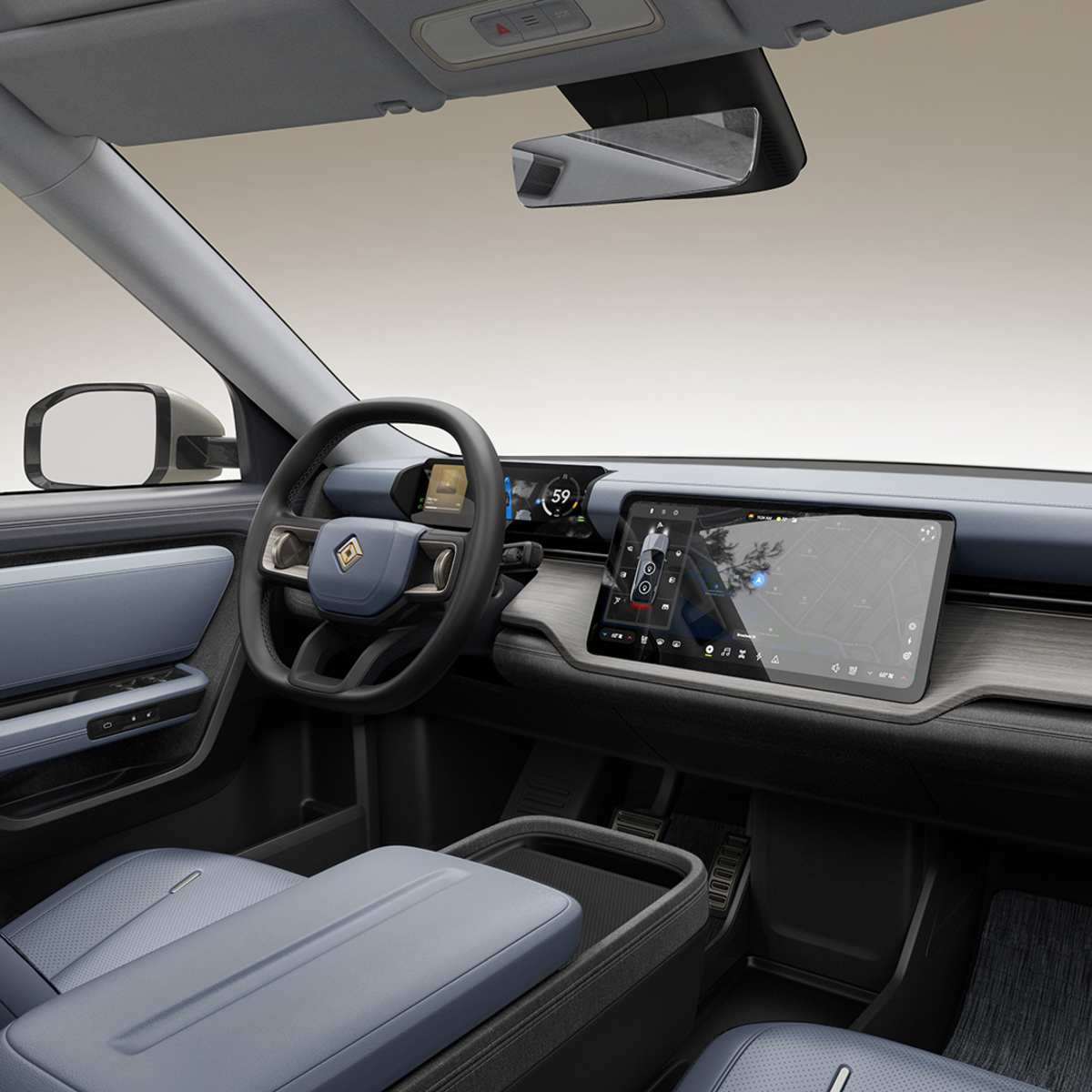
Rivian R2
"But let's talk a little bit about the R2. ... The R2, a lot more accessible. It's the same size as a Tesla Model Y to within a few inches."
The Rivian R2 is an electric SUV that’s meant to be easier to buy than Rivian’s bigger vehicles. The host says it’s about the same size as a Tesla Model Y and is aimed at people who want an EV but not a huge, pricey SUV.
The Rivian R2 is an all-electric SUV positioned as a smaller, more affordable alternative to Rivian’s larger R1S and R1T models. In this segment, it’s compared directly to the Tesla Model Y by size and price, and the host frames it as an “adventure vehicle” aimed at buyers who want EV tech without committing to a big, expensive three-row SUV.
holds its value pretty well
"And actually in the EV world, it actually holds its value pretty well. So it's not even that there were cheap examples on the used market either."
“Holds its value” means the car doesn’t lose its resale price as quickly as others. The host is saying the R1S has been keeping its value well, so you don’t see many heavily discounted used ones.
“Holds its value” refers to how well a vehicle retains its resale price over time. In the EV context, the host is saying the R1S has strong residual value compared with cheaper used examples, which can make it less of a financial risk to buy new.
launch model
"The launch model is about 60 grand, but there will be cheaper versions coming."
A “launch model” is the first version of a new car that goes on sale. The host says the first R2 version starts around $60k, with cheaper versions coming later.
A “launch model” is the initial trim or version of a car sold when it first goes on sale. The host uses it to explain the R2’s starting price, and then notes that cheaper versions are expected later.

4Runner Forerunner
"But if it's going to succeed, they're also looking at the kind of adventure vehicle stuff. So things like Toyota's forerunner goes into there..."
The host is comparing the R2’s target buyers to people who might shop a Toyota adventure SUV instead of an EV. It’s meant to show the R2 isn’t only competing with electric cars.
The host references Toyota’s “forerunner” as an example of the kind of adventure-oriented vehicle the R2 is trying to compete with. This is positioned as a non-EV alternative buyers might consider when looking for a similar size and capability.

Bmws X3
"So things like Toyota's forerunner goes into there, you know, even things like BMW's X3 from the luxury market."
The host brings up the BMW X3 as another type of SUV shoppers might choose instead of an EV. It’s used to show the R2 has to win over people who are considering luxury gas SUVs too.
The BMW X3 is mentioned as a luxury-market alternative that the Rivian R2 needs to pull customers away from. In this segment, it’s part of the argument that the R2 must compete not just with EVs, but also with gas-powered vehicles offering similar everyday size and capability.
drive it for half an hour
"And we're waiting for the launch. But you know, do you fancy having a drive it for half an hour? I'd love to know what you think."
This is basically a short test drive—just enough time to get a first impression. It’s not a long-term ownership test, but it can still help you judge how the car feels.
A short “drive” like this is typically a limited test session rather than a full evaluation. The host frames it as a preview opportunity that helps form early impressions of the R2’s feel and usability.
HUD
"where you can see the edges of the HUD. It's on kind of off-roadery type tires."
HUD means “heads-up display.” It shows important info on the windshield so you can keep your eyes on the road instead of looking down at the dashboard.
HUD stands for “heads-up display,” which projects key driving information (like speed or navigation cues) onto the windshield so you don’t have to look down at the instrument cluster. In this segment, the host notes you can see the edges of the HUD from the driver’s seat, tying it to the R2’s commanding seating position.

Tesla Cybertruck
"It's not, it's not what Tesla did with the Cybertruck where you thought, well, if you just produced a mid-sized truck that kind of looked a bit like a Model Y to probably sell the bucket full. So, why did you go and do the Cybertruck?"
The Tesla Cybertruck is Tesla’s very unusual-looking electric truck. The host brings it up to compare marketing strategy: Tesla went for a dramatic, distinctive design, while Rivian is portrayed as taking a more gradual path with a smaller, cheaper model.
Tesla Cybertruck is referenced as an example of a bold, unconventional design strategy aimed at selling a “bucket full” of vehicles. The host contrasts that with Rivian’s approach—building a good brand and then offering a smaller, more affordable model (R2) for buyers who can’t afford the larger cars.
Rivian R1
"Because the R1 has big range with big battery, but it's massively heavy. It's not very efficient. It doesn't charge"
The Rivian R1 is Rivian’s earlier, bigger electric vehicle. The host’s main takeaway is that it can go a long way because it has a big battery, but it’s also very heavy, which hurts efficiency and charging performance.
Rivian R1 is the earlier, larger Rivian EV platform the host compares against the R2. The key point here is that the R1 has big range thanks to a large battery, but it’s described as being massively heavy and not very efficient, and the host also notes it “doesn’t charge” well (in the context of efficiency/charging behavior).
overengineered
"Ford has spoken about this too, like on the Mach-E, going, we overengineered. We had too much wiring. We had too much of this, too much of that."
“Overengineered” means the car has more complicated stuff than it really needs. In the example the host gives, that extra complexity can add weight and make the car less efficient.
“Overengineered” here is used in an automotive engineering sense: the vehicle has too much complexity or too many systems/components, which can add weight and cost. The host ties it to Ford’s Mach-E example—too much wiring and added weight/complexity—then contrasts it with more software-driven integration where systems “talk” to each other.
software driven
"Like now it's all more software driven and everything talks to each other electronically."
“Software-driven” means the car uses software to control and coordinate lots of its systems. The host’s point is that newer cars are better at having different parts work together through electronics.
“Software-driven” describes modern vehicles where many functions are controlled by software and coordinated across electronic modules. The host contrasts this with older approaches where not everything communicates electronically, emphasizing that better integration can improve efficiency and overall vehicle behavior.
efficiencies
"So, efficiencies in aerodynamics, efficiencies in build, efficiencies in adding lightness, as they say, gave us an overall better vehicle where it's more efficient."
Here “efficiencies” means ways the car uses energy more effectively. Less wasted energy can translate into better range and overall performance from the battery.
In this context, “efficiencies” refers to multiple ways an EV can waste less energy—through aerodynamic improvements, lighter/less complex builds, and smarter system integration. The host links these efficiency gains to making the overall vehicle better, even while still delivering strong range.
lightness
"efficiencies in build, efficiencies in adding lightness, as they say, gave us an overall better vehicle"
“Lightness” just means making the car weigh less. A lighter car usually uses less energy, which helps an electric vehicle get better range.
“Lightness” is the engineering goal of reducing vehicle mass to improve efficiency, acceleration, and handling. The host credits Rivian’s lessons learned with adding “lightness” as part of the efficiency improvements versus the heavier R1.
steep learning curve
"I think this is always challenge with buying the first vehicle from any brand is that there's a steep learning curve. And even if you bring in people who've done this before in other places, Tesla, etc., you're still quite an immature company."
A “steep learning curve” means a new company has a lot to figure out quickly. In car terms, that includes making the cars well and supporting customers as sales grow.
A “steep learning curve” here means a new automaker has to rapidly build expertise in manufacturing, supply chains, quality control, and customer support. The hosts argue that even with experienced hires, a brand still needs time to mature operationally—especially when scaling up sales.
make or break
"They're still hemorrhaging cash. They're still putting how you cut the accounting. They're still losing money overall. This R2 is very much a make or break car for them."
“Make or break” means this product could decide whether the company succeeds or fails. The hosts are saying Rivian R2 is crucial for Rivian to keep going.
“Make or break” is used to describe a product whose success determines whether the company can continue. In this context, the hosts connect Rivian R2’s sales scale to the company’s ability to survive financially and execute its growth plans.

Model Y
"But they still don't think they're going to go from 10,000 vehicles or 20,000 vehicles to a million vehicles. No, that's not going after Model Y. They want like 150,000 vehicles, right?"
Tesla’s Model Y is one of the best-selling electric SUVs. The hosts mention it to show how hard it is for a newer company to sell at the same huge numbers.
Tesla Model Y is a mass-market electric SUV that the hosts use as a benchmark for what “big volume” looks like. They contrast Rivian’s realistic target with Model Y’s scale, implying that reaching that level is extremely difficult for a newer EV brand.

Toyota RAV4
"They don't want to admit that because in their mind, they need to seduced people out of a Toyota RAV4, out of a BMW X3."
The Toyota RAV4 is a very common, popular SUV. The hosts are saying Rivian needs to attract people who already like a mainstream gas SUV, which is a tough challenge.
Toyota RAV4 is the mainstream SUV the hosts cite as the kind of buyer Rivian would need to win over. They use it as a reference point for how entrenched gas-car demand is, and how hard it is to “seduce” customers away from a popular non-EV.

Tesla Model 3
"...udience from people who bought a first-generation Model 3 or a Model Y because they were tech forward and t..."
The Tesla Model 3 is an all-electric car that’s shaped like a sedan. It’s known for being a popular early EV choice. The podcast brings it up to describe the type of people who bought it when it first became available.
The Tesla Model 3 is an all-electric sedan that helped establish Tesla’s mainstream appeal. It’s mentioned because early buyers were often described as tech-forward, and the car’s popularity makes it a reference point for how EV adoption grows. In the podcast context, it’s used to frame the kind of audience that originally bought Model 3 and Model Y.
Lucid
"I like Rivian. I like the product. I think they've done a terrific job with the brand, much more so than Lucid."
Lucid is an electric car brand. In this segment, it’s brought up mainly as a comparison point for how clearly the brand’s identity comes across to buyers.
Lucid is an electric-vehicle brand mentioned as a contrast to Rivian’s brand clarity. The host argues that listeners understand what Rivian is trying to be more than they understand Lucid.
all wheel drive
"This is more of the all-weather vehicle. It's all wheel drive. It's decent ground clearance. You can drive it presumably in the snow and the rain or whatever."
All-wheel drive means the car can send power to multiple wheels. That helps it grip better on wet or snowy roads, which is why the host calls it an all-weather vehicle.
All-wheel drive (AWD) sends power to more than just the front or rear wheels, improving traction when conditions are slippery. The host frames Rivian R2 as an all-weather vehicle partly because it’s AWD and has decent ground clearance.
ground clearance
"It's all wheel drive. It's decent ground clearance. You can drive it presumably in the snow and the rain or whatever."
Ground clearance is how much space there is between the road and the bottom of the car. More clearance can help you avoid hitting bumps, curbs, or rough patches.
Ground clearance is the distance between the road and the lowest part of the vehicle. More clearance helps reduce the chance of scraping the underbody on rough terrain or during snow/ice conditions.
air suspension
"The big thing here is they, for cost reasons, they took out the air suspension that you get on the R1S and the R1T. So that doesn't give you the flexibility to have the ride height variants that you can have if you've got air suspension."
Air suspension is a type of suspension that can change how high the vehicle sits. Raising it helps with rough roads or snow, and lowering it can make the ride feel more normal on regular streets.
Air suspension uses air-filled springs instead of steel coils, letting the vehicle adjust ride height. That matters off-road and in bad weather because it can raise clearance for obstacles and lower the car for easier driving.
Bluetooth speaker
"So you don't get the cool Bluetooth speaker that you get in an R1S and R1T that comes out the center console."
A Bluetooth speaker is a wireless speaker that can play audio without cables. The host says some Rivian models have a removable one in the center console, but the R2 is expected to skip it to save cost.
A Bluetooth speaker is a wireless audio device that connects to the car (or phone) over Bluetooth. Here it’s mentioned as a removable feature from the center console on the higher-end Rivian R1S/R1T that the R2 won’t include.
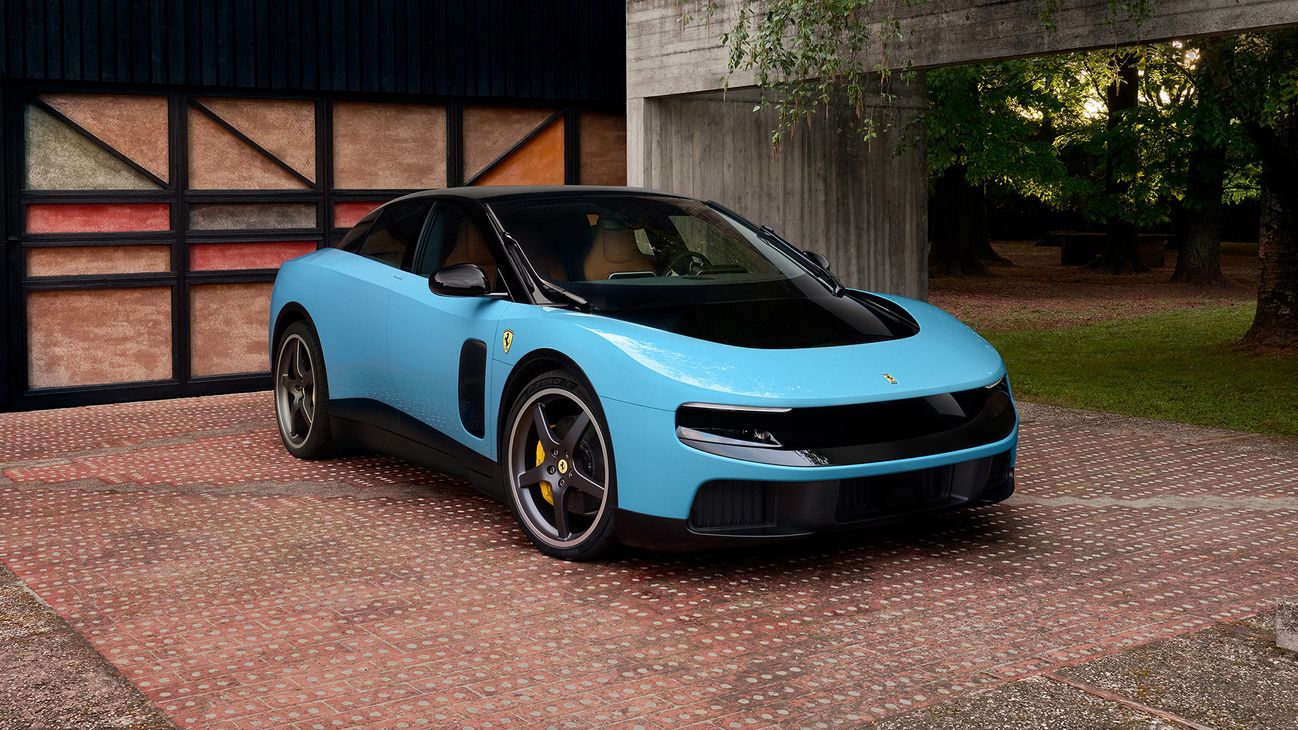
Ferrari Luce
"...gn perspective. We talked a lot about the Ferrari Luce and how that's a product designer trying to do a ..."
The Ferrari Luce is a car that the podcast talks about mainly from a design point of view. It’s being discussed to explain the ideas behind how it looks and what the designers were aiming for. The focus is on the design process rather than basic driving details.
The Ferrari Luce is discussed as a product-design-focused project, with the podcast highlighting a designer’s perspective on what the car is trying to achieve. It’s brought up to explain the design intent and the thinking behind the vehicle rather than just performance specs. That makes it a “design story” car in the episode.
wireless phone charging
"So I love the fact, for example, that Rivian's one first, but the first, the R1S wireless phone charging was rubbish because it used to like, your phone would move around and sometimes it would charge, sometimes it wouldn't."
Wireless phone charging charges your phone without plugging in a cable. It works best when the phone sits in the right spot, which is why alignment matters here.
Wireless phone charging uses electromagnetic induction to charge a phone without plugging in a cable. In this segment, the key issue is alignment: if the phone shifts, the charging can become intermittent.
MagnaSafe
"And in the R2, they've got Magna, what do you call it? MagnaSafe. MagSafe. MagSafe, that's what I'm talking about. Yeah, positions the phone."
MagnaSafe is a wireless phone charger design that helps keep your phone lined up. Because the phone stays in the right position, it’s more likely to charge every time.
MagnaSafe (as used here) refers to a wireless phone-charging system that physically positions the phone in the correct spot. By holding the phone in place, it makes charging more consistent and easier to verify.
saving money on the most used tactile things
"we've sort of talked about this before, probably many times now, is when you're looking for ways to save money, we've seen so many car companies make a mistake on saving money on the most used tactile things."
The idea here is that if a company tries to save money, it shouldn’t do it on the parts you touch all the time. If it does, the car can feel lower quality even if everything else is okay.
This is a design-and-costing concept: cutting costs on high-touch, frequently used interior controls can make a car feel cheap even if the rest of the vehicle is fine. The hosts argue that the “tactile” parts people interact with most often are where cost-cutting is most noticeable.
long range
"The standard version with the long range, this is rear wheel drive, long range, less overall power, about 50 grand early 2027."
“Long range” usually means the EV version is set up to go farther on a single charge. Here, they’re comparing the long-range model’s range to a shorter-range version.
“Long range” is an EV trim/packaging label that generally indicates a larger battery and/or efficiency tuning aimed at maximizing driving distance per charge. In this segment, the long-range R2 is contrasted with a standard-range version with a shorter estimated range.
rear wheel drive
"The standard version with the long range, this is rear wheel drive, long range, less overall power, about 50 grand early 2027."
Rear wheel drive means the power goes to the back wheels only. It can be a bit more efficient, but it may not grip quite as well as an all-wheel-drive setup in bad weather.
Rear wheel drive (RWD) means the electric motors drive only the rear axle. Compared with all-wheel drive, RWD can be simpler and sometimes more efficient, but it may provide less traction in snow or heavy rain depending on tires and traction control.
standard range
"And then the standard range one is obviously very interesting, right? Because it's, you know, where we are the price point rear wheel drive, a little bit smaller battery, by the way, still quick 0 to 65.9 seconds."
“Standard range” is the cheaper EV version that’s designed to go a shorter distance on a charge. They mention it uses a smaller battery compared with the long-range model.
“Standard range” refers to the EV configuration optimized for lower cost rather than maximum distance. In this segment, the standard-range R2 is described as having a smaller battery than the long-range version, with a lower estimated range.
0 to 65.9 seconds
"The standard version with the long range... about 50 grand early 2027. ... still quick 0 to 65.9 seconds."
They’re quoting a time-based acceleration number to show how quickly the car gets up to speed. The transcript cuts off the exact speed target, but the idea is comparing different versions’ quickness.
“0 to 65.9 seconds” appears to be the host’s shorthand for an acceleration or elapsed-time performance figure (likely a 0–something test). It’s a way to compare how quickly different trims get up to speed, though the exact target speed isn’t fully clear from the transcript.
275
"But instead of around that 330 mile range, we're looking at 275. That seems to come"
The “275” number is the estimated distance this EV version can drive on a charge. It’s meant to help you compare range between the different trims.
The “275” figure is presented as an estimated driving range for the standard-range R2. EV range numbers are typically based on a standardized test cycle, and they’re used to compare how far different battery sizes/efficiency setups can go.
aerodynamics
"If you want to go that far, then really you're going to end up with something that's super aerodynamic looking. So it looks like an egg and nobody wants to buy those."
Aerodynamics is how the car’s shape affects how easily it moves through the air. If a car is more slippery through the air, it uses less energy and can drive farther on the same battery.
Aerodynamics is how air flows around a vehicle, strongly affecting energy use at highway speeds. The host argues that to get much more EV range (e.g., 380–400 miles), you often need a more efficient, lower-drag shape—sometimes at the cost of styling appeal.
battery
"Or you put in a much bigger battery, which is the GM root, but then the price and the weight go up and you don't make any money."
The battery is what stores the electricity for an EV. A bigger battery can usually go farther, but it can also make the car heavier and more expensive.
In EVs, the battery is the energy storage system, and increasing its capacity typically increases range. The host notes the downside: a bigger battery raises both price and weight, which can offset some of the range gains.
GM
"Or you put in a much bigger battery, which is the GM root, but then the price and the weight go up and you don't make any money."
GM is a major automaker. In this discussion, the host is basically saying that some companies try to get more EV range by just putting in bigger batteries, which can make the car heavier and pricier.
GM (General Motors) is referenced here as an example of the industry approach of adding more battery capacity to chase EV range. The host contrasts that strategy with Rivian’s ability to pursue efficiency improvements (like aerodynamics) without as much weight and cost penalty.
airflow
"So even little things like the shape of the alloy wheels is designed to improve the airflow... And that's all about airflow as well."
Airflow is just how air moves around the car. If the car’s shape makes the air flow more smoothly, it can use less energy and go farther on a charge.
Airflow refers to how air moves over and around the vehicle surfaces. Designers use it to reduce turbulence and drag—like shaping the wheel edges and roof/spoiler geometry—to improve efficiency and range.
alloy wheels
"So even little things like the shape of the alloy wheels is designed to improve the airflow."
Alloy wheels are wheels made from a lightweight metal mix. The host is saying the wheel design can be shaped to help air flow better around the car, which can improve efficiency.
Alloy wheels are wheels made from a metal alloy (commonly aluminum) rather than steel. In EV design, their shape can be tuned to manage airflow around the wheel area to reduce aerodynamic drag.
compromise
"So there's a lot of things going on in this vehicle, but ultimately, it is a compromise because they want big wheels."
A compromise means you can’t optimize everything at once. The host is saying the vehicle has to balance looks and big wheels with the need to be efficient so it can get more range.
In EV design, a compromise is the trade-off between styling/packaging goals and efficiency targets. Here, the host argues Rivian’s design choices balance “tough adventure” looks and large wheels against aerodynamic efficiency and achievable range.
price point
"it's not at a price point that makes sense for a car... getting you at a price point where it's going to sell vehicles."
Price point just means the price level where enough people will actually buy the car. The host is saying the design has to be efficient enough to meet range goals without making the vehicle too expensive.
Price point is the target retail cost where a product becomes affordable enough to sell in volume. The host repeatedly ties aerodynamic/efficiency choices to the need to reach that price point rather than simply chasing maximum range.
autonomy
"There's a lot of talk about solid state and everything else, but nobody's quite sure where it's coming at scale. Same with autonomy. I mean, one of the things Rivian's also pushing was autonomy."
Autonomy means how much the car can drive by itself. The more autonomy a system has, the more it tries to handle things like speed and lane changes without you doing everything.
In automotive tech, autonomy refers to how much of the driving task a vehicle can perform on its own using sensors and software. The segment contrasts “autonomy” as a major focus for Rivian with Tesla’s current real-world behavior using FSD.
solid state
"There's a lot of talk about solid state and everything else, but nobody's quite sure where it's coming at scale."
Solid-state is a type of battery design that could be safer and store more energy than today’s common batteries. The host is saying people talk about it, but it’s not clear yet when it will be widely available.
Solid-state refers to a battery technology that replaces the liquid electrolyte in conventional lithium-ion batteries with a solid material. It’s discussed as a potential path to higher energy density and improved safety, but the host notes uncertainty about when it will arrive at large scale.

Rivian
"Same with autonomy. I mean, one of the things Rivian's also pushing was autonomy. There's a lot of similarities, maybe not in politics and personality between Elon Musk and RJ Scaringer, who runs Rivian."
Rivian is an electric vehicle company. Here, they’re mentioned because they’re working on software that aims to make the car drive more on its own.
Rivian is an electric-vehicle brand that’s emphasized not just battery-electric hardware, but also software-driven features like autonomy. In this segment, the host highlights Rivian’s push for self-driving capability as a key part of its strategy.
RJ Scaringer
"There's a lot of similarities, maybe not in politics and personality between Elon Musk and RJ Scaringer, who runs Rivian. But they're both technologists and they both get excited about similar stuff."
RJ Scaringer is a key executive at Rivian, described here as running the company. The host uses him to connect Rivian’s leadership mindset to the company’s focus on autonomy and advanced technology.
FSD
"I've been chugging around this week in Edmund's Tesla Model Y with FSD, the full self-driving technology, which I don't know if we're going to talk about this, but I'm going to share this at Langdow anyway."
FSD stands for Full Self-Driving. It’s Tesla’s software that tries to help the car drive more on its own, like handling traffic and lane changes, but you still have to stay alert and ready to take over.
FSD (Full Self-Driving) is Tesla’s software package aimed at automating more driving tasks than basic cruise control. Depending on the version and region, it can include features like traffic-aware driving and automated lane changes, but it still requires driver supervision.
confidence point
"Now they seem to go to a confidence point where you can sort of look around a little bit more, not quite sit there and do your emails, but getting close."
A “confidence point” here refers to the system deciding it’s sufficiently sure about what it sees and predicts—so it allows more driver inattention or more automated behavior. As the software improves, the threshold for that confidence can change, which is why the speaker says it’s “less sensitive” now.
full self driving
"And it also runs a statistic in the car. And obviously this is a car that's shared across the team. And since this latest update, it gives you a percentage of time that you've used full self driving."
“Full self driving” is an advanced driver-assist system that tries to do a lot of the driving for you. Even when it’s on, you still have to watch the road and be ready to take over.
“Full self driving” (often shortened to FSD) is a driver-assistance feature that aims to handle most driving tasks—steering, speed control, and lane changes—without constant human input. In practice, it still requires supervision, and the system’s “confidence” can change based on road conditions and software updates.
Tesla plug
"is that charging infrastructure that Tesla has done so well? Like now everybody's adding Tesla plug. Yeah. It's got a Tesla plug."
“Tesla plug” means the connector type Tesla uses for charging. The big deal is that other brands are starting to use the same connector so their cars can use Tesla’s chargers more easily.
“Tesla plug” refers to Tesla’s charging connector standard (commonly associated with the NACS ecosystem in North America). The speaker is noting that other automakers are adopting Tesla’s connector so drivers can use a shared network of chargers.
Nax North American Standard
"Like now everybody's adding Tesla plug. Yeah. It's got a Tesla plug. Everybody's gone Nax North American Standard, which is basically Tesla plug."
“Nax North American Standard” appears to be a mis-transcription of NACS (North American Charging Standard), the connector standard associated with Tesla’s charging ecosystem. The point is that automakers are aligning to a common standard to reduce friction for drivers and improve charger compatibility.
burn rate
"I was speaking to somebody from Tesla and he was comparing Tesla's burn rate at a similar point in their existence to Rivian's and Rivian's is far, far higher..."
Burn rate means how quickly a company is running through its money. If it’s high, the company may need to sell cars successfully sooner or find more funding.
Burn rate is the rate at which a company spends cash over time, typically to fund operations and growth before it becomes profitable. In EV startup discussions, a higher burn rate can mean the company needs a faster path to successful products or additional funding.
Rivian R3
"But yeah, it's, yeah, R2's make or break for them. And then the R3 is that one that looks like a Mk1 Golf. That's coming down the line, but that's still a couple of years ago."
Rivian R3 is another future electric Rivian model. The host says it’s designed to look like a classic compact car (like a Mk1 Golf), which they think could help it attract more buyers.
Rivian R3 is a planned Rivian electric vehicle positioned as a smaller, more mainstream model than the company’s current lineup. The host compares its styling to a Mk1 Golf, implying a compact, recognizable design direction that could broaden appeal.
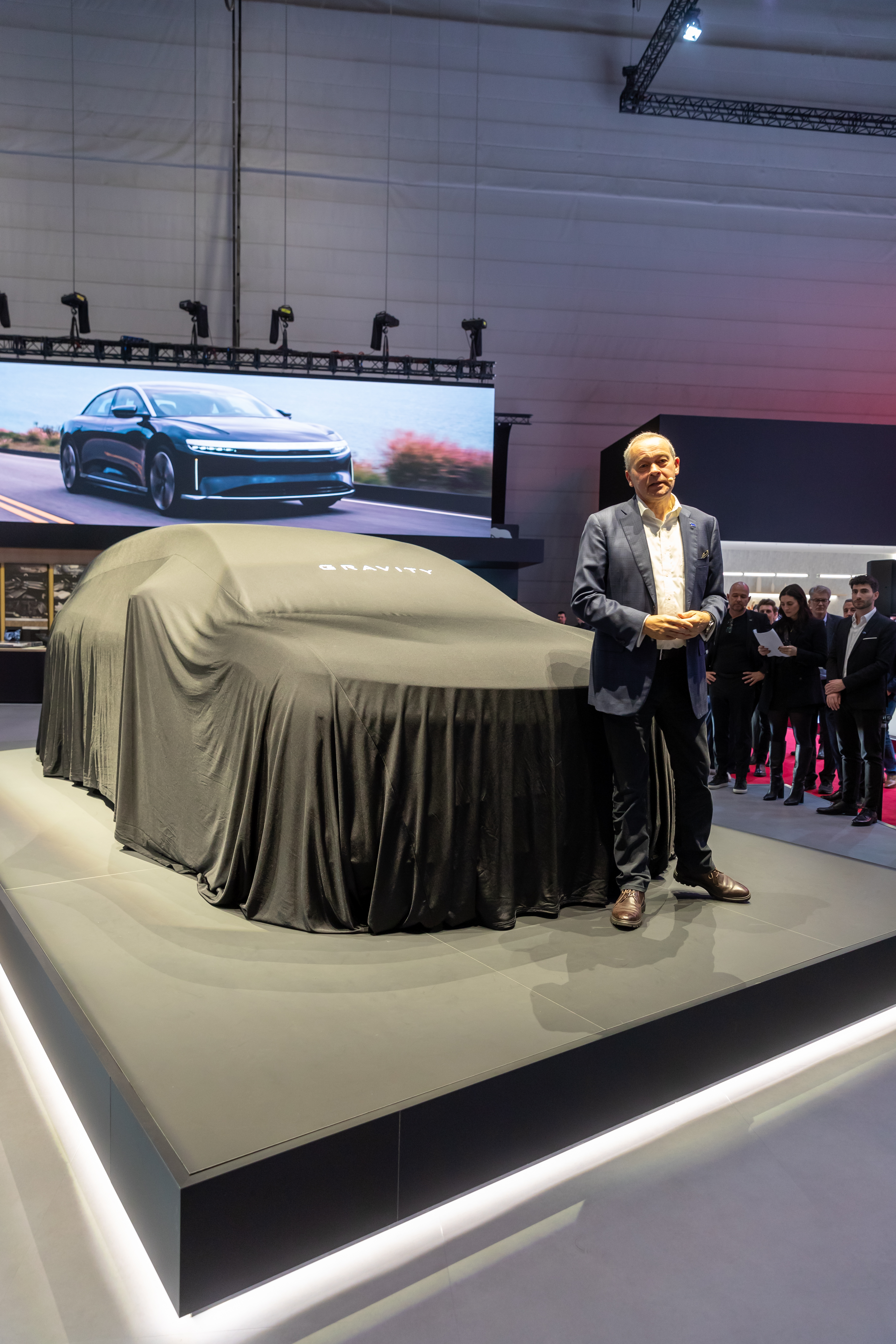
Lucid Gravity
"So I think it's got every chance. It's a desirable product and in a way that I think like the Lucid, like the Lucid Gravity is a decent car, but I don't think it has that kind of desirability. Also released too early."
Lucid Gravity is Lucid’s electric SUV. The host thinks it didn’t become as popular as it could have because it arrived before it was fully ready, so early reviews and owner experiences weren’t strong.
Lucid Gravity is Lucid’s larger electric SUV, intended to expand the brand beyond its earlier sedan. Here, the host argues it lacked the same level of desirability and that it was released too early, hurting early reception among journalists and owners.

Lucid Air
"Also released too early. They put it out there and it didn't work well. And, you know, between journalists and owners of the car, it didn't work well enough. That's the mistake that they made with the air as well."
Lucid Air is Lucid’s main electric sedan. The host is saying Lucid had problems with the Air too, and that early reviews from car writers and actual owners didn’t go well enough.
Lucid Air is Lucid’s flagship electric sedan and the brand’s earlier attempt to prove the technology and build quality. The host says Lucid made a similar mistake with the Air—launching before it worked well enough—so the early feedback loop from journalists and owners was negative.

Ford Gets
"...th Alan Clark, one of the big things he said was, Ford gets deriders being bureaucratic or old school and eve..."
plug-in hybrid
"We're going to talk EV and plug in hybrid. Let's take a quick break first and then we'll be right back. [1822.8s] Okay, we're back. I'm going to kick this off first because I've been driving the Lexus RX... [1849.1s] and their F performance version of it. I drove the plug-in hybrid version of it..."
A plug-in hybrid is a car that uses both gas and electricity. You can charge it by plugging it in, and it can often drive a while on electric power before the gas engine takes over.
A plug-in hybrid is a hybrid vehicle with a larger battery that can be recharged by plugging into external power. It can often drive some distance on electricity alone, but it still has a gas engine for longer trips or when the battery is depleted.

Lexus RX 450H Plus
"Okay, we're back. I'm going to kick this off first because I've been driving the Lexus RX. [1829.3s] They're very popular SUV. The one I've driven is the RX 450H Plus or something. Now, this is a [1840.3s] two-row SUV. They have a gas engine version, an electric version, a plug-in hybrid version, [1849.1s] and their F performance version of it. I drove the plug-in hybrid version of it, [1857.2s] which Lexus claims gets about 38 miles on pure electric."
This is a Lexus RX that’s a plug-in hybrid, meaning it has both a gas engine and an electric system. You can charge it from a plug, and Lexus says it can drive about 38 miles on electricity before the gas engine helps again.
The Lexus RX 450h Plus is a plug-in hybrid version of the RX SUV, combining a gas engine with an electric drive system and a battery you can recharge externally. Lexus claims it can run on electricity for about 38 miles before the gas engine takes over, which is why it’s positioned between a full EV and a conventional hybrid.
pure electric
"I drove the plug-in hybrid version of it, [1857.2s] which Lexus claims gets about 38 miles on pure electric. No secret here. I'm not the customer [1867.5s] for a plug-in electric."
“Pure electric” means the car is running on electricity only, using the battery. In a plug-in hybrid, once the battery gets low, the gas engine usually helps or takes over.
“Pure electric” means the vehicle is being driven only by its electric motor(s), using energy stored in its battery, without the gas engine providing propulsion. In a plug-in hybrid, this typically happens until the battery charge drops to a level where the system switches to hybrid operation.
12-volt outlet
"The plug-in hybrid, it doesn't really work for me. Living in an apartment, [1874.9s] if I was just going to plug this thing into a 12-volt outlet, a 120-volt outlet every night, [1880.9s] let it charge for 12 hours..."
A 12-volt outlet is the small power socket you might use for accessories in a car. It’s generally not meant for charging a plug-in hybrid the way you’d use a normal home outlet.
A 12-volt outlet is a low-voltage power socket commonly found in vehicles, but it’s not the same as charging a plug-in hybrid from home power. Plug-in charging typically uses higher-voltage household power (like 120V or 240V) through an appropriate charging setup.
120-volt outlet
"Living in an apartment, [1874.9s] if I was just going to plug this thing into a 12-volt outlet, a 120-volt outlet every night, [1880.9s] let it charge for 12 hours, get up in the morning, have my 38 miles of range..."
A 120-volt outlet is a normal household plug. Charging on it is often slower than faster charging setups, so you may need to leave the car plugged in longer to get enough range.
A 120-volt outlet is standard household power in many regions (commonly used for basic EV charging). Charging on 120V is usually slower than higher-voltage options, which can affect whether a plug-in hybrid’s battery is ready by morning.

Lexus ES
"I was driving the new ES, which is the brand new sedan, which actually costs pretty much the same money... With the ES, they've said, right, we're going to have full electric or hybrid..."
The Lexus ES is a luxury sedan from Lexus. In this episode, they’re talking about a new version that can be electric or hybrid, and it’s priced close to the Lexus RX SUV.
The Lexus ES is the brand’s mainstream luxury sedan, positioned as a comfort-focused alternative to larger flagship models. Here, the hosts discuss the new ES and its shift toward full electric or hybrid options, plus how it’s priced similarly to the RX in the $50,000–$60,000 range.
Lexus RX
"RX has obviously been around about three years now. You're right. It's not class-leading, but there's a lot of things that just Lexus do well, and the quality always feels good."
The Lexus RX is a luxury SUV. It’s popular because it’s comfortable and easy to live with, and Lexus offers different versions with different types of electric help.
The Lexus RX is a midsize luxury SUV known for a comfort-first ride and a reputation for refinement. In this segment, the hosts highlight that it’s been around for a few years and that Lexus offers multiple powertrains (including hybrid and plug-in hybrid) while keeping the overall ownership experience feeling “just works.”

Mercedes-Benz GLE
"...n SUV, and it's a kind of competitiveness and the GLE. It's that sort of size, but then the ES is now t..."
The Mercedes-Benz GLE is a luxury SUV. It’s designed to be comfortable and upscale while still being practical for everyday use. The podcast mentions it to compare the size category of the car being discussed.
The Mercedes-Benz GLE is a midsize luxury SUV that’s positioned as a more premium, capable alternative in the SUV market. In the podcast, it’s referenced by size—described as being in that “sort of size” range—while comparing it to other models mentioned in the same conversation. That’s why it’s included: it helps listeners understand where the discussed vehicle fits in SUV sizing and class.
underpinnings
"Is it kind of like tarted up Camry? Well, it's a bit more than that because this is a sort of new underpinnings."
Underpinnings are the car’s main “foundation,” like how the body and chassis are built. When a car gets new underpinnings, it usually means it’s a bigger redesign than just cosmetic changes.
Underpinnings refers to the vehicle’s core structural and engineering foundation—things like the chassis design, platform architecture, and major layout decisions. The hosts use it to emphasize that the new ES isn’t just a minor refresh; it uses a newer base that changes size and positioning.
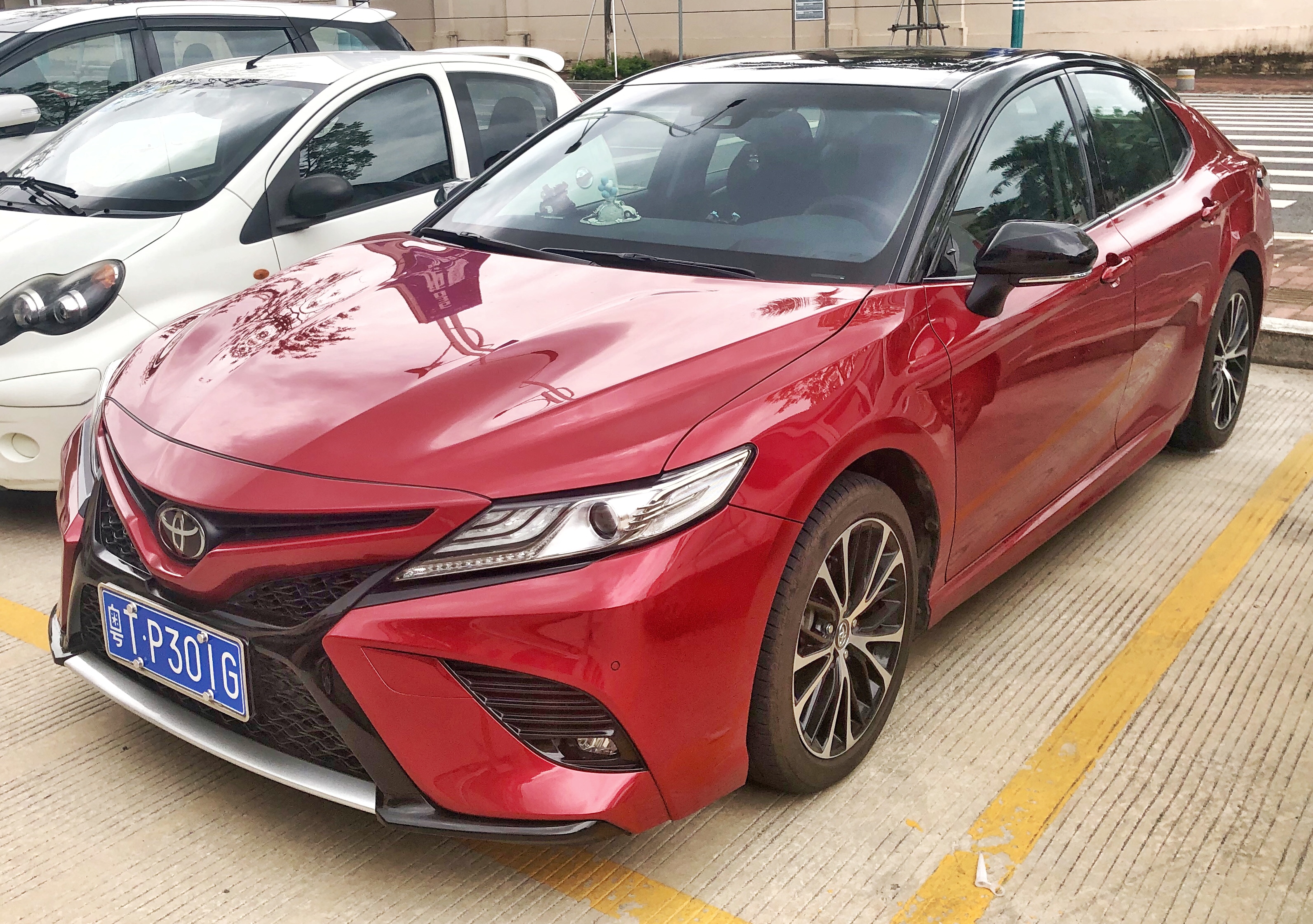
Toyota Camry
"...It's easy as always. Is it kind of like tarted up Camry? Well, it's a bit more than that because this is ..."
The Toyota Camry is a midsize sedan meant for everyday driving. People choose it because it’s comfortable and straightforward to own. The podcast mentions it as a comparison point for a more upgraded version of that kind of car.
The Toyota Camry is a long-running midsize sedan known for being easy to live with and widely used as a practical family or commuter car. It’s referenced as a baseline because the podcast is comparing something to a “tarted up Camry,” implying a more refined or updated take on the familiar formula. That makes it a natural reference point for discussing comfort, usability, and mainstream appeal.
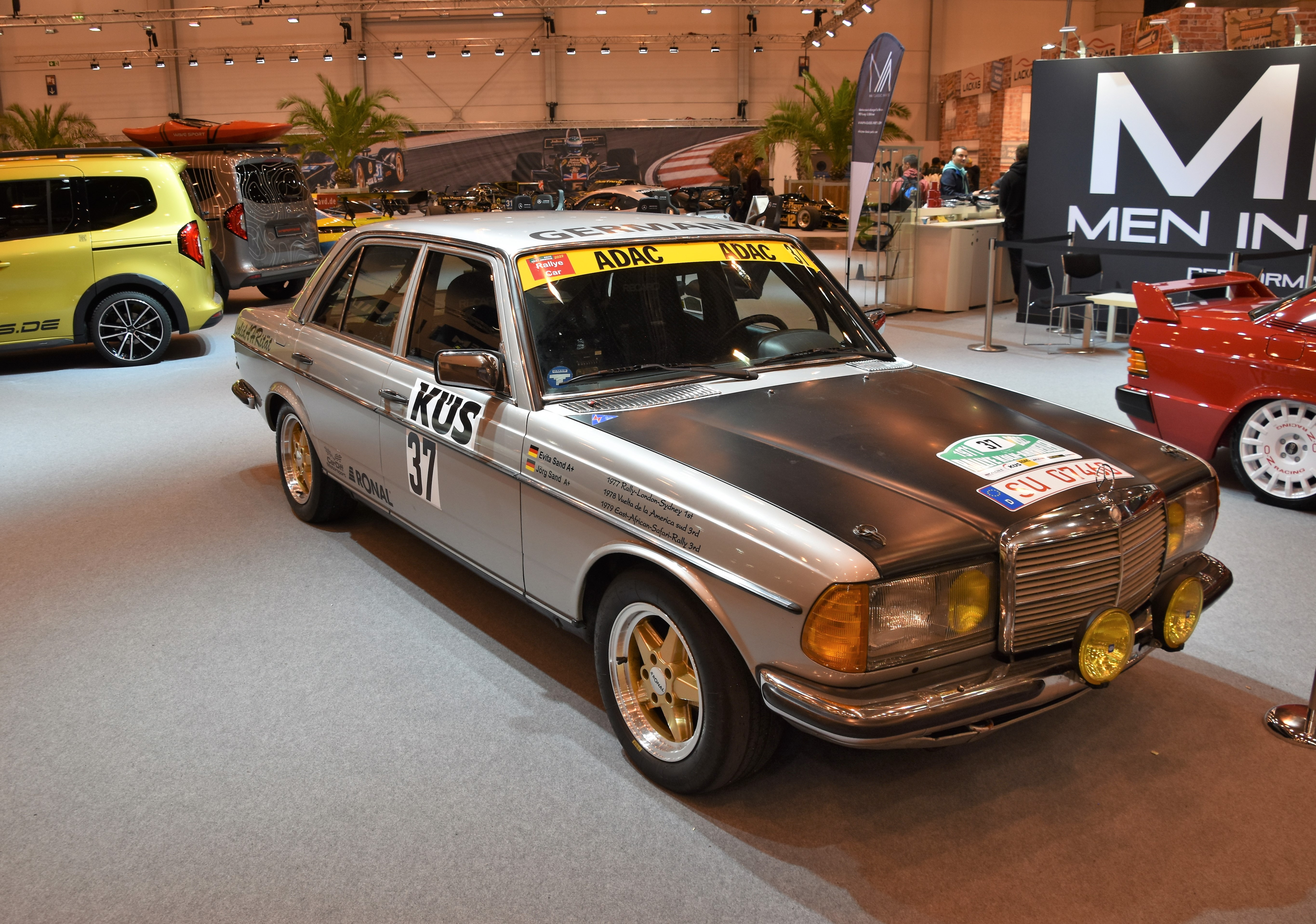
Mercedes E-Class
"It's bigger than before because it's designed to kind of bridge a gap between the old ES and things like the LS. It's kind of a bit bigger. It's sort of more like a Mercedes E-Class rival..."
The Mercedes E-Class is a well-known luxury sedan. They’re using it as a comparison point for how big and positioned the new Lexus ES is.
The Mercedes-Benz E-Class is a mainstream luxury sedan line used as a benchmark for ride comfort, cabin quality, and overall “executive” positioning. The hosts compare the new ES’s size and role to an E-Class rival to explain where Lexus is aiming the car in the market.

BMW 5-Series
"It's sort of more like a Mercedes E-Class rival, but a little bit cheaper, BMW 5-Series or i5, that kind of car."
The BMW 5-Series is a popular luxury sedan line. They’re saying the new Lexus ES is aiming at the same general category of car.
The BMW 5-Series is a benchmark luxury sedan known for balancing comfort with driver-focused handling. The hosts mention it as another comparison point for the new ES’s target size and market slot, alongside the BMW i5.
renaissance of the sedan
"thought. The sedan is having a bit of a renaissance. Why is the RX still previous generation Lexus? The ES is next generation, so you've got different design language, particularly inside... We might be about to see the rebirth of the sedan as being, ...everybody's gone SUV crazy..."
They’re talking about sedans possibly becoming popular again. The reason they give is that SUVs have been dominating, but efficient hybrid or EV options could make sedans more appealing.
A “renaissance of the sedan” is the idea that consumer demand for sedans could rise again after years of SUV dominance. The hosts connect it to practical concerns like fuel costs and the availability of efficient hybrid/EV powertrains.
front-wheel drive
"They do two EVs, one of which is front-wheel drive, the one I had, and they do an all-wheel drive one."
Front-wheel drive (FWD) means the engine’s power is sent to the front wheels, which handle both steering and traction. The hosts mention an ES EV setup that’s FWD, contrasting it with an all-wheel drive version.
Mark Levinson Hi-Fi
"Plenty fast enough. Great Mark Lemonson Hi-Fi. I thought people would be interesting because people are going to go, no, I buy the SUV, but I think it's like the thinking person's choice."
Mark Levinson Hi-Fi is a high-end sound system in some luxury cars. They’re saying the ES they drove had really good audio.
Mark Levinson Hi-Fi refers to a premium audio system brand used in many luxury cars. The hosts mention it as part of the Lexus ES experience, implying the cabin sound quality is a selling point on certain trims.

Hyundai Ioniq
"...out the Lexus plug-in hybrid for the all-electric Hyundai Ioniq 9 and they said the nice version, they said a nic..."
The Hyundai Ioniq 5 is an all-electric SUV. It’s meant to be a practical EV you can use day to day. The podcast mentions it while comparing different electric options and what people might want from them.
The Hyundai Ioniq 5 is an all-electric crossover known for its EV-focused design and mainstream usability. The podcast references it in the context of comparing EV options, including plug-in hybrids and other electric models, which highlights its role as a practical alternative in the EV lineup. It’s brought up because it’s part of the discussion around what’s “nice” or desirable in an EV purchase.

Hyundai Ioniq 9
"I swapped out the Lexus plug-in hybrid for the all-electric Hyundai Ioniq 9... This is the full EV version... I still have it now and I've been driving it and I really like it... we're still in this 300 mile, 310, 315 mile range of EVs"
The Hyundai Ioniq 9 is a fully electric family SUV with three rows. The host likes it for long-distance driving because it can go roughly 300 miles on a charge and has a roomy, comfortable interior.
The Hyundai Ioniq 9 is an all-electric, three-row family EV positioned as a road-trip alternative to other large EVs. In this segment, the host compares it directly to the Lexus ES hybrid/EV approach and highlights its ~300–315 mile electric range and cabin layout.

Hyundai Palisade Calligraphy
"I was already so impressed with the Hyundai Palisade calligraphy... The Palisade is sharp looking... especially in its price point."
The Hyundai Palisade is a big family SUV with three rows. “Calligraphy” is the nicer, more premium version, and the host thinks some buyers prefer it over the electric Ioniq 9 because it can be easier to live with financially.
The Hyundai Palisade is a three-row family SUV, and the “Calligraphy” trim is positioned as the more upscale, feature-rich version. The host uses the Palisade Calligraphy as the benchmark for why buyers might choose it over the Ioniq 9—especially on price and depreciation.

Kia EV9
"I think it's just whether you like the look of the Hyundai and the interior of the Hyundai versus the Kia... It's a nice thing, isn't it?... It's the Kia EV9 in a different dress, basically."
The Kia EV9 is an all-electric, three-row SUV. The host is saying the Ioniq 9 feels like a similar vehicle concept—just with different styling and interior choices.
The Kia EV9 is a three-row, all-electric SUV, and the host frames the Hyundai Ioniq 9 as a similar kind of vehicle. They call it “the Kia EV9 in a different dress,” emphasizing that both target the same family/road-trip use case.
lease
"there are some mega deals on Ioniq 9s at the moment, particularly if you want a lease one."
A lease is like renting a car for a few years with monthly payments, and you usually have rules like mileage limits. The host is saying leasing can make the Ioniq 9 more appealing right now.
A lease is a financing structure where you pay to use the car for a set term, usually with mileage limits, rather than owning it outright. The host mentions “lease” deals as a way buyers might access the Ioniq 9 despite its higher price than the Palisade.
depreciation
"I'm going to keep it a little bit longer and I feel a little bit better about the depreciation compared to the EVs"
Depreciation is how much the car’s value goes down as time passes. The host is saying people may worry less about losing money with the Palisade than with an EV.
Depreciation is how much a vehicle’s value drops over time after you buy it. The host argues that some buyers may feel better about keeping a Palisade longer because EVs can depreciate differently than non-EVs.
captain's chairs
"the one that I've been driving, this calligraphy edition, the interior is fantastic. It's got captain's chairs for the second row."
Captain’s chairs are separate seats in the middle row instead of one long bench. They usually feel more comfortable and can make it easier for people to get in and out of the back row.
Captain’s chairs are individual, separated seats—typically in the second row—rather than a single bench. In a three-row SUV, they can make access to the third row easier and improve comfort for second-row passengers.
infotainment
"One of the things that you pick up on with the Hyundai C, Ioniq 5, even the Tucson and this and the Palisade is the infotainment, the gauges in front of you, the big screen and it goes to the infotainment."
Infotainment is the car’s main screen system for things like navigation and media. It’s what you use for maps, music, and many car settings.
Infotainment is the in-car system that combines media (like music and streaming) with navigation and vehicle settings on a touchscreen or screen cluster. The host is describing how Hyundai’s infotainment layout—screens, prompts, and gauge display—feels consistent across models and price tiers.
wing mirrors
"They have cameras for the rear view mirrors, for the wing mirrors. Oh, they do. Yeah. That's the screen for the camera."
Wing mirrors are the side mirrors on the doors. The host is saying some cars use cameras instead of traditional mirrors, but the US doesn’t allow it.
Wing mirrors are the side mirrors on the doors, and here they’re discussed as being replaced by camera feeds on certain markets. The host notes that the camera image is shown on a screen, but US rules prevent that setup.
rear view mirrors
"Because it's on the Korean spec cars and I think maybe the European ones as well. They have cameras for the rear view mirrors, for the wing mirrors. Oh, they do. Yeah. That's the screen for the camera."
The host is talking about mirror cameras—cameras that replace or supplement the mirrors. Instead of looking at the mirror directly, you see the camera image on a screen.
In this context, “rear view mirrors” refers to mirror-mounted camera systems. The host explains that some Hyundai/Korean-spec (and possibly European) cars use cameras for the wing mirrors and rear view, which are then displayed on a screen.
US legislation
"Oh, they do. Yeah. That's the screen for the camera. But in the US, legislation doesn't allow it. It's not legal. So they have to put that like bit of foam that looks like Agri looks like a speaker, but actually isn't."
The host is saying US rules don’t allow certain camera-mirror setups that other countries can have. So the car has to be modified for the US.
The host claims that US regulations don’t allow camera-based mirror replacements that other markets may use. This is important because it affects how the same vehicle is packaged and displayed differently depending on the country.
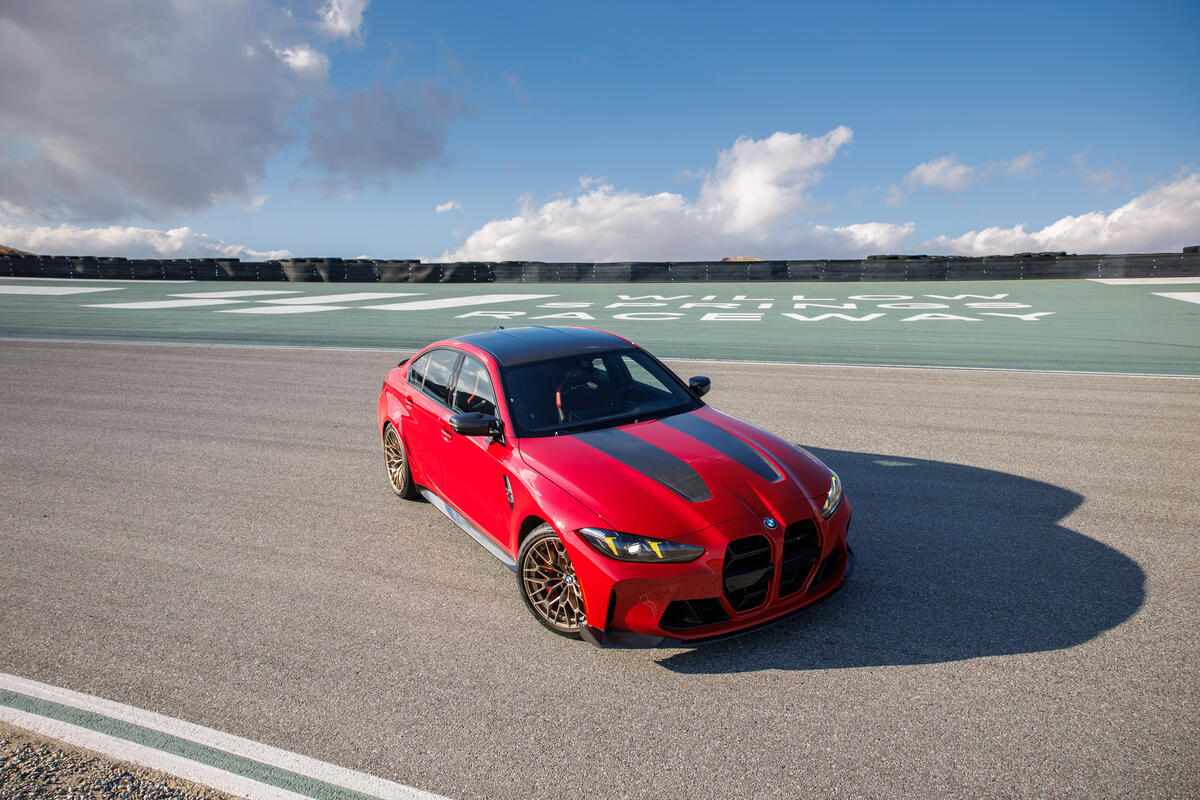
BMW M3
"The BMW M3, which Le Mans is taking place this weekend, which I've been to many, many times. [2546.4s] Do you have any other opportunities? It's a fantastic event. I have not. It's definitely on [2550.2s] my bucket list. It's crazy. I used to, when I lived in Europe, used to go nearly every year. [2555.4s] It's, it's amazing, amazing times there. But BMW took the opportunity to show a concept version [2561.6s] of the M3."
The BMW M3 is BMW’s high-performance model that’s built to drive really well, not just look sporty. Here they’re talking about a new BMW M3 concept and how BMW plans to offer both electric and gas versions next.
The BMW M3 is BMW’s flagship performance sedan/coupe line, known for its track-capable chassis and high-revving power. In this segment, the hosts discuss a BMW M3 concept version tied to the next generation, with both electric and gas variants planned.
Le Mans
"The BMW M3, which Le Mans is taking place this weekend, which I've been to many, many times. [2546.4s] Do you have any other opportunities? It's a fantastic event. I have not. It's definitely on"
Le Mans is one of the most famous car races in the world, known for long endurance racing. Car companies often use it as a big moment to show off new performance cars and tech.
Le Mans refers to the famous endurance racing event held at the Circuit de la Sarthe in France. It’s a major stage for automakers to debut performance concepts and new technologies because global audiences watch the race.
electric version
"But BMW took the opportunity to show a concept version [2561.6s] of the M3. So with the next generation car, they're going to do both. And similar to what [2567.3s] Lexus is doing with the ES, they're going to offer an electric version and a gas version."
An electric version is a car that uses electric motors for power instead of a gas engine. Here they’re saying the electric BMW M3 would use multiple motors and smart control to manage the car’s behavior.
An electric version means the vehicle is powered by one or more electric motors instead of a combustion engine. In this segment, BMW’s plan for the next BMW M3 includes an electric setup with multiple motors and software controlling how each wheel behaves.
four electric motors
"The electric version sounds like it's going to have four electric motors and some very fancy [2575.7s] software that basically controls each wheel, which should, it should be really interesting"
Four electric motors usually means the car can control power to each wheel separately. That can help the car accelerate harder and stay more stable when the road grip changes.
Using four electric motors typically means one motor per wheel, enabling very fine control of traction and torque distribution. That can improve acceleration and handling because the car can respond to grip changes at each wheel independently.
turbocharged six cylinder engine
"And then there will be a gas version, which we believe will [2585.8s] have a turbocharged six cylinder engine. And they'll probably end up costing similar money."
A turbocharged six-cylinder engine is a gas engine with six cylinders that uses a turbo to make more power. The turbo helps it feel stronger without needing a bigger engine.
A turbocharged six-cylinder engine uses a turbocharger to force more air into the cylinders, allowing more power from the same engine size. In this segment, the hosts expect the gas BMW M3 version to use a turbocharged inline-six (or six-cylinder) setup.

BMW i3
"...ey've got the AX3 here. They're going to have the I3, they've got the I5. I'd be amazed if they don't...."
The BMW i3 is a small electric car. It was one of BMW’s earlier EVs and is known for having a unique design. The podcast mentions it while talking about BMW’s electric lineup and what models are expected.
The BMW i3 is a compact electric car that’s known for being an early, distinctive EV offering from BMW. In the podcast, it’s mentioned alongside other BMW electric models, implying BMW’s EV lineup strategy and what might come next. That makes it relevant as a reference to BMW’s earlier EV approach and how the brand’s electric range has evolved.
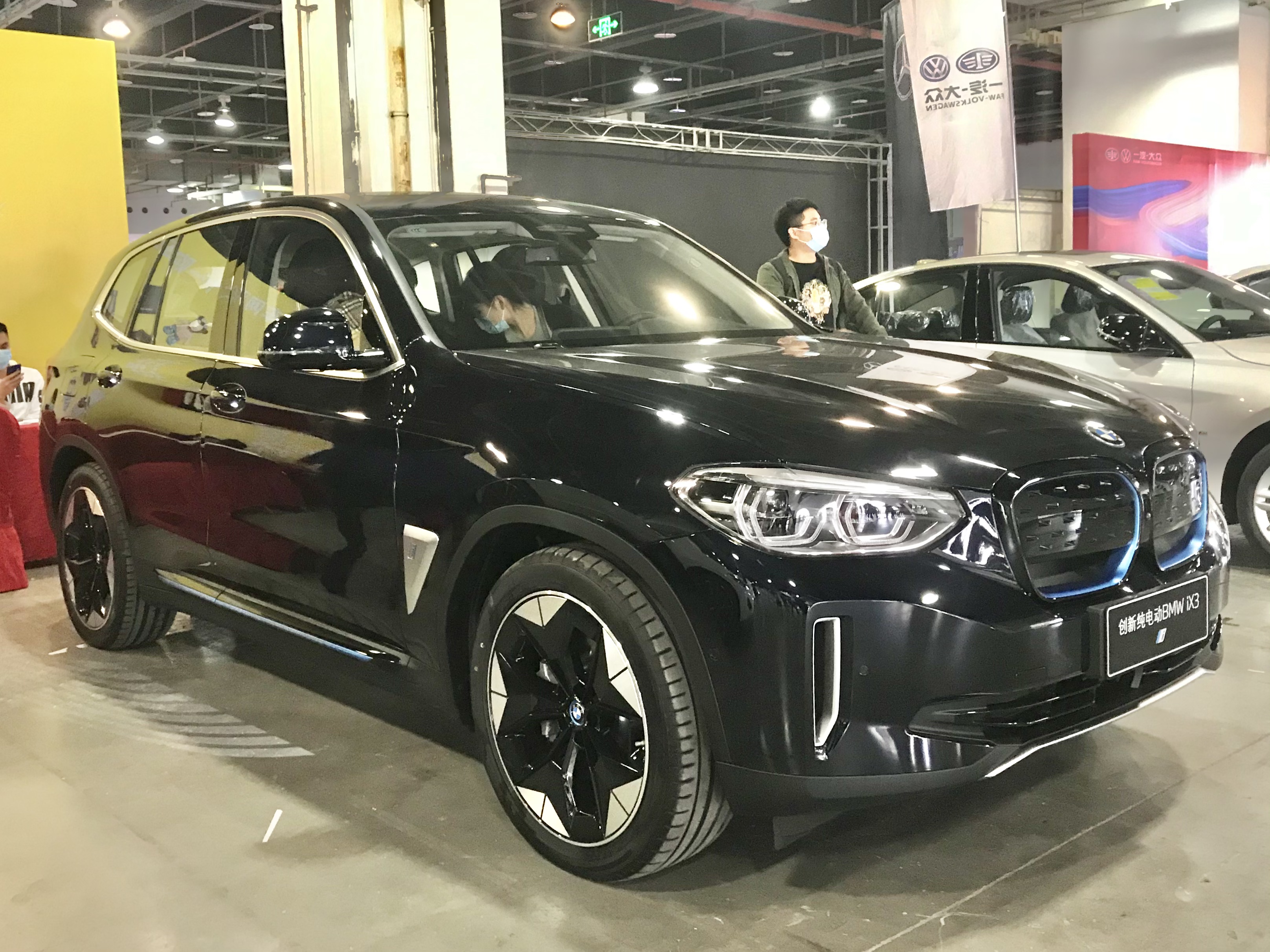
Ix3S
"... perspective, I think, you know, BMW is all in on IX3s and everything else. I think I'd be astonished if..."
The BMW iX3 is an electric SUV. It’s meant to be a practical size for everyday driving, but powered by electricity. The podcast mentions it to talk about BMW’s plans for electric SUVs.
The BMW iX3 (G08) is an electric version of BMW’s X3-sized SUV platform. In the podcast, it’s referenced as part of BMW’s electric commitment—specifically mentioning that BMW is “all in” on iX3s and related EV plans. That’s why it comes up: it’s a key model in BMW’s current and near-term electric SUV strategy.

Bmw M1
"But do you like it? Do you like the [2636.0s] look of it? I kind of do. I mean, I'm definitely picking up, you know, some DNA of BMW M1 and [2643.0s] M1 Pro car and a little bit of, you know, eight series, you know, old, you know, 850. I'm getting"
The BMW M1 is an older, very special BMW supercar that’s known for its distinctive look and racing history. The host is saying the new BMW M3 design reminds them of that classic BMW vibe.
The BMW M1 is a rare, iconic BMW supercar from the late 1970s/early 1980s, built for high-performance road use and racing heritage. The host says the new BMW M3’s styling cues are reminiscent of BMW M1 and other classic BMW designs.

BMW 8 series
"I'm definitely picking up, you know, some DNA of BMW M1 and [2643.0s] M1 Pro car and a little bit of, you know, eight series, you know, old, you know, 850. I'm getting"
The BMW 8 Series is a more upscale, long-distance BMW model line. The host is saying the new BMW M3 concept looks like it borrows some styling cues from that older 8 Series era.
The BMW 8 Series is a grand tourer line known for long-distance comfort with a sporty, upscale design. The host mentions it as part of the design “DNA” they see in the concept BMW M3’s styling.
ducktail spoiler
"It's got this kind of very sort of aggressive ducktail spoiler at the rear on the boot lid or sorry, trunk lid, which looks, which I think that looks looks quite cool."
A ducktail spoiler is a rear wing shape that sticks up a bit at the back. It helps the car feel more planted at higher speeds by using airflow to push the tires down.
A ducktail spoiler is a small, upward-curving rear spoiler shape that helps generate aerodynamic downforce. On a car, it can improve stability at speed by increasing the amount of force pushing the rear tires onto the road.
heat extractor
"You've got a big intake on top of the hood. Yeah, more of a heat extractor, but on an EV, I don't know."
A heat extractor is a vent that helps get hot air out of the car. Even electric cars need cooling for the battery and electronics, so vents can help keep temperatures under control.
A heat extractor is an opening or duct designed to vent hot air from the engine bay or other heat-soaked areas. Even on an EV, there’s still significant thermal management for components like battery packs and power electronics, so designers may use hood openings to help move heat out.
downforce
"That could just be part of adding some downforce to the front end, have it go through the bottom of the grille and then through and out through that, that heat extractor on the hood wouldn't be heat necessarily, but pushing that front end down."
Downforce is the “pressing down” effect from the car’s shape and airflow. It helps the tires grip the road better, especially when you’re going fast or cornering.
Downforce is the aerodynamic force that pushes a car’s tires toward the ground. More downforce generally improves high-speed grip and stability, especially in corners, because the tires can maintain better contact with the road surface.
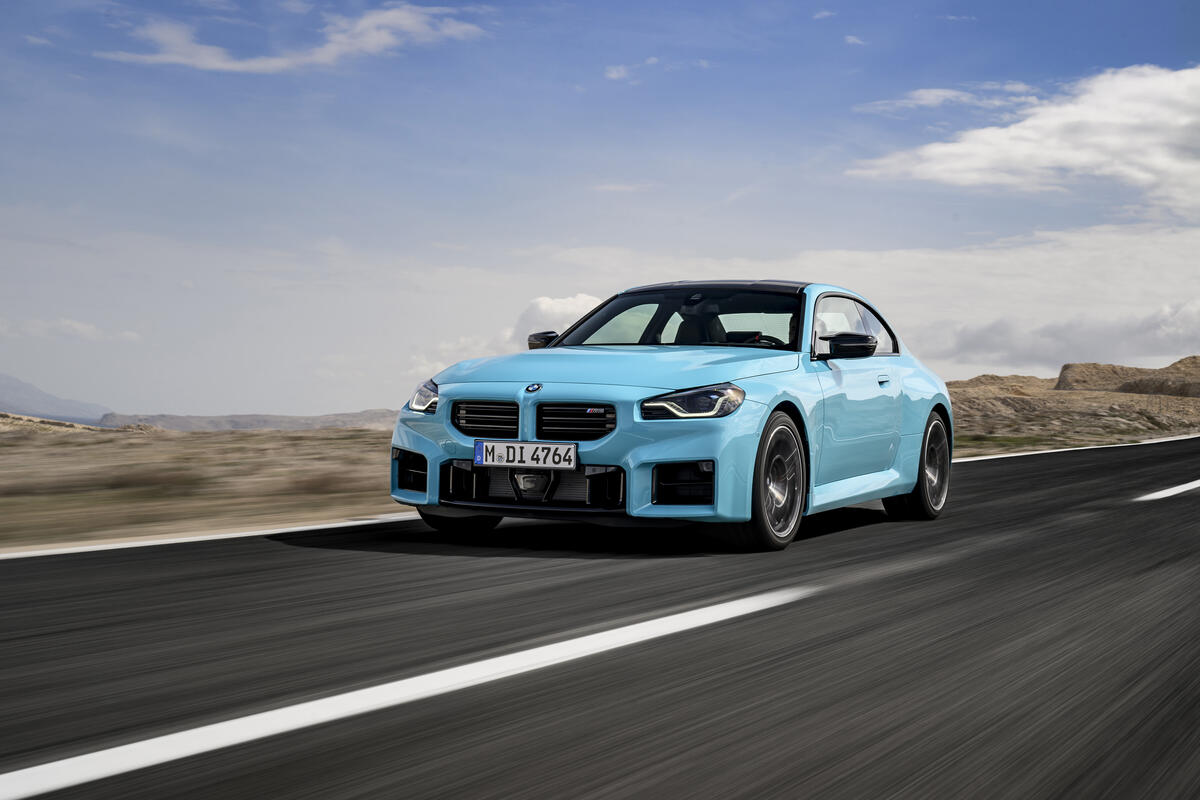
BMW M2
"...eresting. So it's, it looks a little bit like the M2, but feels at least on the pictures, looks seems ..."
The BMW M2 is a small, sporty performance car. It’s designed to feel fun and quick to drive, with a more compact shape than bigger performance BMWs. The podcast brings it up because the car being discussed seems to share some of that look, even if it feels different.
The BMW M2 is a compact performance coupe built to deliver a more focused, driver-oriented experience than larger M models. The podcast notes it looks similar to the M2 but “feels” different based on what’s shown, which suggests the conversation is about comparing performance character and design cues. It’s mentioned as a reference point for sporty styling and compact athleticism.
race harnesses
"But again, you've got, I mean, the concept cars got bucket seats with race harnesses. But if you ditch the race harnesses, you pretty much got the interior..."
Race harnesses are stronger, multi-point seat belts used in track cars. They keep the driver held in place better during hard turns and braking.
Race harnesses are multi-point seat belts designed to restrain the driver more securely during high lateral loads. They’re commonly used with bucket seats in track-focused cars because they reduce the driver’s movement and help maintain proper posture under braking and cornering.
bucket seats
"But if you ditch the race harnesses, you pretty much got the interior and, you know, lots of M car cues and the colouring and everything else. But again, you've got, I mean, the concept cars got bucket seats with race harnesses."
Bucket seats are shaped to “hug” you more than regular seats. They help keep you in place during aggressive driving, and they’re common in race-inspired cars.
Bucket seats are deeply contoured seats that hold the driver and passenger more firmly than flat, wide seats. In performance concepts, they’re often paired with racing-style harness setups to reduce body movement during hard cornering.
trapezoidal screen
"But again, you've got that kind of weird trapezoidal screen that every X3 and three series will have dials along the top."
A trapezoidal screen is just a dashboard display that has an angled, non-rectangular shape. It’s a design choice that changes how the cockpit looks and where the information sits.
A trapezoidal screen refers to a display shape that’s wider at one end, giving it a distinctive angled profile. In modern BMW interiors, this kind of layout is often part of the driver-focused cockpit design and can house instrument and infotainment elements.
rev counter
"You know, you're not going to have a big rev count. And I mean, it's a bit of a shame you have the rev counter in the same way on the, on the gas car."
A rev counter tells you how fast the engine is spinning, usually shown as RPM. EVs don’t work the same way as gas engines, so having a rev-style gauge can feel a bit out of place.
A rev counter (tachometer) shows engine speed in revolutions per minute (RPM). It’s a familiar gauge in gasoline cars, but EVs typically don’t need it in the same way, so using an EV display layout that still resembles a gas-car tach can feel odd to some drivers.

Neuer Class
"...o say that of all the, you know, I quite like the Neuer class design stuff. And I looked at this and thought, y..."
Neue Klasse is BMW’s new approach for future cars, including how they’re designed. The podcast mentions it because the speaker thinks the new design direction looks good. It’s more about the platform and styling direction than one specific vehicle you can buy today.
Neue Klasse refers to BMW’s new vehicle platform and design direction, which the podcast describes as having a distinct design style. It’s discussed because the speaker “liked” the design direction and used it as a reference point for what BMW is aiming to build next. In short, it’s a topic about the brand’s future architecture and look, not a single finished car model.
sleepers
"Is this going to be the design language for the three series and four series? Or is this meant to really look different so you don't confuse, you know, a three series with an M3? No, I've already seen that the three series is going to, this is the three series with, it's got, it's, it's had its testosterone or it's been on the, it's been juiced, as they say. [2788.5s] Is this going to be the design language for the three series and four series? Or is this [2794.8s] meant to really look different so you don't confuse, you know, a three series with an M3? No, I've already seen that the three series is going to, this is the three series with,"
A “sleeper” is a car that doesn’t look like a super-fast performance car, but it actually is. The speaker is saying the M3s they’re talking about weren’t really that kind of disguise—they were more understated than flashy.
A “sleeper” is a car that looks ordinary but is actually very fast or performance-focused. The speaker says the older M3s weren’t really sleepers because they still had an M-car presence, just more subtle than today.

BMW E30
"...subtle. I think there's a little bit, even of the E30, which was the famous late 80s, which had the fle..."
The BMW 3 Series is a compact luxury car. It’s often talked about because it’s meant to drive in a sporty way while still being practical. The podcast brings up an older 3 Series to reference the kind of look or vibe people remember.
The BMW 3 Series is a compact luxury sedan known for balancing everyday usability with sporty driving dynamics. The podcast references the E30, a late-1980s 3 Series, to highlight design or character elements that enthusiasts associate with the model line. That’s why it’s mentioned: it connects modern styling or feel back to a famous earlier version.

BMW M5
"...pe it's not too complicated. Like you look at the M5, too much going on. Yeah. I think there's a time ..."
The BMW M5 is a powerful, performance-focused luxury sedan. It’s meant to be fast and exciting to drive, not just comfortable. The podcast mentions it to describe how its performance can feel manageable rather than overly complicated.
The BMW M5 is the high-performance version of the BMW 5 Series, built for drivers who want strong power and fast acceleration in a luxury sedan. The podcast notes that it’s not “too complicated,” which points to how the car’s performance can be approachable compared with some other extreme performance cars. It’s discussed as a benchmark for serious performance without overwhelming complexity.
goat modes
"Right. Yeah. It's interesting because even on, I don't know, some of like Ford's off-road vehicles with their goat modes and it has like trail and sand and rock and, and, and even then too many people were asking like, what mode do I put it in when I'm on this? So they simplified that whole"
“Goat modes” is a slang way of referring to selectable drive modes on off-road vehicles (like sand/rock/trail). The speaker’s point is that too many mode choices can confuse drivers—especially when they just want the car to handle the situation without thinking.

Ford Bronco
"...re trying to get new people into something like a Bronco and go, hey, you should start going off-road. You..."
The Ford Bronco is an SUV built for off-road driving. It’s designed to handle rough roads and trails better than many regular SUVs. The podcast mentions it because it’s being used to bring new people into off-roading.
The Ford Bronco is a rugged SUV designed for off-road capability and outdoor use. In the podcast context, it’s discussed as a way to attract new buyers into off-roading—essentially encouraging people to start using the vehicle for trails and rougher roads. That makes it relevant because it’s not just a city SUV; it’s marketed around capability.
M1
"and that there's an M1, there's an M2 and what does it mean? And you got a program stuff and you can set like, it was interesting because"
On some BMW M cars, M1 and M2 are buttons that save your favorite driving settings. Pressing them lets you switch setups quickly.
On many BMW M cars, M1 and M2 are preset buttons that let you store and instantly recall specific driver settings. The idea is to make it quick to switch between different configurations without digging through menus.

Toyota Prius
"we've owned a whole bunch of hybrids over a 20 year period starting with the original Prius"
The Toyota Prius is a hybrid car that became famous for saving gas. The host is using it as the first example in a long-term test of whether hybrids actually meet the official mileage numbers.
The Toyota Prius is the best-known mass-market hybrid, originally popularized for combining a gasoline engine with an electric motor to improve fuel economy. The host uses the “original Prius” as the starting point for a 20-year comparison of whether real-world hybrid mileage matches EPA estimates.
EPA
"Not one of them has hit its EPA, average fuel consumption, and most of them have been a long way off"
EPA is the U.S. agency that sets the official fuel-economy test results you see on labels. The hosts are saying their real-world driving often gets worse mileage than the EPA estimate.
EPA refers to the U.S. Environmental Protection Agency’s fuel-economy testing and published ratings. In this segment, the hosts argue their real-world hybrid testing often doesn’t match the EPA average fuel consumption numbers.

Honda Civic
"So even if you look at the 25 Civic hybrid, which, you know, was a Edmunds top radar, best, the best, the best winner, great car. You know, that's done 41 miles to gallon up"
The Honda Civic Hybrid is a Civic that uses a hybrid system to help save gas. The host is saying even with a popular hybrid like this, real mileage may not match the official EPA number.
The Honda Civic Hybrid is a fuel-sipping version of the Civic line that’s designed to improve efficiency with hybrid power. The host cites it as an Edmunds top pick and then compares its real-world mileage to EPA expectations.

Ford Maverick
"and this is like running it for 20,000 miles and living with it day to day. Ford Maverick 33 against 37."
The Ford Maverick is a small pickup truck. The host mentions it because even in a hybrid setup, the real gas mileage may not line up with the EPA estimate.
The Ford Maverick is a compact pickup that’s offered with hybrid powertrains aimed at better fuel economy than typical trucks. In this segment, it’s used as another example where real-world mileage differs from EPA targets.

Grand Highlander
"same Grand Highlander Hyundai Santa Fe hybrid. I'm not a fan of the EPA stuff generally"
The Toyota Grand Highlander is a bigger family SUV. The host brings it up to say that real-world gas mileage for hybrids may not match the EPA numbers you’d expect.
The Toyota Grand Highlander is a larger Highlander-family SUV that can be offered with hybrid configurations. The host mentions it alongside other hybrids to argue that real-world fuel economy often doesn’t reach EPA averages.

Hyundai Santa Fe hybrid
"same Grand Highlander Hyundai Santa Fe hybrid. I'm not a fan of the EPA stuff generally"
The Hyundai Santa Fe Hybrid is a family SUV that uses a hybrid system to save gas. The host is using it as another example where real mileage can be worse than the EPA estimate.
The Hyundai Santa Fe Hybrid is a hybrid version of Hyundai’s midsize SUV, aimed at improving fuel economy while keeping family-friendly practicality. In this segment, it’s part of the host’s argument that EPA fuel-economy expectations don’t always match what people see in everyday driving.
fuel consumption
"But I tend to find a lot of the fuel consumption or the hybrid seats, it's, you know, you're really struggling to ever match what it's claiming."
Fuel consumption is basically how much gas the car uses. The hosts are saying the car may use more fuel in real life than the official test suggests.
Fuel consumption is how much fuel a vehicle uses over a given distance or time, often expressed as MPG (miles per gallon) in the U.S. This segment emphasizes that real-world fuel consumption can be higher than what standardized test cycles predict, especially when driving conditions differ from the test.
real world range test
"What's the difference between, let's say, the Edmunds real world range test versus the EPAs? What the EPA does? ... These figures that we're talking about here are actually more about, we've owned it for a year, and this is where it's landed."
A real-world range test tries to measure how far the car goes in everyday driving, not just in a lab. The idea is to see what you’d likely experience day to day.
A real-world range test is an evaluation method that measures how far a vehicle actually goes under typical driving conditions, rather than under lab-controlled rules. In this discussion, the hosts contrast it with EPA testing by using a specific route and then reporting what happened over real ownership mileage.
60% town, 40% highway
"We actually do a specific route, 60% town, 40% highway, and that's really simulating worldwide driving."
That phrase is a way of describing a driving route mix: more city driving than highway. Since city driving uses energy differently (more stops), the split helps the test match how people actually drive.
“60% town, 40% highway” describes a test route weighting that mixes urban driving with faster highway driving. Because stop-and-go traffic and speeds affect energy use, this kind of split is meant to better represent everyday mixed driving than a single steady-speed run.
Request an Explanation
Heard something you'd like explained? We'll add it to this episode.
Sign in to request explanations for terms you heard.
Want to learn more?
Browse our glossary for plain-English explanations of automotive terms, jargon, and concepts.
Help improve this episode
See something that's not quite right? Our annotations are AI-generated and can sometimes miss the mark. Click the flag icon on any annotation to suggest a correction.
1 community members have helped improve this episode.