Changing and Filling Fluids, Oil Change Frequency, Airflow Issues
About this episode
Fluid maintenance and routine inspections take center stage here, with practical advice on transmission service, oil-change timing for low-mileage vehicles, and the difference between timing chains and timing belts. The conversation also touches on diagnosing odd warning lights after a rough-road event, plus a simple caution for cleaning radiator debris without causing damage. Along the way, the mechanic emphasizes that age and time matter just as much as mileage for several maintenance items.
Changing and Filling Fluids
"Wonder how many folks remember polishing chrome? Good morning to you next awful ASC certified technician from Lloyd's automotive back... If ask Nick, please if you could tell what problems you could see if a transmission fluid is old or needs changing."
They’re talking about keeping car fluids fresh. The main example is transmission fluid, and they also mention getting an oil change.
This segment focuses on fluid maintenance—specifically when to change fluids and how to recognize when a fluid is getting old. It’s centered on transmission fluid as a key example, with oil change timing also mentioned.
oil change
"I gotta give Lloyd's a call too. I'm gonna get another oil change. It comes up. It seems to come up rather quickly"
An oil change swaps dirty engine oil for clean oil. Clean oil helps the engine run smoothly and reduces wear over time.
An oil change replaces used engine oil with fresh oil to maintain lubrication and protect engine wear. Oil also helps carry away heat and contaminants, so changing it on schedule is key to long-term engine health.
transmission fluid
"If ask Nick, please if you could tell what problems you could see if a transmission fluid is old or needs changing. What what kind of are there any telltale signs that you may need some transmission help?"
Transmission fluid is the “oil” that keeps your transmission working smoothly. If it gets old, the car may shift harder, feel jerky, or take longer to go into gear.
Transmission fluid lubricates the transmission’s internal moving parts and helps transfer hydraulic pressure for shifting. Over time it can break down, lose its ability to lubricate, and cause rough shifting or delayed engagement.
hesitation or slipping or delayed engagement (signs of fluid issues)
"Well, if you're not noticing any kind of drag mobility concern any kind of hesitation or slipping or [137.6s] Affirm engagement something different, you know, we talked about that often if you notice something that's changed and different than it used to be"
If your car hesitates, slips, or feels like it takes a moment to “catch” when shifting, it can be a sign something in the drivetrain isn’t working right. Old or low fluid is one possible cause.
Hesitation, slipping, and delayed engagement are drivability symptoms often associated with degraded transmission fluid or other transmission-related problems. They can indicate that the transmission isn’t responding as quickly or transferring power as effectively as it should.
fluid becoming discolored dirty / used up (fluid life cycle)
"I would say under regular maintenance that the fluid is becoming discolored dirty [151.2s] It's starting to get a little bit of a tingy smell to it. It's telling us that it's been used up. It's had its life cycle [156.8s] It's time to replace a fresh clean fluid"
The “life cycle” of a fluid refers to how long it can perform its job before it degrades. Discoloration, dirt, and odors are common signs that a fluid has accumulated contaminants and lost effectiveness, which can affect lubrication and hydraulic performance.
fill plug
"Some have a fill plug, you know, there's a variety of ways that it's done [169.8s] And in some cases we just have to go by the the interval the mileage interval or the time interval"
Some cars don’t have a dipstick. Instead, they use a plug where you add fluid, and the correct level may depend on the car’s setup.
A fill plug is an access point used to add or check certain fluids on vehicles that don’t use a dipstick. Many modern designs require checking at a specific temperature or vehicle position to ensure the correct level.
mileage interval or time interval for fluid service
"And in some cases we just have to go by the the interval the mileage interval or the time interval [174.8s] and say okay [174.8s] It's been X amount of time X amount of miles this or this fluid services do"
Car maintenance schedules are often based on how many miles you drive and/or how many months or years have passed. Even if you don’t drive much, fluids can still wear out over time.
Fluid service schedules can be based on mileage (how far you drive) and/or time (how long the fluid has been in use). This matters because fluids degrade from both contamination and aging, even if the vehicle doesn’t rack up many miles.
brake fluid
"But the transmission fluid brake fluid power steering fluid some of these other fluid services kind of get forgotten from time to time"
Brake fluid is what makes your brakes work when you press the pedal. Over time it can pick up water, which can make braking less effective.
Brake fluid transfers force from the brake pedal to the brake calipers or drums. It can absorb moisture over time, which can reduce braking performance and contribute to corrosion inside the brake system.
power steering fluid
"But the transmission fluid brake fluid power steering fluid some of these other fluid services kind of get forgotten from time to time"
Power steering fluid helps make steering easier. If it’s not in good shape, steering can feel harder than it should.
Power steering fluid helps provide hydraulic assistance for steering. If it’s low, dirty, or degraded, steering can feel heavy or may develop noise and other drivability issues.
100,000-mile fluid service expectations (age + mileage)
"Is just touch over 95,000 miles, but I know [217.6s] It's never been, you know, the transmission fluid has never been changed [220.6s] Might it be a good idea to do that now or give or take what wouldn't do a vehicles? [233.7s] Well, it seems pretty typical usually in that hundred thousand mile interval range. Maybe it's 90 maybe it's 105 up to 120 [241.3s] depends on the make and model, but there's a fairly"
The hosts are basically saying that many cars need certain fluids changed somewhere around the 100,000-mile mark, but it depends on the car. If your vehicle is getting older and you haven’t changed a fluid, it may be time to consider it.
The segment discusses how many vehicles are typically serviced around the ~90,000–120,000 mile range for certain fluids, but exact intervals vary by make and model. It highlights that both vehicle age and mileage influence when fluid replacement becomes due.
spark plugs
"Inspection and services might be spark plugs and might be fluid services. But usually around that time frame of a vehicle there tends to be a larger Service inspection and services that are recommended."
Spark plugs are small parts that help your engine start and run smoothly. If they get worn out, the engine can start to run rough or misfire, so mechanics check them at regular service intervals.
Spark plugs ignite the air-fuel mixture in an engine’s cylinders. Over time they wear and can cause misfires, rough running, and reduced fuel economy, which is why they’re often checked during scheduled maintenance.
maintenance interval
"Hey mentioned, you know, what was my next maintenance interval or service do they can look in the Online or look at the technical information find that Inspection for you share that with you."
A maintenance interval is the planned schedule for things like oil, fluids, and inspections. Following it helps prevent small issues from turning into expensive repairs.
A maintenance interval is the scheduled time or mileage window when specific services are recommended. It’s based on manufacturer guidance and helps ensure wear items like fluids and filters are handled before they cause bigger problems.
warranty purposes
"Absolutely, you know for warranty purposes, obviously, but also for the recommendations, you know, we Are I feel like I do a really good job inspecting vehicles."
Warranty purposes means you keep records of what work was done and when, so the manufacturer can honor coverage if there’s a problem. It often matters that maintenance was done on schedule.
Warranty purposes refers to keeping documented service records so repairs and coverage can be supported if something fails. Many warranties require proof of maintenance performed within specified intervals.
deferred maintenance
"We may have some recommendations that are deferred meaning that, you know, you don't need your tires or brakes quite yet But we should really look at it in this time frame."
Deferred maintenance is when a mechanic says, “This isn’t urgent today, but you should plan for it soon.” They keep an eye on it so it doesn’t become a bigger problem later.
Deferred maintenance means postponing a recommended service that isn’t urgent right now. It’s often still tracked and revisited because delaying can increase wear or lead to more expensive repairs later.
transmission filter
"Do you recommend changing the filter when doing the transmission fluid change?"
A transmission filter is like a screen that catches dirt in the transmission fluid. When you change the fluid, replacing the filter (when applicable) can help keep the transmission cleaner and shifting smoother.
The transmission filter helps trap debris and contaminants in the fluid. Whether it should be replaced during a fluid service depends on the transmission design and service procedure, but many services include filter replacement to keep the system clean.
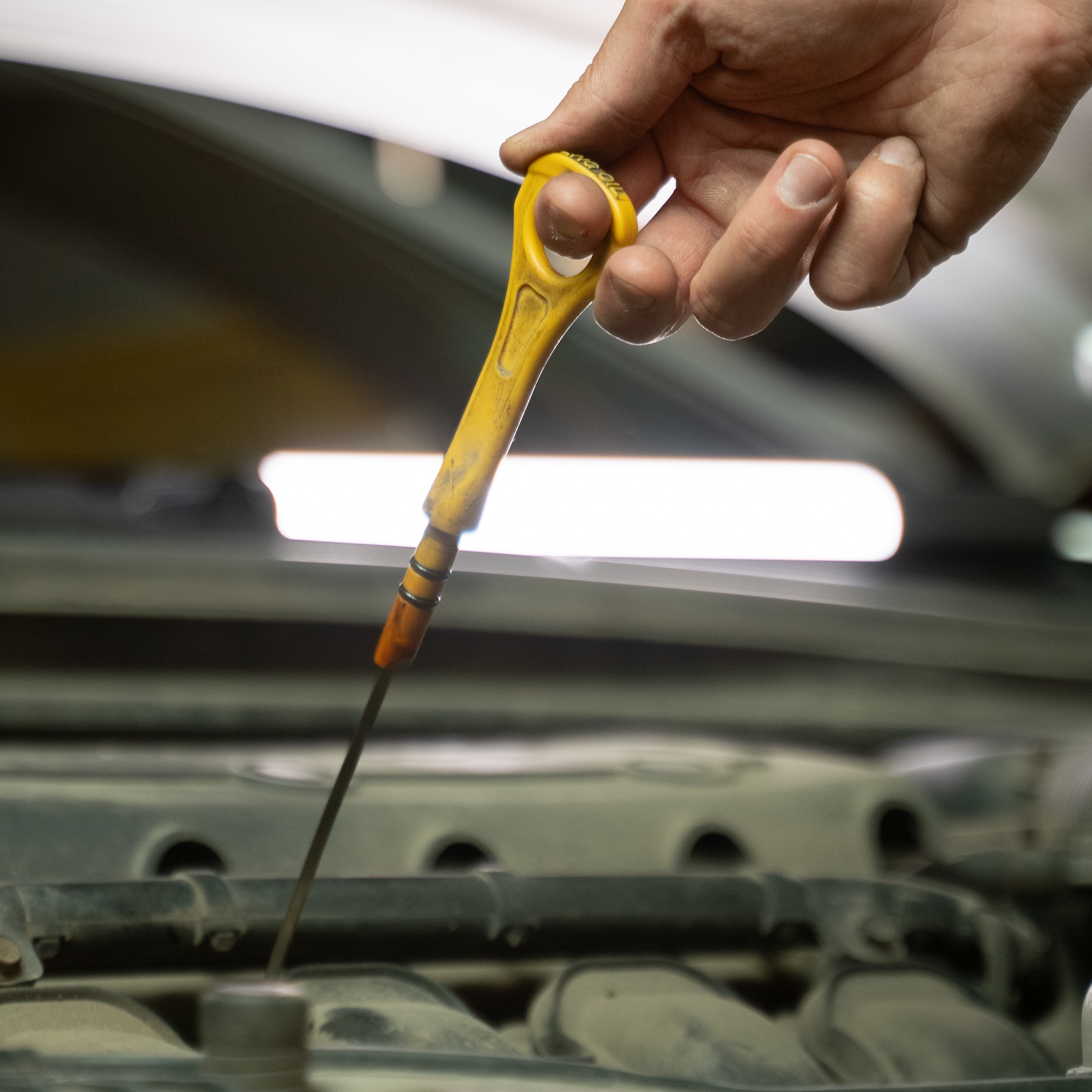
dipstick
"And I get a minimum and a maximum reading on the dipstick depending which way I put it in which reading is correct... you check the dipstick it might say needs to be warm engine obviously want a flat surface... read the manual figure out the proper way of checking it make sure you clean the dipstick clear fully so when you put it back in you're not getting any residual fluid on that dipstick."
A dipstick is a stick you pull out to see how much fluid is in the car. The reading can be wrong if the engine isn’t warm or if the car isn’t sitting level. That’s why you should follow the manual for exactly how to check it.
A dipstick is the handheld gauge used to check fluid level in engines and some transmissions. The correct reading depends on factors like whether the fluid is warm and whether the vehicle is on a level surface. Always follow the manufacturer’s instructions for how to insert and read it.
drain infill
"I would say the most common service these days when vehicles on the road now would be a drain infill... So essentially pulling the lower drain plug out... You recoup all the fluid and then you refill it with the appropriate amount... But I would say the most common practice would be a drain infill"
A drain-and-fill (often shortened to “drain infill”) replaces transmission fluid by draining the pan area and refilling with the correct amount. It typically exchanges only a portion of the total fluid, but it’s the most common service method for many vehicles. It’s different from full flushes that circulate fluid through the system.
CVT
"A texture says this as this does a modern CVT the transmission use fluid only or are there belts as well?... There would be a fluid service only if there is a Failure there's belts and other components in that require for repair but as far as the maintenance schedule It's just giving me the fluid change"
A CVT is a type of automatic transmission that doesn’t use fixed gears like a traditional automatic. Instead, it uses a belt system to change the ratio smoothly. Most of the time, maintenance is mainly about using the right fluid and changing it on schedule.
CVT stands for continuously variable transmission, which uses a belt-and-pulley style system to smoothly vary gear ratios. Because of that design, CVTs rely heavily on the correct fluid type and service intervals. Many CVTs are “fluid service only” under normal maintenance, while belt-related work is typically repair-driven rather than routine.
wheel bearings packed
"Texture says I have an old car that needs the wheel bearings packed. Does Lloyd still do that?"
Wheel bearings help the wheels spin smoothly. On some older cars, the bearings are greased by hand (“packed” with grease). On many newer cars, the bearings are sealed, so you usually replace them instead of repacking them.
“Packing” wheel bearings refers to manually packing grease into the bearing assembly, a method used on some older or non-sealed bearing designs. Many modern vehicles use sealed bearings that don’t get repacked—maintenance is typically inspection and replacement if there’s play or noise. Whether packing is applicable depends on the bearing design.
ASC certified technician
"And welcome back to CCO's car care show Denny along here along with ASC certified technician Nick Stoffel from Lloyd's on a mode of [521.0s] Which Nick is located where and how do we get in touch with you guys if we need your help?"
“ASC certified” means the technician has training and credentials in automotive service. It’s a way of saying you’re talking to someone who’s qualified to help with car maintenance questions.
“ASC certified” refers to a technician certification program (commonly tied to automotive service training and standards). In this context, it’s used to establish that Nick Stoffel is qualified to advise on car-care topics like fluid service and bearing maintenance.
Lloyd's automotive
"Denny along here along with ASC certified technician Nick Stoffel from Lloyd's on a mode of [521.0s] Which Nick is located where and how do we get in touch with you guys if we need your help? [525.6s] Yes, Danny as you know"
Lloyd’s Automotive is the local shop the technician works for. The show is telling listeners where to call or go if they have questions about car maintenance.
Lloyd’s Automotive is the shop the technician (Nick Stoffel) is associated with in the show segment. The hosts are directing listeners to the shop for car-care advice and service.
repack wheel bearings
"But I wanted to go back to because we missed the the answer on the wheel bearings does Lloyd's Still repack wheel bearings [568.7s] We do there's not very many vehicles out there with them"
Repacking is basically refreshing the grease inside the wheel bearing. On some older cars, you can open them up and put in new grease, but on many newer cars the bearings are sealed and you replace the whole unit instead.
Repacking wheel bearings means removing the old grease, inspecting the bearing and seals, then packing it with fresh grease. It’s typically associated with older or serviceable bearing setups; many modern vehicles use sealed bearings that are replaced rather than repacked.
preload
"...you can still pack wheel bearings and redo the seals and preload them and you know get that older vehicle or trailer back on the road."
Preload is how tightly a bearing is adjusted. If it’s set wrong, the bearing can wear out quickly or start making noise. That’s why correct adjustment matters when servicing bearings.
Preload is the controlled amount of tightness or end-play adjustment applied to a bearing assembly. Proper preload helps bearings run smoothly without excessive friction or premature wear; incorrect preload can cause noise and overheating.

Ford Fusion
"I've got a 2017 Ford Fusion v6 with 120,000 miles a half a year ago the turbo went out... Now it's developed a loud knock..."
They’re talking about a 2017 Ford Fusion V6 with 120,000 miles. After the turbo failed once, it now has a loud knocking sound, so the engine may have another problem that needs checking before spending money on a replacement engine.
The caller describes a 2017 Ford Fusion with a V6 and about 120,000 miles. They report a prior turbo failure and now a loud knock, which raises concerns about possible internal engine damage or an oiling problem affecting the turbo and engine components.
turbo
"...the turbo went out so that was a very expensive fix... Determine what that knock is... the turbo was replaced... I suspect that there's some oil flow issues..."
A turbo is a device that uses exhaust gases to spin a compressor and push extra air into the engine. If the turbo breaks, it can sometimes cause oil problems, and that can lead to other engine issues too.
A turbocharger uses exhaust energy to force more air into the engine, improving power and efficiency. When a turbo fails, it can also affect oil flow and introduce contamination, which may contribute to new noises or damage elsewhere in the engine if the root cause isn’t addressed.
loud knock
"Now it's developed a loud knock... It sounds like it's... More on the top of the motor than it would be a connecting rod..."
A knock is a harsh, metallic sound from the engine. It usually means something inside isn’t happy—like worn parts or abnormal combustion. Because it can be expensive, it’s best to figure out where the sound is coming from before driving or replacing parts.
A loud knock is an abnormal impact-like sound that can indicate serious engine problems, such as bearing wear, detonation (spark knock), or damage to internal components. The host notes the sound seems more like it’s coming from the top of the engine than a connecting rod, but the exact source needs diagnosis.
oil flow issues
"...I suspect that there's some oil flow issues... Maybe some some build up or some restriction somewhere which could also lead to this noise that we're having now..."
Oil flow issues mean the engine isn’t getting enough clean oil to the parts that need it. When that happens, parts can wear faster and start making bad noises. It’s important to find the blockage or cause before continuing repairs.
Oil flow issues mean the engine isn’t delivering oil where it needs to go at the right rate/pressure. Restricted passages, sludge buildup, or a failing oil pump can reduce lubrication and cause noisy operation and accelerated wear, including problems related to turbo lubrication.
used engine risk
"And when you go by a used engine, you never know what you're buying. So it's always a risk in that that path also..."
A used engine might look fine from the outside, but you can’t really know how healthy it is internally. The host suggests diagnosing your current engine first so you don’t replace it with another problem.
Buying a used engine is a gamble because you can’t fully verify its internal condition without teardown. The host emphasizes that even if you find a replacement in a yard, you may still be purchasing unknown wear or hidden damage, so diagnosing the current engine first can prevent repeating the same failure.
Variable speed
"Well, a lot of fans have Variable speed so if it sees the heat or sees an issue where it needs a little more air flow, it's going to increase that speed"
Some cars have cooling fans that don’t just turn on/off—they can speed up or slow down. The car does this automatically to keep the engine and other systems at the right temperature.
Variable-speed cooling fans can change their motor speed to match engine heat load. Instead of running at one fixed speed, they ramp up when sensors detect higher temperatures or when extra airflow is needed (for example, during warm-up or when the air conditioning is used).
air conditioning
"As it warms up or gets humid we turn on our air conditioning a lot times those fans will cycle They will cycle for that."
Using the A/C makes the car work harder and creates extra heat. Because of that, the cooling fan may turn on more often, especially when it’s humid.
When the air conditioning (A/C) is turned on, it increases the engine’s workload and often adds heat that must be managed by the cooling system. That’s why cooling fans may cycle more frequently and can sound louder during humid conditions or after the A/C is engaged.
bleed the brakes
"Good morning. Texture says I have a 2011 RX 350 Lexus and I want to bleed the brakes [851.0s] Is the same way as older brake systems where you clean the reservoir?"
Bleeding the brakes means pushing out air bubbles from the brake fluid lines. Air makes the brake pedal feel spongy, so bleeding helps the brakes work the way they should.
“Bleeding the brakes” removes trapped air from the brake hydraulic system. Air compresses, which can cause a soft pedal and reduced braking performance, so the goal is to replace old fluid and ensure only fluid (not air) moves through the lines.

2011 RX 350 Lexus
"Good morning. Texture says I have a 2011 RX 350 Lexus and I want to bleed the brakes [851.0s] Is the same way as older brake systems where you clean the reservoir?"
A Lexus RX 350 is the specific car being worked on. Brake bleeding is the process of removing air from the brake lines so the pedal feels firm and braking is consistent. Newer cars can require slightly different steps, so it’s smart to follow the right instructions for that exact vehicle.
The Lexus RX 350 is a mid-size luxury SUV, and the 2011 model year uses a modern hydraulic brake system that can be bled using the same basic principles as older cars. However, newer anti-lock braking and stability systems can change the exact bleeding steps, so the procedure may differ from older “just bleed at the calipers” methods.
bleeder valve
"Put in fresh fluid pump pump pump the brakes and then open up the bleeder valve and start from the furthest [862.3s] Bleeder valve and work toward the master cylinder"
The bleeder valve is a little screw on the brake hardware that you open to let fluid (and air) come out. It’s how you “purge” the brake lines during bleeding.
A bleeder valve (often on each caliper or wheel cylinder) is the small fitting used to release fluid during brake bleeding. The technician opens it while pumping the brake pedal (or using a vacuum/pressure method) so air and old fluid can be expelled in a controlled way.
bleeding order (furthest wheel toward the master cylinder)
"Put in fresh fluid pump pump pump the brakes and then open up the bleeder valve and start from the furthest [862.3s] Bleeder valve and work toward the master cylinder"
When you bleed brakes, you usually start at the wheel farthest from the master cylinder. That helps the air get pushed out of the lines in the right direction so the whole system ends up bled properly.
Brake bleeding is typically done in a specific order so air is pushed out efficiently from the longest/most distant lines first. The “furthest wheel first, then work toward the master cylinder” guidance helps ensure the system is fully purged and reduces the chance of leaving air pockets behind.
follow the vehicle-specific brake bleeding procedure (manual/research)
"So look your vehicle up or find the manual for your vehicle specifically make sure that that procedure stays the same [888.3s] I believe it is but you need to do you do diligence and I commend you for doing your own your own work."
The speaker emphasizes that while there’s a general brake bleeding technique, newer vehicles may have variations due to ABS/traction control hardware. Using the owner’s manual or service information for the exact make/model helps ensure the procedure matches that vehicle’s brake system design.
ABS
"You know some of the ABS traction control systems [878.8s] There's a little bit different variation in the procedure"
ABS is the system that helps prevent the wheels from locking up when you brake hard. Since it has extra parts in the brake system, bleeding brakes on an ABS-equipped car may need the correct steps so air doesn’t remain trapped.
ABS (anti-lock braking system) helps prevent wheel lockup during hard braking by modulating brake pressure. Because ABS uses valves and a pump, some vehicles require a specific bleeding procedure to ensure air is cleared from the ABS hydraulic unit.

2016 Audi a four
"Here is another text a [1036.5s] 2016 Audi a four put 3500 miles annually [1040.9s] I only take it in once a year the fall for service. Do you think that's okay?"
They’re talking about a 2016 Audi A4. The listener asks if doing service once a year is okay when the car only drives about 3,500 miles per year.
The host is discussing a 2016 Audi A4 and how often it should be serviced. The question is specifically about whether taking it in only once per year is enough given the car’s annual mileage.
twice a year inspection
"So the reason we say, you know twice a year is a good idea is just to get our eyes on that vehicle Make sure everything's working as it should and wearing as it should."
They suggest checking the car about two times a year. The idea is to spot early problems—like something that got bent, loosened, or worn out—before it turns into a breakdown. It’s a simple way to lower the chance of being stranded.
The hosts recommend checking the vehicle about twice a year to catch early wear or looseness before it becomes a bigger problem. Regular visual inspections help identify issues caused by curb impacts, potholes, or road debris—situations that can damage components gradually. The goal is to reduce the risk of getting stranded due to a preventable failure.

Ford Taurus
"Texture ask this it's a 2015 Ford Taurus how to replace a mass airflow sensor [1098.7s] Somebody else must try it themselves"
They’re talking about a 2015 Ford Taurus and using it as an example. The car has a sensor that measures how much air is coming into the engine, and replacing it can fix certain drivability or check-engine issues.
The hosts use a 2015 Ford Taurus as the example for diagnosing and replacing a mass airflow sensor. On this kind of Ford, the sensor sits in the air intake path and helps the engine control module measure incoming air so it can calculate fuel delivery and airflow-related settings.
mass airflow sensor
"But an s a mass airflow sensors typically I'm part of the air intake So you find the air filter there's a tube that goes from the air filter to the engine midway through that tube"
The mass airflow sensor tells the engine computer how much air is getting into the engine. If it’s wrong or failing, the car may feel sluggish, idle oddly, or throw a check-engine light. It’s usually mounted in the air intake tube.
A mass airflow sensor (MAF) measures the amount of air entering the engine. Its readings are used by the engine computer to calculate fuel and optimize combustion; if it’s dirty or failing, the car can run poorly or trigger warning lights. The sensor is typically located in the intake tract between the air filter and the engine.
air intake
"But an s a mass airflow sensors typically I'm part of the air intake So you find the air filter there's a tube that goes from the air filter to the engine"
The air intake is the route air takes from the air filter into the engine. Some sensors are installed in that tube so the car can measure the air correctly. Knowing this makes it easier to find the part they’re talking about.
The air intake is the path that air takes from the filter to the engine. Sensors like the mass airflow sensor are placed in this airflow path so the engine computer can measure what’s coming in. Understanding where the sensor lives helps you locate it during troubleshooting or replacement.
timing belt
"Somebody's questioning whether they really need my timing belt and water pump replaced at a hundred thousand miles Evidently, that's what the maintenance schedule."
The timing belt keeps the engine’s moving parts timed correctly. If it breaks, the engine can be badly damaged. That’s why the car maker sets a specific mileage or time to replace it.
A timing belt synchronizes the engine’s crankshaft and camshaft so the valves open at the correct time. Many engines require belt replacement at a specified mileage/time interval; if it fails, the engine can suffer severe internal damage depending on the engine design. The discussion ties timing belt replacement to the manufacturer’s maintenance schedule.
water pump
"Somebody's questioning whether they really need my timing belt and water pump replaced at a hundred thousand miles Evidently, that's what the maintenance schedule."
The water pump moves coolant so the engine doesn’t overheat. It’s often replaced around the same time as the timing belt because it’s hard to reach later without doing similar work again. That’s why the maintenance schedule may recommend doing both together.
The water pump circulates coolant through the engine to control temperature. On many timing-belt jobs, the water pump is replaced or inspected because it’s driven by the same timing components and is labor-intensive to access later. The hosts mention it in the context of whether it should be replaced around 100,000 miles per the maintenance schedule.
follow the manufacturer's maintenance schedule
"Somebody's questioning whether they really need my timing belt and water pump replaced at a hundred thousand miles Evidently, that's what the maintenance schedule. I would assume what they're reading. What do you think about that?"
The hosts emphasize that service intervals (like timing belt and water pump replacement) are set by the manufacturer based on engineering targets and expected component life. Following the schedule helps reduce the risk of failures that can be expensive or cause breakdowns. It’s also a way to align maintenance with how long the vehicle and specific components are designed to last.
interference engine
"Timing belt were to fail and it's an interference engine. Which means that upon that belt coming apart or coming off the Develves and the pistons can collide which creates permanent damage to the engine which is repairable, but extremely costly."
Some engines are built so the valves and pistons can get very close. If the timing belt breaks, the engine timing goes wrong and the pistons can smash into the valves. That kind of damage is usually expensive to fix.
An interference engine is designed so the piston and valves share the same space in the cylinder, but at different times. If the timing belt fails and timing is lost, the pistons can hit the valves, causing severe internal damage. This is why timing-belt service intervals are so critical.
service interval / follow the interval
"So I would say yes Follow the interval some vehicles you can get a look at it some it's not as easy That's part of the reason why they create these these schedules"
A service interval is the maintenance schedule the manufacturer recommends. Parts can wear out or age even if nothing seems wrong. Sticking to the schedule helps prevent major, costly breakdowns.
A service interval is the manufacturer’s recommended schedule for maintenance tasks like timing-belt replacement. The interval exists because components degrade with time and mileage, not just when they “feel” bad. Following the interval reduces the risk of expensive failures—especially on interference engines.
timing chain
"But a timing chain Properly maintained with you know oil changes should last life of the vehicle... But a timing belt isn't gonna wear is gonna age the rubber's gonna dry up"
A timing chain performs the same job as a timing belt—keeping crank and cam timing synchronized—but it’s made of metal and typically lasts longer. Many manufacturers market timing chains as “lifetime,” meaning they’re expected to last under normal conditions, but they can still stretch or wear over time. Oil changes and correct oil viscosity are important to timing-chain longevity.

Buick Enclave
"Texture says this on our road trip our 2010 enclave hit a rough spot in the freeway and the traction control and stable track warning lights went off We kept driving another hour, but when we exited it seemed to struggle going up a slight incline"
This was a 2010 Buick Enclave SUV. After hitting a rough spot, it showed warning lights related to traction and stability. When they turned the car off and restarted it, the lights went away, which often points to a temporary problem.
The Buick Enclave is a midsize SUV, and in this story the 2010 Enclave triggered traction-control and stability-related warning lights after hitting a rough spot. Those lights can indicate the vehicle detected a loss of traction or a fault in stability/traction systems. The fact that the warnings cleared after restarting suggests an intermittent issue or sensor/glitch rather than a permanent failure.
traction control
"...the traction control and stable track warning lights went off We kept driving another hour, but when we exited it seemed to struggle going up a slight incline"
Traction control helps prevent the wheels from spinning when you’re accelerating on slippery or uneven surfaces. If the system senses a problem, it can light up a warning. Sometimes bumps or sensor glitches can cause the warning to appear.
Traction control is an electronic system that reduces wheel spin by applying brake pressure and/or adjusting engine torque when it detects slipping. Warning lights for traction control typically mean the system is active, disabled, or has detected a fault. Rough impacts can sometimes trigger sensor-related glitches that cause the system to warn.
stable track warning lights
"...the traction control and stable track warning lights went off We kept driving another hour, but when we exited it seemed to struggle going up a slight incline"
This sounds like the car’s stability system, which helps keep you from sliding or losing control. A warning light usually means the system isn’t working normally. If it goes away after restarting, it may have been a temporary glitch.
“Stable track” appears to refer to a stability-control system (often branded as stability/traction control) that helps keep the vehicle pointed in the direction the driver intends. When these warning lights come on, it can indicate the system is off or that it detected a fault. Because the lights cleared after restarting, it may have been an intermittent sensor or communication issue rather than a permanent failure.
sensors
"He hit a rough spot like they said and [1284.9s] Something got kicked up into one of the sensors or one of the readings was a skewed [1288.7s] So the computer system didn't like what it saw so as a as a default it kind of shut everything off and turn the lights on"
Sensors are the car’s “information sources” that tell the computer what’s happening. If a sensor reading looks incorrect, the car may react by turning on warning lights or changing how it drives until things look normal again.
Sensors feed real-time data to the car’s computer (engine/transmission/driver-assist systems). If something gets disturbed—like debris or a rough event causing a sensor reading to look wrong—the computer may store a fault and temporarily change vehicle behavior.
computer system didn't like what it saw so as a default it kind of shut everything off
"So the computer system didn't like what it saw so as a as a default it kind of shut everything off and turn the lights on [1294.4s] Those systems weren't operating so the car drove a little bit differently [1298.3s] You shut the vehicle off it set for a few moments you restarted it reset itself and did a self test"
If the car’s computer thinks something isn’t right, it may reduce power or disable certain systems to keep things safe. After you turn the car off and back on, it re-checks everything and may return to normal if the problem was temporary.
Modern cars use “fail-safe” or “limp” strategies when the computer detects abnormal sensor data. The idea is to protect the vehicle by limiting certain functions, then restoring normal operation after a restart and successful self-check.
self test
"You shut the vehicle off it set for a few moments you restarted it reset itself and did a self test [1304.0s] Which it does every time we start the vehicle it sees everything that it likes the lights stay off and the car runs fine"
When you start the car, it often does a quick check to make sure the sensors and computer are working right. If everything looks good, the car will run normally; if not, it may change how it drives or turn on warning lights.
Many modern cars run a self-test (often called an onboard diagnostic check) at startup. It verifies sensors and control modules are reading correctly so the vehicle can operate normally.

Chevrolet Equinox
"Text just says hi. I just bought a 2022 equinox and my daughter bought a 2019 Honda minivan [1344.4s] Both have push button starts [1346.4s] Now are we supposed to put our foot on the brake when we turn off the vehicles also or just to start getting mixed messages?"
The Chevrolet Equinox is a compact SUV. In the 2022 model, it can have a push-button start, and the listener is asking what the correct routine is for shutting it off.
The Chevrolet Equinox is a compact SUV, and the 2022 model uses a push-button start system (as mentioned in the episode). The episode question is about whether you need to hold the brake when turning it off with that system.
push button starts
"Text just says hi. I just bought a 2022 equinox and my daughter bought a 2019 Honda minivan [1344.4s] Both have push button starts [1346.4s] Now are we supposed to put our foot on the brake when we turn off the vehicles also or just to start getting mixed messages?"
Instead of turning a key, you press a button to start the car. The car usually needs to detect your key fob, and it may have specific steps for turning the car off safely.
Push-button start systems replace a traditional key turn with a button that starts the engine after the car detects the key fob. They also affect how the car interprets “on/off” requests, which is why owners sometimes wonder about brake-pedal behavior.
radiator
"And how to safely clean my radiator [1413.0s] We get this from time to time we do and it's a great question and the first thing I'm going to say is do not use a pressure washer"
Your radiator is like a heat “cooler” for the engine. It uses coolant and airflow to pull heat away—if it gets clogged with leaves or debris, the engine can run hotter than it should.
The radiator is the heat exchanger that removes heat from engine coolant before the coolant returns to the engine. Keeping it clean helps airflow through the radiator so the cooling system can do its job and prevent overheating.
pressure washer
"We get this from time to time we do and it's a great question and the first thing I'm going to say is do not use a pressure washer [1419.9s] That will tear through and create bigger problems that we don't need"
A pressure washer blasts water too hard. Around the front of the car it can bend delicate parts or push water into spots that shouldn’t get hit, which can cause problems later.
A pressure washer uses high-pressure water that can force debris and moisture into places that don’t tolerate it well. In the cooling system area, it can damage fins, seals, or electrical components and create new problems instead of solving the original clog.
garden hose
"The garden hose garden hose and kind of you know rinse it down [1427.3s] It's what we use to be honest now one thing I will say that"
A garden hose is gentler than a pressure washer. It’s usually enough to rinse off leaves and dirt so air can flow through the radiator again.
Using a garden hose is a safer, lower-pressure way to rinse loose debris off the front of the cooling system. The goal is to remove contaminants without damaging radiator fins or pushing water into sensitive areas.
cooling fan
"Sometimes depending on the amount of debris we will kind of separate the cooling fan and the condenser to give us a little more space [1436.9s] I don't expect a consumer to do that"
The cooling fan is what helps move air through the radiator when you’re not driving fast. If leaves and junk pile up in front of it, the fan can’t cool the engine as well.
The cooling fan helps pull air through the radiator when natural airflow isn’t enough, such as at low speeds or in hot conditions. If debris blocks the area around the fan and radiator, the fan can’t move air effectively, reducing cooling performance.
condenser
"Sometimes depending on the amount of debris we will kind of separate the cooling fan and the condenser to give us a little more space [1436.9s] I don't expect a consumer to do that"
The condenser is part of your air conditioning system. It also lives up front where it can get clogged with leaves, and when it’s blocked, the A/C (and engine cooling) doesn’t work as well.
The condenser is part of the A/C system and sits in front of the radiator in many cars. Debris buildup in this front area can restrict airflow to both the condenser and radiator, hurting cooling and A/C performance.
Request an Explanation
Heard something you'd like explained? We'll add it to this episode.
Sign in to request explanations for terms you heard.
Want to learn more?
Browse our glossary for plain-English explanations of automotive terms, jargon, and concepts.
Help improve this episode
See something that's not quite right? Our annotations are AI-generated and can sometimes miss the mark. Click the flag icon on any annotation to suggest a correction.