
Driven: Czinger on Track; Gunther Works F-26 in RAIN; Q&A
About this episode
A sponsor-and-giveaway opener leads into track talk that swings from Czinger’s high-downforce setup at Willow Springs to the Gunther Works F-26’s extreme aero and “echo box” cabin. The discussion gets technical—downforce, stability during throttle-to-brake transitions, shift feel in hybrid modes, and even AC compressor cutout at max throttle. Later, the Q&A pivots to auction/dealer selling, charity car-show logistics, and practical driving advice, with plenty of banter about what’s actually worth the money.
Matt Farah tells the story of driving the spaceship-like 1,200HP Czinger 21C Aero on a racetrack; he and Zack Klapman describe their morning with the terrifying Gunther Works F-26;
Patreon questions include:
Update on the Boxster/Cayman EV
Is a 100k-mile Miata worth $5k?
Was the turbo Fusion any good?
Can the Luce justify its price?
Should the Nissan Z have been a manual first?
High-end digital watches
Charity car shows: ticket price or free to enter?
The car we regret selling the most
How they set speed limits
Can I make my 2023 WRX fun?
Commuter: Civic Si or Prius?
And more!
Recorded May 29, 2026
Show Notes
Vinbidders
Smoking Tire fans get $100 off the listing price with promo code TIRE and by visiting https://vinbidders.com/tire
Go from submitting your car to a confirmed sale in under 1 week with VinBidders. And you only pay $149 if the car sells.
DeleteMe
Get 20% off your DeleteMe plan when you go to www.joindeleteme.com/ TIRE and use promo code TIRE at checkout.
Fitbod
Join Fitbod today to get your personalized workout plan. Get 25% off your subscription or try the app FREE for seven days at https://fitbod.me/TIRE
Hims
For simple, online access to personalized and affordable care for Hair Loss, ED, Weight Loss, and more, visit https://hims.com/TIRE.
Enter to WIN our AMAZING 2025 Porsche 911 Turbo S!! https://www.dreamgiveaway.com/tickets/porsche?promo=SMOKINGTIRE
Promo Code Offer: Get 4X bonus tickets with any donation of $25 or more. With every donation you are helping benefit some wonderful veterans' and children's charities.
Podcast Promo Code: SMOKINGTIRE
Want your question answered? Want to watch the live stream, get ad-free podcasts, or exclusive podcasts? Join our Patreon: https://www.patreon.com/thesmokingtirepodcast
Use Off The Record! and ALWAYS fight your tickets! Enter code TST10 for a 10% discount on your first case on the Off The Record app, or go to http://www.offtherecord.com/TST.
Watch our car reviews: https://www.youtube.com/thesmokingtire
Tweet at us!
https://www.Twitter.com/thesmokingtire
https://www.Twitter.com/zackklapman
Instagram:
https://www.Instagram.com/thesmokingtire
https://www.Instagram.com/therealzackklapman
high-downforce car
"This is the high-downforce car, so I drove and you didn't get to drive it. Did you you are you bringing it up now?"
A “high-downforce” setup means the car is designed to push down harder onto the road. More downforce usually helps the tires stick better when you’re going fast, especially on a race track.
A “high-downforce car” is set up to generate more aerodynamic downforce—extra force pushing the car’s tires into the road. That typically comes from more aggressive aero surfaces (like a larger front wing and rear wing) and is aimed at improving grip and stability, especially at speed on track.
willow springs
"I got to go drive the high-downforce car at at willow springs What a treat to have a membership there and get old-tracked to myself because the only way that"
Willow Springs is a famous race track in California where people drive cars on the track. It’s the sort of place where you can really feel how well a car grips at speed.
Willow Springs is a well-known motorsports circuit in California used for track days and testing. It’s the kind of place where aero and high-speed stability matter, so it’s a fitting venue for evaluating a high-downforce hypercar.
low drag
"“...That's the the low drag car. They called the the V max which is very pretty with the long tail. Very clean design...”"
“Low drag” means the car is designed to push through the air more easily. That can help it go faster, but it may not stick to the road as strongly as a car with more downforce.
“Low drag” means the car is shaped to reduce aerodynamic resistance as it moves through air. Less drag helps it maintain speed and reach higher top speeds, but it can also reduce aerodynamic grip compared with cars that use more aggressive downforce devices.
hard throttle to hard brake
"“...should you get the opportunity to go very very fast in the V max. When you transition from hard throttle to hard brake at high speeds...”"
This is when you go from flooring it to slamming the brakes quickly at high speed. That sudden change shifts the car’s weight and can make the back end feel lighter or less planted, depending on the aero setup.
“Hard throttle to hard brake” describes a rapid transition from accelerating to decelerating at high speed. That weight-transfer event can upset aerodynamic balance and cause the rear to lighten, especially on cars that don’t use a large stabilizing wing.
the back gets light
"“...as happens with other cars without a big fucking wing the back gets light. It's not unmanageable...”"
“The back gets light” means the rear tires aren’t gripping as firmly because the car’s weight shifts forward. It can make the car feel twitchy or less controllable until the load comes back.
When “the back gets light,” the rear axle loses normal load (how hard the tires are pressed to the road). That reduces rear traction and can make the car feel unstable, particularly during high-speed braking or throttle changes if the aero isn’t providing enough rear support.
big wing
"“...as happens with other cars without a big fucking wing the back gets light. It's not unmanageable. But it's a criticism I had of that car... Would have a big wing because they learned before that what happens without one.”"
A “big wing” is a spoiler-like aero part that helps press the rear tires to the road. The idea is that at high speed it improves stability and grip, especially when you’re changing from fast to slow quickly.
A “big wing” (rear wing) is an aerodynamic device that increases downforce and rear stability at speed. The hosts argue that race cars historically used large wings because they learned that without one, the car can become unstable when braking or transitioning at high speed.
arrow
"“...there's the downforce to go through a corner. That's one element and then there's the balance of arrow that happens when you shift the weight forward at really big speeds”"
They’re talking about how the car’s shape affects airflow and balance. At very high speeds, the car’s weight shifts, and that changes how stable it feels—so it’s not just about corner grip.
In this context, “arrow” appears to mean aerodynamic balance/force distribution—how the car’s airflow generates forces across the body. The host links it to weight shifting forward at very high speeds, implying the car’s stability depends on more than just cornering downforce.
Tri-motor hybrid
"Tri-motor hybrid with a 2.88 liter v8 twin turbo that revs to 11"
A “tri-motor hybrid” is a hybrid car that uses three electric motors. Those motors help the car accelerate and can make power delivery feel very immediate.
A “tri-motor hybrid” uses three electric motors as part of the hybrid system. In practice, that can provide stronger acceleration and more flexible torque delivery than a single-motor hybrid, while the engine handles sustained power.
2.88 liter v8 twin turbo
"Tri-motor hybrid with a 2.88 liter v8 twin turbo that revs to 11"
A “twin turbo” engine uses two turbochargers to cram more air into the cylinders. More air means the engine can make more power, and the “2.88 liter” is the engine size.
A “twin turbo” V8 uses two turbochargers to force more air into the engine, allowing higher power output. The “2.88 liter” figure refers to the engine’s displacement, and the turbo setup helps it make strong torque across a wider range.
revv to 11
"Tri-motor hybrid with a 2.88 liter v8 twin turbo that revs to 11"
“Revs to 11” means the engine spins extremely fast before it hits its limit. That can help it make power, but it’s harder on the engine than a low-rev design.
“Revs to 11” is shorthand for an extremely high engine redline (rev limit). High-revving engines can make power efficiently at the top end, but they also demand careful tuning and strong valvetrain/engine durability.
streets of willow
"It's so fast that on the streets of willow you can only go flat"
“Willow” is a famous race track in California (Willow Springs). The speaker is saying the car is so fast that you basically can’t drive it gently there.
“Willow” refers to Willow Springs, a well-known motorsports venue in California. The “streets of willow” phrasing emphasizes how the car’s performance is so extreme that even on a track environment it feels like you can only drive it in a very limited way.
go flat
"It's so fast that on the streets of willow you can only go flat"
“Go flat” means you’re flooring the gas pedal. The car accelerates so hard that you quickly have to slow down again.
“Go flat” means keeping the throttle fully open (wide open throttle). On a car this fast, it implies the acceleration is so strong that the driver can’t realistically modulate speed without immediately needing braking.
hard breaking
"Really two places and for a maximum of about two and a half seconds before you have to be hard breaking"
“Hard breaking” means braking very strongly and late. It matters because it affects how quickly you can slow down for the next turn.
“Hard breaking” refers to very aggressive braking to shed speed quickly after short bursts of acceleration. It’s a key part of lap-time driving because the car’s traction and stability under braking determine how late you can slow for the next corner.
sticky
"Incredibly stable. I mean really it's sticky sticky sticky a"
“Sticky” is a way of saying the tires grip the road really well. That usually means the car feels stable and doesn’t slide around as easily.
In driving talk, “sticky” describes high tire grip and predictable traction. When a car feels “sticky,” it tends to hold its line through corners and resist sliding, which makes it easier to drive quickly and consistently.
time published
"In part because they don't want you know a time published that isn't Something a little more under their control if it's gonna be a track record or something like that"
They’re talking about controlling whether lap times get officially recorded and shared. If a time gets published, it can turn into a “record” that people compare against later.
The hosts are discussing the idea of controlling published lap times. In motorsports and product testing, companies may limit timing or public release to avoid creating an official “track record” expectation that’s hard to manage or verify.

Porsche Carrera GT
"...ir dealer network buys everything from GT 350s to Carrera GTs And here's how they do it. You submit your car in..."
The Porsche Carrera GT is a very rare, high-performance supercar made by Porsche. Because it’s so limited, it’s often treated like a special collectible. The discussion is about how expensive cars like this get bought and sold through dealer networks.
The Porsche Carrera GT (often referred to as the Carrera GT) is a supercar known for its exotic engineering and limited production. It’s mentioned in the context of how dealers acquire and manage high-end inventory, implying it’s a desirable, high-value collectible. The podcast’s dealer-network angle highlights how rare cars like this move through specialized channels.

Lamborghini Gt 350S
"... effort their dealer network buys everything from GT 350s to Carrera GTs And here's how they do it. You sub..."
The Lamborghini 350 GT is an older Lamborghini that was made as a luxury-style sports car for long drives. It’s considered a classic and collectible model. The podcast is mentioning it as part of a set of rare cars that dealers buy and sell.
The Lamborghini 350 GT is an early Lamborghini grand tourer that helped establish the brand’s reputation for stylish, high-performance road cars. In the podcast context, it’s grouped with other rare Lamborghini models to illustrate how dealer networks handle valuable inventory. The mention signals the car’s classic status and collectability.
max throttle
"Extremely fast and I had to do it with the windows closed for sound purposes and like many Hypercars and supercars when you're at max throttle it cuts the AC compressor to use power"
Max throttle is when you push the gas pedal all the way down. It asks the car for its strongest power, and some high-end cars may temporarily change how they run other systems to keep power available.
“Max throttle” means the driver is pressing the accelerator to (or near) its maximum position, commanding the engine to deliver the highest available power. On many hypercars and supercars, that can trigger power-management strategies to protect performance and electrical load.
AC compressor
"Hypercars and supercars when you're at max throttle it cuts the AC compressor to use power So it was really hot. It was a hundred degrees at willow the day I drove it and so"
The AC compressor is the part that makes the air conditioner actually cool the cabin. On some fast cars, it may shut off briefly when you’re driving hard so the car can use that power elsewhere.
The AC compressor is the pump that pressurizes refrigerant so the air-conditioning system can cool the cabin. In some high-performance cars, the compressor is temporarily disabled under heavy acceleration to free up engine power or electrical power for traction and overall performance.
electric compressor
"So the compressor is not cutting out all the time. It's an electric compressor, but it's still it still does not blow cold at full Throttle, so and that's normal for one of these, but"
An electric compressor is the AC pump powered by electricity. Even with electric power, the car may still reduce or shut it off when you’re driving at full power to avoid overloading the system.
An electric compressor is an air-conditioning compressor driven by an electric motor rather than by belt drive from the engine. Even though it’s electrically powered, it can still be cut or limited during hard driving to manage power draw and keep performance systems supplied.
road tire
"I mean if you just look at the handling it's like a fucking prototype You know car it is on a road tire. It's a it's sticky tire But it's a road tire"
A road tire is the kind of tire you can drive on legally on public roads. The point here is that even though it’s not a track-only tire, it still grips really well.
A road tire is a street-legal tire designed for everyday driving, typically balancing grip, comfort, and durability. When a host says the car feels like a prototype “on a road tire,” they’re emphasizing that the tire still provides very high grip despite not being a dedicated race slick.
understeer
"So you don't in the hairpins where the where the car is heavy and the down force Isn't fully there you can induce a little understeer"
Understeer is when you turn the steering wheel but the car doesn’t rotate enough, so it tends to go wide. It usually happens when the front tires don’t have enough grip.
Understeer is when a car turns less than the driver intends—typically because the front tires lose grip first. The host is describing how, in heavy sections like hairpins, you can provoke a bit of understeer when downforce isn’t fully available.
oversteer
"You can induce a little oversteer in general it is incredibly balanced the steering is a little heavy"
Oversteer is when the back of the car slips a bit and the car rotates more than you expected. It often happens when the rear tires lose traction first.
Oversteer is when the car turns more than the driver intends—often because the rear tires lose grip first. The host notes you can induce a little oversteer, but emphasizes the car still feels incredibly balanced overall.
tri-motor setup
"But it's you know with the tri-motor setup you just have this magical front end that always seems to have more and"
A tri-motor setup means the car has three electric motors working together. That can make the car feel very responsive because power can be sent to the wheels quickly and precisely.
A tri-motor setup means the vehicle uses three electric motors to drive the wheels. With torque delivered precisely and quickly, it can help produce a very responsive front end and overall balance—something the host describes as “magical” in how the car turns.
yoke
"Like I don't need to be a hero and slide that especially with the funky yoke like trying to drift that it just"
A yoke is a steering setup that looks more like a bar than a normal round steering wheel. It can feel different in your hands and change how you steer quickly or precisely.
A yoke refers to a steering wheel design shaped like a central bar with two grips, commonly used in some performance cars. The host implies the yoke makes it harder to “drift” or control the car’s attitude, contributing to their caution.
drift
"especially with the funky yoke like trying to drift that it just What I would try to do it on like an airfield"
Drifting is when you steer so the back of the car slides sideways while you keep going through the turn. It’s a controlled form of oversteer, not just losing traction.
In driving, drifting is intentionally oversteering so the car’s rear slides while maintaining control and speed through a corner. The host mentions trying to drift but deciding it wasn’t the right time, especially given the steering feel and traction-control considerations.
A pillars
"Yeah, the and and just like driving on the road with that view with the A pillars the way they are in the center driving position You have to look at every corner"
A-pillars are the structural posts at the front of the car that hold up the roof and sit next to the windshield. Their position can block or shape what you see, which changes how you judge corners.
The A-pillars are the front roof supports that frame the windshield area. The host is describing how the car’s driving position and the A-pillar placement change your sightlines, forcing you to move your head and use different reference points when approaching corners.
reference points
"There's the reference points on earth like here's where I am breaking or here's where I'm aiming But now you have the reference points in the car So placing the car using the A pillar like if you're in a right-hand drive car is"
Reference points are visual landmarks you use to decide when to brake and when to turn. Instead of judging from the road outside the car, you can also use things inside the car—like where the A-pillar lines up—to help you place the car.
In performance driving, reference points are fixed visual cues used to judge braking, turn-in, and cornering lines. The host contrasts traditional “on the earth” references with using in-car references like the A-pillar to place the car precisely near the curb.
open-wheel car
"Driving an open-wheel car is sketchy because you are so [1603.8s] Uncomfortable that you can barely move and if you can't move you can't drive like that's a fact"
An open-wheel car is a race car where the wheels stick out where you can see them. The driver area is usually very tight, so it can be hard to get comfortable and move around.
An open-wheel car is a race car where the wheels are exposed (not covered by bodywork), like many Formula-style cars. Because the cockpit is tight and the driver’s position is fixed, it can feel cramped and uncomfortable—especially for taller or broader drivers.
comfort seat
"This green car has the comfort seat in it [1636.5s] So ironically the comfort seat is is a beautiful [1640.3s] Recaro road car seat so when you sit in it"
A “comfort seat” is a version of the racing seat designed to be easier to live with. It usually gives you more room and is meant to feel better over longer drives than a track-only bucket seat.
A “comfort seat” is a seat configuration meant to prioritize everyday ergonomics—more space and support—over maximum lateral support. In this context, it’s contrasted with a track-oriented bucket setup, and the host notes it changes how much room you have and how the car feels under high cornering forces.
Recaro
"So ironically the comfort seat is is a beautiful [1640.3s] Recaro road car seat so when you sit in it"
Recaro is a well-known seat manufacturer that supplies performance and racing seats to many car makers and aftermarket customers. Here, the host specifically calls out a Recaro “road car seat” used as the comfort-seat option, implying it’s designed for better fit and long-distance usability.
High G loads
"High G loads. I was like actually not quite enough [1671.4s] Side bulls for a fat guy like me and they're like and they were like yeah, you know"
“G loads” are how hard the car is pushing you during driving—like turning hard or braking hard. High G loads can make you feel like you’re being pressed sideways or into the seat, so the seat has to hold you in place.
“G loads” are the forces a driver feels during acceleration, braking, and especially cornering, expressed in multiples of Earth’s gravity. High G loads demand strong lateral support from the seat and harness area so your body stays positioned and doesn’t slide around.
track bucket
"We have like the track bucket [1677.7s] But you know given that this is going on a press tour like we put the comfort seat in this"
A track bucket seat is a racing seat with deep sides that hold you in place. It’s usually less roomy than a comfort seat, but it helps you stay supported when you’re cornering hard.
A track bucket seat is a deep, contoured racing seat that wraps around the driver to provide strong side support during aggressive cornering. Compared with a comfort seat, it typically reduces room and movement but improves stability under high lateral forces.

Ford Mustang
"Yeah, my recommendation is still the comfort seat, but I just it's a funny thing that this and a Mustang GT share something [1700.5s] Really a criticism [1704.1s] But this doesn't it double the g-load"
The Ford Mustang GT is a sporty Mustang model. The host is using it as a comparison for how the seat feels—basically saying the seat setup is similar, but the cornering forces (and how the seat supports you) are different.
The Ford Mustang GT is a performance version of the Mustang line, and the host uses it as a reference point for seat feel. They compare the “comfort seat” in this green car to the sport Recaro seat used in a Mustang GT, suggesting similar ergonomics but different behavior under high cornering forces.

Mclaren F1
"...s outside of I mean Seen positions like a t-50 or McLaren F1. Yeah, look at the thing. Yeah, it's crazy. Yeah,..."
The McLaren F1 is a very expensive, very fast supercar made in small numbers. People talk about it because it was built to be unusually extreme for its time. It’s mentioned when discussing the most impressive supercars ever made.
The McLaren F1 is a rare, high-performance supercar known for its extreme engineering and standout design. It’s often discussed because it set a benchmark for performance and driver experience in its era, and it remains a reference point when people talk about “crazy” supercars. In a podcast context, it comes up as a kind of historical yardstick for what’s possible in a road car.

Gordon T50
"I was like you should absolutely if you can I mean what what else have you seen that's like this outside of I mean Seen positions like a t-50 or McLaren F1. Yeah, look at the thing. Yeah, it's crazy. Yeah, the only thing I thought that was kind of interesting"
The Gordon Murray Automotive T.50 is a rare, very high-performance supercar. People talk about it because it’s designed in a unique way and feels different from typical supercars. In the episode, it’s mentioned as another standout example of an extreme road car.
The Gordon Murray Automotive T.50 is a modern supercar known for its distinctive engineering approach and limited production. It comes up in the podcast as a “what else have you seen that’s like this” comparison alongside other legendary supercars. The reaction “it’s crazy” reflects how unusual and impressive its design and concept are to enthusiasts.
motor generator
"The the hybrid system The the motor generator that's that's the flywheel that's that is in between the engine and the transaxle"
A motor generator is a hybrid part that can either drive the car with electricity or recharge itself. Here, it helps the car shift more smoothly by managing power between the engine and the transmission.
A motor generator is a hybrid component that can act as both an electric motor and a generator. In this Czinger setup, it sits between the engine and the transaxle and helps manage torque during gear changes.
single clutch
"What zinger does so well here is they use that motor generator to smooth out the shifts in a single clutch Gearbox that make it feel like a dual clutch gearbox"
A single-clutch gearbox uses one clutch to connect and disconnect engine power to the transmission. The challenge is that single-clutch shifts can feel less seamless than dual-clutch systems, so this car uses its hybrid motor generator to smooth the transition.
dual clutch gearbox
"smooth out the shifts in a single clutch Gearbox that make it feel like a dual clutch gearbox"
A dual-clutch transmission uses two clutches so the next gear is ready before you need it. That’s why it usually shifts quickly and smoothly, and the host says this car can imitate that sensation.
A dual clutch gearbox uses two clutches—one for odd gears and one for even gears—so the next gear can be pre-selected. That design typically enables faster, smoother shifts, and the segment explains that this car’s hybrid system makes a single-clutch setup mimic that feel.
track plus mode
"When you put the car in what they call track plus mode, which is the fucking suspension slammed like hardcore track mode"
Track Plus mode is a special driving setting meant for track driving. It makes the suspension much stiffer, and it also changes how the car manages shifting and smoothness.
Track Plus mode is a driving setting that changes the car’s behavior for circuit use. In this case, it’s paired with a very firm, slammed suspension setup, and the host notes it affects how much the hybrid system smooths the shifts.
DCT
"Smoothes it out less. Hmm. And so at high speeds on track It no longer really feels like a DCT"
DCT means dual-clutch transmission, a type of gearbox known for quick, smooth shifts. The host is saying that in this car’s track conditions, it doesn’t feel as much like that anymore, so you have to be more careful about when you shift.
DCT stands for dual-clutch transmission. The host is saying that at high speeds on track, the car’s behavior stops feeling as much like a DCT and instead becomes more “punchy,” which changes how you should time gear changes.
loaded up in a corner
"it it punches a little bit and all that means is you Think twice before changing gear when it's like loaded up in a corner"
“Loaded up in a corner” means the car is working hard in the turn and the tires are under a lot of stress. The host is warning that shifting at that moment can be less smooth, so you should be careful about when you change gears.
“Loaded up in a corner” means the car is under high lateral and longitudinal forces—tires are heavily loaded as you brake, turn, and/or apply throttle. The host’s point is that shifting while the car is heavily loaded can feel less smooth or less predictable, so you should think twice before changing gear.
traction control
"But I also did have traction control on and then when I would do a cool-down lap"
Traction control helps the car keep from spinning its tires. If the wheels start slipping, it reduces power and/or uses the brakes so the car can hook up and accelerate more smoothly.
Traction control is an electronic system that reduces wheel slip by cutting engine torque and/or applying brake pressure when the driven wheels lose grip. On track, it can make upshifts and throttle transitions feel smoother, especially exiting slower corners or during low-grip conditions.
cool-down lap
"But I also did have traction control on and then when I would do a cool-down lap"
A cool-down lap is a gentle lap you do after pushing the car hard. It helps heat soak out of parts like brakes so everything can cool down safely.
A cool-down lap is a short drive after hard use to bring temperatures down gradually, especially brakes and drivetrain components. It’s often when drivers notice the car’s behavior changes because the system is no longer in an aggressive, high-load mode.
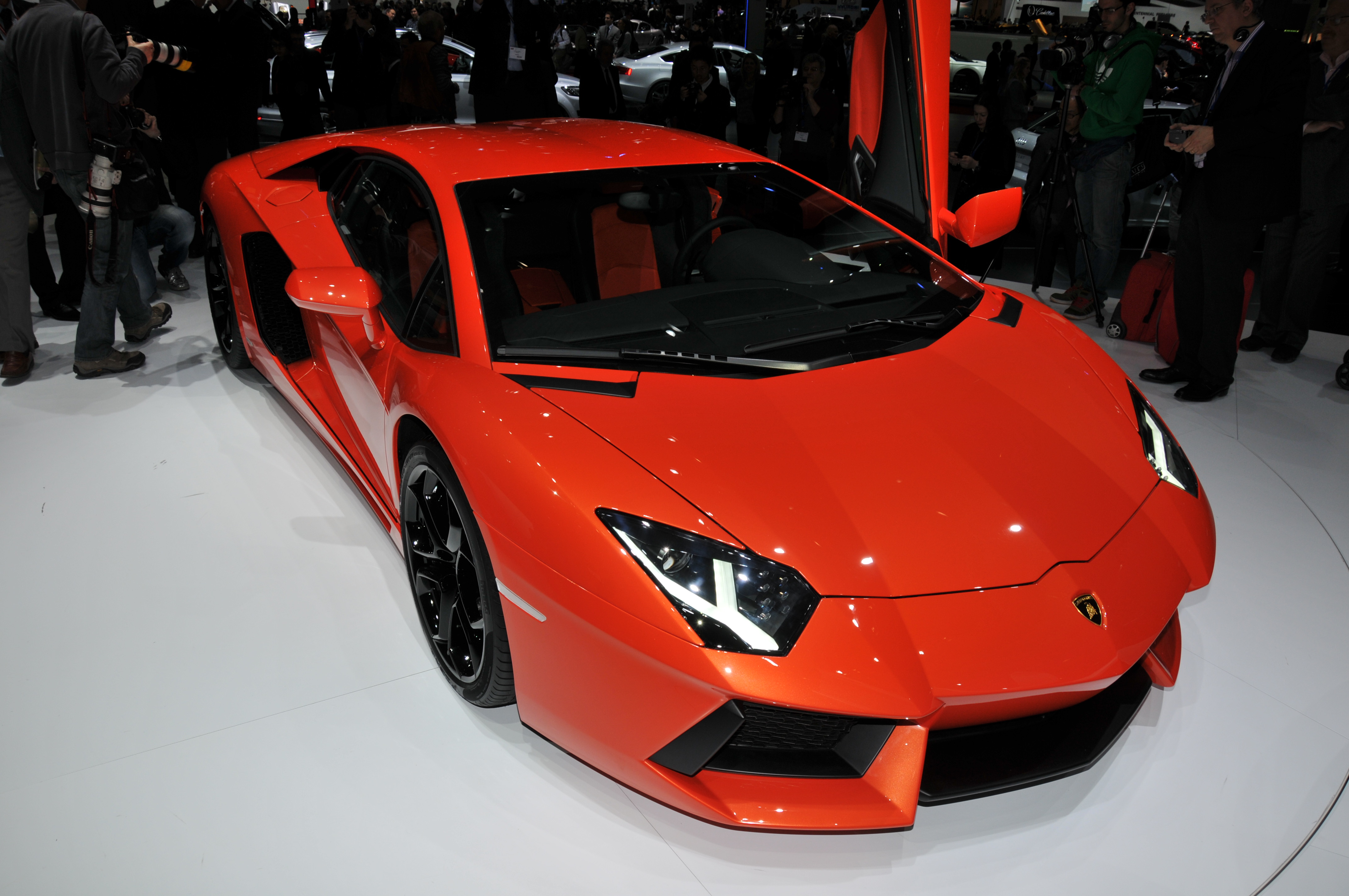
Lamborghini Aventador
"But full throttle full break. It was bang bang, which you know fun [1879.8s] And I'm sure there's a purpose maybe the maybe that motor generator is just being used for fucking to fully dump power [1887.3s] Or for a different purpose during that mode [1891.3s] But it was no longer smooth it kicked like a Lambo Aventador SVJ"
The Lamborghini Aventador SVJ is a supercar with a very punchy, dramatic driving feel. The speaker is comparing the way this other car jolts during hard shifts to how the Aventador SVJ can feel when it snaps into power.
The Lamborghini Aventador SVJ is known for its aggressive, hard-edged feel—especially during full-throttle shifts—because of its high-performance V12 and rapid-shifting gearbox behavior. Here, it’s used as a reference point for the “kick” the speaker felt when the car’s power delivery changed modes.
sequential
"Jesus I forget if I think it's the X-track [1923.8s] Sequential that that Pagani also uses but it just it just fucking at full throttle"
A sequential transmission shifts through gears in order, one step at a time. That usually makes shifts quicker and more repeatable than a traditional gate-style shifter.
A sequential gearbox uses a shift pattern where gears are selected in order (typically via paddle shifters or a shift lever), rather than an H-pattern. This enables faster, more consistent upshifts and downshifts—especially when the car is doing power shifting under full throttle.
power shifting
"It's power shifting like it's barely opening the clutch and it's not it's not stopping the throttle [1934.0s] You know and and so it's a it's a pretty hard slam. Whereas an upshift"
Power shifting means you shift gears while still demanding a lot of power from the engine. Because the car doesn’t fully “let go” between gears, the shift can feel abrupt or forceful.
Power shifting is shifting gears while keeping high engine load—often with minimal interruption to torque. In practice, it can feel like a hard, fast “slam” because the drivetrain is transferring load quickly, sometimes with very little clutch disengagement.
transmission kick
"And so it it that's so smooth, but then all of a sudden like out of nowhere you get this transmission kick. Yeah"
It’s when the car suddenly feels like it “jerks” or “kicks” as the powertrain changes how it sends power to the wheels. It can happen when shifting or when the car decides to change how much torque it’s putting down.
A “transmission kick” is a noticeable jolt or shove felt when the drivetrain changes load or gears. It often happens during clutch engagement, torque converter lockup, or when the car’s shift/traction control logic abruptly changes how much torque reaches the wheels.
buffeting
"Driving it with the windows down on the track is really cool because just the way air flows around it [1997.4s] You don't get buffeting you get a nice breeze"
Buffeting is when the wind hits the car in a rough, uneven way and you feel it “pushing” or vibrating around you. Some cars are calmer, while others make the air turbulence feel loud or uncomfortable.
Buffeting is the annoying, fluctuating pressure on the body caused by turbulent airflow around the car. On open-cockpit or low-windshield vehicles, buffeting can make it harder to hear, can fatigue you, and can be reduced by airflow shaping and proper windscreen/deflector design.
LMP
"It's just like a fucking LMP? [2067.7s] Car right looks like it. Yeah a Lamar car and put nice leather and really nicely designed knobs and stuff and a [2075.2s] Comfy seat in it like that's that's what it feels like"
LMP means a special kind of race car used in endurance racing, like the 24 Hours of Le Mans. The speaker is saying the vehicle feels like it’s based on that kind of race-car design and behavior.
LMP refers to Le Mans Prototype—top-level endurance race cars built for the 24 Hours of Le Mans and similar series. They’re designed for high downforce, efficiency, and stability at speed, so the speaker is describing a “race-car feel” even though the car is street-oriented.

Gunther Works F-26
"And oh by the way this photo of Lucas zinger and Jay Leno staying in the wing this car [2095.7s] This car makes its weight in downforce at 30 at 150 miles an hour [2099.7s] So at 150 you could drive it upside down"
The Gunther Works F-26 is a very extreme race car built to stick to the road using aerodynamics. At high speed it makes so much downforce that the tires can keep gripping even in situations that would normally make a car lose contact with the ground.
Gunther Works F-26 is an extreme track-focused car discussed here for its ability to generate enormous aerodynamic downforce at speed. The hosts describe how, around 150 mph, it can produce enough downforce that the car can be driven “upside down,” highlighting how its aero package is tuned to keep the tires planted even when the car is inverted.
V max
"That's a lot of downforce. Yeah, it's not because a lot of downforce numbers. We see it's always at V max [2107.9s] Yeah, this is not V max 150 and right"
“V max” means the car’s top speed. They’re talking about how the car’s behavior (like downforce) relates to that highest-speed range.
“V max” means the car’s maximum speed (top speed). The hosts reference whether the car’s downforce claim is tied to its V max, implying the aero behavior is being discussed in relation to the highest-speed operating point.
red lock
"Considering it's got 11,000 RPMs to play with so so it seems like it's geared short Until you actually wind each gear to red lock and you realize what you can do it nine because your brain's used to"
“Red lock” is basically the engine’s safety cutoff for RPM. If you keep revving past a certain point, the car limits it to protect the engine.
“Red lock” here refers to the engine’s rev limiter behavior—an electronic limit that prevents the engine from spinning beyond its safe maximum RPM. When the hosts say you can “wind each gear to red lock,” they mean pushing each gear up to the limiter before shifting.
shift lights
"and once you get past eight You have a series of shift lights that do that do like blue then white then red and you shift [2162.6s] You know when it gets to red on the screen"
Shift lights are lights on the dash that tell you when it’s time to shift gears. They usually change color as the engine speed gets higher.
Shift lights are dashboard indicators that tell the driver when to change gears. In this description, they change color as RPM rises (blue/white/red), replacing the need to watch a moving needle and making it easier to shift precisely at high revs.
horsepower
"but when you've got [2414.2s] 1250 fucking horsepower, you know, what is enough room for that? Yeah. Yeah"
Horsepower is a way to describe how strong a car’s engine is. More horsepower usually means the car can accelerate harder, but it also needs the right tires, brakes, and cooling to use that power safely.
Horsepower is a measure of engine power—how much work the engine can do over time. When someone says “1250 horsepower,” they’re pointing to very high power output, which affects acceleration, top speed potential, and how much cooling/braking and traction the car needs to handle it.

morgan three-wheeler
"I think the morgan it's a the morgan three-wheeler has that quality [2454.5s] But this is the morgan three-wheeler plus the t1000"
The Morgan three-wheeler is a weird-but-fun Morgan car with three wheels instead of four. That makes it feel and look different, and the host is using it as an example of a car that’s special to drive.
The Morgan three-wheeler is a distinctive Morgan model built around a three-wheel layout, which gives it a very unusual stance and driving character compared with conventional four-wheel cars. In this discussion, it’s used as a reference point for “unique” cars that feel special in everyday driving.

3 Morgan Threewheeler
"But that's like a shitty car and this is a nice car I think the morgan it's a the morgan three-wheeler has that quality But this is the morgan three-wheeler plus the t1000"
The Morgan three-wheeler is a small vehicle with three wheels instead of four. People like it because it feels different and fun to drive. The podcast is describing it as a more special version of that kind of three-wheeler experience.
The Morgan three-wheeler is a quirky, lightweight three-wheeled vehicle known for its distinctive look and simple, engaging driving feel. In the podcast, it’s compared to “this is a nice car” and described as having the “Morgan three-wheeler plus the t1000” quality, emphasizing how it feels more extreme or special. The point is that it delivers a unique experience compared to typical cars.
track record
"But it is not [2504.8s] Like extreme in a way. This is extreme. I don't think the tourbillon is going to set a track record [2510.1s] Or set five track records in five days."
A “track record” is the best recorded performance time or achievement on a specific race track under defined conditions. In hypercar talk, it’s shorthand for whether a car is engineered to be fastest on track rather than optimized for other goals like comfort, luxury, or a broader customer experience.

Lamborghini Kuntosh
"...rrah, but then you go to like the you know 512 or kuntosh kuntosh Like it's all building on you know the mi..."
The Lamborghini Countach is a famous supercar known for its bold, unusual look. It’s considered an important classic model in Lamborghini’s history. People bring it up when talking about the most memorable designs from that era.
The Lamborghini Countach is an iconic Italian supercar known for its dramatic styling and historical status. It’s frequently mentioned as a design milestone, and the podcast context groups it with other classic Lamborghinis to talk about how the lineup evolved. The “crazy” reaction fits how recognizable and visually extreme the Countach is.
slant nose
"One that's uh named after a fighter plane, but it's it's their take on a slant nose So it's got a whole new front clip."
A slant nose is a styling and aero change to the front of a car that makes it look more sharply angled. The goal is usually to improve airflow and give the car a more track-focused look.
A slant nose is a front-end design where the nose profile is reshaped into a more angled, wedge-like form rather than the classic rounded 911 front. In this segment, the host discusses how a slant nose typically comes with a new front clip and aero details intended to improve airflow and visual aggression.
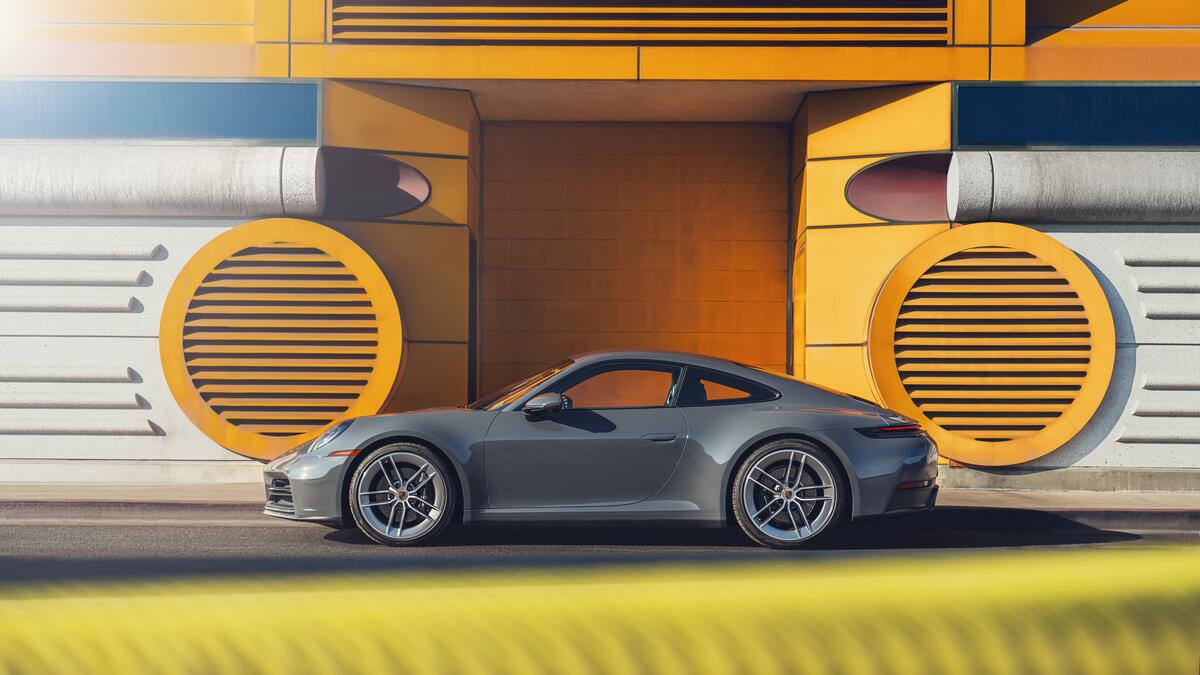
Porsche 911 GT3 RS
"So the new gt3 rs does it. Oh, yeah, as does the mustang gtd"
The Porsche 911 GT3 RS is a high-performance 911 built for track driving. In this discussion, they’re pointing out a bodywork detail that helps channel air around the front wheel to improve grip.
The Porsche 911 GT3 RS is a track-focused 911 known for aggressive aerodynamics. Here it’s mentioned because its front fender-to-door shape includes a vented area that helps manage airflow around the front wheel, which can contribute to downforce and reducing lift.

Ford Mustang GTD
"... So the new gt3 rs does it. Oh, yeah, as does the mustang gtd So it probably helps take air like out of the whe..."
The Ford Mustang GTD is a special Mustang built for faster driving, especially on track. It uses aerodynamic design features to help the car move through the air more effectively. The podcast is talking about how those features work to improve performance.
The Ford Mustang GTD is a track-focused, high-performance Mustang variant designed to improve aerodynamic efficiency and overall performance. In the podcast context, the mention of the new GT3 RS and “as does the mustang GTD” points to how aero features help manage airflow around the car. The discussion is about how those design choices translate into real driving performance.
lift
"So it probably helps take air like out of the wheel well downforce or something like that, you know, just prevent lift"
Lift is the opposite of downforce—airflow can sometimes make a car feel lighter. Reducing lift helps the tires stay planted for better handling.
Lift is the aerodynamic force that tends to pull a car upward, reducing tire contact with the road. The host frames the vented fender/door geometry as a way to reduce lift by improving airflow around the wheel area.

Hyundai Ioniq
"Slant nose, you know, it has little squinty eyes that look almost like a coning zig until zack said Ioniq six and I couldn't fucking unsee that"
They mention the Hyundai Ioniq 6 because the car’s headlight shape reminds them of it. It’s basically a “this looks similar” visual comparison.
The Hyundai Ioniq 6 is an electric sedan mentioned as a visual comparison for the “slant nose” headlights. The host says the headlight shape resembles the Ioniq 6, highlighting how lighting and front-end styling can create recognizable silhouettes.
norbert singer
"With um norbert singer like found a loophole and he's like oh we can take the headlights out of the car And they went way faster and then the take rate for the the public cars was huge,"
Norbert Singer is an engineer associated with Porsche racing. Here, he’s mentioned as the person who found a loophole to change the headlights to help the car go faster.
Norbert Singer is a Porsche engineer known for race-car development, including aerodynamics and packaging solutions used in motorsport-derived 911s. In this segment, he’s credited with finding a way to adapt the car’s lighting setup to improve speed.
greenhouse
"There's just a lack of balance like the greenhouse is still really tall and bubbly and then the slant is flat."
In car bodywork, the “greenhouse” is the glass-and-metal upper section that includes the windshield, side windows, and roof area. The speaker is using it to describe how the 911’s upper shape affects visual balance with the slant-nose front.
chassis bracing
"And then also they've done which we'd all been clamoring for thank god I was the last one was slow the orange car was a good slow shitboxing and they've also done um a whole bunch of Chassis bracing behind the seats Where you know you used to find a back seat sometimes you'd find a cage now. There's an enclosed space"
Chassis bracing is extra reinforcement inside the car’s structure. It helps the car feel more solid and consistent, especially when driving hard, and in this case it’s put behind the seats.
Chassis bracing is structural reinforcement added to stiffen the car’s body and reduce flex, improving how consistently the suspension can do its job. Here it’s described as being placed behind the seats, replacing what might otherwise be a back seat with a more track-focused structure.
cage
"Where you know you used to find a back seat sometimes you'd find a cage now. There's an enclosed space Is there a photo that actually shows it? It's like a filled-in space."
A “cage” here means a reinforced safety structure inside the cabin, like what you see in race cars. It can also make the car stiffer, and they’re saying the layout has changed from an open cage to an enclosed space.
A “cage” in this context means a roll-cage style structure used for safety and stiffness in track-oriented cars. The speaker contrasts older setups where you’d see a cage with a newer enclosed-space approach.
carbon box
"It's like a filled-in space. It's it's it's got a carbon Box effectively around the entire space and inside that is a bunch of chassis bracing that makes it a 200"
A “carbon box” is a strong, lightweight carbon-fiber enclosure. They’re describing it as a protective structure around the space behind the seats, with extra reinforcement inside.
A “carbon box” refers to a carbon-fiber structural enclosure used to package and protect components while also adding stiffness. In this segment it’s described as effectively surrounding the space behind the seats, with additional bracing inside.
precise damper
"You can run a very soft spring and you can run a very precise damper"
The damper is the shock absorber that controls how fast the suspension moves. Better tuning helps the car stay calm over bumps instead of bouncing or feeling loose.
A damper (shock absorber) controls how quickly the suspension compresses and rebounds. “Precise” damping tuning helps the car stay composed over rough surfaces while preventing excessive oscillation or unpredictable steering response.
soft spring
"If you have a stiff structure and a low weight... You can run a very soft spring and you can run a very precise damper"
A soft spring lets the suspension move more over bumps. If the shocks are tuned well, you can get a smoother ride without losing handling stability.
A soft spring means the suspension uses a lower spring rate, allowing more vertical movement over bumps. When paired with a stiff chassis and precise damping, it can improve ride comfort without sacrificing control.
jrz shocks
"I mean they always run jrz shocks. I think but they are set up really well the cars always feel compliant."
JRZ shocks are performance shock absorbers from a specialty company. They help the car soak up bumps smoothly while keeping the handling steady.
JRZ shocks are aftermarket performance dampers known for being tunable and for controlling body motion precisely. In this segment, the hosts credit the JRZ setup for the car’s compliant ride while still feeling stable and controlled on track and rough roads.
double wishbone
"This also has the double wishbone. So they've developed a double wishbone front suspension like the current gt3"
Double wishbone is a type of front suspension that uses two arms to guide the wheel’s movement. It helps the tire stay in the right position, which usually makes steering feel more accurate and stable.
Double wishbone is a front suspension design that uses two control arms per side to control wheel motion precisely. Because it can maintain better wheel alignment as the suspension moves, it helps steering feel more consistent and reduces unwanted tire scrub.
tram lining
"I think it helps reduce tram lining because they're running a 295 front tire"
Tram lining is when your car gets pulled by grooves in the road, like it wants to track straight even if you don’t. It’s more noticeable with wide tires and certain suspension settings.
Tram lining is when a car follows road grooves or tire ruts, causing the steering to feel like it’s being pulled along a straight path. It’s often worse with wide, sticky tires and certain alignment/suspension setups, so reducing it is a handling goal.
295 front tire
"because they're running a 295 front tire... That's that's a crazy amount of tire"
“295” means the tire is about 295 millimeters wide. Wider tires can grip better, but they can also make the car feel heavier to steer and more sensitive to road grooves.
A “295” front tire refers to a 295 mm section width tire, which is very wide for the front axle. Wider tires increase grip but can also make steering feel heavier and can amplify tram lining if the suspension/alignment isn’t tuned well.
wide front tires
"Well, the front engine cars have to use wide front tires. So a dark horse is 305 fronts"
Tires that are wider touch the road over a bigger area. That usually means better grip and more predictable steering, especially when you’re driving hard on a track.
Wide front tires increase the contact patch at the front axle, improving grip and steering response. On track, that extra front traction helps the car resist sliding and can reduce how much it gets deflected by uneven pavement.
ruts
"So it's it's literally catching the edges of the ruts in the road and moving around"
Ruts are grooves in the pavement. If your tires hit the edges of those grooves, the car can feel like it’s getting pushed around or tugged off line.
Ruts are grooves in the road surface, often caused by repeated tire tracks. When a car’s tires ride in or catch the edges of ruts, it can cause sudden steering input and instability, especially at speed.
e85
"And 750 pounds of torque now that's on e85. And we were delivered it with e85, but I filled it back up with 91."
E85 is a mix of mostly ethanol and some gasoline. It can let the engine make more power because it burns in a way that tolerates more aggressive tuning.
E85 is a fuel blend containing about 85% ethanol and 15% gasoline. It typically allows higher engine output because ethanol has a higher octane rating and can support more aggressive ignition timing and boost strategies.
flex fuel
"And we were delivered it with e85, but I filled it back up with 91. It has flex fuel"
Flex-fuel cars can use different fuel mixtures. The car senses what blend you put in and adjusts how it runs so it can still make power safely.
Flex-fuel capability means the vehicle can run on different fuel blends (like E85 and gasoline) and automatically adjusts fueling and timing. That’s done via sensors that detect the ethanol content and then change the engine’s calibration accordingly.
turbocharged engine
"I think this is the most responsive engine I've driven definitely the most responsive turbocharged engine I've driven in terms of"
A turbocharged engine uses a turbo to cram more air into the engine. More air usually means more power, and the driver feels it as strong acceleration when the turbo comes on.
A turbocharged engine uses a turbine-driven compressor to force more air into the cylinders. That lets the engine make more power from a smaller displacement, but it also introduces boost response characteristics that drivers often describe as “spool” and torque delivery.
max torque 750 pound-feet
"Like max torque 750 pound-feet is at 4,500 rpm. No 5,400"
Torque is the engine’s twisting force that helps the car pull strongly. Where the peak torque happens (at what rpm) affects how punchy it feels when you accelerate.
Torque is the twisting force the engine produces, and it strongly affects how quickly a car accelerates, especially at lower speeds. “Max torque” is the peak value the engine reaches, and the rpm where it occurs matters for drivability.
tach
"starting at 39. I'm watching the tach and it rips past the you know peak Torque number"
The tach shows how fast the engine is spinning (rpm). It helps you see when the engine is making its strongest pull and how quickly it responds when you change gears.
The tachometer (“tach”) measures engine speed in revolutions per minute (rpm). Watching the tach helps drivers confirm when the engine is hitting peak torque and how quickly it revs during downshifts.
twin turbo twin charge cooled
"Yeah, it's a four liter twin turbo twin charge cooled"
Twin turbos use two turbochargers to push more air into the engine. Cooling that compressed air helps the engine make more power and run more safely under boost.
“Twin turbo” means two turbochargers are used to pressurize the intake air, often to improve boost response and power. “Charge cooled” indicates the compressed intake air is cooled (typically with an intercooler) to increase density and reduce heat-related knock risk.
flat fan
"Uh, and it's got a flat fan like a 917 does and what that it looks incredible."
They’re talking about a big cooling fan. It helps move air to keep things from overheating, and the way it’s driven can change the noise you hear.
A “flat fan” here refers to a large, flat cooling fan used for airflow management, similar in concept to the cooling setup associated with the Porsche 917. The fan’s design and drive method can affect both cooling effectiveness and how the car sounds.
gear driven instead of belt driven
"That fan is gear driven instead of belt driven. So it does make a little bit of noise"
The fan can be powered by gears or by a belt. Gears tend to feel more mechanical and can make a different kind of noise than a belt system.
A gear-driven fan uses gears to transmit power from the engine, while a belt-driven fan uses a belt and pulleys. Gear drives are often more direct and can change the sound character—here described as a mechanical chatter—compared with belt drive.
single mass flywheel style chatter
"Um, it's a little bit of a chatter sort of like a single mass flywheel style chatter"
“Chatter” is that rattly buzzing sound. A single-mass flywheel can make some vibrations more noticeable, so the car can sound more mechanical.
“Chatter” is a rattling or buzzing vibration that can come from mechanical components. A “single mass flywheel” is a one-piece clutch/engine inertia component; compared to a dual-mass setup, it can transmit more vibration and produce a more noticeable sound under certain conditions.
drive modes
"So it's a there's three drive modes, right? There are there's comfort mode. There's sport mode and there's track mode"
Drive modes are different settings you can choose that change how the car behaves. Track mode usually makes the car more aggressive and less “protective” than comfort mode.
Drive modes are selectable software and calibration profiles that change how the car responds—typically throttle mapping, transmission behavior, traction control intervention, and sometimes steering/brake settings. When the host says there are comfort, sport, and track modes, they’re describing how the car progressively allows more aggressive behavior.
spun the tires
"I spun the tires all the way through second and third and chirped fourth"
Spinning the tires means the tires lose grip and just spin instead of pushing the car forward. It often happens on wet or bumpy roads when there’s too much power for the available traction.
“Spun the tires” describes wheelspin: the driven wheels rotate faster than the car is actually moving forward, usually because traction is insufficient. On a damp, rough road, high power can overwhelm grip, especially in lower gears where torque multiplication is strongest.
chirped fourth
"I spun the tires all the way through second and third and chirped fourth"
Chirping is the squeal/noise tires make when they’re slipping a little while you accelerate. It usually means the tires are getting close to losing grip.
“Chirped” refers to tire noise from brief loss of traction—often a momentary slip at the start of acceleration or during a gear change. It’s a sign the tires are near the grip limit, especially when the road is damp or uneven.
ABS
"what they call motor sport grade traction control and abs"
ABS is the system that keeps your wheels from locking up when you brake hard. It helps you keep steering control by pulsing the brakes automatically.
ABS (anti-lock braking system) prevents the wheels from locking up during hard braking by modulating brake pressure. On performance cars, ABS can be calibrated for track use so it still helps stability while allowing more effective braking than a basic street setup.
upshift
"It does not pull less when you upshift. It pulls the same. That's fucking crazy"
An upshift is when the car changes to a higher gear. The host is saying the car keeps accelerating strongly even after it shifts.
An upshift is a gear change to a higher gear ratio, typically reducing engine speed while maintaining forward acceleration. The host’s point is that in track mode the car continues to pull aggressively even after shifting, rather than feeling like it “falls off” between gears.
side bolstering
"Sides these look like track buckets that will hold you in but actually [3216.5s] Don't have enough side bolstering to hold you in not at all and we were driving canyons"
Side bolstering is the padded “side walls” of a racing seat. They’re there to keep you from sliding around when the car turns hard.
Side bolstering is the extra padding or shaping on the sides of a racing seat. It’s meant to grip your torso during cornering so your body doesn’t slide around when the car pulls lateral G-forces.
deep carbon bucket
"I was like [3245.9s] The hr geiger, you know deep carbon bucket [3248.7s] It's actually a really shallow bolster on the sides"
A deep carbon bucket is a racing seat made from carbon fiber and shaped to wrap around you more. Even if it looks like it should hold you tight, the actual side shape matters for comfort and control.
A deep carbon bucket refers to a racing seat made with carbon-fiber construction and shaped with deeper contours. Carbon buckets are popular in track-focused cars because they can be stiff and lightweight, but the “depth” and side shape still determine how well they actually hold you.

DLS Singer Dls
"...ver like it has like 200 horsepower more than the singer dls turbo like"
The DLS is a special, high-performance version of a Porsche built by Singer. The podcast is comparing how much power different DLS-style builds make. It’s essentially a discussion about performance differences between similar cars.
The DLS mentioned in the podcast appears to refer to the Singer DLS, a track-oriented, restomod-style Porsche built by Singer Vehicle Design. It’s discussed in the context of power differences—specifically that it has around 200 horsepower more than the Singer DLS Turbo. The mention is about how performance specs stack up between closely related builds.
bare carbon
"All the door panels are basically bare carbon that whole back section where the bracing is is just carbon"
“Bare carbon” means the carbon-fiber material is left exposed instead of being covered with padding or fabric. Hard surfaces like that don’t soak up sound, so the cabin can get louder.
“Bare carbon” means exposed carbon-fiber panels rather than upholstered or padded trim. Carbon fiber is stiff and hard, so using it extensively in the cabin can reduce sound absorption and increase cabin resonance—matching the host’s point about the car being very loud inside.
echo box
"It is an echo box. You know, you're sitting inside. I know I said a lot like you're in a mailbox"
An “echo box” is what it sounds like: a space where sound bounces around instead of being absorbed. If the inside is mostly hard surfaces and not much soft material, you hear more noise and it feels louder.
An “echo box” is a cabin acoustics description: a hard, reflective interior that traps and reflects sound rather than absorbing it. When door panels and interior surfaces are mostly bare carbon with few soft materials, the cabin can amplify engine and tire noise, making the car feel dramatically louder.
air cooled
"Look if if that's what Gunther really wants we we must have the fastest air cooled cars around a track period"
An air-cooled engine keeps itself from overheating using air flowing over it, instead of using coolant in a radiator. On a track, that airflow and heat management matter a lot.
“Air cooled” describes an engine cooling system that relies on airflow over the engine rather than a liquid coolant loop. That design changes how the engine manages heat, especially under sustained track loads, and it’s a big part of why certain cars feel and sound a certain way on track.
compliance
"You know the thing that you do but like make it Make it way instead of 2750 make it way 3100 And be full of dynamite and be like quiet. Yeah, because because they've gotten like they know the ride They know how to make the things handle well shifter was fantastic Compliance is good like they've got the engineering and the geometry done"
“Compliance” is how well the suspension soaks up bumps. A more compliant setup rides smoother while still keeping the tires planted for grip.
In suspension talk, “compliance” means how much the car’s ride can absorb bumps and maintain tire contact without feeling harsh. Good compliance usually comes from suspension tuning and geometry, balancing comfort with control.
Porsche 993
"Compliance is good like they've got the engineering and the geometry done and No one is really competing with them in this 993 space."
Porsche 993 is a specific generation of the classic 911 from the late 1990s. In this conversation, they’re saying it’s a tough niche to compete in because the car can be engineered to feel both comfortable and great-handling.
Porsche 993 is the late-1990s generation of the 911, and it’s being discussed here as a niche “space” with few direct competitors. The host is contrasting how this 993-era platform can be engineered for both handling and comfort, implying a restomod-style approach rather than chasing raw power alone.
engineering and the geometry
"shifter was fantastic Compliance is good like they've got the engineering and the geometry done and No one is really competing with them in this 993 space."
This is about how the car is designed to handle and ride well. “Geometry” here means the suspension’s setup angles and layout, which determine how the car behaves over bumps and when you turn.
“Engineering and the geometry” refers to the suspension and chassis design details—things like alignment angles and how suspension components are laid out. Those choices strongly affect handling feel, ride quality, and how predictable the car is under different loads.
Request an Explanation
Heard something you'd like explained? We'll add it to this episode.
Sign in to request explanations for terms you heard.
Want to learn more?
Browse our glossary for plain-English explanations of automotive terms, jargon, and concepts.
Help improve this episode
See something that's not quite right? Our annotations are AI-generated and can sometimes miss the mark. Click the flag icon on any annotation to suggest a correction.