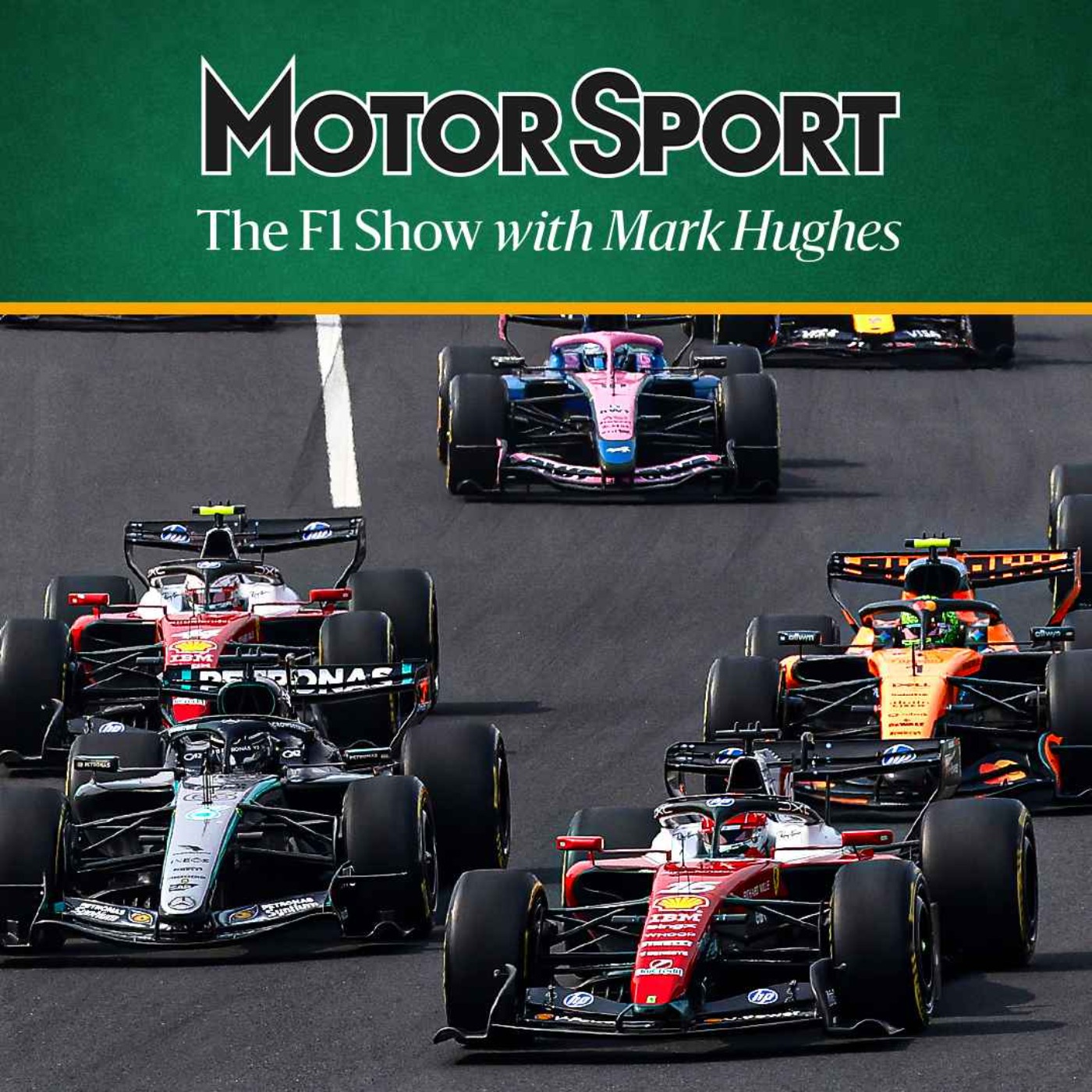
F1's 2026 relaunch: rule changes & engine upgrades unlocked
About this episode
Mark Hughes breaks down F1’s 2026 relaunch momentum: rule changes are being agreed ahead of the Miami GP, with two key areas likely to shift on the electrical side—energy deployment limits, harvesting rate, and battery storage—while any big ICE power increase is politically and technically harder. He also explains the “additional development upgrade” system (time, dyno allowance, and re-homologation thresholds) and why teams will game the measurements. Later, the show turns to Max Verstappen’s engineer J.P. Lambiasi moving to McLaren, plus audience questions on qualifying traffic and dangerous closing speeds.
This week's crunch F1 meeting looks likely to alter the energy split of the new power units: Mark Hughes examines who will be the big winners and losers, and asks what F1’s crisis of its own making says about the state of the sport?
Plus: What is ADUO and why is it so important? And the real reason Max Verstappen’s engineer is moving to McLaren
More from Mark Hughes and Bryn Lucas on the stories that really matter, in the latest episode of the Motor Sport F1 Show.
Subscribe now for every weekly episode and tell us what you want to know from Mark. Send us a message on social media or find this podcast at https://go.motorsportmagazine.com/4mE8A6E and drop your questions in the comments. He'll answer a selection of the best every week.
Read Mark's column every Wednesday at https://go.motorsportmagazine.com/4mE8A6E
Hosted on Acast. See acast.com/privacy for more information.
F1 is set to change its rules and unlock engine upgrades
"F1 is set to change its rules and unlock engine upgrades. How will this affect the championship?"
They’re talking about Formula 1 changing the rules for 2026. When the rules change, teams can often improve their engines in new ways, which can change who’s fastest.
The hosts discuss Formula 1 changing its regulations for the 2026 season and allowing additional engine upgrades. In F1, rule changes can reshape performance by changing how teams design power units and manage development priorities.
Crunch Formula One meeting
"This week's Crunch Formula One meeting will alter the power split, so who will be the big winners and losers,"
They mention a big F1 meeting where important decisions get made. This is the kind of meeting that can change how the cars are allowed to be built and tuned.
The segment references a “Crunch Formula One meeting,” which implies a high-stakes decision-making session where F1 stakeholders agree on technical and sporting changes. These meetings are where the power split and related technical rules are finalized or adjusted.
power split
"This week's Crunch Formula One meeting will alter the power split, so who will be the big winners and losers,"
“Power split” refers to how power is divided and managed within F1’s powertrain—especially between different energy sources and modes in the hybrid era. Changing it can affect acceleration, efficiency, and how teams calibrate the car’s behavior across the race.
F1's crisis of its own making
"and what does F1's crisis of its own making say about the state of the sport? Plus, what is a duo and why is it so important?"
They’re suggesting F1 has some problems that it helped create. The conversation is likely about what F1’s choices have done to the sport.
The hosts mention “F1’s crisis of its own making,” framing the sport’s current challenges as partly self-inflicted. This is a discussion prompt about how regulation, governance, or commercial decisions may be contributing to competitive or fan-facing problems.
Miami Grand Prix
"...there is full agreement that changes will be made before the Miami Grand Prix... So it will be done before Miami, whatever it is they've agreed to do."
The Miami Grand Prix is one of the Formula 1 races. When rules are changed, the sport tries to finalize them early enough that teams can build and update their cars for that event.
The Miami Grand Prix is a Formula 1 race on a purpose-built circuit in Miami, Florida. In F1, major rule decisions are often timed so teams can prepare their cars for the next race on the calendar.
technical people
"Then they meet with the technical people to discuss it. And the following day, there will be a follow-up meeting on that to discuss how to do whatever it is they've decided to do."
“Technical people” in F1 usually refers to engineers and technical delegates who analyze how proposed rule changes affect car design and performance. They help translate high-level decisions into practical, enforceable technical requirements.
F1 Commission
"...it goes to the F1 Commission. And once it's gone to the F1 Commission, it can be incorporated into the regulations."
The F1 Commission is like a rules committee for Formula 1. After they approve something, it becomes official rules that teams have to comply with.
The F1 Commission is a governing body within Formula 1 that helps oversee and approve changes to the sport’s rules. Once an item is agreed there, it can be turned into formal regulations teams must follow.
regulations
"...it can be incorporated into the regulations. So it will be done before Miami, whatever it is they've agreed to do."
Regulations are the official rules for Formula 1. If something gets added to the regulations, teams can plan their car updates around it.
In F1, regulations are the official rulebook covering technical and sporting requirements. When changes are “incorporated into the regulations,” teams can legally design and develop cars around the updated constraints.
safety card
"...might not have happened in time for Miami or would have required the safety card to be played to push it through in time."
“Safety card” here doesn’t mean a car safety system—it’s a figure of speech. It means using a special process to speed things up when there’s not enough time.
“Safety card” is a metaphor for using an emergency or procedural mechanism to get something approved quickly. In this context, it’s about whether governance could fast-track the rule changes to meet a race deadline.
energy split
"Certainly, there will be around the energy split in terms of how much deployment you're going to be permitted, how much harvesting rate you're going to be permitted, how much battery storage you're going to be allowed."
“Energy split” is how the rules let the team decide when to use the car’s stored electrical energy. Think of it like budgeting battery power for acceleration and saving some for later.
In F1’s hybrid era, the “energy split” is how the car’s power unit divides available electrical energy between different uses. It affects how much energy can be deployed for acceleration versus saved for later, and it’s constrained by the rules.
deployment
"Certainly, there will be around the energy split in terms of how much deployment you're going to be permitted, how much harvesting rate you're going to be permitted, how much battery storage you're going to be allowed."
“Deployment” means when the car is allowed to use its stored battery energy to make more power. The rules limit how much you can use, so teams have to choose the best moments.
“Deployment” refers to how much of the stored electrical energy the driver can use at any given time for performance. In F1 regulations, deployment is capped and metered, so teams must plan when to spend that power for maximum effect.
harvesting rate
"Certainly, there will be around the energy split in terms of how much deployment you're going to be permitted, how much harvesting rate you're going to be permitted, how much battery storage you're going to be allowed."
“Harvesting rate” is how quickly the car can recharge its battery while slowing down. The faster you can recharge (within limits), the more electrical power you can use later.
“Harvesting rate” is the maximum rate at which the power unit can convert energy from braking and other sources into stored electrical energy. Teams tune braking and control strategies to maximize harvesting without violating the rules’ limits.
battery storage
"Certainly, there will be around the energy split in terms of how much deployment you're going to be permitted, how much harvesting rate you're going to be permitted, how much battery storage you're going to be allowed."
“Battery storage” is how much energy the car can keep in its battery at once. If the allowed amount is smaller, you run out sooner and have to recharge more often.
“Battery storage” is the amount of energy the system is allowed to store for later use. Limiting storage capacity changes race strategy because it determines how long you can sustain electrical assistance before you must recharge.
electrical side
"But certainly there are the three main factors on the electrical side that they will be trying to tweak."
The “electrical side” is the battery and electric power parts of the F1 hybrid system. If the rules change how that part works, the car’s power delivery and race strategy change too.
The “electrical side” refers to the hybrid components and their rule-governed limits—deployment, harvesting, and storage. Adjusting these parameters changes how much of the car’s performance comes from electric assistance versus the engine.
internal combustion engine power
"Could it go as far as up in the engine power, the internal combustion engine power? That's a bit more problematical, but there is at least one party that is pushing for that."
This is the power coming from the fuel-burning engine itself (not the battery). If the rules let teams make more of it, the car may depend less on electric boost.
“Internal combustion engine power” is the output from the traditional fuel-burning engine portion of the F1 power unit. If rules allow more ICE power, it can reduce reliance on the hybrid system and shift performance balance and development priorities.
internal combustion engine (ICE) power
"Red Bull is very interested in upping the internal combustion engine power. And actually, that is, if you were looking to really make the most impact on addressing the concerns…"
ICE power is the “regular engine” part of the F1 power unit that makes power by burning fuel. If teams increase it, they’re trying to get more thrust from that engine, but they have to stay within F1 rules about fuel use and hardware.
In Formula 1, the internal combustion engine (ICE) is the part of the power unit that burns fuel to make power. When teams talk about upping ICE power, they’re usually discussing how much energy the engine can extract within the sport’s fuel and technical limits.
speed differential in the race
"…the most impact on addressing the concerns, which are the speed differential in the race, the qualifying situation where drivers are having to lift off quite a lot…"
Speed differential is basically how big the performance gap is between cars during the race. If the gap is too large, it’s harder to pass, so the racing can look less competitive.
“Speed differential” refers to how much faster (or slower) one car is compared with others during race conditions. In F1 discussions, reducing speed gaps is often about improving on-track competition and making overtaking more feasible.
qualifying situation where drivers are having to lift off
"…the speed differential in the race, the qualifying situation where drivers are having to lift off quite a lot, that would be how you would do it."
“Lift off” means the driver eases off the throttle instead of going flat-out. In qualifying, that often happens when the car can’t safely or effectively use full power at that moment, so the driver has to back off to stay in control.
When drivers “lift off” in qualifying, it usually indicates the car is hitting a limit—such as traction, overheating, or aerodynamic/energy constraints—before the driver can fully exploit the throttle. This can be a sign that the current rules or setup window is forcing drivers to manage the car more than they’d like.
fuel flow
"…because it does have a lot of implications because the engines have been designed for this power level and this fuel flow…"
Fuel flow is how quickly the engine is allowed to use fuel. If F1 changes the rules around that, teams can’t just “turn a knob”—they often have to adjust the engine and its settings to work properly under the new fuel limits.
Fuel flow is the rate at which fuel can be delivered to the engine, and in F1 it’s tightly regulated. If the fuel flow target or limit changes, teams must redesign engine calibration and hardware to match the new operating conditions.
Mercedes
"If there was, it would be Mercedes for obvious reasons because they're very happy with how competitive they are at the moment."
Mercedes is another major F1 constructor, and the segment frames them as being satisfied with their current competitiveness. The discussion suggests that if rules stayed unchanged, Mercedes would likely be among the teams most comfortable with that status quo.
F1's 2026 relaunch: rule changes & engine upgrades unlocked
"Now, this is the topic of your latest column, the MPH column... We have enough knowledge of how each power unit derives its full performance..."
This part is basically about what the 2026 F1 rule changes could do to team performance. They’re talking about how engine and hybrid upgrades might change who has the advantage.
This segment is about how upcoming 2026 F1 rule changes and engine/power-unit upgrades could shift competitive advantages. The hosts discuss how teams’ hybrid power units may respond differently based on mechanical vs electrical contributions and energy management strategies.
power unit
"We have enough knowledge of how each power unit derives its full performance and what percentage is a mechanical advantage and what percentage is an electrical advantage."
In F1, the “power unit” isn’t just the engine. It’s the engine plus the hybrid parts that store and reuse energy, so the car can make more power than the engine alone.
In modern Formula 1, the “power unit” is the whole hybrid system: an internal-combustion engine plus energy recovery and electrical components. When they talk about how much performance comes from mechanical vs electrical sources, they’re describing how the hybrid parts contribute to lap time.
mechanical advantage
"We have enough knowledge of how each power unit derives its full performance and what percentage is a mechanical advantage and what percentage is an electrical advantage."
This means how much of the car’s speed comes from the regular engine and mechanical parts, versus the hybrid energy system. In hybrid F1 cars, both matter, but they don’t contribute equally all the time.
“Mechanical advantage” here refers to the portion of performance coming directly from the internal-combustion engine and drivetrain, rather than from stored electrical energy. In a hybrid F1 car, the balance between mechanical and electrical contribution affects how the car can deploy power lap-to-lap.
electrical advantage
"We have enough knowledge of how each power unit derives its full performance and what percentage is a mechanical advantage and what percentage is an electrical advantage."
This is the part of performance that comes from the battery and electric motor. If the team can store and use more electrical energy, the car can be faster even if the engine itself isn’t the only source of power.
“Electrical advantage” refers to performance gained through the hybrid electrical system—energy stored in the battery and deployed via electric power. In F1, this can change depending on how much energy is recovered and how aggressively it’s used.
super clipping
"So anything that if you're talking about increasing the super clipping, the rate of super clipping whereby the battery starts charging itself up even when you're in full throttle."
This sounds like a strategy the team uses to manage power and energy flow. The important part is that it’s connected to keeping the battery charged and improving how much boost the car can use.
“Super clipping” appears to be a shorthand in the discussion for a control strategy that increases how the hybrid system manages power delivery/energy generation. Because the transcript doesn’t define it explicitly, the key takeaway is that it relates to charging behavior and how much electrical energy is available during full-throttle operation.
battery starts charging itself up
"the rate of super clipping whereby the battery starts charging itself up even when you're in full throttle."
That phrase means the car can make electricity while it’s running, not just when you slow down. If it can keep the battery charged better, it can use more electric boost later.
This describes self-charging behavior in a hybrid system, where the car can generate electrical energy while driving (including under load) rather than relying only on braking recovery. In F1 terms, it’s about how effectively the power unit can manage energy flows to keep the battery state of charge favorable.
Red Bull Powertrain
"I think probably Red Bull Powertrain is the feeling is that that is a very potent engine in terms of its deployment and in terms of its efficiency and just general all round power."
“Red Bull Powertrain” refers to the team’s power unit program and how it delivers power in practice. The discussion frames it as strong in deployment, efficiency, and overall power—suggesting the car can use its available energy effectively.
transparency
"It's certainly not something that we have that transparency on at the moment. I'm going to come to a bit more about the additional development upgrade opportunities thing..."
“Transparency” here is about how openly F1 stakeholders communicate intentions, compliance, or decision-making around rule changes. Limited transparency can make it harder for teams to predict what will happen next and plan development accordingly.
additional development upgrade opportunities
"...the additional development upgrade opportunities thing in just a bit because some people may not know what that is or how it works."
This is about how the rules can give teams extra chances to bring new parts during the season. That matters because it changes how fast teams can fix problems and improve the car.
“Additional development upgrade opportunities” refers to rule-driven allowances that let teams introduce certain updates more freely during the season. In F1, these kinds of mechanisms can affect how quickly teams can react to performance issues and how much they can spend on development.
enforced hiatus
"...we've gone this bit of a enforced hiatus ahead of Miami, but once it all kicks back up again..."
An enforced hiatus is a required break—basically a pause—before the next big event. The idea is that teams stop for a bit, then restart their work and bring updates again.
An “enforced hiatus” is a mandated break in the F1 schedule or development activity, typically tied to the calendar and regulatory process. The segment suggests it’s a pause before Miami, after which development and upgrades resume.
FIA
"Are there any teams that are likely to hold the FIA Formula 1 to ransom... I think the FIA will still be reserving the right to make further changes"
The FIA is the organization that makes the official rules for Formula 1. Even after new rules are introduced, they can still adjust things later if they think it’s needed.
The FIA (Fédération Internationale de l’Automobile) is the governing body that sets and enforces Formula 1 rules. In this segment, it’s described as reserving the right to make further changes even after the 2026 relaunch rule updates.
energy-hungry circuit
"[742.0s] So it could appear to have worked [745.0s] when in reality when we get to a more energy-hungry circuit [749.0s] we might find out that the change has not been as big as hoped."
Some tracks make you use more power more often. If the circuit demands lots of energy, it can reveal whether the car’s upgrades really work when you’re pushing hard.
An “energy-hungry circuit” is a track that demands lots of usable energy repeatedly—through frequent acceleration zones, braking-to-acceleration transitions, and sustained high load. In F1’s hybrid era, that can expose whether engine/energy changes deliver the expected performance under stress.
Formula One season expectations
"[754.0s] Going into this, going into every Formula One season, [756.0s] fans always want more overtaking. [759.0s] They want less dirty air. [761.0s] They want more fighting, that kind of thing."
The hosts talk about what people expect from each F1 season. They compare different opinions on whether passing is exciting because of driver skill or because of race conditions.
This segment discusses what F1 fans typically want each season—more overtaking, less dirty air, and cars running closer together. It also sets up the debate between “purists” and newer viewers about what counts as a “real” overtake.
overtaking
"[754.0s] Going into this, going into every Formula One season, [756.0s] fans always want more overtaking. [759.0s] They want less dirty air. [760.0s] They want the cars to get closer."
In racing, “overtaking” just means getting past another car. In F1, it’s not only about being faster—it also depends on how well the cars can run close together and still have grip.
Overtaking is a central performance metric in F1, but it’s influenced by more than raw speed. Aerodynamics (like dirty air), tire behavior, and energy/engine deployment strategies all affect how easily cars can pass.
dirty air
"[754.0s] Going into this, going into every Formula One season, [757.0s] fans always want more overtaking. [759.0s] They want less dirty air. [760.0s] They want the cars to get closer."
When one car drives, it messes up the air around it. The next car behind has a harder time getting good grip because the air isn’t clean anymore, so it’s tougher to follow closely and pass.
“Dirty air” is the disturbed airflow a car leaves behind, which makes the following car’s aerodynamics less effective. In Formula 1, it can reduce downforce and grip, making it harder to stay close and overtake.
artificial overtakes
"[761.0s] They want more fighting, that kind of thing. [763.0s] And there is one argument to say the fans have got what they wanted. [765.0s] They've got overtakes are plenty, whether it's artificial [767.0s] or whether it's done by amazing driver skill."
“Artificial overtakes” means passes that happen because the rules or systems make it easier to attack. It’s contrasted with a pass that happens purely from a driver’s skill and judgment.
“Artificial overtakes” refers to passing that’s enabled by race systems or rules rather than purely by one driver out-driving another. In modern F1 discussions, this often points to mechanisms that create opportunities to attack, such as energy deployment effects or race-format influences.
yo-yo style race
"while the sort of yo-yo style race and so-called is very popular with, you know, the more casual fans and even some of the more, established fans can appreciate that it's actually quite, it makes a quite entertaining show on TV."
A “yo-yo” race is one where the order keeps changing in a back-and-forth way. Instead of one car steadily pulling away or staying ahead, the gaps and positions keep swinging around.
A “yo-yo style race” refers to race dynamics where positions and gaps swing back and forth rather than progressing smoothly. In F1 broadcasts, this can be driven by strategy, safety-car timing, or—more recently—by race-control/energy-management behaviors that create artificial-looking position changes.
two different algorithms being out of phase with each other
"But as soon as you realize, as soon as the fan becomes more educated in the fact that that wasn't really an overtake, that was just two different algorithms being out of phase with each other."
This phrase suggests that the cars’ control systems (and/or race-management systems) can behave differently, so the timing of their actions doesn’t line up. When that happens, what looks like a genuine overtake may actually be a mismatch in how systems respond, rather than clean wheel-to-wheel passing.
out breaking
"And the power split was really just keeping the car behind in play, ready to try for an outbreak and move later. But you weren't getting in a situation where one car was empty of battery"
“Outbraking” means you brake later than the car in front and dive into the corner. If you get the braking right, you can pass without needing straight-line speed.
“Outbreak” here is almost certainly “outbraking,” a driving technique where the trailing car brakes later than the car ahead to force the pass into the corner. It’s a key overtaking method because it turns braking performance and traction into a direct position gain.
empty of battery
"But you weren't getting in a situation where one car was empty of battery and the other guy had 500 horsepower more and came past that way."
This means the car’s hybrid battery is running low, so it can’t give as much extra boost. If one car has more battery energy than the other, it can change who can attack and pass.
This describes a hybrid energy-management scenario where one car has little or no usable battery energy left, reducing performance compared to a rival. In modern F1, battery state can strongly influence overtaking opportunities and race strategy, especially when energy deployment windows don’t line up.
FOM
"Yes, that's an algorithm that the FIA, Formula One and FOM have to have to look into a little bit."
FOM is the part of Formula One that focuses on running the show—how races are organized and how the sport is marketed. If they’re talking about attracting fans, it’s usually about presentation and engagement.
FOM (Formula One Management) is the commercial and operational arm behind F1’s promotion, race operations, and media strategy. Discussions about attracting fans and maintaining interest often involve FOM because it manages how the sport is packaged and presented to audiences.
GT World Challenge Europe
"I was talking to some drivers. I was in Poricardo over the weekend covering GT World Challenge Europe,"
GT World Challenge Europe is a racing series for sports cars. The host mentions it to explain what they were covering recently, showing they watch more than just F1.
GT World Challenge Europe is a sports-car racing series featuring GT3/GT4-style competition, often used as a contrast to F1’s single-seater racing. Mentioning it signals the host’s broader motorsport coverage and perspective on how different racing formats create overtaking and fan interest.
crisis of credibility
"you say it's whether or not Formula One considers this to be a crisis of credibility or merely needing a few tweaks."
When people say “crisis of credibility,” they mean they’re starting to doubt the sport. In F1, that can be because the rules feel confusing, unfair, or like they’re not leading to the racing people expect.
In Formula One, a “crisis of credibility” usually means fans and teams doubt that the rules and race outcomes are fair, consistent, or meaningful. It can happen when rule changes, officiating, or technical interpretations make the sport feel less trustworthy.
balance of this season
"for the balance of this season. But I think fundamentally it needs more."
“Balance of this season” refers to how competitive the cars are relative to each other under the current rules and setup window. When the speaker says tweaks could cover the balance, they mean the changes might be enough to keep performance relatively close until the bigger update.
fundamental change
"But I think fundamentally it needs more. It needs a very different energy split between the IC"
A “fundamental change” means the rules would change in a big way, not just small tweaks. That can force teams to redesign how the car makes and uses power.
A “fundamental change” implies more than minor adjustments—typically a major shift in how the regulations shape the car’s performance. In F1, that often means changing the balance of power sources, energy recovery/usage rules, or other core technical constraints.
IC
"It needs a very different energy split between the IC and the electrical on the battery side."
“IC” just means the normal engine that burns fuel. In a hybrid, it’s the part you compare against the electric motor and battery.
“IC” stands for internal combustion, meaning the fuel-burning engine portion of a hybrid power unit. In F1 discussions, it’s contrasted with the electrical side to describe how the hybrid system is delivering power.
electrical on the battery side
"It needs a very different energy split between the IC and the electrical on the battery side."
This is the electric part of the car that comes from the battery. Teams decide when to use that stored energy and when to recharge it, which affects speed and consistency.
This refers to the electrical energy stored in the battery and delivered by the motor/generator system. In hybrid racing, how aggressively teams draw from (and recharge) the battery strongly influences performance and drivability.
combine two completely different energy sources in one car
"And it's the first time the sport has tried to combine two completely different energy sources in one car."
They’re saying F1 is trying something new where the car uses two different kinds of energy at the same time. That’s a big deal because it forces teams to rethink the engine and how the car makes power.
The 2026 F1 relaunch is described as the first time the sport tries to combine two different energy sources in a single car. In practice, this points to a major shift in the power unit concept—moving beyond today’s setup toward a new hybrid/energy architecture that teams must redesign around.
FAA
"They'll be facing the FAA and Formula One and FOM and all the teams and stakeholders in the coming week."
The transcript mentions “FAA” as part of the group involved in upcoming discussions. The exact meaning of FAA isn’t explained here, so it’s unclear what organization they mean from this snippet alone.
“FAA” is mentioned as a stakeholder in the coming week’s discussions, but the transcript doesn’t spell out what it stands for. In an F1 context, it likely refers to a specific regulatory or aviation-related authority, but the exact meaning isn’t confirmed in this excerpt.
development upgrades opportunities
"Now, moving on to the additional development upgrades opportunities. When do we see this coming to play and who is going to take advantage first?"
Teams don’t just build upgrades whenever they want in F1. They get specific chances to bring improvements, and when those chances happen can affect how quickly performance can improve.
“Development upgrades opportunities” means windows where teams can introduce new parts or improvements under the current rules and any newly approved changes. In F1, the timing of these opportunities matters because teams plan budgets, parts production, and track testing around them.
dyno time
"...and you'll get more time, dyno time, and there are allowances made in the cost cap, things like that."
“Dyno time” is time on a dynamometer, a test rig that measures engine output under controlled conditions. In F1, limiting or granting dyno time is a way to control development while still allowing teams to validate upgrades.
cost cap allowances
"...and there are allowances made in the cost cap, things like that. But if you're a bit further off..."
The discussion links performance-based upgrade permissions to the F1 cost cap, meaning teams may receive adjustments that help them stay within spending limits while still developing the allowed upgrades. This is a governance mechanism to balance competitiveness and financial control.
re-homologate certain parts
"And you can re-homologate certain parts. And I think if you're more than six percent off, then you can essentially re-homologate the whole thing."
“Re-homologate” means re-approving parts under the sport’s technical regulations after changes are made. In this context, the rules appear to allow teams to update specific components (and, at larger performance gaps, potentially more broadly) while staying compliant.
horsepower
"[1313.0s] How they actually measure it, [1315.0s] because it's not just horsepower. [1317.0s] It's about what power you have over the lap"
Horsepower is a way to describe how strong an engine is. But in F1, the rules care about more than just the biggest number you can make at one moment. They also look at how consistent and sustainable the performance is.
Horsepower is a measure of engine power, but in modern F1 regulation discussions it’s only part of the story. The hosts emphasize that the relevant metric is about power over a lap and how sustainable it is, not just peak output. That’s why “it’s not just horsepower” matters for rule enforcement and comparisons.
aerodynamic veins
"[1331.0s] There's even details you wouldn't even think of, [1334.0s] such as, you know, the Ferrari and the Haas [1338.0s] have got these above the exhaust [1341.0s] to have these little aerodynamic veins"
Aerodynamic “veins” are small, shaped bodywork elements used to manage airflow around aerodynamic surfaces. Here, the segment explains that Ferrari and Haas use features above the exhaust to redirect airflow, which then affects exhaust back pressure. It’s an example of how aero details can influence engine/exhaust-related measurements.
Ferrari
"[1331.0s] There's even details you wouldn't even think of, [1334.0s] such as, you know, the Ferrari and the Haas [1338.0s] have got these above the exhaust"
Ferrari is mentioned here as an example of a team that shapes airflow near the exhaust. Those small design details can change exhaust behavior, which can affect how performance is measured. It shows how much engineering goes into meeting the rules.
Ferrari is referenced as one of the teams using aerodynamic features above the exhaust to redirect airflow. In this context, it’s not about Ferrari’s history—it’s an example of how specific car design details can influence exhaust back pressure and therefore performance measurement. It highlights the level of detail teams must consider under FIA rules.
Haas
"[1334.0s] such as, you know, the Ferrari and the Haas [1338.0s] have got these above the exhaust [1341.0s] to have these little aerodynamic veins"
Haas is mentioned as another team using small airflow-shaping parts near the exhaust. Those parts can change exhaust flow and back pressure. That matters because F1’s measurement approach can depend on exhaust behavior.
Haas is referenced alongside Ferrari as using aerodynamic features above the exhaust to redirect airflow. The segment ties those design choices to increased exhaust back pressure, which is used as a parameter for determining power output. It’s a concrete example of how teams’ car packaging affects regulated measurements.
back pressure
"[1347.0s] They create some additional back pressure in the exhaust [1351.0s] and the back pressure is one of the parameters [1353.0s] that they're using to determine how much power is coming out."
Back pressure is the resistance to exhaust gas flow created by exhaust system geometry and restrictions. In the segment, the hosts say aerodynamic features above the exhaust can increase back pressure, which becomes one of the parameters used to infer how much power is being produced. That’s a reminder that exhaust behavior can be part of how F1 measures and regulates performance.
time allocated
"[1377.0s] And so you kind of answered the question [1380.0s] that I was going to ask you next. [1381.0s] They don't all give them the same amount of time. [1383.0s] There will be different amounts of time allocated,"
They’re saying teams won’t all get the same amount of time under the rules. That time can be part of how the FIA balances competition. The key idea is that the rules can limit or reward teams through time-based permissions.
The segment indicates that teams do not all receive the same amount of “time allocated,” which implies a rule mechanism that grants different development or operational windows. This connects back to the FIA’s opaque measurement and the resulting allowances. For listeners, it’s a reminder that F1 regulations can be enforced through administrative limits, not just technical specs.
detuned
"Whether that's because, as we talked about before, they've been running slightly detuned so far and maybe Ferrari's been running slightly detuned so far and maybe Red Bull hasn't."
“Detuned” means the engine is being run a little less aggressively than it could be. Teams do this sometimes to make it last longer or to stay within what the rules allow.
“Detuned” means running an engine below its maximum potential—often by adjusting settings like fuel/ignition timing, boost, or other calibration parameters. In F1, teams may detune to improve reliability, reduce wear, or avoid triggering certain rule-related checks while they develop.
compression ratios
"Now, we know that beginning of June, I believe it is, that's when they're going to be changing the way that they essentially check the compression ratios for the cars out there."
Compression ratio is the relationship between the maximum and minimum volume in an engine cylinder, and it strongly affects efficiency and power. The transcript says the FIA will change how they check compression ratios, which implies teams may be able to adjust engine design/calibration more freely to meet the new verification approach.
re-homologate your engine
"Have the FIA said that you can essentially re-homologate your engine and essentially produce something completely new? And does that mean that come June, we'll now see teams that may be struggling..."
“Re-homologate” means getting the FIA’s approval again for a new engine setup. If teams are allowed to do that, they can make bigger changes than usual and potentially improve performance sooner.
“Re-homologate” means re-approving an engine/power unit configuration under the FIA’s homologation rules. If teams can re-homologate and effectively produce something new, it can dramatically change the development timeline mid-season and allow major design shifts rather than only incremental updates.
Aston Martin
"we'll now see teams that may be struggling like, for example, Aston Martin with that Honda. They might be able to completely change up their engine design, their power unit design, and come back very, very strong early to midway through the season,"
Aston Martin is an F1 team. The hosts are using them as an example of a team that might be behind right now, but could get a chance to catch up if the rules let them change their engine more.
Aston Martin is cited as an example of a team that could be struggling with its current power unit setup (specifically linked to Honda in the transcript). The implication is that upcoming rule changes could allow them to redesign more aggressively and improve competitiveness.
Honda
"we'll now see teams that may be struggling like, for example, Aston Martin with that Honda. They might be able to completely change up their engine design, their power unit design, and come back very, very strong early to midway through the season,"
Honda is mentioned as the engine side of Aston Martin’s setup. In F1, the engine package is a huge part of performance, and rule changes can affect how much that engine can be reworked.
Honda is referenced as the engine supplier/partner associated with Aston Martin’s power unit. In F1, engine suppliers’ development direction and how much teams are allowed to modify the power unit under the rules can strongly influence results.
long-lead items
"but engines are very long-lead items, so it's not really a realistic expectation that that would happen."
Some parts take so long to make that teams have to start planning months (or even years) ahead. Engines are one of those parts because they can’t just be quickly redesigned and built in time for the next few races.
In F1, some components are “long-lead items,” meaning they take a long time to design, validate, and manufacture before they can be installed in a car. Engines are especially long-lead because they require extensive simulation, testing, and regulatory compliance work well ahead of race deadlines.
Max Verstappen
"but I want to touch on Max Verstappen. Again, we mentioned Max Verstappen last week, in fact, talking about his future."
Max Verstappen is the main F1 driver being talked about. In this part of the show, they mention where he was and how he’s handling media attention.
Max Verstappen is discussed here in the context of his activities outside F1 media—specifically his presence at Paul Ricard with a GT3 team. This segment ties his off-track schedule to the broader conversation about F1’s 2026 changes.

GT3
"Max Verstappen was at Paul Ricard with his GT3 team. Just there was an onlooker, really, which was nice."
GT3 is a type of race series for modified “regular” sports cars. It’s not one specific car model—think of it as a racing category—and Verstappen was there with his team doing that kind of racing.
GT3 refers to a class of sports-car racing (not a single model) where production-based cars are modified for competition under Balance of Performance rules. When the transcript says Verstappen was at Paul Ricard with his GT3 team, it means he was involved in GT3 racing activities outside F1.
Paul Ricard
"Max Verstappen was at Paul Ricard with his GT3 team. Just there was an onlooker, really, which was nice."
Paul Ricard is a famous race track in France. It hosts different kinds of racing, so it makes sense that a driver like Verstappen would show up for GT3 events there.
Paul Ricard is a well-known motorsport circuit in France that hosts a variety of racing series, including GT events. It’s a common venue for testing and racing programs, so seeing Verstappen there with a GT3 team highlights how top drivers stay active across disciplines.
race engineer
"Jampiero Lambiasi has been Max's race engineer ever since Max joined the senior Red Bull team from Toro Rosso in 2016."
A race engineer is the person who works directly with the driver during a race weekend. They help interpret what the driver is feeling, then suggest changes so the car performs better.
A race engineer is the engineer assigned to a specific driver during race weekends, translating data and feedback into setup changes and strategy. The transcript emphasizes how Lambiasi interprets Verstappen’s needs, manages communication when emotions run high, and helps the driver work effectively with the car’s systems.
driver-engineer relationship
"They have this fantastic, quite combative relationship and he really sort of guides Max when Max's emotions get the better of him... understanding the systems."
In F1, the driver-engineer relationship is a performance-critical partnership: the engineer must quickly interpret the driver’s feedback and convert it into actionable setup and strategy decisions. The segment describes a “combative” but effective dynamic between Lambiasi and Verstappen, where the engineer helps keep the driver focused and the car working within the right operating window.
systems
"and understanding the systems and just being the interpreter of Max and the engineering team."
When they say “systems,” they mean the car’s different technical parts and electronic controls. The engineer’s job is to understand how those parts affect how the car feels and behaves.
“Systems” in this context refers to the car’s technical subsystems that the engineer monitors and adjusts—such as electronics, power delivery behavior, and other configurable controls. The transcript highlights that Lambiasi understands what Verstappen needs from these systems and can interpret how changes will affect on-track behavior.
McLaren
"this move to McLaren is a fantastic opportunity to do exactly that and it puts him essentially just one below Andrea Stella."
McLaren is another top Formula 1 team. The idea here is that Lambiasi is moving to McLaren for a bigger, more senior job rather than working mainly as one driver’s engineer.
McLaren is a major Formula 1 team with its own engineering and race operations. The segment frames Lambiasi’s move to McLaren as a major career step, implying he’ll take on a senior leadership role in the team’s technical and race execution.
Andrea Stella
"it puts him essentially just one below Andrea Stella. And so would be the de facto deputy team principle."
Andrea Stella is a top leader at McLaren. The host is basically saying Lambiasi’s new role would put him near the top of the team’s decision-making chain.
Andrea Stella is a senior figure in McLaren’s leadership structure, closely tied to team direction and engineering management. The transcript uses him as a reference point to explain Lambiasi’s likely rank and influence inside the team.
de facto deputy team principle
"And so would be the de facto deputy team principle. That's not what they're going to call it but that's essentially what it would be."
This phrase means Lambiasi would effectively act like the team’s second-in-command, even if the official title is different. It’s about who has the most influence on decisions.
“De facto deputy team principle” describes an unofficial but functionally equivalent second-in-command role within a team’s leadership structure. The transcript uses it to explain that Lambiasi’s position at McLaren would effectively place him just below the team’s top leadership in day-to-day influence and decision-making.
management changes
"it was all really triggered by the management changes following the passing of Deirdre Mattisage and the complete structural change of how the team was run"
In Formula 1, management changes can trigger broader organizational shifts—new reporting lines, different priorities, and changes in how departments coordinate. That can affect everything from car development timelines to race strategy execution.
driver-team identity
"Max has always been even though he's been joined at the hip to Red Bull forever he still doesn't see himself as part of the fabric of a team in the way say Michael Schumack used to be at Ferrari or even Lewis Hamilton or Mercedes"
They’re talking about how drivers sometimes feel like they truly belong to a team, not just work there. That can influence how they collaborate with the people building the car and how invested they feel long-term.
The segment discusses how a driver can view themselves as part of the team’s “fabric” versus seeing the relationship as more transactional. In F1, that mindset can affect motivation, communication with engineers, and long-term commitment.
straight into F1
"Red Bull would give him the route to get straight into F1 so straight away he's loyally he had some loyalty to them"
“Straight into F1” refers to bypassing the usual ladder of junior series and moving to the top level more quickly. In F1, teams control driver development pathways, so who gets a direct route can strongly affect a driver’s early career and opportunities.
GP2
"Mercedes was planning on giving him a season in GP2 and then Formula 2 and then a season maybe with a lesser team"
GP2 was a racing series for up-and-coming drivers. It helped them prove themselves before moving up to Formula 1.
GP2 was a feeder series that sat just below Formula 1, designed to develop drivers and prepare them for the F1 environment. It was later rebranded as Formula 2, but the key idea is the same: a stepping stone for young talent.
Formula 2
"Mercedes was planning on giving him a season in GP2 and then Formula 2 and then a season maybe with a lesser team"
Formula 2 is a stepping-stone series before Formula 1. If a driver does well there, it can help them get noticed and move up.
Formula 2 (F2) is the main modern feeder series for Formula 1, using cars and competition that are meant to closely mirror the path to F1. Drivers often use strong F2 results to earn F1 seats or test opportunities.

Lando Norris
"Oscar Piaz tree Landon Norris was one of those ... Are they under threat from Max Verstappen for their seats at McLaren from 2028 onwards?"
Lando Norris is an F1 driver. The host is saying that if Verstappen’s future changes, it could affect who drives for teams like McLaren.
Lando Norris is mentioned as one of the drivers potentially affected by Verstappen’s future. In F1 terms, the “threat” is about driver contracts and team strategy—who gets the seat for seasons starting around 2028.

Red Bull
"I don't think Max is looking to get out of Red Bull because he wants to go to McLaren."
Red Bull is an F1 team. The host is talking about whether Verstappen might leave that team and how that could shake up other teams’ driver lineups.
Red Bull is another top Formula 1 team, and the discussion is about Max Verstappen’s likely future within that team. The “stops at the end of this year” line refers to whether he stays or leaves, which affects who could join teams like McLaren.
driver market (being on the market)
"Anybody in a top team would feel threatened by a Max Verstappen being on the market"
In F1, drivers are hired by teams on contracts. If a star driver might become available, other teams start worrying because there are only a few top seats.
“Being on the market” in F1 means a driver’s contract situation could open up, making them available for other teams. When a top driver like Verstappen is rumored to be available, it can create pressure across multiple teams because seats are limited and contracts are negotiated well in advance.
Qualifying (Q3)
"Qualifying is how in Q3 when it comes down to the last few minutes of the session drivers going out for their last Run seem to slow down or even stop at pick exit delaying those behind Consequently it could cause drivers at the rear of the line not to be able to make it around to start their final run"
Qualifying in F1 is split into sessions (Q1, Q2, Q3). Q3 is the final segment where the fastest drivers set their last laps, so any slowing, stopping, or traffic in the closing minutes can directly affect who gets a clean run.
gap management / traffic spacing
"But how the situation has arisen is as a result of a rule that Was imposed to stop the cars having these big gaps out on track... So this said in order to address that you got a Do your gap actually in the pit lane... Cascading effect as you go down the queue"
F1 is constantly trying to keep cars from getting too spread out or too bunched up. A rule meant to stop big gaps can end up causing a line of cars to form, which then delays other drivers and affects their ability to set a fast lap.
“Gap management” is how F1 tries to control spacing between cars to avoid large differences in lap timing that create traffic. The transcript describes a rule meant to prevent big gaps on track, but it can backfire by forcing drivers to wait in the pit lane, producing cascading delays and potentially preventing rear-of-line drivers from completing their final qualifying runs.
pit lane
"So as a result of a rule that Was imposed to stop the cars having these big gaps out on track... you got a Do your gap actually in the pit lane So if you want to gap to the car ahead you've got to wait in the pit lane which obviously has a Cascading effect as you go down the queue"
The pit lane is the road beside the track where teams work on the cars. Here, the rules make drivers wait there to create spacing, and that waiting can cause delays for everyone behind them.
The pit lane is the controlled area where teams service cars and where F1 rules can require certain waiting/positioning. In this transcript, the speaker explains that drivers must “do your gap” in the pit lane to manage spacing, which then creates a queueing effect.
speed Delta
"He says [2230.8s] So far in the first three races [2233.1s] It seems that the speed Delta under deployment between two battling cars is when the cars have two different power unit suppliers"
“Speed Delta” just means the speed gap between two cars during a fight. If one car is consistently faster at certain moments, it can close in quickly—and that can make the racing feel more dangerous.
“Speed Delta” here refers to the difference in speed between two cars when they’re battling closely. In F1, that gap can be driven by differences in performance characteristics like power delivery and energy deployment timing, which affects how quickly one car closes on another.
harvest and deploy
"[2246.3s] Could the Delta be exacerbated by differences in where the units choose to harvest and deploy if so [2254.4s] Could a potential solution to the dangerous closing speeds be to share and standardize where possible the engine maps"
F1 cars can store extra energy and then use it for a burst of performance. “Harvest and deploy” means when the car collects that energy and when it spends it to go faster.
“Harvest and deploy” describes how F1 energy systems capture energy (harvest) and then release it to the car (deploy). The timing and location of that energy use can change traction, acceleration, and closing speed during a race, especially when comparing different engine/power unit suppliers.
engine maps
"[2254.4s] Could a potential solution to the dangerous closing speeds be to share and standardize where possible the engine maps [2261.1s] Kamatsu said very well informed by the way Perry Kamatsu said when they saw the speed Delta between Berman and Colopinto"
“Engine maps” are the programmed control strategies that determine how the engine/power unit responds—such as throttle response, power delivery, and energy deployment behavior. Standardizing maps could, in theory, reduce performance mismatches between teams, but the discussion suggests it may not fully solve the underlying closing-speed issue.
turbo
"For example, the Mercedes has got a much bigger turbo than the Ferrari. So the most efficient way of maximizing the use of energy through the lap won't be the same bits of track between those two engines"
A turbo is a device that helps the engine make more power by using exhaust gases to push extra air into the engine. In racing, the turbo’s size affects how quickly the car feels fast and when it performs best.
A turbocharger uses exhaust gas to spin a turbine that forces more air into the engine, boosting power. In F1, turbo sizing strongly affects throttle response and where the engine is strongest on track, so “bigger turbo” doesn’t just mean more power—it changes the power curve.
closing speed problem
"No, it's not really practical. I think I think the closing speed problem has to be addressed through like a more graded a more graded come down on the on the deployment and so"
This is about how fast one car can reel in another. If the rules make cars jump from “not very fast” to “very fast” suddenly, it can be risky for the cars being caught.
The “closing speed problem” refers to how quickly a faster car can catch and overtake a slower car, which can create dangerous situations—especially if power delivery changes abruptly. The host suggests addressing it with more gradual deployment rules rather than sudden step-changes in performance.
F1 and world motorcycle championships
"1976 where there were high jinks Controversies and blistering racing James Hunt and Barry Sheen took the F1 and world motorcycle championships respectively both of those as we always say very big Characters and you can read all about them..."
They’re pointing out that two different champions won in two different kinds of racing. One was Formula 1 (cars) and the other was motorcycle racing.
The segment references how James Hunt and Barry Sheene won their respective world championships—Hunt in Formula 1 and Sheene in motorcycle racing. This highlights how top-level motorsport success spans different disciplines with different cars, rules, and racing styles.

F1
"James Hunt and Barry Sheen took the F1 and world motorcycle championships respectively both of those as we always say very big Characters and you can read all about them..."
“F1” means Formula 1, which is the highest level of race car series in the world. It’s about purpose-built race cars, not a normal consumer car.
“F1” refers to Formula 1, the top tier of open-wheel single-seater racing. It’s not a specific road car model, but it’s the racing category the show is discussing, including its cars, rules, and championship structure.
Request an Explanation
Heard something you'd like explained? We'll add it to this episode.
Sign in to request explanations for terms you heard.
Want to learn more?
Browse our glossary for plain-English explanations of automotive terms, jargon, and concepts.
Help improve this episode
See something that's not quite right? Our annotations are AI-generated and can sometimes miss the mark. Click the flag icon on any annotation to suggest a correction.