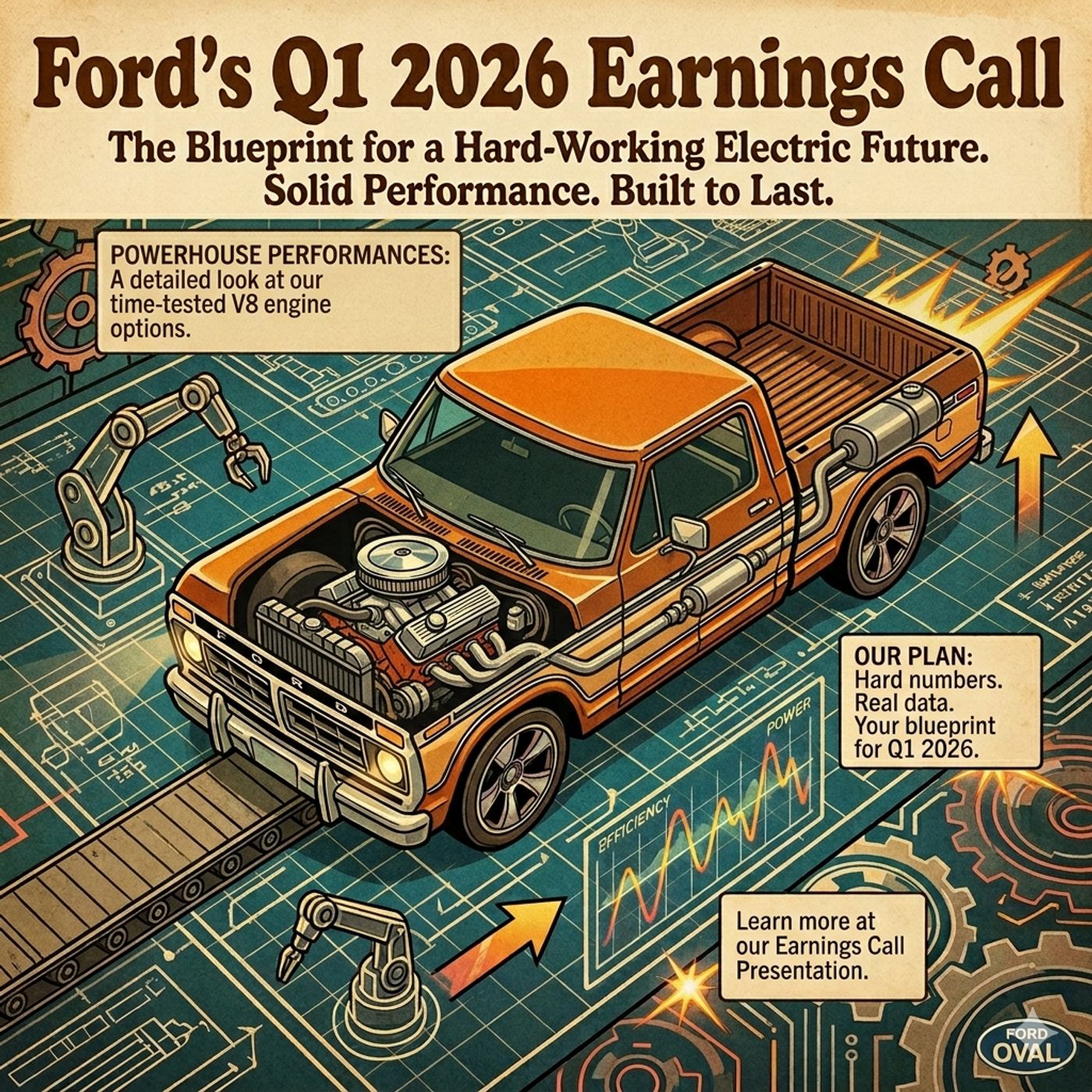
Ford's Q1 2026 Earnings Call
About this episode
Ford’s Q1 2026 earnings call centers on a push to unify software, digital, and industrial execution—creating an end-to-end product creation and industrialization organization. Jim Farley ties this to next-gen EV architectures and in-house software, plus growth in software and physical services revenue (over $15B last year, targeting ~8% annual growth through the decade). The call also highlights cost/quality gains from “skunk work” tools flowing into ICE and hybrid lines, an aggressive North American refresh plan, and a 2027 universal EV platform. Analysts pressed on Chinese EV competition and digital services economics.
In this episode, we dive deep into the newly released financial performance details from Ford Motor Company's Q1 2026 earnings call. The discussion centers on the legacy automaker's ongoing transition toward electrification, detailing their latest production strategies, capital allocations, and vehicle manufacturing updates. We break down the technical article updates and analyze what these profit margins and battery engineering adjustments mean for the future of their EV lineup, including popular models like the Model Y competitors and upcoming consumer trucks. Additionally, we look at market trends, solid-state battery engineering timelines, and how automotive industry dynamics are shifting as legacy tech mixes with next-gen software-driven fleets. Whether you are an EV enthusiast or tracking the broader automotive stock market, this episode offers a comprehensive blueprint of Ford's current trajectory.
Support the Show https://www.supportkilowatt.com/
Other Podcasts:
- Beyond the Post YouTube (https://www.youtube.com/@beyondthepostfm)
- Beyond the Post Podcast (https://www.beyondthepost.fm/)
- Shuffle Playlist (https://shows.acast.com/shuffle-playlist)
- 918Digital Website (https://www.918digital.com/)
News Links:
*Show Art Created By Gemini
Hosted by Simplecast, an AdsWizz company. See pcm.adswizz.com for information about our collection and use of personal data for advertising.
Ford
"[192.0s] and check it out there. Alright, with that, let's go ahead and jump into Jim Farley's opening remarks. [200.2s] Jim's the CEO of Ford. Alright, let's hear what Jim has to say."
Ford is a big car company. Here, their CEO is talking about how Ford is changing its organization to build cars and software faster.
Ford is a major legacy automaker that sells vehicles globally and also runs large-scale software and services efforts. In this earnings call segment, Ford’s CEO is describing how the company is reorganizing to speed up product and software delivery.
end-to-end organization, product creation and industrialization
"[223.6s] Early this month, we took the next step in that evolution by establishing an end-to-end [228.6s] organization, product creation and industrialization."
This is about organizing the company so the whole process—from designing the car to building it in factories—runs more smoothly. The goal is fewer slowdowns between teams.
An “end-to-end” organization is structured to cover the full chain from product planning and development through industrialization (turning designs into mass production). The point is to reduce handoff delays and complexity so new vehicles and software can be rolled out faster.
next-generation electric architectures
"[242.1s] the most intensive product and software rollout in our history. By 2030, almost all of our global [249.2s] volume will feature next-generation electric architectures and in-house software."
“Electric architectures” are the underlying vehicle design frameworks—how the powertrain, battery, wiring, and control systems are laid out. “Next-generation” implies Ford plans a new generation of EV-specific (or EV-ready) platform designs to support faster scaling and better integration with software.
in-house software
"[249.2s] volume will feature next-generation electric architectures and in-house software. [255.0s] This applies to every propulsion type as we deliver and scale high-quality software-defying vehicles."
In-house software means Ford writes and manages the software itself instead of buying it from another company. That can help them control features and updates for the car.
“In-house software” means the automaker develops key software components internally rather than relying primarily on third-party suppliers. This matters because vehicle software affects everything from user interfaces to powertrain control and over-the-air updates.
high-margin software and physical services revenue
"[282.3s] Among other things, this alignment will support our high-margin software and physical services [287.9s] revenue, which was over 15 billion last year."
Ford is talking about making money not only from selling cars, but also from software and services that come with them. They believe those services can be more profitable than the car sale itself.
This refers to revenue streams where software and related services (not just vehicle sales) are expected to carry higher profit margins. For automakers, it often includes connected services, subscriptions, and software-enabled maintenance or support.
aftermarket sales
"[295.6s] 8% annually through the end of the decade. This service growth is driven by offering customers [302.3s] indispensable digital experiences and investing in aftermarket sales with a focus on customer [310.3s] uptime, expanding our parts catalog, and enhancing our service network."
Aftermarket sales are things you buy for your car after you already own it—like replacement parts or service. Ford is saying it wants to sell more of those over time.
Aftermarket sales are parts and services sold after the vehicle is delivered—think replacement components, accessories, and service work. Automakers pursue this because it creates ongoing revenue tied to the installed vehicle base.
skunk work breakthroughs
"[332.8s] the EV market. But before, we're now integrating these skunk work breakthroughs back into our [340.1s] mainstream products and processes."
“Skunk work” means a small group working on experimental ideas quickly. Ford is saying it will use what those teams invent in regular, high-volume car production.
“Skunk work” refers to small, fast-moving teams working on experimental or breakthrough technology outside the normal corporate process. Ford is saying it will take those experimental tools and methods and apply them to high-volume mainstream production.
physics-based cost modeling
"[340.1s] mainstream products and processes. We're applying their advanced tools and physics-based [347.9s] cost modeling to the highest volume internal combustion and hybrid lines."
This is a way to estimate how much something will cost using engineering science, not guesswork. Ford says it’s using those tools to better plan costs for many types of cars, including gas and hybrid models.
“Physics-based cost modeling” uses engineering/physical principles (not just historical averages) to estimate how design choices affect cost. Ford is claiming it will apply these advanced tools to help predict and control costs for high-volume internal combustion and hybrid lines.

next generation F-150
"This includes the next generation F-150 and Super Duty, among many others. It also includes the launch of our universal EV platform in 2027"
The Ford F-150 is Ford’s popular pickup truck. Here, Ford is saying the next version of it will be part of their bigger plan to offer electrified drivetrains.
The Ford F-150 is Ford’s best-selling pickup, and “next generation” signals a major redesign cycle. In this earnings call context, Ford is tying that redesign to its electrification plans and platform strategy for future powertrains.
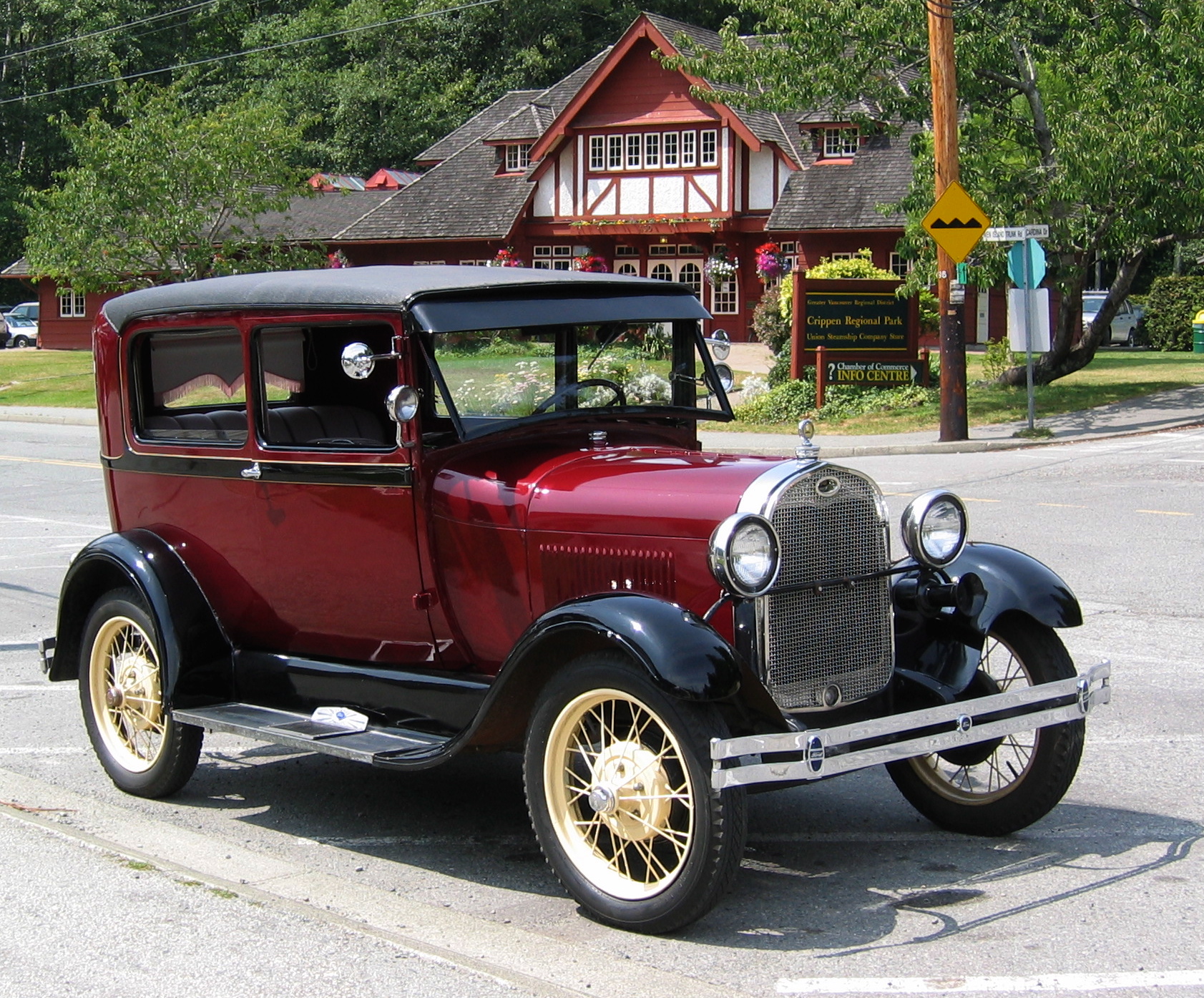
Super Duty
"This includes the next generation F-150 and Super Duty, among many others. It also includes the launch of our universal EV platform in 2027"
Super Duty is Ford’s bigger, heavy-duty truck line. Ford is implying the next versions will also get electrified powertrain options as part of their future platform plan.
Ford’s Super Duty line is the heavy-duty pickup family (positioned above the F-150) aimed at towing and work use. Mentioning “next generation” alongside the F-150 suggests Ford plans to apply its electrification and platform approach to these larger trucks too.
universal EV platform
"It also includes the launch of our universal EV platform in 2027 from our Louisville assembly plant in Kentucky. We are scaling that plant for significant volume"
An “EV platform” is the main design and engineering foundation for electric cars. “Universal” here means Ford wants one common electric-car foundation that can be used for many different vehicle types.
A “universal EV platform” is a shared vehicle architecture designed to underpin multiple vehicle models. The goal is to reduce engineering and manufacturing complexity by using one scalable EV “base” for different body styles and powertrain configurations.
Louisville assembly plant in Kentucky
"It also includes the launch of our universal EV platform in 2027 from our Louisville assembly plant in Kentucky. We are scaling that plant for significant volume"
This is Ford’s factory in Kentucky. Ford is saying it plans to build its next electric-vehicle platform there starting in 2027.
Ford’s Louisville assembly plant in Kentucky is a manufacturing site where vehicles are produced for the North American market. In this call, Ford says it will launch its universal EV platform there, implying a production shift toward electrified vehicles.
powertrain choice
"And speaking of electrification, our strategy remains focused on powertrain choice, not nameplate complexity. By the end of the decade, 90% of our global nameplates will offer electrified powertrains"
A “powertrain” is how the car makes and delivers power (gas, hybrid, or electric). “Powertrain choice” means Ford wants to offer several different types instead of only one.
“Powertrain choice” refers to offering multiple drivetrains—like hybrids, plug-in hybrids, and full EVs—rather than committing to one electrified option. Ford is framing this as a strategy to match different customer needs and regulations while keeping product planning manageable.
extended range electric vehicles
"By the end of the decade, 90% of our global nameplates will offer electrified powertrains, including advanced hybrids, extended range electric vehicles, and full EVs."
An extended-range EV is mostly electric, but it has a backup system that helps recharge the battery on the go. That means you can drive farther without needing to plug in every time.
An “extended range electric vehicle” (EREV) is primarily an electric car, but it includes a generator (often from a small engine) to recharge the battery when needed. The battery provides propulsion, while the generator extends how far you can go without plugging in.
advanced hybrids
"By the end of the decade, 90% of our global nameplates will offer electrified powertrains, including advanced hybrids, extended range electric vehicles, and full EVs."
An advanced hybrid is a car that uses both a gas engine and an electric system. It’s designed to be more efficient than simpler hybrids, especially in stop-and-go driving.
“Advanced hybrids” are hybrid powertrains that use more sophisticated control and energy-management than basic mild-hybrid setups. In EV strategy discussions, this usually means hybrids designed to improve efficiency and reduce emissions while still using an internal-combustion engine.
ICE cars
"we're going to build this for all of the different types of vehicle platforms that we're going to sell, hybrid, extended range EVs, and full electric EVs, as well as ICE cars. So that's not all that different than what GM said."
ICE cars are the regular gas-powered cars that use an engine burning fuel. Ford is saying its strategy covers those too, alongside hybrids and electric cars.
“ICE” stands for internal combustion engine, meaning conventional gas- or diesel-powered vehicles. Ford is contrasting ICE cars with electrified options like hybrids and full EVs as part of its broader platform plan.
Skunk Works
"They developed a whole Skunk Works project. They're building that truck in much in the same way that Japanese, excuse me, Chinese automakers build their vehicles."
“Skunk Works” is a nickname for a special, fast team that builds something in a more experimental way. Ford is saying it used that kind of approach to develop a cheaper truck and then reuse what it learned elsewhere.
“Skunk Works” refers to a fast-moving, highly focused development approach—often involving small teams working with less bureaucracy to prototype and iterate quickly. In this context, Ford is saying it created a dedicated project to develop a new “$30,000 truck” efficiently, then apply those lessons across other platforms.
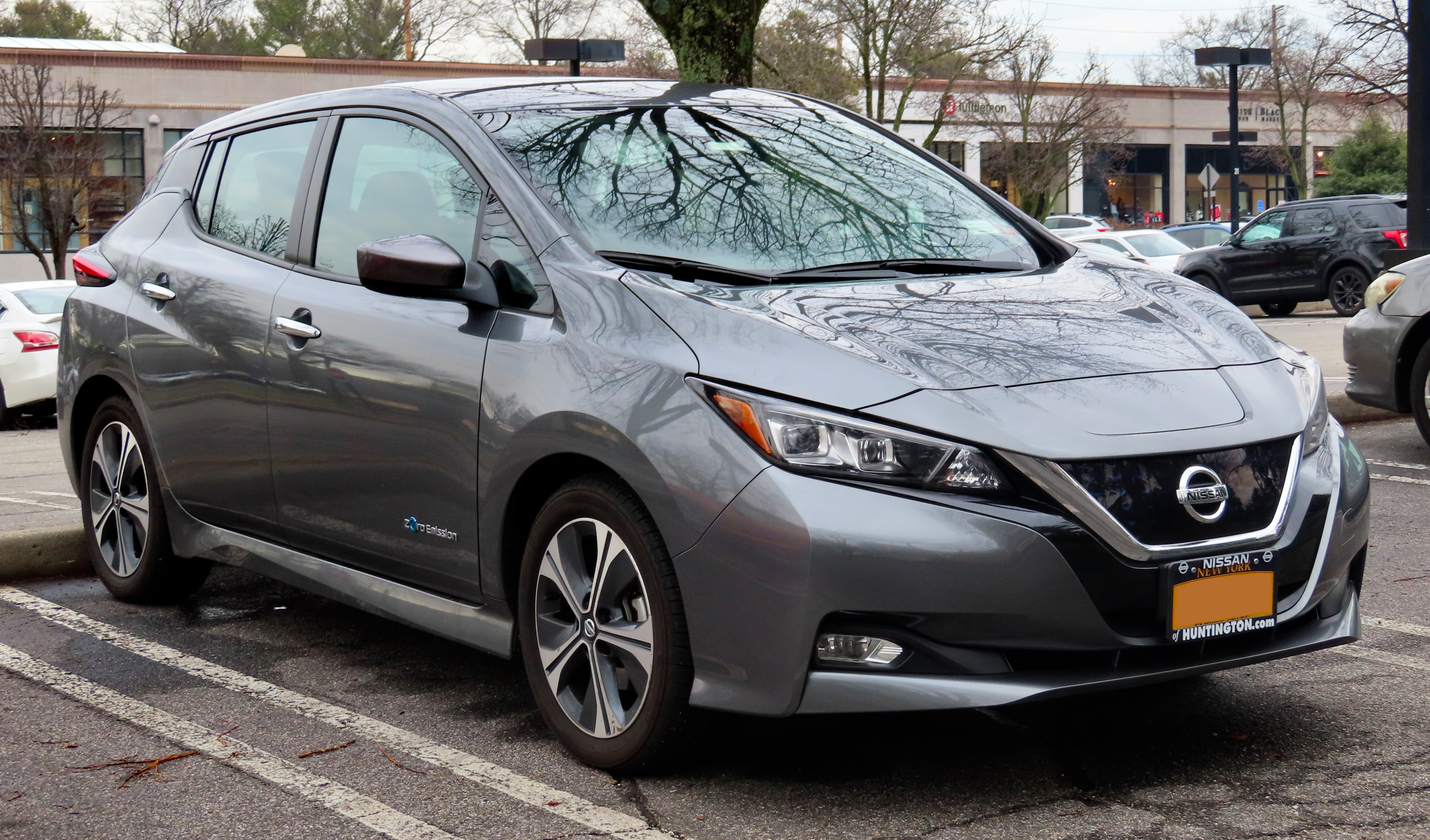
Nissan Leaf
"...e automakers build their vehicles. So they took a leaf or several chapters from the Japanese automotive ..."
The Nissan Leaf is an electric car that runs on a battery instead of gasoline. It’s designed for normal driving and charging at home or in public spots. The podcast brings it up as an example of an early, widely known EV.
The Nissan Leaf is a mass-market electric car designed to make EV ownership practical for everyday use. It’s often referenced in discussions about how automakers approach electric vehicles, including what lessons other companies may take from earlier EV efforts. In the podcast context, it’s used as an example tied to the broader history and development of EVs.
tariff refunds
"“...it was like $1.1 billion in tariff refunds back from the US government...”"
Tariff refunds are money returned to a company after it pays import duties (tariffs) on goods. In earnings calls, they’re often used to explain how trade policy affects costs and cash flow.
EBITDA
"“...because they were really more about EBITDA and things like that.”"
EBITDA is a way to measure how profitable a business is from its core operations. It removes some effects like interest payments and taxes so comparisons are easier.
EBITDA stands for earnings before interest, taxes, depreciation, and amortization. It’s a common earnings metric used to compare operating profitability across companies by stripping out financing and certain accounting items.
Chinese OEMs
"“...some potential partnerships between Ford and some of the Chinese OEMs...”"
OEMs are the companies that actually make the cars (or key parts) in the first place. “Chinese OEMs” means Chinese automakers that could be involved with the US EV market.
OEMs are original equipment manufacturers—the companies that design and build vehicles or major components sold under their own brands or supplied to others. Here, “Chinese OEMs” refers to Chinese automakers that could partner with or compete in the US EV market.
IP sharing
"“...we leverage global partnerships and even IP sharing, including with the Chinese OEs...”"
IP sharing means companies share valuable know-how or technology they’ve developed. In cars, that can include things like designs, patents, or software used in EVs.
IP sharing means sharing intellectual property—like designs, software, manufacturing know-how, or patents—between companies. In the EV context, it often comes up when automakers collaborate on platforms, batteries, or powertrain technology.
level playing field
"“...we are really fully committed to a level playing field here in the US and also safeguarding our whole market...”"
“Level playing field” means everyone should be competing under fair rules. In car trade talks, it often means reducing advantages or disadvantages caused by government policies.
A “level playing field” is a policy and market concept meaning competitors should face similar rules, costs, and protections. In auto trade discussions, it usually points to concerns about tariffs, subsidies, and import restrictions affecting competition.
digital services
"And then he talks a lot about the digital services, again, $15 billion growing 8% a year, which is fairly impressive when you talk about $15 billion,"
Digital services are the online/app features that come with a car. They can include things like connectivity, apps, and other paid add-ons that affect how you use the vehicle.
“Digital services” are software and online features sold alongside vehicles—often delivered through apps, connected-car systems, or online accounts. In this segment, they’re discussed in the context of revenue growth and how carmakers balance helpful services versus annoying monetization.
subscription fees
"So having to pay for a system, for instance, okay, that seems fair. Having to pay for a cell connectivity on your phone or on your car so that you can stream music, that seems fair. Going back to the am I going to want to pay for the luxury of you turning on my heated seats?"
Subscription fees here means paying ongoing money to use certain car features. The host is saying some of these charges feel fair, but charging for things you already have in the car—like heated seats—feels wrong.
“Subscription fees” in the automotive context are recurring charges for features that may be software-enabled in the vehicle. The host’s point is that some subscriptions (like connectivity) can feel reasonable, while others (like paying to use already-installed heated seats) can feel unfair to owners.

F series
"My other question was on the pickup market and Ford obviously has a very strong franchise in that segment with the F series, but you've also spoken to adding more product with the UEV based pickup model coming"
Ford’s F-Series is Ford’s main line of pickup trucks. The host is using it as an example of how strong Ford already is in trucks before talking about new truck models coming.
Ford’s F-Series is the company’s flagship pickup truck lineup and a major part of its U.S. truck business. In this segment, it’s referenced as Ford’s “strong franchise” in pickups, setting up a discussion about how Ford plans to expand its truck lineup with additional electrified and non-EV products.
profit margins
"And then as you think about more supply coming into pickups, what are implications for profit margins in that important category?"
Profit margin is basically how much money a company makes on each sale after paying its costs. The question here is whether more truck supply will help or hurt Ford’s earnings.
Profit margins are how much profit a company keeps from each dollar of sales after covering costs. In an earnings call context, Ford is discussing how changes in supply and demand—especially in pickup trucks—could affect profitability.

Maverick
"On the retail side, the truck business has historically been with the full size pickup and medium pickup, but what we've been able to do is really expand that the pickup segments themselves, Maverick has created a whole new segment..."
The Ford Maverick is a smaller pickup truck from Ford. The speaker is saying that Maverick helped bring in a whole new group of truck buyers, and that trend should keep growing.
Ford Maverick is Ford’s compact pickup that helped create a newer, lower-price “entry” truck segment. In this earnings call, Ford is using Maverick as the example of how expanding pickup offerings can pull more buyers into trucks.
UAV pickup
"We think that trend will continue, especially with the type of packaging that we're going to be able to provide. It worked on Maverick and we are really excited about the UAV pickup and the packaging that that has to really appeal..."
“UAV pickup” sounds like a specific Ford pickup offering or program name. The speaker is saying the way it’s packaged will attract both truck buyers and SUV buyers, but they don’t explain what UAV stands for here.
“UAV pickup” appears to be a product/program name tied to Ford’s future pickup packaging and appeal. Because the transcript doesn’t clearly define it, listeners may need clarification on what Ford means by UAV in this context (likely a specific upcoming pickup variant or platform).

F 750
"We have commercial buyers that buy pickup trucks from Maverick size all the way up to our F 750 and we have products in those segments..."
The Ford F-750 is a heavy-duty Ford truck used for work. The speaker is saying commercial buyers can choose from smaller trucks all the way up to the F-750.
Ford F-750 is a heavy-duty pickup/truck platform aimed at commercial customers who need higher payload and towing capability. Here, Ford is positioning it as part of a lineup that spans from Maverick-sized trucks up through the F-750 for business buyers.

Buick 27 Model
"...stomers and we continue to see we just opened our 27 model year order books and we're starting, we're seeing..."
The Buick Model 27 is a Buick vehicle tied to a particular model year. The podcast is saying that people can start placing orders for that model year now. It’s brought up because it relates to how the company is planning upcoming production.
The Buick Model 27 refers to a specific model year designation for a Buick vehicle, with the podcast noting that order books have opened for the “27 model year.” In the context provided, it’s discussed as part of ongoing planning and customer demand signals. It’s mentioned because new model-year ordering and production timing are important to how automakers manage their product pipeline.
pro power on board
"To do that, we want to offer customers more choice on the powertrain side and tie the powertrains to other benefits that a truck customer would want like a hybrid for pro power on board."
Pro Power Onboard is Ford’s system that lets the truck provide electricity for things like tools or camping gear. Ford is saying that’s one of the reasons buyers would want certain electrified powertrains.
Pro Power Onboard is Ford’s branded feature for providing electrical power from the vehicle to run tools or appliances. In this segment, Ford is using it as a key “truck benefit” to pair with electrified powertrains like hybrids.

Ford Ranger
"...land, Africa, the Middle East, and South America. Ranger is number one or number two in every one of those..."
The Ford Ranger is a mid-size pickup truck that’s sold in many countries. The podcast mentions it because it’s especially popular in several regions around the world. It’s a key model for Ford’s pickup lineup outside of North America.
The Ford Ranger is a mid-size pickup truck sold in many global markets, where it’s known for being a strong seller. The podcast context highlights its popularity across regions like Africa, the Middle East, and South America, emphasizing that it ranks at or near the top in those areas. That kind of market presence makes it relevant when discussing how automakers plan product updates and electrification strategies worldwide.
powertrains
"We are future proofing those lineups now as we speak with [1394.7s] different powertrains and even more affordable options."
A powertrain is the set of parts that makes the car move. It includes things like the engine/motor and how that power gets to the wheels.
A powertrain is the vehicle’s propulsion system—how it makes and delivers energy to move. In this call, Ford is talking about using different powertrains (including EVs and hybrids) to “future proof” pickup lineups in global markets.
EV transition
"So I'll maintain objectivity, but I do think having a broader strategy in that [1464.8s] EV transition [1473.9s] is a good idea."
The EV transition is the shift from gas-powered cars to electric cars. The speaker is saying companies may need a gradual plan so they don’t lose sales while EVs ramp up.
The EV transition refers to the industry shift from internal-combustion vehicles to electric vehicles over time. Here, the speaker argues that a broader strategy during the transition can help companies avoid failure while still moving toward EVs.
infrastructure
"Whether or not it lasts forever, I don't know, but what I like everybody to just [1481.3s] switch over to an EV, yes, I think as long as the infrastructure can keep up"
For EVs, infrastructure means the charging setup—like public chargers and the systems that make them work. The point is that EVs need charging to be available before everyone can switch quickly.
In the EV context, infrastructure means the charging network and related systems needed to support electric vehicles. The speaker notes that widespread adoption depends on charging availability, implying a ramp-up over the next few years rather than an instant switch.
autonomy
"Anyway, let's go ahead to our next question. Just coming back to autonomy, it seems in"
Autonomy is how much of the driving a car can do by itself. The segment is about what Ford thinks or is doing regarding that technology.
Autonomy refers to how much driving is handled by vehicle systems without human input, ranging from driver assistance to fully self-driving behavior. The speaker is teeing up a discussion of autonomy right after the EV/infrastructure comments.
gigawatt hours
"Well, as you know, we are committed to over 20 gigawatt hours of capacity starting in the fourth quarter of next year."
A gigawatt-hour is a way to measure how much energy something can store or deliver. When companies talk about “capacity” in GWh, they mean the total energy their batteries can provide over time.
A gigawatt-hour (GWh) is a unit of energy, not power. In EV and battery discussions, it usually describes how much energy a facility can produce or supply over time (for example, total battery capacity coming online).
UEV
"That'll be a mostly Kentucky one and a little bit of Marshall. Marshall will be really focused on UEV, but has some capacity for energy business."
UEV is a short form for a specific kind of electric-vehicle-related product. In this call, it’s basically telling you what the factory will mainly be making.
UEV is an acronym used in some energy/EV supply-chain contexts to mean a type of electric-vehicle or electrified-vehicle product line. Here, it’s used to describe what a specific manufacturing site will focus on, alongside other energy business capacity.
DC block
"We are on track in the industrial manufacturing capability of doing DC block. It's not just the batteries themselves. It's the containers. It's the management of the battery."
“DC” means direct current, the type of electricity batteries produce. A “DC block” is part of the battery system that helps package and manage that electricity so it can be used safely.
A “DC block” is a battery-related electrical/packaging component used in direct-current (DC) power systems. In manufacturing terms, it implies Ford’s partner is building not just cells, but the DC-ready assembly/packaging needed to manage and deliver battery power safely and reliably.
bridge
"And all I would say, Ryan, is that the energy business is the key element of our bridge to 8% margin. Okay, so I will make this response and all other responses brief."
In earnings-call language, a “bridge” is a step-by-step reconciliation that explains how you get from one financial outcome to another (for example, from prior performance to a target margin). It’s a structured narrative of what changed and why.
mega castings
"like mega castings. You know, UEV has its own software platform, so development and testing of that platform."
“Mega castings” means making big structural parts in one piece instead of many smaller pieces. That can make the car cheaper to build and faster to assemble.
“Mega castings” are very large single-piece castings used in vehicle manufacturing, typically for structural body sections. The idea is to reduce the number of parts and welds, which can lower cost and improve manufacturing speed—important for scaling EV production.
top hats
"Your second piece of question, number of top hats. As we've mentioned, it is a platform. We plan to have high volume at Louisville..."
“Top hats” here sounds like a specific part or module Ford uses as part of its EV production plan. They’re talking about how many versions they’ll run and how that supports the launch.
“Top hats” is an internal manufacturing/engineering term for a specific platform-related hardware or production module used in the EV program. In this context, the speaker treats “top hats” as configurable building blocks tied to the platform and launch planning.
demand creation
"The launch is bigger than the industrial launch, so we want to give you a little bit insight into the demand creation, because that's critical for us."
“Demand creation” means marketing and sales efforts to get people excited about buying the new EV. Ford is saying it matters a lot for getting enough customer orders during the launch.
“Demand creation” is the set of actions a manufacturer uses to generate customer interest and orders before and during an EV launch. In this call, Ford frames it as critical because the EV market is moving toward affordable vehicles and customers need a compelling option.
fully specced
"There's really not much choice on a fully specced, highly capable technological vehicle platform that's really affordable."
“Fully specced” means the car is equipped with the full set of features, not a basic version. Ford is saying their affordable EV can still be well-equipped.
“Fully specced” means a vehicle configured with a complete, high-feature specification—typically including the features and performance elements that buyers expect. Here, it’s used to argue that Ford’s affordable EV platform can deliver a “highly capable” car without stripping it down.
compliance vehicles
"There's a lot of compliance vehicles, but this is a real legitimate, fully capable product for customers."
“Compliance vehicles” are cars companies make mainly to satisfy government rules. The speaker is saying Ford’s EV is meant to be a real product people want to buy, not just a paperwork requirement.
“Compliance vehicles” are EVs (or low-emission vehicles) produced primarily to meet regulatory requirements rather than to satisfy strong consumer demand. The speaker contrasts these with a “real legitimate” affordable EV offering built on the UEV platform.
Request an Explanation
Heard something you'd like explained? We'll add it to this episode.
Sign in to request explanations for terms you heard.
Want to learn more?
Browse our glossary for plain-English explanations of automotive terms, jargon, and concepts.
Help improve this episode
See something that's not quite right? Our annotations are AI-generated and can sometimes miss the mark. Click the flag icon on any annotation to suggest a correction.