
Mat Armstrong Reveals INSANE Car Collection & How YouTube Changed His Life
About this episode
Matt Armstrong lays out how YouTube turned a lifelong car obsession into a business: ad revenue and sponsorship fund builds, while the cars become long-term assets he can keep. He shares the real numbers on losses (about £200k on a rebuild) versus “made” (often hard to calculate since he rarely sells), and explains why he avoids gambling/finance sponsors that don’t feel right. The conversation also covers his massive collection, the storytelling/editing grind, merch and brand-building, and how lockdown helped him quit a job. Along the way, he credits inspiration from viewers and the wide range of people his channel attracts.

Lamborghini Gallardo
"What's your collection now? Lamborghini Gallardo, Maserati Gran Turismo, McLaren 720S, 4x8 Spider, Gauze was cool That car is unreal."
The Lamborghini Gallardo is a high-performance supercar made by Lamborghini. It’s famous for its powerful V10 engine and for being a “real” Lamborghini that many people can still afford compared to the brand’s most extreme models.
The Lamborghini Gallardo is a mid-engine supercar known for its V10 sound and relatively approachable performance compared with some other Lamborghini models. In enthusiast circles, it’s often seen as a “gateway” Lamborghini that still delivers real track-capable behavior.

Mclaren 720S
"What's your collection now? Lamborghini Gallardo, Maserati Gran Turismo, McLaren 720S, 4x8 Spider, Gauze was cool That car is unreal."
The McLaren 720S is a supercar from McLaren that’s designed to be fast and agile. It uses a powerful engine and a lightweight design to make it feel very responsive when you drive it.
The McLaren 720S is a modern supercar built around McLaren’s lightweight carbon-fiber approach and a high-output twin-turbo V8. It’s known for sharp steering response and strong real-world performance, which is why it’s a frequent benchmark in supercar comparisons.

Maserati Gran Turismo
"...hat's your collection now? Lamborghini Gallardo, Maserati Gran Turismo, McLaren 720S, 4x8 Spider, Gauze was cool That c..."
The Maserati GranTurismo is a luxury two-door coupe. It’s built for smooth, comfortable driving while still having strong performance. The podcast mentions it as part of a collection of different high-end cars.
The Maserati GranTurismo is a grand touring coupe designed for comfortable high-speed cruising with a more emotional, performance-focused character. It’s often discussed in car-collection conversations because it represents a classic style of Maserati—luxury plus power in a two-door format. In the episode, it’s listed alongside other notable performance cars.
lottery ticket
"What's next? Huh, that's a lottery ticket. They're absolutely lethal."
A “lottery ticket” car is basically a gamble. It could make you a lot of money, but it could also lose value depending on the market and the car’s condition.
Calling a car a “lottery ticket” means it’s a high-variance bet—either it pays off big (value appreciation, big profit on resale, or a great build outcome) or it can go sideways. In car collecting and flipping, this often comes down to market timing, condition, and how the build affects demand.
lost on the car
"So I would have lost on the, how does that feel? On the car. Do you know, you win some and you do some. Bollocks."
This is about the economics of car builds and resale—how much money you can lose or make after investing in a vehicle. It highlights that even successful builds can end up with losses due to depreciation, repair costs, and shifting buyer demand.
I didn't buy the cars to make money through selling them
"Do you know, I didn't buy the cars to make money through selling them. Well, I want to come to the other bits in a minute."
This is essentially the opposite of car flipping: instead of buying cars as an investment to profit from resale, the speaker buys for personal enjoyment and retention. That changes how they evaluate condition, modifications, and long-term costs.
win-win of the content
"I just want to talk about the cars first because you've got that win-win of the content and everything else. You can't lose, can you?"
They mean making car videos can help in two ways at once. You get to enjoy the cars, and you also grow an audience (which can make the hobby more sustainable).
The hosts are describing how creating car content can be mutually beneficial: it builds an audience while also supporting the car hobby. In practice, the “content” angle can change how people buy, document, and justify spending on cars.
buying and fixing up a car and then going on to the next one
"I didn't seem myself getting a nice car through buying and fixing up a car and then going on to the next one and the next one."
They’re talking about a pattern where someone buys a car, fixes it up, and then sells it to buy another. That’s different from keeping cars long-term.
This describes a “buy, refurbish, and move on” cycle—common in car collecting and flipping. It contrasts with a long-term ownership mindset where the goal is to keep cars rather than rotate them for profit.
competition
"So a lot of them I don't actually sell like the viewers will see that most of the cars are bought I've ever kept or they've gone on the competition or something along those lines."
“Competition” here likely refers to racing or track events where a car is used and possibly sold after being campaigned. In car culture, competition use can strongly influence maintenance needs, wear items, and how a car is valued.
lost 200,000
"So it's, yeah, I don't, I'm not as good to be it because I'm still, even if that car's gone and I've lost 200,000, I'm still in the position I'm in today and like I can work"
The speaker is framing a large financial loss as not changing their overall position—suggesting they’re treating cars as a hobby with acceptable downside. This is a common collector mindset: the “cost” is part of the experience, not just a spreadsheet outcome.
not registered as damaged
"I've spent around 50 to 60,000 pounds on it and it's not registered as damaged. It's got a full rebuild engine, like it had the interior done."
They’re saying the car doesn’t have a “damaged” title/record. That matters because cars with that history usually sell for less, even after repairs.
In many markets, a car can be “registered as damaged” (often meaning it has a salvage/insurance write-off history). That kind of title/registration status can heavily affect resale value and buyer confidence, even if the car is repaired.
full rebuild engine
"It's got a full rebuild engine, like it had the interior done. I love it."
They’re saying the engine was rebuilt from the inside out. That can make the car feel more reliable again and can be a selling point when you go to resell.
A “full rebuild engine” means the engine was taken apart and rebuilt with new or refurbished internal components, rather than just doing minor repairs. For high-value exotics, a documented rebuild can restore reliability and help protect resale value.
crash damaged
"And again, it's, it's crash damaged, but there's, it's only a handful of them made. You know, in like 10 years, I don't think it can go below them."
“Crash damaged” means the car was hurt in an accident. Even if it’s expensive to fix, some people still buy these cars because the model is rare and they think they can sell it later for a profit.
“Crash damaged” means the car has been in an accident and likely has structural or mechanical repairs. For rare exotics, crash history can drastically affect resale value, but some buyers still see upside if the damage is repairable and the model is scarce.
YouTube ad revenue and sponsorship revenue
"Like these are all, the beauty about what I'm doing is I earn, I earn the money through the ad revenue and the sponsorship and that's where, that's where my money's earned. And then like your channel, what kind of money does a YouTube channel like yours make?"
They’re talking about how YouTube makes money—ads and sponsors—and how that money can be used to buy cars. It’s basically “make content, get paid, then reinvest into the cars.”
This segment focuses on how the host earns money through YouTube ad revenue and sponsorships, and then reinvests it into car purchases. It’s a business model discussion: content monetization funding the car collection.
cars have become an asset
"And then with the cars, they're, they've become an asset. It costs my money to make the videos. The money it's cost me to make the videos are going into a car, which at the end is an asset and I get to keep."
They’re talking about buying cars like they’re investments. Instead of seeing the car as something you spend money on, they see it as something you might sell later for money.
The host is describing a “cars as an asset” mindset—treating vehicle purchases as investments rather than pure consumption. This framing depends on rarity, condition, and market demand, and it’s different from owning a car just for transportation.
AdSense
"So like you'll have like ads, you have like your ad sense, which is if you post like an hour long video, you get paid per like if an advert pops up and you get the skippable ads and it's really dependent on what you're posting and the topic that you're posting."
AdSense is the advertising program that pays creators based on ad impressions and clicks shown on their content. In this segment, it’s described as part of how earnings scale with video length and how often ads appear.
skippable ads
"So like you'll have like ads, you have like your ad sense, which is if you post like an hour long video, you get paid per like if an advert pops up and you get the skippable ads and it's really dependent on what you're posting and the topic that you're posting."
Skippable ads are ads you can skip after a few seconds. They still count for advertising, but they’re not as “forced” as ads you can’t skip.
Skippable ads are ads viewers can bypass after a short delay. Because viewers can skip them, platforms typically measure performance differently than non-skippable formats, affecting how much creators earn.
sponsorships
"Exactly. Yeah. Exactly. I don't, the, and then on top of that, then you have the sponsorship and the sponsorships, I think generally are really cheap because what is it?"
Sponsorships are when a company pays a creator to mention or promote them. The price usually depends on how many people watch and who those viewers are.
Sponsorships are paid partnerships where brands pay creators to promote products or services. The segment suggests sponsorship pricing can be influenced by audience size and the brand’s willingness to pay for access to that specific demographic.
Super Bowl ad pricing comparison
"It's a Super Bowl. How much is a Super Bowl to it's, it's like a million, a million. What is it? A million every 10 seconds for an advert?"
They’re using the Super Bowl as an example to show how huge ad prices can be on TV. Then they compare that to what creators pay/earn for ads online.
The hosts compare YouTube/creator ad costs to traditional TV advertising by referencing Super Bowl ad pricing. This highlights how “expensive” ad rates can look in isolation but may be comparable to mainstream broadcast rates.
F1 advertising comparison
"But when you look at TV and when you're looking at like sky sports and in between the F1 or even on F1 stuff, I think it's so reasonable."
They mention F1 broadcasts to make the point that sports TV can have very expensive ad slots. The idea is that online creators can still get good ad money even with different formats.
The segment compares creator ad value to advertising around Formula 1 coverage (including “in between the F1” and F1-related content). It’s used to argue that niche creator audiences can still command strong ad rates.
Creator-owned brands vs sponsored promotions
"So that's where we've sort of adventuring off and say like, right, we need to build our own brands because if we can advertise our own brands, then it's worth it to us... If we're advertising somebody else's shoes, why don't we just go make our own shoes"
Instead of only making money from companies paying to advertise, the creator starts selling their own products. That way they keep more of the profit and aren’t dependent on sponsors.
The segment contrasts traditional sponsorship/advertising with building a creator’s own brand. The motivation is cost control and higher certainty of profit because the creator can capture the full margin instead of negotiating sponsorship fees.
agency
"And then I had an agency ring me saying, 100,000 views you should be charging at least 2000 pounds for that. And then I'm like, what to quit?"
An agency is a middleman that helps creators get paid for promotions. They may tell you what you should charge based on how many people watch your videos.
An agency is an intermediary that negotiates sponsorship pricing and represents creators to brands. Here, the agency advises a higher rate based on view counts, illustrating how pricing can be influenced by market intermediaries.
ad revenue vs sponsorship
"And there'll be some products you advertise that you actually use or you stand by? Yeah, that's that's generally how it's we're at the beauty now with that. The ad revenue really allows me to do what I want to do. And I don't have to rely on sponsorship."
The host contrasts ad revenue with sponsorship-heavy monetization. Ad revenue can provide more independence because it’s tied to views and audience engagement rather than a sponsor paying for the content.
Carvertical
"It's like a meal replacement drink, like and then Carvertical and Carvertical is the we've just done a deal. Yeah, we've just done a deal with Carvertical. Yeah, and they check the cars out the mint lads. I don't have to get my videos approved"
Carvertical is a service that looks up a car’s history using records. The host is saying they’ve partnered with Carvertical long enough that the process is smooth and they don’t have to get every video approved.
Carvertical is a vehicle history/inspection service that checks cars using data sources to help verify details like ownership and history. In the segment, the host says Carvertical reviews cars and that the relationship reduces the need for video approval because the workflow is established.
vehicle repossession (buying from a repossession company)
"I got this car. I'm like, well, I don't know the history because I bought it from a repossession company."
If a car is repossessed, you might not know much about how it was cared for. A history report can help fill in gaps when the seller can’t provide details.
Buying a car from a repossession company often means you may not get a complete service or ownership history. That’s why tools like vehicle history reports become more important—because the usual paperwork and context from a normal retail sale may be missing.
FCA
"We've partnered with Refund Club who following the recent announcement by the FCA are helping thousands of people like you and our cars and money audience to check if you're owed any refund on your car finance agreement in the UK between 2007 and 2021."
FCA is the UK’s financial regulator. In this context, it’s the authority behind the announcement that led to people checking whether they can claim refunds on car finance.
FCA stands for the UK Financial Conduct Authority, the regulator that oversees financial services. Here, the FCA announcement is the trigger for Refund Club’s car-finance refund checks, implying a regulatory change or finding that affects certain agreements.
Refund Club
"We've partnered with Refund Club who following the recent announcement by the FCA are helping thousands of people like you and our cars and money audience to check if you're owed any refund on your car finance agreement in the UK between 2007 and 2021."
Refund Club is a service that helps you figure out if you might be able to get money back from certain car finance deals. If your case looks promising, they handle the next steps for you.
Refund Club is a UK-focused service that helps people check whether they’re owed money related to car finance agreements. In this segment, they’re tied to a UK FCA-related announcement and a process for running checks and handling the legal steps if a claim is valid.
car finance refund checks (UK, 2007-2021)
"...helping thousands of people like you and our cars and money audience to check if you're owed any refund on your car finance agreement in the UK between 2007 and 2021."
They’re talking about checking whether some car finance deals in the UK may have been handled incorrectly. If they find you’re eligible, you may be able to claim money back.
The segment discusses a process for checking whether drivers are owed refunds on certain UK car finance agreements from 2007 to 2021. This is a consumer-protection concept: if the finance terms were mis-sold or otherwise non-compliant, refunds may be available.

BMW i8
"He just recently bought a BMW i8 and it doesn't work and he is like, you know, I'm doing a Matt Armstrong."
The BMW i8 is a hybrid sports car that uses both electricity and a gas engine. If something goes wrong, it can stop working properly because it depends on more than one power system.
The BMW i8 is a plug-in hybrid sports car known for its lightweight design and futuristic styling. It combines an electric motor with a gasoline engine, so when one system has issues, the car can feel like it “doesn’t work” even if only part of the drivetrain is failing.
doesn't work
"He just recently bought a BMW i8 and it doesn't work and he is like, you know, I'm doing a Matt Armstrong."
“Doesn’t work” can mean the car won’t start, won’t drive, or has warning lights that stop it from behaving normally. With newer cars, the problem could be small or could be something deeper, so you usually have to diagnose it.
When someone says a car “doesn’t work,” it can mean anything from a simple fault (like a sensor or battery issue) to a major drivetrain or electrical problem. On modern cars—especially hybrids—diagnosing the root cause often requires scanning codes and checking both the gas and electric systems.
rebuild it
"it is amazing to see how many people, whether it's been inspired to go and buy a car and rebuild it or even just like quitting their job to do something that they enjoy doing."
“Rebuild it” usually means you take a car that’s not working and fix it up until it runs again. People do it as a hobby and to learn, and it can be really satisfying.
“Rebuild it” in car culture usually means taking a non-running or worn car and restoring it back to working condition—often with repairs, parts replacement, and sometimes upgrades. It’s a common YouTube/enthusiast path because it turns a broken purchase into a project with measurable progress.
modified cars
"...it started off just like a small niche of like lads who like messing around, modified cars..."
“Modified cars” refers to vehicles that have been changed from factory configuration—often for appearance, performance, or personalization. The transcript frames the audience starting as a niche of people who like tinkering with modified cars, then expanding into mainstream motorsport interest.
FIA
"...it's kind of grown then to like now there's like the president of the FIA, Mohammed Ben Salim, ringing me the other night..."
FIA is the organization that oversees a lot of big international racing. It’s like the “rules and leadership” body for major motorsport events.
The FIA (Fédération Internationale de l’Automobile) is the governing body for major international motorsport series, including Formula 1. When someone as high-profile as the FIA president watches a creator’s content, it signals how mainstream and influential motorsport media has become.
F1 race
"...he's just finished an F1 race and then he's watching my video like what the hell..."
F1 is the highest level of open-wheel racing. It’s the kind of event where the teams and drivers are constantly analyzing performance and updates.
F1 (Formula 1) is the top tier of open-wheel racing, with races that involve highly engineered cars and strict technical regulations. Mentioning that he’d just finished an F1 race frames the scale of motorsport attention and how quickly news and content travel across the community.
Adrian Newey
"...You'll have Adrian Newey on the phone to you soon. How do we fix this vibration problem?"
Adrian Newey is a legendary Formula 1 race car designer known for shaping multiple championship-winning cars. Bringing him up in the context of “fix this vibration problem” highlights how technical issues in racing cars can be serious and require expert-level engineering.
vibration problem
"...You'll have Adrian Newey on the phone to you soon. How do we fix this vibration problem? That's the thing as well we don't know..."
A vibration problem is when the car shakes or buzzes more than it should. It can come from things like tires, wheels, or parts that don’t spin smoothly, and it’s important because it can make the car harder to control and can wear parts out faster.
A vibration problem refers to unwanted oscillations that can come from rotating components, suspension/bushing wear, wheel/tire imbalance, or aerodynamic/structural resonance. In performance cars—especially race cars—vibration can affect driver comfort, traction feel, and even component durability.
BMX plates
"...I wanted BMX riding that's why all the plates I got like BMX plates on them so that's why we did but there was no money"
“BMX plates” likely refers to number plates or plate designs themed around BMX riding. While not a car part, it’s a personal branding detail that explains how the creator’s interests influenced the way they presented their vehicles publicly.
house flipping
"we've got five houses now or four or five houses now right and because most people flip on yeah after the tax and everything else and you say it becomes not worth it yeah"
House flipping is when someone buys a house, fixes it up, and tries to sell it for more money. If taxes and costs are too high, the profit can disappear.
House flipping is buying a property, improving or renovating it, and then selling it for a profit—often within a relatively short timeframe. The profitability depends heavily on purchase price, renovation costs, sale price, and taxes/fees, which can erase gains if the numbers don’t work.
capital gains tax
"I was just learning all through YouTube of like I was going to flip it my dad was flipping on but then you see the capital gains tax on the arm and it just becomes not worth it"
Capital gains tax is what you may owe when you sell something for more than you paid for it. If you’re trying to make money by buying and selling houses quickly, this tax can cut into your profit.
Capital gains tax is a tax on the profit you make when you sell an asset, such as a property. In house-flipping, the tax can significantly reduce net profit, which is why some investors decide flipping may no longer be worth it after taxes and costs.
refinancing
"but then I learned about the refinancing of like I bought a house for a hundred it was worth 140 then I'd refinance it on a mortgage I'd take that money out and that money was a deposit for the next house"
Refinancing means you swap your current home loan for a new loan. Sometimes it lets you take out some of the home’s value as cash, which can help you buy the next place.
Refinancing is when you replace an existing mortgage with a new one, usually to change the interest rate or access equity. In property investing, people may refinance to pull out cash (equity) and use it as a down payment for another purchase.
equity
"I bought a house for a hundred it was worth 140 then I'd refinance it on a mortgage I'd take that money out"
Equity is how much of the house you own outright. If the house becomes worth more (or you pay down the loan), you may be able to borrow against that extra value.
Equity is the portion of a property’s value you truly own—generally the market value minus what you still owe on the mortgage. When the speaker says the house was worth more and they refinanced to take money out, they’re describing using increased equity to fund the next purchase.
buy-to-let
"I know I don't make nothing on the on the houses anymore. No the buy to let's got harder it's more like commercial and retail now"
Buy-to-let means buying a property to rent it out to tenants. If the rental market or loan costs change, it can become much harder to make good money from it.
Buy-to-let is an investment strategy where you purchase a property specifically to rent it out for income. The economics can change over time due to interest rates, rental demand, and regulation, which can make it harder to generate meaningful returns.
commercial and retail
"it's more like commercial and retail now and converting those which is probably what I would have got into if that was the case"
Commercial/retail investing means renting to businesses or shops instead of families living there. Some investors switch strategies when residential rentals don’t pay as well anymore.
Commercial and retail property investing typically involves renting space to businesses rather than residential tenants. Converting properties to these uses can change the cashflow profile and may be pursued when residential buy-to-let returns are weaker.
taking the leap
"...it's hard to take the leap if you've got responsibilities and children and a family and you've got a steady income coming in to cut that off and take the leap like that's it's that's a big decision..."
They mean the moment you stop playing it safe and commit to your dream full-time. It’s scary because you might lose steady pay, but it can be worth it if you truly enjoy what you’re doing.
The hosts are talking about quitting a stable job to pursue a passion project full-time. In car YouTube terms, this often means turning a hobby like wrenching or “cars up” into a business with income risk.
making a bit out of the cars
"...it was what when when you just got into doing the cars up and making a bit out of it well the the whole youtube thing..."
“Making a bit out of the cars” suggests monetizing car projects—often through flipping, detailing, or building/upgrading cars for resale or content. It’s a common pathway in the enthusiast world: buy a car, improve it, and either sell it or use it to grow an audience.
YouTube thing
"...the whole youtube thing and everything was six years ago but then like actually messing around with cars since I was 17..."
They’re saying YouTube became the reason they could make money from cars. Instead of just working on cars for fun, they started sharing it and earning from views and sponsorships.
“The whole YouTube thing” is framed as the turning point that changed the host’s income and career path. For car enthusiasts, YouTube can monetize wrenching content, build an audience, and eventually fund parts, tools, and car projects.
chopping the spring straight part in the exhaust
"...as soon as I got my first car I was chopping the spring straight part in the exhaust yeah I was doing it everything like my dad was a mechanic..."
He’s talking about cutting and modifying part of the exhaust. People do this to change how loud the car sounds or how it breathes, but it can also cause issues if it’s not done correctly.
This describes modifying the exhaust system by cutting/changing a section of the exhaust piping. Exhaust modifications are often done to change sound, flow, and sometimes performance, but they can also affect legality and emissions compliance depending on where you live.

Bentley Continental GT
"...I went and bought a crash damage Bentley Continental GT it was £10,000 and started rebooting at my driveway and the views everyone's at home it just shot up..."
The Bentley Continental GT is a luxury grand tourer—basically a high-end, fast, comfortable car meant for long drives. He bought one that had crash damage, then fixed it up and used the process for YouTube.
The Bentley Continental GT is a grand tourer (a fast, comfortable long-distance car) from Bentley. In this story, Mat Armstrong buys a crash-damaged example to rebuild and film, turning a repair project into content and income.
finance companies
"...you know what I I bet you change that I bet you change finance companies I bet a finance company would would lend you money to buy a car if they haven't already..."
Finance companies are the businesses that lend you money to buy something. They decide whether they’ll approve the loan and what terms you get based on the car and its value.
Finance companies are lenders that provide loans for big purchases like cars, sometimes using the vehicle as collateral. The discussion highlights that lenders may offer different options depending on whether the car is clean, repaired, or currently “not there” (i.e., not in a condition/value they’ll finance).
refinance
"...there's been like I know there's ways now to I know once I've rebuilt them there's been offers to kind of refinance the the cars aren't there so like we can so at the SVJ when I was smashed to pieces now it's in one piece..."
Refinancing is when you swap your current loan for a new loan. The goal is usually to change the monthly payment or interest rate, but with cars—especially repaired wrecks—lenders may not treat the car as valuable collateral.
Refinancing means replacing an existing loan with a new one—often with different terms like a lower interest rate or different payment schedule. In car collecting, people may refinance based on the car’s current value, but crash history and repair quality can affect how lenders view the collateral.
using assets that appreciate as collateral
"...the only thing we'll finance is is the house but I just I think it makes sense for things which appreciate and yeah like I could make money from which is now become the cars weirdly bit..."
They’re saying borrowing money can be smarter when the thing you buy is likely to go up in value. With cars, that only works if the specific car stays desirable and in good condition.
The speaker argues that financing can make sense for items that tend to appreciate in value—meaning they may grow in worth over time rather than steadily depreciate. In the car world, this is often discussed for rare, desirable, or collectible vehicles, but it depends heavily on market demand and the car’s condition/history.
YouTube changed his life
"...and that's another thing that we try to show our viewers is that people think do you know like people they won't watch the Lamborghini videos or the Bugatti videos..."
They’re saying YouTube completely changed their life. Instead of doing videos just to earn money, it became something they wanted to do and it opened up new opportunities.
This segment frames YouTube as a catalyst for lifestyle and career change, not just entertainment. For car creators, the platform can shift incentives from “making content for money” to “making content for passion,” which can change how often and why they post.
monthly payment situation
"...it's like you there's so like I don't know I don't know how my brain works but I just don't like the monthly payment situation it's it Rob have you ever seen..."
They’re basically saying they don’t like owing money every month. If your monthly bills are manageable, you can make better choices instead of feeling trapped.
The speaker is emphasizing how monthly payments (cash flow) affect decision-making and stress. In car ownership and business, keeping fixed costs low can prevent you from feeling forced to “chase” revenue just to cover obligations.
people think they won't watch the Lamborghini videos or the Bugatti videos
"...people think do you know like people they won't watch the Lamborghini videos or the Bugatti videos oh they're not relatable... because you've already said in your mind you're never going to own one..."
They’re talking about why some people don’t want to watch supercar content. The host says that even if you think you’ll never own one, things can change fast.
This is about the “relatability” barrier in car media: viewers may assume they’ll never own a supercar, so they don’t engage with that content. The speaker counters that mindset by pointing out how quickly life circumstances can change, making those cars feel more reachable over time.
mindset of never going to own it
"but the mindset of that I'm never going to own it I'm never going to do this I'm never going to do you've already put you've already lost before you even started like what you same boat don't start a race and go I'm not going to win it's good it's wild"
They’re describing a mental habit where you tell yourself you’ll never be able to do something. If you assume you can’t, you don’t take the steps that make it possible.
The hosts are talking about a psychological “self-limiting” mindset—deciding you’ll never do something before you even try. In car collecting terms, that can affect whether someone takes chances on purchases, builds relationships, or learns the market.
trading
"it he's kind of come from nothing but it the way they treat money is so different because the you know he's done it through like trading and they sat in the other end like people say oh it's a scam here it's a scam there like"
They’re talking about trading as a way people make money. The point is that some people think it’s a scam, but others do it legitimately.
“Trading” here is discussed as the way some people make money, contrasted with scams. While not a car-specific term, it’s relevant to how collectors and investors may fund purchases and how they evaluate risk in markets.
social proof
"and it puts a bad word on all of them but like the proofs in the pudding for for him we all thought it was all a forgazy thing like oh he's scamming here he's the the money's real"
Social proof means people decide something is real or trustworthy because other people seem to believe it or because there’s evidence. In this story, the host says real actions help convince people.
Social proof is the idea that people judge whether something is trustworthy based on what others say or do. The speaker argues that “proofs in the pudding” and real-world actions (like buying a house) help validate the person’s legitimacy, even if others initially thought he was scamming.
forgazy
"we all thought it was all a forgazy thing like oh he's scamming here he's the the money's real"
“Forgazy” is slang for “fake” or “not real.” Here, the host is saying people thought the person was pretending or scamming until they saw signs it was genuine.
“Forgazy” is slang for something that’s fake or a scam—essentially questioning whether the person’s story and money are legitimate. The speaker says people initially assumed it was “forgazy,” but later evidence made them believe otherwise.

BMW M3
"they bought a Bugatti a Craster Bugatti he's driving around an M3 at the minute and he's just like cutting holes in the bonnet and smashing this around and everyone's like what on earth are you doing"
The BMW M3 is a sporty BMW that enthusiasts usually consider a dream car. The story is basically that someone is treating it in a way that most people would never do.
The BMW M3 is BMW’s performance-focused 3 Series model, typically known for strong handling and a driver-oriented feel. Here it’s used as a “dream car” example—someone is allegedly driving it aggressively and even damaging it, which sparks disbelief.
Abu Dhabi yacht / lifestyle contrast
"Johnny Dodge Johnny Dodge yeah I sat down and was on his yacht and breakfast there's completely two ends of the scales like he's a really well spoken guy ... we're both sat there on a yacht in Abu Dhabi about to"
They’re basically comparing two different lifestyles. One is described as very connected and high-end, and the other is described as more car-culture and chaotic.
The segment contrasts two different lifestyles: one person’s world of networking and wealth versus another’s more chaotic car behavior. The “yacht in Abu Dhabi” detail is used as a setting to emphasize how different their backgrounds and circles are.
drifting
"he's not smashing an M3 up and drifting around in his garage and drifting around in his back garden it's so it's so completely different ways of life"
Drifting is when a driver makes the car’s back end slide sideways on purpose while still steering. It’s a flashy driving style people associate with car culture.
Drifting is a driving technique where the car is intentionally steered so the rear end slides while maintaining control. It’s often associated with motorsport and car culture, and in this segment it’s used to contrast different lifestyles and what people do with their cars.
road trips
"when we go on road trips there's there's things that like stick out like my dad my dad was a mechanic he retired"
A road trip is when you take a longer drive for fun, not just to get somewhere. The point here is that car people use road trips to enjoy the car in real life, with scenery and adventures.
Road trips are a way enthusiasts experience cars beyond commuting—often combining driving, scenery, and planned stops. In this segment, the hosts use road trips to show how different cars (Ferrari, Rolls-Royce, Range Rover) can all fit into the same lifestyle of exploration and content creation.

Aston Martin DBX
"we've kind of brought him out of retirement now and he helps us and he's on the channel and we've got him a Ferrari we've got him a dbx and we've done road trips with him"
The Aston Martin DBX is a luxury SUV from Aston Martin. It’s meant to be comfortable and capable, but still feels like an “Aston” rather than a typical family SUV.
Aston Martin DBX is the brand’s performance-oriented luxury SUV, designed to blend Aston Martin styling with everyday practicality. Mentioning it alongside a Ferrari and a Rolls-Royce highlights a collection that spans sports cars and SUVs.

Alfa Romeo Stelvio
"...ips with him and I remember like we're driving up Stelvio Pass it was no that we Ferke, Ferke Pass were in..."
The Alfa Romeo Stelvio is a compact SUV, meaning it’s taller and more practical than a sports car. It’s built to drive more like a sporty car, especially on twisty roads. The podcast mentions it while talking about driving up Stelvio Pass.
The Alfa Romeo Stelvio is a performance-oriented compact SUV designed for sporty driving rather than just commuting. It’s frequently discussed because it blends everyday practicality with a more driver-focused feel. The episode references it in the context of driving up Stelvio Pass, highlighting its road-trip and mountain-road use.

Land Rover Range Rover
"we did the same thing in like the Sahara Desert with like a Range Rover there's been so many random points where you because everyone's guilty of it"
A Range Rover is a luxury SUV that’s designed for both comfort and tougher roads. Using one in the Sahara implies they were traveling far and wanted something capable and comfortable.
The Range Rover is Land Rover’s flagship luxury SUV, built for long-distance comfort and off-road capability. Here it’s referenced during a trip in the Sahara Desert, which fits the car’s reputation for handling rough terrain while staying comfortable.

911 Porsche Gt3
"...random I remember driving back from I was on the Porsche GT3 and it's in Florida Matt was filming there and I ..."
The Porsche 911 is a sports car made by Porsche. It’s known for being fast and fun to drive, and it has been around for many years. The podcast mentions it in the context of driving and filming experiences.
The Porsche 911 is a long-running sports car known for its distinctive design and rear-engine layout. It’s a frequent topic in car discussions because it has a strong enthusiast following and a wide range of performance variants. The episode references driving and filming around a 911-related context, tying it to real-world driving experiences.
rivets
"I'm there I'm just in the unit I'm here drilling out all these rivets and I'm like I hate this this is horrible my hand my arm's killing"
Rivets are permanent mechanical fasteners used to join metal parts by deforming the material to lock it in place. The host describes drilling out rivets, which implies disassembly or modification work—something that matters for restoration, fabrication, or teardown-style filming.
Silverstone grid walk
"we did the grid walk on Silverstone you know before like the race we always just like walking on there"
A grid walk is going onto the race starting area before the race. It’s a chance to see the cars up close and feel like you’re part of the event.
A “grid walk” is when fans or guests walk around the starting grid area before a race, usually to see cars up close and meet people. It’s a common motorsport experience that highlights how celebrity and racing culture overlap.
wide body kit
"it's got like a wide body kit on it it stored at the shop"
A wide body kit makes the car look wider by adding extra body panels. People do it for looks, and sometimes so they can run bigger tires.
A wide body kit is aftermarket bodywork that adds extra width to the fenders and sometimes bumpers. It’s usually done to fit wider wheels/tires and to give the car a more aggressive stance.
Mallory Park
"it's stored at the shop which is where we sell the merch from at Mallory Park um"
Mallory Park is a racing track in the UK. If cars are stored or merch is sold around it, that usually means the whole setup is connected to track events.
Mallory Park is a well-known UK motorsport circuit, often used for track days and racing events. Mentioning it in the context of storing the car and selling merch suggests the car collection is tied to track culture and events.
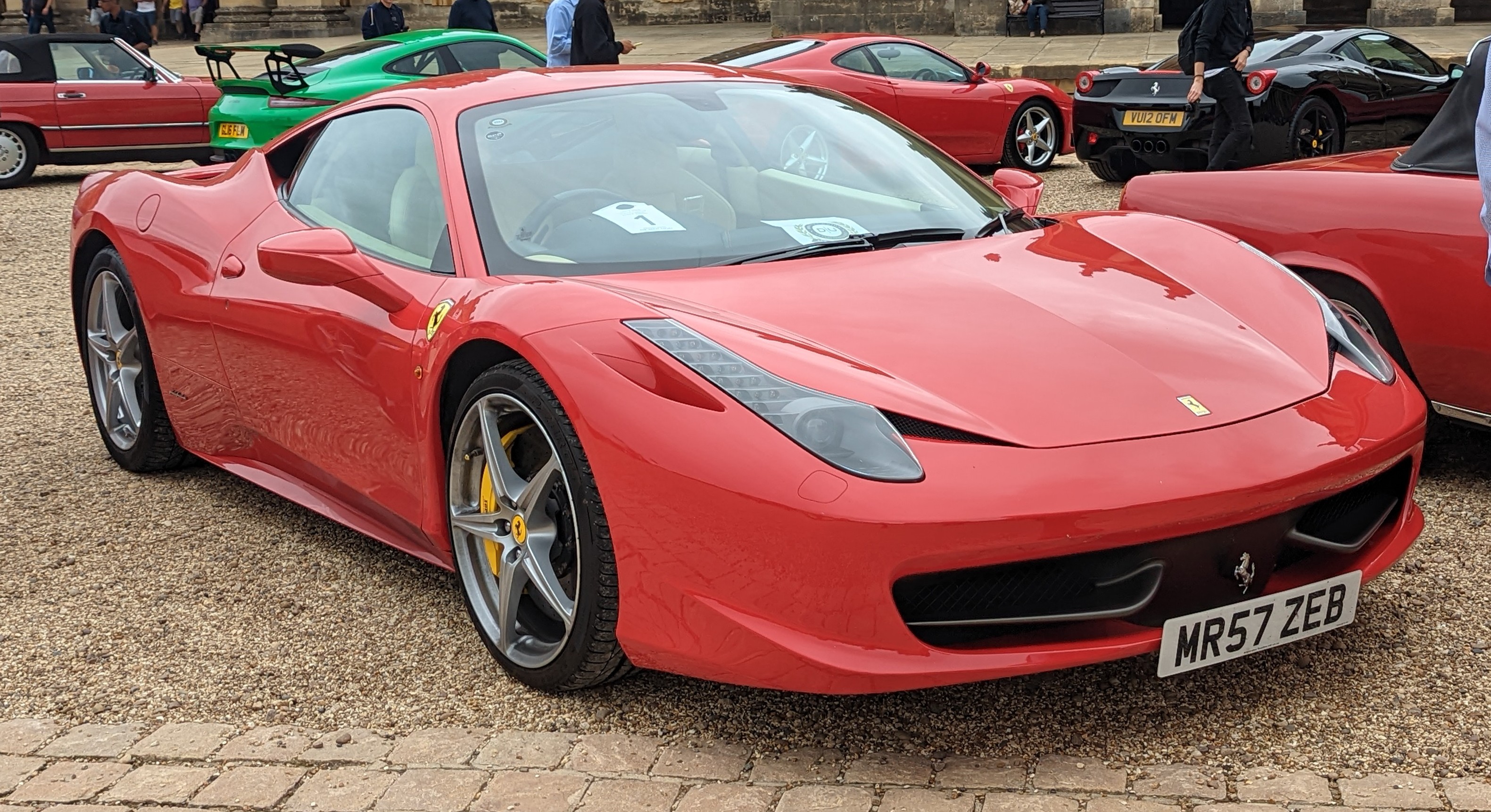
458 Spider
"I've got like an RS6 GT a 458 um yeah it's a 458 Spider"
The Ferrari 458 Spider is a supercar with a roof that can open and close. It’s built for thrilling driving, not just looks.
The Ferrari 458 Spider is a mid-engine supercar with a retractable hardtop roof, combining open-air driving with Ferrari’s performance focus. It’s part of the 458 lineup and is widely known for its high-revving character and sharp handling.

Rolls Royce Wraith
"there's the Rolls Royce Wraith I've still got um a garden"
The Rolls-Royce Wraith is a very luxurious, powerful coupe. It’s meant to feel smooth and special, like a “big deal” car for long drives.
The Rolls-Royce Wraith is a luxury grand tourer coupe known for its powerful engine and very high-end comfort. It’s positioned as a more dramatic, sporty-feeling alternative to other Rolls-Royce models, while still prioritizing refinement.

BMW 635 CSI E24
"there's a BMW 635 CSI E24 I've dropped that off at Lads at Yorkshire car restoration and they're like doing the whole restoration"
This is a BMW 6 Series from the E24 generation, the “635 CSi.” It’s an older classic BMW coupe that people restore because it’s a well-known model and parts can be found if you plan ahead.
“BMW 635 CSI E24” refers to the E24-generation BMW 6 Series, specifically the 635 CSi. The E24 is a classic BMW coupe from the 1980s, and it’s often restored because it’s mechanically straightforward compared with many modern exotics, but still needs careful rust and parts sourcing.

Bmw 635 Csi
"...n brackets green Maserati Gran Turismo there's a BMW 635 CSI E24 I've dropped that off at Lads at Yorkshire c..."
Lads at Yorkshire car restoration
"I've dropped that off at Lads at Yorkshire car restoration and they're like doing the whole restoration they've had it for years now"
They mention a local restoration shop in Yorkshire where they left a car to be worked on. It’s a reminder that serious projects often go to specialists, not regular mechanics.
The host names a specific restoration shop—“Lads at Yorkshire car restoration”—as the place they dropped off the BMW. For listeners, this highlights how collectors use specialist shops for long-term restoration work.

Mercedes C63
"let them crack on Mercedes C63 I just sold that recently to a lad around the corner"
They mention a Mercedes C63, which is the sporty, high-performance version of the C-Class. People like it because it’s fast and feels special to drive.
The Mercedes C63 is a performance version of the C-Class, typically associated with a strong V8 and a big enthusiast following. In collection talk, it’s often chosen as a “usable” fast car, though exact generation matters for engine and transmission details.

Ferrari F430
"Lamborghini Mercelago Ferrari F430 or that's still on the books but that's my dad's one a manual one uh that's wicked that was it was it originally a manual"
They’re talking about a Ferrari F430. It’s a mid-engine Ferrari, and in this case they specifically mention it being a manual, which many enthusiasts prefer.
The Ferrari F430 is a mid-engine V8 Ferrari from the late 2000s, known for its sharp steering feel and high-revving character. The host also mentions it being a manual, which is a key enthusiast detail because manual F430s are often more sought after than paddle-shift versions.
Manual transmission enthusiast value
"that's my dad's one a manual one uh that's wicked that was it was it originally a manual manual yeah that's the first Ferrari I had was it yeah did you have a manual yeah yeah they're valuable now"
They’re saying the car being a manual matters a lot to collectors. As fewer cars come with manuals, manual versions often become more valuable.
The host emphasizes that the Ferrari F430 was originally a manual and says manual cars are “valuable now.” This reflects a broader collector concept: certain drivetrains (like manuals) become more desirable as they’re phased out, especially on cars that are otherwise similar.

Audi RS6
"um RS6 Liam's S3 that's still on the books"
They mention an Audi RS6. It’s the high-performance RS version of the A6, usually chosen because it’s quick but still practical.
The Audi RS6 is a high-performance version of the A6, typically known for strong acceleration and a practical wagon/sedan layout depending on generation. In a collection list, it signals the host keeps at least one “fast but usable” car.

Audi S3
"um RS6 Liam's S3 that's still on the books Lamborghini Eurus that's the uh Hannah's Volkswagen Transporter"
They mention an Audi S3. It’s a smaller, sportier Audi that’s usually turbocharged, and it’s meant to be fun without being huge.
The Audi S3 is a compact performance model (typically turbocharged) that’s popular for its balance of size and speed. Mentioning it alongside RS6 and supercars suggests the collection includes both daily-drivable performance and more exotic cars.

Volkswagen Transporter
"...e books Lamborghini Eurus that's the uh Hannah's Volkswagen Transporter um McLaren 720S kept that one that one we got fr..."
The Volkswagen Transporter Kombi (T6) is a van that can carry people and gear. It’s popular because it’s practical and can be set up for different uses. The podcast brings it up as one of the cars in the conversation.
The Volkswagen Transporter Kombi (T6) is a practical van used for passenger transport and everyday versatility, often favored for family use or camper-style builds. It’s discussed because it’s a common platform for modifications and because it can be both useful and fun to live with. In the episode, it’s mentioned as part of someone’s vehicle lineup.

Lamborghini Eurus
"Lamborghini Eurus that's the uh Hannah's Volkswagen Transporter McLaren 720S kept that one"
They’re almost certainly talking about the Lamborghini Urus. It’s Lamborghini’s SUV—still sporty and fast, but easier to live with than a low supercar.
The transcript says “Lamborghini Eurus,” which is almost certainly the Lamborghini Urus. The Urus is Lamborghini’s modern SUV, combining supercar styling and performance with a more practical daily-driver format.
Repairability and downtime as an ownership factor
"even you can't fix a fucking thing yeah you can't fix there's no such thing as a fixed 720S it don't it ain't fixed like at the minute it's fixed until I drive it"
They’re basically saying that if a car is hard to repair, you end up not wanting to drive it. Real ownership is about how often it’s dependable, not just how fast it is.
The host argues that the McLaren 720S isn’t “fixed” in a lasting way—implying that repairs are complex and can be hard to fully resolve. This is a useful ownership concept: beyond performance, real-world drivability depends on how quickly and reliably a car can be repaired after issues.
Porsche 911 GT3 (992)
"because when someone asks me oh is your 720S all good now I can just go yeah it is until I drive it so the what's the point in driving it because when someone asks me oh is your 720S all good now ... that's why they're a bit cheaper Porsche GT3 a 992"
They’re talking about a Porsche 911 GT3 from the 992 generation. It’s the more track-oriented version of the 911, built for serious driving rather than just cruising.
The host mentions a Porsche 911 GT3 with the “992” generation code, which is the modern 911 GT3 era. GT3s are track-focused 911s, and the 992 generation is known for sharper aerodynamics and a more modern chassis/engine package than earlier GT3s.
Ruby Stone paint/trim reference
"Porsche GT3 a 992 um yeah that's in that uh like what they call it not pink but oh ruby stone ruby stone yeah Rolls-Royce"
They mention “ruby stone,” which sounds like a specific paint or color option. Special colors can matter a lot for how desirable a car is later.
The transcript references “ruby stone” in connection with the Porsche GT3, likely describing a specific color or paint/trim option. For collectors, paint codes and special colors can affect desirability and resale value, so it’s a detail worth clarifying if listeners are shopping.

Lamborghini SVJ
"Rolls-Royce Mansoury Rave the Lamborghini SVJ Ferrari 458 Spyder car that we've not released yet"
They mention a Lamborghini SVJ, which is a special, more hardcore version of the Aventador. It’s the kind of Lamborghini people buy for track-style performance and extreme looks.
“Lamborghini SVJ” refers to the Lamborghini Aventador SVJ, a track-focused, limited-production variant. SVJ models are known for aggressive aero and high-performance tuning, and they’re frequently discussed in collector circles as modern “halo” Lamborghinis.
Ferrari 458 Spyder
"the Lamborghini SVJ Ferrari 458 Spyder car that we've not released yet Porsche GT3"
They mention a Ferrari 458 Spyder, which is the convertible 458. It’s a V8 Ferrari, and the “Spyder” part means you get the open-top experience.
The Ferrari 458 Spyder is the convertible version of the 458, pairing Ferrari’s V8 performance with open-top driving. In collector talk, the Spyder body style is often a big part of the appeal because it changes the driving experience and seasonal usability.

Rolls-Royce Cullinan
"RS Rolls-Royce Cullinan uh oh and nearly said another car we haven't released yet"
The Rolls-Royce Cullinan is a luxury SUV from Rolls-Royce. It’s built for comfort and prestige, not for being a rough, utilitarian off-road truck.
The Rolls-Royce Cullinan is the brand’s ultra-luxury SUV, known for a big, heavy grand-touring feel rather than off-road “hardcore” behavior. It’s a popular choice for collectors because it combines limousine-level comfort with SUV practicality.

Land Rover Defender
"dbx the Defender which Hannah's has got um really cars Hannah got yeah that's a whole"
The Defender is a tough-looking Land Rover that’s known for off-road ability. People like it because it can handle rough roads, but it can still be comfortable.
The Land Rover Defender is a modernized take on a long-running off-road icon, with strong capability and a rugged, boxy design. In collector circles, it’s often chosen because it can be both a daily-capable vehicle and a “project” platform for upgrades.

Ferrari 812 Superfast
"another thing 296 GTB 812 superfast which that Ferrari at the minute um another car we haven't released yet"
The 812 Superfast is a Ferrari with a big V12 engine. It’s known for the classic, dramatic feel of a naturally aspirated supercar.
The Ferrari 812 Superfast is a flagship-style grand tourer supercar built around a naturally aspirated V12. It’s famous for its character and sound, and it represents the “last of the big naturally aspirated” era for many enthusiasts.

Ferrari 296 GTB
"another thing 296 GTB 812 superfast which that Ferrari at the minute um another car we haven't"
The Ferrari 296 GTB is a high-end Ferrari supercar. It uses a hybrid setup, which helps it feel very fast while still being more modern than older purely gas-only designs.
The Ferrari 296 GTB is a mid-engine supercar that’s notable for using a V6 paired with an electric motor (a hybrid layout). It’s often discussed as a key “new direction” Ferrari took to keep performance high while meeting emissions and efficiency goals.

G-Class G Wagon
"...he minute um another car we haven't released yet G wagon another car we haven't released yet m3 and the Ve..."
The G-Class is a luxury SUV from Mercedes-Benz. It’s known for its tough, off-road style and for being comfortable inside. The podcast mentions it as one of the vehicles being talked about.
The Mercedes-Benz G-Class (often called the G-Wagon) is a rugged luxury SUV with a long history and a boxy, distinctive look. It’s discussed because it combines off-road capability with high-end comfort and status appeal. In the podcast, it’s mentioned as another car in an unreleased or planned lineup.

Bugatti Veyron
"G wagon another car we haven't released yet m3 and the Veyron and another car we haven't released yet there's so many we haven't released yet"
The Bugatti Veyron is one of the most famous hypercars ever made. It’s known for being unbelievably fast and for representing the peak of a certain era of supercar engineering.
The Bugatti Veyron is a landmark hypercar that helped define the modern “supercar arms race” with extreme power and engineering. It’s also a cultural icon—when people say “Veyron,” they’re usually referring to a top-tier, collector-grade statement car.
YouTube timing and release cadence
"and worked out for the time to release them on the channel because again the timing is everything on youtube with the with the cars like we could just go out and I could just go right I show the Veyron this week"
The hosts are describing how content scheduling affects viewer understanding and engagement—especially when multiple cars are in production at once. In practice, release cadence matters because viewers need a clear sequence to follow what’s been covered and what’s coming next.
Parts delays affecting production
"it's delayed delays on parts yeah yeah we're putting out a video every week and I want to put out a video every week but then if you get stuck for a car part"
Sometimes the car can’t be finished on time because parts arrive late. When that happens, they have to switch to filming a different car so they can still post regularly.
They mention that “delays on parts” can push back when a car can be filmed and finished, which then forces the channel to release another car instead. This is a common reality in automotive content and restoration: the schedule is constrained by lead times for components and approvals.
being a YouTuber is you should just create your own thing
"to someone to somebody else to edit and I think the whole idea of being a YouTuber is you should just create your own thing if you're telling your story the best way to tell it is through the edit"
They’re saying the best approach on YouTube is to make your own content and tell your story your own way. In car videos, editing is a big part of how people follow the build and trust what they’re seeing.
The host argues that YouTube success comes from creating your own story and presenting it through editing rather than just “being a presenter.” For car channels, editing choices strongly shape how viewers understand a build, the car’s condition, and the creator’s credibility.
Freddie over in America
"Mark uh Mark McCann we've got good relationship with because he's local Freddie over in America"
They mention a person named Freddie in America. It sounds like they’re talking about friendships/connections in the car community that help them keep in touch.
“Freddie over in America” appears to refer to another car-creator or enthusiast contact. The context suggests these relationships are important for networking and ongoing conversations about cars and content.
Mark McCann
"so like I don't like with with uh Mark uh Mark McCann we've got good relationship with because he's local"
Mark McCann is mentioned as someone the host gets along with. In the car YouTube world, that kind of relationship can make it easier to collaborate and share information about builds.
Mark McCann is referenced as a person the host has a good relationship with, likely in the car YouTube/enthusiast space. In car-creator circles, relationships with other channels can affect collaboration, access to cars, and how builds are covered.
Tava Tavares
"Freddie over in America Tava Tavares who also we have Rebus cars really good relationship with"
Tava Tavares is another person they say they get along with. In car YouTube, having good relationships with other creators can make it easier to connect and work together.
Tava Tavares is mentioned as someone the host has a good relationship with. The surrounding discussion places him in the same network as other car channels/creators, where trust and access can matter for filming and car-related projects.
Rebus cars
"Tava Tavares who also we have Rebus cars really good relationship with like they're the two we probably speak to the most often"
“Rebus cars” sounds like a car business or channel they work with. The host is basically saying they have a friendly relationship, which can help with getting cars and talking about builds.
“Rebus cars” is referenced as a company or channel the host has a good relationship with. In enthusiast media, companies like this can be involved in car sourcing, restoration, or content partnerships.
Request an Explanation
Heard something you'd like explained? We'll add it to this episode.
Sign in to request explanations for terms you heard.
Want to learn more?
Browse our glossary for plain-English explanations of automotive terms, jargon, and concepts.
Help improve this episode
See something that's not quite right? Our annotations are AI-generated and can sometimes miss the mark. Click the flag icon on any annotation to suggest a correction.