
Mazda JACKED UP Prices, Now THIS Happened | Episode 957
About this episode
Mazda's recent price hikes have led to a staggering 33% decline in sales year-over-year for October, sparking a discussion about the implications for the brand and its customers. Hosts Wei and Zach analyze the sales data, highlighting how inflated prices have resulted in increased inventory and the necessity for significant discounts. They also explore the broader industry trends affecting automakers and the current buyer's market, emphasizing the leverage consumers have in negotiations. The episode features live data analysis and insights into regional sales variations.
jacked up prices
"Pops Mazda jacked up prices. Now this has happened."
When someone says 'jacked up prices,' they mean that the prices of cars have gone up a lot, usually more than what the manufacturer suggests. This can happen because there are fewer cars available or because dealers want to make more money.
'Jacked up prices' refers to significant increases in the prices of vehicles, often due to market demand, dealer markups, or supply chain issues. This term is commonly used in the automotive industry to describe situations where consumers are charged more than the manufacturer's suggested retail price (MSRP).
Toyota
"We will talk Toyota tomorrow when Marcello from Toyota World joins us."
Toyota is a well-known car brand that makes reliable cars, including the Camry and Corolla, and is famous for creating hybrid cars like the Prius.
Toyota is one of the largest automotive manufacturers in the world, known for its reliable vehicles and innovations in hybrid technology, such as the Prius.

Mazda Cx5
"You've got a CX-5, $40,000 MSRP, 549 days supply, 188 days on market."
The Mazda CX-5 is a small SUV that is well-liked for its good looks and fun driving experience. It's a popular choice for families and individuals alike.
The Mazda CX-5 is a compact crossover SUV known for its stylish design and engaging driving dynamics. It has been popular in the market for its balance of comfort and performance.
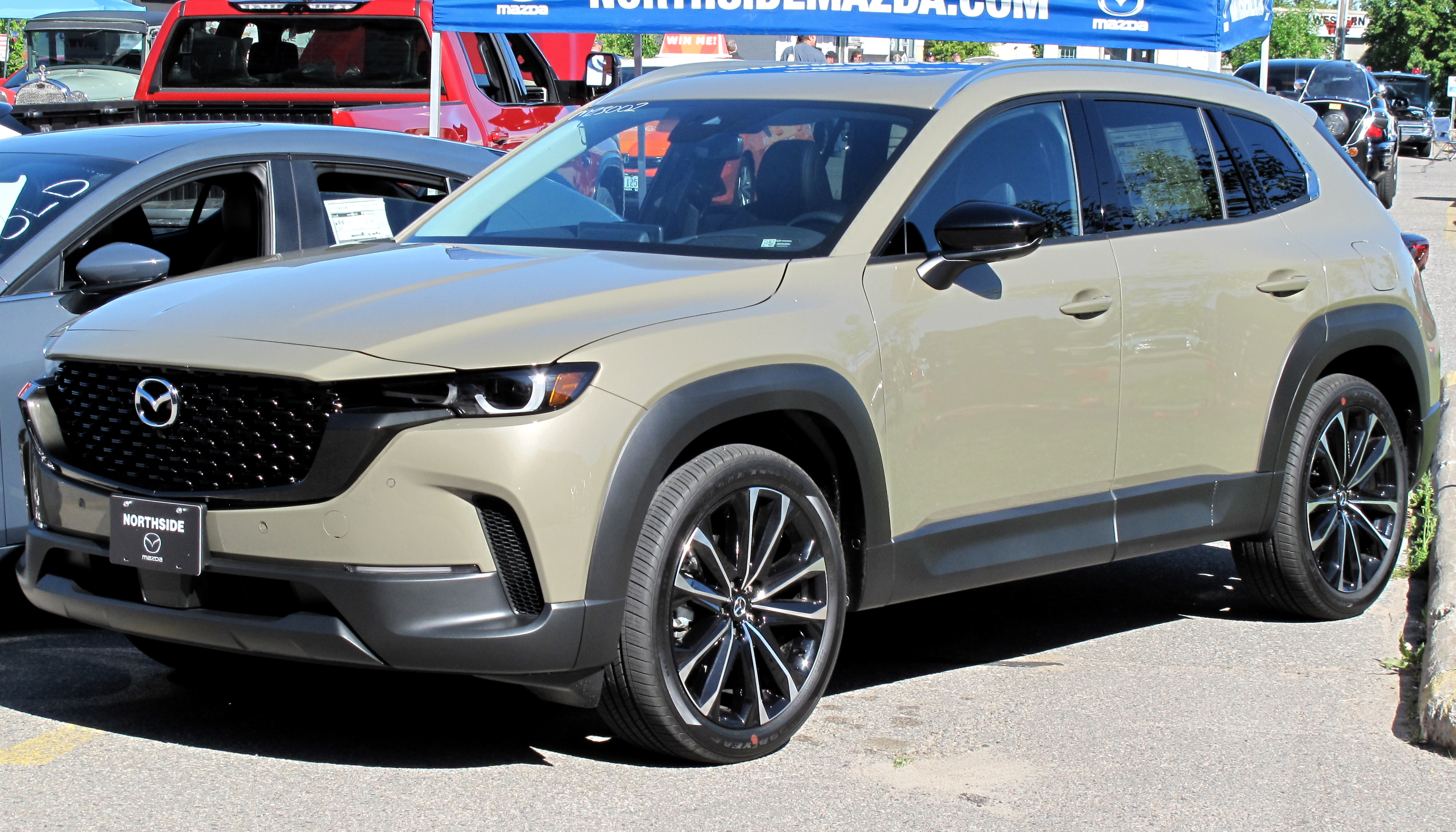
Mazda Cx50
"I've got another one here, a CX-50, not the CX-5, $40,000."
The Mazda CX-50 is a newer small SUV that has a sporty look and comes with modern technology. It's designed for people who want a vehicle that can handle different types of driving.
The Mazda CX-50 is a newer compact SUV that offers a sporty design and advanced technology features. It aims to attract buyers looking for a more rugged and versatile vehicle.
MSRP
"...most Mazdas now sell 10% off of MSRP. That's before the incentives from the automaker."
MSRP is the price that the car maker suggests you should pay for a car. It’s like a starting point for how much a car should cost.
MSRP stands for Manufacturer's Suggested Retail Price, which is the price that the manufacturer recommends for a vehicle. It serves as a guideline for pricing but can vary based on dealer markups or discounts.

Mazda Cx90
"That's before the incentives from the automaker. That's especially true for the CX-90 and CX-70 models. This is what happens."

Mazda Cx70
"...especially true for the CX-90 and CX-70 models. This is what happens."
The Mazda CX-70 is a smaller SUV from Mazda, designed to be fun to drive while still being practical for everyday use.
The Mazda CX-70 is a compact SUV that emphasizes sporty handling and a stylish design. It is aimed at consumers looking for a smaller SUV with a dynamic driving experience.
stair step incentives
"...they were talking about $1,200 in stair step incentives. So it's an interesting moment in time."
Stair step incentives are bonuses that car dealers earn for selling more cars, which can motivate them to sell as many as possible.
Stair step incentives are a type of sales promotion where dealers receive increasing bonuses for selling more vehicles, encouraging them to boost sales volume.
PHEV
"...that Mazda gave you a CX-90 PHEV? Yeah, I had a trust vehicle, yep."
PHEV means a car that can use both electricity and gas. You can plug it in to charge the battery, and it can drive on just electricity for a while before using gas.
PHEV stands for Plug-in Hybrid Electric Vehicle, which refers to a vehicle that can be charged from an external power source and has both a gasoline engine and an electric motor. This allows for driving on electric power alone for a certain distance before switching to gasoline.
value brand
"...they have always been known, in my opinion, as a solid value brand that punches above its weight."
A value brand is a car company that makes good cars but sells them for lower prices than other brands. They are known for giving you a lot of features for the money you spend.
A value brand in the automotive industry refers to a manufacturer that offers vehicles that provide good quality and features at a lower price compared to competitors. These brands are often perceived as offering more for less, making them attractive to budget-conscious consumers.
invoice price
"The invoice price to the dealer is only $43,275. It's not like there's a huge amount of markup here."
The invoice price is what the car dealer pays to get the car from the manufacturer. It's often used to help figure out a fair price when buying a car.
The invoice price is the amount that a dealer pays the manufacturer for a vehicle. It serves as a baseline for negotiations between the dealer and the customer.
markup
"It's not like there's a huge amount of markup here. Even for the dealership, let's scroll down, Dad."
Markup is the extra amount that a dealer adds to the price they paid for the car to sell it to customers. It can change based on how many cars they have and how popular they are.
Markup refers to the amount added to the invoice price by the dealer to determine the selling price of the vehicle. It can vary based on demand, inventory, and dealer policies.

Acura SLX
"...ura store in Scottsdale, Arizona, and we had the SLX, which was the rebadged Azuzu Trooper. And we co..."
The Acura SLX is a type of SUV that was made by the Acura brand in the late 1990s. It’s similar to another vehicle called the Isuzu Trooper, but with some extra luxury features. People talk about it because it was one of the first luxury SUVs and helped start a trend.
The Acura SLX was a mid-size SUV produced by Acura from 1996 to 1999, essentially a rebadged version of the Isuzu Trooper. It was significant for being Acura's first foray into the SUV market, aimed at providing luxury features in a rugged vehicle. The SLX is often discussed for its unique position as a luxury SUV during a time when the segment was just beginning to gain popularity.

Isuzu Trooper
"...which was the rebadged Isuzu Trooper. And we couldn't sell an SLX to save our lives."
The Isuzu Trooper is a type of SUV that was built to handle rough terrain and off-road driving. It was the model that the Acura SLX was based on.
The Isuzu Trooper was a mid-size SUV known for its ruggedness and off-road capabilities. It served as the basis for the Acura SLX, which was a luxury version of this vehicle.
carrying costs
"...And the cost of carrying that vehicle for the amount of time it would take before you sell it is well worth losing $5,500..."
Carrying costs are the expenses a dealership has to pay for keeping cars in stock. This includes things like storage fees and insurance, which can make it expensive to hold onto a car for too long.
Carrying costs refer to the expenses incurred by a dealership for holding inventory, including storage, insurance, and depreciation. These costs can add up quickly, making it financially prudent to sell vehicles as soon as possible.
day's supply
"There is no day's supply because none have sold."
Day's supply is a way to measure how long a car dealer can keep selling cars with the stock they have. If it's low, it means cars are selling quickly or not at all.
Day's supply refers to the number of days a dealer can sell from their current inventory before running out, based on recent sales rates. A low day's supply indicates strong demand or poor sales.
financing
"So then it makes you wonder, what's the incentive on this? So you scroll down to the bottom here, 1.9% financing for 36 months or a subvented lease program."
Financing is how you pay for a car by borrowing money. You pay it back over time, usually with some extra money added for interest.
Financing refers to the process of obtaining funds to purchase a vehicle, typically through a loan or credit. The buyer pays back the borrowed amount over time, often with interest.
lease cash incentive
"The CX-90 had a $10,000 lease cash incentive. What does it have right now?"
A lease cash incentive is money offered by the car company to help lower the cost of leasing a car. It makes it cheaper for you to rent the car for a certain period.
A lease cash incentive is a financial offer from the manufacturer to encourage customers to lease a vehicle. It effectively reduces the overall cost of leasing, making it more attractive to potential lessees.
money factor
"1.9% financing for 36 months, 0.38% is the effective money factor over on the lease."
The money factor is a way to show how much interest you will pay on a car lease. It's a small number that helps determine your monthly payments.
The money factor is a term used in leasing that represents the interest rate on a lease. It is typically expressed as a small decimal number and is used to calculate the monthly lease payment.
buyer's market
"It's not good enough, which continues to reinforce to me how much of a buyer's market this is. You have so much freaking leverage."
A buyer's market is when there are more cars available than people wanting to buy them. This usually means you can get better deals and negotiate lower prices.
A buyer's market occurs when there are more goods for sale than there are buyers, giving buyers the advantage in negotiations. In the automotive context, this often means lower prices and more incentives for consumers.
SUV
"That Audi has a new SUV coming to market in,"
An SUV is a type of vehicle that is larger than a regular car and can carry more people and cargo. They are often used for both city driving and off-road adventures.
An SUV, or Sport Utility Vehicle, is a versatile vehicle that combines elements of road-going passenger cars with off-road vehicles. SUVs typically offer higher ground clearance, larger cargo space, and the option for all-wheel drive.
Audi Q9
"it's set for a debut here soon, the Q9."
The Audi Q9 is a new SUV that Audi is planning to release soon, which will be larger than their current models.
The Audi Q9 is an upcoming SUV model from Audi, aimed at expanding their lineup in the larger SUV segment.

Audi Q7
"And I know that the Q7 is their bigger, three-row SUV."
The Audi Q7 is a bigger SUV from Audi that can fit more passengers and has more space inside than their smaller cars.
The Audi Q7 is a larger three-row SUV that offers more passenger space and cargo capacity compared to smaller models in the Audi lineup.
leg room
"And like most three-row SUVs, the third row normally doesn't have a tremendous amount of leg room."
Leg room is the space you have for your legs when sitting in a car, which is important for comfort, especially in the back seats.
Leg room refers to the amount of space available for passengers' legs in a vehicle, which can significantly affect comfort, especially in the rear seats of SUVs.

Audi 100S
"... Q9, then the Q9's got to be from the 70s to the 100s. Interesting, though."
The Audi 100 is a car that Audi made for many years, starting in the late 1960s. It was known for being well-designed and safe, helping Audi become a popular brand for luxury cars. People discuss it because it was important in shaping the cars that Audi makes today.
The Audi 100 was a mid-size car produced by Audi from 1968 to 1994, known for its innovative design and engineering, including features like aerodynamic styling and advanced safety elements. It played a crucial role in establishing Audi's reputation for quality and performance, particularly in the luxury car market. The Audi 100 is often mentioned for its historical significance and influence on later Audi models.
prestige
"The prestige, Dad, it's selling. 20 have sold in the last 45 days, 18 for sale right now."
'Prestige' means a fancy version of a car that has the best features and is more luxurious than the regular models.
In the automotive context, 'prestige' refers to a high-end trim level or model that offers luxury features and a premium experience. It often signifies the top-tier offerings from a brand.
six-figure price point
"...probably up to a six-figure price point. I bet you the Q900."
A six-figure price point means the car costs between $100,000 and $999,999. It's a way to talk about very expensive cars.
A six-figure price point refers to a price that ranges from $100,000 to $999,999. This term is often used in the automotive industry to describe luxury or high-performance vehicles that command high prices.
optimal buying moment
"We've got, how many days is it from now to the optimal buying moment? You and I have been talking about this a lot because it's the fourth quarter."
The optimal buying moment is the best time to buy a car when prices are lower and dealers are more willing to negotiate. This usually happens at the end of the month or year when they want to meet sales goals.
The optimal buying moment refers to the best time to purchase a vehicle, often influenced by market conditions, dealership incentives, and inventory levels. Typically, this can be at the end of a quarter or year when dealers are more motivated to sell.
fourth quarter
"You and I have been talking about this a lot because it's the fourth quarter. We saw it at the end of October."
The fourth quarter is the last part of the year, and it's when car dealerships often have big sales to get rid of cars before the new year. This is a good time to find deals.
The fourth quarter refers to the last three months of the calendar year, which is a critical time for automotive sales. Dealers often provide significant incentives to clear out inventory and meet annual sales targets during this period.
car deals
"We saw insane car deals. There was one dealer that we did two car deals with on the final day of October."
Car deals are special offers that make buying a car cheaper or easier. They can include discounts or better financing options, especially during certain times of the year.
Car deals refer to special offers or discounts provided by dealerships to encourage sales. These can include price reductions, financing offers, or trade-in bonuses, especially during peak buying times.

Nissan Pathfinder
"Using what I've learned from you, I was able to make a deal on Nissan Pathfinder. I got an extra $2,000 off, making it $10,000 below MSRP and got an extra $1,000 on my trade love here"
The Nissan Pathfinder is a type of SUV that can carry many passengers and is good for both city driving and off-road adventures.
The Nissan Pathfinder is a mid-size SUV known for its spacious interior and off-road capabilities. It's popular among families for its versatility and comfort.
inventory desert
"It tells me I need to look elsewhere for my car. We are in an inventory desert here, which kind of hits on this comment as well."
An 'inventory desert' is when there aren't many cars available to buy in a certain area. This means you might have to look further away to find the car you want.
An 'inventory desert' refers to a situation where there is a significant lack of available vehicles in a particular geographic area. This can lead to limited options for buyers and may result in higher prices due to scarcity.
buying a car out of state
"When calling around to find the best price, are we telling the dealership we live out of town, out of state? We've got a guide back on CarEdge.com that talks about buying a car out of state."
When you buy a car from another state, there are different rules and costs to think about. It's good to know what these are so you don't get surprised later.
Buying a car out of state can involve different regulations, taxes, and fees compared to purchasing locally. It's important to understand these factors to ensure a smooth transaction and avoid unexpected costs.
Request an Explanation
Heard something you'd like explained? We'll add it to this episode.
Sign in to request explanations for terms you heard.
Want to learn more?
Browse our glossary for plain-English explanations of automotive terms, jargon, and concepts.
Help improve this episode
See something that's not quite right? Our annotations are AI-generated and can sometimes miss the mark. Click the flag icon on any annotation to suggest a correction.