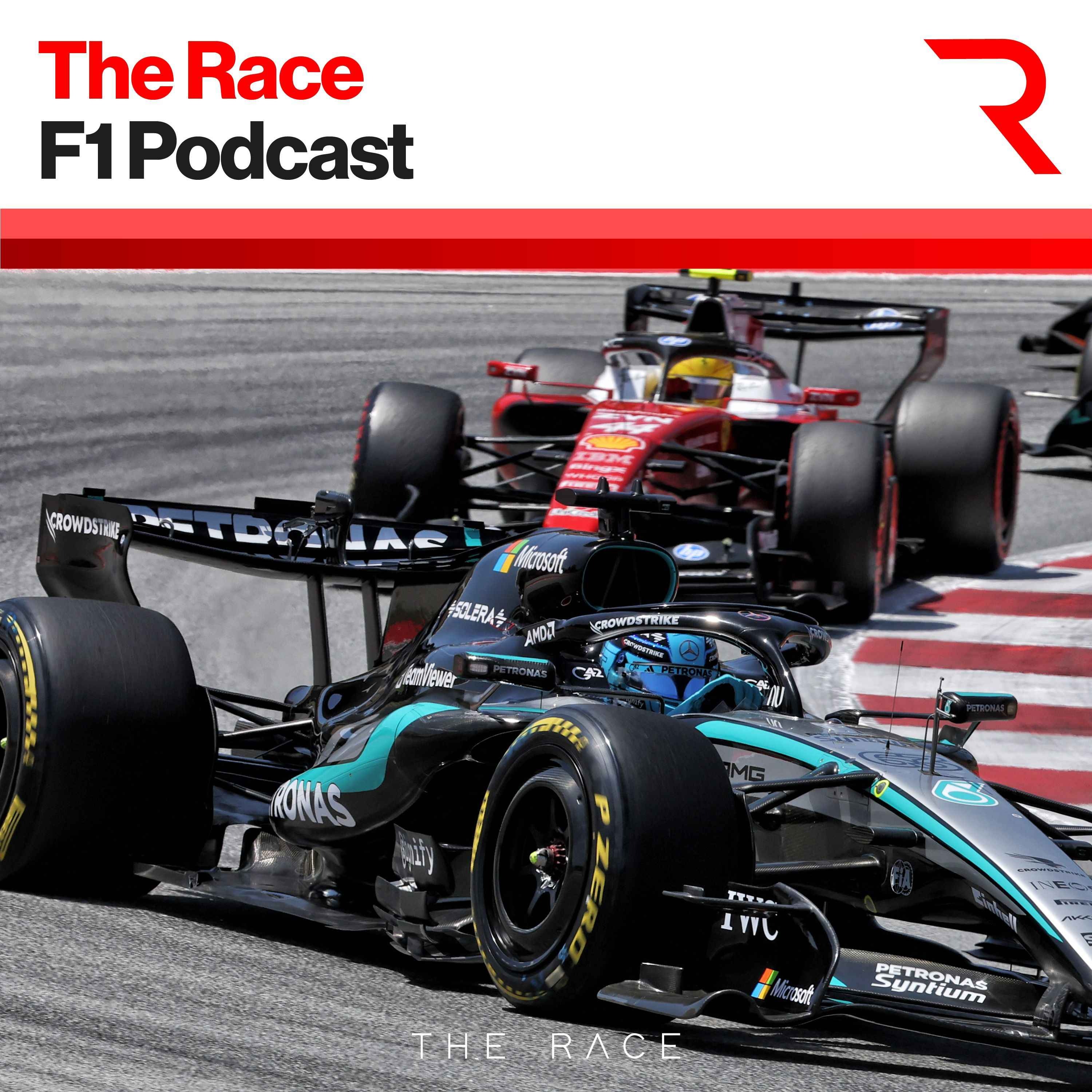
Mercedes vs Ferrari: Why battle could be tighter than ever in Austria
About this episode
Austrian GP preview turns into a wider Mercedes vs Ferrari title-fight discussion: Ferrari’s Barcelona momentum could be boosted by an engine upgrade, while Austria’s altitude and cooling demands may reshape performance. The hosts expect a rear-tyre-limited race with strategy landing around two stops, possibly three in heat. Reliability and battery/cooling concerns could swing points, and even Hamilton’s strengths may not translate as well to the flowing Red Bull Ring layout.
As F1 heads to Austria, Ferrari could have the help of an engine upgrade to boost its chances of turning Lewis Hamilton’s Barcelona win into a title push. But will Mercedes hit back, and if so can George Russell find a way to turn the tide against team-mate Kimi Antonelli after being fortunate to gain 18 points last time out?
Those are the key questions tackled by Edd Straw, Ben Anderson and Josh Suttill in the latest episode of The Race F1 Podcast.
There's also the latest on the Monaco GP pitlane speeding penalty controversy, plus Edd, Ben and Josh tackle another batch of questions sent in by The Race Members' Club.
Get bonus F1 podcasts, extra content and ad-free listening, sign-up to The Race Members' Club on Patreon today.
Hosted on Acast. See acast.com/privacy for more information.
engine upgrade
"The race is on! And as F1 heads to Austria, Ferrari could have the help of an engine upgrade to boost its chances of turning Lewis Hamilton's Barcelona win into a title push."
An engine upgrade means the team brings a newer or improved version of its F1 engine. The goal is usually more speed or better efficiency, but teams have to fit it into strict rules and schedules.
In Formula 1, an engine upgrade usually means bringing a revised power-unit specification—often changes to internal components or control software—to improve power, efficiency, or reliability. Because F1 engines are heavily regulated, upgrades are strategic and can be limited by development timelines and usage rules.
Barcelona
"And as F1 heads to Austria, Ferrari could have the help of an engine upgrade to boost its chances of turning Lewis Hamilton's Barcelona win into a title push."
Barcelona is where Hamilton recently won, and the hosts use that as a clue for what might happen next. They’re basically asking whether Ferrari’s strong form will carry over to Austria.
Barcelona is referenced as the location of Lewis Hamilton’s recent win, which the hosts use as a benchmark for how Ferrari might carry momentum into Austria. In F1 talk, a win at one track often leads to speculation about whether the underlying car strengths will translate elsewhere.
Camille Antonelli
"But will Mercedes hit back? And if so, can George Russell find a way to turn the tide against teammate Camille Antonelli after being fortunate enough to gain 18 points last time out?"
Camille Antonelli is the teammate Russell is being compared against. The idea is that Russell needs to beat him to help Mercedes catch up.
Camille Antonelli is mentioned as Russell’s teammate in the Mercedes context. The hosts suggest Russell needs to outperform him to swing results back toward Mercedes.
Red Bull Ring
"I'm Ed Straw, and joining me to look ahead to events at the Red Bull Ring and tackle the implications of the ongoing ramblings about the Monaco result are Joshua Till and Ben Anderson."
The Red Bull Ring is the race track in Austria where the next Formula 1 race is held. Track layout and elevation can strongly affect how cars and tires perform.
The Red Bull Ring is the F1 circuit in Austria where this race weekend is taking place. It’s known for its high-speed sections and for how elevation and track characteristics can change car behavior and tire wear.
Monaco result
"I'm Ed Straw, and joining me to look ahead to events at the Red Bull Ring and tackle the implications of the ongoing ramblings about the Monaco result are Joshua Till and Ben Anderson."
“Monaco result” means what happened in the last Monaco race. People then debate what it really says about who’s strongest and why.
The Monaco result refers to the outcome of the most recent Monaco Grand Prix and how it’s being interpreted. In F1 coverage, “the result” often drives discussion about car performance, strategy calls, and whether one team’s advantage is real or situational.
altitude
"And Austria is kind of similar, but obviously the altitude, the high altitude, plays a massive role there and can skew things a bit."
Altitude means the track is at a higher elevation. At higher altitude, the air is thinner, so engines can make less power unless the team compensates with settings and strategy.
Altitude affects engine performance because thinner air at higher elevations contains less oxygen. That changes combustion and can reduce power unless teams adjust engine settings and cooling strategies. It also influences aerodynamic behavior and tire temperatures.
tyre management
"Curve riding is really good. We know that the tyre management was exceptional with these trick wheel rims they have."
Tyre management is about making your tires last and work well during the whole race segment. If you manage them well, you can stay quick instead of slowing down as the tires wear out.
Tyre management is how well a team and driver control tire wear and temperature over a stint. In F1, managing degradation is often as important as outright pace because the car that preserves tires can run faster for longer. It’s influenced by setup, driving style, and how the tires are brought into their optimal operating window.
trick wheel rims
"Curve riding is really good. We know that the tyre management was exceptional with these trick wheel rims they have."
“Trick wheel rims” means the team is using special wheel designs, not just normal wheels. The idea is to help the tires work better by controlling things like temperature and grip.
“Trick wheel rims” refers to specialized wheel designs intended to improve tire performance and heat management. In F1, wheel and rim design can affect airflow, tire temperature, and how consistently the tire stays within its ideal operating range. These kinds of details can be tightly regulated but still provide performance advantages.
rear tyre limited race
"Teams are expecting it to be a rear tyre limited race. So that could be similar to Barcelona."
Sometimes the tires—especially the back ones—are what limit how fast you can go. If that’s the case, teams plan their race strategy around keeping the rear tires from wearing out too quickly.
A “rear tyre limited race” is when the limiting factor for pace is how quickly the rear tyres degrade rather than, say, top speed or braking performance. Teams then plan strategy and driving to preserve rear grip, often leading to predictable stop counts and careful traction management.
two stops
"So that could be similar to Barcelona. Two stops are expected."
A “stop” is when the car comes into the pits to change tires. “Two stops” means the teams expect to change tires twice during the race to manage tire wear and keep speed up.
In Formula 1, “stops” refers to scheduled pit stops to change tyres. Saying “two stops are expected” means the race strategy is likely to involve two tyre change windows, balancing tyre wear against the time lost in the pits.
turbo
"And also that small turbo, the core piece of the design, which we don't expect to be changed in this first engine upgrade. I think that could be really quite powerful here because in the Williams team preview,"
A turbo is a device that uses the engine’s exhaust to force more air into the engine. That helps the engine make more power, but conditions like altitude can make it harder for the turbo to work as effectively.
A “turbo” (turbocharger) uses exhaust gases to spin a turbine that compresses incoming air, allowing the engine to make more power from the same displacement. The host notes altitude makes it harder for turbos to “spin and work,” because thinner air changes how effectively the turbo can generate boost.
rear downforce
"So when you've got Ferrari that carries the speed well through the corners, it's got good rear downforce."
Downforce is the aerodynamic “push” that presses the tires onto the road. “Rear downforce” helps the back of the car stick better, improving grip when turning and accelerating out of corners.
“Rear downforce” is the aerodynamic force pushing the car’s rear tyres into the track to increase grip. More rear downforce can help stability and traction through corners, which matters when the host says Ferrari “carries the speed well through the corners.”
traction
"So if you're able to carry speed through the corners, get the power down. [199.0s] If you've got the traction, if you can carry speed onto the straights, because it's really [203.2s] important to remember that speed on the straights is a function of the speed across the full"
Traction just means how much grip the tires have. If you have good traction, you can press the gas harder without the car losing control.
In racing, traction is how much grip the tires have against the track so the car can accelerate without spinning or sliding. More traction lets a driver put power down earlier when exiting corners and maintain higher average speed.
Vmax
"It's not just Vmax or how quick you are in the last 10% of the straight. [213.1s] It's the whole thing. [214.3s] So really, really interesting to see where Ferrari pans out, but of course Josh Mercedes"
Vmax means the highest speed the car reaches. The point here is that being fast at the very end of a straight isn’t enough—you need to be fast the whole way.
Vmax is the car’s maximum top speed on the straight. The host is arguing that top speed alone doesn’t determine straight performance—what matters is the speed you carry into and through the straight over its full length.
regulation cycle
"And that gives, I think, hope that it can be the same on the engine side too. [270.9s] They've so far avoided the missteps that were made after 22. [276.2s] The last time there was a new regulation cycle and they made a really strong start."
A regulation cycle is when the rules for F1 cars change for a new era. Teams have to redesign their cars to fit the new rules, and the host is saying Ferrari handled the latest change better than before.
A regulation cycle is the multi-year period when the sport’s technical rules are updated and teams redesign their cars around the new constraints. The host notes that after “22” (a prior rule change), Ferrari made missteps, but this time they’ve started strongly and avoided those earlier problems.
batteries
"Mercedes, we know, have been having some problems with the batteries. [308.7s] There's one stuck on a boat still, isn't there? [310.7s] Coming back from Canada, the one that blew on George Russell in that race."
F1 cars have batteries that store energy and help the engine deliver extra power. If the battery system has a problem, the car may lose power or stop working.
Modern F1 cars use high-voltage battery systems as part of the hybrid power unit, storing energy for deployment under acceleration and for recovery. Battery issues can cause power delivery problems or even force retirements, so they’re a major reliability risk.
cooling demands
"And you need to really consider cooling demands in Austria, [319.6s] irrespective of the heat wave going on and the fact that temperatures might be [322.8s] as much as 30 degrees ambient when we get to Sunday. [327.7s] The thin air at that altitude just makes the cooling demands that much harder."
Cooling demands are how much the car needs to keep its important parts from overheating. If it’s hot or the track makes it work harder, the team has to move more heat out of the car.
Cooling demands are how much heat the car needs to shed to keep key components within safe operating temperatures. In F1, higher cooling demands can require more airflow through radiators and more aggressive brake and engine heat management.
ambient
"and the fact that temperatures might be [322.8s] as much as 30 degrees ambient when we get to Sunday."
Ambient temperature is the air temperature around the car. In F1, higher ambient temperatures reduce how effectively radiators and brakes can dump heat, which can force teams to adjust cooling and engine/brake operating targets.
thin air
"The thin air at that altitude just makes the cooling demands that much harder. [332.3s] So cooling the engines, cooling the brakes."
Thin air means there’s less dense air at higher altitude. That can make it harder for the car to cool itself and can also change how the car behaves aerodynamically.
Thin air refers to lower air density at altitude, which reduces the amount of oxygen and also changes how well the car can transfer heat to the surrounding air. In F1, that can make cooling harder and affect aerodynamic performance and engine operation.
near the knuckle
"And obviously, Ferrari, they run a bit near the knuckle on engine temperatures [341.7s] to help the aerodynamic performance of the car."
“Near the knuckle” means running something right up to its limit. In this case, Ferrari is keeping engine temperatures very high to gain an advantage, but it can be risky if anything goes wrong.
“Near the knuckle” is motorsport slang for operating close to the edge of an acceptable limit—here, running engine temperatures very high but still within safety margins. It’s a trade-off: hotter running can improve efficiency/aerodynamics, but it increases the risk of reliability problems.
aerodynamic performance
"Ferrari, they run a bit near the knuckle on engine temperatures [341.7s] to help the aerodynamic performance of the car."
Aerodynamic performance is how well the car cuts through the air and how much grip it gets from downforce. How hot the engine runs can affect what openings the car needs, which changes the aerodynamics.
Aerodynamic performance is how efficiently the car produces downforce and reduces drag at speed. Teams often manage engine and cooling temperatures because those choices can influence airflow, radiator openings, and the overall aerodynamic balance.
P.U.
"which has some kind of underlying, it seems, reliability concerns with elements [353.2s] of the P.U."
P.U. means the car’s power unit—the main hybrid engine system in F1. If there are reliability problems with the P.U., the car can lose power or break down.
P.U. is the abbreviation for the Power Unit in Formula 1, the hybrid engine system that includes the internal combustion engine plus energy recovery and deployment components. Reliability concerns with the P.U. can mean anything from power delivery issues to failures that force retirements.
performance parameters
"because I think the cooling demands of the circuit will override [371.4s] a lot of those performance parameters. [374.0s] And of course, we won't be able to actually judge exactly where they stand"
When they say “performance parameters,” they mean the measurable things teams look at to estimate how quick the car will be. It’s basically the car’s settings and behavior that affect speed.
“Performance parameters” are measurable setup and operating factors teams use to predict how fast and consistent a car will be. In F1 discussions, this often includes things like aerodynamic efficiency, tire behavior, and how well the car stays in its optimal temperature window.
Friday
"until we start to get a picture on the Friday. [379.4s] So it's still a slightly uncertain picture. [382.3s] I think we have to be a little bit careful about being too high on Ferrari"
In an F1 race weekend, “Friday” is when teams run practice sessions to gather data and understand car balance, tire performance, and reliability trends. It’s often the first real chance to judge where teams stand for qualifying and the race.
Ferrari
"I think we have to be a little bit careful about being too high on Ferrari [385.7s] based on one race week, and even though there's some very encouraging signs"
Ferrari is an F1 team. The speakers are saying you shouldn’t assume Ferrari will be at the very top just because of one good weekend.
Ferrari is one of Formula 1’s historic teams, and the host is discussing how encouraging early results might (or might not) translate into a tighter battle. The key point here is that a single race week can be misleading when judging true competitiveness.
title race
"Oh, come on, Ed, get excited. [393.0s] We want a title race, a multi-team title race. Come on. [396.6s] Well, that's what we hope for."
A “title race” means the fight to win the championship over the whole season. They’re hoping the competition stays close between several teams.
A “title race” is the season-long fight for the championship, where multiple teams and drivers can realistically win points consistently. The host is arguing that Austria could produce a tighter, multi-team battle rather than one dominant team.
Mercedes
"that not only will Mercedes be challengeable, but they could be beatable. [406.1s] And ideally, we want them at about the same level. [408.0s] Yeah."
Mercedes is another F1 team. They’re saying Mercedes might be competitive enough to fight for the top spots, not just finish near the front.
Mercedes is the F1 team the hosts are specifically talking about in terms of competitiveness. They suggest Mercedes could be “challengeable” and even “beatable,” implying their pace might be close enough to fight for wins and a title.
McLaren
"Yeah. And it's not even just about Mercedes and Ferrari, is it? [410.9s] Because I think McLaren could be quite strong around here. [413.3s] And we know Red Bull and Verstappen have quite a good record here."
McLaren is an F1 team. The point is that they might also be strong at this track, so it may not be only Mercedes vs Ferrari.
McLaren is discussed as a potential front-runner at this circuit, meaning the title fight could involve more than just Mercedes and Ferrari. The host is highlighting a multi-team competitive picture rather than a two-team duel.
Verstappen
"And we know Red Bull and Verstappen have quite a good record here. [416.3s] So you just have this quite interesting multi-team aspect, you know,"
Verstappen is an F1 driver (Max Verstappen). They’re saying he’s done well at this track before, which makes Red Bull look promising.
Verstappen (Max Verstappen) is highlighted as having a strong track record with Red Bull. In F1 analysis, a driver’s past results at a specific circuit can be a useful indicator of how well their driving style and the car’s setup match that track.
reliability
"So maybe we can't count them out. [432.5s] But I just wanted to come on the reliability thing, you know, "
In racing, “reliability” means whether the car can finish the race without breaking. A very quick car still won’t score well if something fails.
In F1, “reliability” refers to whether a car can complete sessions and races without mechanical failures. Reliability can strongly influence results because even a fast car can lose points if it suffers a breakdown or component issue.
Lewis Hamilton
"Are you thinking that Hamilton's got it all sewn up there now, and the clerk's the man of the past, and Lewis Hamilton's the future?"
Lewis Hamilton is a top Formula 1 race driver. Here, the hosts are talking about whether he’s building a lead or if the title fight is still close.
Lewis Hamilton is a Formula 1 driver known for winning multiple World Championships with Mercedes. In this segment, he’s discussed as the current momentum leader heading into Austria.
qualifying crash
"But the clerk didn't feature in that Grand Prix because of the qualifying crash he had."
Qualifying is when drivers race to set their starting position for the main race. A qualifying crash means someone wrecked during that session, which can hurt their chances for the race.
A qualifying crash is an incident during the qualifying session, when drivers are trying to set their fastest lap to determine the starting grid. If it happens, it can prevent a driver from competing normally in the Grand Prix.
Austria
"But it also means you don't know what the clerk would have done in the car had a clean weekend. And also Austria is just not really a great Hamilton track."
Austria is where the next Formula 1 race is held. The track layout matters because it has mostly smooth, flowing turns, with one key tight corner (a hairpin) that changes how drivers can push.
Austria here refers to the Austrian Formula 1 Grand Prix, raced at the Red Bull Ring. The hosts note it’s a track with mostly open, flowing corners, with only one notable hairpin that affects how different drivers can attack.
hairpin
"It's not one where there's a couple of slow corners. But apart from that one hairpin, actually the corners are quite open and a bit flowing."
A hairpin is a very tight corner that you have to slow down for a lot. It often becomes a big deal for braking and car setup because it’s much slower than the surrounding turns.
A hairpin is a very tight, slow corner that requires heavy braking and precise steering. On a track like Austria/Red Bull Ring, the hairpin can be a key overtaking or setup point compared with faster, more flowing corners.
first phase of breaking into the corners
"There's not really the opportunities for Hamilton to really exercise his kind of sensitivity in the first phase of breaking into the corners in the same way."
This refers to the initial braking and turn-in phase—how a driver slows the car and begins rotating it into the corner. The hosts argue Austria’s corner types don’t give Hamilton the same chances to use his strengths during that early braking/entry moment.
Nico Rosberg
"He used to struggle against Nico Rosberg on that track at Mercedes."
Nico Rosberg is a former top Formula 1 driver. The hosts are using his name to describe past on-track battles involving Hamilton on that circuit.
Nico Rosberg is a former Formula 1 World Champion who raced for Mercedes. The segment mentions Hamilton struggling against Rosberg at Austria/that track while both were with Mercedes.
Valterri Bottas
"He struggled a bit against Valterri Bottas on that track at Mercedes."
Valtteri Bottas is another Formula 1 driver who has raced for Mercedes. The hosts are pointing to past Mercedes-era matchups on this circuit.
Valtteri Bottas is a Formula 1 driver who has raced for Mercedes. Here, the hosts say Hamilton also struggled a bit against Bottas on that same track while at Mercedes.
Leclerc
"But it's going to be a little bit of a test of where Leclerc is in terms of avoiding making that mistake that he did in Barcelona when he was chasing something..."
Leclerc is a top Formula 1 driver for Ferrari. The discussion here is about whether he can avoid making the same kind of mistake he made in a previous race.
Charles Leclerc is a Ferrari driver known for pushing hard in qualifying and races, but also for occasional mistakes when chasing the limit. In this segment, the host is comparing Leclerc’s ability to avoid repeating an error from Barcelona.
Russell
"How about the Mercedes drivers, Josh? The Spanish Grand Prix weekend looked like it was Russell's triumphant return with a new approach..."
Russell is a driver for Mercedes. The hosts are saying he looked strong on pace in practice and qualifying, but something went wrong in the race and it affected his results.
George Russell is a Mercedes driver whose performance swings are being analyzed in terms of setup and race execution. The host says Russell had a strong qualifying and practice showing, but the race didn’t go as well, with technical factors like a front wing adjustment mentioned later.
Spanish Grand Prix weekend
"How about the Mercedes drivers, Josh? The Spanish Grand Prix weekend looked like it was Russell's triumphant return with a new approach, dominated qualifying, mighty in practice."
This is the Spain race weekend they’re talking about. They’re comparing how well Russell did in practice and qualifying versus how the race turned out.
This refers to the specific F1 race weekend in Spain that the host is using to set up the Mercedes comparison. The segment focuses on Russell’s qualifying/practice strength versus a weaker race outcome.
front wing adjustment
"So in the case of Barcelona, it was that front wing adjustment had gone wrong for the final stint."
The front wing is a key aero part that helps the car stick to the track. Adjusting it can change how the car handles, and the host says a wrong adjustment hurt performance late in the race.
A front wing adjustment changes the aerodynamic balance at the front of the car, affecting downforce and how the car turns. In this segment, the host says a front wing adjustment went wrong for the final stint, which helps explain why Russell wasn’t as quick later in the race.
Montreal
"For example, Montreal, where obviously Russell retired from the lead, but Antonelli was looking quicker."
Montreal is the Canadian track where an F1 race was held. The hosts are using it as an example of a weekend where one Mercedes driver had trouble while the other looked faster.
Montreal refers to the Circuit Gilles Villeneuve in Canada, which is known for heavy braking zones and traction demands. The host uses Montreal as another example where Russell retired but Antonelli looked quicker.
Canada
"But if we wind it back to Canada, I mean, as you said at the time, Ed, Russell was doing everything he needed to do."
Canada is where another F1 race happens. The track and conditions there can affect how tyres work, which can change how fast drivers are across the weekend.
Canada refers to the Canadian Grand Prix, where track characteristics and weather can make tyre warming and degradation behave differently than at other rounds. That can change whether a driver’s pace looks strong early or fades later.
tyres
"something about the way the tyres are behaving and with that car on certain tracks that really can swing it because Antonelli was doing a lot of chasing in Canada."
In F1, the tyres are a huge part of how fast the car can go. How they heat up and grip the track can change a driver’s pace, especially depending on track conditions.
In F1, tyre behavior (how the tyres heat up, grip, and wear) strongly affects lap time and race strategy. Small changes in track temperature, surface, and traffic can shift whether a driver feels fast or struggles, especially early in a stint.
front tyre temperatures
"But running behind Russell was also helping him with his front tyre temperatures. And we saw in the sprint how Russell was really struggling with the graining because of the cold, relatively cold track temperatures."
The front tyres need to be at the right temperature to grip well. If they’re too cold, the car won’t turn as sharply; if they warm up correctly, the driver can get more traction and confidence.
Front tyre temperatures matter because the front axle does much of the steering and braking work, so grip there largely determines how well the car turns. In F1, running behind another car can change airflow and help tyres reach a better temperature window.
graining
"And we saw in the sprint how Russell was really struggling with the graining because of the cold, relatively cold track temperatures. Once he got through that, he was quite quick."
Graining is a tyre surface degradation where the rubber develops a rough, uneven texture. It usually happens when tyres overheat or aren’t at the right temperature/pressure window, and it can reduce grip until the tyre stabilizes.
compound
"But it was one particular compound, two stints. And then Mercedes muddied the waters with the explanation post race that they'd messed up the front wing adjustment."
Race tires come in different “types” made from different rubber. Some give more grip but wear out faster, so teams have to balance speed and how long the tire lasts.
A tyre compound is the rubber formulation used on the tyre, and different compounds trade grip for durability. In a race, choosing the right compound—and managing it over stints—often decides who can push consistently.
stints
"But it was one particular compound, two stints. And then Mercedes muddied the waters with the explanation post race that they'd messed up the front wing adjustment."
A stint is how long a car stays on the same set of tyres before the next pit stop. Tire grip changes over time, so stints matter for how fast the car can be.
A stint is the period a car runs on a specific set of tyres before making a pit stop. Because tyre grip changes as tyres wear and cool/heat, stints strongly affect race strategy and performance.
DNF
"Russell was meant to come out in this phase of the season and start swinging against Antonelli and properly clawing back points lost obviously was helped by the DNF for Antonelli and Barcelona."
DNF means the driver didn’t finish the race. That usually means they lost out on points because the car had an issue or they couldn’t continue.
DNF means “Did Not Finish,” when a driver can’t complete the race due to mechanical issues, crashes, or other problems. In championship terms, a DNF can swing the points gap dramatically.
medium tyre
"But I wouldn't be feeling the Russell in the Russell camp like he's in proper crisis mode yet because up until whatever went wrong on that medium tyre stint to in Barcelona, he was looking imperious."
“Medium” is one of the tyre types teams choose for a race. It’s usually a balance between grip and how long the tyre lasts, so it affects both speed and how the car behaves over time.
“Medium” is a tyre choice in F1’s compound range, typically positioned between softer (more grip, faster wear) and harder (less grip, longer life). Which compound you use—and how you manage it over a stint—can make or break tyre temperature and pace.
VSC timing
"where he's just desperate for a weekend to go clean. Because even in Spain, he can look at the VSC timing. And he can tell himself, oh, I don't want this race without that."
VSC timing is when the race switches into “virtual safety” mode and when it turns off. That changes how fast drivers can go, so it can make it easier—or harder—to gain position depending on when it happens.
VSC timing refers to when the Virtual Safety Car period starts and ends during a race. Because it changes the speed rules and how teams manage gaps, the exact timing can strongly affect track position and strategy.
safety cars
"He can't influence the external luck with timing of safety cars, etc. But he can make sure he's his absolute best."
A safety car is used when the track isn’t safe, so the field has to slow down and follow a pace vehicle. When it comes out (or goes away), it can completely change who has the advantage.
Safety cars are official pace vehicles deployed when there’s danger on track, forcing cars to slow and follow the safety car. Their timing can reshape gaps between drivers and dramatically change pit-stop and tire strategy.
toe-toed
"Do you think there's a danger that they get toe-toed in this as well? We've been talking about how close Ferrari are getting to Mercedes"
“Toe-to-toe” means two sides are so close that it’s basically a head-to-head fight. Here, they’re asking whether Mercedes and Ferrari (and their drivers) will be battling at nearly the same level.
“Toe-to-toe” (spoken here as “toe-toed”) means two drivers or teams running extremely close to each other in pace and results. In this context, it’s about whether Mercedes and Ferrari—and specifically intra-team battles—stay tightly matched.
Sochi
"And think that to the famous Sochi when Bottas was made to drop down on Hamilton."
Sochi is a race track in Russia where Formula 1 has held events. The hosts bring it up because something memorable happened there involving team instructions.
Sochi refers to the Sochi Autodrom in Russia, a venue that hosted Formula 1 races for many years. The segment uses it as a reference point for a well-known team-order moment involving Hamilton and Bottas.
time penalty
"But this argument that you can just ignore penalties and not take them because if you're given a time penalty and you make a pit stop, you have to serve it."
A time penalty means the race officials add time to a driver’s result for breaking a rule. If the driver doesn’t serve it properly during the race, they can get even more punishment.
A time penalty is an F1 sanction added to a driver’s race time (or served during the race) for rule breaches. If a driver is given a time penalty and doesn’t serve it correctly—like missing the required pit stop timing—they can also receive an additional penalty.
stewards
"there's also a chance here to if you were to have another scenario where the stewards did question the number of times people were being pinged for speeding."
Stewards are the officials in F1 who judge whether rules were broken. They decide on penalties, and teams may protest if they disagree.
In Formula 1, the stewards are the officials who review incidents and enforce sporting regulations. They can investigate things like speeding and decide whether penalties apply, which is why their decisions can trigger protests and appeals.
Court of Appeal
"I don't know if the the Court of Appeal has that power to go, you know what, this is such a mess, we're just going to pretend the race didn't happen."
They’re talking about a higher-level appeals process. The point is that it would be controversial and could set a precedent if they tried to erase the race result.
The Court of Appeal is referenced as a higher authority that could theoretically overturn or nullify decisions in F1 disputes. The speaker suggests it’s unlikely or complicated to “pretend the race didn’t happen,” because of legal power and the precedent it would set.
annul the race result
"you could you could annul the race result, I suppose if it went, I don't know if the the Court of Appeal has that power to go, you know what, this is such a mess, we're just going to pretend the race didn't happen."
Annul means cancel—like saying the race result shouldn’t count. The concern is that it would cause a big controversy and could change how future disputes are handled.
To annul the race result means to invalidate it so the race is treated as if it shouldn’t count for points and standings. The speaker argues that doing so would create major controversy and could establish a risky precedent for future F1 rulings.
cut fuel
"So, you know, if you feel your cut fuel your car with five kilos extra fuel, [1567.9s] just to be safe, that you've got enough to make the end of the race and provide the sample,"
“Cut fuel” means the team tells the engine to use less fuel than it could. They do it to save fuel for the end of the race while still trying to stay quick.
In Formula 1, “cut fuel” refers to running the car with reduced fuel flow/energy delivery compared with the maximum allowed, typically to manage fuel usage over a stint. Teams do this while still trying to stay fast enough to meet performance targets and finish the race with the required fuel sample.
fuel sample
"just to be safe, that you've got enough to make the end of the race and provide the sample, [1571.9s] you're giving away four kilos, I think it is, because you need that kilo left to [1576.4s] provide the sample of performance."
A “fuel sample” is a small amount of fuel taken after the race to check it meets the rules. Teams plan their fuel so they can finish the race and still have enough fuel left for that check.
F1 teams must provide a “fuel sample” after the race for technical verification. Because the sample is taken from the fuel remaining/used under the rules, teams manage fuel loads and engine modes so they can both finish and still have enough usable fuel for sampling.
pit lane measurement
"Now, obviously in this case, the former ones admitted the pit lane [1585.8s] measurement was wonky, the data they were working with was fundamentally wrong,"
A “pit lane measurement” is how officials check what happened in the pit lane—like whether the car followed the pit lane speed rules. If the measurement is incorrect, it can affect whether a penalty is given.
A “pit lane measurement” is the timing/measurement used to determine whether a car complied with pit lane rules (most notably speed limits and related timing). If the measurement is wrong or disputed, it can change whether a penalty is applied, which is why teams may appeal based on how the measurement was taken.
timekeepers
"but the only reason I think that Alpine won their appeal and got the result back is because it wasn't [1595.8s] written in the regulations that that measurement of the day is the one that should be used as [1600.9s] decided by the timekeepers, which in this case was FOM."
“Timekeepers” are the race officials who handle timing and measurements during the event. Their job is to make sure the race timing data is used correctly when deciding penalties.
In F1, the “timekeepers” are the officials responsible for race timing and for applying timing-based decisions (including measurements that can trigger penalties). Their procedures and the governing rules determine which data is authoritative when there’s a dispute.
FOM
"decided by the timekeepers, which in this case was FOM. [1605.7s] If they'd just written that line into the [1611.0s] rules, that would have declared the pit lane measurement, whether it's correct or not,"
FOM (Formula One Management) is the group that manages Formula 1 operations. Here, they’re mentioned as the authority involved in deciding which measurement counts.
FOM stands for Formula One Management, the organization that runs the commercial and operational side of F1 and also plays a role in race operations and decision-making workflows. In this context, the speaker says the pit lane measurement decision was handled by FOM.
pit stops
"Whereas other teams, as you say, they they tried to make pit stops. [1631.6s] Alpine took the risk of not changing tyres, which could have gone wrong, it didn't go wrong."
“Pit stops” are when the car comes into the pit lane during the race to change tires and/or refuel. When you do it (and how long it takes) can make or break race strategy.
“Pit stops” are scheduled stops in the pit lane to refuel (where applicable) and/or change tires, and they’re central to race strategy in F1. The timing of pit stops affects track position and whether a team can avoid penalties while staying within tire and fuel constraints.
wrongly penalized
"Whereas obviously, if they'd served the penalty, a bit like Carlos Sainz did when he got [1643.7s] wrongly penalized for driving into the Mlawson at Zandvoort, they couldn't undo that bit, they could"
“Wrongly penalized” means a driver got a penalty that officials later decide shouldn’t have happened. Even if they fix it afterward, the race timing impact may not be fully undoable.
“Wrongly penalized” describes a situation where a driver receives a penalty that is later determined to be incorrect. The key point here is that even if the penalty is overturned or adjusted, some race effects (like time served) can’t always be fully reversed.
penalty points
"they couldn't undo that bit, they could [1648.3s] only take back the the penalty points they gave him on his license."
“Penalty points” are points added to a driver’s license when they break rules. If a penalty is later found to be wrong, the race outcome may not be reversible, but the license points can be corrected.
“Penalty points” are license points added to a driver’s FIA super license after certain rule infringements. The speaker notes that while you can’t undo a wrongly served penalty in the race, you can sometimes adjust the license points that were applied.
track limits
"weight, speeding, etc. They're just factual judgments, track limits. Even if you disagree with [1823.6s] them or you think they're marginal, usually it's a judge of fact thing."
Track limits are the rules about staying within the marked boundaries of the race track. If a driver goes outside those boundaries, officials can remove the lap time or penalize the result.
“Track limits” are the boundaries on a circuit that define where a car is allowed to drive during a lap. If a driver exceeds them (for example, by cutting a corner), stewards can penalize the lap time or position because it’s considered an unfair advantage.
review mechanism
"And effectively Alpine did, but knowing they were [1834.0s] going to try to review it with this right of review mechanism, I was really surprised that [1838.9s] that went all the way to overturn the result."
A review mechanism is the official way teams can challenge a decision made by race officials. There are rules about what kinds of mistakes can be corrected and what can’t.
A “review mechanism” in F1 refers to the formal process teams use to challenge a steward decision after the race. It’s governed by the rules and typically has limits on what can be overturned (for example, whether it’s treated as a factual error versus an interpretation of rules).
burden of proof
"And whether it will, whether that burden of proof thing will come back under the spotlight and [1879.2s] whether they judge that fairly because there was a lot in the judgment about it passing that test"
Burden of proof means how strong the evidence has to be to change an official decision. Here, it’s about how convincingly a team must show the original ruling was wrong.
“Burden of proof” is the standard for how much evidence is required to overturn a decision. In this context, it refers to whether the court expects a very high level of certainty before reversing what the stewards decided.
fairness and sporting integrity
"And there is a kind of catch [1900.4s] all regulation about considering things through fairness and sporting integrity. I forget the [1904.4s] exact wording."
“Fairness and sporting integrity” are the ideas that the rules should be applied in a way that keeps racing honest. If a process could be manipulated or produce inconsistent results, officials may treat it as a problem.
“Fairness and sporting integrity” are rule principles used to justify how decisions should be made in F1. They’re invoked when officials consider whether a process (like measurements or penalties) produces outcomes that are consistent and not gameable.
50-50 split
"the fact that they are changing the rules quite substantially for next season and the season after to abandon the 50-50 split and move it towards 60-40"
They’re talking about how the rules divide things up—like how much weight different parts of the system get. The point is that the current balance (a 50/50 split) didn’t lead to good racing, so F1 is changing it.
In F1 context, a “50-50 split” refers to how points or performance balance is allocated between two competing elements of the rules. The hosts argue that this balance was producing the wrong racing outcome, prompting a rule change for the next season.
60-40
"to abandon the 50-50 split and move it towards 60-40 just tells you regardless of what anyone says, the rules were wrong and have to be changed."
This is another “split” in the rules—just with different percentages. They’re saying F1 is adjusting the balance to try to fix what wasn’t working before.
The “60-40” shift is a rules rebalancing intended to change how much emphasis one side of the system has versus the other. The hosts connect it to their claim that the prior rule setup was fundamentally flawed and needed correction.
yo-yo racing
"Yeah, I'd also say that the yo-yo racing was always secondary to me in effect than what it had on what the drivers were doing."
“Yo-yo racing” is when the order changes back and forth a lot—cars keep jumping forward and then dropping back. They’re saying it wasn’t the main problem; the bigger issue was that the system didn’t reliably match what drivers were doing.
“Yo-yo racing” describes a pattern where cars repeatedly gain and lose position in short bursts rather than maintaining stable race pace. In this segment, the hosts say it was secondary to the bigger issue: how hard it is to connect on-track behavior with qualifying performance due to deployment quirks.
deployment pictures
"you still see deployment pictures on qualifying laps that it's very hard to correlate with anything."
They’re talking about the data/visuals that show how a driver is using the car’s performance during a lap. The claim here is that those patterns don’t line up with what you’d expect from the lap outcome.
“Deployment pictures” refers to the visual/telemetry-style view of how a driver is deploying energy or performance during a lap. The hosts argue these deployment patterns on qualifying laps don’t correlate well with results, suggesting the system behavior is confusing or inconsistent.
qualifying laps
"you still see deployment pictures on qualifying laps that it's very hard to correlate with anything. Lin Blad in Barcelona, his whole Q3 bid was ruined, wasn't it, by just random deployment mistake that wasn't his fault?"
Qualifying laps are the fast timed runs that decide where you start the race. The point they’re making is that something in the system can mess up a driver’s qualifying even when the driver did everything right.
“Qualifying laps” are the timed runs used to set the starting grid for the race. Here, the hosts discuss how deployment mistakes or quirks during qualifying can ruin a driver’s attempt, even if the driver isn’t at fault.
new engine regulations
"And that's why now basically F1 as a whole can't wait to get to the new engine regulations. Yes, and that's a pretty bad place to be in, I would say."
F1 is changing the rules for the engines. The hosts are saying everyone wants the new rules soon because the current setup isn’t working as well as it should.
“New engine regulations” refers to the upcoming F1 rule package governing the design and operation of the power units. The hosts frame it as a major reset that the sport is eager for, because the current situation is seen as problematic and not fully solved.
power offsets
"There are things I think they've been learned. I think power offsets are an interesting thing in terms of overpowering the problem of following."
Power offsets are rule-based tweaks that change how the car’s power is delivered. They’re saying these tweaks might help make it easier to follow and pass other cars.
“Power offsets” are adjustments that change how much power (or when power is available) a car can use relative to a reference. In this segment, the hosts call them interesting because they may help “overpowering the problem of following,” meaning they could reduce the difficulty of passing.
pit box
"you serve it in your box. So you have to stop in your pit box in order to do it. [2337.6s] And there's no obligation to make a pit stop or stop."
A pit box is your team’s designated parking spot in the pit area. If you have to serve a penalty, you can’t just slow down—you have to stop in the correct pit box.
A pit box is the specific marked space in a team’s garage area where a car must stop during a pit stop or when serving certain penalties. The transcript highlights that penalty service requires stopping in your own pit box.
FB1 sessions
"Given that there are now 88 available FB1 sessions per season for rookies, [2357.3s] why are we still not seeing any female drivers taking part?"
“FB1 sessions” here means the limited rookie opportunities in the F1 ladder system. The key point is that even if sessions exist, you still need the right license to take part.
“FB1” refers to an F1-related driver entry pathway/format used for rookies in this context, with a limited number of available sessions per season. The discussion ties it to licensing requirements, explaining why participation by certain groups may be constrained.
super license
"you need an [2366.1s] FB1 super license. And for that, you need to think, have competed in either six F2 races or [2374.1s] need to think about 25 super license points"
A super license is the top permission drivers need from the FIA to race in F1. You earn it by getting enough points from racing results in lower categories, so it can be a major barrier to entry.
An F1 super license is the high-level FIA license drivers must hold to race in Formula 1. It’s earned by accumulating “super license points” through results in feeder series, so licensing rules can limit who is eligible even if they have the talent.
F2
"either six F2 races or [2374.1s] need to think about 25 super license points, which is quite a hefty total"
F2 (Formula 2) is the main feeder series to Formula 1, where drivers race to build experience and earn FIA super license points. The transcript uses F2 results as one of the routes toward meeting super license requirements.
Formula 3
"but that's yet to sort of translate into Formula 3 level. That'll be the game changer once a female driver is really strong in proper Formula 3"
Formula 3 is a junior racing series that helps drivers develop before they reach higher levels like F2 and eventually F1. The idea is that strong results there could lead to more opportunities in F1.
Formula 3 is another feeder category below F2, often used to develop young drivers before they move up. The hosts suggest that success at the Formula 3 level could be the “game changer” that eventually translates into more diversity at the F1 level.
karting
"Basically, you're really hoping to influence those who might be starting karting, the kind of 6789 year olds who are aspiring to karting and then starting karting."
Karting is racing small go-karts on tracks. It’s a common first step for people who later want to reach Formula 1.
Karting is the entry-level form of motorsport where drivers race small, lightweight go-karts. In Formula 1 development, many future drivers start in karting as kids/teens before moving up to single-seaters.
F1 Academy
"And there are there are questions about whether the existence of F1 Academy and the way that's being pushed is enough."
F1 Academy is a racing series designed to help women progress in motorsport. It’s meant to create more opportunities and a clearer route toward Formula 1.
F1 Academy is a women-only single-seater racing series created to develop female drivers and give them a clearer pathway toward Formula 1. The hosts are discussing whether its current structure and support are enough to produce more top-level talent.
qualifying record
"But I don't see anything massively different in the intra team dynamic between him and Piastri qualifying record."
Qualifying is the session that decides where you start the race. A qualifying record is just a driver’s results in that session over time.
A qualifying record is how a driver performs in the qualifying session, which sets the grid positions for the race. The host is comparing Norris and Piastri’s qualifying results to judge whether one has clearly improved.
intra team dynamic
"But I don't see anything massively different in the intra team dynamic between him and Piastri qualifying record."
Intra-team dynamic means how the two drivers in the same team are doing against each other. It includes how close their performances are and how much pressure or focus each driver gets.
Intra-team dynamic is the competitive relationship inside the same Formula 1 team—how the two drivers compare, how they push each other, and how team strategy and performance affect them. Here, it’s used to discuss whether Norris and Piastri are changing relative to each other.
micro sliding
"what we saw in Barcelona most recently is kind of Norris at his best, you know, dealing with all that micro sliding, managing the tyres really well"
Micro sliding is when the tires are barely slipping—just a tiny amount—rather than gripping perfectly. Good drivers keep it under control so the car stays fast and stable.
Micro sliding refers to very small, rapid loss of traction at the tire contact patch—often caused by the car being near the limit of grip. Managing it well is a key part of extracting lap time and race performance, especially as tires wear and conditions change.
PU
"And obviously, they're having reliability problems with the installation of the PU and the battery in particular."
In F1, the PU is the car’s main hybrid power system. It includes the engine and energy components, and problems with installing it can cause reliability issues.
PU stands for power unit, the hybrid engine system used in modern Formula 1 cars. The host says McLaren is having reliability problems related to installing the PU and specifically mentions the battery, which is part of the hybrid system.
battery
"they're having reliability problems with the installation of the PU and the battery in particular."
The battery is part of the hybrid system in an F1 car. It stores energy so the car can use it for extra power, and if installation goes wrong it can cause reliability problems.
In the F1 power unit, the battery stores energy from the hybrid system and helps provide power when needed. The host’s point is that McLaren’s reliability issues are tied to the installation of the PU system, including the battery.

Dodge Challenger
"...nd again, would that McLaren maybe a championship challenger, we'd probably see a few more mistakes creeping i..."
The Dodge Challenger is a performance car made by Dodge. It’s known for strong engine power and a sporty, rear-wheel-drive layout. People mention it when talking about fast cars and racing-style performance.
The Dodge Challenger is a classic American muscle car built for straight-line performance and a big, V8-focused driving feel. It’s often discussed in motorsport and racing conversations because it represents a long-running approach to high-power, rear-wheel-drive performance. In a podcast, it may come up as a recognizable example of a performance car outside Formula 1’s single-seater world.
exit clauses
"Question now from notchad.altake. You mentioned exit clauses in drivers contracts related to either their performance or the team slash cars performance. How are these decided?"
Exit clauses are contract rules that let a driver get out of the deal if certain goals aren’t met. In F1, those goals are usually about results or whether the car/team is performing well enough.
In F1 driver contracts, “exit clauses” are contractual conditions that let a driver leave (or be released) if certain performance or team-related criteria aren’t met. They’re often tied to championship standing, results, or how competitive the car is.
performance clauses
"Well, ultimately, they're agreed. So the kind of performance clause you will have will depend on where the power is in negotiation. So if you are a driver desperately looking to get onto the F1 grid or stay on the F1 grid and your market value is not that high, then chances are the performance clauses will be about what you do."
Performance clauses are contract conditions that depend on how well someone performs. In F1, they can be based on where the driver finishes in the standings or whether the car is good enough.
“Performance clauses” are parts of a contract that define what results or standings trigger an outcome like release or renegotiation. In this discussion, they’re linked to where “the power is in negotiation” and can be based on driver results or car/team competitiveness.
constructors position
"And it can be anything really. It can be drivers, championship position, constructors position. If I was a team, I'd favor constructors"
Constructors position means where a team ranks in the team championship. It’s based on points from both cars, not just one driver.
“Constructors position” refers to a team’s place in the Constructors’ Championship, which is based on points scored by both cars. It’s different from the Drivers’ Championship, which ranks individual drivers.
Williams
"to spend three years at Williams. He felt like he'd spent too long there... It's not Williams at the back of the grid like it was for Russell."
Williams is a Formula 1 team. The hosts are comparing how competitive it is versus other teams, and how that affects what drivers can learn and prove.
Williams is the Formula 1 team brand mentioned in the context of a driver spending “three years at Williams.” The hosts contrast Williams’ competitive position with other teams, noting it wasn’t “at the back of the grid” in the same way for the current driver.
ref edges
"He's still making mistakes. There are still ref edges. There are still things that he can hone because when you get into Ferrari..."
“Ref edges” sounds like a shorthand for small driving mistakes. The point is that Ferrari expects a driver to be very consistent and not make those repeated errors.
“Ref edges” appears to be a shorthand for reference-line or braking/turn-in errors—small mistakes that show up when a driver isn’t perfectly consistent. The hosts use it to argue that a driver heading to Ferrari must eliminate these kinds of recurring errors.
Ollie Berman
"And Berman's 21. I don't think he'll be unduly worried if he's not in a Ferrari next year... Ollie Berman on a directory that can make him a world champion level driver."
Ollie Berman is a Formula 1 driver. The hosts are talking about how his current season and experience with his team could decide whether he can become a top-level, championship-caliber driver.
Ollie Berman is a Formula 1 driver being discussed as a potential future Mercedes or Ferrari option. The hosts focus on how his current development—learning to reduce mistakes and refine racecraft—could determine whether he reaches a world-champion level.
Haas
"That third year was always in the Haas contract as well... Haas is a great place for him to learn his trade as well."
Haas is a Formula 1 team. The hosts are saying that staying there longer (within reason) can help a young driver improve so they’re ready for a bigger opportunity later.
Haas is the Formula 1 team brand discussed as a place where Ollie Berman can keep developing. The hosts frame Haas as a good environment to “learn his trade,” so that if he later gets a seat at a top team, he’s better prepared.
main car
"Ferrari could have taken him, certainly. But obviously any young driver in that position wants to be in the main car now."
In F1, the “main car” is the regular race car you’re driving in actual Grands Prix. The hosts are saying young drivers want that top job, not a backup role.
In Formula 1, “main car” refers to the primary race car a driver is assigned to compete with regularly, as opposed to being in a reserve/development role. The hosts use it to describe why young drivers want the top seat as soon as possible.
Request an Explanation
Heard something you'd like explained? We'll add it to this episode.
Sign in to request explanations for terms you heard.
Want to learn more?
Browse our glossary for plain-English explanations of automotive terms, jargon, and concepts.
Help improve this episode
See something that's not quite right? Our annotations are AI-generated and can sometimes miss the mark. Click the flag icon on any annotation to suggest a correction.