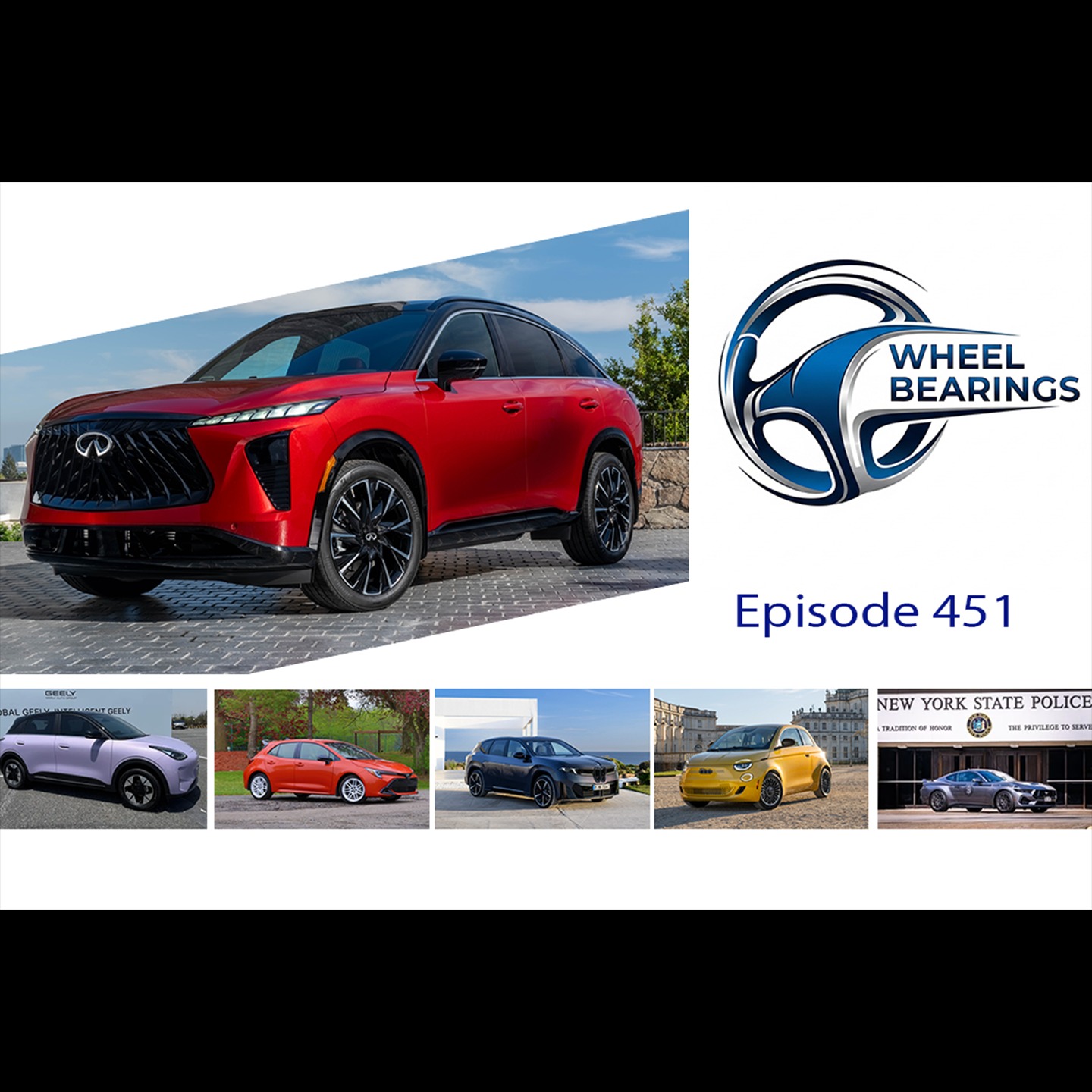
About this episode
Nicole opens with a humid New Orleans Acura trip full of Jazz Fest, beignets, and the MDX Type S, then the conversation widens into a string of car debates: Acura’s pricing and refinement, the Dodge Charger’s new inline-six muscle-car formula, and Kia’s value-packed Sportage and Carnival. Later, the hosts jump to Infiniti’s QX65, a wild rocket-booster EV concept, Chinese EV pricing, Tesla’s Canadian Model 3, and a tiny-run Cadillac Blackwing special.
Nicole has returned from the Big Easy after driving the Acura MDX and eating beignets with too much powdered sugar (is there such a thing as too much?). She also drove the Infiniti QX65, Dodge Charger R/T and Kia Sportage. Sam had the Toyota Corolla FX and Robbie rented a Kia Carnival for a mini vacation.
Fiat inexplicably raises the price of the 500e by $5,000 while Motor Trend drives a $10,000 Chinese EV that doesn't suck. The US spec BMW iX3 is projected to get 434 miles on a charge. The New York State Police are using new Mustang GTs to catch speeders. Dreame has created a ridiculous EV with solid rocket boosters. Lynk&Co has shown off a gorgeous electric GT coupe. Tesla is again shipping Chinese built EVs to Canada and Cadillac is building a very limited run of F1 edition CT5-V Blackwings.
Links
2027 Infiniti QX65 Review: Tennessee-Built Luxury SUV Offers Refined Ride
Is the 2026 Acura MDX Type S Worth It? | NewsNation
Fiat Raises 500e Price by $5,000 With Almost Nothing New - Autoblog
2027 BMW iX3 Range Quietly Jumps To 434 Miles In The U.S.
480-HP Ford Mustang GT Joins Police to Crack Down on Speeders - Autoblog
This Chinese EV Coupe Wouldn't Look Out Of Place In Monaco
Tesla starts selling Chinese-made Model 3s in Canada at the EV's lowest price ever - Engadget
I Just Drove a $10,000 Chinese EV. No, It Didn’t Suck
Blackwing hits the track: Introducing the Cadillac CT5-V Blackwing F1® Collector Series
Advertising Inquiries: https://redcircle.com/brands
Privacy & Opt-Out: https://redcircle.com/privacy
Wheel Bearings
"This is episode 451 of Wheel Bearings. I am Sam Abuelsamid from Telemetry."
This is the name of the podcast. It’s just telling you what show you’re listening to.
This is the podcast title. It doesn’t add technical automotive knowledge by itself in this segment, but it’s the show context.
SAE International
"And I am Roberto Baldwin from SAE International. ... And last week we missed Nicole."
SAE International is a big engineering organization. In this intro, Roberto says he’s with SAE International, so he’s coming at the discussion from an engineering/industry angle.
SAE International is a professional engineering society that supports standards, education, and technical communities across automotive and aerospace. Roberto Baldwin is introduced as being from SAE International, framing his perspective as industry/engineering-focused.
Acura
"So where were you? ... I was there with Acura because Acura sponsors, there's a trombone player named Trombone Shorty... And then we had a day where we drove the Acura MDX."
Acura is a luxury car brand made by Honda. Here, it’s mentioned because Acura sponsored the event and they used an Acura MDX for the trip.
Acura is Honda’s luxury brand. In this segment, Nicole mentions Acura as the sponsor tied to the Trombone Shorty Foundation and the trip where they drove an Acura MDX.

Acura MDX Type S
"And then we saw music, listened to music and got to drive the car. It's this most beautiful blue. It's the, what do they call it? Double apex blue is the Acura MDX Type S. ⁓"
Acura’s MDX Type S is a sportier version of the MDX SUV. It’s a bigger family SUV, and they’re talking about how it looks and how it drives during their event.
The Acura MDX Type S is a performance-oriented trim of Acura’s MDX three-row SUV. In this segment, they’re describing its color and interior, plus how it feels to drive during a short event drive.

Acura Integra
"⁓ It's such a pretty blue and this one what color was the inside of your Integra Sam?"
The Acura Integra is a smaller Acura car. They’re using it as a comparison to describe how the MDX Type S’s blue paint looks.
The Acura Integra is a compact performance-oriented car from Acura. In this segment, they compare the MDX Type S’s exterior color to the shade of blue on an Integra they drove earlier, using it as a reference point for the paint color.
brake calipers
"And then you have red brake calipers, the Brembo brakes that say Acura on the side of it, and they're bright red. It's bright red, bright blue."
Brake calipers are the parts that press the brake pads onto the spinning brake discs to stop the car. When they’re painted, they’re also a noticeable style detail.
Brake calipers are the clamp-like parts that squeeze brake pads against the rotors to slow the car down. Painted calipers (like the bright red ones mentioned) are mostly a visual upgrade, but they often go along with higher-spec brake hardware.
Brembo
"And then you have red brake calipers, the Brembo brakes that say Acura on the side of it, and they're bright red. It's bright red, bright blue."
Brembo makes performance brake parts. In this case, they’re saying the car has Brembo brakes, and you can see it because the brake calipers are painted bright red.
Brembo is a well-known brake brand that supplies performance brake components to many carmakers. Here, they’re pointing out that the Acura MDX Type S has Brembo brakes with red calipers, which is a common visual cue for higher-performance braking hardware.
drive program
"And we went to breakfast lunch and had someplace where they, know, New Orleans, they have pretty big drinking culture, but obviously we're not drinking at lunchtime, especially on a drive program. So they all these mocktails."
A drive program is a planned event where you get to drive a car for a short time. It’s usually organized by the car brand or event, not just a casual test drive.
A drive program is an organized event where journalists or guests get time behind the wheel, usually on a set route and schedule. The hosts frame the outing as more of a lifestyle/experience event than a deep technical evaluation of the vehicle.
Monterey Car Week
"they're good at the little goody bag when you get your room for Monterey Car Week one year. They're like, what kind of snacks do you like?"
Monterey Car Week is a big car event where people go to see cars and sometimes get special perks. They’re mentioning it because they’ve seen similar snack bags there before.
Monterey Car Week is a major annual automotive event in California that includes multiple shows and track/driving activities. The hosts mention it as a reference point for how hotels/brands provide “goody bags” to attendees.
three liter turbo V6 engine
"... The MDX type S has a three liter turbo V6 engine, 355 horsepower, gets a 10 speed automatic."
This engine is a V6 with turbocharging. The turbo helps the engine make more power, and “3.0-liter” is the engine size.
A “turbo V6” uses a turbocharger to force more air into the engine, which helps produce more power from a smaller displacement. “3.0-liter” refers to the engine’s total size, and “V6” means it has six cylinders arranged in a V shape.
10 speed automatic
"... The MDX type S has a three liter turbo V6 engine, 355 horsepower, gets a 10 speed automatic."
A 10-speed automatic transmission uses 10 gear ratios to keep the engine in a more efficient or responsive range. More gears can help the car feel smoother and better matched to different speeds, especially in stop-and-go driving and highway cruising.
three row SUV
"... basically whether the MDX is sort of worth it, right? Because it's a it's a three row SUV. It's a luxury vehicle ..."
A three-row SUV is built with extra seating behind the front seats. They’re saying that because it’s bigger and heavier, it’s harder to make it feel like a sports car.
A three-row SUV is designed to seat more than two passengers, typically with a third row for additional people or occasional use. The segment connects this layout to trade-offs: more weight and packaging can make it harder to feel “sporty” in the way smaller cars do.
sport mode
"And that's what this strikes a nice balance. And there's also modes, and there is a sport mode that lowers the suspension a little bit, tightens things up a bit."
Sport mode is a button/setting that makes the car feel more responsive. Here, they say it also makes the suspension sit lower and feel tighter.
Sport mode is a driver-selectable setting that changes how the car behaves—often by altering throttle response, shift behavior, and suspension settings. In this segment, they specifically say it lowers the suspension a little and tightens things up.
lowers the suspension a little bit
"... there's also modes, and there is a sport mode that lowers the suspension a little bit, tightens things up a bit."
When they say it “lowers the suspension,” they mean the car feels more planted and less bouncy. That can make it feel more controlled when driving.
Lowering the suspension in sport mode typically means the car reduces body movement and can improve how it feels during cornering. It’s usually achieved by changing damping/ride settings and, on some vehicles, adjusting ride height.
hands-free power liftgate
"There's a bangle, some sound system. There's a hands-free power liftgate. You've got a 12.3-inch touchscreen, a digital instrument cluster."
This is the power-operated back door that can open without you touching it. Many cars use a sensor so you can open it with a gesture.
A hands-free power liftgate is an electrically operated rear hatch that can open/close automatically, often using a sensor (like a foot gesture) instead of manually pressing a button. It’s a convenience feature common on modern SUVs.
12.3-inch touchscreen
"There's a hands-free power liftgate. You've got a 12.3-inch touchscreen, a digital instrument cluster. It has a lot in it."
That’s the size of the car’s main screen for things like music, navigation, and settings. Bigger screens are usually easier to read and tap.
A 12.3-inch touchscreen is the infotainment display size used to control navigation, media, vehicle settings, and sometimes driver-assistance options. Larger screens are common in modern luxury vehicles and can make menus easier to use.
digital instrument cluster
"You've got a 12.3-inch touchscreen, a digital instrument cluster. It has a lot in it."
Instead of regular dials, the car uses a screen to show your speed and warning lights. It can display more information than older-style gauges.
A digital instrument cluster replaces traditional analog gauges with screens that can show speed, navigation, warnings, and other driving information. It can be customized and often integrates more vehicle data than older gauge layouts.

BMW X5
"The starting price for the MDX at this with the type S is up there with just the starting price straight up for things like the GV80 and the BMW X5 is even more expensive."
The BMW X5 is a popular luxury SUV. They bring it up to show that some competitors cost more than the Acura MDX at similar entry pricing.
The BMW X5 is a luxury SUV used here as a benchmark for pricing versus the Acura MDX. The hosts note that the BMW X5 can be more expensive at the starting-price level.
Lexus
"Longer than Lexus, longer than Infinity. When did Lexus and Infinity come around? ... Lexus had the LS and the E.S."
Lexus is Toyota’s luxury brand, referenced here in the context of when it launched relative to Acura. The hosts compare early model lineups (like the LS and ES) as part of that brand-history discussion.
Infiniti
"Longer than Lexus in infinity... for Infiniti, they had the Q45... And they had the J20..."
Infiniti is Nissan’s luxury car brand. They bring it up in a historical comparison with Acura and Lexus.
Infiniti is Nissan’s luxury brand, discussed here alongside Lexus and Acura in terms of launch timing and early model names. The hosts mention early Infiniti sedans like the Q45 and J20.

Nissan Altima
"...brand. And they had the J20, which was a rebodied Altima. But actually, it wasn't even called Altima yet a..."
The Nissan Altima is a regular midsize car meant for daily driving. The podcast mentions it because some other cars were built using the same basic design underneath. That’s why the Altima shows up in a discussion about related models.
The Nissan Altima is a midsize sedan that’s been a long-time mainstream option for everyday commuting. In the podcast, it’s referenced because a luxury model was described as a rebodied version of an Altima platform, showing how shared foundations can lead to different badge identities. That’s why it comes up in conversations about vehicle lineage and design origins.

Infiniti Q45
"...died ⁓ Camry. And then for Infiniti, they had the Q45, which was their big luxury sedan, again, unique ..."
The Infiniti Q45 is a luxury sedan, meaning it’s built to feel more upscale and comfortable than a typical car. The podcast mentions it because it was Infiniti’s larger, more important model. It also connects to a discussion about how some cars share basic designs underneath.
The Infiniti Q45 is a large luxury sedan that was positioned as a flagship-style offering in Infiniti’s lineup. The podcast references it as a “big luxury sedan” and notes it as being unique, which is why it comes up in discussions about how luxury brands built their models. It’s also mentioned in the context of rebodied or related platforms, tying it to broader vehicle lineage.
ADAS
"Advanced for accurate usually means you get some, package of extra features like, you know, heads up displays or, you know, some of the more advanced ADAS functions, things like that."
ADAS (Advanced Driver-Assistance Systems) refers to technologies that help the driver, such as adaptive cruise control, lane-keeping, and collision warning/braking. In this segment, “advanced” trim is said to include more ADAS features.
heads up displays
"Advanced for accurate usually means you get some, package of extra features like, you know, heads up displays or, you know, some of the more advanced ADAS functions, things like that."
A heads-up display shows important info in front of you on the windshield. That way you don’t have to take your eyes off the road to check the dashboard.
A heads-up display (HUD) projects key driving information—like speed or navigation prompts—onto the windshield so you can see it without looking down at the instrument panel. It’s often paired with driver-assistance features.

Genesis GV80
"Would you take one over a GV80? ... I'd consider it against the GV80. How's that? Okay, I would consider it."
They’re comparing the Genesis GV80 to an Acura SUV. The GV80 is described as more luxurious inside, while the Acura is framed as having a stronger reputation and a sportier vibe.
Genesis GV80 is a luxury SUV that the hosts compare against an Acura alternative. The discussion centers on interior “fancier” feel versus Acura’s longer track record and reputation.

Hyundai Genesis
"... OK, so the one thing that Acura has that GV, the Genesis doesn't, is that longevity. It's been around a wh..."
Genesis is Hyundai’s luxury car brand. The podcast mentions it because they’re talking about how well these cars last over time. In other words, it’s brought up for durability and long-term ownership.
Hyundai’s Genesis brand is known for luxury vehicles positioned above Hyundai’s mainstream models. In the podcast, Genesis is mentioned in a longevity-focused comparison, implying discussion about how long these cars tend to last or how they hold up over time. That makes it a common topic when people talk about durability in the luxury segment.
twin turbo inline six
"I had the Dodge Charger RT... It's a twin turbo inline six, 420 horsepower, 460 pound feet of torque."
This means the car has a six-cylinder engine arranged in a straight line, and it uses two turbochargers to boost power. The turbos help it feel punchier when you press the gas.
“Twin turbo inline six” describes an engine with six cylinders in a straight line (inline six) and two turbochargers (twin turbo) to force more air into the engine. Turbos help the engine make stronger power, especially when you accelerate.
all wheel drive
"It has all wheel drive, but you can put it in real wheel drive as a little button if you want to have a little funsies."
All-wheel drive means the car can send power to multiple wheels, which helps it grip the road better. It can be especially helpful on slippery days.
All-wheel drive (AWD) sends power to more than just the rear wheels, improving traction in rain, snow, or low-grip conditions. In this segment, it’s also contrasted with switching to a rear-wheel-drive feel for fun.
real wheel drive
"It has all wheel drive, but you can put it in real wheel drive as a little button if you want to have a little funsies."
They’re saying you can switch the car from all-wheel drive to a rear-wheel-drive mode. That can make the car feel more like a classic muscle car when you drive it.
“Real wheel drive” here is used conversationally to mean switching from AWD to a rear-wheel-drive mode. The idea is to get a more traditional driving feel (and potentially different traction/handling behavior) than full-time AWD.
zero to 60
"... 4.6 seconds, zero to 60, two door four door. got the four door."
“Zero to 60” is shorthand for how quickly a car accelerates from 0 mph to 60 mph. It’s a common performance metric used to compare how fast different cars feel when you hit the gas.

Challenger Hellcats
"...the RT before I drove, you know, we've all driven Hellcats when they still had Hellcat chargers out there. I..."
The Challenger is a muscle car, which means it’s built to be powerful and fun to drive. The podcast talks about different versions like the RT and Hellcat, which are higher-performance trims. It comes up because people compare how much power and feel you get from each version.
The Dodge Challenger is a muscle car known for powerful engines and a classic, aggressive design. The podcast references driving an RT and mentions Hellcats, which indicates a discussion about different performance levels within the Challenger lineup. It’s often brought up because it’s a popular platform for enthusiasts who want straight-line power and character.
muscle car
"It has plenty of powers. It has all the vibe that like it feels like a muscle car. It's not delicate. It's not fancy. It's in your face, loud and rough."
A muscle car is typically an American performance car known for strong engine power and an aggressive, no-nonsense driving character. In the segment, the host uses the term to describe the Charger’s loud, rough, “in your face” feel rather than refined luxury.

charger
"So that's my feelings on the charger. like it. Do you like the charger, Sam? ... I think I'm pretty sure the same is going to be true as soon as they can engineer that into the charger."
They’re talking about the Dodge Charger. It’s a performance car, and the episode is about which versions you can get right now and what different engines feel like.
The hosts are discussing the Dodge Charger, a performance sedan that’s being offered with different powertrains. They compare the current availability of V8 models versus the newer Hurricane engine, and they also talk about Charger Daytona variants and upcoming releases.

Nissan Sentra
"I've driven the Daytona a couple times. I've got one coming in a few weeks ... Let's see next week's Sentra."
The Nissan Sentra is mentioned as part of a schedule of cars the host expects to review next. It’s not the focus of the technical discussion here, but it indicates the episode’s broader car lineup context.
V8
"...there's no V8 charger right now, at this time, at this moment. Could it come, maybe? ... Yeah, there's no V8 chargers at this time."
V8 means the engine has eight cylinders. The hosts are saying you can’t get a V8 version of the Charger right now, at least at the time they’re talking.
V8 refers to an engine with eight cylinders arranged in a “V” shape. In this segment, it’s used to distinguish the Charger’s current lack of V8 availability from the Hurricane engine option.
Blutacris
"...pack coming on May 28th in Blutacris, which I assume is their shade of blue on that thing."
Blutacris is a named paint color for the car. They’re describing how it can look like a bright blue in some light, but much darker in other light.
Blutacris appears to be a specific paint color name used for the upcoming Charger. The hosts discuss how it looks very bright blue and can appear darker or different shades depending on lighting.
Hemi
"...it's obviously not as raucous as a Hemi in terms of the way it sounds."
Hemi is a nickname for a particular type of V8 engine design. In this discussion, it mainly matters because people like how it sounds compared to the newer engine.
Hemi refers to Chrysler’s “Hemi” V8 engine design, known for its hemispherical combustion chambers. Here, it’s used as the benchmark for the Charger’s traditional V8 sound (“raucous”) compared with the Hurricane’s character.

Ram
"...in the Wagoneer and in the Ram. And I love that engine."
They bring up the Ram because they’ve driven the same engine in that truck too. It helps them compare how it performs versus other engines.
The Ram is mentioned as another vehicle where the Hurricane engine has been experienced. The hosts use the Ram as a reference point for how smooth, efficient, and powerful the engine is compared with a Hemi-style V8.
raucous sound
"...it's obviously not as raucous as a Hemi in terms of the way it sounds."
They mean the engine/exhaust sounds loud and exciting. They’re saying some people want that “wild” sound even if another engine drives better.
“Raucous sound” describes an aggressive, loud, and characterful exhaust note. The hosts use it to explain why some buyers prefer a Hemi even if the Hurricane engine is objectively better in other ways.

Jeep Wagoneer
"I've driven the six pack in both the Wagoneer or the Hurricane in the Wagoneer and in the Ram."
They mention the Wagoneer because that’s where they’ve experienced the Hurricane engine. It’s part of their comparison of engine character.
The Wagoneer is referenced as one of the vehicles where the Hurricane engine has been driven. The hosts use it to compare how the engine feels in real use versus other V8 options.
efficient
"...the hurricane is a better engine in every respect than the Hemi. It's more powerful. It's more efficient. It's smoother."
They’re using “efficient” to mean it uses less fuel for the same driving. It’s part of their argument that the Hurricane is better overall.
In this context, “efficient” means the engine converts fuel into useful work with less fuel consumption. The hosts contrast efficiency versus the emotional appeal of the Hemi’s sound.
SEMA
"...they did show, where was it? I can't remember if it was at SEMA or during the Woodward Dream Cruise last year."
SEMA is a big auto show in the U.S. where companies show off new cars and performance ideas. They’re saying they saw a Charger concept there.
SEMA is the Specialty Equipment Market Association show, a major U.S. event where automakers and aftermarket companies reveal concept cars and performance parts. The hosts mention it as a place where a Charger drag-racing concept was shown.
Woodward Dream Cruise
"...or during the Woodward Dream Cruise last year. They showed a charger, but a drag racing charger..."
This is a famous car event in Michigan. The hosts mention it as another possible location where they saw a Charger drag-racing concept.
The Woodward Dream Cruise is a well-known car event in Michigan focused on classic and enthusiast cars. In this segment, it’s referenced as another place where the hosts believe a Charger concept was displayed.
drag racing
"...They showed a charger, but a drag racing charger, you know, with a Hellcat in it. So clearly the engine can fit."
Drag racing is racing in a straight line over a short distance to see who accelerates fastest. They’re saying the example Charger was meant for that kind of racing, not normal street driving.
Drag racing is a motorsport where cars accelerate over a short straight distance, typically measured by elapsed time and trap speed. The hosts clarify that the Charger they saw was built as a drag-race-only concept, not a street car.
destination
"feel like this is one of the ones that Dodge has cranked up the destination to like $2,000... the actual destination for the one I had for the Charger RT four four door."
Destination is the shipping fee to get the car from the factory to the dealership. They’re comparing what they thought it was versus what the listing actually shows.
Destination charge is a fee added to the car’s price to cover shipping the vehicle from the factory to the dealer. They’re discussing how Dodge “cranked up” the destination charge and then checking the actual number for a specific Charger.
VIN number
"one of the fleet companies that handles Stellantis... it shows me the VIN number and... which vehicle, what color it is... it has a field in here for battery capacity and it says 0.00 kilowatt hours."
A VIN number is like a car’s fingerprint. It’s a unique code that lets you look up the exact car and its details in a database.
A VIN (Vehicle Identification Number) is a unique 17-character code assigned to each vehicle. Fleet listings and databases use it to pull exact build details like color and equipment, and sometimes even battery-related specs for electrified models.
battery capacity
"it has a field in here for battery capacity and it says 0.00 kilowatt hours. Yeah."
Battery capacity tells you how much energy the battery can hold. It’s usually measured in kWh, and they’re pointing out that the listing shows 0.00, which seems odd.
Battery capacity is the amount of electrical energy a battery can store, typically measured in kilowatt-hours (kWh). In the segment, the fleet listing shows 0.00 kWh, which suggests the vehicle may not be treated as an EV in that particular data field or the listing is incomplete.
kilowatt hours
"it has a field in here for battery capacity and it says 0.00 kilowatt hours."
Kilowatt-hours (kWh) are a way to measure battery energy. More kWh usually means the battery can store more “power,” which can help with range.
Kilowatt-hours (kWh) are units used to measure how much energy is stored in a battery. Higher kWh generally means more potential electric range (for EVs), though real-world range also depends on the vehicle and driving conditions.
ambient lighting
"...get the extra stuff and it's got like ambient lighting and the interior is very cool... lighting is actually pretty cool, especially at night on those textured door panels."
Ambient lighting is the soft, decorative lighting inside the car. It’s meant to make the cabin look nicer, especially after dark.
Ambient lighting refers to interior light strips or LEDs designed to create a mood or highlight surfaces rather than provide primary illumination. Here, they mention it as part of the Charger’s “RT plus” style features and note it looks especially good at night.
Dodge Charger Scat Pack
"Well, the high output is 550. That's the scat pack. Yeah."
The Scat Pack is a higher-performance version of the Dodge Charger. They’re talking about how its power output is higher than the RT and how that changes the value of choosing one trim over another.
The Scat Pack is a performance trim within the Dodge Charger lineup, positioned above the RT. In this segment, they connect the “high output” figure to the Scat Pack and discuss how the power/torque differences affect what you get for the money.
drive modes
"it has modes. has a snow, a mud, a sand. So it has some drive modes to help get you out of stuff."
Drive modes are buttons/settings that change how the car behaves. For example, snow or mud modes help the car manage traction when the road is slippery.
Drive modes are selectable settings that change how the vehicle responds to throttle, traction control, and sometimes steering or transmission behavior. In this segment, they specifically mention modes for snow, mud, and sand to help the SUV get through low-grip conditions.
rock crawling
"...but it's not rock crawling off road. It's not heavy duty off road."
Rock crawling is extreme off-roading where you go very slowly over big rocks and rough terrain. They’re saying the Sportage isn’t built for that kind of hardcore trail driving.
Rock crawling is a specialized off-road driving style focused on very slow speeds over large rocks and steep obstacles, typically requiring low-range gearing and strong traction control. The hosts contrast this with the Sportage’s more everyday “dirt road” capability.

Kia Sportage
"So it's nice to have for the capability... It's kind of light off road... It has a 2.5 liter four cylinder engine. It's an eight speed automatic... So overall, I liked the Kia Sportage."
The Kia Sportage is a small SUV. They’re talking about how it drives day to day, how strong it feels, and how it does when you need to merge onto the highway or handle rougher roads.
The Kia Sportage is a compact SUV. In this segment, the hosts discuss how it handles light off-road use, its powertrain (2.5L four-cylinder and an 8-speed automatic), and how it feels in everyday driving and highway merging.
2.5 liter four cylinder engine
"It's a little underpowered. It has a 2.5 liter four cylinder engine. It's an eight speed automatic."
That means the SUV has a 2.5-liter engine with four cylinders. It’s not the biggest or strongest engine, and the hosts say it can feel a bit short on power when you need quick acceleration.
“2.5 liter four cylinder” describes the engine’s displacement and cylinder count: 2.5 liters total volume across four cylinders. More cylinders and/or larger displacement often help with smoothness and power, but this particular setup is described as “a little underpowered” for the driver’s needs.
eight speed automatic
"It has a 2.5 liter four cylinder engine. It's an eight speed automatic."
This is the SUV’s automatic transmission, and it has 8 different gear ratios. The idea is to help the engine work in the right range, but if the engine doesn’t have much power, it still may feel slow to accelerate.
An “8-speed automatic” is a transmission that automatically shifts through eight gear ratios. More gears can help keep the engine in a more efficient or responsive range, but it doesn’t guarantee strong acceleration if the engine output is modest.
187 horsepower
"And it has 187 horsepower. It's not a lot of horses. That's a small number of horses."
Horsepower is how much pulling power the engine can produce. They’re saying 187 horsepower isn’t a lot, so the SUV may not feel quick when you need extra acceleration.
“Horsepower” is the engine’s power output, and 187 hp is relatively modest for a compact SUV. The hosts connect this number to their impression that the Sportage can feel underpowered when you need a quick burst to pass or merge.
12.3 inch instrument cluster
"...it has a 12.3 inch instrument cluster and infotainment screen."
A “12.3 inch instrument cluster” is the digital screen behind the steering wheel that displays speed, engine/gear info, and navigation or driver-assist data. Larger digital clusters are often part of higher trims and can improve clarity and customization.
infotainment screen
"...it has a 12.3 inch instrument cluster and infotainment screen."
The infotainment screen is the big display in the dashboard for things like music, maps, and settings. It’s also where your phone features can show up.
An “infotainment screen” is the main touchscreen interface for media, navigation, and vehicle settings. The segment also mentions Apple CarPlay/Android Auto, which are features that integrate your phone into that screen.
CarPlay
"CarPlay and Android Auto. has a nice spot for the charging..."
CarPlay lets you connect an iPhone to the car so you can use key apps on the dashboard screen. It’s mainly for navigation, calls, and music.
Apple CarPlay is a smartphone integration system that lets you use compatible iPhone apps through the car’s infotainment screen. It’s commonly used for navigation, calls, and music while keeping your phone functions in the car interface.
Android Auto
"CarPlay and Android Auto. has a nice spot for the charging..."
Android Auto connects an Android phone to the car so you can use supported apps on the dashboard screen. It’s for things like maps, calls, and music.
Android Auto is Google’s smartphone integration system that mirrors supported apps onto the car’s infotainment display. Like CarPlay, it’s designed to make phone features easier and safer to use while driving.
charging pad
"...has a nice spot for the charging and it sort of locks it in. It's slightly raised where you're charging, where the charging pad is."
A charging pad is where you set your phone to charge it wirelessly. They like that it’s shaped so the phone stays in place.
A “charging pad” refers to a built-in wireless charging surface for a phone. The hosts note it’s slightly raised so the phone sits securely and doesn’t slide around.
trim levels
"Even as you move up through the trim levels, you still look at it and think, yeah, okay, this one costs more, but I'm getting these extra things with it."
Trim levels are different versions of the same car model. Higher trims usually add more features, and the hosts compare how the price changes with what you get.
“Trim levels” are different versions of the same model that come with different equipment packages and features. The segment compares pricing across trims and notes that higher trims add more technology and comfort features.

Ford F-150 Lightning
"...y, you know what? It's chaos out there. I see the lightning. I can hear the rain hitting the car, and yet, Ni..."
The Ford F-150 Lightning is a pickup truck that runs on electricity instead of gasoline. The podcast mentions it in a real-world driving moment, like noticing it in the rain. It’s a truck meant to keep the usefulness of a pickup while using an electric powertrain.
The Ford F-150 Lightning is an electric pickup truck built on the F-150 platform concept, combining EV power with truck practicality. The podcast references seeing the Lightning and hearing rain hitting the car, which fits the idea of real-world driving and everyday use. It’s often discussed because it brings electric technology into a segment traditionally dominated by gas engines.
towing 2,500 pounds
"You've got the drive modes on this, it can tow 2,500 pounds..."
This means the SUV can pull a trailer up to about 2,500 pounds, if it’s set up correctly. The exact limit depends on the vehicle and how it’s equipped.
“Towing 2,500 pounds” refers to the vehicle’s maximum trailer weight rating under specified conditions. Towing capacity depends on the powertrain, cooling, brakes, and vehicle design, and it’s typically only available when properly equipped.
heated steering wheel
"a heated steering wheel, because I used them because it was freezing..."
A heated steering wheel warms up the part you hold while driving. It’s helpful in cold weather, and the host says they used it because it was freezing.
A “heated steering wheel” warms the steering wheel for cold-weather comfort. The host specifically mentions using it because it was freezing, highlighting it as a comfort feature tied to trim.
value brand
"[3180.9s] Nicole Wakelin (40:17) That's cheap. Value means that you're paying what you're getting is surprising for the amount of money that you're paying compared to the other guys. And it's a value. That's what Kia and Hyundai both do. [3199.0s] They are truly value brands. You will get more with those two brands for the same dollar than you will in just about anybody else."
A “value brand” is a car brand that tries to give you more for your budget. It’s not necessarily the cheapest car—it’s the one that feels like it’s worth the price.
The hosts use “value brand” to mean a brand that offers more features or a more “premium-feeling” experience for the money than competitors. It’s about what you get relative to price, not just being the cheapest option.
station fee
"[3297.2s] Roberto Baldwin (41:35) ...we put the destination charge right there next to the price. So it's it's literally like the second graph of my article. ⁓ So this is station fee in May was 1445 [3315.2s] Nicole Wakelin (41:48) What is your article, what do you have it as? I'm curious because they're not always."
A “station fee” is another kind of added cost tied to where the car is delivered or how it’s handled before it reaches you. In this conversation, they’re treating it like the same kind of fee as the destination charge.
“Station fee” appears to be used as a synonym/related line item to the destination charge in the hosts’ article pricing breakdown. In practice, it refers to a dealer/transport-related fee that gets added to the vehicle’s price.
zip code
"[3372.3s] Sam Abuelsamid (42:45) Yes, put in my zip code. A zip code. Let's see. Summary. As of May 3rd, 2026, the destination charge is now $14.95."
A zip code is a postal area code. They’re using it to look up the price/fees for their specific location.
A zip code is used to calculate location-specific pricing or fees on some automaker/dealer websites. In this segment, they enter a zip code to get the current destination charge amount.
pothole death traps
"...But then our roads aren't like pothole death traps either, so we got that going for it."
They’re joking about roads that are so rough that potholes can damage your car. Hitting potholes can lead to problems like tire or suspension wear.
“Pothole death traps” is a colloquial way to describe roads that are badly damaged, with potholes that can cause tire damage, wheel alignment issues, and suspension wear. It’s used here to contrast road conditions between regions.
snow and ice and salt
"...because you don't have snow. That's not about what we spend. That's about the fact that you don't have snow and ice and salt..."
Snow, ice, and road salt are harsh on vehicles—especially for corrosion protection—because salt accelerates rust on underbody components and suspension parts. The hosts connect these conditions to regional differences in vehicle wear and road maintenance.
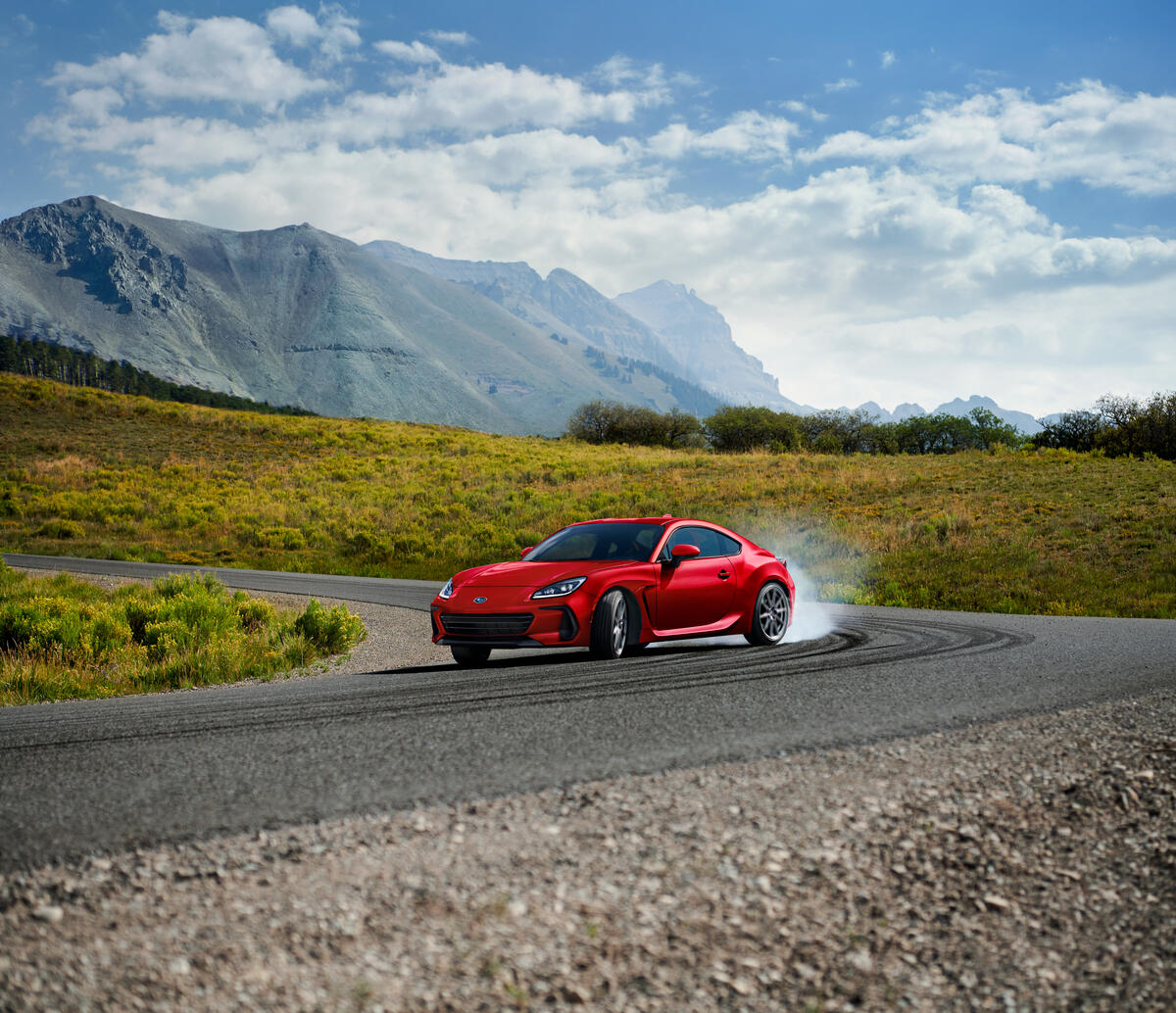
Subaru BRZ
"...Paying a little bit more for gas ain't so bad. Driving around in my BRZ on nice roads."
The BRZ is a small sports car from Subaru. People like it because it feels nimble and fun to drive, especially on good roads.
The Subaru BRZ is a compact sports coupe known for its light weight and balanced handling. In this segment, it’s mentioned as the car the speaker drives on nice roads, implying it’s a fun, everyday-friendly choice for cruising.

Cadillac Escalade
"...I leave here on the 5th because I have to drive the Escalade IQ from here to Omaha."
The Escalade IQ is Cadillac’s electric take on the big Escalade SUV. The host is using it for a long drive as part of an EV-focused trip.
Cadillac Escalade IQ refers to the upcoming/EV version of the Escalade nameplate. Here, it’s the specific EV the host is driving from Omaha, highlighting how the trip involves electric vehicles rather than gas cars.
learners permits
"[3700.6s] only have they only have learners permits. So, you know [3705.0s] have to be in the passenger side anytime the dog is driving."
A learner’s permit is the first step for new drivers. It usually means you can drive, but only with a qualified person supervising you.
A learner’s permit is an entry-level driver credential that allows someone to drive only under specific supervision rules (like having an experienced adult in the car). In the segment, it’s used to explain why a passenger must be in the car while the dog is “driving.”

Hyundai Ioniq 5
"[3861.0s] ...we were thinking about taking the, just the, the Ionic 5 and they're like, no, let's just take, let's rent a van for the dogs."
The Hyundai Ioniq 5 is an electric SUV. They considered using it, but it didn’t have enough room for the dogs on a longer drive.
The Hyundai Ioniq 5 is an electric crossover SUV. Here it’s brought up as a candidate vehicle for a trip, but the group chooses a rental van instead due to space needs for dogs.
rental van choice for dog travel
"[3861.0s] ...we were thinking about taking the... Ioniq 5... they're like, no, let's just take, let's rent a van for the dogs. [3903.7s] ...typically we get the Pacifica or the Voyager..."
They’re talking about what vehicle to rent for a trip with dogs. They pick a van because it has more space for everyone on a longer drive.
This segment discusses choosing a rental van instead of an electric SUV for a trip with multiple dogs. The key driver is passenger/space needs for longer driving.

Chrysler Pacifica
"does not have Stow and Go, which was, you know, that's one of the things that's great about the Pacifica and or the Voyager is that you can put the seats all the way down so that whole big area is clear."
The Chrysler Pacifica is a three-row minivan known for family-focused packaging and available convenience features like Stow and Go. Here, it’s mentioned as a comparison point for how much interior space and flexibility it offers versus the Kia Carnival they’re driving.
Stow and Go
"does not have Stow and Go, which was, you know, that's one of the things that's great about the Pacifica and or the Voyager is that you can put the seats all the way down so that whole big area is clear."
Stow and Go is a feature where some seats can fold down into the floor. That makes it easier to turn the van into a big cargo space without taking seats out.
Stow and Go is a seating system found on some Chrysler minivans where certain seats fold into the floor. That creates a flat, open cargo area without removing seats, which is a big convenience advantage for road trips and hauling gear.
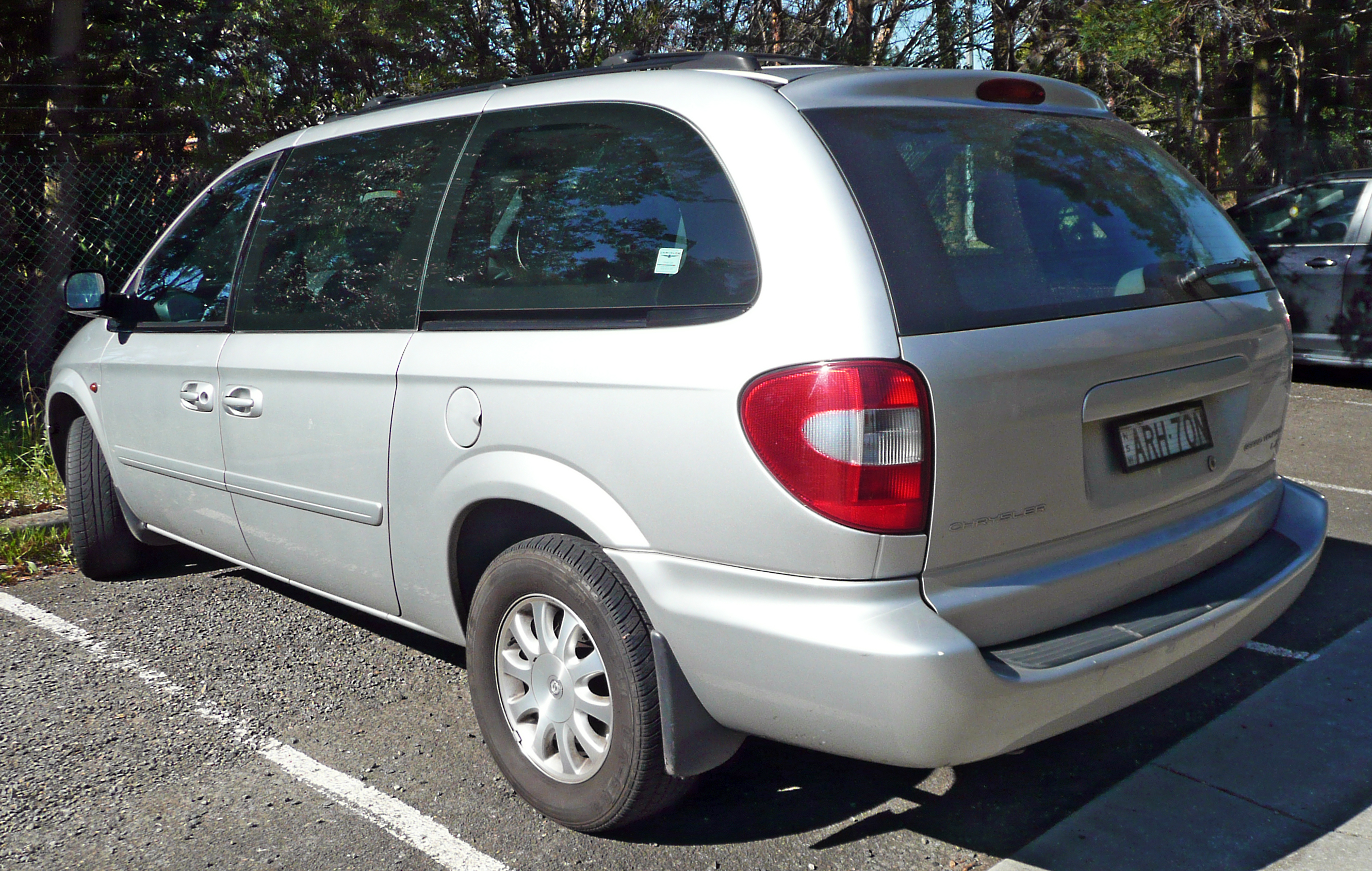
Chrysler Voyager
"does not have Stow and Go, which was, you know, that's one of the things that's great about the Pacifica and or the Voyager is that you can put the seats all the way down so that whole big area is clear."
The Chrysler Voyager is a minivan. They mention it because it can be set up to give you more usable space by folding seats down.
The Chrysler Voyager is another minivan in the same family as the Pacifica, often discussed for its practical interior layout. In this segment, it’s referenced alongside the Pacifica specifically for having Stow and Go-style flexibility.
MPV
"it still has, you know, they don't wanna call it, know, Kia doesn't wanna call it ⁓ a Vans, an MPV, ⁓ like the Mazda, the five."
MPV means “multi-purpose vehicle.” It’s basically a fancy way of saying a people-hauler like a minivan that’s meant for families and trips.
MPV stands for “multi-purpose vehicle,” a category term used for minivans and similar people-movers. The speaker contrasts MPV labeling with how some brands prefer “van” or position the vehicle as SUV-like.
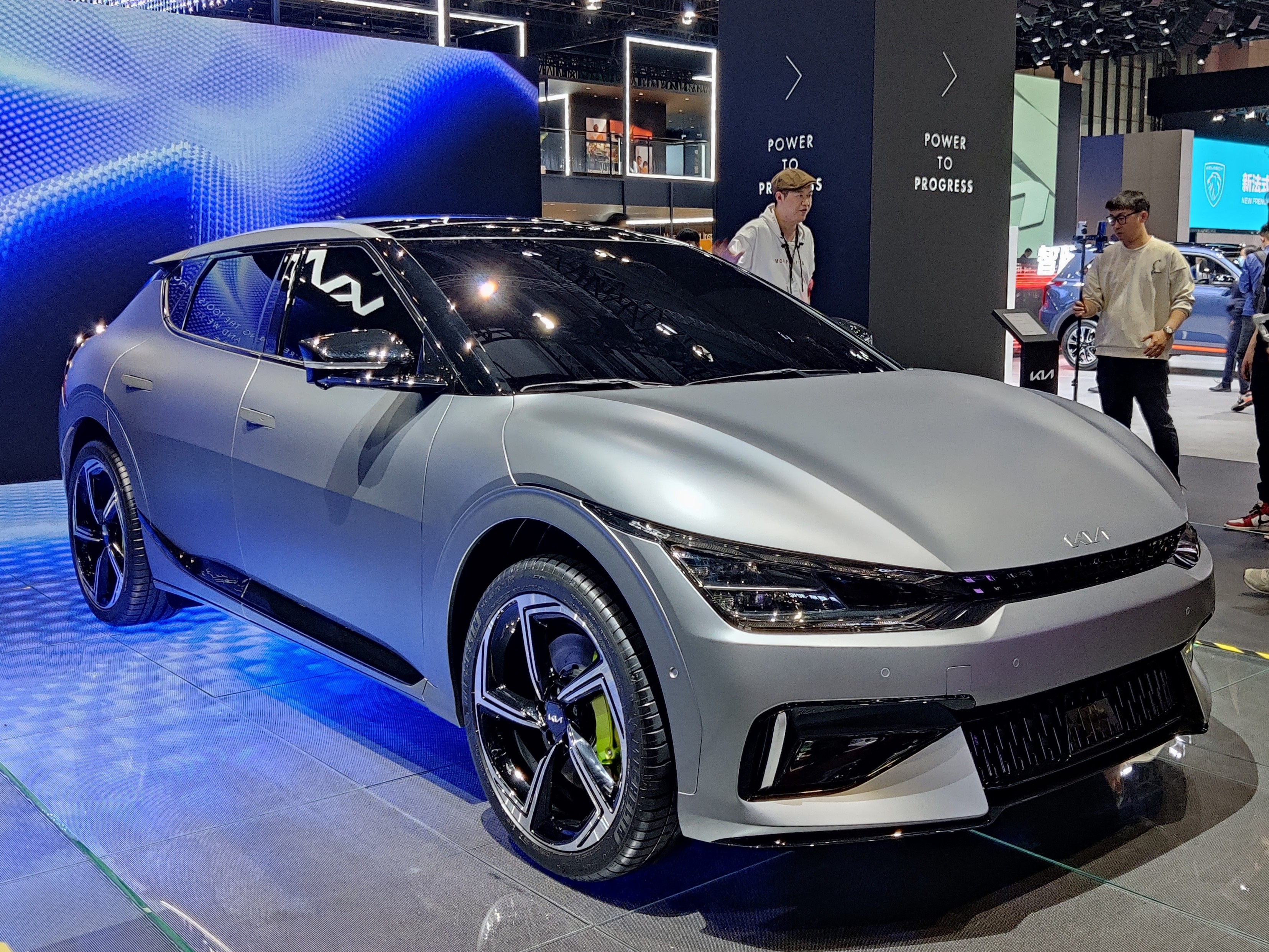
Kia EV6
"that will go away. But that's the one thing that annoys my wife about the EV6. [4092.4s] Yeah, that double, like you gotta tap it to change, now doing volume, now tap it again…"
The Kia EV6 is an electric Kia. They’re complaining about how the controls work—like you have to tap the screen to change things such as volume and temperature.
The Kia EV6 is an electric crossover/SUV. Here it’s used as an example of an infotainment control design the speaker dislikes—specifically a touch/tap interface for adjusting volume and climate.

Kia Carnival
"That all said, ⁓ it's a delightful vehicle. I really like driving the Carnival. It's very smooth. It handles for what it is. ⁓ It's got the low ride height. The dogs really enjoyed it. The seats are very comfortable."
The Kia Carnival is a big family van with three rows of seats. The hosts like it because it’s comfortable, drives smoothly, and the inside space is easy to use for trips.
The Kia Carnival is a three-row minivan focused on family space and comfort. In this segment, the hosts discuss how it drives smoothly, has a lower ride height than some SUVs, and offers practical interior packaging for passengers and cargo.

Lexus Lm
"in Japan the other week, they picked us up and dropped us off at the airport in the Lexus LM, which is one of these luxury minivans."
The Lexus LM is a luxury minivan. They’re saying that in places like Japan, even high-end rides often use a minivan because it’s comfortable and roomy.
The Lexus LM is a luxury minivan (often described as a “people mover”) designed for comfort and spacious seating. The speaker uses it to illustrate how, in some markets, premium airport transfers are commonly done with minivans rather than SUVs.
eco mode
"I did have it in eco mode because again, gas here is very expensive."
Eco mode is a setting that helps the car use less fuel. It usually makes the car respond more gently when you press the gas.
Eco mode is a driver-selectable setting that changes vehicle behavior to improve efficiency, often by softening throttle response and adjusting power delivery. The speaker uses it because fuel prices are high and they want better fuel economy.
headwinds
"yeah, so you hit the headwinds. Fortunately we didn't have any headwinds this time. but yeah, the headwinds coming back from like LA… it just destroys your mileage."
Headwinds are wind coming at you. They make the car work harder, so you usually get worse gas mileage.
Headwinds are winds blowing directly toward the vehicle, increasing aerodynamic drag and making it harder to maintain speed. The hosts connect headwinds to worse fuel economy on highway trips.
fast charging
"But you're usually doing that with the V5 or with the IONIQ 5. it doesn't. And you got your you got your all your free, ⁓ free fast charging sessions with that thing."
Fast charging is when you charge an electric car using a high-power charger. It can add a lot of energy quickly, which helps on longer trips.
Fast charging refers to using a high-power DC charger to add significant battery energy in a shorter time than standard charging. The speaker mentions “free fast charging sessions,” implying the charging network and charging speed affect trip convenience.
zero APR
"The deals right now for the new ones are sort of bonkers, like $11,000 off, like zero APR. And I'm just like, well, like what's the, know, I'm doing a cost analysis right now."
“Zero APR” means the loan has no interest. That can make the total cost lower, so it’s worth comparing it with how much you put down.
“Zero APR” means the financing offer has a 0% annual percentage rate, so you don’t pay interest on the loan. The speaker calls the deals “bonkers” and is doing a cost analysis to compare down payment strategy versus the promotional financing.

Toyota Corolla FX
"Okay, ⁓ well, I, ⁓ like last time I talked about driving the Lexus GX550 Overtrail Plus. ⁓ This time I had kind of the, almost the opposite extreme within the Toyota Lexus lineup with the Toyota Corolla FX. So this is ⁓ a new variant of the Corolla hatchback."
This is a special version of the Toyota Corolla hatchback. They’re talking about how it feels to drive, what kind of engine it has, and how the automatic transmission acts when you choose sport mode.
The Toyota Corolla FX is a Corolla hatchback variant with a sportier styling and equipment package. In this segment, the hosts discuss its engine output, how it drives, and how the CVT behaves in sport mode.

Lexus GX550 Overtrail Plus
"Okay, ⁓ well, I, ⁓ like last time I talked about driving the Lexus GX550 Overtrail Plus. ⁓ This time I had kind of the, almost the opposite extreme within the Toyota Lexus lineup with the Toyota Corolla FX."
This is a tougher, more off-road-focused version of the Lexus GX. The host brings it up just to compare it with a very different kind of vehicle.
The Lexus GX550 Overtrail Plus is a Lexus GX trim focused on off-road capability and rugged styling. It’s mentioned here as a contrast point to the much smaller, more car-like Corolla FX.
twin cam four valve per cylinder
"...when they had the original Corolla FX16, ⁓ which was, that was when they first launched a twin cam four valve per cylinder engine..."
This describes how the engine controls airflow. “Twin cam” and “four valves per cylinder” generally help the engine breathe better, which can improve how it makes power.
“Twin cam” means the engine uses two camshafts to control the valves, and “four valve per cylinder” means each cylinder has four valves (typically two intake and two exhaust). This design can improve breathing and performance compared with simpler valve layouts.

Mazda Miata
"Yeah, that's like my Miata. Yeah, same thing. have 116 horsepower. You know, when I compare it, compare my Miata to the the new one that I drove..."
They mention the Mazda Miata as a reference car. The point is that it’s small and light, so it feels quick even with modest power.
The Mazda Miata is used as a comparison point for power-to-weight feel and packaging. The host contrasts the Miata’s small size and low horsepower with the newer Corolla FX’s larger engine and different cabin space.

Honda Civic
"...my 90 Honda Civic, I think, had 86 horsepower, and I blasted that thing everywhere."
They bring up an older Honda Civic they owned to compare driving feel. The idea is that smaller, lighter cars can feel quick even with lower power numbers.
The Honda Civic is referenced as the host’s earlier car used to illustrate how low horsepower can still feel lively in a lightweight vehicle. It’s part of the broader comparison between older small cars and the newer Corolla FX.
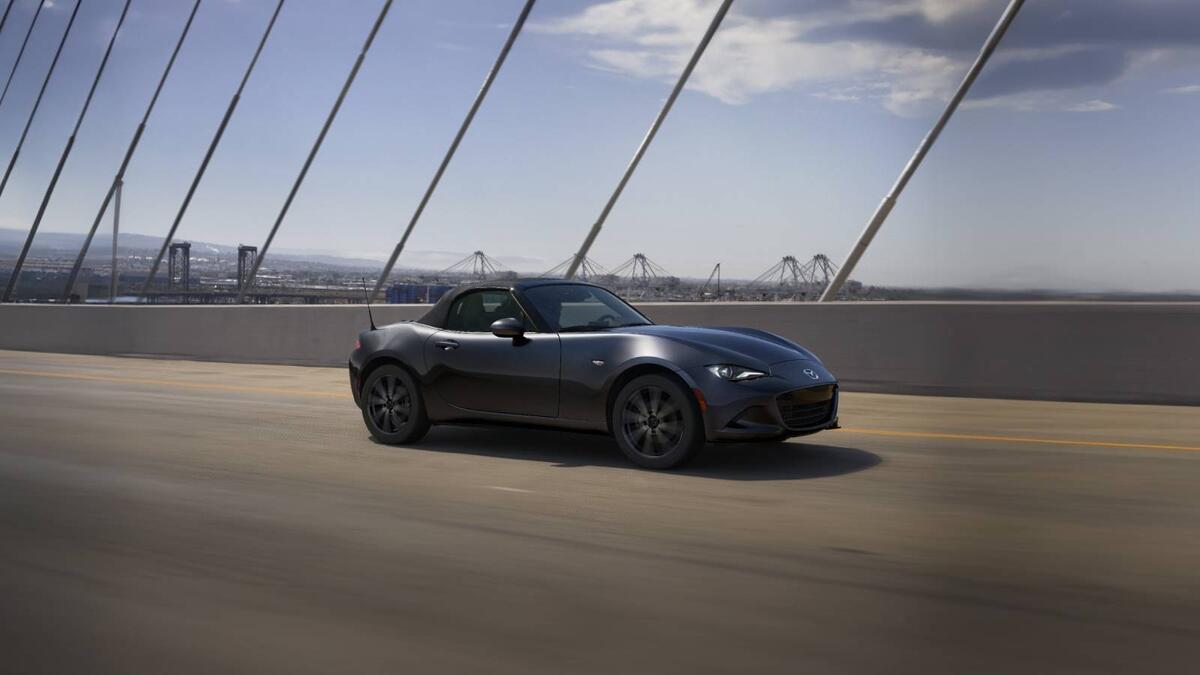
Mazda MX-5 / Miata
"...Sam Abuelsamid (59:05) Yeah, well, that's like my Miata. Yeah, same thing. have 116 horsepower. You know,..."
The Miata is a small two-seat convertible made for fun driving. It’s known for being light and easy to handle, and the podcast mentions it because it has a modest amount of horsepower. That combination is part of why people like it.
The Mazda MX-5 Miata is a lightweight, two-seat roadster built around simple, fun driving dynamics. The podcast references it in the context of power output, highlighting how it’s often discussed as an accessible performance car. It’s a frequent topic because its design philosophy emphasizes balance and driver feel over raw speed.
naturally aspirated
"But the the new Corolla FX ⁓ is has a two liter 16 valve four cylinder naturally aspirated. It's one hundred and forty nine horsepower."
Naturally aspirated means the engine doesn’t use a turbo or blower to force air in. It breathes in air normally, and the power comes from the engine’s design.
Naturally aspirated means the engine makes power without a turbocharger or supercharger, relying on atmospheric pressure and engine design to draw air in. The Corolla FX is described as a naturally aspirated 2.0-liter 16-valve four-cylinder.
torque
"So that's a whole 169 horsepower and 151 foot pounds of torque. That torque peak comes at 4800 RPM, which is not ideal. know, ideally you want a little more torque down low..."
Torque is the engine’s “pulling power.” Higher torque at lower engine speeds usually helps the car feel quicker when you start moving or accelerate gently.
Torque is the twisting force an engine produces that helps the car accelerate, especially at lower speeds. The host points out that the Corolla FX’s torque peak occurs at 4800 RPM, which they say isn’t ideal for getting moving quickly from low RPM.
CVT
"It's funny, they don't even mention the transmission in ⁓ the spec sheet. Yeah, it's CVT, one, it's like, hey, you want something cool? ... even with the CVT, especially if you put it in sport mode, you know, it's was the way they've got it programmed was actually pretty decent."
CVT means the car’s automatic transmission can smoothly change ratios instead of shifting gears like a traditional automatic. In this car, they say it feels decent—especially when you put it in sport mode.
CVT stands for continuously variable transmission, which uses a belt-and-pulley (or similar) system to keep the engine near an efficient RPM. The hosts note that the Corolla FX’s CVT is programmed to feel better in sport mode, and they also mention that the spec sheet doesn’t highlight the transmission.
wheelbase
"The Corolla hatchback is a little bit shorter. than a sedan, it's a shorter wheelbase. So the back seat is a little bit tighter."
Wheelbase is how far apart the front and rear wheels are. A shorter wheelbase often means less room for passengers in the back seat.
Wheelbase is the distance between the front and rear axles, and it strongly affects interior space and ride/handling balance. The segment notes that the Corolla hatchback has a shorter wheelbase than the sedan, making the back seat tighter.
paddle shifters
"And you can use the paddle shifters to do a little manual control, put the drive mode switch into sport mode and it works OK."
Paddle shifters are little levers behind or on the steering wheel. They let you tell the car what “gear” to use, even if the transmission is normally automatic.
Paddle shifters are controls on the steering wheel that let you manually request gear changes in a transmission that otherwise would be automatic. Here, they’re used to add a more driver-involved feel by simulating manual control while still using the CVT.
fixed headrest
"The seats, the seat backs on the FX version are, they've got a fixed headrest. It looks kind of sporty."
A fixed headrest is a headrest that can’t be adjusted up, down, or forward/back. It’s just set in one position.
A fixed headrest is a headrest that doesn’t move or adjust, unlike many adjustable designs. The host mentions the FX version’s fixed headrest as part of its sportier seatback look.
lateral support
"It looks kind of sporty. It's got a reasonable amount of lateral support."
Lateral support is how well the seat “keeps you in place” when the car is turning. Better side support can make driving feel more secure.
Lateral support is how well a seat holds your body on the sides during cornering, helping you stay positioned when the car turns. The host says the FX seats provide a reasonable amount of lateral support.
Toyota connected services
"...the connected services trials, you get three years of Toyota connected services for 485 bucks... if you are... increasingly paranoid about where all your data's going, you may want to take a pass on that one and leave your car unconnected."
This is a set of features that connects your Toyota to Toyota’s network. It can help with things like navigation support, but it may also send data about how you use the car.
Toyota connected services are subscription/telematics features that keep the car linked to Toyota’s systems for things like navigation support and other remote functions. They typically require data connectivity and can raise privacy concerns because the car can send information back to the provider.
Request an Explanation
Heard something you'd like explained? We'll add it to this episode.
Sign in to request explanations for terms you heard.
Want to learn more?
Browse our glossary for plain-English explanations of automotive terms, jargon, and concepts.
Help improve this episode
See something that's not quite right? Our annotations are AI-generated and can sometimes miss the mark. Click the flag icon on any annotation to suggest a correction.