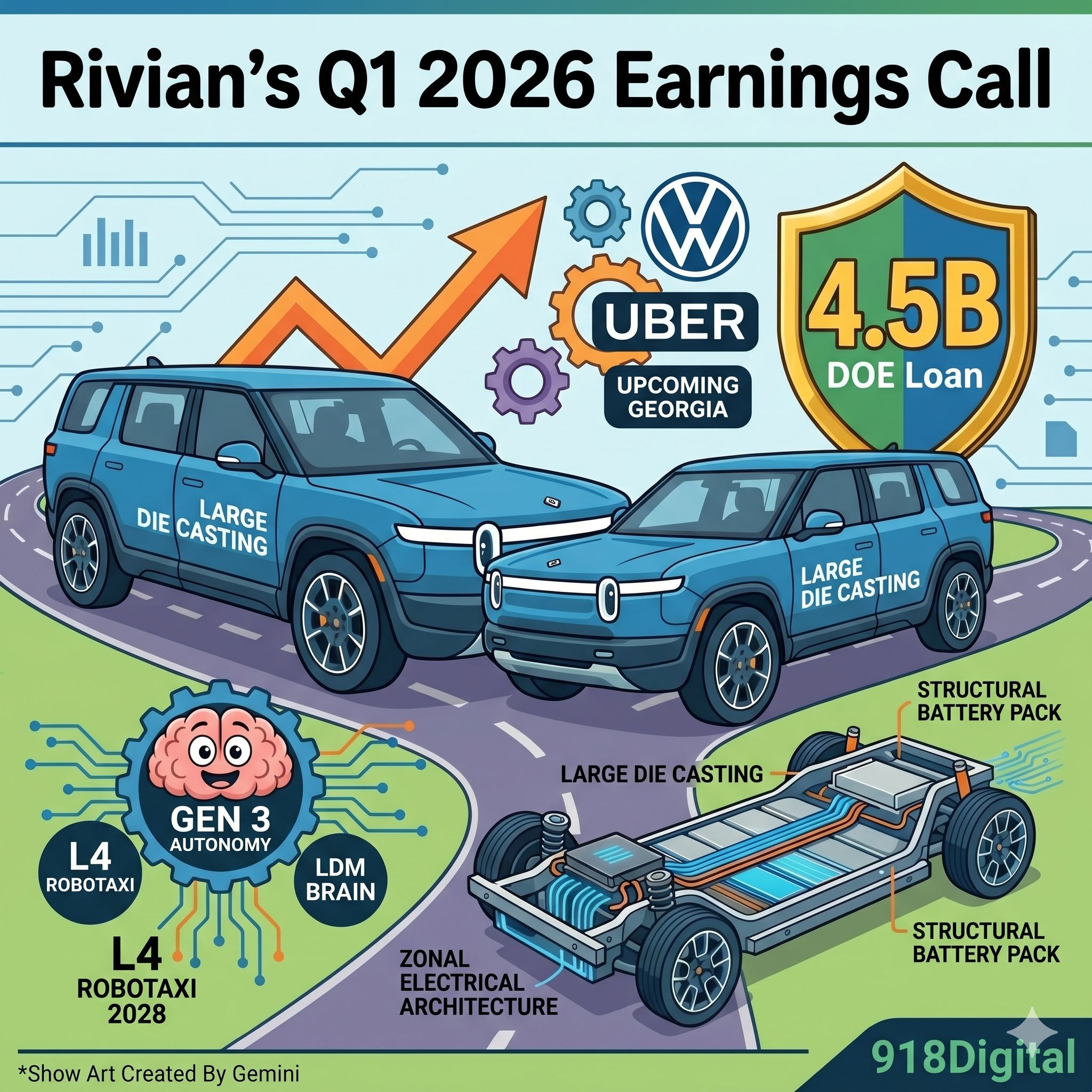
Rivian's Q1 2026 Earnings Call
About this episode
Rivian’s Q1 2026 earnings call centers on R2’s ramp and cost-down plan, including a claim that R2 production has started in Normal, Illinois and that its bill of materials should be about half of R1. Hosts then walk through Q1 financial drivers (regulatory credits and software/services profitability), 2026 delivery and margin expectations, and funding tied to Georgia expansion. A major thread is autonomy: point-to-point first, Gen 3 sensors later this year, and a path toward level four with LiDAR and a large driving model.
In this episode of Kilowatt, host Bodie breaks down Rivian’s highly anticipated Q1 2026 earnings call, shifting the spotlight from raw financial data to the groundbreaking vehicle technology driving the brand forward. The headline milestone is the official start of saleable R2 production in Normal, Illinois, with early midsize SUVs already hitting the road as employee daily drivers. Listeners will discover how Rivian managed to cut the R2's bill of materials in half through massive structural die castings, an integrated high-voltage electronics enclosure, and a streamlined electrical architecture that strips out miles of heavy copper wiring. The episode also dives into Rivian's massive multi-billion dollar liquidity pipeline from the Department of Energy, Volkswagen, and Uber, which is funding a 50% capacity boost at its upcoming greenfield plant in Georgia. Finally, Bodie details CEO RJ Scaringe’s progressive autonomy roadmap, charting the course from Autonomy Plus subscriptions to Level 4 "eyes-off" consumer vehicles and robotaxis hitting complex urban domains by 2028.
Support the Show https://www.supportkilowatt.com/
Other Podcasts:
News Links:
*Show Art Created By Gemini
Hosted by Simplecast, an AdsWizz company. See pcm.adswizz.com for information about our collection and use of personal data for advertising.
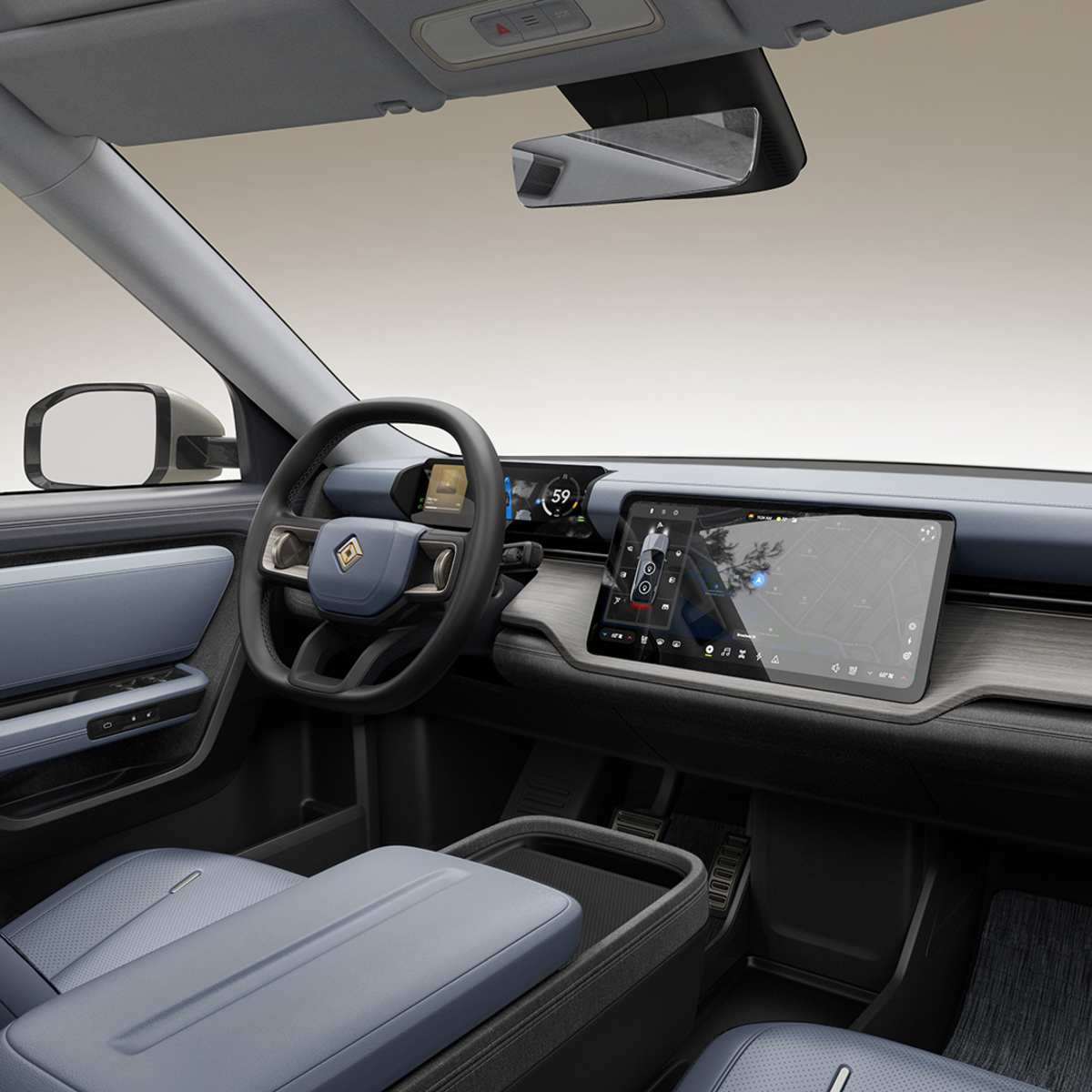
Rivian R2
"With R2 we are taking our design, performance and technology and bringing it to a significantly broader audience without losing what makes Rivian unmistakably Rivian... I absolutely love having R2 as my daily driver."
Rivian R2 is a new, smaller Rivian SUV/crossover. The company is saying it’s designed to be cheaper to build than its bigger model, while still keeping the “Rivian” feel—so more people can afford it.
Rivian R2 is the company’s smaller, more affordable SUV/crossover aimed at bringing Rivian’s design and tech to a broader audience. In this earnings-call segment, Rivian frames R2 as a cost-reduction and manufacturing-scaling project versus its larger R1 platform, including changes to the vehicle’s structure, battery packaging, and electrical architecture.
structural cost reductions
"In developing R2 our team relentlessly focused on achieving structural cost reductions while maintaining the desirability of the product."
This means Rivian is trying to make the car cheaper to build by changing the way it’s designed and manufactured. They’re saying they did it without making the car less appealing.
Structural cost reductions are efforts to lower manufacturing and engineering costs in the vehicle’s core design and build approach, not just by cutting features. In this context, Rivian says it targeted these reductions while still keeping the product desirable.
bill of materials
"For R2 our bill of materials is expected to be approximately half of our R1 platform."
A bill of materials is basically the shopping list of parts needed to build the car. Rivian is saying R2’s parts list should cost about half as much as the bigger R1 platform’s parts list.
Bill of materials (BOM) is the detailed list of all parts and components needed to build a product. Rivian is saying the BOM for R2 is expected to be about half of the BOM for its R1 platform, which is a common way to quantify how much cheaper a vehicle can be to produce.
fixed cost efficiencies
"resulting from a focus on design for manufacturing and leverage fixed cost efficiencies through higher production volumes."
Fixed cost efficiencies are cost savings achieved when the same overhead costs (like factory setup, engineering, and certain infrastructure) are spread across more units. Rivian connects this to higher production volumes for R2.
design for manufacturing
"resulting from a focus on design for manufacturing and leverage fixed cost efficiencies through higher production volumes."
Design for manufacturing is about making the car easier and cheaper to build in factories. Rivian is saying this helps them cut costs when they make more cars.
Design for manufacturing (DFM) means designing parts and assemblies so they’re easier and cheaper to build at scale. Rivian ties DFM to reducing costs and improving efficiency as production volumes increase.
die castings
"Key design changes for R2 include part eliminations and reductions through the introduction of large die castings, a structural battery pack..."
Die castings are metal parts made by pouring molten metal into a mold to create a strong shape. Rivian is using bigger die-cast parts to reduce the number of separate pieces needed.
Die castings are metal parts made by forcing molten metal into a reusable mold (a die) under pressure. Rivian says it’s using large die castings to eliminate/reduce other parts, which can reduce complexity and cost while improving repeatability.
structural battery pack
"Key design changes for R2 include part eliminations and reductions through the introduction of large die castings, a structural battery pack, a new highly efficient drive unit..."
Normally the battery is just mounted inside the car. A structural battery pack means the battery box also helps the car’s body stay rigid and strong, which can reduce weight and parts.
A structural battery pack is a battery enclosure that also contributes to the vehicle’s stiffness and crash structure, rather than being only a protected “container.” Rivian’s mention implies R2 uses the battery pack as part of the car’s load-bearing design to save weight and parts while maintaining strength.
drive unit
"Key design changes for R2 include part eliminations and reductions through the introduction of large die castings, a structural battery pack, a new highly efficient drive unit..."
The drive unit is the EV’s main power system that makes the wheels turn. Rivian is saying R2’s new one is designed to be more efficient.
In EVs, the drive unit is the integrated powertrain hardware that turns the wheels—typically including the electric motor and its associated gearing and power electronics. Rivian says R2 uses a “new highly efficient drive unit,” pointing to efficiency improvements that can help range and performance.
next generation electrical architecture
"the evolution of our next generation electrical architecture to remove miles of copper wire and the consolidation of our high voltage electronics into a single enclosure."
This is how the car’s electrical system is organized—how power and signals get from the battery to the rest of the EV. Rivian is saying they redesigned it to use less wiring, which can make the car lighter and cheaper to build.
Electrical architecture is the overall layout of how an EV routes power and signals between components (battery, inverter, motors, and control systems). Rivian says its next-generation architecture removes miles of copper wire, which can reduce weight, cost, and assembly complexity.
high voltage electronics
"the evolution of our next generation electrical architecture to remove miles of copper wire and the consolidation of our high voltage electronics into a single enclosure."
High voltage electronics are the EV’s power-control components that handle the battery’s high-voltage electricity. Rivian is saying they’re putting more of this hardware into one box to simplify the design.
High voltage electronics in an EV are the components that manage and convert the battery’s high-voltage electricity to the forms needed by the drive system and other subsystems. Rivian says it’s consolidating these electronics into a single enclosure to reduce parts and simplify packaging.
single enclosure
"the evolution of our next generation electrical architecture to remove miles of copper wire and the consolidation of our high voltage electronics into a single enclosure."
A single enclosure means putting multiple electronics into one sealed housing. Rivian is using this to reduce wiring and make the car easier to build.
A single enclosure is a packaging approach where multiple electronic components are housed together in one sealed module. In EVs, consolidating high-voltage electronics can reduce wiring and assembly steps, improving manufacturability.
sourcing leverage
"We are also seeing significant sourcing leverage relative to R1 across a variety of components."
Sourcing leverage is basically buying power—getting better pricing or terms because you’re ordering more. Rivian is saying R2’s scale should help them negotiate better on parts.
Sourcing leverage refers to negotiating power and cost advantages gained when a company buys more parts or has more volume. Rivian says it expects sourcing leverage relative to R1 across components as it scales R2.
production capacity
"As a result we made the strategic decision to increase the production capacity for the first phase of our Georgia plant by 50% bringing it to 300,000 units of annual production capacity..."
Production capacity is how many cars a factory can build per year. Rivian is saying it’s increasing the Georgia plant’s capacity so it can make more R2 cars.
Production capacity is the maximum number of vehicles a factory (or plant phase) can produce in a year under planned conditions. Rivian discusses increasing the first phase of its Georgia plant capacity to support R2 volume and cost efficiency.
automotive regulatory credits
"Automotive gross profit loss was 62 million dollars compared to 92 million dollars of gross profit for the same quarter last year primarily driven by the 100 million dollar decrease in sales of automotive regulatory credits"
Regulatory credits are like government “points” for selling cleaner vehicles or meeting emissions rules. If the company earns fewer of them in a quarter, revenue and profit can drop even if vehicle sales are steady.
Automotive regulatory credits are government-issued credits tied to meeting emissions or clean-vehicle rules. Companies can earn them by selling qualifying vehicles or technologies, and they can also buy/sell them—so changes in credit revenue can swing quarterly results.
depreciation
"which resulted in a 45 million dollar increase in depreciation and stock based compensation expense combined."
Depreciation is an accounting way of charging the cost of big equipment or buildings over several years. It affects reported profit even if no cash is spent in that exact quarter.
Depreciation is an accounting expense that spreads the cost of long-lived assets (like factories, equipment, and tooling) over time. In this earnings discussion, higher depreciation contributes to lower automotive gross profit.
stock based compensation expense
"which resulted in a 45 million dollar increase in depreciation and stock based compensation expense combined."
This is the accounting cost of paying employees with company stock. Even though it’s not a cash expense like wages, it still counts against profit on the income statement.
Stock-based compensation expense is the cost companies recognize in their financial statements for paying employees with stock or stock awards. It can materially affect quarterly profitability, especially for growth-stage companies that use equity incentives.
supply chain risks
"Our team continues to work hard to manage supply chain risks and offset elevated costs."
Supply chain risks are uncertainties in getting parts and materials on time and at the expected cost—often caused by disruptions, shortages, or logistics problems. The speaker says Rivian is working to manage these risks and offset elevated costs as production ramps.
software and services segment
"Our software and services segment reported another strong quarter as depicted on slide 13. During the first quarter the segment generated 473 million dollars of revenue"
This is the part of the business that makes money from software and ongoing services, not just selling the cars. They’re reporting it as its own category in the financials.
A software and services segment is a company’s revenue stream from digital features, subscriptions, connected services, or related offerings rather than vehicle sales. Here, Rivian reports revenue and gross profit for this segment separately from automotive results.
gross margin
"Just first, going back to the Georgia capacity optimization. Curious if it has any impact on your previous long-term financial targets at 25% gross margin?"
Gross margin is a way to measure how profitable a product is. It’s basically the difference between what it costs to make and what it sells for, and the question is whether factory changes could affect Rivian’s target profit level.
Gross margin is a profitability metric that measures how much money a company keeps after covering the direct costs of producing a product. Here, the analyst asks whether Georgia’s capacity optimization affects Rivian’s long-term target of 25% gross margin.
capacity optimization
"Just first, going back to the Georgia capacity optimization. Curious if it has any impact on your previous long-term financial targets at 25% gross margin?"
Capacity optimization refers to adjusting manufacturing output and resource allocation to make production more efficient—often by changing how much is built at a given plant or phase. In this segment, it’s tied to Rivian’s Georgia plans and how those changes might influence financial targets.
trims
"And maybe on that as well, you can maybe share your initial kind of takeaways on kind of R2 demand generation since you kind of launched the trims."
Trims are different versions of the same car—like different equipment packages. The discussion is about how launching those R2 versions affected customer demand.
Trims are different versions of the same vehicle model, typically with different equipment levels and sometimes different powertrain or range options. Here, the speaker references “launched the trims” for R2 and connects that to demand generation.
Rivian R3
"But it also sets up a wonderful foundation for us as we think about further capacity on this platform, both for R2 as well as R3 and variants of those vehicles out of the Georgia facility."
The Rivian R3 is another electric model Rivian is planning. They’re saying the factory capacity they’re adding in Georgia will support building R3 too, not just R2.
The Rivian R3 is another electric vehicle model Rivian plans to build using the same manufacturing “platform” approach they’re discussing for R2. In this segment, they frame Georgia capacity as enabling future production for both R2 and R3.
platform
"But it also sets up a wonderful foundation for us as we think about further capacity on this platform, both for R2 as well as R3 and variants of those vehicles out of the Georgia facility."
A “platform” is like a shared base design that multiple car models can use. Rivian is saying the Georgia factory will be set up to build different models (R2 and R3) that share that base.
In automotive, a “platform” is a shared engineering and manufacturing foundation—like common vehicle architecture and components—that can underpin multiple models. The speaker uses it to explain how Georgia capacity can support R2, R3, and related variants.
ODD
"[981.5s] ...if you're going to launch in 2028 in complex domains like San Francisco and Miami, would that [988.4s] not also imply a pretty wide ODD for the personal vehicles if they're both operating on the same hardware?"
ODD is the “where and when” the self-driving system is meant to work. The question here is whether the robo-taxis and personal cars will be allowed to drive in the same kinds of places if they use the same hardware.
ODD (Operational Design Domain) is the specific set of conditions under which an autonomous system is designed to work—things like geography, road types, weather, and traffic complexity. The speaker is asking whether the robo-taxis and personal vehicles will share the same ODD if they use the same hardware.
point-to-point capability
"[1002.3s] ...it's important to recognize there's going to be a whole series of steps we make... [1007.3s] ...the first layer this year on our consumer vehicles is launching our point-to-point capability. And so that's the ability for the vehicle to drive entirely on its own to an address."
It means the car can drive itself from your starting point to a destination address. Instead of you steering the whole time, the car handles the driving for that trip.
Point-to-point capability is an autonomy feature where the vehicle can drive itself from one specific location to another address without a human doing the driving. It’s a practical milestone because it turns “autonomous driving” from short maneuvers into end-to-end trips.
level three capability
"[1049.4s] As we continue to go into 2027... [1055.6s] ...it's hands off eyes off. That's a level three capability."
Level three means the car can do the driving, and you don’t have to watch the road constantly—but you still have to be ready to take over if the car asks. It’s not full self-driving without any driver involvement.
Level three (L3) autonomy is where the car can drive itself, but the driver is still expected to be ready to take over when the system requests it. The transcript describes this as “hands off, eyes off,” which is a common way to describe the driver’s reduced workload at L3.
level four
"[1055.6s] ...that's a level three capability. And then as we go into 2028... that's when we'll have our first deployments of a level four capability in a robo-taxi. In the robo-taxi variant, there will be some additional sensing..."
Level four is when the car can handle driving by itself in certain situations, without you needing to constantly supervise or take over. Here, they’re saying this is what their robo-taxis will start doing in 2028.
Level four (L4) autonomy means the car can perform the driving task on its own in defined conditions, without expecting a human to take over. In this discussion, it’s tied to robo-taxi deployments starting in 2028, and it’s contrasted with earlier consumer autonomy steps.
robo-taxi
"These are really high value creating activities for the level four capability. And we see them on both robo-taxi applications and on personal owned applications."
A “robo-taxi” is a car that can drive itself to pick up passengers and take them somewhere, like a rideshare. The goal is that you don’t need a human driver in the seat.
A “robo-taxi” is a self-driving ride-hailing vehicle that operates with minimal or no human driver. Because it’s designed for commercial service, it typically relies on more sensing and redundancy than consumer driving features.
sensors
"And that makes sense. And it makes sense that they're going to put more sensors on their robo-taxi. And at some point in time, they'll release a consumer version of that."
Here, “sensors” means the car’s perception hardware—things like cameras and radar—that help it understand what’s around it. Adding more sensors can make the self-driving system more confident and capable.
In autonomy discussions, “sensors” refers to the hardware used to perceive the world—commonly cameras, radar, and lidar. More sensors generally improve detection and reliability, especially as systems move toward higher autonomy levels.
autonomous driving suite
"What does it do really well compared to Tesla's autonomous driving suite? You know, all that stuff."
An “autonomous driving suite” is the self-driving software package in the car. It’s what decides what the car sees, what it plans to do, and how it controls the vehicle.
An “autonomous driving suite” is the bundled set of software and algorithms that handle driving tasks like perception, planning, and control. Comparing one company’s suite to another typically means comparing how well each system performs in real traffic and edge cases.
L4
"to tell you about getting to L4. You'll have point to point at the end of this year and you'll only have the vehicles with the LiDAR end of this year beginning of next year... to, you know, being able to unlock L4..."
“L4” is a self-driving level where the car can do the driving in certain situations without you needing to constantly take over. The speaker is saying they need a lot of testing before they can enable that capability.
“L4” refers to Level 4 autonomy in the SAE self-driving scale, where the vehicle can handle driving tasks in specific conditions without requiring human intervention. Rivian is describing a timeline to reach point-to-point capability and then unlock L4 after additional testing and data collection.
end-to-end approach
"So this is the platform that we launched actually on our Gen2 R1 vehicles is designed around an end-to-end approach where we're building really what we call a large driving model..."
An “end-to-end approach” means the self-driving software is built as one connected system instead of many separate parts. Rivian is saying this helps the car get smarter as they add better sensors and more computing power.
An “end-to-end approach” in self-driving means the system is designed so perception, prediction, and driving decisions are learned and integrated as a single pipeline rather than stitched together from separate modules. Rivian says this architecture is built around a large driving model that scales with more data and compute.

Gen2 R1 vehicles
"So this is the platform that we launched actually on our Gen2 R1 vehicles is designed around an end-to-end approach..."
Rivian’s “Gen2 R1” refers to a newer version of their R1 vehicle platform. They’re saying their self-driving software started on these cars and then gets improved as they add more sensing hardware.
Rivian’s Gen2 R1 is the company’s second-generation R1 platform. In this earnings call context, it’s important because Rivian says its self-driving software platform was launched on these vehicles and then scaled with newer hardware like LiDAR on later models.

Proton Gen2
"... is the platform that we launched actually on our Gen2 R1 vehicles is designed around an end-to-end appr..."
The Proton Gen-2 is a newer vehicle platform from Proton, meaning it’s the basic “design foundation” the car is built on. The podcast brings it up because the way a platform is designed can affect how the vehicle is made and how well it works. It’s discussed as part of a broader technology plan.
The Proton Gen-2 refers to Proton’s second-generation vehicle platform, which the podcast context ties to Rivian’s “Gen2 R1” vehicles and an end-to-end approach to the architecture. It’s significant in EV discussions because platform design affects everything from packaging and manufacturing to how efficiently the vehicle can be built and updated. In the transcript, it’s mentioned as part of the underlying technology strategy rather than as a single standalone model.
neural net
"but think of it as a neural net or a foundation model for driving."
A neural net is a computer learning system that improves by training on lots of examples. Rivian is using it to describe their self-driving software as something learned from data, not just manually programmed.
A neural net is a type of machine-learning system inspired by how biological brains process information. Here, Rivian uses the term to explain that its driving model is learned from data rather than being purely hand-coded with fixed rules.
rules-based
"But very different than previous architectures around self-driving where there were rules-based and, you know, more classically controlled..."
“Rules-based” means the car follows programmer-written logic. Rivian is contrasting that with their data-trained model, which they say can improve as they add better sensors and more computing.
“Rules-based” self-driving architectures rely on hand-coded logic (if-this-then-that rules) for perception and decision-making. Rivian contrasts this with its model-based approach, arguing that as perception and compute increase, the model’s capability grows without losing earlier learned knowledge.
compute
"as you add more perception and as you add more compute, the capability in the model only grows."
“Compute” here means how powerful the car’s computer is. Rivian is saying that more computing power helps the self-driving system process more information and get better.
In this context, “compute” means the vehicle’s onboard computing power used to run perception and driving models. Rivian says increasing compute (along with better perception inputs) increases the capability of the driving model.
AV 1.0 stack
"what we're creating versus the more AV 1.0 stack where they were, as I described, very rules-based and very classically controlled."
They’re talking about the car’s “autonomous driving software system.” The point is that an older version relied more on fixed rules, while the newer approach is built differently.
“AV 1.0 stack” refers to an earlier autonomous-vehicle software architecture. The speaker contrasts it with a newer model-building approach, saying the older stack was more rules-based and tightly controlled.
large driving model
"all feeds into our overall LBM, into this large driving model. And even as we think about introducing new sensors..."
This is the car’s main AI “brain” for driving. It learns from lots of real-world driving data collected by their vehicles and test prototypes.
A “large driving model” is the core AI system that learns driving behavior from large amounts of data. The speaker frames it like a “brain,” trained using sensor data collected from vehicles and prototypes.
LiDAR
"And even as we think about introducing new sensors, things like our LiDAR, this is not as if it's first on the vehicle when it's delivered to customers."
LiDAR is a sensor that uses lasers to “see” the world in 3D by measuring how far away things are. They’re saying they’ve already tested it on prototypes before putting it into customer cars.
LiDAR is a laser-scanning sensor used to measure distances and build a detailed 3D map of the vehicle’s surroundings. In this segment, the speaker emphasizes that LiDAR isn’t being introduced for the first time at delivery—prototypes are already running it.
ground truth fleet
"And that's part of a ground truth fleet that, again, is feeding into this large driving model to accelerate the speed at which that model is learning."
They’re describing a test fleet of cars that gather “real-world facts” about driving. The goal is to use that data to teach the car’s software better and faster.
A “ground truth fleet” is a group of vehicles instrumented with advanced sensors to collect highly reliable data about what’s actually happening on the road. That data is then used to train and validate the driving model more quickly and accurately.
auto revenue
"it looks like Amazon made up almost 50% of your auto revenue in the quarter, so a little bit above historical run rates."
“Auto revenue” means the money the company makes from selling vehicles (and related vehicle deals). It’s a way for the company to separate vehicle income from other kinds of income.
“Auto revenue” is the portion of a company’s sales tied to vehicle-related business—typically vehicle sales and related commercial deliveries. In earnings calls, it’s used to separate EV/vehicle income from other revenue streams like software or services.
Amazon
"it looks like Amazon made up almost 50% of your auto revenue in the quarter... Your relationship with Amazon continues to be something that we're very proud of."
Amazon is the big delivery company they’re talking about. In this call, Amazon is also a major customer buying EVs and helping create the conditions for more EV deliveries.
Amazon is discussed here as a major EV fleet customer driving a large share of Rivian’s commercial vehicle demand. The episode frames Amazon’s scale and operational readiness as key to Rivian’s ability to deploy and grow deliveries.
commercial products
"Can you just maybe talk to what you're seeing with that relationship and maybe even outside of Amazon, the level of maybe interest you're seeing in the commercial products since you launched that extended range version of the commercial vehicle?"
“Commercial products” refers to EV offerings aimed at businesses—often fleets—rather than consumer retail buyers. These products are typically evaluated on uptime, route coverage, total cost of ownership, and how well the vehicles integrate with the customer’s operations.
extended range version
"Maybe just to start on the commercial side of your business, it looks like Amazon made up almost 50% of your auto revenue in the quarter... since you launched that extended range version of the commercial vehicle?"
“Extended range” just means the EV can drive farther on one charge than the standard version. For delivery fleets, that can mean fewer charging stops and more time actually working.
An “extended range” EV is a variant tuned to go farther on a charge, usually by using a larger battery pack and/or efficiency changes. In a commercial context, that matters because delivery routes and charging downtime directly affect how many vehicles can be deployed.
ramp up
"We've spent a lot of time on this program from its initial kickoff... through its initial launch, and now ramping, deploying, that's everything from not only building the vehicles, but on Amazon side, getting their operations and our infrastructure ready..."
“Ramp up” in an automotive/EV context means increasing production and deployment volume over time. It often includes scaling manufacturing, logistics, and—when fleets are involved—coordinating charging and operational readiness.
infrastructure ready to ingest a lot of EVs
"...on Amazon side, getting their operations and our infrastructure ready to ingest a lot of EVs."
They’re saying Amazon has to get its charging and operations set up so it can handle many EVs at once. As the fleet grows, the supporting systems have to grow too.
This phrase points to the need for charging and operational infrastructure to handle a growing number of EVs. “Ingest” here is used like “process/handle,” meaning the customer’s logistics and charging setup must scale with the fleet size.
conversion ratios relative to previous orders
"So I know it's early days, but I was wondering if you could please give us any color on our two order trends and maybe some color on the conversion ratios relative to previous orders."
In an order-to-delivery context, “conversion ratios” describe how many customer orders turn into actual purchases and/or deliveries. Comparing them to “previous orders” helps gauge whether demand is strengthening or weakening as the product moves from early interest into real sales.
Gen 3 autonomy hardware suite
"So the Gen 3 autonomy hardware suite, which is both our in-house rack one platform. And so this is our in-house inference platform, 800 tops per chip."
This is Rivian’s next-generation set of computer hardware for advanced driving features. The idea is that newer hardware can handle the car’s “driving brain” tasks better and faster.
Rivian’s “Gen 3 autonomy hardware suite” refers to the next-generation set of onboard compute and sensing hardware used to run its driver-assistance and self-driving features. In this call, they describe it as an in-house platform intended to improve autonomy capability compared with their prior approach.
800 tops per chip
"And so this is our in-house inference platform, 800 tops per chip. We have two of those chips in the vehicle."
TOPS is a way to describe how powerful the car’s AI computer is. More TOPS usually means the car can process the driving “thinking” tasks more easily.
“TOPS” (tera operations per second) is a measure of AI compute throughput—how much mathematical work the chip can do per second for neural-network tasks. Higher TOPS generally means more headroom for running advanced perception and autonomy models.
perception stack
"along with some other enhancements across the rest of the perception stack. That's cool. I mean, any time you buy a brand new vehicle like the R2,"
The perception stack is the car’s perception software. It’s the part that turns sensor data into an understanding of what objects are around you and where they are.
The “perception stack” is the set of software modules that process sensor inputs (like lidar/cameras/radar) to understand the driving environment. It typically includes tasks such as object detection, tracking, and generating a model of what’s around the vehicle.
autonomy plus
"Starting on autonomy, I'm hoping you can provide more details on the monetization of autonomy plus so far and any data points you can share..."
Autonomy Plus is a paid add-on for advanced driving features. Rivian is talking about how many people choose it and how that helps their software business grow.
“Autonomy Plus” is Rivian’s paid software offering for advanced driving capabilities. The call focuses on monetization—how many customers subscribe (“take rates”) and how that supports growth in software and services revenue.
take rates
"So the take rates higher than what we expected and that bodes really well for us..."
Take rate means “how many people sign up” for a feature when it’s offered. Higher take rates suggest customers want the paid autonomy upgrade.
“Take rate” is the percentage of eligible customers who actually purchase or subscribe to a product or feature. Here, Rivian is saying the take rate for paid autonomy is higher than expected, which implies strong customer demand.
eyes off
"And then following that, allowing you to go eyes off in highway conditions and ultimately everywhere, that means you get your time back..."
“Eyes off” means the car may allow you to look away from the road for a short time while it drives. The key idea is that it only works under certain conditions and you still have to be ready to take over.
“Eyes off” describes a hands-free/attention mode where the system allows the driver to look away from the road for limited periods under specific conditions. It’s typically paired with requirements like “eyes on” at other times to ensure the driver remains ready to take over.
hands-off, eyes-on, hands-off
"we're very bullish on the long-term trajectory to monetize our autonomy on the consumer side and that's for both hands-off, eyes-on, hands-off,"
This phrase describes a driving-assist rhythm: when you can take your hands off, when you must watch the road, and then when you can take your hands off again. It’s basically about how the car and driver share control.
“Hands-off, eyes-on, hands-off” is a driver-assistance operating pattern describing when the driver must have hands on the wheel and when they must monitor the road with their eyes. It’s used to communicate how the system manages attention and control handoffs across different driving scenarios.
order rates
"[2158.4s] Rivian has seen any improvement in order rates for R1, maybe in response to the recent increase in [2165.1s] gasoline prices"
“Order rates” means how many customer orders are coming in, and how fast. They’re using it as a sign of whether Rivian R1 demand is improving.
“Order rates” are how quickly customers are placing new vehicle orders over time. Here, it’s used to gauge whether demand for the Rivian R1 is strengthening, potentially influenced by rising gasoline prices.
gas prices
"I think it's hard to say ultimately what's going to happen around demand with the impact of gas prices going up. Of course, it's a consideration and we do see that manifest in what people are trading in."
“Gas prices” means how expensive it is to buy gasoline. When gas gets more expensive, some people are more willing to consider an electric car to save money on fuel.
“Gas prices” refers to the cost of gasoline at the pump, which can influence consumer demand for electric vehicles. Higher fuel costs can make EVs look more attractive because they avoid paying for gasoline.
trading in
"Of course, it's a consideration and we do see that manifest in what people are trading in. We're seeing more trades of gasoline vehicles or vehicles are less efficient than what we're building."
“Trading in” means giving your current car to the dealer when you buy a new one. They’re saying the types of cars people trade in are changing as fuel costs rise.
“Trading in” is when a buyer turns in their current vehicle as part of the purchase of a new one. In this discussion, Rivian is linking trade-in patterns to whether shoppers are moving away from less fuel-efficient gasoline vehicles.

Rivian R1S
"... were, when we bought our van, we did look at the R1S and we looked at the lucid gravity and technicall..."
The Rivian R1S is an electric SUV with room for more than two rows of seats. People talk about it because it’s meant to be practical for families while still being fully electric. It was mentioned because the hosts were comparing it to other large electric options.
The Rivian R1S is an all-electric, three-row SUV built by Rivian, designed for families that want EV range with real cargo and seating space. It comes up in EV discussions because it’s part of Rivian’s early “R1” lineup and is often compared to other large electric SUVs for practicality. In the podcast context, it’s mentioned alongside other big electric vehicles the hosts considered when shopping for a van-like alternative.
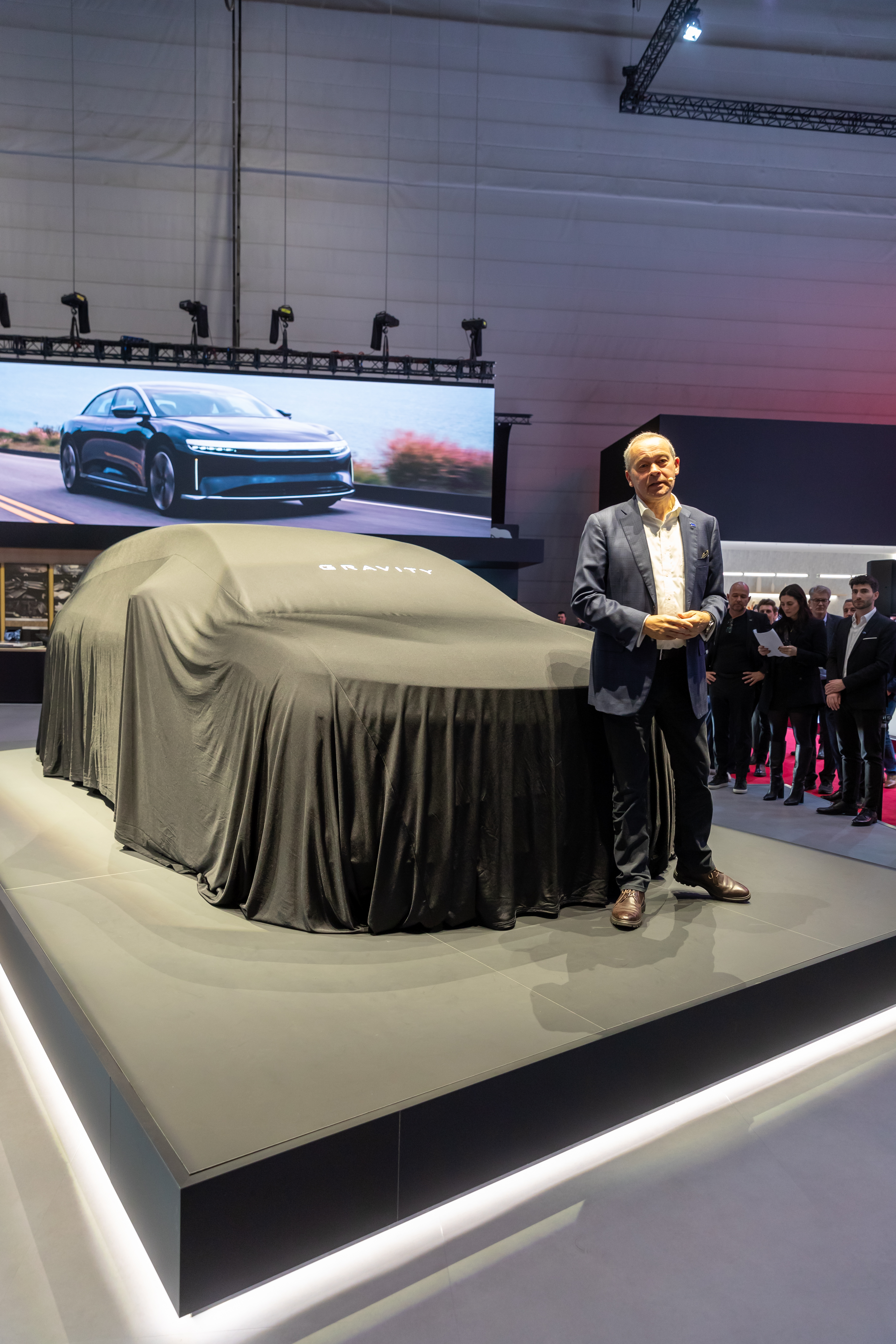
Lucid Gravity
"we did look at the R1S and we looked at the lucid gravity and technically we could afford the R1S or gravity, the lower trims, we could afford to buy one of those cars but that would have been an ridiculously high car payment."
Lucid Gravity is an electric SUV from Lucid. They’re comparing it to the Rivian R1S and explaining why the payment didn’t fit their budget.
Lucid Gravity is Lucid’s electric SUV offering. In this earnings-call discussion, it’s used as a comparison point for how high vehicle payments can be when fuel prices and household costs are already under pressure.

Mazda CX-9
"When I moved my, when I moved to my Tesla, one of the things that was a motivator for me is in my big Mazda CX-9, I was spending about $450 to $550 a month in gas so I decided that I wanted to pay off my car very fast"
The Mazda CX-9 is a family-sized SUV. The speaker mentions it to compare their old gas spending with what they pay after switching to an electric car.
The Mazda CX-9 is a three-row midsize SUV that’s typically powered by a gasoline engine. Here it’s used as the speaker’s prior vehicle to illustrate how high gas costs influenced their decision to move to an EV.
autonomy penetration rate
"adoption, you know, what type of autonomy penetration rate do you expect for your customer owned vehicles? Do you expect customers will prefer the monthly subscription or the one-time purchase"
It means how many people are actually using the car’s “autonomy” features. Higher penetration rate means more drivers are choosing cars with those features.
Autonomy penetration rate is the share of customers (or vehicles) that adopt an advanced driver-assistance/autonomy feature. In practice, it’s a way to measure how quickly self-driving capability is moving from optional tech into mainstream buying behavior.
monthly subscription
"owned vehicles? Do you expect customers will prefer the monthly subscription or the one-time purchase just any color here on your overall vision and customer penetration adoption"
Instead of paying once to get a feature, you pay every month. That can make it easier to try new software features as they’re added.
A monthly subscription model means customers pay recurring fees to access software features—often including autonomy or driver-assistance capabilities—rather than buying them once. This changes how automakers monetize features and how quickly customers can adopt new capability as it improves.
level two
"We've been on a journey of, you know, when we think about autonomy work, level two is, you know, where your eyes are still on the road but you're still responsible for driving the vehicle."
Level two is partial automation. The car can help drive, but you still have to watch the road and be ready to take over.
“Level two” refers to SAE driving automation levels where the car can assist with driving tasks, but the human driver must remain engaged and responsible. The speaker describes it as the eyes staying on the road while the system helps, which is typical of driver-assistance rather than full self-driving.
higher levels of autonomy
"That's like a small appetizer for what you can actually achieve when you get to higher levels of autonomy where you can take your eyes off the road and truly get your time back"
This means more advanced self-driving features than level two. The idea is that the car does more of the driving so the driver has less to do.
Higher levels of autonomy describe automation beyond basic driver-assistance—where the system can handle more of the driving task and the driver’s workload drops. The speaker emphasizes the practical benefit: being able to look away and “get your time back,” implying a shift toward more hands-off, eyes-off capability.
time back
"as people start to experience what it's like to truly have your time back, so take, you know, a 40 minute commute and the idea of getting those 40 minutes back in both directions"
It’s the idea that self-driving features make commuting less stressful and more relaxing. If it feels good in real life, people may start choosing cars based on it.
“Time back” is a customer-experience framing for autonomy: the value proposition is reducing the driver’s active attention and effort during commuting. The speaker connects this to purchase criteria—if people experience it (even indirectly), it becomes a “sticky” reason to buy.
autonomy as a critical purchase criteria
"where autonomy will be a very critical criteria where customers are willing to pay for it because they want their time back."
They’re saying self-driving features will become a major reason people buy a car. Instead of being optional, it could be something buyers actively pay for.
The speaker argues that as autonomy capability improves, it will become a key factor in how customers choose vehicles. That means autonomy shifts from being a nice-to-have feature to something buyers are willing to pay for because it directly affects daily life (like reclaiming time).
KPIs
"I wanted to come back on RoboTaxi. Are there any sort of KPIs that you're sort of tracking or that you need to hit for some of the milestones with Uber?"
KPIs are specific numbers a company watches to see if it’s hitting its goals. For RoboTaxi, they’re the kinds of metrics that show whether the service is working reliably and safely enough to meet milestones.
KPIs (Key Performance Indicators) are measurable targets a company tracks to judge progress toward goals. In the context of RoboTaxi, KPIs typically relate to safety, uptime, and service performance milestones needed for Uber’s autonomous ride-hailing operations.
autonomy package
"what's going on with the autonomy package that Rivian is putting out. And in this instance, I would imagine that's what the KPI he's talking about."
An autonomy package is the bundled set of hardware and software that enables automated driving features. It typically includes sensing, compute, and driving-control software, and it’s evaluated with deployment milestones and on-road proof points.
safety driver
"we'll be deploying vehicles in both San Francisco, Miami with a safety driver. So the vehicles will be running but with benefit of a safety driver in the vehicle with them."
A safety driver is a person in the car who watches what the automated system is doing. It’s used early on so a human can take over if something goes wrong.
A safety driver is a human onboard who monitors the vehicle while it runs in an automated mode. This is commonly used during early deployments to reduce risk while the system gains experience and proves readiness for more autonomous operation.
operate fully on their own
"ramping up to ultimately having the vehicles operate fully on their own as part of a service in 2028."
“Operate fully on their own” refers to reaching a higher level of automation where the vehicle can handle driving without human intervention. In the transcript, this is framed as a staged roadmap culminating in fully autonomous operation as part of a service.
deployed fleets
"you'll actually see them not only being tested, but you'll see them as part of some of these deployed fleets."
A deployed fleet is a set of cars that are actually out in the real world. It’s how companies test self-driving tech in everyday situations and collect results.
Deployed fleets are groups of vehicles that are actively operating in real-world conditions as part of a rollout. Using fleets helps teams gather real driving data and validate that the autonomy system works outside of controlled testing.
OEMs
"potentially license some tech to other OEMs. Just wondering, anything you can say about that?"
OEMs means original equipment manufacturers—companies that build vehicles. Licensing technology to other OEMs would mean Rivian’s autonomy tech could be used in vehicles made by those manufacturers.
domain-based network architecture
"the first of those is shifting away from a domain-based network architecture,"
This is about how a car’s computers are organized and how they talk to each other. The speaker is saying the industry may be moving away from one setup (“domain-based”) to another that better supports advanced tech.
A domain-based network architecture is a vehicle software/network design where functions are grouped into separate “domains” (like infotainment vs. driving). Shifting away from it suggests moving toward a different approach to how vehicle computers communicate, often to improve scalability for advanced features like autonomy.
ECUs
"where you have a very large number of supplier-sourced ECUs that are, you know, little, think of them as little islands of code on little small computers, where you might have, depending on the car, anywhere from 50 to 150 of those little ECUs"
ECUs are the car’s little computers that run different jobs. Think of them like separate control boxes that each handle a part of the car’s electronics.
ECUs (electronic control units) are dedicated computers in a car that control specific functions like power management, body electronics, or driving systems. In this segment, the speaker describes a design with many supplier-sourced ECUs—each acting like its own “island” of code.
zonal architecture
"shift to a much more centralized compute, where you have more of a zonal architecture. So essentially, think of it as a large consolidation of all those little computers into a single or a very small number of large computers"
Zonal architecture means the car’s electronics are grouped into sections (“zones”) that share computing resources. It’s meant to make software updates easier and more consistent across the car.
A zonal architecture is a vehicle computer layout where control is organized by “zones” (like front cabin, rear, or powertrain-related areas) rather than by many independent ECUs. The speaker contrasts this with the harder-to-update multi-ECU approach and argues zonal designs enable faster software updates and deeper integration.
autonomy realm
"[3136.0s] technology that we see opportunities to have licensing deals is in the autonomy realm. And [3142.2s] here it's in a similar way."
“Autonomy” means the car using sensors and computers to help drive itself. “Autonomy realm” is just the speaker talking about that self-driving technology area.
In automotive, “autonomy” refers to systems that can perceive the environment and drive with varying levels of human involvement. When someone says “autonomy realm,” they’re talking about licensing or deploying self-driving/driver-assistance technology rather than traditional vehicle hardware.
radar
"[3157.9s] around that along with our perception platform. So it's the cameras, radar, LiDAR that exist."
Radar uses radio signals to detect objects around the car. It’s especially useful for tracking things and can work well even when visibility isn’t great.
Radar uses radio waves to detect objects and estimate their distance and relative motion. In autonomy stacks, radar is valued for working well in bad weather and for tracking moving targets.
foundation model
"[3166.1s] And then very importantly, the large driving model, this foundation model is a neural map"
A foundation model is a big AI system trained broadly, then used for specific jobs. Here, it’s the main AI used for driving decisions.
A foundation model is a large, general-purpose AI model trained on broad data that can be adapted for specific tasks. In this autonomy context, it’s used as the core driving intelligence that can be deployed across different vehicle configurations.
neural map
"[3171.6s] that we've created that defines what driving or how to drive a vehicle."
A neural map is an AI-made “understanding” of the road and surroundings. It helps the car decide how to drive based on what it has learned.
A “neural map” is a learned representation of the driving environment created by AI, rather than a purely hand-authored map. The speaker says it “defines” how to drive, implying the model uses this internal map-like structure to plan behavior.
flexible architecture to deploy into different vehicle embodiments
"[3180.3s] I made it clear before is a much more flexible architecture to deploy into different vehicle [3185.7s] embodiments."
The speaker means the software is designed so it can work in more than one kind of vehicle. That makes it easier to roll out the same autonomy approach across different models.
This refers to designing autonomy software so the same core system can be adapted to different vehicle platforms and configurations. The benefit is faster scaling: deploying the driving model and compute stack across multiple vehicle types without rebuilding everything from scratch.

Volkswagen I
"architecture works and how it would benefit not only Rivian but other companies. Obviously, that's that partnership with Volkswagen. I did not know that the first deployment of this outside of Rivian was going to be in the ID1 in Europe. So that's cool. Can't wait for people to get their"
The Volkswagen ID. Buzz is an electric van made by Volkswagen. The podcast mentions it because it’s an example of electric vehicle technology being used outside of Rivian. It’s brought up in the context of a partnership and where the first deployments happen.
The Volkswagen ID. Buzz is an all-electric version of the classic Buzz-style van, built on Volkswagen’s EV architecture. In the podcast context, it’s used to illustrate how a technology approach can be deployed beyond Rivian, highlighting a partnership and the idea of shared platform or engineering learnings. That makes it relevant because it shows how EV architecture can scale across different brands and vehicles.
Tesla
"[3242.2s] You know, Tesla [3244.1s] announced it quite a few years ago."
The speaker brings up Tesla to say this “zonal architecture” idea isn’t brand-new. It’s something other major automakers have already been working on.
Tesla is mentioned as having announced zonal architecture earlier, implying Rivian’s approach is part of a broader industry trend. The takeaway is that multiple automakers are converging on similar vehicle software/hardware organization strategies.
trains of miles
"just recognizing the trains of miles that are driven today, the vast majority of those are driven in personally-owned vehicles. And so Robotaxi represents a portion of those..."
“Trains of miles” is a metaphor for the continuous stream of real-world driving that vehicles accumulate over time. For autonomy and fleet-based services, more “miles” generally means more opportunities to learn from real conditions and improve systems.
rideshare companies
"It is, I think, a really good idea for companies like Lucid and Ruby and to be partnering with companies, rideshare companies like Uber, right? ... by partnering with Uber or Lyft, in this case Uber again, Rivian doesn't have to have a massive fleet in, let's say, Phoenix and a massive fleet in San Francisco."
Rideshare companies are the services you use in an app to get a ride. The point of partnering is that they already handle a lot of the matching and operations.
Rideshare companies operate app-based transportation networks—matching riders to vehicles and managing demand across cities. Partnering with them can reduce the need for a new robotaxi operator to build its own fleet and logistics from scratch.
market concentration
"Uber has already built that name recognition. They've already built the platform and they already have a certain amount of market concentration in a wide variety of places."
Market concentration means a few companies dominate the market. If one app already has lots of riders and drivers, a new partner can benefit from that existing scale.
Market concentration describes how much of a market is controlled by a small number of companies. In ridesharing, higher concentration can mean more riders and drivers already exist on the platform, which can accelerate deployment and data collection for partners.
test fleet
"Rivian doesn't have to have a massive fleet in, let's say, Phoenix and a massive fleet in San Francisco. They can have a smaller test fleet and still get a decent amount of data while not breaking the bank..."
A test fleet is a small number of cars used to try things out and collect information. It helps companies learn how the service works without launching everywhere at once.
A test fleet is a smaller group of vehicles deployed to gather real-world data and validate operations before scaling up. In autonomous-vehicle discussions, it’s often used to collect driving data while limiting cost and operational risk.
lower volumes
"we'll see some of the complexity associated with lower volumes on the new R2 line."
It means they’re building fewer cars than they want to. When you make fewer cars, the factory costs are spread across fewer units, so each car can cost more.
“Lower volumes” means producing fewer vehicles than planned. In manufacturing, lower volume usually increases the cost per car because fixed overhead and ramp-up inefficiencies don’t scale down proportionally.
automotive gross profit
"And so as a result of those attributes, we do anticipate seeing an impact to our automotive gross profit over Q2 and Q3 before we start to see the overall benefits of the ramp..."
It’s basically how much money the company makes from selling cars after paying the direct costs to build and deliver them. “Automotive gross profit” means they’re talking about the car business, not everything else.
Gross profit is revenue minus the direct costs of producing and delivering the cars. When they say “automotive gross profit,” they mean the profitability of the vehicle business specifically, excluding other non-vehicle items.
unit economic profile
"...benefits of the ramp, not just on the R2's unit economic profile, but also importantly the fixed cost leverage..."
It means how much money (or cost) each car represents on its own. As the factory gets better at producing cars, each one tends to cost less and make more profit.
“Unit economic profile” refers to the profit or cost picture per individual vehicle. It typically improves when production becomes efficient and fixed costs are spread across more units.
fixed cost leverage
"...the fixed cost leverage that we'll see across the R1 program and EDB program overall."
Some costs stay the same even if you build more cars. When production increases, those same costs are spread across more vehicles, so each car effectively gets cheaper to produce.
Fixed costs are expenses that don’t change much with production volume (like factory overhead). “Fixed cost leverage” means that as production ramps up, those fixed costs get spread over more vehicles, improving unit economics.
Request an Explanation
Heard something you'd like explained? We'll add it to this episode.
Sign in to request explanations for terms you heard.
Want to learn more?
Browse our glossary for plain-English explanations of automotive terms, jargon, and concepts.
Help improve this episode
See something that's not quite right? Our annotations are AI-generated and can sometimes miss the mark. Click the flag icon on any annotation to suggest a correction.