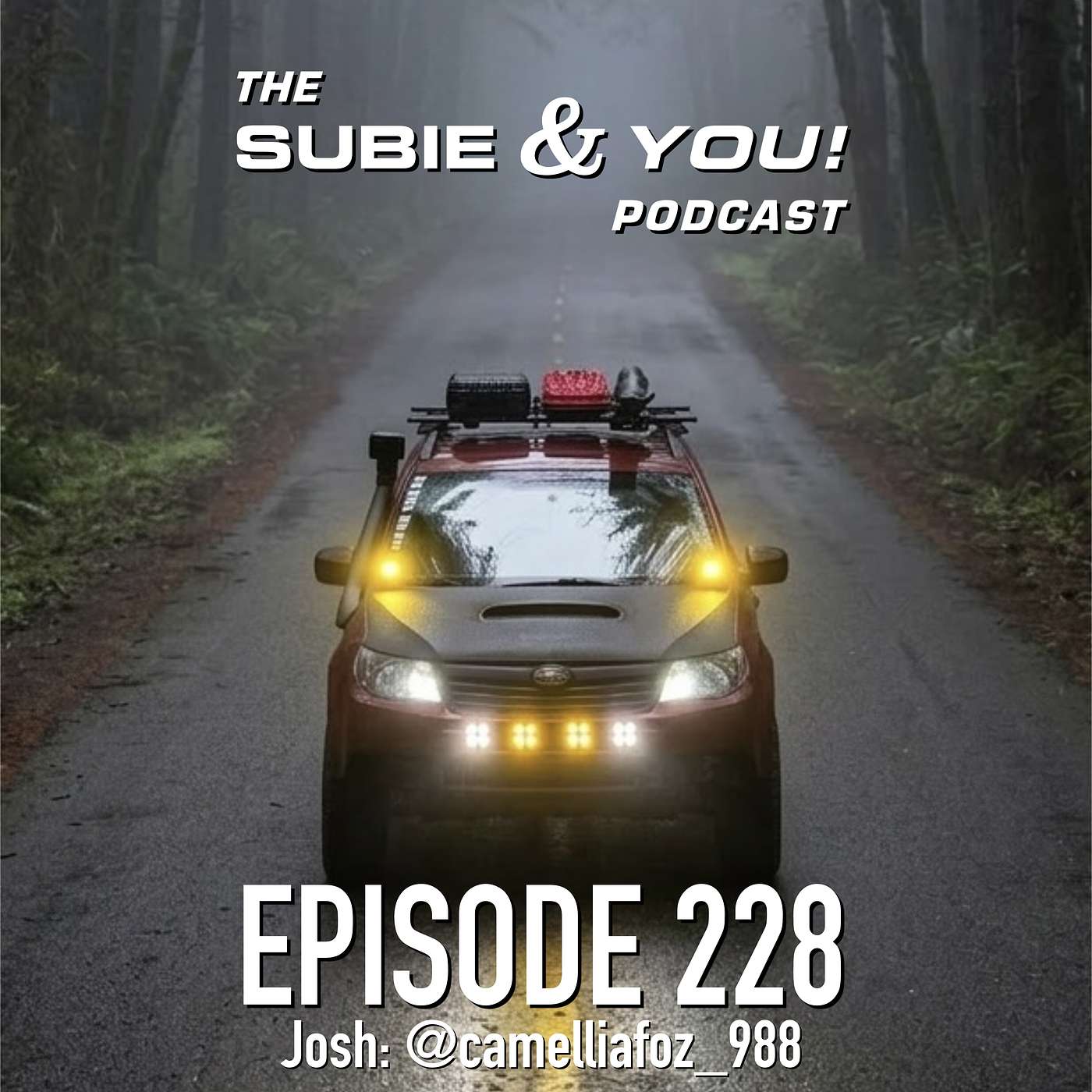
About this episode
Josh, Camellia Foz, shares why he chose his turbo Forester and the big goals behind it—like chasing “555,000 miles” and staging an Alaska launch. The conversation connects his Subaru build and overlanding plans to mental-health advocacy tied to “988,” including volunteering for the hotline and doing off-road welfare checks. Along the way, he details custom drive-shaft work, deep-snow recovery, DIY hood/bedliner repairs, and a custom roof rack—plus his coast-to-coast emergency repair job and the urgency that comes with it.
Josh joins us today to talk about his Subaru Forester, some fun adventures, getting out with the Sendy Subies crew, and the importance of mental health.
Links from the show, links to sponsors and discount partners, and ways to support the podcast:
Camellia Foz
https://www.instagram.com/camelliafoz_988/
- - - - - - - - - - - - - - - - - - - - - - - - - - -
Subie & YOU! Podcast Website!!
https://subieandyoupodcast.com/
Go check out the Subie & YOU! Podcast website!!
Subie & YOU! YouTube Channel
https://www.youtube.com/@subieyou
Please visit the channel and subscribe.
- - - - - - - - - - - - - - - - - - - - - - - - - - -
Sponsors of the Podcast:
Subaru Gear
Use code subieandyou2026 to get 20% off your purchase!
Get FREE shipping for orders over $50 after 20% discount!
Website:
Accentrek Designs
Instagram:
https://www.instagram.com/accentrek.designs/
Website:
https://www.accentrekdesigns.com/
Mele Design Firm
Use code subieandyou on most products store wide to get 10% off your purchase!
Website:
- - - - - - - - - - - - - - - - - - - - - - - - - - -
Other Brands Offering Discounts
Orbis Overlanding
10% discount off Orbis Overlanding and partnering car products
(excludes apparel)
Discount code: subieandyou
Website:

Subaru Forester
"but now we will get into this conversation with Josh and hear all about his forester and his adventures... ...why Subaru and why a forester so that's kind of a multi-part question..."
The Subaru Forester is a family-friendly SUV that’s built to be usable day to day. Josh chose it because he’s tall and wanted more room, and because he wanted Subaru’s all-wheel-drive.
The Subaru Forester is a compact SUV known for its practical interior space and Subaru’s all-wheel-drive system. In this episode, it’s the specific model Josh talks about choosing for legroom/headroom and for being able to keep the car long-term.
all-wheel drive
"I got as I got older I knew that I wanted something all-wheel drive after owning two Hondas and a couple of different Jeeps... I ended up getting myself my very first Subaru..."
All-wheel drive means power goes to all four wheels. That helps the car grip better, especially in rain, snow, or rough weather.
All-wheel drive (AWD) sends power to more than just the front or rear wheels, helping the car maintain traction when conditions are slippery. Josh says he wanted AWD after owning other vehicles, making it a key reason he chose Subaru.
turbocharger
"this car specifically my mom wanted this car but she didn't care if it was a turbo I had to get the turbo and my mom passed away in 2009... ..."
A turbocharger is a part that helps the engine make more power. It does this by pushing extra air into the engine so it can burn more fuel effectively.
A turbocharger is a device that uses exhaust gases to spin a turbine, forcing more air into the engine. More air generally allows more fuel to be burned efficiently, which can increase power compared with a non-turbo engine.
fling the cars off a mountain into a gorge
"they have a track they take the motor and the fuel and everything out and then they either hook it up to a like a tow line and they fling it off of the mountain into a gorge"
They set up cars like a stunt—take out the important stuff, then launch the car off a ramp into a big drop. It’s more about the stunt and spectacle than normal driving.
This describes a demolition-style stunt where cars are stripped and then launched off a ramp into a deep drop. The goal is usually spectacle and record attempts, since the car is essentially treated like a projectile rather than driven normally.
trophies
"the furthest kind of fly gets a better record you can get trophies for it whatnot"
They’re talking about awards people can win for the stunt, based on how well it’s done. So it’s not just for fun—there can be official results.
In this context, “trophies” refers to awards tied to the stunt’s measurable outcomes (like distance or height). It’s not a generic “prize” mention—here it’s connected to record-style attempts.
pinned down with a brick on the gas pedal
"some of them are running engines and they just have them pinned down with a brick on the gas pedal"
That phrase means the gas pedal is held all the way down. It’s basically like forcing the car to stay at full throttle.
“Pinned down with a brick on the gas pedal” is a vivid description of holding the accelerator fully depressed. In car terms, it implies the engine is kept at wide-open-throttle conditions, which can be used to maximize power or ensure consistent behavior during a stunt.

Grand Marquis
"or you know whatever you're both guys got at a junkyard yeah grand marquis something like that"
The Grand Marquis is a Ford sedan. They’re mentioning it as another kind of car that sometimes shows up for the stunt.
The Ford Grand Marquis is a full-size sedan known for comfort and traditional styling. In this episode, it’s name-dropped as another example of a car type that might end up being sent to the stunt event.

Chevy Astro
"sometimes they're like a Chevy Astro or you know whatever"
A Chevy Astro is a Chevrolet van. The host is just saying that sometimes even vans like that get used for the stunt.
The Chevrolet Astro is a compact/midsize van from Chevrolet’s lineup, often used as a generic “junkyard” example in stunt or demolition stories. Here it’s mentioned as one of the types of cars that get sent for the 4th of July launch.

Mercury Grand Marquis
"... whatever you're both guys got at a junkyard yeah grand marquis something like that but uh something that my mom ..."
The Mercury Grand Marquis is a large, older sedan built for comfort and space. It’s the kind of car people may find easily in used parts yards. The podcast mentions it as a car someone had or might be interested in.
The Mercury Grand Marquis is a full-size sedan known for a traditional, comfortable ride and roomy interior. It’s often mentioned in junkyard or project contexts because it’s a common older platform. In the podcast, it comes up as an example of a car someone might look for or work on, including a reference to what a mom had.
Subifest Texas
"I whenever you go to Subifest Texas we see some out in the parking lot"
Subifest Texas is a Subaru car show/event. The host is saying they see lots of older Subarus there.
This is a Subaru-focused car show/event mentioned as a place where the host sees older Subarus in parking lots. It functions as a location/scene marker for the episode’s Subaru community talk.
lifts
"you can buy roof racks for this you can buy lifts but the same lift for this car is also for a 2018 cross track"
A “lift” is an off-road upgrade that raises the car higher off the ground. It helps the tires clear obstacles and makes it easier to drive on rough terrain.
In off-road Subaru builds, “lifts” usually mean suspension lift kits that raise ride height. That creates more clearance for larger tires and helps with approach/departure angles when driving over obstacles.

Crosstrek Cross Track
"...but the same lift for this car is also for a 2018 cross track so it's like a lot of the suspension opponents ar..."
The Subaru Crosstrek is a small crossover SUV meant for normal driving, with options that help it handle rougher roads. The podcast is saying that a suspension lift they’re talking about can also fit a 2018 Crosstrek. So it’s relevant to what parts work on that model.
The Subaru Crosstrek (commonly spelled Crosstrek/Crosstrek in conversation) is a compact crossover built for everyday driving with available off-road-style capability. In the podcast, it’s mentioned because the same lift or suspension setup being discussed for another car also applies to a 2018 Crosstrek. That’s why it comes up in the context of suspension compatibility.
drive shafts
"I figured out how to make the drive shafts for him oh yeah nice um and all superiors now I'm incapable of of providing those"
Drive shafts are the parts that send power from the drivetrain to the wheels. If you change the suspension for off-roading, the angles can change—so custom drive shafts may be needed to make everything work correctly.
Drive shafts transfer torque from the transmission to the axles in a drivetrain, especially on AWD vehicles. When someone fabricates custom drive shafts, it’s typically to accommodate suspension lift geometry, altered driveline angles, or custom off-road components.
custom skid plate
"I've made custom skid plate for it I used uh I think it was the primitive racing design and I made a skid plate for it"
A skid plate is a protective metal plate under the car. It helps prevent damage when you hit rocks or drive over rough ground.
A skid plate is armor mounted under the vehicle to protect vulnerable components from impacts with rocks, logs, and ruts. Custom skid plates are often shaped to clear specific suspension, exhaust, or underbody hardware on a given build.
custom light bracket
"I made the custom light bracket on the front I've made the ditch mounts I've made a bed I've made custom skid plate for it"
A custom light bracket is a fabricated mounting solution for auxiliary off-road lights. It’s designed to position the lights for visibility while fitting the vehicle’s body structure and avoiding interference with other components.
ditch mounts
"I made the custom light bracket on the front I've made the ditch mounts I've made a bed I've made custom skid plate for it"
“Ditch mounts” are brackets used on off-road setups to hold gear near the front corners. The idea is to mount things in a spot that’s useful for driving and recovery.
“Ditch mounts” are off-road mounting points used to attach gear or recovery/lighting hardware near the front corners. The term is informal, but in practice it usually refers to brackets that let you carry or mount equipment where it won’t interfere with obstacles.
primitive racing design
"I used uh I think it was the primitive racing design and I made a skid plate for it"
They’re saying they used a skid-plate design from Primitive Racing. That kind of template can make it easier to build something that fits the car correctly.
“Primitive Racing” is referenced as the design source for the skid plate. In enthusiast fabrication, using an established design template helps ensure the plate fits and clears the underbody before you modify it for your exact setup.
ADF
"but I'm in talks with ADF on getting something a little bit more updated um this summer yeah that'd be good"
ADF is a company they’re talking to about getting a newer skid plate. The goal is usually a better-fitting, more capable protection setup for off-roading.
ADF is mentioned as a supplier the host is in talks with for an updated skid plate solution. For off-road builds, switching to a newer product often means better fitment, improved coverage, or updated materials/geometry.
bracket deletes
"okay I did do some bracket deletes and things to to make the rest of what I have going on in here more cohesive"
“Bracket deletes” means taking out brackets that are no longer needed. People do it to make the build cleaner and to make space for the parts they’re adding.
“Bracket deletes” means removing certain factory or previously installed brackets to clean up packaging and make room for other interior or exterior modifications. In fabrication builds, deletes are often done to reduce clutter, improve fitment, or allow new components to sit properly.
988
"if you're gonna ask about the 988 which I'm sure you will yeah it's the mental health crop or mental health crisis line"
“988” is the phone number to call for mental health crisis support in the U.S. The idea is that if someone is struggling, they can get help by calling that number.
“988” refers to the U.S. mental health crisis hotline number. It’s used to connect people in crisis to trained support, and the speaker describes volunteering and doing outreach tied to that number.
off-road welfare checks
"I volunteered for the hotline and done some off-road welfare checks as well so yeah that's kind of where the 988 comes from"
An “off-road welfare check” is an outreach or safety visit to verify someone’s well-being in a remote or difficult-to-reach area. In this context, it describes the speaker’s involvement in locating people who may be stranded or in trouble.
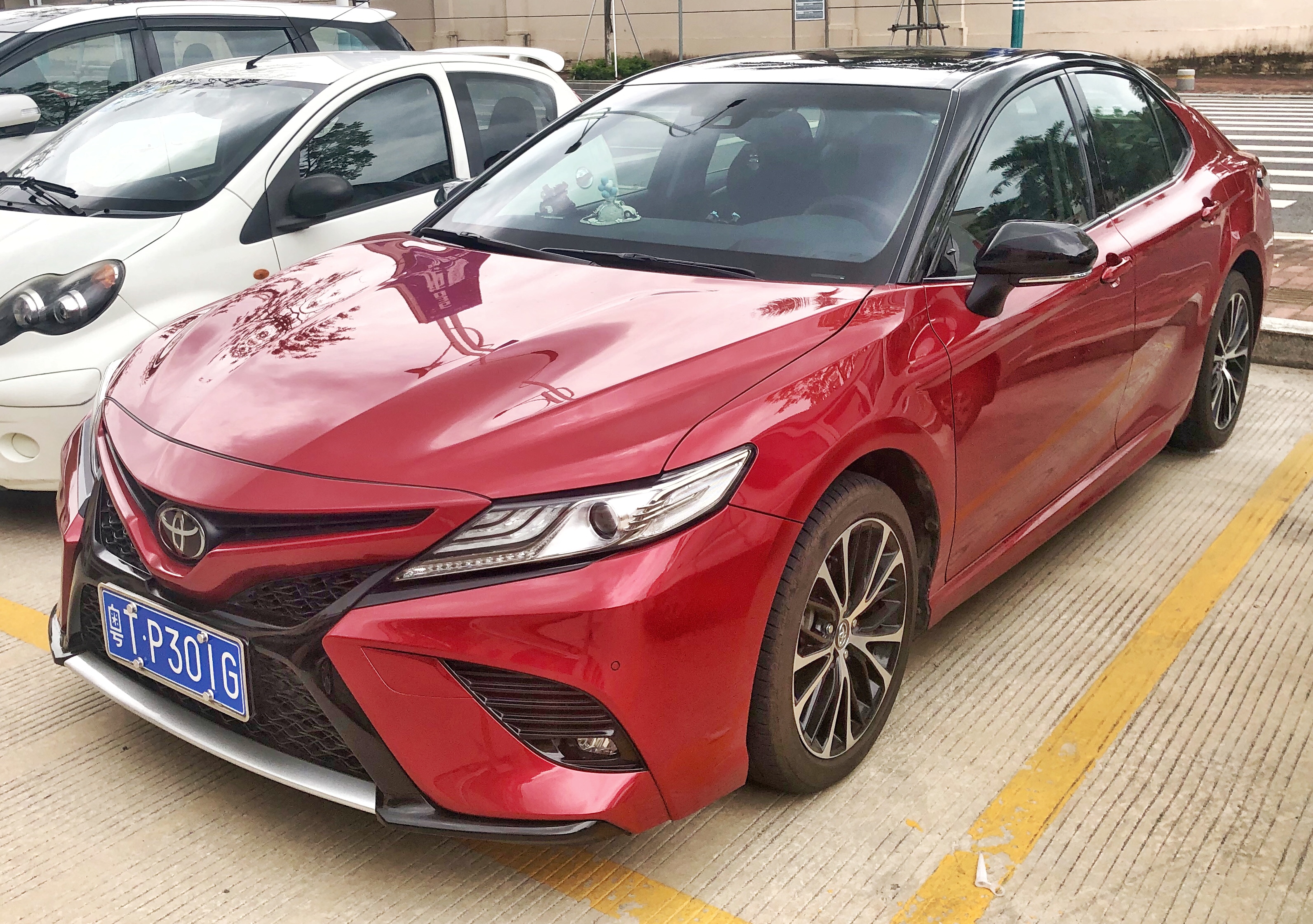
Toyota Camry
"...d I went up ended up uh finding a guy in a Toyota Camry just sitting by a fire he was just sitting by a f..."
The Toyota Camry is a regular everyday car, usually a sedan, meant for commuting and errands. It’s popular and easy to find, so it shows up in a lot of real-life situations. In the podcast, it’s just the car being talked about in that moment.
The Toyota Camry is a mainstream midsize sedan known for comfortable daily driving and strong practicality. It often comes up in everyday stories because it’s common, reliable, and easy to live with. In the podcast, it’s mentioned as the car someone was in while sitting by a fire.
coilovers
"but within three weeks I had this thing on coilovers with an exhaust and I was at the track every weekend"
Coilovers are suspension parts that let you adjust how high or low the car sits. People use them to improve handling and to lower the car for more control in corners.
Coilovers are adjustable suspension units that combine a coil spring and shock absorber. They’re commonly used to lower a car and fine-tune ride height and damping for better handling, especially for track driving.
exhaust
"but within three weeks I had this thing on coilovers with an exhaust and I was at the track every weekend"
The exhaust system carries gases out of the engine. Changing it can change the sound and how freely gases flow, which is why it’s common on performance builds.
An exhaust system routes engine gases out of the vehicle and can be changed to alter sound, flow, and sometimes performance. In performance builds, an upgraded exhaust is often paired with suspension and other track-focused changes.
lowered
"it it was lowered it was lowered for a little while um actually not well I say a little while is a little while because it was about six months"
“Lowered” means the car sits closer to the ground. That can help it handle better in turns, but it may ride rougher and be easier to damage on bumps.
When a car is “lowered,” its ride height is reduced, usually via suspension changes like coilovers. Lowering can improve cornering by reducing body roll and changing tire contact and suspension geometry, but it can also increase the chance of scraping and harshness.
carrier
"that's actually how I figured out how to build the drive shaft because I broke the drive shaft at a track or I broke the carrier"
The carrier is part of the support system that helps hold the drive shaft in the right place. If it fails, the drive shaft can wobble or get damaged.
In a drive-shaft setup, the “carrier” typically refers to the support bearing housing (often called a center support) that holds the drive shaft in position. If the carrier or its bearing fails, it can cause vibration and can contribute to drive-shaft damage.
ratchet strapped
"then I ratchet strapped the drive shaft in place and drove it to Seattle"
Ratchet straps are the heavy-duty straps you tighten with a ratchet. They’re used to keep the driveshaft from moving while transporting it.
Ratchet straps are tie-down straps with a ratcheting mechanism used to secure cargo. Here, they’re used to hold the driveshaft in place during transport.
slip yoke
"the transmission uh yoke the slip yoke is the same as a Nissan 350z oh that's interesting"
A slip yoke is a part of the driveshaft that can slide in and out. That lets the wheels move up and down without the driveshaft getting stretched or binding.
A slip yoke is the splined, sliding section of a driveshaft that allows the drivetrain to change length as the suspension moves. It helps keep the driveshaft connected while maintaining alignment and preventing binding.

Nissan 350Z
"the transmission uh yoke the slip yoke is the same as a Nissan 350z oh that's interesting"
The Nissan 350z is a popular sports car. The host is saying one driveshaft-related part on their car is the same as what you’d find on a 350z.
The Nissan 350z is a rear-wheel-drive sports coupe that’s commonly used as a parts reference because some drivetrain components are shared or compatible across certain applications. In this episode, the host points out that the slip yoke matches the 350z unit.
flange
"making designs for the the flange at the r 160 1 volt and 5 volt"
A flange is a connection surface with bolt holes. It’s how the driveshaft end mates to the other part so everything stays aligned and secure.
A flange is the bolted interface that connects two drivetrain components—here, the driveshaft to the mating end. The host is designing specific flange versions (including different voltages) to match fitment and strength requirements.
one-piece drive shaft
"I was able to make a one-piece drive shaft not that they weren't available they were just extraordinarily expensive"
A one-piece driveshaft is made from one main shaft instead of multiple pieces. Fewer connections can mean less looseness, but it still has to be the right size and balanced correctly.
A one-piece driveshaft is built as a single continuous shaft rather than multiple sections. That can reduce joints and potential play, but it still must be engineered for correct length, balance, and clearance.
carbon fiber
"they usually came in carbon fiber for drag applications and things like that"
Carbon fiber is a strong, lightweight material. The host is saying the expensive driveshafts they could buy were often made from carbon fiber.
Carbon fiber is a lightweight composite material often used in performance driveshafts to reduce mass and improve rotational response. It’s also expensive, which is why the host chose a steel alternative for robustness.

Honda Crvs
"...ot rods you know him and kudos and freaking Honda CRVs all the way up to submarines and helicopter tail ..."
The Honda CR-V is a small SUV, meaning it has more space and a higher driving position than a typical sedan. It’s built for everyday driving like commuting and carrying things. The podcast mentions it as one of the vehicles in the mix.
The Honda CR-V is a compact SUV designed for family-friendly comfort, cargo space, and easy day-to-day use. It’s frequently discussed because it’s a high-volume model with a reputation for being practical. In the podcast, it’s referenced in a list of vehicles as part of the conversation’s “all kinds of cars” theme.
power steering
"I was actually just at their house not too long ago hanging out and trying to get some diagnostics on a on a power steering a steering angle sensor problem that I'm having so I was able to go up there"
Power steering helps you steer with less effort. If something goes wrong, the steering can feel harder or weird, and it can make the car harder to control.
Power steering is the system that uses hydraulic or electric assist to make the steering wheel easier to turn. When it’s having issues, it can feel heavy, inconsistent, or may create drivability/safety problems.
steering angle sensor
"trying to get some diagnostics on a on a power steering a steering angle sensor problem that I'm having so I was able to go up there and hang out with them for a couple hours"
A steering angle sensor tells the car how turned the steering wheel is. If it’s faulty, the car’s computer may not understand what you’re doing, which can cause warning lights or handling issues.
A steering angle sensor measures how much and in what direction the steering wheel (and thus the front wheels) are turned. It feeds the car’s stability/traction systems and helps with diagnostics—if it’s wrong, the car may behave unpredictably or throw warning codes.
lowering it
"I wasn't sure how I was gonna mod it uh after lowering it and going through the whole driveshaft thing"
Lowering means making the car sit closer to the ground. It can look better and change how it drives, but it can also cause other parts to wear or need adjustment.
Lowering a car means reducing ride height, usually by changing suspension components. It can improve stance and handling feel, but it often affects driveline angles and can require additional work to keep everything aligned and reliable.
big tires
"but put big tires on it so it gets horrible gas mileage it makes a lot of noise but you know yeah"
Bigger tires can improve off-road traction and help with obstacle clearance, but they also change gearing and rolling resistance. That often leads to worse fuel economy and more road noise compared with stock tires. The speaker notes that their big tires made gas mileage horrible and increased noise.
rally cross
"I was a big fan of watching rallies and dirt rallies things like that rally cross so I kind of knew what you know I knew what the Subaru was capable of..."
Rallycross is a type of racing where cars drive on a short course that mixes surfaces like dirt and gravel. It’s not long rally stages on public roads—it’s more like a compact track with lots of action.
Rallycross is a motorsport that combines rally-style cars with short, mixed-surface tracks (often dirt and gravel) and frequent jumps/obstacles. It’s different from traditional rally stages because it’s typically run on a closed circuit with multiple heats. The speaker mentions it as part of what influenced their understanding of what a Subaru can do off-road.
overland format
"yeah I just never really thought I started an overland format like I never really thought that I would see it as this mountain goat that it is yeah so when you took it back to stock..."
“Overland” is a way of off-roading that’s more about traveling long distances on rough roads and trails. It’s usually about being prepared and able to handle obstacles, not just going fast.
An overland format is a style of off-roading focused on long-distance travel over rough terrain, usually with an emphasis on comfort and self-sufficiency rather than racing speed. It often involves practical modifications for traction, ground clearance, and durability. In this context, the speaker is saying they didn’t initially think of their Subaru build as overlanding.
cut the bumpers
"I cut the bumpers immediately... I realized that... pulling bumpers off... I've come out of trails with my bumpers in my trunk... so then I decided that it was probably a pretty good idea to cut them..."
Cutting the bumpers is an off-road trick to stop the front or rear from hitting the ground on rough trails. It can help the car go over obstacles without scraping or getting stuck.
Cutting bumpers is a common off-road modification to reduce the likelihood of scraping on rocks, ruts, and steep ledges. It can improve effective approach/departure angles and help the vehicle clear obstacles at low speeds. The speaker describes doing this after repeatedly tearing bumpers off while off-roading.
plunge
"I cut the bumpers immediately I just used the plunge so I multiple to do it and I realized that as though as I was kind of pimping the the limits..."
They’re describing a quick cutting method to trim the bumper right away. The goal is to remove material so the car can clear obstacles better.
“Plunge” here appears to refer to using a plunge-cut tool or technique to remove bumper material quickly. In off-road builds, this is often used when trimming plastic or sheet-metal to create clearance for steeper angles. The speaker is describing how they physically cut the bumpers immediately.
approach and departure angle
"I realized that as though as I was kind of pimping the the limits of approach and departure angle at a stock height on a stock size tire because I don't just just do fire service roads..."
These angles describe how well a car can go up a steep hill or down off a ledge without scraping the front or rear. If you cut the bumpers, the car can usually handle steeper obstacles before it hits.
Approach angle is how steep a surface a vehicle can climb before the front bumper or underbody hits. Departure angle is how steep it can descend or leave a bump before the rear bumper or underbody scrapes. Cutting bumpers can increase both angles by reducing the lowest-hanging parts.
viper cuts
"yeah I started seeing other people like the cross-stretch with the viper cuts which I fell in love with yeah so I kind of wanted to make my own version of that..."
“Viper cuts” is a nickname for a particular bumper-trimming shape people use on off-road cars. It’s meant to give more clearance, and the speaker liked the style enough to copy it.
“Viper cuts” is an off-road bumper-trimming style name used in the community, typically referring to a specific shape/contour cut that improves clearance while keeping the bumper’s structure. The speaker says they fell in love with the look/idea and wanted to make their own version. This is more of a niche builder term than a standardized engineering measurement.
snorkel
"nobody not oh I can't say nobody but not a whole lot of people put snorkels on these cars especially the foresters they don't make one for this car… you're gonna make yourself a snorkel or you're gonna put a snorkel on your car do not cut too low"
A snorkel is an intake tube that brings air from higher up on the car. It helps the engine keep breathing if you drive through water.
A snorkel is an intake extension that raises where the engine’s air is drawn from, typically higher up on the vehicle. It’s used to help prevent water ingestion during deep water crossings and is a common off-road modification.

Suzuki Grand Vitara
"so this is actually just this is a zuki grand vatara snorkel that kind of fits yeah it's kind of had to make it work huh"
The Suzuki Grand Vitara is an SUV model. In this story, the snorkel is originally made for that vehicle, but the host adapted it to fit their Subaru.
The Suzuki Grand Vitara is a compact SUV with off-road-oriented heritage, and it’s being used here as the donor source for a snorkel. The host is describing fitting a Grand Vitara snorkel onto their Subaru Forester because a Forester-specific snorkel wasn’t available.
angle grinder
"it ended up just taking my angle grinder and cutting a slot up and just square out and bolting this thing to the car"
An angle grinder is a handheld power tool with a rotating abrasive disc, used for cutting and shaping metal. Here it’s mentioned as the tool used to cut a slot after the snorkel hole was drilled too low.
pinstripes
"and that's okay yeah it's definitely seen as it's fair share of P&W pinstripes we call them"
“Pinstripes” are small, thin scratches or marks on the paint. They’re usually just cosmetic, and sometimes you can improve them with detailing or polishing.
In car talk, “pinstripes” usually refers to thin, superficial scratches or scuffs along the paint—often from contact with another vehicle or objects. They’re typically cosmetic and may be removable with polishing or paint correction, depending on how deep they are.
donuts
"I have a little ding on the passenger side door and it's from trying to do some donuts since in gravel and a piece flew up and hit the door"
“Donuts” are when a car spins around in place in a circle. It can be fun, but it can also throw up rocks or debris and cause dents or paint chips.
“Donuts” are a driving maneuver where the car spins in a tight circle, usually by breaking traction at the tires. It’s a common way people have fun in a parking lot or open area, but it often leads to body damage from debris and impacts.
fog light
"then there's a dent in the plastic like the hard plastic that's underneath my driver's side fog light"
A fog light is an extra light on the front of the car meant to help you see in bad weather. Since it sits low, it can get damaged more easily.
A fog light is an auxiliary front lamp designed to improve visibility in bad weather like fog, rain, or mist. It’s usually mounted lower on the bumper, so it can be vulnerable to impacts when driving off-road or hitting curbs/embankments.
door dings
"I have like two little door dings on my driver's side door from somebody that parked close and just didn't care"
Door dings are those small dents or scuffs you get when someone bumps your car door in a parking lot. They’re usually not mechanical, but they can be annoying and sometimes need repainting.
Door dings are small dents or scratches caused when another vehicle’s door hits yours, typically in tight parking spaces. They’re usually cosmetic, but they can still require paint correction or panel work if the damage reaches the clear coat or metal.
hail damage
"while I was out having fun it doesn't bother me but that I even have hail damage on my car like on the hood and then on the like a pillar going up on the passenger side"
Hail damage is when hailstones hit your car and leave dents (and sometimes chips in the paint). It can be hard to avoid if you’re caught in a storm.
Hail damage happens when ice pellets strike the vehicle’s body panels, often causing dents and sometimes paint damage. It’s especially common in severe storm regions and can affect large areas like the hood and roof pillars.
rear quarter
"post-wraplander vinyl and it's a perfectly good cut in the vinyl and a nice straight ding in my rear quarter on the driver's side"
The “rear quarter” is the car’s back-side panel near the rear wheel. If it gets dented, it can be harder to fix so it looks straight again.
The “rear quarter” is the body panel area over the rear wheel and extending toward the back of the car. Dents there often involve door/quarter panel alignment and can be tricky to repair cleanly.
vinyl
"post-wraplander vinyl and it's a perfectly good cut in the vinyl and a nice straight ding in my rear quarter"
“Vinyl” usually means a wrap film applied to the car. It can protect the paint, but it can still get cut or damaged if the car is hit.
In car customization, “vinyl” commonly refers to wrap film used to change color or protect paint. Here it’s mentioned in the context of a cut in the vinyl and damage to the underlying body.
quick air downs
"I've got these old things we'll let the air out of the tire let me just do that oh I never even thought about that I keep my quick air downs right with me in my driver's side door pocket"
“Quick air downs” means quickly letting air out of your tires. People do it to change how the tire grips and rides, especially on rough ground.
“Quick air downs” refers to a fast way to lower tire pressure, typically using an air tool/deflator setup. Lowering pressure can improve ride comfort and traction on certain surfaces, but it must be done carefully and reinflated afterward.
hood paint
"it's become the most useful as well visually I would think is my hood paint yeah and then there's a little bit of a story behind that because when I got this car"
“Hood paint” is the paint on the front hood. They’re saying they repainted it (or had it repainted) and it matters visually and because of past damage.
“Hood paint” refers to the finish on the car’s hood, which can be a visible styling mod and also a repair area after body damage. In this segment, it’s tied to a prior accident and a repaint that wasn’t done well.
rear-ended
"because when I got this car I did have a claim on it it got uh rear ended and pushed into another car oh and the paint was done horribly"
“Rear-ended” means someone hit the back of the car. That kind of crash can damage the body and may require repainting or other repairs.
“Rear-ended” describes a collision where another vehicle hits the back of the car. It often leads to structural and alignment issues and can require body repairs and repainting.
paint correction
"I decided I wanted to try my go at paint correction not being a professional at all and I sanded right through to the primer like immediately..."
Paint correction is how people fix scuffs and swirl marks in a car’s paint. The goal is to make the paint look smooth and shiny again.
Paint correction is the process of improving a car’s paint finish by removing defects like scratches, swirl marks, and dullness. It’s usually done with sanding and/or polishing so the surface becomes smoother and more reflective.
primer
"I sanded right through to the primer like immediately... it went straight to primer and I drove it like that for a while..."
Primer is the layer under the visible paint. If you sand down to primer, you typically have to repaint so the top color can properly cover it.
Primer is the base coating applied to bare metal or to existing paint before the final color coats. It helps paint adhere properly and provides corrosion protection, so sanding through to primer usually means the finish needs to be refinished.
wet sanding
"whatever I was just trying to wet sand the hood and it went straight to primer..."
Wet sanding means sanding with water to help smooth out the surface. It can fix scratches, but if you sand too aggressively you can go through the paint layers.
Wet sanding is sanding with water (or a lubricant) to keep the sandpaper from clogging and to control how material is removed. In bodywork, it’s often used to level out damage before polishing, but using the wrong grit or technique can cut through clearcoat or even reach primer.
bed liner
"you just hook it up to your air compressor and it’s like a like a professional paint gun but it’s it’s bed liner..."
A bed liner is a protective coating for a truck bed. It helps prevent damage from hauling things around.
A bed liner is a protective coating applied to a truck bed to guard against dents, scratches, and abrasion from cargo. Many bed liners are spray-on or roll-on products that create a tougher surface than bare paint.
Line-X
"it’s like a like a professional paint gun but it’s it’s bed liner... he goes dude check out the bed of my truck and it was it was like line ex it was perfect and he did it in his driveway so I figured..."
Line-X is a brand of tough spray-on coating used to protect truck areas from scratches and damage. It can also be used on other parts if you want a rugged, durable finish.
Line-X is a brand of spray-on protective bedliner coating. It’s commonly used on truck beds, but people also use it as a durable, textured coating on other exterior surfaces because it resists chips and abrasion.
15 foot rule
"it’s been almost a year now so I don’t think it’s going to yeah no it means it looks good though it kind of like the 15 foot rule yeah it fixes the issue..."
The “15 foot rule” is the idea that small paint flaws look much better when you’re farther away. Up close you’ll see them, but from normal distance they’re less noticeable.
The “15 foot rule” is a common bodywork/paint joke meaning that minor imperfections are hard to notice from about 15 feet away. It’s often used to justify small flaws that look obvious up close but less noticeable at normal viewing distance.
rocker panel
"yeah I think I want to do my I want to do my rocker panel on my on my truck like go for it..."
The rocker panel is the lower side part of the car’s body. It’s easy to get scratched there, so some people add protection.
A rocker panel is the body panel along the lower sides of a car, between the front and rear doors (or between wheel openings). It’s a common spot for scuffs and damage, so people sometimes protect it with coatings or wraps.
camp mode
"so once you open up the back and it's a camp mode it takes a twin excel bed"
“Camp mode” just means the car is set up for camping instead of driving. In this case, it’s when the seats/bed area are arranged so you can sleep and hang out.
“Camp mode” is a custom operating state in a camper-style car build where interior components are configured for sleeping and living. Here, it refers to the sequence where the rear opens and the bed setup deploys so the car becomes a full camping space.
twin XL bed
"once you open up the back and it's a camp mode it takes a twin excel bed so do you so you lay the the front seats down and then the mattress goes over on top of the seats"
A “Twin XL” is a mattress size that’s basically a twin bed, but longer. They’re saying their car setup is built around that mattress so it can turn into a real sleeping space for camping.
A “Twin XL” mattress is a standardized bed size that’s longer than a regular twin. The host is describing a camping setup where the rear bed platform uses a Twin XL mattress so the car interior can convert into a full sleeping area.
bed platform
"no no there's a bed platform built back there oh okay gotcha and it's all on different hinges I can still access the bottom where the spare tire used to be that's extra storage now"
A “bed platform” is a custom insert that turns the car’s interior into a bed. In this case, it’s hinged so it can fold out for sleeping, but you can still reach storage underneath.
A “bed platform” in a car-camping build is a custom structure that spans the interior after seats are folded or removed. Here, it’s built on hinges and designed to create a flat sleeping surface while still allowing access to storage areas like where a spare tire used to be.
hinges
"oh okay gotcha and it's all on different hinges I can still access the bottom where the spare tire used to be that's extra storage now"
Hinges are the metal joints that let parts swing open and closed. Here, they’re what let the built-in bed fold out for camping and fold back for normal driving.
Hinges are the pivot hardware that lets a built-in car bed platform fold and move between driving and camping positions. In this build, the hinges enable the platform to deploy into a flat sleeping setup while maintaining access to under-platform storage.
spare tire
"and it's all on different hinges I can still access the bottom where the spare tire used to be that's extra storage now"
The spare tire is the backup tire you keep in case of a flat. They’re saying their bed build still lets them reach that area, and they use it for extra storage.
The spare tire is the vehicle’s backup wheel/tire stored for emergencies. In this car-camping conversion, the host notes they can still access the area where the spare tire used to be, repurposing it as additional storage under the bed platform.
drawer slides
"I have a nice big table on heavy weight drawer slides so I can you know make my coffee in the morning when I'm out camping"
Drawer slides are the rails that help a drawer open and close smoothly. They’re using heavy-duty ones so the drawer/table setup can handle real use like cooking while camping.
“Drawer slides” are the mechanical rails that let a drawer glide smoothly in and out. The host mentions heavy-duty drawer slides for a table/storage drawer, emphasizing that the hardware is strong enough to support cooking and gear while the car is in motion or parked.
sleep mode
"yeah there is a full bed wind deployed into sleep mode from steering wheel all the way to hatch and I'm almost 64"
“Sleep mode” is when the car’s camping setup is fully deployed for bedtime. They’re describing how their built-in bed goes from stowed to ready-to-sleep.
“Sleep mode” is the end-state of a car-camping conversion where the bed is fully deployed and positioned for sleeping. The host describes a system that deploys from the steering wheel area all the way to the hatch, creating a continuous sleeping surface.
rooftop tent
"it was pretty rough yeah that was like it's for my rooftop tent yeah I saw that you had one"
A rooftop tent is a camping tent that sits on the roof of your car. When you arrive, you open it up so you can sleep up there instead of on the ground.
A rooftop tent is a tent mounted on top of a vehicle, usually on crossbars or a roof rack. It’s designed to deploy quickly and keep you off the ground, which can be useful in rough or wooded camping areas.
aerodynamics
"I ran it full time and I think that was my mistake I mean it's got the aerodynamics of a brick"
Aerodynamics is how air moves around your car. Big add-ons like a rooftop tent can make the car push through more air, which can hurt efficiency.
Aerodynamics is how air flows around a vehicle and add-ons, affecting drag and fuel efficiency. A rooftop tent can increase drag because it adds a large, irregular shape to the airflow.
off-roading
"where I like to go off-roading is like places that most people don't go uh really tight paths lots of trees lots of brush"
Off-roading means driving on rough or unpaved paths instead of normal roads. It often involves tight spots and obstacles, so gear like a rooftop tent can get caught.
Off-roading refers to driving on unpaved or rough terrain where traction and clearance matter more than on-road comfort. In this segment, the tight, brushy trail environment is why the rooftop tent kept getting snagged and damaged.
roof rack
"it takes up half the roof right yeah it takes up half the roof Brittany the cross trek has the same tent that I had"
A roof rack is the hardware on the top of a car that you can attach things to. A rooftop tent typically mounts to the rack so it stays fixed while you drive.
A roof rack is the mounting system on top of a vehicle (often crossbars) used to carry accessories like rooftop tents. The rack provides the structural attachment points that keep the tent secured while driving.
Subaru Crosstrek
"Brittany the cross trek has the same tent that I had okay and it takes up half and just folds over one side or the other depending on which way you have it on your car"
The Subaru Crosstrek is a small SUV that people often use for outdoor trips. Here it’s brought up because it can use a rooftop tent setup similar to the one being discussed.
The Subaru Crosstrek is a compact crossover known for fitting into outdoor-focused lifestyles, including camping setups like rooftop tents. In this segment, it’s mentioned because it can carry a similar half-size rooftop tent design that folds to one side.
axle
"uh Milton broke an axle but there's no surprise he does that every time he turns his part to the right"
An axle is the part that helps drive the wheels. If the wheels are stuck and the car keeps trying to move, that force can stress and even break the axle.
An axle is the shaft that transmits power from the drivetrain to the wheels. In deep snow or mud, repeated torque and wheel slip can put extreme stress on the axle and related driveline parts, making breakage more likely.
no cell service
"I waited at the bottom and eventually and no communication or no communication no cell service my radio did send voice to their radios but I couldn't hear them back"
“No cell service” means your phone can’t connect to the network. In remote places, that’s why people often use radios to communicate.
“No cell service” means there’s no reliable cellular network coverage. In remote off-road areas, that matters because you may not be able to call for help, so you rely on radios or other communication methods.
plasma cutting table
"I have a welder and a a fabric or a laser table uh to a plasma cutting table uh to a plasma cutting table"
A plasma cutting table is a machine that cuts metal using a super-hot electrical jet. It helps you cut parts accurately based on a computer design.
A plasma cutting table uses a high-temperature plasma arc to cut metal sheets into precise shapes. It’s popular for fabrication because it can produce clean, repeatable cuts from a digital design.
G-code
"I can run gcode and just send my computer to cut it and call it a day there you go"
G-code is the computer instructions that tell a cutting machine exactly where to cut. It’s like a recipe the machine follows.
G-code is the standard computer language used to control CNC machines and cutting tools. When the speaker says they can “run gcode,” they mean the computer sends the cutting instructions directly to the machine.
sealant
"but that was user error because I didn't I was told to use a lot of sealant and I thought I used a lot of sealant but apparently my idea of a lot of sealant isn't a lot of sealant"
Sealant is a waterproof glue used to seal cracks and holes. With a roof rack, using too little can let rain water leak into the car.
Sealant is a waterproofing material used to fill gaps and prevent water intrusion at joints and mounting points. For roof racks, proper sealant application is critical because small gaps can let rainwater travel inside the cabin.
Subaru Flatfest in 2022
"when I installed it before uh Subaru Flatfest in 2022 because I knew that I was going to be the only one there with one of his racks"
They mention a Subaru event in 2022 where they showed up with the roof rack. It explains why they installed it ahead of time.
This segment references Subaru Flatfest in 2022 as the event where the speaker planned to be the only attendee with that specific roof rack. It’s used as context for why they installed it and how it served as promotion.
A pillar
"on my way back there was a huge storm and I was driving and I felt something dripping on my leg and I look over and there's water dripping from the A pillar"
The A-pillar is the main support post at the front of the car, near the windshield. If water is coming down from there, it usually means something above it isn’t sealed well.
The A-pillar is the front vertical support of a car’s body, located between the windshield and the front door. Water leaking from the A-pillar area often points to sealant, mounting, or weatherproofing issues around roof or windshield-related components.
headliner
"and I looked over on the passenger side and that like the headliner was wet you know right with right there where like the fabric meets the plastic"
The headliner is the fabric-covered ceiling inside the car. If it gets wet, water is getting in from the outside somewhere above it.
The headliner is the interior ceiling panel of the car, typically made of fabric or foam-backed material. If the headliner gets wet, it usually indicates a leak entering from above—often through roof penetrations, seals, or trim seams.
six-speed manual
"he has a pretty cool cross track it's a 23 manual six speed oh yeah mine's a six speed too I love it"
A six-speed manual means you shift gears yourself with a clutch. It can help the engine stay in the “right” zone while you drive.
A six-speed manual is a gearbox where you select gears yourself using a clutch pedal and a shift lever. Compared with fewer gears, a six-speed can keep the engine in a better operating range more often, which can improve drivability and efficiency.
off-road and overland community
"that's what's really nice too about especially the off-road and overland community is there just a lot of people are very similar in the fact that like they just want to cheer other people on and help people"
This is a group of people who like driving on dirt trails and going on trips with gear. They often help each other out and share advice so everyone has a good time.
The off-road and overland community is a culture of people who drive vehicles on unpaved trails and plan longer, self-sufficient trips. Overland usually implies carrying gear and traveling farther than a quick trail run, often emphasizing preparedness and mutual support.
gravel roads
"we like to go out on the little higher speed trips kind of slide them around and have a good time on some gravel roads and then Danielle and I are much more whimsical"
Gravel roads are loose-surface roads that change how a vehicle grips compared with pavement. On gravel, traction is less predictable, so drivers often focus on smooth inputs and suspension setup to keep the car stable.
slide them around
"we like to go out on the little higher speed trips kind of slide them around and have a good time on some gravel roads"
It means the car is moving in a way where the tires aren’t fully gripping, so it kind of “slides” through a turn. On gravel, that can happen more easily, so it takes skill to keep it under control.
“Slide them around” describes intentionally letting the car lose some traction so the tires break loose and the vehicle rotates or drifts through a turn. On loose surfaces like gravel, this can be easier to do but still requires careful throttle and steering control to avoid losing the car.
Baja designs
"but by the way I'm kind of mad at Baja designs for coming out with the squadron too just as I was happy with my lighting setup"
Baja Designs makes aftermarket lights for off-road and enthusiast cars. The hosts are talking about which brand’s lights look best and fit their setup.
Baja Designs is an aftermarket lighting brand known for off-road-focused headlights, light bars, and auxiliary lamps. In this segment, they’re being compared against other lighting options for a Subaru build.
Diode dynamics
"I might just have to go with that discount code for uh diodynamics because I love Baja designs"
Diode Dynamics is another company that sells upgraded car lights. The speaker is considering them because of a deal, even though they like Baja Designs.
Diode Dynamics is an aftermarket automotive lighting brand, often associated with LED auxiliary lights and lighting upgrades. Here, it’s mentioned as an alternative purchase path via a discount code.
two-wheel drive
"and then a jeep gets stuck because he's in two-wheel drive and then you go back up and pull out the jeep"
Two-wheel drive powers only two tires. On slippery ground, that can make it easier to get stuck compared with a car that drives all four wheels.
Two-wheel drive (2WD) powers only two wheels, which can reduce traction compared with AWD on loose or uneven surfaces. The segment contrasts a Jeep getting stuck in 2WD while the AWD vehicle can pull through and recover it.
drifting
"that you can go and just do donuts and do some drifting and stuff like that"
Drifting is when you intentionally make the car slide sideways while still steering it. It usually needs a slippery surface so the tires can lose grip.
Drifting is a driving technique where the car intentionally over-rotates so the tires slide while the driver maintains control and direction. The speaker describes wanting a slippery muddy surface to practice sliding maneuvers like donuts and drifting.
driving through ruts
"I go it's got ruts in it and you know it's uneven it's bumpy and you can't really do that but"
Ruts are tire grooves in the ground. When you drive through them, the car can get bounced around and steering can feel less predictable.
Ruts are grooves in mud or dirt left by tires, which can force the vehicle to follow a track and reduce steering control. The speaker mentions uneven, bumpy conditions and that it’s hard to “do that,” implying ruts make traction and control more challenging.
fire extinguisher
"well I usually keep a pistol but that comes out of my car when I leave it fire extinguishers water uh sometimes fuel depending on where I'm going yeah I always keep a jump pack and an air compressor ... fire extinguishers are always great because I've been able to put out small like roadside fires during the summer before they became something too much"
A fire extinguisher is a safety device for putting out small fires before they spread. The speaker emphasizes carrying them in multiple cars and describes using one to put out roadside fires, framing it as a practical preparedness item.
jump pack
"I always keep a jump pack and an air compressor so I always have air for my tire and a jump pack in case the battery decides to to go out"
A jump pack is a portable battery used to start a car with a dead or weak 12V battery. The speaker keeps one in their Subaru Forester so they can recover from a battery failure without waiting for roadside assistance.
air compressor
"I always keep a jump pack and an air compressor so I always have air for my tire and a jump pack in case the battery decides to to go out"
An air compressor is used to inflate tires by pumping air to the proper pressure. The speaker mentions using it to keep air for their tires, which helps with roadside flats and maintaining correct tire pressure.
Subi wave
"there's a few [4760.8s] but uh uh they're not off-roader Subaru's yeah the lower lowered Subaru guys tend to not do the [4768.7s] subi wave back and bad taste in your mouth I actually had one a guy driving an STI I gave a [4776.2s] subi wave to and he gave it back"
A “Subi wave” is a friendly wave Subaru drivers do to each other. In this story, it’s also a way to see whether other people notice the car as a Subaru (especially when it’s modified).
“Subi wave” is a community nickname for the hand-wave greeting between Subaru drivers. It’s not an official feature of the car—more of an enthusiast culture thing—and the host uses it to talk about how other drivers recognize (or don’t recognize) their modified Subaru.

Porsche Cayman
"... get like uh just the other day I had this lifted Cayman Porsche Cayman fly by me and then slow down and h..."
The Porsche Cayman is a sports car made for fast, fun driving. It’s designed to handle well, and it’s usually a low, sporty-looking car. In the podcast, someone describes seeing one drive by.
The Porsche Cayman is a mid-engine sports car focused on handling and driver engagement. It’s significant because it delivers performance in a compact, track-capable package. The podcast mentions a lifted Cayman flying by and then slowing down, highlighting how noticeable and distinctive it is.
lifted
"usually go it's just a lifted mom car yeah and then I fire it up and it sounds like a WRX"
“Lifted” means the car has been raised from the factory ride height, usually with suspension changes, to improve ground clearance. In this segment, the host uses it to describe both a lifted Cayman and their own Subaru-like setup, tying it to an off-road or rugged look.
blow off valve
"because it makes me just giddy every single time that I let go of the throttle because I have a little blow off valve ... Darth Vader breathing out"
A blow-off valve (BOV) is a valve used on turbo cars to vent pressurized air when the throttle closes. That sudden release creates the characteristic “pssh” sound and can also help protect the turbo/charge system during rapid throttle lift.

Subaru SVX
"want something older like an 86 like a like an 86 XT Subaru XT was really cool yeah I like the SVX's but they're really hard to come by I really want to mess around and make a brat project or a Baja project depending on what's in the budget and what's in a good uh good location been toying"
The Subaru SVX is an older Subaru coupe, meaning it’s a two-door car with a more unique style. People like it because it’s different and not very common. The podcast says it’s hard to find, but they’re interested in using one as a project.
The Subaru SVX is an older, more unusual Subaru grand-touring coupe with a distinctive look and a focus on comfort. It’s significant because it’s a rare model, so it tends to attract collectors and project-car fans. The podcast mentions liking the SVX but notes they’re hard to find, in the context of wanting an older Subaru project.
Request an Explanation
Heard something you'd like explained? We'll add it to this episode.
Sign in to request explanations for terms you heard.
Want to learn more?
Browse our glossary for plain-English explanations of automotive terms, jargon, and concepts.
Help improve this episode
See something that's not quite right? Our annotations are AI-generated and can sometimes miss the mark. Click the flag icon on any annotation to suggest a correction.
1 community members have helped improve this episode.