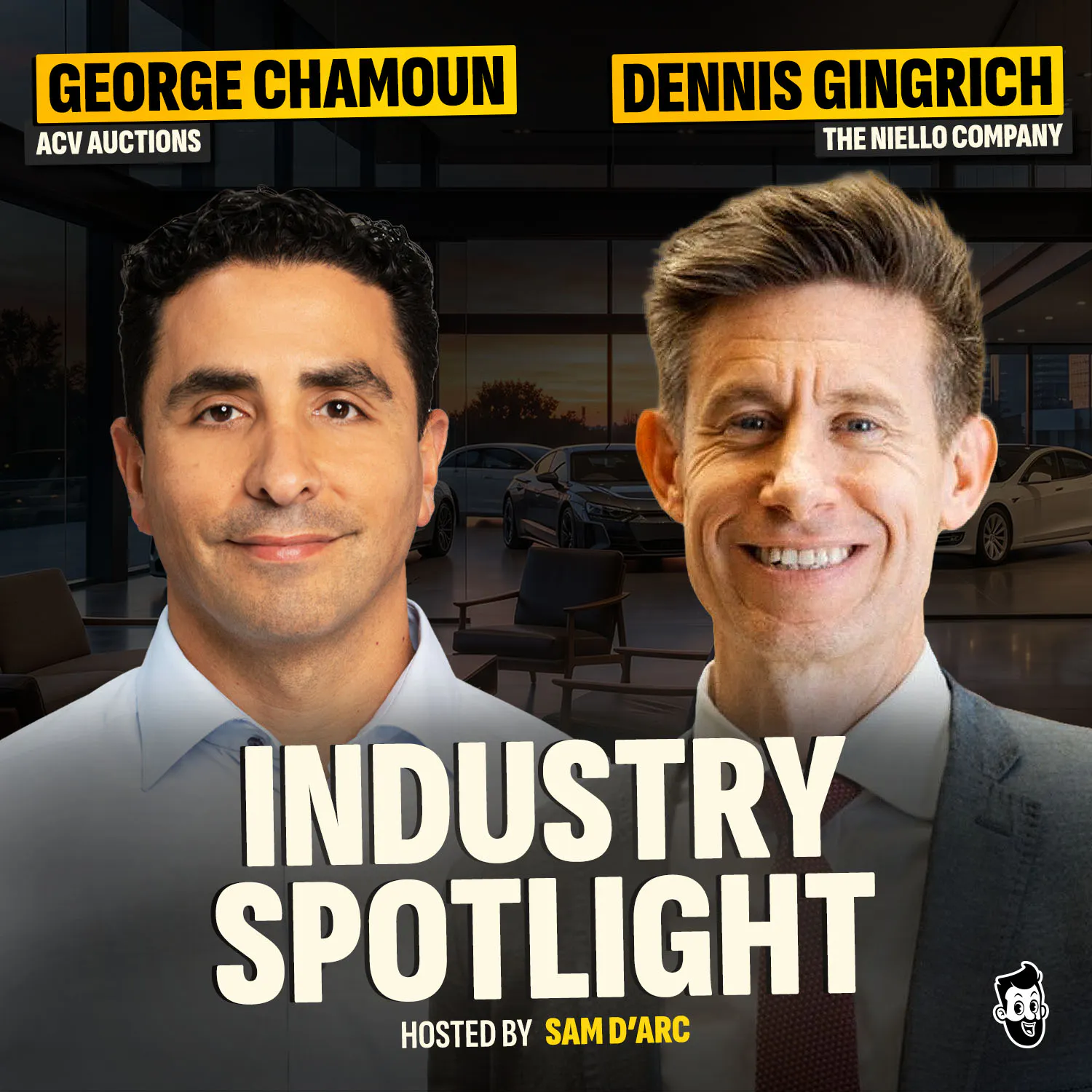
"Stop Guessing on Used Cars" – How Data is Killing the "Art" of the Appraisal | Industry Spotlight
About this episode
Used-car pricing and trade appraisal get reframed as a data problem, not an “art.” The hosts connect thin margins, inventory turns, and lead competition to why guesswork gets expensive fast. They dig into VIN-level, condition-adjusted pricing and CRM-linked retention metrics—arguing inconsistent quotes erode trust. From DMS integrations and auction/inspection data to automated repricing with guardrails and timed follow-up, the episode shows how systems replace gut-driven appraisal and standardize ACV across dealers.
historical data points
"looking at what is actually happening with our historical data points when we're putting numbers on cars."
Historical data points are past examples of what happened before. The idea is to use those past results to make better guesses about what a used car should cost today.
Historical data points are past records (like prior sales, pricing, and outcomes) used to estimate what should happen next. Here, the hosts say they’re using historical data more directly to support pricing decisions on used cars.
used car profitability
"We're just leaning into the data more so than we ever have been last year in terms of our used car profitability."
It means how much profit a dealership actually makes when it buys and sells used cars. If the price is off, the dealership can lose money even if sales volume looks fine.
Used car profitability is how much money a dealership makes on pre-owned vehicles after accounting for acquisition cost, reconditioning, and selling expenses. In this segment, the hosts connect profitability to using more data to price cars accurately.
used car acquisition
"so that's what led us to looking at how we're acquiring cars and looking at different partners... in 2026, used car acquisition has everything to do with the right price."
Used car acquisition is the process of sourcing and buying inventory from auctions, trade-ins, wholesalers, or other partners. The segment argues that in 2026 it depends heavily on getting the right price because profit margins are thin.
used car margins are so thin
"You've got to have enough data to make the right pricing decision... because the margins are so thin."
Thin margins means there isn’t much profit left after costs. So if the dealership pays or prices wrong, they can quickly lose money.
Thin margins means the profit per vehicle is small, so small pricing errors can erase the dealership’s earnings. The segment emphasizes that because margins are tight, dealerships need enough data to price aggressively enough to win the car.
mispriced a car
"Was there an example pre this change where you mispriced a car? There was a trade miss. There was a customer conversation that went sideways because the number was less defensible..."
Mispricing means the dealership asks too much (or too little) compared to what the market will pay. If the price can’t be backed up with data, buyers lose confidence and deals fall apart.
Mispricing a car means setting a selling price that doesn’t match market value closely enough, given demand and comparable sales. The segment describes downstream effects like deal misses and customer conversations going sideways when the number is less defensible.
inventory turn
"When we looked at how we were pricing our cars and our overall turn of our inventory, it was just we were hanging on to hope..."
Inventory turn is basically how fast the dealership sells its cars. If cars don’t sell quickly, the dealership has money tied up and has to deal with pricing pressure.
Inventory turn (turn of inventory) measures how quickly a dealership sells through its stock and replaces it with new units. The segment links inventory turn to pricing accuracy—if cars sit too long or are priced too high, turns slow and profitability suffers.
data-driven appraisal
"So being more proactive in the way we acquire our cars, price our cars so we can move them ... And what is retention plus VIN level data unlock that buying leads? ... when it comes time for us to offer them a value on their trade... they believe that we're going to be honest and fair and forthright."
They’re arguing that dealerships shouldn’t guess at prices. Instead, they should use data about customers and specific cars to price more fairly and consistently.
The segment argues for a data-driven approach to pricing and appraisal instead of “guessing.” By using customer retention metrics and VIN-level data, the dealership can make more consistent, defensible offers that customers perceive as honest and fair.
Nilo company
"is definitely a better equation for the Nilo company and everybody in the industry at large."
They’re talking about a specific dealership group/company called Nilo. The point is that they’re trying to use better planning and data when buying and pricing cars.
The speaker credits the “Nilo company” with a more proactive approach to acquiring and pricing cars. In this context, the company is using data-driven processes to improve how inventory moves.
BMW
"So I see a retention number from your BMW store, 74 percent. Tully's been on the show a lot."
The speaker mentions BMW because they’re using BMW dealership performance numbers as an example. Those numbers are used to show how trust and repeat service can influence other parts of the deal.
BMW is referenced as the dealership brand whose store performance is being tracked. The discussion uses BMW’s store metrics (like service/maintenance repeat behavior) to explain how data affects sourcing and pricing decisions.
retention
"So I see a retention number from your BMW store, 74 percent. ... So what is that 74 percent retention that BMW have to do with how you source cars today?"
In dealership terms, retention is the percentage of customers who return for repeat service and maintenance. The speaker frames retention as a measurable indicator of customer trust, which then affects how confidently the dealership can make trade-in value offers.
VIN level data
"And what is retention plus VIN level data unlock that buying leads? ... just VIN level data, just unpacking the retention question, the 74 percent, you know, Tully does a great job..."
VIN level data means looking up information using a car’s unique VIN number. Since that number identifies the exact car, it can help the dealership understand what leads to follow and how to price more accurately.
VIN level data means using the vehicle identification number (VIN) to pull detailed, vehicle-specific information. Because each VIN uniquely identifies a car, this data can help dealerships connect past behavior and service history to current buying leads and appraisal decisions.
service department
"really tracking that number, holding the service department accountable and, you know, and he does that really by, you know, being competitive on maintenance items."
The service department is the dealership’s repair and maintenance shop. The idea here is that how well they handle maintenance affects whether customers come back.
A service department is the dealership’s in-house workshop that handles maintenance and repairs. The speaker says they track retention by holding the service department accountable, implying service quality and pricing influence repeat visits.
maintenance items
"being competitive on maintenance items. We're not here to make money on maintenance and tires and all that stuff."
Maintenance items are the regular upkeep and wear-and-tear parts a car needs over time. The speaker is saying competitive pricing on these helps customers trust the dealership.
Maintenance items are scheduled upkeep tasks and consumables—things like routine service and wear items—that dealerships sell and install. The speaker implies being competitive on these items supports customer retention.
Nilo Volkswagen
"Dennis Gingrich goes down to Nilo Volkswagen and gets, you know, X and then literally goes around the corner and gets, yeah, it's a completely different number."
Nilo Volkswagen is a dealership used in the story to show that two nearby dealers can quote different prices for the same kind of vehicle. That inconsistency can damage trust.
Nilo Volkswagen is mentioned as a specific dealership location used in an example of inconsistent pricing. The point is that a customer can shop one dealer, then another nearby, and see a completely different number.
ACV
"Before we get to George and get to ACV, walk us through an acquisition story. Customer in your service drive, BMW, you've got their data, you've got VIN level pricing."
ACV is a way to estimate what the car is worth in today’s market. It’s the kind of number dealers try to calculate consistently when appraising used cars.
ACV usually stands for “actual cash value,” a common way dealers and insurers estimate what a vehicle is worth today. In used-car appraisal workflows, ACV is often the target number that pricing tools try to predict consistently.
VIN level pricing
"Customer in your service drive, BMW, you've got their data, you've got VIN level pricing. What's the conversation today versus what it would have been a couple of years ago?"
VIN level pricing is when a dealer uses the car’s unique ID number (the VIN) to price that exact vehicle. It helps avoid guessing based only on the model name.
VIN level pricing means pricing a specific car using its Vehicle Identification Number (VIN), which uniquely identifies that exact vehicle’s build. Because the VIN ties to trim, options, and equipment, the price can be more accurate than generic “model-only” pricing.
NADA
"out at a NADA and they, you know, they showed this project and it's like, it wasn't ready at the time,"
NADA is a reference guide dealers use to estimate what a used car is worth. It helps them put a starting number on a car before they consider the car’s condition and local market.
NADA is a pricing guide used in the U.S. to estimate vehicle values. In dealer workflows, it’s often used as a baseline for appraisals and trade/wholesale pricing decisions.
used car appraisal with data vs "art"
"George, Dennis described the problem that all of automotive faces today. Getting that great used car is job number one, ... Why is book data and segment pricing actually wrong, George?"
The hosts are talking about how dealers should price used cars using better data instead of guessing. The goal is to quote the right number for the exact car, not a rough estimate.
This segment focuses on how dealers use data-driven tools to quote used cars more accurately. It contrasts that approach with traditional appraisal methods that can rely on less precise information.
acquisition leads
"Sam, that the closing rate on these acquisition leads or, hey, we want to buy your car leads is very, very low, you know, and it's because it is sold to multiple dealers in the market."
Acquisition leads are people the dealership finds through ads or online marketing who could become customers. The idea is that it can take a long time to follow up and get them to say yes.
Acquisition leads are potential customers identified through marketing channels who might buy or sell a vehicle. The episode connects lead follow-up and conversion rate to how dealers quote and buy cars.
closing rate
"Sam, that the closing rate on these acquisition leads or, hey, we want to buy your car leads is very, very low, you know, and it's because it is sold to multiple dealers in the market."
Closing rate is how often a salesperson turns a lead into an actual sale. If it’s low, it means many leads don’t end up buying or selling.
Closing rate is the percentage of leads that turn into completed deals. In dealer operations, it’s a key metric because it affects how much effort and time is worth spending on each lead source.
DMS
"all the VIN level data and the metrics that are tie into our DMS to where we could really see what was going on."
DMS is the software system dealerships use to manage inventory and sales. If data is connected to the DMS, it can help the dealer quote and track cars more accurately.
DMS stands for Dealer Management System, the software dealers use to run sales, inventory, and customer workflows. When valuation or analytics are tied into the DMS, the dealer can act on data inside the same system they use day-to-day.
book data
"Why is book data and segment pricing actually wrong, George? Not just imprecise, but wrong for the car that's sitting in front of a manager today in that lane looking to put a number on it?"
Book data is a published estimate of a car’s value from pricing guides. The point here is that the guide number may not match the exact car and its real local market.
“Book data” refers to standardized valuation numbers from pricing guides (like NADA/Black Book-style sources) used for appraisals. The episode argues that these numbers can be wrong for the specific car in front of the manager.
segment pricing
"Why is book data and segment pricing actually wrong, George? Not just imprecise, but wrong for the car that's sitting in front of a manager today in that lane looking to put a number on it?"
Segment pricing means pricing cars based on a category they fit into, not the exact car’s details. The episode’s claim is that category-based numbers can be off for the specific vehicle being appraised.
Segment pricing is valuation based on grouping vehicles into categories (a “segment”) rather than pricing the exact individual car. The discussion suggests segment-based pricing can miss key differences like trim, condition, and local demand.
machine learning and AI
"Sam, what we've done is we've predicted using machine learning and AI, we'd be able to predict the retail price of what the car is going to sell for in the next 30 days within $100."
They’re using computer models trained on lots of past car sales to guess what a car will be worth soon. The goal is to make the price estimate more consistent than relying on gut feel.
Machine learning and AI are used to learn patterns from large datasets (like past sales and auction results) and then estimate future outcomes. In this segment, they’re applied to predict what a used car will sell for and what a trade-in value might be in the next 30 days.
trade in wholesale
"And we may be able to predict the trade in wholesale within $100."
When you trade in your car, the dealer has to buy it from you at a price that makes sense for their resale business. “Wholesale” is the lower, dealer-to-dealer kind of pricing, not the higher retail price you’d see on the lot.
“Trade-in wholesale” refers to the wholesale-style value a dealer expects to pay (or receive) for a customer’s trade-in, typically based on what similar cars fetch in dealer-to-dealer channels. It’s distinct from the retail price a dealer sells the car for to the public.
digital dealer auction
"We have, you know, the largest dealer wholesale auction in the country, digital dealer auction, where we're inspecting over a million cars a year."
Instead of guessing, dealers can buy and sell cars through online auctions. Those auction prices help predict what similar cars should be worth.
A digital dealer auction is an online marketplace where dealers bid on used vehicles, creating real-time market-clearing prices. The segment treats auction results as a key data source for predicting both retail and trade-in values.
franchise dealer
"if we don't allow consumers to trust the franchise dealer, they're not going to sell their car to the franchise dealer."
A franchise dealer is a dealership operating under a manufacturer’s franchise agreement, typically selling that brand’s vehicles and using brand-approved processes. The segment argues that if consumers don’t trust franchise-dealer pricing, they may avoid selling their car to that dealer.
democratize price
"And that ability to democratize price creates trust. And trust is important..."
The idea is that customers should be able to see a fair price without needing special insider knowledge. When the price is based on data, it’s easier for people to trust it.
“Democratize price” means making pricing information accessible and consistent for consumers, rather than keeping it limited to insiders with better data. In this segment, the claim is that instant, data-driven pricing helps consumers trust the dealer offering.
grab on attempted gross
"Or is it a grab on attempted gross, or is it just lack of experience?"
Dealers often have a target profit they want to make on a car deal. The speaker is saying some pricing differences might be driven by those profit goals instead of the car’s true market value.
“Attempted gross” refers to the expected profit (gross margin) a dealer plans to make on a deal, and “grab” implies trying to capture that profit through pricing. The phrase suggests that inconsistent pricing may come from different dealers’ profit targets rather than from a single shared market value.
pricing at scale
"Well, the big box guys aren't looking at, you know, what's the value of that car based on that one store. And so when you have the ability to price vehicles at scale, which we do, you now can predict what it's going to retail for in the next 30 days…"
It means the dealer group uses software to price lots of cars quickly and consistently. Instead of each store guessing, the system handles it for many cars at once.
“Pricing at scale” means using automated systems to value and price many vehicles across many stores, instead of relying on one local appraisal at a time. The point is consistency and speed—especially when inventory changes quickly.
predict what it's going to retail for in the next 30 days
"…you now can predict what it's going to retail for in the next 30 days, what it's going to wholesale for in the next 30 days."
They’re using data to guess what price the car will likely sell for soon. It’s not a one-time estimate—it’s a forecast for the next month.
This describes a forecasting model that estimates near-term retail pricing based on market signals. Retail prediction is about what a dealer expects to sell the car for, not just what it’s worth in theory.
predict what it's going to wholesale for in the next 30 days
"…predict what it's going to retail for in the next 30 days, what it's going to wholesale for in the next 30 days."
They’re also estimating what the car might bring if it’s sold through wholesale channels. Think “dealer-to-dealer/auction price,” not the retail sticker price.
Wholesale prediction estimates what the vehicle could fetch in wholesale channels (often auctions or dealer-to-dealer sales) over a short window. It helps dealers decide whether to hold, sell, or reprice based on expected liquidity.
Viper
"…Dennis does explain George Viper in plain English to the dealer who's not used it. What's the workflow? What gets automated? What stays human? … So we had clear car. We have Max. Now comes Viper. Viper are two towers"
Viper is a software tool the hosts say helps dealers decide what parts of pricing can be automated and what still needs a person. It’s about the day-to-day workflow, not just the price number.
Viper is mentioned as the next product in the workflow, described in terms of what gets automated versus what stays human for dealers. The segment frames it as an operational layer that helps dealers apply the pricing/data outputs.
ClearCar
"…clear car is the ability to be able to put a number on a car, whether it's a sell your car, trade your car… So clear car is powering the websites of… thousands of dealerships."
ClearCar is described as the product that assigns a numeric value to a vehicle across different contexts (sell/trade) and powers pricing on dealership websites. In this segment, it’s positioned as the foundation for condition-adjusted vehicle valuation.
API
"…It's also the trade in for a large e-commerce company. It's the trade in. It's an API being used by two of the largest dealer groups in the country."
An API is like a digital “messenger” that lets different software talk to each other. Here, it means dealer systems can automatically use the pricing data.
API (Application Programming Interface) is a standardized way for software systems to communicate. The segment says ClearCar is used via an API by large dealer groups, meaning their systems can pull pricing/valuation data automatically.
condition adjusted value
"…So clear car already gave us the ability to do a condition adjusted value. I believe it's starting to become the market leader in pricing cars to consumers."
Condition-adjusted value is a pricing approach that modifies a vehicle’s baseline market price based on its actual condition. Instead of treating every car as equal, the model accounts for differences like wear, damage, and overall condition.
Max
"Then there was Max. Max is the sister product. Max does the retail prediction, wholesale prediction, inventory management…"
Max is another software product that helps predict what a car should sell for and manage dealer inventory. The key idea here is that it can update prices automatically.
Max is presented as the “sister product” that builds on ClearCar by focusing on retail and wholesale price prediction plus inventory management. The segment emphasizes automation, including updating retail prices frequently.
automatically doing, setting retail prices and changing them every couple of days
"Max does the retail prediction, wholesale prediction, inventory management and even go as far as automatically doing, setting retail prices and changing them every couple of days."
This is dynamic pricing: the system updates retail prices automatically as market conditions and inventory signals change. Changing prices every few days helps dealers stay competitive without relying solely on manual repricing decisions.
undercarriage
"scan the undercarriage called virtual lift... take the entire vehicle, know whether or not there's a dent... whether or not there's something with the undercarriage"
The undercarriage is the bottom of the car—where you’d see things like the suspension and the parts that can get hit by potholes or debris. Its condition can strongly affect whether a used car is priced as “clean” or not.
The undercarriage is the underside of the vehicle, including areas like the floor pan, suspension components, and other parts that can show damage from road hazards. In used-car appraisal, undercarriage condition is important because it can indicate prior impacts or maintenance issues.
virtual lift
"coupled with our scanner to scan the undercarriage called virtual lift. You drive through and it leverages video"
“Virtual lift” is a way to check the bottom of a car while it’s still on the ground. It helps the system spot damage or issues that would normally require lifting the car.
“Virtual lift” is a scanning workflow that uses a vehicle drive-through setup to inspect the undercarriage without physically lifting the car. It’s meant to quickly capture condition details that affect appraisal and pricing.
Carvon
"CarMax, Carvon and others would love."
The host mentions another used-car company besides CarMax. The exact brand name in the transcript is a bit unclear, but it’s being used as an example of a buyer that wants “clean” cars.
“Carvon” is mentioned alongside CarMax as another buyer/retailer that would want the best-condition vehicles. The transcript doesn’t provide enough context to confirm the exact brand spelling.
CRM
"We're pumping it back into the CRM. And now it's up to the dealer to follow up"
CRM is a dealer’s computer system for managing leads and follow-ups. Here, the scan results get stored there so the team knows what to do next.
CRM stands for Customer Relationship Management. In this context, it’s the dealer’s system for tracking leads and follow-ups, where the scan results are “pumped back” so sales and service can act on them on specific timelines.
follow up on day one, week two, day 60, day 90
"we have to follow up on day one, we have to follow up on week two, we need to follow up on day 60, we need to follow up on day 90."
They’re using a schedule for contacting leads multiple times. The point is to keep following up—right after the car is scanned and then again weeks later—so more leads turn into sales.
This describes a structured lead-nurturing cadence tied to service and appraisal events. Instead of one-time contact, the dealer follows up at multiple time checkpoints (day 1, week 2, day 60, day 90) to convert more of those scanned vehicles into sales.
capturing the data
"But it's all about capturing the data, pumping it back into your CRM, having an established process and follow up"
The big idea is that pricing used cars should be based on real condition information. They’re describing a process where the scan results are recorded and then acted on consistently.
The segment emphasizes that appraisal accuracy depends on capturing condition data, not guessing. The workflow is presented as a repeatable process: scan the vehicle, store the results, and then follow up on a schedule.
service drive
"what we signed up as free leads out of the service drive... Those are absolutely the best cars we can have in our inventory"
The service drive is where cars go for maintenance and repairs. The hosts are saying cars that just went through service are often the best candidates for inventory because they’re more likely to have been cared for.
The service drive is the area where vehicles enter for maintenance and repairs. In this segment, cars coming out of the service drive are treated as especially valuable “free leads” because their maintenance history is more verifiable.
tumble leads
"When they run through the system, we don't have to worry about our sales manager that's too busy counting tumble leads"
“Tumble leads” sounds like a term for leads that aren’t very promising. The speaker is saying the service-drive cars are better leads than the usual lower-quality ones.
“Tumble leads” appears to be a sales/lead-quality term meaning leads that are less qualified or less likely to convert. The speaker contrasts these with “free leads” from the service drive, implying the latter are higher quality because the cars have been maintained properly.
curb rash
"check tires, check brakes, check for door dings, check for curb rash, matching tires and all those things."
Curb rash is scuffing or scraping damage on a wheel from hitting the curb. It’s important because it can mean extra repair cost and can lower what the car is worth.
Curb rash is damage to a wheel (usually alloy) from scraping against a curb. It’s a common cosmetic issue that affects reconditioning cost and can change how a used car is priced.
matching tires
"check for door dings, check for curb rash, matching tires and all those things."
Matching tires means the tires are the same type and tread level. Dealers look for this because different tires can be a safety/quality concern and may require replacement to sell the car properly.
Matching tires means the tires on the same axle (and often all four) are the same brand/model and ideally similar tread depth. Dealers check this because mismatched tires can affect traction, ride quality, and reconditioning cost, and it can be a pricing/condition issue.
door dings
"check tires, check brakes, check for door dings, check for curb rash, matching tires and all those things."
Door dings are small dents from someone bumping your car door. They matter because fixing them can cost money and can lower the car’s resale price.
Door dings are small dents in a vehicle’s bodywork caused by another car’s door. They’re a frequent appraisal factor because they can require paintless dent repair or bodywork, impacting reconditioning cost and retail value.

Volkswagen Id4
"...y on the brands we represent, I have a Volkswagen ID4, I commute back and forth. I had to buy a new tir..."
The Volkswagen ID.4 is an electric SUV, which means it runs on a battery instead of gasoline. It’s made for regular driving like commuting, and you charge it by plugging it in. Because it’s electric, some parts wear differently than on gas cars, and owners may notice things like tire wear from everyday driving.
The Volkswagen ID.4 is an all-electric compact SUV designed for everyday commuting and family-friendly practicality. It’s often discussed because it represents a mainstream, battery-electric option with a focus on usable daily range and charging convenience. In dealership conversations, it commonly comes up around real-world ownership costs like tires, brakes (less wear than gas cars), and charging habits.
cat converter
"This was pre-ACV Max. We took a car in on trade, went through the shop, long story short, cat converter was gone. We missed it."
A catalytic converter is a part that cleans up car exhaust. If it’s gone, the car may fail emissions checks and it can be an expensive problem to fix—so it needs to be caught during inspection.
A catalytic converter (often shortened to “cat converter”) is an emissions-control device that helps convert harmful exhaust gases into less harmful ones. If it’s missing or failed, it can trigger inspection/emissions issues and can materially change a used-car appraisal and repair plan.
flagged
"and the amazing picture it generates is like, Houston, we have a problem. And that is where I think the manager comes in. When these things are flagged, it's like, hey, hey, we really need you to come and look at this thing"
“Flagged” means the computer system is warning that something might be wrong with a car. The manager then checks it in person to confirm before making a pricing or buying decision.
In dealer software workflows, “flagged” means the system marks a vehicle or listing as having an issue or needing attention. The speaker describes managers being pulled in to visually verify flagged items so the dealership can make the right decision.
AI tools
"instead of chasing things all over the worldwide web with 12 different AI tools that say 12 different things."
“AI tools” are computer programs that try to help dealers make decisions about cars. The host is saying different tools can disagree, so you still need a solid process and people to verify what’s going on.
AI tools here refers to software systems that use data and algorithms to estimate values, identify issues, or generate recommendations for dealers. The host’s point is that using multiple tools can produce conflicting outputs, which is why human verification and consistent execution still matter.
inventory management
"Everywhere a used car or used piece of inventory touches the dealership ecosphere, you're owning that... end to end when it comes to used cars, inventory management. It's a Swiss Army knife to get the job done."
Inventory management is how a dealership keeps track of cars—what they have, what it’s worth, and what stage it’s in. Here, they’re saying the tool helps manage that whole process, not just a spreadsheet.
Inventory management in a dealership context is the process of tracking vehicles (and their status) across acquisition, listing, pricing, and sale. The hosts argue that the tool they’re discussing goes beyond basic inventory tracking by tying it into pricing and the used-car workflow end-to-end.
trade process
"You're owning the entire ecosphere. You're owning the inventory management, you're owning the trade process in the service department, the used car trading process in used cars..."
The trade process is what happens when you bring in your current car as part of buying a different one. The dealership has to figure out what your car is worth and what to do with it next.
The trade process is how a dealership handles a customer’s current vehicle when they buy another one—typically including appraisal, payoff coordination, and reconditioning decisions. In this segment, it’s part of the broader “used-car ecosystem” the tool is meant to optimize.
ecosystem
"What hits me that this is different... is you're owning the entire ecosphere. You're owning the inventory management, you're owning the trade process..."
Here, “ecosystem” means the whole chain of dealership steps that involve a used car. They’re saying the tool connects to many parts of that chain, not just one step.
In this context, “ecosystem” means the connected set of dealership processes and systems that touch a used vehicle—inventory management, trade handling, service department steps, and auction acquisition. The speaker uses it to describe an end-to-end platform strategy rather than a single-purpose tool.
auction acquisition
"even the auction acquisition process. Everywhere a used car or used piece of inventory touches the dealership ecosphere..."
Auction acquisition means buying cars from auction sites (usually wholesale). The idea is that the same data-driven system helps decide what to buy and how to price it afterward.
Auction acquisition is the dealership buying process for vehicles at wholesale auctions. The segment frames the tool as covering the whole chain—from auction buying to pricing and selling—so the dealership can reduce guesswork.
workflow solution
"Matter of fact, I think just inventory management to be a workflow solution will be nearly dead in the next handful of years. We can't just think about workflow like screen A, screen B."
A workflow solution is like a guided checklist app. They’re saying that in the near future, tools that only guide steps won’t be enough—dealers will want the data to connect directly to their main systems.
A workflow solution is software that guides steps in a process (like screens A → B) rather than deeply integrating data into the systems that dealerships already use. The hosts argue that “workflow-only” tools will be less valuable as dealerships demand tighter data integration across DMS and third-party apps.
core actual cash value
"We've got to go out there and integrate. And so we're determined to really be that core actual cash value. We're not trying to be every vendor."
They’re talking about a “real” value number for the car—what it should be worth in cash terms. The point is that their system is built around producing that valuation, not just being another app.
“Core actual cash value” is presented as the system’s target valuation—an attempt to estimate what the car is truly worth in cash terms. The segment contrasts this with being “every vendor,” implying the product’s focus is accurate valuation feeding the dealership workflow.
data science predictions
"Here's the data science. Here's where we predict in the next 30 days it's going to retail for."
They’re using software models to predict what a car will be worth soon, instead of relying on gut feel. Those predictions help dealers decide what to offer and list the car for.
The segment describes using data science to forecast future pricing outcomes (retail and wholesale) over a short window. The key idea is replacing “guessing” with model-based predictions that can be fed into dealer workflows.
VIN specific pricing
"it's your focus on VIN specific pricing, right? You're not bundling, you're going VIN specific."
VIN-specific pricing means the quote is based on the exact car you’re dealing with, not just the model name. The VIN is like the car’s unique ID number.
VIN-specific pricing uses the vehicle’s unique VIN (Vehicle Identification Number) to tailor valuation and pricing. Instead of averaging across similar models, the system predicts retail and wholesale outcomes for that exact car configuration.
Carvana
"all these customers, whether they're going to Carvana, CarMax or the Nilo company or wherever, when they get a value on"
Carvana is a company that buys and sells used cars, often online. They’re mentioned as one of the places customers might get a value from.
Carvana is an online used-car retailer that competes for trade-ins and vehicle purchases. The segment groups it with other buyers when discussing how customers compare offers.
pricing intelligence
"So George, why did ACV decide to build the pricing intelligence around the VIN and not just the segment or make model..."
Pricing intelligence is basically “smart pricing” using lots of data. Instead of guessing, it tries to estimate a car’s value using details about that specific vehicle.
Pricing intelligence is data-driven valuation—using market and vehicle data to estimate what a car should sell for. In this segment, it’s described as being VIN-specific and condition-adjusted rather than based on broad categories.
banded
"it's the old banded thing we used to do as Zurich Dennis, right? You're a VIN specific, you're not banded."
“Banded” means putting cars into rough groups and pricing them from the group average. The point here is that VIN-specific pricing is more precise than those broad buckets.
“Banded” pricing refers to grouping vehicles into broad buckets (like by segment or make/model) and assigning values based on those categories. The speaker contrasts this with VIN-specific pricing, which aims to capture differences between individual cars.
wholesale side
"before we were pricing retail cars, right, we already saw that data on the wholesale side."
The “wholesale side” refers to pricing and transactions between dealers (or dealer networks) rather than retail sales to end customers. The speaker claims the system already saw condition-adjusted data there before expanding into retail pricing.
no reserve
"keep in mind, you know, over 20% of the cars running on ACV right now are no reserve."
No reserve means the seller isn’t setting a minimum “must get at least this much” price. If bids don’t reach a certain level, the car can still sell—so pricing accuracy matters a lot.
“No reserve” means an auction listing has no minimum price that must be met for the seller to accept the sale. The segment notes that a large share of cars on ACV are no-reserve, which increases the importance of accurate pricing and risk prediction.
common issues with a year make model brand
"So I think about there. There's a big competitor in the space that recently [1799.5s] is saying, Hey, we're working on the capability to bring in common issues with a year make model [1804.2s] brand."
The phrase describes a valuation approach that accounts for recurring problems tied to specific vehicle attributes like year, make, model, and brand. Instead of treating every car as unique, the system tries to learn which defects are common for a given configuration and adjust value accordingly.
artificial intelligence
"And you know, the breakthroughs of what you can do now, [1871.6s] leveraging artificial intelligence, I think we had the vision of where it was going to go."
Artificial intelligence is computer software that learns from lots of examples. In this context, it helps estimate used-car value by learning patterns from vehicle data.
Artificial intelligence (AI) refers to software that can learn patterns from data and make predictions—here, about vehicle condition and pricing. In used-car valuation, AI can help estimate how common issues affect value across make/model/year combinations.
inflection point
"But it took us a few years. And I think in the world of technology, it's hard to predict like [1883.4s] when you're going to be done. But I think we've hit an inflection point this year that's very [1888.6s] significant."
An inflection point is a turning point where things start improving faster or working better. Here, it means their valuation product reached a stage where it started delivering better results.
An inflection point is a moment when a system’s growth or performance changes direction—often meaning the technology becomes meaningfully more effective. In this episode, it’s used to describe when their AI-driven valuation product reached a stage where results and adoption improved noticeably.
retail pricing
"we're automating the retail pricing with someone else that was on your show and automating the retail pricing all the way down where you don't even need to actually change the prices and it automates the descriptions."
Retail pricing is the customer-facing price a dealer puts on a used car for sale. Here, the system can automate those prices and related listing details.
Retail pricing is the price a dealer lists and sells a vehicle for to end customers, as opposed to wholesale or internal transfer pricing. The segment describes automating retail pricing and even vehicle descriptions, implying a workflow that updates what customers see.
guardrails
"I mean, there are guardrails that will help prevent, keep a dealer confident that it's not going to start dropping prices irrationally, right?"
Guardrails are safety limits that stop an automated pricing system from making extreme or unreasonable price changes. The idea is to keep pricing consistent even when the market shifts fast.
In pricing automation, “guardrails” are constraints that limit how an automated system can adjust prices. The segment uses guardrails to address the fear that automated pricing could “go off the rails” and drop prices irrationally when conditions change quickly.
AI-powered pricing
"Thinking about where you're taking the product next and what the AI-powered pricing landscape looks like, what do you have ahead, George?"
AI-powered pricing means using software that uses data to help set car prices. The hosts say it can automate pricing and descriptions, but with rules to keep it from making wild changes.
AI-powered pricing uses machine learning/AI to recommend or automate pricing decisions based on market and customer signals. In this segment, it’s positioned as a way to update retail pricing and descriptions while using “guardrails” to prevent irrational price drops.
aftermarket
"they literally had an entire undercarriage of the BMW that was all aftermarket undercarriage."
Aftermarket means the parts weren’t made by the car’s original manufacturer. The hosts are implying that non-factory work on the underside can be a risk worth investigating.
Aftermarket refers to parts or modifications made by companies other than the vehicle’s original manufacturer. In this segment, “aftermarket undercarriage” is treated as potentially problematic because it can change how the car was repaired or maintained.
dealer adoption curve
"So, George, talk to us about the dealer adoption curve. What separates those dealers who embrace"
This phrase means how dealerships gradually start using a new system or service. They’re about to explain what makes some dealers adopt it faster than others.
The “dealer adoption curve” is a framework for how quickly and how widely dealerships start using a new tool, process, or data source. The segment is setting up a discussion about what separates dealers who embrace it from those who don’t.
automated processes to buy cars
"So, no longer is this saying, trust that this will happen in the future. So, dealers that are adopting, you know, automated processes to buy cars are buying more vehicles."
They mean using computer systems to handle the used-car buying steps instead of doing everything by hand. That can make the process faster and more consistent.
The hosts are talking about using software-driven workflows to handle parts of the used-car buying process (like sourcing, pricing, and inventory updates) instead of relying on manual steps. The goal is consistency and speed so dealers can move more inventory with fewer errors.
trust
"that's really the core of this whole thing is your brand matters, trust matters."
They’re talking about whether customers believe the dealership is being honest and consistent. If prices don’t line up, customers may not trust the process.
In this context, “trust” is the customer confidence that the dealership’s pricing and process are consistent and transparent. The segment ties trust to operational consistency—especially matching website pricing with internal inventory pricing.
GSM
"So, Dennis, what advice would you give to a GSM who's hesitant to make a change like this, to how they've always priced cars?"
GSM usually means General Sales Manager. It’s the person in charge of how the dealership runs its sales process, including pricing decisions.
GSM typically means General Sales Manager, a dealership role responsible for overseeing the sales department and sales process. The segment frames the GSM as the decision-maker who may be hesitant to change pricing workflows and move toward data-driven systems.
data-driven pricing vs gut-driven pricing
"so much of pricing and automotive five years ago, even maybe even two years ago was so much gut driven. And that used car manager was an artist... Man, you just got to go to the data."
They’re comparing pricing based on intuition (“gut”) versus pricing based on data. The point is that data can back up the decision instead of relying on one person’s instincts.
The hosts contrast “gut-driven” used-car pricing—based on experience and intuition—with data-driven pricing that uses measurable inputs to justify decisions. They argue that data helps substantiate pricing and reduces reliance on individual judgment.
use car manager
"“Once you get over the curve, right? Once you calm that use car manager down...”"
A used-car manager runs the used-car side of the dealership. The point here is that once the data tools are in place, the manager spends less time guessing and more time helping customers.
A “use car manager” (used-car manager) is the person responsible for overseeing the used-vehicle department’s pricing, inventory, and sales strategy. The segment frames it as a role that can be “calmed” once data-driven pricing is adopted, allowing the team to focus on customer-facing work.
AI vendor
"“...if you've got an AI vendor going out and be able to message consumers and following up...”"
An AI vendor is a company that uses software (AI) to help dealers contact customers and keep up with follow-ups. It’s meant to make the process faster and more consistent.
An “AI vendor” here refers to a third-party provider using AI to automate parts of the sales process—like messaging consumers and handling follow-up. The idea is to reduce manual work and respond faster with more consistent outreach.
BDC
"“...we could just integrate this into your BDC right now and just have a great process.”"
BDC is the dealership team/system that handles leads—calling and messaging people after they show interest. The goal is to follow up quickly so you don’t lose the customer.
BDC stands for “Business Development Center,” a dealership function focused on contacting leads and moving them through the sales funnel. In this context, integrating pricing/lead tools into the BDC helps automate outreach and improve follow-up speed.
VIN captured
"“...we coach you because we all know getting the VIN captured is step one. The follow up really important.”"
The VIN is like a car’s fingerprint. “VIN captured” means the dealer gets that number so they can look up the exact car and price it correctly.
“VIN captured” refers to collecting a vehicle’s VIN (Vehicle Identification Number) early in the sales process. Capturing it enables accurate matching to vehicle history, trim/specs, and pricing data so follow-up and valuation are based on the exact car.
Request an Explanation
Heard something you'd like explained? We'll add it to this episode.
Sign in to request explanations for terms you heard.
Want to learn more?
Browse our glossary for plain-English explanations of automotive terms, jargon, and concepts.
Help improve this episode
See something that's not quite right? Our annotations are AI-generated and can sometimes miss the mark. Click the flag icon on any annotation to suggest a correction.