TMCP #648: Bridney Jordan and the Inside Baseball World of Tires for Daily’s, Trucks and Enthusiast Rubber!
About this episode
Brittany Jordan joins The MuscleCar Place to talk tires from the inside—how she went from selling fleet truck tires and retreads to product and marketing work, and how tire durability comes from carcass construction, compound choices, and reading wear patterns. The conversation contrasts marketing hype with side-by-side evaluation, then zooms out to brand positioning (Lexani, Lionheart, RBP) and how Turbo Tires distributes and sells online via SimpleTire.com. Between tire talk, the hosts share family and car-project updates, plus racing and event plans.
Featured Interview: This is a big month! The Muscle Car Place welcomes a brand-new sponsor to the network this month, but this partnership is about far more than advertising banners and product mentions. We’re trying to be a part of something BIG. I sat down with Bridney Jordan, Property Brands and Product Manager for Lexani, […]
The post TMCP #648: Bridney Jordan and the Inside Baseball World of Tires for Daily’s, Trucks and Enthusiast Rubber! first appeared on The Muscle Car Place.
Rolling Big Power Tires
"This week, Brittany Jordan is here from Lexani Lionheart and Rolling Big Power Tires. She is the product and marketing manager for those three tire brands, and her job is to bring those lines into the mainstream."
Rolling Big Power Tires is a tire brand. The guest talks about what makes different tire brands better at certain things.
Rolling Big Power Tires is named as one of the tire brands Brittany Jordan works with. The discussion is about how tire brands are positioned by their strengths and product performance.
Lexani Lionheart
"This week, Brittany Jordan is here from Lexani Lionheart and Rolling Big Power Tires. She is the product and marketing manager for those three tire brands, and her job is to bring those lines into the mainstream."
Lexani Lionheart is a tire brand. The guest works in marketing to help more people discover and buy those tires.
Lexani Lionheart is mentioned as one of the tire brands Brittany Jordan represents. The segment frames her role as helping those tire lines reach more mainstream buyers.
mass production automotive components
"Well, I have a fascination with the world of mass production automotive components. Tires are a big business, but also, frankly, because of Brittany."
Mass production automotive components are car parts made in large quantities. The episode is focusing on how big tire companies make and sell those parts.
Mass production automotive components are parts made in high volume using standardized manufacturing processes. The guest’s fascination is with how these components are engineered and marketed at scale—especially tires, which are a major industry business.
fleet truck tires
"She started out as a young woman from Detroit, just out of college, sent to Nebraska to sell fleet truck tires and retreads. And she learned this game and she succeeded."
Fleet truck tires are for work trucks that drive a lot for a company. They’re chosen to last and stay dependable, not just for looks.
Fleet truck tires are tires used on commercial vehicles that operate as part of a business fleet (like delivery or service trucks). They’re typically selected for durability, predictable wear, and cost-per-mile rather than just grip or style.
National Parts Depot
"This is the Muscle Car Place online podcast brought to you by National Parts Depot. This is the weekly show dedicated to people worldwide who love American muscle cars."
National Parts Depot is the podcast sponsor. It’s a company that sells automotive parts for enthusiasts.
National Parts Depot is named as the sponsor of the Muscle Car Place podcast. It’s positioned as a parts retailer supporting the show’s audience of people who buy, sell, restore, and race American muscle cars.

Chevrolet Corvette
"... For your truck, your minivan, your trailer, your Corvette, your muscle, whatever. She wants to serve you in..."
The Chevrolet Corvette is a sports car made for fast driving and sporty handling. People talk about it when they want something more performance-focused than a regular truck or minivan. In the podcast, it’s used as an example of a “muscle” vehicle.
The Chevrolet Corvette is a performance sports car known for its strong acceleration and driver-focused design. It often comes up in conversations about “muscle” because it’s built to deliver sports-car thrills rather than just everyday transportation. In the podcast context, it’s mentioned alongside other vehicles to highlight it as a serious, capable option for enthusiasts.
push rod tube seals
"And in fact, I need to put a new push rod tube seals in it. When that car is running, it's just pumping oil out of the push rod tubes."
These seals help keep oil from leaking out of the engine’s pushrod area. If they wear out, oil can come out while the engine runs, which is why the speaker knows the leak source.
Push rod tube seals seal the openings for the pushrod tubes, which are part of an engine’s valvetrain that transfers motion from the camshaft to the lifters/rockers. If these seals fail, oil can leak and be “pumped” out around the pushrod tubes while the engine is running.
Oldsmobile 442
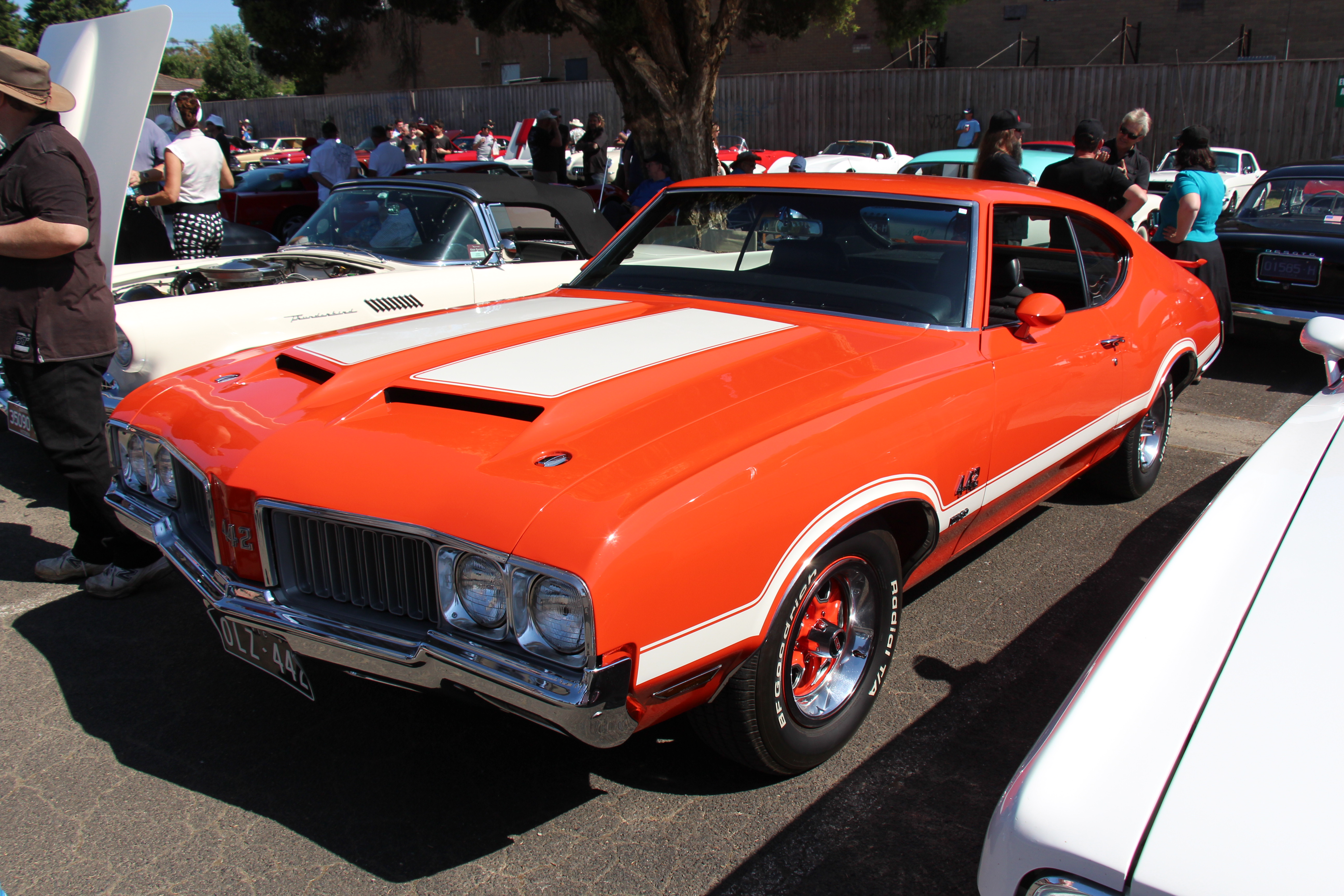
"So she did ask if I had won her that old 442 from Dream Giveaways. ... It's red with the white stripes, the white interior. ... But one big thing. It doesn't have the four speed. So 442 is four speed, four barrel, two doors."
The Oldsmobile 442 is a famous old muscle car. The “442” name is tied to how the engine and drivetrain are set up, and the host is pointing out that the specific car they’re hoping to win doesn’t match the usual configuration.
The Oldsmobile 442 is a classic muscle car nameplate known for a performance-focused V8 package. In this segment, the host is discussing what the “442” refers to—engine and drivetrain configuration details like carburetion and transmission—plus how this particular example differs from the typical setup.
four speed
"But one big thing. It doesn't have the four speed. So 442 is four speed, four barrel, two doors."
“Four speed” means the car has four forward gears. More gears can help the car stay in the right engine speed range for quicker acceleration.
“Four speed” refers to a transmission with four forward gears. In muscle-car context, the number of gears affects how the car accelerates and how it feels at different speeds.
four barrel
"So 442 is four speed, four barrel, two doors. I think that's what the do stands for. Hang on, I got to Google it."
“Four barrel” refers to a carburetor with four openings that let the engine breathe more fuel/air. On older muscle cars, that often goes along with a more performance-oriented setup.
“Four barrel” describes a carburetor setup with four throttle bores (air/fuel passages). It’s commonly used as a shorthand for a higher-flow carburetion configuration associated with stronger performance on classic V8s.
dual exhaust
"Wrong. Four barrel, four speed, dual exhaust."
“Dual exhaust” means there are two exhaust pipes/systems instead of one. It can help the engine breathe a bit better and usually makes the car sound more “muscle-car” like.
“Dual exhaust” means the car uses two exhaust paths (typically one on each side of the vehicle) rather than a single system. On classic muscle cars, dual exhaust is often associated with better flow and a more aggressive sound.
automatic factory automatic
"Anyway, the four speed part, that car doesn't have the one we entered is an automatic factory automatic, and I'm sure it drives great. Sure, it's awesome, but nonetheless, it is not a four speed."
“Factory automatic” means the car left the factory with an automatic transmission rather than being converted later. The host uses this to clarify what drivetrain configuration the car actually has before discussing whether it matches the “four speed” they want.

Calais Olds
"Pretty sure it was an 89 Calais, Olds Calais. You know, those little front wheel drive ones. And there was a 442 badged version of that."
This is an Oldsmobile Calais from 1989. The host is talking about which version it was and what kind of engine it had, and how that compares to a more performance-oriented 442 model.
The Oldsmobile Calais (here, an ’89) is a front-wheel-drive compact from Oldsmobile’s late-1980s lineup. In this conversation, it’s notable because the host contrasts it with a 442-badged variant and mentions it having a “quad four,” which points to a specific engine setup.
quad four
"She didn't have that, but hers did have the quad four. So it had the good motor. I didn't mind that car."
“Quad four” is the name for a specific kind of four-cylinder engine. The host is saying Laura’s car had that engine, and that it was the better choice compared to other versions.
“Quad four” refers to Oldsmobile’s Quad 4 engine family, a compact four-cylinder powerplant designed for good power for its size. In this segment, the host uses it as a shorthand for the “good motor” Laura’s car had compared with the 442-badged version.

Chevrolet Chevelle
"...oping to do for our anniversary. We will take the Chevelle. As long as it's not pouring rain, we'll take the..."
The Chevrolet Chevelle is a classic muscle car from earlier decades, known for being a fun, powerful car. People still talk about it because it’s part of the classic muscle-car era. In the podcast, it’s mentioned as the car they want to use for a special occasion.
The Chevrolet Chevelle is a classic American muscle car from the 1960s and 1970s, known for its bold styling and strong engine options. It’s often discussed because it represents a key era of muscle-car culture and is still popular with collectors and enthusiasts. In the podcast, it’s mentioned as the car they plan to take for an anniversary outing, emphasizing its personal, classic-car appeal.
late model race
"That weekend on June 6th is his debut late model race. He's going to race at Orange County Speedway"
“Late model” is a type of stock-car racing you’ll see on short tracks. The cars start from regular production vehicles, but they’re modified so they can race hard and safely.
A “late model” race is a stock-car style series where cars are based on production models but heavily modified for racing. The term usually refers to the body style/class used in regional short-track racing, and it’s a common stepping stone for drivers aiming to move up to bigger national series.
Carolina Pro Series
"The series Dallas is going to start in, it's called the Carolina Pro Series. It's a little softer entry into late models"
The Carolina Pro Series is a regional racing league for late model stock cars. In this conversation, it’s being framed as a less intense place to start than the bigger tours.
The Carolina Pro Series is a regional stock-car racing series focused on late models. It’s described here as a “softer entry,” meaning it’s positioned as a more approachable starting point for drivers compared to a more competitive or higher-profile tour.
Cars Tour
"than like the Cars Tour like Dale Jr. does. Setzer does run the Cars Tour. That's not where we should start."
The Cars Tour is another late model racing series. They’re saying it’s a tougher place to begin than the Carolina Pro Series.
The Cars Tour is a late model stock-car touring series, referenced here as a more challenging starting point than the Carolina Pro Series. The comparison suggests differences in competitiveness, exposure, or difficulty level between the two paths.
retreading
"we're at fleets, we're at truck stops, [1640.6s] we're in retread shops, learning how to retread tires. [1644.1s] I'm not sure how familiar your audience is with retreading"
Retreading means taking an old tire casing and putting a new tread on it. It’s often used for trucks because it can save money versus buying brand-new tires all the time.
Retreading is the process of reusing a worn tire casing by replacing the tread rubber. It’s common in commercial fleets because it can be cheaper than buying entirely new tires while still meeting performance and safety requirements.
fleets
"and fleets that use them. [1635.9s] So I had two. [1637.1s] And so we're at fleets, we're at truck stops,"
A fleet is a bunch of vehicles run by a company, like a delivery or trucking business. Because they use so many tires, they plan tire purchases and repairs carefully—sometimes including retreads.
In this context, fleets are groups of vehicles operated by a business—like trucking companies or delivery services—rather than individual owners. Fleet operators buy tires in volume and manage them as part of a cost-and-maintenance plan, which is why retreading shows up in their supply chain.
truck stops
"And so we're at fleets, we're at truck stops, [1640.6s] we're in retread shops, learning how to retread tires."
Truck stops are places along highways where truck drivers stop for things like fuel and food. Some also connect to tire services, which matters for truck tire businesses.
Truck stops are roadside facilities that serve professional drivers, often including services like fuel, food, and sometimes tire-related support. In tire sales and retread distribution, they can be key locations where drivers and fleet needs intersect.
Retreads
"Of course, they're very familiar with Retreads. There was a company where I grew up called Bandag that did nothing but Retreads. I mean, it's how it works."
Retreads are used tires that get a new outer tread. Instead of throwing the whole tire away, they reuse the main tire body to save money—especially for trucks that drive a lot.
Retreads are tires that are rebuilt by replacing the worn tread surface while keeping the tire casing. This can be a cost-effective way for commercial fleets and truck drivers to keep tires in service longer than buying entirely new tires.
Bandag
"There was a company where I grew up called Bandag that did nothing but Retreads. I mean, it's how it works."
Bandag is a tire company that focuses on retreading—putting new tread on tires that have already been used. The speaker mentions it to show how common and established retreads are.
Bandag is a tire company known for retread operations—rebuilding worn tires by applying new tread to existing casings. In the segment, the host uses it as an example of a business built around the retread industry.
commercial tires
"I love commercial tires. I wouldn't dare say I like them better than a passenger or a light truck, because I'll probably, you get a group against me on Facebook or something like that"
Commercial tires are made for work vehicles that see a lot of use. They’re built to last and handle tough conditions, not just to look good.
Commercial tires are built for heavy-duty, high-use applications like buses, construction, and fleet vehicles. They’re designed around the job they’ll do—so the tread pattern, rubber compounds, and carcass construction prioritize durability and consistent traction over styling.
light truck
"I wouldn't dare say I like them better than a passenger or a light truck, because I'll probably, you get a group against me on Facebook or something like that"
A light truck tire is designed for vehicles like pickups and SUVs that are used for everyday driving and light-duty hauling. Compared with commercial tires, they typically balance durability with ride comfort and appearance, though they can still be built for rugged use depending on the tire model.
sidewall
"Passure light trucks are similar, but we take away some of the physical aesthetics and maybe a little bit less focus on how cool the sidewall looks, right?"
The sidewall is the part of the tire on the outer edge, not the tread. It can matter for how tough the tire is and how well it survives rough conditions.
The sidewall is the tire’s outer wall between the tread and the bead that sits on the wheel. It’s more than just looks—its construction affects durability, impact resistance, and how the tire handles heat and road hazards.
tire carcass
"Getting a casing or the carcass of a tire through first, life, second, life, third life,"
A tire carcass is the tire’s inner “skeleton.” It’s the part that keeps the tire strong and helps it hold its shape, even when you’re driving on rough roads.
The tire carcass is the tire’s internal structure (the reinforcing layers) that gives it strength and shape. It’s what the tread and sidewall are built onto, so durability and load-handling largely depend on the carcass design.
compound
"know what it's for, know the trend of, know what the compound does for the consumer, because your tire could be the difference"
The tire compound is the rubber recipe in the tread. Changing that recipe can change how well the tire grips, how fast it wears out, and how much fuel it takes to roll.
In tires, the compound is the rubber formulation used in the tread (and sometimes other layers). Different compounds balance grip, wear rate, and rolling resistance, which can affect fuel economy and how long the tire lasts.
fuel savings
"because your tire could be the difference between them hitting a target for fuel savings for a year or not, just depending on if you recommended the right fuel-efficient tire versus not."
Fuel savings means using less gas (or electricity) over time. Some tires are designed to roll more easily, which can help a vehicle use less fuel.
Fuel savings here refers to how much fuel a vehicle uses over time, influenced by tire rolling resistance. Tires designed to reduce rolling resistance can improve efficiency, but the benefit depends on the tire choice and the vehicle’s operating conditions.
fuel-efficient tire
"if you recommended the right fuel-efficient tire versus not. And so deep diving into that, that's the fun for me."
A fuel-efficient tire is made to make the car easier to roll. That can help the car use less fuel, particularly over lots of daily miles.
A fuel-efficient tire is designed to reduce rolling resistance, which lowers the energy needed to keep the tire turning. That can improve fuel economy, especially in fleets or daily-driven vehicles where the mileage adds up quickly.
tire wear patterns
"I like looking at things like that, seeing how it caused an effect, looking at tire wear patterns, trying to figure out what's wrong."
Tire wear patterns are how the tire gets worn down in different spots. If the wear looks uneven, it often means something is off—like alignment, suspension, or tire pressure.
Tire wear patterns are the specific shapes and locations where a tire wears faster than others. They can indicate alignment issues, suspension problems, incorrect tire pressure, or an improper match between the tire’s design and the vehicle’s use.
prototype tire
"So getting a concept, getting a prototype tire, putting it on the road, throwing it in a fleet"
A prototype tire is a trial version of a tire. It’s made to test ideas and see how well it works before it becomes a regular product.
A prototype tire is an early, experimental version of a tire built to test new designs, materials, or construction methods. The goal is to see how it performs in real-world conditions before committing to mass production.
big tires
"About commercial tires? About how big tires the companies work in general."
“Big tires” here means larger tires, usually on trucks and heavy vehicles. They can affect how the vehicle grips and how the tire wears when it’s working hard.
“Big tires” in this context refers to larger tire sizes used on trucks and other heavy-duty vehicles. Larger tires can change ride characteristics, traction behavior, and how wear shows up under load.
evaluating a tire side by side
"and then get to the nitty gritty where I'm evaluating this tire side by side and it's like, this tire is not what I expected."
“Side by side” means comparing tires directly against each other. Instead of trusting ads, you look at how they really perform and wear.
Side-by-side evaluation is a controlled comparison where tires are tested under similar conditions to judge differences in grip, wear, noise, and overall behavior. It’s a more direct way to assess performance than relying on marketing or sponsorships.
tire product lines
"Goal to launch more than 10 tire product lines [2058.9s] in less than three years. [2060.9s] And I was like, really?"
A “tire product line” is a named set of tire models sold under a brand umbrella, often aimed at specific vehicle types and use cases. Launching many new product lines usually means introducing new tread designs and sizes for different markets.
new treads
"reinvigorate our product lines, [2066.6s] spruce them up, add some new treads. [2068.4s] And so if you look at the history"
The “tread” is the pattern on the outside of the tire. New treads usually mean a different pattern (and sometimes different rubber) to change how the tire grips and performs.
“Treads” are the rubber patterns on the tire’s outer surface that control grip, traction, and how the tire handles water and road contact. Adding “new treads” typically means updating the tread pattern and compound to target different driving conditions and customer preferences.
RBP tires
"And so if you look at the history [2070.3s] and the press releases on Lexani, Lionheart and RBP tires, [2074.0s] you'll see in the last two years or so,"
RBP is a tire brand mentioned in the episode. The speaker is using it to talk about how many new tire lines and tread options have been introduced.
RBP is referenced here as a tire brand (RBP tires) whose product lines are part of the host’s “history” and press-release review. The discussion is about launching new tire lines and updating tread offerings.
commercial truck
"And also now I'm branching out away from commercial truck, [2097.2s] right? [2097.4s] And now I'm moving to passenger light truck,"
“Commercial truck” means tires made for work trucks and fleet vehicles. They’re usually built to last and handle heavy use, not just look good.
“Commercial truck” refers to tires designed for work vehicles used for hauling, fleets, and heavier-duty driving. Those tires are often optimized for durability, load capacity, and cost-per-mile rather than purely for appearance.
Lexanis tire lineup positioning (tiering and sizing breadth)
"Even we'll talk about like where our brands are positioned, but where we are kind of in that, I'd say kind of tier three-ish realm, you don't expect to see those sizes and that breadth of the line for Lexanis."
They’re talking about where Lexanis sits in the market and why offering lots of tire/wheel sizes is important. The point is that some brands cater to more unusual fitments than others.
The host explains how Lexanis is positioned in the market and why its wheel/tire sizing range matters. They describe Lexanis as a “tier three-ish” brand that you wouldn’t expect to see offering the same breadth of uncommon sizes.

Chevrolet Camaro
"...exy brand, like the luxury brand. So if you think Camaro or Ferrari or Lamborghini or something that maybe..."
The Chevrolet Camaro is a performance car designed to be quick and fun to drive. It’s often mentioned when people are talking about muscle cars and other exciting performance vehicles. In the podcast, it’s brought up as an example of a car someone might consider.
The Chevrolet Camaro is a muscle car that blends classic performance styling with modern power and technology. It’s frequently discussed because it’s a mainstream, enthusiast-oriented alternative when people compare different performance brands. In the podcast, it’s grouped with other high-end or exotic-sounding names to illustrate the kind of car someone might be thinking about.
EV tires
"So Lexanis got electric vehicle tires, so EV tires, as a summer tire, it has an AT, H, it has a variety of different products in it."
EV tires are tires made specifically for electric cars. They’re designed around how EVs drive—like strong instant torque and the car’s weight—so they can grip and wear better than generic tires.
EV tires are tires engineered for electric vehicles, typically accounting for higher torque, different weight distribution, and often quieter operation. In this segment, “Lexanis got electric vehicle tires” is tied to offering an EV-focused summer tire lineup.
summer tire
"Lexanis got electric vehicle tires, so EV tires, as a summer tire, it has an AT, H, it has a variety of different products in it."
A summer tire is built for warm weather. It’s meant to grip well in dry and wet conditions when it’s not cold out.
A summer tire is designed to work best in warm, dry-to-wet conditions, using rubber compounds and tread patterns optimized for that temperature range. The host is using it to describe the intended seasonal use of the EV tire line.
H
"as a summer tire, it has an AT, H, it has a variety of different products in it."
“H” is probably a tire rating that tells you how fast the tire is designed to safely handle. The host is basically saying they offer multiple versions, not just one tire.
“H” is likely shorthand for a tire speed rating (commonly “H” = 130 mph / 210 km/h) or a product subcategory within the brand’s lineup. The host groups it alongside “AT,” suggesting different tire variants with different intended use or performance characteristics.
mileage level
"They want something maybe that's a little bit more reasonable, don't wanna compromise that integrity of the tire, but maybe willing to accept a little bit lower of a mileage level compared to someone that be willing to pay a little bit more of a premium"
“Mileage level” means how many miles the tire is expected to last. Tires that are built to last longer usually use different materials and tread designs than tires meant to feel sportier.
In tire talk, “mileage level” is a shorthand for how long a tire is expected to last before the tread wears down. It’s usually tied to the tire’s tread design and rubber compound, and it often trades off against grip and ride feel.
195/70R14
"For example, my high school Nova ran on 195, 70 yard 14s. That is available in Lionheart."
“195/70R14” tells you what size tire it is and what wheel it fits. The numbers relate to the tire’s width and sidewall height, and the “14” is the wheel diameter.
“195/70R14” is a tire size code: 195 is the tire width in millimeters, 70 is the aspect ratio (sidewall height as a percentage of width), and “R14” means it’s a radial tire that fits a 14-inch wheel. It’s the kind of sizing you search by when matching tires to a specific car.

Chevrolet Nova
"For example, my high school Nova ran on 195, 70 yard 14s. That is available in Lionheart."
A Chevrolet Nova is a classic American car people often modify and keep running. Here it’s just being used as an example of a car that would need a particular tire size.
The Chevrolet Nova is a classic American muscle car platform that’s commonly used as a reference point for period-correct tire sizes. In this segment, the host uses their high school Nova to illustrate that Lionheart offers a specific vintage-style tire size.
lifted trucks
"Then I learned about how big the tires were for these super nice lifted trucks. And I mean, we have tires and RBP..."
A lifted truck is a truck that sits higher than stock. People do it so the truck can fit bigger tires and look more off-road ready.
A lifted truck has been raised from the factory ride height, typically to fit larger tires and improve off-road clearance. In the segment, lifted trucks are the platform where these oversized, aggressive tires are used to create an off-road look.
28 inch
"Rob, they go all the way to 28 inch. I mean, they're huge."
“28 inch” is the size of the tire. A bigger tire makes the truck sit taller and look more aggressive, and it can also affect how the truck drives.
“28 inch” refers to tire diameter (the overall size of the tire). Bigger diameter tires change the truck’s stance and gearing feel, and they’re commonly used to emphasize an off-road or lifted-truck look.
all-terrain tires
"So we're talking ATs, all-terrain tires, [2433.9s] a highway terrain, but all the way to extreme terrain, [2436.7s] rugged terrain and MTs as well, mud tires."
All-terrain tires are made to handle both regular roads and dirt/gravel. They have tread that’s a bit more “off-road ready” than a highway tire, but they’re still meant to be comfortable for daily driving.
All-terrain tires (often called A/T tires) are designed to work on both paved roads and light off-road surfaces. They typically balance a quieter, more road-friendly tread with more aggressive sidewall and tread-block patterns for dirt, gravel, and uneven terrain.
MTs
"[2436.7s] rugged terrain and MTs as well, mud tires. [2440.0s] Yeah, there's a whole section of CMO with lifted trucks"
MTs are mud-terrain tires. They’re designed to dig into mud and throw it off the tread, but they can be louder and less smooth on regular roads.
MTs here means mud-terrain tires, which are built for deep mud and loose, messy surfaces. They usually have larger, more open tread blocks that can bite and clear themselves, but they tend to be noisier and less efficient on pavement than all-terrain tires.
Turbo Tires
"[2452.4s] So Turbo Tires has all these made. [2455.6s] They're brought here to these states [2456.7s] and then they're distributed, is that right?"
Turbo Tires is the company being talked about. They’re involved in making/sourcing tires and getting them sold through distributors and local dealers.
Turbo Tires is described as the parent company involved in tire sourcing, distribution, and brand strategy. The hosts discuss how Turbo handles wholesale distribution and also works with distributors and local dealers.
Sonny
"So Turbo from a wholesale standpoint, [2462.5s] these three brands like Sonny, Lionheart, RBP, [2465.3s] these are our proprietary brands."
Sonny is a tire brand name. The speaker is saying it’s one of the company’s in-house/proprietary brands that gets sold through their distribution network.
Sonny is mentioned as one of the proprietary tire brands within Turbo Tires’ wholesale portfolio. The speaker groups it with other brands to describe how their branded products are distributed.
associate dealer program
"And a number of local dealers [2473.1s] who we embrace through our associate dealer program [2476.2s] that also sell the tires too."
An associate dealer program is a partnership where local shops are allowed to sell a company’s products. Here, it’s another way these tires reach customers besides big distributors.
An associate dealer program is a business arrangement where independent dealers are partnered with a brand/company to sell its products. In the transcript, it’s used to describe an additional sales channel beyond national distributors.
mud tires
"Rolling big power tires used to just be an RT and mud tires and that was it. We wanted to expand the line because mud tires, although they're cool and people that like them love them, they're starting to decline a little bit"
Mud tires are made for getting traction in messy, soft ground. They usually have a more aggressive tread, which can make them louder and less ideal for mostly highway driving.
Mud tires are designed with aggressive tread blocks and deep voids to grip in soft ground like mud and loose dirt. That same tread design often makes them noisier and less efficient on highways, which can reduce everyday usability for drivers who mostly commute.
RT
"Rolling big power tires used to just be an RT and mud tires and that was it."
RT sounds like a tire type abbreviation, but the speaker doesn’t spell out what it means here. It’s being contrasted with mud tires as another category of tire.
RT is referenced as a tire category in the context of “rolling big power tires,” but the transcript doesn’t define what RT stands for. In tire/vehicle culture, abbreviations like this typically denote a specific tread type or product line, distinct from mud tires.
AT
"So we knew, okay, AT, like all-terrain tires that need to look a certain way, have a certain aesthetic to them"
AT is short for all-terrain tires. It’s a way to say the tire is meant for both regular roads and some rougher surfaces.
AT is an abbreviation for all-terrain tires. In tire marketing and enthusiast talk, it’s used to quickly distinguish them from mud-terrain tires and more street-focused tires.
MT
"So now we have highway terrain, all-terrain, [2559.9s] the MT and XT and RT and fully developed it."
MT usually means “mud-terrain.” It’s a tire style built to grip better in muddy or messy off-road conditions, even if it’s not as quiet or smooth on pavement.
In tire naming, MT usually stands for “mud-terrain,” a tread style aimed at traction in mud and loose, uneven terrain. These tires generally trade some road comfort and noise for stronger off-road bite.
XT
"So now we have highway terrain, all-terrain, [2559.9s] the MT and XT and RT and fully developed it."
XT is a label some tire lines use to mean a certain tire type or tread style. The exact purpose depends on the brand, but it’s generally part of a lineup meant for different driving conditions.
XT is a tire-series shorthand used by some brands to indicate a particular tread/usage category (often positioned between all-terrain and more aggressive off-road designs). Without the brand’s specific legend, the exact meaning can vary by manufacturer.
torque
"Well, there's additional torque and additional weight [2594.3s] and some other things that factor in."
Torque is the “twisting pull” that makes the car accelerate. If an EV delivers a lot of torque quickly, it can make the tires work harder and wear faster.
Torque is the twisting force an engine or motor produces, and it strongly affects how hard a vehicle accelerates. EVs can deliver high torque quickly, which can increase tire wear by putting more load on the tread during launches and rapid driving.
daily driver
"Most of them have a daily driver though. And I would bet for a lot of us, our daily driver is a truck."
A daily driver is the car you use most days, like for work or errands. It’s the opposite of a car you only take out occasionally.
A daily driver is the vehicle you use regularly for everyday errands and commuting, not a weekend-only car. In this context, the host is contrasting classic muscle cars with the more practical “truck” or “daily” setup many owners actually live with.
big lug tires
"when you drive anything with big lug tires that look super cool, they wander on the highway around both 50, they can hunt a little bit."
Big lug tires are chunky, off-road-style tires with deep, blocky tread. They can make the vehicle feel like it doesn’t track straight as easily on the highway.
“Big lug tires” refers to oversized tires with aggressive tread blocks (often seen on off-road or all-terrain setups). Those tread patterns can increase steering effort and make the truck feel less stable on the highway, especially when the tires are large and the tread is designed for traction rather than smooth road tracking.
wander
"they wander on the highway around both 50, they can hunt a little bit."
“Wander” means the car doesn’t stay straight—it kind of drifts or wiggles in its lane. It can happen more at highway speeds with certain tire setups.
In tire/handling talk, “wander” means the vehicle slowly drifts or meanders from its intended lane direction instead of holding a steady line. It’s commonly noticed at highway speeds when tire tread, alignment, or steering geometry makes the car sensitive to road imperfections.
hunt a little bit
"they wander on the highway around both 50, they can hunt a little bit. So you've experienced that and you've seen all that."
“Hunt” means the car starts to sway or oscillate a bit, like it’s constantly trying to correct itself. It can feel especially noticeable on the highway.
“Hunt” describes a speed-dependent oscillation where the steering/vehicle repeatedly corrects itself left-right rather than staying settled. With large, aggressive tires, this can be triggered by tread pattern behavior, tire balance issues, or alignment/steering setup that amplifies small disturbances.
LS swap
"But like, why did you pick this car? Why did you pick this design? Why do you care about this LS swap?"
An “LS swap” is when someone puts a GM LS engine into a different car than it originally came in. People like it because the LS engine is popular, easy to find parts for, and can make the car run and feel better.
An “LS swap” means replacing a car’s original engine with a GM LS-series V8 (commonly from models like the Chevrolet Camaro/Corvette). Enthusiasts do it because the LS engines are compact, modern, and have strong aftermarket support, making them popular for restomods and daily-driver builds.
simpletire.com
"And so you can visit simpletire.com [2904.5s] and order Lexani Lionhearts or RBP tires [2908.1s] and have them shipped directly to your shop,"
simpletire.com is an online place to buy tires. The host is saying you can order tires there and have them delivered to your shop or home.
simpletire.com is presented as an online tire retailer where customers can order specific tire models and have them shipped to their location. The episode frames it as part of a broader distribution and fulfillment network.

Ford Bronco
"...re, you can't quite, okay, I can't see this on my Bronco. We have video footage of this AT tire with a Bro..."
The Ford Bronco is an SUV made for rough roads and off-road driving. It’s designed to handle different terrain and conditions better than many regular cars. The podcast mentions it while talking about something visible or happening on the Bronco.
The Ford Bronco is a rugged SUV built for off-road capability and outdoor use. It’s the kind of vehicle that gets discussed in relation to real-world driving conditions like trails, weather, and traction. In the podcast, it’s specifically referenced in a moment about what the host can see on the Bronco, tying it to practical, on-vehicle details.
Request an Explanation
Heard something you'd like explained? We'll add it to this episode.
Sign in to request explanations for terms you heard.
Want to learn more?
Browse our glossary for plain-English explanations of automotive terms, jargon, and concepts.
Help improve this episode
See something that's not quite right? Our annotations are AI-generated and can sometimes miss the mark. Click the flag icon on any annotation to suggest a correction.