
When outsiders try, and fail, to build a car #317
About this episode
Outsiders keep trying to build cars, but the episode argues the hard part isn’t the design—it’s everything after: suppliers, homologation, emissions compliance, crash testing, and getting to market profitably. The hosts use examples like the Ferrari Luce collaboration, Dyson’s solid-state-battery EV plan, and Apple’s Project Titan, plus the Ineos Grenadier’s traditional approach and its real-world tradeoffs. Even autonomous ambitions run into scaling costs and complexity.
Andrew Frankel and Dan Prosser discuss the challenges of massive brands who try to enter the world of car manufacturing. How many succeed? Dyson, Apple, and Google all invested hundreds of millions only to find it was rather harder than they expected.
Use coupon code pod20 at checkout to get 20% off an annual subscription to The Intercooler's online car magazine for the first year! Listen to this podcast ad-free, and enjoy a subscriber-only midweek podcast too. With a 30-day free trial, you can try it risk-free – https://www.the-intercooler.com/subscribe/
Find out more about JBR Capital here – https://www.jbrcapital.com
Use coupon code Ti10 to get 10% off your Supernatural Car Care order – https://supernaturalcarcare.com/
Hosted on Acast. See acast.com/privacy for more information.
outsiders create cars
"When outsiders create cars, right, that's the topic for this week's podcast. Andrew, can you explain why we've chosen that topic this week?"
The episode is about companies that aren’t really car makers trying to make a car anyway. The hosts discuss why that can be exciting, but also why it often doesn’t go as well as people expect.
“Outsiders create cars” is the episode’s core framing: companies or organizations not traditionally known for car-making trying to build four-wheel personal transport. The hosts use Ferrari Luce as the recent example and compare it to other attempts that were more talked-about than successful.
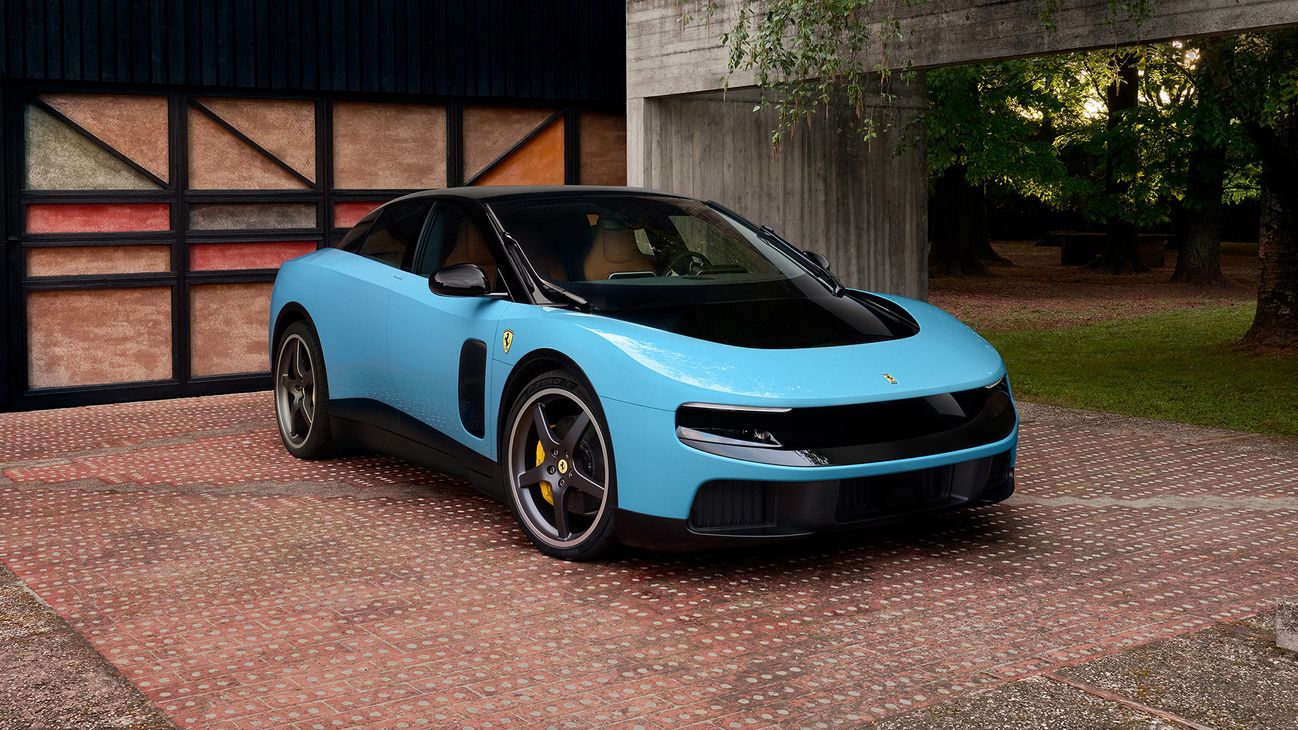
Ferrari Luce
"The not entirely uncontroversial launch of the Ferrari Luce which was famously designed in collaboration with, I don't think we can say it was designed entirely by Love From which is Johnny Ives design agency but it was clearly a collaboration between Ferrari and them"
Ferrari Luce is a Ferrari car project that got a lot of attention. The hosts mention it because it was created with help from a design agency, which is a different kind of collaboration than you’d usually expect from a car company.
Ferrari Luce is a Ferrari-branded four-wheel personal transport concept/product that’s notable because it represents Ferrari trying to enter the broader “outsider” EV/tech-style design and branding conversation. The episode frames it as a high-profile collaboration, which is unusual for Ferrari’s traditional approach to model development.
Love From
"I don't think we can say it was designed entirely by Love From which is Johnny Ives design agency but it was clearly a collaboration between Ferrari and them"
Love From is a design company/brand that works on creative projects. Here, the hosts mention it because it helped design the Ferrari Luce, which is part of why that car got so much attention.
Love From is a design agency brand associated with high-profile creative collaborations. In this episode, it’s mentioned as the design partner behind the Ferrari Luce project, which is why the hosts treat the car as a notable “outsider” style collaboration.
Johnny Ives
"Love From which is Johnny Ives design agency but it was clearly a collaboration between Ferrari and them and the results have certainly got people talking."
Johnny Ive is a famous designer. The hosts bring him up because his design agency is connected to the Ferrari Luce, which is part of the story about outsiders trying to build cars.
Johnny Ive (spelled “Johnny Ives” in the transcript) is a well-known design figure associated with major consumer-tech and design work. The hosts reference him because his design agency is tied to the Ferrari Luce collaboration, which is central to the episode’s theme of non-traditional entrants attempting car creation.
homologation
"understanding you know understanding that those suppliers themselves have suppliers dealer networks websites homologation oh my goodness you know emissions legislation in every which is different anywhere in the world you try to go"
Homologation is the paperwork-and-testing process that makes a car legal to sell in a country. It means the car has been checked to meet safety and emissions rules for that place.
Homologation is the formal approval process that a vehicle must pass to be legally sold and used in a specific country or region. It typically requires proving compliance with safety standards, emissions rules, and other regulations before the car can be marketed.
emissions legislation
"homologation oh my goodness you know emissions legislation in every which is different anywhere in the world you try to go there's a new set of rules which to comply"
Emissions legislation is the set of laws that control how much pollution a car is allowed to produce. Different countries have different rules, so a car has to be made and tested to match each one.
Emissions legislation refers to government rules that limit what pollutants a vehicle can produce and how those limits are tested. Because the rules vary by country, a new car company has to engineer and certify the same basic product to meet multiple regulatory regimes.
INEOS
"and this is a company that we will talk about is the way that INEOS have done it where basically they get everybody else to do it not just supply the engines and gearboxes"
INEOS is the company mentioned as an example of how you can start a car business. In this story, they rely heavily on other companies to build and engineer parts of the car.
INEOS is the company being cited as an example of how a new automaker can be built from scratch. The key idea in the segment is that INEOS outsourced major parts of the engineering and manufacturing ecosystem rather than doing everything internally.
Magna in Austria
"you get somebody else to build the car you get a Magna in Austria and just say um develop it engineer it here's here's a here's a very large check develop me a car engineer the car"
Magna is mentioned as a partner company that can help design and build a car. The host’s point is that a new car company can outsource the hard engineering and production work to specialists like Magna.
Magna is referenced as a manufacturing/engineering partner that can develop and build a vehicle for another company. In this segment, the point is that INEOS would contract Magna (in Austria) to engineer and produce the car to market-ready, regulated standards.
fully homologated
"develop me a car engineer the car and bring ready for market a car that is fully homologated fully crash tested fully compliant with emissions but legislation everything else"
“Fully homologated” means the car has completed the required approval steps so it can be sold legally in the target markets. In practice, that usually implies the vehicle has been tested for safety and emissions compliance, not just engineered to work.
fully crash tested
"bring ready for market a car that is fully homologated fully crash tested fully compliant with emissions but legislation everything else"
Crash testing is how engineers prove a car is safe in crashes by running it through standardized impact tests. “Fully crash tested” means it has passed the required safety tests for approval.
Crash testing is the structured set of tests used to evaluate a vehicle’s safety performance in collisions. When a car is described as “fully crash tested,” it implies it has passed the relevant safety test protocols required for approval and sale.
Nissan
"I remember um David Tuig one of our contributors um told a brilliant story from his days at Nissan um and Carlos Gown the chief of the Renault Nissan Alliance"
Nissan is the car company tied to a contributor’s past experience. The story is used to set up a discussion about competition in the car market.
Nissan is mentioned as the employer context for a contributor’s story. The segment uses Nissan as a real-world example of how big automakers think about competitive threats and market entry.

Ineos Grenadier
"Ineos um should we cover that one off now I mean their their one model is the Grenadier [580.6s] with a a couple of variants I've not driven a Grenadier you've driven a couple I mean how is [586.6s] the car itself"
The Ineos Grenadier is a tough off-road SUV built like older trucks, with a strong frame underneath. It uses BMW engines and is meant to be more hands-on and rugged than most modern cars.
The Ineos Grenadier is a body-on-frame off-road SUV built around a traditional, rugged platform. It’s notable for using BMW engines and for being designed to feel more like an old-school, mechanically involving 4x4 than a modern “appliance” SUV.
body on chassis design
"they've gone for this [598.0s] um body on chassis design um because it's traditional and it's very robust [609.7s] they've got BMW engines"
Body-on-chassis means the car has a separate heavy frame underneath, and the body bolts to it. It’s great for rough use, but it can feel less smooth than newer car designs.
“Body-on-chassis” means the vehicle’s body is mounted on a separate, ladder-style frame. That typically improves durability and off-road toughness, but it can also make ride quality and refinement worse than unibody construction.
BMW engines
"they've gone for this [598.0s] um body on chassis design um because it's traditional and it's very robust [609.7s] they've got BMW engines"
When they say it has “BMW engines,” they mean the engine design comes from BMW. That can be a good sign because BMW engines are well-developed and parts/service are often easier to find.
Saying the Grenadier has “BMW engines” means it uses powertrains sourced from BMW rather than an in-house engine. For buyers, that can matter because engine tuning, parts availability, and known characteristics often track the donor manufacturer’s engineering.
fuel consumption
"you know the ride and refinement is not good by modern standards [626.4s] the fuel consumption is fairly [630.5s] terrible particularly if you get the petrol"
Fuel consumption is just how thirsty the car is—how much gas it burns to drive a certain distance. The speaker is saying it uses a lot of fuel, especially with the petrol version.
Fuel consumption is how much fuel the vehicle uses over a given distance. In this context, the host is criticizing the Grenadier’s real-world efficiency, especially when compared to modern SUVs.
diesel engine
"particularly if you get the petrol because you can buy them with a three liter petrol [633.7s] or diesel engine um some of the ergonomics are a joke"
A diesel engine works differently than a gas engine and often feels stronger at low speeds. Here, it’s mentioned as the alternative to the petrol version when talking about fuel use.
A diesel engine compresses air and then injects fuel, which typically gives strong low-end torque and different fuel-economy characteristics than petrol. The host contrasts diesel vs petrol availability for the Grenadier and ties it to fuel consumption complaints.
mobile white goods
"we goodness knows we are sold we are served up so much tedious electric [671.7s] stuff these days these sort of mean boys talk about them being you know mobile white goods [682.7s] don't we it's it's it's the opposite of that"
“Mobile white goods” is a put-down meaning “just like a household appliance, but on wheels.” The speaker is saying modern cars can feel boring and generic compared with older, more characterful ones.
“Mobile white goods” is a dismissive analogy comparing modern cars to household appliances (like washing machines). The point is that many people feel today’s vehicles are designed to be convenient and uniform rather than engaging or characterful.
real world off-road
"I can't imagine how [730.2s] extreme the kind of off-roading you'd have to do before you could determine which one was actually [734.3s] more capable than the other I mean in both cases it is almost certain that the nerve of the driver [740.6s] will run out long before the ability of the car"
This is about how, on actual trails, you usually hit your own limits before the car’s limits. So two capable off-road vehicles can feel similar in practice because the driver is the bottleneck.
“Real world off-road” is the idea that the limiting factor on trails is often the driver’s skill rather than the vehicle’s theoretical capability. The host suggests that even if two off-road vehicles are similarly capable, the driver will run out of nerve or ability before the car’s performance becomes the deciding factor.
supplier falls over
"they also didn't they [826.4s] and this is another one of the nightmares of you know trying to start a car company you are so [835.4s] vulnerable if one of your suppliers falls over yes um and they had this didn't they"
This is about supply-chain problems. If an important company that provides parts stops working, the carmaker may have to pause building cars until it can source replacements.
This refers to supply-chain risk: when a key supplier goes out of business or can’t deliver parts, production can halt. The host frames it as a major “nightmare” for startups, because they may not own critical components (like seats) and can’t easily replace them on short notice.
Recaro
"and this is another one of the nightmares of you know trying to start a car company you are so [835.4s] vulnerable if one of your suppliers falls over yes um and they had this didn't they [841.6s] with Recaro the German seat manufacturer um I think Recaro got into financial difficulty [848.6s] and for a while Ineos had to stop production because they didn't own seats and you think how"
Recaro makes car seats, and they’re used in a lot of vehicles. The point here is that if a supplier like Recaro runs into trouble, a brand trying to build cars can get stuck because it can’t get the seats it needs.
Recaro is a German seat manufacturer known for performance and racing seats, and it supplies seats to many automotive programs. In this segment, the host uses Recaro’s financial trouble as an example of how a new automaker can be forced to pause production if a key supplier fails.
600 mile range
"it was a large car um it was apparently going to have a 600 mile range although I mean it's easy to make those big claims without having to back them up isn't it"
Range is how far an EV can go before it needs charging. A big number like 600 miles only matters if it’s measured in a way that matches how people actually drive.
“Range” is the distance an EV is expected to travel on a full charge, usually under a specific test cycle. A “600 mile range” claim is only meaningful if it’s tied to a realistic, standardized measurement and achievable efficiency in the real world.
solid state batteries
"but um they planned to introduce solid state batteries and in fact I believe they actually bought a solid state battery company um just to um understand this technology"
Solid-state batteries are a newer kind of EV battery that uses a solid material instead of a liquid inside. The idea is that they could store more energy and be safer, but making them reliably and cheaply is very difficult.
Solid-state batteries are a type of EV battery that replaces the liquid electrolyte found in most lithium-ion packs with a solid material. That can potentially improve energy density and safety, but they’ve historically been hard to manufacture at scale and at automotive cost targets.
kilowatt battery
"it was apparently going to have a 600 mile range although I mean it's easy to make those big claims ... but it had a 150 kilowatt battery"
The “150 kilowatt” number they mention is really about how much energy the battery can store. Bigger battery capacity usually helps with longer range, but it doesn’t guarantee it by itself.
A 150 kilowatt-hour (kWh) battery is a measure of battery capacity—how much electrical energy the pack can store. Higher kWh generally supports longer range, but real-world range also depends heavily on vehicle efficiency and weight.
24 inch wheels
"there was some sort of interesting design choices otherwise big 24 inch wheels wheels pressed out to all four corners to make the interior really spacious"
“24-inch wheels” means the wheel diameter was planned to be very large. Wheel size can affect how the car rides and how the tires behave, and it can also influence how much room the designers can fit inside.
Wheel size (like 24-inch wheels) affects packaging and ride characteristics. Larger wheels can help with interior space packaging when paired with design choices, but they can also change ride comfort and tire behavior depending on the tire sidewall and setup.

Aston Martin DB9
"...ugh the sort I think through the vanquish and the DB9 and the original vantage era was the sort of chie..."
The Aston Martin DB9 is a luxury sports car made by Aston Martin. It’s designed for comfortable long-distance driving while still being fast, and it’s known for its strong V12 engine. It may be mentioned because it’s a well-known model from Aston Martin’s performance era.
The Aston Martin DB9 is a grand touring sports car built by Aston Martin, known for combining a stylish, luxury-focused interior with a powerful V12 engine. It’s often discussed because it represents a key era of Aston Martin’s modern performance lineup and is a common reference point when people talk about the brand’s past “big” GT models. In a podcast, it may come up as part of a comparison of different Aston Martin generations and their character.

Aston Martin Vanquish
"... all the way through the sort I think through the vanquish and the DB9 and the original vantage era was the ..."
The Aston Martin Vanquish is a fast, luxury sports car made by Aston Martin. It’s meant for spirited driving but still aims to be comfortable for longer trips. It comes up in conversations because it’s one of the brand’s more performance-oriented models.
The Aston Martin Vanquish is a high-performance grand tourer from Aston Martin, built to deliver serious speed with a more aggressive, driver-focused feel than many traditional GT cars. It’s frequently discussed alongside other Aston Martin models because it marks a distinct performance direction for the brand during its production years. In a podcast, it may be referenced when comparing how different Aston Martins balance power, handling, and everyday usability.
electric autonomous car
"let's do Apple so it was building um an electric autonomous car codenamed project Titan"
It’s a car that runs on electricity and is designed to drive itself. Instead of you doing all the driving, the car uses cameras/sensors and computer software to handle driving tasks.
An electric autonomous car is a vehicle that uses an electric powertrain (battery-electric) and can drive itself using sensors and software. “Autonomous” implies it performs driving tasks without a human actively steering and accelerating in the moment.
Project Titan
"let's do Apple so it was building um an electric autonomous car codenamed project Titan um from 2014 to as recent as 2024"
Project Titan is the name Apple used for its attempt to build a self-driving, electric car. It was a big multi-year engineering effort that eventually got shut down.
Project Titan is Apple’s internal codename for its long-running effort to develop an electric, autonomous vehicle program. The episode frames it as a multi-year engineering project with prototypes and a large team before being canceled.
canned
"the project was only canned in February 2024 according to reports"
Here, “canned” just means Apple stopped the project and decided not to continue it. It’s like officially canceling a plan.
In this context, “canned” means the project was officially stopped and not continued. It’s a business/engineering term for canceling a program after spending time and money on it.
Tesla
"but it's Apple reportedly pursued partnerships with some industry some car industry heavyweights Tesla VW Mercedes McLaren BMW Nissan Hyundai and BYD"
Tesla is a well-known electric-car and self-driving technology company. The episode mentions it as one of the potential partners Apple considered.
Tesla is referenced as one of the companies Apple reportedly looked at for partnerships related to driverless/automated-car technology. The point here is that Apple wasn’t working in isolation—it explored relationships with major EV and autonomy players.
Mercedes
"Tesla VW Mercedes McLaren BMW Nissan Hyundai and BYD also briefly partnered"
Mercedes is a major car brand. The episode mentions it as part of the group of companies Apple reportedly considered partnering with for autonomous-car work.
Mercedes is mentioned as one of the “car industry heavyweights” Apple reportedly pursued for partnerships. In this context, it signals that Apple’s autonomy program was aimed at collaborating with mainstream automakers, not just tech firms.
BYD
"Tesla VW Mercedes McLaren BMW Nissan Hyundai and BYD also briefly partnered with Magneshtire"
BYD is an electric-car company. The episode lists it as one of the companies Apple reportedly considered partnering with.
BYD is referenced as another reported partnership target in Apple’s autonomous-car efforts. BYD is known for large-scale EV production, so its mention supports the idea that Apple looked to established EV manufacturers.
Magneshtire
"Tesla VW Mercedes McLaren BMW Nissan Hyundai and BYD also briefly partnered with Magneshtire again"
This sounds like a company connected to tires that the episode says Apple worked with briefly. Tires matter a lot for driving tech because they affect grip and vehicle control.
“Magneshtire” appears to be a stylized or mis-transcribed name for a tire-related supplier/partner mentioned in the episode. The context is that Apple reportedly partnered with it briefly as part of its broader driverless-car ecosystem.
Steve Jobs
"because Apple has never really discussed this so it's we have to take all of this with a bit of a pinch of salt I suppose but Steve Jobs apparently had plans to build a car as early as 2008"
Steve Jobs is Apple’s co-founder. The episode says he was thinking about making a car way back in 2008.
Steve Jobs is mentioned as having plans to build a car as early as 2008. The episode uses this to suggest Apple’s interest in vehicles and autonomy predates the later Project Titan timeline.
Chris Porritt
"I also read I was surprised by this I read that Chris Porritt who was the former engineering chief at Aston Martin and later Tesla that he was working on the project at one point as well"
Chris Porritt is an engineer/executive who worked at Aston Martin and later Tesla. The episode says he may have been involved in Apple’s car project at some stage.
Chris Porritt is named as a former engineering chief at Aston Martin and later Tesla, and the episode claims he was working on Apple’s project at one point. This is relevant because it ties Apple’s autonomy effort to experienced automotive leadership.
fully autonomous car
"or the prospect of it being a fully autonomous car you mean a fully autonomous car is a car [1508.4s] that's well does what it says you need no driver involvement of any kind at all"
A fully autonomous car is one that drives itself completely. You don’t have to steer or take over if something happens.
A fully autonomous car is designed to drive without any human input—no steering, braking, or monitoring required from the driver. The host contrasts this with partial automation by emphasizing “no driver involvement of any kind at all.”
London
"you could see him driving around London all over the place to Jaguar Waymo [1522.7s] Jaguar I-Paces running around London and um and you can in certainly in California in LA"
London is mentioned as an example of a city where self-driving cars have been tested in real traffic. The host uses it to show autonomy is easier in some places than others.
London is referenced as a real-world city where fully autonomous cars have been observed driving around. The point is that autonomy can work in dense, mapped urban environments.
Waymo
"you could see him driving around London all over the place to Jaguar Waymo [1522.7s] Jaguar I-Paces running around London and um and you can in certainly in California in LA"
Waymo is a company that builds self-driving technology and has tested it with cars on real public roads. The host brings it up to show autonomy isn’t just a theory anymore.
Waymo is the autonomy brand best known for deploying self-driving vehicles in public road environments. In this segment, it’s referenced alongside Jaguar I-Paces as evidence that fully autonomous driving is already happening.

Jaguar Ipaces
"you could see him driving around London all over the place to Jaguar Waymo [1522.7s] Jaguar I-Paces running around London and um and you can in certainly in California in LA"
The Jaguar I-Pace is an electric Jaguar SUV. The hosts are using it as an example of an EV that’s been used in real-world autonomous-driving experiments.
The Jaguar I-Pace is an all-electric Jaguar crossover built around a battery-electric powertrain, making it a common platform for autonomy demos. In this segment it’s mentioned as a real-world example of fully autonomous driving tests in London and California.
adapt an existing EV to make it fully autonomous
"it's one thing to an adapt an existing EV to make it fully autonomous to actually design your own [1545.6s] thing from scratch um with all the massive additional costs"
One approach is to take a regular electric car and add self-driving tech to it. The idea is to reuse the base car instead of building everything new.
This refers to taking a production electric vehicle and retrofitting it with autonomy hardware and software (sensors, compute, and control systems). The host argues it’s one approach, but that designing a dedicated vehicle from scratch is far more expensive.
design your own thing from scratch
"to actually design your own [1545.6s] thing from scratch um with all the massive additional costs the unimaginably massive [1552.6s] additional costs that that involves"
Instead of modifying an existing car, you build a self-driving car platform from the ground up. That’s usually much more expensive because everything has to be engineered for the tech.
Building an autonomy-focused vehicle from scratch means engineering the car’s chassis, electrical architecture, packaging, and control systems around self-driving requirements. The host frames this as extremely costly compared with retrofitting an existing EV.
Los Angeles
"it's fairly straightforward he says blithely in a place like Los in a place [1585.0s] like Los Angeles but yeah when you get out and about and into the boonies"
Los Angeles is brought up as a big city where self-driving might be more workable. The host suggests it gets harder once you leave the city and its structured roads.
Los Angeles is used as an example of a large city where autonomy can be more feasible than rural areas. The host’s argument is that complexity increases outside well-structured urban grids.
Ferrucho Lamborghini
"can you sort of recount the the the story of ferrucho lamborghini becoming so enraged at enzo ferrari that he decided to build his own car well the other thing is"
Ferruccio Lamborghini was the person who started Lamborghini. He owned a Ferrari but wasn’t happy with it, and that’s often credited as the reason he pushed to build his own sports cars.
Ferruccio Lamborghini was the founder of Lamborghini and a tractor-industry entrepreneur who became dissatisfied with his Ferrari. His frustration is the famous origin story for Lamborghini building its own cars to compete with Ferrari.
Enzo Ferrari
"can you sort of recount the the the story of ferrucho lamborghini becoming so enraged at enzo ferrari that he decided to build his own car"
Enzo Ferrari was the founder and driving force behind Ferrari. In this episode’s story, he’s the figure Ferruccio Lamborghini was allegedly angry at, which is framed as motivation for Lamborghini to build its own cars.
V12 engine
"and developed this incredible new v12 engine which made its debut in 1963 um and was still in the back of the how do you never know how you pronounce it"
A V12 engine is an engine with 12 cylinders arranged in two rows that make a V shape. More cylinders usually means smoother power delivery, and it’s a classic layout for high-end performance cars.
A V12 engine is a gasoline engine with 12 cylinders arranged in two banks (typically forming a “V” shape). In Lamborghini’s case, the V12 is a key part of the brand’s early identity and is credited here with debuting in 1963.

Lamborghini 350 GT
"yeah um and developed this incredible new v12 engine which made its debut in 1963 ... and they produced this 350 gt and then in 1966 the mirror the only thing"
The Lamborghini 350 GT is one of Lamborghini’s first real road cars. It’s a big-deal model because Lamborghini used its new V12 engine to prove it could build a proper sports/grand touring car, not just tractors.
The Lamborghini 350 GT is an early grand tourer from Lamborghini, built around the brand’s newly developed V12 engine. It’s historically important because it helped establish Lamborghini as a serious sports-car maker rather than just a tractor-industry outsider.
vw
"the reason that um they broke with vw was um piet called it an elephant and a real estate piet wasn't keen on it at all um and so vw sort of walked away"
VW is Volkswagen. The hosts are talking about how Smart originally worked with VW, then split and needed a different partner.
VW (Volkswagen) is referenced here as the original partner that Smart broke away from. The point is about corporate partnerships shaping which EV and small-car projects actually get built.
geely
"and they're now part of like with not just Mercedes Benz but with geely as well are they yes yeah yeah it's part owned by Mercedes part by geely"
Geely is another major automaker. The hosts mention it because it’s part of Smart’s ownership, which helps Smart keep producing cars.
Geely is referenced as a co-owner/partner in Smart’s corporate structure. The hosts are highlighting that Smart is backed by large established automakers, not an independent startup.

KTM crossbow
"let's do one other um ktm um so the austrian motorcycle manufacturer and bicycles um particularly known for its sort of off-road motorcycles and many other things um but they they produced the crossbow um which is a sort of lightweight two-seat open top extreme track day car"
The KTM Crossbow is a weird, performance-focused car from KTM (a company famous for motorcycles). It’s built to feel like a track toy—lightweight and very driver-focused.
The KTM Crossbow is a lightweight, open-top, two-seat extreme track-day car built by KTM, better known for motorcycles. It’s notable for its motorcycle-derived engineering approach and for being a niche, performance-focused alternative to conventional sports cars.

X-Bow Crossbow
"...d many other things um but they they produced the crossbow um which is a sort of lightweight two-seat open t..."
The KTM X-Bow is a small, lightweight sports car with two seats and an open design. It’s built to be fun to drive and to feel quick and responsive, mainly by keeping the car light. It may be brought up because it’s a different kind of performance car than the usual luxury grand tourers.
The KTM X-Bow is a lightweight, open-top two-seat sports car designed around a simple, track-oriented concept. It’s significant because it emphasizes low weight and direct driving feel rather than traditional luxury or comfort. In a podcast, it may be mentioned as an example of a niche performance machine that stands out from more conventional grand tourers.
unassisted
"i hated the steering because it unassisted and just really heavy for my taste"
Unassisted steering means there’s little help from a power system. You have to use more strength to turn the wheel, especially when driving slowly or maneuvering.
In steering context, "unassisted" means the steering system provides little or no power help, so the driver must supply more effort through the wheel. That can make a car feel heavy at low speeds and more demanding in tight driving.
joint venture
"so it was a joint venture with Honda they called the company athila"
A joint venture is when two companies work together on the same project. Even if both sides bring strengths, it can still fall apart if they can’t make the plan work in practice.
A joint venture is a business arrangement where two companies team up to create and run a project together. In car terms, it often means shared funding, engineering, and manufacturing responsibilities—yet it can still fail if the partners can’t align on execution.

Yamaha OX 99-11
"should we stick in japan yeah go on yamaha yamaha yeah oh that that little super car they tried to do yeah o x 99 11 yeah ... it’s a sort of tandem two-seater with a version of the yamaha v12 formula one engine detuned to 400 horsepower six-speed manual gearbox ... carbon fiber monocoque"
The Yamaha OX 99-11 was a wild concept car meant to bring race-car tech from Formula 1 to regular roads. It used a V12 engine inspired by F1, had a lightweight carbon-fiber structure, and was designed like a two-seat race car.
The Yamaha OX 99-11 is a concept car built around bringing Formula 1 technology to the road. The speaker highlights its tandem two-seater layout, a detuned Yamaha V12 F1-derived engine, a six-speed manual gearbox, and a carbon fiber monocoque chassis.
tandem two-seater
"it’s a sort of tandem two-seater with a version of the yamaha v12 formula one engine detuned to 400 horsepower"
A tandem two-seater places the driver and passenger one behind the other, like many race cars. This reduces frontal area and can improve aerodynamics compared with side-by-side seating.
detuned
"with a version of the yamaha v12 formula one engine detuned to 400 horsepower"
Detuned means the engine is set up to make less peak power than the race version. The goal is usually to make it easier to drive and less stressed for everyday use.
In engine terms, detuned means the engine is adjusted to produce less power than its original racing specification. Manufacturers do this to improve drivability, durability, and emissions compliance for road use.
carbon fiber monocoque
"amazing looking thing i mean it could have been there's a carbon fiber monocoque so lightweight car"
A carbon fiber monocoque is a one-piece “shell” made from carbon fiber that holds the car together. It’s used because it’s very light but also very strong, which is great for performance cars.
A carbon fiber monocoque is a lightweight structural shell where the body itself carries the loads, rather than relying on a separate frame. Carbon fiber is strong and stiff for its weight, which helps race cars achieve high rigidity and low mass.

Mclaren F1
"it probably i suspect it got clobbered by the same thing that clobbered things like the xj2 20 and that's just yet a marauder and the mclaren f1"
The McLaren F1 is a famous supercar built with a lot of race-car thinking. In this discussion, it’s used as an example of a big, ambitious project that still faced tough real-world hurdles.
The McLaren F1 is a landmark supercar known for its race-inspired engineering and unusual layout. The host mentions it as part of a group of ambitious outsider projects that were ultimately derailed by the same big-picture forces.

Mercury Marauder
"...ered things like the xj2 20 and that's just yet a marauder and the mclaren f1 and it was just yeah it was pr..."
The Mercury Marauder is a performance car model from Mercury, which was part of Ford’s lineup historically. It was made to feel powerful and exciting to drive. It may be mentioned because it’s a recognizable example of older American performance cars.
The Mercury Marauder is a performance-oriented model from Mercury, a brand associated with Ford’s lineup in the past. It’s often discussed because it’s tied to a specific era of American muscle-style performance, and it can come up in conversations about unusual or standout high-performance cars. In a podcast, it may be referenced when listing notable performance vehicles from different makers and time periods.
Request an Explanation
Heard something you'd like explained? We'll add it to this episode.
Sign in to request explanations for terms you heard.
Want to learn more?
Browse our glossary for plain-English explanations of automotive terms, jargon, and concepts.
Help improve this episode
See something that's not quite right? Our annotations are AI-generated and can sometimes miss the mark. Click the flag icon on any annotation to suggest a correction.